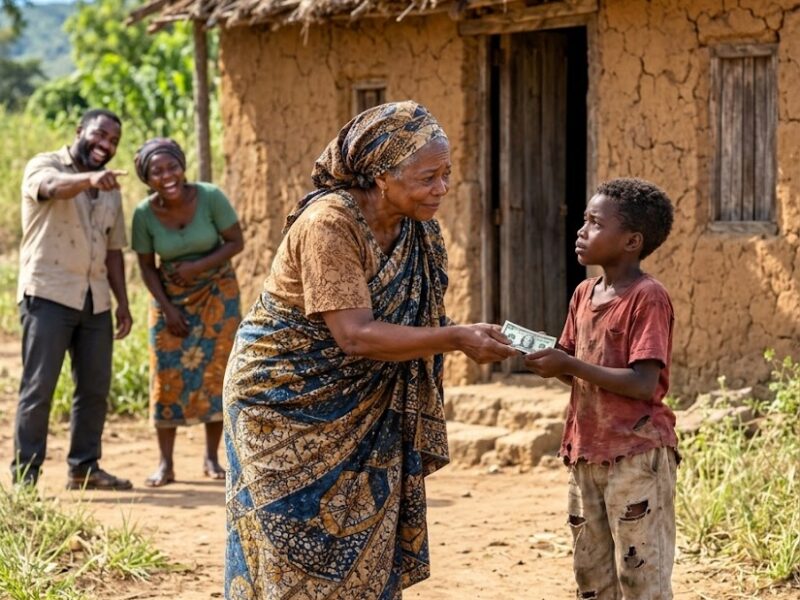
A Poor Widow Gave an Orphan Her Last $5—Twenty Years Later, a Black Limousine Stopped Outside Her Broken Home
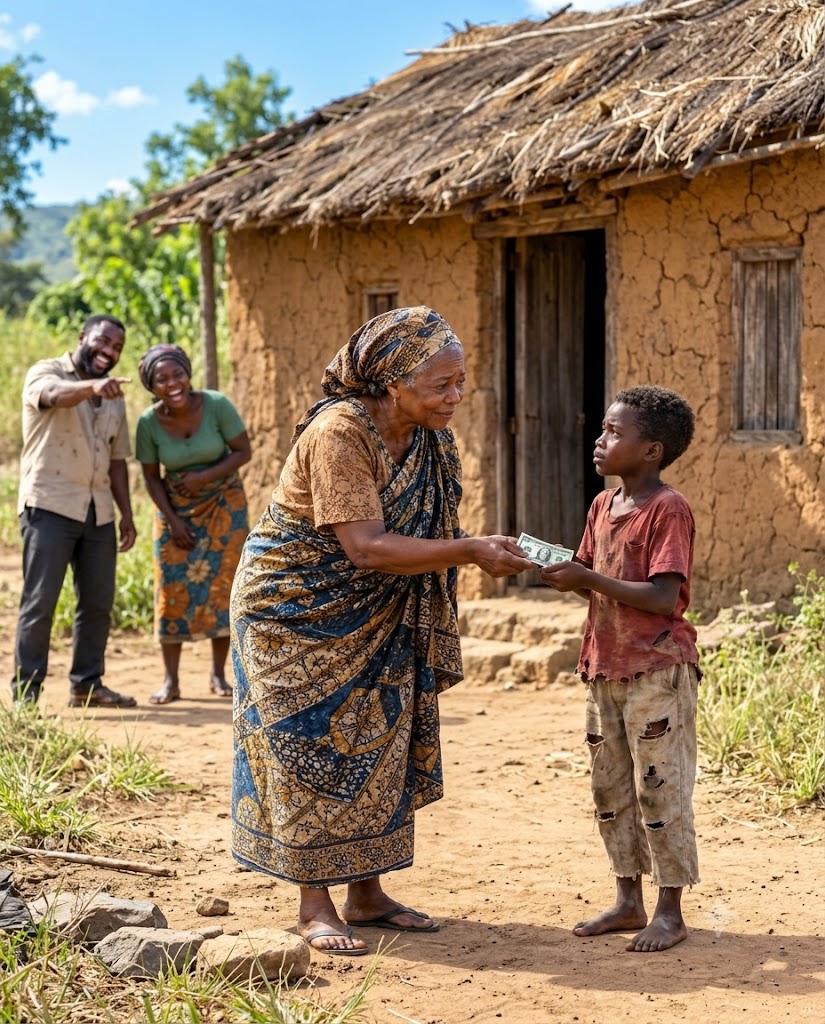
The wind came off the highway like it had somewhere better to be, rattling the tin sign above Naledi Moyo’s door until the whole street could hear it complaining.
She was seventy-eight years old, and she had been up since four, not because she couldn’t sleep but because sleep had become a place she visited only when it felt like having her.
Her hands moved over the small counter of the shop she had kept for forty-one years, the same counter her husband had built from a door he’d rescued off a demolished house, and she counted what was left in the tin.
Ninety pula for a full refill of her medicine, ninety, when yesterday her bones had felt cheaper than that, and today she had seventy.
Seventy was not nothing.
Seventy was bread and tea leaves and maybe a little sugar, if she walked past the shop that sold it cheaper.
Seventy was everything until Friday.
The bell over the door rang, and a girl came in with hunger sitting plain on her face, the way it does when nobody has taught you yet to hide it.
“Mma Lady, please tell me the price has not climbed again.”
Naledi looked at the girl, at the thin wrists, at the shoes held together with wire.
“I wish I could,” she said.
“The full refill is ninety pula now.”
“Ninety? Yesterday my bones were cheaper than that.”
The girl, whose name was Keti, stood very still, the way people do when they are doing arithmetic they already know the answer to.
“This is everything until Friday,” Keti said.
“Seventy won’t cover the full refill. Give me what seventy can buy.”
Naledi could split it, but then Keti would have nothing left for food.
“When did you last eat properly?” Naledi asked.
“Yesterday morning.”
“Then buy food first. Keep the medicine. I will return Friday.”
Keti’s mouth opened, then closed.
“Promise me you will eat today,” Naledi said.
“I promise to try.”
That was the first time Naledi Moyo gave away something she needed, and it would not be the last, because giving, for her, had become a habit the way breathing is a habit, the way grief is a habit, the way standing up again after the world knocks you down is a habit you either build or you die.
The shop was small, but it was hers, and it sat on a corner where a jacaranda tree dropped purple flowers every October like it was paying rent in beauty.
Her husband had planted that tree the year they married, and he had died under it fourteen years ago, sitting in his chair, a cup of tea still warm in his hand, and Naledi had found him there and had not screamed, because screaming would have frightened the neighbors.
She had simply sat down beside him and held his hand until the ambulance came.
The ambulance took forty minutes, because the road was bad, and the hospital was far, and nobody in that neighborhood expected anything to arrive on time.
That was the year the company first came.
They came with folders and smiles and talk of development, of shops and jobs and safer roads, and they said the neighborhood would be transformed.
They said everyone would benefit.
They said the offer was generous.
Naledi had listened, and then she had gone back inside and made tea, because she had learned long ago that when someone arrives with a folder and a smile, the folder is for you and the smile is for them.
The company was called Memoya Odirile Sebele Maseko Development, which was a mouthful, so people just called it Masego, after the man who ran it, a man nobody had ever seen in person but whose name appeared on every letter like a signature on a threat.
The letters came once a month at first, then once a week, then every few days, each one with a slightly higher number, each one with the same promise: a better life somewhere else.
Naledi kept every letter.
She kept them in a box under her bed, because bad news, she had learned, tends to return, and when it does, you had better have the receipts.
“You kept all of them?” asked Amara Nlovu, the young lawyer who had started coming around after the community meeting, the one who handled property law and who had eyes that missed nothing.
“Almost all,” Naledi said.
“Almost all? Was this reference number on every letter?”
“Until recently.”
Amara frowned.
“That is unusual. The meeting file used a different property reference.”
“A clerical error?”
“Maybe. We verify first.”
Naledi liked Amara, because Amara did not arrive with answers; she arrived with questions, and in Naledi’s experience, people with questions were safer than people with answers.
The community meeting had been held on a Friday, in the church hall, because it was the only building big enough to hold everyone who wanted to speak and everyone who wanted to listen.
The councilor had opened the meeting with the usual words, the ones that sound like promises but are actually just introductions.
“We are here to hear the redevelopment proposal and residents’ concerns.”
A man from the company stood up, a man with a tie that cost more than most people’s rent, and he spoke about jobs, safer streets, new business, opportunity.
“Opportunity,” Naledi said, from the back of the hall, loud enough for everyone to hear, “usually asks before entering your home.”
The room went quiet.
“Nobody is being erased, Memoria,” the man said.
“People are being offered opportunity.”
“Money improves an offer,” Naledi said.
“It does not improve every decision.”
The man smiled, the way people smile when they are used to winning.
“Every owner has received an improved offer.”
“Then perhaps you have been meeting the wrong people.”
Someone in the crowd laughed, and the laugh spread, and the man’s smile tightened like a fist.
After the meeting, a young man approached Naledi as she walked home.
He was maybe thirty, with careful eyes and a hand that kept guarding his pocket.
“May I walk you home?” he asked.
“Who sent you?”
“Nobody. I thought you deserved a fair hearing.”
“Then you arrived fourteen years late.”
He didn’t answer, and they walked in silence under the jacaranda, and when they reached her gate, he stopped.
“Green door,” he said.
“Jacaranda.”
Naledi turned.
“You say that as if you have been here before.”
The young man looked at her, and something in his face shifted, like a door opening in a house you thought was empty.
“Perhaps I owe you a memory,” he said.
“Come sit, then. Strange men become less mysterious when their feet stop moving.”
His name was Kabelo Dube, and he was not a stranger, though it would take Naledi a long time to understand why.
Fourteen years earlier, on a Tuesday that had started like any other Tuesday, Naledi had been standing at a bus stop with seventy pula in her pocket, money meant for medicine, money meant for survival.
A boy had been sitting on the bench, maybe twelve years old, with the kind of stillness that comes from having nowhere to go.
She had asked him where his family was.
“I do not have one anymore,” he had said.
She had asked his name.
“Kabelo Dube.”
She had asked when he last ate.
“Yesterday.”
“Morning or evening?”
“Morning.”
Naledi had looked at the bread in her bag, the bread she had bought for herself, the bread she had been saving.
She had given it to him.
“And yours?” he had asked.
“He found it first.”
She had given him the seventy pula, all of it, everything she had, and she had told him to pay his fare to Kanye Children’s Home, and to keep what remained for food.
“But what about you?” he had asked.
“Today, worry about reaching tomorrow.”
“Will I see you again?”
“Live long enough to make somebody else ask you that question.”
She had walked home that night with nothing, and she had eaten nothing, and she had told herself it was fine, because the boy would eat, and that was enough.
It had not been enough, not really, because the next morning she had collapsed in her shop, and the neighbors had called for help, and the clinic had said she was dehydrated and malnourished and lucky to be alive.
She had spent three days recovering, and when she returned to the shop, there was a letter waiting for her, the first letter from Masego, and the number on it had been so large she had laughed out loud.
Fourteen years later, Kabelo Dube sat in her kitchen and told her he had become a community development worker, that he had spent his life trying to understand how neighborhoods like hers got swallowed by companies like Masego, and that he had never forgotten the woman who had given him everything.
“I did not come here to buy your gratitude,” he said.
“Good. Mine is not for sale.”
But there was another reason he had come.
He had been at the meeting because he was investigating Masego, and what he had found was worse than anyone suspected.
The company had been targeting the neighborhood for years, buying up properties one by one, and the offers had been designed to look generous while actually being far below market value.
The residents who signed would get enough to leave but not enough to stay anywhere better.
The residents who refused would be pressured until they broke.
But there was something else, something buried in the records that Kabelo had only begun to uncover.
“The original occupancy register,” he said.
“I need to see it.”
Amara Nlovu found it three days later, in a county archive that smelled like dust and forgotten promises.
The register was decades old, handwritten, with entries that predated the current database by half a century.
And there, on a page that had been copied but not preserved, was an annotation next to several properties, including Naledi’s.
Community occupancy protection.
“What does that mean?” Kabelo asked.
Amara’s face was pale.
“It means these properties cannot be forcibly redeveloped under the current process. It requires additional review before residents can be displaced.”
“How many properties?”
“Several. Moyo is not alone.”
Naledi sat in the lawyer’s office and listened as Amara explained that the protection had been missing from the digitized records, that someone had removed it, or failed to transfer it, or simply let it disappear.
“This was never only her fight,” Kabelo said.
“No,” Amara said.
“It was never only her fight.”
The councilor was notified, and the councilor demanded copies, and the copies were certified, and the ledger stayed where it was, in the archive, where it had waited for decades to be found.
The company sent more letters, more offers, more urgency.
Naledi read each one and put it in the box under her bed.
The community trust was Amara’s idea, a way for residents to pool their resources and buy the land together, to decide their own future instead of having it decided for them.
It required signatures, meetings, patience, and money, and it required people to trust each other, which was the hardest part.
Naledi stood in the church hall and spoke to her neighbors.
“If you truly want to repay me,” she said, “help these people stop begging to stay home.”
Three residents signed the trust papers that day.
The next week, seven more.
The week after that, the company increased its offer again, and Naledi laughed and said her house had not grown overnight.
The man from the company came to her door one evening, and she met him on the porch, under the jacaranda, with the purple flowers falling around them like confetti at a funeral.
“Sign tonight,” he said, “and I will personally increase your compensation.”
“You mistake urgency for generosity.”
“One refusal can delay opportunities for hundreds.”
“Then perhaps your opportunity was built too close to somebody else’s door.”
He left, and she watched him go, and she thought about her husband, and about the boy she had fed fourteen years ago, and about all the people who had left the neighborhood with hope instead of defeat.
Kabelo came back the next day, and the day after that, and eventually he stopped being a visitor and started being family.
He helped her repair the roof, and she taught him how to make tea the way her husband had liked it, strong and sweet and impossible to rush.
“You still have not learned to keep anything for yourself,” he said one afternoon, watching her give the last of her bread to a child who had wandered in.
“I kept enough,” she said.
“Look around.”
And he did.
He saw the shop, small but standing.
He saw the jacaranda, still dropping flowers like rent.
He saw the neighbors who had signed the trust, who had decided to stay, who had chosen each other over the easy way out.
He saw Naledi Moyo, seventy-eight years old, poor in money but rich in something the company could never buy.
“Someone is standing where hunger hopes nobody notices,” she said, nodding toward the door.
A girl stood there, thin and tired, with shoes held together by wire.
Kabelo looked at Naledi.
“You have heard that complaint before.”
“I have heard it every day for fourteen years.”
He reached into his pocket and pulled out a folded piece of paper, worn soft at the edges, the note Naledi had wrapped around the seventy pula all those years ago.
“The poorest hand can still lift another person,” he read.
“My husband wrote that.”
“I know. You gave it to me.”
Naledi took the note and held it, and for a moment she was not seventy-eight, she was sixty-four, standing at a bus stop, giving away everything she had.
“I thought you paid for my dinner,” Kabelo said.
“You paid for the bus that took me to my second life.”
“I did not come here to buy your gratitude.”
“Good. Mine is not for sale.”
She looked at the girl in the doorway, and then at Kabelo, and then at the note in her hand.
“Then help me give it away.”
The trust grew, and the neighborhood changed, not because a company decided it should, but because the people who lived there decided it would.
The company eventually withdrew its offer, not out of kindness, but because the cost of fighting had become higher than the cost of leaving.
The jacaranda bloomed that October, as it always did.
Naledi sat under it, in her husband’s chair, with a cup of tea in her hand and Kabelo beside her.
“You came back,” she said.
“I kept enough.”
“Mena lady, save some for yourself.”
“I did. Look around.”
And she did.
She saw the shop, the tree, the neighbors, the trust, the boy who had become a man, the life she had built out of nothing and given away piece by piece.
She saw all of it, and she smiled, because she had finally understood something she had known all along.
Giving is not losing.
Giving is planting.
And sometimes, if you are very lucky, you live long enough to see the tree.









