A Poor Waitress Defended an Elderly Stranger—Then His Billionaire Son Walked Through the Door

The dinner rush at Meridian had turned the dining room into a battlefield of clinking silverware and half-shouted conversations.
Nina Okonkwo balanced three plates along her left forearm, her shoulder aching from a double shift she hadn’t planned on taking.
Table 12 sat in the corner, draped in linen the color of bone, reserved for a single guest who hadn’t arrived yet.
She noticed him the moment he walked through the glass doors.
An older man, maybe seventy, wearing a suit that had seen better decades and shoes that had been polished so many times the leather had gone soft and gray at the toes.
He carried himself with the quiet dignity of someone who had once been important and had learned to live without an audience.
The hostess, a young woman named Cassie who chewed gum like it owed her money, pointed him toward Table 12 without looking up from her phone.
He sat down slowly, arranging his napkin on his lap with the careful precision of a man who still believed in small ceremonies.
Nina watched him from across the room and felt something loosen in her chest.
He reminded her of her grandfather, a man who had died with exactly eleven dollars in his savings account and a Bible held together by rubber bands.
She was about to walk over and introduce herself when the front doors swung open again.
A woman entered like a weather event.
Her heels struck the marble floor with the authority of a judge’s gavel, and her perfume arrived three seconds before she did.
She was maybe forty-five, wrapped in a cream-colored pantsuit that probably cost more than Nina’s monthly rent, and she was already talking on her phone in a voice designed to be overheard.
“No, the table is reserved under Balogun,” she said, snapping her fingers at Cassie without making eye contact. “Table 12. I confirmed it twice.”
Cassie’s gum-chewing stopped. She glanced at her screen, then at the old man, then back at the woman.
“I’m sorry, ma’am, but there’s already a guest seated there.”
The woman finally looked up. Her eyes landed on the old man, traveled from his worn shoes to his frayed collar, and something behind her face did a slow, deliberate calculation.
“Excuse me,” she said, not to Cassie but to the room at large. “Who seated him there?”
The question landed like a slap.
Nina felt it from twenty feet away, a heat that climbed up her neck and settled behind her eyes.
The old man looked up from his napkin, confused but not yet wounded, the way people look when they haven’t realized they’re being insulted.
“I did,” Nina said.
She hadn’t planned to speak. The words just left her mouth, the way water leaves a cracked glass.
The woman turned toward her, and her smile was the kind that had been practiced in mirrors, sharpened on the bones of people who couldn’t fight back.
“I’m sorry?”
“I seated him there,” Nina repeated. “Table 12 was reserved for one guest, and he arrived first.”
The woman laughed, a short, bright sound that had no joy in it.
“Do you know who I am?”
“No,” Nina said. “But I know he’s a customer, and so are you.”
The woman’s companion, a man in a gray suit who had been standing silently behind her, cleared his throat.
“Renee, maybe we should just—”
“Don’t.” She held up one manicured hand without looking at him. “Table 12 was reserved for one guest. We’re discussing business. Move him somewhere else.”
Nina felt her hands curl into fists at her sides.
“I’m sorry, but he arrived before you requested additional space.”
The woman’s eyes narrowed, and Nina saw something flicker behind them, something that had nothing to do with tables or reservations.
“Do you know how much we’re spending here tonight?”
The old man stood up slowly, his knees cracking like old floorboards.
“Young lady, it’s all right. I can move.”
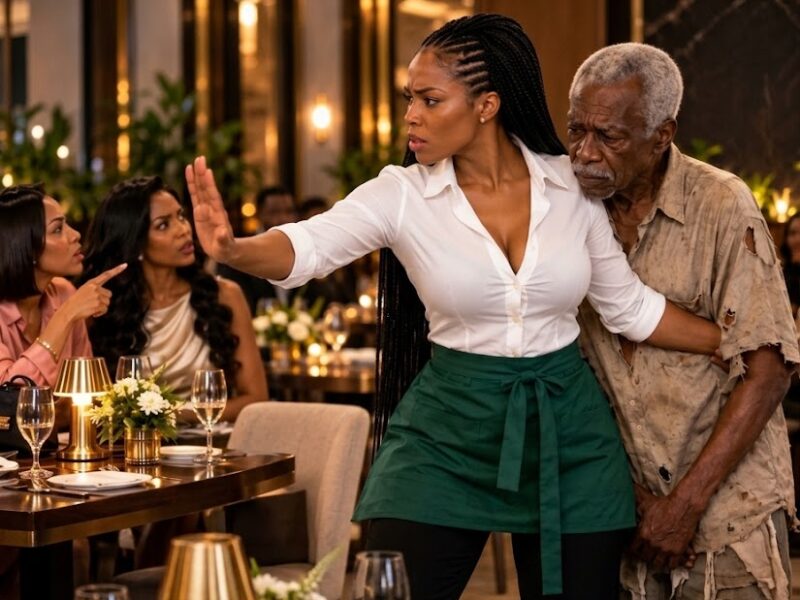
“No, sir.” Nina stepped forward, positioning herself between him and the woman. “You’ve ordered. You have every right to remain where you are.”
The room had gone quiet.
Nina could feel the other diners watching, their forks paused halfway to their mouths, their conversations dissolving into whispers.
The woman tilted her head, studying Nina the way a cat studies a bird with a broken wing.
“Interesting. So now waitresses give lectures on rights.”
“I’m not giving a lecture,” Nina said. “I’m doing my job.”
“Your job is to serve food, not to have opinions.”
“My job is to make sure every guest is treated with dignity.”
The woman laughed again, but this time there was an edge to it, a blade hidden in the sound.
“A word of advice, sweetheart. In this world, dignity is a currency. And you, clearly, are bankrupt.”
Nina felt the insult land, but she didn’t flinch.
She had been called worse by better people.
“And the gentleman is a customer,” she said. “He deserves the same respect as anyone else.”
The woman’s companion shifted his weight from one foot to the other, his face flushed with something that might have been embarrassment or might have been fear.
“Renee, maybe we should just find another table.”
“Her father sits on our parent company’s executive committee,” Renee said, ignoring him entirely. “Does that change the price of his pepper soup?”
The question was directed at Nina, but it landed in the room like a grenade.
Nina heard someone at a nearby table gasp.
She felt the old man’s hand on her elbow, gentle, warning.
“Miss, please. It’s not worth it.”
“Don’t be clever with me,” Renee said, stepping closer. “Honestly, places like this need standards. Everybody shouldn’t just walk in because they can afford one bowl of soup.”
The words hung in the air like smoke.
Nina thought about her mother, who had cleaned houses for thirty years and never once complained about the people who left their dirty dishes in the sink for her to wash.
She thought about her father, who had died of a heart attack at fifty-two because he couldn’t afford the medication that would have kept him alive.
She thought about every person who had ever been told they didn’t belong somewhere because of the size of their wallet.
“Ma,” she said, her voice steady, “I’ll have to ask that we don’t insult other guests.”
Renee’s eyebrows rose.
“You will ask me?”
“Leave it, my dear,” the old man said, his voice soft but firm. “I’ve dealt with people like this my whole life. It’s nothing new.”
But Nina couldn’t leave it.
Something inside her had cracked open, and everything she had swallowed for years—every rude customer, every withheld tip, every time she had smiled through an insult because she needed the job—came rushing to the surface.
“Sir, if I keep quiet because she’s rich, then I’m agreeing that money determines who deserves respect.”
The words fell into the silence like stones into still water.
Renee’s face went white, then red, then something uglier beneath the red.
“Excuse me?”
“You heard me.”
“You’re fired.”
The words came not from Renee but from a man in a dark suit who had appeared at the edge of the dining room, his face a mask of professional concern.
Nina recognized him. Mr. Adeyemi, the floor manager.
He had been standing there for the last thirty seconds, watching, saying nothing.
“Mr. Adeyemi—”
“Remove your apron,” he said. “You’re suspended. Effective immediately.”
Nina felt the floor tilt beneath her feet.
She had been working at Meridian for three years. She had never been late. She had never called in sick. She had covered shifts for coworkers who had emergencies, had stayed late to help clean up, had trained new hires without extra pay.
And now, in the space of five minutes, she had lost everything.
“For what?” she asked, her voice barely above a whisper.
“For insubordination.”
“I was defending a customer.”
“You were causing a scene.”
“I was—”
“Remove your apron, Miss Okonkwo. Or I will have security escort you out.”
Nina stood there, her hands trembling at her sides.
She thought about her rent, due in six days. She thought about her daughter, eight years old, who needed new shoes because her toes had started poking through the front of her old ones. She thought about her husband, who had been falsely accused of stealing from his company and had spent the last eight months unable to find work because of a scandal he didn’t cause.
She thought about all of it, and she felt something inside her break.
But she didn’t cry.
She had learned long ago that tears were a luxury she couldn’t afford.
She untied her apron slowly, folding it with the same careful precision the old man had used with his napkin.
Then she looked at Renee, who was smiling now, a small, satisfied smile that made Nina’s stomach turn.
“You can fire me,” Nina said. “But you can’t make me ashamed of what I did.”
She placed the apron on the nearest table and walked toward the employee exit.
The old man called after her, his voice cracked with something that might have been gratitude or grief.
“Young woman. What is your name?”
She turned, just for a moment.
“Nina. Nina Okonkwo.”
“I’m sorry this happened because of me.”
She shook her head.
“It didn’t happen because of you, sir. It happened because everybody else was afraid.”
And then she walked out, the door swinging shut behind her, and the sound of it echoed through the silent dining room like a period at the end of a sentence.
—
The parking lot was empty except for her car, a fifteen-year-old Honda that had once been blue and was now mostly rust.
Nina sat in the driver’s seat and stared at the steering wheel for a long time.
She didn’t cry.
She had learned that lesson too.
Instead, she pulled out her phone and called her husband.
He answered on the second ring, his voice tired but warm.
“Hey. You okay?”
“No,” she said. “I got fired.”
Silence.
Then: “What happened?”
She told him.
When she finished, he was quiet for so long she thought the call had dropped.
“Tobi?”
“I’m here.”
“I’m sorry.”
“Don’t apologize. You did the right thing.”
“I lost our income.”
“We’ll figure it out.”
“How?”
“I don’t know. But we will.”
She closed her eyes and let the tears come, just for a moment, just enough to remind herself that she was still human.
“Come home,” he said. “We’ll figure it out together.”
She nodded, even though he couldn’t see her.
“Okay.”
She started the car and drove home.
—
The video went viral before she even got there.
Someone in the restaurant had recorded the whole thing—the confrontation, the insults, the quiet dignity of the old man, the moment Nina had taken off her apron and walked out.
By the time she pulled into her driveway, the clip had been viewed four hundred thousand times.
By the time she walked through her front door, it had been shared by a dozen news outlets.
By the time she sat down on her couch and opened her phone, it had become a national conversation.
#MeridianRestaurant was trending.
#NinaOkonkwo was trending.
#WhoIsTheOldMan was trending.
Nina stared at the screen, her hands shaking.
“I don’t understand,” she whispered.
Tobi sat beside her, his arm around her shoulders.
“You stood up for someone. People noticed.”
“I just did what was right.”
“That’s exactly why they noticed.”
She scrolled through the comments, her eyes blurring with exhaustion and disbelief.
Some people called her a hero.
Some people called her a fool.
Some people said she had staged the whole thing for attention.
And then there were the people who asked the question she hadn’t thought to ask herself.
Who was the old man?
Why had he been sitting alone at Table 12?
Why had Renee Balogun been so determined to remove him?
Nina didn’t have answers.
But somewhere across the city, in an office that occupied the top floor of a building made of glass and steel, a man was watching the same video.
He watched it once.
Then twice.
Then a third time, his jaw tight, his hands folded on his desk.
When it ended, he reached for his phone and made a call.
“Find out everything about the waitress,” he said. “And bring me the manager who fired her.”
—
The next morning, Nina woke to a knock on her door.
She opened it to find a woman in a sharp gray suit, holding a manila envelope and wearing the kind of smile that meant business.
“Mrs. Okonkwo?”
“Yes?”
“My name is Sarah Chen. I work for Akinwale Group.”
Nina’s blood went cold.
Akinwale Group. The company that had accused her husband of fraud. The company that had destroyed his career. The company that had turned their lives into a living nightmare.
“I have nothing to say to you.”
“I understand. But I think you’ll want to hear what I have to say.”
“I doubt it.”
“The man you defended last night—the one at Table 12—was Mr. Akinwale’s father.”
Nina froze.
“His father?”
“Yes. And Mr. Akinwale would like to meet you.”
—
The office was on the top floor, and the view made Nina dizzy.
She had never been this high up before, had never seen the city spread out beneath her like a map of everything she couldn’t afford.
The man behind the desk was younger than she expected—maybe late thirties, with the kind of face that had been handsome once and had grown harder with time.
He didn’t smile when she walked in.
He didn’t offer her a seat.
He just looked at her, his eyes dark and unreadable, and said: “You defended my father.”
“Yes.”
“Why?”
“Because it was the right thing to do.”
“That’s it?”
“What else would there be?”
He leaned back in his chair, studying her the way his father had studied the napkin—carefully, deliberately, as if trying to understand something that didn’t quite make sense.
“Most people would have looked away.”
“I’m not most people.”
“No,” he said. “You’re not.”
He was quiet for a moment, and then he did something that surprised her.
He stood up and walked around his desk, extending his hand.
“My name is Kunle Akinwale. And I owe you an apology.”
—
PART 2
—
Nina didn’t take his hand.
She stood there, her arms crossed, her heart pounding, and said nothing.
Kunle let his hand drop. He didn’t seem offended. If anything, he looked like he understood.
“You don’t trust me.”
“Should I?”
“No. Probably not.”
He walked back to his desk and sat down, gesturing toward the chair across from him.
“Please. Sit.”
“I’d rather stand.”
“Suit yourself.”
He opened a drawer and pulled out a tablet, tapping the screen a few times before turning it toward her.
“This is the video that was taken last night. I’ve watched it seventeen times.”
“Congratulations.”
“I’m not trying to impress you. I’m trying to understand you.”
“There’s nothing to understand.”
“There’s everything to understand.” He tapped the screen again. “You defended my father against a woman who could have destroyed your career. You knew she had connections. You knew she could hurt you. And you did it anyway.”
“I didn’t know who she was.”
“You knew she was powerful. You knew she was rich. You knew she could make your life difficult.”
“Yes.”
“And you did it anyway.”
“Yes.”
“Why?”
Nina took a breath.
She thought about her daughter, about the shoes she needed, about the rent that was due.
She thought about her husband, about the eight months he had spent searching for work, about the way he had started to shrink into himself, to become smaller and quieter, as if he was trying to take up less space in a world that had already decided he didn’t belong.
She thought about the old man at Table 12, about the way he had folded his napkin, about the quiet dignity that had radiated from him even as he was being humiliated.
“Because somebody had to,” she said.
Kunle nodded slowly.
“That’s what my father said.”
“He was there. He heard me.”
“He called me this morning. He told me I should find you. He said—” Kunle paused, and something flickered across his face, something that might have been pain or might have been guilt. “He said you reminded him of my mother.”
Nina didn’t know what to say to that.
“She died three years ago,” Kunle continued. “My father has been alone since then. He doesn’t like to go out. He doesn’t like to be around people. But last night, he wanted to have dinner at Meridian. He wanted to feel normal for an hour.”
“And Renee Balogun ruined that.”
“Yes.”
“Why?”
Kunle’s jaw tightened.
“Because she’s afraid.”
“Afraid of what?”
“Of what my father knows.”
Nina felt a chill run down her spine.
“What does he know?”
“That’s not something I can discuss with you right now.”
“Then why did you call me here?”
Kunle leaned forward, his elbows on his desk, his eyes fixed on hers.
“Because you were fired for doing the right thing. And I want to make it right.”
“How?”
“I’m reinstating you. With back pay. And a promotion.”
Nina blinked.
“I don’t understand.”
“You will.” He slid a piece of paper across the desk. “This is a preliminary offer. If you accept it, you’ll be transferred to our corporate office. You’ll work directly with our guest experience team. You’ll report to me.”
“I don’t have experience—”
“You have judgment. That’s more valuable than experience.”
She stared at the paper, her vision blurring.
“I don’t want your charity.”
“This isn’t charity. This is an investment.”
“In what?”
“In you.”
She looked up at him, searching his face for the lie, the catch, the hidden blade.
She didn’t find one.
“Why?” she asked again.
Kunle was quiet for a moment. Then he said: “Because my company has been protecting the wrong people for too long. And I think you’re exactly the kind of person who can help me fix that.”
—
Nina took the offer home and read it three times.
Then she read it a fourth time, just to make sure she hadn’t imagined the salary.
It was more than double what she had been making at Meridian.
More than enough to pay the rent.
More than enough to buy her daughter new shoes.
More than enough to start digging their way out of the hole they had been living in for the past eight months.
Tobi was sitting at the kitchen table when she walked in.
He had been applying for jobs all day, sending out resumes into the void, getting nothing back but automated rejections.
He looked up when she entered, and she saw the exhaustion in his eyes, the defeat, the slow erosion of hope.
“I got a job offer,” she said.
He blinked.
“What?”
She told him.
When she finished, he was silent for a long moment.
Then he said: “Akinwale Group. The company that ruined me.”
“Yes.”
“And you want to work for them.”
“I don’t know.”
“You don’t know?”
“I need to think about it.”
“Nina—” He stopped, his hands gripping the edge of the table. “They accused me of stealing. They destroyed my career. They made me a pariah. And now they want to give you a job?”
“I know how it sounds.”
“How does it sound to you?”
She sat down across from him, her hands folded on the table.
“It sounds like a trap. Or a test. Or something I don’t understand yet. But it also sounds like a chance. For us. For our family.”
“You think they’re doing this out of guilt?”
“I don’t know what they’re doing. But I know we can’t keep living like this.”
He looked away, his jaw tight.
“I don’t want you to work for them.”
“I know.”
“And I don’t want to be the reason you don’t.”
She reached across the table and took his hand.
“You’re not the reason. You’ve never been the reason. The people who framed you are the reason. And maybe—maybe this is a way to find out the truth.”
“What if it’s not?”
“Then at least we’ll know.”
He was quiet for a long time.
Then he said: “I love you.”
“I love you too.”
“Okay.”
“Okay?”
“Okay. Take the job.”
She squeezed his hand.
“Thank you.”
“Don’t thank me yet. If they hurt you, I’ll—”
“I know.”
She leaned across the table and kissed him.
And for the first time in eight months, she felt something that might have been hope.
—
The corporate office was on the forty-second floor, and the elevator ride made Nina’s ears pop.
She stepped out into a lobby that was all white marble and glass, and a receptionist with a perfect smile directed her to a conference room down the hall.
The room was empty when she arrived.
She sat down and waited.
And waited.
And then the door opened, and Renee Balogun walked in.
Nina’s heart stopped.
Renee was dressed in a different outfit—navy blue this time, with pearls—but her smile was the same.
Sharp.
Predatory.
“Well,” Renee said, settling into the chair across from Nina. “This is awkward.”
“What are you doing here?”
“I work here. Or rather, my father does. And I have certain… interests in the company.”
“You’re the one who got me fired.”
“I’m the one who pointed out that you were being insubordinate. There’s a difference.”
“There isn’t.”
Renee shrugged, a small, elegant movement of her shoulders.
“Semantics.”
“Why are you here?”
“To make you an offer.”
“I already have an offer.”
“I know. But mine is better.”
She slid a folder across the table.
Nina didn’t open it.
“What is it?”
“A settlement. You drop your claim against Meridian. You sign a non-disclosure agreement. You never talk about what happened that night. And in exchange, you receive a payment.”
“How much?”
“Enough.”
Nina pushed the folder back.
“I’m not interested.”
“Don’t be naive. Everybody’s interested in money.”
“Not everybody.”
Renee’s smile faltered, just for a moment.
“You think you’re different from me? You think you’re better?”
“I think I’m honest.”
“Honesty is a luxury. People like us can’t afford it.”
“I’m not like you.”
“You’re exactly like me. You’re just poorer.”
Nina stood up.
“I’m not going to sign anything.”
“You’ll regret this.”
“I doubt it.”
She walked toward the door, her heart pounding, her hands shaking.
Renee’s voice stopped her before she reached it.
“You know what your husband did, don’t you?”
Nina turned.
“What?”
“Your husband. Tobi. You know he was accused of stealing from us?”
“He was framed.”
“Was he?”
“He told me the truth.”
“Did he? Or did he tell you what you wanted to hear?”
Nina felt her blood run cold.
“What are you saying?”
“I’m saying that your husband signed off on a payment that didn’t exist. I’m saying that he authorized a transaction that cost us forty-two million naira. I’m saying—”
“Four million.”
Renee blinked.
“What?”
“Forty-two million naira is roughly a hundred thousand dollars. The amount Tobi authorized was four point two million naira. Roughly ten thousand dollars. The numbers were changed.”
Renee’s face went very still.
“How do you know that?”
“Because I read the file. Because I did my research. Because I’m not as stupid as you think I am.”
Renee’s eyes narrowed.
“You’ve been talking to someone.”
“I’ve been talking to my husband.”
“Your husband is a liar.”
“My husband is a victim. And I’m going to prove it.”
She turned and walked out, leaving Renee sitting alone in the conference room, the folder untouched on the table.
—
The truth came out slowly, like a wound being drained.
Kunle had been investigating the payment for months, ever since his father had told him something was wrong.
The audit trail was messy. The signatures didn’t match. The vendors were shell companies, registered in the Bahamas, with no physical address and no employees.
The money had been laundered through a series of accounts, ending up in an investment vehicle that was tied to—of all people—Renee Balogun.
She had been stealing from the company for years.
And when Tobi had been asked to sign off on a payment, she had seen an opportunity.
She had altered the amount, changing four point two million to forty-two million.
And when the theft was discovered, she had let Tobi take the fall.
Nina brought the evidence to Kunle.
He listened without interrupting, his face unreadable.
When she finished, he was silent for a long time.
Then he said: “I believe you.”
“Will you help me prove it?”
“I already have.”
He opened a drawer and pulled out a file.
“This is the original payment authorization. My father found it in his safe last week. It was never submitted to the bank. The transaction that cleared was a forgery.”
“Who forged it?”
“Renee. Or someone working for her.”
“Can you prove it?”
“We’re working on it. But in the meantime—” He slid the file across the desk. “—I think it’s time your husband’s name was cleared.”
—
The announcement came three weeks later.
Tobi was formally cleared of all charges.
The fraud investigation was reopened, focusing on Renee Balogun and her associates.
The company issued a public statement, acknowledging the error and apologizing for the damage done to Tobi’s reputation.
Nina was promoted to a position in corporate affairs, overseeing ethics and compliance.
And Renee Balogun was arrested on charges of embezzlement and fraud.
The night the news broke, Nina and Tobi sat on their porch and watched the sun go down.
“I can’t believe it’s over,” Tobi said.
“It’s not over. It’s just beginning.”
“What do you mean?”
She turned to look at him.
“I mean we still have work to do. We still have to rebuild. We still have to figure out who we are after all of this.”
“Together?”
She smiled and took his hand.
“Together.”
—
But the story wasn’t over.
Because the old man at Table 12 had a secret of his own.
And it was a secret that would change everything.
—
PART 3
—
The call came at midnight.
Nina was asleep when her phone buzzed on the nightstand, the screen lighting up with an unknown number.
She almost ignored it.
But something made her answer.
“Hello?”
“Nina Okonkwo?”
The voice was old, frail, familiar.
“Yes. Who is this?”
“This is Mr. Akinwale. We met at the restaurant.”
She sat up, her heart suddenly racing.
“Sir. Are you all right?”
“I need to see you. It’s urgent.”
“What’s wrong?”
“I can’t explain over the phone. Please. Come to my house.”
He gave her an address in the hills, an exclusive neighborhood she had only ever seen from the outside.
She wrote it down and hung up, her hands trembling.
Tobi stirred beside her.
“What is it?”
“The old man. Mr. Akinwale’s father. He wants to see me.”
“Now?”
“He said it’s urgent.”
Tobi sat up, rubbing his eyes.
“I’ll come with you.”
“No. Stay with our daughter. I’ll be fine.”
“Are you sure?”
“I’ll call you when I get there.”
She dressed quickly and grabbed her keys.
The drive took forty minutes.
The house was a mansion, all stone and glass, set back from the road behind a gate that opened automatically when she pressed the buzzer.
A servant met her at the door and led her to a library on the second floor.
Mr. Akinwale was sitting by the fireplace, wrapped in a blanket, his face pale and drawn.
He looked older than he had at the restaurant.
Sicker.
“Thank you for coming,” he said.
“Of course. What’s wrong?”
He gestured toward a chair.
“Sit. Please.”
She sat.
He was silent for a long moment, staring into the fire.
Then he said: “I’m dying.”
Nina felt her breath catch.
“I’m sorry.”
“Don’t be. I’ve had a long life. A good life. But there’s something I need to do before I go.”
“What?”
He turned to look at her, and his eyes were bright with tears.
“I need to tell the truth.”
“About what?”
“About what happened. About the payment. About your husband.”
Nina’s heart stopped.
“What are you saying?”
“I knew.”
“Knew what?”
He took a shaking breath.
“I knew the payment was altered. I knew your husband was innocent. And I did nothing.”
Nina stared at him.
“You knew?”
“Yes.”
“For how long?”
“From the beginning.”
She felt the world tilt beneath her feet.
“Why? Why would you let them do that to him?”
He closed his eyes.
“Because Renee’s father is my oldest friend. Because I was afraid of the scandal. Because I thought I could fix it quietly, without anyone getting hurt.”
“But someone did get hurt. My husband got hurt. Our family got hurt.”
“I know.”
“You destroyed our lives.”
“I know.”
She stood up, her hands shaking.
“Why are you telling me this now?”
“Because I’m dying. And because I can’t take it with me.”
“You want forgiveness.”
“No. I want justice.”
“You had eight months to give us justice.”
“I know. And I’m sorry. But I can still make it right.”
“How?”
He reached into the blanket and pulled out an envelope.
“This is a written statement. Signed and notarized. It details everything—my knowledge of the fraud, my failure to act, my role in the cover-up.”
He held it out to her.
“Take it. Use it. Make sure everyone knows the truth.”
She took the envelope, her fingers trembling.
“Why didn’t you give this to me sooner?”
“Because I was a coward. Because I was afraid. Because—” He paused, his voice breaking. “Because I didn’t want to lose my son.”
“Your son?”
“Kunle. He doesn’t know about any of this. He doesn’t know I was involved. If you release this statement, it will destroy him.”
Nina looked at the envelope in her hands.
She thought about Tobi, about the eight months of hell he had endured.
She thought about Kunle, about the way he had tried to make things right.
She thought about the old man, dying, desperate, trying to buy back his conscience with a piece of paper.
“I don’t know what to do,” she said.
“Neither do I. But I know I can’t keep lying.”
She sat back down, the envelope heavy in her hands.
“Tell me everything,” she said. “From the beginning.”
And he did.
—
The story was worse than she imagined.
Renee had been stealing from the company for years. Her father, a board member, had covered for her. When the auditors got close, Renee had needed a scapegoat.
Tobi was perfect.
He was new, he was vulnerable, and he had signed off on a payment without following procedure.
She had altered the amount, knowing that the discrepancy would point to him.
And Mr. Akinwale had known.
He had been told by Renee’s father, who had begged him to stay silent.
He had agreed.
And Tobi had paid the price.
“Why did you finally decide to tell the truth?” Nina asked.
“Because of you.”
“Me?”
“The way you stood up to Renee. The way you defended me. I realized that I had been silent for too long. That I had let fear control me. And I didn’t want to die a coward.”
Nina looked at the envelope.
“What will happen to Kunle if I release this?”
“He’ll be devastated. He’ll feel betrayed. He may never forgive me.”
“And you’re okay with that?”
“No. But I’m not doing this for him. I’m doing it for you. For your husband. For everyone who was hurt by my silence.”
She was quiet for a long time.
Then she said: “I’ll take it. But I won’t release it. Not yet.”
“What will you do?”
“I’ll talk to Kunle. I’ll tell him the truth. And I’ll let him decide.”
“He won’t decide the way you want him to.”
“I know. But he deserves to know.”
—
The next morning, Nina called Kunle.
She told him she needed to see him.
She didn’t tell him why.
They met at a coffee shop near his office, a quiet place with exposed brick and soft lighting.
She ordered a latte. He ordered black coffee.
“What’s this about?” he asked.
She pulled out the envelope and placed it on the table between them.
“Your father gave me this last night.”
Kunle’s face went very still.
“What is it?”
“A written statement. About the fraud. About your sister. About your father’s role in covering it up.”
Kunle didn’t move.
He didn’t speak.
He just stared at the envelope like it might bite him.
“He was involved?” he finally said.
“Yes.”
“How involved?”
“He knew. From the beginning. He knew your sister altered the payment. He knew Tobi was innocent. And he let it happen.”
Kunle closed his eyes.
“For how long?”
“Eight months.”
“Why?”
“Because he was afraid. Because Renee’s father is his oldest friend. Because he thought he could fix it quietly.”
Kunle opened his eyes, and they were wet.
“He let your husband suffer. He let you suffer. And he said nothing.”
“Yes.”
“And now he’s dying, so he wants to come clean.”
“Yes.”
Kunle picked up the envelope and turned it over in his hands.
“What do you want me to do?”
“I want you to read it. And then I want you to decide.”
“Decide what?”
“Whether to release it. To the press. To the board. To everyone.”
“If I release it, my father’s reputation will be destroyed. My family’s name will be ruined.”
“I know.”
“And if I don’t release it, your husband doesn’t get justice.”
“You get to decide what justice looks like.”
He looked at her, his eyes searching her face.
“You could have released this without telling me.”
“I know.”
“Why didn’t you?”
“Because you tried to help me. Because you cleared my husband’s name. Because you’re not your father.”
He sat there for a long moment, the envelope in his hands.
Then he said: “I need to think.”
“Take your time.”
He nodded and stood up.
“Nina.”
“Yes?”
“Thank you.”
“For what?”
“For giving me a choice.”
She smiled, just a little.
“Everybody deserves a choice.”
—
PART 4
—
Kunle read the statement in his car, parked in the garage of his office building.
It took him twenty minutes.
When he finished, he sat there, staring at the windshield, his hands gripping the steering wheel so hard his knuckles were white.
His father had lied.
His father had let an innocent man be destroyed.
His father had protected a thief.
And now his father was dying, and he wanted forgiveness.
Kunle didn’t know if he could give it.
He didn’t know if he wanted to.
He thought about Nina, about the way she had stood up for his father in that restaurant, not knowing who he was, not knowing what he had done.
She had done it because it was right.
She had done it because she believed in something.
And his father had repaid her by letting her husband be ruined.
Kunle opened his phone and called his sister.
Tami answered on the second ring.
“Kunle. What’s wrong?”
“Everything.”
“What happened?”
He told her.
When he finished, she was silent for a long time.
Then she said: “I can’t believe it.”
“Neither can I.”
“He knew? He knew Tobi was innocent and he said nothing?”
“Yes.”
“Why?”
“Because he was afraid. Because he didn’t want to lose his friendship with Renee’s father. Because he thought he could fix it.”
“That’s not an excuse.”
“I know.”
“What are you going to do?”
“I don’t know.”
“Kunle—” She paused, her voice breaking. “If you release this, it will destroy him.”
“He’s already dying.”
“But his reputation—”
“His reputation is already a lie. The only question is whether we keep lying.”
She was quiet for a long moment.
“Do what you think is right,” she said. “I’ll stand by you.”
“Thank you.”
“I love you.”
“I love you too.”
He hung up and sat there for a while longer.
Then he made a decision.
—
The board meeting was scheduled for the following morning.
Kunle arrived early, the envelope in his briefcase.
He sat at the head of the table and waited for the directors to arrive.
One by one, they filed in, taking their seats, exchanging pleasantries.
When everyone was present, Kunle stood up.
“I have an announcement,” he said.
The room went quiet.
“Some of you may know that my father has been ill. He’s been struggling with his health for some time. But that’s not why I called this meeting.”
He opened the envelope and pulled out the statement.
“This is a document my father wrote. It details his knowledge of a fraud that took place within our company. A fraud that resulted in the wrongful termination of an employee named Tobi Okonkwo.”
The directors exchanged glances.
Kunle continued.
“My father knew about this fraud. He knew Tobi was innocent. And he did nothing.”
A murmur rippled through the room.
“Why are you telling us this?” one of the directors asked.
“Because I believe in transparency. Because I believe in justice. Because I believe that a company that covers up its mistakes is a company that will eventually destroy itself.”
He placed the statement on the table.
“I’m going to make copies. I’m going to share them with everyone here. And then I’m going to call a press conference.”
“You can’t be serious.”
“I’m completely serious.”
“This will destroy your family’s reputation.”
“Maybe. But at least it will be an honest reputation.”
The room erupted into arguments.
Some of the directors wanted to bury the statement.
Others wanted to negotiate a settlement.
Kunle listened to all of them, and then he said: “This isn’t up for debate. I’m releasing the statement. If any of you have a problem with that, you’re welcome to resign.”
No one resigned.
—
The press conference was held that afternoon.
Kunle stood at a podium in front of a dozen cameras, the statement in his hand.
“My father was involved in a cover-up,” he said. “He knew that Tobi Okonkwo was innocent, and he did nothing. That was wrong. And I’m here to say that we are going to make it right.”
He outlined the steps the company would take.
Full exoneration for Tobi Okonkwo.
Compensation for the eight months he had been unable to work.
A full investigation into the fraud and everyone involved.
And a public apology.
When he finished, the room erupted into questions.
Kunle answered them one by one, his voice steady, his face calm.
He didn’t defend his father.
He didn’t make excuses.
He just told the truth.
And when it was over, he walked out of the room and called Nina.
“It’s done,” he said.
“How did it go?”
“It went. I don’t know if it was the right thing. But it was the honest thing.”
“That’s all you can do.”
“Nina?”
“Yes?”
“Thank you. For giving me the chance to do the right thing.”
“You did that yourself.”
“No. You showed me how.”
She was quiet for a moment.
“Your father—is he okay?”
“He’s dying. But I think he’s at peace. Or at least, he will be.”
“I’m sorry.”
“Don’t be. He made his choices.”
“And you made yours.”
“Yes.”
“Kunle?”
“Yes?”
“I think you’re a good man.”
He smiled, just a little.
“I’m trying to be.”
—
PART 5
—
The aftermath was messy.
The media covered the story for weeks, dissecting every detail, every betrayal, every lie.
Renee Balogun was arrested and charged with fraud, embezzlement, and conspiracy.
Her father resigned from the board and disappeared from public life.
Mr. Akinwale died a month later, surrounded by his family.
Kunle was at his bedside when he passed.
He held his father’s hand and told him he loved him.
And he meant it.
—
Nina and Tobi moved into a new apartment, paid for by the settlement they had received.
It was smaller than their old place, but it was theirs.
They decorated it together, slowly, piece by piece.
They hung pictures of their daughter, of their wedding, of the life they had built.
And they started to heal.
One night, Nina found Tobi sitting on the balcony, staring at the stars.
“Can’t sleep?” she asked.
“Just thinking.”
“About what?”
“About everything. About how close we came to losing it all.”
“But we didn’t.”
“No. We didn’t.”
She sat down beside him and took his hand.
“What are you thinking about now?”
“I’m thinking about that night. At the restaurant. When you stood up for that old man.”
“What about it?”
“You didn’t know who he was. You didn’t know what he had done. You just knew it was wrong to treat him that way.”
“Yes.”
“And you defended him. Even though it cost you your job. Even though it almost cost us everything.”
“Yes.”
“Why?”
She thought about it for a moment.
“Because somebody had to.”
“That’s what you said before.”
“It’s still true.”
He looked at her, his eyes full of something she couldn’t name.
“I love you.”
“I love you too.”
“You’re the bravest person I know.”
“I’m not brave. I’m just stubborn.”
“Same thing.”
She laughed and leaned her head on his shoulder.
They sat there for a long time, watching the stars, saying nothing.
And for the first time in a long time, Nina felt like everything was going to be okay.
—
EPILOGUE
—
Six months later, Nina was walking through the lobby of Akinwale Group when she saw a familiar face.
An old man, sitting on a bench near the entrance, reading a newspaper.
He looked up when she approached, and his face broke into a smile.
“Mrs. Okonkwo.”
“Sir. I didn’t expect to see you here.”
“I come here sometimes. To remember.”
“Remember what?”
“That night. The night you defended me.”
She sat down beside him.
“You know, I never thanked you properly.”
“You don’t have to thank me.”
“I do. You reminded me of something I had forgotten.”
“What?”
“That dignity isn’t something you earn. It’s something you have. And no one can take it away from you.”
She looked at him, this old man who had been through so much, who had lost so much, who had made mistakes and tried to make them right.
“I think you’re right,” she said.
“I know I’m right.” He smiled. “I’ve had a lot of time to think about it.”
They sat there for a while, watching the people come and go.
Then he said: “Your husband. He’s doing well?”
“Yes. He’s working again. He’s happy.”
“Good. I’m glad.”
“And your son?”
“Kunle is… Kunle. He’s trying to be a better man than his father.”
“That’s all any of us can do.”
“Yes.” He nodded slowly. “That’s all any of us can do.”
He stood up, leaning on his cane.
“I should go. My driver is waiting.”
“It was good to see you, sir.”
“It was good to see you too, Mrs. Okonkwo.”
He started to walk away, then stopped and turned back.
“One more thing.”
“Yes?”
“That night. When you stood up for me. You said it happened because everybody else was afraid.”
“I remember.”
“You were right. But you were also wrong.”
“How?”
“It didn’t happen because everybody else was afraid. It happened because you weren’t.”
She smiled.
“Maybe.”
“No. Not maybe. Definitely.”
He tipped his hat and walked out the door.
And Nina sat there, watching him go, feeling something warm spread through her chest.
She thought about that night.
She thought about the insults, the humiliation, the moment she had taken off her apron and walked out.
She thought about everything that had come after.
And she realized that he was right.
She hadn’t been afraid.
And that had made all the difference.
—
THE END
—









