A Poor Waitress Defended an Elderly Man as Wealthy Customers Mocked Him—Unaware His Son Owned the Restaurant and Had Been Watching Everything
**Part 1**
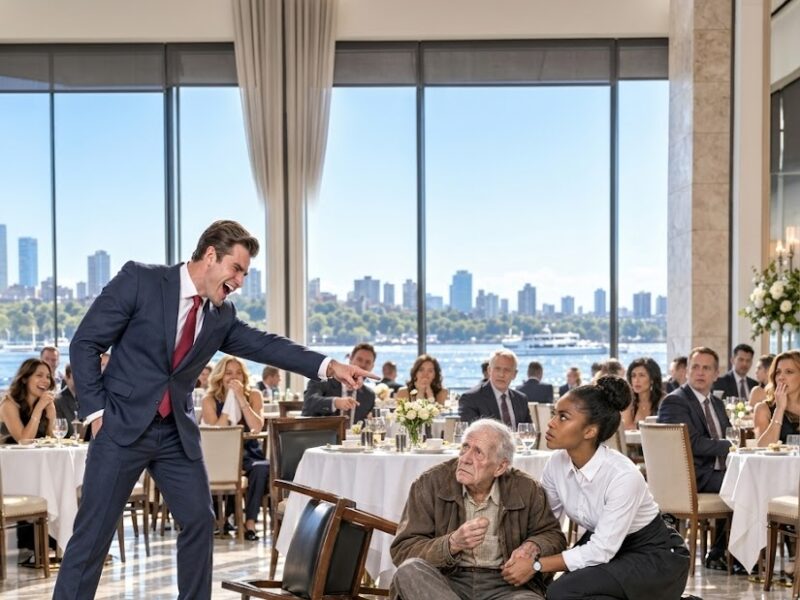
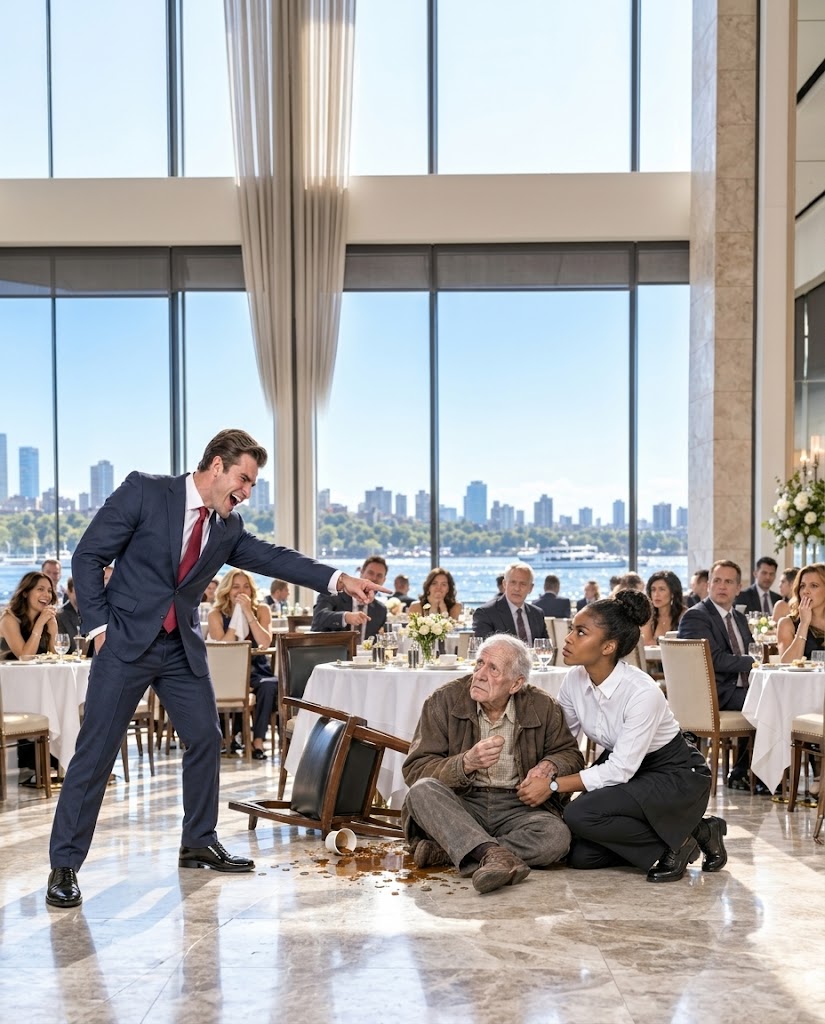
Melody Westbrook froze as a customer ripped the chair out from under a 79-year-old man.
The old man slammed onto the tile. Scalding coffee splashed across his shaking hand. His wedding ring spun away under the table. A polished shoe crushed his hearing aid.
The dining room exploded in laughter. He never cried out. Frail and gray in a faded jacket, he crawled on his knees, groping blindly for that ring. He had not eaten since last night. He heard none of it.
Melody’s heart hammered. Two more days to a permanent job. Her rent was late.
“Walk away, Melody. Last warning.”
Her fingers strangled the tray. She set it down anyway.
“I’ve got you, sir.”
She crouched beside him, found the ring, and pressed it into his trembling palm. Nobody in that room knew who he was. In six days, every one of them would.
Have you ever wondered if one quiet act of kindness matters when a whole room is laughing? Because you’re about to find out. So, leave a like. Tell us below if someone once stood up for you. And let’s go back to where it started.
At 6 that Tuesday morning, Melody Westbrook woke to the rattle of a dryer beneath her bed. Her room sat above a coin laundry on Cable Street, three blocks from the river. It held a narrow mattress, a hot plate, and a desk made from two milk crates and a door.
This morning, the machines below rumbled like distant rain. She was 19. She had lived alone since the spring her mother moved south for work and never sent for her. Taped to the inside of her door was a yellow note from the landlord. Rent was nine days late. The last line was underlined twice.
Friday or the lock changes.
Melody read it every morning. She never took it down. She washed her face in the tiny sink and pinned her hair into a tight, neat bun. She pulled on a white shirt ironed on a towel the night before. Then she clipped on the plastic badge that read Heartwell with a small paper sticker underneath.
The sticker said trainee. Day 88. Two more days. At 90 days, the sticker came off. At 90 days, she became full-time staff with health insurance and a steady schedule. She slid a nursing textbook into her bag. Anatomy and physiology, used, with someone else’s name crossed out on the cover.
Three nights a week, she took classes at the community college across the river. The next semester’s payment was due in five weeks. She had saved barely a third of it. Her prepaid phone showed eleven minutes left on the plan. She turned it off to save the battery and put it in her apron pocket.
Breakfast was a slice of toast folded around a spoon of peanut butter. She ate it walking. The morning was already warm. Sunlight bounced off the river and long white sheets. A brick walkway with iron benches ran along the water. At the far end of the walkway stood the Heartwell.
It was a single low building of pale stone and glass sitting alone on the riverbank. The whole front wall was one wide window facing the water. Inside the lights were bright and white, and the tablecloths were whiter still. Two months earlier, the old owners had sold it. Nobody on staff knew who had bought it.
A crew had hung a blue tarp over the sign above the door, and it had stayed there ever since. The reopening was set for next Monday. The new name would go up that morning. Until then, the staff called the owner by one word. They.
Melody came in through the kitchen door at 6. Kiara Gaither was folding napkins at the counter. She was 26, quick-handed with gold hoops and a laugh that carried across the whole room.
“Morning, baby girl,” Kiara said. “Day 88.”
“Day 88,” Melody said. “Two more and I’m buying you a cupcake. One of the good ones.”
Melody smiled. Then she saw Trey Lockheart come out of the office. And the smile went away. Trey was 31, the shift manager, neat and tired and always holding a tablet. He never raised his voice. He double-checked every table himself.
He followed every rule on the laminated sheet taped beside the time clock. And he expected everyone else to do the same.
“Melody, a minute.”
She followed him to the end of the counter.
“Yesterday, table 6 complained,” Trey said quietly. “The man said you argued with him.”
“He was charged twice for the same wine, sir. I showed him the receipt politely.”
“Yes, sir. It doesn’t matter, he complained.” Trey tapped the tablet. “Rule four, the guest is never argued with. You’re on probation, so this goes in your file. One more complaint before Thursday, and I can’t sign your 90 days. You understand?”
Melody’s throat tightened. “Yes, sir.”
“I’m not trying to be hard on you. The new owners are watching everything right now.” He glanced at the blue tarp through the front glass. “Nobody wants to be the one they fire first.”
He walked back to the office. Kiara slid a folded napkin across the counter to her.
“Breathe,” she whispered.
“Two days. Keep your head down. Smile at everybody, even the jerks. Especially the jerks,” Melody said.
“Now you’re learning.”
By 11:00, the lunch setup was done. Every glass sparkled, every fork lay straight. The sun filled the dining room until the white cloths almost glowed. At the center of the front window stood one round table bigger than the others. It had the best view of the river and the best light in the room.
A small brass card sat on it, polished like a mirror. Reserved. 12:15. Dunlevy. Mr. Dunlevy.
“Every Tuesday brings his clients, orders the most expensive thing on the menu, and tips like it hurts him. Just don’t touch his table,” Kiara said, rolling her eyes.
At 11:40, the front door opened. A bell chimed. Warm air and the smell of the river rolled in. An old man stood in the doorway, one hand on the frame, breathing hard. He wore a faded brown jacket two sizes too big.
His shoes were dusted gray from a long road. His eyes did not go to the host stand. They did not go to the menu board. They went straight to the round table in the window, and they filled with tears. Melody reached him first.
Up close, the old man looked even more worn. He was tall once, but his shoulders had folded forward. His white hair was flattened on one side, as if he had slept against a window. A tan hearing aid curled behind his right ear. His lips were dry and cracked at the corners.
“Good morning, sir. Welcome to the Heartwell. Just one today?”
He took a moment to answer. His eyes went to her mouth, reading the words. “Just one,” he said. His voice was soft and rough, like it had not been used all morning. “Could I sit there, miss, by the window?”
Melody glanced at the round table and the brass card. “I’m sorry, sir. That one’s reserved at 12:15.”
“Oh.” His face did not fall so much as fold in on itself. “Of course. Of course it is.”
He only stood there staring at the table. His lips moved without sound. Melody checked the clock above the bar. 11:42. Thirty-three minutes. Her eyes flicked toward the office door. Her hand touched the apron pocket where her silent phone lay.
Then she watched the old man’s knees tremble under the weight of simply standing.
“You can sit there until they come,” she said. “Just until 12:15. Is that all right?”
His eyes lifted. For a second, the tiredness in them cleared. “That’s more than all right. Thank you, miss.”
She walked beside him to the window. He moved slowly, one hand sliding from chair back to chair back like a man crossing ice. When he reached the round table, he did not sit right away. He laid his palm flat on the white cloth and held it there. Then he pulled out the chair that faced the river and lowered himself into it with a long, shaking breath.
“What can I get you, sir?”
He reached into his jacket and brought out a small fist of money. He opened it on the tablecloth. Two crumpled dollar bills, a pile of coins, a folded bus ticket stamped with a town name Melody had never heard of, four hours north. Every price on the menu was bigger than that pile.
“Just a coffee, please,” he said at last. “Black is fine.”
“Coming right up.”
At the service station, Melody poured the coffee. Kiara leaned in beside her.
“Girl, Dunlevy’s table. Thirty minutes. He’ll be gone before they get here. Trey sees that, he’ll have a heart attack.”
“Trey’s doing inventory.”
Melody set the cup on a saucer. Then she filled a tall glass with ice water and put it on the tray, too. Water was free. When she set it down, the old man stared at the glass. Then he picked it up with both hands and drank half of it without stopping.
Water ran down his chin. He wiped it with the back of his wrist, embarrassed.
“Sorry,” he said. “Long bus ride. I left before sunrise.”
“You don’t have to be sorry, sir.”
His stomach made a low, hollow sound. He pressed his hand against it and looked away toward the river. She saw that his jacket cuffs were frayed but clean. His collar had been buttoned by shaking fingers, one hole off.
When he lifted the coffee cup, it rattled against the saucer so hard that a brown drop leapt onto the cloth. Then she saw the ring. It was a plain gold wedding band, thin with age, loose on his finger. Every few seconds his thumb pushed it around and around.
“When did you last eat, sir?” she asked quietly.
He heard only half of it. He tapped the hearing aid and it gave a thin, sharp whistle.
“I’m sorry, this—” She leaned closer. “Have you eaten today?”
He smiled, and it was a proud, careful smile. “I’m fine. I only came to sit here a little while. That’s all I came for. Here at this table.”
He nodded. His fingertips slid to the edge of the table and felt along the underside of the wooden rim. Slowly searching, they stopped at one spot. He closed his eyes.
“Still there,” he whispered to no one.
Melody did not understand. She did not ask. She left him with the river and his coffee. From across the room, she watched him count his coins into little stacks. Quarters, dimes, nickels. He was making sure he could pay. $2.40. He counted it three times.
At 11:58, Trey came out of the office, glanced at the window, and frowned. Melody met his eyes and mouthed, just until 12:15. He hesitated. Then he nodded once and went back to his tablet. Melody let out a long breath.
At 12:04, the front door swung open hard enough to rattle the bell. A man in a navy suit strode in with two clients behind him. He was eleven minutes early, grinning wide and talking loud enough for the whole room to hear.
“Best table on the river, gentlemen. Every Tuesday, they hold it just for me.”
He turned toward the window. The smile died on his face. Carver Dunlevy did not wait for a host. He crossed the dining room in six long strides and stopped beside the round table.
“Excuse me. You’re in my seat.”
The old man looked up, startled. He turned his good ear toward the voice. “I’m sorry, son. Could you say that again?”
“My seat,” Carver said. “Mine. This table is reserved.”
The old man caught only pieces. He smiled politely, guessing. “Yes, it’s a beautiful table.”
One of the clients snorted. Carver leaned down until his face was a foot from the old man’s. Then he spoke slowly and loudly, stretching every word like a man scolding a dog.
“This is my table. Do you understand English?”
A woman two tables over laughed into her napkin. A man near the bar grinned and turned his chair to watch. Carver straightened up and spread his arms toward the room like a comedian finding his audience.
“The soup kitchens by the bus depot, pal. Free lunch. You’ll love it.”
Now the laughter spread. The old man’s face went red from the collar up. He looked around the room and he understood enough. His shaking hands scrambled for the little stacks of coins. Quarters slid off the cloth and rolled across the tile. He grabbed for them and knocked over the sugar bowl.
More laughter.
“I’m going,” the old man said. His voice came out too loud because he could not hear himself. “I’m sorry. I’ll go. I only wanted five minutes. I came a very long way.”
Melody was already moving. She reached the table with the coffee pot still on her tray.
“Sir,” she said to Carver, keeping her voice low and polite. “Your reservation is at 12:15. He’s just finishing his coffee.”
Carver did not even look at her. “Did I ask you?”
“No, sir. But—”
“Then go pour something.”
He turned back to the old man, who was struggling to stand. The old man had one hand on the table and one hand on the back of his chair. He was halfway up, knees shaking, coins clutched to his chest. Carver grabbed the chair and yanked it hard.
The chair shot out from under him. The old man dropped straight down. His hip struck the tile with a sound like a door slamming. The coffee cup tipped off the table and emptied across his hand. He cried out once, sharp and thin, and pulled the burned hand into his chest.
The gold ring flew off his finger. It bounced once, spun on its edge, and rolled deep under the table. His hearing aid popped loose and skidded across the floor. It stopped against Carver’s polished shoe. Carver looked down at it. Then he stepped on it. There was a small plastic crunch.
For one second, the whole dining room froze. Then someone laughed. Then the whole room exploded. The old man did not look up at them. He did not try to stand. He rolled onto his knees on the hard floor and started to crawl toward the table.
His burned hand shook. His good hand swept blindly across the tile. Back and forth, back and forth.
“My ring,” he said, far too loud. “Has anyone seen my ring? It was my wife’s. I mean, it was ours. Please, has anyone seen it?”
Nobody answered him.
Melody stood frozen, gripping the tray. She took one step toward him.
“Melody.” Trey’s voice hissed from behind the counter. He had come out at the noise. His face was white. “Walk away. Last warning.”
She stopped. Her fingers strangled the tray. Two days. The sticker, the insurance, the yellow note on her door, the anatomy book with someone else’s name on it. Her pulse pounded in her ears.
She stepped back one step under the table.
The old man’s hand touched something and his whole body jerked with hope. It was only a coin. He dropped it and kept searching. His eyes were red and wet, but he did not let a single tear fall. He blinked hard and held them back.
Melody looked at him. Then she looked at the tray in her hands. She set it down on the nearest table. Kiara, across the room, put a hand over her own mouth.
Melody walked straight to the round table and stopped between Carver and the old man. She was a head shorter than Carver. She did not move.
“Step back, sir,” she said. Her voice was quiet. It did not shake.
Carver laughed in her face. “Excuse me?”
“Please step back. He’s hurt.”
Then she turned her back on him as if he no longer mattered and bent low beneath the table. The ring lay against a table leg in the shadow. She picked it up, wiped it on her apron, and crouched in front of the old man.
She took his good hand and gently opened his fingers. She set the ring in his palm and closed his fingers around it. He stared at it. Then he stared at her.
“I’ve got you, sir,” she said, slow and clear so he could read her lips.
His chin trembled. Melody grabbed a clean cloth napkin and plunged it into the ice bucket on the next table. She wrapped it around his burned hand. He gasped at the cold, then sagged with relief.
She slid her arm under his and lifted slowly until he was on his feet. She set the chair back in its place and eased him into it. Then she went to the station, poured a fresh cup, and set it in front of him.
“He’s a paying guest,” she said to Carver, loud enough for the room. “He’s going to finish his coffee.”
The laughter was gone. A woman lowered her fork to her plate. An older man at the bar turned his chair back around and stared at his drink. Carver’s two clients glanced at each other and shifted away from him, suddenly interested in the river.
The old man held the ring in his fist and looked up at Melody for a long time. He did not say anything. His eyes were wet and shining. Carver’s face darkened to a deep, blotched red.
“Manager,” he snapped. “Now.”
Trey was already there. He looked at Carver. He looked at the old man. He looked at Melody. And something tired and unhappy passed over his face.
“Mr. Dunlevy, I’m sorry for the trouble,” he said. Then, quieter: “Melody, I told you rule four. You argued with a guest in front of the whole room.”
“He hurt him, sir. I know what I saw.”
Trey swallowed. “The rule is the rule. I’m sorry. I need your apron.”
The room was completely silent. Melody reached behind her back and untied the apron. She folded it in half, then in half again, neat and square. She walked to the counter and laid it down. She unpinned the badge with the little paper sticker. Day 88. She set that on top.
Kiara turned and faced the wall. Her shoulders were shaking. Melody came back to the round table.
“Sir, can you walk? Let’s go get some air.”
She helped the old man up, lifted his little pile of coins into his jacket pocket, and led him slowly toward the door. On the sidewalk, in the bright white sun, the old man stopped. His grip on her arm turned hard, almost desperate.
“Miss,” he said, much too loud. “I can’t hear anything. Nothing at all.”
His knees buckled. Melody caught him before he hit the pavement. She wrapped both arms around his thin chest and took his weight against her hip. He weighed almost nothing. Through the faded jacket, she could feel his ribs and the fast, frightened flutter of his heart.
“Okay,” she whispered, though he could not hear it. “Okay, I’ve got you.”
She half walked, half carried him across the brick path to the nearest iron bench. It faced the river in full sun. She lowered him onto it and crouched to set his feet flat on the ground. Then she sat beside him, still holding his arm.
He was shaking all over. His face had gone the color of paper. The napkin around his burned hand had slipped, and the skin underneath was an angry, shiny pink. Across the path stood a small cart selling pretzels and bottled water. Melody reached into her shirt pocket. Six dollars. It was her bus fare home and her dinner.
She walked to the cart and spent four of it. When she came back, she twisted the cap off the water and put the bottle in his good hand. She tore the warm pretzel in half and laid it on his knee. He looked at the food, then at her, as if he did not understand it could be for him. She nodded.
“Eat.”
He ate the first half in five bites. He drank the water until the bottle crackled. Slowly, the color came back into his cheeks. He touched his ear where the hearing aid used to be and gave a small, broken laugh.
“It’s all cotton in there now,” he said, far too loud. “Like being underwater.”
Melody pulled the little order pad from her back pocket. She clicked her pen and wrote in big, clear letters.
*Are you hurt anywhere else?*
He squinted at the page. “My hip. It’ll bruise. I’ve had worse.” He paused. “My pride is the part that’s broken.”
She wrote again.
*Is there someone to call for you?*
He patted his jacket pocket and pulled out an old flip phone. He opened it. The screen stayed black.
“Died on the bus,” he said. “I forgot to charge it. I forget a lot of things lately.”
Melody took out her prepaid phone and turned it on. The screen glowed. Eleven minutes left. She held it out to him without a word. He looked at the phone for a long moment. Then he took it and dialed a number slowly with one trembling finger, from memory.
“It’s me,” he said loudly into the phone. “No, listen. I can’t hear you. My hearing aid broke. Just listen.” He took a breath. “I’m in Lynen Ridge, on the river by the Heartwell. Yes, that Heartwell. I’m all right. Don’t fuss. Just send someone. I’ll be on the bench out front.”
He paused, listening to nothing, then said, “I know. I know. I’m sorry.” His voice cracked on the last word. He closed the phone and handed it back with both hands, like something precious.
“Someone’s coming,” he told her. “Half an hour, maybe less.”
Melody wrote, *I’ll wait with you.*
He read it twice. “Don’t you have to get back to work?”
She looked at the pad for a moment. Then she wrote, *Not anymore.*
His face crumpled. He turned toward the restaurant, toward the tall glass wall and the blue tarp over the sign.
“That was because of me.”
She shook her head firmly and underlined the words: *I’ll wait with you.*
They sat in the sun while boats passed on the river. He reached into his pocket and brought out the pile of coins. He pushed all of it toward her. $2.40. Melody closed his fingers back over the coins.
“No.”
He tried again. She shook her head again, smiling now. At last, he looked down at the gold ring on his finger. He turned it once. Then he looked up at the tarp above the door for a long, quiet moment.
“Do you know what name they’re putting up there?” he asked.
She wrote, *Nobody knows. Not even the manager.*
His mouth trembled into something close to a smile. “What’s your name, miss?”
She hesitated, then wrote it in careful letters.
*Melody Westbrook.*
Underneath, she added one more line: *Please don’t worry about me.*
She tore the page off and handed it to him. He read it, folded it once, then twice, and tucked it into the inside pocket of his jacket, over his heart. He pressed his hand flat against it.
A gray sedan rolled slowly along the river road and stopped at the curb. A driver in a dark suit stepped out. He did not look at Melody. He walked straight to the old man and helped him up with great care.
“Sir,” the driver said quietly. Just that.
The old man turned back once at the car door. His lips shaped the words: “Thank you, Melody.”
Then the door closed. The sedan pulled away and was gone around the bend. Dust from the tires settled on the bricks. Melody stood alone on the brick path with two dollars in her pocket and no job. Her phone buzzed in her hand.
The screen read: *Plan expired. 0 minutes remaining.*
Below it, a new text slid in. It was from her landlord. *Friday, final notice.*
Melody walked home that afternoon. It was four miles along the river in the heat. Her feet ached in her work shoes. She did not cry on the walk. She waited until the door of her little room clicked shut behind her. Then she sat on the mattress facing the yellow note. The dryers below rumbled on and on.
On Wednesday, she ironed the same white shirt and went looking for work. The café on Front Street said they would call. The steakhouse by the bridge did not have openings. The pizza place asked where she had worked last. When she said the Heartwell, the manager’s eyebrows went up.
“The Heartwell? Why’d you leave?”
“I was let go, sir.”
“For what?”
Melody told the truth. He listened, nodded slowly, and said they would call, too. Nobody called.
On Thursday, day 90 came and went. There was no sticker to peel off. That evening, while the sun was still high, someone knocked on her door. It was Kiara, holding a pink bakery box.
“I promised you a cupcake,” she said. “I didn’t say you had to be working to get it.”
They sat on the floor and split it with a plastic knife. Then Kiara leaned in close.
“Girl, something’s going on at that restaurant.”
“What do you mean?”
“Wednesday morning, two men in dark suits walked in. They asked for the camera footage. Tuesday, lunch,” Kiara counted on her fingers. “They sat in that office with Trey for an hour. When he came out, he looked like somebody had pulled a plug on him.”
“Who were they?”
“Nobody knows. They took the brass card off the round table, too. Dunlevy’s card. Just put it in a drawer.”
Melody said nothing. Her hand drifted to her back pocket where the little order pad still sat.
On Friday, the landlord came up the stairs. Melody handed him her tuition savings, every dollar. It was still not enough. He counted it twice and sighed.
“Monday noon,” he said. “Full amount. That’s the last extension, Melody. I mean it.”
On Saturday, she heated a can of tomato soup on her hot plate and poured half of it into a second bowl. She carried it across the hall to the widow in 2B, ninety years old, who ate alone every night with the television on. Melody sat with her until the bowl was empty. It was the only dinner she had.
On Sunday afternoon, Kiara called the laundromat’s pay phone and asked the attendant to send Melody down.
“Listen,” Kiara said, breathless. “Trey wants you here tomorrow at 10:00. Final paycheck, reopening day. Okay, that’s not all.” Kiara’s voice dropped. “The owner’s office called Trey this morning. They asked if you would be there.”
Melody gripped the cord. “Me?”
“By name, baby girl. They asked for you by name.”
—
**Part 2**
Monday morning broke clear and bright over the river. Melody put on a plain white T-shirt, dark jeans, and her clean white sneakers. She pinned her hair into the same neat bun. She had no uniform to wear anymore. She looked in the small mirror above the sink and whispered, “It’s only a paycheck.”
By a quarter to 10, she was standing outside the Heartwell. The place had been transformed. Fresh white flowers lined the walkway. A red ribbon stretched across the front door. Inside, every light blazed white, and the new crystal glasses threw little rainbows on the walls. Invited guests in summer suits and bright dresses sipped sparkling water and waited for the reopening.
The blue tarp still hung over the sign. Trey met her at the side door with a white envelope. He held it out without meeting her eyes.
“Final check,” he said. “Plus your hours from Tuesday.”
“Thank you, sir.”
He opened his mouth as if to say more. Then he closed it and walked away. Kiara squeezed her hand from behind the bar and whispered, “Don’t leave yet.”
Melody saw the round table in the window. It was set for two now, with fresh roses in a low glass bowl. There was no brass card. Then she saw Carver Dunlevy. He stood near the window with the same two clients, a glass of champagne in his hand. He was an uninvited regular.
When he spotted Melody, he smirked and raised the glass an inch.
“Didn’t they fire you?” he called across the room. “Here to beg for it back?”
A few guests chuckled. Melody said nothing. She folded the envelope in half and held it against her chest.
At 10:30, two workers climbed ladders on either side of the front sign. The guests drifted toward the tall window to watch. The workers pulled the ropes. The blue tarp slid down and folded onto the walkway.
The new sign was simple. Gold letters on dark green in a graceful, old-fashioned script. *Evangeline.*
“Pretty name,” a woman near the window murmured. “Who’s is it?”
Nobody answered. Then a long black car rolled up to the curb, followed by a gray sedan. Melody recognized the sedan at once. Her breath stopped in her chest.
The driver stepped out and opened the rear door of the black car. A tall man of about fifty climbed out first. He wore a charcoal suit. His face was stiff, his jaw tight. He turned and offered his arm to someone still in the car.
The old man stepped out into the sun. He wore a navy suit that fit him perfectly. His white hair was combed neatly back. A new hearing aid sat behind his right ear. His left hand was still wrapped in a clean white bandage. In his right hand, he held a small folded piece of paper.
He walked slowly up the path, past the flowers and under the gold letters. The staff at the door stepped aside without being asked. He came through the doors and into the dining room. He did not look at the guests. He did not look at Trey. He walked right past Carver Dunlevy as if Carver were a coat rack.
He stopped in front of Melody.
“Melody,” he said. His voice was clear now. It carried to every corner of the room.
Her lips parted. “Sir, your hand—it’s healing.”
“Because of you.”
The tall man stepped up beside him and turned to face the room. He waited until every conversation died.
“Good morning. My name is Nathaniel Pendergast. My company, Pendergast Restaurant Group, bought this restaurant two months ago.” He put a hand on the old man’s shoulder. “This is my father, Clarence Pendergast.”
The room went still.
“Fifty-two years ago,” Nathaniel said, “my father sat at that round table by the window and asked my mother to marry him. Her name was Evangeline. She said yes.” He drew a breath. It shook. “We lost her last spring. I bought this place so her name could hang over the door where it all began.”
“Last Tuesday, my father rode a bus for four hours alone to sit at their table one last time before that sign went up. He didn’t tell me. He didn’t want to fuss.”
Nathaniel’s voice broke completely. He pressed his fist to his mouth for a moment before he could go on.
“I’ve watched the footage from that lunch. Every second of it.”
Carver’s champagne flute slipped from his fingers and shattered on the tile. His face had gone the color of ash. He took one step back, then another, until his shoulders touched the glass wall. Across the counter, Trey’s tablet slid out of his hands and clattered to the floor. He did not pick it up. He stood, gripping the counter’s edge. Behind the bar, Kiara clapped both hands over her mouth. Tears ran straight down over her fingers.
The guests, who had chuckled a minute ago, stared at their shoes. A woman quietly set her glass down on a table as if it had grown too heavy. Melody did not move. Her hands trembled around the envelope. Her back stayed straight.
Clarence Pendergast slowly unfolded the little piece of paper in his hand. It was soft and creased from being opened and closed many times. He held it up so the whole room could see the handwriting.
It read: *Melody Westbrook. Please don’t worry about me.*
“I read this every night this week,” he said quietly.
Then Nathaniel turned very slowly toward the window.
“Mr. Dunlevy,” he said. “Last Tuesday you told my father he was in your seat.” His eyes went hard as stone. “Let’s talk about whose seat it is.”
Carver Dunlevy pushed himself off the glass wall. He tried to smile. It came out crooked.
“Mr. Pendergast, sir, this is a misunderstanding. I had no idea who he was. I thought he was just some homeless guy who wandered in.”
Clarence Pendergast turned his head and looked at him for the first time.
“And if I had been?” he asked.
Carver’s mouth opened. Nothing came out.
Nobody moved. In the kitchen, a pan hissed. One of Carver’s clients set his champagne glass down on the nearest table. The other buttoned his jacket.
“We’ll be in touch, Carver,” the first client said quietly.
The two of them walked out together, past the flowers and under the gold sign. They did not look back. Carver stared after them, his mouth half open, one hand still raised.
“That round table is the one thing in this building I will never sell,” Nathaniel said. “You will never sit at it again. You will never eat here again. My driver will show you out.”
The driver was already at Carver’s elbow. Carver walked the length of the dining room with every guest watching. At the door, he turned back to speak. Every guest looked away. The bell chimed once behind him, and he was gone.
Then Trey stepped forward. His hands were shaking.
“Mr. Pendergast, I need to say this. I’m the one who fired her. It was my decision. Rule four.”
“I know,” Nathaniel said. “I watched that part, too.”
Trey nodded, swallowing hard. “I’ll clean out my office.”
“No, you won’t.” Nathaniel’s voice was calm. “You followed the rules you were handed. That’s what you were trained to do. But starting today, there is one rule above every rule on that sheet by the time clock.” He looked around the whole room. “No rule in this restaurant is ever more important than a person.”
Trey’s eyes filled. He turned to Melody, and for a moment he could not speak.
“I was wrong,” he finally said. “You were right, and I was wrong. I’m sorry, Melody.”
Melody nodded once. “Thank you, sir.”
Clarence Pendergast walked slowly to the round table by the window. He rested his good hand on the back of the chair that faced the river. It was the same chair that had been ripped out from under him six days earlier.
“Melody,” he said. “Come here a moment.”
She came. He lifted the edge of the white tablecloth with two fingers and nodded toward the wooden rim underneath. Melody bent and looked. Carved into the wood, small and worn, almost smooth, were two sets of initials and a year.
*CP and EL, 1974.*
“I carved that with my pocketknife while she was in the ladies’ room,” Clarence said, smiling. “She was so angry. Then she laughed for ten minutes.” His voice thinned. “Last Tuesday, I only wanted to touch it once more. That’s all. When they laughed at me, I thought, well, maybe this is what’s left for an old man. Just this. Being laughed at on the floor.” He looked at her. “Then a young woman put my wife’s ring back in my hand.”
Melody’s eyes stung. She pressed her lips together hard.
Nathaniel came to stand beside them. He took an envelope from his jacket, much thicker than hers.
“My father told me everything on the drive home. He told me you were two days from your permanent contract. He told me you gave your last few dollars to buy him food. He told me you didn’t take a single coin.”
Melody lowered her eyes. “I only did what anybody should do.”
“Everybody in this room could have done it,” Clarence said. “One person did.”
Nathaniel opened the envelope.
“Here’s what the Pendergast family would like to offer, if you’ll accept it. First, a permanent position here at Evangeline as shift lead, starting today. Full salary, full health insurance from the first day. Your schedule will be built around your classes, never the other way around.”
Melody’s hand went to her mouth.
“Second, my father’s foundation will pay your tuition. All of it. Every semester until you finish nursing school.”
A small sound escaped her.
“Third, your pay for every day you missed this week, in full.” He paused. “And your landlord was paid at 9:00 this morning. Your rent is covered through the end of the year.”
Melody’s knees wavered. Kiara came around the bar at a run and caught her by the arm.
“And last,” Nathaniel said. “Starting today, this round table will be reserved every single day. Not for deals, not for regulars. For any older person who comes in alone. Their meal is free, as often as they come. It’s a charity fund, and it will carry your name. The Melody Westbrook Window Table Fund.” He held out the envelope. “We’d like you to run it.”
For a long moment, the only sound in the room was the river moving past the glass. Then someone began to clap. It was the older man from the bar, the one who had turned his chair away on Tuesday. The woman who had put down her fork stood up. Then the whole room was on its feet, applauding.
Kiara was crying openly now, holding Melody’s arm with both hands. Trey stood at the counter with his head bowed. Nathaniel’s eyes were wet. Melody did not cry. She stood very still, trembling from her shoulders to her fingertips. Her back stayed straight.
She looked at the round table. She looked at the carved initials under the cloth. Then she looked at Clarence.
“I’ll take it,” she said softly. “But only on one condition.”
The applause faltered. Every face in the room turned to her. Clarence tilted his new hearing aid toward her.
“Name it.”
“Across the hall from me lives a widow,” Melody said. “She’s ninety. She eats alone every night in front of the television. I want her to be the first person who sits here.”
Clarence looked at her for a long moment. Then he laughed, a real laugh, deep and surprised.
“Evangeline would have hired you on the spot,” he said. “Done.”
“And Kiara runs it with me.”
Kiara, still holding her arm, let out a squeak that made half the room laugh through their tears.
“Done,” Nathaniel said.
—
**Part 3**
The widow from 2B came the very next Tuesday. Melody picked her up in a car the fund had hired and helped her up the brick walkway on her arm. The old woman wore her church hat and a pearl brooch she had not pinned on in eleven years. She sat at the round table facing the river and ordered the salmon. She ate every bite. She talked for two hours.
When she left, she held Melody’s face in both hands and said, “I forgot what it felt like to be expected somewhere.”
Kiara left small cards at the senior center, the library, and the bus depot. Every card said the same thing: *Evangeline on the river. The round table is yours. No charge. Come as you are.*
The first week, four people came. The second week, eleven. By the end of the month, the round table was full every lunch, and the kitchen had quietly started setting a second one beside it.
They came in walkers and in wheelchairs, in pressed suits and in faded jackets. A retired mailman who had outlived both of his brothers. A widower who brought his late wife’s photograph and set it in the empty chair. Melody learned every name and how each one took their coffee.
The Lynen Ridge Ledger sent a reporter. The story ran on the front page under a photograph of the round table in the sunlight. The headline read: *The Table That Waits for Strangers.*
Trey took down the laminated sheet of rules by the time clock. He did not throw it away. He taped a single handwritten card over the top of it: *No rule here is more important than a person.*
Once, a guest complained that an old man was too slow with his soup. Trey walked over, pulled out a chair, and asked the old man about his day. Carver Dunlevy never came back. His two clients signed their contract with a competing firm across the river.
Melody slept through the night. She bought new work shoes. She paid for her textbooks new, with no one else’s name on the covers. She passed her anatomy exam with the highest score in her class. Then she sat on the college steps, laughing and crying at once.
Every Tuesday, without fail, Clarence Pendergast came to lunch. Nathaniel offered to send a driver. Clarence refused. He rode the same bus down from the north, four hours each way, just as he had that first morning. Only now his phone was charged and his hearing aid was new.
A cup of black coffee always waited before he reached the door. He always sat in the chair facing the river. Before he ordered, he always slid his fingertips beneath the rim of the table, found the carved letters, and closed his eyes for a moment.
Then, one bright Tuesday in late October, the front doorbell chimed. An elderly woman stood in the doorway. Her coat was too thin for the season. Her hands were shaking. In one fist, she clutched a small pile of coins. She did not look at the host stand. She looked straight at the round table in the window.
At a table near the door, a man in an expensive jacket glanced at her. He rolled his eyes and sighed loud enough for everyone to hear.
“Oh, come on,” he muttered. “Seriously?”
The old woman flinched. She began to back out through the door. Melody crossed the dining room before the door could close. She did not rush. She did not raise her voice. She stopped in front of the old woman and smiled.
“Good afternoon, ma’am. Welcome to Evangeline. Just one today?”
The woman blinked at her. Her lips trembled. She opened her fist and showed the coins, as if they explained everything.
“I heard about the table,” she whispered. “But I only have this. I’m sorry. I shouldn’t have come.”
Melody gently closed the woman’s cold fingers back over the coins.
“Put that away,” she said softly. “You’re expected.”
She took the woman’s arm and walked her slowly across the room. The man in the expensive jacket watched them pass, his mouth pressed into a thin line. At the round table, Clarence Pendergast looked up from his coffee. He turned his new hearing aid toward the man by the door.
Then he spoke, calmly and clearly, without anger.
“Sir, fifty-two years ago, I asked my wife to marry me at this table. And a few months ago, I crawled on that floor right there. I was looking for her ring while a whole room laughed at me.” He nodded toward the old woman. “Let her have her lunch.”
The man’s face went pink to the ears. He looked down at his plate and said nothing more.
Melody pulled out the chair that faced the river and eased the woman into it. Then she filled a tall glass with ice water and set it down first. The woman lifted it with both hands and drank half of it without stopping. Melody crouched beside her chair, eye to eye.
“There’s soup, there’s salmon, and there’s the best peach cobbler on the river,” she said. “Whatever you want.”
The woman’s eyes filled. “The soup, please.”
Kiara was already heading for the kitchen. Trey came out with a basket of warm bread and set it down without a word. Across the table, Clarence pushed the butter dish toward her with his left hand. The burn had healed to a faint pink scar.
On the wall beside the front door hung a small wooden frame. Inside it, behind glass, was a torn page from a waiter’s order pad. The handwriting was careful and a little shaky. It read: *Melody Westbrook. Please don’t worry about me.*
When the soup came, the woman held the bowl with both hands for warmth before she tasted it. Then she set down her spoon and looked up at Melody with wet, searching eyes.
“Why?” she asked. “Why would a young girl like you do this for a stranger?”
The whole table went quiet. Even Clarence set down his cup to hear the answer. Melody opened her mouth. Then she looked past the woman at the old man in the chair facing the river.
“Because a few months ago, a man sat right here,” she said. “He thought the whole world was laughing at him.”
Clarence lowered his eyes. His thumb found the gold ring and turned it once.
“It wasn’t the whole world,” Melody said. “It only felt that way. It only takes one person to stand up.”
The old woman reached across the white tablecloth and squeezed Melody’s hand. She did not let go for a long time. Clarence slid his fingertips beneath the rim of the table. He found the two sets of carved initials and rested there, eyes closed, smiling.
Outside, the sun lay gold across the river and the dark green sign. Melody took the order pad from her apron pocket. She clicked her pen.
“What’s your name, ma’am?”
She wrote it at the top of a fresh page and underlined it twice.









