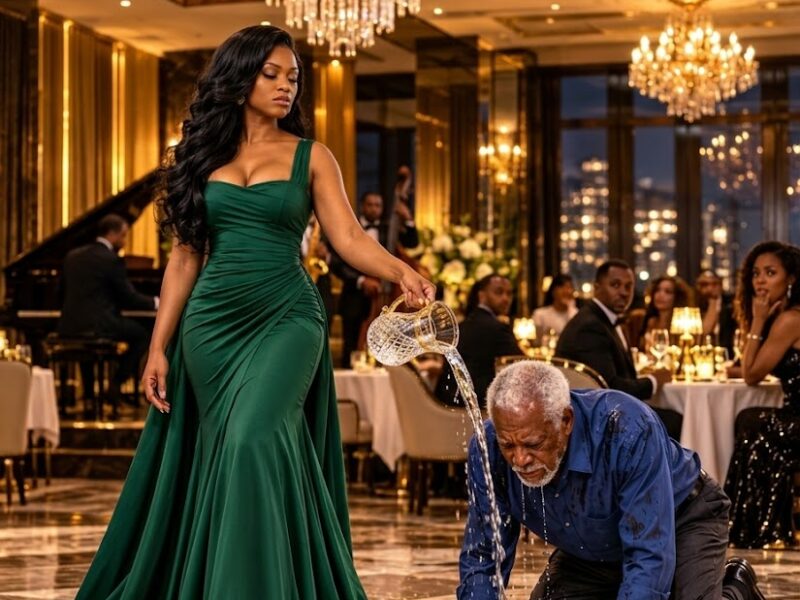
A Poor Waitress Defended a Man Everyone Humiliated—Unaware He Secretly Owned the Billion-Dollar Restaurant Chain
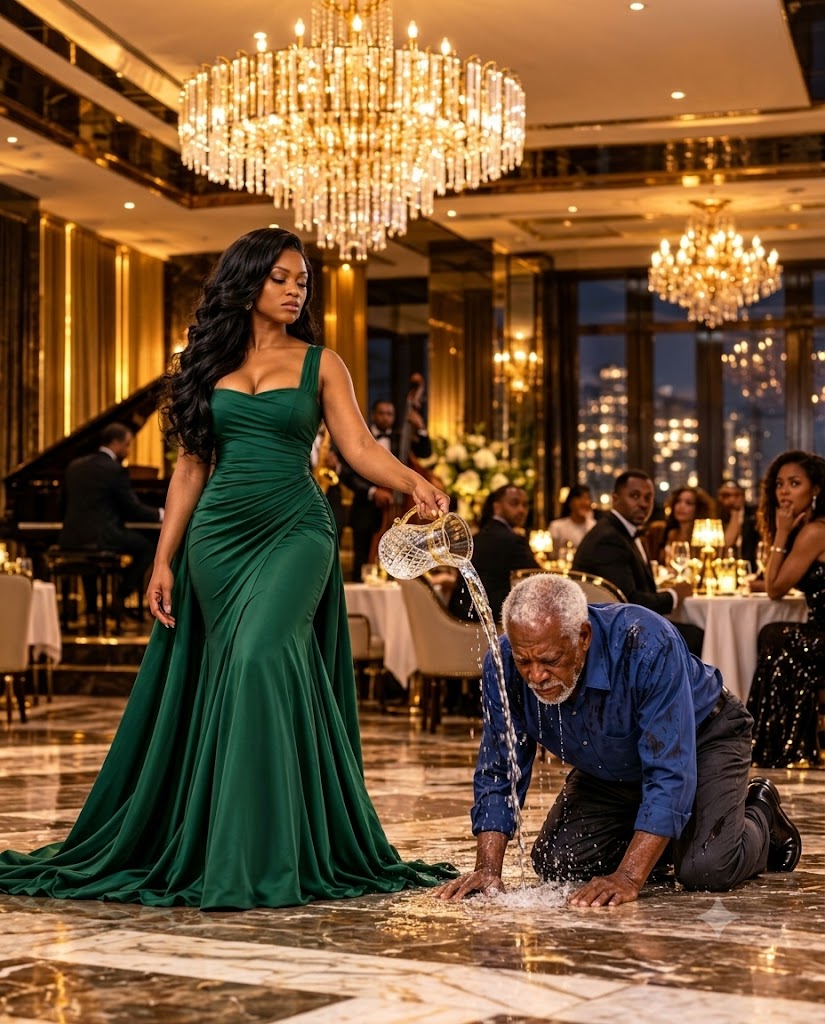
The dinner rush at The Meridian had barely begun when the shouting started.
Amara Okoro balanced a tray of truffle risotto on her shoulder, weaving between tables draped in white linen and crystal chandeliers that cost more than her monthly rent. The restaurant sat on the fifty-second floor of the Okafor Tower, a glass monument to old money and new ambition. Outside, Manhattan glittered like a fistful of diamonds scattered across black velvet.
She had worked here for three years. She knew every corner, every shadow, every secret the kitchen staff whispered about the family that owned this place.
None of that prepared her for the scene unfolding at Table Twelve.
A man in a rumpled gray suit sat alone, his back straight, his eyes fixed on the empty chair across from him. He looked tired. Not the kind of tired that came from a long day, but the kind that settled into your bones after years of carrying weight no one else could see.
A woman in a cream Chanel suit stood over him, her voice sharp enough to cut glass.
“Excuse me. Who seated this man here?” She snapped her fingers at a passing busboy. “This table was booked for one person. We are discussing millions here. Move him somewhere else.”
The man didn’t flinch. He didn’t even look up.
Amara watched from across the room, her jaw tightening. She had seen this before. The wealthy treating the restaurant like their personal playground, as if the staff were furniture and the other guests were inconveniences to be shuffled around.
But something about this man made her pause. The way he sat there, quiet and still, reminded her of her husband. Of the way Obi used to sit at their kitchen table after another rejection letter, pretending he wasn’t drowning.
“Ma,” a junior server said, stepping between the woman and the seated man. “I seated him here. He arrived before you requested extra space.”
The woman turned slowly, her eyes narrowing. “Very interesting. Look at this ordinary waitress giving us a sermon on human rights.” She laughed, a cold, brittle sound. “My father sits on the executive board of this restaurant’s parent company.”
Amara set down her tray. She walked toward Table Twelve with measured steps, her heart pounding but her face calm.
“Madam,” she said, “I must ask you to stop insulting our guests.”
The woman spun around. “Excuse me?”
“Sir.” Amara turned to the seated man, her voice soft but firm. “If I keep quiet just because she is rich, it means I agree that money is the only thing that commands respect.”
The restaurant fell silent. Even the clink of silverware stopped.
“That’s enough,” the woman hissed.
But Amara wasn’t finished. She had spent too many nights watching her husband shrink under the weight of accusations he couldn’t escape. She had sold her grandmother’s wedding ring to pay rent. She had smiled through Christmas dinners where her mother asked why Obi couldn’t just find a “real job.”
She knew what it felt like to be invisible. To be treated like the help.
She was done being quiet.
—
The man in the gray suit finally looked up.
There was something in his eyes that Amara couldn’t name. Gratitude, maybe. Or recognition. Like he had been waiting for someone to see him, and she was the first person who had.
“Thank you,” he said quietly.
The woman in Chanel stormed off, her heels clicking against the marble floor like gunshots. Within minutes, a manager appeared, his face pale, his hands trembling.
“Miss Okoro,” he said, pulling her aside. “The board is reviewing your conduct.”
“My conduct?”
“You insulted a VIP guest.”
“I defended another VIP guest.”
The manager shook his head. “You don’t understand. That woman’s father—”
“I know exactly who her father is.” Amara removed her apron and folded it neatly. “And I know exactly what kind of people sit on that board. Tell them I’ll be back tomorrow to collect my things.”
She walked out of The Meridian with her head held high.
She didn’t see the man in the gray suit watch her leave.
She didn’t see him pull out his phone and make a call.
She didn’t know that within twenty-four hours, everything would change.
—
The next morning, Amara sat at her kitchen table, staring at a stack of unpaid bills.
Obi had left early for another job interview. He had ironed his one good shirt, the blue one she had bought him three years ago, and kissed her forehead before walking out the door. He didn’t mention the interview. He didn’t mention anything anymore.
Their apartment was small, a one-bedroom on the fourth floor of a walk-up in Queens. The radiator clanked in winter. The window in the bedroom didn’t close all the way. But it was theirs, and for a long time, that had been enough.
Now, it felt like a tomb.
She had just picked up the electric bill when her phone buzzed. A number she didn’t recognize.
“Amara Okoro?”
“Who is this?”
“My name is Rebecca Hayes. I’m calling on behalf of the Okafor Group’s customer experience board.”
Amara’s grip tightened on the phone. “If this is about last night—”
“It is. And I’m calling to inform you that your suspension has been lifted.”
She blinked. “What?”
“The two shifts you missed will be paid in full. Additionally, the group is conducting a complete reassessment of Meridian’s service culture. That night exposed absolute rot. We want you on board.”
“To do what?”
“Observe, train, and report directly to the parent company’s customer experience board. Three months, with the possibility of extension. Consider it an opportunity, seeing as you displayed excellent judgment under fire.”
Amara sat down slowly. “Why me?”
“Because you did something no one else had the courage to do. You looked at power and refused to bow.”
The words hung in the air.
“And my husband?” Amara asked. “Obi Okoro. He used to work for the Okafor Group.”
There was a pause on the other end of the line. “That’s… actually part of the reason we’re calling.”
“What do you mean?”
“The group reopened the forensic audit. Your husband always maintained that the figure was altered after he signed off. The auditors found digital footprints proving the transaction was doctored.”
Amara’s heart stopped. “From where?”
“An executive-level terminal.”
She closed her eyes. For two years, she had watched her husband drown in shame. For two years, she had listened to him swear he wasn’t a thief, that someone had set him up, that he had signed a payment authorization for a fraction of what the final document showed.
She had believed him. But belief without proof was just hope, and hope didn’t pay rent.
Now, someone was telling her there was evidence.
“Mrs. Okoro,” Rebecca said, “are you still there?”
“I’m here.”
“We’d like you to start tomorrow. Can you come to the Okafor Tower at nine?”
Amara looked around her tiny kitchen. At the unpaid bills. At the empty chair where Obi used to sit.
“Yes,” she said. “I’ll be there.”
—
The Okafor Tower was even more imposing in daylight.
Amara stood in the lobby, clutching her purse like a lifeline, while security guards eyed her with suspicion. She was wearing her best blouse, the one she had worn to her wedding rehearsal dinner, and heels that pinched her toes.
“Mrs. Okoro?”
A woman in a sharp gray suit approached. She was in her forties, with the kind of face that had seen everything and forgotten nothing.
“I’m Rebecca Hayes. We spoke on the phone.”
They shook hands. Rebecca led her to the elevator, up, up, up, past floors filled with lawyers and accountants and people who made decisions that affected thousands of lives.
The office at the top was all glass and light. A conference table stretched across one wall. Floor-to-ceiling windows offered a view of the entire city.
And sitting at the head of the table was the man from Table Twelve.
Amara stopped in the doorway.
“You,” she breathed.
The man smiled. It was a tired smile, the kind that came from years of carrying secrets.
“Please have a seat, Mrs. Okoro.”
“I’d rather stand until I know whether I’m still employed.”
“I assure you, you are. Your suspension has been lifted. The two shifts you missed will be paid in full.”
She didn’t move. “Who are you?”
The man rose. He was taller than she remembered, with shoulders that spoke of old strength and eyes that held old sorrow.
“My name is Eze Okafor. I own this company.”
Amara’s breath caught.
Eze Okafor. The billionaire. The reclusive founder of the Okafor Group, a conglomerate that stretched from hospitality to real estate to technology. He rarely appeared in public. He gave almost no interviews. He was a ghost in his own empire.
And he had been sitting alone at Table Twelve, being humiliated by a woman in Chanel, while Amara defended him without knowing his name.
“I owe you an apology,” Eze said.
“For what?”
“For not intervening sooner. For allowing my family’s dysfunction to spill into your workplace. For the way you were treated.”
Amara shook her head. “I don’t understand. Why were you sitting there alone? Why didn’t you tell that woman who you were?”
Eze smiled again. “Because I wanted to see what kind of people my employees really are. I wanted to know if anyone would stand up for a stranger. And you did.”
He gestured to a chair. “Please. Sit. We have much to discuss.”
Amara sat.
Rebecca slid a folder across the table. Amara opened it and saw her own name on the first page. Her employment history. Her performance reviews. Her salary.
And then, on the second page, another name: Obi Okoro.
Her husband.
“Why is Obi’s name in this file?”
Eze’s expression didn’t change. “Because your husband’s case is connected to something larger. Something that goes all the way to the top of this company.”
“What do you mean?”
“Your husband was accused of embezzling forty-two million dollars.”
Amara flinched. Even now, hearing the number made her stomach twist.
“He didn’t do it,” she said. “He told me he didn’t.”
“I know.”
“Then why—”
“Because the person who set him up wanted him out of the way. And they used his signature to do it.”
Amara’s hands trembled. “Who?”
Eze leaned back in his chair. “Do you know a woman named Tiwa Bankole?”
The name hit Amara like a slap.
Tiwa Bankole. She had seen the name in Obi’s old photos, in a box she wasn’t supposed to open. She had seen it in the way Obi’s face changed whenever someone mentioned the past.
“His ex-fiancée,” Amara said quietly.
“Yes.”
“What does she have to do with this?”
Eze’s eyes didn’t waver. “Everything.”
—
Amara didn’t go home that night.
She sat in a coffee shop on the ground floor of the Okafor Tower, staring at the folder Rebecca had given her. The pages blurred in front of her eyes.
Tiwa Bankole. Daughter of Chairman Bankole, one of the most powerful men in the country. Married to Bayou Adeyemi, heir to the Adeyemi real estate fortune. Mother to a son named Jude.
And, according to the file, the person who had authorized the payment that ruined Obi’s career.
But there was more.
A hotel video from Abuja. A DNA test that had been buried. A chairman who had protected his daughter at the cost of an innocent man’s life.
And a text message that had lured Amara to an underground parking garage, where she had confronted Kimmy Bankole, Tiwa’s sister-in-law, and learned that the embezzlement scheme went deeper than anyone had imagined.
Amara pulled out her phone. Her finger hovered over Obi’s name.
She had been married to him for six years. She had loved him through unemployment and scandal and nights when they ate ramen because it was all they could afford. She had believed him when he said he was innocent.
But there was something he had never told her.
Something about a child.
Her phone rang. Obi’s name flashed on the screen.
She answered.
“Where have you been?” His voice was hoarse. “I called, but you didn’t pick up.”
“I went to see Eze Okafor.”
Silence.
“You did what?”
“We need to talk, Obi. About Tiwa. About Jude. About everything you never told me.”
The line went dead.
—
He was waiting for her when she got home.
Obi stood in the doorway of their apartment, his face pale, his hands shaking. He looked older than thirty-five. He looked like a man who had been carrying a secret for too long.
“I can explain,” he said.
“Then explain.”
He stepped aside, and she walked past him into the apartment. The kitchen was clean. The dishes were done. A pot of tea sat on the stove, cold.
“Tiwa and I were engaged before I met you,” Obi said. “You knew that.”
“I know.”
“What I didn’t tell you is that… she got pregnant around the time we broke up.”
Amara’s heart stopped.
“I didn’t know at first. She called me one day, said there was something she needed to tell me in private. I met her at a hotel in Abuja. She told me she believed the child might be mine.”
“And?”
“And I agreed to a DNA test. But her father arranged it. He said he would handle everything. And then he told me the test was negative. He said the child wasn’t mine.”
Amara stared at him. “You believed him?”
“I had no reason not to. He showed me the results. I saw the paper. It said I wasn’t the father.”
“Where is that paper now?”
Obi’s face crumpled. “I don’t know. I gave it back to him. I was so relieved, Amara. I thought I could go back to my life. I thought I could marry you without this hanging over my head.”
“But it was a lie.”
“Yes.”
“How do you know?”
Obi reached into his jacket and pulled out a folded document.
“The auditors found this. The real DNA test. The one Chairman Bankole buried. The probability of paternity is 99.9987%. I am Jude’s father.”
Amara took the paper. Her hands were shaking.
“You have a son.”
“Yes.”
“You have a son, and you didn’t tell me.”
“I didn’t know for sure. And then, when I did know, I was scared. I was scared of losing you. I was scared of what it would mean.”
“You were scared.” Amara’s voice was flat. “You were scared of losing me, so you lied. You let me believe we were building a life together while you were hiding a child.”
“I was trying to protect us.”
“Protect us? You were protecting yourself.”
Obi stepped toward her, reaching out. “Amara, please—”
“Don’t.” She stepped back. “You signed a payment authorization for forty-two million dollars because Tiwa asked you to. Not because procurement cleared it. Because she asked you to.”
Obi’s face fell. “How do you know that?”
“Because I’m the new customer service ethics manager for the Okafor Group. And because the auditors found everything. They know about the shell companies. They know about the doctored transaction. They know that Tiwa used you to cover her tracks, and that her father made sure you took the fall.”
“I loved you,” Obi whispered. “I still love you.”
“Love isn’t an excuse for lying, Obi. Love isn’t permission to decide which version of the truth I deserve to hear.”
He didn’t answer.
They stood in the kitchen, separated by six years of marriage and a thousand unspoken truths.
“I’m going to bed,” Amara said. “You can sleep on the couch.”
—
The board meeting was held at nine o’clock the next morning.
Amara walked into the conference room wearing the same gray blouse she had worn the day before. Her eyes were red from crying. Her hands were steady.
Eze Okafor sat at the head of the table. Rebecca Hayes sat beside him. And across the table, flanked by lawyers, sat Chairman Bankole and his daughter, Tiwa.
Kimmy Bankole was also there, her face a mask of fury.
“I only asked Obina to come,” Tiwa said, her voice tight. “This is a private company meeting.”
“I work here as the customer service ethics manager,” Amara replied. “And I am his wife. This family took eight years from him. I’m staying.”
Chairman Bankole cleared his throat. “We reviewed Kimmy’s old emails. He kept the real DNA report hidden for eight years. He used that report to pressure me. And he used it against you too, Tiwa.”
Tiwa’s face went white. “What?”
“Kimmy wanted your silence. He wanted your silence about the payment that destroyed your husband’s career.”
“You knew Kimmy altered that payment?” Amara asked.
“Not immediately,” Tiwa whispered.
“When did you know?”
“Two days after your husband was suspended. I found an access log in the system.”
“And you said absolutely nothing.”
“Kimmy walked into my office before I could even report him. He threw this paper on my desk. The real DNA report.”
Amara felt the room spin. “You stayed silent while everyone blamed Obi. They used his signature, moved the money, and he lost his career.”
“I know.”
“He couldn’t pay his rent. He had to borrow money from his mother. She still thinks he’s working as a consultant. Half his friends stopped picking up his calls after the scandal.”
“I know.”
“I sold my jewelry to pay our rent. I worked two shifts a day just trying to protect his fragile pride. And you knew?”
“I was checking on you quietly—”
“Quietly? You watched my husband lose everything while you stayed comfortable protecting your family.”
Tiwa’s voice cracked. “I was trying to protect my son. Kimmy threatened to reveal the truth about Jude. He knew Bayou wasn’t Jude’s biological father. Bayou raised him as his own. If the truth came out, Jude could lose the family name, his place in the family, and the future he believed was his.”
“He never asked you to protect him by letting his own father suffer,” Amara said coldly.
Tiwa broke down.
“I’m so sorry,” she sobbed. “I’m so sorry I dragged this garbage into your life.”
Amara didn’t move. “Don’t apologize. You’re not the one who needs to pay the price.”
—
Later that day, Amara sat in the chair outside the office of Fei Bankole, Eze’s son and the architect of the leak that had exposed everything.
He had used her. He had sent the hotel video and the text messages, knowing she would follow the trail to the truth.
But she was done being a pawn.
“You used me,” she said, walking into his office without knocking.
Fei looked up from his desk. He was handsome in the way that trust funds made men handsome, all sharp lines and easy confidence.
“Not everything,” he said.
“The footage from Abuja. The text leading me to your father’s involvement. You sent those.”
“Yes.”
“Why?”
“Because if I confronted my father directly, he would have closed ranks to protect Tiwa. He would have buried the entire scandal all over again.”
“So instead, you detonated a truth bomb right in the middle of my marriage.”
“Your husband should have told you the truth years ago.”
“Don’t try to use his failure to wash away your family’s sins.”
Fei leaned back in his chair. “This conglomerate is rotting from the inside out. Kimmy stealing money. Tiwa covering it up. My father turning a blind eye. I can’t run an empire built on lies.”
“Truth doesn’t magically become justice just because a billionaire decides when to release it. You act like you’re doing this for the purity of the company. But all you’re really doing is stepping on your sister’s neck to consolidate your own power.”
His smile faded. “You’re right.”
“One more thing. Who sent the last text? The one in the parking garage?”
“That wasn’t me.”
“Then who was it?”
“I don’t know.”
—
Amara walked into the restaurant the next morning.
The Meridian was empty. Chairs were stacked on tables. The kitchen was dark.
But at the bar, sipping a cup of tea, sat Eze Okafor.
“Chairman,” Amara said. “Unless you’re here for an early bowl of pepper soup, you’re a little late.”
Eze smiled. “Not as surprising as you personally sending me an anonymous text from an untraceable number.”
“I followed the clues, leading me straight to Kimmy Bankole in an underground parking lot.”
“You’re far more observant than Fei. My son thinks he’s a brilliant chess player for using you. What he doesn’t know is that I’m the one who placed you on the board.”
“You ruthlessly stole eight years of my husband’s life,” Amara said, her voice hard. “You stripped him of his right to be a father. All to protect your precious dynasty. Why would you personally shatter it now?”
“Because the machinery has rotted entirely. I covered up for Tiwa seven years ago when she took company funds for a private investment. I thought I was protecting my daughter. But I created a precedent. Kimmy saw it. He started stealing. He used the secret about Jude to put a leash on Tiwa. And Fei—Fei is so rash and merciless. He is willing to burn the entire house down just to sit on the throne.”
“So you borrowed my hands.”
“I needed someone who doesn’t belong to our world. Someone who cannot be bought. The night you stood up to protect a ragged old man from Kimmy Bankole’s humiliation, you proved you were the only one brave enough to look absolute power in the eye and say no.”
“You’re not brave, Chairman. You’re just a coward trying to buy salvation through other people’s pain.”
Eze set down his cup. “I will restore Obi’s honor completely. The settlement. An executive title.”
“We don’t want your money. Obi is going to see Jude. Not as an employee bowing to Tiwa, but as the boy’s father. If Tiwa tries to stop him, we will drag this family through the courts.”
Amara turned to leave.
“Keep your money, Chairman. We reject your gag order.”
She paused at the door.
“You have taught me a lesson today, Amara. True power doesn’t lie in a bank. It lies in whether you can hold your head high when you close your eyes at night.”
She didn’t answer.
She walked out into the morning light.
—
Two weeks later, Amara stood in the parking lot of a private school in Connecticut.
Obi was beside her, his hands shoved in his pockets, his eyes fixed on the entrance.
“I can’t do this,” he whispered.
“You can.”
“What if he doesn’t want to see me?”
“He does.”
The door opened, and a boy walked out.
He was eight years old, with Obi’s eyes and Obi’s smile. He carried a backpack almost as big as he was, and he looked around the parking lot with the cautious curiosity of a child who had been told to wait for a stranger.
Obi’s breath caught.
“Jude,” he said.
The boy looked up.
“Hi,” Obi said. “My name is Obi. I’m… I’m your dad.”
The boy tilted his head. “I know. Mom told me.”
“She did?”
“She said you were coming. She said you would be here.”
Obi dropped to his knees. His eyes were wet.
“I’m sorry,” he said. “I’m sorry I wasn’t there. I’m sorry I didn’t know. I’m sorry—”
Jude stepped forward. He reached out and touched Obi’s face.
“It’s okay,” he said. “You’re here now.”
Amara watched from a distance, her heart aching.
She didn’t know what the future held. She didn’t know if she and Obi could rebuild what had been broken. She didn’t know if the truth would heal them or tear them apart.
But she knew one thing.
The truth was out.
And no one could bury it again.
—
The next morning, Amara walked into The Meridian for her first official shift as customer service ethics manager.
The restaurant was full. The staff moved with purpose. The guests smiled.
And at Table Twelve, a man in a gray suit sat alone.
Amara walked toward him.
“Good morning,” she said. “May I get you something?”
The man looked up. It was Eze Okafor.
“Just a cup of coffee,” he said. “And maybe a conversation.”
She smiled. “I think I can manage that.”
She sat down across from him.
The chandeliers glittered. The city hummed below. And for the first time in years, Amara felt like she was exactly where she belonged.
“Tell me,” Eze said, “how does it feel to be the woman who brought down a dynasty?”
“It feels like justice,” she replied. “And justice doesn’t need a dynasty to stand on.”
He laughed. A real laugh, this time. The kind that came from a man who had finally set down a weight he had been carrying for too long.
“You know,” he said, “my son Fei is going to be a problem.”
“I know.”
“He’s already planning his next move. He wants to consolidate power, take over the company, push everyone else out.”
“And you’re telling me this because?”
Eze met her eyes. “Because I want you to stop him.”
Amara set down her coffee cup.
“I’m a waitress,” she said. “Not a warrior.”
“You’re the only warrior I’ve met in years.”
She didn’t answer.
But in her heart, she knew he was right.
The battle wasn’t over.
It was just beginning.
—
Eight years. That was what they had taken from Obi. Eight years of his son’s life, eight years of birthdays and first steps and bedtime stories. Eight years of a father’s love that had been locked away in a vault of lies and convenience. The real DNA report, the one that could have freed him, sat in Chairman Bankole’s office for nearly a decade, a weapon waiting to be used. And when it was finally used, it wasn’t to free Obi. It was to silence him.
Amara sat alone in her apartment that night, the lights off, the city glowing through the window. Obi had gone to visit Jude again. He had been visiting every day since the board meeting, trying to make up for lost time, trying to build something out of the rubble. It wasn’t working. He came home every night looking more exhausted, more haunted. Jude was polite but distant. Bayou was furious. Tiwa was trying to mediate, but even she couldn’t fix what had been broken.
And Amara? Amara was standing in the middle of it all, holding a secret she hadn’t told anyone.
She had started documenting everything. The emails, the access logs, the forensic audit findings. She had copies hidden in a safety deposit box, encrypted files on a thumb drive, and a lawyer on retainer. She wasn’t a waitress anymore. She wasn’t a victim. She was a witness to the rot at the top of one of the wealthiest families in America, and she was going to make sure that every piece of evidence saw the light of day.
But there was something else.
Something that had been nagging at her for weeks.
The night that Eze Okafor had sat alone at Table Twelve, the night she had stood up for him, he had been waiting. Not for the woman in Chanel. For her. He had known exactly who she was. He had read her file, just like he had read Obi’s. He had orchestrated the entire scene, testing her, measuring her, deciding whether she was worthy of the truth.
And she had passed.
That meant something. It meant that despite everything, despite the lies and the secrets and the pain, she was still the kind of person who would stand up for a stranger.
The kind of person who would fight for what was right.
She picked up her phone and called the number at the bottom of the file.
“Rebecca Hayes.”
“This is Amara Okoro.”
“I know. I’ve been waiting for your call.”
“You knew he was testing me. That night at the restaurant.”
Rebecca paused. “Yes.”
“And you didn’t think to warn me?”
“Would you have acted any differently?”
Amara thought about it. “No.”
“Then it doesn’t matter.”
“I want to know everything. Not just about my husband’s case. About the entire Okafor Group. About the shell companies, the offshore accounts, the people who helped bury the truth.”
“That’s dangerous.”
“I know.”
“It could put you in harm’s way.”
“I know.”
“Are you sure?”
Amara looked around her apartment. At the unpaid bills. At the photographs of her wedding, still hanging on the wall. At the life she had built with a man who had lied to her, but who was still, despite everything, the only person she had ever truly loved.
“I’m sure,” she said.
“Then come to the office tomorrow. Nine a.m. I’ll have everything you need.”
Amara hung up and sat in silence.
She thought about Obi. About Jude. About the son they might have had, the son they might still have, if they could find a way back to each other.
She thought about Tiwa, trapped in a prison of her own making, protecting a child who wasn’t hers by blood but was hers in every way that mattered.
She thought about Eze Okafor, a billionaire with more money than he could spend in a thousand lifetimes, yet he couldn’t buy the one thing he wanted most.
Forgiveness.
The truth.
She thought about Fei, the son who had used her, who had detonated her marriage, who had done all of it in the name of justice.
She thought about Kimmy Bankole, a thief and a blackmailer, the man who had set the entire catastrophe in motion.
And she thought about herself.
A waitress.
A wife.
A woman who had stood up for what was right, even when it was dangerous.
Even when it was painful.
Even when it cost her everything.
She wasn’t a hero. She was just a woman who refused to stay silent.
And that, she realized, was enough.
—
**THE END**
—
*If you liked this story and want to see more about Amara’s fight for justice, Obi’s journey to fatherhood, and the fallout of the Okafor Group scandal, leave a comment below!*









