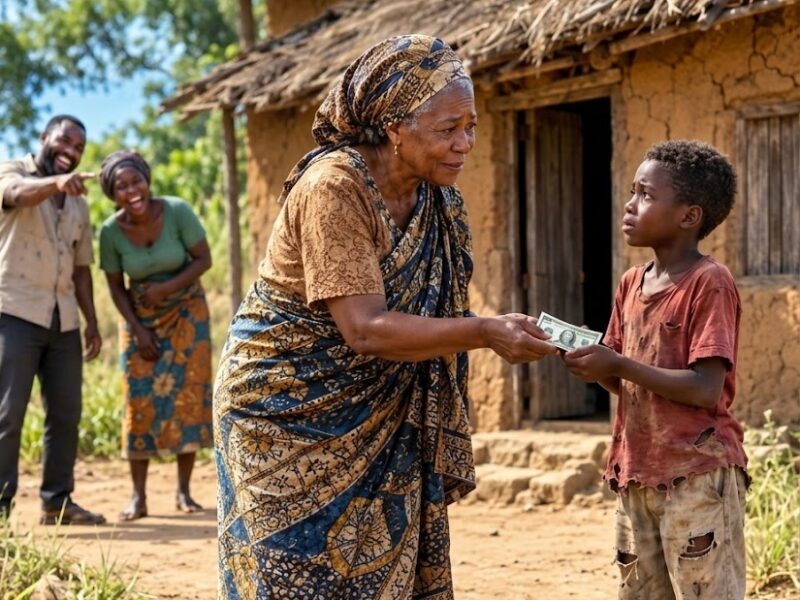
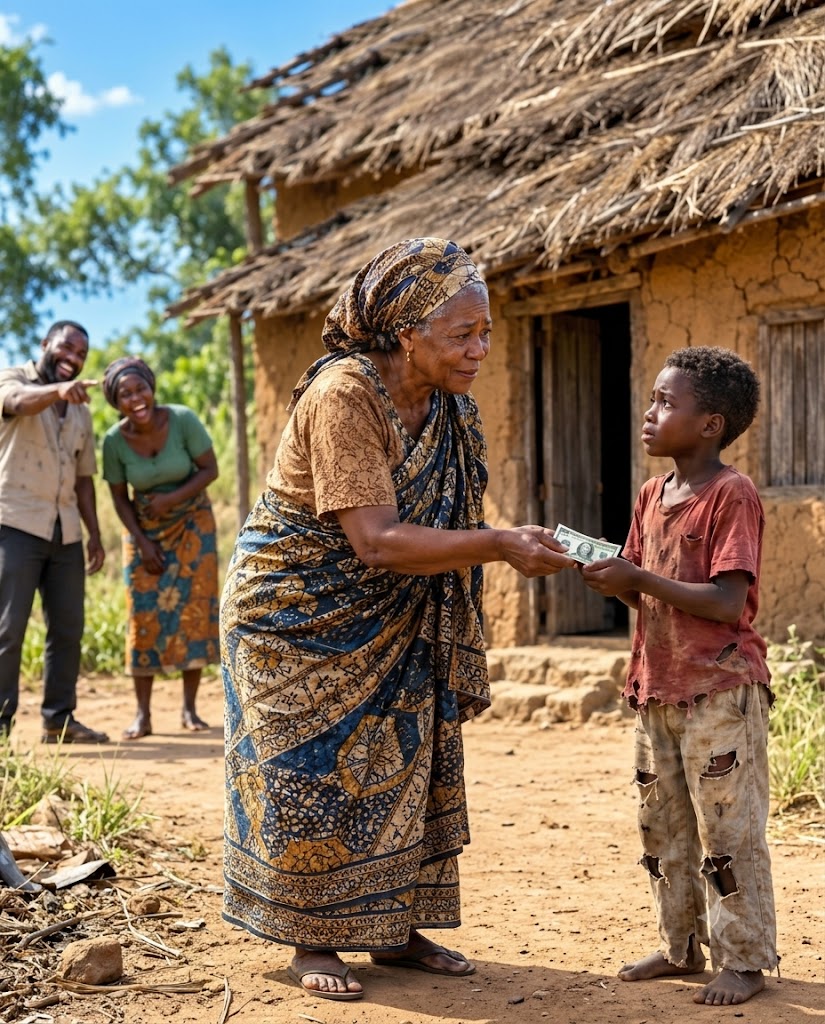
A poor old widow gave her last $5 to a starving orphan child. She had nothing left. But years later, something happened to her that nobody could have predicted.
The wind cut through the gas station canopy like it had somewhere better to be, and 74-year-old Mma Naledi Moyo pulled her threadbare coat tighter around her shoulders.
She counted the coins in her palm one more time, though she already knew the total. Five dollars and seventy cents. Not enough for the full refill of her blood pressure medication.
“Tell me the price hasn’t climbed again,” she whispered to the pharmacist behind the counter, though she already knew the answer from the pity in his eyes.
“I wish I could, Mma,” he said softly. “The full refill is eighteen dollars now.”
Eighteen dollars. Yesterday her bones had been cheaper than that.
“This is everything until Friday,” she said, sliding the coins across the counter. “What can five dollars buy?”
He looked at the money, then at her face. “I can split it, but then you’ll have nothing left for food.”
The fluorescent lights hummed overhead. Outside, a bus hissed to a stop and pulled away.
“When did you last eat properly, Mma?” he asked.
“Yesterday morning.”
“Then buy food first. Keep the medicine. Come back Friday.”
She gathered the coins back into her palm, each one cold against her weathered skin.
“Promise me you’ll eat today,” the pharmacist called after her.
“I promise to try.”
—
The bus station smelled like diesel and tired people. Naledi sat on a cracked plastic seat, her paper bag of bread and tea leaves pressed against her chest like a shield.
A boy stood at the ticket window, his voice barely audible over the announcements.
“Please, which bus goes to Kanye Children’s Home?”
The clerk didn’t look up. “Kanye is far from here. Where’s your family?”
“I don’t have one anymore.”
Something in the boy’s voice made Naledi turn. He couldn’t have been more than twelve. His shoes had holes. His shirt was clean but threadbare, the kind of clean that came from washing in public restrooms.
“What’s your name?” she asked.
He turned, and she saw eyes that had seen too much and eaten too little. “Kabelo Dube.”
“I’m Naledi. When did you last eat, Kabelo?”
“Yesterday.”
“Morning or evening?”
“Morning.”
She stood and walked to the food cart by the station entrance. The vendor, a woman she knew from the neighborhood, raised her eyebrows.
“Stew today, Mma. I saved the soft meat for you.”
“You’re trying to make me spoiled.”
“No medicine today?”
Naledi shook her head. “Medicine can’t argue with an empty stomach.”
The vendor pushed the container across the counter. “Take the meal. Pay me later.”
“No debts.”
“It’s one meal, not a mortgage.”
“A debt grows inside the person carrying it,” Naledi said, her voice firm. “How much for bread and tea leaves?”
“Twenty-five.”
She counted out the coins carefully. “Good. Even poverty should leave change.”
—
She found Kabelo still standing by the ticket window, staring at the departure board like it might rearrange itself into something hopeful.
“Here,” she said, pressing the bread into his hands.
He looked at the food, then at her. “And yours?”
“You found it first.”
“Mma, that was your food.”
“Then today it has a better owner.” She nodded toward the ticket window. “Do you have bus money?”
“No. They said I could walk.”
“Not before dark.” She looked at the clerk. “How much to Kanye?”
“About fifteen dollars.”
“And the last bus?”
“Soon.”
“Mma,” the clerk said, recognizing her now, “that money is everything you have.”
“I know exactly what it is.”
“At least keep five dollars for yourself.”
“Then the boy may arrive five dollars too late.” She pulled her worn wallet from her pocket and counted out the bills. “Pay your fare. Keep what remains for food.”
“But what about you?” Kabelo asked, his voice cracking.
“Today, worry about reaching tomorrow.”
“Will I see you again?”
“Live long enough to make somebody else ask you that question.”
He clutched the bread and the ticket like they were made of gold. “Thank you, Mma Naledi.”
“Go. Don’t make that bus wait for gratitude.”
—
The Kanye Children’s Home had a green door and a jacaranda tree in the front yard, its purple blossoms scattered across the walkway like forgotten confetti.
A woman in a cardigan answered the door. “Yes? Can I help you?”
“Please. Is this Kanye Children’s Home?”
“Yes.” She looked past Kabelo, searching for an adult. “Slow down, child. Where’s the adult with you? Your mother?”
“She died.”
“Your father?”
“I never knew him.”
“Who told you to come here?”
“Our neighbor. My grandmother died three days ago.”
The woman’s face softened into something practiced and kind. “How did you pay for the bus?”
“A woman gave me everything she had.”
“Did she write that down? Her name? Her address?”
“I don’t know. But I want to keep it.” He pulled the paper bag from his pocket and unfolded it carefully. At the bottom, in shaky handwriting, were the words: *The poorest hand can still lift another person.*
—
Fourteen years later, a black sedan pulled up to a community meeting hall in a neighborhood that had seen better decades.
Kabelo Dube stepped out, now twenty-six, wearing a suit that fit him like armor. He carried a leather briefcase and a memory that had never faded.
The hall was packed. Residents clutched papers and each other. At the front, a developer named Mr. Masego stood beside a presentation board covered in renderings of glass towers and manicured walkways.
“Thank you for coming,” Masego said, his smile polished. “This project brings jobs, safer streets, and new business to your community.”
“And apparently requires old people to disappear first,” a voice called from the back.
Kabelo’s heart stopped. He knew that voice.
Mma Naledi stood, older now, her hair silver, her back still straight. “Nobody is being erased, Memoria,” Masego said smoothly. “People are being offered opportunity.”
“Opportunity usually asks before entering your home.”
“Every owner has received an improved offer.”
“Money improves an offer. It doesn’t improve every decision.”
Kabelo watched as the woman who had given him everything refused to bow. He watched as the developer’s smile tightened. He watched as the room divided into those who wanted to sell and those who wanted to stay.
—
After the meeting, Kabelo found her sitting alone on a bench outside, staring at the jacaranda tree that still stood in her yard across the street.
“Mma Naledi?”
She looked up. “Do I know you?”
“Fourteen years ago, you gave a hungry boy your last fifteen dollars and told him to live long enough to make somebody else ask him that question.”
Her eyes narrowed. “Kabelo?”
“Yes, Mma.”
She studied him for a long moment. “You look like the road fought you.”
“The road lost.”
“Did you eat?”
“Enough.”
“No medicine, no food. Where did the money go?”
He almost smiled. “A child needed tomorrow more than I needed supper.”
She nodded slowly. “You can stay tonight. Only tonight.”
“Tonight is where tomorrow starts.”
—
The records room at the county clerk’s office smelled like old paper and fluorescent light.
Amara Nlovu, a community property lawyer with sharp eyes and sharper questions, spread the documents across the table.
“Do you still have every letter the company sent?” she asked Naledi.
“I keep bad news. It tends to return.”
“Was this reference number on every letter?”
“Until recently.”
Amara frowned. “That’s unusual. The meeting file used a different property reference.”
“A clerical error?”
“Maybe. We verify first.”
Kabelo leaned over the papers. “What does this annotation mean? ‘Community occupancy protection’?”
Amara’s pen stopped moving. “It means this property requires additional review before residents can be displaced under the current process.”
Naledi’s hands trembled. “My husband died here. Children eat here. Your calculator cannot count either of those.”
“And you’re not alone,” Amara said, pulling more files from the stack. “Several properties carry the same protection. This was never only your fight.”
—
The council meeting the next week was standing room only.
Councilor Masego sat at the head of the table, his patience visibly thinning. “The original register marked several homes under protected community occupancy. Those records are decades old.”
“Age does not erase a valid restriction,” Amara said. “No final transfer proceeds until these occupancy rights are reviewed.”
“This is a business matter, not a personal crusade.”
“You think this is about property,” Kabelo said, standing. “You think everything eventually becomes a number. That belief is exactly why you misjudged Mma Naledi.”
“And what do you propose?”
“A community trust. Residents choose together what happens to their homes. Not you. Not the company. Them.”
Masego laughed. “That sounds expensive.”
“Hope accepts installments.”
—
Three months later, the neighborhood looked different.
Not because the buildings had changed, but because the people had. The community trust had been signed by forty-seven residents. The development company had been forced to renegotiate. And Mma Naledi’s house still stood, its green door freshly painted, its jacaranda tree in full bloom.
Kabelo sat on her porch, a cup of tea warming his hands.
“You came back,” she said.
“I kept enough.”
“Mma Lady, save some for yourself.”
She smiled, and for a moment she looked younger than her years. “I did. Look around.”
He looked. Children played in the yard. Neighbors waved from across the street. The sewing class she had started was meeting in her living room, the sound of laughter drifting through the open window.
“You know,” she said, “when I gave you that money, I didn’t expect anything back.”
“I know.”
“Then why did you come?”
He set down his tea and pulled a worn paper bag from his pocket. The same one she had given him fourteen years ago.
“The poorest hand can still lift another person,” he read. “You wrote that. But you never told me who wrote it first.”
She was quiet for a long moment. “My husband. He wrote it on our first anniversary. We had nothing, but he said we had each other, and that was enough to lift anyone.”
“And you kept it.”
“I kept enough.” She reached over and squeezed his hand. “You know, I never had children. But if I had, I would have wanted them to be like you.”
Kabelo felt tears prick his eyes. “And I never had a mother. But if I had, I would have wanted her to be like you.”
They sat in silence as the sun set, the jacaranda blossoms falling like purple snow.
—
The next morning, Kabelo found her in the garden, tending to the roses her husband had planted decades ago.
“You’re up early,” he said.
“I always am. Old bones don’t sleep.” She looked at him. “You’re leaving today.”
“I have to. There’s another community. Another fight.”
“Then go. But promise me something.”
“Anything.”
“Eat today. And tomorrow. And the day after that. Don’t give away everything you need.”
He smiled. “I promise to try.”
She laughed, a sound like wind chimes. “That’s what I said. And look at me now.”
He looked. She was standing in her garden, surrounded by flowers, in a house that still belonged to her, in a neighborhood that had learned to fight for itself.
“You saved me,” he said.
“No. You saved yourself. I just gave you a bus ticket.”
“No.” He shook his head. “You gave me hope. You gave me a reason to keep going. You gave me tomorrow.”
She reached up and touched his cheek. “Then we’re even.”
—
The bus station looked the same, though the plastic seats had been replaced and the food cart now sold organic smoothies.
Kabelo bought a ticket. One way. To the next town, the next fight, the next person who needed someone to believe in them.
As the bus pulled away, he looked out the window and saw her standing on the platform, waving.
He waved back.
And in his pocket, the paper bag with her husband’s words remained, a reminder that the poorest hand can still lift another person, that hope accepts installments, and that sometimes, the smallest kindness can change everything.
The bus turned a corner, and she disappeared from view.
But the feeling of her hand in his, the sound of her laugh, the memory of her green door and jacaranda tree—those stayed.
They would always stay.
—
**THE END**
—
*Inspired by a true story of generosity, community, and the unexpected ways kindness returns.*









