A Poor Man Begged for Shelter During a Blizzard—The Hotel Manager Humiliated Him, Unaware He Owned the Entire Lodge
**Part 1**
The snow had been falling for six hours straight, and the temperature had dropped to nine below zero.
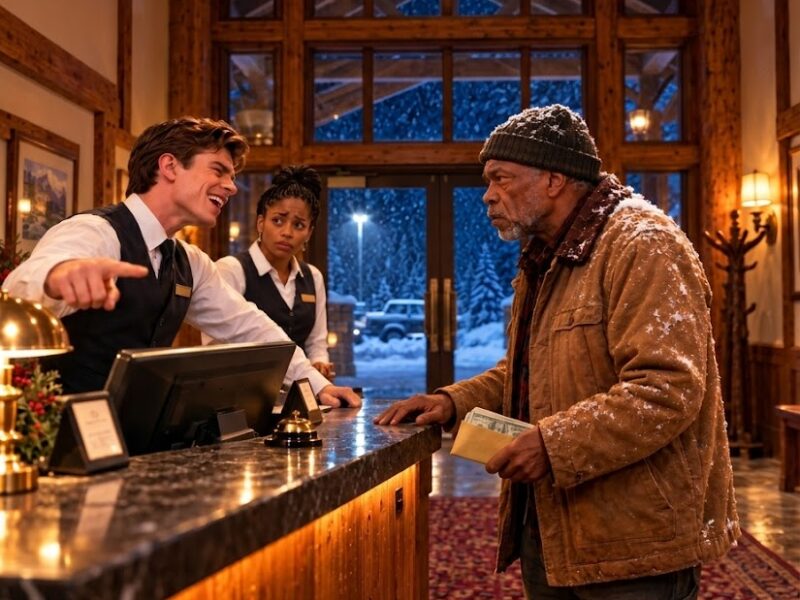
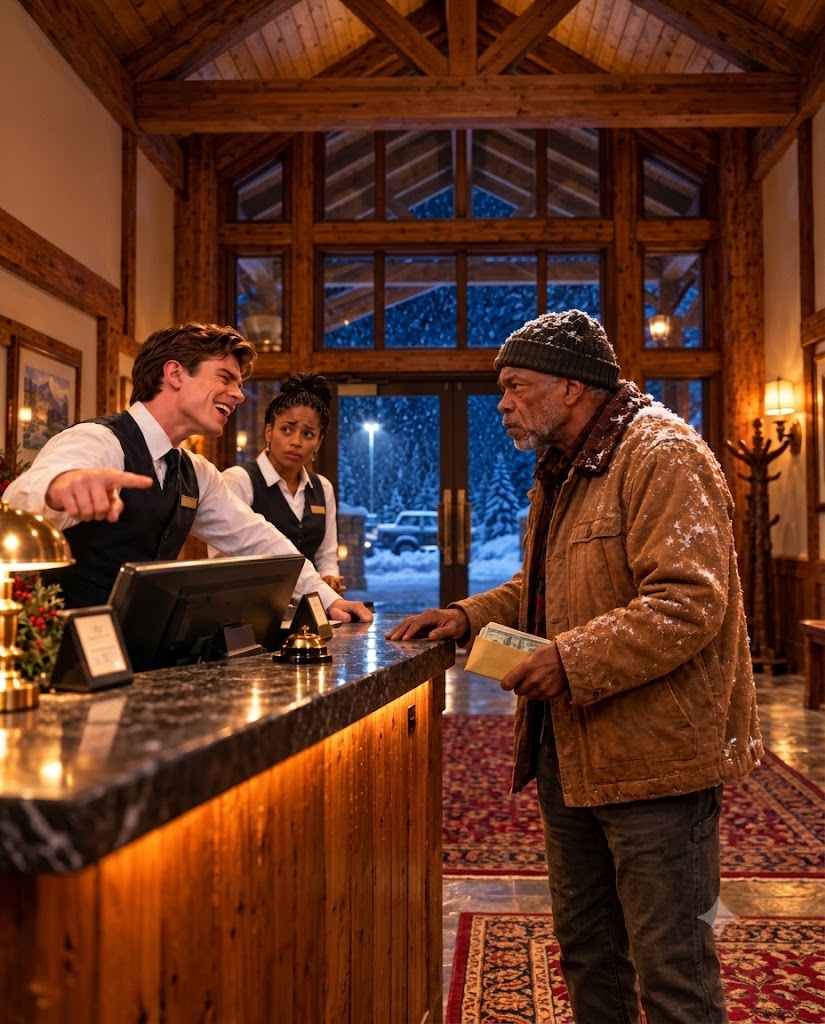
Jack Brooks stood at the front desk of the Silver Hollow Lodge, his breath still visible in the warm air of the lobby, his hands shoved deep into the pockets of a coat that had seen better decades.
“I need a room,” he said.
The woman behind the desk—mid-thirties, sharp eyes, a name tag that read GRACE—didn’t even look up from her computer screen.
“We’re full.”
“Anything. One night.”
“That’s if we had one.”
Jack pulled a thick envelope from his coat pocket and set it on the counter.
“Cash. Twelve hundred.”
Grace finally looked up, her expression shifting from disinterest to something closer to suspicion.
“People don’t carry hotel money in an envelope, sir.”
“I do.”
“Yeah,” she said slowly, “that’s kind of the issue.”
—
A man emerged from the back office—silver-haired, maybe sixty, with the kind of smile that had learned to hide its teeth.
“That yours?” he asked, nodding toward the envelope.
Jack didn’t answer.
“Run the heater,” the man said, already turning away. “You’ll be fine.”
“It’s nine below.”
“So crack a window.”
The man—DALE, according to his name tag, though Jack already knew plenty about Dale Hutchkins—disappeared back into his office.
—
The state patrol officer who arrived twenty minutes later was young, tired, and clearly not paid enough for this.
“Passes closed till morning,” he announced to the lobby at large. “Nobody goes back down.”
“He was just leaving,” Dale said, emerging from his office with a fresh cup of coffee.
“Leaving to where?” The officer frowned. “Full, sir. That part’s true. County storm rule. Pass closes, nobody gets sent back out.”
He looked at Jack, then at the sofa near the fireplace.
“You can have the sofa by the fire.”
Dale’s jaw tightened.
“Naomi, optics. We’ve got people in the ridge suite. Dale is going to—”
“Dale can tell me himself,” a woman’s voice cut in.
A tall woman in her fifties—NAOMI—stepped into the lobby, her gaze fixed on Dale with the kind of patience that suggested she’d been waiting a long time for this moment.
“Put that away,” she said, nodding at the envelope. “Nobody pays for a sofa.”
She turned to Jack.
“Thank you.”
Then, to Grace: “Coffee’s on the cart. Blankets are in the chest.”
—
Jack settled onto the sofa, the fire crackling nearby, and pulled out a small notebook.
*Grace, memo for the morning,* he wrote. *Pass is closed. I’m stuck at Silver Hollow lobby sofa. Wanted to see the place before anybody knew I was coming.*
He paused, then added: *Well, nobody knows those numbers that never added up. I’m looking at them. Nine rooms out of order. 21 through 29.*
He looked up as the state patrol officer returned.
“First thing my own lodge told me was go sleep in the truck,” Jack murmured, more to himself than anyone. “State Patrol is bringing six people up. Their van slid off at the chain-up area.”
“Okay,” Grace said, appearing beside him with a blanket. “And?”
“And we’re full except 21 through 29.”
Grace’s expression flickered.
“Those are down for maintenance.”
“I walked them at 8. Heat’s running. Beds are made. 24 has a do-not-disturb on the door.”
He met her eyes.
“Want me to shut that?”
From across the lobby, Dale’s voice cut in: “Nah, let him listen. Guy sleeps in a pickup. Who’s he going to tell—the pickup?”
—
The night wore on, and the storm worsened.
Jack watched from his sofa as the lodge’s true nature revealed itself—the hushed conversations, the nervous glances, the way Dale’s voice dropped whenever certain names were mentioned.
“Those rooms are spoken for, kiddo,” Dale was saying to Grace, his tone condescending.
“By who? There’s nobody in the system.”
“Cash guests. Regulars. They like their privacy.”
Grace’s jaw tightened.
“Does Atlanta know about the regulars?”
Dale laughed—a short, ugly sound.
“Atlanta’s a spreadsheet, sweetheart. Never set foot on this mountain. Never will.”
—
At 3:00 a.m., the lodge’s generator sputtered.
Jack was awake, his notebook open on his knee, when he heard Dale’s voice from the front desk.
“Drawer’s 640 short.”
“That’s not possible.”
That was Grace.
“I haven’t been near your drawer.”
“Then you won’t mind.”
A pause.
“Dale. Sorry. The front cash drawer is missing $640. I think I know who has it.”
Jack looked up as Dale and the deputy approached him.
“Evening, chief. May I see that envelope?”
Jack handed it over without a word.
Dale flipped through the bills.
“Twenties. Tanner, what’s the drawer?”
“Mostly twenties,” the deputy—TANNER—confirmed.
“There you go. These are our twenties.”
“That’s $1,200,” Jack said calmly. “I came in with it.”
“So you say. Here’s how it goes. Pass opens, I call the deputy. Till then, you wait in your truck. Envelope stays with me.”
He turned to Tanner.
“Told you he was trouble.”
“Tanner, his coat. Walk him out.”
—
The deputy escorted Jack to the door, but before they could step outside, Grace’s voice rang out.
“Wait.”
Everyone turned.
“Let’s go, man,” Tanner said, pushing Jack toward the exit. “Truck’s right there.”
But Grace was already moving toward them, her phone in hand.
“He walked in at 9:40. Droy was short at 9:15. Same 640.”
She looked at Tanner.
“DH, that’s you. You took the bank bag back to your office 25 minutes before he got here.”
Dale’s face went pale.
“That notebook’s lodge property. Hand it over.”
“It’s mine,” Grace said, clutching it to her chest. “Walgreens down in Ridgeline. $4.99.”
—
The confrontation that followed was brief but brutal.
“Bank bag, right?” Dale said, his voice strained. “Must have miscounted. Tanner, run it again.”
The deputy hesitated.
“He’s still gone at first light,” Dale added.
Jack watched as Grace handed over her notebook—no, her evidence.
“You didn’t have to do that,” Jack said quietly.
“Read my own handwriting,” Grace replied.
“You wrote down a man carrying a bag.”
“The system says whatever Dale types into it. Paper says what happened.”
She met his eyes.
“End of every shift, I take a picture of the page.”
“Who taught you that?”
“My dad drove a rig 30 years. He used to say, ‘If you didn’t log it, you didn’t drive it.'”
Jack nodded slowly.
“He still drive?”
“Stroke this spring. He’s in rehab in Grand Junction, learning to button his own shirt. Insurance pays some, I pay the rest.”
She looked away.
“I work nights so I can drive down and sit with him days.”
“And after 7?”
“Guess he gets more of me.”
—
The generator coughed again, and the lights flickered.
“Anybody above Dale you could call?” Jack asked.
Grace shook her head.
“I emailed Atlanta in June about the East Wing. The general inbox. And Dale wrote back, said Atlanta sends everything about this place to him. Told me to stick to the front desk.”
She gestured toward the fuel gauge on the wall.
“She’s thirsty tonight.”
“Who fills it?”
“Kesler Fuel every Tuesday. Dale switched us this spring. An old guy from Montrose did it for years. Kesler charges three times what he did.”
She paused.
“I sign the slips. Dale say why?”
“Dale doesn’t say why.”
Jack leaned forward.
“Say the owner walked in tomorrow. What would you tell him?”
Grace’s eyes widened slightly.
“The owner.”
She took a breath.
“Storm nights open 21 through 29.”
“That’s all.”
“That’s all.”
Jack studied her for a long moment.
“You didn’t ask for your job back. You asked what I’d tell him, not what I’d ask him for.”
**Part 2**
Morning came slowly, the storm refusing to release its grip on the mountain.
Jack stood by the window, watching the snow pile higher, when his phone buzzed.
“Got your memo and your text. Are you okay?”
“I’m fine,” he said. “County says the pass opens at 9:00. Be on the first convoy up.”
“Done.”
“Bring HR. Pull the key card logs for rooms 21 through 29. Six months.”
“21 through 29. And find me that Kesler fuel contract, whatever’s on file.”
“Anything else?”
“Ask the county for a deputy.”
“Why are you whispering?”
“Manager sleeps right over my head.”
—
At 9:00 sharp, the county convoy arrived.
Six people stumbled out of a van, their faces pale with cold and exhaustion. State Patrol officers helped them into the lobby, where Grace had coffee waiting.
“Dale’s going to love this,” Tanner muttered.
Dale appeared at the top of the stairs, his face a thundercloud.
“County, six people are trespassing in my banquet room. I never authorized them to be there.”
“Trespassing?” one of the travelers protested. “State Patrol drove us to your door.”
“Third company,” Dale snapped. “To the door, ma’am. Not my Aspen room.”
He turned to Tanner.
“Then the tow company. Abandoned pickup in my lot. Owner’s expense.”
—
But Jack was no longer on the sofa.
He was standing in the center of the lobby, his coat off, his posture straight, a different man entirely from the one who’d walked in the night before.
“Hi. Silver Hollow Lodge. We’ve got an abandoned vehicle.”
“It’s not abandoned,” Jack said calmly. “I’m sitting right here.”
Dale’s eyes narrowed.
“Then you won’t mind it being gone. And Tanner, put this in her file. Abandoned her post. Let strangers into restricted areas. Word for word. Any lodge calls for a reference, that’s what they get.”
“I never left my post,” Grace said, her voice steady. “I was the post.”
“Not anymore, kiddo.”
—
The deputy who arrived was not Tanner.
DEPUTY PIERCE was a tall woman with sharp eyes and a no-nonsense demeanor that immediately put Dale on edge.
“Ma’am, welcome to Silver Hollow,” Dale said, his tone shifting to something almost obsequious. “Terrible night, terrible roads. Let me get you something hot.”
But Deputy Pierce wasn’t looking at Dale.
She was looking at Jack.
“Mr. Brooks,” she said. “Mr. Brooks.”
“Hello, sir. You still need the tow?”
Jack smiled slightly.
“All right. You came up here for the East Wing numbers. I understand.”
He turned to address the room.
“$38,000 a month paid in cash. Those payments have never appeared on the tax returns. Atlanta will never see those numbers.”
Dale’s face went white.
“Starting—retainer—and—deduction—drag us—”
“Grace,” Jack said calmly. “Say it so they can hear.”
Grace stepped forward, her notebook open in her hands.
“Rooms 21 through 29 are listed out of order since April. Key card logs show those doors open 212 times in 6 months. Every key for those rooms was made on one card. A master issued to D. Hutchkins.”
Dale sputtered.
“This card—this card goes all over this building. I lend it out every night. Tanner, tell him. Tanner, who uses my card, kid? Three years I carried you. Open your mouth.”
Tanner’s face was pale, but he spoke.
“11:12 this morning. Side door, East Hall. Man in a Kesler fuel jacket. Envelope. DH.”
“She’s fired,” Dale shouted. “She’ll write anything.”
“She didn’t write the next part,” Jack said quietly. “I heard it. ‘Storm week. Cash is slow. I already scraped the front drawer for you.'”
He stepped closer to Dale.
“At 3:00 in the morning, you accused me of taking cash from the front drawer. You said it in front of everyone here.”
He paused.
“Dale, you’re fired.”
“You can’t just—”
“You sold rooms in my lodge directly to outside customers without recording the bookings. Then you ordered a traveler to sleep overnight in his truck.”
Jack’s voice was ice.
“Dale Hutchkins, I’m detaining you for theft of the cash room proceeds and money from the front drawer. Turn around, please.”
“Over a sofa,” Dale muttered. “Over a guy on a sofa.”
“Over 212 doors,” Jack corrected. “Turn around.”
—
The plows hadn’t finished, and the road was still one lane.
“County convoy goes down the mountain at 4,” Deputy Pierce said. “You’ll stay in my vehicle until then.”
“Phone call,” Dale demanded. “I want my lawyer.”
“One call. Make it quick.”
Dale fumbled for his phone, his hands shaking.
“Vest pocket. My cell.”
He dialed.
“It’s me. They know.”
A pause.
“Make it hurt.”
Jack watched as Dale hung up.
“That wasn’t a lawyer.”
“Never said it was a good one.”
—
The next call came from a different quarter.
“Kesler.”
ROY KESLER was a man who’d made his fortune by being the only fuel supplier in a fifty-mile radius. He arrived at the lodge at 3:00 p.m. sharp, his truck idling outside, his expression carefully neutral.
“Atlanta has paid Kesler Fuel every month since April,” Grace reported, handing Jack a folder. “Each invoice is three times the old rate.”
“And the contract?”
“Our files have no contract. Not a single page.”
“Then it’s in his office.”
—
Kesler entered the lobby like a man who owned the place—which, in a sense, he had believed he did.
“Mr. Brooks. Roy Kesler here. Kesler Fuel and Snow. Silver Hollow has a five-year contract with us.”
Jack didn’t look up from the papers in his hands.
“Heating oil, generator fuel, and the lodge road. Ending that contract carries a fee of $1.5 million.”
“I’ve never signed a thing with you.”
“Page nine carries your name and a blue ink signature. It appears authentic.”
Kesler smiled thinly.
“Dale owes me money. Dale has been taken away and you are responsible for that outcome. You have two ways to settle this. Pay the contract termination charge or settle Dale’s personal debt.”
He paused.
“Once either amount is paid, scheduled fuel deliveries will resume. I’ll arrive at 3 to discuss the paperwork.”
He turned to leave.
“Stay warm.”
—
Naomi appeared at Jack’s elbow, her face grim.
“A contract you never signed can be declared void, but proving that in court could take weeks. Kesler expects the lodge to run out of fuel before the dispute is resolved.”
She pulled out her phone.
“Hi, it’s Naomi up at Silver Hollow. Any truck free today? Our old Montrose guy.”
A pause.
“Every truck’s running for the county tomorrow morning, earliest.”
She looked at Jack.
“Is the lodge about to lose power?”
“His portable backup tank has less than an hour of reserve,” Jack said. “The road is one lane, convoy only. Emergency transport can’t reach the lodge until the plows finish.”
He looked at the fuel gauge.
“His remaining supply won’t last for the trip down the mountain.”
—
Naomi’s voice rang out across the lobby.
“All staff, this is Naomi. Report to the main building. Close the spa. Turn off power to the East Wing. Turn off the kitchen cold storage units. Pack their contents in the snow. Set hallway lights to half. Every circuit stays off unless people depend on it.”
She paused.
“Keep the Aspen room supplied. Keep the Aspen room circuit powered throughout. Mark its breaker red so it stays on.”
—
Grace approached Jack, her notebook in hand.
“Ask her. Is that yours?”
Jack looked at the signature on the contract.
“That signature looks exactly like mine. That’s how I signed my name.”
“Then there’s a serious problem,” Deputy Pierce said. “A judge would recognize your name and handwriting on that contract.”
“Wait,” Grace said suddenly. “When I straightened that letter last night, he shouted at me.”
“What did you straighten?”
“That letter. It was crooked, so I fixed it. He ordered me to keep my hands off his wall.”
She looked at Jack.
“Can I have page nine?”
Jack handed it over.
“Nobody signs their name the same way twice,” Grace said, studying the document. “Someone traced it from your welcome letter.”
“The contract copies your handwriting exactly,” Deputy Pierce said. “That makes it a felony. Something I can address today instead of a civil case next year.”
“So we win,” Naomi said. “We win against Dale.”
“Kesler can shrug and say his manager gave him a contract already signed,” Jack said. “He knew nothing about the problem.”
Grace was already flipping through her notebook.
“April 11th, 1:40, side door V, the Kesler jacket, an envelope. April 25th, side door V, an envelope. May 9th, May 23rd. Every other Thursday, each time after midnight, each time an envelope.”
She looked up.
“Every time Dale. Since April. Since the week Dale switched the fuel.”
“Kesler was receiving lodge money through Dale from the start,” Jack said slowly. “The cash rooms, the front desk drawer. This contract would let those payments continue after—”
He stopped.
“So he’s not standing outside this.”
“He’s standing right in the middle of it.”
—
Deputy Pierce stepped forward.
“Deputy, this is a contract matter. There’s no need for you to remain.”
“I’ll stay.”
—
Kesler returned at 3:00 p.m., his expression confident.
“Mr. Brooks, you have your documents. I decide when the fuel deliveries are made.”
He held up page nine.
“Page nine. On top of the letter it was copied from. You’re saying someone copied your signature from that letter onto the contract? Fine. Take me to court over it. With lawyers in Denver, this could take two years, maybe three, and the court will hear my side.”
He smiled.
“I supplied your fuel for seven months. Your company paid every invoice for those seven months. Your Atlanta office raised no objection. To me, that means the company agreed to our terms.”
He stepped closer.
“You came into my East Hall last night, 1:00 in the morning. You checked whether I’d gone to sleep. You told Dale he’d lost money at Roy’s card table. If he wasn’t paid up by March, Roy would collect from the lodge.”
Jack met his gaze.
“This isn’t a fuel deal. It’s Dale’s gambling debt charged to my lodge under my name.”
“That’s a story from a man on a couch.”
“And paying a forged invoice isn’t accepting a deal, Mr. Kesler. It’s getting robbed twice.”
—
The generator sputtered again.
“Naomi, his machine’s off. There you go. Easy. Follow my count.”
“How long?”
“About 40 minutes. Maybe a little less if he remains seated.”
—
Deputy Pierce stepped forward, her hand on her radio.
“The handwriting matches exactly. Someone traced that signature. Mr. Kesler, this is forgery. It’s a criminal matter now, not a civil dispute.”
“Ask Dale,” Kesler said smoothly. “He gave me the contract already signed. I supply fuel. Checking signatures isn’t my job.”
“April 11th, 1:40 a.m. At the side door, Dale passed an envelope to your man wearing a Kesler company jacket. The same exchange happened every other Thursday, including last night at 1:12 a.m.”
“A notebook, handwriting—anybody can write.”
Grace stepped forward.
“I photograph every page at the end of every shift. Timestamped.”
Deputy Pierce turned to the man in the Kesler jacket—the one who’d been standing silently by the door.
“Mr. Moore, the cash out of those nine rooms went somewhere. Looks like it went in your jacket. You want to tell me about it before Mr. Kesler tells me about you?”
Moore’s face crumbled.
“Don’t—”
“I collect the envelopes. That’s all. Roy tells me the money is for fuel and I deliver the envelopes to him. I never signed any papers. I’ve never seen a contract.”
—
The end came quickly.
“Bring it up to the shed. Fill the tank. Top it off. Write down that I delivered.”
“310. Noted.”
—
Deputy Pierce turned to Kesler.
“Sit down, both of you.”
She pulled out her handcuffs.
“Roy Kesler, you’re being taken into custody for extortion using a forged contract to do it.”
Kesler’s face went pale.
“I just filled your tank. I recorded the delivery.”
“Turn around and place your hands behind you.”
She looked at Jack.
“The contract’s void.”
Jack nodded.
“And we’ll want seven months of fuel money back.”
“At triple the price.”
—
The convoy left at 4:00 a.m., Dale and Kesler in the back of the deputy’s vehicle.
Grace stood in the lobby, her vest on the desk, her notebook in her hand.
“Hi, Daddy. It’s me. Sunday. I’ll be down Sunday.”
A pause.
“No, I didn’t get fired. Kind of the opposite. I’ll tell you Sunday.”
She smiled.
“Do your exercises.”
—
Jack approached her.
“You gave me your sofa that night when I had nothing. Now give him the rooms.”
Grace looked at him, confused.
“Sorry?”
“The chain law is in effect. My truck has no chains.”
He smiled.
“Is there anything available?”
Grace’s eyes widened, then softened.
“We have a room.”
—
**Part 3**
The Aspen Room was the finest suite in the lodge—two bedrooms, a fireplace, a view of the mountains that stretched for miles.
Jack stood by the window, watching the snow fall, when Grace knocked on the door.
“Mr. Brooks? I mean—Jack?”
He turned.
“Yes?”
“I just wanted to say—I mean, I know you’re the owner and everything, but—”
She took a breath.
“Thank you. For seeing what was happening. For not just driving away.”
Jack was quiet for a moment.
“You were the one who kept the notebook. You were the one who stayed.”
He gestured toward the chair by the fire.
“Sit down.”
Grace hesitated, then sat.
“I’ve been watching this place from a distance for three years,” Jack said. “Atlanta kept telling me everything was fine. The numbers looked good. But something didn’t add up.”
He looked at her.
“Nine rooms, out of order since April. $38,000 a month in cash that never appeared on the books. A fuel contract I never signed.”
“$38,000 a month,” Grace repeated. “That’s—”
“$456,000 over six months. Enough to renovate the East Wing twice over.”
He paused.
“Where did you learn to document everything like that?”
Grace smiled slightly.
“My dad. He drove a rig for 30 years. He always said, ‘If you didn’t log it, you didn’t drive it.'”
She looked down.
“He had a stroke this spring. He’s in rehab in Grand Junction. I work nights so I can drive down and sit with him during the day.”
Jack nodded slowly.
“Insurance pays some. You pay the rest.”
“Yes, sir.”
He was quiet for a moment.
“What if I told you that Silver Hollow needs an acting general manager?”
Grace looked up, startled.
“Sir?”
“Someone who knows this place. Someone who documents everything. Someone who isn’t afraid to stand up to a manager who’s been stealing from the company for years.”
He met her eyes.
“Someone who would give a stranger her sofa when he had nowhere else to go.”
Grace’s eyes glistened.
“Mr. Brooks, I—”
“The job is yours. Starting immediately.”
He handed her a piece of paper.
“These are the terms. The salary is $85,000 a year, plus health insurance that covers rehabilitation services for family members.”
Grace stared at the paper.
“Mr. Brooks—”
“And one more thing.”
He gestured toward the window.
“Tomorrow morning, you’re going to drive down to Grand Junction. You’re going to sit with your father. And you’re going to tell him that his daughter just became the general manager of the finest lodge in Colorado.”
Grace’s tears spilled over.
“He’s not going to believe me.”
“Then bring him back with you. Once the pass is clear, bring him up here. We have a room for him. Room 24.”
He paused.
“It has a do-not-disturb on the door. But I think we can make an exception.”
—
The next morning, the sun broke through the clouds for the first time in three days.
Jack stood on the front porch of the lodge, his coat pulled tight against the cold, watching as the first plows finally cleared the road.
Naomi appeared beside him.
“Kesler’s lawyer called. He wants to negotiate.”
“Let him.”
“And Dale’s been officially charged. The county prosecutor says they have enough evidence for a conviction.”
Jack nodded.
“The notebook?”
“Grace photographed every page. She has timestamped images going back six months.”
“Good.”
Naomi hesitated.
“Mr. Brooks—the $1.5 million contract. We can fight it, but it could take years. In the meantime—”
“In the meantime, we find a new fuel supplier.”
He turned to face her.
“The old guy from Montrose. The one who did it for years before Dale switched.”
“I already called him. He’s willing to come back. At the original rate.”
“Then we’re in business.”
—
That evening, Jack found Grace in the lobby, her notebook open on her knee.
“You’re still here?” he asked.
“New job. Lots to catch up on.”
She looked up.
“I’ve been going through the records. The nine rooms, the cash payments, the fuel invoices. There’s more.”
“More?”
“Naomi’s notebook. The one she used to document the fuel deliveries. It goes back five years. The last two years, there are discrepancies.”
She handed him a page.
“The amounts don’t match. Kesler was charging triple what he recorded. Dale was pocketing the difference.”
Jack studied the page.
“How much?”
“Altogether? About $240,000 over two years.”
He was quiet for a moment.
“Where’s Naomi?”
“In her office.”
“Call her. We need to talk.”
—
Naomi arrived ten minutes later, her expression guarded.
“You wanted to see me?”
Jack held up the page.
“Your notebook. The fuel deliveries. Two years of discrepancies.”
Naomi’s face went pale.
“I—I didn’t know. I just signed the slips Dale gave me. I never checked the numbers.”
“Until now.”
She nodded slowly.
“Until now.”
“Then you have a choice to make.”
Jack set the page down.
“You can keep your job. But you’re going to have to answer some hard questions. About what you knew, and when you knew it.”
Naomi took a breath.
“I understand.”
“Good. Because I need you. This lodge needs you. But I need to know I can trust you.”
“You can.”
“Then sit down. We have work to do.”
—
The days that followed were a blur of activity.
The county prosecutor filed charges against Dale and Kesler. The fuel contract was officially void. The old supplier from Montrose returned, his rates fair and his deliveries reliable.
Grace settled into her new role with surprising ease. She knew the lodge—the rhythms, the quirks, the people—and she managed it with a combination of firmness and warmth that Jack admired.
On her third day, she found Jack in the Aspen Room, staring at a photograph on the wall.
“That’s the original owner,” he said. “My grandfather. He built this place in 1948.”
Grace looked at the photograph—an older man with a kind face and a weathered smile.
“He looks like you.”
“Everyone says that.”
He turned away from the photo.
“You know, when I first came here, I wasn’t sure what I’d find. I expected corruption. What I found was worse.”
“Worse?”
“The corruption was there. But there was also courage. People who were willing to do the right thing, even when it cost them.”
He looked at Grace.
“You’re one of those people.”
She flushed.
“I just did what was right.”
“That’s all courage is.”
He walked to the door.
“Get some rest. Tomorrow’s going to be busy.”
“What’s happening tomorrow?”
“We’re reopening the East Wing.”
—
**Part 4**
The East Wing was a revelation.
Nine rooms, each one freshly renovated, each one with a view of the mountains that took your breath away.
Grace stood in room 24, taking in the freshly painted walls, the new furniture, the fireplace that crackled with real wood.
“This is incredible,” she breathed.
“Guest experience,” Jack said from the doorway. “That’s what you told me last night. Some of them pose a risk. You made a call.”
Grace’s expression fell.
“Mr. Brooks—”
“What did you say to me? ‘For my next job. Would you write that I acted professionally?'”
He stepped into the room.
“At 9:40 last night, a man arrived after the mountain pass had closed. It was nine below zero. You told him to leave his truck window open and remain in the truck until morning. You made that decision. Dale didn’t. Lodge protocol didn’t.”
Grace was silent.
“I won’t write a letter claiming otherwise,” she said finally.
“I know.”
He studied her.
“Are you calling him on me?”
“No. Your employment here ends today.”
Grace’s face went pale.
“What?”
“That’s my decision. And cancel the tow truck.”
He turned to leave.
“Wait—Mr. Brooks—”
He stopped in the doorway.
“You were the one who kept the notebook. You were the one who stayed. You didn’t have to do that.”
He looked back at her.
“And you didn’t have to stay at the front desk when you could have left. You didn’t have to help those six people. You didn’t have to stand up to Dale.”
He stepped closer.
“You’re the general manager of this lodge. That’s not a punishment. That’s a reward.”
Grace’s eyes widened.
“What?”
“Your employment at the front desk is over. Your employment as general manager starts now. I told you that three days ago.”
He smiled.
“Unless you’ve changed your mind?”
Grace stared at him.
“You—you said my employment ends today.”
“As a front desk clerk. Not as manager.”
She let out a breath—half laugh, half sob.
“Mr. Brooks—”
“Jack.”
“Jack—”
She shook her head.
“You’re impossible.”
“So I’ve been told.”
—
Grace’s first official act as general manager was to call a staff meeting.
“Listen up,” she said, standing in the lobby. “We’ve been through a lot in the last week. We’ve lost a manager. We’ve lost a fuel contract. We’ve lost a lot of trust.”
She paused.
“But we’ve also gained something. We’ve gained a new owner. We’ve gained a new fuel supplier. And we’ve gained a new chance to make this place what it should be.”
She looked at Naomi.
“Some of you have been here for years. You’ve seen the changes. You’ve seen the corruption. And you’ve stayed.”
She looked at Tanner.
“Some of you made mistakes. You did things you shouldn’t have. But you also told the truth when it mattered.”
She looked at the assembled staff.
“This lodge is not about its walls or its rooms or its views. It’s about the people who work here. It’s about the people who stay here. It’s about the people who come here when they have nowhere else to go.”
She paused.
“I was one of those people once. A long time ago. I know what it’s like to need a place to stay.”
She met Jack’s eyes.
“And I know what it’s like when someone gives you a chance.”
—
The next week passed in a blur.
Grace held job interviews, reviewed contracts, and sorted through two years of mismanagement.
In between, she drove down to Grand Junction to see her father.
“Hey, Daddy.”
Her father—HAROLD—looked up from his wheelchair, his face breaking into a smile.
“Hey, baby. How’s the lodge?”
Grace sat down beside him.
“It’s good. Better than good. I’m the general manager now.”
His eyes widened.
“You—really?”
“Really.”
She pulled out her phone.
“I have pictures. Of the East Wing. Of the rooms. Of the mountains.”
She showed him.
“It’s beautiful.”
He stared at the photos, his eyes glistening.
“You did good, baby. You did good.”
“Thanks, Daddy.”
“Your mother would be proud.”
Grace took his hand.
“I know.”
—
The weeks turned into months, and Silver Hollow blossomed.
The East Wing rooms—21 through 29—were fully booked by January. The lodge’s reputation, tarnished by years of mismanagement, began to recover.
Jack stayed on for a month, overseeing the transition, before returning to Atlanta.
“You’ll be fine,” he told Grace at the airport. “You’ve got everything you need.”
“What if I’m not?”
“You are.”
He handed her a small notebook.
“This is my personal number. If you ever need anything—anything at all—call me.”
Grace tucked it into her pocket.
“Thank you, Jack. For everything.”
“You did the work, Grace. I just opened the door.”
—
**Part 5**
In June, a letter arrived at Silver Hollow Lodge.
Grace opened it at her desk, her eyes scanning the words.
*Dear Grace,*
*I received the plaque last week. It’s hanging in my living room now, next to a picture of my dad. I think he’d get a kick out of it.*
*I’m writing to tell you that the fuel contract is finally settled. Kesler agreed to repay seven months of overcharges—at triple the original rate. The total came to $1.2 million.*
*I’ve invested half of it in the lodge. The rest is in a trust for your father’s care.*
*I know you didn’t ask for this. But you earned it.*
*There’s one more thing. I’m coming back to Silver Hollow. Not as the owner—as a guest. I’ll be arriving on the evening flight, assuming the pass isn’t closed.*
*I’d like to see what you’ve done with the place.*
*See you soon,*
*Jack*
—
Grace sat at her desk, the letter in her hand.
She thought about the night Jack had walked in—the snow falling, the temperature at nine below, the front desk telling him to sleep in his truck.
She thought about the sofa by the fire.
She thought about the notebook in her pocket.
She thought about her dad, learning to button his own shirt.
She reached for her phone.
“Naomi? It’s Grace. Get room 24 ready. We have a guest coming.”
—
The evening Jack arrived, the lodge was quiet.
He walked through the front door, shaking snow from his coat, and found Grace waiting at the front desk.
“Welcome to Silver Hollow Lodge,” she said, a smile playing at the corners of her mouth. “How can I help you?”
Jack looked at her—the vest, the name tag, the poised expression—and laughed.
“I need a room.”
“We’re full.”
“Anything. One night.”
“That’s if we had one.”
Jack reached into his pocket and pulled out an envelope.
“Cash. Twelve hundred.”
Grace took the envelope, her eyes never leaving his.
“People don’t carry hotel money in an envelope, sir.”
“I do.”
“Then you won’t mind if I check.”
She opened the envelope, counted the bills, and nodded.
“Everything looks good.”
She handed him a key card.
“Room 24. It’s our finest suite. The do-not-disturb has been removed.”
Jack took the key.
“Thank you.”
Grace smiled.
“You’re welcome.”
—
That evening, they sat by the fire in the Aspen Room, the mountains stretching out before them.
“I’ve been meaning to ask you,” Jack said. “The notebook. The one your dad told you to keep.”
Grace pulled it from her pocket.
“I still have it. I document everything now. Every shift. Every guest. Every detail.”
“Because if you didn’t log it, you didn’t drive it.”
“Exactly.”
Jack was quiet for a moment.
“Your dad would be proud.”
“He is proud.”
She opened the notebook.
“I wrote something in here. The night you arrived. I wrote about the man who came in from the storm and asked for a room.”
She handed him the notebook.
Jack read the entry.
*”At 9:40, a man arrived after the mountain pass had closed. He was carrying an envelope with $1,200. He asked for a room. I told him we were full.”*
He looked up.
“That’s not the end of the story.”
“No,” Grace said. “It’s not.”
She took the notebook back and flipped to the next page.
*”The man stayed on the sofa. He didn’t complain. He didn’t demand. He watched. He listened. And at 3:00 in the morning, when Dale tried to frame him for theft, he didn’t fight back. He just smiled.”*
She flipped to the next page.
*”I didn’t know who he was. I didn’t know he owned the lodge. I just knew he was someone who deserved a chance.”*
She closed the notebook.
“And then I gave him one.”
Jack was quiet for a long moment.
“You know,” he said, “the night I arrived, I wasn’t sure what I would find. I expected corruption. I found you.”
“And me?”
“You’re the reason this lodge is still standing.”
—
The next morning, Jack woke early and walked outside.
The sun was rising over the mountains, painting the snow in shades of gold and pink.
He thought about his grandfather, who had built this place seventy years ago.
He thought about the men and women who had worked here, the ones who had been honest, the ones who had not.
He thought about Grace, who had kept the notebook, who had stayed, who had given him her sofa when he had nowhere else to go.
He thought about the future—the lodge, the mountains, the people who would come and stay.
He pulled out his phone and called Grace.
“Good morning. It’s me.”
“Jack?”
“I’m looking at the sunrise. It’s the most beautiful thing I’ve ever seen.”
Grace was quiet for a moment.
“Wait there. I’ll bring coffee.”
—
She arrived ten minutes later, two cups in her hands.
They stood on the porch together, watching the light spread across the sky.
“I’ve been thinking,” Jack said. “About the future.”
“What about it?”
“I want to stay.”
Grace turned to look at him.
“Stay?”
“Here. At Silver Hollow. Not as the owner who visits once a year. Not as the guy who shows up in a blizzard and sleeps on the sofa.”
He looked at her.
“As someone who’s here. Every day. Who knows the staff by name. Who knows what the pass looks like in every season.”
Grace’s eyes were wide.
“But—your life in Atlanta—”
“Atlanta is a spreadsheet. This mountain is my home.”
He took a breath.
“If you’ll have me.”
Grace looked at him—the man who had walked in from the storm, who had slept on her sofa, who had trusted her, who had believed in her.
“We’ll have you.”
—
The plaque that Jack sent to Grace’s father hung in a place of honor at Silver Hollow Lodge.
*In recognition of Grace Carr—General Manager—For Integrity, Courage, and Dedication to the Guests of Silver Hollow.*
Her father had framed it and brought it to the lodge on his first visit after rehabilitation.
“That’s my girl,” he said proudly. “That’s my girl.”
—
The lodge continued to thrive.
Grace and Jack—both now co-managers—worked side by side, their partnership as natural as the snow and the mountains.
The East Wing rooms were fully booked through the next season. The fuel contract had been negotiated with an honest supplier. The staff had been trained to document everything, just like Grace.
And the notebook—the one from Walgreens—had become a symbol of something larger.
It was the notebook that had caught a thief.
It was the notebook that had brought down a corrupt manager.
It was the notebook that had saved a man’s lodge.
It was the notebook that had given Grace a new life.
—
On a cold January night, Jack stood in the lobby, watching the snow fall.
The temperature was nine below zero.
The pass was closed.
And in the lobby, sitting by the fire, a young couple with tired faces and heavy coats were asking for a room.
“We’re full,” Grace was saying.
“Anything. One night.”
Grace looked at Jack across the lobby.
He nodded.
“We have a room,” Grace said. “It’s not much. But there’s a sofa by the fire, blankets in the chest, and coffee on the cart.”
The young man’s face broke into a smile.
“Thank you.”
The young woman looked confused.
“You mean—we can stay?”
“Yes,” Grace said. “You can stay. As long as you need.”
She looked at Jack.
“Nobody pays for a sofa.”
—
**THE END**









