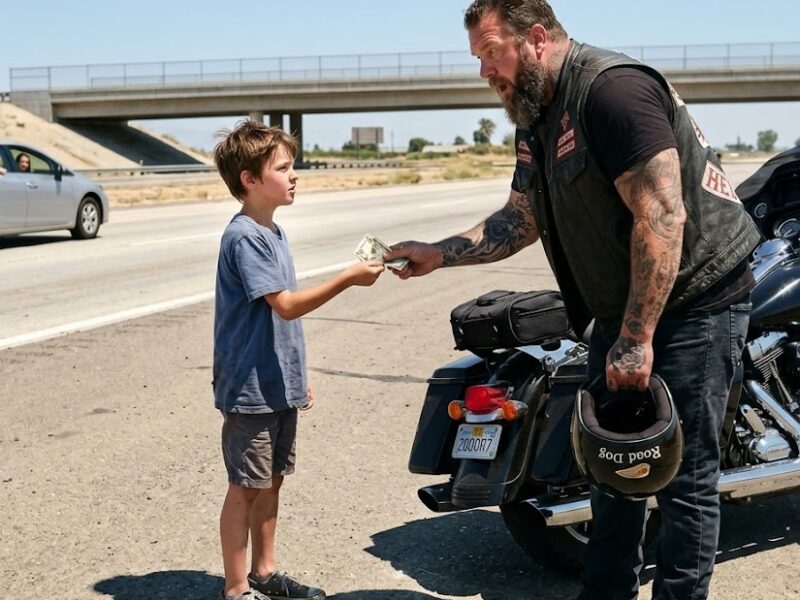
A poor kid gave his last money to help a stranded biker. That evening, 250 Hells Angels showed up for him.
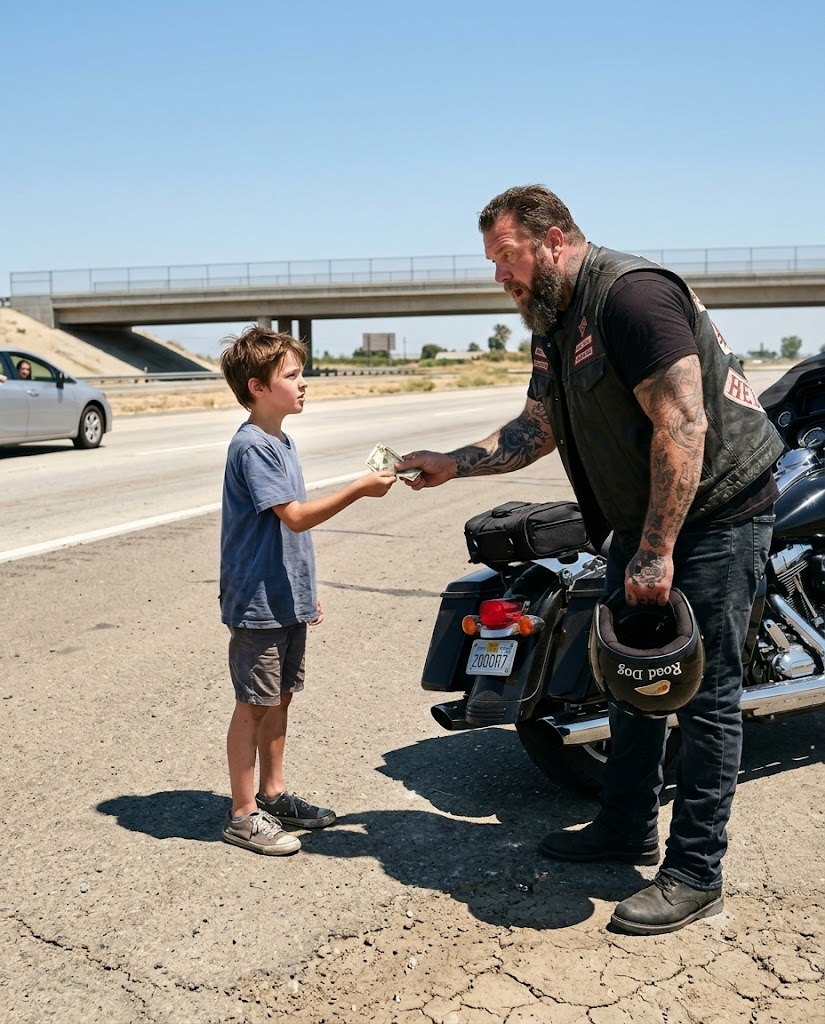
The August heat in the San Joaquin Valley didn’t just make you sweat.
It pressed down on you like a physical weight, a heavy hand on the back of your neck that refused to let up.
For eleven-year-old Leo Bennett, the heat was just one more thing to endure.
He lived in the Sunnyside Trailer Park on the dusty outskirts of Fresno, California, a rusted collection of aluminum boxes that trapped the summer temperatures until they felt like ovens.
Leo was a small kid for his age, with a shock of untidy brown hair and eyes that had seen far too much of the adult world.
His mother, Sarah, was a fighter, but her body was currently losing a brutal battle with severe pneumonia.
Without medical insurance, every penny they scraped together went to over-the-counter remedies and the absolute bare minimum of food.
She had been forced to take an unpaid leave of absence from her shifts at a local diner, and the financial cliff they had been teetering on had finally crumbled beneath them.
That afternoon, Leo had exactly five dollars and thirty-five cents in his pocket.
It was a single, crumpled five-dollar bill and a smattering of dull dimes and nickels.
It was the absolute last of their money.
He was walking the two miles down County Road 14 to Miller’s Grocery.
His mission was strictly calculated: a loaf of the cheapest white bread, a jar of generic peanut butter, and if the tax wasn’t too high, maybe a can of chicken noodle soup to help his mother’s throat.
The asphalt was soft under Leo’s worn-out sneakers, radiating waves of distortion that made the horizon look like a mirage.
As he approached the overpass near Highway 99, he noticed a massive, imposing figure kicking the dirt on the shoulder of the road.
It was a biker, and not just a weekend enthusiast.
Even at eleven, Leo knew what the leather cuts and the patches meant.
The man was a mountain of muscle and faded tattoos, wearing heavy denim and heavy leather despite the hundred-degree heat.
On his back, boldly stitched, was the infamous winged death’s head logo: Hells Angels, California.
The man was pacing furiously around a massive, custom-built Harley-Davidson that was dead silent.
His thick, bearded face was flushed red with anger and heat exhaustion.
Leo stopped walking.
He watched as cars drove past the stranded giant.
You could see the drivers physically stiffen.
Windows were quickly rolled up.
Doors were locked with audible clicks.
The societal fear surrounding the motorcycle club was palpable.
People were terrified, instinctively assuming the man was dangerous, unpredictable, or a criminal.
They gave him a wide berth, leaving him to bake on the unforgiving shoulder.
The man kicked the front tire of the Harley, letting out a string of curses that echoed in the heavy air.
Then he looked up and locked eyes with Leo.
“What are you staring at, kid?” the man barked, his voice like gravel in a blender.
His name, stitched on a small patch over his heart, read Grizzly.
Arthur “Grizzly” Henderson was the sergeant-at-arms for his chapter, a man whose reputation commanded respect and fear in equal measure.
But right now, he was just a man losing a fight with gravity and a dry gas tank.
Leo didn’t run.
He took a hesitant step closer, clutching the coins in his pocket.
“I wasn’t staring, sir. I was just wondering if your bike was thirsty.”
Grizzly blinked, caught off guard by the kid’s lack of fear.
He wiped a thick forearm across his sweating forehead.
“Thirsty ain’t the word for it, half-pint. She’s bone dry.”
Grizzly sighed, the anger draining out of him, leaving only exhaustion.
“Saddlebag latch snapped about ten miles back. Didn’t notice until my engine sputtered out. Wallet, phone, tools all scattered somewhere on the northbound lane of the 99.”
Leo looked down the road.
“There’s a Chevron station just over that ridge. Maybe a ten-minute walk.”
“Yeah, I know,” Grizzly grumbled, leaning heavily against the handlebars.
“But the attendant there is a hard-ass. I walked over an hour ago, asked if he could spot me a couple bucks for a red can and a gallon of regular so I could get to my clubhouse. Guy looked at my cut, panicked, and threatened to call the county sheriff if I didn’t get off his property. Refused to let me even use the phone. I ain’t got a single red cent on me, kid, just waiting to see if one of my brothers rides past.”
But the highway was mostly empty, save for the terrified commuters who sped up when they saw him.
Grizzly was stranded, fiercely loyal to a bike he couldn’t leave behind, and entirely out of options.
Leo stood in the dust.
He felt the crumpled five-dollar bill in his pocket.
It was his anchor.
It was his mother’s dinner.
It was survival.
But as he looked at the massive, frightening man, Leo didn’t see a monster or a menace.
He saw the same quiet desperation he saw in his mother’s eyes when the rent was due.
He saw a human being who was completely ignored and discarded by the people speeding by in their air-conditioned cars.
The internal battle raging inside Leo’s chest was deafening.
“If I give him this money, Mom doesn’t eat.”
The thought was sharp and painful, but his mother had always taught him that character wasn’t measured by what you gave when you had plenty, but by what you offered when you had nothing.
Leo swallowed hard, his throat dry from the dust.
He walked directly up to the massive biker.
Grizzly looked down, towering over the boy, a frown creasing his heavily scarred face.
Leo pulled his hand out of his pocket and extended his fist.
He opened his fingers, revealing the crumpled, sweat-stained five-dollar bill.
“Here,” Leo said, his voice barely above a whisper, though it cut through the hum of the highway traffic perfectly.
“It’s enough for the red plastic can and a gallon of gas. I know it is because I price-checked the cans last week when I thought about collecting cans to recycle.”
Grizzly stared at the green paper resting in the child’s small, dirty palm.
The massive biker’s expression shifted from irritation to absolute bewilderment.
He looked from the money to Leo’s worn-out shoes, his frayed T-shirt, and his thin arms.
Grizzly had spent decades reading people, and he knew poverty when he saw it.
“Put that away, kid,” Grizzly said, his voice suddenly softer, almost rough with a different kind of emotion.
“I ain’t taking your money. You look like you need that more than I do.”
“You can’t stay out here,” Leo insisted, stepping closer and practically pressing the bill into Grizzly’s heavy leather vest.
“People are mean. They aren’t going to stop for you. You need to get home to your family.”
Grizzly froze.
The word family struck a chord deep within the chest of a man who lived and died for his brotherhood.
He looked at the kid’s unwavering eyes.
There was no pity in Leo’s gaze, just a profound, undeniable solidarity.
“Kid,” Grizzly started, but the words caught in his throat.
He slowly reached out with a massive, calloused hand and took the five-dollar bill.
It looked ridiculously small in his palm.
“What’s your name?”
“Leo. Leo Bennett.”
“All right, Leo Bennett. You stay right here with my girl,” Grizzly said, patting the leather seat of his Harley.
“Don’t let nobody touch her.”
Leo nodded solemnly, standing guard over the massive machine as the hulking biker jogged over the ridge toward the Chevron station.
True to Leo’s word, fifteen minutes later, Grizzly returned, carrying a small, one-gallon red plastic container.
He poured the fuel into the tank, tossed the can aside, and threw his heavy leg over the saddle.
With a powerful kick, the Harley roared to life, a deafening thunder that shook the dust from the air.
Grizzly killed the engine back down to a low rumble.
He reached into his deep leather pocket and pulled out a heavy silver skull ring, but then hesitated.
Instead, he unclipped a small, heavily braided leather lanyard from his belt, a piece adorned with a red and white 81 bead, a token of immense respect within his world.
He leaned down and handed it to Leo.
“You hold on to this, Leo. It means something where I come from. And you tell me exactly where you live.”
“Sunnyside Trailer Park,” Leo said, looking at the intricate leatherwork.
“Lot 42, down off Jensen Avenue.”
Grizzly repeated the address quietly to himself, nodding once.
“Nobody goes hungry for Arthur Henderson. You remember that.”
With a twist of the throttle, the massive bike tore down the highway, leaving Leo alone in a cloud of exhaust and dust.
It was only when the silence returned that reality crashed down on Leo.
He looked at his hand.
He held thirty-five cents.
He couldn’t buy bread.
He couldn’t buy soup.
He had just given away their survival.
A knot of pure panic tightened in his stomach.
He turned around and began the long, agonizing walk back to the trailer park, entirely empty-handed.
When Leo pushed open the flimsy aluminum door of lot 42, the stifling heat of the trailer hit him.
His mother, Sarah, was asleep on the faded floral sofa, a damp washcloth draped over her forehead.
She stirred as the door clicked shut, offering a weak, exhausted smile.
“Leo, honey, did you get the soup?” she asked, her voice raspy and thin.
Tears immediately welled up in Leo’s eyes.
He walked over and sat on the edge of the coffee table, hanging his head.
“Mom, I’m so sorry. I didn’t go to the store.”
He poured the whole story out: the stranded giant, the angry drivers, the desperate need for gas, and the choice he had made.
He showed her the braided leather lanyard.
He waited for the anger, for the disappointment.
Instead, Sarah reached out a trembling hand and gently pulled Leo into a hug.
“Oh, my sweet boy,” she whispered into his hair.
“You did the right thing. When someone is broken down by the side of the road, you help them. We will be okay. We will drink water tonight, and tomorrow I’ll feel better. I’ll figure something out.”
But they both knew there was nothing left to figure out.
The gravity of their situation was violently punctuated just an hour later, right as the sun began to set, casting long, bruised shadows across the trailer park.
A heavy, aggressive fist pounded on the thin metal door.
The entire trailer shook.
“Sarah, open this damn door.”
It was Rick Gable, the park landlord.
Rick was a notorious local tyrant, a man who inherited the property and ran it like a personal fiefdom.
He was infamous for cutting off the water to tenants who were a day late and tossing belongings into the dirt.
Leo opened the door slightly, keeping the chain lock engaged.
Rick, smelling sharply of cheap beer and stale cigarettes, shoved his face into the gap.
“Where’s your mother, kid?” Rick snarled, his eyes darting into the dim trailer.
“She’s sick, Mr. Gable,” Leo said, his voice trembling, but his stance firm.
“I don’t care if she’s on her deathbed,” Rick spat, slamming his hand against the siding.
“Rent was due yesterday. Four hundred bucks, plus the fifty-dollar late fee. You tell her she has until eight a.m. tomorrow. If I don’t have cash in my hand by eight in the morning, I’m changing the padlocks and putting your trash on the curb. You hear me? Eight a.m.”
Rick turned and stomped away, his boots crunching loudly on the gravel.
Leo shut the door and locked it, sliding down with his back against the faux wood paneling until he hit the floor.
His mother was silently weeping on the couch, turning her face to the wall so Leo wouldn’t see.
They had absolutely nothing.
No money.
No food.
And now, no home.
The trailer grew dark.
The oppressive silence of the evening was suffocating.
Leo curled up on the frayed rug, clutching the braided leather lanyard the biker had given him, wondering if doing the right thing had just ruined their lives completely.
Then, just past nine p.m., the silence was broken.
It started as a low, distant vibration in the floorboards.
It sounded like a thunderstorm rolling across the valley, but the sky was completely clear.
The vibration grew louder, a deep, guttural, synchronized roar.
Leo sat up.
The sound was coming down County Road 14.
It was turning into the Sunnyside Trailer Park.
The vibration in the floorboards of lot 42 escalated from a low tremble to an earth-shaking rumble.
The aluminum walls of the trailer began to rattle, and the few mismatched plates in the cupboards clinked together like nervous teeth.
Leo scrambled to his feet and ran to the small, dusty window facing the main thoroughfare of the Sunnyside Trailer Park.
What he saw made his breath catch in his throat.
Headlights.
A sea of them.
They poured off County Road 14 like a river of glowing eyes, cutting through the pitch-black night.
The deafening roar of V-twin engines echoed off the metal siding of the trailers, a synchronized mechanical symphony that demanded absolute attention.
Neighbors who had been sound asleep moments before were suddenly peering through their blinds or cautiously stepping out onto their tiny porches, their faces illuminated by the sweeping beams of halogen lights.
It wasn’t just ten or twenty motorcycles.
The line stretched all the way back to the highway.
Two hundred and fifty heavily customized Harley-Davidsons were rolling into the destitute trailer park at a slow, deliberate crawl.
At the front of the massive column rode a man Leo instantly recognized.
It was Grizzly, but he wasn’t alone.
Riding in tight formation beside him were the heavy hitters of the club, men whose patches bore the weight of decades of history.
Among them was the chapter president, a stoic, gray-bearded man whose leather cut displayed a worn memorial patch dedicated to the legendary Ralph “Sonny” Barger, the iconic founding member of the Oakland Hells Angels.
It was a clear signal to anyone who understood the culture.
This wasn’t a casual ride.
This was official club business.
The convoy of heavy iron navigated the narrow dirt roads of the park, creating a cloud of dust that hung in the beams of their headlights.
They bypassed the manager’s office, ignored the scattered, discarded toys and rusted cars, and headed straight for the back corner of the park, straight for lot 42.
Leo stepped back from the window, his heart hammering violently against his ribs.
“Mom,” he whispered, his voice trembling.
“Mom, they’re here.”
Sarah, exhausted and feverish, struggled to sit upright, clutching a threadbare blanket to her chest.
“Who? Leo, who is here?”
Before he could answer, the roar of the engines abruptly ceased.
The sudden silence that followed was somehow more intimidating than the noise.
It was a heavy, expectant quiet, broken only by the sound of boots, hundreds of them, crunching on the gravel outside.
A massive silhouette filled the frosted glass of the front door.
A gentle, almost polite knock echoed through the small space.
Leo looked at his mother.
She nodded weakly.
He slid the chain lock back and turned the handle, pulling the flimsy metal door open.
Grizzly stood on the concrete block step.
He looked different now.
He wasn’t the sweaty, exhausted, desperate man stranded on the shoulder of Highway 99.
He was standing tall, flanked by his brothers, an imposing army of leather and denim stretching out into the darkness as far as the eye could see.
They completely surrounded the small plot of land holding the trailer.
Grizzly looked down at Leo and a massive, genuine smile broke through his thick beard.
“Told you nobody goes hungry for Arthur Henderson, kid,” Grizzly said, his rough voice carrying clearly in the quiet night.
He stepped aside and the men behind him began to move.
The president of the chapter, a towering man named John, stepped forward carrying two massive brown paper grocery bags.
Behind him, another biker carried two more, and another, and another.
“Can we come in, Leo?” Grizzly asked gently.
Leo numbly stepped aside.
The bikers filed into the tiny trailer, their massive frames making the cramped living room feel even smaller.
They set the bags on the rickety kitchen counter, on the coffee table, and on the floor.
Sarah stared in absolute disbelief.
“What? What is all this?” she rasped, pulling the blanket tighter.
Grizzly took off his leather riding gloves and tucked them into his belt.
He walked over to the sofa and actually took a knee, bringing himself down to eye level with Sarah so he wouldn’t tower over her.
The gesture of respect from the giant man was striking.
“Mom, you raised one hell of a young man here,” Grizzly said softly.
“This afternoon, my bike died on the 99. But that wasn’t the worst part.”
Grizzly swallowed hard, the tough exterior cracking just a fraction.
“My daughter, Emily, was in a bad wreck this morning. T-boned by a drunk driver. She was seven months pregnant.”
Sarah gasped, her hands flying to her mouth.
Leo’s eyes widened.
“She was rushed to Fresno Community Hospital, going into emergency surgery to try and save her and the baby. I got the call, jumped on my bike, and didn’t even think to check my fuel gauge or my saddlebag latches. I just rode,” Grizzly explained, his voice thick with emotion.
“When I broke down, nobody would stop. People looked at my patches and saw a criminal. They saw garbage. I was stuck, and my little girl was going into surgery without her dad.”
Grizzly looked up at Leo.
“And then this kid walks up, offers me the last five dollars to his name. A kid who, by the looks of it, hadn’t eaten a square meal all day. He gave me everything he had so I could get to my family.”
Grizzly reached into his leather vest and pulled out a fresh, unlit cigar, rolling it nervously between his fingers.
“I made it to the hospital, Mom. I made it with ten minutes to spare. I got to hold her hand before they put her under. I got to tell her I loved her.”
A tear slipped down the biker’s weathered cheek, disappearing into his beard.
“They saved them both. I got a grandson tonight, and I wouldn’t have been there if it weren’t for your boy.”
The room was absolutely silent.
Even the hulking bikers standing by the door were staring intently at the floor, jaws clenched, deeply moved by their brother’s testimony.
“So,” Grizzly said, clearing his throat and standing back up.
“We brought dinner and breakfast, and enough groceries to last you until winter.”
While Grizzly was talking to Sarah, the atmosphere outside the trailer was shifting.
The loud arrival of two hundred and fifty Hells Angels had inevitably drawn the attention of the park’s tyrant landlord, Rick Gable.
Furious that his authority was being challenged and assuming the bikers were causing trouble, Rick had marched out of his double-wide manager’s unit in his bathrobe, wielding a wooden baseball bat.
But as he rounded the corner and saw the sheer scale of the gathering, rows upon rows of customized choppers and hundreds of hard-eyed men wearing the death’s head patch, his bravado evaporated instantly.
He dropped the baseball bat in the dirt.
Two large bikers immediately stepped into his path, blocking his view of lot 42.
“Can we help you, friend?” one of them asked, his tone polite but laced with unmistakable menace.
“I’m I’m the landlord,” Rick stammered, his eyes darting frantically.
“No trouble. I don’t want any trouble.”
Inside the trailer, Grizzly heard the commotion.
He turned to Leo.
“Kid, you mentioned earlier something about your landlord guy named Rick.”
Leo swallowed hard and nodded.
“He said if we don’t have four hundred and fifty dollars by eight a.m. tomorrow, he’s throwing us out and changing the padlocks.”
Grizzly’s eyes narrowed.
The warmth in his expression vanished, replaced by a cold, hard glare.
He looked at John, the chapter president.
John gave a single, firm nod.
Grizzly turned and walked out the front door, stepping down off the porch.
The crowd of bikers parted like the Red Sea, creating a clear path between Grizzly and the terrified landlord.
Rick Gable backed up, his hands raised in surrender.
“Look, I just run the place. I didn’t call the cops or nothing.”
Grizzly stepped right into Rick’s personal space.
He towered over the landlord.
He reached into his deep leather pocket and pulled out a thick wad of hundred-dollar bills.
He peeled off five bills and shoved them forcefully into the front pocket of Rick’s bathrobe.
“That’s the rent for lot 42,” Grizzly rumbled, his voice dropping an octave.
“Keep the change for the late fee.”
Rick stared down at the cash, shaking.
“Yeah. Yes, sir. Rent paid. No problem.”
“We’re not done,” Grizzly said, leaning in closer.
“Sarah and Leo Bennett are under the protection of the California Hells Angels. If their water gets shut off, if their power flickers, if a single piece of trash blows onto their lawn, we are going to hold you personally responsible. If you ever raise your voice at that woman or that boy again, I will come back here, and I will not be bringing groceries. Do we have a crystal clear understanding, Rick?”
“Crystal,” Rick squeaked, beads of sweat pouring down his pale face.
“Crystal clear.”
“Good,” Grizzly said, patting Rick hard on the cheek.
“Go back to bed.”
Rick turned and practically ran back to his double-wide, locking the door firmly behind him.
The crisis of the eviction was handled in less than two minutes, but the club wasn’t finished.
Over the next hour, they completely transformed the bleak reality of lot 42.
One of the bikers, a man nicknamed Doc, who served as a paramedic in his civilian life, checked Sarah’s vitals and provided her with a heavy course of high-grade antibiotics and fever reducers from his extensive medical kit, strictly instructing her on how to take them.
Others went outside with tool kits.
By the light of their motorcycle headlamps, they tightened the loose skirting around the bottom of the trailer, fixed the rusted hinges on the front door, and repaired the leaking pipe under the kitchen sink that had been causing water damage for months.
Before the night was over, Grizzly sat down at the small kitchen table with Leo.
He pulled out an envelope and slid it across the table.
“That’s a little something from the hat we passed around the clubhouse tonight,” Grizzly said.
“It’ll cover rent for the next year. And when your mom gets back on her feet, tell her to come down to Henderson Custom Cycles on Elm Street. I need a new bookkeeper who knows the value of a dollar. The job pays well, and it comes with health insurance.”
Leo looked at the envelope, thick with cash, and then at the massive, bearded man.
“I I don’t know what to say. It was only five dollars.”
“It was your last five,” Leo, Grizzly corrected him gently, tapping his massive finger on the table.
“You gave me everything you had when the rest of the world looked right through me. In our world, loyalty and respect are everything. You showed both tonight. You’re family now.”
Grizzly stood up and ruffled Leo’s hair.
He walked to the door, signaling to the men outside.
Within minutes, the two hundred and fifty engines roared back to life, the thunder returning to the valley.
As they rode out of the Sunnyside Trailer Park, the air felt lighter.
The oppressive fear and hopelessness that had choked the trailer for months was gone.
Blown away by the exhaust of heavy iron and the unbelievable kindness of the most feared men in California.
The story didn’t end that night.
True to his word, Grizzly hired Sarah as his bookkeeper.
With steady income and proper medical care, she recovered fully.
The Bennetts moved out of the trailer park two years later and into a modest, comfortable house in a better part of town.
Seven years later, when Leo Bennett walked across the stage to receive his high school diploma, the cheering section wasn’t just his mother.
Taking up three entire rows in the back of the auditorium were thirty men in heavy leather cuts, clapping loudly and whistling for the young man they had unofficially adopted.
And tucked safely beneath his graduation gown, resting against his heart, Leo still wore the braided leather lanyard with the red and white 81 bead, a permanent reminder that the greatest investments we ever make aren’t measured in dollars and cents, but in the empathy we show to those the world has left behind.
The summer heat in Fresno had a way of making time feel slow, like the whole valley was holding its breath.
But for Leo Bennett, that August had moved like a whirlwind, one moment bleeding into the next until the boy who gave away his last five dollars barely recognized the life he was living now.
Sarah recovered faster than any doctor expected, though Leo suspected the antibiotics from Doc and the steady meals had as much to do with it as anything.
She started at Henderson Custom Cycles three weeks after that night, walking into the shop on Elm Street with her hair combed back and her hands only slightly trembling.
Grizzly met her at the door, his massive frame filling the entrance, and simply said, “You must be Sarah. Leo’s told me you can stretch a dollar farther than anyone in this valley.”
She laughed, the first real laugh Leo had heard from her in months, and something in the trailer park seemed to shift that day.
The job was more than bookkeeping.
Sarah organized the shop’s chaotic paperwork, negotiated with parts suppliers, and within six months had saved the club enough money on bulk orders that John, the chapter president, joked they should put her name on the building.
Grizzly just grunted and said, “She’s family. Family doesn’t need their name on a building.”
But Leo saw the way the men treated his mother, with a quiet respect that bordered on reverence.
They opened doors for her, asked her opinion on business decisions, and once, when a customer got loud and rude about a repair bill, three bikers materialized from the back room and stood silently behind Sarah until the man apologized and paid in full.
Leo, meanwhile, found himself absorbed into a world he never expected.
He spent afternoons at the shop after school, doing homework on a worn leather couch in the corner while the men worked on bikes.
They taught him things his mother couldn’t: how to change a tire, how to check oil, how to listen to an engine and hear what was wrong.
Grizzly, in particular, took an interest in the boy.
He never called Leo his son, but the way he ruffled his hair and asked about his grades said enough.
One afternoon, Grizzly found Leo staring at a row of motorcycles, his eyes tracing the chrome and the custom paint jobs.
“You want to learn to ride someday?” Grizzly asked, leaning against the workbench.
Leo nodded, then hesitated.
“Mom says it’s dangerous.”
“Your mom’s right,” Grizzly said, not missing a beat.
“Motorcycles are dangerous. So is crossing the street. So is trusting people. Everything worth doing has risk, kid. The trick is knowing which risks are worth it.”
He picked up a wrench and handed it to Leo.
“Start with the basics. You can’t ride until you can fix what breaks.”
That became Leo’s education.
He learned to wrench on old Harleys, to diagnose problems by sound and feel, to respect the machines and the men who rode them.
By the time he was fourteen, he could rebuild a carburetor blindfolded.
By fifteen, he was helping Doc with basic first aid, learning how to wrap a sprain and clean a wound.
The club didn’t just give the Bennetts money; they gave them a world, a family, a place to belong.
And Leo, in turn, gave them something they didn’t know they needed: a reminder of why they did what they did.
He was proof that their code, their loyalty, their willingness to show up when it mattered, actually meant something.
The years passed, and the story of the kid who gave his last five dollars to a stranded biker became legend within the club.
New members heard it during their prospect period, a lesson in what it meant to be part of something bigger than yourself.
Grizzly never told the story himself; he let others tell it, standing silently with his arms crossed while someone else recounted the night two hundred and fifty bikes rolled into Sunnyside Trailer Park.
But Leo saw the way Grizzly’s eyes softened when the story reached the part about the five-dollar bill, and he knew the old biker carried that moment with him like a talisman.
When Leo was sixteen, Grizzly’s daughter Emily came to the shop with her son, a bright-eyed boy named Caleb who was already showing an interest in motorcycles at the age of four.
Emily had recovered fully from the accident, though she walked with a slight limp and had a scar on her forehead she didn’t bother to hide.
She found Leo in the back, elbow-deep in an engine, and stood watching him for a moment before speaking.
“You’re the kid who saved my dad,” she said.
Leo looked up, wiping grease from his hands.
“I didn’t save him. I just gave him five dollars.”
Emily shook her head.
“You gave him hope. You gave him a reason to believe that people were still good. That’s not nothing.”
She knelt down beside him, her eyes serious.
“I want you to know something. My son Caleb is alive because of you. I’m alive because of you. That night, when my dad walked into that hospital room, I was terrified. I thought I was going to die, and I thought my baby was going to die, and then my dad was there, holding my hand, telling me he loved me. And I knew, I knew, that everything was going to be okay.”
She reached out and squeezed Leo’s greasy hand.
“Thank you. For giving him those five dollars. For giving him a reason to keep going.”
Leo didn’t know what to say.
He just nodded, his throat tight, and watched as Emily stood up and walked back to the front of the shop, where Grizzly was teaching Caleb how to sit on a motorcycle without touching anything he shouldn’t.
That night, Leo lay in his bed in the house they had moved into two years ago, a modest three-bedroom with a real yard and a garage where he could work on his own bike.
He thought about that afternoon on Highway 99, about the heat and the dust and the crumpled five-dollar bill in his pocket.
He thought about the look on Grizzly’s face when he handed over the money, the disbelief and the gratitude and the something else, something deeper, that Leo hadn’t understood at the time.
He thought about his mother, asleep down the hall, healthy and whole and happy.
He thought about the men in leather cuts who had become his family, who had taught him that loyalty meant showing up, that respect meant giving it freely, that family wasn’t just blood.
And he thought about the lanyard, still hanging on his bedpost, the braided leather with the red and white 81 bead, a reminder of a world he had never expected to be part of.
He reached out and touched it, feeling the rough texture under his fingers.
It meant something, Grizzly had said.
It meant something where he came from.
Now it meant something to Leo too.
The years continued to unfold, each one adding new layers to the story.
Sarah eventually became the shop’s full manager, running the business side while Grizzly and the others handled the bikes.
She hired two more employees, local kids who needed a chance, and she trained them the same way Grizzly had trained Leo: with patience and respect and the expectation that they would earn their place.
The shop became known in Fresno not just for motorcycles but for second chances.
People came there looking for work, for advice, for a hand up, and Sarah never turned anyone away.
She had been there herself, she told Leo once, and she knew what it felt like to need someone to believe in you.
Leo graduated high school with honors, the only kid in his class with thirty Hells Angels in the audience.
The principal had been nervous about the bikers attending, but Sarah had assured him they would be on their best behavior.
They were, mostly.
One of the men, a gruff guy named Tank, let out a piercing whistle when Leo’s name was called, and another, a quiet man named Preacher, actually wiped away a tear.
Grizzly sat in the middle of the row, arms crossed, face impassive, but Leo saw the pride in his eyes when their gazes met.
After the ceremony, Grizzly pulled Leo aside.
“College next, right?” he asked, though it wasn’t really a question.
“Yes, sir. I got into Fresno State. Business major.”
Grizzly nodded, his expression unreadable.
“You’ll do well. You’ve got a good head on your shoulders.”
He paused, then reached into his jacket and pulled out something small, wrapped in a cloth.
“I want you to have this.”
Leo unwrapped the cloth and found a small, silver pin, shaped like the club’s logo, the winged death’s head.
“I can’t,” Leo started, but Grizzly cut him off.
“It’s not a patch. It’s a pin. It means you’re an ally, a friend of the club. You earned it, kid. You earned it that day on the highway, and you’ve earned it every day since.”
Leo pinned it to the inside of his jacket, over his heart.
He wore it every day after that, a small, secret reminder of the family he had found in the most unlikely place.
College was different.
Leo was older than most of his classmates, more serious, more focused.
He had seen things they hadn’t seen, experienced things they couldn’t understand.
He didn’t fit in with the kids who partied and played, but he found his place among the older students, the veterans, the ones who had worked before they studied.
He took classes in business and finance, learning how to make numbers work, how to build something from nothing.
In his spare time, he worked at the shop, still wrenching on bikes, still learning from the men who had raised him.
It was during his junior year that the club faced its biggest challenge.
A developer had bought a chunk of land near the shop, planning to build a strip mall, and when the club refused to sell, the developer started applying pressure.
He called the city, the county, the state, looking for any reason to shut the shop down.
He sent inspectors, filed complaints, threatened lawsuits.
It was a coordinated attack, designed to break the club’s spirit, to force them to sell, to give up.
John, the chapter president, called a meeting.
The men gathered at the shop, filling the front room with leather and denim and the smell of exhaust.
They discussed options, debated strategies, but no one had a clear answer.
The developer had money, connections, and a willingness to fight dirty.
The club had loyalty, but loyalty didn’t pay lawyers.
Leo, sitting in the corner, spoke up.
“What if we fight back with what we have?”
The room fell silent, all eyes turning to him.
“We have a reputation. A story. People don’t know the real us. They know the fear, the myths, the movies. But they don’t know about the night you brought groceries to a trailer park. They don’t know about the second chances. They don’t know about the good you’ve done.”
He stood up, his voice gaining strength.
“Let me tell the story. Let me show them who you really are.”
Grizzly looked at him for a long moment, then nodded.
“What did you have in mind, kid?”
Leo pulled out his phone.
“We start with a video. We tell the story of the five dollars. We show the shop, the work we do, the people we’ve helped. We make them see us.”
The video took weeks to film and edit, but when it was finished, it was powerful.
It opened with the dusty highway, the stranded biker, the kid with the crumpled bill.
It wove through the years, showing the shop, the rebuilds, the smiles of people who had been given a chance.
It ended with Grizzly, staring into the camera, saying simply, “We’re not monsters. We’re just people trying to do right.”
The video went viral.
It was shared thousands of times, picked up by local news, then national outlets.
The developer, facing a public relations disaster, withdrew his plans.
The shop was safe.
That night, the club celebrated.
They filled the shop with music and laughter, grilling burgers in the back lot, drinking beer and telling stories.
Grizzly found Leo standing alone, looking at the wall of photos, old memories mixed with new.
“You did good, kid,” Grizzly said, handing him a soda.
“Really good.”
Leo shrugged.
“I just told the truth. The truth did the rest.”
Grizzly nodded, taking a long drink.
“That’s all anyone can do. Tell the truth. Stand up for what’s right. Show up when it matters.”
He clapped Leo on the shoulder.
“Your mom would be proud.”
Leo looked at him.
“She is proud. She tells me every day.”
“Good,” Grizzly said.
“Good.”
They stood in silence for a moment, watching the men they had become, the family they had built.
Leo thought about the five dollars, about the lanyard, about the night two hundred and fifty bikes rolled into a dusty trailer park.
He thought about all the things that had happened since, the years of hard work, the moments of joy, the people he had met, the man he had become.
He touched the pin on his jacket, the small silver death’s head, and smiled.
It was never about the money, he realized.
It was never about the five dollars.
It was about the moment of choice, the decision to help when helping was hard, the willingness to see the humanity in someone the world had discarded.
That was the real gift, the real investment.
And it had paid dividends he never could have imagined.
The shop is still there, on Elm Street in Fresno.
It’s bigger now, with a new building and a parking lot out back.
Sarah runs the business, Grizzly oversees the work, and Leo, now a graduate with a degree in business, handles the finances.
The men still ride, still wear their cuts, still command respect and fear in equal measure.
But now, when people see them, they don’t just see the patches.
They see the story.
They see the five dollars.
They see the boy who gave everything, and the men who gave everything back.
The lanyard hangs in Leo’s office now, framed on the wall, a reminder of where he came from and what he learned.
Next to it is a photo, taken on the night of the graduation, the thirty men in leather cuts and the boy they had adopted, all of them smiling, all of them family.
And beneath the photo, a small plaque, engraved with words that Leo wrote himself, words that he lives by every day:
“The greatest investments are not measured in dollars and cents, but in the empathy we show to those the world has left behind.”
The August heat in the San Joaquin Valley still presses down like a physical weight.
But for Leo Bennett, it’s a reminder.
A reminder of the day he gave away his last five dollars.
A reminder of the night two hundred and fifty bikes rolled into a dusty trailer park.
A reminder that compassion changes everything.
A reminder that the smallest acts of kindness can ripple outward, touching lives, changing futures, building families.
A reminder that no one goes hungry for Arthur Henderson.
And that the greatest investments are made with the heart.









