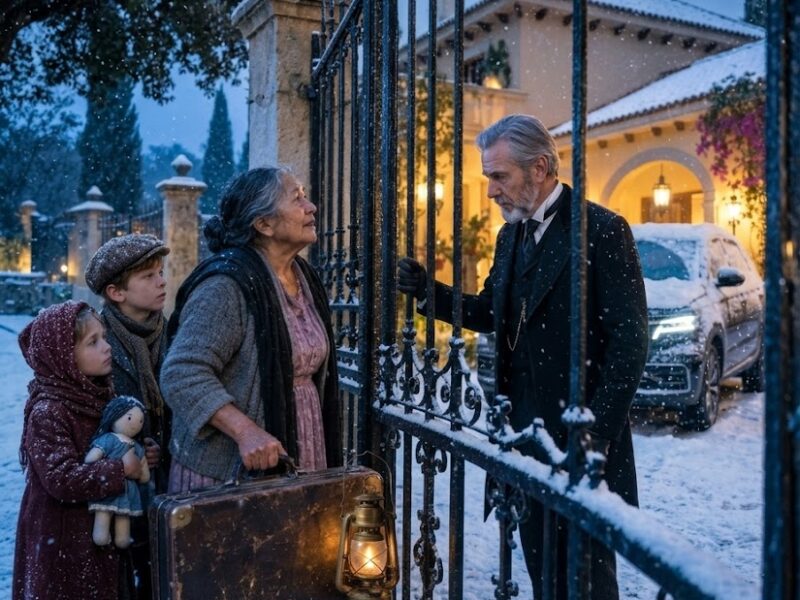
A Poor Grandmother Begged a Millionaire Widow for One Night of Shelter—By Morning, One Unexpected Discovery Had Changed Both Their Lives Forever
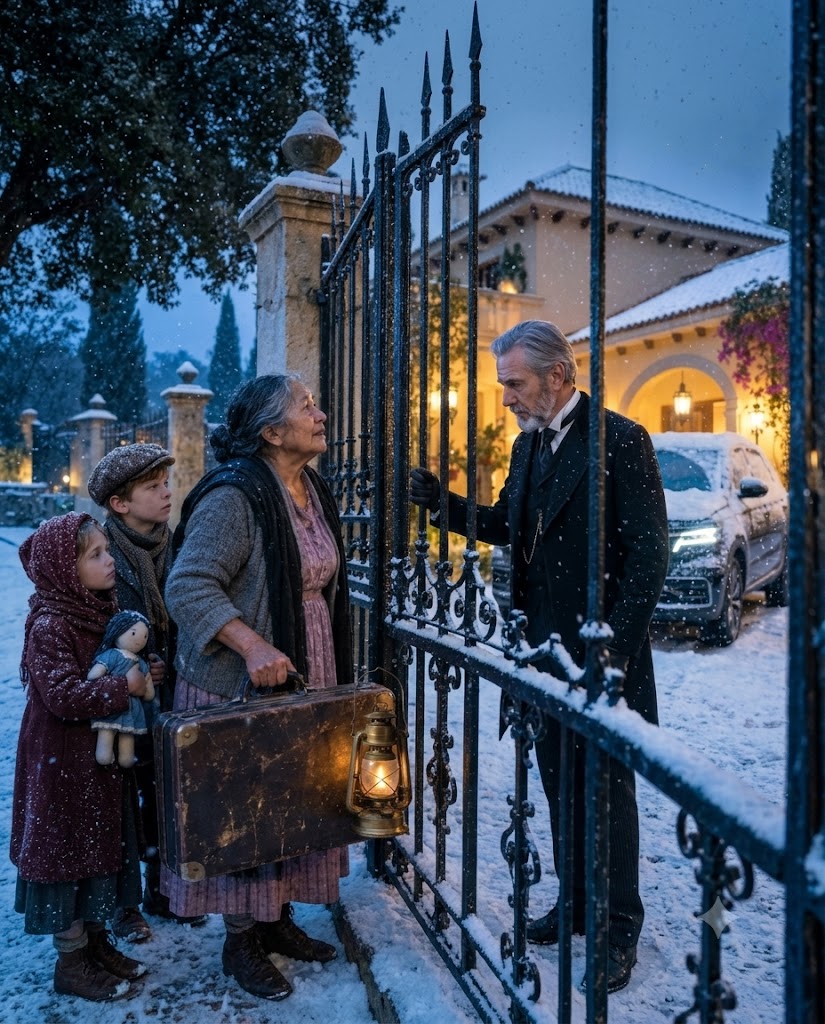
The wind off Lake Michigan didn’t just blow—it bit. Thomas pressed his sister Clara against his side and watched his grandmother’s breath turn to fog.
Her knit gloves were soaked through, her coat thin as a bedsheet, and the snow had already swallowed the sidewalk behind them.
“Grandma, is that where we’re going?” Thomas asked, pointing at the huge stone house on the corner.
“Yes, Thomas. Keep your sister close.”
Clara’s lips were pale blue. “Grandma, I can’t feel my fingers.”
“Put your hands inside your sleeves, child. We’re nearly there. I can see the front door.”
But the door was stuck. The brass handle wouldn’t budge, and Thomas’s small hands slipped on the ice.
“Try the handle slowly,” Grandma said. “Don’t hurt your fingers.”
“Grandma, is there anything left to eat?”
“Only a little bread, my dear. We’ll share it.”
“You can have my piece. What if he sends us away?”
“Then we’ll ask him to hear us first.”
Clara grabbed the hem of Grandma’s coat. “Please don’t leave us.”
“Never, child.”
The porch light snapped on. A woman in a cashmere robe opened the door just wide enough to show a sliver of a warm hallway.
“At this hour? In a storm like this?”
“Please, ma’am. My grandma is very cold.”
“Who are you? Why out in this storm?”
“Nowhere else to go,” Grandma said. “We don’t need much, just somewhere warm.”
The woman looked at the three of them—Grandma’s soaked shoes, Clara’s shivering shoulders, Thomas’s cracked lips—and stepped aside. “Come inside quickly before the cold takes your strength.”
The warmth hit them like a wave. Clara held her fingers up to the lamp and laughed, a small, cracked sound.
“It’s warm in here. I can feel my fingers again.”
“Close the door, young man. Let’s keep the warmth inside.” The woman turned to Grandma. “Madam, are you afraid of something?”
“I don’t want to bring trouble into your home.”
“You have brought snow through the door, not trouble. Sit down before your legs give way.”
“You’ve already done more than we expected.”
“Grandma hasn’t sat down all day,” Clara said. Then, quieter, “Grandma hasn’t sat down all day.”
The woman noticed the single canvas bag by Thomas’s feet. “Is that all you brought with you?”
“Everything we own fits inside,” Grandma said. “There was bread this morning, but we shared the last piece.”
“A warm house is no use to hungry children.” The woman disappeared into the kitchen and returned with a tray: sliced apples, buttered rolls, a bowl of soup. “Are these really for us?”
“Every apple, every slice. You don’t need to ask twice.”
“Thank you, ma’am. I’ll pay you back when I grow up.”
“You can repay me by growing into a kind man.”
Clara bit into an apple and her eyes went wide. “It’s the best apple I’ve ever tasted. Grandma, you eat first.”
“You need it more than I do.”
“You walked farther than all of us.”
Grandma smiled and broke the last roll into three. “Then there is enough for everyone.”
The woman introduced herself as Agnes Blackwood. The name landed like a strange weight in the warm room.
“Agnes, forgive me, but why did you come to my house?”
“Because this was the last door I could knock on. My husband told me something years ago.”
“What did he tell you?”
“He said that if winter ever left us with nothing, I should find the Blackwood mansion.”
“Blackwood? What was your husband’s name?”
“Samuel Whitmore.”
The woman’s hand froze around her teacup. “I haven’t heard that name in twenty years.”
“Then you knew him?”
“There was a man who helped my father when our family had almost nothing.”
“Samuel never spoke of it.”
“This is my father standing beside Samuel.” She pulled a framed photograph from the mantel. Two men stood in front of a storefront, young and grinning. “That is my husband. He was younger than you are now.”
Grandma touched the glass. “He saved my father’s business, and we never forgot him. My father promised Samuel that his family would never be abandoned.”
“Promises are easy when everyone is alive.”
“My father died before he could keep that promise.”
“And you? What will you do?”
“You will not leave this house tonight.”
“We cannot ask you to feed us forever.”
“I’m not asking you to stay forever. I’m asking you to survive this winter.”
Clara tugged at Agnes’s sleeve. “Can we really stay?”
“Tonight, you are safe.” Agnes nodded toward the staircase. “Take your time. These stairs are old.”
Thomas climbed first, counting each step. “We haven’t seen a house this grand in years. Grandma, does anyone live upstairs?”
“Not anymore.”
At the landing, Thomas pointed at a door with a heavy brass lock. “Sir—ma’am, why is that door locked?”
“That room belonged to my father.”
“Can we see inside?”
“Not tonight, son. The children can sleep here. I’ll have fresh water brought up.”
“One bed is enough,” Grandma said. “They can share.”
“There are two beds and both are theirs.”
Clara’s voice was tiny. “Will you send us away in the morning?”
“No one will send you into a snowstorm from this house.”
“Even if we have no money?”
“Especially then.”
Grandma waited until the children were tucked under two quilts. Then she stood in the hallway, her hand on the banister.
“Mr. Blackwood—Agnes, I must ask you one thing.”
“Ask me.”
“Please promise the children won’t be separated.”
“I give you my word. They will stay together.”
“Then I can sleep tonight.”
But Agnes didn’t sleep. She stood outside her father’s study, keys cold in her palm, and listened to the wind. Twenty years of silence pressed against the locked door.
Her son, Edward, appeared at the top of the stairs. “Father, what else did you promise him? This cannot be the whole story.”
“Samuel’s family was supposed to receive the land outside the northern village, but the transfer was never completed.”
“Does Agnes know what she has lost?”
“Did Samuel ever tell you about land near the northern village?”
“Why are you asking me that now?”
“Did your husband ever mention a promise made by my father?”
Grandma’s voice came from the guest room doorway. “My father wrote that your family received land.”
“Samuel died believing that promise had been forgotten.”
Edward stepped closer. “What do you mean, forgotten?”
“The northern estate is granted to Samuel Whitmore. I found the record in my father’s study. But the final seal is missing.”
Grandma’s hand went to her chest. “Does that mean we belong somewhere?”
“It means this promise was never meant to be forgotten. There should be an official signature here.”
“Then someone stopped the promise from becoming real.”
“Or someone hid the final document. Here—the northern estate was recorded for Samuel’s family.”
“Then why did we lose everything?”
“Because this record says the transfer was deliberately halted. He witnessed the transfer.”
“Samuel said he handled the estate papers.”
“Did your husband trust him?”
“Before everything was taken from us.”
“Then we must discover what he did.”
Agnes unlocked the study. The smell of old paper and cold ash rose from the desk. She opened a folder sealed with red wax.
“This folder has my father’s seal. The northern estate is granted to Samuel Whitmore.”
“Then why was our family left homeless?”
“The final seal is missing.”
“Can you finish it now?”
“First, I must learn who stopped it. Silas Crow signed this note.”
“Then he knew the transfer existed.”
“He may have known exactly why it was stopped. There is an address here. Crow’s office, Millbrook Village.”
“That village is only a few miles from where Samuel worked.”
“Could Silas still live there?”
“This address is twenty years old. We cannot assume anything.”
“But will you help us find the truth?”
“I give you my word. Tomorrow, I will send for the estate records.”
The storm howled all night. Just before dawn, someone pounded on the front door.
Edward grabbed a flashlight. “Who would come in this storm?”
“I was expecting no one,” Agnes said.
“Stay here. I’ll see who it is.” He cracked the door. “Who is there?”
“I have business concerning the Whitmore family.”
“How do you know that name?”
“Because someone should have told you the truth years ago.”
Agnes stepped into the hall. “Silas Crow?”
“You remember my name.”
“I found it in my father’s records.”
“Then you have found the papers, too.”
“How did you know?”
“Because I have been searching for them since Samuel died.”
Grandma appeared at the top of the stairs. “Silas Crow. After all these years? Why did you let Samuel’s family suffer?”
“I never wanted that to happen.”
“Then why did we lose our home?”
“Because I made a terrible mistake, and someone powerful made sure I could never correct it.”
“Who?”
“You will explain everything inside,” Agnes said.
“I will, but you must understand one thing first. The man who stopped the transfer was your husband’s closest friend. He trusted Lord Harrington most of all.”
“Harrington was my father’s business partner. And he was the last man to handle the original transfer.”
“Harrington took the seal. Why would he steal land promised to Samuel?”
“Far more than its fields.”
“What could be worth more than our home?”
“A buried fortune.”
“What fortune?”
“Old mining records and a sealed deposit belong to the northern estate.”
“Samuel never mentioned gold.”
“Because he never knew the whole truth.”
“Why tell us this now?”
“Because Harrington is dead. And I can finally speak.”
Silas spread a brittle map across the kitchen table. “This is the map Samuel was never allowed to see. This mark shows the old stone cellar beneath the estate.”
“And the fortune is there?”
“The records say the sealed deposit was hidden nearby.”
“Can you restore our family’s land?”
“If the documents are genuine, we have a chance.”
Clara climbed onto a chair. “If the land is ours, can Grandma have a proper home?”
“I will make sure you are safe, whatever we discover.”
“And we won’t be separated?”
“Never, my dear. You will stay together.”
The blizzard buried the old road by morning. They waited two days, then three. On the fourth morning, the plows broke through.
“We cannot travel to the estate in this weather,” Edward said. “The old road will be buried.”
“Then what happens now?”
“We wait for daylight, prepare supplies, and leave when it is safe.”
“You’ll come with us?”
“I will lead the journey myself. There is something else you must know. A warning I received the night the transfer disappeared. The handwriting belongs to Lord Harrington.”
“He threatened Samuel?”
“He threatened anyone who tried to expose him.”
“Why did you keep silent?” Grandma asked.
“I was afraid. I have regretted it every day.”
“Fear kept this injustice alive long enough.”
“I know. I cannot undo those years.”
“No, but you can help us put things right. Will you stand with us?”
“Until the truth is known.”
They left at first light. The carriage rocked over frozen ruts, the children bundled under three blankets. Agnes held the reins, Silas beside her with the map.
“Is this the road to our family’s land?” Thomas asked.
“It is the road to the truth. The snow has covered the old tracks.”
“We have come too far to turn back,” Grandma said.
Clara grabbed Thomas’s hand. “I’m not letting go.”
“There is room for all of you,” Agnes said.
“Samuel dreamed of seeing this truth uncovered,” Silas murmured.
“Then we will uncover it for him.”
A mile past Millbrook, Silas pulled the carriage to a stop. “Something is wrong with the road.”
“Did we lose the way?”
“Not yet, lad. Millbrook is that way, but this arrow points north. Someone wanted travelers to miss this turn.”
“The road to our land?”
“It might be. This bend matches the drawing. Your father knew this road existed, and someone tried to erase it.”
“Are we still going?”
“We have not come this far to turn back. Once we enter these woods, the road disappears. Then we follow the map, not the tracks.”
The woods swallowed them. Snow-laden pines closed overhead, and the only sound was the crunch of hooves and Clara’s soft counting.
“I can see something ahead,” Thomas said.
A stone pillar rose from the drifts, carved with a crest. “This mark belongs to my father’s estate. Then we have found the correct road.”
Beyond the hill stood a building with a slate roof and boarded windows. “There. Is that where we’re going?”
“It isn’t on the map,” Silas said.
“No, but I have seen that roof before. Lord Harrington used this place for private meetings. Why wasn’t it in the records?”
“Because he wanted it forgotten.”
“What did he hide here?”
“The evidence we came to find.”
The door was locked. Fresh scratches marked the keyhole. “Has anyone entered recently?”
“Someone has tried.”
“Could Harrington still have hidden the papers here?”
“If he did, this door may be the only thing protecting them.” Silas knelt and lifted a loose step. A key glinted in the frost. “Harrington always kept a spare beneath the step.”
“You knew this place better than you admitted.”
“I knew enough to be afraid.”
Inside, dust covered a long table. A single folder sat in the center, sealed with black wax. “This could prove everything. Don’t break the seal until you read the name.”
Agnes turned the folder over. “Samuel Whitmore. Harrington recorded the seal’s location but used a false name.”
“Can you identify it?”
“Blackthorn House, three miles north of Millbrook.”
“Will we finally find the proof?”
“We’re closer than ever.”
Clara looked up. “If we find the seal, will our family get its home back?”
“Samuel would have been grateful,” Agnes said. “Look—there’s a building beyond the hill. Blackthorn House. The private archive should be behind the east wing.”
The door was old, but the lock turned. Inside, shelves of ledgers rose to the ceiling. Silas pulled one down and opened it to a page marked with a ribbon.
“The original seal. It’s here.”
Agnes held it to the light. “The mark matches the estate papers exactly.”
“Then the truth ends here,” Grandma said.
“And our family?”
“Your family will not be forgotten again.”
The seal was genuine. The land records were restored within the month, and the northern estate returned to Samuel Whitmore’s heirs. Grandma slept in a room with a window that faced the orchard, and Clara planted tulip bulbs along the fence. Thomas kept the map folded in his coat pocket, a reminder of the road that had almost been erased.
Agnes visited every Sunday with a basket of apples.
“You can repay me by growing into a kind man,” she told Thomas, and he nodded, serious as a judge.
The stone cellar was opened in spring. The sealed deposit held enough to repair the barn and pay the taxes for a generation.
Silas Crow stayed on as caretaker, and every evening he walked the fence line, checking the locks.
One night, Grandma found Clara at the kitchen table, drawing the crest from the stone pillar. “Grandma, is that where we’re going?” she asked, pointing at the orchard.
“Yes, child. And we’re never leaving.”
The wind off the lake still bit in winter, but the house held its warmth. The door stayed open. The promise stayed kept.









