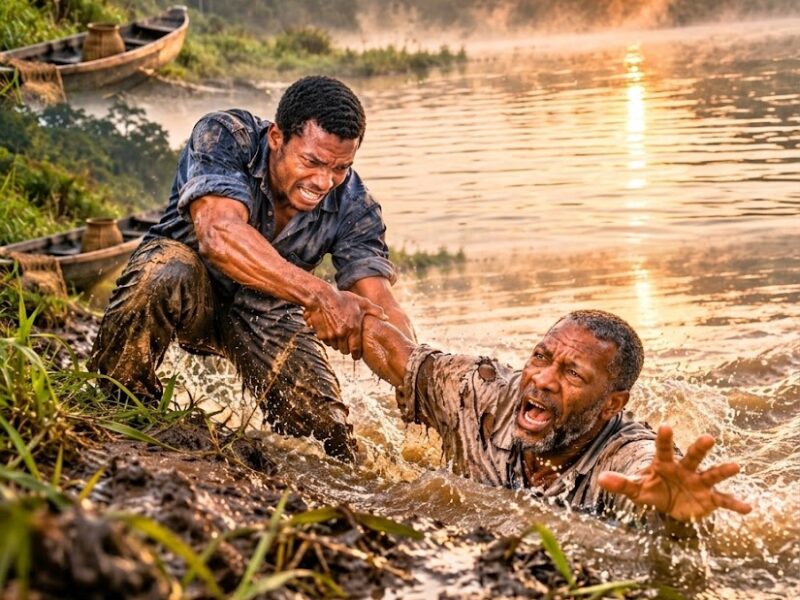
A poor fisherman pulled a dying stranger from the river. He had no idea the man he just saved was the missing shipping tycoon every police boat in the country was searching for.
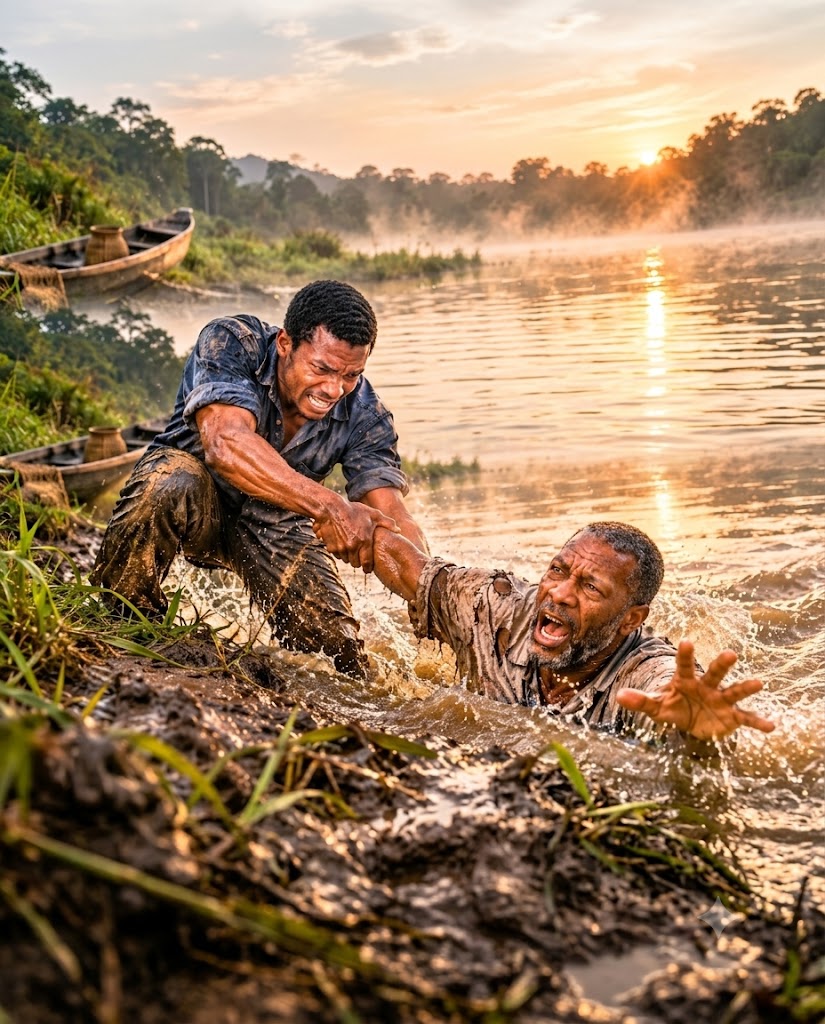
The morning fog clung to the bay like a wet blanket, and all Marcus had to show for five hours of backbreaking work were three miserable fish.
Three fish. A whole morning’s work.
He sighed and wiped the salt spray from his weathered face, squinting at the weak sun that was just now burning through the haze over Monterey Bay. His small skiff bobbed gently against the dock, the wood groaning like an old man’s knees.
“Good morning, Marcus!” called Rosa from her usual spot at the fish market stall. “Tell your wife I have fresh halibut today. Caught it myself at dawn.”
“I’ll let her know,” Marcus called back, though he knew Elena wouldn’t be buying halibut anytime soon. Not at those prices. Not with the way things had been going lately.
He was about to haul his meager catch up the dock when something caught his eye. A shape in the water, maybe fifty yards out. Dark. Motionless.
Probably just driftwood, he told himself. But something made him look again.
It wasn’t driftwood.
—
“Hey! Hey, can you hear me?”
Marcus had already cut his engine and was rowing hard toward the shape. His arms burned, but he didn’t stop. He couldn’t stop.
The man was face-down in the water, his expensive-looking suit waterlogged and dragging him under. Marcus grabbed him by the collar and hauled him into the boat with a grunt that tore through his back like a knife.
“Come on, come on,” he muttered, checking for breathing. There was none.
Marcus had learned CPR back in high school, never thinking he’d actually need it. He tilted the man’s head back, pinched his nose, and started compressions.
One. Two. Three. Four.
“Don’t you dare die on me,” Marcus growled. “Not in my boat. Not today.”
He breathed into the man’s mouth twice, then went back to compressions. The stranger’s lips were blue. His skin was cold. Marcus kept going, his own heart pounding so hard he could hear it in his ears.
Finally, the man coughed. Water spilled from his mouth, and he gasped like a man breaking the surface after being buried alive.
“That’s it,” Marcus said, relief flooding through him. “That’s it. You’re okay. I’ve got you.”
The man’s eyes fluttered open, wild and unfocused. “Where… where am I?”
“Monterey. You’re in Monterey. Just hold on. I’m getting you somewhere safe.”
—
Marcus’s small cottage sat at the end of a gravel road, half-hidden by cypress trees that had been there longer than anyone could remember. Elena was hanging laundry when she saw him carrying a stranger up the path, and the look on her face shifted from confusion to alarm in seconds.
“Marcus? Who is that? What happened?”
“Found him in the bay. Almost drowned.”
“Bring him to the shade,” Elena said, already moving. “I’ll get water. And call 911.”
“No,” the stranger croaked. “No police. Please.”
Marcus and Elena exchanged a look. But the man was shivering so hard he could barely speak, and there was no time to argue.
“Fine,” Marcus said. “But you’re going to the ER. That’s non-negotiable.”
The stranger didn’t argue. He just closed his eyes and let them lead him to a chair under the oak tree.
—
The ER doctor said the man was lucky to be alive. Dehydration, hypothermia, and a concussion from whatever had knocked him into the water.
“He needs rest,” the doctor told Marcus. “And someone to keep an eye on him. He shouldn’t be alone for the next forty-eight hours.”
“I’ll take him back to my place,” Marcus said, surprising himself. He had no idea why he was doing this. The man was a stranger. He could be anyone. He could be trouble.
But Marcus remembered what it felt like to be alone. To have no one. He remembered the year he’d spent on the streets after his father died, when he was just a teenager, before Elena’s family had taken him in.
No one had helped him then. He hadn’t forgotten that.
—
“What’s your name?” Marcus asked as he helped the man into the passenger seat of his beat-up truck.
The man opened his mouth, then closed it. A strange look crossed his face. “I… I don’t know.”
“You don’t know your own name?”
“I remember… I remember water. And cold. And then nothing.” He touched his temple and winced. “It’s like there’s a wall there. I can feel things behind it, but I can’t reach them.”
“Head trauma,” Marcus muttered. “The doctor said it might take time.”
“What if it doesn’t come back?”
Marcus had no answer for that. He just started the engine and drove.
—
The village—as they called their small neighborhood on the outskirts of Monterey—was a tight-knit community of fishermen and their families. Word traveled fast, and by the time Marcus pulled into his driveway, half the street knew he’d pulled a stranger from the bay.
Mostly, people were kind. They brought food, blankets, offers to help. But not everyone.
Marcus’s uncle, a bitter man named Walter who had never forgiven Marcus for inheriting his father’s boat instead of him, showed up on the second day with fire in his eyes.
“I heard you brought a stranger into our village,” Walter said, standing in the doorway like he owned the place. “Who gave you permission?”
“He was drowning, Uncle. What was I supposed to do? Leave him?”
“A man like this brings nothing but trouble. You don’t know who he is. You don’t know what he’s running from. He should go back to the river.”
The stranger, who had been resting on the couch, sat up slowly. “Please,” he said, his voice still hoarse. “I mean no harm to anyone. I just need time to remember.”
“He stays,” Elena said, stepping between them. “This is our house, Walter. Not yours. And you don’t get to decide who we help.”
Walter’s face twisted with rage. “You’ll regret choosing him over your own family. Mark my words.”
He stormed out, slamming the door hard enough to rattle the windows.
“I’m sorry,” the stranger said quietly. “I don’t want to cause problems between you and your family.”
“You’re not the problem,” Marcus said. “He is. And he’s been that way long before you showed up.”
—
Days turned into weeks. The stranger’s memory didn’t return, but his strength did. He insisted on earning his keep, helping Marcus with the boat, learning to mend nets, even joining him on early morning fishing trips.
“You don’t have to do this,” Marcus told him one morning as they hauled in a decent catch. “You’re a guest.”
“I don’t want to be a guest,” the man said. “I want to be useful. I want to feel like I’m… I don’t know. Like I’m someone.”
Marcus understood that. Better than he wanted to admit.
“You’re someone,” he said. “We just don’t know who yet.”
The man laughed—the first real laugh Marcus had heard from him. “That’s either very comforting or very terrifying. I haven’t decided which.”
“Welcome to my life.”
They worked in comfortable silence for a while, the only sounds the creak of the boat and the cry of gulls overhead. Then the stranger spoke again.
“I keep having dreams,” he said. “Faces I don’t recognize. Places I’ve never been. And there’s always… there’s always a ring. A gold ring with a crown over two crossed anchors.”
Marcus frowned. “A crown over crossed anchors? That sounds familiar.”
“Does it?”
“I don’t know. Maybe I’ve seen it somewhere. A logo or something.”
The stranger’s eyes lit up with something like hope. “If you remember anything, will you tell me?”
“Of course.”
—
That night, Marcus couldn’t sleep. The image of the ring nagged at him, pulling at threads of memory he couldn’t quite grasp.
He got up and went to the small desk in the corner of the bedroom, careful not to wake Elena. He pulled out his old laptop—a relic from a decade ago that still somehow worked—and typed into the search bar.
“Crown over crossed anchors.”
The results made his blood run cold.
—
“Elena,” he whispered, shaking her awake. “Elena, wake up.”
“What? What’s wrong?”
“I know who he is. Or at least… I know who he might be.”
She sat up, rubbing her eyes. “What are you talking about?”
Marcus turned the laptop toward her. On the screen was a news article from six months ago, the headline screaming in bold letters:
**SHIPPING TYCOON CHINEDU OKAFOR PRESUMED DEAD AFTER YACHT ACCIDENT**
Below the headline was a photo of a man who looked exactly like the stranger sleeping on their couch.
—
## Part 2
—
Elena stared at the screen for a long moment, her face unreadable.
“Chinedu Okafor,” she read aloud. “Owner of Okafor Shipping International. Net worth… oh my God, Marcus. This can’t be right.”
“It’s him. Look at the photo. It’s the same man.”
“But what was he doing in the bay? The article says his yacht went down off the coast of Santa Cruz. That’s hours from here.”
Marcus scrolled down, his heart pounding. “It says he was declared dead after a three-week search. His family held a memorial service. His uncle took over the company.”
“His uncle?”
“Walter.” Marcus felt sick. “The article says his uncle, Walter Okafor, was named interim CEO pending a formal investigation.”
Elena’s hand flew to her mouth. “Marcus. Do you think…”
“I don’t know what I think. But we need to tell him. He deserves to know who he is.”
—
They woke the stranger—Chinedu, if that’s who he really was—and showed him the article.
He stared at the screen for a long time, his expression shifting from confusion to shock to something that looked almost like recognition.
“Chinedu,” he said slowly, testing the name on his tongue. “That’s… that’s me. I think that’s me.”
“You remember?”
“Not exactly. But it feels… right. Like a word you forgot you knew.” He touched his temple again, that same gesture he always made when trying to reach through the wall in his mind. “There’s more there. I can feel it. But it’s like trying to grab smoke.”
“The article says your uncle took over your company,” Marcus said carefully. “Walter Okafor.”
Chinedu’s face darkened. “Walter. Yes. I remember him. He was always… jealous. Always wanted what I had.”
“Do you think he had something to do with what happened to you?”
“I don’t know. But I wouldn’t put it past him.”
—
The next morning, Marcus drove to the harbor market. He had a plan, and it was probably a stupid one, but he couldn’t think of anything better.
He found a vendor who sold nautical antiques and asked if he’d ever seen a crest like the one Chinedu described.
“A crown over crossed anchors?” The vendor, an old man with a white beard and knowing eyes, nodded slowly. “That’s the Okafor family crest. Old shipping family from Lagos. Been around for generations.”
“Do you know anything about them?”
“Only what I read in the news. The old man died a few years back—heart attack, I think. Left everything to his son, Chinedu. But then Chinedu died in that boating accident. Terrible tragedy.”
“And now?”
The vendor shrugged. “Now his uncle runs things. Walter something. Can’t say I’ve heard anything good about him.”
Marcus thanked him and headed back to the truck. His mind was racing.
If Chinedu was really the missing shipping tycoon, and if his uncle had tried to kill him… then bringing him back from the dead could be dangerous. For everyone.
—
When Marcus got home, he found Chinedu in the backyard, staring at the ocean.
“We need to talk,” Marcus said. “And you’re not going to like what I have to say.”
Chinedu turned, his expression guarded. “What did you find?”
“Your uncle. Walter. He’s been running your company since you disappeared. And from what I’ve heard, he’s not exactly heartbroken about your death.”
“I remember him,” Chinedu said quietly. “Not everything. But enough. He was always… cold. Calculating. He wanted my father’s approval more than anything, but he never got it. My father saw through him.”
“Do you think he tried to kill you?”
Chinedu was silent for a long moment. “I think… I think I remember being on the yacht. It was night. There was a storm. And then someone was there. Someone I trusted.”
He closed his eyes, his face contorted with the effort of remembering.
“He pushed me. I remember falling. The water was so cold. And then… nothing.”
“Your uncle.”
“I don’t know. Maybe. But someone wanted me dead. That much I’m sure of.”
—
“We need to go to the police,” Elena said when they told her. “This is attempted murder.”
“We can’t prove anything,” Marcus argued. “And if we go to the police and we’re wrong, we’ve just told a powerful man exactly where his missing nephew is.”
“So what do we do? Just hide him forever?”
“I don’t know. But we need a plan.”
Chinedu spoke up. “I need to go back. To my company. To my life. If Walter did this, I need to prove it. And I can’t do that from here.”
“Are you insane? He’ll kill you the moment he sees you.”
“He won’t. Not if I’m careful. Not if I have proof.” He looked at Marcus. “I need your help. I can’t do this alone.”
Marcus wanted to say no. He wanted to tell Chinedu to go to the police and let them handle it. But he looked at the man who had become his friend over the past few weeks, and he knew he couldn’t turn his back.
“What’s the plan?”
—
The plan was simple, which meant it was probably going to fail spectacularly.
Chinedu would return to Lagos—to his company, to his uncle—and pretend he had no memory of what had happened. He would claim he’d been rescued by a passing boat and had been recovering in a hospital, unable to remember anything until recently.
“I’ll tell them I have amnesia,” he explained. “That I only just remembered who I was. Walter will have to act surprised. He’ll have to pretend to be happy to see me. And then he’ll make a mistake.”
“What kind of mistake?”
“He’ll try to kill me again. And this time, I’ll be ready.”
Marcus shook his head. “This is a terrible plan.”
“Then help me make it better.”
—
They spent the next three days preparing. Marcus used his meager savings to buy Chinedu a decent suit and a plane ticket to Lagos. Elena packed food and first-aid supplies, her face tight with worry.
“You don’t have to do this,” she told Chinedu. “You could just disappear. Start a new life somewhere.”
“I could,” he agreed. “But that’s not who I am. I have a daughter. A company. People who depend on me. I can’t just walk away.”
“You have a daughter?”
Chinedu nodded, his eyes distant. “Amara. She’s twelve. She lives with her mother in London. I haven’t seen her in… I don’t know how long. But I remember her. I remember her laugh. I remember the way she used to run to me when I came home.”
His voice cracked. “I have to get back to her. I have to make sure she’s safe.”
—
The night before Chinedu was supposed to leave, Marcus couldn’t sleep. He sat on the porch, staring at the stars, his mind churning with doubts and fears.
“You should be sleeping,” Chinedu said, stepping out onto the porch. “It’s late.”
“So should you.”
They sat in silence for a while, listening to the waves crash against the shore.
“I never thanked you,” Chinedu said finally. “For saving my life. For everything.”
“You don’t have to thank me.”
“I do. You didn’t have to help me. You didn’t have to take me in. But you did. And now you’re risking everything to help me get my life back.” He paused. “Why?”
Marcus thought about it. “Because I know what it’s like to have nothing. To be nobody. And I know what it’s like when someone offers you a hand and pulls you up.” He looked at Chinedu. “I’m just paying it forward.”
“Paying it forward,” Chinedu repeated. “I like that.”
They sat in comfortable silence for a while longer, then Chinedu stood.
“I should get some rest. Tomorrow’s going to be a long day.”
“Chinedu?”
He turned. “Yes?”
“Be careful. Don’t trust anyone. Not even me.”
Chinedu smiled—a real smile, the first one Marcus had seen since this whole thing started. “I trust you, Marcus. More than anyone I’ve ever met.”
Then he went inside, and Marcus was left alone with the stars and the waves and the weight of what they were about to do.
—
## Part 3
—
The airport was crowded when Marcus dropped Chinedu off, full of families and businessmen and tourists heading to places Marcus would probably never see.
“Last chance to back out,” Marcus said as they stood outside the terminal.
“Are you trying to talk me out of it?”
“Maybe.”
Chinedu shook his head. “I have to do this. For my daughter. For myself. For everyone Walter has hurt.”
Marcus nodded. He understood. He didn’t like it, but he understood.
“Call me when you land. And keep your head down. Don’t trust anyone.”
“I know.”
“And Chinedu?”
“Yeah?”
Marcus pulled something from his pocket—a small, worn silver ring that had belonged to his father. “Take this. For luck.”
Chinedu stared at the ring, then at Marcus. “I can’t take this. It’s yours.”
“It’s just a ring. And you need luck more than I do.”
Chinedu slipped it on his finger, his eyes wet. “Thank you. For everything.”
“Don’t thank me yet. Thank me when this is over.”
They clasped hands, and then Chinedu turned and walked into the terminal, disappearing into the crowd.
Marcus stood there for a long time, watching the planes take off and land, wondering if he’d just sent his friend to his death.
—
The first call came three days later.
“I’m alive,” Chinedu said, his voice strained. “And I’m in.”
“Where are you?”
“My old office. It’s… strange. Everything looks the same, but it feels different. Like I’m a ghost haunting my own life.”
“How did Walter take it?”
“He pretended to be overjoyed. Cried. Hugged me. Said he’d been praying for this day.” Chinedu’s voice turned bitter. “He’s a better actor than I thought.”
“Be careful. He’s going to try something.”
“I know. I’m ready.”
“What’s your next move?”
“I’m going through my old files. Meeting with my old contacts. Trying to find proof of what Walter did. It’s slow going, but I’m making progress.”
“Just remember—don’t trust anyone. Not even the people who were loyal to you before. They might have been bought.”
“I know. But some of them… some of them I trust. Like my assistant, Ngozi. She’s been with me for ten years. She’s the one who helped me get back into the building without Walter knowing.”
“Ngozi. Can you trust her?”
“I think so. She cried when she saw me. Real tears. Not like Walter.”
“Just be careful. Please.”
“I will. I have to go. I’ll call you soon.”
The line went dead, and Marcus was left staring at his phone, his heart pounding with worry.
—
The second call came a week later, and it was not good news.
“Walter knows,” Chinedu said, his voice tight with panic. “He found out I’ve been going through the files. He’s trying to have me removed from the company. Claims I’m mentally unstable, that my amnesia has made me unfit to lead.”
“Can he do that?”
“He’s trying. He’s called a board meeting for tomorrow. He’s going to try to get me declared incompetent.”
“What are you going to do?”
“I have proof. The financial records. The emails. He was embezzling from the company for years. And I have evidence that he hired someone to sabotage my yacht.”
“Wait—you have proof he tried to kill you?”
“I have proof he paid someone. The man who pushed me overboard. I found him. He’s willing to testify.”
Marcus exhaled. “That’s… that’s huge. You can take that to the police.”
“I am. But first, I’m going to confront Walter at the board meeting. In front of everyone. I want to see his face when he realizes he’s lost.”
“Chinedu, that’s dangerous. He might—”
“I know. But this is my company. My life. I’m not going to let him take it from me.”
“Just… just be careful. And call me when it’s over.”
“I will. I promise.”
—
The call didn’t come.
Marcus waited all day, his phone in his hand, his heart in his throat. He tried calling Chinedu’s number, but it went straight to voicemail.
Elena tried to comfort him. “He’s probably just busy. The board meeting, the police, all of it. He’ll call when he can.”
But Marcus knew something was wrong. He could feel it in his bones.
The next morning, he turned on the news, and his worst fears were confirmed.
**SHIPPING TYCOON CHINEDU OKAFOR ARRESTED FOR FRAUD AND EMBEZZLEMENT**
Marcus stared at the screen, his blood running cold. The reporter was saying something about forged documents, about false claims, about a man who had been “unstable” since his accident.
Walter had turned the tables. He’d painted Chinedu as the criminal, not the victim.
And now Chinedu was in jail, waiting for a trial that could send him away for years.
—
## Part 4
—
“I have to go,” Marcus said, throwing clothes into a duffel bag.
“Go where? Marcus, you can’t just—”
“I have to. He’s my friend, Elena. And he’s in trouble. I can’t just sit here and do nothing.”
“But what can you do? You’re a fisherman. You don’t know anything about law or business or—”
“I know how to tell the truth. And I know how to fight for what’s right.” He zipped the bag and turned to her. “I saved his life once. I’m not going to let him lose it now.”
Elena stared at him for a long moment, then sighed. “You’re impossible, you know that?”
“I know.”
She pulled him into a hug. “Come back to me. Both of you.”
“I will. I promise.”
—
The flight to Lagos was long and uncomfortable, and Marcus spent most of it staring out the window, his mind racing.
He didn’t have a plan. He didn’t have any evidence. All he had was the truth and the desperate hope that it would be enough.
When he landed, he took a taxi to the police station where Chinedu was being held. He had to wait hours to see him, and when he finally did, his heart broke.
Chinedu looked terrible. His suit was wrinkled, his eyes were bloodshot, and there was a bruise on his cheek that hadn’t been there before.
“Marcus?” He looked up, disbelief in his eyes. “What are you doing here?”
“I came to help.”
“You shouldn’t have. It’s dangerous. Walter has connections everywhere.”
“I don’t care. You’re my friend. And I’m not going to let him win.”
Chinedu shook his head, a bitter smile on his lips. “You’re either the bravest man I’ve ever met or the stupidest.”
“Probably both.”
—
They talked for an hour, and Chinedu filled Marcus in on what had happened.
Walter had been planning this for years. He’d been embezzling money, falsifying records, building a case against Chinedu in case he ever came back. And when Chinedu had shown up, seemingly with no memory, Walter had seen his chance.
“He claimed I was an impostor,” Chinedu said. “Said I was a con man pretending to be his nephew. He had documents, witnesses, everything.”
“But you have proof he tried to kill you.”
“I did. But the man I found—the one who pushed me—he disappeared. Walter got to him first.”
“So what do we do?”
Chinedu was silent for a moment. “There’s one person who can help us. My daughter. Amara. She’s the only one Walter can’t control. She has access to the family trust. She can prove who I am.”
“Where is she?”
“London. With her mother. But Walter has people watching them. If I try to contact her, he’ll know.”
“Then I’ll go. I’ll find her. I’ll bring her here.”
Chinedu looked at him, his eyes wet. “You would do that for me?”
“I told you. I’m not going to let him win.”
—
Marcus flew to London the next day, armed with nothing but a photograph of Chinedu and a desperate hope.
He found Amara’s school easily enough—an exclusive private academy in the heart of the city. But getting to her was another matter.
He waited outside the gates for hours, watching the students pour out at the end of the day. And then he saw her—a tall girl with her father’s eyes and her mother’s smile, surrounded by friends.
“Amara!” he called. “Amara Okafor!”
She turned, her face confused. “Who are you?”
“I’m a friend of your father’s. He sent me.”
Her face went pale. “My father is dead.”
“No. He’s alive. And he needs your help.”
—
Amara’s mother was skeptical at first. But when Marcus showed her the photograph—when he told her the whole story—she agreed to let Amara come with him.
“If this is true,” she said, “if Chinedu is really alive… then Walter has a lot to answer for.”
“He does. And we’re going to make sure he does.”
—
The flight back to Lagos was tense. Amara was quiet, her eyes distant, and Marcus could only imagine what she was feeling.
“You don’t have to do this,” he told her. “If you’re not ready.”
“He’s my father,” she said simply. “I have to.”
—
The courtroom was packed when they arrived. Walter was there, smug and confident, surrounded by lawyers. Chinedu sat alone, his head bowed.
And then Amara walked in.
“Dad?”
Chinedu looked up, and his face transformed. “Amara? Amara!”
He tried to stand, but the guards held him back. Amara ran to him, throwing her arms around him, and the whole courtroom fell silent.
“It’s him,” she said, her voice clear and strong. “This is my father. I’d know him anywhere.”
Walter’s face went white.
—
## Part 5
—
The trial lasted three days, but the verdict was never really in doubt.
Amara’s testimony was the turning point. She identified her father with absolute certainty, and she provided documents from the family trust that proved Walter had been embezzling for years.
“I knew something was wrong,” she testified. “My father would never have done the things Uncle Walter accused him of. He was always honest. Always kind. That’s why I knew—when I saw him in that courtroom—that he was innocent.”
The jury deliberated for less than an hour.
Walter was convicted on all counts—embezzlement, fraud, and attempted murder. He was sentenced to twenty-five years in federal prison.
And Chinedu was free.
—
The day Chinedu was released, Marcus was there to meet him. They stood outside the courthouse, the sun shining down on them, and for a long moment, neither of them spoke.
“You did it,” Marcus said finally. “You got your life back.”
“We did it,” Chinedu corrected. “I couldn’t have done any of this without you.”
“You would have figured something out.”
“Maybe. But I’m glad I didn’t have to.”
They clasped hands, and then Chinedu pulled Marcus into a hug.
“You’re a good man, Marcus. The best I’ve ever known.”
“I’m just a fisherman.”
“No. You’re a hero. And I’m going to spend the rest of my life trying to repay you.”
—
Chinedu offered Marcus a job—a position in his company, a salary that would have made Marcus’s head spin. But Marcus declined.
“I’m not made for that world,” he said. “I’m made for the ocean. For the early mornings and the salt air and the simple life.”
“I understand,” Chinedu said. “But you’ll always have a place in my family. Always.”
They stayed in touch. Chinedu visited Monterey every year, bringing Amara with him. They would fish together, just like old times, and Chinedu would tell Marcus about his latest adventures in the shipping world.
And every time, Marcus would smile and say the same thing:
“Three fish for a whole morning’s work. Good morning. Tell your wife I have fresh fish today.”
And Chinedu would laugh, remembering the day he’d been pulled from the river—the day a poor fisherman had saved his life and changed both of their destinies forever.
—
Let this be a lesson to every soul in this village.
Kindness given in secret never truly goes unnoticed.
—
**THE END**









