A paralyzed Navy SEAL begged, “Can you please help me?” — and everyone walked past him until one nurse finally stopped.
## Part 1
The first thing the Navy SEAL said wasn’t “I’m a veteran.” It wasn’t “I’m a commander.” It wasn’t even his name.
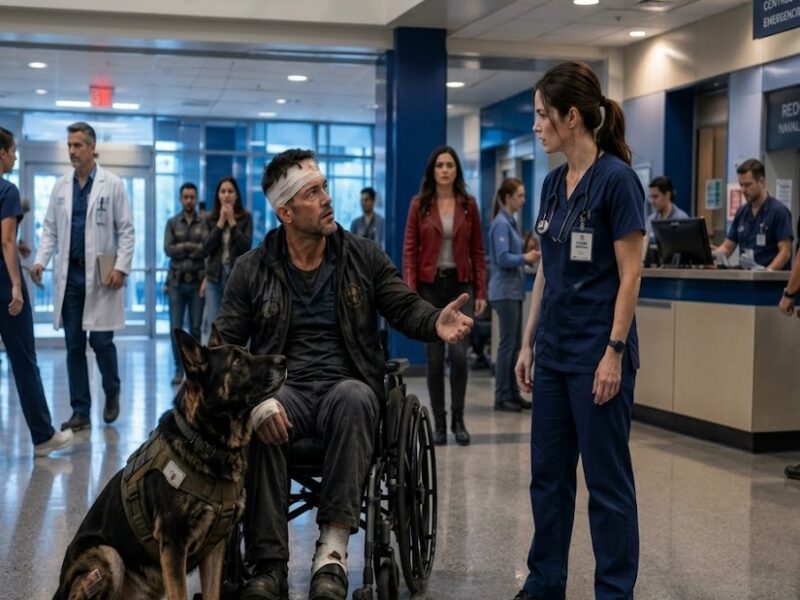
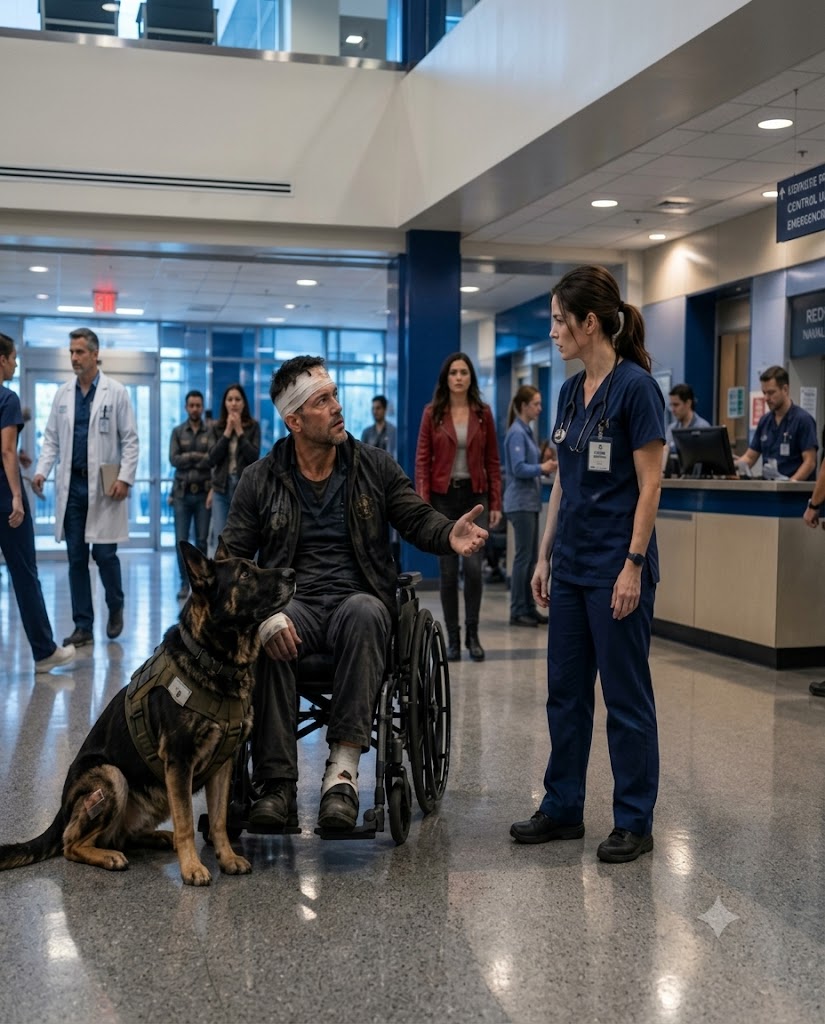
He simply looked toward the crowded nurses’ station, swallowed hard, and said, “Can you please help me?”
Nobody answered. A receptionist glanced up from her computer screen at Redwood Point Naval Medical Center, her fingers still moving over the keyboard. A nurse looked over her shoulder briefly, then returned to the medication cart she was pushing. A doctor passed through the lobby carrying a tablet, his eyes fixed on the screen, his white coat billowing behind him.
Then everyone kept moving. The man remained where he was, alone in his wheelchair, his hands resting against the rims. His face carried the controlled exhaustion of someone who had spent years teaching himself not to ask for anything.
Beside him sat his military working dog, a large black and tan German Shepherd. One front shoulder had a shallow scrape. There was another small abrasion beneath the edge of his olive drab harness.
The dog was tired, too, but he never moved more than a foot away from his handler. The SEAL looked toward the nurses’ station a second time. His voice was quieter now.
“Please.”
Still nothing. The lobby hummed with the ordinary sounds of a Thursday morning—phones ringing, elevators chiming, the distant beep of monitors from the emergency department. Nobody noticed the man who had once carried a nation’s weight on his shoulders.
Then a nurse walking through the emergency lobby suddenly stopped. She looked at the veteran, then at the dog, then at the way the man’s fingers were struggling against the wheelchair rim. She turned around and walked back.
What she didn’t know yet was that the two people sitting in front of her were connected by a military history the hospital had failed to notice. And one detail beneath that dog’s harness was about to force the entire hospital to ask a question nobody expected.
Why had this SEAL and his K9 been treated like strangers when someone had specifically ordered that they should never be separated?
Before we get into why this one nurse stopped when everyone else walked past, tell us where you’re watching from in the comments. We’d love to see how far these stories travel. And if you enjoy emotional military K9 stories, subscribe and stay with us.
It was 8:17 on a Thursday morning at Redwood Point Naval Medical Center in San Diego, California. The lobby was busy enough that people had stopped noticing one another.
Patients waited beneath a large hospital directory that listed departments in tiny white letters against a blue background. Family members stood near the coffee station, clutching paper cups and staring at their phones. A rehabilitation volunteer pushed two wheelchairs toward the elevators, her sneakers squeaking against the polished floor.
Phones rang at the reception desk. A television mounted above the waiting area displayed the day’s hospital schedule along with a continuous loop of health and safety announcements. And near a blue support pillar, sat Lieutenant Commander Owen Mercer, 44 years old, former Navy SEAL.
Broad shoulders. Powerful arms. Short dark hair threaded with gray. Weathered face. Deep-set brown eyes that had seen things most people only read about in books.
He wore a dark navy veteran jacket over a gray shirt. His wheelchair was modern, rugged, and obviously customized for someone who used it every day. He didn’t look helpless.
That was important. He looked like a man who had spent years learning exactly how to manage the things his body could still do.
But this morning, something was wrong. His right forearm had gone numb after the long drive from his home in Oceanside. His hands were trembling slightly. His transfer board was still strapped to the back of his chair, and he was exhausted.
Beside him sat Bruno, six years old, black and tan German Shepherd. Strong chest. Slightly graying muzzle. Dark intelligent eyes. Military K9 harness. Worn identification tag that clinked softly whenever he moved.
Bruno had been Owen’s working partner before Owen’s spinal injury. After the injury, Bruno had stayed with him. He was no longer deployed as a field K9. His role had changed.
He now helped Owen retrieve dropped items, alert him to obstacles, assist with doors, and stay close during transfers. Owen called him partner. Bruno had never needed a different name.
That morning, both had arrived for a rehabilitation appointment. Neither had been seen.
Owen had been told to wait, then told to ask another desk, then told someone would come. Nobody had. At 7:50, Owen had asked a receptionist for directions. At 8:00, he had asked a volunteer. At 8:08, he had tried to move himself toward the elevator.
At 8:12, he had returned to the lobby because the rehabilitation office was temporarily closed between appointments. By 8:17, he had stopped asking until he couldn’t ignore Bruno’s condition anymore.
The dog had a scrape across the front of his right shoulder. Another small abrasion sat beneath the harness. Nothing dramatic. But Bruno had been favoring his rear leg since the night before.
Owen could feel it in the way the dog shifted weight when standing. He couldn’t inspect the area properly from his chair. He needed help, so he asked, and nobody came.
A nurse in blue scrubs finally approached. Her name was Clare Rowan, 36 years old, dark brown hair tied into a low ponytail. Hazel eyes. Slim, practical build. Black stethoscope. White hospital badge that identified her as a registered nurse in the rehabilitation department.
She had been working at Redwood Point for five years. Clare wasn’t the loudest nurse in the department. She wasn’t the kind who dominated a room.
She was the kind who noticed when a monitor sounded slightly different. When a patient stopped making eye contact. When someone said “I’m fine” too quickly.
She stopped in front of Owen. “Hi.”
Owen looked up. “Hi.”
She looked toward Bruno. “Is he the patient?”
Owen gave a tired smile. “Today, probably.”
Clare almost smiled. “What’s his name?”
“Bruno.”
The dog looked at her. Clare did not immediately reach for him. “Hi, Bruno.”
His ears moved. She waited. He sniffed the air, then looked back at Owen. Clare noticed that.
“You’ve been waiting.”
Owen nodded. “A while.”
“How long?”
“About 45 minutes.”
Her expression changed. “Has anyone helped you get upstairs?”
“No.”
“Your appointment—rehabilitation?”
Clare looked toward reception, then back at Owen. “Okay.”
She crouched beside Bruno. “I want to look at that shoulder.”
Owen nodded. “He’s been favoring his leg, too.”
Clare looked at the dog carefully. “You know when it started?”
“Last night. Did he fall?”
“No. Jumped off a curb.”
“Any cry?”
“No.”
“Loss of appetite?”
“No.”
Clare smiled. “He’s a tough one.”
Owen looked down at Bruno. “He’s always been tougher than me.”
Clare looked back at him. “You’re allowed to say that’s not true.”
A faint smile appeared on Owen’s face. It was the first one all morning.
Clare stood. “I’m going to get someone from veterinary rehabilitation.”
Owen nodded. Then she noticed how he was sitting. His shoulders were too far forward. His right hand was braced hard against the wheel. His breathing was shallow.
She looked closer. “When was the last time you changed position?”
Owen hesitated. “Maybe an hour ago.”
Clare frowned. “You’ve been sitting like this since you arrived?”
“Yes.”
“Why didn’t you tell anyone?”
He looked at the lobby. Nobody was listening. Clare’s expression softened. She crouched again.
“Then let’s fix that.”
Clare called rehabilitation. No answer. She called veterinary intake. No answer. She called the orthopedic nursing team.
A technician finally answered. “Send them upstairs.”
Clare looked at Owen. “Let’s go.”
Owen positioned his hands on the wheels. Clare stepped aside. She didn’t push. She didn’t grab the chair. She simply walked beside him.
Owen noticed. “You’re not going to help.”
“I am helping.”
“How?”
“By letting you tell me when you need me.”
He looked at her for a second. Neither spoke. Then Owen maneuvered forward. Bruno followed perfectly.
They entered the elevator. The doors closed. Clare glanced at Bruno.
“Does he always stay that close?”
“Always. Even when you don’t ask. Especially then.”
She smiled. “That sounds like a very serious relationship.”
Owen laughed quietly. “He’s impossible.”
Bruno looked at them both. Clare grinned. “I think he disagrees.”
The rehabilitation floor was quieter. The lights were softer. The hallway was wider. The waiting chairs were arranged in small groups instead of long rows.
Clare guided Owen toward the intake desk. A rehabilitation coordinator looked up.
“Commander Mercer.”
Owen nodded. “That’s me.”
The coordinator checked the computer. “Your appointment was moved.”
Owen blinked. “To when?”
“Next week.”
Silence. Owen looked at Clare. Clare looked at the screen.
“That’s not what his confirmation says.”
The coordinator frowned. “I don’t know what happened.”
Owen stared at his lap. He looked embarrassed, not angry. Embarrassed. Clare noticed immediately.
“What happened is someone made an error.” She looked at the coordinator. “He drove here. He’s here now. Then let’s see him now.”
The coordinator hesitated. “We’re booked.”
Clare’s voice stayed calm. “Then find someone.”
The coordinator looked annoyed. Owen quietly said, “It’s okay.”
Clare turned toward him. “No.”
He looked surprised.
“You shouldn’t have to sit in a hospital for an hour because two departments didn’t communicate.” She pointed toward the corridor. “We’ll sort it out.”
For the first time, Owen looked less like a man trying to disappear and more like someone who had just realized he didn’t have to.
They eventually found a therapist who could see him. During the assessment, Clare stayed nearby because Bruno needed veterinary evaluation, too.
The therapist asked Owen to demonstrate his normal wheelchair transfer. He did. Halfway through, his arms began to shake. The therapist immediately reached toward him.
Owen stiffened. “Wait.”
The therapist stopped. Clare noticed. Owen took a breath.
“I can finish.”
The therapist nodded. “You tell me when you need help.”
Owen completed the transfer, then sat back. Clare smiled.
“That was good.”
Owen looked at her. “You say that to everyone?”
“Only when they earn it.”
He laughed. Bruno wagged his tail. The moment was small, but it mattered. Because Owen had spent months being helped before he was asked whether he wanted help.
Clare was doing something different. She was asking first.
That afternoon, Clare was finally able to examine Bruno with the veterinary team. The shoulder scrape was superficial. The rear leg showed mild soft tissue soreness. No fracture, no major damage.
Bruno would be fine with rest and monitoring. Owen exhaled.
“Good.”
Clare smiled. “See?”
Bruno lifted his head. Owen scratched behind his ears. Then Clare noticed something unusual beneath the dog’s harness.
There was a strip of faded fabric stitched into the inner lining. Not part of the standard harness. Not a manufacturer label. A patch. Three words.
Do not separate.
Clare frowned. “Owen.”
He looked at her. “What?”
“Did you put this here?”
He glanced down. His face changed. “No.”
“Do you know what it means?”
Owen stared at the patch. “I’ve seen it before.”
“Where?”
“On Noah’s gear.”
Clare waited. “Who was Noah?”
Owen’s fingers tightened against the wheelchair rim. “Bruno’s first handler.”
And Owen looked at the dog. “Noah died during the same operation that left me paralyzed.”
Clare’s eyes softened. “I didn’t know.”
“Most people don’t.”
He looked back at the patch. “Noah stitched those words onto Bruno’s old harness.”
“Why?”
Owen swallowed. “He said Bruno wasn’t just a working dog.”
He paused. “He was family.”
Clare touched the patch lightly. “Why is it still here?”
Owen shook his head. “I don’t know.”
Bruno looked up, then suddenly turned his head toward the hallway, his ears lifted. Clare followed his gaze.
A man stood at the far end of the corridor. Gray jacket. Military haircut. He saw Bruno, stopped, and walked away.
Bruno quietly whined. Owen noticed. Clare looked at him.
“Do you know him?”
Owen shook his head, but his expression said otherwise. He had gone pale.
And before Clare could ask another question, Bruno pulled slightly against the harness toward the corridor where the stranger had disappeared.
Owen stared after him, then whispered, “That can’t be possible.”
## Part 2
Owen stared toward the corridor where the stranger had disappeared. Bruno remained fixed on the same spot.
Clare watched the dog’s posture. “Who was he?”
Owen didn’t answer immediately. “I don’t know.”
Clare studied his face. “You looked like you knew him.”
“I knew someone who looked like him.”
“Who?”
Owen’s eyes moved to Bruno. “Noah.”
Clare felt a chill. “You think that was Noah?”
“No.” Owen shook his head. “Noah died.”
“Then who was the man?”
“I don’t know.”
Bruno gave a quiet whine. Owen placed a hand on his harness. “Easy.”
The dog settled. Clare looked toward the empty corridor.
“Was anyone supposed to know you were here today?”
“No.”
“Your military unit?”
“No.”
“Your appointment?”
“Only the hospital.”
Clare nodded slowly. She didn’t like the coincidence. Neither did Owen.
A few minutes later, a security officer approached. “Everything all right?”
Clare nodded. “Yes.” Then she glanced toward Owen. “There was someone in the hallway who caught his attention.”
The security officer looked down the corridor. “Do you have a description?”
Owen answered. “Male, gray jacket, military haircut. Maybe late 40s.”
“Did he approach you?”
“No.”
“Did you recognize him?”
Owen hesitated. “I don’t know.”
The officer nodded. “I’ll check the cameras.”
He walked away. Clare turned back toward Owen.
“You don’t have to solve this right now.”
Owen gave a small laugh. “That’s not exactly how my brain works.”
“I noticed.”
Bruno rested his head against Owen’s knee. Owen looked down. “At least someone has better judgment.”
Clare smiled. “He definitely does.”
The security officer returned 20 minutes later. He looked serious.
“I checked the hallway and the cameras. They didn’t record the man’s face clearly.”
Owen frowned. “Why?”
“He was facing away.”
“Where did he go?”
“He entered the old rehabilitation corridor.”
Clare looked at Owen. “That corridor is closed.”
“Yes.”
“Did he come back out?”
The officer shook his head. “He disappears from the camera at the service stairwell.”
Owen’s expression tightened. “Did he have access?”
“We’re checking.”
Clare noticed Bruno’s ears lift. The dog had heard something. She followed his gaze.
A faint metallic sound came from the corridor. A door closing. Bruno stood.
Owen looked up. “Bruno.”
The dog stayed beside Clare, then looked toward Owen. Clare realized something.
“He isn’t trying to leave.”
Owen nodded. “He’s telling us something.”
If you’re still with Owen, Bruno, and Clare, consider subscribing. Sometimes the hardest clues are the ones everyone walks past because they don’t know they’re clues. And tell us where you’re watching from in the comments. We’d love to see how far these stories travel.
Clare asked the security officer to unlock the old rehabilitation corridor. They entered together.
Owen maneuvered his wheelchair slowly. Bruno walked beside him. The corridor smelled different—older, dusty. The walls still carried faded Navy K9 program signs.
At the end was a small room marked “Archive—Authorized Personnel Only.” Owen stopped.
“I’ve never seen this.”
Clare looked at the door. “Apparently, someone has.”
The lock had been recently scratched. Not damaged. Just recently used. The security officer opened it.
Inside were old training files, photographs, and retired equipment. Clare moved slowly through the room.
Owen noticed Bruno pulled toward a shelf. “There.”
Clare followed. A worn blue storage box sat on the bottom shelf. Bruno sat beside it.
Clare looked at Owen. “Do you recognize it?”
Owen shook his head. She opened it.
Inside was a folded piece of fabric, a K9 collar, a few old photographs, and a sealed envelope. The envelope had one name written across it.
Owen Mercer.
His breathing changed. Clare looked at him.
“That’s yours.”
“I know.”
His hands trembled. “I’ve never seen it.”
The security officer stepped back. “Do you want me to call someone?”
Owen shook his head. “Not yet.”
Clare looked at the envelope. “Do you want to open it?”
Owen couldn’t answer. Bruno touched the envelope with his nose.
Clare looked at the dog. “Maybe you should.”
Owen swallowed, then opened it. Inside was one sheet of paper. Only a few lines.
The handwriting was unmistakable. Noah’s.
Owen read silently. His face drained. Clare waited.
“What does it say?”
Owen looked at her. “It’s from Noah.”
He read aloud. “If you’re reading this, something happened to me. Don’t let anyone take Bruno from you. He has already lost one family. He doesn’t need to lose another.”
Owen stopped. His voice broke slightly. The next sentence was shorter.
“And if they tell you that you can no longer be useful, don’t believe them.”
Owen lowered the paper. Clare’s eyes filled. The final line remained. She could see it.
“You and Bruno are still a team, even if they forget.”
The room became silent. Owen closed his eyes.
“He wrote this before the mission.”
Clare nodded. “He knew something.”
“Or he knew Owen’s personality.”
The security officer said quietly. Owen gave a weak laugh. “That sounds like him.”
Clare looked at the old photographs. One showed Noah beside Bruno when the dog was younger. Another showed Owen standing beside them.
The three of them looked like a family. Owen stared at the picture.
“He promised he’d never leave us.”
Clare’s voice softened. “He didn’t.”
Owen looked at her. “What do you mean?”
“He left you something.”
The door behind them closed. Everyone turned.
A man stood in the corridor. The same gray jacket. The same military haircut. The stranger from earlier.
Bruno immediately moved in front of Owen’s wheelchair. The man’s face was partially shadowed.
He looked at the open archive box, then at the letter. “You weren’t supposed to find that.”
Owen’s expression hardened. “Who are you?”
The man didn’t answer. Clare stepped slightly in front of Owen.
“Are you military personnel?”
The man looked at her. “Not anymore.”
The security officer reached for his radio. “Sir, you need to identify yourself.”
The stranger sighed. “My name is Elias Grant.”
Owen stared. The name meant something. “Elias.”
The man looked at him. “You knew Noah.”
“Yes.”
“How?”
Elias hesitated. “I trained with him.”
Owen’s face tightened. “Then why did you disappear?”
Elias looked toward Bruno. “Because after Noah died, people wanted the dog transferred. And I refused.”
Clare asked, “Why?”
Elias looked at her. “Because Noah had asked me to make sure Bruno stayed with Owen.”
Owen looked at the letter. “Why didn’t you tell me?”
“I tried. When? After your injury?”
Owen frowned. “I don’t remember.”
“You were in rehabilitation.” Elias paused. “You were angry at everyone.”
Owen looked down. “I probably was.”
“You told the Navy you didn’t want Bruno.”
Owen looked up sharply. “I never said that.”
Elias nodded. “They wrote it down anyway.”
Silence. Clare felt the pieces beginning to fit. The wheelchair, the dog, the old patch, the unanswered appointment, the strange man, the hidden letter.
Something had happened around Owen’s rehabilitation that he had never been told. Clare looked at Elias.
“What are you saying?”
Elias answered. “They were preparing to separate them.”
Owen’s jaw tightened. “Who?”
“The same people who believed a disabled SEAL and an injured K9 were both liabilities.”
Clare looked at Owen. Owen looked at Bruno. Bruno pressed against the wheelchair.
Elias continued. “I kept copies of the records because I knew one day someone would need to prove that wasn’t what Noah wanted.”
Owen looked at the letter. “And you brought us here today?”
“No.” Elias shook his head. “I didn’t know you were coming.”
Clare looked at Bruno. The dog had been the one who led them to the archive. The dog had found the letter. The dog had brought the past back to the man who had spent years believing he had lost it.
Elias looked toward Bruno. “Noah trained him to remember certain places.”
Owen stared. “Why?”
“Because he knew Bruno would never be able to explain.”
Clare finished the thought. “So he left the explanation in places the dog would recognize.”
Elias nodded. Owen looked at Bruno. The German Shepherd lifted his head for the first time that day.
Owen smiled without sadness. “Partner.”
Bruno nudged his hand. Clare watched the two of them. And suddenly the question wasn’t whether the hospital had failed Owen.
It was whether it had been preparing to separate the only two beings who still understood what he had lost. And now Clare knew something else.
She was going to have to stop it.
Clare stood in the middle of the old archive room. The letter was still in Owen’s hands. Bruno sat beside the wheelchair. Elias remained near the doorway.
Nobody spoke for several seconds. Then Owen looked at Clare.
“They were going to separate us.”
Clare nodded slowly. “It appears someone tried.”
Owen looked at Elias. “Who?”
Elias hesitated. “The decision wasn’t made by one person.”
“Who approved it?”
“Rehabilitation administration.”
Owen’s expression hardened. “They told me Bruno was being evaluated.”
Elias shook his head. “They were evaluating whether he could be reassigned.”
Owen stared. “To another handler.”
“Yes.”
His jaw tightened. “And me?”
“They were writing that you were no longer capable of providing adequate operational care.”
Owen laughed once. There was no humor in it. “They didn’t ask me.”
“No, they didn’t.”
“Ask Bruno.”
“No.”
Clare looked at the old letter. “That was the point.”
She turned toward Owen. “Someone had already decided what your future was supposed to look like.”
Owen looked down. For years, he had believed that feeling invisible was something he had imagined.
Maybe it wasn’t. Maybe people really had been making decisions around him while he was still learning how to live in his changed body.
Clare placed a hand lightly against the wheelchair armrest. “Then let’s stop letting them decide.”
## Part 3
The next morning, Clare requested an official review. Not an argument. Not a complaint. A review.
She gathered Owen’s rehabilitation records, Bruno’s veterinary records, the old assignment documents, Noah’s letter, and the statement from Elias.
She asked the hospital to review the original decision-making process that had classified Owen and Bruno separately.
The military liaison was not happy. “You’re reopening a closed determination.”
Clare remained calm. “Because the underlying information was incomplete.”
“We have a rehabilitation assessment.”
“You have a rehabilitation assessment written without the handler’s full history.”
“He was assessed as independent.”
“Then why was his K9 considered incompatible with him?”
The liaison didn’t answer.
Clare continued. “Because someone assumed assistance meant dependency.”
Owen watched from the hallway. He didn’t say anything. He didn’t need to. For once, someone else was willing to speak while he simply remained present.
If this story has stayed with you, consider subscribing. Sometimes courage looks like standing up for someone when they are too tired to keep explaining themselves. And tell us where you’re watching from in the comments. We’d love to see how far these stories travel.
The review lasted four days. During those four days, Owen kept his appointments.
Bruno’s shoulder healed. The abrasion beneath his harness disappeared. His gait returned to normal.
And every morning, Clare checked on them. One morning, she found Owen struggling with a transfer.
He stopped, closed his eyes, took a breath. Clare approached.
“Need a hand?”
Owen looked at her. “Yes.”
She nodded. “Tell me how.”
That sentence mattered. She didn’t assume. She didn’t grab him. She let him direct the movement.
When he was seated safely, Owen looked at her. “You know what?”
“What?”
“That question is different.”
Clare smiled. “How?”
“You ask what I need instead of deciding.”
She nodded. “That’s the difference.”
Bruno rested his head on Owen’s knee. Owen smiled. “And apparently, he approves.”
On the fifth morning, the review board called Owen into a conference room. Clare wasn’t required to attend. Owen asked her to.
The board included two rehabilitation physicians, a Navy medical liaison, and an administrative officer. Elias waited outside.
Bruno lay beside Owen’s wheelchair. The board chairman opened the file.
“We’ve reviewed the material.”
Owen nodded. The man glanced at Noah’s letter.
“We acknowledge that Commander Mercer and Bruno have a long-standing working relationship.”
Owen said nothing.
The chairman continued. “However, their roles have changed.”
“Yes. Bruno can no longer perform field operations.”
“I know.”
“And you are permanently medically restricted.”
“I know.”
The chairman looked at Clare. “So the question becomes whether maintaining this pairing serves a rehabilitation purpose.”
Clare answered before Owen could. “It does.”
“On what basis?”
She looked at Owen. “Observe him.”
The room became quiet. Owen maneuvered his wheelchair forward. Bruno immediately moved beside him.
Owen stopped. Bruno stopped. Owen reversed. Bruno reversed.
Owen turned left. Bruno turned left. Then Owen positioned himself beside a narrow doorway.
Bruno moved behind the chair, waited, then gently nudged Owen’s hand toward a fallen item on the floor. One of the physicians looked impressed.
Clare continued. “They’ve developed a functional system.”
The chairman nodded. “Could another K9 perform these tasks?”
“Possibly.”
“Could another handler work with Bruno?”
“Probably.”
Clare looked directly at him. “But that’s not the same question.”
He waited.
“The question is whether separating them improves either patient’s outcome.”
Silence. The veterinarian spoke. “It wouldn’t improve Bruno’s.”
One physician looked at Owen. “What about you?”
Owen answered quietly. “He gives me a reason to keep doing the hard things.”
That sentence changed the room. He continued.
“Rehabilitation. Transfers. Appointments. Getting dressed. Leaving the house.” He looked down at Bruno. “Everything became easier when I had someone beside me who didn’t care that my body changed.”
Clare’s eyes softened. “And Bruno?”
Owen smiled. “He doesn’t care either.”
The chairman closed the file. “We’ve reached a decision.”
Owen straightened.
“Commander Mercer and Bruno will remain paired.”
Owen’s eyes closed briefly. A breath escaped him.
The chairman continued. “Bruno will be formally reclassified as an assistance and mobility companion K9.”
Owen nodded. “Thank you.”
Then the chairman looked at Clare. “Nurse Rowan.”
“Yes?”
“You’ve demonstrated unusually strong advocacy.”
Clare smiled faintly. “I was just asking questions.”
He nodded. “Sometimes that’s enough.”
After the meeting, Owen returned to the lobby. The same lobby where he had sat alone days earlier.
The same blue pillar. The same nurses’ station. But it felt completely different.
He stopped. Clare came beside him. “You okay?”
Owen looked around. “Yeah.”
“You’re sure?”
He nodded, then smiled. “I think I finally understand something.”
“What?”
“I thought I came here because Bruno needed medical attention.”
Clare waited.
“But I think I came here because I needed someone to remind me I wasn’t invisible.”
Clare smiled. “You weren’t.”
“I know that now.”
Bruno sat beside him. Owen reached down. “Neither was he.”
Elias approached. He held out the old patch. “Do not separate.”
“I think this belongs to you.”
Owen took it. He looked at the worn stitching, then at Bruno.
“Where did Noah get this?”
Elias smiled. “He made it himself.”
“When?”
“Three weeks before the mission.”
“Why?”
Elias looked toward the dog. “He told me something.”
“What?”
“He said someday Bruno might forget who his team was.”
Owen smiled sadly. “What did Noah say then?”
Elias answered. “I’ll make sure he has something that reminds him.”
Owen ran his thumb over the patch, then looked at Clare. “He was always planning ahead.”
Clare nodded. “That sounds like someone who knew his team.”
Owen’s eyes filled. “He did.”
## Part 4
A month later, Owen returned for another appointment. This time he didn’t wait at the reception desk.
He rolled directly toward rehabilitation. Bruno walked beside him.
People recognized them now. A nurse smiled. A technician waved. A doctor stopped to say hello.
Owen didn’t need to ask whether someone would help. And somehow he didn’t need to prove he could do everything alone either.
He had learned something more important. Independence wasn’t the absence of help. It was having a choice about when to accept it.
Clare saw him from across the corridor. Bruno noticed her first. He walked toward her.
Owen followed. Clare crouched. “Hi, Bruno.”
The German Shepherd gently pressed his head against her shoulder. She laughed. “You remembered?”
Owen smiled. “He remembers everyone who treats him well.”
Clare looked at him. “And you?”
He nodded. “I remember too.”
Before they left, Owen stopped near the exact blue pillar where Clare had found him. He looked at it, then at her.
“You know what I said that morning?”
Clare smiled. “Can you please help me?”
“Yes.”
He nodded. “I thought I was asking you to help me get upstairs.”
Clare waited.
“I wasn’t.”
“What were you asking?”
Owen looked at Bruno, then back at her. “To stop pretending I didn’t need anyone.”
Clare’s expression softened. “And what did you learn?”
Owen smiled. “That asking for help doesn’t erase everything I can still do.”
He looked down at his hands. “It just means I don’t have to do every part alone.”
Bruno nudged the wheelchair. Owen laughed. “Apparently, he agrees.”
Clare scratched behind the dog’s ears. “He usually does.”
Owen started toward the exit, then stopped. “Clare.”
She looked up.
“Thank you.”
“For what?”
“For stopping.”
She smiled. “You asked.”
“I did.”
“And I heard you.”
Owen nodded. “Exactly.”
He turned toward the doors. Bruno moved beside him.
The same man who had once sat helplessly in a crowded lobby was now leaving under his own control with his partner at his side.
No miracle had repaired his spine. No doctor had erased what happened to him. No nurse had taken away his disability.
Something more realistic had happened. Someone had given him back something hospitals sometimes forget to protect.
Dignity.
And Bruno had been given something just as important. Not reassignment. Not retirement. Not a new handler.
His team.
The patch remained attached beneath his harness. Do not separate.
It had once been a promise from a fallen handler. Then it became a reminder for a wounded SEAL.
And finally, it became proof that even after everything changed, some bonds were still worth protecting.
Clare watched them disappear through the hospital doors, then returned to her shift.
Because tomorrow another patient would probably sit somewhere unnoticed. Another person might ask for help quietly.
Another frightened animal might be treated like a problem instead of a partner.
And Clare knew exactly what she would do. She would stop.
She would listen. And before deciding what someone could no longer do, she would ask one simple question.
What do you need?
## Part 5
Three weeks after the review board decision, Owen received a call from the hospital’s patient advocacy office.
They wanted to know if he would be willing to speak at a staff training session. The topic was patient dignity and communication.
Owen almost said no. He had spent years avoiding attention. He had spent years perfecting the art of being invisible.
But then he looked at Bruno. The dog was lying on his bed near the window, his harness draped over a chair, the patch visible on the inner lining.
“Do not separate.”
Owen picked up the phone. “I’ll do it.”
The training session was scheduled for a Tuesday afternoon in the hospital’s main auditorium. Clare was asked to introduce him.
She stood at the podium, her hands clasped loosely in front of her. The room was filled with nurses, doctors, administrators, and support staff.
“Most of you know me,” Clare began. “I work in rehabilitation. I’ve been here five years.”
She paused. “Three weeks ago, I met a patient in the lobby. He had been waiting for 45 minutes. Nobody had helped him.”
The room was quiet.
“He asked for help. Quietly. Politely. And nobody heard him.”
Clare looked toward the side of the stage. Owen sat in his wheelchair, Bruno beside him.
“Until I did.”
She stepped back. Owen maneuvered forward.
He didn’t use a microphone at first. He simply looked at the audience.
“I’m not here to tell you that you’re bad at your jobs,” he said. “I’m here to tell you that sometimes you don’t see what’s right in front of you.”
He paused.
“I was a Navy SEAL for 18 years. I served in places I can’t tell you about. I did things I can’t describe.”
The room was still.
“Then one day, I woke up in a hospital bed and couldn’t feel my legs.”
He looked down at Bruno.
“This dog was with me through all of it. He was my partner before. He’s my partner now.”
Owen reached down and touched the patch on Bruno’s harness.
“His first handler stitched these words into his gear. Do not separate.”
He looked up.
“Someone in this hospital tried to separate us. They wrote things about me that weren’t true. They made decisions without asking me.”
The audience shifted uncomfortably.
“But one nurse stopped. One nurse asked. One nurse listened.”
Clare stood at the side of the stage, her eyes glistening.
“That’s all it took,” Owen said. “One person who didn’t keep walking.”
He paused.
“So I’m asking you to stop. Not every time. Not for every patient. But when something feels wrong, when someone seems invisible, when a dog looks tired and a man looks defeated.”
He smiled slightly.
“Stop. Ask. Listen.”
The room erupted in applause. Owen didn’t smile. He simply nodded.
Bruno wagged his tail.
## Part 6
After the training session, Owen and Clare sat in a small conference room down the hall. Bruno was asleep under the table.
“You were good up there,” Clare said.
Owen shrugged. “I just told the truth.”
“That’s what made it good.”
He looked at her. “You know what I keep thinking about?”
“What?”
“Noah.”
Clare waited.
“He wrote that letter because he knew something might happen. He knew Bruno might need protection. He knew I might need protection.”
Owen paused.
“He was right.”
Clare nodded. “He sounds like he was a good man.”
“He was.” Owen’s voice was quiet. “He was the best of us.”
Bruno stirred under the table, then settled again.
“I used to think I survived that mission because I was lucky,” Owen said. “Now I think I survived because Noah made sure I would.”
Clare frowned. “What do you mean?”
Owen looked at her. “The operation that paralyzed me—it was supposed to be Noah’s mission. He was supposed to lead it.”
Clare’s eyes widened.
“But he gave it to me. He said he had a feeling.”
Owen paused.
“He died two weeks later on a different operation. One I was supposed to lead.”
Clare was silent.
“He swapped assignments,” Owen said. “He took my place.”
The room felt colder.
“Why?”
Owen shook his head. “I don’t know. I’ve spent years trying to figure it out.”
He looked at Bruno.
“But I think he knew.”
Clare reached across the table and placed her hand on his.
“You don’t have to figure it out alone.”
Owen looked at her. For a long moment, neither spoke.
Then Bruno lifted his head and whined softly. Owen laughed.
“He’s right. We should go.”
Clare smiled. “He usually is.”
## Part 7
Six months later, Owen returned to Redwood Point for a routine checkup. The lobby was just as busy as it had been on that Thursday morning.
But this time, something was different.
A new sign had been installed near the nurses’ station. It was small, simple, and easy to miss.
But Owen noticed it.
“Every patient deserves to be seen.”
Underneath, in smaller letters:
“If someone asks for help, stop and listen.”
Clare was standing near the reception desk when Owen rolled in. Bruno walked beside him.
She smiled. “You saw the sign.”
“I saw it.”
“Administration put it up after your talk.”
Owen nodded slowly. “It’s a start.”
Clare crouched to greet Bruno. The dog pressed his head against her shoulder.
“He’s getting gray,” she said.
“He’s earned it.”
Clare stood. “How are you doing?”
Owen considered the question. “Better.”
“Just better?”
He smiled. “Better is good.”
Clare nodded. “Better is good.”
They walked together toward the rehabilitation wing. Bruno stayed close to Owen’s chair.
As they passed the blue pillar, Owen stopped.
“This is where it started,” he said.
Clare nodded. “This is where you asked.”
“And you stopped.”
She smiled. “And I listened.”
Owen looked at Bruno. The dog looked back at him.
“Do not separate,” Owen said quietly.
Clare touched the patch on Bruno’s harness. “Never again.”
Owen started forward again. Bruno matched his pace.
The lobby was still busy. People still hurried past. Phones still rang.
But somewhere in that crowd, another person might be sitting alone, afraid to ask for help.
And Clare would be there. Ready to stop. Ready to listen.
Ready to ask one simple question.
What do you need?
## Part 8
The story spread faster than anyone expected.
A local San Diego news station picked it up first. Then a veterans’ advocacy group shared it online. Then a national military publication ran a feature.
Owen didn’t want the attention. But Clare convinced him it mattered.
“People need to hear this,” she said. “Not for you. For them.”
Owen agreed, reluctantly.
The feature was published on a Sunday morning. By Monday afternoon, Owen’s phone hadn’t stopped ringing.
Veterans called to say thank you. K9 handlers called to share their own stories. Hospital administrators called to ask for advice.
But one call stood out.
It came on Tuesday evening. Owen almost didn’t answer.
“Commander Mercer?”
“This is Owen.”
“My name is Sarah Chen. I’m a nurse in Portland.”
Owen waited.
“I read your story. I have a patient—a Marine veteran. He’s been in our hospital for three weeks. He has a service dog.”
Owen felt his chest tighten.
“They’re trying to separate them. They say the dog is a liability.”
Owen closed his eyes.
“What do I do?” Sarah asked.
Owen looked at Bruno. The dog was asleep on his bed, the patch visible on his harness.
“Do not separate,” Owen said.
“What?”
“Those are the words stitched into my dog’s harness. They were written by his first handler. He died protecting them.”
Owen paused.
“Tell your patient I said that. Tell him he’s not alone.”
Sarah was quiet for a moment. “Thank you.”
“One more thing,” Owen said.
“What?”
“Ask him what he needs. Don’t decide for him. Just ask.”
“I will.”
Owen hung up. He looked at Bruno.
“We’re not done yet, partner.”
Bruno lifted his head. His tail wagged once.
## Part 9
That night, Owen couldn’t sleep.
He sat in his living room, the letter from Noah spread out on the coffee table. Bruno lay at his feet.
He read the words again.
“If you’re reading this, something happened to me. Don’t let anyone take Bruno from you. He has already lost one family. He doesn’t need to lose another.”
Owen’s eyes moved to the next line.
“And if they tell you that you can no longer be useful, don’t believe them.”
He paused.
“You and Bruno are still a team, even if they forget.”
Owen folded the letter carefully.
“I haven’t forgotten, Noah,” he whispered. “I won’t.”
Bruno lifted his head. His dark eyes reflected the lamplight.
Owen reached down and scratched behind his ears.
“You miss him, don’t you?”
Bruno let out a soft breath.
“Yeah. Me too.”
They sat in silence for a long time. Then Owen wheeled himself toward the bedroom.
Bruno followed.
## Part 10
A year after that Thursday morning in the lobby, Redwood Point Naval Medical Center held its annual patient appreciation event.
Owen was invited as a guest speaker. Clare was there, too.
The auditorium was full. Owen wheeled onto the stage with Bruno beside him.
He looked out at the audience. Doctors. Nurses. Administrators. Patients. Families.
“I’ve been asked to talk about my experience here,” Owen began.
He paused.
“But I think the story is bigger than me.”
He looked at Clare in the front row.
“It’s about a nurse who stopped when everyone else walked past.”
Clare smiled.
“It’s about a dog who never left my side.”
Bruno wagged his tail.
“And it’s about a promise made by a man who died so I could live.”
The room was silent.
“His name was Noah. He was Bruno’s first handler. He stitched three words into Bruno’s harness.”
Owen reached down and touched the patch.
“Do not separate.”
He looked up.
“Those words saved me. They saved Bruno. And now they’re saving others.”
He paused.
“All because one person stopped. One person asked. One person listened.”
Owen looked at Clare.
“Thank you.”
The room erupted in applause. Clare wiped her eyes.
Bruno stood and pressed his head against Owen’s knee.
Owen smiled.
“We’re still a team,” he whispered. “Even if they forget.”
The patch remained. The promise remained.
Do not separate.
## Part 11
After the event, Owen and Clare walked—well, Owen rolled—through the hospital lobby one last time.
The blue pillar was still there. The nurses’ station was still busy. The coffee station still had a line.
But something had changed.
A young veteran sat near the pillar. He had a service dog beside him. A small sign on his wheelchair said: “Please ask before approaching.”
A nurse approached him. She crouched down. She asked a question.
The veteran smiled.
Clare noticed. “You see that?”
Owen nodded. “I see it.”
“That’s because of you.”
Owen shook his head. “That’s because of you.”
They watched the nurse listen to the veteran. She didn’t rush. She didn’t assume.
She just listened.
Bruno watched too. His tail wagged slowly.
“Ready?” Clare asked.
Owen nodded. “Ready.”
They walked toward the doors. The same doors Owen had once been pushed through helplessly.
Now he moved under his own control. Bruno beside him. Clare beside them both.
The patch on Bruno’s harness caught the sunlight.
Do not separate.
It had started as a promise. It had become a reminder. And now it was a symbol.
Some bonds cannot be broken.
Some teams cannot be separated.
And some people—like Clare—will always stop.
She will always ask.
She will always listen.
Because sometimes that’s all it takes.
One question.
What do you need?
## Part 12
Months later, Owen received a package in the mail. It had no return address.
Inside was a small wooden box. Carved into the lid were three words.
Do not separate.
Owen opened the box. Inside was a photograph. It showed Noah, Owen, and Bruno. The three of them were standing in front of a military transport plane.
Noah was smiling. Owen was laughing. Bruno was sitting between them, his tongue hanging out.
On the back of the photograph, in Noah’s handwriting:
“Some teams are forever.”
Owen held the photograph for a long time. Bruno sat beside him, his head resting on Owen’s knee.
“We’re still a team,” Owen whispered.
Bruno’s tail wagged.
Owen placed the photograph on his desk. He looked at it every day.
And every day, he remembered.
Not the pain. Not the loss. Not the paralysis.
But the promise.
Do not separate.
Because some bonds are stronger than injury. Stronger than bureaucracy. Stronger than death.
Some bonds are forever.
## Part 13
Clare was promoted to nurse manager six months later. She didn’t want a big celebration.
But Owen insisted.
“You earned it,” he said.
They met for coffee at a small shop near the hospital. Bruno lay under the table.
“You know what I’ve been thinking?” Clare asked.
“What?”
“That day in the lobby. When you asked for help.”
Owen waited.
“I almost didn’t stop.”
He looked at her. “Why not?”
“I was tired. I had a million things to do. I almost kept walking.”
She paused.
“But something made me stop.”
Owen smiled. “Bruno?”
Clare laughed. “Maybe. Or maybe it was you.”
She looked at him.
“You looked like you’d been invisible for years. And I couldn’t keep walking.”
Owen nodded slowly. “I had been.”
Clare reached across the table. “Not anymore.”
Owen took her hand. “Not anymore.”
Bruno lifted his head and whined softly.
They both laughed.
“I think he wants coffee,” Clare said.
“He wants everything.”
Clare scratched behind Bruno’s ears. “He deserves it.”
Owen nodded. “He does.”
They sat in comfortable silence. The coffee grew cold. The afternoon sun streamed through the window.
And for the first time in years, Owen felt something he had almost forgotten.
Peace.
## Part 14
The following spring, Owen was invited to speak at a national K9 handlers’ conference in Washington, D.C.
He almost declined. But Clare convinced him.
“Your story matters,” she said.
So Owen flew to D.C. with Bruno beside him. The flight was difficult. Transfers were difficult. Everything was difficult.
But Bruno made it easier.
At the conference, Owen stood—well, sat—in front of hundreds of handlers and their dogs.
He told them about Noah. About the letter. About the patch.
He told them about Clare. About the lobby. About the question.
“Ask what they need,” he said. “Don’t decide for them. Don’t assume.”
He paused.
“And if you ever think about separating a handler from their dog, remember three words.”
He touched Bruno’s harness.
“Do not separate.”
The audience stood and applauded.
Bruno wagged his tail.
Owen smiled.
Noah’s promise lived on.
## Part 15
Years passed.
Owen continued his rehabilitation. Bruno grew older. His muzzle turned gray. His gait slowed.
But he never left Owen’s side.
Clare remained at Redwood Point. She trained new nurses. She told Owen’s story.
She taught them to stop. To ask. To listen.
And every year, on the anniversary of that Thursday morning, Owen and Clare met at the blue pillar.
They didn’t say much. They didn’t need to.
Bruno sat between them.
The patch remained on his harness.
Do not separate.
It was more than a promise now. It was a legacy.
A legacy of one nurse who stopped.
One SEAL who asked.
One dog who never left.
And one fallen handler who made sure they would always be together.
Some teams are forever.
Do not separate.
## Part 16
The final chapter came on a quiet Sunday morning.
Owen woke to find Bruno lying beside his bed, his breathing slow and labored.
He knew.
He called Clare. She came immediately.
They took Bruno to the veterinary hospital. The doctors were kind. They explained the options.
Owen listened. He asked questions. He made the decision.
Clare stayed beside him.
When it was over, Owen held Bruno’s harness. The patch was still there.
Do not separate.
He cried. Clare held his hand.
“He’s with Noah now,” she said.
Owen nodded. “I know.”
They sat in silence for a long time.
Then Owen looked at the patch.
“I’ll keep it,” he said.
Clare nodded. “I know you will.”
Owen held the harness against his chest.
“Do not separate,” he whispered.
The promise remained.
And it always would.
## Part 17
Owen didn’t get another dog.
He didn’t need to.
Bruno was still with him. In the patch. In the photographs. In the memories.
He continued to speak. He continued to advocate.
He told Bruno’s story everywhere he went.
And every time he told it, he ended with the same words.
“Do not separate.”
Because some bonds cannot be broken.
Some teams cannot be separated.
And some promises are forever.
## Part 18
Clare visited Owen a year after Bruno passed.
They sat on his porch, watching the sunset.
“You know what I miss most?” Owen asked.
“What?”
“The way he looked at me. Like I was still whole.”
Clare nodded. “You are whole.”
Owen looked at her. “I know that now.”
He paused.
“He taught me that.”
Clare smiled. “Noah taught him.”
Owen nodded. “And Noah taught me.”
They sat in silence.
Then Owen reached into his pocket and pulled out the patch.
Do not separate.
He held it up to the fading light.
“Some things never fade,” he said.
Clare nodded. “Some things are forever.”
Owen put the patch back in his pocket.
They watched the sun go down.
And somewhere, in the quiet of the evening, a dog barked.
Owen smiled.
“Good boy,” he whispered.
## Part 19
The story of Owen, Bruno, and Clare didn’t end.
It spread. It grew. It touched lives across the country.
Hospital administrators changed policies. Military units changed protocols. K9 handlers changed the way they trained.
All because one nurse stopped.
All because one SEAL asked.
All because one dog never left his side.
All because one fallen handler made a promise.
Do not separate.
It became a rallying cry. A reminder. A symbol.
And it all started in a crowded hospital lobby on a Thursday morning.
When a man in a wheelchair looked toward the nurses’ station and said five simple words.
“Can you please help me?”
Nobody answered.
Until someone did.
## Part 20
Clare retired from nursing ten years later.
She had trained hundreds of nurses. She had changed countless policies. She had told Owen’s story so many times she knew it by heart.
But she never forgot that Thursday morning.
She never forgot the man in the wheelchair.
She never forgot the dog with the patch.
She never forgot the question.
What do you need?
On her last day, she walked through the lobby one final time.
The blue pillar was still there. The nurses’ station was still busy.
But something was different.
A new sign hung on the wall.
“Every patient deserves to be seen.”
Underneath:
“If someone asks for help, stop and listen.”
Clare smiled.
She touched the sign.
Then she walked out the doors.
And somewhere, in the distance, she heard a dog bark.
She smiled.
“Good boy,” she whispered.
## Part 21
Owen lived another fifteen years.
He never remarried. He never got another dog.
But he was never alone.
Clare visited every week. They talked. They laughed. They remembered.
And every year, on the anniversary of that Thursday morning, they met at the blue pillar.
They didn’t say much. They didn’t need to.
They just stood there—or sat there—and remembered.
The man who asked for help.
The nurse who stopped.
The dog who never left.
And the promise that held them all together.
Do not separate.
Some teams are forever.
## Part 22
When Owen passed, Clare was by his side.
He was 74 years old. He had lived a full life. He had loved. He had lost. He had fought.
But he had never been alone.
In his pocket, they found the patch.
Do not separate.
Clare held it for a long time.
Then she placed it in his hand.
“Do not separate,” she whispered.
She kissed his forehead.
“Good boy,” she said.
And somewhere, in the distance, a dog barked.
## Part 23
Clare lived another twenty years.
She never stopped telling the story.
She never stopped fighting for veterans. For K9 handlers. For anyone who needed someone to stop and listen.
And every year, on the anniversary of that Thursday morning, she went to the blue pillar.
She stood there alone.
But she was never alone.
Because the story lived on.
The man who asked for help.
The nurse who stopped.
The dog who never left.
And the promise.
Do not separate.
Some teams are forever.
## Part 24
The hospital eventually renamed the lobby.
They called it the Mercer Lobby.
A plaque hung on the wall.
It read:
“In honor of Lieutenant Commander Owen Mercer and his K9 partner Bruno. They taught us to stop. To ask. To listen.”
Underneath, in smaller letters:
“Do not separate.”
And every day, nurses walked past that plaque.
Every day, they remembered.
Every day, they stopped.
They asked.
They listened.
Because of Owen. Because of Bruno. Because of Clare.
Because of a promise.
Some teams are forever.
Do not separate.
## Part 25
And so the story ends.
Not with a miracle. Not with a cure. Not with a happy ending that erased all the pain.
But with something more realistic.
A man who asked for help.
A nurse who stopped.
A dog who never left.
And a promise that held them all together.
Do not separate.
It started in a crowded lobby. It spread across a nation. It changed a system.
And it all began with five simple words.
“Can you please help me?”
Nobody answered.
Until someone did.
And that made all the difference.
Do not separate.
Some teams are forever.









