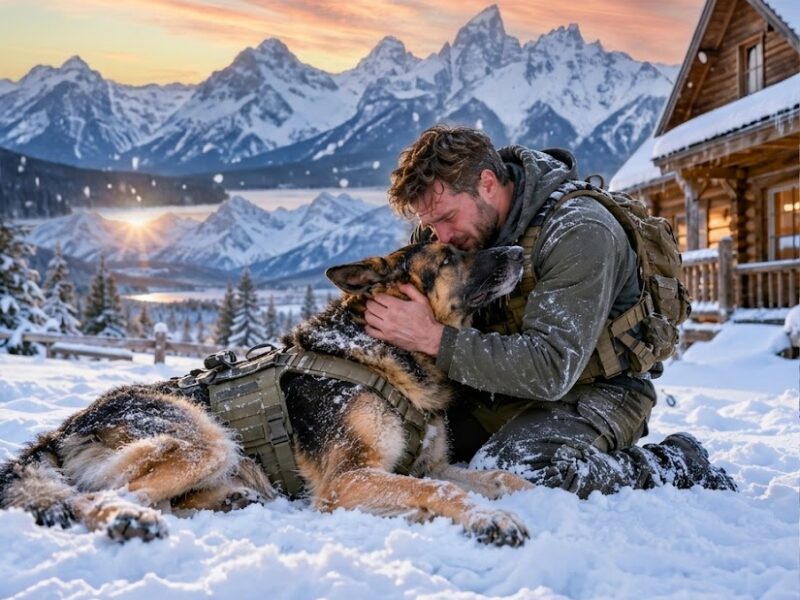
A Navy SEAL’s Retired K9 Recognized Him After Three Long Years—Then the German Shepherd Collapsed in the Snow Before He Could Reach His Old Partner
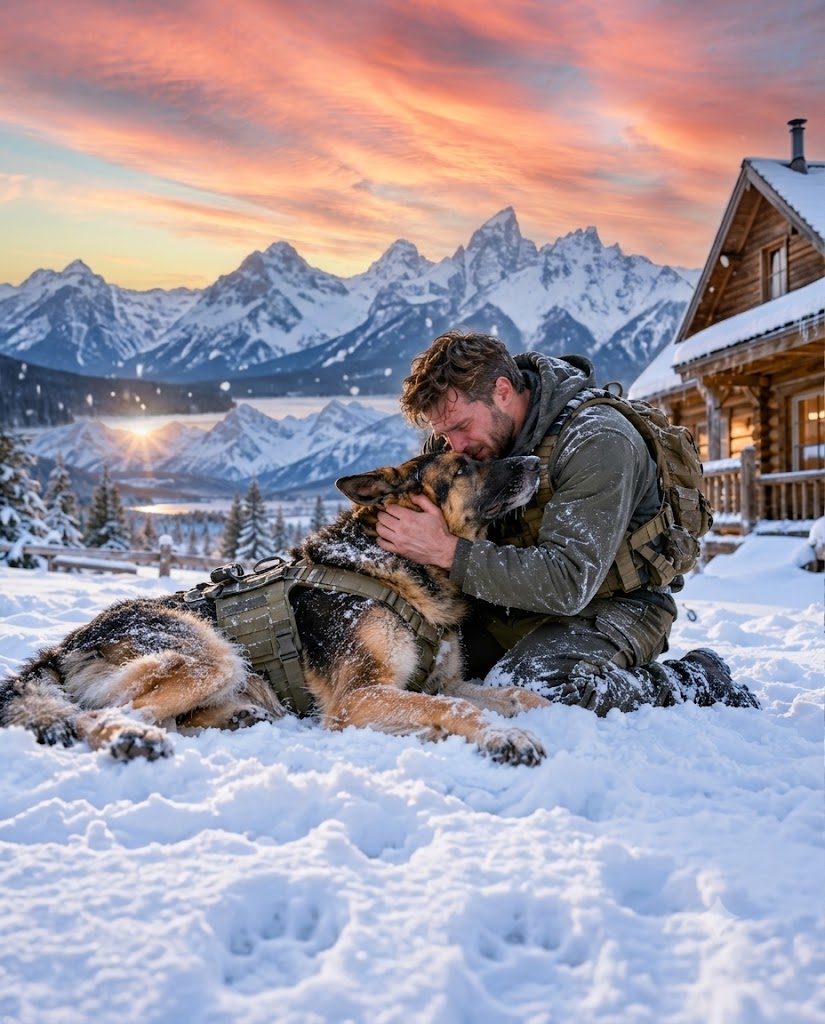
The freezing Montana wind howled, burying the tracks of a battered German Shepherd canine.
For three years, this war hero believed his Navy SEAL handler was dead.
But when a familiar scent cut through the blizzard, the dog ran until his legs gave out, collapsing at the feet of a ghost.
Chief Petty Officer Jonathan Hayes did not believe in luck.
He believed in training, muscle memory, and the sharp instincts of his partner, a 75-pound German Shepherd named Titan.
Titan wasn’t just a military working dog.
He was a highly classified Tier 1 asset attached to a Navy SEAL team, cross-trained in explosive detection and human apprehension.
But to John, Titan was his shadow, his protector, and the only living creature who truly understood the weight of the badge they wore.
Their bond was forged in the harshest environments on Earth.
From the sweltering, unforgiving deserts of the Middle East to the claustrophobic confines of urban war zones, they moved as a single organism.
When John’s heart rate spiked, Titan’s ears pinned back.
When John tapped twice on his tactical vest, Titan knew it was time to move in total silence.
They had survived five deployments together.
They were supposed to retire together.
But November 12th, 2023, changed everything.
The objective was a high-value target extraction deep in a remote, mountainous region bordering Syria.
Intelligence had promised a swift in and out night raid.
The intel was catastrophically wrong.
The moment John’s boots hit the rocky terrain, the night erupted.
It was a perfectly executed ambush.
Heavy machine gun fire tore through the darkness, pinning the SEAL team behind crumbling mud walls.
“We need a path out. Push forward,” yelled Captain Bradley Miller, the team commander.
His voice barely cut through the deafening roar of RPG explosions.
John released Titan’s leash.
“Find the wire, buddy. Find it.”
Titan surged forward, his nose working frantically through the chaos, searching for IEDs hidden in the dust.
The dog was a phantom in the night, weaving through debris.
He successfully flagged two tripwires, saving the lives of three SEALs who were maneuvering to flank the enemy.
But as the team pushed toward the extraction zone, a devastating mortar round dropped straight into the courtyard.
The shockwave was apocalyptic.
John was thrown violently against a reinforced steel gate, the impact shattering his femur and driving shrapnel deep into his chest.
He hit the ground, his vision swimming in a sea of red and black.
He couldn’t breathe.
He couldn’t move.
Through the ringing in his ears, John saw a blur of fur.
Titan had abandoned the search grid and sprinted back into the kill zone, standing directly over John’s bleeding body.
The dog bared his teeth, barking furiously into the darkness, refusing to let anyone, friend or foe, near his handler.
“Titan. Down,” John choked out, tasting copper.
Then came the second blast.
It was a secondary explosive, hidden in the walls of the compound.
The detonation ripped the earth apart.
The sheer force of the explosion threw Titan into the air, tossing the dog over a steep, rocky ravine that bordered the compound.
“Hound! Titan!” John screamed, his voice tearing his throat.
He tried to drag himself toward the edge, leaving a trail of blood in the dirt.
But his body betrayed him.
Strong hands grabbed John by the tactical vest.
It was Ryan Jenkins, a fellow SEAL, hauling him toward the landing zone where a medevac Black Hawk was already hovering.
“My dog! We have to get my dog!” John thrashed wildly, fighting his own brothers.
“He’s gone, John. The ravine is crawling with hostiles. We have to go now or we all die,” Jenkins yelled, hauling John into the chopper as the Black Hawk lifted into the night sky.
John stared down at the smoking crater where his best friend had been.
The darkness swallowed the landscape, and John slipped into a coma.
The agonizing belief that he had abandoned his partner burned into his fading consciousness.
John woke up five weeks later in a sterile room at Walter Reed National Military Medical Center.
He had survived three surgeries, a collapsed lung, and a leg that had been painstakingly rebuilt with titanium rods.
But the physical pain was nothing compared to the news Captain Miller delivered when he visited.
“We sent a recovery team back to the site three days after the ambush, John,” Miller said softly, unable to meet John’s eyes.
“They scoured the ravine. They found his tactical collar, but there was no sign of him. I’m sorry, brother. Titan is MIA. He didn’t make it.”
For John, the world stopped spinning.
The military offered him medals, psychological counseling, and an honorable medical discharge.
But they couldn’t give him the one thing he wanted.
John became a ghost of his former self.
Consumed by survivor’s guilt, he couldn’t bear to be around other dogs.
Couldn’t watch military movies, couldn’t even stand the smell of the ocean.
He packed whatever was left of his life into a duffel, bought a cabin in the rugged mountains of Bozeman, Montana, and vanished from the world.
He intended to live out the rest of his days alone in the quiet snow, punishing himself for a death he felt he caused.
What nobody knew, what the United States military hadn’t realized in the chaotic fog of war, was that Titan had not died in the ravine.
The explosion had shattered Titan’s left hind leg and left a jagged, deep gash across his left eye.
But the dog was a survivor.
Buried under rubble, he had waited for two days, severely dehydrated and bleeding, listening for John’s whistle.
It never came.
Eventually, instinct took over.
Titan dragged himself out of the rocks and wandered into the desert, becoming a feral scavenger, fighting wild dogs and avoiding human patrols.
Months later, a Kurdish Peshmerga patrol found the emaciated, battered German Shepherd near a border checkpoint.
Recognizing the faded US military tattoo on the inside of his ear, they handed him over to an American private contracting firm.
But by then, the military bureaucracy was a mess.
Titan’s serial number was recorded incorrectly by a weary contractor.
He was logged as a stray local working dog, patched up by a field veterinarian, and shipped back to the United States under a civilian rescue program.
Titan was traumatized.
The loud noises of the civilian shelter terrified him.
He had nightmares, waking up snarling and snapping at the air.
He walked with a heavy limp, and the scar over his eye gave him a menacing look that kept adopters away.
Finally, a specialized rehabilitation veterinarian named Dr. Amelia Cross took him in.
She moved him to a quiet sanctuary in the foothills of Montana, hoping the crisp mountain air and isolation would soothe the broken canine’s shattered nerves.
It was December 2026.
Three years had passed since the ambush in Syria.
A monstrous winter storm, later dubbed the blizzard of the decade, slammed into the Rocky Mountains.
Temperatures plummeted to 20 below zero.
The winds howled at 60 miles per hour, snapping pine trees like matchsticks and dumping three feet of snow in a matter of hours.
At the sanctuary, a massive oak tree crashed through the perimeter fence, taking out the power lines.
In the freezing darkness and chaos, the dogs panicked.
Titan, triggered by the explosive sound of the cracking timber—a sound too much like mortar fire—bolted.
Driven by pure blind panic, the aging German Shepherd pushed through the broken fence and ran blindly into the unforgiving blizzard.
Ten miles away, deep in the mountain woods, John Hayes was fighting his own battle against the storm.
John’s cabin was completely snowed in.
He was wrapped in a thick wool coat, leaning heavily on his wooden cane, trying to clear the exhaust vent of his backup generator.
The cold was agonizing on his titanium leg, sending sharp spikes of pain up his spine.
The wind was deafening, a whiteout condition where he could barely see ten feet in front of his face.
Out in the wilderness, Titan was dying.
He had been wandering for hours.
His paws were bleeding, cracked by the ice.
His lungs burned, and his bad leg was completely numb.
The cold was creeping into his organs.
He collapsed under the shelter of a snow-covered boulder, curling into a tight ball.
He closed his scarred eyes, letting the heavy snow blanket his fur.
The fight was finally leaving him.
But then, the wind shifted.
A sharp gust blew down the valley, carrying something microscopic.
A scent.
Titan’s eyes snapped open.
His nose twitched.
It was a faint, nearly undetectable trace, buried under the smell of pine and ice.
It was the scent of burnt wood, dark roast coffee, and a very specific brand of gun oil.
It was a scent permanently burned into the deepest, most primal part of his brain.
Titan let out a low, ragged whine.
He forced himself up.
His back legs shook violently, threatening to give out, but he bit down on his own tongue and pushed forward.
He didn’t care about the cold anymore.
He didn’t care about the pain.
He plowed through snowdrifts that were up to his chest, driven by an impossible hope.
Back at the cabin, John finished clearing the generator vent.
He turned to head back to the warmth of his porch when he saw it.
A dark shape was moving at the edge of the tree line.
John froze.
Bear? Wolf?
He instinctively reached for the heavy revolver holstered at his hip.
The shape was stumbling, pushing through the deep snow with frantic, desperate lunges.
As the creature got closer, the glow of the porch light caught it.
It wasn’t a wolf.
It was a dog.
A massive, emaciated German Shepherd coated in ice.
John’s heart stopped.
He let go of his gun.
“Hey,” he called out, his voice hoarse.
“Hey, it’s okay. Come here, buddy.”
The dog froze about twenty yards away.
The wind howled between them.
Titan stared at the man on the porch.
The man had a beard now.
He looked older.
He leaned on a cane.
But the stance, the broad shoulders, the voice—Titan let out a sound that wasn’t a bark.
It was a scream.
A high-pitched, agonizing cry of pure, desperate recognition.
The dog completely abandoned self-preservation.
He launched himself forward, fighting through the thick snow, his bad leg dragging behind him.
John dropped his cane.
His breath caught in his throat.
The dog was closing the distance, and in the harsh yellow light of the porch bulb, John saw it.
The jagged scar over the left eye.
The distinct black pattern on the snout.
“No,” John whispered, his knees buckling.
“It can’t be. It’s impossible.”
Titan reached the bottom of the porch steps.
The adrenaline that had kept him alive for ten miles finally evaporated.
His front legs collapsed.
The mighty canine hit the snowy ground hard, burying his face in the white powder, his chest heaving violently.
Too weak to climb the three wooden steps to his master, John fell to his knees in the snow, ignoring the screaming pain in his own rebuilt leg.
He crawled toward the collapsed animal, his hands shaking violently.
He grabbed the dog’s heavy head, lifting it from the snow.
Titan whined, a weak, pathetic sound, and forced his scarred, icy nose into the crook of John’s neck.
He inhaled deeply, tasting the scent of the man he had taken a bomb for three years ago.
John’s trembling hands moved instinctively to the inside of the dog’s left ear, rubbing away the ice and frost.
The porch light illuminated the faded blue ink stamped into the skin.
Canine T-74.
John broke.
A ragged, guttural sob tore out of his chest, echoing into the dark, violent blizzard.
He wrapped his arms around the freezing, heavy body of his canine partner, burying his face in the ice-covered fur, crying like he hadn’t cried since he was a child.
“I got you,” John wept, rocking the massive dog back and forth in the snow.
“I got you, buddy. You’re home. You’re finally home.”
Titan let out a long, heavy sigh, resting his chin on John’s shoulder.
And for the first time in three years, the canine closed his eyes without fear.
But the reunion was far from over.
The storm was only getting worse, and Titan’s breathing was growing dangerously shallow.
The dog was slipping into severe hypothermia, and they were trapped miles away from any veterinary hospital with no power, no roads, and a blizzard that was about to turn deadly.
The wind screamed against the timber walls of the cabin, a deafening roar that threatened to tear the roof from its rafters.
John Hayes did not feel the biting cold, nor did he feel the agonizing grind of titanium against bone in his rebuilt leg.
Adrenaline, a ghost from a past life he thought he had buried, flooded his veins.
He gathered the massive, limp body of the German Shepherd into his arms.
Titan weighed nearly 80 pounds, his fur matted with heavy ice, and his breathing a terrifyingly shallow rattle.
John strained, his bad leg buckling for a fraction of a second before he let out a guttural yell and hauled his partner up the wooden steps and through the heavy oak door.
He kicked the door shut, cutting off the shriek of the blizzard.
The cabin was plunged into the deep, flickering orange glow of a dying hearth.
The power had been out for hours, and the ambient temperature inside the room was already plummeting.
John laid Titan gently on the thick rug in front of the stone fireplace.
The dog’s eyes were rolled back, a terrifying rim of white showing beneath the scarred lids.
His gums were pale, almost blue—the universal, undeniable sign of severe shock and hypothermia.
“Stay with me, T,” John muttered, his voice a frantic, breathless rasp.
“Do not tap out on me. Not today.”
Muscle memory took over.
John was no longer a broken, retired veteran hiding in the woods.
He was Chief Petty Officer Hayes, and his teammate was going into cardiac failure.
He scrambled to his tactical medical footlocker in the corner of the room, throwing open the heavy latches.
He bypassed the standard civilian first aid and grabbed four Mylar thermal blankets, a heavy wool sleeping bag, and several chemical heat packs he kept for backcountry emergencies.
He threw a dozen heavy cedar logs onto the dying embers, violently stoking the fire until a massive, roaring blaze illuminated the entire cabin.
Returning to the rug, John knelt beside his dog.
He began snapping the chemical heat packs, shaking them until they burned hot, and carefully wrapped them in towels so they wouldn’t scorch Titan’s skin.
He placed them in the dog’s armpits, groin, and along the carotid arteries of his neck—the exact protocols for a human casualty in extreme cold.
“You’re okay, buddy. You’re okay,” John whispered, his hands moving with frantic precision.
As he worked, he finally got a clear look at his old partner in the firelight.
It broke his heart all over again.
Titan was painfully thin, his ribs showing prominently against his flanks.
The devastating scar across his left eye spoke of unspeakable trauma, and his left hind leg was a mess of improperly healed tissue and atrophied muscle.
This wasn’t just a dog who had survived a bombing.
This was a soldier who had walked through hell for three years, entirely alone.
John layered the Mylar blankets over the dog, sealing the heat in, and draped the heavy wool sleeping bag over the top.
But Titan’s shivering was weakening.
That was the most dangerous sign.
When a freezing body stops shivering, the internal core temperature has dropped to a critical, fatal threshold.
The dog let out a faint, rattling exhale.
His chest stopped moving.
“Titan!” John shouted, slamming his hands against the floorboards.
He pressed two fingers against the femoral artery inside the dog’s back leg.
The pulse was there, but it was a thready, vanishing flutter.
The external heat wasn’t working fast enough.
The cold had seeped too deep into the animal’s bones.
Without hesitating, John stripped off his heavy winter coat, his flannel shirt, and his boots.
Bare-chested in the freezing cabin, he crawled directly under the Mylar and wool layers, pressing his warm, bare skin against the ice-cold, wet fur of the German Shepherd.
He wrapped his arms tightly around Titan’s chest, pulling the massive dog into an embrace, trapping their bodies together to force his own core body temperature into his partner.
It was a desperation tactic they had used once before, years ago.
Pinned down on a freezing mountain ridge in the Hindu Kush while waiting for a delayed medevac.
“I’m right here,” John whispered into the dog’s ear, his tears tracking hot paths through the grime on his face.
“I’m not leaving you. I will never leave you again. Do you hear me? That is an order, Titan. You hold the line.”
For hours, the storm outside buried the cabin under walls of white.
Inside, the fire snapped and hissed, casting long, frantic shadows across the walls.
John lay motionless, speaking softly into the dark, recounting their old missions, calling out the names of their fallen brothers, whispering the tactical commands Titan knew so well.
He talked to keep the dog tethered to the world of the living, and he talked to keep his own mind from shattering.
Around 3:00 a.m., the miracle happened.
John felt a sudden, sharp twitch against his ribs.
Then another.
Titan’s chest heaved.
The massive canine drew in a deep, stuttering breath, and a violent, full-body shiver racked his frame.
The shivering had returned.
The core temperature was rising.
John tightened his grip, closing his eyes as a wave of overwhelming relief washed over him.
Slowly, the terrifying blue hue began to leave Titan’s gums.
The dog’s breathing evened out, matching the slow, steady rhythm of John’s own heart.
Beneath the layers of wool and Mylar, the ghost of the Syrian desert finally found peace.
The blinding glare of the morning sun piercing through the frost-covered window woke John.
The wind had completely died, leaving behind a profound, heavy silence that only exists in the aftermath of a catastrophic blizzard.
The fire had burned down to a pile of glowing orange ash.
John shifted, groaning as the stiff muscles in his back and his damaged leg screamed in protest.
Before he could even sit up, a heavy weight shifted against his chest.
Titan was awake.
The German Shepherd’s one good eye locked onto John’s face.
For a long, breathless moment, neither man nor dog moved.
John stared at the golden brown iris, terrified that if he blinked, he would wake up back in the hospital bed at Walter Reed, and this would all be a cruel, phantom dream.
Then, very slowly, Titan pushed his cold, wet nose against John’s bearded cheek.
A broad, pink tongue darted out, licking the salt and dried tears from the veteran’s face.
The dog let out a soft, rumbling grumble.
A sound he used to make in the barracks when he wanted his belly rubbed.
John let out a watery laugh, burying his face in Titan’s neck.
“Good morning to you, too, brother.”
The peace of the morning was suddenly shattered by the distant, high-pitched whine of a two-stroke engine.
John sat up, immediately on high alert.
The sound was growing louder, echoing off the snow-choked pine trees.
Snowmobiles.
Nobody came up this mountain in the winter unless it was an absolute emergency.
He threw on his flannel shirt, grabbed his cane, and limped heavily toward the front window, wiping away the condensation.
Two brightly colored snowmobiles were plowing through the heavy drifts, navigating the treacherous incline toward his front porch.
The lead rider was wearing a bright red search and rescue parka.
John opened the front door just as the engines cut out.
Dr. Amelia Cross ripped her helmet off, her breath pluming in the freezing air.
Her face was pale and exhausted.
Behind her, Sheriff Thomas Reed killed the engine of his own sled, stepping off into waist-deep snow, his hand resting cautiously on his radio.
“Mr. Hayes?” Amelia called out, her voice trembling slightly as she trudged up the steps.
“I am so sorry to intrude. We’ve been tracking a signal for hours. The cell towers were knocked out, but a GPS ping off a radio repeater led us right to these coordinates before the grid went completely dark.”
John stood in the doorway, his broad frame blocking the view into the cabin.
He looked from the veterinarian to the sheriff, his expression unreadable.
“Tracking what? A dog?”
Amelia said, tears welling in her eyes.
“A German Shepherd. He broke out of my rescue sanctuary last night during the storm. He’s severely disabled. He’s terrified of loud noises, and he’s been missing in this weather for twelve hours. The GPS collar pinged its final location right near your property line.”
Amelia’s voice broke.
“Please, please tell me you’ve seen him. Even if it’s too late, I just need to know.”
John leaned heavily on his cane.
He looked at the frantic veterinarian, seeing the genuine, desperate care in her eyes.
The ice in John’s chest, a frozen barricade he had built around his heart for three years, finally cracked and melted away.
He didn’t say a word.
He simply stepped back and pushed the heavy oak door wide open.
Amelia and Sheriff Reed peered into the dim warmth of the cabin.
There, sitting tall and proud on the rug by the fireplace, was the massive German Shepherd.
“Titan!” Amelia gasped, dropping to her knees on the porch, a sob of relief tearing from her throat.
She reached her hands out.
“Oh my god, you’re alive. You made it.”
But Titan didn’t run to her.
Instead, the dog took two limping steps forward and positioned himself perfectly at John’s left side.
He sat down squarely, his shoulder pressing firmly against John’s good leg, his chest puffed out, and his ears standing at strict, unwavering attention.
It was the flawless, textbook heel position of a Tier 1 military working dog.
Titan looked at the strangers on the porch, then looked up at John, waiting for his commander’s next order.
Amelia froze.
Her hands dropped to her sides.
She stared at the rigid, military posture of the dog.
And then she slowly looked up at the scarred, heavily bearded man leaning on the cane.
She noticed the faded Navy SEAL trident tattooed on John’s forearm.
“I wasn’t a stray,” John said quietly, his voice thick with emotion.
His hand drifted down, resting gently on the top of Titan’s head.
The dog leaned into the touch, closing his eyes in pure bliss.
“You called him Titan. How did you know his name?”
“It was written on his import paperwork from the Middle East,” Amelia stammered, completely bewildered.
“But they said he was a local street dog, a civilian rescue. They said he had no owner.”
“They were wrong,” John replied, looking down at the dog who had crossed an ocean, survived a war, and fought through a deadly blizzard just to find him.
“His name is K9 T-74, and he is a United States Navy hero.”
Sheriff Reed slowly took off his hat, clutching it to his chest.
Suddenly realizing he was standing in the presence of something sacred, Amelia covered her mouth, the pieces finally clicking together.
The dog’s nightmares, his tactical awareness, his refusal to bond with anyone at the sanctuary.
He hadn’t been lost.
He had been looking.
And somehow, against all laws of probability, science, and nature, a gust of wind in a devastating blizzard had carried the scent of home right to him.
“He’s yours,” Amelia whispered, wiping her eyes.
“He was always yours.”
John smiled.
A genuine, warm smile that hadn’t graced his face in a very long time.
He knelt down in the doorway, burying his face in Titan’s fur, surrounded by the crisp mountain air and the blinding white snow.
The war was finally over.
They had both walked through the fire.
They had both carried the scars.
And now, finally, they were both home.
—
**Part 2**
—
The days that followed the blizzard were quiet in a way John had forgotten was possible.
Sheriff Reed had radioed in to the county dispatch, confirming that the missing service animal had been located alive and was receiving care.
The story traveled faster than any storm could, spreading through the small Montana community like wildfire.
Amelia Cross returned the next morning with a full veterinary kit, a portable oxygen tank, and enough medical supplies to stock a small clinic.
She worked on Titan for over two hours, cleaning his cracked paws, treating the frostbite on his ears and tail, and carefully examining the improperly healed leg that had been left untreated for years.
John watched from the kitchen table, his hands wrapped around a mug of black coffee, his eyes never leaving his dog.
“He’s going to need surgery on that hind leg,” Amelia said, not looking up from her work.
“The bone healed wrong. It’s causing him pain with every step. I can’t believe he ran ten miles on this.”
“He’s stubborn,” John said quietly.
“Runs in the unit.”
Amelia paused, her hands resting on Titan’s flank.
The dog was lying on his side, his one good eye fixed on John, his breathing steady for the first time in days.
“Mr. Hayes—”
“John.”
“John,” she corrected herself.
“I need to ask you something, and I need you to be honest with me.”
She reached into her bag and pulled out a worn manila folder, the edges frayed and stained.
“I pulled Titan’s intake records from the rescue program. There were discrepancies I couldn’t explain when he first arrived. The tattoo in his ear, the way he responded to tactical commands, the nightmares.”
She opened the folder and laid out a single sheet of paper.
“There was a note in his file from the contractor who processed him overseas. It said the dog was a local stray with no identification.”
She looked up at John.
“But that’s not true, is it?”
John set down his coffee mug.
His jaw tightened, and for a moment, he looked like the man he used to be—hard, precise, dangerous.
“No,” he said.
“It’s not true.”
Amelia waited.
“Titan was assigned to my team in 2019,” John said, his voice flat and controlled.
“Tier 1 asset. Explosive detection and human apprehension. He completed over three hundred missions in five deployments. He saved my life more times than I can count.”
He paused, his hand drifting to the faded tattoo on his forearm.
“In November 2023, we were ambushed in a remote region near the Syrian border. Titan was thrown into a ravine during the firefight. My team was extracted under heavy fire. I was told he was dead.”
Amelia’s eyes widened.
“Three days later, a recovery team went back. They found his collar. No body. The military classified him as killed in action.”
John’s voice cracked, just slightly.
“I believed them. For three years, I believed I left my dog to die in that ravine.”
Amelia was silent for a long moment.
Then she reached across the table and placed her hand over John’s.
“He didn’t die,” she said softly.
“He survived. He came back. And somehow, he found you.”
John nodded, unable to speak.
Titan let out a soft whine from the rug, and John immediately stood, crossing the room to kneel beside him.
The dog licked his hand, his tail giving a weak but hopeful thump against the floorboards.
“He needs that surgery,” John said, his voice steady again.
“How much will it cost?”
Amelia hesitated.
“The procedure is complex. Titan needs a full reconstruction of the hind leg, plus physical therapy and ongoing care. I’d estimate somewhere around $7,000 to $9,000, depending on complications.”
John didn’t flinch.
“I’ll pay it. Whatever it takes.”
Amelia shook her head.
“John, I’m not asking you for money. I’m telling you this because I need you to understand what you’re taking on. Titan is not a young dog anymore. He’s been through hell. He may never fully recover.”
John looked at her, and for the first time, Amelia saw the full weight of everything he had carried for three years—the guilt, the grief, the endless nights of wondering what he could have done differently.
“He took a bomb for me,” John said quietly.
“He stood over my body and refused to let anyone near me. He lost his leg, his eye, and three years of his life because of me.”
He looked down at Titan, who was watching him with unwavering devotion.
“I’m not going anywhere. Not ever again.”
Amelia nodded, a small smile breaking through her professional composure.
“Then let’s get him back on his feet.”
—
The surgery took place three weeks later at a specialized veterinary hospital in Bozeman.
John drove Titan himself, refusing to let anyone else handle his partner.
The hospital staff, initially skeptical of the scarred, limping German Shepherd, quickly realized they were dealing with something extraordinary.
Titan remained calm throughout the pre-operative procedures, his eyes tracking John’s every movement, his body relaxing only when John’s hand was on his head.
“We’ve never seen a dog this well-behaved,” one of the technicians remarked.
“Especially not one with his history.”
“He’s a professional,” John said simply.
The surgery was successful, but the recovery was brutal.
Titan spent two weeks in the hospital, followed by another six weeks of intensive physical therapy at Amelia’s sanctuary.
John visited every single day, driving over an hour each way through the winding mountain roads, sometimes in weather that would have kept any sane person at home.
He sat with Titan during his therapy sessions, coaching him through the exercises the same way he had coached him through training drills years ago.
“Come on, T. You know this. Push through it. That’s an order.”
Titan, who had once run ten miles through a blizzard on a shattered leg, had to be coaxed through simple walking exercises.
But he never gave up.
And neither did John.
The bond between them, which had been forged in war and tested by separation, had only deepened in the months since the blizzard.
John had stopped drinking.
He had started taking care of himself, if only because Titan needed him to be at his best.
He had even begun speaking with a counselor at the local VA clinic, something he had sworn he would never do.
But the biggest change was harder to quantify.
For the first time in three years, John Hayes felt like he had a reason to wake up in the morning.
—
The first snow of the following winter arrived on a quiet December evening, almost exactly one year after the blizzard that had brought them back together.
John sat on the porch of his cabin, a blanket draped over his lap, a mug of coffee in his hand.
Titan lay at his feet, his head resting on John’s boots, his breathing slow and peaceful.
The dog still limped, but it was a comfortable limp now, the result of a successful surgery and months of careful rehabilitation.
The scar over his eye had faded to a pale silver line, barely noticeable unless you knew to look for it.
His ribs had filled out, his coat had grown thick and glossy, and his eyes—both of them—held a quiet contentment that John had never thought he would see again.
“You know,” John said, his voice soft in the evening air, “I spent three years punishing myself for something that wasn’t my fault.”
Titan’s ear twitched, but he didn’t move.
“I thought I had failed you. I thought I had left you behind.”
John took a sip of his coffee, his eyes fixed on the distant mountains.
“But you never gave up on me, did you? You never stopped looking.”
Titan lifted his head, his one good eye meeting John’s.
He let out a soft, rumbling grumble—the sound he used to make in the barracks when he wanted his belly rubbed.
John smiled.
“Yeah, buddy. I know.”
He reached down and scratched behind Titan’s ear, his fingers brushing over the faded tattoo that had brought them back together.
“Canine T-74,” he murmured.
“You’re a hell of a soldier, you know that?”
Titan’s tail thumped against the porch floor.
“And you’re a hell of a friend.”
They sat there in silence as the snow began to fall, covering the mountains in a fresh layer of white.
The war was over.
The scars would remain.
But they had both walked through the fire, and they had both come out the other side.
Together.
—
The story of John Hayes and Titan spread far beyond the small Montana community.
A local reporter who had heard about the reunion from Sheriff Reed wrote a feature article for the Bozeman Daily Chronicle, and from there, the story was picked up by regional news outlets.
Within a month, it had gone national.
A producer from a major cable news network reached out to John, asking for an interview.
He declined.
A veteran’s advocacy group offered to pay for Titan’s ongoing medical care.
John thanked them but refused.
“We’re doing fine,” he said.
“We don’t need anything.”
But there was one offer he couldn’t refuse.
The United States Navy, after reviewing the circumstances of Titan’s disappearance and recovery, made an official determination.
The dog’s records were corrected.
His designation was restored.
And in a small ceremony at the Naval Amphibious Base in Coronado, California, K9 T-74 was formally recognized for his service.
John attended the ceremony in his dress uniform, his chest heavy with medals he had never felt he deserved.
Titan sat beside him, his posture perfect, his gaze steady, the very picture of a military working dog.
When the commanding officer read the citation—praising Titan’s bravery under fire, his unwavering loyalty to his handler, and his extraordinary survival against impossible odds—John felt a lump form in his throat.
The officer pinned a small medal to Titan’s collar, a gesture that was largely symbolic but deeply meaningful.
“K9 T-74,” the officer said, “your country thanks you for your service.”
Titan, as if understanding the gravity of the moment, let out a single, sharp bark.
The assembled crowd laughed, then applauded.
John knelt down and wrapped his arms around his dog, burying his face in the thick fur of his neck.
“I’m proud of you, buddy,” he whispered.
“Always have been. Always will be.”
—
The years that followed were quiet, but they were full.
John and Titan settled into a comfortable routine in the Montana mountains.
They hiked the trails together in the summer, John leaning on his cane, Titan limping slightly but keeping pace.
They sat by the fire in the winter, John reading or listening to music, Titan dozing at his feet.
John adopted a second dog, a scruffy terrier mix from a local shelter, mostly because Titan seemed lonely when John had to leave for appointments.
The terrier, whom John named Rookie, was everything Titan was not—yappy, energetic, and completely untrained.
But Titan tolerated him with the patience of an old soldier who had seen too much to be bothered by trivial things.
And when Rookie got too rambunctious, Titan would let out a single, low growl, and the terrier would immediately settle down.
“Good boy,” John would say, and Titan’s tail would wag.
The VA counselor John had been seeing encouraged him to write about his experiences, and eventually, John did.
He started with a journal, then a blog, then a book.
The book, titled “The Longest Watch,” was published three years after the blizzard.
It was part memoir, part tribute to the military working dogs who served alongside their handlers in the most dangerous places on Earth.
The dedication page read simply: “For Titan. You never left me. I will never leave you.”
The book was a modest success, finding an audience among veterans and dog lovers alike.
John donated a portion of the proceeds to organizations that supported the adoption of retired military working dogs.
He never sought fame or recognition.
He simply wanted to make sure that the story of what Titan had done—what all military working dogs did—was never forgotten.
—
On a crisp autumn morning in 2030, John Hayes sat on his porch, a cup of coffee in his hand, watching the sun rise over the mountains.
Titan lay beside him, his head resting on John’s knee.
The dog was old now, his muzzle gray, his movements slow and deliberate.
But his eyes still held that spark—the quiet, unshakeable loyalty that had defined him from the very beginning.
“You know,” John said, his voice soft, “I used to think I didn’t deserve to be happy. After what happened in Syria. After what I thought I had done to you.”
Titan’s ear twitched.
“But you showed me I was wrong. You crossed an ocean, survived a war, and ran ten miles through a blizzard just to prove it.”
John set down his coffee and placed his hand on Titan’s head.
“You’re the best thing that ever happened to me, T. The absolute best.”
Titan let out a contented sigh, his eyes closing as the morning sun warmed his fur.
John sat there in silence, the mountains stretching out before him, the world quiet and peaceful.
He thought about the ambush, the explosion, the ravine.
He thought about the years of guilt and grief, the isolation and the pain.
And he thought about the moment in the blizzard when he had looked out at the tree line and seen a dark shape moving through the snow.
A ghost, he had thought at first.
But it wasn’t a ghost.
It was a miracle.
The war was over.
The scars remained.
But they were both alive, both whole, both home.
And that, John realized, was enough.
It was more than enough.
It was everything.
—
**Part 3**
—
The years passed, and the world changed, but the bond between John and Titan remained the one constant in their quiet corner of the Montana mountains.
Titan grew slower, his joints stiffened, his eyesight dimmed, but he never lost that spark of awareness that had made him a Tier 1 asset.
He still woke at the sound of John’s alarm in the morning, still followed him from room to room, still positioned himself at John’s left side whenever they were outside.
It was the heel position—the perfect, textbook heel position of a military working dog.
Some habits, John knew, would never die.
And he was grateful for that.
The sanctuary that Amelia Cross ran in the foothills had grown in the years since the blizzard.
She had expanded her operation, building additional kennels, hiring more staff, and taking in more dogs—not just military working dogs, but any animal that needed a second chance.
John and Titan became regular visitors.
They would drive down the mountain on Sunday afternoons, John with a container of homemade dog treats, Titan with his tail wagging in anticipation.
The dogs at the sanctuary always seemed to recognize something in Titan.
Maybe it was the way he carried himself, the quiet confidence of a dog who had seen the worst the world had to offer and had come out the other side.
Maybe it was the scar over his eye, a visible reminder of the price he had paid.
Whatever it was, the other dogs respected him.
They deferred to him.
They followed his lead.
“He’s like a general,” Amelia said one afternoon, watching as Titan calmly separated two dogs who had been about to fight.
“He doesn’t even have to growl. He just looks at them, and they stop.”
John smiled.
“Leadership,” he said.
“You can’t train it. You either have it or you don’t.”
Titan, as if hearing the praise, looked over at John and let out a soft grumble.
John laughed.
“Yeah, yeah. You’re a big deal. We know.”
—
The winter of 2032 was a hard one.
A series of storms battered the Rocky Mountains, dumping record amounts of snow and knocking out power for weeks at a time.
John, older now, with gray in his beard and a deeper ache in his titanium leg, found the storms harder to manage than he used to.
But he had Titan.
And Titan, despite his age, was still the best partner John had ever had.
When the power went out, Titan would lie beside John in front of the fire, his body a warm, steady presence in the cold.
When the wind howled, Titan would press his head against John’s leg, a silent reminder that he was not alone.
When John’s nightmares came—and they still came, though less often now—Titan would wake him with a gentle nudge of his nose, his one good eye full of understanding.
“I’m okay, T,” John would whisper, his hand finding Titan’s fur in the darkness.
“I’m okay.”
Titan would let out a soft sigh and settle back down, his head resting on John’s chest.
And John would close his eyes, the steady rhythm of Titan’s breathing lulling him back to sleep.
—
The spring of 2033 brought warmer weather and a welcome visitor.
Amelia Cross arrived at the cabin one Saturday morning, her truck loaded with supplies and a familiar, eager expression on her face.
“I have a proposition for you,” she said, stepping onto the porch with a grin.
John raised an eyebrow.
“Should I be worried?”
“Probably.”
She sat down in the chair next to him, her eyes bright.
“I’m expanding the sanctuary. I want to build a dedicated facility for retired military working dogs—a place where they can live out their final years with dignity and care.”
She paused.
“And I want you to help me run it.”
John stared at her.
“Amelia, I’m not—”
“You’re exactly the right person,” she interrupted.
“You know these dogs. You understand what they’ve been through. You understand what they need.”
She gestured at Titan, who was lying in a patch of sunlight, his eyes half-closed.
“Look at him, John. He’s the proof that recovery is possible. That these dogs can find peace.”
John was silent for a long moment.
He looked at Titan, at the scar over his eye, at the gray in his muzzle, at the way his tail still wagged whenever John spoke his name.
He thought about the three years of isolation, the guilt, the grief.
He thought about the blizzard, the impossible reunion, the slow, painful journey back to life.
And he thought about all the other dogs out there—dogs like Titan—who had served their country and been forgotten.
“Okay,” he said.
“I’m in.”
Amelia’s face lit up.
“Really?”
“Really.”
She threw her arms around him, a gesture that surprised them both.
John, not a man who was comfortable with physical affection, awkwardly patted her back.
“Thank you,” she whispered.
“You have no idea what this means to me.”
John looked over her shoulder at Titan, who had raised his head and was watching them with a knowing expression.
“Yeah,” he said.
“I think I do.”
—
The facility opened eight months later.
It was a modest operation—a dozen kennels, a small office, a training yard, and a memorial garden for the dogs who didn’t make it home.
John and Amelia ran it together, John handling the dogs and the veteran outreach, Amelia handling the medical care and the administrative work.
They called it “Second Watch Sanctuary,” a nod to the military tradition of standing guard through the night.
The first dogs arrived in the fall of 2034—a pair of elderly German Shepherds who had served in Afghanistan, a Belgian Malinois with a missing leg, a Labrador Retriever who had spent six years detecting explosives in Iraq.
John greeted each one personally, kneeling down to their level, letting them sniff his hand, speaking in the same low, steady voice he had used with Titan for over a decade.
“Welcome home,” he said to each one.
“You’re safe now. You’re with family.”
And somehow, impossibly, the dogs seemed to understand.
They settled into their new lives with a grace that John found humbling—a quiet acceptance of the care they had earned, the rest they had fought for.
Titan, now fifteen years old and slower than ever, became the unofficial mascot of the sanctuary.
He would walk the grounds every morning, his limp more pronounced, his steps more deliberate.
He would visit each kennel, sniffing at the dogs inside, offering a soft grumble of greeting.
And the dogs, no matter how traumatized or broken, would always respond.
They would wag their tails.
They would press their noses against the wire.
They would whine with something that sounded like hope.
“He’s still leading them,” Amelia observed one morning, watching as Titan made his rounds.
“He’s showing them that it’s possible to survive. That it’s possible to heal.”
John nodded, his throat tight.
“He’s been doing that his whole life.”
—
The winter of 2035 was Titan’s last.
He had been slowing down for months, his appetite waning, his sleep growing longer and deeper.
John knew what was coming.
He had known for a while.
But knowing didn’t make it easier.
On a cold January night, with the wind howling outside and the fire crackling in the hearth, Titan lay on his rug in front of the fireplace, his head resting on his paws.
John sat beside him, his hand on Titan’s back, feeling the slow, steady rhythm of his breathing.
Rookie, the scruffy terrier, lay curled against Titan’s side, his usual yappiness replaced by a quiet, watchful stillness.
“You’ve been a good dog, T,” John said softly.
“The best dog.”
Titan’s ear twitched, and he let out a soft sigh.
“I don’t know what I would have done without you. I don’t know who I would be.”
John’s voice cracked.
“You saved me, buddy. Not just in Syria. Not just in the blizzard. Every day since.”
Titan lifted his head, his one good eye meeting John’s.
There was no fear in that gaze, no pain, no regret.
Only love.
Only trust.
Only the unshakeable certainty of a dog who had found his person and never let go.
“I love you, Titan,” John whispered.
“I love you so much.”
Titan let out a long, contented breath, his head settling back down on his paws.
And then, quietly, peacefully, he was gone.
—
John buried Titan in the memorial garden at the sanctuary, under a small oak tree that Amelia had planted the year before.
He placed a simple stone marker at the head of the grave, engraved with the words that had defined Titan’s life:
K9 T-74. United States Navy. Faithful unto the end.
The ceremony was small—just John, Amelia, Rookie, and a handful of veterans who had come to pay their respects.
John spoke briefly, his voice steady despite the tears streaming down his face.
“He was a soldier,” he said.
“He was a hero. But more than that, he was my friend.”
He paused, looking down at the grave.
“He never gave up on me. Not once. Not in Syria, not in the blizzard, not in all the years since.”
He knelt down and placed a single white flower on the marker.
“Rest easy, buddy. You’ve earned it.”
—
The years that followed were quieter, but they were not empty.
John continued to run Second Watch Sanctuary, dedicating his life to the dogs who had served their country and been forgotten.
He adopted another German Shepherd, a retired explosives detection dog named Koda, who had been surrendered to the sanctuary after his handler died of cancer.
Koda was not Titan.
No dog could ever be Titan.
But Koda was loyal, and brave, and broken in ways that John understood.
And together, they healed.
John wrote a second book, a follow-up to “The Longest Watch,” titled “Second Watch: The Dogs Who Came Home.”
It was dedicated to Titan, and to all the military working dogs who had served and sacrificed and been forgotten.
The book became a bestseller, and John used the proceeds to expand the sanctuary, building more kennels, hiring more staff, and creating a network of foster families across the country.
He became an advocate for military working dogs, speaking at conferences and testifying before Congress about the need for better care and support for these animals.
He never sought fame or recognition.
He simply wanted to make sure that no dog like Titan was ever forgotten again.
—
On a cold December morning in 2040, exactly fourteen years after the blizzard that had brought them back together, John Hayes stood on the porch of his cabin, a cup of coffee in his hand.
Koda lay at his feet, his head resting on John’s boots.
The sun was rising over the mountains, painting the snow in shades of gold and pink.
John thought about Titan.
He thought about the ambush, the explosion, the ravine.
He thought about the three years of isolation, the guilt, the grief.
He thought about the blizzard, the impossible reunion, the slow, painful journey back to life.
And he thought about the moment in the snow when he had looked out at the tree line and seen a dark shape moving toward him.
A ghost, he had thought at first.
But it wasn’t a ghost.
It was a miracle.
The war was over.
The scars remained.
But they had both walked through the fire, and they had both come out the other side.
Together.
John took a sip of his coffee and looked down at Koda.
“You know,” he said, “I used to think I didn’t deserve to be happy.”
Koda’s ear twitched.
“But Titan showed me I was wrong.”
He reached down and scratched behind Koda’s ear.
“He showed me that even after the worst things happen, there’s still a reason to keep going.”
Koda let out a soft grumble, his tail thumping against the porch floor.
John smiled.
“Yeah, buddy. I know.”
He sat there in silence as the sun continued to rise, the mountains stretching out before him, the world quiet and peaceful.
The war was over.
The scars remained.
But they were both alive, both whole, both home.
And that, John realized, was enough.
It was more than enough.
It was everything.
—
**THE END**









