A Navy SEAL’s K9 Wouldn’t Stop Barking at a Rusted Shipping Container—When He Finally Forced It Open, What He Found Changed Everything
**Part 1**
Rain hammered the corrugated steel of Terminal 46 like a thousand tiny fists, and the saltwater smell of the Port of Seattle soaked into everything it touched.
Deep inside that maze of rust and diesel exhaust, an abandoned shipping container sat forgotten by the world—its paint long since eaten away by oxidation, its identification marks scrubbed clean.
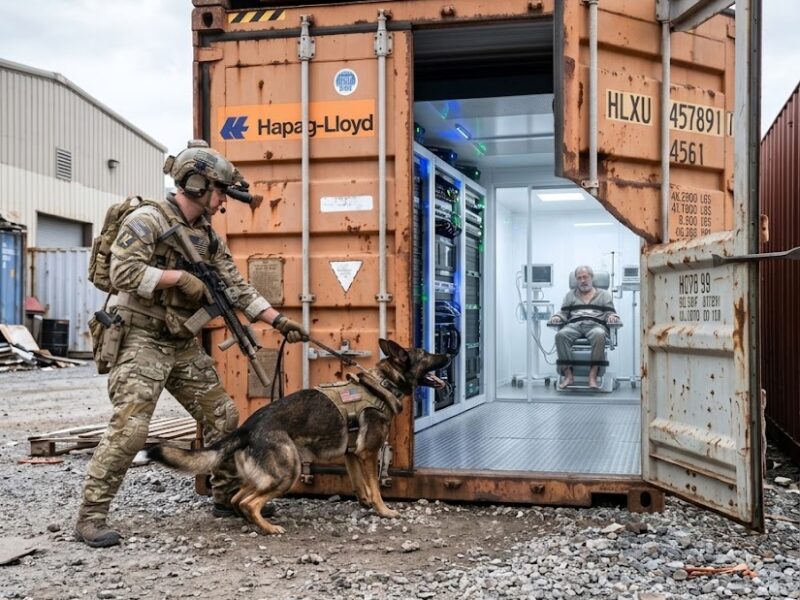
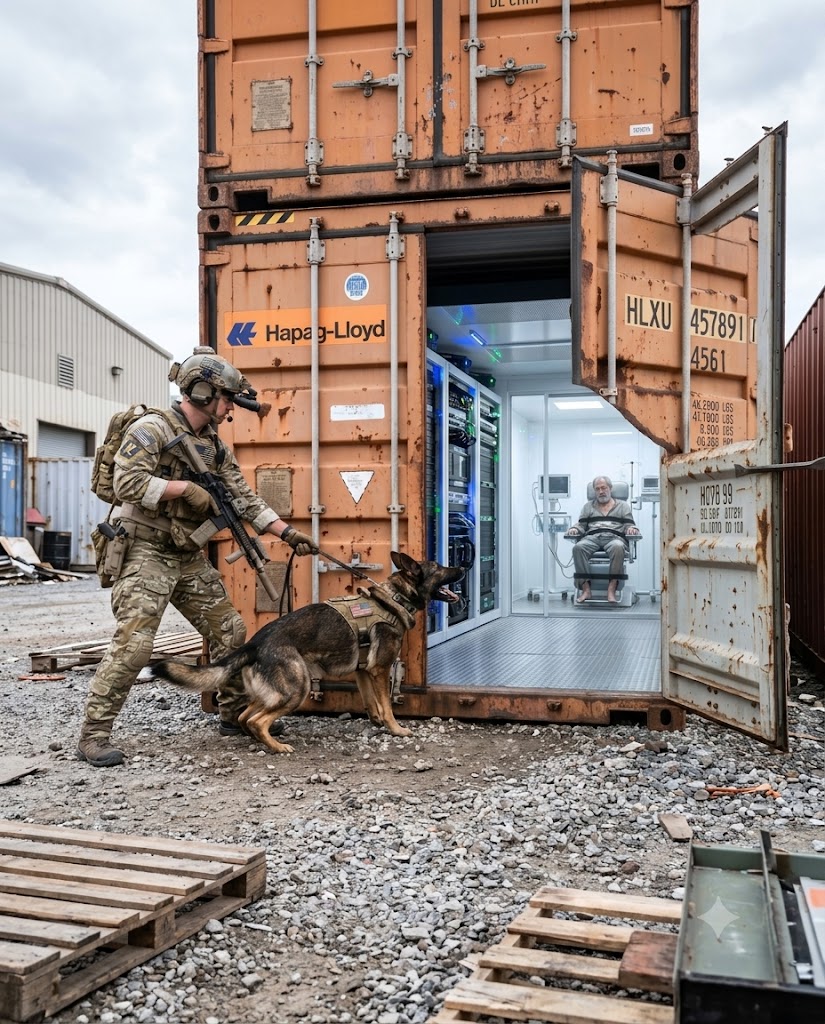
Nate Sullivan, a decorated former Navy SEAL, walked the graveyard rows of Sector 9 with his bomb-sniffing German Shepherd, Bruno, a retired MARSOC tactical K9 with a coat the color of burnt mahogany.
For twelve years Nate had operated in the most unforgiving corners of the Middle East, and patrolling shipping yards for Trident Security Solutions was supposed to be a quiet deceleration—a welcome slowing of the pulse.
Bruno wasn’t just a pet; he had survived IED blasts in Helmand Province and clearing operations in Fallujah, and the bond between man and dog had been forged in environments where a single missed scent meant death.
It was 1:45 a.m. on a frigid Tuesday in November when the leash suddenly went taut.
Nate stopped immediately, his right hand instinctively dropping toward his hip as Bruno’s ears pinned flat against his skull and his hackles rose in a jagged ridge down his spine.
The dog was staring dead ahead at a forty-foot shipping container stacked on the ground level—a relic with no logos, no company identifiers, and most suspiciously, no ISO reporting marks required by international maritime law.
It was an absolute ghost.
Bruno didn’t sit, which was his standard response for explosives, and he didn’t paw at the ground, his standard response for narcotics; instead, he began to whine—a high-pitched, anxious sound Nate hadn’t heard since an operation in Yemen when the dog had located a trapped friendly under rubble.
Then Bruno pressed his wet nose against the rusted bottom seam of the heavy double doors and began to bark—not a warning bark, but a frantic, desperate alarm.
“Quiet, Bruno. Halt,” Nate commanded in German, shining his heavy-duty Maglite across the container’s face.
The light revealed a massive industrial-grade master lock securing the latch—a lock that was entirely out of place, gleaming and brand new against a box that looked like it had been rotting in the salt air for a decade.
Nate pulled his radio from his vest. “Dispatch, this is Sullivan. I’m at Sector 9, Row G, position four. I’ve got a K9 alert on an unmarked forty-footer. I need a manifest check.”
Static crackled before Sarah Higgins, the night shift dispatcher, replied, “Copy, Nate. Give me the serial.”
“There is no serial, Sarah. The box is scrubbed. No paint, no numbers. It’s entirely off the books.”
A long pause stretched over the radio, and Nate could hear the clicking of Sarah’s keyboard echoing through the channel.
“Nate, the digital grid for Sector 9 shows that slot is completely empty. There’s nothing supposed to be in position four. Wait—let me check the manual override logs.”
Before Sarah could finish, a different voice cut into the channel—Godfrey Tillman, the port authority night director, a bureaucratic ladder climber who wore expensive suits to a blue-collar shipyard and had always rubbed Nate the wrong way.
“Sullivan, this is Tillman. Step away from that container. It’s a dead drop for a federal hazardous materials audit. The paperwork is classified and handled above your pay grade. Continue your patrol route. Do not engage.”
Nate narrowed his eyes at the brand new lock. “Director Tillman, my dog is signaling a critical distress alert. He’s trained for biohazards and explosives, but this is a search and rescue response. If there’s a hazardous leak, we need HazMat out here now.”
“I said stand down, Sullivan,” Tillman barked, abandoning professional radio etiquette entirely. “You are a private contractor. If you touch that lock, I will have Trident Security pull your contract before sunrise, and you’ll be facing federal tampering charges. Walk away. Now.”
Nate clicked his radio off and looked down at Bruno, who had stopped barking but was now pacing frantically back and forth across the rusted doors, occasionally stopping to sniff the deep gouges in the metal.
He had spent a decade recognizing the signs of an ambush, a lie, and a cover-up—and Tillman’s reaction was terrified, not authoritative.
There was no federal HazMat audit; the lock was new, the grid was manually wiped, and the whole thing stank worse than the diesel in the air.
“Come on, Bruno,” Nate whispered, giving the leash a gentle tug. “Let’s play their game for now.”
He led the reluctant dog away from Sector 9, retreating into the labyrinth of shipping lanes—but Nate Sullivan was not a man who walked away from a distress signal, and the SEAL ethos didn’t wash off just because he was wearing a private security badge.
He was coming back, and he was going to open that box.
By 3:15 a.m. the storm had intensified, transforming the port into a chaotic symphony of crashing waves and howling wind—perfect cover for a man who intended to break the law.
The cameras in Sector 9 had mysteriously gone offline at 2:00 a.m., a detail Nate confirmed by hacking into Trident’s localized security feed from his ruggedized Panasonic Toughbook in his truck.
Tillman was undoubtedly preparing to move the container under the cover of darkness, and Nate knew his window was rapidly closing.
Leaving his high-visibility contractor jacket on the passenger seat of his Tacoma, Nate geared up in a black tactical soft shell, checked the chamber of his SIG Sauer P320, and slid it into his thigh holster.
From a metal lockbox in the truck bed he retrieved a pair of thirty-six-inch heavy-duty bolt cutters and a specialized titanium breaching pry bar he’d kept since his DevGru days.
“Stay,” Nate ordered Bruno, leaving the truck’s window cracked just enough for air.
The dog whined and paced the back seat but obeyed, because if things went sideways, Nate didn’t want the canine caught in the crossfire.
Nate ghosted through the shadows of the shipping yard, the torrential rain masking his footsteps as he utilized the blind spots between the massive stacks of containers, moving with the fluid, silent precision the Navy had spent millions of dollars ingraining into his muscle memory.
When he reached Sector 9, Row G, the area was eerily deserted, but the tension in the air was palpable, and the rusted container sat exactly where it had been, the heavy rain washing over its oxidized roof.
Nate approached the doors and pressed his ear against the freezing wet metal; at first there was nothing but the drumming of the storm, and then he heard it—faint, rhythmic, entirely unnatural for an abandoned metal box.
Thump, pause, thump, pause—it sounded like the mechanical hum of an industrial generator, accompanied by the low vibrating hum of heavy cooling fans.
Without hesitating, Nate clamped the jaws of the massive bolt cutters around the thick shackle of the master lock, and though the steel was hardened and meant to withstand standard tampering, he leveraged his entire body weight onto the extended handles.
His shoulders burned and the muscles in his forearms strained against the resistance until, with a sharp violent crack, the steel shackle snapped and the heavy lock fell into his gloved hand.
He tossed it quietly onto the wet asphalt, drew his SIG Sauer with his right hand, and grabbed the rusted vertical locking bar with his left.
He took a deep breath, braced his boots against the pavement, and threw the heavy right door open.
The hinges shrieked in protest, a horrible metallic scream that seemed deafening in the quiet yard, and Nate immediately stepped back into the shadows raising his weapon, expecting a rush of movement or a hail of gunfire from inside.
Nothing came out.
Instead, what spilled from the opening was a blinding, clinical white light and a rush of freezing sterile air, and the odor of rust and diesel was instantly overpowered by the sharp chemical scent of medical-grade ozone and bleach.
Lowering his weapon slightly, Nate stepped into the container, and his jaw tightened because the rusted exterior was a complete illusion—merely a shell.
The interior had been retrofitted with pristine white polyurethane soundproofing and insulated paneling, the floor covered in antistatic rubber matting, and fluorescent LED strips lined the ceiling casting a shadowless glare over a staggering array of high-tech equipment.
To his left was a massive bank of black servers, their green and blue optical lights blinking furiously, with heavy-duty liquid cooling pipes running along the ceiling to keep the processors from overheating.
The mechanical thumping he had heard outside was a state-of-the-art air filtration and climate control system humming in the corner.
“What the hell is this?” Nate muttered to himself, stepping further inside as the door slowly swung half closed behind him, muting the sound of the Seattle storm outside.
To his right, running the length of the wall, were whiteboards covered in complex logistical routes, shipping manifests, and satellite photographs of military installations across Eastern Europe and the South China Sea.
But it wasn’t the espionage setup that made the SEAL’s blood run cold—it was what lay at the very back of the container.
Separated by a thick wall of reinforced soundproof Plexiglas, a secondary room had been built into the rear quarter of the space, and inside the glass enclosure was a harsh stainless steel medical chair, similar to a dental recliner, with leather restraints dangling from the armrests and ankles.
Someone was sitting in it.
Nate holstered his weapon and sprinted to the glass, slamming his palm against the Plexiglas. “Hey!”
The figure in the chair slowly lifted their head—a man, severely emaciated, wearing a soiled gray jumpsuit, with intravenous tubes running from his left arm to a digital monitor on a rolling cart.
His face was battered, his lips cracked and bleeding, but as the man’s eyes focused through the blinding light, Nate felt the floor drop out from beneath him.
The man in the chair was Wilton Murphy.
Nate stumbled back a step, his breath catching in his throat, because it was impossible—Wilton Murphy was a high-level Defense Intelligence Agency asset, and Nate’s SEAL team had been assigned to extract Murphy from a compromised safe house in Sanaa, Yemen, five years ago.
The operation had been a catastrophic failure; a thermobaric explosive had leveled the building before Nate’s team could breach, and the Pentagon had declared Murphy dead.
Nate had stood at the man’s closed casket funeral in Arlington.
Yet here he was, alive, hidden inside a rusted shipping box on American soil.
Nate frantically searched the frame of the Plexiglas door, finding a digital keypad, and pulled his pry bar from his belt, jamming the titanium tip into the seam of the electronic lock and wrenching it sideways.
The plastic casing shattered exposing the wiring, and Nate yanked the internal release cable, and the heavy glass door hissed open.
He rushed in, immediately checking Murphy’s pulse—it was erratic and terrifyingly weak.
“Wilton,” Nate whispered, pulling a specialized cutting tool from his vest to slice through the heavy leather restraints on the man’s wrists. “Wilton, it’s Sullivan. Stay with me. I’m getting you out of here.”
Murphy’s eyes were cloudy, struggling to track Nate’s face, and he coughed—a dry, rattling sound.
When he finally spoke, his voice was nothing more than raw gravel. “You… you shouldn’t have opened that door, Nate.”
Murphy wheezed, his cold trembling fingers reaching up to grip Nate’s tactical vest with surprising desperation.
“I’ve got you. We’re leaving,” Nate said, lifting the man’s arm over his shoulder.
Murphy shook his head weakly, staring past Nate toward the open doors of the container. “No. You don’t understand. The server bank. They aren’t extracting data. They’re uploading it. The grid is compromised. And they—” Murphy coughed violently, blood spattering his pale chin. “They are already here.”
Before Nate could process the warning, the heavy metallic thud of multiple car doors slamming echoed through the storm outside, and tires screeched to a halt on the wet asphalt, boxing in Sector 9.
Over the roar of the rain, Nate heard the distinct, chilling sound of a suppressed rifle bolt being racked back.
He had walked directly into a trap, and the nightmare was just beginning.
—
**Part 2**
Nate immediately lunged for the main breaker box mounted near the server racks, and with a harsh yank he killed the interior lights, plunging the container into total darkness save for the eerie ambient glow of the liquid cooling systems and server LEDs.
The sudden blackness was his only immediate advantage.
He unholstered his SIG Sauer, moving silently to position himself behind the heavy steel doors, effectively using the rusted threshold as a fatal funnel.
Outside, the storm continued its relentless assault, but through the driving rain Nate could hear the distinct squelching footsteps of tactical boots on wet pavement—they were moving in a disciplined, staggered formation.
Three men, maybe four—these were not local cops or port authority rent-a-cops.
The absolute silence of their approach, no shouting, no demands for surrender, screamed tier one private military contractors.
They were here to sanitize the site.
“Stay down, Wilton,” Nate whispered, his voice barely audible over the humming servers.
“They need the drive,” Murphy rasped from the floor, clutching his bleeding side where the IV had been ripped out. “The master drive, Nate. Red slot, take it.”
Nate ignored the instruction for a moment, his eyes adjusting to the darkness, and from the shadows a narrow beam of an infrared laser cut through the rain, painting the inner wall of the container.
Then came the voice.
“Sullivan, we know you’re in there.”
It was Director Godfrey Tillman shouting from a safe distance behind an armored SUV, his voice cracking with a mixture of terror and authority.
“Throw out your weapon. You stumbled into a designated black site. Surrender now, and you walk away. If my men have to breach, you and the asset die.”
Nate didn’t bother responding, because he knew a kill squad when he saw one—there was no walking away from a resurrected ghost and a rogue server farm.
Suddenly a flashbang grenade bounced through the half-open door, clattering violently against the rubber floor mats.
Nate’s instincts took over as he kicked the grenade toward a drainage grate in the center of the container, shielding his eyes and opening his mouth to equalize the pressure.
The detonation was deafening in the confined space, a concussive shockwave that shattered the remaining Plexiglas and sent a shower of sparks cascading from the ceiling.
Before the smoke could clear, two heavily armed operatives breached the threshold, their suppressed rifles raised and sweeping the room.
Nate fired twice—two suppressed thwips echoed—but his aim was true.
The lead operative took two rounds to the Kevlar plating on his chest, knocking the wind out of him and sending him sprawling backward into the mud.
The second operative pivoted, laying down a burst of automatic fire that chewed through the server racks, sending sparks and coolant fluid spraying across the room.
Nate dove behind a reinforced steel desk as glass and metal rained down on him—he was pinned, heavily outgunned, and running out of time.
A hundred yards away, sitting in the back of the locked Tacoma, Bruno was losing his mind.
The K9 had heard the muffled crack of the flashbang and the subsequent gunfire, and the deep guttural growls tearing from his throat were no longer warnings—they were the desperate cries of a loyal soldier separated from his pack.
Bruno began throwing his eighty-five-pound frame against the passenger window, not caring about the pain, backing up over the center console and lunging with all his might.
On the third impact the safety glass webbed, and on the fourth it shattered outward into the storm.
Bruno leaped through the jagged frame, his paws hitting the wet asphalt at a full terrifying sprint, a missile coated in dark fur completely invisible in the rainy night.
He zeroed in on the scent of gunpowder, ozone, and Nate’s unique stress pheromones.
Back at the container, the second operative was advancing on Nate’s position, pulling a fragmentation grenade from his vest to finish the job.
He pulled the pin.
He never got to throw it.
Out of the darkness Bruno launched himself through the air, completely bypassing the operative’s body armor and sinking his powerful jaws directly into the man’s exposed forearm.
The operative screamed in agony as the German Shepherd’s momentum carried them both to the ground, the live grenade skittering harmlessly out into the deep puddles of the shipping yard where it detonated with a muffled crump.
Nate seized the opening, vaulting over the desk, kicking the operative’s rifle away before delivering a brutal strike to the man’s jaw that knocked him unconscious.
“Good boy, Bruno. Guard.”
The dog immediately stood over the fallen man, teeth bared, rain slicking his fur, ready to tear out the throat of anyone who moved.
Nate rushed to the entrance, sweeping his weapon across the perimeter, and the remaining operatives were retreating behind the armored SUV, realizing their sterile takedown had turned into a chaotic bloodbath.
“Tillman!” Nate roared into the storm. “It’s over. Pull your guys back, or you’re a dead man.”
A heavy silence followed, broken only by the idling engine of the SUV, and then the vehicle’s tires spun against the wet pavement.
Tillman and the surviving operatives were abandoning the site—they had lost the element of surprise, and local law enforcement would inevitably be responding to the explosions.
Nate let out a ragged breath, lowering his pistol but keeping it unholstered, and turned back into the shattered smoking container where Bruno trotted up to him and nuzzled his free hand.
The SEAL dropped to one knee, wrapping his arm around the canine’s thick neck. “You saved my life, buddy. Again.”
But the danger was far from over.
From the back of the container a loud synthetic voice echoed from the damaged server console: “Biometric override required. Upload sequence at ninety percent. Time to completion: three minutes.”
Nate rushed back to Murphy, hauling the battered intelligence officer to his feet. “Wilton. Talk to me. What is that upload? Why were they keeping you alive?”
Murphy coughed, wiping blood from his chin, his eyes darting toward the flashing monitors. “Knock list, Nate. The Defense Intelligence Agency’s non-official cover registry. Deep cover agents embedded in the Kremlin, Beijing, Tehran. They needed my retinal scan and vascular signature to bypass the security firewalls.”
Nate felt a chill that had nothing to do with the Seattle rain—if that list was uploaded to whatever rogue syndicate Tillman was working for, dozens of American operatives would be executed before sunrise.
“Why you?” Nate asked, moving toward the primary terminal.
“Because I designed the encryption,” Murphy wheezed, leaning heavily against the wall. “When the safe house in Yemen went up, it wasn’t a terrorist strike. It was an inside job. A shadow faction within the DIA wanted the list to sell to the highest bidder. They pulled me from the rubble, staged my death, and threw me in this box. They’ve kept me in a chemically induced coma for five years, bringing me out only when they needed to update the biometrics.”
Nate stared at the screen. “Ninety-four percent. How do I stop it?”
“You can’t abort it from the console,” Murphy said, his voice dropping to a desperate whisper. “They hardwired the fail-safes. But the master drive, the physical ledger, it’s in the red slot below the primary server. If you take that, the upload corrupts. It sends blank data.”
Nate dropped to the floor, pulling away a damaged metal grate, and behind it was a reinforced lockbox containing a single flashing red hard drive.
He wedged his titanium pry bar into the housing and cracked it open, violently ripping the drive from its SATA cables.
Instantly the monitors flashed crimson: “Error. Primary data source disconnected. Upload corrupted.”
“Got it,” Nate said, shoving the heavy drive into his tactical vest.
“We have to burn the rest,” Murphy insisted, struggling to stay upright. “If they recover the secondary servers, they might be able to piece together fragments. Burn it all, Nate.”
Nate looked around, his eyes landing on the severed liquid cooling lines leaking highly flammable propylene glycol across the floor, mixing with the sparks from the shattered electrical panels.
“Bruno, out!” Nate commanded, and the dog immediately sprinted out of the container and into the rain.
Nate grabbed Murphy, throwing the emaciated man over his shoulder in a fireman’s carry, and as he stepped out of the container he aimed his SIG Sauer at the main electrical junction box mounted above the servers.
He fired three rounds.
The junction box exploded in a shower of blue sparks, and the sparks ignited the pooling coolant.
Within seconds a massive, unnatural green flame swept across the interior of the container, devouring the millions of dollars of rogue technology and five years of Wilton Murphy’s living hell.
Nate carried Murphy through the labyrinth of Sector 9, Bruno leading the way, his sharp nose clearing their path of any lingering threats, and the wail of police sirens was finally cutting through the sound of the storm, closing in on the Port of Seattle.
They reached the Tacoma, and Nate carefully placed Murphy in the passenger seat, wrapping him in a heavy emergency foil blanket from his medkit.
Bruno hopped into the back, shaking the freezing rain from his coat.
Nate climbed into the driver’s seat and started the engine, and he didn’t turn on his headlights, navigating the back alleys of the industrial park using only his memory and the ambient city lights.
“Where are we going?” Murphy asked, his voice weak but laced with the first hint of hope he had felt in half a decade. “We can’t go to the feds, Nate. We don’t know who is compromised.”
“We aren’t going to the feds,” Nate said, staring at the road ahead, his hand resting reassuringly on the hard drive secured in his vest. “I have contacts from my Dev Group days, guys who live off the grid. We vanish, Wilton. We disappear. We decrypt this drive. And then we hunt down every single traitor who put you in that box.”
Murphy managed a weak, exhausted smile, closing his eyes as the heat from the truck’s vents washed over him.
In the backseat Bruno let out a soft, contented sigh, resting his chin on Nate’s shoulder.
The war wasn’t over—in fact, it had just truly begun—but as Nate drove off into the Pacific Northwest night, leaving the burning rusted container far behind, he knew one thing for certain.
They had the data.
They had the truth.
And heaven help anyone who came looking for them.
—
**Part 3**
The Tacoma’s odometer read 47,312 miles when Nate finally pulled off the I-5 near Tumwater, and the rain had softened to a persistent drizzle that made the roadside diner’s neon sign bleed pink light across the wet gravel.
Murphy had drifted in and out of consciousness for the entire drive, mumbling fragments about retinal scans and dead drops and a man he called “the Architect,” and Nate had kept one hand on the wheel and one eye on the rearview mirror the whole way.
Bruno sat upright in the back seat, ears swiveling at every passing semi, and Nate knew the dog was still in tactical mode, still guarding, still counting threats.
He parked behind the diner, killed the engine, and turned to Murphy. “I need to make a call. You stay in the truck with Bruno. If anyone who isn’t me opens that door, you let him do his job.”
Murphy nodded weakly, his fingers curling around the foil blanket.
Nate stepped out into the cold, walked twenty yards into a stand of wet evergreens, and pulled a burner phone from his jacket—a cheap prepaid model he kept for exactly this kind of situation.
He dialed a number he hadn’t called in four years.
It rang three times before a gravelly voice answered. “This better be a wrong number, because I don’t know anyone who’d call this line.”
“Redline, it’s Sullivan.”
A long pause. “Nate Sullivan. As I live and breathe. You know, most people who retire from the Teams stay retired. You’re calling me at four in the morning from a number I don’t recognize, which means you’re either in trouble or you’re about to put me in trouble.”
“Both. I need a safe house, medical supplies, and a forensic accountant who doesn’t ask questions.”
Another pause, longer this time. “What kind of medical supplies?”
“The kind you use on a man who’s been held captive for five years.”
Redline—a former SEAL medic named Marcus Reyes who had left the Teams after a jump injury and now ran a survivalist outfitter in the Cascades—let out a low whistle. “You’re not kidding.”
“I never kid before sunrise. I’ve got a DIA asset in my truck who was declared dead in Yemen five years ago, and I’ve got a hard drive that’s going to get a lot of people killed if it falls into the wrong hands. I need to disappear for about seventy-two hours.”
“Seventy-two hours,” Redline repeated. “You know what I charge for seventy-two hours of disappearing?”
“I know what you charged in Afghanistan, and I know you owe me for that business in Kandahar.”
The line went quiet for a beat. “That’s a low blow, Sullivan.”
“It’s a true blow. You in or not?”
Redline sighed. “I’m in. But you’re buying the coffee. And you’re going to tell me everything, and I mean everything, including why you’re traveling with a dog that sounds like he could eat a car door.”
“Bruno’s a good judge of character. He’ll like you.”
“Everybody likes me. That’s my curse. Head north on I-5, take the exit for Highway 12, and I’ll text you coordinates. And Nate—whatever you’re into, make sure you’re not being followed. I don’t run a bed and breakfast for federal agents.”
Nate hung up, pocketed the phone, and walked back to the truck, where Bruno’s tail gave a single, restrained wag—the canine equivalent of a soldier’s crisp salute.
“Good boy,” Nate murmured, and climbed back behind the wheel.
—
The safe house was a converted hunting cabin tucked into a fold of the Cascades so deep that GPS gave up and handed you a compass.
Redline met them at the door with a medical bag in one hand and a shotgun in the other, and he took one look at Murphy’s emaciated frame and swore under his breath.
“Five years, you said?”
“Five years.”
“Get him inside. I’ve got IV fluids and a cot in the back room. And Nate—” Redline caught his arm as he passed. “Whatever’s on that drive, it’s already got a body count, hasn’t it?”
Nate thought about the flashbang, the suppressed rifles, the operative Bruno had taken down in the mud. “At least one. Maybe more before this is over.”
Redline nodded grimly. “Then let’s make sure it’s the right people.”
For the next six hours, Nate and Redline worked in shifts—Redline stabilizing Murphy with fluids and antibiotics, Nate setting up a laptop on the cabin’s scarred wooden table and plugging in the master drive.
The drive was encrypted with a military-grade cipher, but Murphy, drifting in and out of consciousness, managed to rasp out the passphrase: a string of numbers that turned out to be the date of his daughter’s birth, a detail the DIA had never bothered to purge from his file.
When the drive finally unlocked, Nate stared at the screen for a long, silent minute.
It wasn’t just the knock list—it was everything.
Names, photographs, bank transfers, encrypted communications between Tillman and a shadow faction inside the DIA, and a payment ledger that traced back to a shell company registered in Delaware with a single line item: “Consulting services—$2.4 million USD.”
“Two point four million dollars,” Nate said aloud, and Redline looked up from Murphy’s bedside.
“What?”
“The price of a man’s life. They sold Murphy for two point four million dollars, and they were about to sell forty-seven deep cover agents for a lot more.”
Redline walked over, stared at the screen, and shook his head. “Forty-seven agents. That’s not a leak. That’s a massacre waiting to happen.”
“Not anymore,” Nate said, and began copying the files onto three separate encrypted thumb drives—one for himself, one for Redline, and one for a man he trusted more than almost anyone left alive.
—
By noon the next day, Nate was standing in a parking garage in downtown Olympia, holding a cup of black coffee and waiting for a silver Honda Civic to pull into the space next to him.
The driver was a woman in her fifties with sharp eyes and gray-streaked hair pulled back in a practical ponytail—Dr. Elaine Cortez, a former DIA counterintelligence officer who had resigned in protest after Yemen and now taught graduate courses at the University of Washington.
She stepped out of the car, looked at Nate, and said, “You look like hell.”
“I feel like hell. You look like you’re about to retire and move to Florida.”
“Not anymore, apparently.” She nodded toward the thumb drive in his hand. “Is that what I think it is?”
“It’s the reason you resigned. It’s the proof you never got. Murphy is alive, Elaine. They kept him in a box for five years, and they were about to sell the knock list to the highest bidder.”
Cortez’s face went pale, then hard. “How many names?”
“Forty-seven. Including three assets inside the Kremlin and two inside the Chinese Ministry of State Security.”
She took the drive, turned it over in her fingers, and looked back at Nate with the expression of a woman who had spent five years wondering if she’d made the right choice. “You know what happens if we do this. The shadow faction isn’t going to roll over. They’ve got people in the Pentagon, in Langley, probably in the White House.”
“Then we don’t go through the front door. We go through the press, through the inspectors general, through every member of Congress who’s ever sat on an intelligence committee and asked a hard question. We dump the whole thing at once and let the light in.”
Cortez was quiet for a long moment. Then she smiled—a thin, dangerous smile. “You know, Sullivan, I always said you were too idealistic for this line of work.”
“I prefer to think of it as stubborn.”
“Same thing.” She pocketed the drive. “Give me forty-eight hours. I’ve still got contacts at the New York Times and the Project on Government Oversight. If we’re going to burn this thing down, we’re going to do it right.”
—
**Part 4**
Forty-eight hours later, Nate was sitting in a diner in Tacoma with a plate of eggs he hadn’t touched and a phone that wouldn’t stop buzzing.
The story had broken at 6:00 a.m. Eastern—a joint investigation by the New York Times and the Project on Government Oversight, with documents, photographs, and a statement from a “senior former intelligence official” who had chosen to remain anonymous.
By 9:00 a.m., the first congressional hearing had been announced.
By noon, Godfrey Tillman had been arrested at his home in Bellevue by FBI agents who found him trying to shred documents in his garage.
By 3:00 p.m., the DIA had issued a statement confirming that Wilton Murphy, long presumed dead, was alive and receiving medical care at an undisclosed location.
By 6:00 p.m., three senior DIA officials had resigned, and the attorney general had announced a full-scale investigation into what the press was already calling “the Knock List Affair.”
Nate read the headlines on his phone, set it down, and finally took a bite of his eggs.
Across the table, Redline was scrolling through his own phone with the expression of a man watching a train wreck in slow motion. “You know, when I signed up to help you, I figured we’d be running from black helicopters for a month, not watching the whole thing blow up in a day.”
“Sometimes the light works faster than the dark.”
“That’s very philosophical for a guy who broke into a shipping container with a pair of bolt cutters.”
Nate shrugged. “I contain multitudes.”
Bruno, curled up under the table with his chin on Nate’s boot, let out a contented sigh.
The dog had been in a good mood all day—Nate suspected he could sense the shift in the air, the way the tension had broken, the way the hunt was over.
But Nate knew better than to think it was truly finished.
The shadow faction had lost this battle, but the people who had orchestrated Yemen, who had staged Murphy’s death, who had kept a man in a chemically induced coma for five years—they weren’t all in custody.
Some of them were still out there, and some of them would be looking for revenge.
Nate’s phone buzzed again, and this time it was a text from Cortez: “Murphy’s daughter has been notified. She’s flying in from Chicago tomorrow. She thought her father died when she was nineteen.”
Nate typed back: “Does she want to see him?”
“She does. He wants to see her too. I think it’s going to be a good reunion.”
Nate set the phone down, and Redline looked at him. “What now?”
“Now we wait. We see who else gets arrested, who else resigns, who else decides to cooperate with the investigation. We make sure the list gets published in full, so every one of those forty-seven agents knows they’re exposed and can get out.”
“And after that?”
Nate thought about it. He thought about the twelve years he’d spent in the Teams, the friends he’d lost, the missions that had gone sideways, the retirement he’d thought he wanted.
He thought about Bruno, who had saved his life twice now—once in Yemen, once in a shipping container.
He thought about Wilton Murphy, who had designed the encryption that had gotten him kidnapped and tortured, and who would now have to rebuild his life from the ground up.
“I don’t know,” Nate said finally. “Maybe I go back to patrolling shipping yards. Maybe I do something else. Maybe I finally take that vacation to Montana I’ve been promising myself.”
Redline snorted. “Montana. You’d be bored in a week.”
“Yeah,” Nate admitted. “Probably.”
—
Three weeks later, Nate stood in the lobby of a Veterans Affairs hospital in Seattle, watching Wilton Murphy walk—slowly, with a cane, but walking—down the corridor toward the exit.
Murphy’s daughter, a tall woman with her father’s sharp eyes and a floral scarf wrapped around her neck, held his arm and talked to him in a low, steady voice.
Murphy looked up as they approached, and his face broke into a smile that made him look ten years younger.
“Sullivan,” he said, releasing his daughter’s arm to shake Nate’s hand. “I hear I have you to thank for my freedom.”
“You have Bruno to thank for your freedom,” Nate said. “I was just the guy with the bolt cutters.”
Murphy laughed, a dry, rasping sound, and looked down at Bruno, who was sitting at Nate’s feet with his tail wagging in a slow, dignified rhythm. “Then I owe you a steak, young man,” he said to the dog. “The biggest steak in Seattle.”
Bruno’s tail wagged faster.
Murphy’s daughter stepped forward and shook Nate’s hand. “I’m Claire. I wanted to meet the man who brought my father back from the dead.”
“I’m glad I could.”
“I read the news reports. About the list, the agents, the cover-up. It’s hard to believe something like that could happen here.”
Nate thought about the shipping container, the white walls, the Plexiglas cage, the medical chair with its leather restraints. “It’s harder to believe it almost got away with it.”
Claire nodded, and her father squeezed her hand.
“Where will you go now?” Murphy asked.
“Back to work, I think. Trident offered me a permanent position. A promotion, actually. Night shift supervisor.”
“Does that mean you’ll stop breaking into shipping containers?”
“Only when I have to.”
Murphy laughed again, and this time it was a fuller, healthier sound.
As Nate walked out of the hospital into the pale Seattle sunlight, Bruno at his side, he thought about the knock list, the agents whose lives had been saved, the traitors who had been exposed.
He thought about the red hard drive, still locked in a safe deposit box in Olympia, waiting for the day when it might be needed again.
He thought about the war that wasn’t over—the war against the shadow faction, against the people who had sold a man’s life for two point four million dollars.
And he knew, with the certainty of a man who had spent his entire adult life in the service of his country, that he would be ready.
He had the data.
He had the truth.
He had Bruno.
And heaven help anyone who came looking for them.
—
*The knock list was published in full three months later, and all forty-seven agents were successfully extracted and relocated.*
*The shadow faction inside the DIA was dismantled over the course of eighteen months, with eleven senior officials convicted of conspiracy, treason, and espionage.*
*Wilton Murphy retired to a small town in Vermont, where he wrote a memoir about his five years in captivity and his unlikely rescue by a Navy SEAL and his dog.*
*Nate Sullivan stayed on as night shift supervisor at Trident Security Solutions for two more years before finally taking that vacation to Montana.*
*He brought Bruno.*
*And when the call came, as he always knew it would, he answered.*









