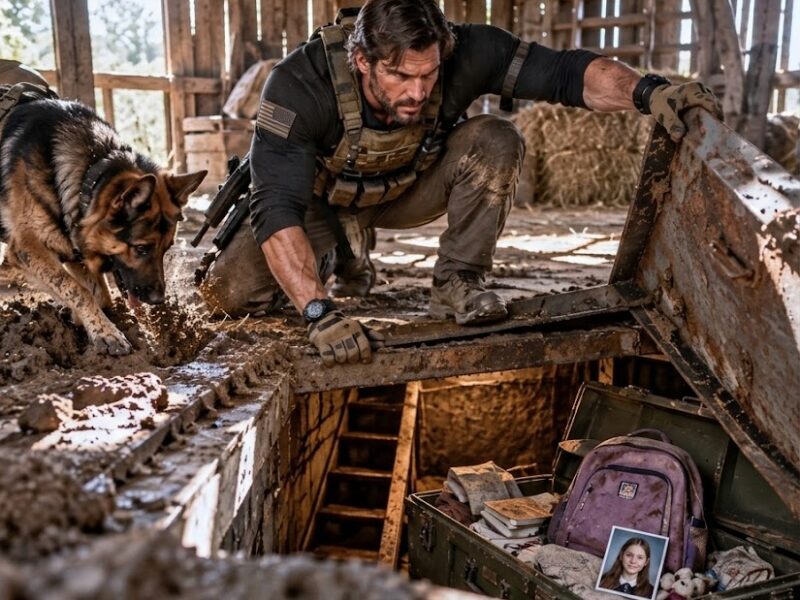
A Navy SEAL’s German Shepherd Started Digging Beneath an Abandoned Barn—What the Dog Unearthed Exposed a Mystery That Had Haunted a Small Town for 20 Years
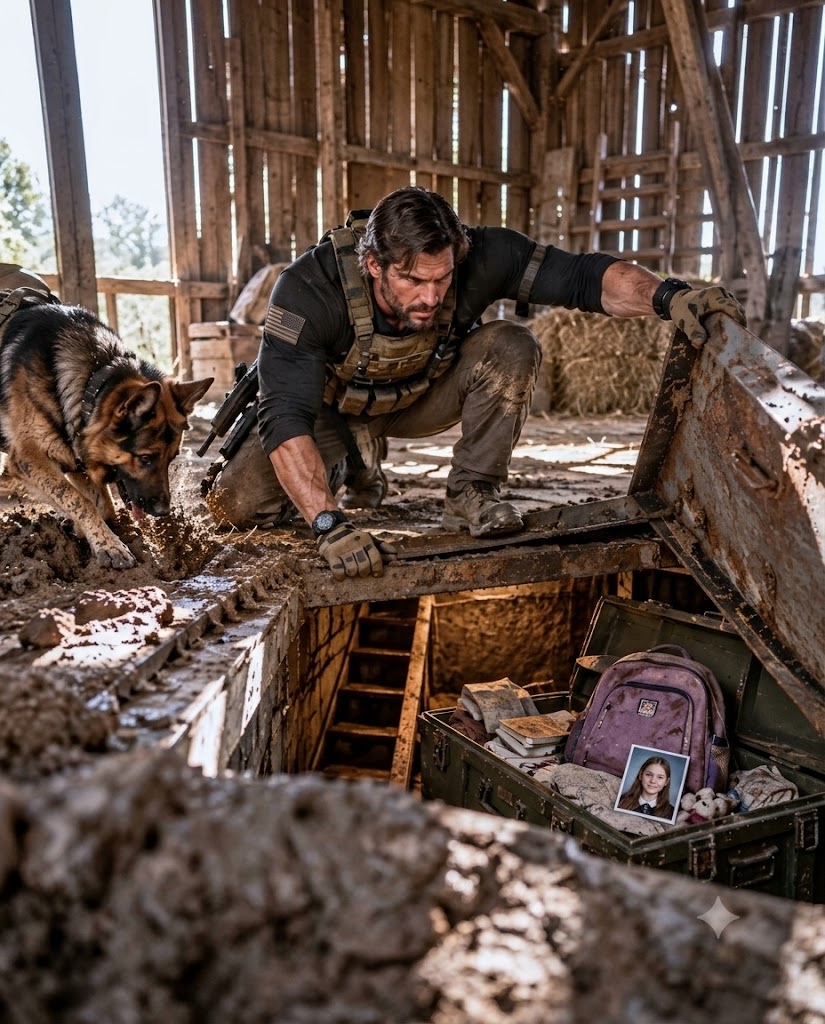
Dust swirled around Titan’s paws as the retired military K9 dug frantically beneath the rotting floorboards of an abandoned barn in Montana’s Bitterroot Valley.
Former Navy SEAL Jonathan Reynolds tried to pull his German Shepherd away, but what lay buried in the cold Montana earth had been hiding a chilling secret for exactly twenty years.
Jonathan had spent his entire adult life reading the silence.
As a decorated Navy SEAL who had survived four grueling deployments across the most hostile terrains on the planet, he knew that the absence of noise was rarely a sign of peace.
Sometimes, it was a warning.
But out here in the sprawling pine-covered expanse of western Montana, he had hoped the silence would finally just mean quiet.
Seeking isolation after a medical discharge shattered his military career, Jonathan had purchased a dilapidated 40-acre farm site unseen.
The property had sat abandoned for years, its fields overgrown with wild fescue, and its buildings sagging under the weight of harsh winters and total neglect.
It was the perfect place for a man trying to outrun the echoes of combat.
His only companion was Titan, a heavily scarred 70-pound German Shepherd.
Titan wasn’t just a pet—he was a highly trained tactical K9 who had saved Jonathan’s life on more than one occasion in the mountains of Afghanistan.
They were bound together by trauma, loyalty, and an unspoken understanding of how the world truly worked.
The previous owner of the property, a reclusive cattle rancher named Elias Caldwell, had passed away years ago, leaving the estate to rot in probate before the county finally auctioned it off.
Locals in the nearby town of Oak Haven had warned Jonathan about the property.
They claimed the soil was sour, the well water tasted like iron, and old man Caldwell had been a paranoid shut-in who chased away anyone who came within a mile of his driveway.
Jonathan didn’t care about local gossip.
He just wanted to fix up the main cabin and live out his days in absolute solitude.
It was a brisk Tuesday afternoon in late October when the routine broke.
Jonathan had decided to tackle the property’s most dangerous eyesore—a massive, collapsing barn situated near the edge of the tree line.
Its roof had partially caved in and the timber was dangerously compromised.
He was inside the dim, dust-choked structure hauling out rusted farm equipment and heavy lengths of rotting chain when he noticed Titan acting strangely.
Military working dogs do not behave erratically without cause.
Their entire existence is predicated on discipline, focus, and highly specific behavioral conditioning.
Titan had been trained in explosive ordnance detection, tracking, and search and rescue.
When Titan was off duty, he usually lay near Jonathan’s feet, his sharp amber eyes watching the perimeter with a calm vigilance.
But right now, Titan was restless.
The German Shepherd was pacing a tight circle in the far corner of the barn near what used to be an old tack room.
“Titan, here,” Jonathan commanded, his voice a low, authoritative rumble that usually brought the dog instantly to his side.
Titan paused, looked back at Jonathan with his ears pinned flat against his skull, and let out a low, vibrating whine.
Then, he deliberately turned his back on his handler, lowered his snout to the dirt floor, and began to scratch.
Jonathan dropped the coil of heavy rope he was carrying and walked over, his combat boots crunching against the dry, compacted earth.
“What do you have, buddy?”
Titan’s scratching turned into frantic digging.
Clods of hard, dry soil flew through the air as the dog’s powerful front paws tore into the ground.
He was digging with a desperate intensity, his breathing heavy, his focus entirely locked on a specific patch of dirt next to a crumbling wooden support beam.
“Leave it,” Jonathan ordered, stepping forward to clip a leash onto Titan’s collar.
The dog stopped instantly, but he didn’t back away.
Instead, Titan executed a flawless, rigid sit.
He stared intently at the shallow depression he had just excavated, his body trembling slightly, and let out a sharp, single bark.
Jonathan felt the hair on the back of his neck stand up.
A cold spike of adrenaline, familiar and sharp, pierced through his chest.
That was Titan’s final alert signal.
It was the exact posture the canine took when he found an IED buried in a dirt road, or when he located human remains hidden beneath the rubble of a collapsed building.
“Easy, boy,” Jonathan murmured, his tactical instincts instantly overriding his civilian mindset.
He knelt beside the dog, examining the dirt.
There was no smell of chemicals, no obvious signs of recent disturbance.
The ground here was as hard as concrete, compacted by decades of heavy equipment and neglect.
Whatever was down there hadn’t been buried yesterday.
It had been there for a very, very long time.
Jonathan stood up, walked to his truck parked outside, and grabbed a heavy steel trenching shovel and a heavy-duty pry bar.
When he returned, Titan was still sitting in the exact same spot holding the alert.
Jonathan praised the dog quietly, moved him back a few paces, and drove the blade of the shovel into the earth.
The digging was brutal.
The soil was laced with thick, stubborn tree roots and jagged river stones.
Jonathan’s shoulders burned and sweat stung his eyes despite the chill in the autumn air.
But he didn’t stop.
He worked with the methodical, rhythmic persistence of a man accustomed to manual labor and physical suffering.
For nearly an hour, he excavated a hole three feet wide and two feet deep.
He found nothing.
No bones, no metal, no scent of anything out of the ordinary.
He was just about to call it off, convincing himself that Titan had finally made a mistake or tracked an old animal burrow, when the steel edge of his shovel struck something hard.
Clang.
It wasn’t the dull thud of a rock.
It was the sharp, distinct ring of heavy metal.
Jonathan stopped.
He wiped the sweat from his forehead with the back of his dirty glove and shone his flashlight down into the hole, clearing away the loose dirt with his hands.
His fingers brushed against cold, rusted steel.
It was flat.
Delving deeper, he uncovered a thick industrial iron ring bolted to a massive steel plate.
It wasn’t a pipe.
It wasn’t an old piece of farm machinery.
It was a trapdoor buried three feet underground, deliberately concealed beneath the foundation of the barn.
The discovery of the hatch changed everything.
The quiet, restorative life Jonathan had envisioned in Montana was instantly replaced by a deep, pulsing paranoia.
He stared at the rusted metal handle, his mind racing through the possibilities.
Doomsday bunker? Old root cellar? A smuggler’s hideout?
Whatever it was, the deliberate nature of its burial—covered by layers of heavily compacted earth and situated beneath a barn that had stood for half a century—spoke of desperate concealment.
“Good boy, Titan,” Jonathan whispered, his voice tight.
The dog whined in response, pacing at the edge of the excavation, still highly agitated.
Jonathan grabbed his pry bar and jammed the wedge tip under the edge of the steel plate.
The hatch was sealed shut by years of rust and mineral buildup.
He threw his entire weight onto the steel bar, his muscles straining against the resistance.
For a moment, nothing happened.
Then, with a deafening metallic shriek that echoed through the empty barn, the seal broke.
A wave of stale, freezing air rushed out from the darkness below.
It smelled of mildew, damp earth, and something faint and sickeningly sweet.
Jonathan stepped back, letting the trapped air ventilate.
He reached to his belt, instinctively touching the cold grip of the SIG Sauer P320 he carried out of habit.
Clicking his tactical flashlight to its highest lumen setting, he aimed the brilliant white beam into the void.
A set of crumbling concrete stairs descended into utter darkness.
“Stay,” he ordered Titan.
The dog whimpered, clearly hating the command, but obeyed, sitting rigidly at the edge of the hole to stand guard.
Jonathan descended slowly, testing each step.
The stairs ended after about ten feet, opening into a small, windowless concrete room, roughly ten by ten feet.
The walls were weeping with moisture.
The beam of his flashlight cut through the gloom, illuminating thick cobwebs and a floor littered with rodent droppings.
At the center of the room sat a massive, olive-drab military surplus transit trunk.
It was the kind of reinforced container used to ship heavy artillery or sensitive electronics overseas.
It was secured with three heavy brass padlocks, all of them thick with green patina.
Jonathan walked around the trunk, inspecting the perimeter of the room.
There was nothing else.
No supplies, no weapons, no signs of life—just this single, heavy container, buried and forgotten.
He climbed back up the stairs, retrieved a pair of heavy bolt cutters from his truck, and descended once more.
The brass locks were stubborn, but the mechanical advantage of the heavy cutters sheared through the old metal with a series of sharp snaps.
Jonathan pulled the broken locks away, unlatched the heavy steel clasps, and pushed the lid open.
The rubber O-ring seal hissed as it broke, releasing a blast of perfectly preserved, stagnant air.
He aimed his flashlight inside.
The contents were impeccably organized, insulated against the dampness by the trunk’s airtight seal.
On top lay a faded pink JanSport backpack.
Jonathan’s brow furrowed.
A child’s backpack?
He reached out and carefully unzipped the front pocket.
Inside was a plastic student ID card.
He wiped away a thin layer of dust and shone his light on the face.
It was a young girl with bright blonde hair and a nervous smile.
The text read: Oak Haven High School student, Chloe Dawson.
Issued September 2005.
Jonathan felt the blood drain from his face.
Even though he had only lived in Oak Haven for a few months, he knew that name.
Everyone knew that name.
When Jonathan was signing the closing papers on the Caldwell property, the real estate agent had rambled nervously about local history, making a passing reference to the town’s greatest tragedy.
In the spring of 2006—exactly twenty years ago—sixteen-year-old Chloe Dawson had vanished without a trace while walking home from a shift at the local diner.
The entire state had searched for her.
The FBI had been brought in.
The town had nearly torn itself apart pointing fingers.
Nobody was ever found.
No suspect was ever charged.
And the case had grown devastatingly cold.
And now her backpack was buried beneath his barn.
But Chloe’s belongings weren’t the only things in the trunk.
Jonathan carefully lifted the backpack and set it on the concrete floor.
Beneath it was a chilling collection of items.
There were three heavy manila envelopes stuffed tightly with bundled sequential hundred-dollar bills—easily over one hundred thousand dollars in cash.
Next to the money was a vintage 35mm camera, several rolls of undeveloped film wrapped in foil, and a thick black leather-bound ledger.
Jonathan opened the ledger.
The pages were filled with meticulous handwritten entries detailing massive financial transactions, illegal land transfers, and kickback payments.
The dates ranged from 2002 to 2006.
As Jonathan scanned the names listed in the ledger, his stomach tightened.
These weren’t random criminals.
They were the pillars of the community.
There were payments logged to Trevon Holloway, who had been the chief of police during Chloe’s disappearance and was now a prominent state senator.
There were land deeds forcibly transferred to Ronnie Caldwell, the brother of the deceased Elias Caldwell, who currently served as the town’s mayor.
This wasn’t just a grave for a missing girl’s belongings.
It was an insurance policy.
Elias Caldwell had been a part of something massive, something entirely corrupt, and he had kept the evidence hidden underground.
Whoever Elias was protecting or blackmailing had likely killed Chloe Dawson because she saw something she shouldn’t have—or found herself in the wrong place at the wrong time.
Jonathan realized with crystal clarity that he was holding a live grenade.
This trunk contained the answers to a twenty-year-old nightmare and the evidence to send half the county’s leadership to federal prison.
Suddenly, the absolute silence of the property was shattered.
From above, Titan unleashed a furious, savage bark—not his usual warning woof, but the deep, guttural roar of a war dog actively engaging a threat.
Jonathan killed his flashlight instantly, plunging the bunker into pitch blackness.
Above him, he heard the heavy crunch of gravel.
Not one vehicle, but at least three, moving fast and aggressively up his long, isolated driveway.
Doors slammed.
“Put the dog down if it charges,” a harsh male voice yelled from outside the barn.
Jonathan drew his weapon, the metallic click of the safety disengaging echoing softly in the dark cellar.
The twenty-year-old mystery had just violently collided with the present, and the men who had kept the secret buried were already here to ensure it stayed that way.
Footsteps crunched over broken glass and dried hay just outside the tack room.
Jonathan moved with practiced, lethal efficiency.
He shoved the ledger and the vacuum-sealed photographs deep into the interior pocket of his heavy canvas jacket, zipping it tight against his chest.
He grabbed the rusted steel handle of the heavy trapdoor and hauled it upward, wincing as the hinges let out a faint metallic groan.
He slammed the hatch shut, grabbed his flathead shovel, and frantically swept a thick layer of wet dirt, gravel, and loose hay over the exposed metal plate, erasing any immediate sign of the subterranean bunker.
Titan’s low, guttural growl vibrated through the damp air.
The German Shepherd stood positioned between the tack room entrance and the main corridor of the barn.
His hackles raised to full height, baring his teeth in a silent promise of violence.
Jonathan stepped out of the hole, deliberately wiping mud across his jeans to look like a man merely struggling with stubborn farm work.
He walked out of the tack room to stand beside his dog, placing a steadying hand on Titan’s neck.
He kept his right hand hovering just inches from the grip of his concealed 9mm sidearm.
Stepping through the collapsed main doors of the barn were two men looking completely out of place in the muddy, rotting ruin.
The first was a man Jonathan instantly recognized from the twenty-year-old Polaroid, though time and luxury had added silver to his hair and a thick layer of fat to his waistline.
Mayor Ronnie Burgess wore a tailored wool trench coat that looked absurd against the rural backdrop.
Beside him stood a massive, broad-shouldered man in a crisp, tan uniform and a flat-brimmed Stetson hat—Oak Haven’s chief of police, William Miller.
“Morning, Jonathan,” Mayor Burgess called out, his voice dripping with a forced, folksy warmth that didn’t reach his cold, calculating eyes.
“Heard you were settling in. Didn’t expect to find you digging in the mud at this hour.”
“Just assessing the foundation,” Jonathan replied evenly, his face an unreadable mask.
“Contractor is bringing a bulldozer next week to tear this eyesore down. Wanted to make sure there wasn’t a concrete slab that was going to snap his blade.”
Chief Miller stepped forward, his hand resting casually on the butt of his duty weapon.
His dark eyes swept over the barn, lingering on the freshly disturbed earth spilling out of the tack room.
“You’re making quite a mess for a simple foundation check, Mr. Reynolds. Your uncle Robert never let anyone near this old barn. Always said it was structurally unsafe. You ought to leave it be.”
“I own the property now, Chief,” Jonathan said, his tone perfectly flat, holding Miller’s gaze without blinking.
“I decide what gets left alone.”
Titan barked a single, deafening, aggressive crack that echoed off the rotting rafters.
Chief Miller flinched, taking a half step backward.
“Call your animal off,” Miller snapped, his face flushing red.
“He doesn’t like strangers on our land,” Jonathan said, gently patting Titan’s side to keep the dog grounded.
“Especially uninvited ones. What can I do for you, Mayor?”
Burgess offered a thin, plastic smile.
“Just a friendly, neighborly visit, Jonathan. We try to look after our veterans in Oak Haven. Your uncle was a good man, a vital part of our community. It would be a shame to disrupt the peace he enjoyed here. If you need help clearing this barn, Chief Miller’s boys can come handle it for you, free of charge.”
It wasn’t an offer.
It was a tactical probe.
They knew Jonathan had hired a contractor, and they were terrified of what the heavy machinery would unearth.
They had come to assess the threat.
“I appreciate the offer, Ronnie,” Jonathan said, deliberately using the mayor’s first name to establish dominance.
“But I handle my own messes. I’ll see you gentlemen around town.”
Burgess stared at Jonathan for a long, heavy moment.
The mask of the friendly politician slipped, revealing something deeply venomous underneath.
“Be careful out here, Jonathan. Old farms can be dangerous places. Things collapse when you start digging where you shouldn’t.”
Without another word, the mayor turned and walked back out into the drizzle, Chief Miller following closely behind.
Jonathan stood perfectly still until he heard the crunch of their SUV tires fading down the gravel driveway.
Only then did he exhale, the adrenaline slowly draining from his muscles.
They knew—or at least they strongly suspected—and men with millions of dollars and a twenty-year-old murder to hide did not leave loose ends.
Back inside the fortified walls of the cabin, Jonathan spread the contents of the lockbox across his kitchen table.
The ledger was a meticulously detailed accounting of a massive money laundering operation.
Uncle Robert had been the bagman for a cartel pipeline running right through Oak Haven, washing dirty cash through local real estate and municipal contracts authorized by Mayor Burgess.
But the most damning piece of evidence was a handwritten letter tucked into the back cover.
Penned in Robert’s shaky handwriting: “Jonathan, if you are reading this, the cancer finally took me, or Burgess poisoned me to keep me quiet. We killed Tommy Shaw. He figured out the laundering scheme and was going to bring in the feds. Burgess shot him and forced me to bury him in the cellar to prove my loyalty. I couldn’t live with the guilt, but I was too much of a coward to confess. I leave this to you because you’re a SEAL. You know how to fight monsters. Finish this.”
Jonathan stared at the letter, a cold, hard fury settling into his bones.
His uncle had been a weak, corrupt man, but he had given Jonathan the keys to burn Burgess’s empire to the ground.
He didn’t dial 911.
The local dispatch would route straight to Chief Miller.
Instead, Jonathan pulled a secure satellite phone from his military gear bag and dialed a number he hadn’t used in three years.
It connected to Special Agent Harrison Brooks, an FBI organized crime investigator who had coordinated intelligence with Jonathan’s SEAL team during a joint task force operation in South America.
Jonathan quickly briefed Brooks on the skeleton, the ledger, and the local police involvement.
“Listen to me, Jonathan,” Brooks said, his voice tense over the static.
“I’m mobilizing a tactical team out of Denver right now, but we are three hours away. If Burgess knows you’re digging, he won’t wait for a warrant. He’s going to send Miller’s crew tonight to stage an accident. You need to abandon the property.”
“I’m not leaving Tommy Shaw in the dirt,” Jonathan replied coldly.
“And I’m not running from a corrupt small-town politician. I’ll hold the property, Harrison. Just get here.”
Jonathan disconnected the call.
He had three hours.
He looked down at Titan, who was already sitting at attention, sensing the shift in his handler’s demeanor.
It was time to go back to work.
By midnight, the rain had returned, transforming the farm into a pitch-black, muddy swamp.
Jonathan had killed all the lights in the house.
He sat in the darkness of the second-floor loft, peering through the scope of his hunting rifle.
He had strategically parked his truck, blocking the main driveway, and scattered broken glass across the front porch to serve as an auditory alarm.
At 1:15 a.m., the perimeter was breached.
Four figures emerged from the tree line, moving with the synchronized, practiced steps of men accustomed to night raids.
They were dressed in dark tactical gear, carrying suppressed rifles.
Chief Miller was leading the assault.
They weren’t coming to talk.
They were coming to execute him.
Jonathan didn’t wait for them to reach the house.
He tapped his radio headset, emitting a high-frequency click.
Down in the yard, hidden beneath the porch, Titan received the command.
The first man stepped onto the muddy lawn, scanning the dark windows of the cabin.
He never saw the 90-pound missile of muscle and fur launch from the shadows.
Titan hit the man squarely in the chest, his powerful jaws locking onto the assailant’s weapon arm.
The man went down with a muffled scream, his rifle clattering into the mud.
Miller and the other two men spun around, raising their weapons in panic.
Crack.
Jonathan fired from the second-floor window.
The round shattered the stock of the second man’s rifle, sending him sprawling into the dirt clutching his bruised shoulder.
“Contact! Second floor!” Miller shouted, firing a blind burst of suppressed rounds into the siding of the cabin.
Jonathan was already moving.
He vaulted down the back staircase, slipping out the reinforced kitchen door, and disappearing into the dense wet brush flanking the property.
He was a phantom in his element, operating in the blind spots of men who thought a badge made them invincible.
Titan, having disarmed the first man, melted back into the shadows, circling the intruders like a wolf.
The third man backed toward the barn, his flashlight beam cutting erratically through the rain.
“Chief, I can’t see the dog. Where is the—”
Titan struck again from behind, taking the man down by the back of his tactical vest, dragging him backward into the mud.
The man shrieked, dropping his weapon and scrambling to cover his face.
Titan didn’t maul him.
He simply stood over the terrified man, baring his teeth, keeping him pinned to the earth through sheer intimidation.
Miller was left alone in the center of the yard, breathing heavily, swinging his rifle wildly at the darkness.
“Reynolds, you’re a dead man! You hear me? You think anyone is going to believe you over me?”
“They won’t have to,” a voice whispered from the darkness directly behind him.
Miller spun around, but Jonathan was already inside his guard with a brutal, practiced strike.
Jonathan shattered Miller’s knee with a tactical baton, dropping the massive chief to the mud.
Before Miller could raise his rifle, Jonathan delivered a heavy cross to his jaw, knocking him out cold.
The yard fell completely silent, save for the steady drumming of the rain.
Jonathan stood over the unconscious police chief, his chest heaving, the adrenaline slowly leveling out.
Titan trotted out of the shadows, sitting dutifully at Jonathan’s side, completely unharmed.
Two hours later, the rural highway leading to Oak Haven exploded in a sea of flashing red and blue lights.
Dozens of FBI tactical vehicles swarmed the property, securing the scene and ripping Chief Miller and his surviving men out of the mud in handcuffs.
Agent Brooks met Jonathan on the front porch, taking possession of the lockbox, the ledger, and the horrific Polaroids.
By dawn, the FBI had raided Mayor Burgess’s sprawling estate.
The powerful politician was dragged out of his mansion in silk pajamas, weeping and begging for a deal as the cameras of local news crews, tipped off by Brooks, flashed relentlessly in his face.
The twenty-year reign of terror in Oak Haven had been dismantled in a single night.
A week later, the town of Oak Haven gathered at the local cemetery under a clear, bright autumn sky.
The mood was somber and heavy with regret.
An honor guard folded the American flag over a pristine silver casket, finally laying Deputy Tommy Shaw to rest with the dignity he had been denied for two decades.
His name had been cleared, his badge restored to honor, and the stolen money recovered from offshore accounts.
Jonathan stood at the very back of the crowd, dressed in a simple black suit, watching from a distance.
He didn’t want the town’s gratitude or their apologies.
He had done what he came to do.
He looked down at Titan, who sat quietly at his side, wearing a new leather collar.
Jonathan reached down, scratching the German Shepherd behind the ears.
“Good boy,” Jonathan murmured softly.
They turned away from the crowd and walked back toward the quiet isolation of the farm.
The ghosts of Oak Haven were finally resting, and for the first time since he had left the military, Jonathan Reynolds truly felt at peace.
The pink JanSport backpack—Chloe Dawson’s last earthly possession—sat on the evidence table in the FBI field office in Denver, tagged and photographed and waiting for the family who had spent two decades praying for answers.
That backpack had started everything.
It had been the first thing Jonathan saw in the trunk, the first confirmation that Titan’s instincts had led them to something far bigger than an old farmer’s secret.
And it would be the last thing Chloe’s parents touched when they finally laid their daughter to rest, a piece of her returned after twenty years of silence.
What stayed with Jonathan most wasn’t the shootout or the arrest or the headlines that followed.
It was the moment Titan sat rigid in the barn, trembling, staring at the dirt with his ears pinned flat.
One dog’s training, loyalty, and unbreakable instinct had uncovered a secret buried for decades.
One alert signal had given the past a chance to be confronted.
And one retired Navy SEAL, digging in the cold Montana earth, had decided not to ignore the sign that something deserved a closer look.
If you had been in Jonathan’s boots—standing over that shallow hole with Titan holding the alert—would you have kept digging?
Or would you have walked away?









