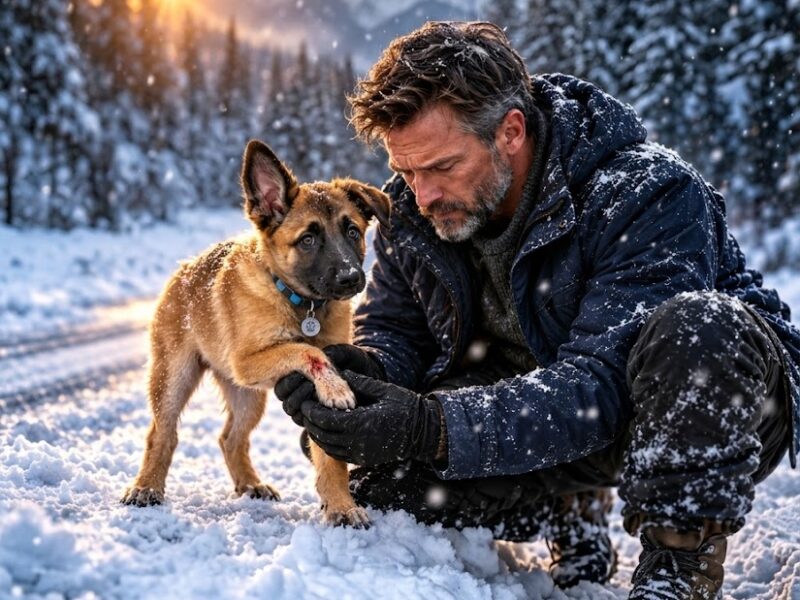
A Navy SEAL swerved to avoid a K9 puppy on a rain-slicked road—then the injured dog led him straight to a sinking car.
**Part 1**
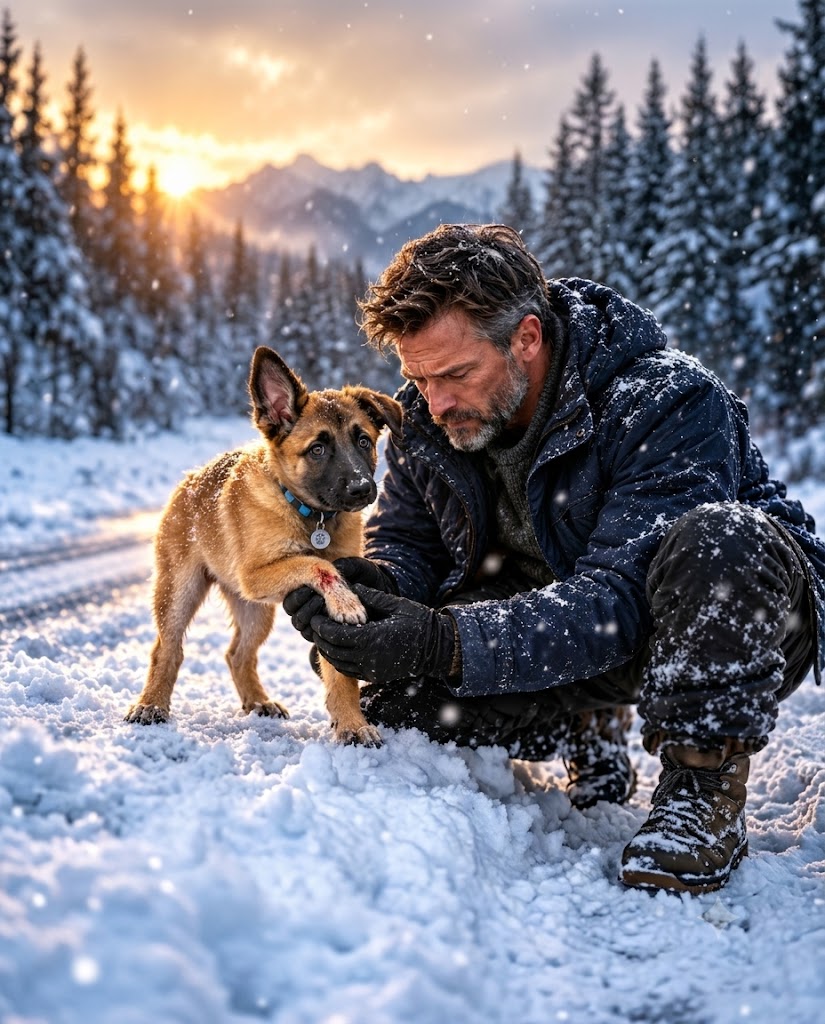
At 4:46 p.m. on a snow-covered highway in North Dakota, a retired Navy SEAL slammed on his brakes when a tiny Belgian Malinois puppy stumbled into his headlights. The puppy was barely 3 months old, trembling in the freezing wind with his injured left front paw lifted helplessly off the ground.
Graham Reick swerved to avoid him, then stepped out, believing he had found a lost puppy. But the little dog refused to leave. He limped toward the forest, stopped, and looked back, desperately trying to make the stranger follow.
Graham finally picked him up and followed his tiny paw prints toward a frozen lake. What he discovered stopped him cold. A young woman was trapped inside a car, sinking through the ice. Her trembling hand pressed against the windshield as dark cracks spread beneath the wheels.
Then, a terrifying sound echoed across the lake. The ice was breaking. The wounded puppy had found someone to help. But would they reach her before the frozen lake swallowed her car?
At 4:20 p.m. on a bitter February afternoon, snow swept across the lonely roads outside Larchford, North Dakota, turning the forests of the Turtle Mountains into a world of white silence. Twenty-seven-year-old Meera Callahan leaned forward over the steering wheel of her dark blue Subaru Outback, struggling to see beyond the swirling snow.
She was a slender young woman with shoulder-length chestnut brown hair, green hazel eyes, and faint freckles across her pale cheeks. Beneath her burgundy winter jacket and gray knitted scarf was a heart that had always found it difficult to turn away from someone in need. As a volunteer with Larchford Winter Outreach, she regularly delivered supplies to isolated families.
Today, she was carrying emergency batteries and relief packages to a nearby warming center. In the secured soft carrier behind her sat Scout, a three-month-old male Belgian Malinois puppy she had recently taken into her care. His short, warm fawn coat contrasted with the deep black mask covering his little muzzle.
One ear was beginning to stand while the other still folded slightly forward, giving him a permanently curious expression. Scout was intelligent, affectionate, and sometimes timid around unfamiliar noises. He wore a light blue collar with a small name tag and had already developed the habit of following Meera wherever she went.
With the heating system in her apartment temporarily out of service, Meera had decided to bring him to the warming center rather than leave him alone in the cold. The temperature had fallen to 16 degrees below zero Celsius when Meera approached a narrow intersection near Marrow Lake. Her offline navigation displayed a shortcut to the warming center.
Through the snow, she noticed tire tracks disappearing down the right-hand road. No barrier blocked the entrance, and the warning sign that should have marked the dangerous access route was nowhere in sight. She hesitated, then followed the tracks.
Within moments, the trees opened onto a broad white expanse. Meera’s stomach tightened. It was the frozen lake. She immediately pressed the brake, but her tires had already reached the slick downhill approach.
The Subaru slid beyond the shoreline and onto the ice, drifting sideways as she struggled to regain control. The rear passenger side struck a hardened snowbank beside an old guidepost. A heavy impact shook the vehicle. Then came a deep, unsettling crack beneath the front wheels.
The Subaru stopped at an angle, its nose sinking slightly toward a dark opening in the ice. Meera sat motionless for one stunned moment. Her right ankle was trapped beneath the distorted lower dashboard and her phone had fallen somewhere beneath the seat. She reached for it but could not stretch far enough.
Outside, the wind swallowed her first frightened call for help. Behind her, Scout began whining. The impact had damaged the fastening on his soft carrier, leaving one side partially open. When he crawled out, he held his left front paw awkwardly against his chest. He tried putting it down, then quickly lifted it again.
Meera turned toward him, alarmed by his frightened expression. “Scout! Oh, sweetheart!” She reached backward, but pain stopped her. A damaged rear passenger door had been pushed slightly open by the collision, leaving a narrow gap to the snow outside. Scout moved toward it, following the cold air and daylight.
“No, baby, stay here,” Meera whispered at first, but another ominous creak traveled beneath the vehicle. The puppy squeezed through the opening and dropped onto the snow-covered ice. He stumbled, steadied himself on three legs, and looked back at her.
Meera stared at his tiny figure through the damaged doorway. She wanted him safely inside her arms, yet she knew the car itself was no longer safe. “Go, Scout,” she called, her voice trembling. “Go find somebody.”
The puppy tilted his head. He understood none of the danger surrounding them. He only knew that the woman who fed him, held him, and spoke softly when he was frightened, was still inside that strange, silent machine. Scout turned toward the compressed tire tracks leading away from the lake. His injured left front leg remained lifted as he began moving on the other three.
The distance to the main road was approximately 150 meters, but to such a young puppy, struggling through snow and wind, it might as well have been miles. Sometimes he followed the shallow grooves left by the Subaru’s tires where the snow was easier to cross. Sometimes he wandered into deeper powder and had to struggle back onto the tracks.
His small body trembled. He stopped more than once, turning his dark brown eyes toward the distant vehicle. There was no reassuring voice now, only the cold wind passing through the trees. He gave a thin whine and continued forward. Behind him, the uneven trail of paw prints told a story no one was there to read.
Three distinct impressions appeared again and again, while the fourth paw rarely touched the snow. By the time Scout reached the upper road, his movements had become slow and uncertain. Then he heard something different from the wind, the low rumble of an approaching engine.
At 4:46 p.m., Graham Reick was driving his charcoal gray Ford F-250 along the same deserted road. Fifty-two years old, Graham was a retired senior chief of the United States Navy SEALs, a broad-shouldered man standing six-foot-two. His angular face bore the quiet marks of age and difficult years, framed by short dark brown hair graying at both temples and a neatly trimmed salt-and-pepper beard. Steel blue-gray eyes watched the road beneath heavy brows.
He wore a dark navy winter parka over a charcoal sweater, black winter trousers, and weatherproof boots. Graham had spent more than 25 years in military service, learning to observe details others overlooked. Since retiring, he lived alone in a wooden cabin outside Larchford, repairing radios, generators, and emergency communication equipment.
People in town knew him as dependable but distant. He rarely stayed for coffee after finishing a job and almost never discussed his military years. Fifteen years earlier, a communications failure during an evacuation mission had contributed to the loss of his closest teammate, Parker Lowe, a sandy-haired man with green eyes and an easy smile. Graham had never entirely escaped the belief that he should have called for additional support sooner.
A small movement near the roadside suddenly caught Graham’s attention. He eased off the accelerator. Then, a puppy stepped directly into the snowy lane. Graham reacted immediately, braking hard and steering toward a cleared section of shoulder.
The truck slid briefly before coming to a stop. He remained still for a heartbeat, staring through the windshield. In the headlight stood a tiny Belgian Malinois, shaking with one front paw lifted off the ground.
Graham opened the door and stepped into the cutting wind. “Easy, little guy,” he said, keeping his voice low. “Where did you come from?” The puppy looked at him, let out a small cry, and turned toward the narrow road leading into the forest.
Graham approached slowly, but Scout moved away, limping several steps before looking back. When Graham stopped, the puppy stopped, too. When the man moved forward, Scout tried to continue. Graham frowned. This was not how a frightened stray usually behaved. The animal was exhausted, clearly uncomfortable, and desperate to go in a particular direction.
Graham lowered himself beside the tracks, expecting to find signs that someone had abandoned the puppy near the highway. Instead, he noticed something that made his expression change. The little paw prints led out of the forest, following fresh tire impressions all the way to the road, and the pattern was unmistakable. Three paws pressing into the snow while the injured fourth barely touched it.
This puppy had not wandered here looking for food. He had struggled here from somewhere beyond the trees. Graham lifted his eyes toward Scout, who had stopped again and was staring down the access road. A strange thought entered the former SEAL’s mind. What if the puppy wasn’t trying to escape something? What if he was trying to make somebody follow him?
Graham removed his gloves and gently offered one hand. Scout hesitated, sniffed his fingers, and allowed himself to be lifted. The puppy’s small body trembled against the man’s chest. Graham opened his parka slightly, sheltering Scout inside the warm folds while keeping his nose uncovered.
“All right, partner,” he murmured. “Show me what I’m missing.”
Following the tire marks, he carefully walked down the snowy access road. The wind grew stronger as the trees thinned. Graham noticed that the tracks were unusually fresh and continued beyond the shoreline. He stopped on firm ground when the frozen surface of Marrow Lake came into view.
Something dark appeared through the blowing snow. He narrowed his eyes. It was a vehicle perhaps 25 meters from shore. A dark blue Subaru Outback sat at an unnatural angle. Its front end tilted toward a break in the ice. Water showed through a narrow opening beside the front wheel.
For one terrible moment, Graham thought the car might be empty. Then his flashlight caught movement behind the windshield. Inside the Subaru, Meera heard a distant voice. She raised her head, struggling to focus through the condensation on the glass.
A man stood near the shoreline with a bright light in his hand. She tried to shout, but her voice was weak. Instead, she lifted one gloved hand. Graham saw it immediately. He moved no farther onto the ice.
Years of experience told him that a dangerous surface did not become safe simply because someone needed help on the other side. He took out his phone and called 911, reporting the location, the stranded vehicle, and the visible cracks spreading beneath it. The dispatcher confirmed that ice rescue personnel were being notified.
Graham described the nearest access road and the unstable condition of the car before looking up again. “My name is Graham,” he called across the frozen water. “Help is coming. Can you hear me?”
Meera managed another small movement. “My dog,” she whispered, though the wind carried most of her words away. Graham glanced down at the trembling puppy nestled against his chest. Scout lifted his black muzzle toward the Subaru and gave a faint whine. Graham finally understood why the little animal had refused to leave the road.
The former SEAL remained on solid ground, keeping Scout sheltered and the emergency dispatcher informed. He continued calling to Meera, asking her to remain as still as possible, and reassuring her that rescuers were coming. He knew better than to promise everything would be fine. His attention moved constantly between the woman’s silhouette, the vehicle’s position, and the dark fractures surrounding its front wheels.
Beneath the wind came a low, hollow sound. Graham fell silent. Another crack echoed across the lake, deeper than the first. The Subaru shifted almost imperceptibly, its nose dropping closer to the water. Meera cried out from inside. Scout pressed against Graham’s chest, trembling as the man’s grip tightened protectively around him.
Graham raised the phone again. “The vehicle is moving,” he told the dispatcher, his voice controlled but urgent. “Please tell the rescue team the ice is breaking beneath the front end.” He looked at the little Belgian Malinois, whose exhausted eyes were still fixed on the car. The puppy had done everything his small body could manage. Now the life of the person he loved depended on strangers reaching her in time.
Across the silent lake, another thin crack began spreading through the white surface toward the Subaru.
**Part 2**
The sound came again, low and hollow, like something enormous shifting beneath the frozen surface of Marrow Lake. Graham Reick stood on the snow-covered shoreline, watching a thin black fracture stretch away from the front wheel of the dark blue Subaru. Inside, Meera Callahan moved behind the fogged windshield, her raised hand trembling as she tried to signal that she was still conscious. The wind carried her voice away before Graham could make out the words.
He tightened his hold around Scout. The three-month-old Belgian Malinois tucked inside his Navy winter parka. The puppy’s warm fawn coat was damp with melting snow, and his injured left front leg remained curled carefully against his small chest. Scout lifted his black muzzle toward the stranded vehicle and made a faint questioning sound.
Graham looked down at him. “I know, little buddy,” he whispered. “She’s still out there.”
On the phone, the emergency dispatcher confirmed that the specialized ice rescue team had been alerted. Graham reported another movement beneath the car, keeping his voice steady even as the urgency pressed against his ribs. The distance across the ice was barely 25 meters. He had crossed far greater distances under far worse circumstances. Yet those few meters might as well have been an ocean.
Fifteen years earlier, Graham had believed that determination and training could overcome almost any obstacle. During a military evacuation, a communications failure had separated his team from the support they needed. His closest friend, Parker Lowe, never returned. The investigation had identified several contributing failures, but Graham remembered only his own hesitation before requesting additional assistance.
Now staring at Meera’s vehicle, he felt the same terrible temptation to act immediately. To prove that this time he could reach someone before it was too late. His boot shifted toward the ice. Then a muffled crack sounded beneath the Subaru, stopping him.
Graham forced himself to remain on solid ground. He knew the surface was unstable, and one more person trapped in freezing water would only make the rescue harder. He raised his flashlight. “Meera, keep looking toward the light. Help is on the way.”
Inside the car, the young woman raised her hand again. Graham remained where he was, speaking to her between updates to the dispatcher, because staying useful mattered more than appearing fearless. Inside the Subaru, Meera struggled to keep her breathing controlled.
Her right ankle was trapped beneath the distorted lower dashboard, and the air around her feet had grown painfully cold. The vehicle had settled farther forward since the accident, leaving the rear passenger area higher than the front. Each faint movement of the ice made her grip the steering wheel. She could no longer see Scout outside. The last image she remembered was his small body disappearing through the damaged rear door, one front paw held awkwardly against his chest.
Meera tried not to imagine him alone in the forest. She had promised herself she would give the frightened puppy a safe home. Yet now she could not even reach him. When Graham called to her again, she pressed a shaking palm against the glass. “My puppy,” she shouted. “Did you find my puppy?”
Graham caught enough of her words to understand. He looked into his parka where Scout’s dark brown eyes remained open. “He’s here, Meera. He’s safe with me.”
For the first time since the Subaru stopped moving, Meera felt something other than fear. “Good boy,” she whispered. “Oh, Scout! Good boy!”
At approximately 5:05 p.m., headlights appeared through the blowing snow behind Graham. A county patrol vehicle stopped at the end of the access road and a middle-aged officer in a heavy winter jacket hurried toward him. Graham pointed out the safest ground he had identified and quickly explained the situation.
The officer carried Scout to the heated patrol vehicle where the puppy could be sheltered while arrangements were made for veterinary care. Scout protested softly when Graham handed him over. “She’s not going anywhere without us trying,” Graham said, touching the puppy’s head once. “You’ve done enough.”
The officer promised to keep him warm and observed that the little dog’s injured paw needed prompt attention. Graham watched Scout disappear into the vehicle, feeling an unexpected reluctance to let him go. Then he turned toward the lake. The Subaru had tilted another few inches. He could see Meera’s silhouette, but her hand had fallen from the window.
Graham called her name. A moment passed before she lifted her head. Then something happened that Graham would remember long after the ice melted. Scout, resting in the warmth of the patrol vehicle, suddenly raised his head toward the distant lake and let out three sharp cries.
Almost at the same moment, Meera’s voice drifted faintly across the ice. “Scout!”
Graham looked from the puppy to the woman trapped in the car. Neither could clearly see the other through the snowfall, yet both were still searching for the same familiar presence. He had witnessed soldiers endure fear for the sake of those they loved, but never imagined a puppy barely old enough to leave its mother could become the thread holding a frightened woman to hope.
Before he could answer Meera, another crack spread beneath the Subaru. This time, the front end lowered visibly. Graham raised the emergency phone. “The vehicle is shifting again,” he reported. “Please tell them we’re running out of time.”
The specialized rescue vehicles arrived shortly after 5:10 p.m. Darla Kincaid stepped out first, a 44-year-old rescue commander with a sturdy athletic build, short dark blonde hair tucked beneath her helmet, and pale blue eyes that missed very little. Her Navy rescue jacket carried orange reflective markings that flashed under the emergency lights.
Darla had earned the trust of Larchford’s residents through years of responding to winter emergencies. She did not confuse rushing with speed, and she never allowed concern for a victim to erase concern for her team. Graham knew her from previous communications equipment inspections.
“One conscious adult, right leg trapped, vehicle nose down about 25 meters out,” he told her.
Darla studied the shoreline and the visible fractures. “Any movement since your last report?”
“Twice. The front’s dropping.”
She nodded and immediately assigned positions. Two trained ice rescue specialists prepared their protective suits, tether lines, and rescue sled while other crew members established the shore support. Graham stepped aside, then took the position Darla assigned him near the communication equipment.
The rescuers approached low to the ice using their specialized equipment with safety lines maintained from shore. Graham followed their progress without speaking unless asked. One technician reached the higher rear portion of the Subaru and confirmed that Meera remained responsive. The second assisted with access to the passenger compartment.
Their voices came through the radio in short measured reports. Meera was still wearing her seat belt. Her ankle remained caught, but there was space to work from behind the front seats. The team first checked her responsiveness and supported her position before carefully freeing her from the obstruction.
Inside the vehicle, Meera could hear the rescuers explaining each step. “We’re going to move you toward the back,” one said. “We have you.”
She nodded, her teeth chattering. For a moment, she wanted to ask them to hurry, but the calmness of their voices steadied her. Outside, Graham listened as the radio crackled. The same sound had haunted him for 15 years. This time, however, someone answered every call.
At approximately 5:23 p.m., the rescue team brought Meera onto the tethered sled and completed the return to shore. Graham saw her face clearly for the first time. Chestnut hair tangled around her pale cheeks, gray shadows of exhaustion beneath her green hazel eyes, and an expression caught between disbelief and relief. She was frightened, cold, and visibly exhausted, but alive.
Medical personnel immediately took over, protecting her from further cold and assessing her injuries. Darla confirmed that every rescuer had returned to solid ground. Seconds later, a deep crack rolled across the lake. Everyone turned. The ice supporting the Subaru’s front end gave way and the vehicle dipped sharply into the black water. Its rear rose briefly before settling lower as the surrounding ice broke apart.
No one moved toward it. There was nothing inside worth another life. Graham watched in silence, aware that the difference between rescue and tragedy had been measured in minutes.
Meera was being prepared for transport when Graham approached the ambulance. Her right ankle had been immobilized, and the medical crew was continuing treatment for cold exposure and other possible injuries. She recognized his face from the shoreline.
“Scout,” she asked immediately.
Graham crouched beside the open door. “He’s warm. Someone’s taking him to a veterinarian. His front leg needs attention, but he made it.”
Meera’s eyes filled. “He found you?”
Graham nodded. “He stopped my truck. Wouldn’t let me walk away.”
A tired smile crossed her face. “He hates being alone,” she whispered.
Graham felt something tighten inside his chest. “Then I’d say he was pretty determined not to leave you alone.”
Meera tried to thank him, but he gently shook his head. “The rescue team brought you back. Scout showed me where to look.”
The paramedic began closing the ambulance door when Meera suddenly caught Graham’s sleeve. Her expression had changed. “The road,” she said weakly. “There wasn’t a warning sign. Nothing across the entrance.”
Graham looked toward the snow-covered access road as the ambulance pulled away. Darla joined him, following his gaze. He repeated Meera’s words, then explained that he had noticed no barrier when he followed Scout’s tracks.
Darla’s expression tightened. The ice near the Subaru had failed, yet the access road remained open to anyone unfamiliar with the danger. She reached for her radio and ordered the entrance secured immediately.
Graham watched the patrol vehicle where Scout rested, his small black-masked face barely visible through the side window. The puppy had brought one person back from the edge of the lake. But somewhere beyond the forest, another driver might already be following the same old tire tracks toward the ice.
Darla lowered her radio and looked at Graham. “We need to find out why that road was open.”
Across Marrow Lake, the broken ice shifted quietly around the disappearing Subaru. The rescue was over. The danger, Graham realized, might not be.
**Part 3**
By the time the ambulance disappeared into the snowy darkness, the broken surface of Marrow Lake had begun to settle into an uneasy silence. Graham Reick stood beside his charcoal gray Ford F-250, watching the rescue crews pack their equipment beneath the flashing emergency lights. Somewhere across the ice, Meera Callahan’s Subaru lay partly submerged, its dark blue body barely visible through the gathering dusk.
Graham pulled his Navy parka tighter around his shoulders. For 25 years in the Navy SEALs, he had learned that surviving an emergency did not always mean the danger had ended. Sometimes the mistake that caused one disaster remained hidden, waiting for the next person.
Darla Kincaid approached with her radio pressed against her ear. “We’ve got a deputy securing this entrance,” she told him. “But there are other access roads around the lake. Until we confirm the closure notices reached everyone, I’m not taking chances.”
Graham nodded. He thought of Scout’s tiny paw prints leading from the frozen shoreline. If that puppy had never reached the highway, Meera might still be trapped inside the car.
Darla looked toward the darkening forest. “Go check on her, Graham. I’ll find out why that barrier wasn’t there.”
He hesitated, then climbed into his truck. For once, he allowed someone else to carry the responsibility.
Twenty minutes later, Graham entered Pinerest Community Hospital, where the smell of disinfectant and warm air seemed strangely ordinary after the frozen lake. Near the emergency department sat a woman in her late fifties with a softly rounded figure. Shoulder-length chestnut hair streaked with silver and green hazel eyes remarkably similar to Meera’s.
Audrey Callahan, 58, wore a brown wool coat and a cream scarf loosely wrapped around her neck. Her hands rested tightly together in her lap. Years of raising a daughter on her own had taught Audrey to appear strong even when frightened, but tonight her composure was slipping.
When Graham introduced himself, she stood so quickly that her scarf fell from her shoulder. “You’re the man who found her.”
Graham shook his head gently. “A puppy found me. I just followed him.”
Audrey stared at him, struggling to understand. Graham explained how Scout had stopped his truck, injured and trembling, then repeatedly turned toward the lake. As Audrey listened, tears gathered in her eyes.
“She brought him home three weeks ago,” she whispered. “He was afraid of every unfamiliar sound. Meera said all he needed was patience.”
Graham remembered the little Malinois standing alone on the highway, his left front paw raised against his chest. “He was frightened today, too,” he answered. “But he kept going.”
A physician soon informed Audrey that Meera was stable after treatment for cold exposure, a closed right ankle fracture, and a mild concussion. She would need continued observation and a careful recovery, but the immediate danger had passed. Audrey lowered herself into her chair, pressing both hands over her face.
Graham remained beside her until her breathing steadied. Then his phone vibrated. It was Darla.
“We’ve confirmed the lake access was supposed to be closed,” she said. “I need your help with something else.”
At the maintenance yard, 61-year-old Ellie Talbot had admitted that his crew temporarily moved the portable barrier to allow a snowplow to retrieve equipment. Ellie was a stocky man with weathered skin, closely cropped silver hair, a gray mustache, and tired blue-gray eyes. He had spent nearly four decades maintaining rural roads, usually arriving before sunrise and leaving after everyone else. His reputation was built on reliability, which made today’s mistake particularly difficult to accept.
A second snowplow had broken down, pulling his workers away before anyone completed the final barrier check. Meanwhile, a backup power failure had silenced the local radio repeater used by several private service crews.
Darla’s voice hardened. “Ellie says two workers are scheduled to return through the Eastern Lake Access tonight. We can’t confirm they’ve heard the closure warning.”
Graham walked toward the hospital window. Outside, snowflakes spun beneath the parking lot lights. County emergency channels had remained operational, which explained why the rescue team had responded to his 911 call. But the smaller VHF repeater serving local contractors had gone silent when its standby power system failed.
Darla had already sent deputies toward the eastern access and ordered barriers placed wherever crews could reach safely. Yet the approaching vehicle might arrive before those patrols.
“I’ve got a technician heading up to the repeater station,” Darla continued. “You know that equipment better than anyone in town.”
Graham closed his eyes. For an instant, the warm hospital corridor vanished. He remembered another radio 15 years earlier. Its speaker filled with static while Parker Lowe’s voice faded somewhere beyond a broken communications link.
Parker had been the closest thing Graham ever had to a brother. A broad-shouldered SEAL with sandy brown hair, green eyes, and a smile that could ease tension even before a difficult mission. Graham had spent years replaying the decisions surrounding his death. The thought of another unanswered call tightened his chest.
“You have patrols going there?” he asked.
“Already moving,” Darla answered. “This gives us another way to reach them.”
Graham opened his eyes. “Send me the station information. I’ll meet your technician.”
At the Hilltop communication station, the wind shook the metal housing while Graham and a county technician inspected the failed backup system. Graham was checking a damaged power connection when a portable receiver briefly caught a voice through the static.
“Marrow access. Anyone copy?”
The transmission vanished almost immediately. Graham froze. It was not Parker’s voice. It belonged to someone alive somewhere beyond the darkness, trying to make contact.
For 15 years, Graham had dreamed of answering a call that came too late. Now another voice was fading from a radio. And somewhere below the hill, a vehicle might be approaching the same frozen lake that had nearly taken Meera’s life.
Graham swallowed, forcing his attention back to the equipment. The technician isolated the faulty power supply, and together they completed the approved repair, connected the available standby source, and checked the repeater’s operation. A green indicator illuminated the panel. The receiver hissed, then cleared.
Graham tested the channel and heard Darla respond from the command post. She immediately called the two-person service crew. For several seconds, there was silence. Then, a man answered. His pickup was approaching the eastern access road, following an older route map used by the winter fishing operators.
Darla instructed him to stop on a safe section of the mainland road and avoid every route onto the lake. The driver confirmed that he had stopped. A deputy traveling from the opposite direction reached the vehicle shortly afterward and guided both workers toward an approved alternative route.
“Two occupants safe,” the deputy reported.
Graham remained seated beside the radio. There were no cheers, no dramatic celebration, just an ordinary voice confirming that two people would reach home that night. Somehow, those simple words loosened a weight he had carried for years.
Across town, another quiet struggle was taking place at Ivy Saurin’s veterinary clinic. Dr. Ivy Saurin, 39, was a calm woman with medium olive skin, warm brown eyes, and dark brown hair tied neatly behind her head. Wearing teal scrubs beneath a white clinical coat, she spoke gently to frightened animals and believed patience was as important as technical skill.
Scout lay on a padded blanket inside a temperature-controlled recovery enclosure. His golden fawn fur had been dried, revealing the clear black mask around his muzzle and the small light blue collar bearing his name. X-rays showed a minor non-displaced fracture in one of the small bones of his left front paw with no obvious growth plate damage on the initial images.
Ivy arranged appropriate support, pain relief, and follow-up monitoring. Scout would need restricted activity and time to heal. When a metal door clicked shut nearby, he startled and lifted his head, searching the room with dark brown eyes.
“You’re safe now,” Ivy whispered. “Nobody needs you to be brave tonight.”
Audrey arrived after receiving confirmation that Meera was resting comfortably at the hospital. In her hands was a gray scarf Meera had worn and left at home. Ivy checked it and placed a safe portion near Scout’s bedding. The puppy sniffed the familiar fabric, his little black nose moving slowly along its folds. He shifted closer, rested his chin beside it, and finally closed his eyes.
Audrey watched him sleep. “She used to laugh because he followed her from room to room,” she told Ivy. “Even when she was only getting a glass of water.” Her voice trembled. “Today, he couldn’t follow her, so he went looking for someone else.”
Ivy looked at the tiny supported paw and the exhausted puppy curled around the scent of home. “Whatever made him take that road,” she said softly, “someone listened when he asked for help.”
Near midnight, Graham returned to his cabin among the dark pines. He removed his parka, set his radio on the table, and opened a drawer he had avoided for months. Inside lay an old photograph of Parker Lowe standing beside him before their final deployment together.
Graham studied his friend’s easy smile. He had spent 15 years believing he could honor Parker only by remembering the day he lost him. Tonight he had learned something different.
Meera was alive. Scout was receiving care. Two workers had been guided away from the dangerous lake. None of those outcomes belonged to Graham alone. He had followed a puppy, trusted a rescue team, and worked beside a technician to restore one broken line of communication.
Slowly, he placed Parker’s photograph on the living room shelf rather than returning it to the drawer. Outside, snow continued falling through the forest. Graham looked at the familiar face and whispered, “I couldn’t bring you home, brother, but tonight we brought somebody else home.”
For the first time in years, the silence that followed did not feel quite so empty.
**Part 4**
Three mornings after the accident at Marrow Lake, pale winter sunlight slipped through the windows of Pinerest Community Hospital, touching the white blanket covering Meera Callahan’s legs. The 27-year-old woman lay awake, watching snow drift from the bare branches outside.
Her chestnut brown hair had been brushed away from her face, revealing faint freckles and green hazel eyes that still carried the exhaustion of everything she had survived. Her right ankle rested securely in a medical support, and the doctors had warned her that the concussion might leave her tired and sensitive to bright light for some time. But none of those discomforts troubled Meera as deeply as the silence beside her bed.
At home, that silence would have been filled by little paws clicking across the floor, a black muzzle nudging her hand, and a puppy demanding attention whenever she stopped moving. Scout had followed her everywhere since the day she brought him home. Now she could not stop imagining his tiny body disappearing through the damaged door of her Subaru, alone on the frozen lake.
Her mother, Audrey Callahan, sat nearby, knitting a gray scarf she had started and abandoned three times that morning. At 58, Audrey had learned to conceal worry beneath practical routines. But Meera could see the strain in her tired green hazel eyes.
“Mom,” Meera whispered. “Did I leave him out there?”
Audrey set her knitting aside. “Honey, Scout got out when the car was damaged. You couldn’t reach him.”
Meera turned toward the window. “He was only three months old.”
Audrey reached for her daughter’s hand. “And somehow that little boy found someone who could help you.”
A gentle knock sounded at the door. Graham Reick stood in the hallway, his broad shoulders filling much of the doorway. The 52-year-old former Navy SEAL wore a charcoal gray sweater beneath his open dark navy parka. His short brown hair was silver at the temples, and the neatly trimmed salt-and-pepper beard framing his angular face made his steel blue-gray eyes appear even more serious.
He had spent most of his adult life learning how to remain composed in difficult moments. Yet something about entering a hospital room still unsettled him. He carried a printed photograph from Dr. Ivy Saurin’s veterinary clinic.
“I thought you might want this,” he said.
Meera accepted it with trembling fingers. In the picture, Scout lay on a soft blanket, his warm fawn coat clean, his black-masked face resting beside a familiar gray scarf. His left front leg was protected by a small veterinary support. One ear stood higher than the other, just as it always had.
Meera stared at the photograph until her vision blurred. “He looks so tired.”
Graham pulled the chair closer. “The veterinarian says he’s stable. There’s a small fracture in his left front paw, but she’s treating it. He needs rest and time.”
Meera pressed the picture against her chest. “I should have protected him better.”
Graham watched her struggle with those words. He recognized that particular kind of guilt. It was the kind that took every detail of a terrible day and rearranged it until the survivor seemed responsible for everything.
Meera asked him to tell her what happened after Scout escaped. Graham began with the part she already knew least. A charcoal gray pickup traveling along an empty road, a sudden movement in the snow, and a frightened little Belgian Malinois forcing him to brake.
He described the puppy standing on three legs beneath the headlights, then turning toward the forest whenever Graham approached. “I thought somebody had abandoned him,” Graham admitted. “I wanted to get him warm and take him somewhere safe.”
“But he wouldn’t go?” Meera asked.
Graham shook his head. “He kept looking back. Every time I stopped following, he stopped, too.”
He told her about the uneven paw prints beside the tire tracks and the moment the trees opened onto Marrow Lake. Meera listened without interrupting. When he finished, tears were running silently down her cheeks.
“He must have been terrified,” she whispered. “He gets nervous when the vacuum cleaner starts. Sometimes he hides behind my legs when strangers visit.”
Graham looked at the photograph. “He was scared. I could see that much.”
Meera brushed one finger across Scout’s pictured black muzzle. “Then why didn’t he just keep running?”
Graham considered the question. He had spent years studying animal behavior only from the practical distance of someone accustomed to working around military dogs, never pretending to know everything they understood. “I can’t tell you what was in his mind,” he answered. “But he kept turning toward that lake, and because he did, I followed.”
For a while, neither spoke. Then Meera noticed the way Graham looked away whenever she thanked him. He had described every rescuer’s contribution, praised the emergency dispatcher, and insisted Scout deserved most of the credit. Yet he seemed uncomfortable acknowledging that his own decision mattered.
“Can I ask you something?” she said.
Graham nodded.
“Why is it so hard for you to believe you helped save me?”
The question settled between them. Graham stared at his hands, broad and weathered from years of service and mechanical work. Finally, he spoke about Parker Lowe.
Fifteen years earlier, Parker had been his closest friend in the Navy SEALs, the kind of man who remembered birthdays, checked on younger teammates, and could make a difficult deployment feel less lonely. During an evacuation mission, communications failed, and Graham delayed requesting additional support while his team tried to manage the situation. Parker never came home.
Investigators later identified several contributing failures, but Graham had spent years returning to the same question. “What if I had asked for help sooner?”
“I promised his family we’d look after each other,” Graham said quietly. “I still hear that promise sometimes.”
Meera studied the man beside her. His rigid posture seemed less like coldness now and more like someone who had been holding an invisible weight for far too long. She looked down at Scout’s photograph, then back at Graham.
“You know what I remember most from the lake?” she asked. “Not the cracking ice. Not even the cold. I remember hearing somebody tell me help was coming and realizing I wasn’t alone anymore.”
Graham said nothing.
“You keep talking about the person you couldn’t bring home,” she continued softly. “But Graham, you stayed until I came home.”
The words struck him more deeply than she realized. For 15 years, he had measured his worth against one terrible loss. Now, a young woman sitting in a hospital bed was asking him to consider something he had almost forgotten. Perhaps a life should not be judged only by its worst day.
Graham looked toward the window, blinking against an unexpected heaviness in his eyes. “Parker was a better man than I knew how to be,” he said.
Meera shook her head. “Maybe he was a good man who loved another good man enough to trust him.” She paused, catching her breath. “And maybe he’d be proud that you’re still helping people.”
Graham could not answer. He had expected gratitude from Meera, perhaps questions about the accident. He had not expected her to give him a different way to remember his friend. When Audrey returned with water, she found them sitting quietly, the photograph of Scout resting between them. She did not interrupt. Some conversations, she understood, needed room to settle.
Several days later, the county held a review meeting concerning the unsafe entrance to Marrow Lake. Meera attended briefly by video with medical approval while Audrey sat beside her. Graham and Darla Kincaid were present at the municipal operations building where maps of the lake access roads covered a large table.
Darla, the 44-year-old rescue commander, spoke with the clear, deliberate authority of someone who understood that finding responsibility was different from finding someone convenient to blame. Ellie Talbot stood near the back. The 61-year-old maintenance supervisor wore his usual yellow reflective work jacket, but his familiar confidence had disappeared. His weathered face looked older beneath his short silver hair, and his gray mustache moved slightly as he pressed his lips together.
“The barrier was moved so our equipment could get through,” he admitted. “Then we had another breakdown. I thought somebody had put it back.”
Darla studied him. “Did anyone confirm that?”
Ellie lowered his eyes. “No. That was my responsibility.”
Audrey’s expression tightened. “My daughter nearly didn’t come home because everyone thought somebody else had done their job.”
Ellie did not argue. “You’re right,” he answered. “I’m sorry.”
Meera listened from her screen before speaking. “I should have stopped when the road looked unfamiliar,” she admitted. “I trusted an old map and tire tracks I didn’t understand.”
Graham turned toward her image. “You made a mistake,” he said. “But that doesn’t erase the need for a proper warning.” He suggested secured barriers, documented closure checks, direct confirmation from authorized road users, and dependable backup communications.
Darla supported those recommendations and assigned the appropriate departments to evaluate them. Ellie agreed to cooperate with the investigation and corrective work. The meeting ended without easy forgiveness or dramatic accusations. Responsibility would take longer than one apology.
Outside, Darla walked with Graham toward his truck. “I’ve been meaning to ask you something,” she said. “Would you consider joining our emergency communications volunteers?”
Graham gave a humorous little smile. “I spent years trying to get away from that kind of responsibility.”
Darla nodded. “I’m not asking you to carry the whole town. I’m asking you to be part of a team.”
He looked toward the snowy hills. “I’ll think about it.”
That afternoon, Graham visited Ivy’s veterinary clinic. Scout was resting in a small recovery area, his left front paw still protected and his activity carefully restricted. Ivy allowed Graham to sit beside the padded enclosure while she supervised.
The little Malinois lifted his head when Graham spoke. His dark brown eyes studied the familiar man, and his unfinished ears shifted forward. Graham offered his hand near the enclosure opening. Scout sniffed his fingers and settled again, his black muzzle resting close to them.
“There you are, partner,” Graham whispered. “No more highways for you.”
Ivy smiled. “He’ll need several more weeks before we know how well that paw has healed, but he’s comfortable, and we’re watching him closely.”
Graham remained seated longer than he intended. He told Scout about Parker, about the radio station, and about how strange it felt to be needed by people again. The puppy offered no answers. He simply rested beside a familiar human presence, warm and safe.
By the end of the second week, Meera had been discharged to Audrey’s home with instructions for continued recovery. She still needed a wheelchair for longer distances and could not put normal weight on her injured right ankle. Scout’s healing had progressed enough for Ivy to arrange a quiet, supervised reunion without allowing him to run or strain his paw. Graham offered to drive Meera and Audrey to the clinic the following morning.
That evening, he returned to his cabin and stood before the shelf where Parker’s photograph now rested. Beside it, he placed a copy of Scout’s picture. One image belonged to a man he could never bring back. The other showed a small puppy whose courage had helped bring someone home.
Graham looked at them both, then switched off the lamp. His phone lit up with a message from Audrey. “Tomorrow they finally get to see each other again.”
Graham smiled in the darkness. For the first time in years, he found himself looking forward to tomorrow. Not because the past had stopped hurting, but because life had finally given him something beautiful to anticipate.
**Part 5**
The morning of the reunion arrived beneath a pale blue sky nearly two weeks after the accident at Marrow Lake. Snow still covered the fields outside Larchford, North Dakota, but sunlight had begun to soften the frozen edges of winter. Graham Reick had arranged a wheelchair-accessible vehicle through Winter Outreach to bring Meera Callahan and her mother to the veterinary clinic.
Meera sat beside Audrey holding the same photograph of Scout that Graham had delivered to her hospital room. Her shoulder-length chestnut hair fell loosely around her pale freckled face and her green hazel eyes kept returning to the picture. Her right ankle remained immobilized and every movement required care. Yet the discomfort seemed distant compared with the thought of seeing her puppy again.
Graham, broad-shouldered and quiet in his dark navy parka, glanced at her in the rearview mirror. Silver touched both temples of his short brown hair, and his neatly trimmed salt-and-pepper beard framed a face that rarely revealed more than he intended.
“Nervous?” he asked.
Meera managed a small smile. “What if he doesn’t recognize me?”
Audrey reached across and squeezed her daughter’s hand. “Sweetheart, that little dog followed you everywhere. Two weeks won’t change what he knows.”
Dr. Ivy Saurin had prepared a quiet rehabilitation room at the clinic. The 39-year-old veterinarian, with warm brown eyes, olive-toned skin, and dark hair tied neatly behind her head, greeted them in teal scrubs beneath her white coat. She explained that Scout’s left front paw was healing, but the small fracture still required protection and restricted movement.
“No excited running today,” she reminded Meera gently. “We’ll bring him close enough for you to touch him safely.”
Meera nodded. Graham positioned her wheelchair beside a padded examination area while Audrey stood nearby. Then Ivy opened the adjoining door.
In her arms rested a small Belgian Malinois puppy with short, warm fawn fur, a deep black mask surrounding his muzzle, and dark brown eyes that seemed almost too large for his young face. His left ear stood higher than the right, which still folded slightly forward. Around his neck was the familiar light blue collar bearing his name. His injured left front paw remained supported.
Scout looked around uncertainly until a soft voice broke the silence. “Hey, little buddy.”
His ears shifted. Meera swallowed. “It’s me, Scout.”
The puppy lifted his head, suddenly attentive. Ivy lowered him carefully onto the padded surface beside Meera’s chair. Scout sniffed her outstretched fingers, hesitated for a heartbeat at the unfamiliar hospital scent, then pressed his black muzzle into her palm.
Meera covered her mouth with her free hand as tears spilled down her cheeks. “You came back to me,” she whispered.
Scout settled closer, breathing softly beneath her touch. Graham turned toward the window, but not before Audrey noticed the tears gathering in his steel blue-gray eyes. For several minutes, nobody tried to fill the silence. Meera gently stroked the puppy behind his ears while Ivy ensured that his healing paw remained protected.
“I remember seeing him get out,” Meera said at last. “I thought he would freeze before anyone found him.”
Graham moved closer. “He found the tire tracks. Then he found the highway.”
Meera looked up. “But why did he keep coming back toward the lake?”
Graham considered the question carefully. “I don’t know what he understood. He was frightened and he wanted somewhere safe. But every time I stopped following, he turned back toward you.”
Meera looked down at Scout, who had rested his chin against her hand. “You were scared, too, weren’t you?”
The puppy blinked slowly. Graham remembered that snowy road, the little raised paw, and the stubborn way Scout had refused to disappear into the trees. For 15 years, Graham had believed courage meant controlling fear and reaching danger before everyone else. Yet the smallest creature he had ever helped had taught him something his military training never fully explained. Sometimes courage was simply continuing when fear gave you every reason to stop.
The weeks that followed brought progress measured in careful movements rather than dramatic victories. Meera began physical therapy, first practicing transfers and short movements without putting weight on her injured right ankle, then gradually working toward supported walking as her doctors permitted. Some mornings she felt almost like herself. On others, headaches and fatigue reminded her that recovery would not follow a straight line.
Scout faced his own challenges. Ivy monitored the healing bone with follow-up examinations and imaging, adjusting his care as he grew. When the veterinarian eventually cleared him to begin controlled movement without the support, the puppy approached his first steps cautiously, as though his left front paw had become something unfamiliar.
Meera watched from a nearby chair. “That’s it, sweetheart,” she whispered. “One step at a time.”
Scout placed his paw down, shifted his weight, then looked up at her. Meera laughed, and for a moment, the room felt wonderfully ordinary. Graham, who had driven her to the appointment, watched them with a quiet smile. Neither patient was completely healed, but neither was facing recovery alone.
One afternoon, while Meera practiced walking with assistance, Scout heard a metal gate close in the adjoining hallway. The sudden clang made him stop, lowering his body as memories of unfamiliar noises seemed to overtake him. Meera paused, too.
Graham expected the puppy to retreat, but Scout turned toward him instead. The little Malinois studied the former SEAL for several seconds before slowly relaxing, encouraged by Graham’s calm presence. Then Meera said something Graham had not expected.
“Look at him. He still remembers being afraid, but he’s learning that not every loud sound means danger.” She glanced at Graham. “Maybe people can learn that, too.”
Graham felt the words settle somewhere deep inside him. For 15 years, every radio crackle, every unanswered call, and every unexpected silence had carried him back to the day Parker Lowe died. Watching Scout take another careful step, Graham wondered whether the little dog was still leading someone toward safety. Only this time, perhaps that someone was him.
As March turned into April, Graham became a familiar presence at the Callahan home. He repaired a loose porch railing, helped Audrey carry groceries, and occasionally stayed for dinner. Audrey, whose silver-streaked chestnut hair and tired green hazel eyes softened whenever her daughter laughed, had developed a habit of setting a third place at the table before Graham arrived.
At first, he protested. Then, he began bringing coffee or fresh bread. One evening, while Scout slept on his padded bed, Meera teased Graham about how seriously he approached fixing a kitchen cabinet. Graham answered with such unexpected dry humor that Audrey nearly dropped her spoon laughing.
The sound surprised him. He could not remember the last time a meal had ended with laughter instead of the silence of his lonely cabin. Later that night, he returned home and stood before the photograph of Parker Lowe on his living room shelf.
His friend had been a broad-shouldered SEAL with sandy brown hair, green eyes, and an easy smile that could make the hardest days bearable. Graham picked up his phone and called Parker’s younger sister, Naomi Lowe, now 50, a thoughtful woman with short auburn hair touched by silver and the same steady green eyes as her brother.
Graham remembered how patiently she had listened over the years, never forcing him to speak before he was ready. For the first time, he told Naomi about the puppy, the frozen lake, and the decision to trust the rescue team rather than attempt everything himself.
“I spent 15 years thinking I should have been able to save everybody,” he admitted.
Naomi was quiet for a moment. “Graham, Parker trusted you because you cared about your team. He never expected you to control every outcome.”
Graham stared at the photograph. “I still wish I’d called for help sooner.”
“I know,” she answered gently. “And you always will. But I don’t think my brother would want the rest of your life to become another casualty of that day.”
Graham closed his eyes. The sorrow did not vanish. No conversation could return Parker to his family. Yet, for the first time, Graham allowed himself to remember their friendship without letting its ending swallow everything that had come before. That night, he left Parker’s photograph in its place on the shelf, beside the picture of Scout resting against Meera’s gray scarf.
By early May, much of the snow around Larchford had melted. The community gathered at the local outreach center to recognize the rescuers and volunteers who had helped residents through the severe winter. Darla Kincaid attended in her Navy rescue jacket, her short dark blonde hair uncovered for once. Ellie Talbot stood nearby looking uncomfortable in a clean work shirt.
The 61-year-old maintenance supervisor had cooperated with the review of the Marrow Lake accident and was helping implement the corrective measures required by the county. Secured barriers, documented closure checks, and improved backup communications had been introduced to reduce the chance of another preventable tragedy.
Graham had accepted Darla’s invitation to volunteer with emergency communications, though he insisted he preferred repairing equipment to standing before an audience. Meera arrived using a cane for short distances with Audrey beside her.
Scout, now a little over five months old, walked on all four legs after completing the veterinary stages of recovery. He was still unmistakably a young Belgian Malinois with warm fawn fur, a black facial mask, and the same expressive brown eyes. He wore no military insignia or rescue certification, only his light blue collar and name tag.
When Scout spotted Graham across the gathering, his tail began moving enthusiastically. Meera allowed him to approach on his lead, and the puppy stopped beside the former SEAL, lifting his face toward the familiar man.
Graham crouched and rubbed gently behind his ears. “Well, look at you,” he murmured. “Four good paws and still causing trouble.”
Meera laughed. Darla thanked the rescue personnel, medical staff, technicians, and volunteers who had contributed to the events surrounding Marrow Lake. When she mentioned Scout, applause spread through the small room. The puppy merely looked around, puzzled by the noise, then settled beside Meera.
Graham watched him with quiet affection. The little animal had no idea what people were celebrating. He had never needed a title or a certificate. He had simply become part of a story in which frightened strangers chose not to leave one another behind.
Later that afternoon, Graham drove Meera and Scout to the safe mainland parking area overlooking Marrow Lake. The dangerous access road remained secured and the lake beyond the trees reflected the pale spring sky. Meera stood beside Graham, leaning lightly on her cane while Scout rested near her feet.
“I still wonder how he knew where to go,” she said.
Graham watched the puppy sniff the grass emerging through the last patches of snow. “Maybe he didn’t,” he answered. “Maybe he just kept looking until somebody listened.”
Meera considered that. “He found you when I needed someone.”
Graham looked toward the road where his truck had nearly struck a frightened little animal months earlier. “Maybe I needed him, too.”
A gentle breeze moved through the trees. Scout returned to Meera’s side, then looked up at Graham with those familiar dark eyes. The former SEAL smiled. That winter, a three-month-old puppy had traveled on three injured legs, searching for someone who might save the girl he loved. He had led a stranger to a sinking car. But without knowing it, he had also led a lonely soldier toward the life he thought he had lost forever.
And as Graham watched Meera and Scout walk slowly toward the waiting vehicle, he understood something he had forgotten for 15 long years. Coming home was not always about reaching a place. Sometimes it was about finding people who made you want to stay.
Sometimes God’s greatest miracles don’t arrive with thunder, bright lights, or signs from heaven. Sometimes they arrive on four tiny paws through a frightened little puppy who refuses to give up even when one of those paws is too injured to touch the ground.
Scout was only three months old. He had no special training, no understanding of danger, and no way of knowing whether anyone would stop to help. All he knew was that someone he loved was still out there alone and in danger. So he kept moving through the snow, one painful step at a time, until a stranger finally stopped.
And perhaps that was the miracle God had prepared all along. Because Scout didn’t just lead Graham Reick to a young woman trapped on a frozen lake. He led a lonely Navy SEAL, a man who had carried 15 years of grief and regret, back toward hope, friendship, and the life he thought he had lost forever.
Sometimes God doesn’t remove the storms from our lives. Instead, he sends someone to walk beside us until we find our way through them. That someone might be a friend, a stranger, a family member, or even a small frightened animal whose love is greater than its fear.
And isn’t that something we can all learn from? In our everyday lives, we may never face a sinking car or a frozen lake. But somewhere around us, someone may be struggling silently. An elderly neighbor may need a helping hand. A veteran may be carrying memories no one can see. A family member may need someone to listen. And an abandoned or injured animal may be waiting for a kind person to notice.
We don’t have to be heroes to make a difference. Sometimes all God asks of us is to stop, to listen, to show compassion, and to refuse to turn away when someone needs us. Remember, you never know whose life you might change with one small act of kindness. And you never know whether the person or animal you stop to help might be the very blessing God has placed in your path.
If Scout’s courage and Graham’s journey touched your heart, please share this story with someone who needs a little hope today. Your share might remind another person that kindness, loyalty, and miracles still exist in this world.
And I’d love to hear from you in the comments. Do you believe God sometimes sends animals into our lives for a special reason? Has a dog or another animal ever changed your life in a way you will never forget? Also, tell us where you’re watching from. It means so much to know that people from different places can come together through stories of love and compassion.
If you believe in faith, second chances, and the extraordinary bond between humans and animals, please give this video a like and subscribe to our channel. Your support helps us continue sharing heartfelt stories of brave veterans, loyal dogs, and the quiet miracles that bring hope into our lives.
Every new subscriber brings our community closer to 1,000 subscribers, and we’re grateful to have you here. Before we say goodbye, I’d like to leave you with a simple prayer.
May God bless you and your family. May he protect your home, guide your steps, and give you strength when life feels overwhelming. May he bring comfort to those carrying grief, healing to those facing illness, peace to those struggling with loneliness, and hope to every heart that has forgotten what happiness feels like.
May God watch over our veterans, our rescuers, and every faithful animal waiting for love, shelter, and a safe place to call home. And if you’re facing a difficult season in your own life, may you always remember this. Just because the road ahead is covered in snow doesn’t mean God has forgotten the way to find you. Sometimes the smallest messenger carries the greatest blessing.
God bless you. Stay safe and never stop believing in the power of love, kindness, and second chances.









