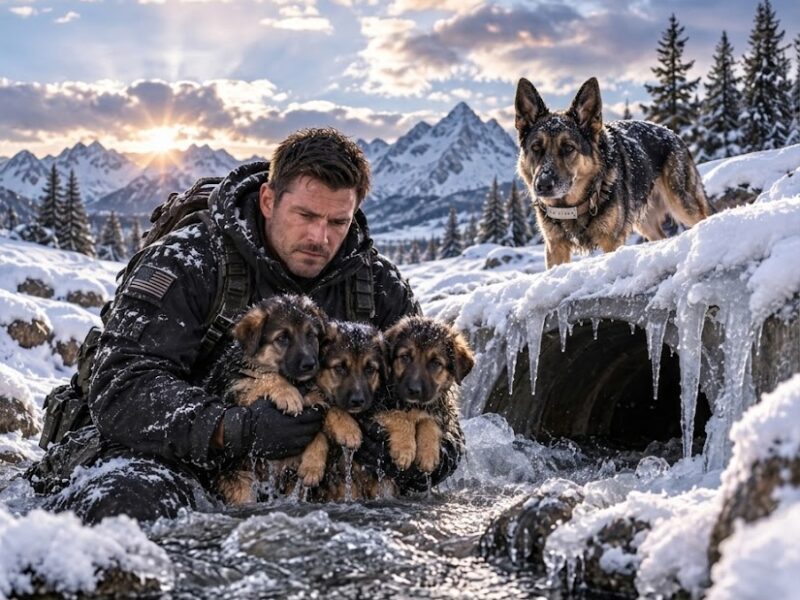
A Navy SEAL saved a litter of freezing German Shepherd puppies from a snowdrift. Then their mother did something he never forgot.
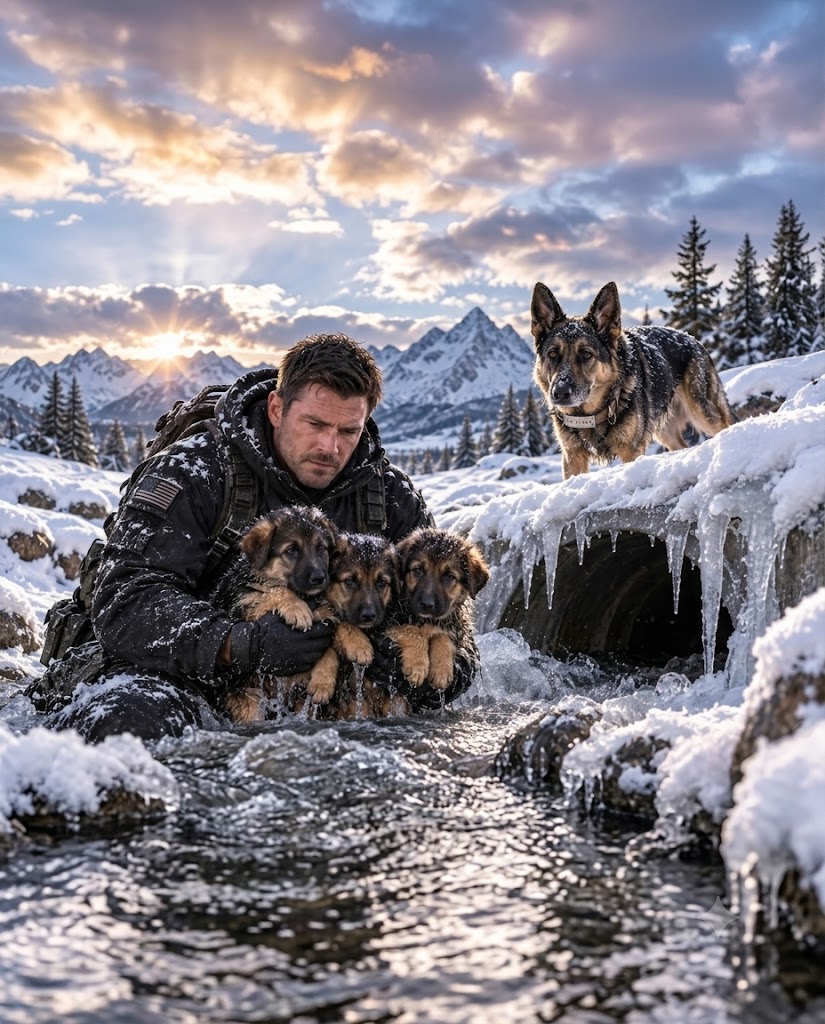
The puppy’s cry came from beneath six inches of ice, where nothing that small should still be alive.
Mason Reed killed the engine and listened. The mountain road fell silent around his pickup except for ticking metal beneath the hood and the dry hiss of pine branches rubbing overhead.
Then it came again. Thin. Broken. Close.
Mason stepped into knee-deep snow, boots crunching through the crust, and followed the sound toward a drainage culvert buried beneath the roadside. Cold air burned his throat.
The steel rim felt like frozen glass beneath his glove. He dropped to one knee and shined his flashlight inside.
Three pairs of eyes blinked back.
German Shepherd puppies, no more than a few months old, packed against one another behind a shelf of ice. Their black and tan coats were stiff with frozen moisture.
One tried to stand and immediately folded against its littermate.
“Easy,” Mason whispered.
Sixteen years of military operations taught him that panic wastes time. And these puppies had almost none left.
He pulled a wool blanket from his emergency kit, crawled shoulder-first into the culvert, and broke loose the thin ice around them with careful strikes of his flashlight handle. The pipe smelled of rust, wet earth, and old runoff.
Water soaked through his sleeve.
One puppy gave a weak growl when Mason reached forward.
“Good,” he murmured. “Keep that.”
He wrapped the smallest first, then the other two, carrying them one at a time to the pickup. The cab filled with warm air, damp fur, and the faint rubber smell of the floor mats.
Mason placed them together beneath the blanket and turned the heater toward their shelter without pressing them directly against the vent. Three puppies alive. Barely.
He reached for his phone and froze.
Something moved beyond the windshield.
A German Shepherd stood forty feet uphill between two snow-covered pines. Adult female. Lean beneath a dark sable coat. Snow powdered her shoulders and upright ears.
Her breath left white clouds around her muzzle.
Mason opened the door slowly. The dog did not retreat. Her eyes moved past him, toward the pickup, toward the puppies.
“You their mother?” Mason asked.
Her ears twitched at his voice. She took three steps downhill, stopped, and lifted her nose.
The puppies stirred inside the cab. One whimpered.
The female’s body tightened, but she did not rush them. Instead, she looked directly at Mason, turned uphill, walked several yards, then stopped and looked back.
Mason had seen working dogs refuse commands, signal hazards, guard wounded handlers. This was different.
He closed the truck door to hold the warmth inside and followed ten feet. The female moved again. Stopped. Looked back.
“Your babies are down there.” Mason pointed toward the truck.
She glanced at it once, then continued uphill.
That was when he noticed the collar beneath her wet fur. Weathered leather. Military-style hardware. A narrow metal plate flashing beneath his flashlight.
Mason approached only when she allowed it. She stood motionless as he brushed snow from the plate with two fingers.
Four characters emerged through the scratches. K9-17.
Beneath them: 0421.
Mason’s thumb paused against the cold metal. Not a pet store tag. Not a phone number.
Before he could examine it further, the shepherd pulled away and trotted toward a sagging chain-link fence half buried among the trees. She stopped beside a rusted post, looked at Mason, then back toward the warm pickup below.
Once. Twice. The same deliberate movement.
Mason looked from the three freezing puppies he had just saved to their mother waiting beside a place she clearly needed him to see.
Then he followed her into the snow.
He followed because Freya had already done the one thing a frightened stray would not. She trusted him with her puppies and walked away only after watching him put them somewhere warm.
Mason recognized the difference between abandonment and a working dog asking a human to finish something she could not do alone. But there was something more personal in the way he kept moving.
Years in the SEAL teams taught him what it looked like when someone turns back for the last member of the unit. And Freya kept giving him that same look over her shoulder.
Mason glanced once toward the pickup where three small shapes breathed beneath his blanket, then back to the mother standing alone in the white.
“All right, girl,” he whispered. “You trusted me with them. I’ll trust you with this.”
And he followed.
Freya did not run from her puppies. She stopped every twenty yards and waited for Mason to understand. He followed her uphill until the pickup disappeared behind the curve, then stopped himself.
The cold had sharpened into something vicious. Snow squeaked beneath his boots, and the wind pushed the resinous smell of pine through the trees. Somewhere below, three puppies were breathing inside a warm cab because he put them there.
Mason looked at Freya. She stood beside the sagging chain-link fence, chest rising fast, her dark eyes fixed on him.
“I’m not leaving them alone for long.”
Her ears turned toward the road before her gaze returned to him. No whining. No pacing. She simply waited.
Mason moved closer to the fence. Rust flaked beneath his glove as he gripped the post. Beyond it sat an abandoned service lane disappearing between spruce trees, half swallowed by snow.
Freya stepped through a gap where the wire had pulled away from the ground, traveled ten feet, then looked back again. Same motion. Same pause.
Mason had seen dogs flee. They keep distance. He had seen frightened mothers circle back to their litters. Freya was doing neither. She was regulating his movement. Leading him.
He crouched and pointed downhill. “Your pups are warm. If that’s what you’re worried about, come with me.”
Freya looked toward the truck. For one second, her weight shifted downhill. Then she turned toward the service lane and pawed once at the snow beside the fence.
Mason watched the gesture, then the direction of her body. She was not choosing between him and the puppies. She expected both to remain where she left them.
That changed the problem.
He reached carefully beneath the fur at her neck. The leather collar was stiff with ice, the metal hardware scarred and dull. K9-17. 0421.
He already knew the shape of military inventory language, but he did not pretend to know what these numbers meant. Not yet.
“You belong to somebody’s system,” he murmured.
Freya pulled free, but she did not retreat. Instead, she nosed the fence gap and looked at him again.
Mason exhaled through his teeth, turned, and headed back toward the road. Freya followed halfway and stopped.
At the truck, the smallest puppy lifted its head from the blanket. When Mason opened the door, warm air spilled into the blue-white dusk, carrying the smell of damp fur and wool.
He checked each puppy with steady hands, rubbing their paws gently through the blanket. One licked weakly at his knuckle.
Mason removed his insulated jacket, folded it around the litter, then shifted a plastic storage bin from behind the seat to make a protected nest on the floorboard. He could not chase a mystery while risking the lives he had already saved.
So he changed the situation.
He started the engine, turned the heater higher, and drove the truck fifty yards up the shoulder until the headlights washed across the broken fence.
Freya appeared immediately. She came to the passenger side, sniffed once at the door where the puppies rested, then turned toward the service lane.
Mason saw it now. She was not asking him to abandon them. She was asking him to bring them.
He eased the truck into four-wheel drive and stopped at the edge of the old lane.
“All right,” he said quietly. “You lead, we all go.”
Freya stepped into the headlights, snow bright against her coat. And for the first time since Mason found the puppies, she moved forward without looking back.
She needed him because the route ahead was built for a handler, not a dog alone. Gates, buried markers, and whatever lay beyond them required human hands. While her puppies were too weak to follow without Mason’s warm truck, the collar troubled him more with every yard.
K9-17 fit the shape of a military program designation. 0421 did not behave like a normal identification number, especially on hardware worn smooth from years of use. Stranger still, someone had deliberately cut a shallow line beneath those four digits, as if they were meant to be read separately from everything above them.
Mason watched Freya move deeper along the abandoned service lane.
“17 tells me who you were,” he murmured. “So what does 0421 tell you where to go?”
Freya stopped so suddenly in the headlights that Mason’s boot hit the brake before his mind caught up. The pickup settled into the snow-packed service lane, tires grinding over frozen gravel, while the three puppies shifted beneath the blankets on the passenger side floor ahead.
Freya stood beside a narrow drainage cut where wind had scraped the snow almost clean. Mason left the engine running and stepped out. The heater hummed behind him. Outside, the air bit through his shirt where he had surrendered his jacket to the litter.
Freya lowered her nose. Not to the road. To the snow beside it.
Mason swept his flashlight across the surface and saw tracks. Hers. Several sets crossing the same fifty-foot stretch in both directions.
He knelt, touching the hard rim of one print. Some edges were softened by fresh powder. Others were deeper, older, frozen solid beneath a thin crust.
She had traveled this route more than once.
Mason looked back toward the culvert. “You kept coming back.”
Freya watched the truck instead of him. Through the windshield, one puppy lifted its head. Only then did she look down the lane again.
Mason followed the tracks with his light until paw prints became faint, then disappeared beneath wind-blown snow near the fence. Beside them was something different.
A boot impression. Human. Deep heel. Lugged sole. Another lay six feet farther on.
Mason’s flashlight stopped. Someone had walked this route too.
He checked direction before drawing conclusions. The toe pointed toward the culvert. A second print overlapped Freya’s older track. He measured the stride with his eyes, then noticed the snow packed inside the tread had hardened darker than the powder around it.
Older? How much older? He could not tell. Not yet.
From the pickup came a sharp puppy cry.
Freya spun. She raced past Mason, not uphill, but back toward the truck, and planted both front paws against the passenger door.
Mason was there seconds later. The smallest puppy had crawled free of the blanket and wedged itself against the seat rail. He opened the door, cupped the trembling body in both hands, and returned it to the warmth between its littermates.
Freya pushed her muzzle into the opening, touching the first puppy, then the second, then the third. Always in that order. One. Two. Three.
She withdrew only after the smallest settled. Mason noticed the sequence but filed it away. Right now, keeping them warm mattered more.
He secured the blanket so none could crawl out again. Then Freya suddenly turned toward the ditch beside the truck and pawed at a ridge of ice.
Metal answered with a dull clang.
Mason crouched and cleared the snow with his glove. Beneath it stood a short steel post barely eighteen inches high, painted military green beneath years of rust. A stamped plate was bolted to its face.
Most of the lettering had vanished, but four digits remained clean enough to read. 0421.
Mason looked at Freya’s collar. Same number.
His earlier assumption collapsed. It was not a date. It was not simply an identification number. The number belonged to this place.
Beyond the post, almost hidden beneath the trees, another faded marker stood farther uphill. Mason swept his beam between them. Then toward the old boot tracks leading in the same direction.
Freya pressed her nose briefly against 0421 and looked back at her puppies.
Mason closed the passenger door, locking their warmth inside. Then he studied the human footprints once more and made a decision.
“Nobody moves your babies until I know who came through here.”
Freya stepped past the marker and waited while Mason turned the pickup toward the next post. She was not leading him toward a random place in the mountains. Each time the headlights found another weathered marker, Freya followed the same narrow corridor between them, stopping only long enough to make certain the truck and her puppies were still behind her.
Mason began to understand that 0421 marked the beginning of a route she had traveled before. Whatever waited farther up that abandoned service lane was somewhere Freya believed a human was supposed to take her young when she could not carry them there herself.
By the time Mason reached the abandoned K9 facility, the puppies had stopped trembling. That mattered more than the rusted sign hanging crooked above the gate, more than the number 0421 still turning through his head.
He parked beneath a security lamp that spilled weak amber light across packed snow and carried the puppies inside a small caretaker building after calling the emergency number posted outside. Freya stayed close enough that her shoulder brushed his leg.
The room smelled of dust, propane heat, and old canvas.
Caleb Voss, the gray-haired caretaker who answered the call, brought towels and a plastic kennel from storage without wasting questions. Mason knelt beside the heater while Freya touched each puppy with her nose. First. Second. Third. Same order.
Only after the smallest settled did she sit.
“You know her?” Mason asked.
Caleb’s hand stopped on the kennel latch. “Freya.”
The shepherd’s ears lifted.
Mason looked from the dog to Caleb, then back. “Start there.”
Caleb unlocked an old office and woke a desktop computer whose fan whined beneath the silence. According to the archived record, Freya belonged to a military working dog recovery program before being classified unstable after the death of her handler, Lieutenant Aaron Vale. The file said she later left the program during decommissioning.
Mason kept one hand near the puppies while reading. “K9-17.”
Caleb nodded. “Program designation.”
“N0421.”
Caleb’s eyes stayed on the screen. “Could be an inventory reference.”
“Could be,” Mason said.
He already had a steel marker buried beside a mountain service lane, proving the number belonged to a physical location.
Caleb opened a folder of scanned photographs. Training yards. Kennels. Handlers beside shepherds and faded tactical gear.
Then Freya appeared. Younger. Cleaner. Wearing the same style collar, seated beside a lean man identified beneath the image as Aaron Vale.
Mason studied the caption. April 18th.
The personnel record beside it listed Vale’s death on January 9th of that same year. Three months earlier.
Mason leaned closer. The monitor gave off a faint electrical warmth. Sleet tapped against the window like fingernails.
“Who entered this date?”
“Records were rebuilt when the program closed.” Caleb folded his arms. “A lot of files were transferred.”
Mason enlarged the photograph. He did not accuse anyone. Dates could be entered wrong. Images could be mislabeled. But the photograph itself contained something the database could not explain away.
Behind Freya stood a training board with a faded stencil: K9-17. Beneath it, partly obscured by Vale’s boot, was 0421.
Mason turned toward the dog.
Freya was no longer watching her puppies. She was staring at the photograph. Her body became perfectly still. Then she walked to the desk, raised her muzzle toward the screen, and gave one low breath through her nose.
Caleb reached for the mouse. Mason caught his wrist before the image disappeared. Not hard. Just enough.
“Leave it.”
Caleb met his eyes. Mason released him and pointed first to Vale’s recorded death date, then to the photograph timestamp, then to the marker visible behind Freya.
“Either a dead man posed for this picture,” Mason said quietly, “or somebody rebuilt this dog’s history wrong.”
Behind him, one puppy squeaked. Freya immediately turned, touched all three in the same careful order, then faced Mason again.
He closed the archive window but did not leave. “I’m not taking her babies back into that mountain until we know which part of this record is false.”
Freya’s old file called her dangerous. But the dog beside Mason was warming her smallest puppy with her own breath.
The caretaker room had gone quiet except for the propane heater clicking behind the wall and sleet scratching across the dark windows. Warm wool, damp fur, and stale coffee mingled in the air. Mason sat on the floor beside the plastic kennel while Freya lay against its open door, her body curved around the three puppies.
Caleb remained near the desk.
“That classification,” Mason said. “Unstable after handler loss. What did she actually do?”
Caleb rubbed a thumb across the edge of the folder. “Stopped cooperating with transfers. Guarded certain equipment. Wouldn’t leave the recovery yard on command.”
“Bit anyone?”
“No.”
“Charged anyone?”
Caleb hesitated. “She blocked handlers.”
Mason looked at Freya. “That isn’t the same thing.”
Caleb opened another archived assessment. The report described fixation, refusal, protective posturing. Freya was repeatedly separated from familiar equipment and moved between kennels after Aaron Vale died.
Mason read every line, then glanced toward the puppies. The smallest had crawled against Freya’s foreleg. She lowered her muzzle. First puppy. Second. Third. Always the same sequence.
Caleb reached into an old cabinet for more records, shifting a cardboard box. Something metallic fell inside it with a soft clink.
A black training whistle rolled across the desk.
Freya’s head snapped up. Her ears locked forward.
Caleb froze. “That belonged to the program.”
Mason rose. “Don’t blow it.”
But Caleb had already lifted it. Perhaps from habit. Perhaps because he wanted to prove the old report correct.
One short note cut through the room.
Freya moved instantly. Not toward Caleb. Toward the puppies.
She stepped across the kennel entrance, shoulders square, placing her body between the litter and every person in the room. No barking. No snapping. Her eyes moved from Mason to Caleb, then to the door.
Mason raised an open hand. “Nobody move.”
Caleb whispered, “That’s what she used to do. Exactly like this. Every time that whistle sounded after Vale died.”
Mason watched Freya’s feet. Balanced. Not lunging. Her body shielded the kennel while leaving an open line toward the room’s rear exit. The puppies remained behind her. She checked them without turning fully.
One. Two. Three. Then faced outward again.
Mason had worked beside enough trained dogs to recognize the difference between uncontrolled aggression and repeatable behavior. Chaos changes shape. Training repeats.
He stepped sideways. Freya shifted with him, preserving the same angle between herself, the puppies, and the exit. Mason changed direction. She adjusted again.
“She isn’t threatening us,” he said.
Caleb lowered the whistle.
Mason pointed toward the rear door. “She’s forming a barrier and keeping an evacuation lane open.”
The whistle disappeared into Caleb’s fist. For the first time, the words on the assessment seemed less like diagnosis and more like someone describing a procedure they did not understand.
Mason took the whistle, placed it gently on the desk, and crouched.
“Freya.”
Her gaze found him. He did not reach for her. He moved to the side, clearing the path she had protected.
After several seconds, Freya stepped backward into the kennel and touched each puppy again. First. Second. Third. The same sequence she performed at the truck. The same sequence after the photograph.
Mason looked toward the computer, then at the number on her collar. 0421. A location. A trained protective response. A mother who carried three freezing puppies toward an old military route instead of away from it.
He turned to Caleb. “Pull every map this program used.”
Caleb started to object, but Mason set the whistle beside the photograph of Aaron Vale.
“Because if this was training, she wasn’t running from something on that mountain.”
He looked at Freya guarding the three lives he had pulled from the ice.
“She was trying to get them somewhere.”
Caleb spread the old training map across the floor, and Freya walked straight to the route everyone thought she had abandoned.
Mason knelt beside the paper while the propane heater clicked behind him and wet sleet rattled against the windows. The map smelled of mildew and cardboard, its folds soft from years inside a storage tube.
Across the faded topographic lines ran a chain of numbered circles through the mountain property. Mason found 0421 near the drainage corridor where he had pulled the three puppies from the ice. It was followed uphill by two more checkpoints.
“Evacuation route?” Mason asked.
Caleb slowly nodded. “Recovery teams practiced moving dogs and equipment offsite if the main kennels became unusable.”
Mason traced the route with one finger. The old facility sat west. The culvert lay southeast. If Freya had simply escaped, she had traveled the wrong direction for freedom. She had moved deeper along a controlled route.
Mason looked toward her. Freya lay beside the puppies, but her eyes remained fixed on the map.
“What happened at 0421?”
Caleb shook his head. “I handled facilities, not field protocols.”
Mason took the black whistle from the desk but did not use it. He placed it beside the map instead. Whistle. Protective formation. Numbered marker. Repeated travel between the puppies and the route.
Separate facts began locking together.
“She wasn’t trying to leave the program,” Mason said. “She was moving through it.”
Caleb pulled a brittle operations binder from a cabinet. Most pages were maintenance schedules, fuel logs, gate inspections. Mason ignored anything that could not connect directly to Freya and the puppies.
Then he found a route legend. Emergency transition points identified by four-digit station codes. No explanation of individual commands. He did not need one. Not yet.
The number on Freya’s collar matched a station. The same number appeared behind her and Aaron Vale in the old photograph. The marker existed exactly where the map said it should.
Three independent pieces. One conclusion.
Mason rose. “We go back.”
Caleb stared at the windows. “Road could close within an hour.”
“Then we have less than an hour.”
Mason wrapped the puppies inside his insulated jacket and carried the kennel to the truck. Freya followed so tightly her flank brushed his knee. Outside, wind drove grains of ice across the security light and the pickup’s exhaust hung white beneath the trees.
Mason secured the kennel behind the passenger seat where warm air could circulate without blowing directly on the litter. Freya climbed into the rear cab only after touching each puppy. First. Second. Third.
Mason drove back to 0421.
At the marker, he stopped. He did not lead Freya this time. He opened the rear door. She jumped down, checked the puppies through the open cab, then turned uphill along the mapped route. Not toward the old kennels. Not toward the highway. Toward the next evacuation point.
Mason followed in the truck until fallen timber blocked the lane. He got out with a flashlight, leaving the engine and heat running. Freya moved thirty yards ahead, paused beside another green post, then looked back.
Mason checked the map. Exact position. He looked down at the snow. Her tracks continued beyond it toward the final checkpoint.
Suddenly, the shape of what happened became clear. When the mountain turned dangerous, Freya had taken her puppies toward the one place her training told her meant shelter. The culvert was not where she abandoned them. It was where she had managed to get them before the cold stopped them.
Mason folded the map and slipped it beneath his shirt.
“You remembered the route,” he whispered.
Freya turned toward the final marker hidden somewhere above them. Mason looked back at the glowing truck where three small shapes slept in his jacket, then made his choice.
Before anyone labeled their mother unstable again, he was going to find out what she had been trained to reach.
Caleb’s signature sat beneath the words unfit for reassignment, and Mason finally understood where the lie began.
They were back inside the caretaker building because the storm had erased the upper service lane faster than expected. Ice rattled against the siding. The fluorescent light buzzed overhead, and Freya lay beside the kennel while three puppies slept against the wool of Mason’s jacket.
Caleb stood across the desk. Mason slid the printed assessment toward him.
“You wrote this.”
Caleb did not touch it. “Yes. Unstable after handler loss. Protective fixation. Unsafe for reassignment.”
Mason tapped the signature. “Yours?”
“Mine.”
Freya lifted her head at Caleb’s voice. Mason watched her before looking back at him.
“She followed an evacuation route through a blizzard with three puppies. She responded to that whistle like a trained protection dog. So either you never understood her, or you needed somebody else to believe this.”
Caleb’s jaw tightened. Outside, wind pushed against the window until the glass gave a low groan.
“You want the clean answer?” he said. “There isn’t one.”
Mason waited.
Caleb opened a lower drawer and removed a yellowed transfer sheet. Unlike the scanned records, this one carried handwritten routing marks. Freya’s identification appeared near the top. Below it were three proposed destinations.
Mason read them once, then again. Different facilities. Different states. No guarantee she would remain in the recovery program.
“When Vale died, the program started coming apart,” Caleb said. “Then closure orders came. Dogs that could still work were being reassigned.”
Mason looked toward Freya. Her muzzle rested inches from the smallest puppy.
“And you stopped hers.”
Caleb nodded. “I tried. By calling her unstable. By making her undesirable on paper.”
The heater ignited with a hollow thump. Caleb’s fingers flattened against the desk.
“She wouldn’t transfer cleanly after Vale. She guarded his equipment. She kept returning to the same training routes. Anyone reading that behavior without knowing her would call it a problem. I made sure they did.”
Mason’s eyes narrowed. “You lied.”
“Yes.”
The word landed without defense.
“Because if she passed reassignment, they could send her anywhere. If she failed, she stayed here while I tried to arrange permanent placement.”
Mason glanced at the old assessment. The same sentences that made Freya look dangerous had kept her from being shipped away. The lie was real. The meaning was wrong.
“Then why was she outside?”
“The permanent placement never cleared before the program shut down. Records were split between systems. I kept checking on her here. This winter, the lower perimeter failed.” Caleb pointed toward the mountain. “By the time I found the breach, she was gone.”
Mason thought of the human bootprints beside the culvert. Maintenance. Fence inspections. Not someone abandoning puppies. Once suspicion fell away, Freya arose.
She touched the puppies in order. First. Second. Third. Then walked to the door. Her nose pressed against the seam beneath it.
Mason checked the wall clock. The storm was worsening, but the puppies were warm now. They were breathing deeper and steadier.
Caleb reached for Freya’s collar. She stepped away from him. Then she looked at Mason. Once toward the door. Back to Mason.
The same signal she had given beside the culvert, but now her puppies were safe.
Mason slowly stood. “There’s another checkpoint after 0421.”
Caleb looked toward the dark window. “Mason, that route hasn’t been used in years.”
Freya scratched once at the door.
Mason took the folded map from beneath his shirt. One station remained beyond the point they had reached. He looked at Caleb.
“You protected her from reassignment.”
Then he looked at Freya waiting beside the exit.
“But Aaron Vale taught her something you never knew.”
Mason opened the door. Snow exploded into the warm room, and Freya ran straight into the storm.
Freya vanished into the white darkness, leaving her three warm puppies behind for the first time. Mason grabbed his flashlight and followed.
Snow struck his face like sand, and the open door behind him threw a shrinking rectangle of yellow light across the drifts. Freya did not return. She appeared twenty yards ahead only when his beam caught the silver plate on her collar, then disappeared between the pines again.
Mason pulled the folded map from his shirt. He did not follow blindly. The line from 0421 ran northeast, crossed the service lane, then climbed toward one final checkpoint near an old emergency shelter.
Freya was moving exactly northeast.
Mason checked his compass and started climbing. Wind groaned through the spruce tops. Beneath his boots, crusted snow broke with sharp glass-like snaps.
Freya slowed whenever Mason fell behind, but she never turned toward the facility. The puppies were safe now. Whatever kept pulling her through the route was somewhere ahead.
Ten minutes later, Mason found the final marker leaning beneath a fallen pine. Freya circled it once, nosed low, then moved toward a concrete structure half buried in the slope.
An emergency shelter.
Its steel door was frozen shut. Freya scratched at the bottom seam, stopped, and looked at Mason.
He wedged his flashlight beneath one arm, cleared packed ice from the hinges, and pulled. Nothing. He braced one boot against the concrete and tried again.
Rust cracked. The door opened six inches with a metallic scream.
Freya pushed through before Mason could widen it. Inside, the air smelled of cold concrete, old canvas, and mouse-chewed paper. His flashlight revealed empty shelves, a collapsed field cot, and a weatherproof storage box bolted beneath a bench.
Freya went directly to it. She did not paw wildly. She sat.
Mason knelt and wiped dust from the lid. K9-17 was stenciled across the metal. Beneath it, almost erased: Emergency Transfer.
The latch had corroded, but his multi-tool opened it. Inside were obsolete route cards, a faded photograph of Aaron Vale with Freya, and a sealed plastic sleeve attached to a chain.
Mason lifted it carefully. A military dog tag slid against the plastic with a soft click.
Aaron Vale.
Beneath it was a handwritten instruction card dated before the program closure. Mason read:
“Only what matters. If K9-17 is dissolved, Freya is not to be separated from dependent pups. Transfer her to a qualified handler family whenever possible.”
The final line was shorter.
“She knows the evacuation route. Let her finish it.”
Mason looked at Freya.
Every strange thing returned at once. The loops between culvert and fence. The numbered marker. The protective formation. The repeated count of three. The way she kept leading him forward while never forgetting the puppies behind her.
She had not been searching for a person who was gone. She had been completing the last instructions he left inside her training.
She was not abandoning her puppies. She was leaving because for the first time since the storm began, she believed she no longer had to guard them herself. They were warm. They were together. And they were with Mason.
He remembered her standing above the culvert soaked in snow, choosing a stranger because her own strength could take them no farther. Now she was making that choice again.
Mason tightened his hand around the old dog tag and watched her disappear toward Vale’s final checkpoint. Then he followed, not because Freya asked him to, but because he finally understood what that trust cost her.
Freya reached the caretaker building with Aaron Vale’s dog tag still held gently between her teeth. She walked to the first puppy and touched its nose. Then the second. Then the smallest.
One. Two. Three.
The same count she had made beside the frozen culvert. The same count she had made inside Mason’s truck. The same ritual everyone had mistaken for simple maternal checking.
This time, after the third puppy answered with a sleepy lick, Freya did not turn toward the door. She stood perfectly still.
Mason crouched beside her. “They’re all here.”
Freya looked at him. Then she lowered her head and placed Aaron’s dog tag into his open palm.
The chain was warm from her mouth. Mason closed his fingers around it.
No command passed between them. None was needed.
Caleb read Aaron’s recovered instruction twice, then made the necessary calls while the storm buried the mountain road outside. The surviving program records, Freya’s identification, and Aaron’s written directive finally agreed on one thing.
She and her dependent puppies were never meant to be separated. With the facility closing and Mason qualified to take responsibility for them, temporary placement was approved, followed by permanent transfer once the paperwork cleared.
By morning, the storm weakened. Pale sunlight spilled across the snow, turning every pine branch silver. Mason carried the kennel to his pickup. Freya walked beside him freely.
At the broken fence, she paused. The old route lay beyond it, its markers almost invisible beneath fresh snow.
Mason waited. Freya looked toward 0421 for several seconds. Then one puppy whined from the truck. Her ears turned. She walked past the fence without entering and climbed into the cab.
Weeks later, the smallest puppy no longer needed blankets to stop trembling. All three tumbled across Mason’s living room rug, paws thudding against hardwood while firewood popped behind the stone hearth. The house smelled of cedar smoke and warm coffee.
Freya lay nearby, watching them wrestle beneath the amber light. Aaron’s dog tag hung from a simple hook beside her weathered K9-17 collar. Not hidden. Not displayed like a trophy. Just kept where Mason could see it.
The official correction to Freya’s record arrived in a plain envelope. Mason read it once. The word unstable was gone. He folded the paper and put it away.
Freya never needed the correction. People did.
That night, snow began falling softly beyond the windows. The puppies circled twice and collapsed together beside the fireplace.
Freya arose. She approached the first and touched noses. Then the second. Then the smallest.
One. Two. Three.
Mason watched from his chair. For a moment, he expected her to turn toward the door, to search for another checkpoint, another unfinished command somewhere beyond the dark trees.
She did not.
Freya walked to him instead. Aaron’s tag caught a thread of firelight on the wall behind her. She placed her head on Mason’s knee. Her breathing slowed. Her eyes closed.
And for the first time since he found her children freezing beneath the ice, their mother stopped keeping watch, because the man who saved her puppies had finally given her somewhere she no longer had to.









