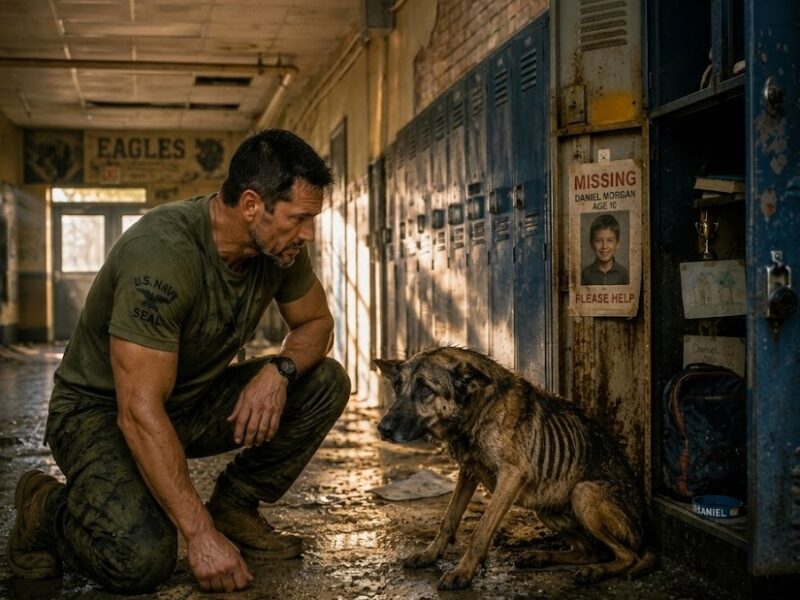
A Navy SEAL rescued a dog trapped inside an empty school. Then the dog led him to a missing boy’s locker—and everything changed.
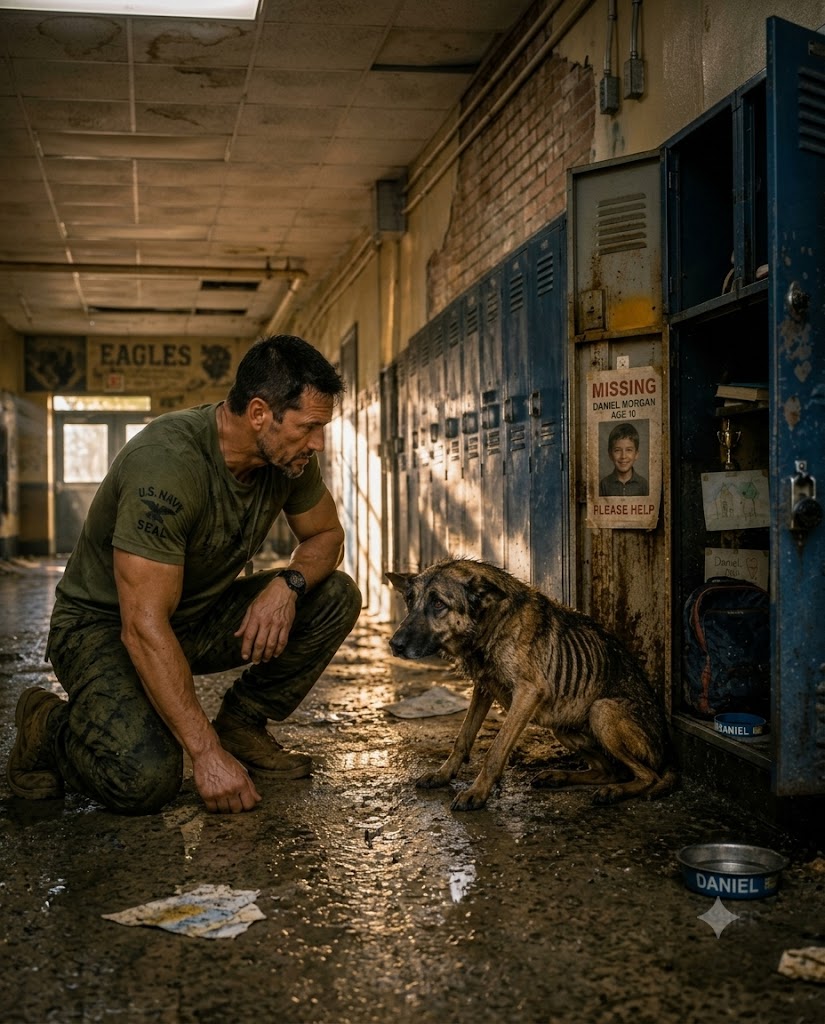
The scrape of claws against wet pavement stopped Evan Mercer before he reached the gate of Harbor Pines Senior Care Center. He had been walking along the coastal road outside the nursing home when he heard the sound again. A heavy German Shepherd shifted behind the low fence, not running, not barking, just refusing to leave the patch of grass where the morning fog met the sidewalk.
Evan slowed. The dog watched him with tired, alert eyes. Its coat was rough from being outside, and its ribs showed slightly beneath the fur. But the animal still carried itself with the careful awareness of a dog that had spent years paying attention to the world around it.
“Easy,” Evan said quietly. He did not reach out. That was the first choice he made. At 37, Evan had learned that some things reacted badly when pushed.
After leaving the Navy SEAL community years earlier, he had rebuilt his life repairing small boats near the Oregon coast. He knew how to stay calm when situations changed, but he also knew when his experience did not make him the expert in the room. The German Shepherd took one step back. Evan stopped moving.
A staff member from Harbor Pines came outside carrying a phone and a worried expression. “We’ve been trying to figure out where he came from,” she said. “He showed up before sunrise.”
The dog glanced toward the building, then immediately looked away. Evan noticed. Not fear of the people walking past, not fear of the cars on the road, not fear of the unfamiliar place. Something about the building pulled a different reaction from him. A few minutes later, after Evan sat on the pavement at a safe distance, the dog finally moved closer.
Slowly, carefully, the animal sniffed the air near Evan’s hand, but did not touch him. Then it sat. The staff member exhaled. “I’ve never seen him do that with anyone.”
Evan looked at the dog’s worn collar. A faded tag hung from the metal ring. Ranger, he read. The name felt like it belonged to a dog who once had somewhere to be. Evan called a local veterinary clinic and arranged an evaluation.
Until help arrived, he stayed nearby with a bowl of water and space between them. Ranger drank cautiously, stopping every few seconds to look around. The immediate problem was simple. The dog had spent an unknown amount of time outside, and he needed a safe place, water, and a professional check. The harder question could wait.
When the clinic assistant arrived, Ranger allowed Evan to walk beside him, but kept his body tense. The dog moved like every step required a decision. As they reached the entrance of Harbor Pines, the director stepped outside. “Is there a problem?” the woman asked. Ranger froze.
The change was instant. The dog lowered his head, stepped backward, and pulled away from the doorway as if the space between them had suddenly become much larger. Evan did not know why. He only knew that Ranger had just answered a question nobody had asked yet.
And after the veterinary visit revealed the dog needed more than a temporary rescue, Evan realized saving Ranger from the sidewalk was only the beginning of understanding what had brought him there. The veterinary clinic door closed behind Ranger, and Evan Mercer stood in the parking lot watching the German Shepherd settle into a quiet examination room. The visit had answered the first problem.
Ranger was dehydrated, underweight, and carrying old injuries that needed professional attention, but he was stable. A local veterinarian explained that the dog needed rest, consistent meals, and time to reduce stress. No one could determine his full history from a collar and a few observations. Evan understood that. Understanding something and accepting it were different.
He drove back to his small rental house near the Oregon coast with Ranger resting on a blanket in the backseat. The dog did not panic. He simply watched every passing shadow through the window and lifted his head whenever the truck turned toward unfamiliar streets. Evan noticed. He noticed everything.
That habit had followed him long after his years as a Navy SEAL were over. He checked locks twice without thinking. He kept his tools arranged in the same order on his workbench. He chose the chair in restaurants where he could see the entrance. Not because he expected trouble, but because old routines were difficult to leave behind.
His life had become quieter by design. Most mornings were spent repairing fishing boats and replacing worn parts for people who depended on the water. His evenings were simple. Coffee, maintenance work, and the sound of waves beyond the window. No missions. No briefings. No people waiting for him to solve impossible problems.
Now there was a German Shepherd sleeping three feet away from his kitchen table. Ranger opened his eyes when Evan placed a bowl of water nearby. The dog did not move toward it immediately. Evan sat down and waited. Minutes passed. Finally, Ranger stood, walked over, and drank.
Afterward, he returned to the same spot beside the wall where he could watch both the room and the hallway. Evan did not try to change that. The next morning, he called the veterinary clinic again and arranged a follow-up evaluation. He also contacted the local animal services office to make sure he was handling the situation correctly.
Ranger was not his dog, and Evan knew a rescue did not automatically create ownership. That was another lesson he had learned the hard way. Doing the right thing still required respecting boundaries. Later that afternoon, Evan brought Ranger back near Harbor Pines to see if anyone recognized him. The nursing home staff gathered outside, curious but careful.
Ranger remained calm until Linda Wexler stepped through the doorway. The director stopped when she saw the dog. Ranger immediately moved behind Evan. It was not aggressive. It was not an attack. It was a retreat. Evan looked between them, searching for an explanation he did not have.
Linda lowered her voice. “He did that before.” Those four words changed the situation because now Evan knew Ranger’s reaction was not a one-time accident, and someone at Harbor Pines had seen it happen before. Before he could ask another question, the staff requested that Ranger be brought back inside for identification, forcing Evan to decide whether helping the dog meant keeping distance from the place he feared or stepping closer to understand why.
The request from Harbor Pines followed Evan Mercer home. By evening, Ranger was standing near the kitchen doorway, watching Evan move around the small rental house with the same careful attention he had shown since arriving. The German Shepherd was no longer hiding behind furniture or pressing himself against the far wall, but he still kept a measured distance, as if every new sound required approval before he reacted.
Evan placed a leash beside the door. He did not pick it up. Instead, he sat on the floor and waited. The choice was deliberate. Ranger had followed him because he allowed the space between them to close, not because Evan had forced it. After several quiet minutes, the dog walked toward the leash, sniffed it, and stepped away. Evan let him.
The next morning, they tried again. This time, Ranger touched the leash with his nose and remained there for a few seconds before backing away. It was not obedience. It was not a command followed. It was a decision. Evan adjusted his plans for the day.
His boat repair work could wait a few hours. He called the clinic, confirmed Ranger’s follow-up appointment, and checked with the local animal services office about the proper steps for a found dog. He had spent years making fast decisions under pressure, but this was different. Ranger did not need someone to take control. He needed someone who could recognize when control was the wrong answer.
That afternoon, Evan returned to Harbor Pines with Ranger. The visit was supposed to be simple. Find out if anyone recognized him. Confirm whether the nursing home had any connection to the dog. Move forward from there. But Ranger changed the plan. When they reached the front walkway, the dog stopped beside Evan.
He looked toward the building, then toward the parking lot, then back at Evan. For a moment, Evan thought Ranger would refuse to move. Instead, the dog stepped forward, only a few feet. Then he stopped again. Evan followed the dog’s pace, not his own.
A staff member named Carla came outside and immediately recognized him. “He stayed around here before,” she said. Evan looked at her. “How long?” Carla hesitated. That hesitation mattered. Before she could answer, Linda Wexler stepped out of the entrance.
The director kept a calm expression, but Ranger’s body changed instantly. His ears lowered. His weight shifted backward. Evan saw it. This time, he did not assume he understood. He watched. Linda noticed the reaction and quietly said, “I was hoping he wouldn’t remember me.”
The sentence created more questions than answers. Evan did not confront her. He did not accuse her. He simply asked what she meant. Linda looked toward the building. “Because the last time Ranger was here,” she said, “things did not go the way anyone expected.”
Evan looked down at the dog beside him, realizing that the problem was no longer only finding where Ranger belonged. It was understanding what had happened before Ranger ever reached the gate. And the next step would require Evan to enter Harbor Pines with Ranger beside him, not as a rescuer, but as someone finally willing to listen.
Linda Wexler’s words stayed between them as Evan Mercer followed her through the entrance of Harbor Pines. “Because the last time Ranger was here, things did not go the way anyone expected.” Evan did not answer immediately. He watched Ranger instead.
The German Shepherd stepped inside the lobby, but kept close to the doorway. His paws remained planted near the exit, his head moving slowly as residents, staff members, and visitors passed through the space. Evan had seen enough to know one thing. Ranger was not refusing the building completely. He was measuring it.
Linda noticed Evan watching the dog instead of watching her. “That is exactly what we couldn’t understand,” she said. “He wasn’t afraid of everyone.” They moved into a small administrative office near the front desk. Evan stayed standing until Linda offered him a chair.
Old habits made him glance toward the door before sitting. But he caught himself and chose the seat facing the room instead. Not because he needed to prepare for something. Because Ranger was still watching the hallway. Carla, the staff member who had recognized Ranger, joined them with a folder in her hands.
“This is what we have,” she said. Evan did not reach for it. He waited. The folder contained basic records connected to the nursing home’s previous animal support program. There were dates, staff notes, and general information about visits from therapy animals.
Nothing explained why Ranger reacted to Linda. Nothing proved anyone had done anything wrong. Evan knew better than to turn a question into an accusation. His first instinct was to search for patterns. His second was to slow down before trusting that instinct.
Linda explained that Ranger had appeared months earlier with someone connected to Harbor Pines. She described him as calm at first, comfortable around residents, and unusually attentive to certain areas of the building. “Then one day everything changed,” she said. Evan looked at the folder. “What changed?”
Linda paused. “That’s the part we never fully understood.” The answer bothered him because it was honest. Not because it was suspicious. Outside the office window, Ranger stood beside Carla. The dog allowed her to hold the leash, but only after Evan stepped away and gave him space.
That small action mattered. For the first time since arriving at Harbor Pines, Ranger accepted guidance from someone besides Evan. It was progress, but it also showed Evan something uncomfortable. He was not the only person Ranger could trust.
Later that afternoon, Evan walked the property with a staff member while Ranger remained nearby. They passed the garden area, the dining room entrance, and a side hallway that was currently closed for maintenance. Ranger stopped near that hallway. He did not pull toward it. He did not panic. He simply stood still.
Evan noticed a faded sign beside the door. The lettering was worn, and the room behind it was not accessible to visitors. “Old program room,” Carla explained. “We haven’t used it recently.” Evan looked at the sign, then at Ranger.
It was a detail, nothing more. There were several possible reasons for the dog’s reaction. A familiar smell, a memory, a coincidence. Evan refused to decide too early, but before he left, Linda received a call that changed the situation. Because Harbor Pines needed an answer about Ranger’s status, and they could no longer allow him to remain at the nursing home without a formal plan.
Ranger’s future at Harbor Pines was no longer a question that could wait until tomorrow. The call Linda received changed the mood of the entire afternoon. Because Ranger was a found dog without confirmed ownership, Harbor Pines could not simply allow him to remain on the property indefinitely.
The nursing home had residents to protect, staff responsibilities to manage, and rules that existed for reasons beyond one unusual situation. Evan understood that. That did not make it easier. Outside the building, the late spring air carried the damp salt smell of the Oregon coast. Low clouds moved over the shoreline, and the grass around Harbor Pines still held moisture from the morning fog.
Ranger stood beside Evan near the parking area, watching people move in and out of the entrance. “He needs a proper evaluation,” Carla said. “Not because he’s dangerous, because nobody knows what he needs yet.” Evan nodded. Carla’s concern was not about getting rid of Ranger.
She had spent months watching residents connect with the dog when he appeared near the property. She wanted a solution that protected everyone, including the animal. That mattered. Evan called the veterinary clinic and arranged another appointment with a behavioral specialist. He also agreed to keep Ranger away from the building until there was a clearer plan.
It was the responsible choice. It was also the choice Ranger did not understand. When Evan reached for the leash, Ranger stepped back. Not far, just enough. The dog looked between Evan and the nursing home, then lowered his head. Evan stopped.
A few days earlier, he might have interpreted the reaction as refusal. He might have tried to solve the problem by making the next step happen faster. Instead, he waited. Ranger eventually approached, but only after Evan placed the leash on the ground and gave him room. The small victory came with a reminder. Ranger was not following commands. He was making choices.
That evening, Evan brought Ranger back to his house and set up a quiet area near the kitchen. He placed food, water, and a blanket nearby, but he did not try to force a routine. The dog accepted the space, then rejected the blanket. Instead, Ranger chose the spot near the hallway where he could see both doors. Evan noticed but did not interfere.
The next morning, the veterinarian confirmed Ranger’s physical condition was improving. However, the specialist explained that the dog’s reactions appeared connected to specific experiences and environments, not simple obedience issues. There were no quick answers. That afternoon, Evan received a message from Harbor Pines. Linda wanted to meet.
Not as a director defending a facility, as someone trying to understand what had happened. When Evan arrived, Linda brought him to the old program room beside the hallway Ranger had noticed earlier. The door was unlocked, but the room had not been used recently.
Inside were old supplies from the nursing home’s former animal support program. A worn sign hung on the wall. A few items remained on shelves. Nothing explained Ranger’s fear, but one thing was clear. Someone had cared for him there before, and Linda’s next words changed the direction of Evan’s questions.
“Before we decide what happens to Ranger,” she said, “you need to know why he stopped coming here.” The old program room at Harbor Pines looked like a place waiting for someone to remember it. Evan Mercer stood near the doorway while Linda Wexler turned on the lights one section at a time.
The room was clean, but unused. Shelves held old training materials, empty storage containers, and a few items left behind from the nursing home’s former animal support program. Nothing about it explained Ranger. That bothered Evan more than a clear answer would have.
He had spent years learning that uncertainty was where mistakes happened, but this was not a situation where speed created safety. This required patience, and patience was something Evan had to practice. Linda walked toward a cabinet and stopped. “Ranger used to come here with a volunteer,” she said. “Not every week, just enough that residents started recognizing him.”
Evan looked through the room, not searching for a hidden answer, but noticing what was actually there. The faded sign, the empty leash hook near the wall, the worn corner of a mat. Small details, possible connections, not proof. “That volunteer was the owner?” Evan asked.
Linda shook her head. “No, that was part of the confusion.” Before Evan could ask more, Ranger shifted behind him. The dog had followed them into the room, but stayed close to the entrance. He did not pull away. He did not move deeper inside. He simply watched.
Evan lowered himself slightly, keeping his body relaxed. “Your call,” he said quietly. Ranger remained still. Then, after several seconds, the dog stepped forward and placed one paw onto the old mat near the center of the room. A small action, but different.
Evan noticed the change without assigning a meaning he could not prove. The dog was not revealing a secret. He was showing a limit. A few seconds later, a sound from the hallway caused Ranger to turn sharply. A cart rolled past outside, and the wheels created a sudden metal rattle. Ranger backed away.
Evan moved between the dog and the hallway without thinking, then stopped himself. He was not there to control every reaction. He stepped aside. Ranger chose to remain in the room. That mattered. Later, Evan spoke with the nursing home staff about Ranger’s previous visits.
He learned that several employees remembered him, but everyone remembered different pieces. One person thought Ranger had stopped coming because the volunteer moved away. Another believed the program ended because of scheduling issues. Linda remembered a different timeline. No one was lying. At least, Evan had no reason to believe they were.
The problem was that everyone had only part of the story. That evening, Evan called the veterinary specialist and shared his observations. He described Ranger’s reactions, the places where the dog relaxed, and the situations that increased his stress. The specialist reminded him that behavior patterns could have multiple causes. Evan accepted that answer. A dog was not a puzzle box. Ranger was an animal with experiences, instincts, and needs.
The next morning, Evan made a decision. He would not push Ranger back into Harbor Pines. Instead, he would help create a safer plan involving the nursing home, the veterinarian, and the people who actually worked with animals. But when he arrived at Harbor Pines to explain that choice, he found Linda waiting with a document in her hand.
It was a request for a formal review of Ranger’s situation. And the person who had submitted it was not Linda. It was someone who believed Evan had already made the wrong decision. The formal review request changed the room before Evan Mercer even opened the document.
He stood outside Harbor Pines with Ranger beside him, watching Linda Wexler hold the paperwork with a tired expression. “It came from our compliance office,” Linda said. “They’re concerned about liability.” Evan looked at the form, not angry, not surprised, just quieter because he understood what the paper meant.
Ranger was no longer only a dog that needed help. He had become a responsibility moving through a system with rules, timelines, and people who had to answer for their decisions. “Who requested it?” Evan asked. Linda looked toward the building. “Someone who thinks we should have handled this differently.”
That answer followed him inside. The review was scheduled for the following week, but Evan wanted to understand what information already existed. He met with staff members, not as an investigator, but as someone trying to prevent a wrong decision from being made too quickly. That was when the first assumption began to fall apart.
The old program room was not where Ranger had experienced something negative. It was where he had once been comfortable. The worn mat, the faded sign, the empty leash hook. They were not signs of something hidden. They were reminders of a routine that had ended.
Evan stood in the doorway while Ranger entered the room slowly. The dog sniffed the floor, paused near the mat, and then sat. Not frozen, not afraid, waiting. The second assumption changed, too. Ranger’s reaction to Linda was not proof that she had caused his fear.
Linda had been the person who helped coordinate the animal support program. She had been the person who noticed when Ranger stopped appearing. She had also been the person who asked for the review because she wanted a clear process. The problem was not one person. The problem was that everyone had only seen one piece.
Evan felt the shift physically. His shoulders relaxed slightly, and he closed the folder he had been carrying. He had been looking for the person connected to Ranger’s fear. Now, he needed to understand the event that changed Ranger’s behavior. That changed everything.
The goal was no longer protecting Ranger from Harbor Pines. The goal was making sure Harbor Pines did not make another decision without understanding Ranger’s needs. The veterinarian confirmed that Ranger’s physical condition was improving, but the behavioral specialist explained that sudden changes in routine could create setbacks for a dog already struggling with uncertainty.
Evan listened, and he made a choice. He asked Harbor Pines to delay any decision about removing Ranger from the area until the review included the people who had actually interacted with him. It was not a demand. It was a request backed by responsibility. Some staff members supported him. Others worried the delay would create more complications.
Carla understood both sides. “I want him safe,” she said, “but I also need to know what happens after we make a decision.” That sentence stayed with Evan because she was right. A decision was not only about the moment. It was about what came after.
That evening, Evan returned to his house with Ranger. For the first time, the dog walked directly to the spot near the kitchen table without waiting for Evan to sit down first. A small change, a voluntary one, but the next morning, the animal services office called.
The review had been moved forward, and until it was completed, Ranger would have to leave Evan’s care temporarily. Ranger was gone before Evan Mercer had time to decide whether he agreed. The animal services officer arrived at Harbor Pines with a calm explanation and a stack of paperwork.
No one raised their voice. No one treated Evan like an enemy. That almost made it harder. The process was simple. Ranger was a found dog with uncertain ownership and a documented need for evaluation. Until the review was complete, he would be placed in temporary care where professionals could monitor his health and behavior.
Evan understood the reasoning. He also understood what it meant. For the first time since finding Ranger outside the nursing home, he had no say in what happened next. Ranger seemed to sense the change before the leash was handed over.
The German Shepherd stood beside Evan near the parking lot. His body tense but not panicked. He looked toward the unfamiliar vehicle, then back at Evan. Evan crouched down. He wanted to make the moment easier. His first instinct was to reassure Ranger the way he would reassure a person.
But Ranger was not a person. So Evan simply stayed still. After a few seconds, Ranger allowed the handler to take the leash. It was not trust. It was tolerance. And Evan respected the difference.
The temporary facility was only a short drive away, but the separation affected more than Evan expected. He returned home to a quiet kitchen, an empty water bowl, and a blanket Ranger had barely used. The absence was noticeable because Ranger had changed the rhythm of the house without trying.
Evan did not call the situation unfair. He did not blame the Animal Services Office. He looked at the facts. He had made one mistake. He had assumed that keeping Ranger close was automatically the safest option. It was not.
The next day, Evan visited the facility with the veterinarian’s approval. Ranger was physically stable, but the environment had clearly taken effort from him. He stayed near the corner of the room. He ate, drank, and responded to staff, but he did not settle the way he had at Evan’s house.
The behavioral specialist explained that some dogs handle change by becoming quiet and watchful. That did not mean they were failing. It meant they needed consistency. Evan listened. Then he noticed Ranger looking toward the door every time footsteps passed outside.
Not because the dog knew something. Not because he was trying to communicate a hidden answer. Because the dog was adapting. And that was something Evan understood. The hardest part was accepting that his role was not to fix every problem himself. It was to support the people who had the right expertise.
Before leaving, Evan spoke with Linda by phone. She had learned that the review would include additional records from Harbor Pines’ former animal support program. There was another complication. The temporary placement could become permanent if the review board decided Ranger’s needs were better met away from the nursing home.
Evan looked through the facility window at Ranger lying quietly on the floor. The dog was safe, but safe was not the same as settled. For the first time, Evan had to choose between fighting to keep Ranger close and accepting a process that might lead somewhere he could not control.
He made the only decision that respected both of them. He would attend the review and speak for Ranger, not over him. Ranger watched Evan Mercer enter the temporary care facility, but this time the dog did not stand up immediately. That was different.
A week earlier, every separation had ended with uncertainty. Ranger had looked toward Evan as if expecting the next change before it happened. Now the German Shepherd stayed where he was. He watched. He waited. Then, when Evan sat on the floor several feet away, Ranger slowly walked over and rested near him.
Not against him. Not asking to be held. Just close enough to choose the same space. The behavioral specialist noticed the change. “That’s a good sign,” she said. “He’s learning that your presence doesn’t always mean something has to happen.”
Evan nodded. The words stayed with him because they applied to more than Ranger. For years, Evan had measured progress by action. Fix the problem. Move the obstacle. Reach the objective. Ranger required something different. Patience.
The review meeting was approaching and the question remained the same. Should Ranger return to Harbor Pines or would another environment be better for him? No one wanted a rushed answer. That included Linda.
Before the meeting, Evan met with Linda, Carla, the veterinarian, and the behavioral specialist at Harbor Pines. The goal was not to decide who was right. The goal was to build a complete picture. For the first time, everyone sat at the same table.
Ranger was not treated as evidence. He was treated as a living animal with needs. The behavioral specialist suggested a controlled visit to the nursing home with specific boundaries. Ranger would not be forced into the building. He would not be expected to perform or prove anything.
He would simply have the opportunity to make choices. Evan agreed. When Ranger arrived, he stepped out of the vehicle slowly. The familiar coastal air moved across the courtyard carrying sounds from the nursing home and the nearby road. Ranger looked toward the entrance.
Then he looked at Evan. Evan did not lead him forward. He waited. After a moment, Ranger walked beside him toward the garden area instead of the main doorway. That choice mattered. It showed that Ranger could return to Harbor Pines without returning to the exact situation that frightened him.
But it did not solve the central problem. Because when they reached the garden, Ranger stopped near a bench where several residents had once spent time with him. The dog lowered his head. Carla noticed something. “There’s something about this area,” she said.
Evan looked around. A familiar place. A familiar reaction. But not an answer. The group documented what happened. The veterinarian recorded Ranger’s behavior. The specialist noted the conditions that helped him remain calm. For the first time, the information was not coming from one person’s memory.
It was being observed. That changed the review. It also changed Evan’s relationship with Ranger. The dog was no longer simply allowing Evan to make decisions around him. Ranger was participating in the process by choosing when to move closer, when to stop, and when to continue.
Conditional cooperation. A partnership without certainty. Later that afternoon, Linda brought Evan a copy of the original program records from Harbor Pines. “I found something you should see before the review,” she said.
Inside the folder was a missing page that had been separated from the rest of Ranger’s history, and the name written at the top was not Linda’s. It was the name of the person who had first brought Ranger to Harbor Pines. The name at the top of the missing page changed everything.
Evan Mercer stared at the record while Linda Wexler stood across the table waiting for his reaction. The name was not hers. It belonged to Daniel Reeves, the volunteer who had originally brought Ranger to Harbor Pines. For weeks, Evan had believed the center of the story was Linda because Ranger reacted whenever she appeared.
Now he understood that he had been looking at the wrong part of the picture. Linda explained that Daniel had worked with the nursing home’s animal support program for several years. He was not an employee of Harbor Pines. He volunteered because he believed older adults benefited from time with calm, trained animals.
Ranger had first arrived with Daniel. Not because Ranger was afraid of the building, because the dog had a routine there. Evan looked back through the notes. The old program room, the faded sign, the mat where Ranger had stopped. Those details were no longer signs of something being hidden.
They were pieces of a life Ranger had once known. “What happened to Daniel?” Evan asked. Linda looked down. “His health changed. He couldn’t continue volunteering.” That was the part nobody had understood.
When Daniel stopped coming, Ranger’s world changed, too. The dog had not simply lost a location. He had lost the person who connected that location to safety. Evan felt the weight of his earlier assumptions. He had been ready to protect Ranger from a person who might never have been the problem.
That realization did not make him ashamed. It made him careful. The review meeting was no longer about whether Harbor Pines had failed Ranger. It was about whether everyone had misunderstood what Ranger needed after losing a familiar person and routine.
The behavioral specialist explained that dogs could form strong associations with places, sounds, and people. Ranger’s reaction to Linda may have come from the changes surrounding Harbor Pines, not from Linda herself. Linda had her own reason for wanting the review completed.
She was responsible for the nursing home. A decision based only on emotion could create problems for residents, staff, and Ranger. Carla wanted something different. She wanted the residents who remembered Ranger to have a chance to see him again, but only if it was truly good for the dog.
Everyone at the table wanted the same outcome. They just approached it from different responsibilities. During the final practice visit before the review, Evan walked Ranger through the garden instead of toward the main entrance. Ranger moved beside him, not because he was told, because he chose to.
When they reached the bench where residents had once spent time with him, Ranger stopped and looked around. Then he sat beside Evan. A few minutes later, Linda stepped into the garden. Ranger noticed her. His body stiffened briefly.
Evan did not move. He did not speak for Ranger. He waited. After a moment, Ranger stayed where he was. That small choice mattered, but it did not answer the biggest question. Could Ranger return to Harbor Pines without losing the stability he had rebuilt?
The review board needed an answer, and they needed Evan to make a decision. He could argue for Ranger to stay close to him and risk ignoring what professionals believed was best, or he could support a plan that might separate them again, but give Ranger the strongest chance to heal.
The review meeting at Harbor Pines began with Evan Mercer sitting at a table surrounded by people who all carried a different responsibility for Ranger. Linda Wexler represented the nursing home. The veterinarian represented the dog’s health. The behavioral specialist represented Ranger’s needs.
Carla represented the residents who remembered the German Shepherd as part of their daily lives, and Evan represented the person who had found him. That was the part he struggled with, not because he lacked an opinion, because he finally understood that his opinion was not the most important one.
The records were reviewed first. Daniel Reeves had brought Ranger to Harbor Pines years earlier as part of the animal support program. The program had ended when Daniel could no longer continue volunteering. Ranger’s connection to the building had changed after that loss, and everyone had been trying to understand the result.
The evidence did not point to one person. It pointed to a series of changes. Different people, different decisions, one dog affected by all of them. The board members asked Evan what he believed should happen. The old version of him would have answered quickly.
He would have explained why Ranger should stay with him. He would have listed the progress they had made. He would have argued from the hours he spent caring for the dog. Instead, Evan looked through the window where Ranger waited with the behavioral specialist.
The dog was lying calmly, but his ears moved whenever voices changed in the room. Evan noticed. Then he made the choice he had been avoiding. “I don’t think the question is where Ranger belongs with me,” Evan said. “I think the question is where Ranger can have the most stable life.”
The room became quiet. His answer surprised some people. It also created a cost because Evan had been the strongest voice supporting Ranger’s return to Harbor Pines. Some staff members had started seeing him as the person who understood the dog best. Now he was saying something different.
The board decided that Evan would no longer be the primary temporary caretaker during the transition period. The decision was reasonable. It was also painful. Evan lost the role he had built around himself. He would no longer be the person making every daily choice for Ranger.
The dog’s future would depend on a team, not one man. After the meeting, Evan walked outside with Ranger for the final scheduled visit before the next evaluation. The wind moved through the coastal grass and Ranger stood beside him. Evan did not call him closer.
He did not reach for him. He simply waited. After a few moments, Ranger walked over and placed his head near Evan’s knee. A quiet gesture, a choice. The dog was not asking Evan to solve the situation. He was showing that their connection remained even when Evan stepped back.
That was the moment Evan accepted the hardest part. Protecting Ranger meant accepting a future he could not control. But before they left, Linda received a message from the review committee. The final public evaluation would happen at Harbor Pines. Everyone involved would need to be present.
And because Evan had chosen not to fight for control, he was now the only person who could explain why Ranger’s behavior had changed from fear to cooperation. The next morning, Evan returned to Harbor Pines with Ranger for the evaluation that would decide whether the dog could stay connected to the place he once knew.
The final evaluation at Harbor Pines began with Ranger walking beside Evan Mercer through the garden instead of toward the main entrance. That choice alone told the story better than any argument could. The German Shepherd was alert, but he was not overwhelmed. He paused when people moved nearby.
He watched the doors. He listened to unfamiliar sounds. Then he continued. The behavioral specialist recorded each response while the veterinarian reviewed Ranger’s physical condition. Linda, Carla, and the review committee observed from a few feet away. No one rushed him. No one tried to make him prove anything.
The first question was simple. What actually happened? The answer came from the records, the observations, and the people who had been there. Ranger had not developed fear because Harbor Pines itself was unsafe. He had changed after losing the routine and familiar connection created by Daniel Reeves, the volunteer who originally brought him to the nursing home’s animal support program.
The second question followed. Who was directly responsible? The answer was not one person. Daniel’s departure changed Ranger’s routine. The program’s closure removed a familiar environment. Staff members, including Linda, responded based on incomplete information. Everyone had been reacting to a change they did not fully understand.
The third question was why? The reason was not neglect or hostility. It was loss of familiarity. Ranger had connected certain people, sounds, and places with comfort. When those pieces changed, his behavior changed with them.
The fourth question was how it happened. The chain became clear. Daniel brought Ranger to Harbor Pines. Ranger built positive associations with residents and the program room. Daniel could no longer continue volunteering. The program stopped operating.
Ranger later returned to a place that looked familiar, but felt different because the people and routines he remembered were gone. The fifth question was proof. The answer came from what had already been documented. The old program records connected Ranger to Daniel. The worn room, the faded sign, and the map showed where Ranger’s earlier routine had existed.
The veterinary and behavioral evaluations showed that Ranger’s reactions changed depending on context, not simply one individual. And the controlled visits showed that Ranger could remain calm at Harbor Pines when given time and choice. The final question was consequence.
The review committee made its decision. Ranger would not be removed from the Harbor Pines area permanently. Instead, the nursing home would restart a structured animal support arrangement with professional guidance, clear boundaries, and regular evaluations from the veterinary and behavioral team.
Linda remained responsible for coordinating the program. Carla helped prepare the spaces where residents could interact with Ranger safely. Evan was not named Ranger’s owner. He was not given control over the program. That was the cost of the choice he made.
But he was asked to remain part of Ranger’s transition because the dog had developed a stable connection with him. When Ranger finished the evaluation, he walked across the garden and stopped beside Evan. A few weeks earlier, Evan would have seen that moment as proof he was needed.
Now he understood it differently. Ranger was not choosing him because he had all the answers. Ranger was choosing him because Evan had learned how to listen. The review was complete. The decision was official. The question of why Ranger feared the Harbor Pines director had been answered.
But the next chapter was not about discovering the past. It was about what happened after two lives changed because they had found each other. The decision at Harbor Pines did not erase what came before. Evan Mercer learned that quickly.
The first weeks after the review were not dramatic. There were no speeches. No sudden changes that fixed everything overnight. There were schedules, appointments, small adjustments. The kind of work that rarely made a story, but mattered every day.
Ranger’s new routine was built around consistency. The behavioral specialist continued monitoring his progress, and the veterinarian remained involved to make sure the German Shepherd’s physical recovery stayed on track. Harbor Pines changed, too. The old animal support program returned with clearer boundaries.
Staff members received guidance on how to interact with Ranger, when to give him space, and how to recognize when he needed a quieter environment. Linda Wexler kept coordinating the program. Not because she had been proven right, but because she had been willing to adjust when the situation demanded it.
Carla helped prepare the garden area where Ranger spent most of his visits. It became the place where residents could see him without overwhelming him. And Evan? Evan went back to repairing boats. At first, he expected the quiet to feel strange.
It did. But it was different from the silence before Ranger. His small house near the Oregon coast still had the same worn kitchen table, the same tools by the door, and the same sound of waves in the distance. The difference was that he no longer measured every day by what he needed to fix.
Something simply needed time. Ranger was not Evan’s reward. He was not a symbol of a perfect rescue. The dog belonged to the life that worked best for him. That meant some days Ranger stayed at Harbor Pines. Some days he visited Evan during supervised outings approved by the people responsible for his care.
The connection remained because it was built on choice, not ownership. Months later, Evan returned to Harbor Pines on a cloudy spring morning. The air smelled like salt water and wet grass. The same coastal breeze moved through the garden. The same gate stood near the sidewalk.
The place where Evan had first heard claws scrape against pavement. The memory felt different now. Ranger walked beside him slowly. The old collar still hung around his neck, but it had been cleaned and repaired. The faded tag that once represented uncertainty now simply marked a part of his history.
They reached the garden. Ranger paused. For a moment, Evan remembered the first day. The dog standing outside the gate. The distance between them. The fear. Then Ranger lowered his head, sniffed the grass, and continued forward.
Not because he had forgotten. Because he had learned that the same place could hold a different meaning. Evan sat on the bench while Ranger rested nearby. No command. No expectation. Just a quiet afternoon beside the Oregon coast.
A staff member walked past and smiled. “Looks like he knows where he belongs today.” Evan watched Ranger lift his ears toward the sound of the ocean. He did not answer immediately because he knew the truth was simpler.
Ranger had never needed one perfect place. He needed people who paid attention. And on that cloudy spring morning at Harbor Pines, with the grass moving in the coastal wind and the dog’s paw prints leading across the garden path, Evan knew the rescue had never been only about saving Ranger.
It had been about learning when to hold on, when to step back, and when to let trust grow at its own pace.









