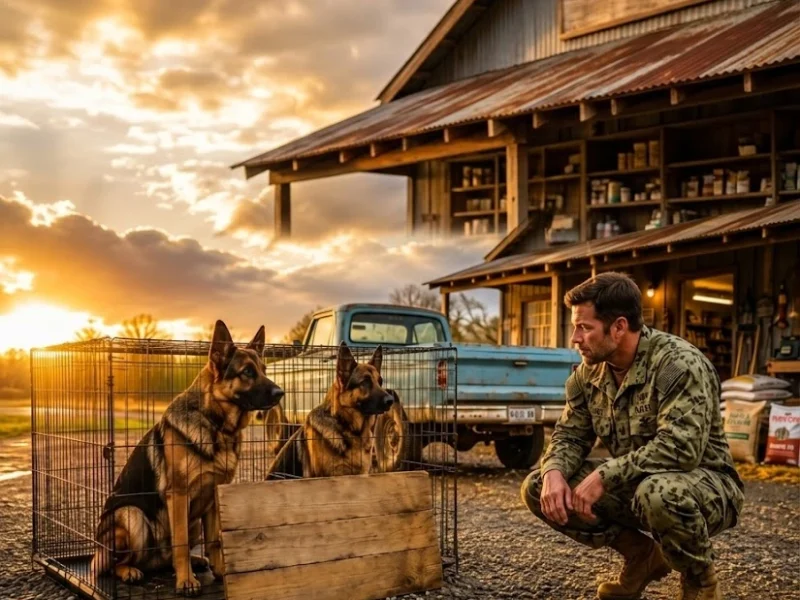
A Navy SEAL picked one German Shepherd for his team — but her brother ran straight into the storm to save his sister’s life.
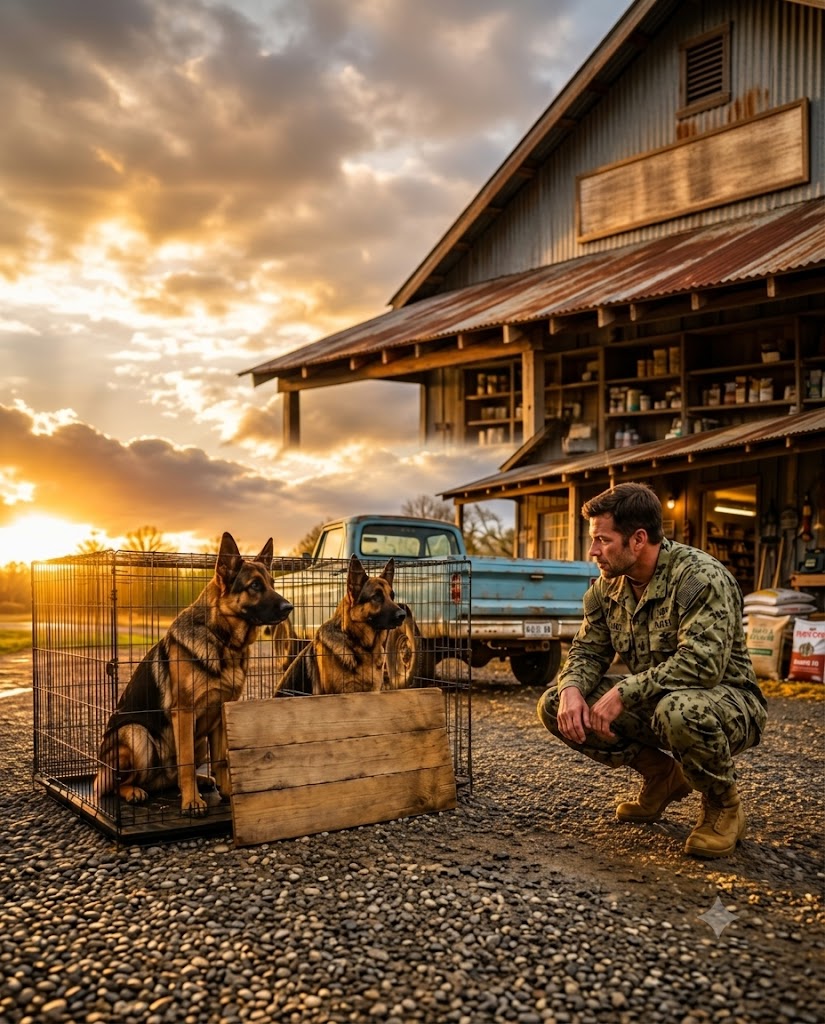
The creek had become a living thing, not water anymore.
Something older and meaner, the color of wet clay, carrying fence posts and uprooted brush like it had debts to collect.
Vince Doran lay wedged against a half-submerged cottonwood trunk.
His right arm hooked over the bark and his left boot pinned beneath a tangle of old wire and broken planking that the current kept pressing harder against him with every passing minute.
Rain fell in sheets.
His chest lamp still worked, but it only showed him more water coming.
Cob stood on the bank above him, four feet of black and gold and trembling muscle, ears flat against his skull.
The 9-month-old German Shepherd had scrambled free when the bridge went, but he stayed low, kept inching forward as if he could close the distance between them by wanting it badly enough.
Vince knew better than to reach back.
The moment he shifted his weight, the wire would shift, too.
He had already tested it once and felt the cottonwood lurch sideways.
Calla was somewhere across what used to be the footbridge.
Thirty feet of washed-out gap and roaring water between her and Vince.
He couldn’t see her from where he lay, but he knew she was there.
She did not run from things she had chosen to stay with.
“Cob,” his voice came out rougher than he meant it to.
The dog dropped even lower, hindquarters shaking.
“Find Amos.”
Cob’s ears came up.
He swung his head toward the tree line, then back to Vince, then toward the trees again, as though triangulating between the two most important things in his world and finding no good answer in either direction.
“Go.”
Vince pointed upstream toward the trail that ran south through the timber to Amos Kettridge’s farm.
“Find Amos.”
Cob made a sound, high and torn in the way that has no translation in human language and needs none, and then turned and disappeared into the dark wall of pines.
The rain swallowed the sound of his paws within seconds.
There was nothing left but the creek and the cold and the weight of the wire across Vince’s leg and the question that neither of them could answer.
Whether a 9-month-old dog who had run that trail only three times, always in daylight, always with Vince walking ahead of him, could find his way through a mile of storm-soaked forest in the dark before the creek ran out of patience.
—
Three weeks earlier, Vince Doran was lying awake in his fourth motel room in five months when Barbara Lund, the estate attorney handling his late uncle’s affairs, called to tell him the property outside Darby had finally cleared probate.
He had been awake since 2:00 in the morning.
He had not told her that.
Barbara was precise in the way of people who have delivered both good news and difficult news enough times to no longer feel the difference in their own chests.
She recited the particulars without embellishment.
Fourteen acres along the East Fork of the Bitterroot Valley.
A house that would need attention, a barn in somewhat better condition, and a dirt road the county had last maintained during the previous administration.
The land was his.
What he did with it was his business.
Vince thanked her and set the phone on the nightstand and looked at the ceiling for a while.
He was 53 years old, broad through the shoulders, lean through the middle, with close-cropped dark hair gone silver at both temples, and a face that people described as serious even when he wasn’t trying to be.
Twenty-two years in the Navy SEALs had left him with perfect posture, the reflex to locate every exit in every room he entered, and an understanding of exactly how much can go wrong in the space of a single second.
The years since had given him something he hadn’t wanted.
The specific exhaustion that comes from surviving something that shouldn’t have survived without you.
His military working dog’s name had been Ranger.
A Belgian Malinois with a thin scar along his left shoulder from a training accident and eyes the color of old amber that turned almost orange in direct sun.
They had deployed together twice.
In northern Syria during what was logged as a routine reconnaissance operation, Ranger had detected a pressure plate in the road that Vince had not seen.
What the dog did next wasn’t trained behavior.
It was something that exists before training, beneath it, older than any command Vince had ever given him.
Ranger moved in front of Vince.
The explosion was small as these things go.
The aftermath was not.
Vince had held Ranger for 40 minutes in the dirt while the team secured the perimeter.
He hadn’t cried.
He hadn’t spoken.
He had pressed one hand against the dog’s ribs and felt the breathing slow and slow and finally stop.
And afterward he had carried Ranger himself to the extraction point because he had not been able to make himself let anyone else do it.
He left the Navy 14 months later.
Since then he had worked maritime security in Louisiana, hauled freight across the Southwest, repaired marine engines at a boat yard in Pensacola.
He lived in furnished rooms and paid deposits on apartments he never unpacked.
He told himself he preferred the freedom of it.
He had begun to suspect somewhere around month 18 that freedom and the inability to stay were not the same thing and that he had been confusing them on purpose.
The drive to Darby took two days.
He stopped for fuel and coffee at a farm supply store somewhere in western Montana beside a gravel lot stacked with fence rolls and mineral supplement bags, and things he was going to need eventually.
He was stretching beside the truck when he noticed the crates beneath the metal awning at the far end of the building.
A piece of cardboard read in marker, “Working Shepherds, Good Homes Only.”
There were two of them, a female in the first crate, and a male in the second.
Both 9 months old, both German Shepherds with that particular alertness behind the eyes that working lines carry regardless of whether they have ever been given any real work to do.
The female watched Vince from inside her crate without moving toward him.
She was sable coated, dark saddled, with amber eyes that tracked every hand crossing the lot.
One ear stood straight, the other bent slightly at the tip, like punctuation on a sentence she hadn’t finished.
She studied him with the unhurried patience of an animal that had already determined there was a difference between people worth trusting, and people who would be gone by noon.
The male paced twice, sat, stood again, and shoved his nose between the bars as if the crate door were a personal inconvenience that someone had simply forgotten to address.
“You looking?”
The woman who came around the side of the building was in her early 70s, white-haired and deliberate in her movements, with hands that told 40 years of outdoor work better than any resume.
Muriel Stanton had raised working dogs on a farm 20 miles north.
Arthritis in both wrists had made the decision for her over this past winter, the kind of decision the body makes when a person has been arguing against it for too long.
The sheep had gone to another farm already.
These two were the last.
She did not try to sell them to Vince.
She looked at him the way she might examine a fence post, gauging whether it was set deep enough to hold.
“What’s her temperament?” he asked, nodding toward the female.
“She watches before she decides. Once she decides, that’s it.”
Muriel paused.
“Her name is Calla. She’s had it since she was 3 weeks old. I’d keep it if I were you.”
“And the male?”
“His name is Cobb. He decides before he thinks and thinks about it afterward.”
No criticism in her voice, just the plain fact of it.
“They’re littermates, born 8 minutes apart. Neither one has slept without the other since the night they came into the world.”
Vince looked at Cobb, who had located a dry leaf inside the crate and was transporting it from one corner to the other with the focused energy of someone completing an important assignment.
“I’m looking for one dog,” Vince said.
“I’ve got a property to rebuild. One dog makes more sense financially.”
Muriel nodded as though this were a reasonable thing to say and opened Calla’s crate.
Calla descended the ramp slowly.
She smelled the back of Vince’s hand, stepped back, and looked at him for a long moment.
Then she sat.
He accepted the leash.
One dog was manageable.
One food bill, one set of vet appointments, one living thing whose eventual absence might hurt.
He had become practiced at calculating such possibilities before they had a chance to surprise him.
He had already turned toward the truck when Cobb pressed both front paws under the door of his crate, claws scraping against the gravel, and made a sound that stopped Vince’s feet before his mind caught up to why.
Not a bark, not a whine, something in between that had no equivalent in human language.
Calla stopped walking.
Vince stood in the gray morning light and did not move.
A road in northern Syria came back to him, not the last moment on it, but the stretch just before it.
The sound of Ranger’s footsteps beside his, the way the dog had pressed against his left leg as they moved, as if trying to become part of the same body.
He thought about the empty space that had been there afterward during the extraction.
And the way he had stared at it while telling himself that following orders and abandoning someone were not the same thing.
He had spent years believing that.
He turned around.
“How much for both?”
Muriel studied him for a breath longer than necessary.
Then she named a fair price.
When they loaded the crates into the truck bed, Muriel paused at Calla’s door before latching it.
She placed one arthritic hand between the dog’s ears and kept it.
She did not speak.
Some goodbyes are not for the ears, and she had said this one already in ways Vince was not meant to see.
As he pulled out of the lot, he checked the rearview mirror.
Muriel was still standing where he’d left her, watching the road until the truck curved out of sight.
—
The property outside Darby had not been occupied in nine years.
The house leaned slightly to the north, not dangerously, but enough to notice.
And the porch railing had separated from its post on the west side.
The barn was in better condition than the house, which Vince took as a statement about his uncle’s priorities.
That he found himself respecting.
The pasture ran east until it reached Slate Creek, a narrow clear running stream that in ordinary weather moved quietly enough to hear only if you stood at the edge and listened for it.
It had been raining for two days before he arrived.
The creek was already higher than it should have been for October.
He spent the first evening making the house safe enough to sleep in and building a temporary enclosure from materials in the barn.
Calla inspected everything slowly, thoroughly, committing each new space to memory before moving to the next.
Cobb inspected everything at speed, discovered an old rubber boot beneath the porch steps, and apparently made a permanent ownership claim on it before Vince had finished unloading the truck.
The neighbor appeared the next morning.
Amos Kettridge was 66, shorter than Vince, but heavy through the chest and shoulders, with a broad weathered face and pale gray eyes that moved at the unhurried pace of a man who had stopped rushing toward things a long time ago.
He farmed the land to the south and had known Vince’s uncle for 30 years.
He arrived with a steel thermos and what he described as lumber that was simply taking up space in his shed.
Vince understood the offer for what it was.
He accepted it without making a ceremony of it.
They worked easily together.
Amos did not ask questions that required Vince to explain himself, and Vince did not offer information that hadn’t been requested.
It was the most comfortable arrangement Vince had found with another human being in close to two years.
Cobb decided Amos was trustworthy on the second day after discovering that the older man carried dog biscuits in his jacket pocket.
Calla took four days before she crossed within arms’ reach of him without first verifying where Vince was standing.
On the fifth day, Vince found her limping near the barn with a hawthorn thorn embedded deep in the pad of her right rear foot.
He crouched in the mud and kept his hands visible and placed one palm flat on the ground between them.
Calla looked at his hand, then at his face.
She had already learned what it meant when he moved slowly, that he was not going to rush anything, not going to force anything, not going to take the decision out of her hands.
She stood still while he worked, and she trembled slightly when the tweezers went in, but she did not pull away.
When it was over and the paw was loosely wrapped, she lowered herself and rested the side of her head against his knee.
She stayed there for a long time.
Vince kept one hand along her shoulder and felt something ease in the center of his chest that he had not realized was still braced for impact.
Cobb’s training went differently, as everything about Cobb went differently.
His energy was not a problem.
It was the wrong instrument being pointed at the wrong task.
Vince began working with him on the find command, using Amos as the target.
He would hold Cobb by the collar while Amos moved to a different part of the property, then release the dog to locate him.
The first attempt ended with Cobb running past Amos entirely, circling the barn twice, and returning with the expression of a dog who had exceeded all reasonable expectations.
“He found the general idea of it,” Amos observed.
“He found a squirrel trail.”
“Progress is progress.”
By the third session, Cobb was working with his nose instead of his assumptions.
He lost the scent once near the drainage ditch at the east fence, circled back, relocated it, and arrived at Amos’s position with his whole body vibrating at a frequency that suggested the stakes had been mortal, and he had handled them.
Amos gave him a biscuit from the jacket pocket and scratched behind both ears.
“Some days that game might mean something real,” Amos said, watching Cobb spin once in a tight circle out of sheer happiness.
“Let’s hope not,” Vince said.
“That’s not how hope works.”
Amos picked up his hammer and went back to the fence.
“You don’t get to decide when it’s needed.”
—
The weeks passed and settled into a shape Vince hadn’t planned for.
Morning feeding, fence work, repairs, evenings by the stove.
Calla began sleeping at the foot of his cot when nightmares came, and they still came, and probably would for a long time.
She was already beside the mattress before he was fully awake, her chin resting on the edge, her eyes on his face.
He would put his hand between her ears and breathe until the room came back around him.
Cobb slept under the kitchen table surrounded by items he had apparently classified as important.
One work glove, a length of baling twine, a coffee can lid, and the rubber boot from the first night that Vince had given up trying to recover.
One evening in early October, Vince called a man named Broderick, his handler from the last deployment, the one who had been there when Ranger died.
They hadn’t spoken in almost a year.
The call was brief and mostly unremarkable.
Two men finding their way back to ordinary conversation after a long gap.
Before hanging up, Broderick said, “You sound different.”
“How so?”
A pause on the line.
“Like you’re somewhere.”
Vince didn’t answer that directly.
But he sat with it after the call in the particular way that true things stay with you.
Not comfortable, not uncomfortable, but present.
The rain that began in the third week of October came in three days before it considered a fourth.
The kind of rain that starts as weather and becomes something else.
Slate Creek, which Vince had crossed a dozen times in the preceding weeks, began to show its other character, darker, faster, carrying debris from somewhere upstream.
On the morning of the fourth day, he crossed the old wooden footbridge to check the north fence line.
He brought Cobb.
Calla stayed on the near side of the bridge, watching from the bank with her body straight and her ears turned toward him even after he had disappeared into the trees.
The fence was fine, the rain was not.
By the time he turned back toward the footbridge, the creek had risen 10 inches and the current was carrying branches the weight of a man’s arm, turning them sideways in the water.
Vince moved faster.
He was two-thirds of the way across when the bridge made a sound like a rifle shot.
The left support went first.
The decking tilted and he grabbed the railing with both hands and held it for half a second before the whole structure rolled, and the current caught him like something that had been waiting for exactly this.
He went under.
When he came up, he was 20 yards downstream, and a cottonwood trunk lay across the creek directly ahead.
He caught it, pulled his chest over the bark, got his face out of the water.
His left boot had snagged on something below the surface, old fence wire from the collapsed bank wrapped around his ankle in a way that pulled tighter every time the current pushed debris against it.
He tried to rotate once to free it.
The cottonwood shifted.
He stopped.
Cobb had scrambled free of the bridge before it went completely.
He stood on the near bank above Vince, pacing in tight half circles.
His whole body tight with a feeling that had no outlet.
Somewhere on the far side of 30 feet of moving water and destroyed bridge, Calla was calling, short, sharp, controlled, the sound of an animal who had made a decision about staying and was announcing it to the storm.
Vince reached for his phone, soaked through and dead.
He had the small emergency light clipped to his jacket.
He switched it to flash and held it toward the sky on the chance it could reach anyone.
Then he looked at Cobb.
The dog stopped pacing.
His eyes moved between Vince and the dark trees to the south and back again, running the calculation that had no good answer.
“Cobb.”
He kept his voice level.
He had learned under circumstances that the voice you use in an emergency is the one that gets remembered.
“Find Amos.”
Cobb stared at him.
“Find Amos.”
He lifted his free arm and pointed upstream toward the southern trail, toward Amos Kettridge’s farmhouse a mile away through the timber.
Cobb made a sound that Vince would carry with him longer than he expected.
Something with all of the dog’s complicated feelings in it, distilled into a single note.
Then he swung toward the tree line.
Looked back once.
“Go,” Vince said.
Cobb went.
The rain closed over the sound of his paws within seconds.
There was nothing left but the creek and the cold and the weight of the wire across Vince’s ankle and the long open question of whether a 9-month-old dog who had never been asked to do anything this hard could manage it now.
Vince pressed his forehead against the bark of the cottonwood and breathed deliberately.
The cold had moved past discomfort and arrived at the category of problems that compound quickly.
He cataloged what he had.
One working arm, one lamp no one had seen, and two dogs who had been asked to do the only things he needed done.
He thought about Ranger.
Not the last morning, which he had thought about too many times.
The other mornings.
The way Ranger had settled against his left leg during movements, as though trying to share the same footprint with him.
The way the dog had looked at him after hard days, not with relief or gratitude, but with simple recognition.
“We’re here, both of us, still here.”
He had not let himself think about those days in a long time.
He had only let himself think about the last one.
Something bumped against his trapped ankle and the wire loosened for a moment before finding a new grip.
Vince held still and breathed and did not fight the current.
Fighting the current was not a strategy.
It was the feeling that something ought to be happening when the actual work was just staying.
He didn’t know how much time passed.
Long enough for the rain to shift.
Long enough for his grip on the bark to feel less certain than it had.
Then he heard something on the north bank upstream.
Calla appeared at the water’s edge 20 feet above where he lay.
She was soaked through, mud along her chest and one ear plastered flat.
She had found a narrowing in the creek farther north or had simply decided that the current mattered less than the direction she needed to go and crossed it.
She came down the bank with her belly low and her eyes on Vince the entire way.
And she positioned herself on the bank directly across from his face as close as the geometry allowed.
She could not reach him in the water.
She didn’t try.
She simply stayed.
Every time his eyes started to close, and they did more than once, as the cold did the thing cold does, she moved.
One deliberate step forward, a sound from the back of her throat that wasn’t a bark, wasn’t a whine, just I see you.
I’m here.
Don’t go yet.
He didn’t go.
—
Amos Kettridge had been standing at his kitchen window for the better part of an hour watching the water he could see climbing the near bank of the pasture creek when something hit his porch door hard enough to shake the frame.
He opened it.
Cobb fell inside, soaked to the skin, shaking, a broken lead dragging behind him, one front paw bleeding from something he had run across in the dark.
He grabbed the cuff of Amos’s work pants, released it, ran to the door, came back, barked once with everything he had.
Amos had spent enough years around working dogs to understand he was not being asked a question.
He called 911 while pulling on his boots.
He described the creek and the old footbridge and Vince Doran’s property and asked specifically for a water rescue unit.
The dispatcher asked him to stay on the line.
He informed her politely that he would not and hung up.
Cobb led him back through the timber at a pace that pushed the edges of what Amos’s legs could still manage.
At the two trail forks, the dog circled back to confirm Amos was still following before running ahead again.
When a fallen pine blocked the path, Cobb went around the root ball and waited on the far side, watching with his head slightly tilted, until Amos cleared the obstacle.
The county rescue unit met them at the property line.
Their coordinator, Kira Dunmore, was lean and quick-moving and had the contained urgency of someone trained to keep her voice steady, precisely when other people’s voices went up.
She took in the creek and the destroyed bridge and Vince’s flash lamp in one sweep and started directing her team before Amos had finished his sentence.
Cobb went to the bank.
All that running, all that desperate, mile-long sprint through the rain and the dark, and he simply stopped at the edge and looked across.
Calla looked back at him from the far side.
She had not moved from Vince’s position.
The rescue team worked in the clean, efficient way of people who have trained for exactly this.
A line went in.
A technician reached Vince’s trapped ankle and freed the wire without shifting the cottonwood.
They pulled him free of the current in less than six minutes, and Kira kept one hand on his wrist the entire time.
Not to restrain him, just to maintain contact.
When they laid him on the bank, Calla pressed her muzzle against the side of his neck and held it there until the paramedics gently but firmly moved her.
He spent two days in a hospital in Missoula.
The hypothermia resolved.
The bruising along his ribs was significant but not permanent.
A gash on his left forearm took 11 stitches.
He had the bone-deep tiredness that doesn’t come from the body alone.
Amos brought both dogs to his farm and reported only that they were eating and that Cobb had investigated the broom closet with more thoroughness than was strictly warranted.
Vince understood there was more that wasn’t being said.
He did not push.
On the afternoon of the second day, Amos drove him back up the mountain road under a sky that had come out of the storm, pale and washed and very blue.
The specific blue that only shows up over Montana when something difficult has passed.
County workers had already fenced off the creek bank where the bridge had stood.
The orange safety fencing moved slightly in the cold air.
Amos pulled into the gravel yard and put the truck in park.
Cobb came around the side of the barn at a run.
He had apparently been listening for the sound of that particular engine from whatever distance a 9-month-old German Shepherd could manage.
And he had been ready for a long time.
He hit the gravel and slid and caught himself and stopped 18 inches from Vince.
Close enough that Vince felt the heat of him.
Far enough that he had calculated at the last second that the man standing on crutches should probably not be knocked sideways.
He pressed his forehead against Vince’s hand and closed his eyes.
He was still shaking, though from what exactly Vince couldn’t say.
Vince stood in the cold October afternoon with his hand on a trembling dog and understood that this was not a small thing being offered to him.
He had not known until this moment how much he had been refusing to receive.
Calla came around from the other side at her own pace.
She stopped directly in front of Vince and looked up at him with those amber eyes.
Then she stepped between his boots and pressed her forehead against his chest.
The three of them stayed there in the gravel and the pale light for a while.
He had driven to Montana intending to give two dogs a home.
He saw now, with the clarity that sometimes only comes after cold water and the long silence of a hospital room, what had actually happened.
Calla had crossed freezing water in the dark to sit beside him and refused to let him close his eyes.
Cobb had run a mile through a storm on legs that were shaking before he reached the halfway point.
They had done it without being asked twice.
Without negotiating.
Without calculating whether he deserved it.
Ranger had done the same thing in a different country at a different cost.
And Vince had spent two years telling himself he no longer had the right to be on the receiving end of that kind of love.
That surviving it once was already more than was owed to him.
The least he could do was stop putting any living thing in the position of caring whether he was all right.
He had been wrong about that.
He could see it plainly now with Calla’s forehead against his chest and Cobb’s weight against his leg and Amos pretending to inspect the porch railing from a respectful distance.
He had been wrong and the dogs had not let him stay wrong and that was the whole of it.
—
Winter came slowly to the Bitterroot that year.
The creek settled back to its quiet voice.
New steel bridge posts went in before the ground froze and Vince worked through the cold months on the inside of the house the way he had always meant to.
Not just making it functional but making it his.
He hung photographs on the wall above the mantel.
One was of his uncle on this same land younger and caught mid-laugh at something outside the frame.
The other was of Ranger taken on a base in Germany the year before their last deployment sitting straight with that look he always had.
Complete attention.
Every sense open.
Ready for whatever the next moment required.
Vince had carried that photograph in a duffel bag for four years.
He put it on the wall.
Cobb stole one of Amos’s work socks in November and showed no signs of remorse by December.
Calla walked the fence perimeter each morning before settling on the porch for exactly as long as the sun held the boards warm.
When nightmares came and they still did and would for a long time yet, Calla was already at the bedside before Vince was fully awake, her chin on the mattress edge, her eyes steady.
He would put his hand between her ears and breathe, and the room would come back to him, and eventually morning would follow.
Muriel Stanton called in early December, claiming she was simply being thorough about follow-up.
Vince told her about the flood.
She was quiet for a long moment.
“That’s who Calla is,” she said finally.
“From the day she was born, she decides, and then that’s it.”
“What about Cobb?”
Something in her voice shifted slightly.
“Cobb is a force of nature wearing a dog. I always hoped he’d find someone who could keep up.”
Vince looked across the kitchen at Cobb, who was attempting to fit a feed bucket over his own head for reasons that made complete sense to him and no one else.
“He may have found someone willing to try,” Vince said.
He called Amos on Christmas Eve because it seemed like the thing to do, and he was finding slowly that his instincts about such things were coming back.
They talked for a while about the spring fence project and the east wall of the barn, and whether the county road would hold through February.
Near the end of it, Amos said, in the low, matter-of-fact register he used for anything that actually mattered to him, “You were in rough shape when you got here.”
“I know.”
“You’re not anymore.”
Vince didn’t argue with that.
He stood on the porch after hanging up, in the cold and the dark and the particular silence of a Montana Christmas Eve, with Calla pressed against his left leg and Cobb leaning into his right, and the stars overhead were the kind that only come out when the sky is genuinely clear.
He had lived for a long time in a silence he had told himself was peace.
He understood now that peace had a different weight to it, warmer, louder in small ways, complicated by the presence of lives that needed his steadiness, and in return gave him back his own.
Two dogs had run through a storm for him.
One had crossed dark water to sit beside him in the cold, and in whatever way grace works, when it doesn’t arrive with thunder or announcement, when it comes instead on muddy paws, through a wet door, in the middle of the night, they had brought him back to himself.
He was not gone, he was here.
Cobb nudged his hand once decisively and went back inside to deal with the feed bucket situation.
Calla stayed beside him in the cold until he was ready to go in.
And then she followed him through the door and across the threshold of a house that had finally, without any ceremony and without his permission, become a home.
—
Sometimes the life you were trying to give away is the one that gets returned to you.
Sometimes you drive out to a piece of inherited land to disappear quietly, and two dogs with no interest in your plans sit down in front of you and refuse to let you.
Not because they owe you anything, because they have already decided, and for them, that is enough.
If this story found you today, please share it with someone who needs to know they are not as forgotten as they feel.
Leave a comment telling us where you’re watching from, and about a person or animal who stayed beside you when you needed it most.
Subscribe to Paws of Courage for more stories of faith, loyalty, and the love that keeps looking for us, even when we have stopped looking back.









