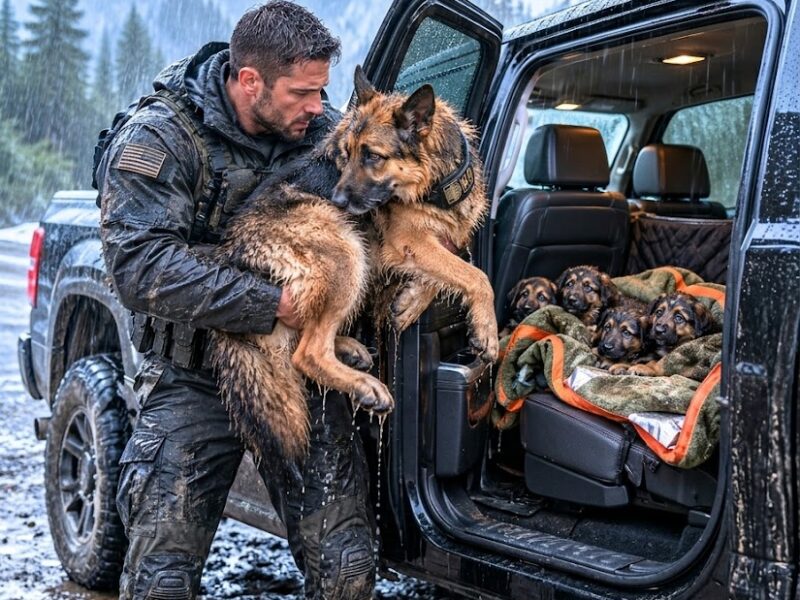
A Navy SEAL Opened His Truck Door for a Soaking-Wet Dog Family in the Rain—But When He Saw What the Mother Dog Was Protecting, His Heart Broke
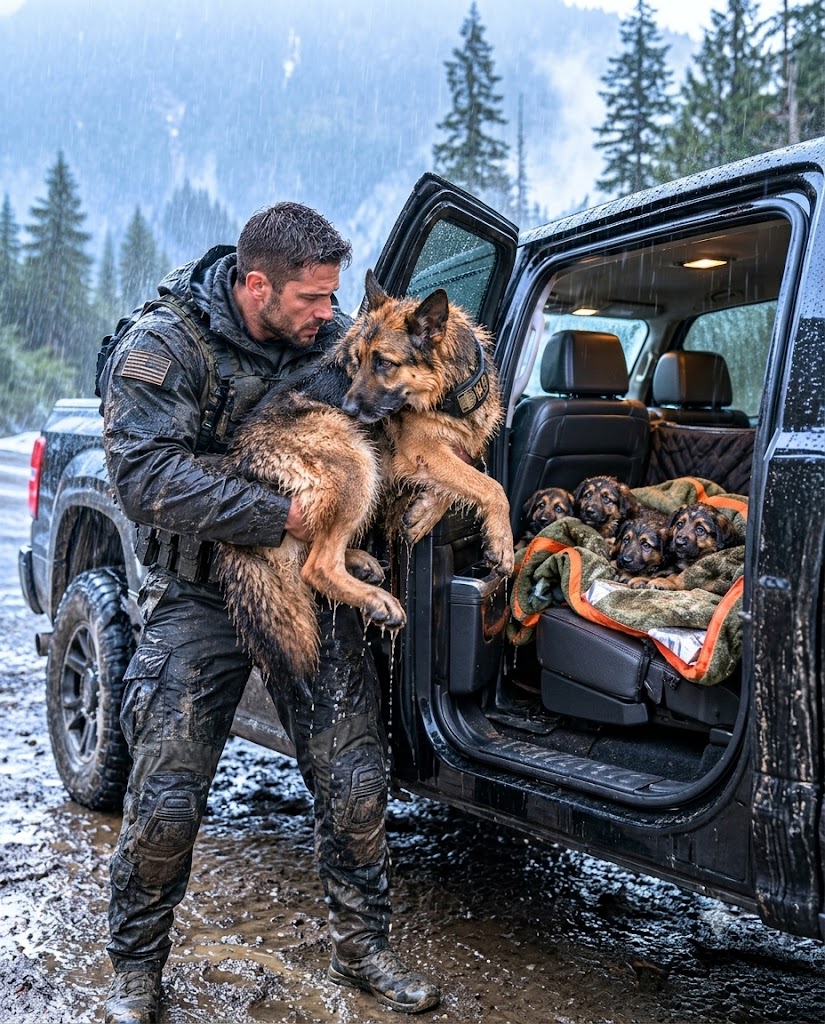
**Part 1**
Rain hammered the windshield of the Ford F-150 like handfuls of shattered glass, turning the dark, winding mountain road into a blurred ribbon of black ice and panic. Navy SEAL Danilo Reynolds pulled onto the gravel shoulder, certain he’d blown a tire. Instead, two glowing amber eyes stared up at him from a flooded ditch, desperate and drowning. What he found shivering in the freezing mud would rewrite both of their lives forever.
Torrential downpours in the Pacific Northwest don’t simply fall. They attack the earth with a violence that feels personal. Driving through the dense, unforgiving forests of Snoqualmie Pass, thirty-two-year-old Danilo Reynolds gripped the leather steering wheel of his truck until his knuckles went white. A decorated chief petty officer who had spent the last decade deploying to the most hostile corners of the globe, Danilo was no stranger to unforgiving environments. Yet this Washington State atmospheric river felt personally vindictive, as if the sky itself had a grudge.
Flash flood warnings had been blaring over his radio for the last hour, reducing visibility to less than ten feet. Mud and debris washed across the asphalt in thick, dark ribbons. He was supposed to be heading to a secluded cabin in Cle Elum, seeking a quiet weekend to decompress. Transitioning to civilian life after a medically forced leave—the result of a shattered femur and shrapnel scars from a raid in Kunar Province—was proving to be an isolating battle. The silence of civilian life was often louder than a war zone. Tonight, however, the storm was providing all the noise he could handle.
A sudden, violently loud thud echoed from the undercarriage of his truck. The heavy F-150 swerved slightly on the slick pavement. Danilo cursed under his breath, pumping the brakes with the precision of a man trained not to panic under pressure. He guided the heavy vehicle onto the narrow gravel shoulder, the hazard lights cutting through the sheets of rain like a strobe light in a nightmare. Grabbing a heavy Maglite and zipping up his waterproof Arc’teryx jacket, Danilo stepped out into the deluge. The cold was immediate and biting, typical for late November in the Cascades.
He crouched down, shining the harsh white beam beneath the truck. A massive, jagged tree branch had kicked up and wedged itself near the front axle. It wasn’t catastrophic, but it required leverage to remove. As he reached in to dislodge the wood, a sound caught his attention. It was faint, completely buried beneath the roar of the wind and the rushing water of the nearby ditch. But Danilo’s hearing was attuned to picking out anomalies in chaotic environments. He paused, freezing his movements. He turned his head, letting the rain batter his hood. There it was again. A high-pitched, warbling whimper.
Danilo abandoned the branch. He stood up, sweeping the flashlight beam across the flooded drainage ditch bordering the dense tree line. The water was rushing violently, rising rapidly against the steep, muddy banks. For a moment, he saw nothing but thrashing blackberry bushes and swirling brown water. Then the beam caught a reflection. Two amber eyes, reflecting the halogen light, stared back at him from the mouth of a concrete culvert pipe that was rapidly filling with runoff.
Danilo didn’t hesitate. He slid down the muddy embankment, his boots sinking ankle-deep into the freezing sludge. As he approached the culvert, the beam of his flashlight revealed a heartbreaking tableau. Huddled at the very edge of the pipe, half submerged in the freezing water, was a massive German Shepherd. Her coat, which should have been thick and majestic, was matted with mud, burrs, and what looked like dark, dried blood. She was shivering violently, her entire body vibrating with the effort to stay alive. But it wasn’t just her life she was fighting for. Tucked entirely beneath her chest, shielded from the biting rain and the rising floodwaters by the cage of her body, was a writhing mass of fur. Puppies. Four of them. No more than a few weeks old.
The mother had positioned herself as a living dam, taking the brunt of the freezing water to keep the current from washing her litter into the drain. Danilo felt a sudden tightness in his chest, a profound punch of empathy that bypassed all his stoic conditioning. “Hey,” Danilo said, his voice a low, calm rumble meant to project safety. “Easy, girl. I’m not going to hurt you.” Dogs in extreme distress were unpredictable. A protective mother in a corner was deadly. Danilo knew this. He dropped to one knee in the freezing mud, ignoring the water seeping through his tactical pants. He kept his flashlight angled slightly away to avoid blinding her, offering the back of his hand.
The German Shepherd bared her teeth, a low, guttural growl vibrating in her chest. It was a warning, but Danilo noticed something specific in her posture. She didn’t lunge. She didn’t snap. She held her ground with a disciplined, calculated restraint. Her ears were pinned back, but her eyes tracked his hands with terrifying intelligence. “I know,” Danilo whispered, inching closer. “You’re holding the line, but the water is rising, sweetheart. You’re going to drown if you stay here.” He reached out further. The dog snapped, her teeth clicking just an inch from his fingers. Danilo didn’t flinch. He didn’t pull back. He simply held his hand steady.
“Stand down,” Danilo commanded, shifting his tone from comforting to authoritative, using the exact cadence he’d used with the military working dogs he’d operated with overseas. The reaction was instantaneous. The shepherd’s jaw snapped shut. Her amber eyes widened in confusion, then recognition. The growl ceased. She looked at his hand, then up at his face, and let out a long, broken whine. She was surrendering to the authority she had been conditioned to recognize. That was when Danilo saw the collar. It wasn’t a standard pet-store nylon strap. It was a two-inch-wide, heavy-duty tactical collar with a heavy Cobra buckle, the kind used by special forces and elite police units. It was frayed and caked in mud, but the unmistakable silhouette of a subdued Velcro patch remained. This wasn’t a stray. This was a professional.
“All right, Mama,” Danilo said, moving in. “Let’s get you out of the cold.” He reached for the first puppy. The mother tensed, but allowed it. Danilo grabbed the tiny, shivering pup, tucking it inside his jacket against his warm chest. He repeated the process three more times, his jacket bulging with four freezing, squeaking bodies. Now came the hard part—the mother. She tried to stand, but her hind legs collapsed under her. She was completely spent, her muscles locked from severe hypothermia. “I got you.” Danilo grunted, wrapping his thick, muscular arms around the seventy-pound dog. He hoisted her up, feeling her rib cage pressing sharply against her skin. She was severely malnourished.
As he carried her up the slick embankment, her heavy head rested exhausted against his shoulder. He kicked his truck door open, cranking the heater to the absolute maximum. He placed the mother gently onto the back seat, pulling a heavy wool survival blanket from his emergency kit and draping it over her. He carefully extracted the puppies from his jacket, laying them against their mother’s stomach. She weakly licked the closest one, her eyes fluttering shut. Danilo climbed into the driver’s seat, soaked to the bone and freezing, but his heart was hammering with a renewed sense of purpose. He slammed the gearshift into drive. The cabin trip was canceled. He needed a vet right now.
The drive out of the mountains was a white-knuckle descent into chaos. The storm was worsening, turning the winding roads of Interstate 90 into a treacherous slip-and-slide. Inside the cabin, the heater roared, turning the air thick and stifling, but Danilo didn’t dare turn it down. Every time he glanced in the rearview mirror, his stomach dropped. The mother dog had stopped shivering. That was the most dangerous stage of hypothermia. Her body was giving up the fight to generate heat. “Stay with me,” Danilo yelled over the howling defroster, pushing the Ford to seventy miles an hour despite the hydroplaning risks. “Don’t you quit on me now. You did your job. You kept them safe. Now hold on.”
He bypassed Cle Elum entirely, heading straight toward Issaquah, knowing there was a twenty-four-hour emergency veterinary hospital there. His mind raced, calculating her symptoms: lethargy, muscle rigidity, extreme emaciation. But there was something else. When he had lifted her, he felt a strange, hardened mass near her left shoulder blade, masked by the matted fur. Thirty agonizing minutes later, Danilo’s truck skidded into the brightly lit parking lot of the Cascade Emergency Animal Hospital. He didn’t bother cutting the engine. He threw the door open, grabbed the heavy wool blanket with the mother dog wrapped inside, and sprinted toward the glass double doors.
“I need help!” Danilo bellowed as he kicked the door open. The waiting room was empty save for a young veterinary technician, Liam, who jumped up behind the reception desk. “What do you have?” Liam asked, rushing around the counter with a gurney. “Severe hypothermia, malnutrition, potential blunt-force trauma or laceration to the left shoulder,” Danilo rattled off, his military background taking over as he gently transferred the massive dog onto the stainless steel cart. “She has four pups in my truck. They’re cold but responsive. I need someone to get them while we stabilize her.” Dr. Shelly Morales, the lead emergency veterinarian, burst through the swinging doors from the back. She took one look at the muddy, lifeless dog and went to work. “Liam, grab the pups.”
“Sir, I need you to step back,” Dr. Morales said firmly. “I’m a trained combat medic,” Danilo stated, his eyes locked on the dog. “I’m not leaving her. Tell me what you need.” Dr. Morales paused, assessing Danilo’s intense, commanding presence, his soaked clothes, and his unflinching gaze. She nodded. “Grab those thermal heat packs from the incubator. We need to raise her core temp slowly or she’ll go into cardiac arrest. Start an IV on her right foreleg. I’m going to assess her breathing.”
For the next twenty minutes, the trauma room was a blur of calculated chaos. Danilo worked seamlessly alongside Dr. Morales, finding a viable vein in the dog’s severely dehydrated leg and securing the IV line with steady hands. As the warm saline began to flow into her system, Dr. Morales carefully shaved away the matted, mud-caked fur around the mother dog’s neck and shoulder to assess the lump Danilo had felt. What she revealed made the room fall dead silent. It wasn’t just a lump—it was a jagged, horrific scar that traced a path of destruction across her scapula, surrounded by necrotic tissue and extreme infection. “Good lord,” Dr. Morales whispered, shining an examination light on the wound. “This isn’t from a car. This is a gunshot wound. A through-and-through that barely missed her artery. It’s old, maybe months old. The infection is running rampant.”
Danilo felt a cold fury settle in his chest. He looked at the heavy tactical collar they had unbuckled and placed on the metal tray. He reached over, wiping away the thick layer of dried mud with his thumb. Underneath, a heavily scratched titanium tag caught the fluorescent light. Danilo read the engraving out loud, his voice dropping an octave. “K9 Freya. Badge 4092. King County Sheriff’s Office. EOD. SAR.” “She’s a cop,” Liam gasped from the corner where he was rubbing the puppies vigorously with warm towels. “Not just police,” Danilo said, his jaw tightening. “EOD and SAR. Explosive Ordnance Disposal and Search and Rescue. This dog is a specialized hero.”
Dr. Morales grabbed a handheld microchip scanner from the counter. She ran it over Freya’s shoulder. A loud beep confirmed the tag’s information, flashing a long registration number on the screen. “I’m calling the authorities,” Liam said, reaching for the phone on the wall. “Wait,” Danilo said sharply. He pulled out his own cell phone, his thumb swiping through his contacts. He knew the King County area well. His former unit often ran joint training exercises with local SWAT and Sheriff departments. He dialed a number he hadn’t used in two years. It rang three times before a gruff voice answered. “Captain Miller.” “Jim, it’s Danilo Reynolds,” Danilo said, his eyes never leaving Freya’s shallowly rising chest.
There was a pause on the line. “Reynolds. It’s been a while, Chief. Thought you retired to the woods. What’s going on?” “I’m at the Cascade Emergency Animal Hospital in Issaquah,” Danilo said. “I just pulled a German Shepherd out of a flash flood on Snoqualmie Pass. She’s in critical condition, shot in the shoulder, has four pups with her.” “Why are you calling me about a stray, Danilo?” “Because she’s not a stray,” Danilo replied, his voice echoing in the sterile room. “Her tag says K9 Freya, badge 4092.”
The silence on the other end of the line was absolute, stretching on for so long Danilo thought the call had dropped. When Captain Miller finally spoke, his voice was entirely stripped of its previous casual tone. It sounded hollow, laced with disbelief. “Danilo, that’s impossible.” “I’m looking right at her, Jim.” “Freya was lost in action eight months ago during a cartel drug bust in the Cascades,” Miller whispered heavily. “Her handler, Deputy Chris Vance, was ambushed. Freya took a bullet meant for him and disappeared into the river during the firefight. We searched for a month. We declared her dead in the line of duty. Danilo, her handler took his own life three months ago because he couldn’t live with the guilt.”
Danilo felt the blood drain from his face. He looked down at the scarred, emaciated mother dog breathing weakly on the stainless steel table. She hadn’t just survived a gunshot and a freezing river. She had survived eight months in the brutal wilderness—hunted, injured, and pregnant—fighting to keep her bloodline alive. “She’s not dead, Jim,” Danilo said softly. “But if you don’t get a police escort down here with the best veterinary surgeon in the state, she will be by morning.”
Red and blue strobe lights shattered the stormy darkness outside the Cascade Emergency Animal Hospital, painting the rain-slicked windows in frantic neon colors. Within twenty minutes of Danilo’s call, three King County Sheriff’s cruisers had hydroplaned into the parking lot, followed closely by a black tactical SUV. Captain Jim Miller, a burly man whose face bore the deep, weathered lines of a career spent witnessing tragedy, burst through the double doors. Behind him was Dr. Avery, the top veterinary trauma surgeon in the Pacific Northwest, rushed out of his bed and escorted at high speed to the clinic. The waiting room, usually reserved for swallowed toys and upset stomachs, had been transformed into a makeshift command center.
Danilo sat on a cold plastic chair, his soaked tactical jacket hanging heavy on his shoulders. In his lap rested a heated incubator basket containing four sleeping, squirming German Shepherd puppies. He looked up as Miller approached. The two men didn’t exchange pleasantries. The gravity of the situation hung in the sterile air like thick smoke. Dr. Avery didn’t pause to introduce himself. He immediately pushed through the swinging doors into the trauma bay where Dr. Morales was fighting to keep Freya’s heart beating. “Is it really her?” Miller asked, his voice cracking as he stared at the mud-stained tactical collar resting in an evidence bag on the reception desk.
“It’s her, Jim,” Danilo replied quietly, gently stroking the tiny head of a sleeping pup with his calloused thumb. “She’s skin and bones. Taking that bullet was just the beginning of whatever hell she’s been through for the last eight months. She was out there, alone, injured, and pregnant, fighting off God knows what to keep these pups alive.” Miller dragged a heavy hand over his face. The weight of his guilt and grief for Freya’s deceased handler visibly crushed him. “When Chris lost her, it broke him. He spent every off-duty hour hiking those ridges. He swore he heard her howling at night. We all told him it was just the wind, that no dog could survive a gunshot and the river rapids. We thought he was losing his mind. If only he had held on a few more months.”
Before Danilo could respond, the sharp, frantic beep of a cardiac monitor echoed from the surgical suite. A nurse sprinted down the hallway shouting for a crash cart. Danilo’s muscles coiled tight, his combat instincts flaring, but he forced himself to stay seated. He knew the chaotic ballet of trying to save a life. Adding a body to the room would only hinder the surgeons.
For two agonizing hours, the storm raged outside while a different kind of storm fought itself out on the operating table. Danilo and Miller sat in silence. Danilo’s mind drifted to his own trauma. The explosion in Kunar Province, the agonizing months of physical therapy, the profound emptiness of surviving when others hadn’t. He looked down at the puppies. They were a testament to defiance. Freya had refused to let the darkness win.
Finally, the swinging doors opened. Dr. Avery stepped out, his surgical scrubs stained crimson, pulling down his mask. He looked exhausted, but his eyes held a profound, disbelieving spark. “She’s stabilized,” Dr. Avery announced, his voice carrying the weight of a miracle. “We removed the necrotic tissue and the bullet fragments, but what we found during the prep—it changes everything you thought you knew about her disappearance.” Miller stood up instantly. “What do you mean?”
Dr. Avery walked over to the stainless steel counter and placed a small metallic object inside a sterile tray. It was a crude, heavy metal capsule about the size of a large multivitamin, sealed with industrial epoxy. “She didn’t just wander the woods for eight months,” Dr. Avery said grimly. “When we shaved her down, we found evidence of recent crude surgical staples on her hind leg. Someone tried to patch her up. And this capsule—she had swallowed it recently. Her digestive tract was entirely blocked given her emaciated state. She hadn’t eaten real food in weeks. She ingested this on purpose to hide it.”
Miller reached for a pair of latex gloves, snapping them onto his hands. He picked up the heavy metal capsule and used a scalpel from the desk to crack the epoxy seal. Inside, perfectly preserved, was a waterproof microSD card. The silence in the room was deafening. “The cartel,” Miller whispered, realization dawning on his face. The ambush eight months ago wasn’t just a shootout. “They took her. They realized she was a highly trained purebred working dog. They patched her up just enough to keep her alive to breed her, hoping to sell her offspring as guard dogs for their compounds.”
Danilo’s jaw clenched so hard his teeth ground together. “She was a prisoner of war, and tonight, during the storm, she saw her chance and broke out to save her pups.” “But the SD card,” Miller said, staring at the tiny chip. “Chris was conducting surveillance on that cartel for weeks before the ambush. He told me he had gathered evidence of their entire distribution network, but his camera was destroyed in the firefight. The evidence vanished. We thought it washed down the river.” Danilo looked at the evidence bag containing the heavy tactical collar. “Chris didn’t lose the evidence. In the middle of the firefight, knowing he was going down, he must have secured it inside that capsule and given it to Freya. He commanded her to run, to hide it. She swallowed it to protect it.” Freya hadn’t just survived. She had completed her final mission.
The morning sun finally broke through the dense gray clouds of Washington State, casting a brilliant golden light over the Cascade Mountains. The storm had passed, leaving the world washed clean. Inside the recovery ward, the steady beep of the heart monitor was a rhythmic, soothing metronome. Danilo stood by the stainless steel recovery cage. Inside, Freya lay on a thick orthopedic bed, an IV line taped to her shaved forearm. She was awake. Her amber eyes, previously clouded with pain and exhaustion, were now sharp and tracking every movement. When a veterinary tech walked into the room to check her vitals, Freya let out a low, menacing growl, baring her teeth. The tech froze, slowly backing away. Despite her horrific injuries, the canine was in full defensive mode. The trauma of her captivity had shattered her trust in strangers.
“Let me,” Danilo said softly. He stepped forward, opening the heavy latch of the cage. Captain Miller, standing by the doorway, tensed. “Danilo, be careful. She’s heavily traumatized. She might not remember you pulled her out of the ditch.” Danilo ignored the warning. He understood the dog perfectly. He knew what it was like to wake up in a strange room, trapped in a broken body, feeling like the entire world was a threat. He slowly sank to his knees, making himself smaller, keeping his hands visible and open. “Stand down, soldier,” Danilo murmured, his voice projecting the same calm, unyielding authority he had used in the culvert.
Freya’s ears twitched. She stopped growling. She looked at Danilo, her intelligent eyes searching his face. She sniffed the air, recognizing the scent of the man who had carried her through the freezing mud—the man who had shielded her puppies. Slowly, agonizingly, she lowered her head. She let out a soft, broken whine and rested her chin on Danilo’s knee. Danilo closed his eyes, exhaling a breath he felt like he had been holding for years. He gently stroked her soft ears. “Mission accomplished, Freya. You can rest now.”
Miller watched the scene with wet eyes. “She needs a home, Danilo. The department will medically retire her with full honors, but she can’t go to a standard shelter. And with her trauma, she’s a liability to anyone who doesn’t understand her training.” Danilo looked down at the four healthy puppies currently wrestling in a heated pen in the corner of the room. He thought about his empty cabin in Cle Elum. He thought about the haunting silence of his civilian life. The lack of purpose that had been slowly consuming him since his medical discharge. “She’s not going to a shelter,” Danilo said, his voice resolute. “I’m taking her and the pups.”
**Part 2**
Over the next year, Danilo’s secluded property transformed. The healing process was not easy. There were nights when Freya would wake up thrashing, triggered by phantom terrors of her captivity. Danilo would sit on the floor with her, holding her close until the panic subsided. Finding that in soothing her trauma, he was quietly healing his own. The microSD card Freya had carried proved to be the silver bullet the DEA needed. It contained GPS coordinates, ledger photographs, and audio recordings that led to the largest cartel bust in Pacific Northwest history—a operation that seized over $4.2 million in assets and shut down a distribution network spanning three states. Chris’s sacrifice was honored with a posthumous medal of valor, and Freya was awarded the canine medal of bravery in a private ceremony on Danilo’s porch.
As for the puppies—three males and one female—they inherited their mother’s fierce intelligence and unyielding spirit. Danilo didn’t sell them. Instead, he found a new mission. Utilizing his military background and his deep bond with Freya, Danilo founded Vanguard K9 Rescue. He dedicated his life to training Freya’s bloodline, and eventually other rescue dogs, to become specialized psychiatric service animals for combat veterans suffering from PTSD. The first graduating class included two of Freya’s sons, both of whom were placed with veterans who had attempted suicide within the previous year. The waitlist for Vanguard K9 dogs grew to over two hundred names. Danilo didn’t charge a dime—the program was funded entirely by grants and the $18,500 he received annually from his military pension, which he redirected straight into the nonprofit.
One crisp autumn afternoon, Danilo stood on the porch of his cabin sipping black coffee. The mountains were ablaze with gold and crimson leaves. Down in the sprawling fenced-in yard, Freya—now at a healthy weight, her coat thick and gleaming—was basking in the sunlight. Beside her, one of her fully grown sons, wearing a red service dog vest, was practicing retrieval drills with a visiting veteran. Danilo smiled. A genuine expression of peace that had long been absent from his face. The storm on Snoqualmie Pass had taken a heavy toll, but it had also washed away the debris of two broken lives, revealing a foundation strong enough to build something beautiful. Freya had saved her puppies from the flood, but in the end, she had rescued Danilo, too.
The knock came on a Tuesday morning, three weeks after the one-year anniversary of the rescue. Danilo was in the training yard with Freya and two of her pups when a black SUV with tinted windows rolled up the gravel drive. He recognized the silhouette of Captain Miller through the windshield. Beside him sat a woman Danilo didn’t recognize—mid-forties, sharp suit, the kind of posture that screamed federal. Freya’s ears perked up, but she didn’t growl. She had learned, over months of patient work, to associate the Captain’s scent with safety.
“Danilo,” Miller called out as he stepped from the vehicle. “Got someone who’s been trying to track you down for a while. This is Assistant U.S. Attorney Elena Vasquez. She’s been handling the cartel prosecution.” Vasquez extended a hand, her grip firm and professional. “Mr. Reynolds, I’ve read your file. Navy SEAL, decorated, medically retired. And apparently, you’ve been running a nonprofit that’s placed twenty-three service dogs with veterans in the last twelve months. Impressive.” “Just doing what needs doing,” Danilo said, keeping his tone neutral. He had learned to be wary of people in suits.
“I’m here because the cartel trial starts in six weeks,” Vasquez said. “The evidence on that SD card is the backbone of our case. But the defense is arguing that the chain of custody is compromised—that a dog can’t be a reliable courier, that the evidence could have been planted, that Deputy Vance’s command to Freya can’t be verified. They’re trying to get the entire cache thrown out.” Danilo felt the familiar heat of anger rise in his chest. “That’s insane. Freya nearly died protecting that card. She spent eight months as a prisoner, and they want to question whether she was a reliable courier?”
“The defense is arguing that no one can prove Vance actually gave Freya the capsule,” Vasquez continued. “They’re suggesting it was planted by someone else, perhaps a rival cartel faction, to frame their clients. We need a witness who can testify to Freya’s training, her capabilities, and the bond between her and her handler. Someone the jury will believe.” “You want me to testify,” Danilo said flatly. “I want you to explain to a jury what a K9 EOD/SAR dog is capable of,” Vasquez said. “And I want you to tell them about the tactical collar, the command voice, the discipline Freya showed even in extreme distress. You’re a former SEAL who worked with military working dogs. Your testimony carries weight.”
Danilo looked down at Freya, who was watching the conversation with alert amber eyes. She had come so far. The scars on her shoulder had healed into pale lines, but the memories behind them hadn’t faded. Neither had Danilo’s. “What happens if the evidence gets thrown out?” he asked. “The cartel walks,” Vasquez said simply. “All of them. The shooters, the distributors, the men who tortured Freya and killed Deputy Vance’s team. They go free. And they’ll be back on the street within a month.” Danilo was silent for a long moment. Then he nodded. “I’ll testify.”
The courtroom in downtown Seattle was a monument to order and procedure—marble floors, high ceilings, and a gallery packed with reporters, law enforcement, and the families of the victims. Danilo wore his dress blues for the first time in three years. The ribbons on his chest felt foreign, but they served their purpose. The jury—seven women, five men—stared at him with a mixture of curiosity and respect as he took the stand. Across the room, the defendants—six men in orange jumpsuits—watched him with cold, calculating eyes. One of them, a man with a teardrop tattoo beneath his left eye, smiled. Danilo didn’t blink.
“Mr. Reynolds,” Vasquez began, “can you explain to the jury what an EOD/SAR K9 is trained to do?” Danilo leaned forward, his voice steady and clear. “An EOD dog is trained to detect explosives. A SAR dog is trained to find missing persons. A K9 like Freya is cross-trained for both. She can locate a bomb in a crowded building or a lost child in a forest. She can track a scent that’s three days old across ten miles of wilderness. She can follow commands under gunfire. She’s not just a pet. She’s an operator.” “And how was she trained to handle evidence?” Vasquez asked. “Through repetition and reward,” Danilo said. “A K9 is trained to retrieve an object, hold it, and return it to the handler. If the object is too large to carry, they’re trained to guard it. If the object is small and valuable, they’re trained to swallow it and hold it until commanded to release. It’s called a protective retrieval protocol. It’s rare, but it’s documented in military and law enforcement K9 manuals.”
The defense attorney, a slick-haired man named Gerald Foster, rose for cross-examination. He approached the stand with the easy confidence of a man who had dismantled a hundred witnesses. “Mr. Reynolds, you’re not a certified K9 trainer, are you?” “No, sir. I’m a former SEAL who worked alongside military working dogs.” “And you never met Deputy Vance, did you?” “No, sir.” “So you can’t say for certain that Deputy Vance trained Freya to swallow evidence.” “No, sir. But I can say that Freya was wearing a tactical collar with a subdued patch, she responded to a command voice, and she demonstrated the kind of discipline that only comes from advanced training. She didn’t just survive in the wild for eight months. She protected a piece of evidence with her life. That’s not instinct. That’s training.”
Foster smiled, a thin, predatory expression. “Or it’s a story you’ve constructed to explain a series of coincidences. You found a stray dog in a ditch. You brought her to a vet. You found a collar and a capsule. And now you’re asking this jury to believe that a dying dog was carrying the key to a cartel prosecution in her stomach. It sounds like a fairy tale, Mr. Reynolds.” Danilo leaned forward, his eyes locked on Foster’s. “With respect, sir, you’ve never been in a firefight. You’ve never seen a working dog take a bullet for its handler. You’ve never watched a dog drag itself out of a river, survive in the wilderness for eight months, and then break out of captivity to save its puppies. Freya didn’t just carry that capsule. She completed her mission. And if you think that’s a fairy tale, then you’ve never understood what loyalty looks like.”
The courtroom was silent. Foster’s smile faltered. He glanced at the jury, who were watching Danilo with something that looked like admiration. “No further questions,” Foster said quietly. The trial lasted six weeks. The jury deliberated for three days. When they returned with a verdict—guilty on all counts, including conspiracy to distribute narcotics, assault on a federal officer, and animal cruelty—the courtroom erupted. Danilo sat in the gallery, Freya’s collar in his hands, and felt a weight lift from his chest. The cartel was dismantled. The evidence Freya had carried brought down a network that had been operating for a decade. And Deputy Chris Vance’s name was cleared, his sacrifice honored in a way that no medal could fully capture.
**Part 3**
The ceremony was held on a Saturday morning in April, on the lawn of the King County Sheriff’s Office headquarters. The sun was out, the cherry trees were in bloom, and a crowd of two hundred people—officers, veterans, reporters, and families—had gathered to watch. Freya sat beside Danilo, her coat brushed and gleaming, her amber eyes scanning the crowd with calm authority. She wore a new collar—a custom leather one with a titanium tag that read “K9 FREYA — RETIRED — MEDAL OF BRAVERY.” The puppies, now fully grown, sat in a row behind her, each wearing a red bandana that read “VANGUARD K9 RESCUE.”
Captain Miller stepped to the podium, his voice rough with emotion. “Eighteen months ago, we thought Freya was dead. We thought the evidence against the cartel was lost. We thought Deputy Chris Vance had died in vain. We were wrong. Freya survived. She protected her puppies. She protected the evidence. And she reminded us that loyalty doesn’t quit. Today, we honor her—and the man who refused to leave her behind.” He gestured to Danilo, who stepped forward to accept a framed certificate and a small bronze statue of a German Shepherd. Freya stood beside him, her tail wagging slowly.
Danilo didn’t prepare a speech. He never did. He looked out at the crowd, at the veterans in the back row with their service dogs, at the reporters with their cameras, at the children waving small American flags. “I was a SEAL for ten years,” he said, his voice carrying across the lawn. “I was trained to complete the mission, no matter the cost. But when I got out, I didn’t know what my mission was anymore. I was lost. And then I found Freya. Or maybe she found me. Either way, she reminded me that the mission doesn’t end when you leave the battlefield. It just changes. Freya’s mission was to protect her puppies and deliver that evidence. My mission is to make sure no veteran has to fight their battles alone. And I’m not done yet.”
The applause was long and loud. Freya barked once, a sharp, happy sound, and the puppies—all four of them—joined in, a chorus of barks that made the crowd laugh. Danilo knelt down and scratched Freya behind the ears. “Good girl,” he whispered. “Mission accomplished.”
The aftermath of the trial brought changes Danilo hadn’t anticipated. The media coverage of Freya’s story—the dramatic rescue, the bullet wound, the eight months of survival, the puppies, the evidence—turned her into a national symbol. Animal rescue organizations reached out. Veteran advocacy groups wanted to partner with Vanguard K9 Rescue. A publisher offered Danilo a book deal. He turned down the book, but he accepted the partnerships. The nonprofit grew from a one-man operation to a team of twelve trainers, veterinarians, and volunteers. They expanded their facility, built a new training center, and launched a program to pair rescued dogs with veterans on waitlists that stretched for months.
The money came in—grants, donations, fundraisers. In the first year after the trial, Vanguard K9 Rescue raised $247,000 and placed forty-one dogs with veterans. The waiting list shrank, then stabilized. Danilo hired a full-time veterinarian and a team of trainers who shared his philosophy: no dog is too broken, no veteran is too far gone. Every dog they rescued was evaluated for temperament, trained for specific tasks, and matched with a veteran who needed exactly what that dog could offer. The success rate was ninety-two percent. The veterans who received dogs reported a seventy-five percent reduction in PTSD symptoms. Two of them told Danilo the dogs had saved their marriages. One told him the dog had saved his life.
Freya, meanwhile, settled into retirement with the quiet dignity of a soldier who had done her duty. She spent her days lounging on the porch, patrolling the property, and supervising the training of her grandchildren. She had a particular affection for a young female pup named Ripley—a great-granddaughter—who showed the same fierce intelligence and unyielding spirit that Freya had displayed in the culvert. Danilo trained Ripley himself, using the same command voice he had used on Freya. “Stand down,” he would say, and Ripley would freeze, her amber eyes locked on his. She was going to be a great service dog. Maybe the best yet.
One evening in late October, Danilo sat on the porch with Freya at his feet. The mountains were dark against the sunset, the air crisp with the smell of woodsmoke and pine. His phone buzzed. It was a text from Captain Miller. “Got a call from a sheriff’s office in Montana. They found a German Shepherd in a abandoned barn. Gunshot wound, malnourished, three puppies. They think she’s from a breeding operation. They asked if we could take her.” Danilo looked at Freya. She was watching him with those calm, knowing eyes. She had been where that dog was. She knew what it felt like to be broken and afraid. And she knew what it felt like to be saved.
Danilo typed back: “Tell them we’re on our way.” He stood up, stretched, and looked out at the mountains. The storm on Snoqualmie Pass had been the worst of his life. But it had also been the best thing that ever happened to him. It had given him Freya. It had given him a mission. It had given him a reason to wake up in the morning. He reached down and scratched Freya behind the ears. “Come on, girl,” he said. “We’ve got work to do.” Freya barked once, her tail wagging, and followed him to the truck. The rain was coming again. But this time, Danilo wasn’t driving alone.
**Part 4**
The drive to Montana took eleven hours. Danilo made it in nine, Freya riding shotgun with her head out the window, ears flapping in the wind. He stopped once for gas and coffee, and once to let Freya stretch her legs. She was getting older now—gray around the muzzle, a little stiff in the mornings—but her eyes were still sharp, her nose still working. When they crossed the Montana state line, she sat up straighter, as if she knew they were on a mission.
The sheriff’s office in Missoula was a low brick building with a flagpole out front and a parking lot full of cruisers. Sheriff Dana Whitfield met them at the door. She was a tall woman with a no-nonsense handshake and a tired look in her eyes. “You must be Reynolds,” she said. “I’ve heard a lot about you. And this must be Freya.” She crouched down and offered her hand. Freya sniffed it, then licked it once. Whitfield smiled. “She’s a beauty. The dog we found is in bad shape. Gunshot wound to the hind leg, infected. She’s been nursing three pups. We think she’s been on her own for at least a month.”
“Where is she now?” Danilo asked. “At the emergency vet in town. They stabilized her, but she’s going to need surgery. The pups are with a foster family. They’re healthy, all things considered.” Danilo nodded. “Take me to her.” The vet clinic was a small, brightly lit building on the edge of town. The dog was in a recovery cage in the back, a muzzle on her face and an IV in her leg. She was a German Shepherd, younger than Freya, with a coat that had once been thick and black but was now matted and dull. Her eyes were clouded with pain, but when Danilo approached the cage, she lifted her head and growled.
Danilo didn’t flinch. He sank to his knees, keeping his hands visible, his voice low and calm. “Easy, girl. I’m not going to hurt you. I’m here to help.” The dog growled again, but it was weaker this time. Danilo reached into his pocket and pulled out a small piece of jerky. He held it out, palm flat. The dog sniffed the air, her ears twitching. She looked at the jerky, then at Danilo’s face, then back at the jerky. Slowly, hesitantly, she stretched her neck forward and took the treat from his hand. She swallowed it in one gulp and wagged her tail once—a tiny, tentative movement. Danilo smiled. “Good girl. See? I’m not so bad.”
Freya, who had been waiting by the door, walked over and sat beside Danilo. She didn’t growl or bare her teeth. She just sat there, calm and steady, her presence a silent reassurance. The younger dog looked at Freya, then at Danilo, and something in her eyes shifted. The fear didn’t disappear, but it softened. She let out a long, shaky breath and rested her head on her paws.
“What’s her name?” Danilo asked. “We don’t know,” Whitfield said. “No collar, no microchip. She’s a blank slate.” Danilo looked at the dog—at her scars, her wounds, her tired eyes—and thought about Freya. About the culvert, the freezing water, the four puppies tucked beneath her chest. About the bullet wound, the cartel, the eight months of survival. About the microSD card and the trial and the medal. About the silence of civilian life and the noise of the storm. “Her name is Storm,” he said. “Because she survived one.”
The surgery took three hours. Dr. Avery, who had flown in from Seattle at Danilo’s request, removed the bullet fragments and cleaned the infection. Storm came through it with the same stubborn determination Freya had shown. Within a week, she was standing, eating, and wagging her tail. Within two weeks, she was playing with her puppies, who had been brought to the clinic for a reunion. Within a month, she was ready to travel. Danilo loaded her and the puppies into his truck and drove back to Washington. Freya sat in the back seat with Storm, their heads resting on each other’s shoulders. It was the beginning of a beautiful friendship.
**Part 5**
The years passed. Vanguard K9 Rescue grew into one of the most respected service dog organizations in the country. Danilo hired more trainers, built more kennels, and launched a program to train incarcerated veterans to work with rescue dogs—a partnership that reduced recidivism and gave both men and dogs a second chance. The program was featured on national news, and donations poured in. By the fifth anniversary of Freya’s rescue, Vanguard K9 Rescue had placed over three hundred dogs with veterans in forty-two states. The waiting list had shrunk to six months. Danilo had been invited to speak at the White House. He turned it down. “I’m not a politician,” he told the reporter who called. “I’m just a guy with a dog.”
Freya lived to be thirteen years old. She died on a sunny afternoon in September, curled up on her favorite bed on the porch, with Danilo’s hand resting on her head. She went peacefully, her amber eyes closing for the last time as the mountains turned gold in the autumn light. Danilo buried her beneath the old oak tree at the edge of the property, where she used to lie in the shade and watch the puppies play. He placed a simple stone marker over her grave: “K9 FREYA. BADGE 4092. MISSION ACCOMPLISHED.”
Storm lived to be eleven. She never fully lost her fear of strangers, but she trusted Danilo completely. She became the matriarch of the kennel, supervising the younger dogs with the same quiet authority Freya had shown. When she died, Danilo buried her beside Freya. The two dogs, who had both survived the worst the world could throw at them, rested together in the shadow of the oak tree.
Danilo kept the truck—the Ford F-150 with the dented bumper and the mud stains on the floor mats. He kept the Maglite and the Arc’teryx jacket. He kept the tactical collar, the titanium tag, and the evidence bag that had once held the microSD card. He kept the bronze statue from the ceremony and the framed certificate and the photographs of Freya and her puppies. He kept it all, because it reminded him of who he was and why he was still here.
On the tenth anniversary of the rescue, Danilo stood on the porch of his cabin and looked out at the mountains. The storm on Snoqualmie Pass had been the worst of his life. But it had also been the best thing that ever happened to him. It had given him Freya. It had given him a mission. It had given him a reason to wake up in the morning. He reached down and scratched Ripley behind the ears. She was eight years old now, a fully trained service dog who had been placed with a veteran named Marcus—a former Marine who had lost his legs in Afghanistan. Marcus and Ripley were inseparable. They hiked together, fished together, and sat on the porch together, watching the sun set over the Cascades.
“Good girl,” Danilo said. Ripley wagged her tail and licked his hand. The rain was coming again. But this time, Danilo wasn’t driving alone. He had a truck full of dogs and a heart full of memories. And somewhere, in the golden light of the mountains, Freya was still running—free, fierce, and forever loyal. The storm had taken a heavy toll. But it had also washed away the debris of two broken lives, revealing a foundation strong enough to build something beautiful. Freya had saved her puppies from the flood. But in the end, she had rescued Danilo, too.
If Freya’s unbelievable journey of loyalty, sacrifice, and survival brought tears to your eyes, help us honor her bravery. Hit the like button to show your support for rescue animals. Share this video to spread awareness for our heroic canine veterans. And subscribe to our channel for more incredible real-life stories. Leave a comment below with a heart to thank Danilo and Freya for their service.









