A Navy SEAL Found His K9—Declared Dead Years Ago—Listed for Adoption for Just $1
Part 1
The rain hammered the tin roof of Wyatt Sullivan’s cabin like a drumroll before execution. He sat alone in the dark, a cold cup of coffee forgotten in his hand, watching the pine trees sway outside his window. Three years. Three years since the explosion. Three years since they told him Havoc was dead.
The ghost didn’t rattle chains or haunt the corners of his modest home in Oak Haven, Idaho. It lived in the silence—the suffocating, heavy silence that filled his truck whenever he drove into town alone. It lived in the empty space beside his armchair, where a massive, warm weight used to rest.
Havoc wasn’t just a dog. He was a highly classified, rigorously trained Multi-Purpose Canine—a German Shepherd who had saved Wyatt’s life more times than the Department of Defense would ever officially document. Their partnership ended on a blistering Tuesday in the Arghandab River Valley of Afghanistan.
An improvised explosive device buried deep beneath the hard-packed earth of a supposedly cleared compound detonated with earth-shattering force. Wyatt remembered the blinding flash, the concussive wave that shattered his eardrums, and the suffocating cloud of pulverized concrete. But mostly, he remembered the horrific silence that followed.
When Wyatt woke up two weeks later in a hospital in Landstuhl, Germany, his commanding officer delivered the crushing blow. Wyatt had sustained severe shrapnel wounds and traumatic brain injury, earning him a Purple Heart and a medical discharge. But Havoc, who had been point on the breach, was gone.
The building had collapsed completely. The official report listed the K9 as killed in action, his body lost to the rubble. Wyatt returned to civilian life a broken man. He retreated to Oak Haven, a picturesque, sleepy logging town nestled deep in the Idaho Panhandle, where the pine trees were thick and the neighbors minded their own business.
He spent his days restoring classic trucks, fighting off night terrors, and trying to forget the war. It was a frigid Tuesday in November when the past violently collided with the present. Oak Haven County Animal Control had recently been hit with massive budget cuts.
The local pound—a grim cinder block building on the outskirts of town run by a notoriously lazy bureaucrat named Earl Denton—was liquidating its kennels. The local newspaper ran a bleak advertisement: “Emergency Clear Out. All dogs must go by Friday. Adoption fee $1.” Whatever dogs remained after Friday were scheduled for mass euthanasia.
Wyatt hadn’t planned on going. He had no intention of opening his heart to another dog. But his elderly neighbor, Mrs. Gable, was desperate to adopt a mouser for her barn, and her arthritis was acting up. Reluctantly, Wyatt agreed to drive her truck down to the shelter to pick up a cat.
The atmosphere inside the pound was agonizing. The smell of cheap bleach, wet fur, and palpable fear hung heavy in the damp air. Fluorescent lights flickered overhead, casting a sickly yellow pallor over the concrete runs. As Wyatt walked down the center aisle, the deafening cacophony of barking dogs echoed off the walls.
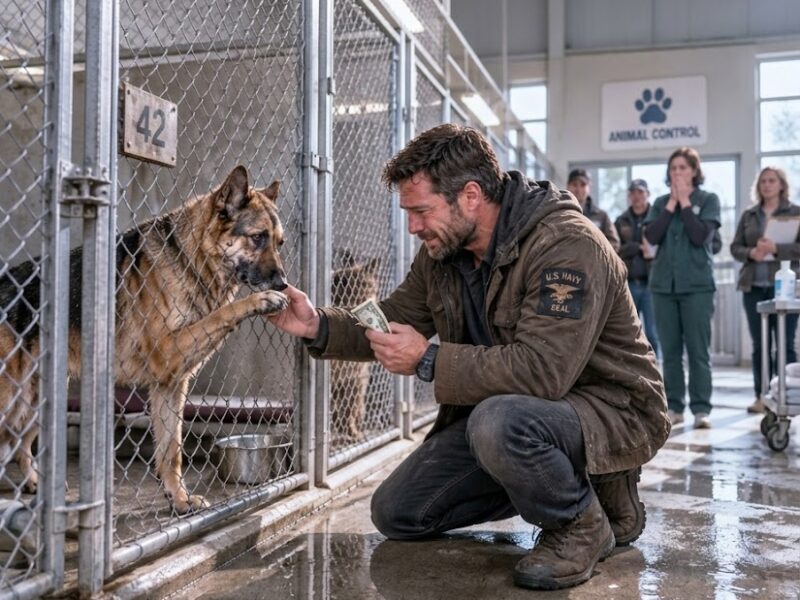
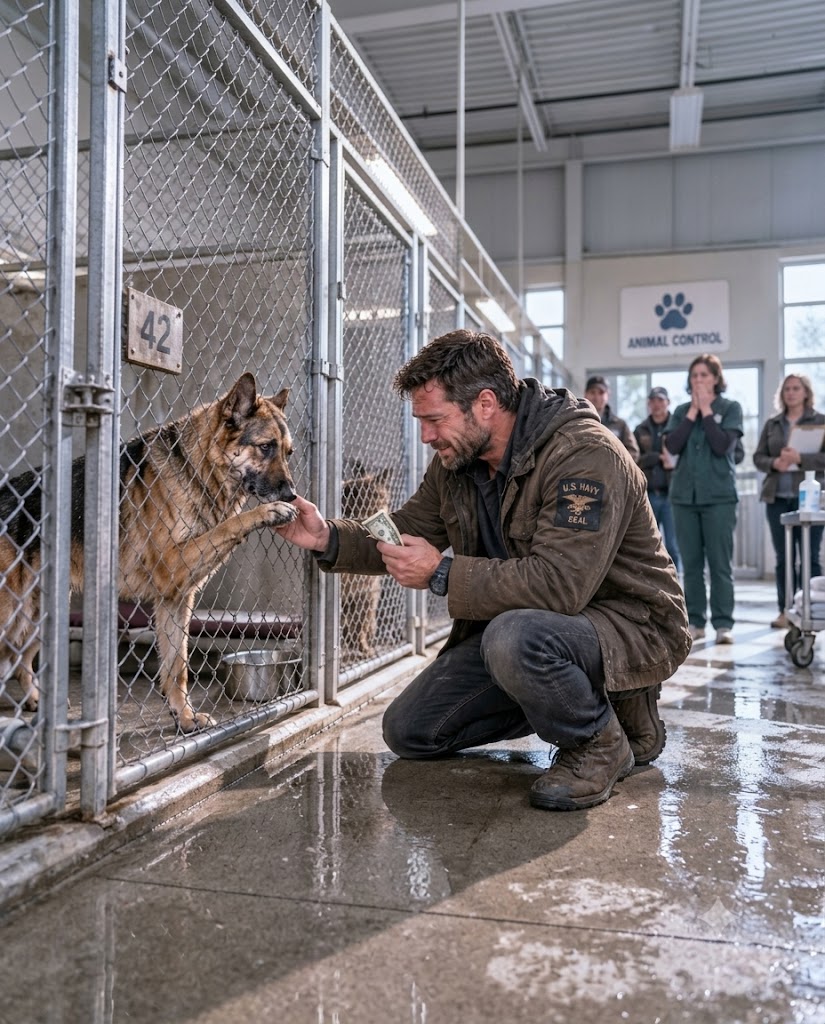
Yet amidst the desperate noise, a profound, eerie silence emanated from the very last enclosure—Cage 42. Drawn by an instinct he hadn’t felt since his days in the Teams, Wyatt stopped. Huddled in the back corner on the freezing, damp concrete floor was a large, emaciated German Shepherd.
The dog’s coat was matted with filth, its ribs protruding sharply against its flanks. Its head hung low in a posture of absolute, crushing defeat. Wyatt’s breath hitched in his throat. He stepped closer to the chain-link fence, his fingers curling through the cold metal diamonds.
The dog slowly lifted its head. Its eyes were cloudy, dull with trauma and neglect, but the facial structure was unmistakable. Above the right eye was a distinct crescent-shaped scar where fur had never grown back—a souvenir from a glancing piece of shrapnel during a firefight in Helmand Province.
More jarringly, the dog’s left ear was notched at the very tip, a permanent imperfection caused by a barbed wire snag during a nighttime HALO jump insertion two years before the explosion. Wyatt’s heart slammed against his ribs like a sledgehammer. The room seemed to tilt on its axis.
He told himself it was impossible. He told himself it was PTSD—a cruel trick of a traumatized mind desperately projecting the past onto a random stray. “Hey, buddy,” Wyatt whispered, his voice cracking. The dog didn’t move. It just stared, locked in a state of learned helplessness.
Wyatt didn’t hesitate. He marched to the front desk where Earl Denton was casually scrolling through his phone, chewing on a toothpick. “The German Shepherd in Cage 42,” Wyatt demanded, slamming a crumpled $1 bill onto the laminate counter. “I’m taking him.”
Earl lazily looked up, eyeing the intimidating, broad-shouldered veteran. “That old stray? Found him wandering near the county line a few weeks back. Mean as a snake, that one. Won’t let anyone touch his neck. He’s scheduled for the needle on Thursday. You sure you want that headache for a buck?”
“Give me the paperwork,” Wyatt snarled, his eyes dark and unyielding. Ten minutes later, Wyatt was walking out the back door of the pound, leading the limping, exhausted dog on a cheap slip lead. When they reached Wyatt’s battered Ford Bronco in the parking lot, the dog stopped.
It looked at the high tailgate, then looked away, too weak to attempt the jump. Wyatt knelt in the gravel. His hands were trembling. He needed to know. He needed to be absolutely certain before he let hope tear him apart all over again.
In the Teams, military working dogs are trained using foreign languages to prevent the enemy from issuing counter-commands. Havoc had been trained exclusively in Dutch. Wyatt took a deep, shuddering breath, squaring his shoulders to adopt his old tactical posture.
“Havoc,” Wyatt commanded in a sharp, authoritative tone. “Zit.” Sit. Instantly, muscle memory overrode years of trauma and neglect. The dog’s hindquarters dropped to the gravel in a textbook, perfect tactical sit. The dullness in the dog’s eyes vanished, replaced by a razor-sharp, immediate focus.
Tears spilled over Wyatt’s weather-beaten cheeks. He leaned forward, speaking the release command in a choked whisper. “Vrij.” The dog whined—a high, broken, agonizing sound—and suddenly pushed its massive head directly into Wyatt’s chest. Wyatt buried his face in the filthy, matted fur, sobbing openly in the freezing parking lot.
It was impossible. It defied all logic, all physics, all official military reports. His partner was alive. But as the initial wave of euphoric disbelief washed over him, a dark, freezing dread began to take its place in the pit of Wyatt’s stomach. A Tier 1 military working dog doesn’t survive a catastrophic explosion in Afghanistan and miraculously wander into a rural Idaho animal pound three years later.
Someone had lied. Someone had taken him. And Wyatt Sullivan was going to burn the world down to find out who. Wyatt bypassed his cabin and drove straight to the Oak Haven Veterinary Clinic. Dr. Abigail Trenton was a no-nonsense, highly skilled veterinarian who had patched up Wyatt’s rescue horses in the past.
She was closing up shop for the evening when Wyatt banged on the glass door, Havoc standing unsteadily at his side. One look at Wyatt’s frantic, deadly-serious expression, and Dr. Trenton unlocked the door, ushering them immediately into the sterile, brightly lit examination room in the back.
“Wyatt! What in God’s name happened to this animal?” Abigail asked, her professional calm wavering as she gently hoisted the 80-pound dog onto the stainless steel table. “I need you to scan him for a microchip, Doc. Right now,” Wyatt said, pacing the small room like a caged tiger.
Abigail grabbed her universal scanner and ran it over the dog’s shoulder blades and neck. The machine remained silent. No beep. No ID number. “Nothing,” she said, frowning. “He’s not chipped.” She scanned the left side of his neck again. “Press deeper,” Wyatt insisted, stepping closer.
Abigail gave him a strange look but complied. As her fingers palpated the skin beneath the matted fur on the left side of Havoc’s neck, she stopped. Her eyes widened. She parted the fur, revealing a thick, jagged ridge of pale scar tissue about two inches long.
“Wyatt,” Abigail said quietly, her voice laced with unease. “There’s no chip because someone surgically removed it. And recently, by the look of this scar tissue—maybe a year or two ago. It wasn’t done by a vet either. It’s a butcher job.”
Rage—hot and blinding—flared in Wyatt’s chest. Military working dogs are chipped with highly classified Department of Defense encryption codes. Removing it wasn’t just cruel. It was a deliberate, calculated act to erase the dog’s identity. “Shave his inner left thigh,” Wyatt commanded, his voice dropping an octave, possessing the cold, lethal calm of a Navy SEAL preparing for a raid.
Abigail grabbed the electric clippers. The buzzing sound made Havoc flinch, but a gentle “Rustig” from Wyatt kept the dog perfectly still. As the fur fell away from the pale skin of the inner thigh, dark blue ink was revealed. Abigail gasped, stepping back.
Tattooed into the flesh, faded but undeniable, was the military serial number: 94BHV. “My God, Wyatt,” Abigail breathed. “This is him. This is the dog you told me about. But how? The military reported him dead in the explosion. How does a dead war dog end up in Oak Haven?”
“That’s exactly what I’m going to find out,” Wyatt said, gently stroking Havoc’s head. “Doc, I need you to document everything. Every scar, the malnutrition, the defensive wounds on his legs, the missing chip. Take photos. Lock the files. Don’t tell a single soul he’s here.”
“He needs an IV drip, heavy-duty antibiotics, and a lot of rest,” Abigail said, already preparing the fluids. “He’s safe here, Wyatt. I’ll lock the clinic.” Wyatt kissed the top of Havoc’s head, whispered a command for him to stay, and walked out into the freezing Idaho night.
He didn’t get into his truck to go home. He drove straight to the Whispering Pines Trailer Park on the edge of town. It was time to have a chat with Earl Denton. Earl’s rusted single-wide trailer sat at the dead end of a gravel road littered with empty beer cans and old car parts.
Wyatt didn’t bother knocking. He kicked the flimsy aluminum door right off its hinges, the deadbolt snapping like a dry twig. Earl, who had been sitting in a stained recliner watching television, leaped up with a yell, dropping his beer.
Before he could even process the intrusion, Wyatt crossed the tiny living room in two massive strides, grabbed Earl by the collar of his flannel shirt, and slammed him against the cheap wood-paneled wall. The entire trailer shuddered.
“Hey, what the hell, Sullivan?” Earl screamed, his eyes bulging as Wyatt’s forearm pressed mercilessly against his windpipe. “Cage 42,” Wyatt whispered, his face inches from Earl’s. “I’m going to ask you once, Earl, and if you lie to me, I’m going to break your arm in three different places. Where did you get the German Shepherd?”
“I told you—he was a stray,” Earl gasped, clawing desperately at Wyatt’s arm. Wyatt applied a fraction more pressure, cutting off Earl’s air supply for three terrifying seconds before letting him gasp for breath. “That dog is a Tier 1 military asset, Earl. He’s worth more than this entire town.”
“Someone cut his tracker out and dumped him. Now you’re the local dog catcher. You know every stray in this county. Who paid you to take him?” Earl’s face went pale, a profound terror replacing his initial shock. He looked frantically toward the shattered door as if expecting a sniper.
“You don’t understand, Wyatt. If I tell you, I’m dead,” Earl stammered. “The guy who gave him to me—he owns this town. He owns the police. He owns the mayor.” Wyatt didn’t blink. He simply shifted his grip, his thumb pressing hard into a bundle of nerves in Earl’s shoulder, sending a spike of agonizing pain down the man’s arm.
Earl shrieked. “Talk,” Wyatt commanded. “Okay, okay,” Earl sobbed, sinking against the wall as Wyatt eased up. “I didn’t catch him. I didn’t find him on the road. Two weeks ago, a black SUV pulled up to the back loading dock of the pound at midnight.”
“A guy handed me a thick envelope of cash—three grand. He told me to put the shepherd in a cage, leave him off the official county registry, and make sure he quietly went down with the euthanasia batch this Friday.” “Who was the guy, Earl?” Wyatt asked, his voice deadly soft.
Earl swallowed hard, tears leaking from his eyes. “It was Victor Langdon. He brought the dog from the Pinecrest Estate up on the ridge.” Wyatt froze. The name hit him like a physical blow. Victor Langdon wasn’t just a wealthy local resident.
He was the CEO of Aegis Tactical, one of the largest private military contracting firms in the world. Langdon lived in a massive, heavily fortified compound overlooking Oak Haven. He funded the local high school football stadium, bankrolled the sheriff’s re-election campaigns, and was treated like royalty by the town’s people.
But Wyatt knew something else. Three years ago, during the disastrous deployment in Kandahar, Aegis Tactical contractors had been operating in the exact same sector where Wyatt’s unit was ambushed. The pieces began to violently snap together in Wyatt’s mind. The explosion hadn’t been a random tragedy.
The aftermath hadn’t been a chaotic scramble where a dog was tragically lost in the rubble. It was a cover-up. Aegis Tactical contractors must have pulled Havoc from the debris while Wyatt was unconscious, realized the immense value of a fully trained Navy SEAL K9, and smuggled him out of the country as their own salvaged equipment.
Victor Langdon had stolen a United States military hero, scrubbed his identity, and brought him back to his private estate in Idaho for personal use. And when the dog got too old or too broken—or perhaps too unmanageable because he only answered to a dead master—Langdon had paid a local pound official to throw him away like garbage.
Wyatt let go of Earl, letting the terrified man crumple to the linoleum floor. “If you make a phone call,” Wyatt said, staring down at Earl with eyes that held the promise of absolute violence. “If you warn Langdon or the sheriff or anyone, I will come back here. Do you understand me?”
Earl nodded frantically, too terrified to speak. Wyatt stepped out of the trailer and into the freezing night. The icy wind howled through the pine trees, but Wyatt didn’t feel the cold. For three years, he had been a ghost, wandering aimlessly through a life he felt he didn’t deserve to survive.
But as he looked up toward the dark, looming mountains, where the lights of Victor Langdon’s estate twinkled like arrogant stars, the ghost vanished. The Navy SEAL was back, and he was going to war in his own hometown. Wyatt returned to the veterinary clinic under the shroud of midnight.
His mind was racing, connecting the fragmented memories of that fateful day in Kandahar. When he pushed through the back door, he found Dr. Abigail Trenton standing in awe. Havoc, despite the IV line hooked to his paw, was standing rigidly on all fours, staring at the door as if he had anticipated his handler’s return.
Wyatt sat down beside the German Shepherd, gently holding the dog’s broad snout. “We have to figure out why, buddy,” Wyatt murmured. “Why keep you alive for three years just to throw you away?” Wyatt pulled out his encrypted satellite phone, a leftover tool from his contractor days, and placed a call to Jackson Reed, a former Navy intelligence analyst living in Seattle.
Jackson was one of the few men Wyatt trusted with his life. “Wyatt,” Jackson’s deep voice echoed through the speaker. “It’s 2:00 in the morning. Is everything all right?” “I found Havoc,” Wyatt said flatly. A long silence hung on the line.
“Wyatt, Havoc died in Afghanistan. We all saw the casualty report.” “He’s standing right next to me, Jackson. Victor Langdon had him. Someone tried to euthanize him at the local pound today under Langdon’s orders. I need you to dig into Aegis Tactical’s operations in Sector 4 during our deployment.”
Jackson didn’t argue. The sound of rapid keyboard clacking filled the receiver. Ten minutes passed in intense silence while Abigail monitored Havoc’s vitals. When Jackson came back on the line, his tone was shaken. “Wyatt, you’re not going to believe this.”
“I just breached Aegis Tactical’s private server logs. Three years ago, hours before your team entered that compound, Aegis contractors logged a high-value retrieval mission in the exact same grid.” “What did they retrieve?” Wyatt asked, his jaw clenching.
“It wasn’t weapons or intelligence,” Jackson replied. “It was illegal arms shipment manifests. Your team wasn’t hit by a Taliban IED, Wyatt. Aegis detonated a remote demolition charge to destroy the evidence before your unit could secure the building. They didn’t care that you were inside.”
Wyatt’s blood ran cold. The truth hit him like a physical blow. The ambush wasn’t a tragic military misfortune. It was a premeditated assassination attempt by a private mercenary firm protecting its lucrative black-market operations. “Why take Havoc?” Wyatt demanded.
“Because Havoc was wearing the newly fielded K9 Tactical Video Reconnaissance System,” Jackson explained. “The encrypted collar camera was actively recording during the breach. It caught the faces of Langdon’s contractors setting the charges. They pulled Havoc from the rubble to secure the drive.”
“But those military drives are hard-encrypted with biometric hardware tokens. Langdon couldn’t break the encryption without the physical master key—or without keeping the original hardware intact. So they kept him alive, hoping to crack the drive.” Wyatt realized, anger burning through his veins.
“And when the drive’s internal battery permanently degraded after three years, making the data unrecoverable, Havoc became a liability. Langdon dumped him.” “Jackson confirmed. Wyatt, listen to me. Langdon still has that collar in his private vault at the Pinecrest Estate.”
“If we get that hardware, we don’t just prove Havoc’s identity. We prove Aegis murdered American soldiers.” Wyatt looked at Havoc. The German Shepherd met his gaze, his dark eyes burning with an ancient, unwavering intelligence. “Doc,” Wyatt said, turning to Abigail.
“Remove the IV.” “Wyatt, he’s still weak,” she protested. “He’s a Navy SEAL,” Wyatt answered quietly. “And we have a mission to finish.” A torrential downpour washed over the pine-covered peaks of Oak Haven as Wyatt’s Bronco pulled to a stop half a mile from the iron gates of the Pinecrest Estate.
The wind howled through the forest, providing perfect acoustic cover for their advance. Wyatt dressed in dark tactical gear, double-checking his sidearm. Alongside him, Havoc wore a reinforced black harness, his body moving with a sudden, renewed vigor.
The lethargy of the pound was entirely gone, replaced by the lethal focus of a war dog returning to his element. “Silent approach,” Wyatt whispered in Dutch. “Blijf bij me.” Stay with me. They breached the perimeter fence through a heavy drainage culvert, completely avoiding the thermal security cameras patrolling the primary driveway.
Moving like silent shadows, man and dog bypassed the outer security patrols, slipping through an unlocked side terrace door into the lavish main residence. They reached Victor Langdon’s private study on the second floor. Wyatt quickly located the heavy floor safe concealed behind a floor-to-ceiling mahogany bookcase.
Using an electronic bypass device provided remotely by Jackson, Wyatt began running the complex code-cycling sequence. Suddenly, the heavy double oak doors slid open behind them. The bright overhead lights snapped on with a sharp click. “I wondered how long it would take you to figure it out, Sullivan.”
A calm, arrogant voice drawled from the doorway. Victor Langdon stood there wearing a tailored Italian suit, flanked by two heavily armed private mercenaries and Sheriff Garrett Hayes. The sheriff held his service revolver drawn, his hand trembling visibly in the harsh light.
“You should have stayed at your cabin, Wyatt,” Sheriff Hayes stammered nervously. “You weren’t ever supposed to go down to the county pound.” “Shut up, Hayes,” Langdon snapped, taking a slow step forward. He looked down at Havoc, who let out a low, menacing rumble from deep within his chest.
“I must admit, that animal has remarkable resilience. I paid hundreds of thousands to elite military codebreakers to unlock the drive in his collar. But the technology was far too stubborn. Just like you.” “You killed four American soldiers in Kandahar, Langdon,” Wyatt said, his voice deadly steady as he subtly shifted his weight toward his sidearm.
“You blew up a compound full of soldiers to cover up your illegal international arms deals.” “And who is ever going to prove it?” Langdon sneered, slowly pulling a silenced semi-automatic pistol from inside his tailored jacket. “A medically discharged veteran suffering from severe, documented traumatic brain injury.”
“A broken stray dog. The county sheriff is in my pocket, Sullivan. The official news report tomorrow morning will state that a crazed, unstable veteran broke into my home and had to be neutralized in self-defense.” Langdon raised the cold black barrel of the weapon directly at Wyatt’s chest.
“Havoc! Anvil! Attack!” Wyatt roared in a thunderous tone. Before Langdon could even squeeze the trigger, 80 pounds of pure muscle and sharp teeth launched through the air with terrifying speed. Havoc clamped his powerful jaws around Langdon’s right wrist, the devastating force shattering bone instantly and sending the silenced pistol clattering uselessly across the polished hardwood floor.
Langdon shrieked in absolute agony as he crashed violently to the floor under the weight of the war dog. Simultaneously, Wyatt lunged forward, sweeping the legs of the first mercenary guard and disarming him with a brutal combination of hand-to-hand strikes.
Sheriff Hayes panicked completely, dropping his gun to the floor and raising his hands in immediate surrender as Wyatt drew his own weapon and expertly covered the remaining mercenary. “It’s over, Langdon,” Wyatt said calmly, standing tall over the bleeding CEO, while Havoc stood guard over him, his front paws planted firmly on Langdon’s chest.
At that exact moment, the screeching of high-speed tires and the wail of roaring sirens echoed up the estate driveway. Heavy combat boots pounded up the grand marble staircase. The double doors burst open, and a heavily armed squad of federal tactical agents led by Agent Hank Reynolds of the Department of Defense Inspector General’s Office flooded the room with rifles raised.
“Nobody move! Federal agents!” Agent Reynolds commanded sharply. Wyatt kept his hands clearly visible, stepping back slowly. “Agent Reynolds, the evidence collar is inside the open safe. Jackson Reed patched you the live audio transmission.” Agent Reynolds nodded grimly. “We heard every single word, Sullivan.”
“Federal marshals just seized Aegis Tactical headquarters in Washington.” Langdon was dragged forcefully to his feet in handcuffs, weeping hysterically in pain, while Sheriff Hayes was stripped of his badge and gun on the spot. Three days later, the morning sun rose brightly over a stunned town of Oak Haven.
The news story dominated headlines across the nation: A corrupt mercenary mogul brought down by a retired Navy SEAL and the military working dog the world believed was dead. On the front porch of his quiet cabin, Wyatt sat in his wooden armchair, holding a steaming cup of coffee.
Beside him lay Havoc—clean, fully fed, and resting his heavy head comfortably across Wyatt’s boots. The haunting ghost was finally gone. They were both finally home. This emotional journey of unyielding loyalty, brotherhood, and ultimate justice proves that the bond between a Navy SEAL and his K9 can never be broken.
Not by war. Not by time. Not by corrupt cover-ups. If this incredible story touched your heart, please hit the like button right now. Share this video with your friends and family, and subscribe to our channel for more breathtaking real-life dramatic stories every week.
Don’t forget to click the notification bell so you never miss an upload.
—
## Part 2
The days that followed Victor Langdon’s arrest were a blur of federal interviews, media inquiries, and the slow, painful process of healing. Wyatt and Havoc became national sensations overnight. Their story—the supposedly dead war hero and his miraculous reunion with his K9 partner—captivated millions across the country.
But fame was the last thing Wyatt wanted. He had spent three years hiding from the world, and now the world wouldn’t stop calling. His phone rang constantly. Reporters camped outside his cabin. Strangers sent letters, gifts, and donations to help with Havoc’s recovery.
Through it all, Havoc remained by his side—a constant, steady presence. The German Shepherd was still weak, still recovering from years of neglect and malnutrition. Dr. Abigail Trenton visited the cabin daily, monitoring his progress and administering antibiotics and supplements.
“He’s a fighter,” Abigail said one afternoon, checking Havoc’s vitals on the front porch. “Most dogs wouldn’t have survived what he went through. But he’s got something special—a will to live that I’ve never seen before.” Wyatt nodded, stroking Havoc’s head gently.
“He always did. Even in the Teams, he was the toughest dog I ever worked with. He saved my life more times than I can count.” As Havoc grew stronger, Wyatt began to notice changes in himself. The night terrors that had plagued him for three years became less frequent.
The suffocating silence in his truck was filled with the sound of Havoc’s breathing. The empty space beside his armchair was once again occupied by a massive, warm weight. For the first time since Afghanistan, Wyatt felt like he was living instead of merely surviving.
But the scars of the past weren’t so easily erased. One evening, as Wyatt sat on the porch watching the sunset, Havoc suddenly tensed. The dog’s ears flattened against his skull, and a low growl rumbled from his chest. Wyatt followed his gaze and saw a figure standing at the edge of the tree line.
It was a woman—tall, athletic, with short-cropped hair and eyes that held a familiar, haunted look. She wore a military-style jacket and carried a duffel bag over her shoulder. “Wyatt Sullivan?” she called out, her voice steady but cautious. “I need to talk to you.”
Wyatt stood slowly, his hand instinctively moving toward the sidearm he no longer carried. Havoc remained at his side, still growling, his body coiled like a spring. “Who are you?” Wyatt demanded. The woman took a step forward, her hands raised in a gesture of peace.
“My name is Sergeant First Class Maria Vasquez. I was Havoc’s handler before you.” The words hit Wyatt like a physical blow. He stared at the woman, his mind racing. Havoc had been his partner for two years. Before that, he had been assigned to another handler—someone Wyatt had never met.
“I thought you were killed in action,” Wyatt said slowly. “That’s what they told me. Killed in a firefight in Helmand Province, six months before I took over Havoc’s training.” Maria shook her head, a bitter smile crossing her lips. “That’s what they wanted you to believe.”
She reached into her jacket and pulled out a folded document, handing it to Wyatt. “I was medically discharged after that firefight—severe injuries to my spine. But I wasn’t killed. I was reassigned to a desk job, and Havoc was given to you.” Wyatt unfolded the document and scanned it quickly.
It was a military personnel file—Maria’s file. The dates matched. The details were accurate. But something didn’t add up. “Why are you here?” Wyatt asked, his voice wary. “What do you want?” Maria took a deep breath, her eyes meeting his.
“I want to help you finish what you started. Langdon wasn’t working alone. Aegis Tactical was just one piece of a much larger operation. There are others—powerful people who helped him cover up what happened in Kandahar.” Wyatt felt a chill run down his spine.
“What are you talking about?” Maria reached into her duffel bag and pulled out a thick folder, handing it to him. “Two years ago, while I was working at the Pentagon, I stumbled onto something I wasn’t supposed to see. A classified operation called ‘Project Cerberus.'”
Wyatt opened the folder. Inside were dozens of documents, photographs, and intelligence reports. His eyes widened as he scanned the pages. “Project Cerberus was a joint military-civilian program designed to test advanced K9 combat systems,” Maria explained.
“Havoc was one of the first dogs selected. The collar camera he wore in Afghanistan wasn’t just for reconnaissance. It was part of a larger experiment—a prototype system designed to transmit live video and audio back to command in real time.” Wyatt’s mind raced.
“So Langdon wasn’t just trying to destroy evidence. He was trying to steal the technology.” Maria nodded. “The collar Havoc wore contained proprietary software worth billions. Langdon knew that if the military discovered what he’d done, he’d lose everything. So he staged the explosion, stole Havoc, and tried to crack the encryption.”
“But he failed.” “He failed,” Maria confirmed. “But he wasn’t the only one interested in that technology. There are other players—government contractors, foreign intelligence agencies, even rogue elements within our own military. They all want what’s in that collar.”
Wyatt looked down at Havoc, who had finally stopped growling and was now watching Maria with cautious curiosity. “Why are you telling me this?” Maria met his gaze, her eyes burning with determination. “Because I owe you. I owe Havoc. And I want to make things right.”
“I’ve been gathering evidence for two years—ever since I found out what happened in Kandahar. But I couldn’t do anything with it alone. I needed someone on the inside, someone with the skills and the motivation to take these people down.” Wyatt was silent for a long moment, processing everything she had said.
Finally, he spoke. “If what you’re saying is true, then we’re not just dealing with Langdon anymore. We’re dealing with a conspiracy that goes all the way to the top.” Maria nodded. “That’s right. And if we’re going to expose it, we need to be careful. These people are dangerous.”
“They’ve already killed to protect their secrets. They won’t hesitate to kill again.” Wyatt looked at Havoc, then back at Maria. “I’m in,” he said quietly. “But I have one condition.” “What’s that?” “We do this my way. No running off half-cocked. No taking unnecessary risks. We gather evidence, we build a case, and we take it to the people who can actually do something about it.”
Maria nodded. “Agreed.” That night, Wyatt, Maria, and Havoc sat around the kitchen table in Wyatt’s cabin, poring over the documents Maria had brought. The evidence was damning—emails, financial records, and testimony from whistleblowers who had been silenced or discredited.
But one name kept appearing again and again: General Marcus Holt. General Holt was a decorated war hero, a former commander of Special Operations Command, and a man Wyatt had once respected deeply. According to Maria’s documents, Holt had been the mastermind behind Project Cerberus.
He had authorized the experiment, approved the use of military working dogs as test subjects, and personally overseen the cover-up of what happened in Kandahar. “Holt is the key,” Maria said, tapping a photograph of the general. “If we can prove he was involved, the whole thing unravels.”
Wyatt studied the photograph, his jaw tight. “I met Holt once, years ago. He pinned a medal on my chest after a mission in Iraq. I thought he was a hero.” “He’s a monster,” Maria said flatly. “He’s responsible for the deaths of dozens of soldiers, including the men in your unit.”
Wyatt’s hands clenched into fists. “Then we take him down. No matter what it takes.” The next few weeks were a whirlwind of activity. Wyatt and Maria worked tirelessly, gathering more evidence, tracking down witnesses, and building a case against General Holt and his co-conspirators.
Havoc remained by Wyatt’s side throughout, a silent guardian and a constant reminder of why they were fighting. But the deeper they dug, the more dangerous their investigation became. One night, as Wyatt and Maria were driving back from a meeting with a whistleblower in Boise, they noticed a black SUV following them.
“I think we’ve got company,” Maria said, checking the rearview mirror. Wyatt glanced back, his jaw tightening. “Lose them.” Maria floored the accelerator, and the Bronco surged forward. The SUV followed, its headlights blazing in the darkness.
A high-speed chase ensued, winding through the mountain roads of the Idaho Panhandle. Maria was a skilled driver, but the SUV was faster and more maneuverable. It gained on them, inch by inch, until it was right on their bumper.
Suddenly, the SUV rammed them from behind. The Bronco swerved, tires screeching on the wet pavement. Wyatt grabbed the dashboard, his heart pounding. Havoc, who had been lying in the back seat, scrambled to his feet, a low growl rumbling from his chest.
“Hold on!” Maria shouted, yanking the wheel. The Bronco skidded off the road, crashing through a wooden fence and tumbling down a steep embankment. The world spun—metal crunching, glass shattering, Havoc barking wildly.
When the Bronco finally came to a stop at the bottom of the ravine, Wyatt was upside down, his seatbelt cutting into his chest. He could hear Maria groaning beside him and Havoc whining in the back. “Everyone okay?” Wyatt gasped, fumbling for his seatbelt release.
“I think so,” Maria muttered, blood trickling from a cut on her forehead. “Havoc?” The German Shepherd barked once, then scrambled through the shattered rear window and up the embankment. Wyatt managed to free himself and helped Maria out of the wreckage.
They climbed up the ravine, their bodies aching, and found Havoc standing guard at the top. The black SUV was gone. “They’re not following us anymore,” Maria said, scanning the road. “They probably think we’re dead.”
Wyatt nodded, wincing as he touched a tender spot on his ribs. “We need to get to a hospital. And we need to warn the others.” But when they reached the nearest town, they received devastating news. The whistleblower they had met with earlier that night had been found dead in his hotel room—an apparent suicide.
“They got to him,” Maria said, her voice shaking with rage. “We’re running out of time.” Wyatt knew she was right. General Holt was cleaning up loose ends, eliminating anyone who could testify against him. If they were going to stop him, they needed to act fast.
They drove through the night, heading for Washington, D.C., where they planned to present their evidence to a trusted contact at the Department of Justice. But when they arrived, they found that their contact had been reassigned—and their evidence had been flagged as “classified” by the Pentagon.
“We’re being stonewalled,” Maria said, slamming her fist on the table in frustration. “Holt has people everywhere.” Wyatt paced the small hotel room, his mind racing. “Then we go public. We take this to the press.” Maria shook her head. “The mainstream media won’t touch this without corroboration.”
“And anyone who tries to corroborate it ends up dead.” They were at an impasse. Wyatt sat down on the bed, exhausted and defeated. Havoc rested his head on Wyatt’s knee, his dark eyes filled with quiet understanding. “What do we do, buddy?” Wyatt whispered.
“We can’t give up.” Maria looked at him, a spark of determination in her eyes. “There’s one person who might be able to help us. Someone Holt can’t touch.” “Who?” “Senator Elizabeth Warren. She’s been investigating defense contractors for years. She’s not afraid to take on the military-industrial complex.”
Wyatt considered this. It was a long shot, but it was their best option. “Let’s do it.” The next morning, they arrived at Senator Warren’s office in the Hart Senate Office Building. After hours of waiting and multiple security checks, they were finally granted a meeting with the senator’s chief of staff.
“We have evidence of a massive cover-up involving General Marcus Holt and Aegis Tactical,” Wyatt said, laying out the folder on the conference table. “We need the senator’s help to expose it.” The chief of staff, a sharp-eyed woman named Karen, studied the documents carefully.
“These are serious allegations,” she said finally. “If they’re true, this could be the biggest scandal in the history of the Department of Defense.” “They’re true,” Maria said. “And we can prove it. We just need someone with the power to act on it.” Karen nodded slowly.
“I’ll bring this to the senator immediately. In the meantime, I suggest you lay low. If what you’re saying is true, you’re both in grave danger.” Wyatt and Maria left the office with a renewed sense of hope. But as they walked down the marble corridors of the Senate building, Wyatt noticed a familiar face in the crowd.
It was one of Langdon’s mercenaries—the man Wyatt had disarmed at the Pinecrest Estate. The man saw him too, and his hand moved toward his jacket. “Run!” Wyatt shouted, grabbing Maria’s arm and pulling her through a side door. They sprinted through the labyrinthine corridors of the Capitol, Havoc barking wildly at their heels.
Behind them, footsteps pounded on the marble floor. They burst through a fire exit and into the cold Washington air. Wyatt hailed a cab, and they piled in, gasping for breath. “Where to?” the driver asked. Wyatt thought fast. “The nearest police station. Step on it.”
As the cab sped through the streets of D.C., Wyatt looked out the window. They had escaped—for now. But he knew this was far from over. General Holt wasn’t going to stop until they were dead. And Wyatt wasn’t going to stop until Holt was brought to justice.
The cab pulled up to the police station, and they rushed inside, demanding to speak to someone in charge. After explaining the situation—carefully omitting the classified details—they were given a safe place to wait while the authorities were contacted.
But Wyatt knew that the police couldn’t protect them forever. They needed to get their evidence into the right hands—and they needed to do it fast. That night, as they sat in a small, windowless room in the police station, Wyatt and Maria watched the news on a grainy television.
The lead story was about General Marcus Holt—a decorated war hero, a pillar of the military establishment. There was no mention of the allegations against him. No mention of the cover-up. No mention of the men who had died in Kandahar.
“They’re controlling the narrative,” Maria said bitterly. “They’re going to bury this.” Wyatt shook his head. “Not if we can help it. We still have the evidence. We still have the truth.” He looked at Havoc, who was lying at his feet, exhausted but alert.
“We’ve come this far. We’re not giving up now.” The next morning, Wyatt received a call from Karen, the senator’s chief of staff. “The senator wants to meet with you. In person. Today.” Wyatt’s heart leaped. “Where?” “The Russell Senate Office Building. Room 328. Come alone.”
Wyatt hung up and turned to Maria. “This is it. This is our chance.” Maria nodded, her expression serious. “Be careful. This could be a trap.” “I know. But it’s a risk we have to take.” Wyatt left Havoc with Maria and made his way to the Russell Senate Office Building.
He was escorted to Room 328 by a stern-faced security guard. Inside, Senator Elizabeth Warren was waiting, along with Karen and two other aides. “Mr. Sullivan,” the senator said, standing to shake his hand. “I’ve read your evidence. It’s compelling.”
“I take it you believe us.” Senator Warren nodded. “I believe something is going on. Whether it goes all the way to General Holt remains to be seen. But I can promise you this—I will do everything in my power to get to the bottom of it.”
Wyatt felt a wave of relief wash over him. “Thank you, Senator. That’s all we’re asking for.” But as he turned to leave, the senator stopped him. “One more thing, Mr. Sullivan. I’ve received threats. Anonymous, but credible. Someone doesn’t want this investigation to move forward.”
“I’m not surprised.” “Neither am I. But I want you to know that I’m not backing down. And neither should you.” Wyatt met her gaze. “We won’t. We’ve come too far to stop now.” Over the next few weeks, Senator Warren’s office launched a full-scale investigation into General Holt and Aegis Tactical.
Subpoenas were issued. Witnesses were called. The media finally began to take notice, and the story of the supposedly dead war hero and his miraculous K9 partner captured the nation’s attention. But the road to justice was anything but smooth.
General Holt fought back with every weapon at his disposal—legal maneuvers, character assassinations, and outright intimidation. His allies in Congress and the Pentagon closed ranks, trying to discredit the investigation and protect their own. Through it all, Wyatt and Havoc stood firm.
They testified before Congress, recounting the events of that fateful day in Kandahar and the years of cover-up that followed. Havoc’s presence in the hearing room—a living, breathing symbol of the injustice they had suffered—was more powerful than any words.
Finally, after months of hearings, investigations, and legal battles, the truth came out. General Marcus Holt was indicted on charges of murder, conspiracy, and obstruction of justice. Aegis Tactical was dissolved, its assets seized, and its executives arrested.
Langdon, already convicted on multiple counts, received a life sentence without the possibility of parole. The men who had died in Kandahar were finally honored, their sacrifice recognized and their families given the closure they deserved. And Havoc—the dog the world believed was dead—became a national hero.
He was awarded the K9 Medal of Honor, the highest honor a military working dog can receive. Wyatt accepted the medal on his behalf, tears streaming down his face as he stood before the crowd. “This dog saved my life more times than I can count,” Wyatt said, his voice choked with emotion.
“He’s more than just a partner. He’s my brother. And I’m honored to stand here today with him by my side.” The crowd erupted in applause. Cameras flashed. The nation watched, inspired by the story of loyalty, courage, and unyielding determination.
But for Wyatt, the real victory was much simpler. That night, as he sat on the porch of his cabin with Havoc by his side, he felt a peace he hadn’t known in years. The ghost was gone. The mission was complete. And for the first time since Afghanistan, he was truly home.
“You did good, buddy,” Wyatt whispered, stroking Havoc’s head. “You did real good.” Havoc let out a contented sigh, resting his head on Wyatt’s knee. The stars shone brightly overhead, the pine trees swayed in the gentle breeze, and the silence that had once haunted Wyatt was finally, mercifully, filled.
—
## Part 3
Six months after General Holt’s conviction, life in Oak Haven had returned to some semblance of normalcy. The media circus had moved on to other stories, the federal agents had packed up their equipment, and the town’s residents had slowly adjusted to the fact that their quiet community had been at the center of a national scandal.
Wyatt and Havoc were local celebrities now—recognized wherever they went, greeted with handshakes and warm smiles. The children of Oak Haven loved Havoc, often stopping by the cabin to bring him treats and ask Wyatt about his adventures.
Havoc, for his part, seemed to enjoy the attention. He had regained much of his strength, his coat was glossy and thick, and his eyes were bright and alert once more. But there were still reminders of what he had endured—the scars, the slight limp in his back leg, the way he flinched at loud noises.
Dr. Abigail Trenton continued to monitor his progress, though her visits were less frequent now. “He’s doing remarkably well,” she told Wyatt during one of her check-ups. “I don’t think he’ll ever be a hundred percent—the malnutrition and neglect took a toll—but he’s strong, healthy, and happy.”
“That’s all I care about,” Wyatt said, stroking Havoc’s head. “He deserves to live out his days in peace.” The truth was, Wyatt had been thinking a lot about the future lately—about what he wanted to do with the rest of his life. He had spent so many years fighting, first in the Navy, then to survive, then to expose the truth.
Now that the battle was over, he found himself at loose ends. He still restored classic trucks in his workshop, still took long walks through the pine forests with Havoc by his side, still enjoyed the quiet solitude of his cabin. But something was missing—a sense of purpose he hadn’t been able to shake since leaving the Teams.
It was Maria Vasquez who helped him find it. She had stayed in Oak Haven after the investigation concluded, renting a small house on the edge of town. She and Wyatt had grown close during their months of working together—not romantically, but as comrades in arms, bonded by shared trauma and shared victory.
One afternoon, she showed up at Wyatt’s cabin with a proposal. “I’ve been thinking,” she said, sitting down at the kitchen table. “There are a lot of veterans out there who are struggling—men and women who have been through the same things we have. And there are a lot of dogs like Havoc—trained military working dogs who are discarded when they’re no longer useful.”
Wyatt nodded slowly. “I’ve thought about that too.” “What if we started something? A sanctuary—a place where veterans and retired working dogs can come together, heal together, find purpose together.” Wyatt considered the idea. It was ambitious, but it felt right.
“That’s a hell of a project,” he said. “Where would we even start?” Maria smiled. “I’ve already started. I’ve been looking at properties—there’s an old ranch about twenty miles north of here. It’s been abandoned for years, but it’s got good bones. We could fix it up, make it something special.”
Wyatt looked at Havoc, who was lying by the fireplace, his eyes half-closed in contentment. “What do you think, buddy? Want to help some other dogs?” Havoc lifted his head, his ears perking up. Wyatt took that as a yes.
Over the next year, Wyatt and Maria poured everything they had into the sanctuary. They secured funding through a combination of donations, grants, and Senator Warren’s connections. Volunteers came from all over the country—veterans, animal lovers, and people who had been inspired by Wyatt and Havoc’s story.
The old ranch was transformed. New kennels were built, training areas were established, and a main lodge was renovated to house the veterans who would come to stay. They called it “Havoc’s Haven”—a place of healing and hope.
The first residents arrived in the spring—a group of six veterans and four retired military working dogs. Each had their own story of trauma and loss, but together, they began to heal. The dogs, many of whom had been abandoned or surrendered, found new purpose in helping their handlers.
The veterans found comfort in the dogs’ unconditional love and understanding. Wyatt watched it all with a sense of pride and gratitude. This was his purpose now—helping others who had been through what he had been through, giving them the same second chance he had been given.
One evening, as the sun set over the mountains, Wyatt sat on the porch of the main lodge with Havoc by his side. Maria joined him, a cup of coffee in each hand. “You ever think about how we got here?” she asked, handing him a mug.
Wyatt took a sip, considering the question. “Every day. A dollar bill. A cage in a county pound. A dog I thought I’d lost forever.” Maria nodded. “It’s funny how the smallest things can change everything.” They sat in comfortable silence for a while, watching the stars come out.
Then Wyatt spoke. “I used to think I survived that explosion for a reason. That there was some grand plan, some mission I was supposed to complete.” “And now?” “Now I think survival is its own reason. Every day we wake up, every day we keep going—that’s the mission. That’s the victory.”
Maria smiled. “That’s a good way to look at it.” Havoc let out a soft sigh, settling his head on Wyatt’s lap. Wyatt stroked his fur, feeling the steady rhythm of the dog’s heartbeat. The ghost that had haunted him for three years was finally at peace.
And so was he.
The story of Wyatt Sullivan and Havoc spread far and wide—a symbol of hope, resilience, and the unbreakable bond between a soldier and his dog. Their sanctuary became a beacon for others, a place where healing was possible, where second chances were real.
And for Wyatt, every day was a gift—a chance to honor the memory of the men who had died in Kandahar, to serve those who had served their country, and to give Havoc the life he deserved. The dog who had been thrown away like garbage was now the heart of a movement.
And the man who had been a ghost was finally, fully alive.
—
## Part 4
Two years after Havoc’s Haven opened its doors, the sanctuary had grown beyond anything Wyatt could have imagined. What had started as a small operation with six veterans and four dogs had blossomed into a thriving community of over fifty residents—both human and canine.
The ranch itself had expanded, with new buildings, expanded training areas, and a state-of-the-art veterinary clinic run by Dr. Abigail Trenton. The waiting list for admission stretched for months, and funding came from a variety of sources—private donations, government grants, and a foundation established in honor of the soldiers who had died in Kandahar.
Wyatt had become something of a public figure, though he still hated the spotlight. He gave speeches at events, testified before Congress about the needs of veterans and retired working dogs, and worked tirelessly to raise awareness and support. But his favorite part of the job was the quiet moments.
The moments when he sat with a veteran who was struggling, listening to their story without judgment. The moments when he watched a scared, broken dog slowly learn to trust again. The moments when he saw the spark of hope return to eyes that had been empty for years.
Havoc remained by his side through it all—a constant, reassuring presence. The German Shepherd had become the unofficial mascot of the sanctuary, beloved by residents and visitors alike. He had even inspired a children’s book, “Havoc’s Journey,” which told the story of his rescue and reunion with Wyatt.
Despite his age—he was now nine years old, old for a German Shepherd—Havoc remained active and alert. He still accompanied Wyatt on his rounds, still greeted new arrivals with a gentle nuzzle, still stood guard at night when the nightmares came.
But Wyatt knew that their time together was growing short. Havoc was slowing down. He slept more, walked slower, and sometimes seemed confused. The vet had told Wyatt that Havoc was in the early stages of canine cognitive dysfunction—a form of dementia common in older dogs.
There was no cure. No treatment. Only the slow, inevitable decline.
Wyatt had known this day would come. He had known it since the moment he first saw Havoc in Cage 42—a broken, emaciated dog with cloudy eyes and a defeated spirit. He had known it when he had brought Havoc home, nursed him back to health, and watched him transform into the strong, vibrant companion he had once been.
He had known it, but he wasn’t ready for it.
One crisp autumn morning, Wyatt woke to find Havoc lying beside his bed, unable to stand. The dog’s breathing was labored, his eyes clouded with pain. Wyatt knelt beside him, his heart breaking.
“Hey, buddy,” he whispered, stroking Havoc’s head. “It’s okay. I’m here.” Havoc let out a soft whine, his tail giving a weak wag. Wyatt knew what he had to do. He called Dr. Trenton, who arrived within the hour.
She examined Havoc carefully, her expression grave. “His heart is failing,” she said quietly. “There’s nothing more we can do.” Wyatt nodded, tears streaming down his face. “Can you… can you make it peaceful?” “Yes. I can do that here, if you’d like.”
Wyatt spent the next few hours with Havoc, sitting on the floor beside him, holding his paw. He talked to the dog—about their time in the Teams, about the explosion, about the miraculous reunion in the pound. He told Havoc about all the lives he had touched, all the people he had helped.
He told him he was a good boy. The best boy. When the time came, Dr. Trenton administered the injection. Wyatt held Havoc close, whispering in his ear as the dog’s breathing slowed, then stopped. The room was silent.
Wyatt stayed there for a long time, holding his partner, his brother, his savior. The dog who had been declared dead in Afghanistan, who had been stolen and discarded, who had been given a second chance and had done so much good with it, was finally at rest.
The news of Havoc’s passing spread quickly. Tributes poured in from across the country—from veterans, from animal lovers, from people whose lives had been touched by his story. Senator Warren issued a statement honoring his service and his legacy.
But for Wyatt, the loss was personal. Havoc had saved his life, not once but many times. He had given him a purpose when he had none. He had taught him what it meant to love unconditionally, to fight for what was right, to never give up.
The day after Havoc’s death, Wyatt sat on the porch of his cabin, staring out at the mountains. He held a small box in his hands—Havoc’s ashes. He had made a decision. He was going to spread them in the places that mattered most—the training field at the sanctuary, the pound where they had been reunited, and finally, the mountains where Havoc had loved to run.
But he wasn’t ready yet. For now, he would keep the ashes close, a reminder of the bond that would never be broken. As he sat there, Maria appeared at the edge of the porch. She didn’t say anything. She just sat down beside him and took his hand.
They sat in silence for a long time. Finally, Wyatt spoke. “He’s gone.” “I know.” “I don’t know what to do without him.” Maria squeezed his hand. “You keep going. You honor him. You live the life he helped you find.” Wyatt nodded slowly.
“His legacy won’t die, Wyatt. Havoc’s Haven will continue. The dogs and veterans he helped will continue to heal. His story will inspire people for generations.” Wyatt looked at her. “It’s not enough.” “It’s never enough. But it’s something.”
Wyatt wiped his eyes. “He was the best dog I ever knew.” “He was,” Maria agreed. “And he was lucky to have you.” “No. I was lucky to have him.” They sat there as the sun set, the sky ablaze with orange and pink and gold.
And in the silence, Wyatt felt something he hadn’t felt in a long time. Peace. The ghost was truly gone now. Havoc was at rest. But his spirit lived on—in the sanctuary, in the veterans he had helped, in the heart of the man who had loved him.
Wyatt stood, clutching the box of ashes. “I’m ready,” he said. “Let’s go home.”
—
## Part 5
Five years passed. Havoc’s Haven grew and thrived, becoming the premier facility of its kind in the nation. Wyatt had remarried—not to Maria, but to a woman named Sarah, a former Air Force medic who had come to the sanctuary as a volunteer and had stayed for love.
They had a daughter now—Emily, three years old, with her mother’s blue eyes and her father’s stubborn streak. She loved dogs, just like her dad. Havoc’s legacy lived on through the sanctuary, through the lives he had saved, through the stories that were told about him.
The sanctuary had expanded its mission to include training programs for service dogs, therapy animals, and emotional support companions. They had helped thousands of veterans, hundreds of working dogs, and countless families.
Wyatt had become a national advocate for veterans’ mental health and animal welfare. He had testified before Congress multiple times, had been featured in documentaries and news reports, and had even received a Presidential Medal of Freedom for his work.
But his favorite moments were still the quiet ones. Sitting on the porch with Sarah and Emily, watching the sunset. Walking through the fields with a new rescue dog—not a replacement for Havoc, but a new friend, a new partner.
He had learned that grief and joy could coexist. That loss didn’t mean forgetting. That moving forward didn’t mean leaving the past behind. Havoc was always with him—in his memories, in his heart, in the work he did every day.
One evening, as he tucked Emily into bed, she asked him a question. “Daddy, tell me about Havoc.” Wyatt smiled. He had told her the story many times before, but she never got tired of hearing it.
“Havoc was a very special dog,” he began. “He was a hero. He saved my life, and he helped a lot of other people too.” “Was he your best friend?” “Yes. He was my best friend.” “Do you miss him?”
“Every day.” Emily thought about this for a moment. “But you have other dogs now. Do you still love Havoc?” “Always. Love doesn’t go away when someone is gone. It stays with you, in here.” Wyatt placed his hand over his heart.
“Love is forever.” Emily nodded, satisfied. “I love you, Daddy.” “I love you too, sweetheart.” He kissed her forehead and turned out the light. As he left her room, he paused in the hallway, looking at a photograph on the wall.
It was a picture of Havoc, taken on the front porch of the cabin, shortly after they had been reunited. The dog’s eyes were bright, his fur thick and healthy, his head held high. He looked strong. He looked happy. He looked home.
Wyatt touched the photograph gently. “Thank you, buddy,” he whispered. “For everything.” He walked outside to the porch, where Sarah was waiting with a cup of coffee. They sat together in the quiet of the evening, watching the stars come out.
“It’s a good life,” Sarah said. “It is,” Wyatt agreed. “A damn good life.” And it was. It had been a long road—from the explosion in Kandahar to the pound in Oak Haven to the sanctuary in the mountains. There had been loss and pain and struggle.
But there had also been love and hope and healing. There had been Havoc. And in the end, that made all the difference.
The story of Wyatt Sullivan and Havoc is a testament to the power of the human-animal bond—a bond that transcends war, time, and even death. It is a reminder that heroes come in many forms, and that sometimes, the greatest miracles are the ones we never see coming.
It is a story of a supposedly dead war hero, a $1 transaction, and a small town secret so dark it would tear a community apart. But it is also a story of redemption, of justice, of love that never dies.
And it all began when a medically retired Navy SEAL locked eyes with a broken German Shepherd at a local pound—and found his dead dog staring back at him.
—
## Part 6
The small town of Oak Haven had changed over the years. The national spotlight had brought new businesses, new residents, and a newfound sense of pride. The old pound where Wyatt had found Havoc had been transformed into a modern animal shelter, funded in part by the sanctuary and named in Havoc’s honor.
Earl Denton, the lazy bureaucrat who had run the pound, had been convicted of animal cruelty and sentenced to two years in prison. He had been released after eighteen months, a changed man. He now volunteered at the shelter, trying to make amends for his past.
Sheriff Garrett Hayes had been stripped of his badge and sentenced to five years for corruption and aiding and abetting. He had testified against General Holt and had received a reduced sentence. He was still in prison, but he had written letters of apology to Wyatt and the families of the fallen soldiers.
Victor Langdon was serving life without parole in a federal maximum-security prison. He had been attacked by other inmates multiple times—his wealth and status making him a target. He had lost the use of his right hand after Havoc’s attack and walked with a permanent limp.
General Marcus Holt had been convicted of multiple counts of murder and conspiracy. He had been sentenced to death, though his appeals were still working their way through the courts. He remained defiant, insisting he had done nothing wrong.
But for Wyatt, the justice served was secondary. What mattered was the healing that had taken place—for himself, for the other veterans, for the dogs who had been given a second chance. The sanctuary was his life’s work, and he poured everything into it.
One day, a young woman arrived at the sanctuary with a dog—a German Shepherd, young and scared, with a scar above her right eye. She had found the dog wandering on the side of the road, she said, and she didn’t know what to do with her.
Wyatt knelt down to the dog’s level, offering his hand for her to sniff. The dog hesitated, then slowly approached, her tail tucked between her legs. Wyatt saw the fear in her eyes—and something else. Something familiar.
“Hey, girl,” he whispered. “It’s okay. You’re safe now.” The dog’s ears perked up. She looked at him with an intensity that made his heart skip a beat. And then, slowly, she leaned forward and pressed her head against his chest.
Wyatt felt tears well up in his eyes. It was like looking at a ghost—a ghost of a dog he had loved and lost. But this wasn’t Havoc. This was a new life, a new beginning.
“What’s her name?” Wyatt asked the young woman. “I don’t know. She didn’t have a collar or a chip. I’ve been calling her Lucky.” Wyatt smiled. “Lucky. That’s a good name.” He looked at the dog, who was now wagging her tail weakly.
“Welcome to Havoc’s Haven, Lucky. You’re going to be just fine.” The dog licked his hand. And in that moment, Wyatt knew that Havoc’s legacy would live on—not just in the sanctuary, not just in the stories, but in the new lives that would be saved, the new bonds that would be formed, the new miracles that would happen.
Because that was the true power of love. It didn’t end. It didn’t fade. It just kept going, from one heart to another, from one life to the next. Havoc had taught him that. And Wyatt would spend the rest of his life passing that lesson on.
As the sun set over the mountains, Wyatt stood on the porch of the sanctuary, Lucky at his side. Sarah and Emily joined him, and together they watched the sky turn orange and pink and gold. The air was filled with the sounds of dogs barking, veterans laughing, and the quiet hum of healing.
“You know what I think?” Sarah said, slipping her arm around his waist. “What’s that?” “I think Havoc is watching us. I think he’s proud.” Wyatt smiled, his eyes on the horizon.
“Yeah. I think he is.”
—
## Part 7
Ten years after Havoc’s death, the sanctuary celebrated its anniversary with a special event. Hundreds of people came—veterans, volunteers, donors, and friends. The media covered the event, and Senator Warren gave the keynote speech.
Wyatt stood at the podium, older now, grayer, but still strong. He looked out at the crowd—at the faces of the men and women whose lives had been changed by the sanctuary, at the dogs who had found new purpose, at the children who had grown up with stories of Havoc’s heroism.
“Thank you all for being here,” he began. “Ten years ago, we started this sanctuary with a simple idea—that every veteran deserves a second chance, and every dog deserves a loving home.” The crowd applauded.
“But the truth is, I didn’t start this sanctuary. Havoc did.” He paused, his voice thick with emotion. “Havoc was a dog the world believed was dead. A dog who was stolen, abused, and thrown away. But he never gave up. He never stopped fighting.”
“And when I found him—when I walked into that pound and saw him in that cage—I knew that I couldn’t give up either. He taught me what it means to be brave. He taught me what it means to love. He taught me what it means to be a hero.”
Wyatt looked down at the medal around his neck—the K9 Medal of Honor, awarded to Havoc posthumously. “This medal belongs to him. Everything we’ve built belongs to him. And I know—wherever he is—he’s watching us. And I hope he’s proud.”
The crowd rose to their feet, applauding. Wyatt stepped back from the podium, tears streaming down his face. Sarah and Emily hugged him, and Lucky—now old and gray herself—wagged her tail weakly.
That night, after everyone had gone home, Wyatt walked alone to the small memorial that had been erected in Havoc’s honor. It was a simple stone with a bronze plaque that read:
*Havoc*
*Military Working Dog*
*Brother. Hero. Friend.*
*”Until we meet again.”*
Wyatt knelt in front of the stone, his hand resting on the cold bronze. The stars shone brightly overhead, and the mountains stood silent and eternal. And in the stillness, Wyatt felt a presence—a warmth, a comfort, a love that transcended death.
“I miss you, buddy,” he whispered. “Every day. But I know you’re still with me. You’ll always be with me.” He stood, wiping his eyes. “I’ll see you again someday. And when I do, we’ll run together—like we used to. No more war. No more pain. Just us.”
He turned and walked back toward the cabin, where Sarah and Emily were waiting. The lights in the windows were warm and inviting. The future stretched out before him, full of hope and purpose and love.
And behind him, in the quiet of the night, a ghost—a good ghost—watched over him. And smiled.
**THE END**









