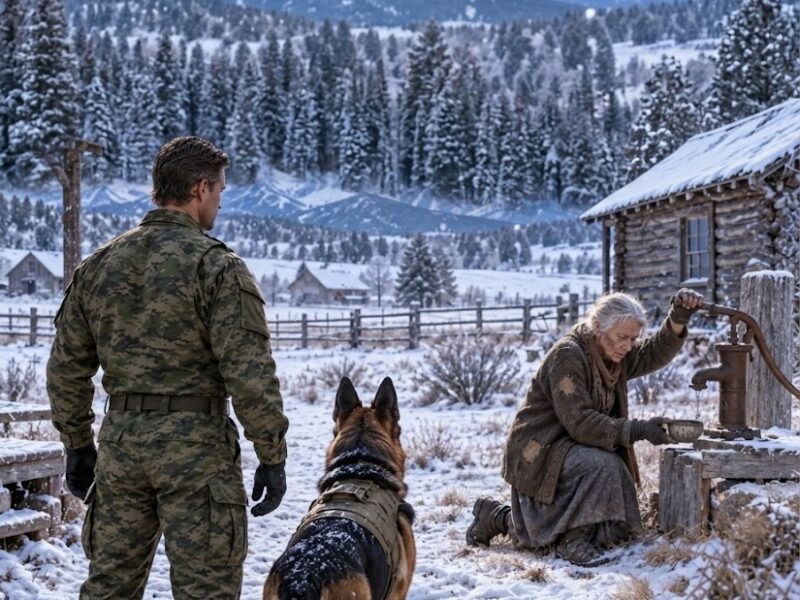
A Navy SEAL Found an Elderly Woman Collapsing Beside a Dry Well—Then She Recognized the Name on His Dog Tags
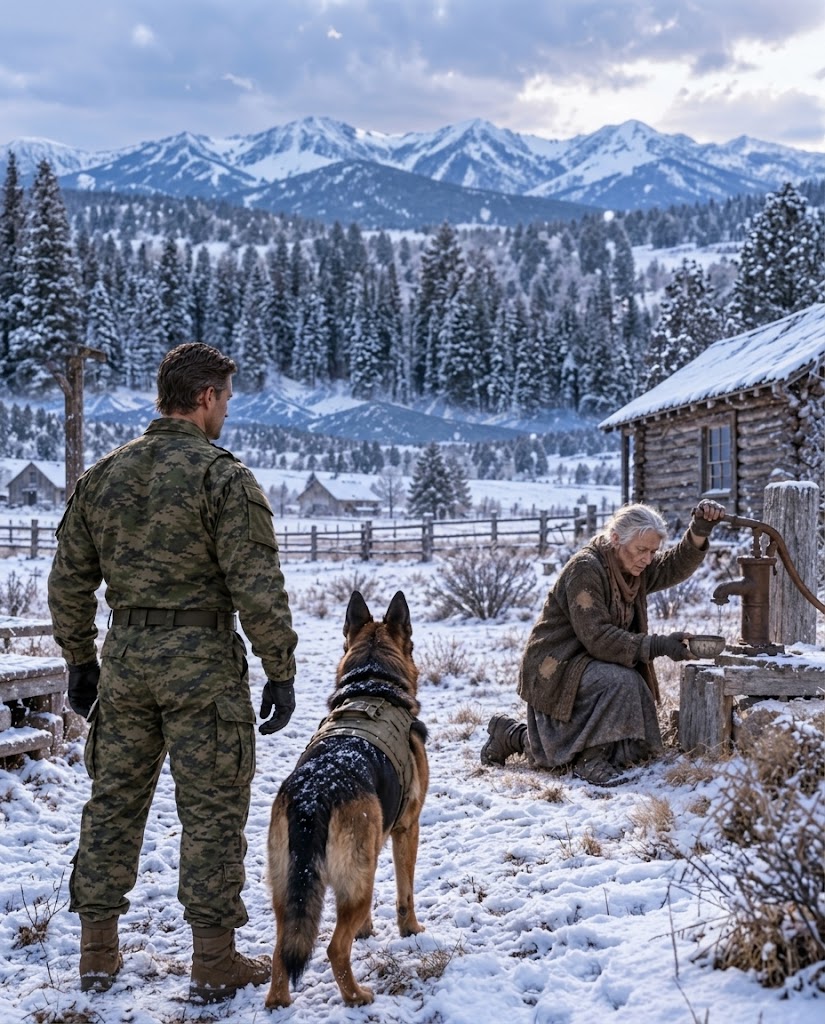
The Minnesota wind cut through the valley like a blade honed on the bones of winter itself.
It was the kind of cold that made the pine trees groan, that turned breath into ghosts, that made men who had survived deserts and jungles and oceans remember what it felt like to be truly small.
Gavin Mercer had been home for exactly forty-seven minutes when he saw her.
His mother.
Seventy-two years old, hunched beside the old hand-pump well behind the cedar-sided house where he had learned to walk, to fish, to pray. She was pushing down on the iron handle with both hands, her shoulders curved beneath a light brown wool coat that had seen better decades, her breath rising in thin white clouds.
The bucket beneath the spout was empty.
Not almost empty. Not waiting for more.
Empty.
She pumped again.
Gavin stood frozen at the edge of the driveway, his old Ford still ticking as the engine cooled, Rook already out of the truck and bounding through the snow toward her. The German Shepherd’s yellow and black coat flashed against the white like a warning.
Three drops fell.
Three.
Then nothing.
—
Gavin had spent three years away from Brightwater Hollow, Minnesota.
Three years of deployments, training rotations, temporary quarters, and assignments that kept home perpetually postponed. He was forty years old now, transitioning away from operational life as a Navy SEAL, though he had not yet decided what came afterward.
He stood six-foot-one with broad shoulders and the compact, disciplined strength of a man who had spent years training his body but had never cared about looking impressive. His face was sharply masculine—strong jaw, clean-shaven cheeks, deep-set eyes that carried a quiet sadness even when he smiled. Silver had begun threading the dark hair above his temples, though his neat undercut remained as carefully maintained as it had during active service.
He wore a fitted long-sleeved green camouflage uniform, clean and practical, with dark winter boots.
Order had become part of him long before he understood that order and peace were not the same thing.
Beside him sat the only creature who seemed equally uncertain about retirement. Rook was a six-year-old German Shepherd with a rich yellow and black coat, a dark saddle across his back, a black mask around an intelligent pair of brown eyes, and upright ears that seemed permanently tuned to a world humans could not hear.
He was powerfully built without being bulky, his chest deep, movements economical. A worn brown leather collar circled his neck, carrying a small metal tag that clicked softly whenever he turned his head.
Rook had once known helicopters, commands whispered in darkness, long waits, strange rooms, and the difference between ordinary silence and dangerous silence.
Civilian life had introduced him to stranger problems.
He still inspected doors before lying down. He still woke when Gavin shifted too quickly at night, and he still watched Gavin for orders even when there were none to give.
“You’re going to have to learn how to be bored,” Gavin had told him somewhere in South Dakota.
Rook had glanced at him.
That makes two of us.
—
The road into Brightwater Hollow had always seemed smaller in Gavin’s memories.
At forty, Gavin had learned that memory did that to places. It widened childhood rivers, deepened old winters, and made the houses of one’s youth seem large enough to contain every version of the person one had ever been.
Now the two-lane road wound beneath tall northern pines, their branches bowed beneath fresh Minnesota snow. Winter sunlight broke through them in pale golden shafts, scattering over frozen ponds and white fields until the whole valley appeared almost painfully clean.
Gavin drove with both hands relaxed on the wheel of his old Ford.
For nearly three years, he had moved between deployments, training rotations, temporary quarters, and assignments that kept home perpetually postponed.
He had spoken to his mother almost every Sunday.
Every time, Evelyn Mercer had said some version of the same thing.
I’m fine. The house is fine. Winter is winter. Don’t worry about me.
And Gavin had accepted those answers.
Perhaps because they sounded believable.
Perhaps because believing them was convenient.
—
Three miles later, the first houses of Brightwater Hollow appeared.
Nothing looked wrong.
That was almost the worst part.
Smoke rose from chimneys. Snow covered the roofs in thick white caps. The church steeple stood exactly where Gavin remembered it. A faded red barn leaned into the sunlight beside a frozen field.
The Mercer house sat near the northern edge of the village, a cedar-sided home his father had repaired one board at a time before cancer took him eleven years earlier.
Gavin slowed at the familiar mailbox.
For the first time that morning, something tightened in his chest.
Home.
He turned into the drive.
Rook stood before the truck had fully stopped.
What?
The German Shepherd’s ears went forward.
Gavin followed his gaze.
A figure stood beside the old hand-pump well near the far side of the yard.
Rook was out the moment Gavin opened the door. He bounded through the shallow snow, then stopped so abruptly that powder sprayed past his front legs.
Gavin stepped from the truck.
The woman beside the well heard them.
She turned.
—
For half a second, he did not recognize his own mother.
Evelyn Mercer was seventy-two, a naturally small woman who had once seemed indestructible to her son. In Gavin’s childhood, she had hauled firewood in one arm while carrying groceries in the other, baked for church fundraisers, patched torn coats, balanced family bills, and possessed the irritating ability to know when Gavin was lying before he finished the lie.
Her white hair was now gathered into a simple low bun. Fine lines covered her pale, gentle face, and age had softened the blue-gray eyes Gavin remembered as bright and uncompromising.
But it was her body that stopped him.
She was thin.
Too thin.
Her shoulders curved beneath an old light brown wool coat. A cream scarf was wrapped twice around her neck, and faded gloves covered hands that still looked red from the cold.
A galvanized bucket sat beneath the pump.
Evelyn pushed the iron handle down with both hands.
It groaned.
A thin trickle struck the bottom of the bucket.
Then nothing.
She worked the handle again.
Three drops.
Gavin stared.
Rook slowly approached her. His tail moved once.
Evelyn looked at the dog first, and something warm broke through the exhaustion on her face.
“Well,” she whispered, “you got bigger.”
Rook pressed his muzzle gently against her glove.
Then Evelyn looked at her son.
No accusation, no anger.
She simply smiled.
“You came home.”
Gavin had heard gunfire sound less powerful.
—
He crossed the yard and wrapped his arms around her.
She felt frighteningly light.
He held her a second longer than he normally would have.
“You should have told me.”
“I just said hello, Mom. And you’ve been here twelve seconds.”
He almost laughed. Almost.
Then he looked at the bucket.
“What happened to the well?”
Evelyn glanced at it.
“The same thing that happened to everybody else’s.”
—
That answer followed Gavin into the house.
Dinner was simple—vegetable stew, bread warmed beside the stove, and coffee Evelyn insisted was still coffee despite having been brewed with bottled water.
The kitchen had changed less than she had. Copper pans still hung beside the window. His father’s old clock still gained four minutes every month. A ceramic rooster Gavin had hated since adolescence continued guarding the top of the refrigerator with the smug immortality of ugly household decorations.
Rook settled beside the wood stove, or tried to. Every few minutes, his eyes opened when the house creaked.
Evelyn noticed.
“He doesn’t sleep much.”
“Neither do I.”
She studied Gavin across the table.
“That wasn’t what I asked.”
“It wasn’t a question.”
“Still, my son.”
There it was. The old Evelyn.
But when she lifted her mug, Gavin noticed how carefully she used both hands.
—
He asked about the water again.
This time she answered.
It had begun almost eight months earlier. At first, the wells simply ran slower. People blamed an unusually dry summer. Then autumn came and the water level continued falling. Some families installed storage tanks. Others deepened their wells where they could afford it.
By early winter, several households had almost no usable water at all.
The nearest reliable supply was more than thirty miles away.
“You drive there when you need to?”
“How often?”
“Gavin.”
“How often?”
Evelyn sighed.
“Twice a week. Sometimes three.”
He stared at her.
She looked annoyed now, which somehow made him feel better.
“You’re seventy-two.”
“Thank you for confirming it.”
“In winter.”
“I had noticed.”
“Thirty miles.”
“The road does not become longer every time you repeat the number.”
—
He leaned back. The humor vanished as quickly as it had come.
“How long have you been doing that alone?”
Evelyn looked toward the stove.
That was answer enough.
Then Gavin noticed a slight stiffness when she stood to collect their bowls.
“Sit down. I can carry two bowls. You’re limping.”
“I am seventy-two, apparently.”
“Mom.”
She stopped.
For the first time that evening, her face changed. Not weakness—embarrassment.
She had fallen six weeks earlier while dragging two five-gallon water containers from the truck. Nothing had broken. A doctor in the next town had checked her hip.
She had never told Gavin.
Something inside him turned cold.
“You should have called me.”
“And said what? That you needed me.”
Evelyn placed the bowls back on the table. Her eyes were tired but steady.
“You spent most of your life running toward people who needed saving, Gavin.”
He said nothing.
“I wasn’t going to become another name on that list.”
—
The words landed quietly.
That made them worse.
Gavin lowered his eyes.
For years, he had understood duty as distance. Go where ordered. Do what was required. Protect people whose names he might never learn. There had always been another mission, another departure, another reason that coming home could wait.
He had called his mother. He had remembered birthdays. He had sent money she rarely used.
He had somehow mistaken contact for presence.
Across the room, Rook lifted his head.
The dog looked first at Gavin, then toward the dark window.
His ears rose.
Something changed in Rook. Not fear, not aggression—attention.
The German Shepherd stood and crossed the kitchen slowly. He stopped at the back door, nose lifted toward the narrow crack along its frame.
Gavin watched him.
“Rook.”
The dog did not turn.
Evelyn frowned. “Does he need outside?”
“Maybe.”
Gavin opened the door.
Cold air entered at once. Rook stepped onto the porch and stood completely still beneath the pale porch light.
Beyond the yard stretched the northern tree line. Black pines, white ground, nothing moving.
Rook stared toward it.
Then his nose lifted higher. Once, twice.
Gavin felt an old instinct awaken. He had spent enough years beside that dog to recognize the difference between curiosity and concentration.
“What is it?”
Rook took three steps into the snow, stopped, looked back, then faced north again.
For several long seconds, neither man nor dog moved.
Finally, Gavin called him inside.
Rook obeyed, but reluctantly.
That bothered Gavin more than if the dog had barked.
—
By seven the next morning, Gavin had the well housing open.
Sunlight glittered over the yard with deceptive warmth, though the temperature remained far below freezing.
He checked what he knew how to check. The hand pump linkage had excessive play. One valve was badly worn. Ice had formed around part of the upper assembly.
None of it surprised him. The well was old.
He cleaned the mechanism, replaced a cracked seal from a box of spare hardware his father had kept, adjusted the linkage, and thawed a frozen section carefully.
Evelyn watched from the porch.
“You know,” she called, “most sons bring flowers.”
“Flowers don’t fix valves.”
“That explains why you’re single.”
Gavin looked up.
Evelyn smiled innocently into her coffee.
Even Rook seemed to glance between them.
For a few minutes, the world felt almost normal.
Then Gavin tested the pump.
The handle moved more smoothly. Water came faster for four seconds. Then the stream weakened to a thin ribbon.
Gavin pumped again.
Same result.
He crouched beside the well. The mechanism was working. The water simply was not there in the quantity it should have been.
That changed the problem.
—
He was still thinking when Rook walked past him.
The German Shepherd moved across the yard, nose close to the snow. At the northern fence, he stopped exactly where he had stared the night before.
Gavin straightened.
“Rook.”
The dog looked back, did not return.
Beyond him stood the dark wall of pines.
Gavin followed Rook’s gaze. Nothing—no animal, no person, only winter light between trees.
By afternoon, Gavin drew a glass from the well and examined it beneath the porch. Clear, no obvious sediment, no strange smell.
Rook came over, sniffed the glass once, then turned his head away toward the north again.
Gavin watched him until Evelyn called from inside.
—
That evening, he went searching for a larger wrench.
His father had once kept tools in a narrow cabinet beneath the stairs. Most were still there.
So were three white envelopes.
Identical.
Gavin pulled them out.
Each was addressed to Evelyn Mercer. Each contained a formal offer to purchase the house and surrounding acreage.
He read the numbers twice.
They were low—far below what he remembered similar land selling for years earlier.
All three offers had come during the period when the wells were failing.
At the bottom of every letter appeared the same name.
Northridge Land and Water Development.
—
Gavin carried the envelopes into the kitchen and laid them across the table.
Evelyn stopped folding a dish towel. For several seconds, she said nothing.
“You weren’t going to mention these either.”
“I said no.”
“That wasn’t my question.”
“I know.”
Gavin tapped the dates. “The first one came five months ago.”
“Yes.”
“After the water problem started.”
Evelyn looked at him, then at the letters.
“They started sending them after the wells began going weak.”
The kitchen became very quiet.
Behind Gavin, Rook was lying near the stove, but the dog was not asleep. His head was raised, his ears pointed toward the northern wall of the house.
Gavin looked at the three offers again, then toward the dark window.
For the first time since returning to Brightwater Hollow, he stopped thinking about how to repair his mother’s well.
Because perhaps the well was not the problem at all.
Perhaps it was only the first thing he could see.
—
By eight the next morning, Brightwater Hollow looked almost too beautiful to be in trouble.
Sunlight lay across the snow in broad sheets of white and gold. Chimney smoke climbed straight into a cloudless Minnesota sky, and frost jeweled every wire fence along the road. From a distance, the village looked preserved rather than wounded, as though winter had placed it carefully beneath glass.
Up close, the truth was harder to miss.
Gavin Mercer drove slowly through streets he had known since childhood, Rook sitting upright beside him in the Ford. Gavin had brought a small notebook, a thermos of coffee, and no plan beyond listening.
He had spent enough years in uniform to know what happened when a man decided on an answer before asking enough questions.
The three purchase offers he had found in his mother’s cabinet bothered him, but suspicion was not evidence.
So he began with water.
—
The first stop was a small white house near the old sawmill road.
Harold Finch, seventy-eight, opened the door before Gavin reached the porch.
Harold had been a logger for nearly forty years, and age had bent him without making him look fragile. He was tall but stooped now, with heavy forearms, a square weathered face, and a thick white mustache that seemed to collect snow whenever he stepped outside. His gray hair had thinned badly on top, though he still combed what remained with unnecessary precision.
People in Brightwater remembered Harold as blunt but dependable. After losing two fingers in a logging accident at fifty-one, he had returned to work three months later because, as he once told Gavin’s father, the trees weren’t going to feel sorry for me.
“You’re Evelyn’s boy,” Harold said.
“Been a while since anyone called me that.”
“Been a while since you were here.”
There was no cruelty in it. That made the remark land more cleanly.
—
Harold took Gavin around back. His well pump sat beneath a rough plywood shelter. Beside it stood three blue plastic water containers.
“Started slowing around June,” Harold said. “By September, I couldn’t fill the bathtub without waiting an hour between runs.”
“Anyone inspect it?”
“Had a well man from Duluth come out.”
“What did he say?”
Harold rubbed one hand over his mustache.
“Said the equipment was old, but not old enough to explain that.”
Gavin wrote it down.
Harold glanced at the notebook. “You investigating something?”
“I’m trying not to.”
That earned a short laugh. “Good luck with that.”
—
At the next house, no one answered. A moving trailer was gone from the driveway, but pale rectangles in the snow showed where boxes had recently been stacked.
Two streets farther south, Gavin passed another house with plywood over one window and a For Sale sign tilted toward the road.
Rook watched all of it from the passenger seat. The dog could not understand mortgages or property values, but he understood absence.
At every empty house, his ears shifted toward the silence inside.
—
Near the center of town, Gavin stopped beside the home of Martha Keane, a seventy-four-year-old widow with short silver curls, a round face reddened by the cold, and the careful, slightly stiff movements of someone whose knees had stopped forgiving stairs years ago.
Her husband had died six winters earlier, and since then Martha had acquired a reputation for remembering everyone’s birthday while pretending not to care whether anyone remembered hers.
She showed Gavin four sealed water jugs stacked beside her kitchen.
“Costs me almost a quarter of my pension some months,” she said. “For water and fuel to get it.”
“Anyone helping?”
She gave him a look.
“I’m old, Gavin. I’m not dead.”
He almost smiled.
Apparently, independence was contagious among women of his mother’s generation.
—
By ten-thirty, Gavin had seven names in his notebook.
Three weak wells. Two nearly dry. Two families already purchasing almost all drinking water elsewhere.
It was not enough for a conclusion, but it was too much for coincidence to feel comfortable.
—
The only hardware store in Brightwater Hollow sat across from the post office. A wooden sign over the door read Harland Supply, though the second A had faded so badly it looked like the store had spent years arguing with its own name.
Inside, everything smelled of machine oil, lumber dust, coffee, and old rubber boots.
Behind the counter stood Wade Harland, sixty-one.
Wade was broad through the chest and thick around the waist, with the durable build of a man who had spent most of his life lifting objects other people considered too heavy. His face was square and sun-browned beneath deeply creased eyes. Short gray hair stuck unevenly from beneath a dark knit cap, and a trimmed gray mustache gave him the permanently skeptical expression of someone who expected every new idea to arrive with missing parts.
He wore a brown canvas work jacket over a red and black flannel shirt, faded jeans, and boots scarred by years of salt and mud.
Wade had known Gavin since boyhood. He had also once banned seventeen-year-old Gavin from the store for trying to repair a snowmobile carburetor on the front counter. The ban had lasted forty minutes.
“Well,” Wade said, looking him over. “Government finally send you back.”
“Apparently, you complained enough.”
“I complained professionally.”
Rook wandered to the end of the counter and sniffed a box of work gloves.
Wade pointed at him. “That dog steals anything.”
“He’s paying retail.”
“He has no income.”
“Then you’re liable.”
—
The humor faded when Gavin mentioned Northridge.
Not dramatically. Wade simply stopped wiping the counter.
“They bought anything from you?”
“Everybody buys something from me.”
“That wasn’t what I asked.”
Wade looked toward the front windows.
About a year earlier, Northridge representatives had begun attending county meetings and local business gatherings. They spoke about winter tourism, infrastructure, employment, and bringing younger families back to the region.
Most people had liked the sound of it.
Then came property inquiries.
At first, residents laughed them off. Old land was not merely acreage in places like Brightwater. It was father’s fences, mother’s kitchens, trees planted at births, and graves dug behind churches.
But months passed. Water became harder to get. Feed costs rose for the few small farms left. Older residents began asking themselves how many winters they wanted to spend hauling water.
And the offers kept coming.
“Were the prices fair?” Gavin asked.
Wade gave him a humorless smile. “Depends who’s desperate.”
“Did you think anything was wrong?”
“I think plenty of things are wrong.”
“Northridge.”
Wade leaned both palms on the counter.
“I’m not saying anybody caused anything.”
“I didn’t ask you to.”
A small pause.
Then Wade said, “Sometimes one thing doesn’t look like much. Then you put five things side by side and suddenly you don’t like the picture.”
That went into Gavin’s notebook, too.
—
Brightwater Elementary sat three blocks away.
Once the school had served nearly eighty children. Now half the hooks in the entrance hallway were empty.
The woman who met Gavin near the office was Nora Bellamy, thirty-three, a teacher who had grown up two counties south and moved to Brightwater six years earlier.
She was slender, medium height, with fair skin, warm hazel eyes, and chestnut brown hair gathered into a low practical tie at the nape of her neck. She wore a navy wool coat over a cream turtleneck, dark trousers, winter boots, and carried a brown leather satchel worn smooth at the corners.
Nora possessed the calm of a person accustomed to answering ten questions while tying one child’s boot and stopping another from eating glue. But beneath that patience was stubbornness.
Brightwater’s declining population had already reduced the school staff twice. Nora had watched children disappear from classrooms one family at a time, and somewhere along the way she had begun writing things down.
—
She led Gavin into an empty classroom.
On one wall hung paintings of winter trees. Another displayed a row of paper rivers made by third graders.
Nora placed a thick spiral notebook on a desk.
“I started this for school enrollment,” she said.
Inside were household names, dates, addresses, and small notes. Moved to Duluth. Grandparents in Bemidji. Well unreliable. Installed tank. House listed. Northridge inquiry.
Gavin slowly turned the pages.
“What made you start tracking the company?”
“I didn’t.” She sat opposite him. “I tracked why children were leaving. The company kept showing up in the margins.”
That distinction mattered.
Gavin found his mother’s road. Three properties had reported severe water problems. All three had later received purchase inquiries. Another cluster farther south showed the same pattern.
Not perfectly, not universally, but enough to notice.
“How many people know you have this?”
“About the school records, the district, this notebook? Very few.”
“Why?”
Nora met his eyes.
“Because noticing a pattern is not the same as proving one.”
Gavin leaned back slightly.
He liked her answer.
—
Halfway down the next page, Rook rose from where he had been lying beneath the teacher’s desk.
He crossed the classroom without urgency and stopped beside the wall covered with children’s drawings.
One picture showed Brightwater Creek in summer. Blue water, green banks, oversized trout, and a yellow sun drawn in one corner.
Rook stared at it.
Nora smiled faintly. “Art critic?”
Gavin almost answered.
Then Rook lowered his nose to the floor beneath the drawing. A dark water stain marked the baseboard. Nothing mysterious—probably snow melt from children’s boots.
Yet beside the drawing someone had written in uneven pencil: My dad says the creek used to be louder.
Gavin read it twice.
It was probably nothing more than a child repeating an adult.
Still, the sentence caught him.
People often failed to notice something disappearing when it vanished slowly. A river, a town, a parent growing older. Sometimes absence announced itself only after it had already become normal.
Rook turned and looked at him.
For one strange second, Gavin had the uncomfortable feeling that the dog had brought him not to an answer, but to the right question.
How long had Brightwater been becoming quieter before anyone decided to listen?
—
Nora made a call that afternoon.
The woman who answered was Dr. Lena Hartwell, forty-six, a hydrologist at a Minnesota state university.
Lena appeared on Nora’s laptop with rectangular glasses, a narrow, intelligent face, light brown hair cut to her jaw, and the brisk manner of someone accustomed to explaining complex things without making other people feel stupid.
She had spent nearly two decades studying groundwater movement across northern Minnesota.
Gavin described what he had seen. Multiple shallow wells, declining yield over roughly the same period, no obvious contamination.
Lena asked about local geology, then pulled up public maps.
Brightwater Hollow, she explained, lay over an old alluvial valley formed by water and glacial deposits. Many residential wells tapped relatively shallow groundwater. That groundwater was partly replenished by precipitation and partly by exchange with Brightwater Creek.
“If creek flow stays significantly lower for long enough,” Lena said, “the local water table can fall.”
“So one source problem could affect several wells.”
“It could.”
“Does that prove that’s happening?”
“No.”
The answer came instantly.
Gavin appreciated it.
—
“What would?” he asked.
“Measurements. Historic flow data, if it exists. Well levels. Upstream comparisons.”
Nora looked toward Gavin.
For the first time, they had something better than suspicion.
A testable explanation.
—
Late that afternoon, Gavin drove with Rook to a public access point near Brightwater Creek.
The winter sun had fallen low enough to turn the snow pale amber.
Gavin remembered the creek from childhood as noisy, even beneath ice. Now it moved beneath the frozen edges in a narrow, dark ribbon.
Rook approached. He lowered his muzzle, sniffed, then stepped away without drinking.
Instead, he climbed the bank.
Gavin followed.
Thirty yards upstream, Rook stopped beside a dirty gray patch in the snow.
Gavin crouched. A faint oily sheen marked the crust.
He touched none of it.
Nearby, pressed through newer snow, ran the broad tread marks of an off-road utility vehicle. They continued north toward higher ground.
Gavin photographed the stain and the tracks with his phone.
No conclusion. No accusation.
Just two more facts.
Rook stood several yards ahead, yellow and black coat bright against the snow, ears pointed toward the trees.
Gavin slipped the phone back into his pocket.
This time he did not call the dog away.
He simply stood beside him and looked in the same direction.
—
Gavin did not follow the tracks north.
Not that afternoon.
The old part of him wanted to. That instinct had kept him alive for years—the habit of seeing a trail and wanting to know where it ended before darkness could erase it.
But Brightwater Hollow was not a battlefield, and whatever was happening here would not be solved by moving faster than everyone else.
So Gavin took photographs, recorded the location, and went home.
—
The next morning, he called Dr. Lena Hartwell.
Lena listened without interrupting while Gavin described the narrow creek, the oily residue near the bank, and the utility vehicle tracks heading upstream.
When he finished, she said, “Forget the tracks for now.”
Gavin leaned against the kitchen counter. “That was not the part I expected you to say.”
“They may matter later. But if you want to know whether the creek is losing water somewhere between the uplands and the village, measure the water.”
“How?”
“Three points. One upstream if you can legally access it. One near the middle reach. One before the creek enters the village.”
She explained a basic field method using cross-sectional measurements and current velocity. It would not replace professional instrumentation, but if done consistently, it could show whether the creek was losing an unusual amount of flow between locations.
“Take coordinates,” Lena added. “Photograph the banks. Record time and weather. Don’t make assumptions from one reading.”
Gavin almost smiled. “You say that a lot.”
“Because people enjoy conclusions more than measurements.”
“I know the type.”
“I suspect you are the type.”
That earned the smile.
—
For the next two days, Gavin and Nora worked along Brightwater Creek.
Nora arrived the first morning wearing the same navy wool coat and carrying a waterproof notebook, a measuring tape, and two pencils tucked behind one ear.
“You brought two?”
“One is for when you drop the first one in the creek.”
“I don’t drop equipment.”
“Every man says that before dropping equipment.”
Rook walked beside them, his yellow and black coat vivid against the snow, ears shifting constantly toward wind, water, and distant sounds.
At the first site, several miles north of the village, the creek still had life in it. The water moved dark and steady beneath a shelf of ice.
At the second site, the flow was weaker.
At the third, just before the creek bent toward Brightwater Hollow, it was significantly lower.
Gavin repeated the measurements, then repeated them again the next morning.
The numbers were not identical. Nature rarely offered that convenience. But the pattern remained.
A substantial amount of water was disappearing somewhere between the upper and lower reaches.
—
Nora stood over the notebook, studying the figures.
“That feels important.”
“It is enough to say something.”
“No.”
She looked up. “You enjoy disappointing people.”
“I enjoy not being wrong in public.”
“That sounds exhausting.”
“It is.”
—
They sent the measurements to Lena.
Her answer came less than an hour later. The numbers did not establish a legal diversion, but the loss was significant enough that she recommended narrowing the search area.
That changed the investigation—not into proof, into geography.
Gavin spent the afternoon at his mother’s dining table with old county maps, tax parcel maps, and public land records spread across the wood.
Rook slept beneath the window.
Evelyn passed through once, looked at the papers, then at her son.
“You used to complain when your father made you read property maps.”
“I also complained about vegetables and haircuts.”
“I still complain about haircuts.”
She touched the back of his neatly trimmed undercut.
“No, you pay somebody to give you the same one every month.”
Then she walked away before he could defend himself.
—
On one digital parcel map, the area north of the village was divided among several private owners.
One large section stood out.
Northridge Land and Water Development.
But something else caught Gavin’s attention.
A thin gray line cut through the western edge of the forest. No modern road name, no maintenance designation.
He enlarged the historical layer.
There it was. An old logging road. It appeared clearly on maps from the 1960s and 1970s and became less distinct in later records.
Gavin took the map to Wade Harland.
Wade stared at it for several seconds.
“Old Larkin Spur.”
“You remember it?”
“Everybody my age remembers it.”
“What was it used for?”
“Timber trucks. Before the mill shifted south.”
“Still open?”
Wade snorted. “Hasn’t been a proper road in thirty years. Drivable if you hate your suspension.”
“Anyone use it?”
“Hunters sometimes. Snowmobilers when they’re lost.”
Gavin tapped the upper section. “Northridge.”
Wade’s expression changed.
“Don’t know.”
“Have you seen their vehicles there?”
Wade hesitated, then shook his head.
“Not personally.”
Gavin folded the map.
That mattered, too.
Not knowing was different from pretending to know.
—
The following morning, Gavin returned to the edge of Larkin Spur.
He did not need to search long.
Fresh vehicle tracks ran through the old road. Wide tread, repeated traffic. Not one lost hunter.
Rook moved along the shoulder, sniffing where tires had cut through packed snow.
The old road had been partially cleared. Low branches had been cut. One section had fresh gravel beneath the snow.
Someone was maintaining access.
Gavin checked the property boundaries before going farther. Part of the spur crossed private land owned by a family named Carver.
He stopped.
No shortcuts.
—
By noon, he was standing on the porch of Samuel Carver, sixty-seven, the neighboring landowner whose western acreage bordered Northridge property.
Samuel was lean and rangy, about six feet tall, with a narrow angular face, pale blue eyes, and a white beard trimmed close enough to suggest he disliked mess even in retirement. His hair was thin, silver, and combed straight back.
He wore a dark green insulated work coat, brown canvas pants, and old leather boots polished more by habit than vanity.
Samuel had spent thirty-two years as a county road maintenance supervisor before retiring. That career had shaped him into a man who distrusted vague descriptions.
Roads were either passable or not. Culverts were either blocked or not. Promises, in his experience, were rarely useful unless somebody attached a date.
Gavin explained what he wanted.
“I need access to the western ridge. I’ll stay on your property.”
Samuel studied him. “What are you looking for?”
“I don’t know yet.”
That answer, I believe.
He opened the door wider.
“Coffee first.”
—
Twenty minutes later, Samuel signed a simple written permission allowing Gavin to cross his land.
He also pointed to an old ridge trail.
“Stay west of the red survey posts,” he said. “That keeps you off Northridge ground.”
“Anything up there I should know about?”
“Ice under pine needles, and if Rook runs after a deer, I’m keeping the dog.”
Rook looked at him.
Samuel looked back.
“I think he understands contracts.”
—
The ridge climb took nearly an hour.
From the west, the forest rose gradually, then broke into exposed granite shelves overlooking the upper watershed.
Gavin used binoculars from behind a cluster of spruce trees.
At first he saw nothing unusual.
Then the landscape resolved.
Below, near the creek, stood an old concrete control structure—small, weathered, half hidden by brush and snow. Gavin recognized the type from photographs and local erosion control reports. It was not a dam in the dramatic sense, more like a low regulation barrier designed decades earlier to slow runoff and protect stream banks.
That part fit the public history.
But something newer ran behind it.
A steel pipeline, fresh enough that the metal still reflected light through patches of snow. It emerged from the rear side of the control structure and disappeared northeast through the trees.
Gavin adjusted the binoculars.
The pipe was too large to be a temporary hose, too deliberate to be debris. A compact pump housing stood nearby.
No workers were visible. No active vehicles. Nothing cinematic.
That made it more troubling.
The structure looked almost ordinary, as if it belonged there.
—
Then Rook changed direction.
The German Shepherd had been lying beside Gavin, calm but alert. Without warning, he stood—not toward the structure, away from it.
Rook moved six yards along the ridge and stopped beside an old cedar. His nose worked rapidly.
Gavin followed.
A fresh-cut pine branch lay partially buried beneath snow. Nothing strange by itself.
But beside it stood a weathered wooden marker, almost completely hidden.
Samuel’s old red boundary paint was still visible beneath newer gray overspray.
Gavin crouched.
The newer paint had not erased the old line perfectly. Someone had tried to make the marker blend into the trees.
He checked his GPS. They were still on Carver property. The legal boundary lay dozens of yards east.
Gavin stared at the marker.
It might have been meaningless—a mistake, a surveyor’s shortcut, a hunter’s work.
But for the first time, a different possibility entered his mind.
What if the easiest way to hide activity was not to hide the machinery?
What if it was to make people uncertain about where they were allowed to look?
Rook sat beside him.
Gavin rested one hand on the dog’s shoulder.
“Good catch.”
Rook sneezed.
The moment became less mystical.
That helped.
—
From the ridge, Gavin photographed only what he could clearly see from Samuel’s land—the old control structure, the pump housing, the pipeline disappearing northeast, the access track.
He recorded his position with each image.
Back at the house that evening, he searched public permitting databases.
After nearly two hours, he found a filing submitted by Northridge eighteen months earlier.
The project description read: Bank stabilization and restoration of existing erosion control infrastructure.
The approved work referenced repair of the old control structure, vegetation management, limited access road rehabilitation, minor drainage improvements.
Gavin read the permit twice.
Nothing in the public description referred to a new steel pipeline capable of carrying substantial water northeast.
That absence mattered—but only as a question, not yet as an answer.
He sent the filing and photographs to Lena.
Her response was careful.
The pipe might serve several legitimate purposes. Temporary bypass, drainage stabilization, construction support. Without specifications, she could not determine function from photographs alone.
Again, Gavin appreciated the restraint.
It would have been easier if everyone simply agreed with him.
Truth rarely worked that way.
—
The next afternoon, he and Rook returned down Samuel’s ridge trail.
Halfway back, Rook stopped beside a sagging section of wire fence.
Something dark hung from a low branch. The dog sniffed it repeatedly.
Gavin pulled it free.
A work glove. Heavy synthetic leather, damp from snow. On the back was a stitched logo.
Northridge Land and Water Development.
He turned it over. No name, no date, no miracle.
A worker dropping a glove proved little more than a worker had been there.
But the location mattered. It lay well west of the company’s visible work area near the old access route.
Gavin photographed it where it had been found, then left it hooked back on the branch.
Rook watched him.
“Not evidence worth stealing,” Gavin said.
The dog wagged once.
—
Nora was waiting at Evelyn’s house when he returned.
She had a folded county notice in her hands.
“I found something.”
The notice was nearly a year old. Most residents would have skimmed it and forgotten it.
Northridge had submitted a preliminary planning proposal for an eco-resort development northeast of Brightwater Hollow.
That was interesting.
The attachment was more interesting.
A separate application requested exploratory review for commercial groundwater extraction on adjacent property.
Gavin laid the document beside the parcel map.
The resort site. The water exploration area. The new pipeline. The weakened village wells. The property buying activity.
Placed separately, each fact had another possible explanation.
Placed together, they began to form a shape.
—
Nora watched him.
“If they could control water over there—”
“Don’t finish that sentence.”
She frowned. “Why?”
“Because we don’t know that they do. We know they’re trying to develop the land.”
“Yes.”
“We know they’re exploring commercial water extraction.”
“Yes.”
“We know people here are selling because they can’t afford to live without water.”
“Yes.”
“And you saw a pipeline?”
“Yes.”
Nora folded her arms. “So you’re saying I’m not allowed to think?”
Gavin looked at her.
“I’m saying knowing something could be true isn’t the same as proving it is.”
For a moment, Nora stared at him.
Then one corner of her mouth lifted.
“You sound like a very difficult teacher.”
Gavin leaned back in the chair.
“I sound like someone who stayed alive long enough by not guessing.”
Rook was stretched beneath the table, entirely uninterested in the philosophy of evidence.
Then somewhere beyond the house came the faint growl of a truck climbing the northern road.
The German Shepherd’s head rose immediately. His ears turned toward the sound.
Gavin looked at the map one more time.
He still did not know what Northridge was doing.
But now he knew exactly where the questions were beginning to gather.
—
By the time Dr. Lena Hartwell arrived in Brightwater Hollow, Gavin had stopped thinking of the problem as a mystery.
Mysteries invited imagination. What they needed now was a record.
Lena arrived just after sunrise in a dark university utility vehicle carrying two hard equipment cases, a laptop bag, and the same expression she had worn during their video calls.
Alert, unsentimental, and mildly suspicious of anyone who used the phrase obviously true.
In person, she was taller than Gavin had expected, around five-eight, slender without looking delicate. At forty-six, she had a narrow, intelligent face, fair skin reddened slightly by the northern cold, and light brown hair cut cleanly along her jaw. Thin rectangular glasses sat over gray-green eyes that seemed to evaluate distances even during ordinary conversation.
She wore a charcoal winter parka over a dark turtleneck, weather-resistant field pants, sturdy hiking boots, and thin insulated gloves that allowed her to handle instruments without losing dexterity.
Lena had spent nearly twenty years studying groundwater systems across northern Minnesota. She was patient with people, impatient with unsupported certainty, and had developed the habit after watching communities spend thousands of dollars correcting the wrong water problem simply because someone had chosen a convenient explanation too early.
She set her equipment on Evelyn’s kitchen table.
“Where are your records?”
Gavin pointed to three folders.
“Good.”
“No hello?”
“I drove two hours before coffee.”
Evelyn appeared behind him carrying a mug.
Lena looked at it, then at Evelyn. “I may have underestimated this household.”
“You’re not the first,” Evelyn said.
—
Within thirty minutes, the dining room became a temporary field office.
Nora arrived with photocopies of old household records voluntarily provided by residents. Gavin had organized well complaints by date. Lena brought regional precipitation data, aquifer maps, historic stream flow records, and the measurements Gavin and Nora had taken earlier.
Nothing looked dramatic.
That was the point.
Lena began eliminating explanations.
The previous summer had been somewhat dry, but not dry enough to account for the scale of decline reported across Brightwater Hollow.
Several wells were old, but not all of them. Three newer wells showed nearly the same pattern as houses using systems installed decades earlier.
Equipment failures could explain individual households. They could not easily explain dozens of properties declining across the same period.
—
By noon, Lena had drawn a rough diagram of the valley.
Brightwater Creek entered from higher ground, crossed permeable deposits of sand and gravel, and interacted with the shallow groundwater system beneath much of the village.
She tapped the page with one gloved finger.
“The village is not sitting over one giant underground bathtub.”
Nora smiled. “That was almost exactly how I pictured it.”
“Most people do. Groundwater is less cooperative.”
Lena pointed to several zones. “What matters is recharge. Water entering the system. Your well levels suggest that recharge changed significantly.”
Gavin stood behind her. “Because of the creek?”
“Possibly, in large part. And the flow loss we measured is consistent with it.”
Nora leaned forward. “So someone is taking the water.”
Lena looked at her.
“No.”
The word was firm without being harsh.
“What we can say is that water is leaving or failing to enter the local system in quantities large enough to matter.”
She turned the diagram around.
“That proves water is disappearing from where Brightwater normally receives it.”
A pause.
“It does not prove who is taking it.”
Gavin nodded.
Exactly the distinction he wanted preserved.
—
Nora spent the afternoon on a different kind of evidence.
She had taken her original school notebook and begun comparing its dates against publicly recorded property contacts and copies of purchase offers residents agreed to share.
The first pattern emerged around one neighborhood south of the church. Four wells had reported severe decline within a six-week window. Within the next two months, three of those households received unsolicited purchase offers.
Then Nora checked another cluster closer to the western fields. Again, the water problems came first, then offers.
The amounts changed, too.
Nora placed three copies beside each other. “The later one is lower.”
Gavin looked. She was right.
One property had received an initial offer, refused it, then received another four months later after its well yield worsened. The second offer was almost eighteen percent lower.
“That could still be normal negotiation,” Gavin said.
“I know.” Nora slid another pair forward. “Then here. Same pattern. And another.”
Not every property fit. Some had received no offer. Some offers had come through brokerage firms rather than directly through Northridge.
But when Nora checked company registration records, two of those firms listed mailing addresses connected to businesses that had previously represented Northridge development projects.
Again, not proof of wrongdoing.
But increasingly difficult to ignore.
—
Lena looked over the table. “You’re building correlation.”
Nora sighed. “I’m beginning to hate that word.”
“You’ll hate causation more.”
Gavin almost smiled.
—
Wade arrived after dark.
He did not come through the front door immediately. Gavin saw his truck parked outside for almost two minutes before the older man finally stepped out.
When Wade entered, he kept his brown canvas jacket on.
That told Gavin more than the expression on his face.
A man planning to stay took off his coat.
A man uncertain whether he should have come left it on.
Evelyn poured him coffee anyway.
Wade stood beside the dining table, eyes moving over the maps.
“You’ve got enough paper here to kill a forest.”
“Sit down,” Gavin said.
Wade did not.
Instead, he looked at Lena. “You the water expert?”
“Hydrologist.”
“That sounds more expensive.”
“It usually is.”
Wade gave one humorless breath through his nose.
Then he turned to Gavin.
“There’s something I didn’t tell you.”
Nobody interrupted.
—
Six months earlier, Wade had been closing Harland Supply shortly before eleven when several trucks passed through the village heading north.
Not pickups. Flatbeds.
One carried sections of large-diameter pipe. Another carried what Wade believed was pumping equipment, because he had sold and serviced smaller versions for agricultural customers.
“You recognize the equipment enough to know it wasn’t lumber.”
“Where did they go?”
“Toward Larkin Spur.”
“How many nights?”
Wade looked down. “Three that I saw.”
Nora stopped writing. “Why didn’t you tell anyone?”
Wade’s jaw tightened.
Northridge purchased fuel, fasteners, winter gear, hoses, and other supplies from businesses throughout the county. They had purchased from him, too. His store still carried debt from a renovation after the roof collapsed three winters earlier.
“You ever owe a bank money?” Wade asked Gavin.
“Yes.”
“Enough that losing ten percent of your business could decide whether you still own the front door?”
“No.”
“There you go.”
His voice held no pride in the admission, only fatigue.
“I had no proof they were doing anything wrong, and I wasn’t about to become the town lunatic yelling about trucks in the dark.”
Gavin could see what Wade expected. Judgment, maybe anger.
He gave him neither.
“What do you know now that you didn’t know then?”
Wade looked at him.
That question seemed to unsettle him more than blame would have.
He slowly removed his coat, then sat down.
—
Two evenings later, Gavin found Evelyn sitting alone at the kitchen table.
Not the dining table covered in evidence. The small kitchen table where his father had once eaten breakfast before dawn.
She had placed a stack of receipts in front of her. Water purchases. Gasoline. A pharmacy receipt.
Gavin recognized the medication. Pain relief.
“You kept these.”
“I keep everything.”
“I thought Dad was the hoarder.”
“He kept broken hinges. I keep useful paper.”
Gavin began sorting by date. The fuel costs rose as the water crisis worsened.
Then he reached the pharmacy receipt from six weeks earlier.
His hand stopped.
The date matched the fall she had told him about.
He imagined her in the driveway alone, snow under her boots, two full water containers, no one close enough to hear if she had broken something instead of merely bruising herself.
Anger rose in him. Not at Northridge. Not yet.
At himself.
“I should have been here.”
Evelyn continued folding another receipt. “You weren’t.”
“I know.”
“You had your work.”
“That doesn’t make it better.”
“No.”
Her agreement surprised him.
Then she looked up.
“But don’t make me evidence that you failed.”
—
He stared at her.
Evelyn’s face was softer than it had been in his childhood, but the woman inside it had not weakened.
“I lived three years without you standing in this kitchen,” she said. “Some of those years were difficult. Some were fine. I’m your mother, Gavin. Not a mission you came home too late to complete.”
His throat tightened.
“What am I supposed to do with that?”
“Stay long enough to stop asking what you’re supposed to do.”
For several seconds, neither spoke.
Then Rook came into the kitchen carrying one of Gavin’s gloves.
He placed it directly in Evelyn’s lap.
She looked down. “So much for loyalty.”
Gavin watched his mother laugh, and something in him shifted.
He had spent days treating Brightwater like a problem to solve.
Maybe home required another skill entirely.
Presence.
—
The next afternoon, Rook gave them a new lead.
Wade had asked Gavin to help move several bags of salt behind the supply store. Beyond the rear lot, the ground sloped into a shallow depression choked with brush and snow.
Rook disappeared behind an old shed.
A minute later came the unmistakable scrape of paws against frozen soil.
“Rook.”
The dog ignored him.
Wade walked over. “He digging up my property?”
“Apparently.”
“I’m billing him.”
They found Rook pawing snow away from a rusted iron stake.
Wade stared at it, then stepped closer.
“Well, I’ll be damned.”
“You know it?”
“That’s not a property pin.”
Wade crouched. “Old timber flume marker.”
Gavin looked at him.
Wade explained that decades earlier, before modern logging roads became common, timber operators had used shallow engineered channels and drainage cuts to control runoff and move water along parts of the logging tract. Most had been abandoned. Some had filled naturally. Some had disappeared beneath vegetation.
Wade pointed northeast. “This one ran that way.”
Gavin felt the shape of the landscape changing again.
The direction aligned closely with the pipeline he had seen from Samuel Carver’s ridge.
—
They brought Lena out before disturbing anything else.
She examined the marker, then searched historical forestry maps on her laptop. After nearly an hour, she found a faint line—an abandoned channel running northeast from near the old erosion control structure.
“Could Northridge use this?” Gavin asked.
Lena considered carefully.
“Not without work. But if sections were still intact, rehabilitating an old channel would require far less visible construction than building a new one.”
There it was.
The first explanation that made the absence of a giant hidden project make sense.
Perhaps Northridge had not constructed an enormous secret water system.
Perhaps they had only repurposed pieces the landscape had already forgotten.
—
That evening, Rook returned to the old iron marker alone.
Gavin found him standing over the exposed stake as snow began to fall.
The dog was not digging now. He simply stood there, nose lowered, listening.
Beyond the depression lay woods planted by men who were dead before Gavin was born. Beneath those woods, an abandoned channel cut through frozen ground.
Gavin rested a hand on Rook’s back.
For years, he had trusted the dog to notice what men concealed deliberately.
Here, Rook seemed to be doing something stranger.
He was noticing what time itself had hidden.
Gavin looked toward the trees.
Sometimes the past did not stay buried because it wanted to haunt anyone.
Sometimes it remained because one day somebody would need it again.
Rook turned toward him, then sneezed snow from his nose.
Whatever solemn meaning Gavin had assigned to the moment disappeared immediately.
“Thanks,” he muttered.
Rook wagged his tail.
—
The final piece arrived from Nora that night.
She came into the Mercer house with cold-reddened cheeks and several printed property records tucked beneath her arm.
“I checked option agreements.”
Gavin moved the hydrology maps aside.
Northridge had acquired purchase options or preliminary rights on multiple parcels around Brightwater Hollow.
That alone was legal. Development companies did it all the time.
But the dates were significant. Several agreements had been signed before the village’s water decline became severe. Some predated the first widespread well complaints by months.
Nora placed the map beside them.
Many of the optioned parcels clustered near Northridge’s proposed development zone. Others bordered properties now suffering from serious water problems.
Wade stared at the page. “They were betting on this place before everybody else started betting against it.”
Nobody answered.
Gavin looked at Lena. “Could be ordinary speculation.”
“Yes.”
Nora exhaled sharply. “Everything could be something else.”
“That’s why evidence takes time,” Lena said.
Gavin studied the dates. Northridge publicly described Brightwater as an aging community with declining infrastructure. Privately—or at least financially—they had positioned themselves to acquire more of it before the water crisis became obvious.
That fact did not prove anyone had intentionally harmed the village.
But it created a question Gavin could no longer ignore.
If Northridge truly believed Brightwater Hollow was becoming worthless because its water was disappearing, why had they worked so hard to own more of it before everyone else realized the same thing?
—
By the end of the week, Brightwater Hollow had discovered something Gavin Mercer had learned years earlier in uniform.
Information never stayed still.
It moved through kitchens, church steps, gas pumps, school parking lots, and the narrow aisles of Harland Supply. It changed slightly every time someone repeated it.
By Saturday morning, some people were saying the creek had been deliberately drained. Others claimed Northridge had already been caught breaking state law.
Neither was true.
Gavin disliked rumors because they made people feel certain before certainty had been earned.
But stopping them was impossible.
The harder problem was deciding whether Brightwater still had enough trust left to hear the truth.
—
He discovered the answer outside the post office.
A man Gavin vaguely remembered from childhood was fastening a tarp over furniture in the bed of a pickup. His wife carried boxes from a nearby house while two children waited inside the truck.
They were leaving.
Gavin offered to help with the heavier pieces. The man refused politely. Then he recognized Gavin.
“You’re Evelyn’s son.”
“Gavin, I know.”
His name was Daniel Rusk, forty-two, a mechanic from the southern end of Brightwater. He was a stocky man with broad hands, dark blonde hair cropped close to his head, and a tired, square face covered by two days of pale stubble. His blue eyes looked older than the rest of him.
He had spent fifteen years repairing farm equipment and snow plows, which had given him a practical temperament and very little patience for theories that could not pay bills.
His wife, Kelly Rusk, thirty-nine, was a slim woman with shoulder-length auburn hair and a freckled face made pale by exhaustion. She worked part-time at a dental office thirty miles away and had spent the last six months carrying laundry to her sister’s house because the family well could no longer support four people.
“Going far?” Gavin asked.
“Duluth. For good.”
Daniel tightened the rope harder than necessary. “We can’t keep waiting.”
Gavin hesitated. “We may finally be getting somewhere.”
Daniel looked at him.
Something in the man’s face hardened.
“That’s easy for you to say.”
Gavin remained still.
Daniel glanced toward the Mercer road. “You came back a few weeks ago. If Northridge starts suing people or the state takes a year to decide anything, you can leave again.”
Kelly quietly said his name, but Daniel continued.
“We have a mortgage, two kids, no water. You get to make this a fight because you don’t have to live with it if the fight goes bad.”
The words were unfair in places.
They were also true in others.
Gavin could have defended himself. He did not.
Three years away had consequences no explanation could erase.
“I understand,” he said.
Daniel shook his head. “No. You understand now.”
Then he climbed into the truck.
Gavin watched the family drive south through the white morning.
Rook sat beside him, his yellow and black body still, dark ears following the disappearing vehicle.
Gavin had spent much of his life believing courage meant moving toward danger.
Brightwater was teaching him that sometimes courage belonged to people who could not leave the danger behind.
—
That evening, Nora Bellamy organized a meeting at the Mercer house.
Not a rally. Not an accusation.
Just information.
Twelve people came.
Harold Finch took the chair closest to the stove. Martha Keane arrived carrying cookies she insisted were for everyone except Wade, which meant Wade ate three before the meeting started. Samuel Carver came with a folded road map under one arm. Lena Hartwell sat near the dining table with a stack of technical notes.
Wade stayed near the wall at first, arms crossed inside his brown canvas jacket.
Evelyn poured coffee.
Rook moved from person to person with the solemn responsibility of a host who had contributed nothing to preparation.
—
Gavin stood beside a large sheet of paper Nora had taped to the wall.
He had divided it into three columns.
Confirmed. Unconfirmed. Needs expert review.
Harold squinted. “That your military system?”
“No.”
“Looks military.”
“It’s three columns, Harold.”
“Government loves columns.”
A few people laughed. The tension lowered slightly.
Gavin began.
Confirmed. Multiple wells across Brightwater Hollow had declined over approximately the same period. Measured stream flow decreased significantly between the upper and lower sections of Brightwater Creek. Northridge owned or controlled property near the area where the decline occurred. Northridge had repaired existing erosion control infrastructure. A newer pipeline existed near that infrastructure. Northridge had also pursued real estate interests around the valley.
Then Gavin moved to the second column.
Unconfirmed. Whether Northridge was diverting water illegally. Whether the pipeline caused the village’s groundwater decline. Whether property acquisitions were connected intentionally to water shortages. Whether anyone had committed a crime.
Someone near the back muttered, “Then what do we actually have?”
Lena answered before Gavin could.
“A reason to keep checking.”
The room became quiet.
That answer did not satisfy everyone, but it was honest, and honesty was beginning to matter more than certainty.
—
Rook found an old tennis ball beneath the sofa halfway through the meeting.
No one knew how long it had been there.
The German Shepherd carried it directly to Harold.
Harold looked down. “No.”
Rook dropped it onto his boot.
“I said no.”
Rook stared at him.
Martha leaned across the room. “He’s figured out you’re the weakest.”
Harold threw the ball.
Rook raced after it.
The room laughed.
Five minutes later, the ball rolled beneath Nora’s chair. Ten minutes after that, it landed beside Lena’s equipment case.
By the time Rook pushed it toward Wade, even Gavin had stopped pretending the meeting was entirely serious.
Then Rook noticed Wade’s glove hanging from the back of a chair.
He lifted it carefully by two fingers of leather, carried it across the room, and placed it on Wade’s boot.
Wade stared down at him. “You stealing from my store again?”
Rook’s tail moved.
For the first time in several days, Wade laughed openly.
Not a polite chuckle. A real laugh.
Evelyn watched him from the kitchen doorway.
For one short moment, the water crisis disappeared.
There were only neighbors in a warm house. Bad coffee, old grudges, cookies, and a dog convinced humans required constant supervision.
Perhaps communities did not recover all at once.
Perhaps they first remembered how to sit in the same room.
—
Then someone knocked at the front door.
Three firm knocks.
Every conversation stopped.
Rook’s behavior changed instantly. The playful dog vanished. His body became still, head level, ears forward.
Gavin crossed the room.
“Rook, stay.”
The German Shepherd obeyed, though his eyes remained fixed on the entryway.
When Gavin opened the door, a stranger stood beneath the porch light.
The man appeared to be in his late forties. He was medium height, perhaps five-ten, and thinner than his heavy winter coat initially suggested. His face was narrow and bony, with hollow cheeks, deep-set brown eyes, and faint shadows beneath them that made exhaustion look permanent.
Dark hair, heavily threaded with gray, was cut short but unevenly, as though grooming had become something he remembered only when necessary. A day’s stubble covered his jaw.
He wore an old blue-gray industrial jacket over a charcoal sweater, dark work pants, and scuffed safety boots. He held a rectangular document case against his chest.
“My name is Eli Cross.”
Gavin waited.
The man swallowed.
“I worked for Northridge.”
Behind Gavin, the house had become completely silent.
Eli looked past him and saw the gathering. For a second, he seemed ready to leave.
“I can come back.”
Gavin stepped aside.
“You already came this far.”
—
Eli entered.
Rook approached slowly, not threatening, assessing.
Eli stopped and let the dog choose the distance.
That small decision registered with Gavin.
Rook sniffed the man’s boots, then stepped away.
Eli exhaled.
“I helped maintain the Brightwater control site.”
No one laughed after that.
—
Eli Cross had spent twenty-three years working around industrial pumps, drainage systems, and mechanical controls.
He had not begun his career with Northridge. For sixteen years, he worked for municipal contractors, maintaining storm water equipment and rural pumping stations. After his divorce and the financial strain that followed, Northridge had offered better pay and steady benefits.
Eli had accepted.
He was quiet by nature, careful with language, and uncomfortable being the center of attention. Months of carrying something he believed he should have spoken about earlier had made those traits worse.
He paused before almost every answer, not because he was inventing one, but because he seemed afraid of saying more than he could defend.
“I’m not here to tell you they plan to destroy the town,” Eli said.
Gavin nodded. “Good.”
That surprised him.
Gavin pointed to a chair. “Tell us what you actually know.”
—
Eli opened the case.
The original permit work had been legitimate. Northridge had authorization to repair the aging control structure and stabilize damaged portions of the creek bank.
Then the scope changed internally.
A secondary line was installed. Its project label was bland enough to disappear inside any engineering document.
East stabilization feed.
“What did it stabilize?” Lena asked.
Eli gave her a tired look. “That depends which meeting you were in.”
He removed a technical drawing.
The line connected the control structure to infrastructure extending northeast.
Eli had retained copies of documents he had been legally issued as part of his work package. Drawings, maintenance schedules, flow summaries, and email chains in which he was a recipient.
He had kept them when he resigned four months earlier.
“Why?” Nora asked.
Eli rubbed one thumb along the edge of the folder.
“Because by then I didn’t trust myself to remember things correctly.”
“Why did you resign?”
A long silence.
“My supervisor changed an operating schedule after I complained about downstream readings.”
“Changed illegally?”
“I don’t know.”
That answer mattered.
—
Eli continued.
He had noticed that the east stabilization feed sometimes operated at much higher flow rates than he believed necessary for erosion control purposes. When he questioned it, he was told the system was supporting broader site stabilization.
Then came an email.
Lena read it first.
One line referred to accelerating acquisition in distressed parcels.
Nobody spoke.
“That doesn’t say water caused the distress,” Gavin said.
“No,” Eli replied.
Another email was more troubling. It directed staff to maintain elevated transfer rates during a period that overlapped with a planned round of property outreach in Brightwater.
Still not a confession.
No one wrote that residents should be deprived of water. No one explicitly tied the operational instruction to forcing sales.
But now technical operations, property acquisition dates, declining wells, and Northridge’s expansion plans occupied the same timeline.
For the first time, they were no longer merely adjacent suspicions.
There was a documented bridge between departments.
Eli closed his eyes briefly. “I should have said something earlier.”
Wade looked at him from across the room.
“Yeah.”
The answer was blunt.
Eli nodded. “I know.”
Wade stared at him another moment, then looked away.
Perhaps one frightened man recognized another.
—
Gavin did not celebrate.
He called the county sheriff’s office.
An hour later, Deputy Clare Rowan arrived.
Clare was thirty-eight, tall and athletic, with a straight-backed posture that suggested discipline without performance. Her face was angular, with high cheekbones, a strong nose, and sharp gray-blue eyes accustomed to noticing who spoke first and who avoided speaking at all.
Dark brown hair was pulled tightly into a low knot beneath her winter cap. She wore a dark county winter uniform under a heavy-duty coat, polished black boots, and a standard equipment belt.
Clare had served in the sheriff’s department for fourteen years. Early in her career, she had watched a poorly handled property investigation collapse because witnesses exaggerated claims before investigators secured records.
Since then, she had become almost irritatingly procedural.
That made Gavin trust her faster.
—
She spent nearly an hour reviewing what Eli had brought.
She asked where each document came from, who originally possessed it, whether it had been modified, whether Eli still had access to company systems.
He did not.
“Good,” Clare said.
She did not want him trying to obtain anything else.
Lena explained the hydrology. Nora explained the property timeline. Gavin explained only what he had personally observed.
Clare finally closed the folder.
“I’m sending copies of the water-related material to the state resource office.”
Nora leaned forward. “You believe us?”
Clare looked at her.
“I believe the documents need review.”
Not the answer people wanted.
Probably the answer they needed.
She turned to Gavin.
“If this is what it looks like, the best thing you can do now is not ruin it by trying to do our job.”
—
Years earlier, Gavin might have disliked the instruction.
Tonight, he understood it perfectly.
He had been trained to move when other people froze, to enter dangerous places, to act before hesitation became catastrophe.
But this was not that kind of mission.
Northridge could not be defeated by Gavin proving he was braver than its employees. The truth needed a chain of custody, experts, records, witnesses willing to stand behind what they knew.
He looked around the dining room.
At Eli, exhausted from months of silence. At Wade, who had finally admitted fear. At Nora and Lena bent over documents. At Evelyn pouring fresh coffee as though truth itself required hospitality.
Rook lay beside her chair, finally asleep despite the strangers in the room.
Gavin understood something then.
Sometimes discipline meant going through the door.
And sometimes the hardest discipline of all was knowing when to stop at the threshold and let the right people take the next step.
—
The storm announced itself three days before it arrived.
Not with snow, but with temperature.
Brightwater Hollow spent one afternoon under weak sunshine that softened the crust along the roads. By evening, water dripped from barn roofs.
Before dawn the next morning, the temperature plunged almost thirty degrees, locking every puddle beneath a fresh sheet of ice.
Dr. Lena Hartwell disliked the pattern immediately.
She stood at Evelyn Mercer’s dining table with regional weather data open on her laptop while Gavin studied a topographic map beside her.
“Freeze, thaw, hard freeze,” Lena said. “That’s when ice lies to you.”
Gavin looked up. “Ice lies?”
“It looks solid after the surface refreezes. Underneath, flowing water may already have opened cavities.”
North of the village, the situation carried another risk.
If the east stabilization feed was still operating at elevated volume, the eastern holding area identified in Eli Cross’s engineering records could receive more water than its winter drainage system was designed to handle.
“If that happens during heavy snow,” Gavin asked.
“Possibly nothing.”
Lena tapped the map. “Possibly overflow.”
That was the problem with responsible experts, Gavin thought. They rarely gave satisfying answers.
They gave accurate ones.
—
By evening, the National Weather Service warning had become visible reality.
Snow moved across the valley in long horizontal bands, erasing fences, roads, and distant tree lines until Brightwater seemed to shrink into the few warm rectangles of light glowing from its houses.
Gavin stayed home.
That mattered.
A younger version of himself might have considered the storm an opportunity to check the northern site while visibility was poor. But Deputy Clare Rowan’s instruction remained clear.
Do not interfere. Do not trespass. Do not compromise an investigation that had finally reached people with legal authority to act.
So Gavin stacked firewood, checked the generator, filled water containers, and made sure Evelyn had everything she needed.
At ten, she found him testing the back door latch for the third time.
“It was locked the first two times.”
“I know.”
“Then this must be recreational.”
Gavin looked at her. “You want the power to go out?”
“No.”
“Then stop making fun of the man responsible for the generator.”
“I raised the man responsible for the generator.”
She walked away before he could win.
—
Rook lay near the wood stove.
The six-year-old German Shepherd appeared asleep, his yellow and black body stretched across the warm floor, but Gavin knew better. One ear remained tilted toward the house, the other toward the wind.
At midnight, the storm intensified.
By one-thirty, snow had built halfway up the porch steps.
At 2:07 a.m., Rook stood.
No bark. No growl. He simply rose so quickly that Gavin woke on the sofa before fully understanding why.
The dog faced the northern wall, rigid, listening.
Gavin sat up. “Rook.”
The German Shepherd walked to the back door, then stopped. His ears shifted forward.
Gavin heard only wind at first. He crossed the room and waited.
There—far beyond the house—a low mechanical hum. Steady. Deep enough to almost disappear beneath the weather.
A pump. Or something close to one.
—
Gavin checked the time and called Clare.
She answered on the fourth ring.
“What?”
“I can hear machinery north of the village.”
A pause. “From your house?”
“Barely.”
“Stay there.”
“I am.”
Another pause, as though she had expected an argument.
“That’s new.”
“Personal growth.”
Clare ignored that. “The state water office has a storm response contact already monitoring the drainage concern Lena flagged. I’ll call them.”
The line ended.
Gavin looked down. Rook remained at the door.
“Don’t look disappointed.”
The dog did not move.
—
Forty minutes later, Clare called back.
An overflow report had come in from a county drainage sensor east of Northridge property. The state wanted to inspect. They also wanted someone familiar with the older ridge approach and drainage cuts.
Clare added, “That means geography, Mercer. Not heroics.”
“I know the difference.”
“I’m beginning to believe you.”
—
By 3:30, Gavin was standing at a designated public access point north of Brightwater.
Rook stood beside him.
Clare arrived in a sheriff’s utility vehicle with two county rescue personnel.
The first was Marcus Hale, forty-four, a broad-shouldered volunteer rescue captain with a shaved head, a square dark brown face, and a short black beard touched with gray at the chin. Marcus wore a high-visibility winter rescue shell over insulated work gear.
A former lineman, he had joined county rescue after losing a co-worker in an ice-related accident twelve years earlier. The loss had made him unusually strict around frozen water.
Beside him was Tessa Boone, twenty-nine, a paramedic with a compact athletic build, pale skin, green eyes, and strawberry blonde hair braided beneath a wool cap. She was quick without being reckless and spoke with the economical calm of someone accustomed to keeping frightened people focused on the next useful action.
The state representative arrived last.
Aaron Pike, fifty-two, worked as a field compliance officer for Minnesota’s water resources division. He was lean, medium height, with a long weathered face, thinning sandy-gray hair, and wire-framed glasses that repeatedly fogged when he pulled his scarf too high.
He had spent twenty-four years inspecting rural water systems and had acquired the mildly irritated demeanor of a man who trusted calibrated meters considerably more than corporate explanations.
Aaron carried two sealed instrument cases.
“Who knows the safe western approach?” he asked.
Gavin raised a hand.
Aaron looked at Rook. “Dog necessary?”
Clare answered. “Tonight, apparently.”
Marcus adjusted his headlamp. “Dog goes where I can see him.”
Gavin nodded. No argument.
That seemed to disappoint Clare almost as much as it had Rook.
—
They moved north on a county-maintained service path, remaining outside Northridge’s fenced property.
The storm had transformed the landscape. Trees appeared and disappeared behind curtains of snow. Headlamps illuminated millions of white particles rushing sideways. The creek could often be heard without being seen, its sound strange beneath sections of ice.
Gavin stayed behind Aaron and Clare.
No leadership role. No tactical command. He was there because he knew the ground.
That distinction mattered to him now.
—
After twenty minutes, Marcus stopped.
“Water.”
At first, Gavin saw only snow.
Then his light caught a dark moving line crossing a shallow drainage cut.
Water was spilling from the northeast.
Too much water.
Aaron crouched safely above it and measured temperature and flow velocity.
“This isn’t melt,” he said.
No one needed the explanation. There had not been enough warmth for that.
They followed the drainage downhill from public land until it became obvious where the excess was originating.
A holding basin on Northridge property was overtopping through an emergency spill channel.
Aaron called his supervisor. Clare documented location and time.
Gavin said nothing.
Nature was doing what their paperwork had not yet managed—showing the system while it was alive.
—
The group moved toward a legally accessible observation point bordering the county easement.
From there, the storm opened for several seconds. Long enough.
Gavin saw the old erosion control structure, then the newer equipment behind it.
Lights glowed around the pump housing. A valve assembly stood partially exposed. Water ran through the east stabilization feed at a volume far greater than anything he had previously witnessed.
Aaron lifted a flow meter and began recording.
Clare photographed the site.
Tessa marked their position.
Marcus watched the ice.
Every person had a job.
That was how Gavin preferred it.
—
A man appeared from the north ridge side several minutes later.
He approached along the company access path but stopped behind the boundary fence.
Caleb Voss, forty-one, was a Northridge night operations technician. He was tall and narrow-waisted, with a long face, close-cropped brown hair, a neatly trimmed reddish beard, and tired eyes squinting against blowing snow.
His reflective worker bore the Northridge emblem across the chest.
Caleb had worked industrial maintenance most of his adult life and carried himself less like an executive protecting a secret than an exhausted technician trying to get through a miserable night shift.
“What are you doing here?” he called.
Aaron identified himself.
Caleb’s posture changed. Not panic. Caution.
“The transfer system is in freeze protection mode,” he said. “We’re preventing line damage.”
Aaron pointed toward the overflowing basin. “At this rate, automatic controls increased flow. Who authorized the operating range?”
“I’d have to check.”
Aaron nodded. “Please do.”
There was no confrontation, no confession, no villainous speech. Just a technician standing in a snowstorm with an explanation that might have sounded reasonable if Eli Cross’s records did not already show similar high transfer operation on multiple earlier dates.
Aaron asked Clare quietly whether those records had been preserved.
“Yes.”
“Good.”
—
Then the ice spoke.
Rook froze in the middle of a step.
Gavin noticed immediately.
The German Shepherd’s head dropped. Not toward Caleb, not toward the machinery—toward the ground.
His ears rotated, searching.
Clare was three paces ahead, moving toward a slightly clearer position near the drainage edge.
Rook stepped sideways, blocked her.
“Rook,” Clare said.
The dog did not move.
She shifted left. Rook moved left.
Then he barked once.
Sharp. Commanding.
Gavin felt the hair rise along his arms beneath his clothing.
He knew that bark.
“Clare, stop.”
Marcus reacted at the same instant. “Everybody hold.”
For one second, nothing happened.
Then the snow-covered surface six feet ahead of Clare cracked.
A muffled hollow sound rolled beneath them.
The crust dropped away.
Not dramatically. Not like a movie.
A section perhaps four feet wide collapsed into black water rushing beneath the ice.
Clare stepped backward.
Tessa exhaled a curse.
Marcus immediately redirected everyone uphill.
Rook stood rigid, staring at the opening.
Clare looked at him. “How?”
Gavin kept his eyes on the ice. “Moving water makes noise underneath hollow sections. Dogs hear frequencies we miss. He probably felt vibration, too.”
Clare stared at Rook for another second.
The dog glanced at her, tail low, still alert.
“That explanation somehow makes him less creepy.”
Gavin looked at her. “You thought he was psychic?”
“I was considering it.”
For the first time all night, Clare smiled.
Then Aaron called from behind them.
“I’ve got enough.”
—
The moment was over.
But something had changed.
Clare no longer looked at Rook as Gavin Mercer’s retired working dog.
She looked at him as a member of the group who had just prevented a very bad night from becoming worse.
—
By dawn, the state had issued an emergency operational hold on the transfer system.
The initial justification was narrow and practical—unsafe overflow conditions, unstable winter drainage, and the need to preserve operating data while regulators determined whether the system was functioning within authorization.
That was enough.
No one declared Northridge guilty of deliberately depriving Brightwater Hollow of water. Not yet.
But the machinery stopped.
Under formal authority, operating logs were preserved and requested. Control data from the pumping system entered official review. Permit conditions were compared against the actual configuration. Eli’s documents were submitted for authentication and cross-reference.
Property acquisition questions were forwarded separately to the appropriate investigators rather than folded carelessly into the water inquiry.
Gavin appreciated that.
One problem at a time.
—
By mid-morning, the storm began to weaken.
Clouds thinned over the eastern horizon.
Gavin returned to the creek with Clare, Aaron, and Rook. Without the transfer system pulling at the upper reach, water was already moving differently through the control structure.
Not magically restored. Not healed.
Simply allowed to follow more of its natural course.
Gavin stood on the bank, Rook beside him.
For years, victory had meant departure. Finish the assignment. Load the gear. Leave before the place could become part of you.
He had built an adulthood from exits.
Now Brightwater Hollow stood behind him. His mother’s house, the failing wells, the neighbors who had stayed, the ones already gone, the school trying to remain open.
Rook looked toward the village, then back at Gavin.
The dog had spent his own life learning to follow wherever Gavin went.
For the first time, Gavin wondered whether both of them had been asking the wrong question.
Maybe the next chapter of their lives was not about where they would go.
Maybe it was about whether they finally had a reason not to.
—
Northridge did not disappear when the pump stopped.
There were no handcuffs waiting outside its offices the next morning. No television crews crowded the road into Brightwater Hollow. No executive stood before a microphone and admitted that an entire village had been pushed toward desperation.
Companies with money rarely vanished because one night had gone badly.
Northridge still had attorneys. It still owned land. It still had contracts, employees, and people whose livelihoods depended on it.
And through its counsel, the company denied that anyone had intentionally harmed Brightwater Hollow.
Its public position was careful. The east stabilization feed had served an authorized infrastructure purpose. Any excessive transfer had resulted from operational decisions still under review. The relationship between creek flow and residential wells had not yet been legally determined.
Gavin Mercer read the statement once.
Then he folded the newspaper and put it aside.
Three weeks earlier, he might have been angry at every word.
Now he understood something more useful.
Northridge no longer got to decide which questions could be asked.
That was enough for the moment.
—
The state water resources division confirmed that the transfer system had operated in ways exceeding the limited purpose described in the original erosion control documentation.
The finding was administrative—not yet a final judgment of intent—but it was sufficient to widen the review.
Investigators began examining separate issues rather than forcing everything into one dramatic accusation.
Water transfer operations. Permit compliance. Property acquisition. Representations made to landowners.
The proposed eco-resort was placed on hold while the regulatory review continued. Several pending property transactions connected to affected parcels were delayed until questions surrounding the acquisitions could be examined.
Deputy Clare Rowan made sure Gavin understood the difference between delay and victory.
“They’re reviewing,” she said when she stopped by the Mercer house two days after the storm. “That’s not the same as finding criminal conduct.”
Clare looked exactly as she always did. Dark hair secured neatly at the back of her head. Winter uniform precise. Gray-blue eyes carrying the mild suspicion of someone who believed optimism should come with documentation.
“I know,” Gavin said.
Clare studied him. “You’re becoming inconveniently reasonable.”
“I’m trying something new.”
“Don’t overdo it.”
She left with two signed statements and half a loaf of bread Evelyn forced on her.
That, Gavin thought, was probably as close to friendship as Clare Rowan intended to get.
—
Brightwater Hollow had not been saved.
Not in the way stories like to use that word.
It had simply been given time to breathe.
And sometimes time was the first thing drowning people needed.
—
The creek changed before the wells did.
Lena Hartwell returned four days after the emergency hold with monitoring equipment and a stack of fresh field sheets.
The snow had stopped, leaving the valley beneath a sky so blue it seemed newly washed.
Gavin joined her at three measurement sites. Nora came after school. Rook naturally behaved as though the operation had been organized for his benefit.
At the upper site, Lena recorded little change. That made sense.
The important difference appeared farther downstream.
More water was continuing along Brightwater Creek instead of leaving the system through the transfer line.
At the village reach, flow had begun to increase. Not dramatically. Not enough for celebration. But measurably.
Lena crouched near the bank, studied the meter, and wrote the number twice.
Nora leaned over her shoulder. “Good?”
“Better.”
“You hydrologists really hate happiness.”
“We prefer repeatable happiness.”
Gavin smiled.
He had learned to appreciate Lena’s refusal to make miracles out of measurements.
—
For the next several days, she checked shallow monitoring points around the valley.
Groundwater did not rise immediately. The soil and sediments needed time. Water had to return to the creek, seep through permeable layers, and begin replenishing what months of reduced recharge had taken away.
Some wells might recover faster. Some might require repairs regardless. Some households might still need deeper systems in the future.
Reality remained stubbornly complicated.
But the direction had changed.
That mattered.
—
A week after the storm, Gavin and Rook walked beside Brightwater Creek near the old footbridge.
The morning was bright but bitterly cold. Thin ice framed both banks while open water moved through the center.
Rook approached the creek.
Gavin stopped.
Months earlier, the German Shepherd had repeatedly investigated the weakened waterway without drinking.
This time, Rook lowered his head.
He sniffed, waited, then drank.
Nothing dramatic happened. No music, no revelation. Just a six-year-old yellow and black German Shepherd drinking cold water from a creek beneath a winter sun.
But Gavin found himself unable to look away.
Rook raised his head, droplets hanging from the black fur beneath his muzzle.
Then he shook himself so violently that icy water sprayed across Gavin’s camouflage shirt.
Gavin stepped back. “Really?”
Rook looked entirely satisfied.
Gavin laughed.
It came unexpectedly.
For three years, laughter had usually belonged to someone else in a room—something he heard, something he acknowledged. This one came from somewhere deeper.
And as it faded across the empty creek bank, Gavin understood why the small moment mattered.
Rook had not found proof. He had not solved the case. The dog had simply trusted his senses from the beginning.
Humans had required maps, instruments, legal records, and arguments.
Rook had known only that something about the water was wrong.
Now apparently something was right enough to drink.
For Gavin, that was not evidence.
It was better.
It was hope.
—
The first residential well to show noticeable improvement belonged to Harold Finch.
Harold called Gavin before seven in the morning and announced without greeting, “Bathtub filled in twelve minutes.”
Gavin sat up in bed. “What?”
“Twelve minutes. Is that good? It used to take forty-five.”
Then Harold hung up.
Apparently, joy had not improved his telephone manners.
Two days later, Martha Keane reported better pressure. A third property followed.
Lena warned everyone against assuming the entire aquifer had recovered. But by the end of the second week, the trend had become difficult to dismiss.
—
Then came the Mercer well.
Evelyn went outside shortly after sunrise carrying the same galvanized bucket Gavin had seen on the day he returned.
He noticed it from the kitchen window.
For a moment, he remained still. Then he followed her. Rook came behind him.
The snow around the well had been packed smooth by weeks of footprints. Morning sunlight caught the frost along the pump handle.
Evelyn placed the bucket beneath the spout.
She looked at Gavin. “No tools.”
“I’m not touching anything.”
“Good.”
She worked the handle.
The pump gave one familiar groan, then another.
Water came.
Not drops. Not the thin, exhausted thread Gavin remembered.
A steady stream struck the bottom of the metal bucket.
The sound was ordinary.
That was what made it beautiful.
Evelyn stopped pumping. She stared into the bucket.
Gavin watched her face.
Seventy-two years had left fine lines around her eyes and mouth. The months without reliable water had thinned her body and taught her movements unnecessary caution.
But the smile that appeared belonged to the woman he remembered from childhood. The woman who had once stood in the kitchen with flour on her cheek while explaining that seven-year-old Gavin could not legally adopt a raccoon.
She pumped again. More water.
Rook moved closer and sniffed the bucket.
Evelyn filled an enamel cup.
Gavin expected her to drink.
Instead, she held it toward him.
“You first.”
His throat tightened. “Mom, don’t make this complicated.”
He took the cup.
The water was painfully cold.
He drank.
When he lowered it, he turned his face toward the tree line—just briefly, long enough to gather himself.
“You crying?” Evelyn asked.
“No.”
“Good. Would be embarrassing.”
He looked at her.
She was smiling.
She had seen everything. She simply loved him enough not to make him explain it.
—
Brightwater began changing in small ways.
Daniel and Kelly Rusk delayed their final move after learning that their well was showing signs of recovery. Their furniture remained boxed, but Daniel told Gavin they would give the house another month before deciding.
It was not a triumphant homecoming. It was a family allowing itself one more possibility.
At Brightwater Elementary, enrollment stabilized just above the threshold Nora had feared losing.
One afternoon, she stood outside the school while children threw snow at one another with the strategic incompetence common to eight-year-olds.
“We’re staying open,” she told Gavin.
“For now?”
Nora smiled. “For now is underrated.”
—
At Harland Supply, Wade hung a hand-painted sign beneath the front window.
Water jugs available again. But hopefully not forever.
Martha complained that the lettering leaned left. Wade informed her she was welcome to open a competing hardware store.
She bought two batteries and stayed another twenty minutes arguing.
—
Eli Cross found work with a smaller engineering company outside Duluth.
He agreed to remain available to investigators and testify if required.
He did not describe himself as brave.
When Gavin saw him again, Eli simply said, “I should have talked sooner.”
Gavin answered, “You talked.”
It was not forgiveness. It was not absolution.
Sometimes redemption was simply what a person did after finally admitting where fear had taken him.
—
Lena continued monitoring the groundwater. Clare kept the investigation inside proper legal channels. Nora kept records. Wade remembered details. Residents compared letters.
Nobody became the savior of Brightwater Hollow.
That may have been why the village finally had a chance.
Everyone carried one small piece.
Eventually, those pieces became too heavy for one powerful company to push aside.
—
Gavin never announced that he was staying.
He simply stopped preparing to leave.
One morning, he repaired a damaged section of the shed roof. The next week, he replaced thirty feet of old fence. He stacked firewood beside Evelyn without turning the activity into proof that she needed him.
Sometimes, he accompanied Nora’s students to the creek where Lena had helped create a simple monitoring project. The children measured temperature, watched ice formation, and learned how water moved through the valley beneath their own houses.
Rook attended these lessons with great seriousness until someone produced a sandwich.
Life after the Navy remained undefined.
For the first time, Gavin allowed that to be acceptable.
He did not need a five-year plan.
He needed Tuesday, then Wednesday, then whatever came next.
—
Winter slowly loosened its grip.
Snow retreated from south-facing roofs. Dark earth appeared around tree trunks. The days lengthened, and somewhere during that quiet transition, Rook changed, too.
Since arriving at Brightwater, he had always slept near a door. Front door, back door, bedroom doorway—some position from which he could rise instantly if Gavin moved.
One morning, Gavin woke and noticed the hallway was empty.
He stopped. “Rook.”
Nothing.
He checked the kitchen. No dog. Then the living room.
Rook lay beside Evelyn’s chair in a broad rectangle of morning sunlight. His yellow and black coat shone warmly against the floorboards. His head rested on his paws. Both ears were relaxed.
He was asleep. Deeply asleep.
No door beneath his eyes. No command awaited.
Evelyn sat beside him reading.
She looked over the top of her glasses. “Don’t wake him.”
Gavin leaned against the doorway.
Rook’s paws twitched once in a dream.
Outside, water waited in the well. Farther north, Brightwater Creek moved beneath thinning ice, following the valley it had shaped long before any company thought to own it.
Gavin looked from the sleeping dog to his mother.
For most of his adult life, he had believed the important skill was knowing how to find the way home.
He had been wrong.
The harder thing was recognizing when home had finally found you—and knowing when there was no longer any reason to leave.
—
Sometimes the miracle is not that the river returns overnight.
Sometimes the miracle is that people finally choose to stand beside one another long enough for the truth to find its way home.
Gavin came back to Brightwater Hollow believing he needed to fix a well.
What he discovered was something far deeper.
His mother did not need a hero. His village did not need one man to save everyone. And Rook did not need words to show him where his heart was meant to be.
Each of them carried only one small piece of the answer.
Evelyn carried patience.
Nora carried memory.
Lena carried knowledge.
Wade carried the courage to speak after being afraid.
Eli carried the strength to admit that silence had lasted too long.
Clare carried justice without anger.
And Rook carried something simpler than all of them.
Loyalty.
—
Maybe that is how God often works in our lives.
Not always through thunder, signs in the sky, or impossible moments that everyone can see.
Sometimes God sends the right person at the right time.
Sometimes He gives a frightened man one more chance to tell the truth.
Sometimes He puts a loyal dog beside someone who has forgotten how to trust his own heart.
And sometimes the miracle is simply a door that remains open long enough for someone to come home.
—
There are seasons in life when everything seems to be drying up.
A relationship. A dream. Our strength. Our faith.
We may look at what is missing and believe there is nothing left to save.
But just because we cannot see the water does not mean the well is empty forever.
There may still be a path beneath the frozen ground.
There may still be people willing to stand beside us.
There may still be a purpose waiting in the place we thought we had already left behind.
—
Gavin spent years believing strength meant leaving, enduring, completing the mission, and moving on.
In the end, he learned that another kind of strength exists.
The strength to stay.
The strength to listen.
The strength to let others help.
The strength to stop treating love like a duty and begin receiving it as a gift.
And perhaps that is the lesson Brightwater leaves with us.
We do not always need to be the person who saves everyone.
Sometimes we are called to notice.
Sometimes we are called to speak.
Sometimes we are called to forgive.
And sometimes we are simply called to stay beside someone while the water slowly finds its way back.
—
If this story touched your heart, share it with someone who may need a reminder that hope can return even after a long winter.
Tell us in the comments what part of Gavin, Evelyn, or Rook’s journey stayed with you the most.
And if you believe stories of loyalty, faith, second chances, and ordinary people choosing to do what is right are still worth telling, subscribe to the channel and join us for the next story.
May God bless you and your family.
May He give strength to those carrying burdens in silence, comfort to those who feel alone, courage to those who need to speak the truth, and peace to those still searching for their way home.
And wherever you are watching from tonight, may you never forget this.
Sometimes the greatest miracle is not finding a new road.
Sometimes the greatest miracle is discovering that the one you left behind was still waiting for you.
—









