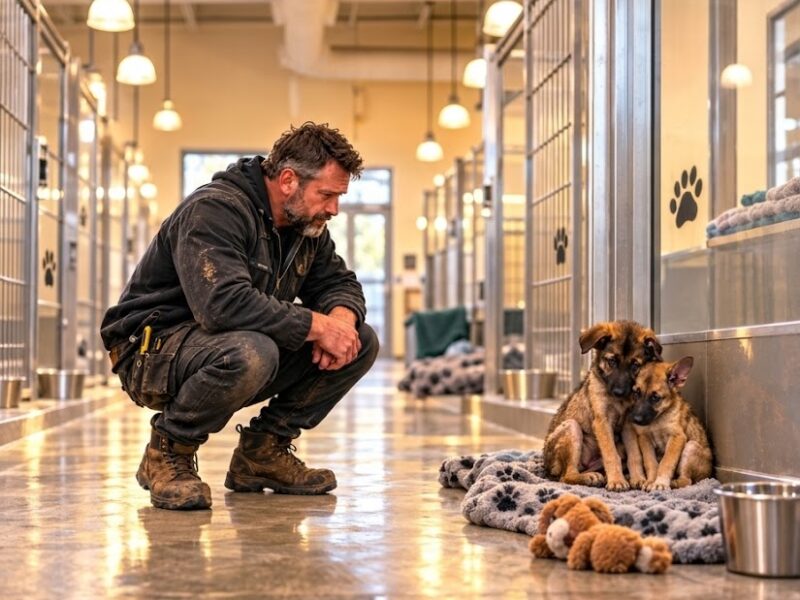
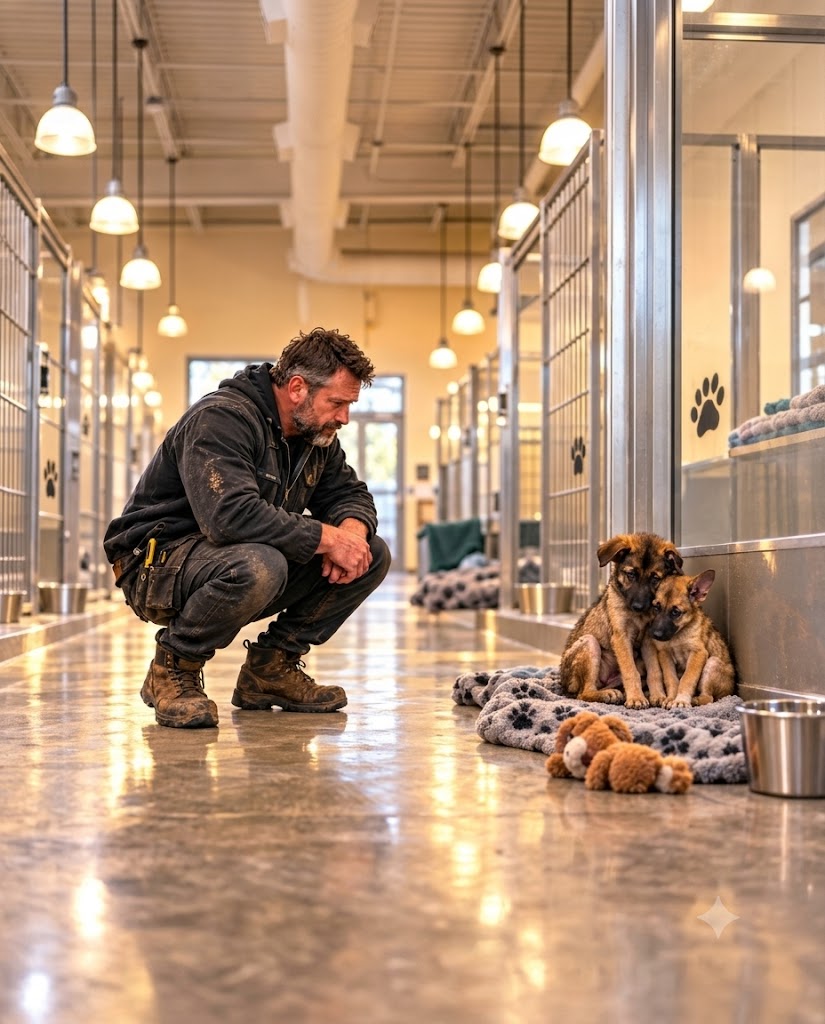
A Navy SEAL came to fix the power lines after a storm. He didn’t expect to leave with two K9 puppies who refused to let him go.
Cinder and Ren were only seven weeks old when they lost their mother.
The two Belgian Malinois puppies had stopped gaining weight, barely touched their food, and spent most of their days pressed together inside a quiet rescue nursery in northern Utah.
Then Reed Holloway walked through the door.
The fifty-year-old former Navy SEAL had not come looking for a dog.
Four months after losing his sixteen-year-old son to illness, Reed wanted almost nothing from the world except enough work to keep his hands busy and enough silence to keep people from asking how he was doing.
He had come to Northlight Canine Rescue for one reason: to repair a failing heating circuit before another winter storm moved into Stonepine Valley.
But something happened when Reed knelt beside the puppy pen.
Ren stood up. Cinder followed. And after days of barely eating, both Malinois puppies lowered their heads to the same bowl and began to eat.
While Reed quietly worked only a few feet away, he told himself it meant nothing. They were puppies. He was just an electrician. Grief did strange things to animals, and Reed knew better than most what grief could do to people.
But two days later, those same puppies would be sleeping inside Reed’s house.
And before the week was over, a name hidden in an old rescue file would force him to confront a question he had spent his entire life refusing to ask.
Was this really coincidence? Or had Noah somehow found Northlight before his father ever did?
By 8:30 on the last Tuesday of January, snow had already erased most of the tire tracks along Stonepine Valley.
The northern Utah mountains rose behind the town like a wall of white stone, their upper ridges disappearing into low clouds while powder drifted across the narrow roads in thin, restless sheets.
Reed Holloway watched those sheets cross the windshield of his aging dark gray pickup and counted the seconds between each sweep of the wipers.
He had been counting things for most of his adult life. Doors, windows, vehicles, footsteps, exits. Twenty-five years in the Navy, most of them spent in special operations, had taught him that the detail you ignored was often the detail that mattered.
Retirement had changed the uniform, not the habit.
At fifty, Reed was still a large man, a little over six feet tall, broad through the shoulders, with the dense, economical build of someone who had once trained because other men’s lives depended on it.
His dark brown hair had gone silver at both temples, and a short salt-and-pepper beard sharpened an already angular face. His blue-gray eyes rarely rested on anything without assessing it first.
People who did not know him often mistook that vigilance for coldness. Those who had known him longer understood there was something gentler underneath, though Reed had become skilled at keeping that part hidden.
Sixteen years earlier, an operation in Afghanistan had taken three men from his team. Reed had survived with an old knee injury, several scars, and a lesson he had never completely unlearned: anything you loved could be taken before you were ready.
Then Noah had been born, and for sixteen years, Reed had broken his own rule.
Four months ago, his only son had died after nearly two years of treatment for a serious illness.
Since the funeral, Reed’s world had narrowed into a schedule. Wake up, make coffee, work, eat because the body required fuel, return home, check the locks twice, sleep when exhaustion finally won.
He still paid his bills, still repaired generators, heating systems, and household wiring throughout Stonepine Valley. He had earned his civilian electrical certification after leaving the Navy because machines were easier than people. A failed relay did not ask how you were holding up. A broken circuit did not tell you it was sorry.
That morning’s job was at Northlight Canine Rescue, twelve miles outside town.
Reed had nearly declined it. The rescue itself was not the problem. Dogs were.
Noah had wanted one desperately. When treatment’s done, Reed had always told him. When you’re better, when we have more time.
The future had once seemed like something dependable. Now those words felt almost cruel.
Northlight occupied an old ranch property surrounded by pine fencing and snow-covered pasture. Several low buildings had been connected over the years by enclosed walkways. The main structure was painted faded green, with a broad porch and a wooden sign over the entrance bearing a simple silhouette of a dog beneath the words Northlight Canine Rescue.
A woman was waiting when Reed entered.
Tessa Monroe was fifty-eight, short and compact, with straight silver-gray hair cut just below her ears and a weathered face that suggested years spent outdoors in every kind of weather. Her brown eyes were direct without being intrusive. She wore work boots, faded jeans, and a fleece jacket covered in small white dog hairs.
There was nothing sentimental about the way she carried herself. She had managed Northlight for almost two decades and had developed the calm efficiency of someone accustomed to injured animals, difficult decisions, and well-meaning people who sometimes made both worse.
“Reed.”
“Tessa.”
She did not ask about Noah. Reed immediately appreciated her for that.
“The nursery circuit tripped three times overnight,” she said. “We reset it, but I don’t trust it.”
“Good instinct.”
She handed him a clipboard with the electrical layout. “Panels through here.”
That was the entire conversation Reed wanted.
He followed her down a warm corridor where the sounds of barking faded behind insulated doors. The puppy nursery was quieter. Heat lamps cast amber pools over several pens, and the room carried the clean smell of disinfectant, blankets, warm formula, and animals.
Reed was opening his tool case when he noticed the two Belgian Malinois puppies.
They occupied a pen near the far wall. Both were seven weeks old, though they looked younger because neither had been gaining weight properly.
The male, Cinder, was slightly larger, with a dark fawn coat, a sharply defined black mask, oversized paws, and ears that seemed undecided about whether they were ready to stand upright. His dark amber eyes followed every movement in the room with a stillness unusual for such a young dog. He was cautious rather than timid, watching first and deciding later.
Beside him lay his sister, Ren. She was finer-boned and visibly smaller, with softer fawn coloring, enormous amber eyes, and one ear beginning to rise while the other folded sideways. Where Cinder held himself back, Ren seemed drawn toward connection. Even when she lacked the confidence to pursue it, she rested against her brother’s ribs as if physical contact had become necessary.
A shallow dish of softened puppy food sat nearby, barely touched.
Reed looked away.
“Their mother was Sable,” Tessa said quietly. “Malinois came to us pregnant.”
Reed continued removing the cover from a junction box. “I only need to know where the circuit runs.”
Tessa took the hint but added one necessary sentence. “Difficult delivery. Emergency surgery. She never really recovered afterward. Complications caught up with her a few days ago.”
Reed’s screwdriver stopped for less than a second, then moved again. He did not ask how the puppies had reacted. He did not need to. Loss had a posture. He knew it in people. Apparently, he knew it in dogs, too.
A tall woman entered from a side room carrying a tablet.
Dr. Camille Hart was forty-two, lean and long-limbed, with chestnut hair pulled into a practical knot and an intelligent, composed face almost entirely free of makeup. She wore navy scrub pants beneath a heavy cardigan and moved slowly around nervous animals, never reaching before they had registered her presence.
Camille had been Northlight’s primary veterinarian for six years and possessed a deliberately unsentimental manner. She cared deeply about animals, but she distrusted the idea that affection alone could solve medical or behavioral problems.
“Morning,” she said.
Reed nodded.
Camille crouched outside the pen to check the puppies’ feeding sheet. “Still not enough?”
Tessa sighed. “Better than yesterday. Not meaningfully.”
Reed kept working. He did not want to know.
But because the electrical outlet he needed sat low on the wall, he eventually had to lower himself onto one knee only a few feet from the pen.
Ren raised her head. Reed removed two screws. She stood. Cinder watched her, then watched Reed.
Reed did not look at either animal. He studied the old wiring instead, muttering under his breath. “Whoever installed this hated electricians.”
Ren took three small steps toward the wire mesh. Reed reached for his meter. Cinder stood now, too.
Camille noticed before anyone else did. She quietly slid the food dish closer. Neither puppy approached it.
Reed tested a wire, frowned, and tapped the plastic handle of his screwdriver twice against the floor. Tap. Tap.
Cinder’s ears shifted. The puppy looked at Reed, then down at the bowl. He stepped forward and sniffed. One lick, then another. Ren immediately followed.
Camille froze. Tessa looked from the puppies to Reed.
He remained absorbed in the wiring. Cinder ate slowly, pausing every few seconds to glance toward the large man sitting nearby. When Reed shifted farther down the wall, Cinder stopped. Ren stopped, too. Reed sat again. After several seconds, Cinder lowered his nose to the bowl.
Camille’s expression changed. Not wonder—recognition. She had been trying to reduce pressure around the puppies for days. Reed was doing it without realizing he was doing anything at all. No coaxing, no staring, no high-pitched encouragement, no reaching hands. Just a deep, steady voice, predictable movements, and a man who asked nothing of them.
Camille quietly lifted the feeding sheet. “Interesting.”
Reed glanced over. “What’s interesting?”
“Nothing yet.”
He disliked that answer.
Across the pen, Ren had finished eating. Instead of returning to her blanket, she walked to the section of wire closest to Reed and sat down. Cinder joined her seconds later.
Two underweight Belgian Malinois puppies who had spent days withdrawing from nearly everyone in the nursery now sat shoulder-to-shoulder, silently watching a stranger who had made no attempt to win them over.
And for reasons Reed could not have explained, he suddenly remembered a question Noah had asked him years ago.
“Dad, do dogs know when people are sad?”
The memory arrived so clearly that Reed nearly turned, expecting to find his twelve-year-old son behind him. There was only the hum of the heater and two amber-eyed puppies.
Reed forced himself back to the job. He found the immediate fault—heat damage around an aging connection and evidence that the system had been drawing too much load. He replaced the damaged section, checked the breakers, then discovered that the transfer relay controlling part of the heating circuit was also beginning to fail.
“It’ll run,” Reed told Tessa, closing the panel. “But replace that relay before the next cold snap.”
“I’ll order one today. How soon?”
“If the supplier has it tomorrow.”
Tessa nodded. “Do it.”
Reed packed his tools. The room should have felt finished. Instead, he could feel the puppies watching him. He hated that he could feel it.
He stood. Ren immediately rose. Cinder followed.
Reed picked up his tool case and walked toward the door. A small sound came from behind him. Not a bark—barely even a cry. A soft, uncertain whine.
Reed stopped. Every muscle in his shoulders tightened.
He remained facing the doorway for several seconds before turning.
Ren stood with her nose near the mesh. Cinder was directly behind her. Both were staring at him.
“They’re puppies,” Reed said, more firmly than necessary. “They’ll watch anybody.”
Tessa leaned against the counter, arms loosely folded. She could have told him that six volunteers had passed through the nursery since sunrise. She could have told him Ren had not followed any of them to the front of the pen. She could have told him Cinder had eaten more during the previous two hours than he had eaten during most of the previous day.
Instead, she simply said, “Maybe.”
Reed left.
Outside, the snow had thickened, softening the edges of the buildings and covering the hood of his pickup in fresh white powder. He placed his tools behind the seat and stood with one hand on the door.
For no reason he wanted to examine, he looked back toward the nursery windows.
Then he drove home.
His house sat at the edge of Stonepine Valley beneath a stand of dark pines. It was clean, warm, organized, and almost completely silent.
Reed ate soup standing at the kitchen counter. He ignored two messages on his phone, checked tomorrow’s jobs, checked the locks. Upstairs, he passed the closed door to Noah’s bedroom without touching the handle. He had done that every night for four months.
In bed, Reed waited for the usual memories. Hospital lights, the antiseptic smell of Noah’s room, the final weeks, the unbearable stillness afterward.
They came, but strangely, they were not the last images that remained.
Just before sleep finally reached him, Reed saw one crooked Malinois ear, then another puppy standing behind it—two amber eyes fixed on him from the other side of a wire pen.
And for the first time in many weeks, the last thing Reed Holloway carried into sleep was not an image of something he had lost.
It was the image of something that had looked back.
The replacement relay arrived at Northlight shortly after nine the next morning, and Reed Holloway was back on the property before ten.
He had told himself during the entire drive that this was simply unfinished work. The old relay had shown heat discoloration. The forecast called for another sharp temperature drop after sunset, and Reed did not leave questionable electrical equipment behind if he could prevent it. Those were facts. They were measurable, practical, and comfortable.
The fact that he had thought about two seven-week-old Belgian Malinois puppies while making coffee that morning was neither practical nor something he intended to examine.
The storm had not yet arrived, but the sky over Stonepine Valley had flattened into a solid gray ceiling. Snowbanks crowded the roads, and wind combed loose powder off the surrounding fields. Reed backed his pickup beside Northlight’s service entrance, automatically positioning it so the nose faced outward. Twenty-five years of military habit had made backing into parking spaces less a preference than an instinct. Even now, retired and carrying nothing more dangerous than electrical tools, he still liked knowing he could leave without turning around.
Tessa Monroe met him halfway down the corridor.
“Parts on the workbench.”
“Good.”
“Coffee’s fresh.”
“I’m fine.”
“I didn’t ask if you wanted any.”
Reed glanced at her. The corner of Tessa’s mouth moved just enough to suggest she had won something minor.
He continued toward the nursery. Before he reached the doorway, a faint movement came from the pen. Ren had been lying beside the heating pad. At the sound of Reed’s boots, she lifted her head. Her partly raised ear rotated toward the hall before the rest of her body followed. By the time Reed entered, she was standing.
Cinder remained down for several seconds longer. He watched the doorway with those dark amber eyes, cautious and thoughtful in a way that seemed too old for his small body.
Then Reed set his metal tool case on the floor. Cinder stood.
Reed noticed. He wished he had not.
Dr. Camille Hart was weighing the puppies that morning. She had already placed Ren on the digital veterinary scale and recorded her number before Reed arrived.
Camille wore the same practical calm she seemed to carry everywhere, her chestnut hair pulled back tightly and the sleeves of her cardigan pushed above her wrists. She never hurried around frightened animals, and she never softened difficult information merely to make humans more comfortable.
“Morning,” she said.
Reed nodded toward the scale. “Any better?”
The question escaped before he could stop it.
Camille looked at him once, registering that fact without commenting on it. “A little. Not enough to celebrate.”
“Didn’t ask for a celebration.”
“No, you generally don’t.”
Reed opened the replacement relay packaging. Tessa left them to work. Camille returned Cinder and Ren to their pen and placed breakfast inside.
Ren sniffed the softened food, took two small bites, then wandered away. Cinder approached, hesitated, and sat.
Reed removed the panel cover. For several minutes, the only sounds were the quiet hum of the nursery heater and the click of tools.
Then Ren returned to the bowl. She began eating. Cinder watched her, then glanced toward Reed. He followed.
Camille looked at the clock. She said nothing.
Reed continued disconnecting the old relay. After five minutes, he noticed her staring.
“What?”
“I’m observing.”
“Me?”
“They’re eating.”
“Yes, that’s normally considered useful in puppies.”
Camille suppressed a smile. “Yesterday, I thought their response around you might have been coincidence.”
Reed turned back to the wiring. “It was, maybe.”
He disliked that word more every time someone at Northlight used it.
Camille leaned against the counter. “Do you know what you do differently from most people who come into this room?”
“Fix things.”
“You don’t ask the puppies for anything. Reed, stop moving for a moment.”
He paused, hand still on the panel.
“Everyone means well,” Camille continued. “They crouch, call them, reach toward them, make noises, try to encourage them to eat. From a human perspective, they’re being kind. From the perspective of an animal that’s already overwhelmed, kindness can still feel like pressure.”
Reed tightened a terminal screw. “So they like me because I’m unfriendly.”
“For some animals, being left alone is the first form of safety they understand.”
The sentence landed somewhere. Reed did not want it to. He kept his face expressionless.
Camille continued in the same clinical tone. “Your movements are predictable. Your voice stays low. You don’t stare at them. You don’t keep reaching into their space. You’re there without demanding a response.”
Reed looked at Cinder. The male puppy had stopped eating and was watching him. Their eyes met. Cinder did not retreat.
Reed looked away first. “Don’t turn this into something it isn’t.”
“I’m a veterinarian, Reed. I spend most of my life trying not to do that.”
That answer, at least, he respected.
By early afternoon, the replacement relay was installed. But Reed found another problem during testing. The automatic transfer switch—the component responsible for moving the nursery heating load onto backup power if the primary supply failed—was not engaging as cleanly as it should. The system still worked, but not well enough for Reed. He tested it twice more. Same hesitation.
Tessa appeared behind him. “Can it wait?”
“Probably. That’s not the same as yes.”
“No.”
Snow had started outside, fine grains tapping against the windows. Tessa checked the weather on her phone. “They’re saying roads get worse after six.”
Reed examined the transfer mechanism again.
“You can come back tomorrow,” she said.
He pictured leaving it overnight. Then he pictured the nursery losing heat in the middle of a January cold snap.
“It’s another couple hours.”
Tessa studied his profile but did not point out that Reed could easily have recommended shutting down that branch and using portable backup heaters until morning.
Instead, she said, “I’ll leave the side entrance unlocked until you’re done. I’m not asking anybody to stay.”
“I know.”
By late afternoon, most volunteers had gone home before the weather worsened. Northlight became unusually quiet. Snow thickened beyond the windows until the pasture disappeared and the property lights glowed inside white halos.
Reed worked. Occasionally, he heard Ren moving behind him. Cinder spent long periods simply watching.
At 6:30, Camille returned from the clinic side of the building to check their evening feeding. The puppies ate nearly all of it. She marked the chart.
Reed noticed. He pretended not to.
Just before Camille picked up the empty bowl, a metal tray slipped from the counter in the adjacent treatment room. It struck the floor with a sharp, sudden crash.
Ren startled violently and scrambled backward. Cinder spun toward the sound, body low and rigid.
For a fraction of a second, Reed was somewhere else. Not Northlight, not Utah. A dark compound sixteen years earlier. Dust, metal, radio chatter. Three men whose voices he could still hear if he let memory open too far.
His shoulders locked. His hand tightened around the screwdriver.
Then Cinder did something unexpected. Instead of retreating toward the rear of the pen, the little Malinois looked directly at Reed.
Reed looked back. Neither moved.
“Easy,” Reed said quietly.
The word came from somewhere older than conscious thought. Not a command, not comfort exactly—just a steady sound.
Cinder’s ears shifted toward his voice. Ren stopped scrambling. After several seconds, she moved close to her brother. Cinder remained focused on Reed until his own body slowly relaxed.
Camille had seen the entire exchange. She did not say, They’re responding to you. She did not say, You needed that, too.
Instead, she picked up the tray and said calmly, “Everybody survived.”
Reed exhaled. He had not realized he was holding his breath.
Something about the moment bothered him for the rest of the evening. Not because the puppies had startled—because Cinder had looked at him first.
Reed understood working dogs well enough not to invent mysticism where ordinary behavior explained something. Cinder had likely learned that Reed’s voice predicted quiet. That was all.
Still, the thought followed him.
When the transfer switch finally tested cleanly, it was after nine. Reed sat in a molded plastic chair while the system completed one final cycle. Fatigue had settled behind his eyes.
Across the room, Ren circled twice and lay down. Cinder remained sitting.
“You’ll wear yourself out watching everything,” Reed murmured.
The puppy blinked.
Reed knew something about that. In Afghanistan, vigilance had kept people alive. After Afghanistan, Reed had brought it home. He checked windows. He noticed cars that stayed behind him for too many turns. He sat where he could see entrances. Even during Noah’s treatments, when Reed had spent endless hours in hospital rooms, some part of him had cataloged hallways, elevators, staff badges, fire exits.
Knowing danger could come from anywhere had once been useful. Knowing death could come from inside a sixteen-year-old boy’s own body had made every old skill feel meaningless.
Ren lowered her head. Cinder looked toward Reed one last time. Then slowly he lay beside his sister.
Reed’s eyes closed before he intended them to.
He dreamed of Noah, but not the Noah from the last months. This Noah was twelve, skinny and long-limbed, sitting in the passenger seat of Reed’s pickup with a camera hanging against his chest. They were stopped beside a snowy field. A stray dog had been watching them from beyond a fence.
“Dad,” Noah asked, “do dogs know when people are sad?”
Reed remembered answering without thinking. “Dogs notice everything, kid.”
In the dream, Noah smiled. “Maybe that’s not the same thing.”
Reed woke abruptly. For a moment, he did not know where he was. The nursery was dim except for the heating lamps. The final test cycle had finished.
Through the pen, Ren was awake. She was lying beside Cinder, but her head was raised. She was looking at Reed.
He checked the wall clock. Nearly midnight. Tessa had apparently gone to her office at some point, but Reed heard no movement from the rest of the building.
He stood quietly and collected his tools. Neither puppy rose.
That should have made leaving easier. Strangely, it did.
At the nursery doorway, Reed looked back once. Cinder was asleep on his side now, his small body no longer curled tightly. Ren had lowered her head again. For the first time since Reed had seen them, neither puppy appeared to be waiting for something.
He turned off the work light and closed the door gently.
Outside, snow covered nearly half an inch of his windshield. Reed brushed it away, started the truck, and waited for the heater to clear the glass.
He expected the familiar heaviness to return on the drive home. It was still there. Grief had not changed because two dogs had eaten dinner. Noah was still gone. Afghanistan was still sixteen years behind him and on certain nights only sixteen seconds away.
But beneath all of that was another feeling Reed had not expected. The puppies were warm. They had eaten. They were sleeping. And for tonight, at least, nothing required him to save them. He only had to know they were all right.
For a man who had spent months believing there was nothing left in the world he could protect without eventually losing it, that small certainty felt dangerously close to hope.
Two days after the storm, Northlight called again.
Reed almost let the phone ring out. He had spent the morning replacing a breaker panel in a vacation cabin above Stonepine Valley and had just returned home when Tessa Monroe’s name appeared on the screen.
For several seconds, he watched it vibrate against the kitchen counter. He had already fixed the nursery circuit. The relay was new. The transfer switch was stable. There should have been no reason for Northlight to need him again.
He answered on the fourth ring. “Holloway.”
Tessa did not waste time. A water line in the foster building had frozen overnight and split behind one of the interior walls. No animals had been hurt, but three rooms had to be shut down while the drywall was opened and the plumbing repaired. Several foster dogs had already been moved into registered homes.
The problem was Cinder and Ren.
“No,” Reed said before Tessa had actually asked.
Silence held for a beat. “I haven’t asked yet.”
“You were going to eventually.”
Reed rubbed a hand over his beard. “I don’t foster dogs.”
“I know.”
Tessa explained that Camille did not want the puppies moved far from Northlight while their weight was still being monitored. The usual foster homes nearby were already full. One family could take one puppy, but Camille preferred not to separate them abruptly while both were still recovering from the loss of Sable. Another approved foster lived nearly an hour away across roads expected to ice overnight.
Reed stared through the kitchen window at the snow-covered pines behind his house. “There has to be somebody else.”
“There probably will be by the end of the week.” Tessa paused. “I’m asking for three nights.”
“Maybe four,” she added.
“Three.”
Tessa’s voice softened slightly. “That a yes?”
“That’s a maximum.”
Northlight treated the arrangement more seriously than Reed expected.
Tessa arrived at his house that afternoon before the puppies did. She walked through the kitchen, mudroom, hallway, and the small fenced side yard, checking exposed wires, cleaning chemicals, narrow spaces behind furniture, and anything two curious Belgian Malinois puppies might decide was edible.
Reed followed with his arms folded, increasingly irritated by what felt like an inspection of a home he had managed perfectly well for years.
“They’re seven weeks old,” Tessa reminded him after he objected to moving a container of ice melt from the mudroom floor. “Their survival strategy is putting everything in their mouths and seeing what happens.”
Reed moved it to a high shelf.
Camille arrived twenty minutes later with two separate wire crates, bedding, puppy food, a digital scale, feeding sheets, cleaning supplies, and enough written instructions to satisfy even Reed’s appetite for structure.
She emphasized that each puppy needed to eat and rest separately at least part of the time.
“They can be together,” she said, “but don’t let them become one nervous system with eight legs.”
Reed looked at Cinder and Ren in the transport crate. Ren already had her nose pressed to the bars. Cinder sat behind her, watching the room.
“Three nights,” Reed said.
Camille handed him the feeding chart. “Then do three nights properly.”
That was language Reed understood.
By six o’clock, his refrigerator held a schedule secured with a magnet. Feedings, weigh-ins, bathroom breaks, rest periods, individual handling.
Reed measured every portion. Ren ate first and investigated afterward. Cinder studied each bowl as if it might contain a hidden condition.
Reed quickly learned that Ren would charge toward anything new until something startled her, while Cinder approached only after deciding the object had failed to kill his sister.
By the end of the first evening, Ren had attacked a bootlace, dragged a dish towel halfway across the kitchen, and fallen asleep under a chair she had spent ten minutes trying to climb. Cinder had remained within sight of Reed almost the entire time. Not close—just watching.
Reed told himself that observation meant nothing. He had watched people for twenty-five years without wanting to take them home.
Near midnight, Reed carried Ren to her crate after she fell asleep against the leg of the kitchen table. As he lowered her onto the blanket, her eyes opened halfway. Instead of squirming free, the puppy lifted one small paw and placed it against the inside of Reed’s wrist.
The touch was barely there. Warm pads against scarred skin.
Reed froze for one impossible second.
He remembered Noah at six years old, falling asleep in the truck after a fishing trip. One small hand wrapped around Reed’s thumb as if letting go might cause the world to move without him.
The memory came so cleanly that Reed’s chest tightened before he could defend against it.
Ren’s eyes closed again. Her paw slipped away.
Reed stayed crouched beside the crate long after she was asleep. Across the room, Cinder watched him through the bars of his own crate, silent and still.
Reed finally stood. “Don’t make something out of it,” he muttered, though he was no longer sure whether he was talking to the dog or himself.
The second day was noisier.
Ren discovered the kitchen towel drawer. Cinder discovered that the coffee grinder was suspicious but survivable. Reed discovered that two Malinois puppies could create disorder faster than a team of grown men living out of duffel bags.
He also discovered, to his annoyance, that he was beginning to recognize their movements without looking. The quick scrape of nails followed by a bump usually meant Ren. The pause before entering a room meant Cinder. By noon, Reed knew which puppy had finished drinking simply from the rhythm against the metal bowl.
Something about knowing those things unsettled him. Familiarity had once felt natural. Now it felt like risk.
Late that afternoon, Ren grabbed one end of a dish towel hanging from the oven handle. Cinder, apparently deciding his sister required assistance, caught the opposite end. They pulled in different directions until Ren’s hind feet lost traction. She slid forward, crashed gently into Cinder, and both puppies rolled sideways in a tangled heap.
Reed laughed.
It was not a smile. It was an actual laugh, short and rough from disuse.
Both puppies froze. So did Reed.
The sound seemed wrong in the house. Four months ago, Noah had died. And Reed had somehow just laughed because two dogs had fallen over.
Guilt arrived instantly, irrational but sharp. His face hardened. He turned toward the sink and gripped the edge of the counter.
Somewhere inside him, a voice said that a father whose son was dead did not get to enjoy something this soon. Another part of him knew the thought was cruel and absurd. Grief did not listen to reasonable arguments.
Behind him, the puppies resumed wrestling. Reed stood there until his breathing settled.
That evening, he went upstairs to retrieve a small space heater from the hall closet. Ren followed before he noticed. Cinder came more slowly behind her.
Reed was halfway down the corridor when Ren stopped beside a door that had remained closed for nearly four months.
Noah’s room.
The latch had not caught completely. Ren touched the door with her nose. It opened three inches.
Reed’s entire body went rigid. “Ren.”
The puppy pushed again.
“Out.” His voice came harder than he intended.
Ren stopped immediately. Cinder halted several feet behind her.
Reed stepped forward to close the door. Then he saw inside.
A gray hoodie still hung over the back of Noah’s chair. His camera sat on the desk beside two lenses. A paperback lay face down where Noah had left it during one of the weeks when he had still been strong enough to read for long periods.
Reed had cleaned almost every other room after the funeral. Not that one.
Ren sat down inside the doorway. She did not sniff the clothes, did not find some meaningful object, did not perform any miracle. She simply sat. Cinder approached but stopped at the threshold.
Reed stared at the room until the edges blurred slightly.
Then, for the first time since Noah’s death, he lowered himself to the floor beside the open door. Cinder lay down next to his leg. Ren curled onto the carpet a few feet inside.
Reed said nothing. He stayed there for nearly twenty minutes.
The room still hurt, but it did not destroy him. That realization frightened him almost as much as entering it had.
On the third morning, Reed woke before his alarm because Ren was making a soft, impatient noise from downstairs. Cinder was quiet, waiting as usual.
Reed fed them, recorded their weights, cleaned the bowls, and caught himself calculating how much puppy food remained.
At 10:13, Tessa called.
“The foster rooms are usable again,” she said. “You can bring them back this afternoon.”
Reed looked toward the kitchen. Ren was chewing a rubber toy. Cinder was watching snowfall outside the glass door.
“Four o’clock,” Reed said.
After hanging up, he opened the cabinet beneath the sink. Two new stainless steel bowls sat inside. He had bought them the previous afternoon while picking up groceries. He had told himself the shelter bowls were inconvenient.
Across each rim was a strip of white tape. In Reed’s block handwriting, one read Cinder. The other read Ren.
He stared at them for a long time.
Three nights, he had said. Temporary. Practical. Nothing more.
But somewhere between feeding charts, muddy paw prints, one unexpected laugh, and an open bedroom door, Reed Holloway had begun making room for two small lives without ever deciding to.
And now, for the first time, returning them felt less like completing a task and more like giving something back.
At four o’clock exactly, Reed Holloway pulled into Northlight’s snow-packed parking lot with Cinder and Ren secured in separate travel crates behind the front seats.
He had spent most of the drive telling himself that returning them was simply the next scheduled step. Three nights had been the agreement. The foster wing was usable again. Camille could continue monitoring their weight. Everything was proceeding exactly as planned.
None of those facts explained why Reed had taken the longer road through the valley or why he had stopped twice to check the rearview mirror even though both puppies were sleeping.
Ren woke first. When the truck slowed, her uneven ears lifted as Northlight came into view. Cinder remained curled against his blanket until Reed opened the rear door. Then the male Malinois raised his head and watched Reed with the same deliberate amber stare that had unsettled him from the beginning.
“Don’t start,” Reed muttered.
Cinder blinked.
Inside, Camille weighed them one at a time. Ren protested the scale by attempting to walk off it before the number settled. Cinder stood perfectly still but stared at Camille as though the entire procedure required formal evaluation.
Their progress was modest but measurable. Both had gained weight. Ren’s appetite had improved significantly. Cinder was still cautious at meals, but the difference from three days earlier was obvious.
“This is good,” Camille said, entering the figures into her tablet. “Not miraculous, not finished, but good.”
Reed handed her a folder.
Camille opened it and stared at the pages. Every feeding time had been logged. Water intake was estimated. Weight changes were recorded to the ounce. There were notes on sleep, stools, individual handling, even which puppy became restless first before a bathroom break.
Camille looked up. “You know, most foster parents just write ate well.”
Reed shrugged. “That isn’t data.”
“I was afraid you’d say that.”
Tessa appeared from the office carrying two mugs and watched Cinder follow Reed’s movement across the nursery. Ren, less subtle, pressed herself against the side of the pen nearest him.
Reed deliberately stepped away.
“They’re back. They’re eating. Your building isn’t leaking anymore. Mission complete.”
“You make puppies sound like electrical equipment,” Tessa said.
“Electrical equipment is easier. Usually.”
He picked up his coat. “I’ve got a service call tomorrow morning.”
Tessa nodded rather than trying to delay him. Reed appreciated that.
He reached the hallway before Camille called after him. “Reed.”
He stopped.
“The bowls.”
He looked back. She was holding the two stainless steel bowls labeled Cinder and Ren. He had accidentally left them in the supply bag.
“Keep them,” he said.
Camille glanced at Tessa but said nothing.
Reed walked out before either woman could turn the answer into a conversation.
The building felt strangely quieter after he left.
Tessa carried the foster paperwork back to her office, where an old desktop computer sat beneath shelves full of adoption files, veterinary records, donated leashes, and photographs from almost twenty years of animals passing through Northlight.
She opened Reed’s emergency foster form to update his status in the system. His surname caught her attention.
Holloway.
She stared at it for several seconds. Something about it was familiar, though Northlight had worked with hundreds of families.
She searched the database. Several unrelated entries appeared. Then one old fundraising folder surfaced from the previous spring.
Winter Faces Fundraiser.
Tessa opened it. The name on the screen stopped her.
Noah Holloway, age 15.
For a moment, she assumed it had to be coincidence. Then she opened the original registration form. The emergency contact listed was Elise Holloway. The address was the same Stonepine Valley area.
Attached to the application were four photographs submitted by Noah for the fundraiser: snow-covered pines at sunrise, an abandoned fence disappearing into fog, a crow perched on a hospital window ledge, and a photograph of late afternoon light reflected in melting snow.
Tessa sat very still.
She had not remembered Noah because she had known him personally. Winter Faces had been mostly online. Young photographers and artists submitted work. Friends and neighbors bought prints, and the proceeds went toward veterinary expenses for difficult rescue cases.
Noah’s contribution had not been large enough to stand out financially. But his note did.
Tessa read it twice.
I’m saving for a dog when treatment is done, so this is for one that has to wait longer than me.
The office suddenly felt too quiet.
Tessa looked through the glass wall toward the nursery. On the other side, Ren had been pacing along the front of the pen since Reed left. Cinder sat behind her, facing the hallway through which Reed had disappeared.
Neither dog could possibly know the name on Tessa’s screen. Reed himself did not know Noah had ever contacted Northlight. And Tessa had not known Reed was Noah’s father until that exact moment.
Yet the boy whose father had repeatedly promised him a dog when treatment was over had quietly raised money for this same shelter months before his death.
Now, four months after Noah was gone, two motherless puppies had attached themselves to the one man who had spent those same months trying not to attach himself to anything at all.
Tessa was not a superstitious woman. Nineteen years in rescue had taught her that people often saw destiny where ordinary timing was enough.
But sitting there with Noah’s note glowing on the screen, even she found herself wondering how many coincidences had to line up before a person was allowed to call them something else.
She did not call Reed immediately. Instead, she verified everything first—the address, the email, the emergency contact. Then she called the phone number Reed had left on his foster form and asked him to return when he had time.
His truck was back in the parking lot twenty-five minutes later.
Reed entered the office already guarded. “Something wrong with the puppies?”
“No.”
“Then what?”
Tessa turned the monitor toward him. “I found something while updating your foster paperwork.”
Reed looked at the screen. He went completely still when he saw Noah’s name.
“What is this?”
Tessa explained Winter Faces. She explained that Noah had registered online the previous spring and sold several of his photographs through Northlight’s fundraiser.
Reed’s jaw tightened. “You knew?”
“No.”
“You knew Noah was my son before you called me for the electrical job?”
“No.”
“You brought me here because of this?”
“No, Reed.” Tessa’s answer came without hesitation. “I remembered the surname today. That’s all.”
He looked at her for several seconds, searching her face for manipulation. Tessa did not flinch.
Then Reed looked back at the screen. His eyes moved to Noah’s note. He read it silently once, then again.
Something in his face changed. Not dramatically—Reed had spent too many years controlling his expressions for that—but the defensive hardness around his eyes loosened.
Noah had never told him. He had talked about dogs constantly, shown Reed photographs, sent him links to breeders and rescues, once tried to convince him that a Belgian Malinois would be a perfectly normal family pet. An argument Reed had dismantled with the weary patience of a man who actually understood working dogs.
But Noah had never mentioned Northlight. Never mentioned the fundraiser.
Reed left without taking the printout Tessa offered him. He made it as far as his pickup, then sat behind the wheel without starting the engine.
Snow drifted slowly past the windshield.
For most of Reed’s adult life, coincidence had been something to investigate, not trust. In special operations, patterns had causes. Tracks came from somewhere. Radio silence meant something. A door left open demanded a reason.
But what reason could explain this?
Noah had loved dogs. That was ordinary. Northlight had run a fundraiser—also ordinary. Noah had participated. A shelter had later needed electrical work. A technician had been called. Two puppies had recently lost their mother. They had responded unusually well to a quiet man who wanted nothing from them.
Every piece made sense on its own. Together, they felt different.
Reed rested both hands on the steering wheel and closed his eyes.
He did not think Noah had sent the puppies. That idea felt too easy, almost disrespectful to everything death actually was.
But for the first time since the funeral, Reed allowed himself to consider that something could matter even if he could not prove why.
His phone rang. Elise.
He almost ignored it out of habit.
“Reed.” Her voice was softer than he remembered.
Elise Holloway was forty-eight, slender and medium height, with fair skin, green-brown eyes, and dark blonde hair now threaded with silver around the temples. Years ago, she had been quick-moving and impatient, someone who could carry a conversation, three grocery bags, and a list of unfinished tasks at the same time.
Noah’s illness had changed her differently than it changed Reed. The last two years had put permanent tiredness around her eyes, but where Reed had withdrawn after their son’s death, Elise had tried to keep speaking about him, afraid silence would reduce Noah to the fact that he was gone.
“Tessa called me,” she said. “She asked permission to send me the old fundraiser file.”
Reed looked toward the nursery building. “You knew about it?”
“No. I remember helping him set up some payment account for photography, but he didn’t tell me where the money went.” She laughed once, then her voice broke. “That sounds like him.”
Reed said nothing.
Elise continued. “He would love this.”
Reed swallowed. “The shelter, the puppies, all of it.”
A pause. Then Elise gave a small laugh through her tears. “Actually, he would think it was hilarious.”
“Why?”
“Because you were the one who spent half his childhood telling him we were not getting a Malinois.”
A memory surfaced before Reed could stop it. Noah at fourteen, holding up a photograph on his tablet. Look at that face, Dad. Reed answering that face needs three hours of work before breakfast. Noah grinning. So maybe.
Reed laughed quietly at first, then genuinely. The sound surprised him. Elise heard it.
Neither of them spoke for several seconds.
For once, Reed did not feel guilty because the memory had not come from a hospital room. Noah was not pale beneath fluorescent lights. He was alive again for one brief moment—annoying his father, arguing badly, smiling because he already knew the answer was no.
Reed opened his eyes and looked through the nursery window across the parking lot. He could just make out two small shapes moving behind the glass.
He still did not know what Cinder and Ren meant. He did not know whether they meant anything at all.
But for the first time since Noah died, Reed understood that remembering his son did not have to begin with the way Noah had left the world.
It could begin with the way he had lived in it.
Three days after Reed learned that Noah had once raised money for Northlight, Tessa Monroe called again.
This time she did not hide the reason behind a broken pipe, a heating system, or a piece of electrical equipment.
“Camille and I want to talk to you about Cinder and Ren.”
Reed was standing in his workshop behind the house, replacing the starter on an old generator for a neighbor. He looked through the frosted window toward the mountains.
“Are they all right?”
“They’re fine.” Tessa paused. “That’s not the question.”
Reed knew what was coming. Northlight could place the puppies elsewhere. There were qualified foster families. Eventually, there would be adopters. He had completed the three nights he had promised. Nothing obligated him to continue.
Still, before he could stop himself, he asked, “What exactly are you proposing?”
Two hours later, he sat across from Tessa and Dr. Camille Hart in Northlight’s office while Cinder and Ren wrestled quietly in an exercise pen nearby.
Camille was direct. “Foster to adopt. Six weeks. And before you say yes because you feel something after finding Noah’s file, I want you to understand what you’re agreeing to.”
Reed leaned back. “Go ahead.”
“Two Belgian Malinois from the same litter can become overly dependent on each other if everything is done together. They need separate crates, separate feeding, individual training, individual outings, and time learning that the world doesn’t end when the other puppy is in another room.”
“I already started doing that for three days.”
Camille’s voice remained calm. “This is years.”
Reed looked toward the pen. Ren was attempting to climb over Cinder. Cinder endured it for several seconds before standing and walking away with the tired dignity of a much older dog.
Tessa said, “Feeling sorry for them isn’t enough.”
Reed’s jaw tightened.
Camille added, “Neither is loving them.”
Reed turned back to her.
“Then what is?”
“Work. Consistency. Patience. Structure. And the ability to let each dog become itself instead of whatever you need it to be.”
That last sentence struck deeper than Reed expected. He had spent four months fighting the fear that caring for Cinder and Ren would somehow make them substitutes for Noah. Camille had just given that fear a different shape.
Reed looked at the paperwork. “Six weeks.”
“Six weeks,” Tessa confirmed.
Reed picked up the pen.
Life with two growing Malinois puppies did not resemble healing in any graceful sense.
It resembled muddy paw prints, chewed cardboard, alarms before sunrise, training sessions in the cold, and discovering that Ren could reach objects Reed was certain were beyond her reach.
Cinder grew into himself more slowly. He preferred solving problems before acting, and food rewards could convince him to learn almost anything. Ren was bolder with people, quicker to test boundaries, and entirely convinced that hesitation was a flaw other creatures suffered from.
Reed began walking them separately. Cinder accompanied him to the mailbox in the mornings while Ren stayed home with a food puzzle. The next day, they switched. He fed them in different parts of the kitchen and trained them one at a time in the mudroom.
At first, both protested separation. Ren whined. Cinder paced. Reed did not rush to reunite them. Within weeks, each could settle alone.
The house changed with them. Curtains that had remained closed were opened because the puppies liked watching snowfall. Reed began going outside even on days when he had no service calls. He started answering more phone calls because ignoring them while two dogs barked at the ringing phone somehow seemed ridiculous.
One Saturday morning, an old teammate invited him to breakfast. Reed stared at the message for several minutes, then typed back: 30 minutes, no speeches.
It was the first social invitation he had accepted since Noah’s funeral.
None of this erased anything. Some mornings, Reed woke before dawn with the same hollow weight in his chest. Noah was still gone. The room at the end of the hallway still belonged to a boy who would never come home. Afghanistan still visited certain dreams.
But grief was no longer the only thing occupying the house.
Near the end of the third foster week, Reed noticed something that unsettled him more than any dramatic gesture could have.
He was sitting at the kitchen table sorting training notes when Cinder woke from a nap, walked past him, and settled alone beside the back door. Ren remained asleep in the living room.
Weeks earlier, Cinder would not have chosen a position where he could not see his sister. Now he rested without checking on her.
Reed stared at him and suddenly understood what Camille had meant.
Healing was not always moving closer. Sometimes it was learning that separation did not automatically mean loss.
The thought struck Reed with almost physical force. For four months, he had treated every step away from Noah’s memory as betrayal because some part of him believed distance meant abandonment.
But Cinder had not stopped loving Ren simply because he could sleep in another room.
Perhaps Reed could move forward without moving away from his son.
That Sunday, Elise came to the house.
It was the first time she had crossed Reed’s threshold since the funeral. She looked thinner than she had six months earlier, and the silver at her temples had become more visible, but her green-brown eyes still carried the alert warmth Noah had inherited from her.
Ren approached immediately, tail moving so hard that her entire rear end followed. Cinder stayed several feet back and watched. Elise understood enough not to pursue him. She sat on the floor near the sofa and let Ren climb awkwardly across her legs.
Ten minutes later, Cinder came close on his own and placed his nose against the back of Elise’s hand.
“He always wanted one,” Elise said.
Reed looked at both puppies. “He wanted every dog he ever saw.”
“That’s also true.”
They laughed softly.
The conversation drifted toward Noah. Not the illness, but the boy. The year he burned pancakes because he tried cooking while watching a photography tutorial. The afternoon he sat outside for nearly three hours waiting for a squirrel to return to the same branch. The argument in which fourteen-year-old Noah had declared a Belgian Malinois basically a regular family dog.
Reed shook his head. “I gave him a ten-minute lecture on drive, exercise, impulse control, and working genetics.”
Elise smiled. “And what did he say?”
“So that’s a maybe.”
This time Reed laughed without stopping himself. Elise did too.
For a few minutes, Noah existed between them as something more than absence.
Two weeks later came the six-month mark since his death.
Reed knew the date before he opened his eyes that morning. The entire day felt heavier. He completed the dogs’ routine, answered no calls, and by evening sat on the living room floor with his back against the sofa. He was not crying. He simply could not make himself get up.
Ren noticed first. She approached slowly, unusual for her, and sat against Reed’s left thigh. She did not paw him or lick his face. She just stayed.
Cinder was resting in his crate across the room. Reed opened the door. The male Malinois stepped out, stretched, walked over, and settled on Reed’s right.
Three bodies in a quiet room.
Nothing was fixed. That was the point.
Reed placed one hand on each dog and finally understood something he had spent most of his life resisting. Not every problem was an operation. Not every wound could be closed. Sometimes presence was the only useful thing left to give.
At the end of six weeks, Reed returned to Northlight for the formal evaluation.
Cinder and Ren were stronger now, their coats fuller and bodies filling out as they should. Ren’s ears had nearly decided to remain upright. Cinder had developed a habit of sitting beside Reed’s left leg when uncertain. Not because he had been trained there, but because that position seemed to suit him.
Camille reviewed their medical and behavioral progress. Tessa placed the adoption papers on the desk.
“Still want both?” she asked.
Reed looked at the puppies. Ren was trying to investigate a cardboard box under the desk. Cinder watched her, already appearing resigned to whatever trouble was coming.
“Ask the harder question,” Reed said.
Tessa studied him, then understood. “Are you ready for them to be part of your life instead of part of your grief?”
Reed was quiet for a long moment.
“I think that’s what they already became,” he said, and signed.
By early April, snow had begun retreating from the lower fields of Stonepine Valley. Patches of brown grass appeared along the roads, and water ran beneath thinning ice near the ditches.
Reed brought Cinder and Ren back to Northlight for a routine checkup. On the way out, he stopped beside the small display honoring participants from the old Winter Faces fundraiser.
Noah Holloway’s name was there.
Reed looked at it. He did not need to touch it. Did not need to stand there until grief became punishment.
Cinder waited near the door. Ren looked back at Reed.
“You would love these two, kid,” he said quietly.
Then Reed opened the door. Cinder stepped into the pale spring light. Ren followed, stopped, and turned until Reed came with her.
Noah had not been replaced. Nothing could replace him.
Cinder and Ren had not cured Reed either. They had simply entered his life at a moment when love had begun to feel more dangerous than loneliness, and reminded him day by day that those were not the same thing.
Perhaps destiny did not always announce itself through miracles. Sometimes it was nothing more than two grieving animals, one grieving man, a broken heating circuit, and a series of ordinary events arriving in an extraordinary order.
Reed stepped outside with them. Behind him was Northlight. Ahead was the valley, the melting snow, and a road he had not yet traveled.
For the first time in months, he did not need to know exactly where it ended.
Sometimes God does not answer our pain by giving back what we lost.
Sometimes the miracle is quieter than that. It may come through a phone call we almost ignore, a door we do not want to open, or even two small animals who arrive at the exact moment our hearts have forgotten how to hope.
Reed could never bring Noah back, and Cinder and Ren could never replace him. But perhaps that was never their purpose.
Maybe God placed them in Reed’s path to remind him that grief and love can exist in the same heart, and that moving forward does not mean leaving the people we love behind.
Sometimes the people and animals who enter our lives are not there to erase our wounds. They are there to sit beside us while those wounds slowly become something we can carry.
In everyday life, many of us are holding pain that nobody else can see. We lose people, relationships, dreams, opportunities, and sometimes even the version of ourselves we thought we would become.
We may not receive a dramatic miracle, but we can still notice the small ones. Someone who calls at the right time. An unexpected kindness. A reason to get out of bed. Or a new responsibility that quietly gives us a reason to keep going.
If this story touched your heart, share it with someone who may need to hear that message today.
Leave a comment and tell us what part of Reed, Cinder, and Ren’s journey stayed with you the most.
And if you believe stories of loyalty, healing, faith, and second chances still matter, please subscribe to the channel and join us for the next story.
May God give you strength for the burdens you carry, peace for the things you cannot change, and the courage to recognize the small miracles He may already be placing along your path.
May God bless you, your family, and everyone you love.









