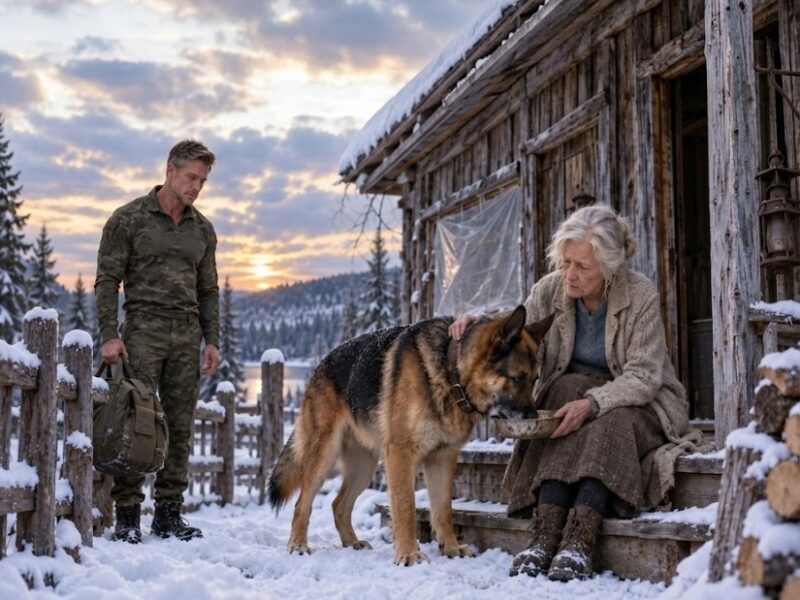
A Navy SEAL came home to surprise his mother—and found her giving her last meal to her dog. What he learned next broke him.
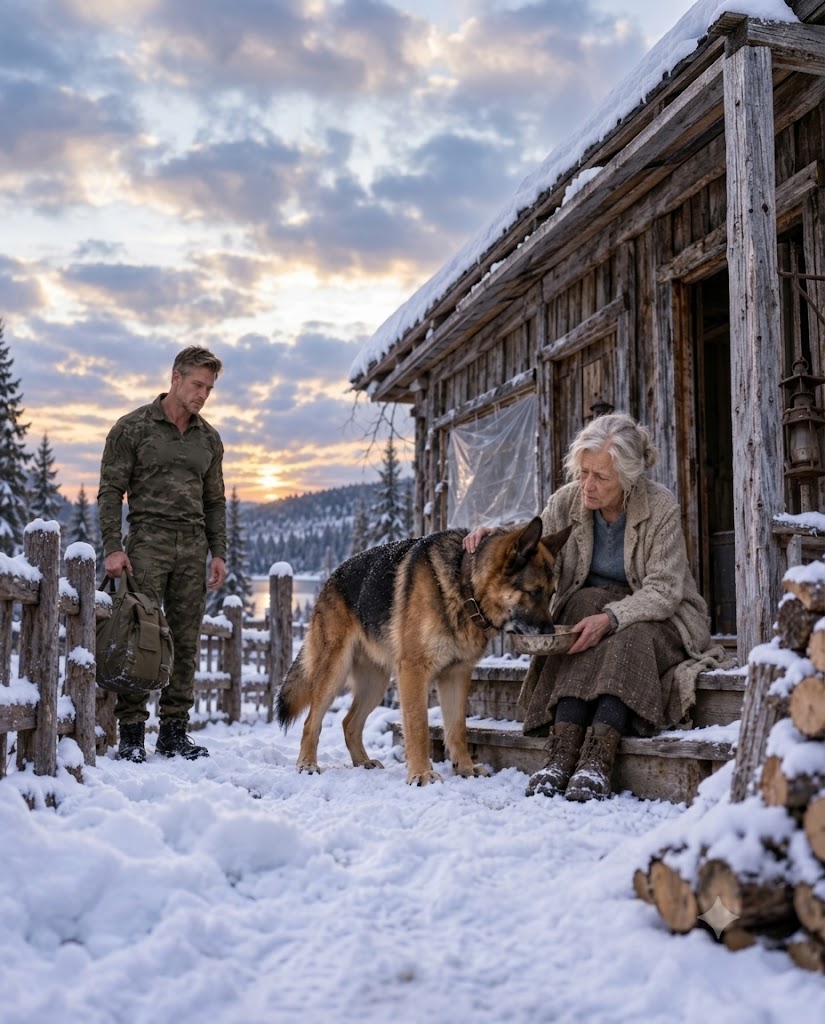
For ten years, Navy SEAL Cade Whitmore refused to forgive the mother who walked away and chose another life without him.
Then one winter, a trembling Christmas card led him to a broken shed in Michigan, where he found her old, cold, and quietly starving.
Beside her stood Brier, an aging German Shepherd who had stayed through death, poverty, and every lonely winter Cade never saw.
But Brier remembered something no one else did—a forgotten trail through the snow leading deep into the forest toward Daniel’s abandoned fishing cabin.
Beneath the cabin floor, Cade uncovered a hidden box, a letter, and a truth that shattered everything he had believed about the man he blamed for stealing his mother.
What Cade discovered next forced two angry sons to face the same wound and gave a broken family one final chance to find its way home.
Before we begin, tell us where you’re watching from.
And if you love stories of SEALs, loyal dogs, faith, and second chances, please like this video and subscribe.
Ten years earlier, Cade Whitmore had believed anger could preserve a memory.
At thirty, he had already spent much of his adult life learning how to leave places without looking back.
The Navy had taught him discipline, endurance, and the strange art of carrying home inside a duffel bag.
By then, Cade stood six-foot-one, broad-shouldered and solidly athletic rather than heavily muscled, with the controlled posture of a man who never wasted movement.
His handsome American face was angular, clean-shaven, and sharply defined by a strong jaw.
Ash-brown hair, already beginning to show faint silver at the temples, was kept in a neat undercut.
Deep gray-blue eyes gave him a calm appearance that often concealed more sorrow than peace.
His father had been dead for nearly two years when everything between Cade and his mother finally broke.
Thomas Whitmore had been a quiet, broad-handed man with thinning brown hair, a weathered square face, and the patient temperament of someone who could repair a broken porch step without needing the whole neighborhood to hear about it.
His death had left an emptiness in the Whitmore home that neither mother nor son knew how to enter without hurting themselves.
Cade escaped into work.
His mother, Evelyn, stayed behind.
At fifty-nine, Evelyn Whitmore was still a graceful woman then, small at roughly five-foot-three, with a slender frame, soft oval features, pale blue eyes, and silver beginning to thread through her light brown hair.
She had always possessed a gentle manner, but grief had made her quieter.
For months after Thomas died, she moved through the old house as though afraid of disturbing his absence.
Then she met Daniel Puit.
Daniel was a sixty-one-year-old widower from Michigan.
Medium-tall and lean, with a long, kind face, warm brown eyes, gray hair combed neatly to one side, and a carefully trimmed gray mustache.
He wore old flannel shirts, spoke without hurry, and had the practical kindness of a man who had learned that loneliness rarely announced itself loudly.
He never asked Evelyn to forget Thomas.
That was probably why she trusted him.
Cade understood none of that at the time.
All he understood was that his mother had fallen in love with another man, and then she was leaving.
Their final argument took place beside the kitchen table where Thomas used to read the Sunday newspaper.
“You don’t have to understand,” Evelyn had said.
“I understand perfectly.”
“No, Cade, you understand what hurts you.”
He had looked at the packed boxes near the door.
Something in him hardened.
“If you leave with him, don’t expect me to follow.”
Evelyn went very still.
The words wounded her.
Cade saw that.
He said nothing to take them back.
Perhaps that was the moment everything changed.
Or perhaps nothing changes in one moment.
Perhaps families simply gather small wounds until pride builds a wall around them.
Evelyn left.
Cade waited for her to call.
Evelyn waited for him.
A month became a year.
A year became ten.
The Christmas card arrived on a Tuesday in January.
Cade was forty now.
The years had sharpened rather than softened him.
His shoulders remained broad, his body still lean and disciplined from years of training, and the fitted long-sleeved green camouflage uniform he preferred sat cleanly against his frame.
Matching camouflage trousers, a dark tactical belt, and brown combat boots completed the same orderly appearance he carried almost everywhere.
No beard ever shadowed his face.
Even after long travel, Cade looked like a man who believed neatness was one small thing the world could still be forced to obey.
The envelope had been forwarded more than once.
His mother’s handwriting stopped him.
Not because it was unfamiliar—because it wasn’t.
The same elegant loops remained, but the lines trembled.
Cade opened the card.
There was no photograph, no explanation, no apology—only one sentence.
“I hope winter is kind to you, wherever you are.”
Cade read it twice, then again.
Something about the sentence irritated him.
That was easier to admit than saying it frightened him.
The last time he had seen Evelyn, she had been fifty-nine.
Now she was sixty-nine.
Ten years sounded different when counted in birthdays instead of anger.
For most of the afternoon, Cade told himself the card meant nothing.
By evening, he had searched the return address: North Haven, Michigan.
The following morning, he packed.
The drive north gave him too much time to think.
Snow deepened along the roads as towns became smaller and pine forests grew taller.
By the time North Haven appeared beneath a pale blue winter sky, sunlight was spilling over Lake Superior and turning the frozen shoreline silver.
It was almost offensively beautiful.
Cade hated that.
He had expected a place associated with his mother to look darker somehow.
Instead, snow sat bright on spruce branches.
Birch trunks glowed white between the pines.
Smoke curled lazily from chimneys scattered across the small town.
Cade kept both hands on the steering wheel.
He had made himself one promise: he would look.
That was all.
If Evelyn had a comfortable house, good neighbors, a husband who had treated her well, Cade would turn around.
He would not reopen ten years because of one Christmas card.
The GPS guided him through town, then beyond it.
The houses thinned.
The paved road became a narrower county road and eventually a snow-packed lane running beside the woods.
Cade frowned.
“Destination ahead.”
He slowed.
At the end of the lane stood a structure that looked less like a home than an old storage shed someone had persuaded not to collapse.
Cade stopped the truck.
No.
The roof bowed beneath accumulated snow.
Plastic sheeting had been taped over one window from inside.
Weathered wooden siding showed gray through peeling paint.
A thin metal chimney rose from the roof, but hardly any smoke came from it.
The GPS announced that he had arrived.
Cade stared at the screen, then at the building.
Then he saw the woman.
She was dragging a plastic tub filled with split firewood through the snow.
Her body was much smaller than he remembered.
At sixty-nine, Evelyn Whitmore Puit stood barely five-foot-three, but hardship had made her appear smaller.
Her frame was thin beneath an old cream-gray wool coat patched neatly near one elbow.
Under it showed the hem of a long brown-gray skirt.
Worn winter boots sank unevenly into the snow.
Her white-silver hair was gathered into a loose low bun at the back of her neck.
She pulled the tub three steps, stopped, pressed one hand against her left hip, breathed.
Cade forgot how to move.
He knew that gesture—when he was a child, Evelyn had rested one hand on her hip whenever she was tired from gardening.
But she had not looked old then.
She looked old now.
Not ruined, not helpless.
That somehow hurt more.
She simply looked like a woman who had been carrying too much for too long.
The driver’s door handle remained beneath Cade’s fingers.
All those years he had imagined this meeting.
Sometimes he was cold.
Sometimes she apologized.
Sometimes he said nothing at all.
In none of those versions had his mother been dragging firewood toward a broken shed.
Then the door of the building moved.
A German Shepherd stepped outside.
The dog was eight years old, male, large, but slightly leaner than ideal.
His coat was a rich yellow-gold beneath a distinct black saddle stretching across his back.
Black covered his muzzle, though silver had begun dusting the fur around it.
Upright ears turned toward Cade’s truck, and deep amber eyes studied the unfamiliar vehicle with quiet intelligence.
A worn dark-brown leather collar circled his neck.
Brier did not bark.
He walked to Evelyn, stopped slightly in front of her, and watched Cade.
Not aggression—protection.
That simple difference struck Cade immediately.
The dog was not warning him away.
He was asking what kind of man had arrived.
Cade finally opened the truck door.
His boots touched snow.
Evelyn looked up.
The plastic tub slipped from her hand.
One log rolled into the snow.
For several seconds, she stared at him as if age had finally begun playing tricks on her.
“Cade.”
His name sounded smaller in her voice than he remembered.
“Hi, Mom.”
That was all he had.
Ten years and two words.
Evelyn took half a step forward, then stopped.
Cade did the same.
Neither opened their arms.
There were distances measured in feet, and others measured in things never said.
Brier looked from one to the other.
Then, unexpectedly, the German Shepherd walked over to Cade.
He stopped just beyond arm’s reach and smelled the cold air around him.
Cade remained still.
Brier’s amber eyes lifted to his face.
For one strange second, something in the dog’s expression changed.
Not recognition—that would have been impossible—but Brier’s ears relaxed.
He looked back at Evelyn, then at Cade again, and sat between them.
Cade felt an inexplicable pressure behind his ribs, as though the dog had looked at two stubborn human beings and decided somebody needed to begin behaving sensibly.
“You’re cold,” Cade said.
Evelyn managed a faint smile.
“It’s Michigan. You know what I mean?”
Her smile faded.
“I’m fine.”
There it was.
The sentence people used when truth would cost too much.
Cade’s eyes traveled past her—the sagging roof, the plastic-covered window, the nearly dead chimney, the patched coat, Brier’s lean ribs beneath his winter coat.
He looked back at his mother.
“No,” Cade said quietly. “You’re not.”
Evelyn lowered her eyes.
Cade offered to carry the firewood inside.
She refused immediately.
That almost made him laugh.
Some things had survived ten years perfectly.
He carried it anyway.
Evelyn would not let him come farther than the doorway.
“The place is a mess.”
“I’ve seen worse.”
“You’ve also had the courtesy not to inspect most of it.”
Her attempt at humor landed between them awkwardly but gently.
Cade set down the wood.
“I should find a motel.”
Relief crossed Evelyn’s face too quickly.
That hurt.
Or perhaps it was shame—Cade could no longer tell.
He walked toward the truck.
Behind him, Brier remained in the doorway.
Cade opened the driver’s door, then glanced back.
Through the plastic-covered side window, he could see part of the small table inside.
Evelyn sat down.
Brier settled near her chair.
She opened a small container of stew.
Cade froze.
There was barely enough for one person.
Evelyn placed two bowls on the table.
Slowly, carefully, she picked out most of the pieces of meat.
She dropped them into Brier’s bowl.
For herself, she kept the thin broth, potatoes, and one piece of bread.
Cade’s hand tightened around the truck door.
Brier lowered his head toward the food, then stopped.
The German Shepherd looked at Evelyn.
She tapped the bowl.
“Go on.”
Brier still did not eat.
He moved instead to her side and rested his muzzle across her thin knee.
Evelyn smiled and scratched behind his ear.
Only then did Brier return to the bowl.
And Cade understood something he had not been prepared to understand.
His mother was hungry.
The dog knew it.
And somewhere during those ten years, Brier had become the creature who watched over all the things Cade had stopped seeing.
That thought hurt worse than anger ever had.
Cade shut the truck door without getting inside.
He crossed the snow again.
Three knocks.
Evelyn opened the door.
Surprise entered her pale blue eyes.
Cade looked past her at the two bowls, then back at the woman who had once packed his school lunches, stayed awake through fevers, and mailed cookies to places she was not allowed to know much about.
For ten years, he had carried the question of why she had left him.
Standing there, he discovered another question was suddenly more important.
His voice dropped.
“Mom.”
Evelyn waited.
Cade swallowed.
“What happened to you?”
Evelyn stepped aside without answering immediately.
Cade entered.
The warmth he had expected never came.
The room was perhaps fifteen degrees warmer than the snow outside, but the cold still lived in the walls.
It slipped beneath the rear door, gathered near the floorboards, and lingered around the single window covered with clear plastic.
A small electric heater hummed beside the wall with the exhausted sound of a machine being asked to do more than it was built for.
Cade stood quietly and let his eyes adjust.
One main room, a narrow bedroom beyond a faded curtain, a tiny kitchen counter, a two-burner electric stove with only one burner working, a metal bucket beneath a dark stain in the ceiling.
Two shelves held oatmeal, several cans of soup, half a loaf of bread, and a nearly empty container of dog food.
Evelyn closed the door behind him.
“You don’t have to inspect everything.”
“I’m not inspecting.”
“You have your inspection face.”
Cade looked at her.
“I have an inspection face?”
“You had one at twelve.”
For one brief second, he almost smiled.
Then his gaze settled on the old heater again.
Brier walked past him and lay beside Evelyn’s chair.
The eight-year-old German Shepherd folded his yellow-and-black body onto a worn rug.
Ears still turned toward Cade even though his amber eyes had softened.
Age had silvered the edges of his black muzzle, but nothing about the dog seemed dull.
Brier watched the room as if protecting it required noticing every breath.
Cade glanced toward the bowls on the table.
“Why did you give him most of the meat?”
Evelyn busied herself folding the edge of a dish towel.
“He ate less yesterday.”
“That wasn’t what I asked.”
“He’s getting older.”
“So are you.”
The words came out harder than Cade intended.
Evelyn’s hand stopped.
He immediately regretted the tone.
She looked toward Brier and gave a small, almost embarrassed smile.
“He never chose any of this.”
Something inside Cade loosened.
Not completely—ten years could not collapse because of one sentence.
But anger depended on distance.
It was easier to resent the woman he remembered than the elderly mother standing in front of him wearing a patched coat inside her own home.
Cade crouched beside the back wall.
Cold air touched his fingers before he reached the baseboard.
He moved to the rear door.
The wood had warped enough that daylight showed faintly through one edge.
“When did this happen?”
“It swells in the summer.”
“I’m asking about the gap, Evelyn.”
“Last winter, maybe.”
Cade tested the faucet.
The first turn produced nothing.
The second produced a thin stream.
“Pipe freezes sometimes.”
His jaw tightened.
He looked upward.
The ceiling insulation above one section had sagged away entirely.
The heater clicked off.
Three seconds later, it clicked back on.
Cade stared at it.
“Mom, this thing isn’t heating the room.”
“It does eventually.”
“Eventually when? April?”
Evelyn folded her arms.
“Cade.”
He stood too quickly.
For a moment, anger flashed across his face, sharp and familiar.
Evelyn lowered her eyes.
“All right,” she said softly. “I know what this looks like.”
That stopped him.
She thought he was angry with her again—just like ten years ago.
Cade rubbed one hand across the back of his neck.
“I’m not mad at you.”
Evelyn looked at him as if neither of them quite believed that sentence yet.
The truth was more complicated.
He was angry at the leaking roof, at the frozen pipe, at the heater, at whoever had allowed this.
At himself, mostly at himself, because every terrible thing in that room had existed yesterday, too, while Cade had been living somewhere else without knowing—or perhaps without asking.
The following morning, Cade returned before nine.
His truck bed was filled with groceries, insulation board, weather stripping, hand tools, a safer portable heater, two bags of dog food, and enough supplies to make Evelyn suspicious before he had unloaded the first box.
“No.”
Cade continued carrying bags.
“Good morning to you, too.”
“I mean it.”
“So do I.”
“I can pay you back.”
“I didn’t ask.”
“That is precisely the problem.”
Cade stopped.
There she was—the mother he remembered, small, stubborn, and capable of turning gratitude into an argument if pride required it.
Brier appeared behind her.
The German Shepherd walked directly to the dog food bags and sat beside them.
Cade pointed.
“At least someone here appreciates me.”
Evelyn looked at Brier.
“He has questionable judgment.”
Cade stared at her.
Then Evelyn smiled.
The laugh escaped him before he could stop it.
It was short, rusty, but real.
Evelyn laughed, too.
For several seconds, the cold little building sounded almost like a home.
Cade was replacing weather stripping along the rear door when an old pickup pulled into the lane.
A man climbed out slowly.
Caleb Dunn was seventy years old and perhaps five-foot-nine, thin but still solid through the forearms and hands.
Years of carpentry had left those hands wide, scarred, and permanently rough around the knuckles.
His weathered square face was framed by short white hair and a neatly trimmed gray-white beard.
Pale blue eyes carried a practical kindness that did not advertise itself.
He wore a faded rust-red flannel shirt beneath an old brown canvas jacket, olive work trousers, and boots whitened by road salt.
Caleb walked with the measured caution of someone whose body had begun charging interest on a lifetime of physical work.
“You must be Cade.”
Cade straightened.
“Depends who’s asking.”
“Caleb Dunn. I own the ground under this architectural masterpiece.”
From inside, Evelyn called out.
“I heard that.”
Caleb raised his voice.
“Good.”
Cade liked him immediately.
Caleb explained that the shed had once been his workshop.
He had converted part of it years ago, mostly for seasonal use.
When Evelyn needed somewhere to stay, he offered it for free, Caleb said.
Evelyn appeared in the doorway.
“For rent. I asked twenty dollars.”
“And I pay twenty dollars every month like the IRS is watching.”
Cade looked between them.
Caleb’s humor faded.
“I tried telling her twenty dollars wasn’t necessary. She doesn’t like owing people.”
“I’ve noticed.”
Caleb glanced at the roof.
“I meant to do more work here. Then my right shoulder started behaving like it belonged to somebody ninety years old.”
“How long has she been here?”
Caleb hesitated.
“Coming up on three years.”
Three years.
Cade absorbed the number without moving.
Three Michigan winters.
Brier came outside and leaned briefly against Caleb’s leg.
Caleb scratched behind the dog’s ear.
“That one kept her sane.”
Cade looked toward Evelyn.
She had already gone back inside.
Later that morning, Cade drove into North Haven for more supplies.
Belle’s Market stood on the corner of a narrow main street beneath a faded green awning.
Inside, the store smelled of coffee, oranges, cardboard, and warm bread.
The woman behind the counter looked up before Cade reached her.
Norabel was sixty-two, about five-foot-four, pleasantly full-figured, with a round, expressive face, warm brown eyes behind thin-framed glasses, and a short bob of silver-brown hair that curled slightly around her cheeks.
She wore a pale blue cotton shirt, a wine-red cardigan, dark trousers, and a beige store apron.
Everything about Norah suggested practical kindness—the sort that understood people often accepted help more easily when allowed to pretend it was not help.
“You’re Evelyn’s boy.”
Cade stopped.
“That obvious?”
“You have her eyes when you’re worried.”
“I’m not worried.”
Norah smiled.
“You also have her lying voice.”
Cade almost laughed.
He filled his basket—soup, coffee, eggs, fruit, bread, Brier’s food.
At checkout, Norah placed two bags of apples beside his groceries.
“I didn’t buy those.”
“They’re going soft.”
Cade picked one up.
It was perfect.
He looked at her.
Norah kept scanning.
“Your mother is very good at making five dollars behave like ten.”
Cade’s expression changed.
Norah finally met his eyes.
“She never asked me for anything.”
“Then how?”
“You don’t have to ask somebody to notice.”
The words stayed with him.
When Cade returned, Brier was sitting in the bedroom doorway—not sleeping, watching.
Cade carried a box of groceries inside and noticed the dog’s gaze remained fixed on a small wooden chest beneath Evelyn’s bedside table.
“Something in there?”
Brier’s ears moved forward.
Cade crouched.
The German Shepherd rose and walked toward the chest.
But instead of sniffing it, Brier looked back at Evelyn.
Evelyn had stopped folding laundry.
For one second, fear—not panic, but something older and sadder—passed through her face.
Then Brier gently nudged the wooden lid with his nose.
Evelyn crossed the room quickly.
“That’s nothing.”
Cade looked at her.
Brier stepped away.
Evelyn placed both hands over the little chest.
Something in Cade told him not to push.
Not yet.
But for the first time since arriving, he understood that poverty was not the only thing his mother had been hiding.
That afternoon, Cade accompanied Evelyn to a small clinic after noticing she was almost out of one medication.
There he met Dr. Hannah Voss.
Hannah was forty-eight, around five-foot-seven, with a balanced, healthy build and the calm posture of someone accustomed to speaking with frightened people without making them feel frightened.
Ash-blonde hair lightly streaked with silver was cut into a tidy jaw-length bob.
Her gray-green eyes were direct but kind, and she wore a navy turtleneck, charcoal trousers, a long dark coat, and low black boots.
She recognized Cade’s name immediately—not because Evelyn complained about him, but because she talked about him.
Hannah did not embarrass Evelyn by saying that.
Instead, when Evelyn stepped away to schedule an appointment, Hannah quietly explained the practical truth.
Evelyn received Social Security.
She was not completely without income, but what came in was consumed by electricity, fuel, food, medication, transportation, and basic living costs.
She could qualify for additional assistance, Hannah said.
“Then why isn’t she getting it?”
Hannah gave him a look that contained almost professional levels of patience.
“You’ve met your mother.”
Cade exhaled.
“Fair.”
“I gave her forms twice. Norah gave her forms once. Caleb tried, and she said somebody else needed it more.”
Cade closed his eyes briefly.
Of course she had.
By late afternoon, he returned to the shed and resumed work on the door.
He needed screws from a small cabinet beside Evelyn’s bed.
When he opened it, he accidentally shifted the little wooden chest Brier had watched earlier.
The lid opened.
Cade froze.
There was no money inside, no valuables—only pieces of his own life.
A photograph of Cade at twenty-three.
An old Navy patch.
Several newspaper clippings mentioning his unit.
Christmas cards addressed to him but never mailed.
A birthday card from six years earlier.
Another from four.
Another from last year.
Cade picked up one envelope.
His name was written across it in Evelyn’s trembling hand.
Behind him, floorboards creaked.
Evelyn stood in the doorway.
“I didn’t mean to open it.”
“I know.”
“Why didn’t you send them?”
Her eyes lowered.
“I did send some. At first.”
Cade waited.
“Then I stopped.”
“Why?”
Evelyn looked older suddenly.
“Because after enough silence, you start believing silence is the answer.”
Cade stared at the box.
For ten years, he had told himself his mother forgot him.
The evidence in his hand said something far crueler.
She remembered.
Every year she had simply believed she no longer belonged in his life.
Evening settled blue outside the window.
The repaired heater warmed the room more evenly now.
Brier lay beside Evelyn’s chair, his chin across one paw.
Cade sat opposite her.
For several minutes, they listened to the heater hum.
Then Cade finally asked the question he had avoided since arriving.
“Where’s Daniel?”
Evelyn’s fingers stopped around her mug.
Brier lifted his head.
The dog rose, moved closer, and rested his silvering muzzle across Evelyn’s knee.
Her hand settled automatically between his ears.
She stared at the floor.
“Daniel died three winters ago.”
Cade did not answer immediately.
His eyes moved around the small room—the cracked wall, the patched curtain, the old stove, the newly sealed door—then back to his mother.
“If Daniel died three years ago,” he paused, “why are you living here?”
Evelyn’s fingers tightened gently in Brier’s fur.
When she finally spoke, her voice was barely above the hum of the heater.
“Because after he died,” she looked at Cade, “this was the only place left for me.”
By the time Evelyn finished telling the story, the heater had warmed the little room enough for frost to disappear from the lower corners of the window.
Cade had not moved from his chair.
Brier lay between them, one yellow-and-black shoulder pressed against Evelyn’s shin.
The explanation began with a house Cade had never seen.
It stood closer to Lake Superior on a wooded rise where spruce trees leaned toward the water and winter storms sometimes sent ice against the shoreline hard enough to sound like breaking glass.
Daniel had taken Evelyn there when she moved to Michigan.
She had believed it belonged to him—not because he lied, but because neither of them had understood how important the distinction would eventually become.
The property had been part of the Puit family holdings for decades, tied to land Daniel’s parents had accumulated before either of his marriages.
Ownership passed through a family trust structure that kept the house connected to Daniel’s children and the older Puit estate rather than leaving it entirely under his personal control.
Daniel had once told Evelyn, “Whatever happens to me, you’ll be all right.”
She believed him.
Cade stared at the floor.
“Nobody explained the trust to you?”
“Not in a way I thought mattered.”
“It mattered.”
“I know that now.”
There was no defensiveness in her voice.
That made it harder to stay angry.
After the funeral, Daniel’s eldest son had taken over much of the practical administration.
His name was Wesley Puit.
At forty-four, Wesley was tall at just under six feet with a lean, controlled build and the rigid posture of a man who seemed uncomfortable when anything around him became emotionally untidy.
He had a rectangular face, a firm jaw, dark brown hair touched with silver above the ears, and brown-gray eyes that rarely revealed more than he intended.
He kept himself clean-shaven and dressed with careful restraint—charcoal wool coat, navy sweater, dark trousers, polished black boots.
“He hated you?” Cade asked.
Evelyn considered the question.
“No. That’s not what I expected. He distrusted me.”
“Difference?”
“To Wesley, probably.”
Years earlier, Daniel’s first marriage had ended badly.
Wesley had been old enough to understand the arguments but too young to understand that adults could fail each other without there being one villain.
By the time Daniel met Evelyn, Wesley had already decided his father had abandoned one family in search of another.
Evelyn became proof of that story, not the cause.
“Proof?”
“He thought I married Daniel for the house,” Evelyn said.
“Did Daniel correct him?”
“Many times.”
“Did Wesley listen?”
Evelyn looked at Cade.
“You tell me. How well do angry sons listen?”
The words landed cleanly.
Cade said nothing.
Wesley had not thrown Evelyn into the snow.
That would almost have been easier to hate.
Instead, he arrived two weeks after the funeral with folders, schedules, and the stiff courtesy of someone determined to be legally correct.
He explained that the lake house remained part of the Puit family estate.
There were taxes, maintenance, trust obligations, decisions that required signatures Evelyn did not control.
He gave her several months to move.
“He said I could take my time,” Evelyn said.
Cade’s mouth tightened.
“Generous.”
“He believed he was being fair.”
“Was he?”
Evelyn took longer to answer.
“No. But Wesley had not shouted. He had not threatened. He had simply treated the years Evelyn lived there as though they had been an extended visit that had reached its end.”
That coldness hurt more than cruelty might have.
One afternoon, Evelyn found Wesley standing in Daniel’s workshop, sorting tools into boxes.
She asked what would happen to Daniel’s fishing equipment.
Wesley answered without looking at her.
“Family things stay with family.”
Evelyn stopped talking after that.
Cade’s jaw hardened.
“He said that to you?”
“He was grieving.”
“So were you.”
“Yes.”
“Why does that excuse him?”
“It doesn’t.”
That answer surprised him.
Evelyn looked at Brier.
“It only explains him.”
She could have hired an attorney.
A neighbor suggested one.
Daniel’s daughter Rachel called once and told her not to rush into leaving, but Evelyn had no strength left for a dispute.
She had buried one husband years earlier, then spent a decade carrying guilt over Cade.
Now Daniel was gone too.
The thought of sitting across from his children in offices and arguing about what portion of his life belonged to whom made her feel sick.
So she packed clothes, photographs, a few kitchen things, personal letters, Brier.
That was almost everything.
Wesley did not want the dog.
By then, Brier had spent years following Daniel through woods, fishing trails, and long mornings beside the lake.
But his deepest attachment after Daniel’s absence settled around Evelyn.
“He told me Brier was getting old,” Evelyn said.
Cade looked at the German Shepherd.
Brier opened one amber eye.
“Eight isn’t ancient.”
“Apparently Wesley prefers his relationships with lower maintenance requirements.”
Cade looked sharply at his mother.
Evelyn’s mouth twitched.
He laughed despite himself.
It lasted only a second.
Then anger returned.
“I’m going to see him.”
Evelyn straightened.
“No.”
“I didn’t say I was going to hit him.”
“You said it like a man who wanted me to be impressed by that distinction.”
Cade stood.
Brier raised his head.
“Mom, he pushed you out of your home.”
“It was never legally mine.”
“It was your home.”
“Yes.”
“Then why are you defending him?”
Evelyn rose more slowly.
She looked small beside her son, but nothing in her expression was weak.
“I’m not defending Wesley.”
“Then what are you doing?”
“Trying to keep you from making anger useful again.”
Cade went still.
Evelyn’s voice softened.
“I already lost one son because anger made both of us proud. Don’t become another man who lets anger choose his life.”
There it was—not accusation, recognition.
Cade suddenly saw a shape he did not like.
Wesley had spent years convinced Evelyn had taken his father.
Cade had spent years convinced Daniel had taken his mother.
Two grown men, two different stories, the same wound.
Cade sat down again.
Brier lowered his head between his paws.
The dog seemed satisfied with the outcome.
Two days later, the old shed sounded like a construction site.
Cade had decided anger needed a job.
Caleb Dunn arrived shortly after sunrise carrying a thermos and a collection of tools old enough to qualify for pensions.
With him came Owen Beckett.
Owen was fifty-five, around five-foot-eleven, broad through the chest, with the dense strength of a man who had spent thirty years climbing ladders, pulling cable, and carrying equipment through basements.
His wide face was clean-shaven, his short salt-and-pepper hair cut close, and his brown eyes had the patient skepticism of someone who assumed every previous homeowner had done at least one dangerous thing with wiring.
He wore a navy work shirt beneath a gray utility jacket, brown work trousers, and heavy safety boots.
Owen opened the electrical panel.
Then he stared.
Then he closed it.
Cade raised an eyebrow.
“That bad?”
Owen opened it again.
“I wanted to see if it improved.”
Caleb snorted into his coffee.
It had not.
Owen found overloaded circuits, outdated connections, and several improvised repairs that needed professional replacement.
Cade did not argue.
For once, experience had taught him exactly where competence ended.
The second specialist arrived before noon.
Noah Mercer was forty-six, about five-foot-ten, with a sturdy average build, a slightly round face, hazel eyes, and short dark-brown hair beginning to silver near the temples.
He was clean-shaven and wore a charcoal-gray Henley beneath a dark navy work jacket, utility pants, and brown boots.
Unlike Owen’s dry seriousness, Noah carried an easy humor that seemed specifically designed for cold houses and worried customers.
He inspected the heating system.
“How attached are you to this heater?”
Evelyn looked concerned.
“Emotionally? Preferably not.”
Cade folded his arms.
“Can it be saved?”
Noah looked at him.
“Sure.”
Cade waited.
Noah continued, “If your goal is to display it in a museum.”
Even Evelyn laughed.
That afternoon, Cade carried damaged boards toward Caleb’s truck while Brier lay near the porch.
Evelyn and Caleb were talking about Daniel.
The moment Daniel’s name was spoken, Brier’s ears lifted.
The dog did not look at Evelyn.
He looked toward the trees.
Cade noticed.
A few seconds later, Brier stood, walked to an old leather glove lying beside his bed, picked it up carefully, and returned to the doorway.
The glove was too large to belong to Evelyn.
Its brown leather had gone dark with age.
The fingers permanently curved from years of use.
“Daniel’s?” Cade asked.
Evelyn nodded.
“He used to wear those when they went out together.”
“Out where?”
“Fishing. Walking. Sometimes I never knew.”
Brier continued staring at the forest—not restless, not frightened, remembering.
Caleb followed the dog’s gaze.
“Daniel used to take him down toward that old lake trail.”
Cade looked at Caleb.
“What’s down there?”
“Mostly woods now,” Caleb paused. “Used to be an old fishing cabin farther in.”
Brier lowered the glove onto the porch, then lay beside it.
Nothing else happened, but Cade found himself looking toward the trees long after everyone returned to work.
Over the next several days, the shed changed little by little.
Cade removed warped boards and replaced sections around the rear entrance.
Caleb showed him where the framing could be strengthened without tearing apart the wall.
Owen rewired the dangerous circuits.
Noah arranged replacement heating equipment.
Cade hauled lumber, fitted insulation, replaced the back door, rebuilt the lower step, and sealed the gaps that had been feeding winter air into the room.
Brier became his shadow.
At first, the dog remained several yards away.
Then two.
Eventually, Brier began sleeping beside Cade’s toolbox.
One afternoon, Cade left a new work glove on a stack of lumber.
Five minutes later, it disappeared.
He searched the shed, the porch, the truck.
Nothing.
Evelyn watched from the doorway with suspicious innocence.
Finally, Cade noticed Brier near the snowbank.
Only the dog’s ears and tail were visible.
“Brier.”
The German Shepherd froze.
Cade walked closer.
Brier stepped aside.
One green work glove protruded from the snow.
Cade stared at him.
“Your dog is a criminal.”
Evelyn folded her arms.
“Technically, he was Daniel’s.”
Cade picked up the wet glove.
“Then this is inherited behavior.”
Evelyn laughed.
Not politely, not carefully.
A real laugh.
Brier wagged his tail once, apparently pleased with himself.
Cade looked at his mother.
For just a moment, she seemed younger.
Not fifty-nine again, not untouched by time—simply alive in a way he had not seen since returning.
That was enough.
The following afternoon brought clear skies after several hours of snowfall.
Cade finished fastening a section of trim and began gathering his tools.
Brier stood at the porch.
“Inside,” Cade called.
The dog did not move.
“Brier.”
Amber eyes turned toward him.
Then Brier stepped into the snow.
He walked perhaps ten yards toward the forest, stopped, looked back.
Cade frowned.
Brier continued several more yards, stopped again, looked back again—not wandering, waiting.
Evelyn came onto the porch.
The moment she saw where Brier was facing, the expression left her face.
Cade noticed.
“What?”
Evelyn stared beyond the dog toward the narrow opening between the trees.
“Daniel used to take him that way.”
Brier stood silently beneath the snow-covered pines.
The old leather glove lay near the porch behind him.
Cade set down his tools, pulled on his coat.
Evelyn looked at him.
“Cade.”
He stepped off the porch.
Brier immediately began walking again.
This time, Cade followed.
The trail disappeared almost as soon as it entered the trees.
Fresh snow had softened every familiar edge.
Fallen branches lay beneath white drifts, and the narrow path twisted between spruce, birch, and dark pine trunks until Cade could no longer tell whether they were following a trail or only the memory of one.
Brier seemed to know the difference.
The eight-year-old German Shepherd moved ahead at a measured pace, his yellow-and-black coat sharp against the snow.
He was not excited.
He did not run blindly or pull at some imaginary destination.
Instead, Brier stopped often, lowered his black muzzle toward the ground, tested the air, then adjusted his direction by a few feet.
Sometimes he circled a tree before continuing.
Sometimes he stood perfectly still, amber eyes studying the woods.
Cade recognized the behavior for what it was—not magic, not some impossible animal prophecy, but memory mixed with scent, terrain, and habit.
Years earlier, Daniel had walked these woods with him.
Brier was simply remembering a road the humans had forgotten.
Evelyn followed several yards behind Cade.
Her pace worried him.
The uneven snow forced her to lift each foot higher than usual, and every few minutes her right hand drifted toward her left hip.
She wore the same old cream-gray coat, the patched sleeve visible whenever she used a low branch for balance.
Her pale face had reddened from the cold, and several strands of white hair had escaped the loose bun at the back of her neck.
Cade stopped.
“That’s enough.”
Evelyn caught up.
“No.”
“You’re limping.”
“I have been limping for years. It has yet to become fatal.”
“This isn’t funny.”
“I wasn’t joking.”
Cade looked toward Brier.
The dog had stopped farther ahead and was watching them.
“Mom, we don’t even know where he’s going.”
Evelyn followed Cade’s gaze.
“No.”
Then she took another careful step.
“But I want to know.”
There was something in her tone Cade had begun learning not to fight.
He offered his arm.
Evelyn looked at it, then at him for half a second.
Cade expected her to refuse.
Instead, she slipped one hand through his elbow.
Neither mentioned it.
They kept walking.
The woods opened after nearly twenty minutes.
Beyond a line of leafless birch trees, a frozen inlet stretched beneath the winter sky.
A small fishing cabin stood near the shore.
Time had nearly swallowed it.
The roof sagged on one side.
Moss and ice clung to the shingles, and the gray wood siding had faded until it almost matched the surrounding trees.
One window was boarded over.
Snow had drifted against the front entrance nearly halfway up the door.
Evelyn stopped.
Cade felt her grip tighten slightly around his arm.
“I remember this place.”
“You came here with Daniel?”
“Twice.”
Brier moved ahead.
“He came much more often,” Evelyn added.
“With Brier?”
“Always.”
The German Shepherd circled the cabin once, then again.
His nose remained low.
Cade watched carefully.
Brier was not searching the entire property at random.
He kept returning to the right side of the structure, where a smaller utility door was almost hidden by snow.
The dog scratched once, then looked back.
Cade approached.
“That seems specific.”
Evelyn stood several feet away.
“Daniel used that side door when he brought fishing gear.”
Cade brushed snow from the frame.
The latch was rusted but intact.
He worked it loose carefully rather than forcing the wood.
When the door opened, a dry smell escaped from inside.
Dust, old pine, metal, cold air.
Nothing had disturbed the room in years.
The cabin was simple.
One large room, a wood stove, two chairs, an old cot against the wall, a rough table near the center.
Fishing poles leaned in one corner beneath a canvas tarp.
Dust covered nearly everything evenly.
That mattered.
No decay pattern suggested recent disturbance.
No footprints, no recent movement, no sign someone had come back after Daniel’s death.
Evelyn remained near the doorway.
Her expression had changed.
The place seemed to contain more of Daniel than she had expected.
A chipped green mug still hung from a hook.
An old wool cap sat on a shelf.
A faded photograph of Lake Superior had been pinned beside the stove.
Evelyn touched nothing.
Cade understood.
Sometimes objects became dangerous when they had been left exactly where someone placed them before dying.
Brier walked slowly through the room.
His tail remained low.
Then he stopped beside the table.
Cade expected him to continue.
He did not.
Brier lowered his head and sniffed along one table leg.
Then he pawed at the floor once.
Twice.
Cade folded his arms.
“If this is about a mouse, you’re buying dinner.”
Brier ignored him.
Evelyn gave the faintest smile.
The dog scratched again.
Cade crouched.
Snowmelt and age had darkened the floorboards, but one plank near the table showed something different—two shallow chisel marks, not random scratches.
Cade ran his thumb over them.
“Daniel do much carpentry?”
“Enough to hide mistakes.”
Cade looked at her.
“That sounded personal.”
“He once built a bookshelf that leaned north.”
“Maybe it had ambition.”
Evelyn laughed softly.
Then the sound faded as Cade pushed the table aside.
The plank lifted more easily than it should have.
Beneath it was a narrow recessed space between the joists.
Inside sat a cedar box wrapped in old waterproof canvas.
The room went silent.
Brier did something Cade did not expect.
Instead of rushing toward the opening, the German Shepherd stepped back.
He sat beside Evelyn—not beside the box, beside her.
Evelyn stared down at him.
Brier looked up for several seconds.
Neither moved.
Then Evelyn placed one trembling hand on the silvering fur around his muzzle.
“He was here,” she whispered.
Cade looked toward the hidden compartment.
“Daniel?”
Evelyn nodded slowly.
“Brier remembers him here.”
The realization changed the room.
The dog had not led them to money.
He had led Evelyn to the last place where Daniel’s habits still lived.
And perhaps that was why Brier had watched the forest all those years—not because he understood what had been hidden, but because someone he loved had once walked this road.
Cade wrapped the cedar box again before carrying it outside.
He did not open it there.
The cabin was too cold, the light too poor, and Evelyn was visibly tired.
They returned slowly.
This time, Cade did not wait for Evelyn to ask.
He kept one hand beneath her elbow through the steepest sections.
Brier walked ahead but no longer searched.
Whatever task had held his attention seemed complete.
Back at the shed, Cade placed the box on the kitchen table.
Evelyn sat opposite him.
Brier settled beside her chair.
The cedar lid had swollen slightly but remained sealed well enough to protect the contents.
Cade worked the latch carefully.
Inside was no fortune, no theatrical stack of cash—just a series of ordinary things that suddenly felt enormous.
A thick envelope, several hundred dollars in emergency cash, a folded bank statement, a certificate for a long-term investment account, a beneficiary designation form, and one letter.
Evelyn’s name was written across the front in Daniel’s handwriting.
She stopped breathing for a moment.
Cade pushed the letter toward her.
“You should open it.”
Her fingers hovered above the envelope.
“I don’t know if I can.”
“You don’t have to do it alone.”
That was the sentence—not the letter, not the money.
That was what finally made Evelyn pick it up.
Daniel’s handwriting was compact and slightly uneven.
Evelyn read slowly.
Cade watched her face.
Daniel wrote that his health had been worrying him more than he admitted.
He had been experiencing chest pain.
The doctors had ordered more testing.
He did not believe he was dying, but age had taught him that believing something would wait did not mean it would.
Daniel wrote that Wesley still did not trust Evelyn.
He regretted failing to repair that relationship.
He also knew Evelyn would rather go without than ask Daniel’s children for anything, so he had created a separate financial arrangement.
The account remained in his name during his lifetime.
Evelyn was listed as beneficiary upon his death.
Daniel had intended to explain everything after the bank completed the final paperwork.
He hid copies at the fishing cabin because he did not want the documents misplaced among the estate papers at the lake house.
Then came the line that broke Evelyn.
“You have spent too much of your life believing love must be paid for with sacrifice.”
Her lips trembled.
Cade looked away long enough to give her the dignity of choosing whether to cry.
She did—quietly.
Brier rose and pressed his head beneath her hand.
Evelyn continued reading.
Daniel wrote that money could solve practical problems but not the one he worried about most.
He mentioned Cade—not with resentment, with concern.
“Find your son.”
Evelyn covered her mouth.
The next sentence took longer.
“Pride has already taken enough years from both of you.”
Cade stared at the table.
Daniel had known.
A man Cade had spent ten years blaming for taking his mother had apparently spent part of his final days hoping to send her back toward him.
That truth did not erase the past.
It complicated it—and sometimes complication was the beginning of honesty.
Cade examined the documents after Evelyn finished.
The beneficiary form clearly listed Evelyn Whitmore Puit.
The account documents were dated several weeks before Daniel’s death.
The letter itself was dated six days before he died.
Cade looked at Evelyn.
“He was planning to tell you.”
She nodded.
“He always thought there would be another morning.”
The words were simple.
They unsettled Cade more than he expected.
He had thought the same thing for ten years.
Another Christmas.
Another call.
Another chance.
Brier rested beneath the table.
Now Cade looked at the dog.
“He probably brought him the day he hid this.”
Evelyn followed his gaze.
“Probably.”
Brier’s ears twitched at Daniel’s name.
Nothing more.
No miracle.
No mysterious understanding—just memory, a path, a room, a man’s scent once attached to a place, and loyalty strong enough to preserve the direction long after the person was gone.
Cade looked back at the paperwork.
One problem remained.
The documents showed that Daniel had intended the account for Evelyn.
They did not prove the account still existed.
Years had passed.
The institution could have merged, transferred the assets, closed the account improperly, or required additional probate records.
Evelyn traced Daniel’s handwriting on the letter.
“He said I’d be all right.”
Cade gathered the financial documents into one careful stack.
For the first time since arriving in North Haven, his expression carried something other than anger or regret.
Purpose.
“Then tomorrow,” he said, “we find out whether he kept that promise.”
Maryanne Cole did not believe in hopeful paperwork.
That was the first thing Cade learned about her.
Her office occupied the second floor of a narrow brick building in downtown North Haven, above an insurance agency and across from a bakery whose windows fogged in the winter cold.
Inside, everything was orderly without being elegant.
Dark shelves of probate law books, framed photographs of Lake Superior, two filing cabinets, and a broad wooden desk worn smooth along one edge.
Maryanne was fifty-two, about five-foot-six, slender and straight-backed.
Her long composed face was framed by auburn-brown hair lightly streaked with silver and brushed neatly to one side.
Dark green eyes watched through thin reading glasses with the steady attention of someone who disliked assumptions almost as much as sloppy documents.
She wore a navy blazer over a cream blouse, tailored gray trousers, and black ankle boots.
She had practiced probate and family property law for more than twenty years.
Her parents had nearly lost their farm during a succession dispute when she was in college.
That experience had given her a permanent suspicion of sentences beginning with “Everyone understood what Dad wanted.”
“Intent matters,” Maryanne said, turning Daniel’s beneficiary form beneath the desk lamp.
“But documents matter more.”
Cade sat beside Evelyn.
Brier waited at home with Caleb.
Evelyn’s hands were folded tightly in her lap.
“What do we know?” Cade asked.
Maryanne removed her glasses.
“We know Daniel created an investment account. We know this document appears to name Evelyn as transfer-on-death beneficiary. We know the dates are consistent.”
“Then it’s hers.”
“No,” Cade frowned.
Maryanne continued calmly.
“It may be hers. First, we verify the account existed, whether the designation was accepted, whether the institution changed hands, and whether any later documents superseded this one.”
Evelyn looked down.
Cade recognized disappointment before she could hide it.
Maryanne noticed, too.
“That isn’t bad news, Mrs. Puit. It isn’t good news either. It’s honest news.”
Cade almost smiled.
He liked her.
Verification took two days.
They felt longer.
Maryanne contacted the financial institution listed on Daniel’s documents, then discovered it had merged with a larger regional bank eighteen months after his death.
There were archived records, old account numbers, identity requirements, death certificates, probate records.
Each answer created another request.
Cade resisted the urge to treat bureaucracy like an enemy position.
Maryanne noticed.
“You’re pacing.”
“I’m standing.”
“You’ve crossed the same carpet eleven times.”
Cade stopped.
Evelyn hid a smile.
On the second afternoon, Maryanne called them back.
This time, there was no stack of unanswered forms waiting on the desk—only one printed statement.
Maryanne turned it around.
“The account still exists.”
Evelyn stared at her.
Cade did not speak.
Maryanne explained that Daniel’s original investment had remained active after his death because the beneficiary claim had never been initiated.
The funds had transferred internally when the institution merged, but the underlying account record and beneficiary designation remained preserved.
“How much?” Cade asked.
Maryanne gave them the current value.
Nineteen thousand five hundred dollars.
Evelyn’s expression did not change at first.
Then one hand rose slowly to cover her mouth.
The amount was not enormous wealth.
It would not buy mansions or transform anyone’s life into fantasy.
But it was enough.
Enough for medical care.
Enough for proper housing.
Enough for repairs.
Enough to stop measuring every grocery item against the heating bill.
Cade looked at his mother.
Tears had gathered in her pale blue eyes.
He thought she was crying because she was safe.
Then Evelyn whispered, “He remembered.”
Cade understood.
This was not about the balance.
Daniel had kept his promise.
Even though he had died before he could explain it.
Maryanne gave them another piece of information before they left.
“There’s something else you both need to understand.”
Cade looked at her.
“Wesley did not touch this money.”
Evelyn’s eyes lifted.
Maryanne tapped the account history.
“There were no withdrawals after Daniel’s death. No attempted transfer by the estate. No request from Wesley. From everything I can see, he never knew the account existed.”
Cade leaned back.
Part of him had wanted Wesley to be guilty of something clear.
That would have been easier.
A stolen account created a villain.
A grieving son who acted coldly because he believed his own version of the past was much harder to hate.
Maryanne folded her hands.
“Sometimes families do terrible damage without committing crimes.”
Cade glanced at Evelyn.
“Yes,” he said quietly. “I’m starting to notice.”
He met Wesley that afternoon—not at Evelyn’s house, not at the old lake property.
Cade chose a small coffee shop near the marina because neutral ground seemed wiser.
Wesley arrived exactly on time.
Cade recognized him immediately.
The forty-four-year-old man was just under six feet, lean, clean-shaven, with a rectangular face, firm jaw, dark brown hair graying slightly above the ears, and brown-gray eyes that seemed to measure every room before relaxing inside it.
His charcoal wool coat was buttoned neatly over a navy sweater and dark trousers.
Nothing about him looked cruel.
That irritated Cade more than he expected.
Wesley sat across from him.
“You found the account.”
Cade studied him.
“Maryanne contacted you. She asked questions about the estate.”
“I didn’t know.”
The answer came without hesitation.
Cade believed him.
Wesley looked toward the window.
“My father liked contingency plans. Apparently, he didn’t like telling anyone about them.”
“He told my mother she’d be taken care of.”
“I know.”
“Then why did you make her leave?”
Wesley’s jaw tightened.
“I didn’t drag her out.”
“That seems to be everybody’s favorite defense.”
“I gave her months.”
“You treated her like a guest in the house where she buried her husband.”
Wesley looked back at him.
“And she treated my father like a chance to begin again.”
Cade’s expression hardened.
“Careful.”
“I’m not insulting her.”
“You’re doing an impressive imitation.”
Wesley exhaled through his nose.
For several seconds, neither man spoke.
Then Wesley said, “My parents were married thirty-one years.”
Cade waited.
“When they separated, my father was already halfway gone emotionally. A year later, Evelyn was there. She didn’t cause their divorce. I know that now.”
“Didn’t stop you from blaming her.”
“No.”
The honesty disarmed Cade slightly.
Wesley continued.
“My father remarried, moved closer to the lake, bought Brier, started fishing again. He seemed happier than he had been in years.”
“That made you angry?”
“It made me feel replaceable.”
Cade went still.
Wesley looked down at his coffee.
“My sister adjusted. I didn’t.”
Cade heard his own thoughts in another man’s voice.
For ten years, he had told himself Daniel had taken Evelyn.
Wesley had told himself Evelyn had taken Daniel.
Different sides of the same locked door.
Wesley reached into his coat and placed something on the table—a photograph.
Daniel stood beside the lake, older but smiling, one hand resting on Brier’s back.
Evelyn stood beside him.
What stopped Cade was the small object in Daniel’s other hand—a Christmas card.
On the back, in Daniel’s handwriting, were three words: “For Cade, someday.”
Cade stared at it.
“Where did you get this?”
“Dad’s desk.”
“Why didn’t you give it to her?”
Wesley looked ashamed for the first time.
“Because I was angry.”
The answer hung between them.
Not greed, not conspiracy.
Anger.
Cade realized the photograph was almost more disturbing than any evidence of wrongdoing could have been.
Wesley had not stolen Evelyn’s money.
He had simply allowed resentment to make him cruel in small, quiet ways.
Exactly the kind of cruelty Cade understood too well.
Wesley did not apologize.
Cade did not demand it.
Some conversations became less honest the moment people rushed toward forgiveness.
Instead, Cade pushed the photograph back across the table.
“Keep it.”
Wesley looked surprised.
“Why?”
“So you remember what anger made you hide.”
Wesley’s expression tightened.
Cade stood, then stopped.
“You and I spent years punishing the same woman for different stories we never bothered to question.”
Wesley said nothing.
Cade walked away.
He did not feel victorious.
That surprised him.
For years, he had imagined confronting the man connected to his mother’s disappearance and finally having someone to blame.
Instead, he had found a mirror.
That evening, snow tapped gently against the repaired window.
Evelyn sat at the small table while Brier slept beside her chair.
Cade had spent an hour pretending to adjust a cabinet hinge that had been fine after the first ten minutes.
Finally, Evelyn said, “You’re going to wear out that screw.”
Cade put down the screwdriver.
“Why did you really leave?”
Evelyn did not answer immediately.
He sat across from her.
“I know about Daniel,” Cade said. “I know what happened afterward. I’m asking about before.”
Evelyn looked toward the window.
“When your father died, everybody told me I was strong.”
Cade listened.
“I hated that word.”
“Why?”
“Because people say you’re strong when they want you to keep carrying something.”
Her fingers traced the rim of her mug.
“You were thirty. You had your career. Every time you called, you were leaving somewhere or going somewhere. I was proud of you.”
She smiled sadly.
“And I started convincing myself that being proud meant I was no longer allowed to need you.”
Cade’s throat tightened.
“Daniel came along when I had forgotten what it felt like for someone to notice if I came home late.”
“You could have told me.”
“Yes.”
“You could have said you were lonely.”
“Yes.”
The lack of defense hurt more than an argument would have.
Evelyn looked at him.
“I chose badly in one important way, Cade. I thought because you were grown, leaving quickly could not hurt you the way leaving a child would.”
“It did.”
“I know.”
Daniel had not rescued Evelyn.
He had simply met her at the moment she needed companionship.
She fell in love.
Then Cade became angry, and Evelyn’s guilt turned into pride.
“I kept thinking I would call when you were less angry.”
Cade gave a bitter half-smile.
“I kept thinking I’d answer when you apologized first.”
“A very efficient system.”
He laughed quietly.
So did she.
Then the room became still again.
Evelyn’s eyes filled.
“I never stopped loving you.”
Cade looked at her.
“I stopped believing I still had the right to ask you to love me.”
He had imagined this conversation for ten years.
In every version, he had something to say—something sharp, something final.
Now he had none.
Cade reached across the table and took his mother’s thin hand in his.
Evelyn closed her fingers around his.
No apology could recover ten years.
No sentence could erase them.
But for once, neither was asking the past to disappear.
They were simply refusing to give it another night.
Brier opened one amber eye, then closed it again.
Cade’s phone vibrated on the table.
He almost ignored it.
Then he saw the sender—his unit.
He read the message twice.
Return date confirmed.
Three weeks.
After that would come one of his final operational assignments before transitioning toward a stateside training role he had been discussing for months.
Three weeks suddenly felt very short.
Evelyn saw his face.
“You have to go.”
It was not a question.
Cade looked around the partially repaired room.
New insulation still weighted against one wall.
Tools covered half the counter.
The repaired door now closed properly.
But the house was nowhere near finished.
Brier slept at Evelyn’s feet.
Cade thought about another departure ten years ago.
Back then, leaving had been easy because anger told him departure was strength.
This time, there was no anger left to carry him—only responsibility.
He looked at his mother, then at the unfinished house.
Three weeks.
The problem was no longer whether he could stay forever.
He could not.
The real question was harder.
How did a man leave without turning departure into abandonment again?
Three weeks was not enough time to repair ten years.
Cade knew that by the second morning.
He also knew something else.
Trying to make up for lost time could become another form of pride.
He could not rebuild every birthday he had missed, every winter Evelyn had spent alone, or every phone call neither of them had made.
So he stopped trying.
Instead, he focused on the things that could still be changed.
A roof that leaked.
A bathroom that needed a safer floor.
A heating system that belonged in another century.
A woman who deserved to wake up warm without wondering whether the electric bill would punish her for it.
And a dog who had already survived enough cold rooms.
Evelyn surprised him on the first day by refusing to leave the old shed.
Cade had assumed the money Daniel left would change her mind.
There were small houses for sale closer to town.
Cleaner houses.
Easier houses.
He showed her three listings on his phone.
Evelyn looked at each one politely, then handed the phone back.
“No.”
Cade stared at her.
“No?”
“This is my home.”
He looked around the half-finished room.
“Mom, this was a workshop.”
“It was. It still leans.”
“So did your father after fifty.”
Cade almost smiled.
Evelyn rested one hand on the table.
“When I came here, I thought I had lost everything.”
Her eyes moved toward Brier, who slept near the stove.
“But this place kept me alive.”
Cade said nothing.
“I don’t want to erase that.”
“What do you want?”
She looked around again.
“To make it worthy of surviving.”
That answer ended the argument.
For once, Cade understood that helping someone did not mean replacing their choices with his own.
Work began the following morning.
Caleb Dunn took control of the carpentry with the authority of a man who had spent half a century believing tape measures were more reliable than people.
He inspected Cade’s framing work and frowned.
“What?”
Caleb tapped one board.
“You’re confident.”
“That sounds like a compliment.”
“It wasn’t.”
Cade stared at him.
Caleb handed him a level.
“Confidence doesn’t straighten lumber.”
Cade liked him more every day.
Owen Beckett handled the electrical system.
The fifty-five-year-old electrician moved methodically through the house, replacing dangerous wiring, updating outlets, and separating overloaded circuits.
His broad face remained serious even when his humor surfaced.
At one point, Cade asked whether the old panel had any redeeming qualities.
Owen answered, “It hasn’t killed anybody yet.”
Noah Mercer arrived with new heating equipment two days later.
The forty-six-year-old HVAC technician carried himself with the relaxed confidence of someone who enjoyed fixing machines more than explaining why they had failed.
He looked at the old heater one final time.
“Should we say something?”
Cade frowned.
“To the heater?”
“It served bravely.”
“It tried to freeze my mother.”
“Then maybe not.”
Even Evelyn laughed.
The house changed one section at a time.
New insulation went into the walls.
Damaged roofing came off.
Caleb and Cade replaced warped boards and strengthened the porch frame.
Owen modernized the electrical system.
Noah installed reliable heating.
A contractor recommended by Caleb replaced the bathroom floor with a safer, non-slip surface and added a grab bar near the shower.
Cade rebuilt the front steps wider and lower.
He added a rail Evelyn pretended not to need.
She used it the first morning without comment.
Cade said nothing.
That was progress, too.
Norabel appeared every few days carrying food she claimed was extra.
Nobody believed her anymore.
Nobody challenged her either.
One afternoon, she arrived with a casserole large enough to feed a construction crew.
“I accidentally made too much.”
Cade looked at the dish.
“For a wedding?”
Norah adjusted her glasses.
“Do you want lunch or an investigation?”
Cade took the casserole.
“Yes, ma’am.”
Dr. Hannah continued helping Evelyn with the practical side of rebuilding her life.
She reviewed medications, arranged a better plan for Evelyn’s hip pain, and helped complete applications for assistance Evelyn had previously refused.
This time, Evelyn signed them—not happily, but she signed them.
Cade noticed the difference.
His mother was not surrendering her independence.
She was finally learning that accepting what she was legally entitled to was not the same as taking from someone else.
Near the end of the first week, Cade built a recessed sleeping area beside the kitchen wall for Brier.
It had an insulated base, a washable floor, and enough room for the German Shepherd to stretch comfortably beside the warmth.
Evelyn stood behind Cade when he finished.
“The dog’s corner looks better than my first apartment.”
Cade brushed sawdust from his sleeve.
“He has connections.”
Brier walked over, sniffed the new bed, turned around twice, then walked away and lay directly across Cade’s boots.
Evelyn covered her mouth.
Cade looked down.
“I spent six hours on that.”
Brier closed his eyes.
Caleb, watching from the porch, said, “Customer feedback seems negative.”
Three days later, a car no one recognized stopped near the house.
A woman stepped out carrying a medium-sized cardboard box.
Rachel Puit was thirty-eight, about five-foot-six, slender but healthy, with an oval face, lightly defined cheekbones, fair skin, and chestnut-brown hair falling in soft waves to her shoulders.
Hazel-green eyes gave her an open expression, though grief had left a permanent caution around them.
She wore a burgundy turtleneck beneath a camel-colored wool coat, dark jeans, and brown winter boots.
She stood beside the car for several seconds before approaching.
Evelyn froze when she saw her.
“Rachel.”
Rachel nodded.
“I should have come sooner.”
Nobody moved.
Brier did.
The German Shepherd walked toward Rachel slowly.
He stopped, sniffed her hand, then pressed his muzzle into her palm.
Rachel’s face crumpled.
“Oh, Brier.”
She knelt in the snow.
The dog remembered her.
That was all it took.
Rachel cried before she reached the porch.
Cade watched Evelyn’s expression change.
Not suspicion, not anger—something more painful.
Hope.
Rachel brought a box of Daniel’s belongings—not valuable things.
A fishing knife, a worn thermos, several photographs, an old watch that no longer worked, a small notebook containing grocery lists, fishing dates, and reminders written in Daniel’s practical handwriting.
Rachel sat at the kitchen table with Evelyn while Cade deliberately worked farther away than necessary.
“I let Wesley handle everything,” Rachel said.
Evelyn listened.
“I told myself I was grieving.”
“You were.”
“That became an excuse.”
Evelyn shook her head.
“You lost your father.”
“So did Wesley.”
“Yes.”
Rachel looked down.
“And you lost your husband.”
Evelyn did not answer.
Rachel continued.
“I never thought you were using him.”
That mattered.
Cade could see it.
Evelyn’s eyes filled, but she did not cry.
“Why didn’t you say anything?”
Rachel gave a small, ashamed smile.
“Because silence was easier.”
Evelyn looked toward Cade across the room.
He understood immediately.
There seemed to be far too much of that in both families.
“I know something about that,” Evelyn said.
They talked for nearly two hours.
Nothing was fixed.
That made it feel real.
But when Rachel left, Evelyn stood outside watching until her car disappeared.
Not like someone losing another person.
Like someone wondering whether they might return.
Wesley came four days later.
He did not call first.
His dark vehicle stopped beside the lane just before sunset.
Cade stepped outside automatically.
Wesley got out wearing the same charcoal coat, navy sweater, dark trousers, and polished black boots.
He opened the rear door, then lifted out an old wooden chair.
Cade recognized it from one of Daniel’s photographs.
Wesley carried it to the porch.
Evelyn appeared in the doorway.
Nobody spoke for several seconds.
Finally, Wesley set the chair down.
“Dad would have wanted you to have it.”
Evelyn touched the doorframe.
“Thank you.”
Wesley nodded once.
He did not apologize.
Evelyn did not ask him to.
He turned and walked back to the car.
Cade watched him leave, then looked at his mother.
She placed one hand on the worn back of the chair and kept it there—a small gesture, but healing rarely entered through grand doors.
Sometimes it arrived as an old chair left on a porch.
By the second week, Brier followed Cade almost everywhere.
If Cade carried lumber, Brier walked beside him.
If Cade sat to eat, Brier settled under the table.
If Cade climbed a ladder, Brier sat below as though supervising safety compliance.
One morning, Evelyn walked into the main room before sunrise.
Cade was asleep on the sofa.
One arm hung toward the floor.
Brier lay stretched across his legs.
Evelyn smiled.
“He usually takes months to trust someone.”
Cade opened one eye.
“Maybe age lowered his standards.”
Brier’s tail thumped once against the floor.
Cade looked down.
“Traitor.”
The tail thumped again.
Near the end of the third week, the house was not luxurious.
It was better—warm, safe, dry.
The roof no longer leaked.
The windows held winter outside.
The bathroom was easier for Evelyn to use.
The steps were stable.
A small porch faced the trees.
The new heating system hummed quietly instead of fighting for survival.
Cade sat on the porch beside Evelyn one afternoon.
Sunlight poured across the snow.
He was tightening a loose screw in the new railing, even though it was already secure.
Evelyn watched him.
“You always fix things when you’re afraid to talk.”
Cade stopped turning the screwdriver.
“That’s specific.”
“You’ve done it since you were twelve.”
He set the tool down.
For a while, they watched Brier wander through the yard.
Then Cade spoke.
“I thought you chose Daniel instead of me.”
Evelyn turned toward him.
There was no defense in her face.
“I know. I spent ten years believing that.”
“I chose a new life badly.”
Cade looked at her.
She continued.
“That isn’t the same as choosing not to love you.”
The old version of Cade might have argued, might have demanded explanations, might have required pain to be perfectly balanced before letting it go.
This Cade only nodded.
“I know that now.”
Evelyn’s eyes filled with tears.
Neither said the word forgiveness.
They did not need to.
Some truths were stronger when nobody named them.
That night, Cade finished packing.
His departure was the next morning.
The house was quiet.
Evelyn called his name from the main room.
He returned.
She was sitting near the stove.
Brier sat beside her.
Evelyn’s hand rested gently on the German Shepherd’s head.
“There’s something I want Brier to do for me.”
Cade stopped.
“What?”
Evelyn looked down at the dog who had slept beside her through three winters, followed her through loneliness, and remembered roads even when people forgot them.
Then she looked at her son.
“I want him to stay with you for a while.”
Cade answered too quickly.
“No.”
Evelyn did not look surprised.
Brier sat beside her chair, calm as ever, his yellow-and-black body relaxed but alert.
Silver had begun to gather around his black muzzle, softening the face of a dog who had spent years watching doors, roads, weather, and people who tried not to admit they were lonely.
Cade looked from Brier to his mother.
“No,” he repeated. “I’m not taking him.”
Evelyn rested one hand between the dog’s ears.
“I didn’t say forever.”
“That doesn’t make it better.”
“It makes it accurate.”
Cade stood near the packed duffel by the wall.
“He stayed with you when Daniel died.”
“I know.”
“He stayed when you left the lake house.”
“Yes.”
“He stayed through all of this.”
His hand moved toward the repaired room around them—the warm walls, the new heating vent, the solid door, the place that no longer looked like a shed trying to survive winter.
Cade’s voice lowered.
“I’m not taking the one thing that stayed when everyone else left.”
Evelyn looked down at Brier, then back at her son.
“That’s exactly why I want him with you.”
Cade frowned.
Evelyn continued gently.
“You think I’m giving him away because I don’t need him anymore.”
“Aren’t you?”
“No.”
She almost smiled.
“I’m asking him to do for you what he did for me.”
That stopped him.
Cade looked at Brier again.
The German Shepherd watched him with amber eyes that never seemed impatient.
Evelyn continued.
“When Daniel was gone, I could go an entire day without speaking to another person.”
Her hand moved slowly across Brier’s neck.
“But Brier made silence feel less empty.”
Cade looked away.
“He won’t fix what’s wrong with me.”
Evelyn’s voice softened.
“I’m not sure there’s anything wrong with you.”
Cade gave her a flat look.
She smiled.
“All right. Several things.”
He almost laughed.
Then her expression turned serious.
“But you’ve spent years leaving before places could become important enough to hurt.”
Cade looked at her.
That one landed.
Evelyn had always possessed an irritating ability to wait until he was most defenseless before telling the truth plainly.
“He can stay with me when I’m stateside,” Cade said.
“That’s what I mean. And when I’m gone, he comes back here.”
Cade glanced around the house.
Evelyn saw the question before he asked it.
“I’m not alone anymore.”
She began counting quietly—not like someone making an argument, but like someone reminding herself of a miracle she had not expected.
“Caleb is less than half a mile away.”
Cade nodded.
“Norah appears every other day carrying food nobody ordered.”
“That woman is dangerous.”
“Hannah calls if I miss an appointment.”
“She should.”
“Rachel came yesterday.”
Cade looked at her.
Evelyn smiled faintly.
“She stayed for coffee.”
That mattered more than Cade expected.
“And you?” Evelyn said.
Cade frowned.
“I’m leaving.”
“Yes. But this time I know where you’re going.”
The words changed the room.
Evelyn leaned back.
“For ten years, I didn’t know how to take care of my son anymore.”
Cade said nothing.
She touched Brier’s head.
“Let me do it once.”
His throat tightened.
He hated that.
Emotion had always seemed easier when it belonged to someone else.
Cade crouched beside Brier.
The dog leaned forward and smelled his sleeve.
“You understand any of this?”
Brier licked once across Cade’s wrist.
Cade looked at his mother.
“I’m going to assume that was legally binding.”
Evelyn laughed.
They made the arrangement simple.
Brier would stay with Cade during his final stateside training transition and the stretches when Cade was home.
If Cade deployed or had to be away for more than a few days, Brier would return to North Haven.
Not boarding.
Not strangers.
Home.
One home with Evelyn, one with Cade.
The idea sounded unusual only until Cade realized Brier had already been living between memories for years.
Perhaps two homes suited him.
That night, Cade woke shortly after two.
The house was quiet.
He heard one soft sound near the front door.
Not a bark—a low scratch.
Cade got up.
Brier stood beside the door holding Daniel’s old leather glove.
He looked toward Cade, then toward Evelyn’s bedroom.
Cade opened the door slightly.
Cold air entered.
Brier did not move outside.
Instead, the German Shepherd carried the glove across the room and placed it beside Cade’s packed duffel.
Then he lay down between the duffel and Evelyn’s bedroom door.
Cade stood in the dark.
A strange understanding came over him.
Brier was not choosing one person over another.
The dog was simply arranging what mattered in the only language he had.
Daniel.
Evelyn.
Cade.
Not replacing—connecting.
Cade bent and scratched behind Brier’s ear.
“You make people look foolish.”
Brier closed his eyes.
That seemed like agreement.
Morning came pale and clear.
The snow had stopped.
Cade loaded the truck while Evelyn stood on the porch in her old cream-gray coat.
The repaired chimney released a steady ribbon of smoke.
Daniel’s wooden chair sat near the front window.
Beside it, Cade had added another.
He had not explained why.
Evelyn had not asked.
Brier walked to the truck.
Cade opened the rear door.
The German Shepherd climbed inside and settled on the blanket Cade had laid across the seat.
Cade looked back at Evelyn.
She smiled—not bravely, not sadly, just like a mother watching her son leave with the expectation that he would return.
Cade reached for the door.
Brier suddenly stood.
Before Cade could react, the dog jumped down.
“Brier.”
The German Shepherd ran toward the porch.
Evelyn barely had time to bend before Brier pressed his broad head against her chest.
She wrapped both arms around his neck.
He did not whine, did not bark.
He simply stayed there.
Cade watched from beside the truck.
The embrace lasted long enough that he considered looking away.
Then Brier stepped back.
Evelyn cupped his face.
“All right, old man.”
Brier looked at her one last time, then turned.
He walked back to the truck without being called, climbed inside, lay down.
Evelyn approached Cade.
In her hand was Daniel’s old leather glove.
She offered it.
Cade accepted it.
“He looks for this when he misses home.”
Cade looked at the worn leather, then at his mother.
“So will I.”
Evelyn’s eyes filled.
She did not cry.
Neither did he.
Some goodbyes did not need to become tragedies to prove they mattered.
The road away from North Haven felt different from the road that had brought him there.
Cade noticed that before he reached the highway.
Ten years earlier, he had left his mother emotionally before she ever crossed the state line.
This time, distance did not feel like abandonment.
It felt temporary.
That distinction changed everything.
Brier rode quietly behind him.
At the first stoplight, Cade glanced in the mirror.
“You snore.”
Brier stared back.
“That’s not an answer.”
The dog yawned.
Cade smiled.
The weeks that followed were unexpectedly ordinary.
That became Cade’s favorite part.
He called Evelyn—not because something was wrong, but because it was Tuesday.
She video-called him once because Brier had gained two pounds and she accused Cade of feeding him like a retired admiral.
Cade turned the phone toward the dog.
“Defend yourself.”
Brier was asleep.
“Coward.”
Evelyn laughed through the screen.
Another call happened because Cade saw Evelyn standing on a kitchen chair behind her.
“What are you doing?”
“Getting flour.”
“Get down.”
“I’m sixty-nine, not six.”
“You have a hip problem.”
“I also have flour.”
“Mom.”
She climbed down while complaining that the Navy had apparently trained him specifically to harass elderly women.
He told her Caleb could move the flour to a lower shelf.
She told him Caleb had better things to do.
An hour later, Rachel sent Cade a photograph.
The flour was on the lower shelf.
Cade saved the picture.
Ordinary things.
Ridiculous things.
Precious things.
A family rebuilding itself not through speeches but through arguments about dog food and kitchen shelves.
A few months later, winter began loosening its grip on North Haven.
Cade returned after completing his assignment.
He did not tell Evelyn—partly because he wanted to surprise her, mostly because he wanted to know what returning home felt like when nobody had spent ten years waiting.
As the truck turned onto the familiar county road, Brier lifted his head.
Two miles later, the dog sat upright.
His ears rose.
Cade glanced over.
“You know.”
Brier moved toward the window.
The snowbanks along the road had shrunk.
Dark earth showed beneath the trees.
Sunlight glittered across small streams of meltwater.
The old shed appeared at the end of the lane—except it no longer looked old.
Warm yellow light filled the windows.
Smoke curled from the chimney.
The repaired porch stood clean and solid beneath the fading snow.
Daniel’s chair sat on one side.
The second chair remained beside it.
Evelyn stepped outside.
She looked healthier—not younger.
Time had not reversed itself.
Her body was still slight, her hair still silver-white.
She still rested one hand near her hip when standing too long.
But the exhaustion Cade remembered from the first day was gone.
Brier could no longer wait.
The moment Cade opened the door, the dog ran.
Evelyn laughed as Brier crossed the yard.
He reached her first.
Cade followed more slowly.
His mother looked past the dog toward him.
For a moment, neither spoke.
Then Evelyn asked, “How long are you staying?”
Not, “When are you leaving?”
That difference contained ten years.
Cade looked at the house, at Brier standing between them, at the first drops of melting snow falling from the roof.
“Long enough this time.”
Evelyn smiled.
And that was enough.
Cade had once believed forgiveness meant saying the past no longer mattered.
He knew better now.
Forgiveness did not change what happened.
It simply stopped yesterday from taking tomorrow, too.
Daniel’s money had given Evelyn security.
His letter had given her proof that love had not forgotten her.
But Brier had given the family something stranger and more valuable.
Direction.
The dog had never understood accounts, estates, pride, betrayal, or forgiveness.
He remembered roads.
He remembered people.
He remembered which places had once held love.
Sometimes that was enough.
Because when human beings became too proud to find their way back to one another, a faithful dog only had to remember the path home.
Sometimes the greatest miracle is not that God changes what happened to us.
It is that He gives us another chance before it is too late.
Cade could not recover the ten years he lost with his mother.
Evelyn could not undo the decision that broke her son’s heart.
Daniel could not return to explain everything he had prepared.
Yet somehow, through an old letter, a forgotten path, and the faithful memory of a German Shepherd named Brier, a broken family found its way back to one another.
Maybe that is how some miracles arrive.
Not with thunder, not with a voice from heaven, but through a door that opens at the right moment, a person who chooses to forgive, or even an animal that remembers the road humans were too hurt and too proud to follow.
In everyday life, we often believe there will always be more time.
More time to call our parents.
More time to apologize.
More time to forgive someone.
More time to tell the people we love that they still matter.
But time is one thing none of us are promised.
If there is someone you love but have grown distant from, perhaps today is the day to take one small step toward them.
You may not be able to repair every wound, but you can choose not to let yesterday steal another tomorrow.
And if you are carrying regret, remember this.
God can still bring purpose from years that seem wasted.
He can place the right people, the right moment, and sometimes even the right faithful companion on the road that leads us home.
If this story touched your heart, please share it with someone who may need to hear its message today.
Tell us in the comments where you are watching from and let us know whether there is someone in your life you wish you had more time with.
If you believe stories about faith, family, forgiveness, and the extraordinary bond between people and animals deserve to be told, please subscribe to the channel and join us for the next story.
May God bless you and your family, protect those you love, bring comfort to anyone carrying loneliness or regret, and give each of us the courage to return to the people who are still waiting for us.
And wherever life takes you, may God always help you find your way.









