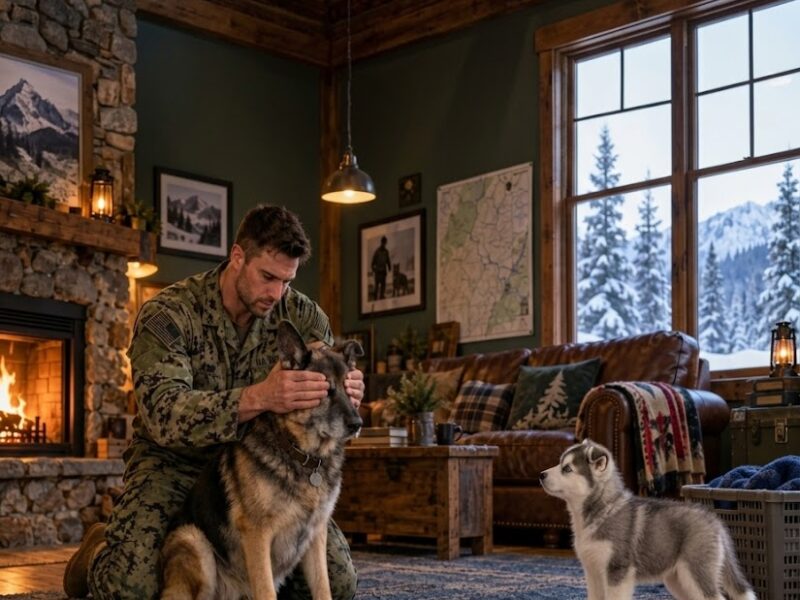
A Navy SEAL brought home an abandoned husky — and then his old dog gave him a gift that left him in tears.
The late afternoon sun hung low over Redstone Canyon, casting long shadows across the dry Colorado grass.
A search team had been combing the area since dawn, looking for a family whose truck had been found near the upper trail.
Evan Callahan stood beside a rescue vehicle, his gray eyes steady as he studied the map spread across the hood.
He was tall and broad-shouldered, with closely cropped brown hair and the quiet discipline of a Navy SEAL who had learned to stay calm when everyone else was afraid.
Sheriff Tom Walsh pointed toward the canyon’s narrow service road.
“Rock slide blocked the main route,” he said. “We’re checking every structure within half a mile.”
Evan nodded but said nothing. He had learned long ago that words rarely improved a search.
The canyon stretched before him in layers of red and pale stone, beautiful and indifferent.
Volunteers called out names, checked shallow ravines, and examined the edges of the trail.
The usual sounds of birds had gone quiet, as if even the wildlife understood something was wrong.
Evan walked behind the others, following a narrow line of disturbed dust that led toward an abandoned observation station beneath the slope.
The building had once been used by forest rangers, but its wooden walls were faded and its windows clouded with years of dirt.
One side of the roof had collapsed, leaving the interior half covered by broken branches and dry leaves.
Evan was about to turn away when he heard something.
It was not a bark. It was a thin, trembling sound, so faint he almost mistook it for the movement of loose metal.
He stopped and listened.
The sound came again.
Evan raised one hand, signaling the others to wait, then moved toward the building.
Inside, the light was dim and dusty. A cracked table stood near the wall, and an old cabinet had fallen across the floor.
The sound came from behind it.
Evan knelt and carefully moved a few pieces of wood aside.
At first, he saw only a corner of a faded blue blanket. Then a small face appeared.
The puppy was a Siberian husky, perhaps ten weeks old, with pale gray and white fur and bright blue eyes that looked far too tired for such a young animal.
One front paw had a small scrape, but there was no serious injury. He was thin, dusty, and completely still.
Instead of trying to escape, he stared past Evan toward the doorway, as if waiting for a familiar figure to return.
Evan lowered his voice. “Hey, little one. You’re safe now.”
The puppy did not move.
Beside him lay a plastic bowl with only a trace of dry food and a folded piece of paper held down by a small stone.
Evan picked it up and read the single sentence written in uneven blue ink.
Please take him somewhere that understands loyalty.
For a moment, he remained still, the paper between his fingers.
He had seen people leave behind belongings, vehicles, even entire houses after disasters.
But there was something different about the puppy’s silence. It was not wild fear. It was the quiet of an animal that had waited too long and no longer knew whether hope was useful.
Evan removed his gloves and extended one hand.
The puppy watched him for several seconds before slowly placing his nose against Evan’s palm.
His body trembled once, then relaxed.
Evan felt the decision forming before he allowed himself to name it.
“We’re going to get you checked out,” he whispered. “Then we’ll figure out the rest.”
Tom arrived a few minutes later with another volunteer.
He examined the room, then noticed a small metal badge half buried beneath the edge of the blue blanket.
The badge was scratched but still readable. Pine Ridge K9 Program.
Tom turned it over in his hand. “That program shut down years ago. They trained search and rescue dogs here before the county moved everything closer to town.”
Evan looked at the puppy. “Could he be connected to it?”
“Maybe. We’ll check the records.”
Tom searched for a microchip, but the scanner returned nothing. There was no collar, no identification tag, and no nearby vehicle that could explain how the puppy had reached the abandoned station.
The missing family still had not been found, and Tom could not spare a team member to remain with the dog.
The nearest shelter was full, and the county’s temporary holding facility would not be able to receive him until the next morning.
Evan looked down at the puppy, who had pressed his small body against the side of his boot.
“I’ll take him to Clare,” he said. “After that, I can keep him overnight.”
Tom gave him a knowing look. “Overnight?”
Evan ignored the question. “Until we find out where he belongs.”
They carried the puppy back to the rescue vehicle, wrapped him in the blue blanket, and placed him carefully on the passenger seat.
The puppy remained quiet throughout the drive to Aspen Hollow.
At the clinic, Clare Morgan met them at the entrance. She was a woman in her early forties with dark hair tied loosely behind her neck and a calm manner that made frightened animals settle before she touched them.
She examined the puppy gently, cleaned the small scrape on his paw, checked his breathing, and gave him water in a shallow bowl.
“He’s exhausted and underfed, but he should recover,” Clare said. “He needs warmth, regular meals, and somewhere quiet. More than anything, he needs to feel safe.”
Evan stood beside the examination table, watching the puppy drink in small, careful sips.
“Do you think someone will come looking for him?”
“I don’t know,” Clare answered. “But the note suggests whoever left him wanted him found, even if they didn’t know how to care for him anymore.”
Evan glanced at the scratched badge Tom had placed on the counter. “Pine Ridge K9 Program. Does that mean anything to you?”
Clare studied it. “My father used to volunteer there. They trained dogs for wilderness searches and disaster response. Some of the older working dogs were placed with military families when the program closed.”
Before Evan could ask more, his phone began to vibrate.
The name on the screen was Marcus Reed.
Marcus was Evan’s former teammate, a lean, dark-haired man with a guarded voice and a habit of saying he was fine long before he actually was.
Evan stepped into the hallway and answered.
“You make it home?” Marcus asked.
“Not yet. I’m at Clare’s clinic.”
“Everything okay?”
Evan looked through the open doorway at the husky puppy who had curled into the blue blanket with his eyes half closed.
“I found a dog during the search.”
“You always did collect impossible problems.”
The joke sounded weak, and the silence that followed was too long. Evan could hear a television playing somewhere in the background, though Marcus did not seem to be watching it.
“How’s your leg?” Evan asked.
“It works.”
“That wasn’t my question.”
Marcus exhaled. “I’m managing.”
Evan knew that answer. It was the same one he had given doctors, friends, and family whenever he wanted them to stop asking.
“Come by Aspen Hollow tomorrow,” Evan said.
“I’m not looking for company.”
“You don’t have to look for it. Just come.”
Marcus did not reply immediately. Then he said, “Maybe.”
When the call ended, Evan remained in the hallway for a moment, thinking about how easily a person could become invisible inside his own life.
He returned to the examination room and found the puppy awake, watching him.
Clare placed a small temporary leash beside the blanket.
“The shelter can take him in the morning,” she said. “Or you can foster him tonight.”
Evan looked toward the clinic window. Outside, the last sunlight rested on the rooftops of Aspen Hollow, turning them gold.
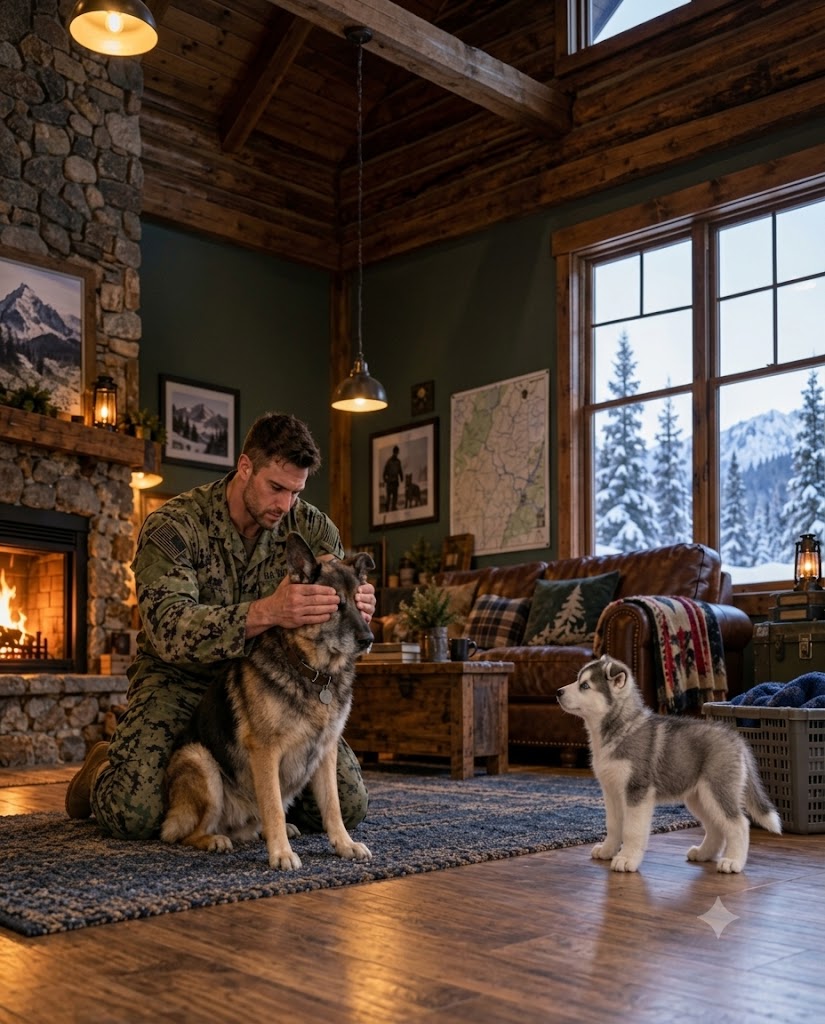
Somewhere beyond the town, his house stood at the edge of the pine forest, where his aging German Shepherd, Ranger, was waiting beside the familiar warmth of the fireplace.
Evan had planned to go home alone. He had planned for a quiet evening, a simple meal, and the same careful routine he had followed for years.
Instead, he lifted the puppy into his arms.
The husky rested his chin against Evan’s chest and closed his eyes.
“Temporary foster,” Evan said.
Clare’s small smile told him she did not believe the words.
He carried the puppy outside, placed him gently in the passenger seat, and started the drive toward home as the lights of Redstone Canyon faded behind him.
The puppy slept beneath the blue blanket, and Evan kept one hand near him, listening to the soft rhythm of his breathing while the road to Aspen Hollow opened ahead.
By the time Evan reached home, the last light of afternoon had faded behind the pine-covered hills.
The town was quiet, its narrow streets lined with small wooden houses and warm windows, while the dry mountain air carried the scent of cedar and distant fireplaces.
Kota remained curled beneath the blue blanket on the passenger seat, waking whenever the vehicle slowed before resting his chin against the edge of the seat again.
Evan glanced at him several times during the drive, still unsure how a creature so small had managed to change the shape of his entire evening.
His house stood at the end of a gravel road, set behind a low wooden fence and surrounded by tall pines.
Beyond the back porch was a wide yard that sloped gently toward the forest, and beyond the forest rose the dark outline of the foothills.
It was not a large house, but it had been built with strong walls, wide windows, and a deep porch where Evan had spent many quiet mornings with a cup of coffee and Ranger at his feet.
When he turned off the engine, the porch light flickered on automatically.
For a few seconds, Evan sat in the driver’s seat with both hands resting on the wheel. He could hear Kota breathing softly beside him.
Inside the house, Ranger was waiting.
Evan carried the puppy to the front door and pushed it open with his shoulder.
A large German Shepherd lifted his head from the brown rug near the hallway.
Ranger had once been a powerful working dog with a dark saddle, steady amber eyes, and a posture that made people instinctively step aside.
Now silver covered most of his muzzle. One ear bent slightly at the tip, and his movements had become careful and measured.
Age had taken away his speed, but not his dignity. Even from the floor, he watched the room as if every sound still belonged to him.
“Hey, partner,” Evan said quietly.
Ranger’s eyes moved from Evan’s face to the bundle in his arms.
Kota stirred beneath the blanket, then raised his small head. One blue eye appeared first, followed by the other.
Ranger did not growl. He simply studied the puppy with an unreadable expression.
Evan stepped inside and placed Kota’s bed near the fireplace, several feet away from Ranger’s rug.
“This is Kota,” he said, feeling slightly foolish as he introduced them. “He’s staying for a little while.”
Ranger pushed himself up. The effort was visible in the slow movement of his front legs and the hesitation that followed before his hind legs joined them.
Evan instinctively moved forward, but Ranger’s eyes warned him not to interfere.
The old dog stood alone, balanced himself, and walked toward Kota.
The puppy remained still in Evan’s arms.
Ranger lowered his head and took in the unfamiliar scent of dust, road, clinic soap, and the blue blanket from Redstone Canyon.
Kota’s tail moved once.
Ranger looked back at Evan, then turned away. He crossed the room and dragged his rug several inches farther from the fireplace before lowering himself onto it.
Evan watched him in silence. “No one is replacing you,” he said.
Ranger did not look at him.
Kota seemed to sense the tension. When Evan placed him on the new bed, the puppy remained curled against the blanket. His ears lowered.
Evan filled two bowls and set them apart in the kitchen. Ranger approached his own bowl, sniffed it, and then walked away without eating.
Kota watched him but did not touch his food either.
“You don’t have to copy him,” Evan murmured.
Kota blinked up at him. After a moment, he lowered his nose to the bowl and took one cautious bite.
Ranger remained near the fireplace, facing the room but refusing to meet the puppy’s eyes.
Evan spent the next hour trying to make the house feel normal. He prepared a simple meal, answered a few messages from the rescue team, and placed Kota’s paperwork on the kitchen counter.
Every few minutes, he looked toward Ranger.
The old dog had once followed him from room to room, never crowding him, but always remaining close enough to respond if needed.
Tonight, Ranger stayed near the fireplace while Kota remained on the opposite side of the room. The distance between them seemed far greater than it really was.
The following morning, Clare arrived with a medical bag and two paper cups of coffee.
She stepped inside without knocking because she had known Evan long enough to ignore formalities.
Kota approached her first, sniffing her shoes before retreating beneath the kitchen table. Ranger remained on his rug, watching her calmly.
Clare examined Kota’s paw, checked his eyes, and listened to his breathing. Then she moved toward Ranger.
The old dog allowed her to place a hand against his chest, though he looked toward Evan as if asking why the examination was necessary.
Clare listened for several seconds longer than she had the day before. She also checked Ranger’s gums, measured his weight, and asked how often he had been eating.
“He skipped breakfast,” Evan said.
“Only today?”
Evan hesitated. “A few times recently.”
Clare did not respond immediately. She wrote something in her notebook, then watched Ranger walk back toward the fireplace.
His breathing sounded heavier than it had in the past, but Evan tried to dismiss it.
“He’s twelve,” he said. “He has good days and bad days.”
“Then keep track of both,” Clare replied. “His appetite, his breathing, how long it takes him to stand, whether he seems uncomfortable. Don’t rely on memory.”
Evan nodded, though he disliked the seriousness in her voice.
Clare did not mention a diagnosis, and Evan did not ask for one.
Instead, she placed a small container of supplements beside Ranger’s bowl and gave instructions for Kota’s meals.
Before leaving, she looked at the two dogs. Kota had fallen asleep beneath the table. Ranger’s eyes remained open, fixed on the puppy.
“Give them separate spaces,” Clare said. “Let Ranger choose when he wants to come closer. He has lived here a long time.”
“I know.”
“Knowing and remembering are different things.”
After Clare left, Evan stood at the kitchen window and watched the road.
A few minutes later, Marcus’s truck appeared near the fence.
Marcus stepped out slowly, one hand resting on the side of the vehicle. His new prosthetic leg made a faint mechanical sound against the gravel, and he paused before climbing the porch steps.
Evan opened the door before Marcus could knock.
“You made it,” he said.
“I said maybe.”
“You usually say maybe when you mean no.”
“I’m working on being unpredictable.”
Marcus entered and looked around the room. His eyes found Ranger first, then Kota, who had woken beneath the table.
“At the rescue?” Marcus asked.
“His name is Kota.”
Kota crawled out cautiously, carrying a red rubber ball in his mouth. Evan had found it beneath an old chair and placed it near the puppy’s bed, hoping it might make him feel at home.
Kota walked toward Ranger and stopped a few feet away. He lowered the ball to the floor and waited.
Ranger opened one eye, saw the toy, and turned his head toward the window.
Kota picked up the ball and took a few steps closer.
“Easy,” Evan said.
The puppy stopped at once. He looked disappointed but did not whine.
Marcus crouched beside him. “He knows how to take a hint.”
Kota glanced at Ranger once more, then carried the ball toward Marcus and placed it carefully against his boot.
Marcus stared down at it. “What am I supposed to do with this?”
Evan shrugged. “Maybe he thinks you need a mission.”
Marcus gave him a tired look, but Kota pushed the ball forward again.
For the first time in months, Marcus laughed. It was a quiet, surprised sound, as if it had escaped before he could stop it.
He rolled the ball gently across the floor. Kota chased it, slipped slightly on the wooden boards, and returned with his tail moving faster than before.
Ranger watched from the rug. He did not join them, but his ears shifted toward the sound.
Marcus rolled the ball again, slower this time. Kota brought it back and rested his chin on Marcus’s knee.
Marcus looked at Evan. “He doesn’t know I’m broken.”
“Maybe he doesn’t care.”
The words settled between them. Marcus lowered his hand and touched the puppy’s head.
Ranger looked away, but he did not leave the room.
That evening, Marcus stayed for dinner. He spoke little about his injury, and Evan did not force him to explain.
They talked instead about the rescue team, the strange habits of small-town dogs, and the fact that Kota had already decided the kitchen rug belonged to him.
When Marcus finally left, he paused beside the porch and looked back at the warm window.
“I’ll come by tomorrow,” he said.
Evan nodded.
Inside, Kota had fallen asleep beside the fireplace, though not on Ranger’s rug. Ranger remained several feet away, his head resting on his paws.
After a long silence, the old dog stood, crossed the room, and moved his rug farther from the puppy.
He did not growl or show anger. He simply created more distance, as if trying to protect the last familiar piece of his life.
Evan turned off the kitchen light and stood in the hallway, listening to the quiet breathing of the two dogs.
Kota had entered the house believing he might be left behind again. Ranger had watched him arrive believing he might soon be forgotten.
Evan understood neither fear completely, but he knew both of them were real.
He left the door to his bedroom open, just as he had done for Ranger every night for years.
In the darkness, the house held two different rhythms of breathing, one young and uncertain, the other slow and watchful.
Nothing had been solved. But for the first time, no one was entirely alone.
Three days after Kota arrived, the house had developed a new rhythm, though Evan was not yet sure whether it was becoming peaceful or simply more careful.
Mornings began with the quiet scrape of Ranger’s claws against the wooden floor, followed by the soft movement of Kota getting out of his bed.
The puppy had already learned that the brown rug near the fireplace belonged to Ranger and that the hallway was not a place for sudden games.
He followed Evan from room to room but stopped whenever Ranger lifted his head, as if the old dog’s silence were a language he was slowly learning.
That morning, sunlight entered through the kitchen windows in thin golden lines and rested across the floor.
Evan filled Ranger’s bowl with the food Clare had recommended, placed it beside the wall, and stepped back.
Ranger walked toward it with his usual quiet dignity. He lowered his head, smelled the food, and remained still.
Evan waited.
The old dog took one small bite, lifted his head, and turned away.
“Come on, partner,” Evan said. “Just a little more.”
Ranger glanced at him but did not return to the bowl. He walked slowly toward the fireplace and lowered himself onto the rug.
The movement took longer than it should have. His front legs settled first, then his back legs followed with a slight hesitation that Evan tried not to notice.
Kota sat beside his own bowl, watching. The puppy’s food had been softened with warm water, and its scent filled the kitchen.
Usually, Kota would have eaten immediately, but he remained still. His eyes fixed on Ranger.
“You can eat,” Evan told him.
Kota did not move.
Evan crossed the room and placed one hand against the old dog’s shoulder. Ranger’s fur was warm, but his breathing felt heavier beneath it.
For months, Evan had explained away every change. Ranger was getting older. Ranger had worked hard. Ranger needed more rest.
Those explanations had once sounded reasonable. Now they sounded like words he had repeated so often that they no longer protected him from the truth.
He called Clare.
She arrived before noon with her medical bag and a folder of notes from the previous visit.
Ranger did not object when she examined him, though he watched Evan throughout the process.
Clare listened to his heart, checked his breathing, and asked Evan several questions about his appetite, his sleep, and the way he stood after lying down.
Evan answered more honestly than he had before.
Ranger had been eating less. He tired quickly. Sometimes he coughed at night. Sometimes he stood in the middle of a room as if he had forgotten why he had walked there.
Clare remained quiet for a long moment after placing the stethoscope against his chest. Then she looked at Evan.
“His heart disease has progressed,” she said gently. “I’m afraid it is moving faster than we hoped.”
Evan stared at the worn leather strap of Ranger’s collar.
“How much time?”
Clare did not pretend to know. “With medication and careful management, we may have months. It could be longer, or it could change suddenly. I can’t give you an exact number.”
The word months settled over the room with a weight Evan had not expected.
He had spent years learning how to respond to immediate danger. He knew how to assess a route, protect a team, and make decisions when every second mattered.
But there was no strategy for watching a friend grow weaker. There was no piece of equipment to repair, no enemy to confront, and no mission that could be completed before the clock ran out.
Ranger rested his head on the rug, calm and dignified, as if the conversation did not concern him.
Evan remembered him young, crossing open ground with powerful strides, stopping the instant Evan called his name.
He remembered Ranger lying outside the door of temporary barracks, alert through the night.
He remembered the dog finding lost hikers, guiding frightened children toward rescuers, and standing beside Evan whenever the world became too loud.
Ranger had always known what to do when someone was lost. Now Evan wondered whether he was the one who had lost his way.
Clare placed several medication bottles on the counter and wrote down a schedule.
“Keep his days familiar,” she said. “Short walks if he wants them. Let him rest, but don’t make the house feel like a hospital. He still needs to feel included.”
Evan nodded, absorbing each instruction, even as his mind resisted the future they implied.
Kota approached the fireplace and stopped several feet away. He looked at Ranger, then at the bowl in the kitchen.
Ranger opened one eye.
Kota lowered himself onto the floor without making a sound.
Clare watched the exchange. “He’s learning,” she said. “He knows Ranger needs space.”
Evan looked at the puppy. Kota had arrived frightened and uncertain, yet he had already begun adjusting himself around an older dog who had never asked for his help.
When Ranger finally lifted his head and took another small bite from the bowl, Kota stood and hurried to his own food. He ate only after Ranger had begun.
Evan watched the two dogs beneath the quiet afternoon light and felt something shift inside him.
Kota was not trying to take Ranger’s place. He was learning how to stay near someone whose strength was fading.
While Evan tried to adjust to the news, Pine Ridge Animal Haven was facing a crisis of its own.
The rescue center stood at the edge of town on a narrow piece of land surrounded by old fencing, cottonwood trees, and a row of small kennels.
Helen Harper, who had run the place for nearly two decades, kept the shelter alive through donations, volunteer work, and a stubborn refusal to give up.
Her sixteen-year-old niece, Lily, helped after school and knew every animal by name.
A notice from the county had been posted on the office door. The land had been purchased by a development company planning to build a private mountain resort.
Pine Ridge had six months to relocate.
Helen kept the notice folded inside a drawer, but Lily had already made copies and began asking for help.
She created a small online page, contacted local businesses, and placed hand-painted signs around Aspen Hollow.
Most people wished her luck, but few believed a modest shelter could stand against a company with lawyers, investors, and plans already approved.
Marcus came to Pine Ridge intending to stay for one afternoon.
Lily handed him a hammer before he could finish saying hello.
“The west fence is leaning,” she said.
“I’m not a construction worker.”
“You’re taller than me.”
“That is not a qualification.”
“It is the only one I have today.”
Marcus looked at the fence, then at Lily, and eventually took the hammer.
The work was slow at first. His prosthetic leg made the uneven ground difficult, and he had to stop several times to regain his balance.
He expected people to notice, so he kept his eyes on the boards.
Lily did not stare or offer unnecessary encouragement. She simply held the next piece of wood in place and waited.
By late afternoon, one section of the fence stood straighter than before. It was not perfect, but it held.
Marcus stepped back and studied it. “You’ll have to paint it,” he said.
Lily smiled. “That means you’re coming back.”
Marcus did not answer. But the next morning, he returned with a box of screws and a thermos of coffee.
Evan began helping, too. He repaired a gate, replaced a broken latch, and helped Helen move bags of feed into storage.
The more time he spent at Pine Ridge, the less time he spent thinking about the quiet house and the orange medication bottles on his kitchen counter.
Clare noticed.
She found him beside the shelter’s back fence one afternoon tightening a bolt that did not need tightening.
“You’ve been here every day,” she said.
“There’s work to do.”
“There will always be work.”
Evan kept his eyes on the gate.
Clare leaned against the fence. “You can help Pine Ridge and still go home when Ranger needs you.”
Evan’s hand stopped. “I am going home.”
“You’re arriving at the house. That isn’t always the same thing.”
He looked at her then. Clare’s voice remained gentle, but she did not allow him to hide behind it.
“You can rescue other people, Evan. You can repair fences, carry supplies, and give everyone else something to depend on. But this time, you have to learn how to stay beside someone you cannot save from time.”
Evan said nothing.
Beyond them, Lily was explaining to Marcus how to organize a community meeting, and the dogs in the nearest kennel barked at the sound of a delivery truck.
The world continued moving, asking for repairs and decisions.
Evan looked toward the road leading back to Aspen Hollow. At home, Ranger would be lying near the fireplace, and Kota would probably be waiting a few feet away watching him.
Evan sat down the wrench and removed his gloves. “I’ll finish tomorrow,” he said.
Clare nodded.
That evening, he returned home before dark.
Ranger was awake on his rug, and Kota was sitting beside his untouched bowl.
Evan warmed Ranger’s food, placed it nearby, and sat on the floor without urging him.
After several minutes, Ranger reached forward and ate a few slow bites. Only then did Kota lower his head to his own bowl.
Evan rested his back against the wall and watched them eat in silence.
He still had no answer for the months ahead, but for the first time he understood that being present was not the same as giving up.
Sometimes it was the most important mission left.
The days after Clare’s warning passed quietly, but the quiet inside Evan’s house no longer felt simple.
He began measuring Ranger’s meals, writing down the times the old dog rested, and leaving the back door open for a few extra minutes so Ranger would not have to hurry outside.
He also spent several afternoons at Pine Ridge with Marcus and Lily, repairing gates and sorting donated supplies.
Yet he always returned home before sunset.
Ranger seemed to notice whenever Evan was away for too long. He would remain near the fireplace, awake but still, and lift his head the moment Evan opened the front door.
Kota, meanwhile, had become more confident. He knew where his food was kept, which blanket belonged to him, and which parts of the house were still forbidden.
He had also discovered that the red rubber ball with the bite could be pushed beneath furniture and recovered with great ceremony.
On a clear afternoon, while Evan stood at the kitchen counter measuring Ranger’s medication into a small piece of soft food, the ball rolled from beneath the sofa.
Kota froze for half a second, then pounced on it with all the excitement of a puppy who had just found treasure.
He rushed across the living room, the ball bouncing between his teeth, his paws sliding slightly over the wooden floor.
He tried to stop near the fireplace but turned too sharply. His shoulder brushed against a light wooden chair, and the chair tipped over with a sudden crack.
Ranger startled.
He raised his head quickly and tried to stand, but his back legs did not gather beneath him at once. His breathing changed, becoming faster and more strained.
Evan dropped the medication packet and crossed the room.
“Ranger, easy,” he said, kneeling beside him. “You’re all right. Stay still.”
Kota stopped near the fallen chair. The ball slipped from his mouth and rolled beneath the table.
He looked from Evan to Ranger, his ears lowered, his entire body suddenly small and uncertain.
Evan placed one hand beneath Ranger’s neck and another against his side, waiting until the old dog’s breathing began to settle.
It took several long minutes.
No one spoke. The chair remained on its side, and the afternoon sunlight continued to fall across the floor as if nothing had happened.
When Ranger finally rested his head on the rug, Evan turned toward Kota.
The puppy had not moved. He was still staring at Ranger with frightened eyes.
Evan knew the accident had not been Kota’s fault, but fear had reached him before reason could.
“You can’t do that again,” he said more sharply than he intended.
Kota flinched.
Evan closed his eyes, but the apology stayed trapped behind his teeth. He carried the chair back to the kitchen, placed the ball on the counter, and returned to Ranger.
Kota remained near the doorway, unwilling to come closer.
That evening, the house felt divided into separate territories.
Ranger rested beside the fireplace. Kota stayed on his bed, and Evan moved between them with the careful exhaustion of a man trying to prevent two different kinds of pain from touching.
After dinner, he opened the temporary foster papers from Pine Ridge.
The words looked plain and official. Responsible party. Temporary placement. Veterinary care. Transfer if necessary.
Evan stared at the line about final adoption until it became difficult to read.
Ranger had very little time left, and Kota was still young enough to begin again somewhere else.
Evan told himself that finding another home would be an act of kindness. He told himself Ranger deserved calm, familiar days without the noise and unpredictability of a puppy.
He told himself that a good family would understand Kota’s needs better than a man who was already struggling to care for an aging dog.
But beneath every explanation was the same fear. He was afraid that Kota would make Ranger’s final days harder, and more afraid that he would not be able to forgive himself if that happened.
The next morning, Evan called Helen.
“I need to ask about placement,” he said.
Helen listened without interrupting as he explained what had happened.
“Is Ranger stable?” she asked.
“He’s resting.”
“And Kota?”
Evan looked across the room. The puppy sat near the back door watching Ranger sleep.
“He’s fine.”
Helen was quiet for a moment. “That wasn’t really my question.”
Evan rubbed his forehead. “He frightened Ranger yesterday. It was an accident, but Ranger had a difficult episode.”
“Does Ranger want him gone?” Helen asked.
Evan looked at the old dog. Ranger’s eyes were open, but his face revealed nothing.
“I don’t know.”
“Then perhaps you should find out what Ranger is asking for instead of deciding for him.”
Evan tightened his grip around the phone. “I’m trying to protect him.”
“I know,” Helen said. “But protection can become another name for fear if you’re not careful.”
She promised to ask about possible foster homes and said she would call back once she knew more.
After the conversation ended, Evan stood in the kitchen with the phone still in his hand.
Kota slowly approached and placed one paw against his boot. Evan looked down at him.
The gesture was so trusting that he nearly changed his mind.
Instead, he opened the closet and began gathering Kota’s belongings.
The small blue bowl went into a canvas bag. Then came the washed blanket from the station, the soft leash, the bag of puppy food, and finally the red ball from the kitchen counter.
Kota followed him from room to room. He did not understand the paperwork, but he understood that the objects connected to him were being moved.
When Evan picked up the blue blanket, Kota reached for one corner with his teeth.
“Not now, buddy,” Evan whispered.
The puppy released it and lowered his head.
Across the room, Ranger watched everything. He did not bark or rise. He simply remained unnaturally still.
Later that afternoon, Marcus and Lily came by Pine Ridge with a photograph of the metal badge Tom had found near Kota’s blanket.
The name on it was clearer now. Eleanor Hayes, Pine Ridge K9 Program.
Lily searched the center’s old paper files while Marcus checked a box of retired training records. Helen joined them and turned the pages carefully.
When she saw Eleanor’s name, her expression changed.
“She trained some of the earliest dogs here,” Helen said. “She had a way of seeing potential in animals other people overlooked.”
Marcus found an old record mentioning a German Shepherd named Ranger. It did not contain much information, only a training number, a date, and Eleanor’s handwritten initials, but the name was enough to make them pause.
Lily took a picture of the record and posted a short story online about Kota, the abandoned puppy connected to Pine Ridge, and Ranger, the retired rescue dog who had once belonged to the same program.
She did not exaggerate the situation or ask for pity. She simply wrote that two dogs from different stages of life had found themselves in the same home, and that Pine Ridge needed help to remain open.
By evening, messages began arriving from people across Colorado.
Someone offered food. Someone else promised blankets. A local hardware store offered materials for the fence.
Small donations appeared one after another, each one modest but meaningful.
Marcus read the messages aloud while Lily updated a list on the office wall. For the first time since the development notice arrived, Helen allowed herself to believe that Pine Ridge might have a future.
Evan knew none of this.
He was at home sitting in the darkened living room while Ranger rested near the fireplace and Kota slept in his bed. The canvas bag stood beside the kitchen table.
Near midnight, Evan heard a faint scraping sound from the hallway.
At first, he thought Kota had moved. Then the sound came again, slow and uneven, followed by a pause.
Evan rose and followed it into the small office.
Ranger stood beside the old desk, his head lowered toward the narrow space beneath it. He was breathing heavily, but his eyes remained focused.
Evan switched on the lamp and saw a worn black collar lying under the desk.
Ranger had found it himself.
“Leave it,” Evan whispered.
Ranger looked at him, then carefully gripped the collar and pulled. The leather slid across the floor.
Ranger paused, gathered himself, and began walking toward the living room.
Evan followed without interfering.
The old dog crossed the hallway one slow step at a time and stopped in front of Kota.
The puppy woke and lifted his head.
Ranger dropped the collar between them.
For a moment, neither dog moved. Then Ranger touched the leather with his nose and pushed it gently toward Kota.
Kota lowered his head, smelled the collar, and moved closer. He did not grab it or play with it. He simply lay down beside Ranger, placing one paw near the worn leather.
Evan stood behind them, unable to speak.
He had believed Ranger wanted Kota removed because he had mistaken distance for rejection.
Perhaps the old dog had not been defending his place at all. Perhaps he had only been waiting to know whether Evan still saw him.
Evan lowered himself to the floor and rested one hand on Ranger’s shoulder and the other on Kota’s back.
“I’m sorry,” he whispered.
Ranger did not look at him. He only allowed Kota to remain close.
The packed canvas bag waited near the kitchen, but Evan no longer saw it as a solution. He saw it as proof that fear had almost made a decision for him.
Near dawn, Kota fell asleep with one paw touching the old collar. Ranger stayed beside him, awake and calm.
Evan remained on the floor between them, listening to the soft rhythm of their breathing, while somewhere across town, strangers continued sending help to a rescue center that had once seemed destined to disappear.
No one in the house said the words aloud, but the decision had already been made.
Kota would not be leaving.
The morning after Evan decided that Kota would stay, the house felt different without becoming easier.
Kota no longer chased the red ball across the living room or rushed toward every sound outside. He walked slowly through the rooms, pausing whenever Ranger shifted on the rug, and spent most of his time lying a few feet away from the old dog.
Ranger noticed the change but did not resist it. He still kept his distance, yet he no longer left the room whenever Kota came near.
Evan took it as a fragile form of peace.
Before leaving for Pine Ridge, he prepared Ranger’s medication, placed fresh water beside the fireplace, and checked the latch on the back door.
Ranger watched him from the rug, his breathing steady enough to ease Evan’s concern. Kota sat beside him, alert and quiet.
“We won’t be gone long,” Evan said. “Stay with him.”
Kota lifted his head as if he understood.
Marcus was waiting near the truck when Evan stepped outside. The work at Pine Ridge had grown because of Lily’s post.
Donations had arrived from neighboring towns, and the shelter now had enough money to replace the damaged medical cabinet, buy new supplies, and begin repairs on the oldest section of fencing.
It was not enough to solve everything, but it had given Helen time. For the first time in weeks, she could speak about the future without lowering her voice.
“The back kennel still needs a new gate,” Marcus said. “And Lily says three more people are coming to help.”
Evan glanced toward the house. “I’ll be back before lunch.”
“You’ve said that every day this week.”
“Today I mean it.”
Marcus looked at him but did not argue.
At Pine Ridge, the morning passed in a series of practical tasks. Marcus measured the posts while Lily sorted donated blankets and labeled boxes. Helen worked inside the office answering calls from people who wanted to help.
A local hardware store had agreed to provide materials at a reduced price, and a retired teacher offered to organize weekend volunteers.
The small shelter was still surrounded by uncertainty, but there was movement everywhere. People carried boards, folded blankets, cleaned empty kennels, and made lists.
Marcus worked slowly, yet he refused to sit down whenever his leg began to ache. He had discovered that the shelter did not ask him to be the man he had been before the injury. It only asked him to show up and do what he could.
Evan noticed the difference in him.
Marcus no longer looked at every task as a test of what he had lost. He was beginning to see the work itself as something worth doing.
“You’re good with the dogs,” Lily said while handing him a box of supplies.
“I’m good with fences.”
“The dogs seem to disagree.”
One of the older rescue dogs had been following Marcus along the edge of the yard, resting its chin against his knee whenever he stopped.
Marcus glanced down at it. “It has poor judgment.”
Lily smiled and walked away before he could object.
Near the end of the morning, Evan checked his phone. There were no messages from home.
He told himself that was a good sign. If something were wrong, someone would have called.
He returned to work, tightening a bolt on the new gate while Marcus held the frame in place.
Back at the house, Ranger woke from a shallow sleep. The room was quiet except for the ticking clock above the fireplace.
Kota lay near the edge of the rug, his head resting between his front paws.
Ranger tried to stand. His front legs straightened, but his hind legs did not respond as quickly as they had before. He paused and tried again.
This time, his paws slipped slightly on the rug, and he lowered himself back down.
Kota rose at once and touched his nose to Ranger’s shoulder. Ranger did not answer.
Kota looked toward the kitchen, then toward the hallway. Evan was not there.
The puppy moved to the back door and pushed his nose against the narrow gap beneath it. The door opened enough for him to squeeze through.
Outside, the yard was bright and dry, with the sharp smell of grass, pine needles, and warm soil.
Kota ran across it, following the path Evan had taken many times before. He stumbled once on the uneven stones but gained his balance and continued toward the workshop, where the sound of tools carried through the open windows.
At Pine Ridge, Evan was leaning over the gate when he heard a bark.
It was not the playful sound Kota made when he wanted the ball. It was short, urgent, and repeated.
Marcus looked up first. “Is that your dog?”
Evan straightened.
Another bark came from the road.
Kota appeared at the entrance to the work area, his white and gray fur marked with dust, his chest rising quickly from the run.
He looked directly at Evan, turned toward the house, and barked again.
Evan took one step forward. “What is it?”
Kota ran several feet back, then stopped and looked over his shoulder.
Evan thought the puppy might be frightened by something outside, but Kota returned and pressed his nose against Evan’s hand.
When Evan did not move quickly enough, Kota caught the loose edge of his work pants between his teeth and pulled gently toward the road.
The gesture was not aggressive. It was desperate in its simplicity.
Marcus was already reaching for the truck keys. “Go,” he said.
Evan did not ask questions. He followed Kota across the yard with Marcus close behind.
Kota ran ahead, stopping every few seconds to make sure they were coming.
When Evan entered the house, he found Ranger lying beside the fireplace, awake but unable to rise.
The old dog’s breathing was shallow and uneven, and his eyes turned toward the sound of Evan’s footsteps.
Evan dropped to his knees. “I’m here, partner.”
Kota pressed close to Ranger’s face and gave a small whine.
Evan remembered Clare’s instructions, reached for the emergency medication packet, and called her while Marcus prepared the truck.
His hands remained steady because Ranger needed them to be steady.
“We’re bringing him in,” Evan said. “He’s having a serious episode.”
Clare’s voice stayed calm on the phone. “Keep him comfortable. Don’t make him walk. I’ll be ready when you arrive.”
Marcus opened the back door of the truck and placed Ranger’s old blanket across the seat. Together, they lifted the old dog carefully and carried him outside.
Kota followed so closely that Evan nearly stepped on him. The puppy climbed into the truck and settled against Ranger’s chest.
Evan reached for him, but Marcus gently touched his arm. “Leave him there,” he said. “He knows where he needs to be.”
The drive to Clare’s clinic was quiet except for Evan speaking softly to Ranger. He repeated the same words without thinking.
“Stay with me. We’re almost there. You’re not alone.”
Kota remained pressed against the old dog, his head tucked beneath Ranger’s jaw. He did not bark or move away, even when the truck turned through the streets of Aspen Hollow.
At the clinic, Clare and an assistant opened the side door before Evan had fully stopped.
“Bring him inside,” Clare said.
Evan lifted Ranger while Marcus carried the medical bag. Kota tried to follow them through the entrance, but Clare asked Marcus to hold him back.
The puppy resisted for a moment, then went still, keeping his eyes fixed on Ranger as the door closed.
Evan stood in the hallway with empty arms. Silence felt heavier than the noise of the truck.
Marcus placed Kota on Evan’s jacket, but the puppy would not sit comfortably. He kept turning toward the treatment room.
“He found you,” Marcus said quietly.
Evan looked down at Kota. “He didn’t know what was happening. He knew something was wrong.”
Evan lowered himself beside the puppy. “I should have stayed home.”
Marcus shook his head. “You came back when he called. That’s what matters.”
For a while, neither man spoke. Then Marcus looked toward the treatment room.
“After my injury, I thought I had nothing left to offer. I couldn’t do the work I used to do. I couldn’t protect anyone the way I thought I was supposed to. I figured that meant I was finished.”
Evan kept one hand on Kota’s back. “You helped me get Ranger here.”
“That’s not much.”
“It is to me.”
Marcus looked down at the puppy. “Maybe saving someone doesn’t always look like the things we were trained to do.”
Evan remembered Kota running across the yard, turning back again and again until he was certain Evan followed.
“Sometimes it just means noticing that someone needs help and refusing to walk away,” he said.
Marcus nodded.
A few minutes later, Helen called. Lily had told her what happened, and she wanted Evan to know that the donations had reached the amount needed to purchase the medical supplies Pine Ridge had been missing.
The county had also agreed to review the shelter’s relocation request instead of forcing it to close immediately.
“Ranger may not know it,” Helen said, “but his story helped keep this place alive.”
Evan looked at the closed treatment room door. “He’s been helping people for a long time.”
“Then perhaps this is another one of his missions.”
The call ended, and Evan placed the phone beside him. Kota lowered his head onto Evan’s knee but kept watching the door.
Somewhere inside the clinic, Clare and her staff were caring for Ranger. Outside, Pine Ridge had received another chance.
Marcus sat beside Evan, and for once, he did not try to fill the silence with a joke.
Evan rested his hand on Kota’s back and listened to the faint sounds beyond the hallway.
He had spent years believing that protection meant standing between danger and the people he loved.
Now, sitting on a clinic floor with a frightened puppy beside him, he understood that it could also mean staying present when there was no promise of an easy outcome.
The treatment room door remained closed, and Evan did not know what waited on the other side.
He only knew that Kota had found him, Marcus had stayed, and Ranger was no longer facing the moment alone.
Ranger returned home two days after the emergency at Clare’s clinic, but the house seemed to recognize that he was no longer the same.
He could still stand for short periods, yet every movement required patience. His head remained proud and his eyes were clear, but his body worked harder beneath the familiar coat.
Clare carried the medication bag to the kitchen and placed the schedule beside Evan’s coffee tin.
“He can be comfortable here,” she said. “Familiar rooms, familiar voices, familiar routines. Don’t push him to do more than he wants.”
Evan looked at the old dog resting in the back seat of the truck. “What about another treatment?”
Clare’s expression softened. “There may be things we can try, but I don’t want his remaining days to become a series of procedures and recovery. He needs peace now, Evan. He needs to know he is home.”
Evan nodded slowly.
For the first time, he did not ask whether there was another option hidden somewhere, another medication or specialist who could keep Ranger beside him indefinitely.
He simply opened the truck door and helped the old dog down.
Kota waited near the porch, still wearing Ranger’s worn collar on a soft blue strap. The puppy did not jump or bark. He stood quietly until Ranger reached the first step, then followed several feet behind.
Inside the house, Evan began making small changes.
He moved Ranger’s water bowl closer to the rug, placed folded towels beneath the areas where the floor became slippery, and shifted the bed so Ranger could still see the front door.
He kept the medication bottles in plain sight instead of hiding them in a drawer. Every morning, he checked the schedule, prepared Ranger’s food, and opened the curtains before the sunlight became too strong.
Nothing about the work was dramatic, but each task carried the weight of a promise.
Evan no longer told himself that Ranger was simply tired. He no longer said that the old dog would be fine without admitting how uncertain the future had become.
He learned to recognize the difference between rest and discomfort, between a quiet breath and a strained one, between the moments when Ranger wanted help and the moments when he wanted to remain independent.
Kota adjusted with him.
The puppy followed Ranger at a careful distance and stopped whenever the old dog stopped. If Ranger drank, Kota waited. If Ranger turned toward the porch, Kota stood beside the doorway until Evan opened it.
At night, Kota slept close to the old collar, as if the familiar scent carried instructions he did not yet understand.
Some mornings, Evan carried a chair onto the porch and sat beside Ranger while the town slowly woke beyond the trees.
He talked about the years they had shared, not because he believed Ranger understood every word, but because silence had never been the only language between them.
He told him about their first training day, when Ranger had ignored every command for nearly an hour.
He remembered the first time the dog found a lost hiker in a stretch of forest where even the search team had become uncertain.
He recalled the nights when Ranger had rested outside his door after difficult missions, never asking questions and never leaving before Evan finally slept.
Ranger listened with his eyes half closed, occasionally moving one ear when a familiar name appeared.
Evan did not know whether the old dog remembered each event, but he knew the memories were still alive in him.
Marcus visited almost every afternoon.
Sometimes he brought supplies from Pine Ridge, and sometimes he brought nothing at all. He would sit on the porch steps while Kota rested near Ranger, and the two men watched the sunlight move across the yard.
Marcus no longer tried to hide the discomfort in his leg or apologize when he needed to pause. He had begun training several volunteers at Pine Ridge and was helping Helen plan a safer entrance for the older dogs.
Lily sent messages about donations and new families offering to foster animals. Life was continuing around them.
But inside Evan’s house, time had narrowed to meals, medicine, breathing, and the steady presence of a dog who had once seemed unstoppable.
Ranger’s good hours became shorter.
Some mornings he managed to walk as far as the end of the porch. On other days, he stayed on his rug and watched the yard through the open door.
Kota never complained. He would lie nearby with his muzzle resting on his front paws, his blue strap lying across his chest and Ranger’s collar hanging quietly against it.
Evan sometimes caught Ranger looking at the collar. The old dog never tried to take it back. He only watched Kota wear it, as if he were studying whether the young dog had learned how to carry something precious.
One morning, Evan woke before sunrise because the house was too quiet.
For years, he had heard some small sound outside his bedroom. Ranger shifting his weight, the metal tag touching the floor, a slow breath from the hallway.
Now there was nothing.
Kota appeared in the doorway almost immediately. He did not enter. He simply stood there with his head lowered and looked toward the living room.
Evan understood before he moved.
Ranger lay beside the fireplace with his eyes open. His head rested near the edge of the rug, and his breathing was calm but weak.
Evan knelt beside him and placed a hand beneath his neck.
“Hey, partner,” he whispered.
Ranger looked at him.
When Evan tried to help him stand, the old dog did not gather his legs beneath him. There was no panic in his eyes, only a deep tiredness that seemed to reach beyond the morning.
Evan called Clare. She answered on the second ring and listened as he described Ranger’s condition.
“Keep him comfortable,” she said quietly. “You don’t have to take him anywhere unless you want to. If he is peaceful, let him stay where he knows he belongs.”
Evan looked around the room. The fireplace, the brown rug, the old collar hanging beside the door, and the wooden floor carried the marks of twelve years together.
“He stays home,” Evan said.
“Of course,” Clare replied. “I’ll come if you need me.”
Evan brought Ranger’s old blanket from the back of the sofa. It was faded and soft, with one corner worn from years of use.
He wrapped it around the old dog and lifted him carefully. Ranger felt lighter than Evan remembered, yet the weight against his chest carried every year they had shared.
Kota followed them to the porch, keeping so close that Evan could hear the small click of the collar with every step.
Evan laid Ranger on the blanket facing the yard. The air was mild, and the trees stood still beneath the pale morning light.
Kota settled beside him, leaving enough space for Ranger to breathe but remaining close enough for their shoulders to touch.
Evan sat on the other side and rested one hand against Ranger’s neck.
For a long time, he said nothing. Then he began telling stories.
He talked about the first apartment they had shared after Evan left active duty. The winter when the heater stopped working and the night Ranger had stayed awake beside him until the nightmares passed.
He remembered the missions that ended well and the ones that left silence behind.
He did not make the memories grander than they were. He simply gave them back to Ranger one by one, as carefully as returning something borrowed.
Clare arrived near the bottom of the porch steps and stopped there.
Marcus came a few minutes later carrying a small wooden board he had made at Pine Ridge. Lily followed with a simple bundle of wildflowers gathered from the edge of the property.
None of them spoke loudly. They understood that the porch belonged to Evan and Ranger.
Clare placed a folded clinic towel beside the flowers, the same towel Ranger had rested on during his first examination years earlier.
Marcus lowered the wooden board near the steps but did not show it to Evan.
Kota shifted closer to Ranger. The worn collar clicked softly against the blanket.
Ranger opened his eyes and turned his head toward the sound. With visible effort, he lifted his muzzle and touched the collar resting against Kota’s chest.
He held it there for a quiet breath, then looked at Evan.
Evan leaned forward until his forehead rested against Ranger’s.
“You did enough, old man,” he whispered. “You stayed when I needed you. You found people when they were lost. You brought me home more times than I can count. I’ve got Kota now, and he’s got me. We won’t forget you.”
Ranger’s eyes remained fixed on him. There was no fear in them, only the calm of a watchman who had checked every door and found everything in order.
His breathing became softer, and his body relaxed beneath Evan’s hand.
Kota remained pressed against his side.
The trees moved gently beyond the yard, and somewhere far away, a vehicle passed along the road.
Ranger released one final quiet breath and was gone.
Evan stayed beside him, holding the old dog long after the morning had changed.
Clare lowered her head. Lily wiped her eyes with the back of one hand. Marcus stood silently near the steps, giving Evan the space to say goodbye without words.
Later, when the sun had moved higher, Marcus placed the wooden board beside the porch.
It carried only one sentence.
He never stopped watching over us.
Evan read it twice.
“I thought losing him would leave nothing but an empty place,” he said.
Marcus looked toward Kota, who was still lying beside Ranger’s blanket.
“Maybe it leaves a direction instead.”
Evan followed his gaze. Ranger was no longer there, but the collar rested against Kota’s chest, and the young dog remained where the old one had taught him to stay.
For the first time, Evan understood that a life could end without its meaning ending with it.
Ranger had completed his last watch, but he had not left Evan without a path.
Several weeks after Ranger’s passing, the house in Aspen Hollow was quieter, but it no longer felt empty.
Evan had kept the old brown rug beside the fireplace, the faded blanket on the porch, and the small wooden board Marcus had made.
Kota had grown taller and stronger, yet he still moved through the rooms with the same patient care he had learned from Ranger.
He no longer startled whenever a door closed or a vehicle stopped outside. When Evan picked up the worn collar, Kota lowered his head without being asked, as if he understood that the object carried a memory too important to treat like an ordinary toy.
One clear morning, Evan placed the collar around Kota’s neck and drove to Pine Ridge.
The rescue center looked different from the last time he had seen it. The old fence had been repaired. The kennels had fresh roofs. And volunteers moved between the buildings carrying food, blankets, and boxes of medical supplies.
The county had delayed the development project after receiving hundreds of letters from local residents, and Helen had been given time to create a long-term plan for the shelter.
It was not yet secure, but it had a future.
Marcus was working near the new training yard while Lily painted a sign for the entrance. Clare was arranging medical supplies in the small clinic room.
Kota walked beside Evan, calm and attentive, occasionally looking toward the empty space where Ranger would once have stood.
“He remembers,” Lily said softly.
“I think we all do,” Evan replied.
Helen was waiting in the office with an envelope in her hands. Her expression was unusual, caught between excitement and hesitation.
“This arrived yesterday,” she said. “I wanted you here before I opened it.”
The envelope was thick, cream-colored, and addressed in careful handwriting. In the corner was the name Eleanor Hayes.
Evan recognized it immediately from the metal plate on Ranger’s old collar.
Helen opened the letter and began to read, but after the first few lines, she handed it to Evan.
The writer introduced herself as an elderly woman living at a care center outside Denver. She explained that Lily’s post about Kota and Ranger had reached someone who knew her former work at Pine Ridge.
For years, Eleanor had trained dogs for wilderness searches, disaster response, and emotional support. Ranger had been one of the first young dogs she worked with after the program opened.
She remembered him as serious, observant, and unwilling to obey anyone who had not earned his trust.
“He was never the easiest dog,” Eleanor wrote. “But he was one of the most faithful.”
Evan lowered his eyes to the page.
The letter continued with a story no one at Pine Ridge had known.
Kota had come from the final litter, descended from the same rescue line as Ranger. Eleanor had taken him in after his previous arrangement fell through, intending to raise him for a gentle support program.
But her health declined faster than expected, and she was moved to the care center before she could find him a permanent home.
She had tried to arrange a safe placement, but the process became complicated, and she feared that Kota would be passed from one temporary home to another.
So she brought him to the old observation station near Redstone Canyon, a place still known to the rescue teams who worked in the area.
She left the blue blanket, food, and the note because she believed someone from Pine Ridge would eventually find him.
“I did not leave him because I stopped loving him,” Eleanor wrote. “I left him because I loved him enough to admit that I could no longer give him the life he deserved. I hoped the right person would hear his silence.”
The final lines were addressed directly to Evan.
Ranger spent his life finding people who were lost. Perhaps his last mission was to lead Kota to you. Please do not think of the puppy as something that replaced him. Think of him as the part of Ranger that was still searching for a home.
Evan read the letter twice.
The office became very quiet. Clare placed one hand on his shoulder while Marcus looked toward Kota, who was sitting near the doorway with Ranger’s collar resting against his chest.
Evan had believed their meeting at Redstone Canyon was an accident born from an ordinary rescue call.
Now he understood that the blue blanket, the old badge, the note, and the puppy’s connection to Ranger had formed a chain of events that none of them could have seen at the time.
Ranger had not simply accepted Kota. He had recognized something in him.
Perhaps that was why he had brought out the old collar. Perhaps he had known that the young dog would carry forward what he could no longer carry himself.
Helen asked whether Evan wanted to speak with Eleanor. He hesitated, then agreed.
The call was arranged that afternoon. Eleanor appeared on the screen from a quiet room with sunlight behind her. She looked fragile but alert, with silver hair and a warm expression that softened when Kota came closer to the camera.
“Is that him?” she asked.
“That’s him,” Evan replied.
Kota tilted his head at the sound of Eleanor’s voice. She smiled.
“He still listens before he trusts. Ranger taught him well.”
Evan told her about Ranger’s final morning, the collar, and the way Kota had stayed beside him.
Eleanor closed her eyes for a moment. “Then Ranger finished what he started,” she said. “He gave that boy a home, and he gave you a reason to keep opening the door.”
Evan thanked her, but the words felt too small. Eleanor only shook her head.
“I should be thanking you. You did not rescue Kota because he was useful. You rescued him because he needed someone.”
That sentence stayed with Evan long after the call ended.
It became the foundation of what came next.
With the donations raised after Lily’s post, Evan and Helen created a new program within Pine Ridge and named it Ranger’s Watch Rescue.
The center would continue helping abandoned animals, but it would also offer calm companionship for veterans and families recovering from loss.
Marcus became responsible for training volunteers and helping older dogs adjust to new homes. Lily managed the center’s records, adoption updates, and community events.
Clare organized the medical program and taught volunteers how to recognize when an animal needed rest, patience, or professional care.
Evan handled the practical work and spoke with veterans who were not yet ready to describe what they had been through.
Kota became part of the program slowly. He was not forced to perform or approach anyone. He was taught to remain nearby, to wait without crowding, and to respond to people who needed quiet company.
His greatest gift was not a command or a trick. It was his ability to stay.
One afternoon, a young boy named Noah arrived at Pine Ridge with his grandmother.
He had recently lost his old dog and had not spoken to anyone since. He sat near the fence with his hands folded tightly in his lap, refusing the toys Lily offered and turning away whenever someone asked a question.
Evan did not send Kota to him immediately. Instead, Kota was allowed to walk freely in the training yard.
After a while, the husky noticed the boy and moved toward him. He stopped several feet away, lowered himself to the ground, and faced the opposite direction, giving Noah space.
Minutes passed. The boy watched him silently.
Kota did not hurry. He did not demand attention. He simply remained there.
Eventually, Noah reached out and touched the soft fur along Kota’s shoulder. Kota turned his head but did not move away.
The boy’s grandmother covered her mouth, and Lily looked toward Evan with tears in her eyes.
Evan placed one hand on the old collar around Kota’s neck. The metal tag made a soft, familiar sound.
He remembered Ranger lying beside the fireplace. Ranger standing at the edge of the yard. And Ranger touching his nose to the collar before his final breath.
He understood then that the old dog was no longer guarding one house. His watch had become larger.
It lived in Kota’s patience, in Marcus’s quiet service, in Lily’s determination, in Clare’s careful hands, and in every frightened animal that found a safe place at Pine Ridge.
Beneath the framed photograph of Ranger, Evan placed a small wooden plaque with a single sentence.
No one should have to wait alone.
From that day forward, every dog that entered the center was given time, space, and the chance to be understood.
Kota continued to grow, and Evan continued to heal. The loss of Ranger never disappeared, but it became gentler, like a familiar voice carried through another room.
Whenever Kota settled beside someone who was afraid, Evan could almost imagine Ranger standing nearby, calm and watchful, certain that the next part of the mission was already underway.
Sometimes the greatest lessons arrive quietly.
This story reminds us to notice the lonely, care for those who cannot ask for help, and understand that love is not about replacing what we have lost.
Love continues through kindness, family, loyalty, faith, and the small good deeds we do every day.
If Ranger and Kota touched your heart, share this story with someone who believes in loyal love and second chances.
In the comments, tell us the name of a person or animal whose love still guides you, and write one word you want to carry into tomorrow, such as loyalty, kindness, family, hope, or faith.
May God bless you, your family, and every kind heart watching this.









