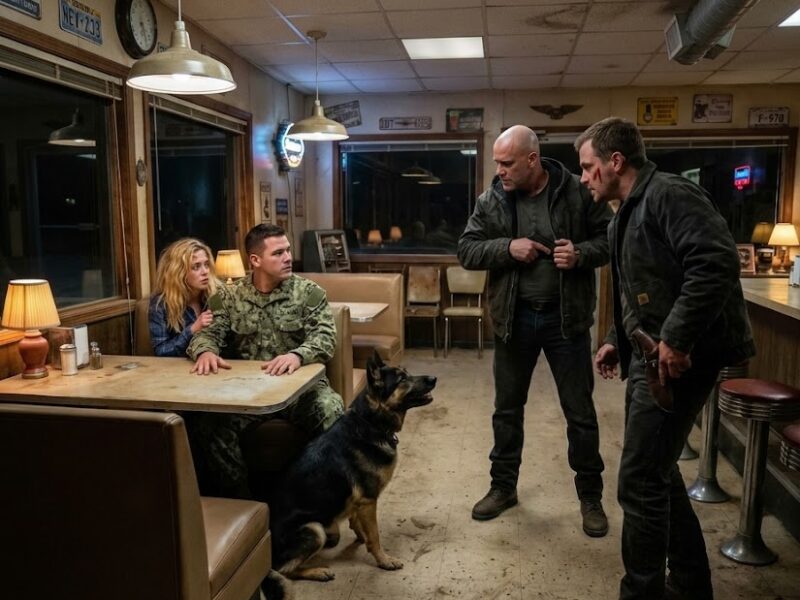
A Navy SEAL and His K9 Were Eating Alone in a Quiet Diner—Until a Trembling Little Girl Rushed Inside, Begging Them to Save Someone
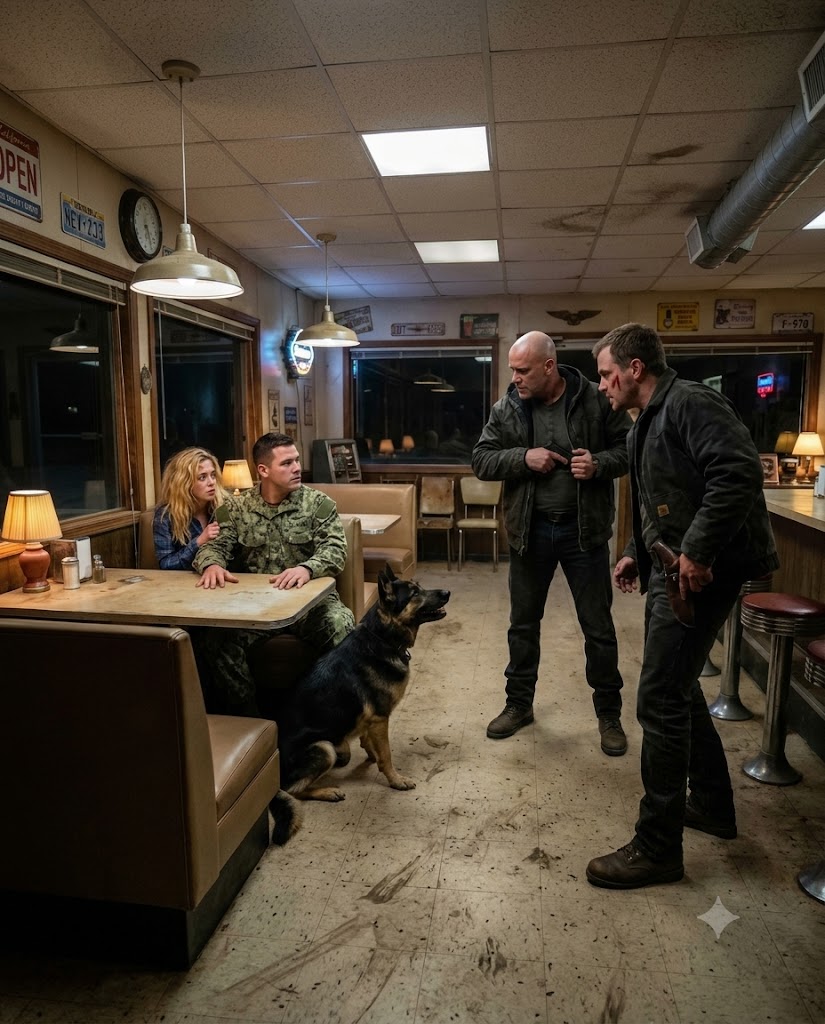
The girl hit the diner door so hard it swung all the way around and cracked against the outer wall. That was the sound that pulled Mason’s eyes up from his coffee. She stood in the doorway for exactly two seconds, chest heaving, hair plastered to one side of her face, a dark bruise spreading across her left cheekbone like a storm cloud.
Her eyes swept the room in a single desperate arc. They landed on Mason. Then they dropped to Dakota, the large German Shepherd sitting at Mason’s feet, and something in the girl’s face shifted. Not relief. Not exactly. More like a drowning person spotting a log in the current and deciding it was worth grabbing.
Mason set down his mug. He had been on leave for nine days. After three deployments and a training cycle that had chewed through two of his team members and a rotator cuff, his commanding officer had finally handed him thirty days and told him to disappear somewhere quiet.
He had driven east from San Diego without a destination in mind, just moving through the open country, the way a man sometimes needs to move when the walls of a house start to feel like a kind of pressure. He had found the diner forty minutes ago, a roadside place called Patton’s with cracked vinyl booths and a hand-lettered sign in the window that said OPEN and a smell of old grease that reminded him of his grandmother’s kitchen.
He had ordered coffee and a piece of pie he hadn’t touched. That was before the door flew open.
The girl crossed the floor in quick, uneven strides. She was young, mid-twenties at most, wearing a canvas work jacket two sizes too large, jeans caked with dark dirt at the knees, and one boot that had lost its lace. The bruise on her face was fresh.
There were shallow cuts on both hands, the kind you get from climbing through brush or breaking glass. She stopped at the edge of Mason’s booth. Up close, she was shaking so hard her teeth were clicking. “Please,” she barely got the word out. “Can I sit with you?”
Mason looked at her for a moment. He looked at the cuts. He looked at the door she’d come through, still slowly swinging shut against the cold. “Sit down,” he said.
She dropped into the seat across from him. Koda raised his big head and sniffed the air, then placed his chin very deliberately on the edge of the seat cushion beside the girl’s thigh. The dog had done this before with a child after a car accident outside Kandahar, with a translator who’d lost two brothers in a single week.
Mason had never fully understood how Koda knew. He just did. The girl looked down at the dog. Something broke slightly in her expression. She placed one shaking hand on Koda’s broad skull.
“My name’s Mason,” he said quietly. “This is Koda. Take a breath.”
“Lena,” she said. “Then no, don’t use that. They know that name. Call me anything else.”
Mason glanced toward the counter. The man behind it, heavyset, sixties, wearing a faded Carhartt shirt, had stopped pretending to clean glasses. He was watching their booth with the particular quality of attention that belongs to someone who already knows what’s happening and is simply waiting to see how it plays out.
His hand was beneath the counter. “Who’s coming for you?” Mason asked. He kept his voice even, the same tone he used during vehicle patrols when a child was running alongside the road and he needed his driver to understand without alarming the interpreter.
“Men from the compound.” She was whispering now. “About eight miles north, they keep women there. I’ve been there four months. I got out through a gap in the fence two hours ago. I walked the whole way on the highway. Please don’t let them take me back.”
Her voice fractured on the last word. She pressed her lips together, forcing herself to hold it. Mason processed this quickly. A trafficking location, eight miles north. The man behind the counter had made a call. He would almost guarantee it.
The layout of the diner, one front entrance, one door to the kitchen that almost certainly led to a rear exit. No other customers. Three vehicles in the parking lot. His dark gray pickup was one of them. “How many men at the compound?” he asked.
“I don’t—maybe fifteen, more sometimes. The sheriff comes out there. Sheriff Pollard.” She stopped. “He’s part of it.”
Corrupt local law. That simplified certain decisions and complicated others. Koda’s ears rotated sharply toward the front window. Mason saw it before the headlights swept across the glass. The dog’s alertness always ran about four seconds ahead of his own.
A vehicle was pulling into the lot. Then the deep rumble of an engine, then the crunch of gravel. Two doors opened and closed. The men who walked in were built for the work they did. One was bald and thick-necked, moving with the careful deliberateness of someone who had done violence enough times that it no longer required adrenaline.
The other was younger, with a jaw that had been broken at least once and reset imperfectly. He was carrying a flashlight in one hand like a club. The bald one had a pistol tucked inside his jacket. Mason could see the slight distortion in the fabric at the right hip.
They saw the girl immediately. The bald man’s eyes moved to Mason, a brief appraisal. He clocked the short military haircut, the posture, the broad frame. He decided it wasn’t his problem. “Time to go, sweetheart,” the bald man said.
He wasn’t yelling. Men like this didn’t need to yell inside a room this small. The girl’s hand tightened in Koda’s fur. Mason did not stand up. He set both palms flat on the table, fingers spread, and looked directly at the bald man. “She’s having dinner with me,” Mason said.
The younger man with the broken jaw laughed. He took a step forward and pulled back his jacket to show his own weapon. “That’s real sweet. Nobody asked you, soldier boy. Move along and eat your pie.”
There is a moment in a physical confrontation when the decision is made. Not when the first punch lands, before that. When both parties understand where this is going and what it will cost. Mason had learned to recognize it as a kind of stillness.
A fraction of a second where everything held perfectly in place before gravity took over. He felt it now. He reached slowly for his coffee mug. Both men watched the hand. That was the mistake. A deliberate misdirection he had used before.
His other hand dropped below the table and found Koda’s collar. He gave the dog a single tap. Koda went from resting to fully alert in the span of a heartbeat. Then Mason stood. He threw the hot coffee into the bald man’s face.
The man made a sharp sound and his hands came up instinctively. That was all Mason needed. He was already moving. He covered the distance in two steps, caught the bald man’s gun wrist before the weapon cleared the jacket, and twisted inward and down with enough force to make the joint give.
The gun dropped. Mason drove his elbow into the man’s jaw, and the man folded. The younger one lunged forward. He was fast, and he had leverage. He got one arm around Mason’s shoulder from behind.
Mason let it happen for half a second, then dropped his weight, grabbed the arm, and threw the man forward over his own hip. The younger man hit the floor hard enough to shake the table. Mason landed on top of him, got control of the position, and put him to sleep with a precise compression on both sides of the neck.
Ten seconds, maybe twelve. He stood up breathing steady. Behind the counter, the heavyset owner had a short-barreled shotgun raised. His hands were shaking. Not from fear, Mason realized, but from the effort of holding the weight at that angle.
“Koda,” Mason said. The dog was already moving. He cleared the counter in a single fluid leap, hit the owner in the chest with his full weight, and drove him back against the shelving. The shotgun discharged into the ceiling tiles.
By the time the plaster dust settled, Koda had the man pinned, muzzle six inches from the owner’s face, a low continuous rumble vibrating in his chest. “Good boy,” Mason said. He walked behind the counter, took the shotgun, cracked it open, and dropped the remaining shell into his breast pocket.
He looked down at the owner without particular emotion. “You made a phone call when she walked in,” Mason said. “Don’t make another one.” He whistled. Koda stepped back and returned to his side. The owner did not move.
Mason went back to the booth. The girl, Lena, was pressed into the corner, both knees pulled to her chest. She looked at the two men on the floor, then at Mason. Her expression was the one he had seen on people who had just witnessed something that didn’t fit inside any framework they’d been given for understanding the world.
“We need to leave,” Mason said. He picked up his tactical jacket from the seat and handed it to her. “Put this on your arms.” She pulled the jacket on. It swallowed her.
“My truck is the gray one on the left side of the lot,” he said. “Can you run?”
“Yes.”
“Koda, heel.”
They went out through the kitchen exit. The Wyoming night was cold in the way that high desert gets cold, not wet, but dense, settling into the lungs like crushed ice. Mason moved them to the truck and had the engine running before either of them said another word.
He backed out of the lot without using his headlights and turned east on the county road, not the highway. “There’s a first aid kit in the glove box,” he said. “Your hands are cut.”
She found the kit and opened it in her lap. Her hands were still trembling, but she worked at the antiseptic wipes with the focused concentration of someone who needed something to do. “Why east?” she asked after a few minutes.
“Because whoever they called will expect us to head toward the highway. The closest cell signal in this county is about twelve miles west. They’ll set up on the highway first.” He checked his mirrors. The road behind them was dark.
“How many of those men know what you look like?”
“All of them.”
“Does Sheriff Pollard have deputies outside the county?” She shook her head. “He keeps everything local. That’s how he controls it. The state troopers, he’s got some kind of arrangement where they don’t come out this far on routine patrols. I heard the men talking about it.”
Isolated jurisdiction with internal capture. This was not an improvised operation. Someone with real planning experience had built this, probably years ago, using the geography and the badge as a wall. Mason thought through his options.
He had no firearm of his own. He’d been on a road trip through three states, not a deployment, and he’d left his personal sidearm locked at home. The two weapons he’d taken at the diner were the shotgun shell and the pistol he’d pulled from the bald man’s jacket.
He had his knife, a full trauma kit, two water bottles, and the tactical mindset that eleven years of naval special warfare had built into him so deeply, it was no longer separate from instinct. Koda sat in the backseat with his head between the two front headrests.
“Tell me about the compound,” Mason said. She took a breath and began. The facility was built around an old mining operation. A cluster of original structures from the 1940s that had been reinforced and rewired within the last several years.
The main holding area was a repurposed machine shop, metal walls, a padlock center aisle with cages running down both sides. There was a guard rotation, six men on at any given hour, with a bunkhouse on the north end of the property for the rest.
A generator provided power. The perimeter was a chain link fence with a single vehicle gate on the south face. She knew it in the specific granular detail of someone who had spent four months memorizing every inch of a place she intended to leave.
“How many women?” Mason asked. She was quiet for a moment.
“When I arrived, there were eleven. There are more now. I think nineteen.”
He nodded once and let that number sit. Nineteen. The number had a weight to it, the kind that settles into the chest and stays there. They drove for another twenty minutes.
Mason turned off the county road and followed a pair of dirt tracks through scrub land and dry creek beds, navigating by memory and the terrain his headlights showed him in the last half second before each obstacle. Lena braced herself against the door handle and didn’t complain.
He stopped at the base of a long ridge and killed the engine. “Why are we stopping?” she asked.
“Because in about five minutes, someone is going to be looking for a moving vehicle on every road out of that diner.” He got out and came around to her side. “We go on foot from here. The ridge gives us high ground and cover. Can you climb?”
She got out without answering and started up the slope. She could climb. The ridge took thirty minutes in the cold. Mason moved them at a sustainable pace, watching Koda’s behavior to monitor for anyone tracking their position.
The dog ranged slightly ahead, nose down, then back to Mason’s hip. His tail stayed low, alert but not alarmed. At the top of the ridge, Mason found a shallow rock shelf that provided concealment from three sides.
He got Lena settled and crouched down beside her. Koda pressed against her knee. Below, through a gap in the terrain, the distant smear of the diner’s neon sign was still visible eight miles west.
Two sets of headlights were moving on the highway. A third was coming up the county road. “They’re organized,” Mason said quietly. He wasn’t speaking to her specifically. It was the kind of observation he’d always made aloud during mission planning because it forced him to hear the problem clearly.
“What do we do?” she asked.
He looked at her. In the gray light at the top of the ridge, with the jacket wrapped around her shoulders and the bandaged hands and the bruise on her face, she looked exhausted in a way that went down to the bone. But her eyes were sharp.
Whatever fear had driven her through that diner door had not broken her. It had used her up and she was still here. “I’m going to make a call,” he said.
He pulled out his phone. The signal was thin, one bar fluctuating. “If this connects, I need five minutes.” The number he dialed was one he had never deleted from his contacts. A man named Warren who worked as a federal liaison to three different alphabet agencies and who had once, in a safe house outside Djibouti, told Mason that if he ever found himself in a situation that local authorities couldn’t or wouldn’t handle, to call this line and not the other one.
The call connected on the second ring. Mason spoke for four minutes and thirty seconds. He gave the location, the nature of the operation, the number of potential victims, and the two words that would accelerate federal response faster than anything else. Active trafficking and law enforcement complicity.
Warren asked two questions. Mason answered them. “Six hours minimum,” Warren said. “Maybe four if I can get air assets repositioned. Can you stay contained until then?”
“I’ll manage,” Mason said. He hung up and looked at Lena. “Help is coming, but it’s going to take time.”
She nodded slowly. Then something shifted in her expression, not toward fear, but away from waiting. “Those women in there, one of them, her name is Cora. She’s seventeen. She got sick two weeks before I left. They weren’t giving her anything for it.”
Mason held her gaze. “I’m going in,” he said. It was not a sudden decision. He had been building toward it since the moment she said nineteen. He just needed the federal call to be confirmed before he committed to the operational timeline. “I know the layout from what you’ve described, but I do better with eyes on the approach.”
“I know a gap in the fence on the east side,” Lena said immediately. “Near the old ore processing shed. The cameras on that wall have a dead angle because one of the guards broke the mounting bracket and never fixed it.”
He studied her for a moment. “You’re not coming inside.”
“The keys to the cage locks are on a hook behind the guard station. Third shelf down, left side. You won’t find it without knowing exactly where to look.” She was right. He knew she was right. He could see it in the certainty with which she said it. The certainty of someone who had studied that hook for months, who had looked at it every morning and every night, and built her entire hope around eventually reaching it.
“You stay behind me at all times,” he said. “You do exactly what I signal when I signal it. If I go down, you take Koda. Go back the way we came, and you go north on the ridge until the first creek bed. You follow the creek east until you hit the service road. You wait there.”
“Okay,” she said.
“Say it back.” She said it back, word for word. He handed her the pistol he’d taken at the diner. He spent eight minutes teaching her grip, stance, safety, sight picture, trigger discipline. He had taught this before to more frightened people than her in worse conditions. She was a better student than most.
They moved out at 2:14 a.m. The compound was lit up on the south and west faces. Generator-powered halogen work lights on poles, the kind that construction crews use. The east side, as Lena had said, was noticeably dimmer.
One camera mounted on the corner post was angled wrong, its field of view covering a square of empty gravel rather than the approach from the scrubland. Mason studied the guard rotation for eleven minutes, counting cadence, measuring gaps.
There was a four-minute window on the east side patrol. Long enough to cut the fence and get through if they moved efficiently. He cut, they moved, they were inside. Koda entered last, crouching low with his belly nearly touching the ground, reading Mason’s body language and matching it exactly. The dog made no sound.
The ore processing shed smelled of rust and old oil. They moved through it in a low crouch, following the eastern interior wall, staying in the shadow band between the halogen pools. A single guard was visible twenty yards ahead, facing away, leaning against a support post and looking at his phone.
Mason gestured to Lena to stay. He gave Koda the same signal. He took the guard down from behind. Clean, controlled, quiet. The man went down without a sound and Mason secured his hands with a zip tie from his jacket pocket and dragged him behind a cluster of old equipment.
He took the man’s radio and earpiece. Through the earpiece, he could hear the voice traffic. Two names repeated frequently, Holland and Torres. Someone named Holland was apparently standing near the vehicle gate. Torres was responding from inside the main building.
The radio was information. Information was oxygen. He returned to Lena and Koda and they moved to the machine shop. The door was padlocked from the outside.
Lena looked at him, then pointed to a key ring hanging on a hook inside a plywood frame structure, barely large enough to be called a booth, an improvised guard station near the door. A single dim lamp was on inside. No one was in it.
He went in. The keys were where she’d said, third shelf, left side. He brought them back. Inside the machine shop, the first thing was the smell, close, warm, human. The kind of smell a place gets when too many people have been inside it for too long without enough air.
The lights were off. He could hear breathing in the darkness. Then a voice said something very quietly in a language he recognized as Spanish.
Federal law enforcement is coming, he said, keeping his voice very low. We’re getting you out now. I need everyone to be completely quiet. Can anyone translate? A woman’s voice in the dark said, I speak English. Good. Tell the others no lights, no phone flashlights, no sound. We move in a group, low and fast.
He heard her speak in rapid Spanish. The sound of movement in the dark. He went to the first cage, tried keys until one turned, then the next. Lena was beside him, working the other side of the aisle without being asked.
Her hands steady now, the shaking gone. She was in her element here. This was the place she had studied, the place she had memorized. She moved with a precision that he recognized as the opposite of fear.
Koda positioned himself at the entrance to the machine shop without being told. His ears swept the arc outside. Nineteen women. Three of them needed to be helped walking. One of them, a girl who was barely past girlhood, was running a fever. Her skin papery and hot.
Mason crouched beside her and checked her pulse and her eyes. “Cora,” Lena said softly.
“Cora,” Mason said, keeping his voice calm, “I’ve got you. You’re going to be okay.” He looked up and found the woman who spoke English. “When we go outside, you’re going to guide the group east toward the fence. There’s a gap. You go through it and you keep moving east. Don’t stop until you hit the scrubland. There’s a ridge. You go up the ridge and you wait. I’ll find you.”
She nodded. The voice in his earpiece said, “Holland, you copy? Doing a head count at the shop.” He had maybe ninety seconds.
“Move,” he said. They moved. Getting nineteen people through a fence gap in ninety seconds was not tactically elegant. But the alternative was a firefight inside a building with civilians. And that was not something he was willing to accept.
He stayed at the gap, pulling people through, guiding the ones who hesitated, keeping his body between the group and the compound interior. Koda worked beside him, nudging stragglers forward with his head the way a sheepdog would.
The shout came from behind them when the last person was almost through. A guard near the machine shop who had done the head count early. Mason turned. The guard was young, early twenties, already raising a radio to his mouth.
Mason closed the distance in a flat sprint. He got to the man before the radio keyed, stripped it from his hand, and put him down hard on the gravel. From the bunkhouse on the north side, he heard voices.
The lights on the south perimeter came on, all of them simultaneously. Someone had hit a flood switch. He went through the fence gap. Outside, the group was moving up the slope in a rough cluster, the English-speaking woman at the front guiding them, Lena near the back.
Mason caught up and put himself at the rear. Behind him, he could see flashlights sweeping across the compound. “Keep moving,” he said. “Don’t look back. Just move.”
The ridge was brutal in the cold and dark. He could hear people breathing hard, hear feet slipping on loose rock. He moved up and down the line, steadying whoever needed it, passing the water from his pack, keeping them together and moving.
Koda ranged alongside the group, never more than ten yards away. At the top of the ridge, he counted heads, nineteen plus Lena. He keyed the radio he’d taken. He let the search traffic fill his ear, building a picture.
Two groups searching the compound, one group at the vehicle gate, one group being dispatched along the south road. Nobody had yet thought to go east. He pulled out his phone, two bars now. He called Warren.
“I have nineteen individuals out,” he said. “We’re on the east ridge approximately two hundred meters above the compound. Two of them need immediate medical.” He paused. “How far out are you?”
“Thirty minutes,” Warren said. “Two federal vehicles and a medevac helo. Do you have a light source?”
Mason looked at the people around him. Several of them had small phones. “I can make one.”
“We’ll find you.” He hung up and turned to the group. “Take out your phone screens. Face them east. Hold them up.”
Twenty small rectangles of light appeared in the dark. He walked to where Lena was sitting at the edge of the group, her knees pulled up, one arm around Cora, who had her head against Lena’s shoulder, and her eyes closed. He sat down beside them.
For a few minutes neither of them spoke. The cold was still sharp, but the wind had softened. The scrub land below was dark. Far south, the compound’s halogen lights made a hard bright smear.
“She’s breathing okay,” Mason said, checking Cora’s pulse again.
“I know,” Lena said. “She’s stronger than she looks. She lasted four months in that place.”
He looked out over the landscape. The dark sky above Wyoming was dense with stars, the kind of sky that city life erased. “You memorized everything,” he said. “Every detail of that compound. You were planning this the whole time.”
“I planned it the first week,” she said. “I just needed to wait for the right moment.” She paused. “I didn’t plan on finding a Navy SEAL and his dog in a roadside diner.”
Koda, hearing nothing but his name missing from the sentence, and yet somehow following the intent of it, walked over and pressed his big body against Lena’s side. She laughed. It was a small sound, cracked around the edges, but it was real.
In thirty-one minutes, a federal helicopter swept over the ridge with its searchlight and found twenty rectangles of light pointing east. The two federal vehicles came up the access road from the south. In the canyon between the ridge and the compound, Mason could see the flashlights of men who had been pursuing them slowing, stopping as the radio traffic in his earpiece devolved into panic.
Sheriff Pollard was taken into custody at the county line at 3:52 a.m. attempting to leave in his personal vehicle with a bag in the backseat. He did not resist. Men like him rarely did when the thing they’d built finally came apart.
Cora was airlifted before dawn. As the sun came up over the eastern plain washing the dry grass gold and softening the hard edges of the scrub land, Mason sat on the tailgate of a federal vehicle and drank the coffee a young agent had handed him without being asked. Koda lay at his feet. The morning was very quiet.
Lena came and sat beside him. She had a blanket over her shoulders and someone had given her clean socks which she seemed to find disproportionately comforting. She held her coffee with both hands and looked out at the same morning he was looking at. They sat like that for a while.
“Where were you driving to?” she asked before the diner.
“Nowhere in particular,” he said.
She nodded. She seemed to understand that. “Thank you,” she said. Not the panicked version from the diner booth, not the thank you that meant please keep me alive. This was the other kind, the kind that settles somewhere permanent.
He looked at her. “You got yourself out,” he said. “Two hours on foot in the dark. That’s the thing that started all of this.”
She was quiet for a moment, then Koda helped. The dog lifted his head at the sound of his name and looked at them both with his amber eyes. His tail swept once across the ground. Some things do not require explanation. A man, a dog, a dark road, and the particular kind of quiet that comes after a long night when the light finally decides to stay.
The narrator has told you the facts of this story. But the part worth keeping is not the fight in the diner, or the fence cut in the dark, or the nineteen faces of women walking up a ridge toward dawn. The part worth keeping is simpler than that. It is a girl who refused to stop moving, and a man who saw her stop and asked, very quietly, if she needed to sit down.









