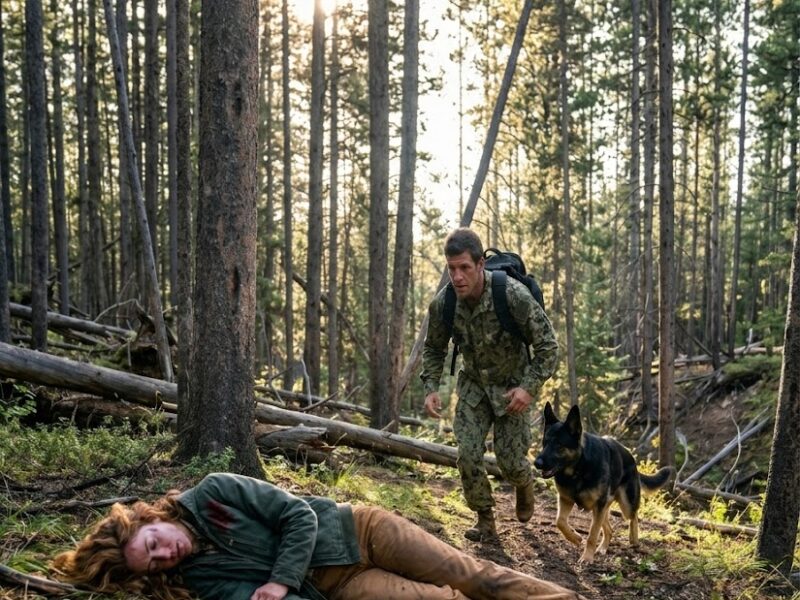
A Navy SEAL and His K9 Found a Wounded Woman Deep in the Forest—Her Shocking Secret Exposed a Hidden Threat That Could Have Cost Thousands of Lives
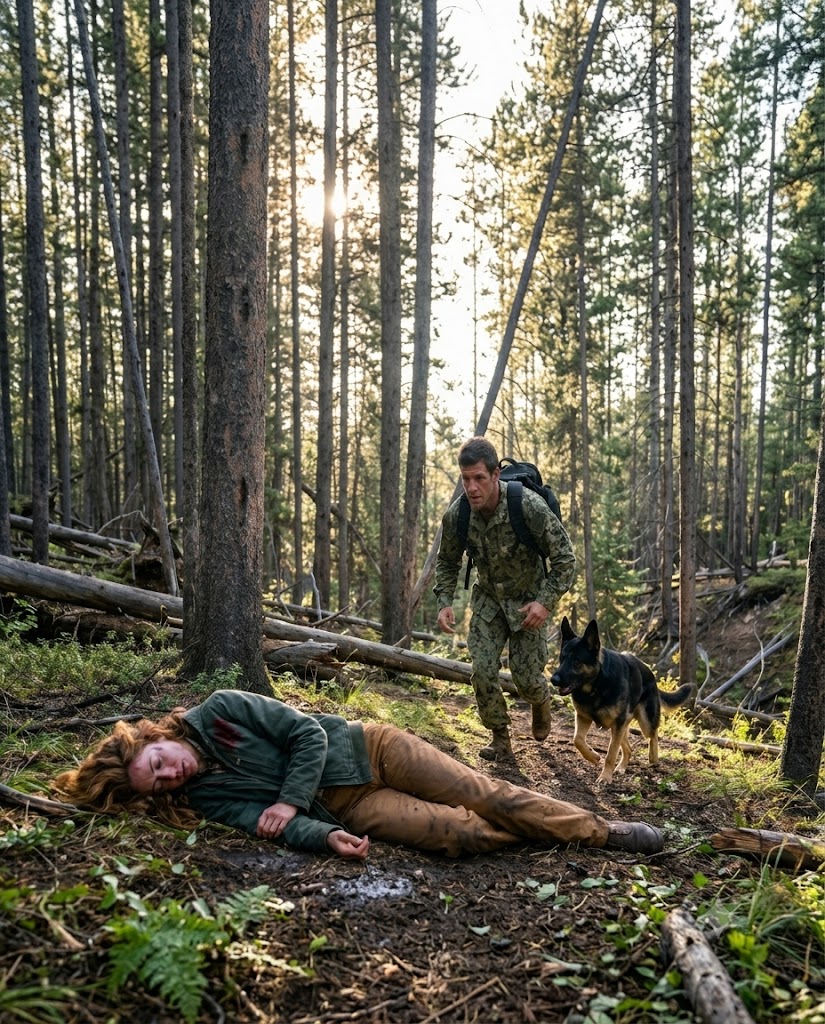
Duke found her first. That was how it always worked with Duke.
Not instinct exactly. Not training exactly. Something the military manuals never managed to put a name to. Once dispatched, the dog would trot the trail twenty yards ahead, ears relaxed, tail swinging loose. Then the switch flipped somewhere inside him and he was simply gone, off the path and into the timber like a ghost with a mission.
Reed had learned a long time ago not to argue with that switch.
He was thirty-eight years old and had spent the last eleven of them as a Navy SEAL. Eleven years of sand and salt water, of rooms cleared in the dark, of decisions made in half a breath that nobody ever discussed at dinner. He had taken leave because his commanding officer had looked at him across a metal desk in Virginia Beach and used the word mandatory.
Reed had not argued with that either.
He had driven west with Duke in the passenger seat and a single duffel bag in the back, and he had kept driving until the highway turned to two-lane blacktop and the blacktop turned to gravel and the gravel ran out entirely at the trailhead for Olympic National Park’s backcountry corridor.
That had been four days ago. He had not spoken to another human being since. He did not miss it.
The old-growth forest here was unlike anything Reed had ever seen deployed to or trained in. The trees were enormous, ancient, draped in green moss so thick it looked painted on. The understory was dense with sword ferns and oxalis. The air tasted clean in a way that made the back of his throat ache a little. He had been sleeping eight hours a night for the first time in years. He had been dreaming about nothing at all.
Duke vanished into a wall of huckleberry brush at the edge of a steep drainage. Reed stopped walking. He tilted his head. The forest had gone quiet in the particular way it went quiet when something was wrong. Not the peace of empty wilderness, but the held-breath silence of disturbance.
He followed.
The drainage dropped sharply. Old root systems jutted from the bank like broken ribs. Reed picked his way down by feel, watching Duke’s tail disappear around a moss-covered boulder the size of a truck. He rounded the boulder and stopped.
She was lying face down on a bed of wet ferns. Red hair fanned out around her head. She was wearing a canvas field jacket, the kind with reinforced elbows, and heavy rubber boots caked with trail mud. The left side of the jacket was darker than the right side.
Reed registered that darkness before he registered anything else. He was already moving, already kneeling, already pressing two fingers to the side of her neck. Pulse faint, fast, shallow. Duke stood close to her head, not nudging her, not sniffing, just standing guard the way he stood guard over things that mattered.
Reed pulled her carefully onto her side. He unzipped the field jacket. Underneath, soaked through a heavy flannel shirt and a base layer both, was a wound in her left shoulder that told him everything he needed to know about what kind of morning this had become. Entry wound small and clean, no exit wound visible from this angle. The bleeding was still active.
He dropped his pack. His hands moved without thought, pulling out the blowout kit he carried the same way other people carried their wallets. He cut the shirt away from the wound with his trauma shears. He packed hemostatic gauze with direct pressure and held it.
Duke sat down beside him and rested his chin on the woman’s arm, a gesture so gentle it looked almost deliberate.
She woke up swinging.
Her good arm came up fast and her nails caught Reed’s forearm before he could pull back. She was pushing with her legs, trying to scramble backward, letting out a sound that was not quite a scream—too much pain behind it for that—and her eyes were wide and entirely blind with terror.
“Hey.” Reed kept his hands on her shoulder. He did not raise his voice. “Hey, stop. You’re going to bleed out if you keep moving. Stop.”
She did not stop. She grabbed a fistful of his shirt.
Duke moved. The German Shepherd stepped over Reed’s knee and simply laid himself across the woman’s lap, all seventy-four pounds of him, warm and solid and completely unbothered. He looked up at her face. His tail thumped once against the fern bed. He licked her wrist.
The fight went out of her. It happened in about four seconds. Her hand released Reed’s shirt. Her chest was still heaving, but the blind scrambling stopped. She looked down at Duke the way people sometimes looked at a fire in a fireplace—not thinking, just watching. Some switch inside her flipping from panic to something that could be worked with.
“His name is Duke,” Reed said. “He’s not going to hurt you. Neither am I. My name is Reed. I’m going to keep pressure on your shoulder. You have a through-and-through gunshot wound and I need you to stay still.”
She swallowed. She looked at Duke. She reached out with her free hand and touched the dog’s ear.
“Petra,” she said. Her voice was dry and cracked. “My name is Petra.”
“Okay, Petra. What happened?”
Her eyes came up and found his. He had spent eleven years reading people’s faces in bad situations, and what he saw in hers was not confusion. It was not shock. It was the particular expression of someone carrying a piece of information so heavy they could barely hold it.
“You have to listen to me,” she said. “I know that sounds insane right now, but you have to listen to me before anything else.”
“I’m listening.”
She closed her eyes for a moment. When she opened them, she spoke in a flat, controlled voice that told Reed she had been rehearsing this in her head the whole time she was unconscious.
“I’m a wildlife biologist with the Park Service. I was tracking wolf corridor activity in the Quinault restricted zone above the Quinault drainage this morning. I went off trail before dawn to check camera traps on the north-facing slope above Boundary Ridge. That ridge is glacially carved granite, extremely unstable. The park has it closed to the public because the fracture system along the upper face is unpredictable.”
She paused, breathed.
“When I got close to the upper monitoring station, I heard machinery. Drilling equipment. I got low and worked around to where I could see the base of the cliff.”
Reed kept his hand steady on her shoulder.
“There were men. Six, maybe eight. Full tactical loadout, suppressed rifles, the kind of gear that does not come from a sporting goods store. They had core drills set up along the base fractures. They were packing the drill holes with something gray and waxy.”
She looked at him.
“I was a geology minor in college. I know what shape charges look like.”
Reed let that land.
“Below Boundary Ridge,” Petra continued, her voice dropping even lower, “there is the Quinault River Lowlands. This is Labor Day weekend. The main valley campground is at maximum capacity. The overflow sites are full. The group sites are full. I was coordinating with a ranger yesterday who told me they had turned away four hundred vehicles at the gate. There are families down there, Reed. Children.”
“If that ridge comes down,” Reed said, “it buries the valley.”
“Every campsite. Every RV. Every tent. Thousands of tons of rock moving at over a hundred miles an hour. Nobody walks away from that.”
Reed took his hands off the wound long enough to apply the compression wrap. He worked fast, covering the hemostatic gauze, tying it firm.
“You tried to move and they saw you,” he said. It was not a question.
“I stepped wrong. Someone opened fire. I ran downhill into the drainage and I don’t remember anything after that.” Her jaw tightened. “They know I saw them.”
Reed stood up. He surveyed the timber around them with the slow, methodical attention of someone who was not doing it to be thorough, but because it was simply how his eyes worked now. Always working the perimeter. Always looking for the thing that did not belong. The forest was still wrong, too quiet. Not the quiet of before.
“Can you walk?”
“Yes.”
“Then we move. Right now.”
—
There are moments when a person in the wilderness stops being a civilian and becomes something else entirely. Not a soldier. Civilians can never fully make that crossing. But something adjacent. Something forged in the specific crucible of having to move through a landscape that wants to kill you while other human beings are also actively trying to kill you.
Petra made that crossing in the first hundred yards. She did not complain. She did not slow down except when the terrain demanded it. She bit back the sounds her shoulder was making her want to make and she kept moving.
Reed noted this without commenting on it. Some things deserved more than comment.
He moved them northeast, away from the drainage and into thicker timber. He backtracked twice to obscure the line of their passage. Duke ranged ahead, quartering the slope, coming back to check on Petra with the periodic attentiveness of a nurse doing rounds.
Half a mile into the timber, Reed found the natural shelter he was looking for. A granite overhang cut deep into a hillside, almost entirely screened by a curtain of sword ferns and the massive exposed root mass of a fallen Sitka spruce. The overhang was barely large enough for two adults and a large dog. It smelled like damp earth and bark mold.
“In here,” Reed said.
They pressed into the overhang. Petra folded down against the cold stone. Duke immediately settled across her feet.
“What are we doing?” Petra whispered.
“Letting them walk past us,” Reed said. “They’ll push south first because that’s where the trailhead is. Where the ranger station is. That’s the logical direction for a wounded person to run.”
“And then?”
“Then we go north.”
She stared at him in the dark, back toward the ridge. Back toward the ridge.
She was quiet for a moment. “How many of them do you think are looking for us right now?”
“At least two. Probably more. They need to find you before you talk to anyone. That’s their priority.” He held her gaze in the dimness. “They’re not going to find you.”
Fourteen minutes passed. Reed counted them internally, the way he had trained himself to count in confined spaces—not by checking the time, but by breathing, by listening, by the slow calibration of the body against silence. Duke’s ears swiveled twice, but he did not growl. The animal intelligence behind those dark eyes was processing and sorting and filing.
On the fifteenth minute, footsteps.
Heavy, deliberate. Somebody with serious boots and serious weight moving through the sword ferns at the top of the drainage slope. Reed put his hand on Duke’s shoulder. The dog looked up at him. Reed held his gaze and did not move a muscle. Duke understood what that meant. The dog’s body went entirely still—not the frozen stillness of an animal startled, but the controlled stillness of a trained operator who had chosen stillness as a tactic.
The footsteps came closer. A figure appeared at the edge of the root mass, visible through a gap in the ferns. Heavy tactical pants, plate carrier, suppressed rifle across the chest. He stopped six feet from the overhang entrance. He looked at the hillside. He looked at the fern curtain. He looked directly at the gap where Reed was watching him through it.
Reed did not breathe.
The figure turned his head. He activated his radio, listened to something, murmured a response too low to hear. He moved on. The footsteps faded.
Reed waited four more full minutes before he let himself exhale.
“Gone,” he said quietly.
Petra’s hand was pressing hard against her own sternum, like she was trying to hold her heartbeat inside by force. She let it drop.
“We have maybe a ninety-minute window before they figure out we went the wrong direction,” Reed said. “We need to be at that ridge before they realize it.”
He stripped off the bottom layer of his shirt, soaked it in water from his canteen, and pressed it carefully to Petra’s forehead. The compression wrap on her shoulder was holding clean. She was pale, but her eyes were clear.
“Talk to me about the ridge,” he said. “Tell me everything about those fractures.”
There is a specific quality of courage that people who have never been truly afraid tend to misunderstand. They imagine it as something loud, something aggressive, something that stands up in the face of danger and announces itself. But the real thing is quieter than that. The real thing is a woman with a bullet wound in her shoulder, sitting in a cold rock overhang in the backcountry of Olympic National Park, drawing a diagram in the dirt with her finger, explaining fault line geometry to a man she met forty-five minutes ago because thousands of people she has never met are sleeping in a valley below, and the math is simple and terrible.
Petra drew a long line in the dirt. “This is the base fracture. Runs horizontal across the entire lower face. The cliff is essentially a hanging block held in tension by a series of granite pillars here, here, and here.” She marked three points. “If you compromise those three load-bearing sections simultaneously, the whole shelf releases. Gravity does the rest. You don’t need a lot of explosive if you place it correctly.”
“How long would that geology take to become a debris field?”
“Forty seconds from detonation to full valley impact.”
“Warning time for people below?”
“None. The sound of the blast would arrive at the same time as the leading edge of the debris.”
Reed looked at the diagram in the dirt for a moment, then he stood up.
“Okay. Let’s move.”
—
The climb to Boundary Ridge in the last light of afternoon nearly broke Petra twice. The slope was steep enough that horizontal movement was faster than vertical on some sections, requiring switchbacks that burned time they did not have. Reed moved behind her, a hand at her back on the worst grades, taking some of her weight without making it feel like charity. Duke picked the route, nose down, finding the least treacherous lines through the scree.
They did not speak. Speaking cost oxygen, and oxygen was rationed at this pitch.
Thirty-eight minutes after leaving the overhang, they crested the ridge. The view stopped Reed cold for exactly two seconds before he shoved the beauty of it out of his head and started working. The Quinault lowlands spread below them, vast and green-gray in the fading light. The campground was visible as a constellation of small warm lights—cooking fires and lantern glow, and the white halos of RV awning lights. Thousands of lives burning small and cheerful, and entirely unaware three thousand feet below.
Reed turned to the cliff face. “Show me the pillars,” he said.
Petra pointed. He followed her finger to three sections of the lower cliff face where the granite was slightly different in color and texture from the surrounding stone. At the base of each pillar, barely visible in the dimming light, was the dull gray sheen of packed explosive compound. Thin wire ran between them, daisy-chaining the charges. The wires converged at a black control unit bolted to the rock face above the middle pillar.
Reed moved toward it, staying low, keeping to the shadows at the base of the cliff. He crouched in front of the unit, pried the cover plate with the tip of his knife. Inside, a digital timer was running.
Twenty-two minutes and fourteen seconds.
He heard Petra’s sharp intake of breath behind him.
“They moved the timeline,” Reed said. He was already tracing the wire bundle, mapping the circuit with his eyes. “Someone on the radio must have ordered it.”
“Twenty-two minutes,” Petra said. Her voice was measured and level with a visible effort. “Can you disarm it?”
“I can disarm it if you can tell me which of these three charges is the primary anchor point. The one that, if it fails to detonate, the other two can’t compensate for structurally.”
Petra moved up beside him, bracing her uninjured arm against the cliff face for support. She studied the three pillars. She was doing geology in her head. Reed could see it, the way her eyes moved across the stone with the particular focus of someone reading a language.
“Middle pillar,” she said. “The left and right pillars carry roughly thirty percent of the load each. The middle carries forty. If the middle charge fails, the other two cannot produce enough simultaneous force to release the shelf. You don’t stop it completely, but you prevent catastrophic failure. Nobody in that valley dies.”
Reed nodded once. He traced the wire from the middle pillar charge back to the main bundle. Found the splice point, pulled his knife.
A boot scraped on rock six feet to his left. He was already moving when the voice came.
“Step away from the board.”
The man who stepped out of the shadow of a granite outcrop was large, military bearing, with a shaved head and a jaw like a structural component. He had a suppressed rifle leveled at Petra’s center mass. His eyes were flat and operational.
“Hands where I can see them,” he said. He was looking at Reed. “Both of you. Right now.”
His name was Voss. Reed did not know that yet, but he could read the type. The eyes gave it away. Not rage, not ideology, not fear—just calculation. The most dangerous kind.
“You’re done,” Voss said. His voice was level. “Your dog, the woman, all of it. Done. The board detonates in twenty minutes whether you disarm one wire or not. I have a redundant trigger on my person, and I will use it before I let you walk away from this ledge.”
Eighteen minutes thirty seconds on the timer behind Reed’s back.
Reed looked at Voss. He looked at where the rifle was pointed. He looked at Duke, sitting three feet to Voss’s left, absolutely still, watching.
Reed dropped his hands to his sides. He looked directly at Voss and kept his eyes there and did not look at Duke again. He did not need to.
Duke launched from a dead standstill.
He covered three feet in a fraction of a second, and his jaws found Voss’s right forearm at the wrist before the man even registered the motion. The rifle fired once, wild, into the trees. Voss screamed. He swung left with his free elbow, catching Duke in the ribs with enough force to make the dog grunt, but Duke held.
Reed crossed the distance in two steps. He drove his forearm into Voss’s throat. He grabbed the rifle barrel with his other hand, twisted it up and back, felt Voss’s finger clear the trigger guard in reflex. He brought his knee into the man’s solar plexus. Voss folded. Duke released. Reed brought his elbow down across the back of Voss’s neck.
Voss went down, and Voss did not get up.
Reed was already moving back to the control board.
Fifteen minutes, forty seconds.
He found the wire from the middle pillar charge. His hands were completely steady. Behind him, he heard Petra breathing in controlled counts, holding herself together by will alone. He cut the wire. Then he found the redundant trigger Voss had mentioned, a small radio receiver clipped to the man’s tactical vest. He crushed it under his boot heel. Then he went to work on the primary board.
“Blue, green, or red?” Reed said.
“What?”
“Three wires going into the timer relay. I can kill the timer entirely, or I can cut the wrong one and we find out if the fall from this ledge is survivable. Blue, green, or red?”
Petra looked at the board. She looked at the timer. Eight minutes.
“The green one will be the battery feed,” she said. “Cut the red, and you risk triggering the anti-tamper. Cut green, and you just kill the clock.”
“How sure are you?”
A pause of exactly two seconds.
“Sure enough,” she said.
Reed cut the green wire.
The timer stopped at seven minutes and forty-one seconds.
—
The ledge was silent except for the wind coming up off the valley and the sound of Petra slowly sliding down the cliff face until she was sitting on the cold stone with her back against the granite and her eyes closed and both hands pressed flat against the rock like she needed to feel something solid and permanent. Duke walked over to her. He sat down and leaned his full weight against her side. She wrapped her arm around him and did not let go.
Reed secured Voss with the man’s own zip ties. He recovered Voss’s radio, switched frequencies until he found an emergency channel, and keyed the mic.
“This is Chief Petty Officer Reed, United States Navy, transmitting from Boundary Ridge in the Olympic National Park backcountry corridor. I have a civilian gunshot casualty requiring immediate medevac. I have one restrained hostile with additional hostiles in the lower drainage sectors. I have disabled a large-scale explosive array on the cliff face above the Quinault campground. The array was designed to cause a mass casualty rockfall event. Threat is contained but the site is not secure. I need law enforcement, bomb disposal, and medical response at the ridge trailhead immediately.”
Static. Then a voice, tight and slightly stunned.
“We copy you, Chief Reed. Say again—explosive array, Quinault Ridge?”
“Affirmative. Multiple charges. Middle pillar wire is cut. Primary timer is dead. Secondary trigger destroyed. You need EOD up here before anyone touches the remaining charges. The charges on the left and right pillars are still armed.”
“Copy all. Scrambling now. Hold your position.”
Reed set the radio down. He walked over to where Petra was sitting against the cliff with Duke pressed against her. He lowered himself onto the rock beside them. Below, the campground lights burned small and warm in the vast dark of the valley. Cooking fires, lanterns, children in sleeping bags who would wake up tomorrow and not know how close the morning had come to never arriving.
Some truths are too large to carry comfortably. The weight of what did not happen is different from the weight of what did, and heavier in its own strange way.
“You did it,” Petra said quietly.
“We did it,” Reed said. “I needed your geology.”
She let out a sound that was half laugh, half something that had nowhere else to go. Duke thumped his tail against the stone.
They stayed on that ridge for two more hours. The cold settled in hard, and Reed gave her his outer layer without discussion. She did not argue. Duke remained pressed to her side, a furnace wrapped in black and tan fur. And the stars above the Olympic ridgeline were the kind of stars you only see when there are no cities within a hundred miles in any direction.
The helicopter found them by Reed’s signal mirror.
—
Three days later, the hospital room in Port Angeles was warm and smelled like antiseptic and weak coffee. Morning came through the blinds in thin gold strips. Duke was asleep on the floor, belly up, legs loose—the posture of an animal that had decided this was safe ground and planned to stay.
Petra was awake when Reed walked in with two cups of coffee from the vending machine down the hall. She looked better. The color had come back into her face. The IV line was gone. Her left arm was in a proper sling, her shoulder packed and wrapped by people with more tools than Reed’s field kit.
She watched him set the cups down on the tray table.
“They got all of them,” she said. “The FBI called an hour ago. Eight in total. They’re all in custody.”
“I heard.”
“They found enough C4 on that ridge to take down half the cliff face.” She paused. “The ranger told me there were forty-two hundred people in that valley Friday night.”
Reed sat down in the chair beside the bed. He picked up his coffee cup. He held it.
“Forty-two hundred people who went home Sunday,” he said. “Who drove out of that park with their kids sunburned and tired and already arguing about the drive. Who would tell the story of this camping trip for years without ever knowing there was a story inside it they never got to hear.”
“How’s your shoulder?” he asked.
“Painful,” Petra said. “Honest.”
“That’s the right kind.”
She looked at him across the tray table. Outside the window, the Olympic peaks stood white-topped against a hard blue sky, unchanged and permanent in the way that mountains are permanent, indifferent to human drama, outlasting every version of it.
“You came here for quiet,” she said.
“I did.”
“Are you going to try again after this?”
Reed thought about it. He thought about the empty trailhead parking lot, the gravel road, the silence of old-growth timber before anything had happened in it.
“Maybe,” he said. “But I think the mountains might have different plans.”
Duke opened one eye from the floor. His tail moved twice. He closed his eye again.
Petra smiled. It was a real one, not the managed kind people deploy in hospital beds to reassure visitors. It reached everything.
“I do my best work in the field,” she said. “In case you were wondering.”
“I wasn’t wondering,” Reed said. “But I noticed.”
She reached across the tray table and he met her halfway.
Outside, the peaks held their silence. The valley below them was green and full of life and completely unbothered. The way valleys are when the thing that almost happened to them simply did not. The river moved through it the way it always had and always would, carrying the mountain slowly, piece by piece, down to the sea.
This is what the narrator can tell you, looking back on all of it. The most important moments are almost never the ones we plan for. Reed drove into those mountains to find silence. He found it. He just had to earn it first. And Duke, as always, found the thing that needed finding before anyone else knew it was lost.
Courage is not the absence of fear. Every person on that ridge that night was afraid. Courage is what happens when you choose to move anyway because something larger than your fear is standing in the valley below, trusting that the mountain will hold.
It held.









