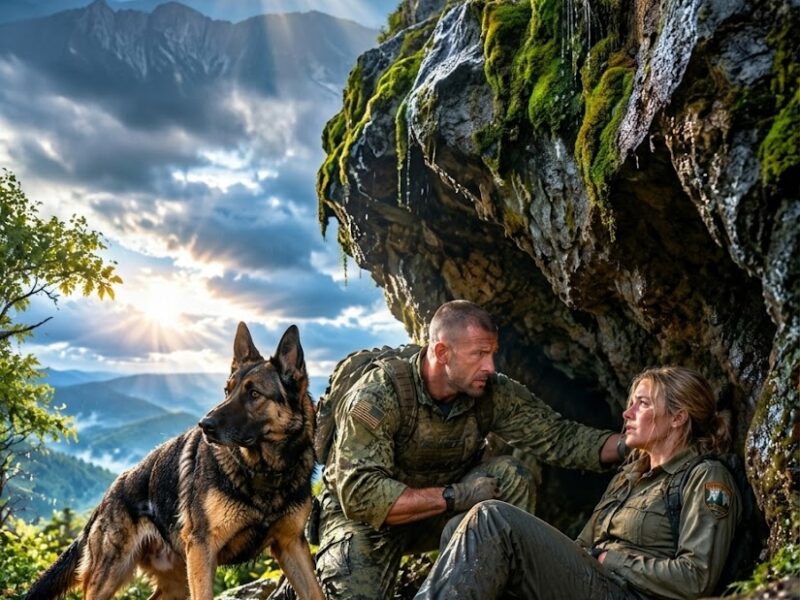
A Navy SEAL and his dog found a dying warden in a cave. What happened next will leave you in tears.
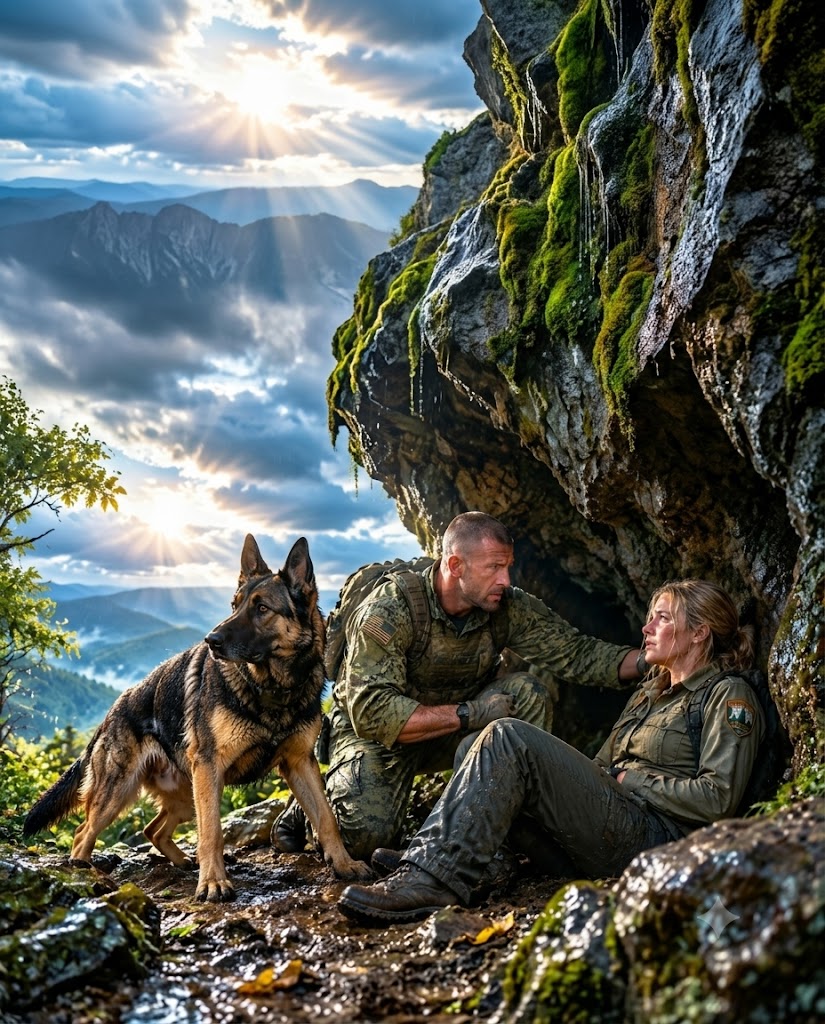
The dog stopped moving before the man did.
That alone told Heath everything he needed to know about the next few hours.
He stood on the ridge trail and watched Onyx freeze mid-step, one black paw raised off the ground, his broad head swiveling into the wind.
The German Shepherd’s nostrils worked fast and quiet, reading the air with the same precision a trained medic reads a pulse.
Heath knew the look.
He had seen it in Kandahar province, in jungle corridors in the Philippines, in the salt flat desert of northern Africa.
That look meant something was changing and not in a good direction.
Heath lifted his eyes to the sky above the Blue Ridge.
The clouds had stacked up without warning.
They came in low and fast over the Virginia ridgeline, piling on top of each other like freight cars derailing in slow motion.
The color of them was wrong, not the blue-gray of a normal afternoon thunderhead, but something darker, denser, the color of old pewter left too long in a cabinet.
The air pressure had dropped sharply in the last 20 minutes.
Heath felt it in the cartilage of both knees, the reliable barometric joints that had survived two combat deployments and one very bad night on a mountain in Yemen.
He was on leave, 14 days of mandatory rest his commanding officer had hand-delivered in the form of orders.
Get out of base, clear your head, come back functional.
He had driven his truck nine hours to the Shenandoah Highlands with nothing but a pack, a trauma kit, and Onyx riding shotgun with his head out the window the entire way.
Three weeks ago, Heath had pulled Onyx from a county shelter in rural North Carolina.
The dog had been surrendered by his previous handler, a retired military contractor who could no longer keep him.
The intake paperwork listed him as a trained military working dog, Belgian Malinois cross with German Shepherd, high drive, high intelligence, minimal civilian adjustment.
The shelter staff had warned Heath that Onyx struggled with new environments and new people.
Heath had looked at the dog through the chain-link gate.
Onyx had looked back without blinking.
Heath had said, “I know the feeling,” and signed the adoption papers.
They had been inseparable since.
Onyx moved now, stepping off the marked trail toward the west face of the ridge.
He did not run.
He moved with deliberate, controlled urgency, the way trained dogs move when they are tracking something real.
Heath adjusted the straps of his pack and followed without hesitation.
He had learned to trust the dog’s judgment faster than most people trusted their GPS.
The first drops of rain came sideways.
Within 90 seconds, the sideways rain became a vertical wall of water.
The temperature fell 10 degrees in the time it took Heath to cinch his jacket collar.
Wind tore through the hardwood canopy overhead, bending old hickory trees at angles they were not designed to hold.
A crack of lightning hit somewhere close.
The thunder was immediate and enormous, like something structural collapsing inside the earth.
Onyx kept moving.
Heath followed him down a steep embankment, grabbing exposed tree roots to keep from sliding, his boots punching through the soaked leaf cover into the soft clay beneath.
They pushed through a dense wall of mountain laurel.
The branches clawed at Heath’s face and jacket.
He kept his eyes on Onyx’s dark haunches.
The dog stopped at the base of a limestone outcropping.
It was a solid wall of pale gray rock, maybe 30 feet high, running along the base of the ridge like a forgotten foundation.
Onyx moved left along the rock face.
Nose low, tail held still, he stopped at a place where a shoulder of stone jutted outward, creating a shadow deep enough to hide a person.
Behind the jutting rock, almost completely concealed by a curtain of hanging fern and wet moss, a fissure opened in the limestone.
It was narrow.
A heavy man would need to turn sideways.
Onyx put his nose in the gap and huffed.
Then he looked back at Heath and made a sound Heath had only heard him make once before during a night walk when Onyx had found an injured fox caught in a wire snare.
It was not a warning sound.
It was something else.
Heath drew his fixed-blade knife.
He pushed the ferns aside with his forearm and turned sideways to push through the fissure.
The limestone scraped both shoulders of his jacket.
He squeezed through and stepped into the dark.
The cave opened up quickly.
He could stand fully upright within six feet of the entrance.
The space was maybe 30 feet wide at the widest point, narrowing toward the back.
The ceiling dripped.
The floor was packed earth and loose stone.
The air inside was cold but dry and carried the mineral smell of deep rock.
He clicked on his headlamp.
Onyx was already at the far wall.
The dog stood over a shape on the ground, his tail moving in short, anxious sweeps.
He nuzzled the shape with his nose and looked over his shoulder at Heath with those dark eyes that communicated whole paragraphs.
Heath moved fast.
The shape was a woman.
She lay on her side with her back against the cave wall, her knees drawn toward her chest.
She wore the olive-tan uniform of a Virginia state game warden.
The silver badge on her chest catching the beam of his headlamp.
Her name tag read Waverly.
Her dark hair was plastered against her face.
Her skin was cold and the color of old candle wax.
A pressure bandage improvised from what appeared to be a torn section of her shirt was wrapped around her right thigh.
The fabric was saturated.
The bleeding had not fully stopped.
Heath pressed two fingers to the side of her neck.
Pulse weak, fast, shallow.
She was alive but spending borrowed time.
He pulled the trauma kit from his pack and went to work.
He cut away the improvised bandage with his shears and assessed the wound.
The bullet had passed through the outer quadrant of the thigh missing the femoral artery by a margin that had everything to do with luck and nothing to do with the shooter’s intention.
The exit wound was ragged.
He packed it with hemostatic gauze a commercial tourniquet two inches above the wound site.
He cranked the windlass until the bleeding stopped.
He checked the bandage on her other leg.
A deep abrasion, not a gunshot.
She had slid down something rough at high speed.
She had been running.
He wrapped her in his emergency blanket and elevated her feet on his pack.
He looked at Onyx.
“Down,” he said quietly.
The dog curled against her side without instruction.
Reading the need before the command finished.
Heath sat back on the cold stone floor.
The storm outside hammered the ridge with continuous violence.
Rain came in sideways through the cave fissure in fine mist.
He listened.
No voices, no boots, no flashlights sweeping the tree line.
Not yet.
He did not let himself relax.
He reached over and carefully opened the warden’s belt pouches.
He found a compact radio, a Motorola unit sealed against moisture.
He powered it on.
The squelch was alive.
He turned the volume down to barely audible and held the speaker close to his ear.
He waited.
Then he pressed transmit.
“This is a civilian at an emergency frequency. I have a wounded Virginia game warden, female gunshot wound to the right thigh. Significant blood loss, currently unconscious. I am sheltering in a limestone cave on the west face of Whitmore Ridge, approximately two miles south of Cravens Gap Trailhead. I need medical extraction. Does anyone copy?”
Static, rain, thunder.
Then a male voice, professional and measured, “Copy, civilian. This is Blue Ridge County Emergency Coordination, Hal Denton speaking. We read you on this frequency. Can you repeat the warden’s name and your current GPS position?”
Heath checked his watch, read the coordinates, transmitted them.
“Standing by,” Denton said. “We have been looking for Warden Waverly Holt for two days. That is excellent news. I am coordinating rescue resources now. Weather is severe, but we will have a team at your location within 30 minutes. Keep her warm and keep that tourniquet in place. You did the right thing.”
The voice was warm, confident, trustworthy.
Heath clipped the radio to his shoulder strap and looked at Onyx.
The dog was watching the cave entrance.
Heath stood up.
He gathered loose stones from the cave floor and scattered them across the entry passage, covering every inch from wall to wall with irregular gravel that would crunch loudly under any boot.
He strung a length of paracord from his pack across the passage at ankle height, anchoring each end to a heavy limestone projection.
He tested the resistance, solid.
Anyone rushing through the dark would catch the cord and go down hard onto the gravel.
He returned to the center of the cave and checked Waverly’s pulse again.
It was still there, still holding.
Then her eyes opened.
They moved without focus at first, sweeping the ceiling.
They found his headlamp, flinched away from the brightness.
He angled the light toward the floor.
Her eyes found his face.
“Easy,” he said. “You are safe right now. I am Heath. I am a Navy SEAL on leave. I found you and your dog found me first. You have a tourniquet on your leg. The bleeding stopped.”
Her lips moved.
He leaned close.
“How long?” she whispered.
Each word cost her something.
“We found you maybe 20 minutes ago. I contacted county emergency. Help is coming.”
Something changed in her face.
Something fast and cold, like watching a door close in wind.
“Who did you contact?” she said.
Not a question, a dread confirmation.
“Hal Denton, county emergency coordinator.”
She closed her eyes.
“He is the one,” she said.
Her voice was barely a sound.
“He is running it.”
Heath stayed very still.
“Running what?” he said.
She took three careful breaths, each one deliberate against the pain.
“I have been working a trafficking case. Not drugs, people. Undocumented workers brought across the state line in refrigerated produce trucks. They use the old fire roads up here at night. The roads are gated and technically state forest land, but Hal Denton controls the access permits. He has county cover for everything.”
She paused.
Her face tightened.
“I found the staging location six days ago, a decommissioned fire lookout tower at the top of Whitmore Ridge. They were holding 43 people in the generator room. I photographed everything. I was calling it in when I heard them behind me. I ran. They followed me for six days. Four. I lost them twice, crossed the creek three times. Two nights ago they got close enough to shoot. I took the round in the leg and went down a ravine, crawled until I found a cave.”
Heath looked at the radio on his shoulder strap.
“You said 43 people,” he said.
“They have already moved most of them. There may be more coming through. That is why they cannot let me surface. I have photographs. I have location data.”
She looked at him with eyes that were clearer now, sharper with pain and urgency.
“Everything is on the memory card in my left breast pocket. If they find me, they destroy the card and it all disappears.”
Onyx made a sound.
It was not a bark.
It was the low continuous register that started somewhere deep in his chest.
The sound a trained military dog makes when the threat is no longer hypothetical.
His hackles rose, his ears pinned flat.
He moved away from Waverly and faced the cave entrance.
Heath had his sidearm out before Onyx finished the first growl.
He moved Waverly against the wall, keeping the emergency blanket around her.
He pressed his index finger to his lips.
She nodded.
He positioned himself in the deepest shadow along the left wall, crouching below the line where a flashlight beam naturally sweeps, and waited.
The first man came through the fissure in a controlled entry stance, using a weapon-mounted light that swept left to right at chest height.
He was good.
He stepped through the gap and his lead foot hit the paracord.
The cord caught him at mid-shin.
He pitched forward.
His weapon light swept the ceiling.
His boots came down hard on the gravel scatter, and the sound in that enclosed space was enormous.
He cursed and threw his free hand out to break his fall against the cave wall.
His partner was already through the gap behind him.
Heath moved.
He came out of the shadow on the left side and closed the distance to the second man in four steps.
He caught the man’s wrist before the weapon came up, twisted outward and down, and drove his palm into the man’s chin.
The head snapped back.
He went down and did not get up.
The first man had recovered to his knees.
He swung the weapon light toward the sound of the scuffle.
Heath was already inside his arc.
He grabbed the barrel with his left hand and drove it upward, then stepped inside the man’s body and delivered two short hammer fists to his ribs.
The man’s breath left him in a rush.
His grip loosened.
Heath stripped the weapon, stepped back, and leveled it at him.
“On the ground,” Heath said, “face down, hands behind your neck.”
The man obeyed.
Heath bound both of them with zip ties from his kit.
He dragged them into the rear of the cave.
He stripped their radios and their secondary weapons and laid everything in a pile.
He crouched beside Waverly.
“Two,” he said, “both secured.”
Her face was white, not just from blood loss now.
“There will be more,” she said.
The radio on Heath’s shoulder crackled.
The same voice, Hal Denton.
“Echo two, this is coordination. Confirm status of the cave. Have you secured the objective? Report in.”
Heath looked at the radio for one long second.
He pulled the memory card from Waverly’s breast pocket without asking.
She let him take it.
He tucked it into the interior pocket of his own jacket against his chest, sealed behind a zipper.
He powered down the radio.
Then he unstrapped his watch.
He held it up so Waverly could see the small orange button recessed in the lower right of the casing.
“SOS beacon,” he said, “bypasses local and state channels, goes directly to federal monitoring, seal grade encryption. They cannot intercept it.”
He pressed the button and held it for three seconds.
A faint vibration confirmed activation.
He clipped the watch back on his wrist.
“Now we hold,” he said.
Onyx walked over and sat beside him.
The dog’s ears were up, fully alert, but the low growl had stopped.
He pressed his shoulder against Heath’s knee.
They had maybe 15 minutes before another team arrived.
Heath used the time well.
He built the entrance barricade from heavy stones, stacking them into a waist-high wall across the lower half of the fissure.
It would not stop determined men, but it would slow them, and it would force them to climb in rather than rush in.
He positioned himself at an angle to the wall that gave him a clear field of fire through the upper gap without silhouetting himself against the pale limestone.
He heard the trucks before he saw the lights.
Two vehicles large, coming down what sounded like a gravel service road on the far side of the outcropping.
Doors opened, boots in wet gravel, low voices behind the rain.
Then a voice through a megaphone.
“Heath, my name is Hal Denton. I am the Blue Ridge County emergency coordinator. I have a medical team with me. We have an ambulance standing by at the road. I understand you found our warden. Please come out with her now and we will get her the help she needs.”
The voice was exactly as it had been on the radio, steady, professional, designed to be believed.
Heath did not move.
He watched through the gap in the rock wall.
Three flashlight beams swept the forest edge.
He counted at least five bodies moving in the tree line.
They were not medical personnel.
They moved in tactical intervals, keeping spacing, using cover.
One of them was large and wore a dark jacket with reflective lettering across the back.
Hal Denton himself.
The megaphone again.
“We know you are in there, son. Two of my people went in and have not come back out. Do not make this worse than it already is. I have resources you cannot match. Send out Waverly and the memory card and we can resolve this quietly.”
Waverly’s hand found Heath’s arm in the dark.
She did not say anything.
She squeezed once.
He squeezed back.
Then the canisters came.
Two of them, arcing through the rain, landing in the soft mud outside the entrance.
Smoke poured immediately, thick and gray.
A third canister sailed through the gap in his stone wall and skittered across the floor.
Tear gas.
Heath recognized the hiss.
He dropped to the floor, pulling Waverly flat.
He pressed a soaked cloth from his kit over her nose and mouth.
He found Onyx by feel in the smoke, pushed the dog’s head to the ground, kept his hand on the dog’s neck.
His eyes burned.
His throat closed down to a small channel of air.
He had maybe 90 seconds before the cave became uninhabitable.
He thought about the fissure where they had entered.
He thought about the west face of the outcropping and the steep embankment beyond it.
The entrance faced northeast.
If he could get out through a different point on the rock face, he would emerge behind and to the left of their position.
He found the rear wall by touch.
He ran his hands across the limestone until he felt the section where water wept continuously from a horizontal crack about chest height.
Water meant a void behind it.
It meant weakness in the stone.
He pulled the captured weapons and magazines from the pile.
Working by feel, he extracted propellant from a dozen cartridges and packed the powder into a tight bundle inside a glove, wetting it slightly, then pressing the bundle deep into the crack alongside a bent copper primer to serve as the initiator.
He pulled Waverly close.
He got his arm around her, taking her weight on his right side.
“Cover your face,” he said into her ear. “Keep your eyes shut.”
He struck the primer with the heel of his knife.
The explosion was sharp and directional, blowing outward in a concentrated burst.
Chunks of limestone sprayed across the cave.
Dust filled the space completely, but the crack had become a hole, rough-edged, jagged, but open.
Fresh air poured through it, pushing the gas back toward the entrance.
He helped Waverly through first.
She moved on one leg and both arms, pulling herself through the gap.
He followed.
Onyx squeezed through after him.
They emerged on the far side of the outcropping, 20 yards south of the cave entrance, on a steep slope covered in wet fern and loose shale.
The rain was still heavy, but the gas was already dissipating into the open air.
Heath could see the scene below him through the tree trunks.
Denton’s men had not heard the explosion over the storm.
They were still watching the main entrance, weapons up, waiting.
Denton himself stood beside a dark SUV, one hand pressing a radio to his ear, the other holding the megaphone loosely at his side.
Heath positioned Waverly in the shelter of a large oak.
He pressed her hand to the tree trunk.
“Hold here,” he said. “Do not move.”
She looked at him with eyes that had stopped being afraid and started being something harder than that.
“Bring him back in one piece,” she said. “I want to testify.”
He moved down the slope with Onyx at his heel.
He worked the flanks first, taking the outer men quietly and quickly, one after another, using the noise of the storm for cover and the darkness of the tree line for concealment.
He moved like something that had been trained for years to do exactly this in exactly these conditions, which is precisely what he was.
By the time the remaining men at the center of the formation realized something was wrong, Heath was already inside their perimeter.
Two minutes later, Hal Denton stood alone.
The large man turned a slow circle in the rain, pointing his flashlight at the bodies of his people on the ground around him.
His hand was shaking, not from cold.
“I know you are out there,” Denton called.
His voice had lost everything that had made it sound trustworthy.
Heath stepped out of the trees 10 yards behind him.
“Put it down,” Heath said.
Denton turned.
He had a pistol in his right hand.
A large-framed semi-automatic that he raised with the jerky motion of a man who had never actually pointed a weapon at someone who was pointing one back.
“You have no idea what you have walked into,” Denton said. “Do you understand the scale of what I am running? This goes up through three counties. I have people in the state capital. A Navy SEAL on vacation is not going to…”
“Put it down,” Heath said again, same tone, same volume.
Denton fired.
He fired wide, the way untrained men fire under stress, his body anticipating the recoil before his finger pulled the trigger, and throwing the muzzle left.
Heath moved right by one step, and Denton’s round split the air where his shoulder had been.
Heath shot him twice.
Both rounds hit Denton in the right leg.
He dropped in the mud screaming and clutching his knee.
Heath walked forward, kicked the pistol away, rolled him face down, and secured his wrists with the last zip tie from his cargo pocket.
He stood up and looked at the gray pre-dawn sky above the ridgeline.
Then he heard it, rotors, more than one set.
Three federal helicopters came in low over Whitmore Ridge, running lights probing through the rain.
They settled into the clearing east of the outcropping with organized precision.
Men in dark jackets with yellow lettering fast-roped down before the skids touched the wet grass.
Heath walked back up the slope to Waverly.
She was sitting at the base of the oak tree.
Onyx had his head in her lap.
She was stroking his ears with the slow automatic motion of someone who needed something to hold on to.
She looked up when Heath appeared through the fern.
“He is down?” she asked.
“He is down,” Heath said.
She exhaled, long and slow, like something she had been holding for six days finally left her body all at once.
The federal medics found them before Heath had to say another word.
They moved with controlled efficiency, getting a line into Waverly’s arm, checking the tourniquet, loading her onto a stretcher.
One of them looked at Heath’s field dressing work and nodded once without saying anything.
That nod was enough.
They carried her out through the tree line toward the clearing.
The rain had slowed to a steady drizzle.
The sky was lightening at the eastern edge.
As they loaded her into the medevac helicopter, Waverly turned her head and looked at Heath.
She was pale and exhausted, and she had a long recovery ahead of her, but her eyes were steady.
“The memory card,” she said.
Heath reached into his jacket and held it up between two fingers.
“Federal agent behind you gets it in 10 seconds,” he said.
She almost smiled.
It was a small one and real.
Onyx walked forward and laid his chin gently on the edge of the stretcher.
He looked at Waverly with his dark, patient eyes.
She put her hand on his head and held it there for a moment.
The helicopter door closed.
The rotors rose in pitch.
The aircraft lifted off over the ridge and banked south toward the nearest trauma center.
Heath stood in the wet clearing and watched it go until it disappeared into the gray.
He looked down at Onyx.
The dog looked back at him.
“Good work,” Heath said.
Onyx shook the rain off his coat and pressed his flank against Heath’s leg.
Three months later, on a Tuesday afternoon in early November, Heath sat on a wooden bench in a city park in Harrisonburg, Virginia.
The sky was clear and cold.
The maples along the path had lost most of their leaves.
Children chased a soccer ball across the grass field nearby.
Onyx lay at Heath’s feet with a tennis ball between his front paws, supervising it.
Footsteps on the concrete path.
A slight irregular rhythm, one heel landing differently than the other.
The way a person walks when they are still rebuilding something.
Heath looked up.
Waverly walked toward him.
She wore civilian clothes, jeans, and a fleece jacket, her dark hair down.
She moved with a cane on her right side, her pace steady and deliberate.
The limp was noticeable, but her posture was not.
She held her head level, and her eyes were clear.
Onyx lifted his nose, and his tail began to move.
“Easy,” Heath said.
Onyx stayed put.
He whimpered once in pure happiness, and that was all he allowed himself.
Waverly reached the bench and sat down carefully beside Heath.
She stretched her right leg out in front of her and exhaled.
“Physical therapy is twice a week,” she said. “The therapist says I am ahead of schedule.”
“That does not surprise me,” Heath said.
She looked at the dog at their feet.
“Hey, Onyx,” she said quietly.
The dog’s tail swept the concrete in a slow arc.
He put his chin on her shoe.
They sat for a moment without talking.
The soccer ball rolled past the bench.
A child ran after it.
A crow called from somewhere up in the bare maple branches.
“41 people,” Waverly said. “They found 41 of the 43. Two are still unaccounted for. The FBI says they are working with international partners.”
She paused.
“Denton pled guilty last week. He took four others down with him.”
“I know,” Heath said. “I testified.”
She nodded.
She already knew that, too.
“I wanted to see you before you ship out again,” she said. “I heard you deploy in December.”
“10 days,” he confirmed.
She looked at him.
“Will you take him with you?”
Heath looked down at Onyx.
The dog raised his eyes at the shift in attention, his brown gaze steady and attentive and entirely without ego.
“No,” Heath said. “He stays here. I have a friend who will keep him. He has earned a break.”
Onyx lowered his chin back to Waverly’s shoe and sighed contentedly.
Waverly watched the dog for a long moment, then she said, “I think about that cave a lot, not the bad parts. I mean, I think about those, too, but the part I keep coming back to is waking up, and he was right there, just this big warm presence. I did not know where I was. I did not know if I was going to make it, and this animal was just there, not asking anything, just there.”
Heath said nothing.
He understood exactly what she meant.
“It is a good dog,” he said finally.
Waverly reached down and put her hand on Onyx’s head.
The dog closed his eyes.
“The best,” she said.
They sat in the quiet park for a long time after that, the three of them.
No urgency, no extraction window, no storm rolling in from the ridge, just the cold November air and the sound of children playing and the low rustle of dry leaves on the concrete.
Sometimes that is what survival looks like on the other side, not a parade, not a headline, just a bench in the sun and someone beside you who is also there and a dog who never doubted for a moment what his purpose was.
This narrator has told many stories about courage and sacrifice, about the bonds that form in the worst possible moments between the most unlikely people, but I keep returning to a simple truth that Onyx understood before any human in that cave did.
He did not need to know the whole story.
He did not need to be briefed or convinced or persuaded.
He heard something alive behind the rocks, and he went toward it.
That was enough.
That is always enough.
If this story moved you, if you believe that love and loyalty can hold the line even in our darkest hours, share it with someone who needs to hear it today.
Leave a comment telling us about an animal who showed up for you when nothing else did.
Subscribe to Paws of Courage for more stories about the extraordinary things that happen when a human and a dog refuse to give up on each other.
And take good care of your people, the ones with two legs and the ones with four.









