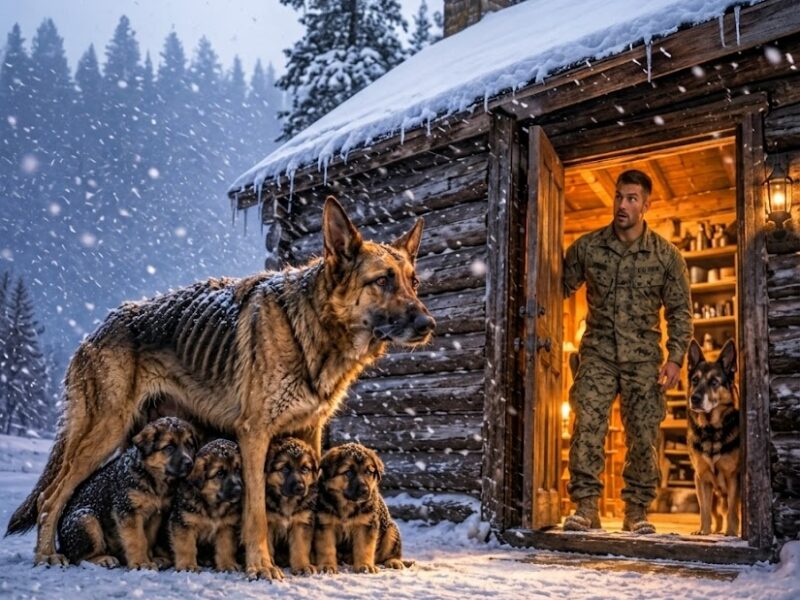
A Mother K9 Led a Former Navy SEAL to Four Freezing Puppies—Then He Heard Someone Trapped Beneath Them
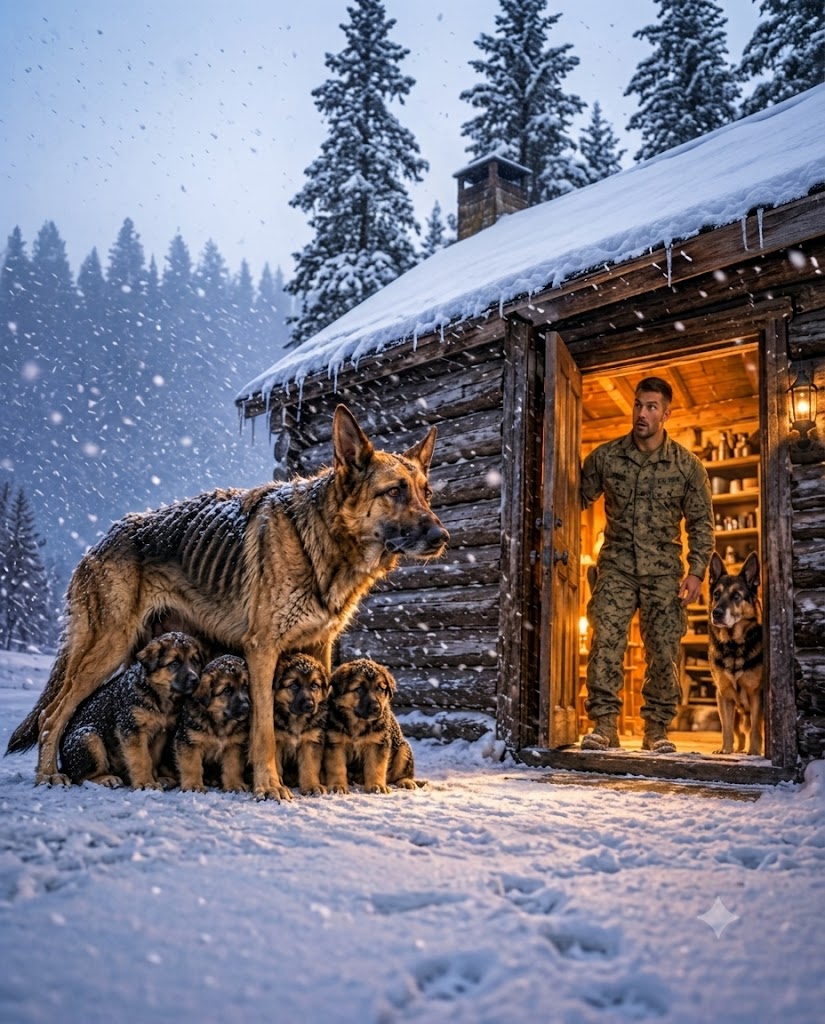
On a snow-filled night in Pine Hollow, Colorado, retired Navy SEAL Ethan Cole was eating alone when a frail German Shepherd mother appeared outside his window.
She refused his food, carried a strip of old cloth, and led Ethan and his retired K9 into the frozen forest.
What they found at an abandoned mountain resort would reveal four frightened puppies, a trapped old man, and a lesson about love without possession that would change Ethan’s silent life forever.
Before we begin, let us know in the comments where you are watching from.
And if this story touches your heart, please subscribe.
—
By early evening, Pine Hollow had nearly disappeared beneath a blanket of falling snow.
The mountain town grew quiet as the roads turned white.
Porch lights blurred behind drifting flakes, and the dark forest pressed close to every wooden home.
Ethan Cole, a broad-shouldered former Navy SEAL with close-cropped brown hair, a guarded expression, and a quiet habit of studying every doorway before entering it, sat alone at his kitchen table with his retired K9, Atlas.
Atlas was an aging German Shepherd with a graying muzzle, a steady gaze, and a stiff left shoulder that reminded him of the years they had spent working together.
The small house smelled of cedar smoke and warm food, and for a while the only sounds were the soft ticking of a wall clock and the low hum of the heater.
Then Atlas lifted his head.
He did not bark.
He simply rose from the rug and faced the window.
Ethan lowered his fork and listened.
Snow brushed against the glass in a constant whisper, but beneath it came something else, a faint scrape near the porch steps.
Ethan stood, crossed the room, and looked through the window.
At first he saw only the pale blur of the storm.
Then a shape appeared at the edge of the porch light.
A female German Shepherd stood alone in the snow.
She was painfully thin with her ribs visible beneath a dull yellow-brown coat.
One front paw held carefully off the ground and flakes gathered along her back and ears.
Yet her eyes were clear and alert.
She was not looking at the food stored beside the door or at the warm light spilling through the windows.
She was looking directly at Ethan.
He had spent enough years around working dogs to recognize the difference between panic and purpose.
This animal was frightened, but she was not lost.
She was waiting for something.
Ethan opened the mudroom cabinet and took out a shallow bowl, a container of warm water, and an old fleece blanket.
Atlas followed him to the inner door, but Ethan raised one hand.
“Stay here.”
Atlas stopped without protest.
Ethan opened the side entrance instead of the front door, choosing a path that would give the dog more room and less pressure.
He set the bowl beneath the porch overhang, placed the water beside it, and spread the blanket several feet away.
Then he stepped back and kept his hands at his sides.
The dog did not move.
Her attention shifted from Ethan to the food, then toward the trees beyond the driveway.
The wind moved through the branches, carrying loose snow across the ground.
Ethan waited.
He knew patience was not the same as doing nothing.
Patience meant allowing another living creature to decide whether the next step was safe.
After nearly a minute, the dog approached the bowl.
She smelled the food, lifted her head, and studied the porch again before taking a few quick bites.
She swallowed too fast, paused, and looked over her shoulder toward the forest.
Ethan noticed the deep hollowness behind her ribs, the careful way she placed her injured paw, and the faint tracks that disappeared beyond the edge of the light.
There were smaller marks mixed among them, almost erased by the falling snow.
He could not tell whether they belonged to animals or were simply broken patches in the surface, but something about the sight made his chest tighten.
The dog drank only a little water.
When Ethan opened the mudroom door to let warmth reach the porch, she turned toward it, but did not cross the threshold.
She stood there as if the open doorway represented both safety and a decision she was not ready to make.
Ethan understood that feeling more than he wanted to admit.
Since leaving the Navy, he had built his life around controlled distances.
He kept his phone turned face down, answered only necessary calls, and avoided the town whenever he could.
Years earlier, during a winter operation overseas, he had made one decision too quickly.
The mission had ended with a teammate seriously injured.
And although no one had blamed Ethan directly, he had carried the moment as if it were a permanent order.
Since then, he had trusted observation more than instinct and silence more than comfort.
The German Shepherd lowered her head and took another bite.
Ethan remained still, but his thoughts moved to the first time Atlas had chosen to trust him.
It had not happened because Ethan had reached out.
It had happened because he had sat nearby every evening and allowed the dog to decide when closeness was safe.
Perhaps this animal needed the same kind of space.
He left the blanket where it was, moved the food slightly farther from the doorway, and stepped inside without closing the screen.
The dog watched him retreat.
Atlas remained behind the inner gate, his body calm, but his attention fixed on the visitor.
For a brief moment, the two German Shepherds looked at each other through the mesh.
Atlas did not growl or approach.
The female did not lower her head in submission.
They simply held each other’s gaze.
Two animals measuring a world neither fully trusted.
Then the female turned away from the house.
—
At the county animal control station on the western side of Pine Hollow, Maya Brooks, a practical woman with dark hair tied beneath a wool cap and a reputation for treating frightened animals with patience, sat beneath a desk lamp studying a map of the Eastern Ridge.
Several handwritten reports were spread around her.
A mother German Shepherd had been seen near the grocery store.
Four young puppies had been spotted beside an abandoned service road.
Someone had left food near a frozen creek.
No one knew where the animals belonged or who had first sheltered them.
Maya circled the eastern properties and paused at the name Walter Hayes.
Walter lived alone in an old house beyond the ridge, a place difficult to reach during winter and rarely visited by anyone.
She picked up the phone and tried his number.
It rang several times before going silent.
Maya wrote down the time and tried again.
There was still no answer.
A few minutes later, Ben Carter, a local mechanic who had stopped by to deliver a set of spare batteries, mentioned that Walter’s porch light had been dark for two nights.
“He may just be staying inside,” Ben said.
“Walter does that whenever the snow settles.”
Maya looked back at the map.
“Maybe,” she replied, though her voice suggested she was not convinced.
—
Outside Ethan’s house, the dog had finished what little food she could manage.
She did not touch the blanket.
Instead, she stepped away from the porch and turned toward the dark line of trees.
Ethan watched through the window as she took several slow steps, then stopped and looked back at him.
Her expression carried no demand, only a quiet urgency he could not explain.
She glanced once toward the forest, once toward the house, and then back at Ethan.
He did not open the door.
He did not call her closer.
He only left the porch light burning as she disappeared into the snowfall, carrying with her the feeling that she had not come to his home for food alone.
Ethan had barely turned away from the window when he heard the faint scrape again.
He looked back and saw the German Shepherd standing at the edge of the porch light, exactly where she had been before, as if she had walked only far enough to make sure he understood that she was leaving, and then changed her mind.
The snow had thickened, softening the tracks around the house, but she remained easy to see against the white ground.
Atlas stood behind the inner gate, watching her without a sound.
Ethan opened the side door a few inches, keeping his body turned slightly away so the dog would not feel cornered.
She did not approach.
Instead, she lowered her head, reached toward a strip of old fleece caught beneath the porch railing, and pulled it free.
The cloth had probably once belonged to a blanket or a worn jacket.
She held it gently between her teeth, took two steps toward the trees, and looked back.
Ethan felt the meaning before he could put it into words.
She was not asking for another meal.
She was asking him to understand that something beyond the house needed him.
He placed a fresh portion of food near the porch, but the dog ignored it.
He set down another bowl of warm water, yet she barely glanced at it.
Her attention stayed fixed on the dark line of forest to the east.
Ethan checked the time.
It was past 7, and the mountain road had already disappeared beneath new snow.
He had no intention of following an unfamiliar animal into the night without knowing what waited beyond the trees.
But he also knew that allowing the dog to vanish alone might mean losing the only sign of four puppies whose condition was still unknown.
He went inside, secured the door, and reached for the satellite communicator on the shelf beside his field notebook.
Maya answered after the second signal.
“Ethan, tell me you’re not standing outside with that dog.”
“I’m inside,” he said. “For the moment.”
He described the fleece, the repeated looks toward the eastern ridge, and the way the dog refused food.
Maya listened without interrupting.
When he finished, she exhaled slowly.
“The eastern trail is not safe tonight. There are buried drainage cuts, fallen timber, and sections where the old path crosses above the creek. If she is trying to lead you somewhere, that does not mean you should follow without preparation.”
“I know.”
“Do you?”
Her question was calm, but it carried the firmness of someone who had learned how often good intentions became dangerous when people mistook urgency for permission.
Ethan looked through the glass at the dog.
“I know enough to wait until I have the right equipment.”
Maya paused. “Then wait while I check the county records.”
She placed him on speaker and began searching through the files at the animal control station.
Ethan could hear paper moving, a drawer opening, and the faint hum of an old heater.
“I found the property,” she said several minutes later. “Walter Hayes, former Forest Service maintenance worker. He bought the eastern cabin decades ago and refused to leave, even after the road became seasonal.”
Ethan looked toward the map pinned above his desk.
“Is he still there?”
“As far as we know, but no one has spoken to him this week.”
Maya’s voice changed slightly.
“There are older reports about him caring for stray dogs. He never registered them as his. He built shelters, left food, and called the county only when an animal needed medical help.”
Ethan understood the distinction.
Walter had offered protection without demanding ownership.
It reminded him of the dog outside, standing close to warmth, but refusing to surrender her freedom.
“Do the records mention this mother?” he asked.
“One note from last autumn mentions a female Shepherd near the old service cabins. Another report says four young dogs were seen around the same ridge.”
A knock sounded at the station door.
Maya muted the communicator, then returned a moment later.
“Ben is here with a map.”
Ben Carter had found an old topographic sheet in his garage, one printed before several of the newer access roads were closed.
He told Maya that Walter had once shown him a narrow route across the ridge, though Walter had warned him never to use it during heavy snow.
“He said the mountain changes faster than people do,” Ben added. “I thought he was being dramatic.”
Maya spread the map across her desk and marked the old cabins with a pencil.
“There are three possible buildings in this area. One is collapsed, one is used for seasonal storage, and one belongs to Walter. Which one is closest to Ethan’s property?”
Ben asked.
Maya measured the distance with her finger.
“The trail crosses the valley and climbs toward the eastern slope. In summer, it is less than 2 miles. Tonight, it will feel much farther.”
Ethan heard the exchange through the communicator and began preparing.
He filled a small pack with thermal blankets, a headlamp, spare batteries, first aid supplies, a compact shovel, a coil of rope, water, and high-energy dog food.
He added a second bowl, a folded towel, and a heated pad from the storage cabinet.
He checked each item twice, not because he had forgotten how to prepare, but because he wanted every decision to be deliberate.
Atlas watched from beside the gate.
When Ethan lifted the working harness, the old K9 rose carefully, favoring his shoulder only for a moment before settling into the familiar posture of a dog who still believed every journey had a purpose.
“You stay close,” Ethan said.
Atlas looked toward the door.
“I know that was not a request.”
On the other end of the line, Maya heard him and said, “If Atlas shows signs of fatigue, you turn back. I mean it.”
“Understood. And you send me your route before leaving the property.”
Ethan stepped into the mudroom, attached the harness, and checked the communicator again.
The dog outside remained near the tree line, the strip of fleece still hanging from her mouth.
She had not entered the shelter.
She had not eaten.
She had simply waited.
For a few seconds, Ethan thought about the memory he had carried since the military.
The memory of moving too quickly because someone had needed an answer before he had enough information.
He had spent years believing hesitation was weakness, then learned that recklessness could wear the disguise of courage.
Tonight, he would not chase the dog.
He would give her the choice to lead.
Ethan opened the outer door.
Cold air entered the mudroom, carrying the clean scent of snow and pine.
Atlas stepped onto the porch and stopped beside him.
The female German Shepherd watched them from a short distance.
She did not retreat this time.
Her ears lifted and her gaze moved from Ethan to Atlas, then back again.
Ethan lowered the pack onto his shoulder and kept the leash loose.
“We will follow only if you want us to,” he said, knowing she could not understand the words, but hoping she could understand the tone.
The dog held his gaze.
Behind her, the forest stood dark and silent beneath the falling snow.
Somewhere beyond it were four puppies and perhaps an old man whose house had gone dark.
The dog turned slightly, then looked back one final time.
Ethan realized he needed a name for the animal if he was going to speak about her over the radio.
He thought of the way she paused before every movement, listening as if the mountain itself were giving her instructions.
“Nora,” he said quietly. “I’ll call you Nora.”
She did not come closer and she did not accept the open shelter.
She simply turned toward the eastern trail and began walking into the trees.
—
Nora disappeared into the trees, and for several seconds, Ethan remained on the porch with one hand resting lightly on Atlas’s harness.
Then he stepped beyond the circle of light, closed the door behind him, and followed the narrow line of paw prints that the falling snow had not yet erased.
The forest seemed larger at night.
Moonlight settled across the branches and turned every open patch of ground pale, while the darker spaces between the trees concealed fallen limbs, uneven drifts, and shallow dips beneath the snow.
Nora moved ahead without hesitation.
But she never went so far that Ethan lost sight of her.
Every few dozen steps, she paused and looked back, waiting until Atlas had caught up before continuing.
Ethan kept the working line loose and used his trekking pole to test the ground before each step.
He did not call Nora or urge her forward.
The decision had to remain hers.
Atlas followed with the patient concentration of a dog who had spent years reading terrain and people, though the old stiffness in his left shoulder became more noticeable as the path climbed.
Ethan shortened the line, slowed his pace, and adjusted the weight of his pack so Atlas would not have to pull against it.
“Easy,” he murmured. “We have time.”
He was not certain that they did, but the words helped him keep his breathing steady.
Nora reached a bend in the trail and stopped beside a patch of exposed snow.
Ethan approached carefully and saw several small impressions scattered near the base of a pine.
They were not clear enough to identify one by one, but the marks were too small and too close together to belong to Nora.
She lowered her nose toward them, then lifted her head and looked toward the eastern ridge.
Ethan understood that the four puppies had passed through this place earlier.
He crouched beside the tracks without touching them, studying the direction in which they continued.
The trail crossed behind a fallen tree and disappeared beneath a layer of fresh snow.
Nora waited only a moment before moving on.
Through the satellite communicator, Maya asked for an update.
“We are past the lower fence line,” Ethan replied. “Nora is following the old maintenance trail. Atlas is moving steadily, but I am slowing the pace.”
“Good,” Maya said. “Your signal is holding for now. The temperature has dropped another few degrees, and the wind is shifting east.”
Ethan looked through the trees.
Fine snow was beginning to sweep across the trail in thin ribbons.
“How far is the nearest safe access point?”
“If you stay on the marked route, there is a service clearing near the lower valley. Do not cut across the upper slope.”
Her voice became firmer.
“The snow pack there is uneven, and the old creek crossing may be covered.”
“Understood.”
“Ethan,” she added. “I need you to check in every 10 minutes.”
“You will.”
The call ended, but Maya kept the channel open.
At the county rescue station, Captain Daniel Reed was preparing a tracked rescue sled, extra blankets, and portable lighting in case Ethan’s route turned into an emergency search.
He did not send a team after him yet because Nora had not led Ethan to a confirmed location, but he kept two responders ready beside the equipment bay.
Meanwhile, Ben drove through the eastern edge of Pine Hollow, stopping at the few houses that still showed lights.
He asked whether anyone had seen Walter Hayes, whether smoke had risen from the old chimney, or whether a vehicle had passed through the snow before the road disappeared.
Most people gave uncertain answers.
One resident remembered seeing Walter carrying bags of feed toward the ridge several weeks earlier.
Another said the old man had mentioned a female Shepherd, but had never asked for help.
Ben wrote each detail in a small notebook and sent the information to Maya, who added it to the growing map on her desk.
None of it confirmed where Walter was now, but together the fragments suggested that his connection to Nora and the puppies had lasted longer than anyone in town had realized.
In the forest, the trail narrowed beside a slope covered with young birch trees.
Nora climbed first, placing her paws carefully along a higher strip of ground.
Ethan held Atlas’s line close and tested every section before allowing him forward.
The older dog stopped once, lifted his head, and listened.
Ethan waited.
Somewhere beyond the trees, snow slipped from a branch and landed with a soft, heavy sound.
Nothing else moved.
Atlas looked back at him, then continued.
After another half hour, Ethan noticed the rhythm of his own breathing had changed.
The cold had entered through the collar of his jacket, and the weight of the pack pressed against his shoulders.
He signaled Maya for a short rest and guided Atlas toward the shelter of a fallen pine.
Nora stopped farther ahead, glancing back, but not returning.
Ethan knelt beside Atlas, loosened the harness, and used part of the backpack’s strap to create a temporary support around the dog’s chest.
Atlas accepted the adjustment without protest, and lowered himself onto the snow.
Ethan checked his paws, offered him a little water, and rubbed the muscles near the old shoulder without forcing the joint.
“You do not have to prove anything tonight,” he said.
Atlas opened one eye and rested his chin on Ethan’s knee.
Maya heard the pause through the communicator.
“Is Atlas all right?”
“He is tired but stable. We are resting for a few minutes.”
“Then stay there as long as you need.”
Ethan looked toward Nora, who stood beneath the trees with a strip of fleece still in her mouth.
“She is waiting.”
“She can wait longer than you think. You cannot assume she knows the safest route just because she knows where she wants to go.”
Ethan watched the dog’s silhouette against the snow.
“I know.”
The words were quiet, but the memory behind them was not.
Sitting beside Atlas in the cold brought back the old feeling of being responsible for every decision, every delay, and every life connected to his actions.
During his final deployment, Ethan had once moved before receiving a complete update because he believed speed would protect his team.
The choice had not ended the way he intended.
He had carried the lesson into civilian life until caution became another form of isolation.
Maya seemed to understand the silence on the line.
“You are thinking about the old mission,” she said.
Ethan did not ask how she knew.
“I should have waited then,” he replied. “Tonight, I am afraid of waiting too long.”
Maya’s answer came after a short pause.
“Then remember this. You are not alone, and this is not a contest against the mountain. The goal is not to arrive first. The goal is to bring everyone home safely.”
Ethan looked down at Atlas, then at the trail ahead.
The sentence settled into him more deeply than any reassurance would have.
He had spent years believing that a leader had to carry every burden without sharing it.
Now Maya was asking him to trust the people who were listening, preparing, and standing ready beyond the trees.
He clipped the communicator closer to his jacket and rose.
Atlas stood more slowly, but his posture remained composed.
Ethan checked the support strap once more before allowing him to move.
Nora turned as soon as they were ready.
She did not look impatient.
She simply began walking again.
The trail descended toward a narrow valley where the wind had gathered fresh snow across the ground.
Ethan guided Atlas along the higher edge, avoiding the darker sections where the surface looked too smooth.
At one point, Nora stopped beside another cluster of small tracks.
She lowered her head, followed the scent for a few feet, and then continued east.
The marks were older than the ones near the pine, but they confirmed that the puppies had traveled this way.
Ethan sent Maya their location, and Daniel Reed replied that the rescue sled was now staged at the southern access road.
Ben reported one final piece of information from the nearby houses.
Someone had seen a weak light in the direction of Walter’s property two nights earlier, but no one had gone close enough to investigate.
The information did not solve anything.
Yet it gave the journey a clearer purpose.
Nora climbed the opposite side of the valley, moving toward the shadowed ridge beyond it.
Ethan followed with Atlas at his side, the line still loose between them.
Snow continued to fall, and the forest remained quiet.
But the path ahead no longer felt empty.
Somewhere beyond the ridge, four small lives were waiting, and Ethan had begun to understand that the safest way forward was not to force the mountain to yield, but to move through it, one careful decision at a time.
—
Nora climbed the eastern ridge without slowing, and Ethan followed with Atlas close beside him.
The snow had covered most of the trail, but the abandoned resort appeared between the pine trees just as the moon slipped behind a veil of thin cloud.
Several small cabins stood in silence beneath heavy white roofs, their windows dark and their wooden signs faded by years of cold.
No road led directly to the property anymore.
Only a narrow service path connected it to the valley, and even that path had nearly disappeared beneath the storm.
Nora crossed the empty courtyard and ran toward the rear of the buildings.
Ethan raised his headlamp and saw a small storage shed, partly hidden behind a line of trees.
Its door was not fully closed.
The gap at the bottom was wide enough for a dog to pass through, and the snow around it was marked with several sets of small tracks.
Nora reached the shed first, then turned around as if waiting for Ethan to understand.
He approached slowly, keeping Atlas behind him.
The cold air inside the shed smelled of straw, old wood, and stale feed.
At first, Ethan saw only a pile of blankets in the corner.
Then one small head lifted, followed by another.
Four German Shepherd puppies were curled together inside a makeshift nest.
They were young, quiet, and visibly underfed, but all four were breathing and responsive.
One puppy stayed close to the others, while another shifted carefully when it tried to stand.
Nothing about the scene suggested that they had been abandoned recently.
Someone had arranged the straw, placed old blankets around the walls, and left a metal water container beside the nest.
The container had stopped working, but the water inside had not completely frozen.
An empty food pan lay nearby.
Ethan lowered himself several feet from the entrance and spoke softly.
The puppies watched him with wide, uncertain eyes.
He did not reach for them.
Instead, he removed a small packet of food from his pack, divided it into a shallow dish, and placed warm water beside it.
The puppies did not move at first.
Atlas lay down outside the shed, his body forming a quiet barrier against the wind.
Nora stood between Ethan and the puppies, watching every movement.
Ethan kept his hands visible and waited.
After a few moments, the smallest puppy crawled forward and smelled the food.
Another followed, then the remaining two moved closer, as if reassured by the first.
They began eating slowly.
Nora did not join them.
She remained near the entrance, her eyes shifting from the puppies to the main house across the courtyard.
Ethan noticed the way she kept turning her head.
The puppies were safe for the moment, but something else still held her attention.
She checked the shed once more, then crossed the snow toward the largest building.
Ethan rose and followed, leaving Atlas beside the puppies.
Nora did not run.
She moved around the side of the building and stopped near a collapsed section of porch.
Part of the roof had fallen across the steps, and the snow had filled the spaces between the broken boards.
The structure looked unstable, so Ethan stopped several feet away.
“Nora,” he said quietly.
She looked back at him, then began scraping at a narrow area beneath the debris.
Her movements were urgent, but controlled.
She did not try to climb onto the damaged porch.
She only cleared loose snow from one small gap and then lowered her head toward the darkness beneath it.
Ethan scanned the area without stepping closer.
He had spent enough time around damaged structures to know that a rescue could become dangerous if someone moved the wrong piece of timber.
He lifted the communicator from his jacket and sent his location to Maya.
“We found the property,” he said. “There is a shed with four puppies. Nora is at a collapsed porch.”
Maya answered immediately.
“Are the puppies alive?”
“Yes, weak but alert. I have food and water with them. Nora is indicating something under the porch.”
“Do not move the structure,” Maya said. “I am checking the property records now.”
Ethan crouched at the edge of the snow without placing his weight on the porch.
Nora made a short sound deep in her throat, then pressed her nose toward the opening.
Ethan switched off his headlamp so the bright beam would not reflect off the snow.
The courtyard became quieter.
The wind moved through the pines.
The damaged roof creaked faintly, and somewhere behind him, one of the puppies shifted inside the shed.
Ethan held his breath and listened.
At first, there was nothing.
Then he heard a faint, uneven exhale from beneath the boards.
He turned his head toward the sound and waited.
A second breath followed.
Someone was alive under there.
Ethan did not touch the debris.
He stayed low, keeping his voice calm.
“Can you hear me?”
The answer was not a word, only a weak movement beneath the timber.
Nora remained beside the gap, her body still and her attention fixed on the darkness.
Ethan moved his communicator closer to his mouth.
“Maya, there is a person beneath the porch. I can hear breathing.”
For several seconds, Maya said nothing.
When she spoke again, her voice had changed.
“What property did you say?”
“The old Hayes residence behind the abandoned resort. Walter Hayes. That is the name on the county map.”
The silence on the radio grew longer.
Ethan looked back toward the shed where Atlas was lying beside the entrance and the puppies were gathered around the food.
“Maya?”
“I know Walter,” she said at last. “Not recently. When I was a child, my family’s truck slid off the mountain road during a winter closure. Walter found us before the county team reached the area. He brought my mother and me to his cabin and stayed awake until help arrived.”
Her voice became quieter.
“He never talked about it afterward. He acted as if he had only done what anyone would do.”
Ethan looked at the old house.
“Did he live here alone for years?”
“He worked for the Forest Service before retiring. He knew every trail on that ridge. He also had a habit of leaving food for animals that no one else noticed.”
Ethan glanced toward the clean bowl inside the shed and the carefully folded blankets.
“He was caring for Nora and the puppies.”
“Yes,” Maya replied. “And if he is beneath that porch, he may have been trying to protect them before something happened.”
Ethan kept his eyes on the unstable beams.
“I can hear him breathing, but I cannot see enough to know how much space there is.”
“Stay where you are. I am contacting Daniel.”
Ethan heard movement on Maya’s side of the line, followed by the faint sound of papers being shifted.
She was no longer speaking only as an animal control officer.
She was speaking as someone who had just realized that a person from her childhood might be waiting beneath the snow.
Ben’s voice appeared briefly in the background.
He had reached the station and was helping Maya compare the old property map with the newer county records.
“The rear porch was added years ago,” he said. “There should be a service entrance on the north side.”
Maya repeated the information to Ethan.
“Look for another access point, but do not walk across the damaged section.”
Ethan turned carefully and studied the building’s outline.
He could see a narrow path around the side, nearly hidden by snow, but he did not move yet.
Nora pressed closer to the opening and rested her chin near the edge of the debris.
She was not trying to enter.
She was simply staying near the person beneath it.
Ethan understood then that she had not crossed the mountain merely to find the puppies.
She had left them in the safest place she knew and returned for the man who had once given her shelter.
Behind him, Atlas lifted his head as one of the puppies made a small sound.
Ethan looked from the shed to the collapsed porch, feeling the weight of both responsibilities at once.
Maya remained on the radio.
Daniel was preparing the rescue equipment, and Ben was searching for the safest route.
No one had arrived yet, but Ethan was no longer alone in the decision.
He placed one gloved hand on the snow beside Nora, careful not to touch her.
Beneath the boards, another faint breath answered from the darkness.
Maya heard it through the communicator, and when she spoke, her voice was steady again.
“We are coming, Walter. Hold on.”
Ethan kept watch beside Nora while the four puppies waited in the shelter behind him.
And for the first time since leaving his house, he understood exactly what the dog had been trying to say.
—
Maya’s words were still echoing through the communicator when the first glow of rescue lights appeared beyond the trees.
Daniel Reed arrived with two responders in a tracked sled, moving carefully across the courtyard while the wind pushed loose snow against their coats.
He studied the collapsed porch from a distance, asked Ethan where he had heard the breathing, and then divided the work into quiet, precise steps.
One responder marked a safe boundary around the unstable section.
Another placed temporary supports beneath the roofline without disturbing the buried boards.
Daniel instructed Ethan to remain near the opening and continue speaking to Walter while Maya stayed on the radio and recorded every update for the medical team waiting at the southern access road.
Ethan wanted to do more.
His body remembered how to move toward danger, how to lift, brace, and take control before anyone else could react.
But the structure did not respond to courage.
It required patience, measurements, and people who knew exactly where to place their hands.
He kept his position beside Nora and spoke through the narrow gap.
“Walter, this is Ethan Cole. The rescue team is here. We are going to bring you out carefully.”
For a moment, there was no answer.
Nora remained close to the opening, her head lowered toward the darkness.
Snow gathered along her back, but she refused to move away.
Ethan glanced toward the shed.
Atlas was still lying beside the four puppies, blocking the wind while they rested in their nest.
The sight steadied him.
Everyone had taken a position, even the dogs.
Everyone was waiting for the next safe step.
Daniel called for a quiet lift and the responders worked together.
The roof section rose only slightly, just enough for the supports to slide into place.
No one rushed.
Each adjustment was followed by a pause while they listened for movement in the damaged structure.
Ethan could hear the wind, the soft shifting of snow, and the low, controlled instructions passing between the rescuers.
Then Walter moved beneath the boards.
“Nora,” his voice was faint, but the name was clear.
Ethan leaned closer without touching the debris.
“She’s here. The puppies are safe, too.”
Walter breathed out slowly.
“All four?”
“All four.”
The old man seemed to relax.
Nora lifted her head at the sound of his voice and placed one paw near the edge of the opening.
Ethan kept his hand near the snow, but did not reach for her.
He knew she needed to see that Walter was not being taken without her understanding what was happening.
Daniel glanced at Ethan and nodded toward the dog.
“Let her stay where she can see him.”
The team continued clearing loose boards one at a time.
Walter had been protected by a narrow space beneath the porch, but he had been there too long without warmth or water.
The medics prepared blankets and a stretcher while Daniel coordinated the safest path away from the building.
When the opening became wide enough, one responder spoke to Walter in a calm voice and explained every movement before it happened.
Walter answered when he could.
He did not complain.
His first questions were about the dogs.
Ethan told him that Nora had brought him there, that the puppies were waiting in the shed, and that Atlas was keeping watch.
Walter closed his eyes for a moment.
“She came back,” he whispered. “She always does.”
Ethan did not ask what he meant.
The sentence sounded less like surprise than gratitude.
At last, the medics were able to reach Walter and assess him without forcing him to move quickly.
They found that he was cold, dehydrated, and weak, with a minor fracture in his wrist and several injuries that required medical attention.
But there was no immediate sign that his life was in danger.
They explained each step before lifting him onto the stretcher.
Walter listened, then turned his head toward Nora.
“You brought someone,” he said.
Ethan understood that Walter was speaking to the dog, not to him.
Nora remained still until the stretcher was clear of the debris.
Then she moved alongside it, close enough to smell Walter’s glove, but not close enough to interfere.
The rescue team carried him toward the tracked sled.
One of the responders instinctively tried to guide Nora away, but Daniel raised a hand.
“Give her room.”
Walter’s fingers shifted beneath the blanket.
Nora lowered her head and touched her nose to the edge of his hand.
She did not jump onto the stretcher or make a sound.
She simply stayed there for a few seconds, as if confirming that the person she had come to save was still with her.
Then the medics carried Walter toward the vehicle.
Ethan watched until the sled disappeared beyond the trees, its lights fading into the snow.
Only then did he turn toward the shed.
Atlas had lifted himself onto his elbows, and the four puppies were awake again.
One had pressed close to the older dog’s side while another watched the rescue team from the doorway.
Ethan crouched beside them and placed fresh food near the entrance.
Nora returned to the shed after a final glance in the direction Walter had gone.
She did not eat immediately.
She stood among the puppies, counted them with her nose, and remained there until every one of them was settled.
—
At the temporary animal care station, the situation became more complicated than a simple rescue.
Walter needed medical care.
The puppies needed examination, and Nora still did not tolerate closed doors or unfamiliar hands.
Maya arrived with the county paperwork and learned that an official wanted to separate the animals immediately so they could be processed more quickly.
Maya objected.
She did not raise her voice, but she refused to let urgency erase the history between them.
“They have survived by staying together,” she explained. “We can provide separate spaces without forcing immediate separation. The mother needs to see her puppies, and the puppies need her presence while they learn that people are not going to take everything away.”
Ben helped move clean bedding into a quiet corner of the station while Daniel arranged a heated area away from the main kennels.
Dr. Emily Hart, the town veterinarian, arrived with a soft voice, a compact medical bag, and a plan that began with observation rather than restraint.
She watched Nora from several feet away, noted the puppies’ breathing and movement, and asked Maya about their behavior before recommending treatment.
“Fear is information,” Emily said. “It tells us what they have experienced. It is not a character flaw.”
She proposed a gradual schedule.
Warmth, water, small meals, basic medication, and gentle examinations only when the animals were ready.
No one would force contact simply to make the process faster.
Ethan stood outside the care room while Nora settled around the puppies.
The arrangement was not perfect.
She paced when a door closed, and Atlas disliked the unfamiliar smells from the medical supplies.
Still, every animal had a place, and no one was being treated as a problem to be solved.
Later that night, Ethan went to the hospital with Maya.
Walter lay beneath a heated blanket, an IV line supplying fluids, his wrist supported, and his voice stronger than before.
When he saw Ethan, he studied him for a long moment.
“Why did you come back?” Walter asked.
Ethan knew he was not asking about the porch.
He was asking why a stranger had crossed the mountain, waited beside him, and refused to leave the dogs behind.
Ethan looked through the window toward the dark valley.
“Nora led the way,” he said. “I only tried not to ruin what she had already begun.”
Walter looked down at his supported hand, then closed his eyes with quiet relief.
Outside, the snow continued to fall over Pine Hollow.
But for the first time that night, every life Nora had tried to protect was somewhere warm, surrounded by people who were learning that rescue was not the same as taking control.
—
Several days after the rescue, Walter could sit upright without assistance.
But the doctor still wanted him to move carefully and remain somewhere warm while his strength returned.
His wrist was supported, his body tired easily, and the road to his property remained buried beneath packed snow.
The house itself was not ready for anyone.
The porch had been damaged, the heating system needed inspection, and the old path from the road was too uneven for a person recovering from an injury.
Ethan visited the hospital each afternoon, usually bringing updates about Nora, the puppies, and Atlas.
He never entered the room carrying promises.
He brought information, then waited for Walter to decide what to do with it.
On the fourth day, Ethan placed a folder on the table beside Walter’s bed.
“My maintenance cabin is available,” he said. “It has heat, electricity, a private entrance, and enough space for you to recover while the repairs are completed.”
Walter looked at the folder without opening it.
“No.”
Ethan had expected resistance, but the quickness of the answer still caught him off guard.
“You have not seen the cabin.”
“I do not need to see it.”
“You need somewhere safe.”
Walter turned his attention toward the window.
“I have managed my own life for 23 years.”
“You were found beneath a collapsed porch.”
The words left Ethan before he could soften them.
Walter looked back at him, not angry, but tired.
“And now you believe that gives you the right to organize the rest of it.”
Ethan felt the old instinct rise inside him.
He wanted to list the risks, the medical instructions, the distance to town, and the weaknesses in Walter’s house.
He wanted to make the decision simple by presenting only one reasonable option.
But as he looked at Walter, he realized that he was doing exactly what he had promised himself he would not do.
He was turning help into an order.
Ethan closed the folder.
“You are right.”
Walter seemed surprised by the answer.
Ethan continued.
“The cabin is one option. The rehabilitation center in town is another. Maya can help arrange a temporary room if you prefer to stay closer to the clinic. You can also choose someone else to help with the repairs. I will give you the information, but I will not decide for you.”
Walter studied him for a long moment.
“And the dogs?”
“Nora and the puppies are receiving care at the county station. You can be involved in every decision about them.”
“That is not the same as caring for them myself.”
“No,” Ethan said. “It is not.”
The room became quiet.
Walter looked toward the winter sky beyond the glass, where the mountains were partly hidden by snow.
“The cabin,” he said at last, “but only if I can leave when I’m ready.”
“Agreed.”
“And no one moves Nora without telling me.”
“Agreed.”
“And you do not turn my recovery into a military operation.”
Ethan almost smiled.
“I will try.”
Walter raised one eyebrow.
“Try harder.”
That was the first time Ethan heard humor in his voice.
—
At the county animal care station, the dogs were progressing slowly.
Nora still remained cautious around unfamiliar movement, but she had started accepting small pieces of food from Dr. Emily Hart’s open hand.
Emily never reached toward her suddenly.
She sat near the enclosure, placed the food on her palm, and allowed Nora to decide whether to come closer.
Some days, Nora approached within a few feet.
On other days, she stayed near the puppies and watched from a distance.
Emily treated both choices as information rather than failure.
The four puppies were stronger, though they still slept in a tight group whenever a door opened or a new sound entered the room.
Atlas was allowed to visit from the other side of a low, temporary fence.
He rested outside the enclosure while the puppies observed him through the spaces between the rails.
He did not push forward, and Ethan did not ask him to become a replacement parent.
The arrangement gave the puppies a chance to study him without pressure.
One of them, the smallest and most easily startled, refused to approach whenever Ethan faced it.
Yet when Ethan turned his back and pretended to examine a water bowl, the puppy crept forward and sniffed the edge of his boot.
Ethan noticed, but did not turn around.
He remembered what Emily had said about allowing trust to arrive quietly, so he remained still.
His hands relaxed at his sides while the puppy took one more step and then retreated behind its siblings.
Nothing dramatic happened.
No one clapped, and no one called it a breakthrough.
But when Ethan returned the next morning, the same puppy waited near the entrance instead of hiding at the back.
—
Beyond the station, Pine Hollow began to change in small, practical ways.
Ben organized several residents to repair the old storage building beside the animal control office.
They replaced loose boards, cleared snow from the roof, and created two separate warm sections so frightened animals could rest without being crowded.
Ben did not call it a shelter because Maya reminded him that the county had rules about medical intake and animal placement.
They called it an emergency winter holding space, a temporary refuge for animals displaced by road closures or severe weather.
Maya arranged a small fundraiser at Nora Bell’s grocery store.
There were no dramatic speeches and no photographs designed to make people feel guilty.
Residents bought soup, bread, batteries, blankets, and small bags of feed.
Some left cash in a jar near the register.
Others brought materials instead of money.
A retired carpenter donated hinges.
A school teacher brought washable bedding.
And a group of teenagers painted simple signs for the new holding space.
Daniel Reed visited the site and marked several locations along the eastern route where emergency boxes could be installed.
Each box would contain thermal blankets, a first aid kit, a beacon, and written instructions for contacting rescue services.
Daniel explained that the boxes would not make the mountain harmless.
They would simply make help easier to find when roads disappeared.
Ethan helped when he could, but he no longer tried to take responsibility for every task.
He carried boards, checked measurements, and listened when Ben told him to leave the heavier work to someone else.
The change was small enough that most people did not notice it.
Ethan noticed.
—
One evening after returning from the station, he found a missed call on his phone.
The caller was Rachel Cole, his younger sister.
Her voice message was brief.
She had heard about Walter through a friend in town and wanted to know whether Ethan was all right.
She also said she could come to Pine Hollow if he wanted company.
Ethan listened to the message twice without answering.
He and Rachel had not spoken properly in years.
She believed he had chosen the silence around him, while Ethan had believed she no longer wanted to understand the reasons for it.
Neither had been completely right.
He placed the phone on the kitchen table and began sorting medical supplies that did not need sorting.
Walter, now staying in the maintenance cabin, watched him from the doorway.
He had arrived that afternoon with a small bag, his supported wrist, and a clear agreement that the cabin was temporary.
Nora and the puppies remained at the county station until their care plan was settled.
Walter had asked about them three times before sunset.
Now he looked at Ethan and said, “You are holding that phone as if it might answer for you.”
Ethan glanced down.
“My sister called.”
“And you did not call back. It has been a long time.”
Walter moved carefully to the chair near the window.
“Some doors do not open because someone forces them.”
Ethan said nothing.
“Sometimes,” Walter continued, “you only stand outside long enough for the person on the other side to believe you’re not leaving.”
The words settled between them.
Ethan looked at the phone again.
He did not know what Rachel would say, and he could not promise that one conversation would repair years of distance.
But he understood that waiting for certainty could become another way of refusing to begin.
He picked up the phone, found Rachel’s name, and pressed call.
Ethan remained still, listening to the sound that seemed to travel across far more than a few miles of snow.
—
By the end of winter, the eastern property no longer looked like the silent place Ethan had first seen beneath the snow.
The damaged porch had been repaired.
The broken heating system had been replaced, and a new fence surrounded the shelter behind Walter’s house.
The work had taken weeks because every decision had been made carefully with Walter involved in each stage.
He had refused to let the repairs turn his home into a place designed by strangers, and Ethan had learned not to offer solutions before asking what Walter wanted.
The old man returned from the rehabilitation center with a walking cane, a small bag of clothes, and a determination that surprised everyone except Nora.
She had been waiting in the heated shelter with the four puppies.
And when Walter stepped through the gate, she approached him slowly, pressed her nose against his hand, and then walked beside him toward the house.
Walter did not call her closer or attempt to hold her.
He simply left the doorway open and allowed her to choose where she wanted to stand.
After the county inspection confirmed that the fence was secure, the shelter was warm, and Walter had a reliable medical plan, Nora was officially placed in his care.
The adoption papers were simple, but Walter read every line before signing them.
“She is not property,” he said. “She is family.”
Maya nodded and added the final note to the file.
“Then the home has to be safe enough for her to remain by choice.”
Walter accepted that condition without argument.
The four puppies stayed with Nora for several more weeks while Dr. Emily monitored their health and observed their temperaments.
They grew stronger, became curious, and began exploring the shelter in different ways.
One puppy always carried a piece of rope from one corner to another.
Another preferred to sleep near the water bowl.
The smallest still startled at sudden sounds, but no longer hid whenever Ethan entered.
It would wait until he sat down, then approach his boot and remain there for a few quiet seconds.
Ethan never reached for it.
He had learned that trust did not need to be captured in order to be real.
When the time came to place the puppies, Maya adopted the most observant one, the puppy that had first learned to follow her voice during feeding time.
And Daniel Reed took another, not as a working animal or a future rescue tool, but as a companion who would live in his home and grow at an ordinary pace.
He promised that training would come only if the dog enjoyed it and remained healthy enough for it.
The final two puppies were adopted together by a family in Pine Hollow who had visited them several times and understood that separating them would create unnecessary fear.
Walter watched the family carry the puppies toward their vehicle, then returned to the shelter to clean two unused bowls.
Ethan found him there a few minutes later.
“You could have said goodbye,” Ethan remarked.
Walter placed the bowls on a shelf.
“They had already said goodbye. They stopped looking back.”
Ethan understood that Walter had noticed what others might have missed.
The puppies had left with familiar bedding, medical records, and a plan for settling into their new home.
They were not being abandoned.
They were moving forward.
—
Atlas adjusted to Nora in his own measured way.
He allowed her to rest near the porch and shared the yard without tension, but he continued to guard the old gray cushion beside Ethan’s stove.
The puppies were permitted to visit the main house for short periods.
Yet Atlas made it clear that his bed remained his.
When one puppy tried to climb onto the cushion, Atlas stood across the entrance and looked toward Ethan.
Ethan redirected the puppy.
Instead of asking Atlas to surrender the only place that had belonged to him for years, Norah watched from the doorway, then settled on the rug nearby.
There was no need to make every space common in order to create a family.
Some boundaries, Ethan realized, were not walls against love.
They were part of what made trust possible.
Around the same time, the community completed the emergency holding shelter near the county station.
Ben installed the final door latch and painted a simple sign above the entrance.
Maya created a record system for supplies, approved animal transfers, and emergency contacts.
Daniel placed weatherproof rescue boxes along the eastern trail, each one marked with reflective tape so travelers could find them in low visibility.
The boxes contained blankets, a beacon, basic first aid materials, and clear instructions for contacting help.
Ethan helped repair the route between the two properties.
He did not make the mountain harmless because no one could promise that.
Instead, he and the volunteers cleared unstable branches, added reflective posts, and built a narrow footbridge over the most difficult part of the creek crossing.
The path became easier to recognize in winter, and responsibility became something visible rather than something people assumed would appear when trouble began.
—
Rachel came to Pine Hollow a few days after their first phone call.
She brought the old wall clock that had belonged to their father, wrapped carefully in a wool blanket.
Ethan had not seen it since he left home.
They placed it on the kitchen table and spent the afternoon cleaning the wooden case, examining the small gears, and searching for the reason the hands had stopped.
Their conversation did not immediately repair the years between them.
Rachel still had questions, and Ethan still struggled to answer without retreating behind short sentences, but they worked side by side without treating silence as a punishment.
When the clock finally moved again, its first quiet tick filled the room.
Rachel looked at Ethan.
“It sounds different here.”
Ethan glanced toward the window where Atlas rested near the porch and Nora watched the puppies in the yard.
“Maybe the room is different,” he said.
Neither of them tried to explain more.
It was enough that she had come and enough that he had allowed her to stay.
—
On a clear morning near the end of the season, Ethan and Atlas walked along the newly marked trail between the two properties.
The snow had softened under the pale sunlight, though the shaded ground remained firm beneath their boots.
Atlas wore his harness, but no longer needed a tight working line.
Ahead, the reflective posts led toward the open clearing halfway between the houses.
Walter stood near the repaired shelter with Nora and the two puppies who were still visiting before their final placement.
He carried a thermos in one hand and the repaired wall clock beneath the other arm.
When Ethan reached the clearing, Walter lifted the clock slightly.
“You left the pendulum weight in the cabin.”
“I thought you were keeping it.”
“I was returning it. That is not the same thing.”
Walter handed the clock to him and Ethan accepted it with a small smile.
They sat outside the shelter and poured coffee into the metal cups from the thermos.
Below them, Pine Hollow rested in the bright valley, its rooftops shining beneath the remaining snow.
Atlas stood at the end of the trail and looked toward Nora.
Ethan unclipped the line.
The dog did not rush forward.
He crossed the clearing at a steady pace, slowed as he approached Nora, and stopped just outside her space.
Nora lifted her head.
For a moment, neither dog moved.
Then she stepped forward and touched her nose to Atlas’s.
The contact lasted only a second, but it carried no fear or hesitation.
Atlas moved past her to inspect the puppies, who immediately began circling his legs.
One tried to carry away a short branch, while the other followed close behind.
Atlas looked toward Ethan as if asking whether this new arrangement had been approved.
Ethan only smiled.
Nora settled in the sunlight, close enough to watch, but far enough to remain comfortable.
Walter leaned back in his chair.
“They do not need to live under one roof,” he said.
“No,” Ethan replied. “They only need to know the road is open.”
The word stayed with him as he looked across the valley.
Nora had not been saved so that Ethan could keep her.
Walter had not been helped so that he would lose control of his own life.
Atlas had not been forced to surrender his routines, and Ethan had not needed to remain a soldier, waiting for the next command.
Each of them had been given shelter, time, and the freedom to choose.
The repaired clock ticked softly beside the shelter.
The puppies played in the snow.
Rachel’s car could be seen near Ethan’s house, and Maya’s new emergency signs marked the route below.
Nothing had become perfect, but everything had become connected.
Ethan understood then that love was not measured by how tightly someone was held.
Sometimes it was measured by the path built beneath their feet, the light left burning at the doorway, and the promise that they could return whenever they were ready.
—
Sometimes love does not mean holding someone tightly.
It means giving them safety, patience, and the freedom to choose their own way home.
In our daily lives, a kind word, a little understanding, or simply staying beside someone in silence can become the help they need most.
Like Ethan, Nora, Walter, and Atlas, we may all be healing from something unseen.
And we never know how much our compassion can change another life.
If this story touched your heart, please share it with someone who needs hope today.
Leave a comment saying, “I choose patience, kindness, and love without possession.”
Subscribe to the channel for more heartfelt stories of courage, loyalty, and second chances.
May God bless you, your family, and everyone who is quietly searching for a safe way home.









