
A Millionaire Visited His Black Ex-Wife’s Run-Down House to Confront Her—But When He Saw His Own Mother Sitting Inside, He Could Barely Believe His Eyes
**Part 1**
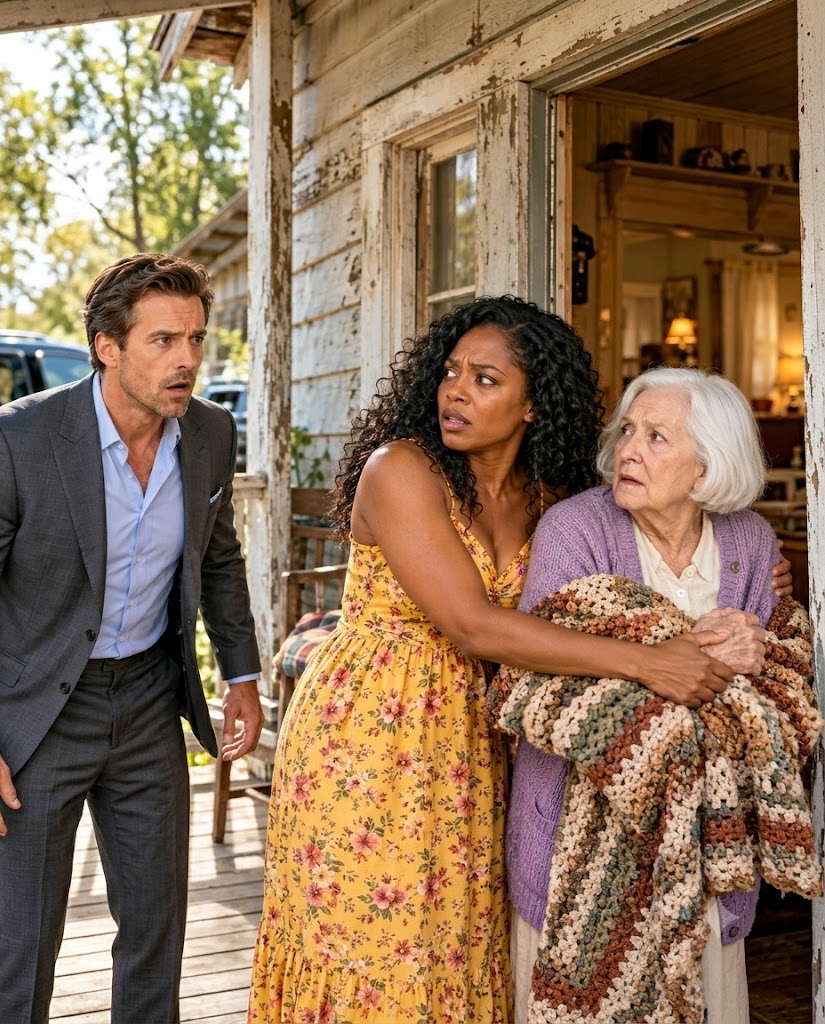
The gravel driveway ended where the pavement gave up, and Daniel Whitford killed the engine of his Range Rover in front of a house that looked like it had been apologizing to the Texas sun for fifty years.
Paint curled off the porch rail like dried leaves, and a window unit rattled in the side wall, dripping water onto a tomato plant in a coffee can.
He checked the address on his phone one more time, then at the check in his jacket pocket — twenty thousand dollars, made out to Corrine Hayes.
Five years since the divorce, and he had never once driven out to Ruby Creek, never once sent more than a birthday card that she probably threw away unopened.
Now he was four hours from Dallas, sweating through a tailored shirt, about to pay his ex-wife to keep quiet about a wedding she had never asked to hear about.
The screen door creaked before he could knock.
Corrine stood there in a yellow cotton dress, hair tied back, looking exactly like the woman who used to leave for the night shift at the diner while he was still pretending to build a company out of a garage.
“You could have called,” she said.
“I didn’t think you’d pick up.”
“You’re right. I wouldn’t have. You drove all this way. So sit.”
She held the door open with one hip, and the smell that came out of that house hit him like a memory he didn’t know he’d been carrying — bacon grease, pine cleaner, and something sweet baking.
“My mama taught me you feed whoever comes up that road,” Corrine said, and pointed at a chair on the porch. “Even the ones who don’t deserve it.”
Daniel sat. The chair wobbled under him, one leg propped on a brick.
“Sloan and I are getting married in June,” he said. “She thought this would be decent.”
He slid the envelope across the little table between them.
Corrine didn’t touch it. She looked at it the way you look at a snake on a hiking trail — with interest, and a healthy amount of distance.
“A check,” she said slowly. “And a promise to stay quiet. You drove four hours to pay me to be quiet about a wedding nobody asked me about?”
“It’s not like that.”
“With your family, it was always like that.”
She finally picked up the envelope, turned it over, and set it back down untouched.
“How’s your mother?”
Daniel looked at the tomato plant. “Sloan found her the best memory care home in Dallas. Fourteen thousand a month. She stopped knowing me last spring. Sloan said visits only upset her, so I stopped going.”
Corrine went very still.
“You stopped going.”
“The doctor said—”
“You stopped going.”
And then, from inside the house, faint and thin as tissue paper, a voice began to hum.
Daniel’s whole body went cold, because he knew that song — a slow, wandering lullaby his mother had hummed over his bed every night until he was ten years old, a tune she’d learned from her own grandmother and never once written down.
“Finish your juice, Daniel,” the voice said, singsong, gentle. “Finish your juice, baby.”
The screen door swung open behind Corrine, and a small woman in a cardigan shuffled out onto the porch, bare feet on the warped boards, one hand tracing the wall for balance.
“Corrine, honey,” she said. “Is somebody here? I heard a man.”
Daniel couldn’t breathe.
“Daniel. Please,” Corrine whispered, hand flat on his chest, holding him in the chair. “Let me go in first. She scares easily.”
“That’s my mother’s voice.”
“Then go slow. And do not cry in front of her.”
He stood anyway, because no force on earth could have kept him seated, and Corrine stepped aside with a look on her face that was equal parts pity and warning.
“Mom,” he said. “What are you doing here?”
The old woman peered up at him, past him, through him, and smiled a polite stranger’s smile.
“Corrine takes care of me,” she said. “She makes the pancakes too thin, but don’t tell her.”
“How long?” Daniel turned to Corrine, and his voice cracked down the middle. “How long has she been here?”
“Eight months.”
“Eight months?”
“Last November I found her at the bus station in Abilene. Midnight. Nightgown. Holding a photograph of you in her hand and asking every stranger if they’d seen her son.”
Daniel’s knees gave out, and he sat back down hard enough that the chair leg slipped off the brick.
“She was supposed to be at Magnolia Crest. I pay them every month. Fourteen thousand dollars, on time, for three years.”
“They put her out, Daniel. The payment stopped. She had one bag and a bus ticket and a bus driver who called the number written inside her coat. My number. From a Christmas card I sent your office six years ago.”
“That’s impossible.”
“I called your office six times. I wrote four letters. Every one of them came back.”
Daniel pulled out his phone with shaking hands and called the number from memory, and when the administrator answered he didn’t bother with hello.
“This is Daniel Whitford. Send me my mother’s file. Now.”
He listened. His jaw worked. Corrine watched the color drain out of his face and didn’t say a word.
“Discharged,” he repeated slowly, for her benefit, for his own. “Fourteen months ago. At the request of S. Beckett.”
The phone lowered to his lap.
“Then where has my money been going?” he asked, and it wasn’t really a question for Corrine, but she answered it anyway.
“That’s a question for the woman you’re about to marry.”
The humming started again, soft and steady, and Daniel’s mother swayed gently on the porch like a willow in a breeze only she could feel.
“Why, Corrine?” His voice came out wrecked. “After everything she said to you? She told you that you would never be a Whitford. She said it at our wedding, in front of your whole family.”
Corrine knelt down and retied the old woman’s cardigan, patient as a nurse, gentle as a daughter.
“Because she’s somebody’s mother,” she said. “And for three years, she was mine, too.”
The hinge of it — the thing that swung the whole day around — was that Corrine had every right to slam that door, and instead she had spent eight months making pancakes too thin for the woman who once refused to sit at the same table as her.
Daniel’s mother shuffled forward then, and reached out, and found Corrine’s face with her fingertips the way a blind person reads a page.
“Corrine? Come here, sweetheart. I said terrible things to you once. In that big house. I was wrong. You were the only one who came for me.”
Corrine’s chin trembled, but she held it.
“Hush now,” the old woman said. “You were scared. That’s all.”
She turned her cloudy eyes toward Daniel and squinted, and for one long, terrible second he thought she might know him.
“Danny,” she said at last. “You let this one go. That was the dumbest thing you ever did.”
“I know, Mom.”
The old woman patted Corrine’s cheek once, then wandered back inside, humming her lullaby to the curtains and the coffee can and the thin Texas light.
Daniel sat with his head in his hands for a long time, and Corrine let him, because she had learned patience the way other people learn to type — out of necessity, and a little bit of spite.
“You sold your car,” he said finally, without looking up. “You work nights.”
“Her medicine isn’t cheap. I work at the clinic. Miss Bev next door sits with her when I’m on shift.”
“Let me pay for everything. The best doctors, a private nurse, all of it.”
“No.”
“Corrine—”
“She doesn’t need the best of anything, Daniel. She needs her son.”
That landed like a boot to the ribs, and he deserved every ounce of it.
He pulled out his phone again, and this time he called his own lawyer, and his voice was the voice of the man who had built a company out of a garage: flat, cold, finished.
“I’m taking her home. To Dallas.”
Corrine stood up so fast the chair scraped. “To the house where the woman who put her out still lives?”
Daniel stopped. His jaw worked again. Then he sat back down, slowly, and the fight went out of his shoulders.
“You’re right,” he said. “She stays here until I make this right.”
“Then go make it right.”
The old woman reappeared in the doorway with a paper bag in her hands.
“Danny,” she said, and for a moment she was almost there, almost his mother, almost the woman who had taught him to tie his shoes. “I knit you one every winter. Colleen keeps them in the closet. Seven of them.”
“Seven?”
“Seven winters. I never stopped.” She handed him the bag. “You always ran cold, baby.”
Daniel opened it. Seven hand-knit scarves in seven shades of blue, and he sat on a run-down porch four hours from Dallas and cried like a boy.
“Come back Sunday,” his mother said. “Corrine makes peach pie on Sundays.”
“I’ll be here, Mom.”
His phone buzzed in his pocket — *Babe. Where were you? You missed the cake tasting* — and he looked at the screen like it belonged to a stranger.
Business in West Texas, he typed back. How’s Mom doing, Sloan?
*Oh, thriving. I visited Tuesday. She asked about you, then forgot again. It’s so sad.*
He read it three times. Then he typed: I’d like to visit her this weekend.
*Absolutely not. The doctor said it confuses her. Let me handle Mom.*
Daniel set the phone face-down on the table and looked at Corrine, who was already clearing the glasses and stacking plates and not asking him for a single thing.
“Sunday,” he said.
“She sets three plates every Sunday,” Corrine said, her back to him. “I was just waiting to see who would show up.”
Daniel put the envelope with the twenty-thousand-dollar check back in his jacket pocket, because it was the wrong size now, the wrong shape, the wrong language entirely.
He drove back to Dallas that night with seven scarves on the passenger seat, and somewhere around Abilene he pulled over and called a private investigator he’d used once for a business deal gone sour.
“I need you to follow the money,” he said. “Fourteen thousand a month. Three years. My mother’s care. I want to know where every dollar went.”
“Might take a few days.”
“Take two.”
The dashboard light glowed green over the scarves, and Daniel thought about the woman humming in a run-down house in Ruby Creek, and about the woman in the sparkling dress waiting for him in Dallas, and for the first time in five years he wasn’t sure which one was the stranger.
—
**Part 2**
Monday morning the PI called before Daniel’s coffee had stopped steaming.
“The fourteen thousand never went to Magnolia Crest,” the man said, and Daniel could hear him flipping pages. “It went to a holding company called MC Senior Services. Registered owner, Trevor Beckert.”
Daniel knew the name. Trevor Beckert was Sloan’s cousin from Fort Worth, the one who had “helped” with the wedding guest list and had a laugh like a car alarm.
“Total payments over twenty-four months,” the PI went on. “Three hundred thirty-six thousand dollars. There’s no care facility attached to that company. Not a single bed. Just an address that forwards mail.”
“And my mother,” Daniel said, and his voice sounded like gravel in his own ears. “Where does the record say she’s been living?”
“According to the state, nowhere. She dropped off the Medicaid rolls fourteen months ago. You want the rest, you’re going to have to ask somebody who knows the mailroom.”
Daniel did not have to ask. He drove to the office at seven in the morning and stood in the doorway of the mailroom until the clerk stopped sorting and looked up.
“Sir?”
“The mailroom log. I want all of it. Every returned letter from the last three years.”
The clerk’s ears went red. He typed and clicked and then the printer spat out a page, and Daniel read it standing up, and the sentence hit him in the chest like a fist through sheetrock.
“Sloan Beckett ordered every letter from Corrine Hayes returned unopened,” he read aloud. “Every one.”
Four letters. Six phone calls. Eight months of an old woman sleeping at a bus station, and a woman in a yellow dress driving to Abilene at midnight to bring her home.
Daniel walked into his own office, shut the door, and sat down behind a desk that had cost more than the house in Ruby Creek, and he did not move for a long time.
Then he picked up his phone.
“Grace? The engagement gala on Saturday. Add two seats at the front table.”
“For who, sir?”
“My family.”
He hung up, and then he made two more calls: one to his attorney, and one to a real estate agent in Dallas with instructions to list the house by the end of the week.
Two days later, a rented car with tinted windows rolled to a stop in front of the house in Ruby Creek, and Sloan Beckett stepped out onto the gravel in heels that were not built for gravel.
“The waitress,” she said, looking at the porch and the coffee can and the rattling window unit. “So this is where he sneaks off to. Cute little shack.”
Corrine came around the side of the house with a basket of laundry on her hip.
“Can I help you, ma’am?”
Sloan smiled like a knife being drawn. “You think you can win him back with pie and a sad story?”
The screen door banged open, and Daniel’s mother stepped out, and her face was the face of a woman who had once told a young bride she was not and never would be a Whitford, and Sloan saw it in an instant.
“Coreen?” the old woman called, and her voice fluttered. “Coreen, who are these people?”
Sloan’s eyes lit. “Mom. It’s me. Sloan.”
“Come on. I’m taking you somewhere nice.” She stepped forward, and her fingers closed around the old woman’s wrist with a grip she did not bother to soften. “I don’t know you.”
“She’s not going anywhere with you.” Corrine set the laundry down and stepped between them, and her voice was flat and quiet and final. “Move. Or my lawyers will bury you.”
Sloan laughed, but it was a nervous laugh, and it did not reach her eyes.
“Do you know who I am marrying? You are nothing. You were nothing when he left you.”
“He didn’t leave me. I left.” Corrine’s chin came up. “Because people like you were already in that house.”
Sloan stood there in her elegant heels and her elegant coat, and the sun went behind a cloud, and she looked like exactly what she was: a woman who had been caught.
“Get off this porch,” Corrine said.
“Enjoy your little old lady.” Sloan turned, one last smile over her shoulder, cold as a coin. “Saturday, I become Mrs. Whitford.”
Daniel’s mother watched the rented car crunch away down the driveway, and her hands twisted in her cardigan, and she hummed a small anxious note.
Then she turned to Corrine. “I don’t like that one,” she said. “She has a mean mouth.”
Corrine laughed, once, hard, and put her arm around her.
Daniel called that night, and Corrine stood in the kitchen with the phone against her ear and did not say hello.
“She was here, Daniel.”
“I know. She called me from the road to complain about the porch.”
“She tried to take your mother.”
There was a long, dangerous silence on the line.
“Saturday,” he said at last. “You want us in Dallas.”
Corrine looked at the old woman humming at the table, and at the door that needed painting, and at the life she had built out of somebody else’s discarded things.
“Mama,” she said, “how would you like to go to a party?”
“Will there be dancing?”
“There’ll be music.”
—
**Part 3**
The ballroom of the Whitford Hotel glittered like a jewelry box turned over on a velvet table.
Four hundred guests, ice sculptures of swans, an orchestra playing something careful and expensive, and a front table draped in white where the next Mrs. Whitford stood greeting donors like a woman born to it.
“Thank you all for coming,” Sloan said into the microphone, diamond flashing on her hand. “Family means everything to Daniel and me. It’s what we build on. It’s what we protect.”
She paused, and she smiled, and she put her hand over her heart.
“I visit Daniel’s mother every single week. She’s my second mother.”
The room applauded. Somewhere in the back, a reporter from the business page wrote it down.
And then the doors at the rear of the ballroom opened, and a man in a black suit came through them with an old woman on one arm and a woman in a simple yellow dress on the other.
The orchestra stopped mid-phrase.
“Since family means everything, Sloan,” Daniel said, and his voice carried to every corner of the room without a microphone, “I brought mine.”
Sloan’s face did something complicated — surprise, then calculation, then a mask that would not hold.
“Daniel, what are you doing?”
“Danny.” The old woman clutched his sleeve and stared out at four hundred strangers. “Who’s this woman in the shiny dress?”
Daniel’s voice was calm and terrible and kind.
“This is the woman who visits you every week, Mom.”
“I’ve never seen her in my life.”
The silence in that ballroom had a sound, and the sound was four hundred people breathing differently.
Daniel’s attorney rose from a chair near the stage with a folder in his hand.
“Magnolia Crest discharged Mrs. Whitford fourteen months ago,” he said, clipped and professional. “At Ms. Beckett’s request. Every payment since then went to MC Senior Services, owned by Trevor Beckert.”
Trevor, standing near the bar with a glass in his hand, went the color of the swans.
“Sloan said it was just paperwork,” he said, and his voice cracked right down the middle. “She said it was just paperwork.”
Daniel turned to Sloan, and he didn’t raise his voice, because he didn’t need to.
“Daniel, she’s lying. That woman is after your money.” Sloan pointed at Corrine, and her hand was shaking. “You told me my mother didn’t know me anymore. You were right about one thing, Sloan.” He stepped closer. “She doesn’t know you.”
“I never asked for a dollar.” Corrine set a white envelope on the front table, unsealed, and the check inside was visible to anyone who cared to look. “I mailed your check back this morning.”
Sloan’s composure went out from under her like a rug.
“Daniel, please. Think about what you’re doing. Think about us.”
“Keep the dress.” He took the ring from his pocket — she had left it at the house when she’d fled that morning — and set it beside the check. “Leave the ring.”
Two men in dark suits appeared at Sloan’s elbow, and her cousin’s, and the attorney nodded toward the doors.
“Ms. Beckett. Mr. Beckett. Our attorneys are waiting for you downstairs.”
“Sloan, you said nobody would ever check,” Trevor hissed, and the microphone caught it, and it went into every phone and every camera in that glittering room.
The doors closed behind them.
Daniel turned to the crowd, and the crowd was very still, and he found he could not think of a single polished thing to say.
“The woman who should be honored tonight,” he said, “is Corrine Hayes. She took my mother in when I didn’t even know she was lost.”
The applause started slow and scattered and then it built, and it built, and it built, until the chandeliers seemed to ring with it.
Corrine ducked her head. “Daniel, I didn’t do it for applause.”
“I know,” he said. “That’s why it matters.”
His mother stood between them, humming, swaying, her eyes moving over the lights and the flowers and the four hundred faces with a wonder that had nothing to do with any of them.
When I was lost, Daniel thought, I didn’t remember my house. I didn’t remember my money.
He looked at Corrine.
I remembered her voice.
“Danny.” His mother pulled at his sleeve, and for a moment her eyes were clear, and the clarity was sharp as glass. “Ask her to dance. Don’t be dumb twice.”
The orchestra, to its eternal credit, found the tune.
Daniel held out his hand, and Corrine looked at it for a long moment, and then she took it, and the four hundred guests of the Whitford Hotel watched a millionaire dance with a waitress in a yellow dress while his mother hummed along.
Six months later, the Dallas house sold for two million and the proceeds went into a fund, and Daniel moved to Ruby Creek with a bag of tools and no idea what he was doing.
“You’re bad at carpentry,” Corrine said, watching him sand a porch rail that had been sanded three times already.
“Mom says I’m getting better.”
“She says that about everyone.”
“She sets three plates every Sunday. I was just waiting to see who’d show up.”
He finished the porch in October and painted the whole house yellow, and the neighbors said it was the brightest thing on that road in fifty years.
Miss Bev still sat with his mother on the nights Corrine worked, though Corrine had cut down to two shifts a week, and Daniel had learned to make pancakes that were exactly as thin as they were supposed to be.
“The farm is yours,” he told Corrine one evening, on the porch, with the sun going down. “Paid off. And a fund for every family in this county caring for someone alone. It’s called Corrine’s Porch.”
She looked at him for a long time, and the yellow paint glowed in the last light, and she didn’t say thank you, because thank you wasn’t the right size for it.
“My memory comes and goes, sweetheart,” his mother said from the doorway, holding a scarf she’d just finished, the eighth one, in a shade of yellow she’d chosen herself. “So I’ll say it while I have it. You’re my daughter. Not by law. By love.”
Corrine wiped her eyes with the back of her hand. “Does it make you feel better?”
“No,” Daniel said, and put his arm around her. “Mom does.”
His mother sat down in the rocking chair between them and started to hum, the old lullaby, the one she’d never written down, the one Corrine had learned without being taught.
“She’s humming again,” Corrine said.
“She hums when she’s happy.”
The three of them sat on the yellow porch while the Texas sky went orange and then purple and then dark, and the crickets came out, and the lullaby went on.
At the end of the evening, in a voice soft as a folded letter, Daniel’s mother said the thing that closed the circle.
“Both of my children are home.”
The scarves were in the hall closet, eight of them now, and the ninth was already on the needles, and on the porch the plates were set for three.









