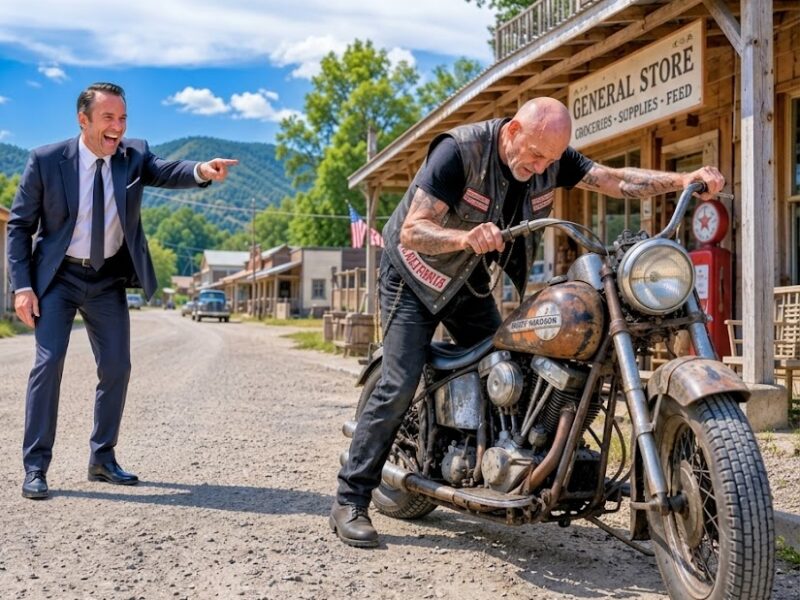
A millionaire laughed at an old man’s rusty Harley and called it “junk.” Ten minutes later, 50 Hells Angels pulled up — and the millionaire’s smile disappeared.
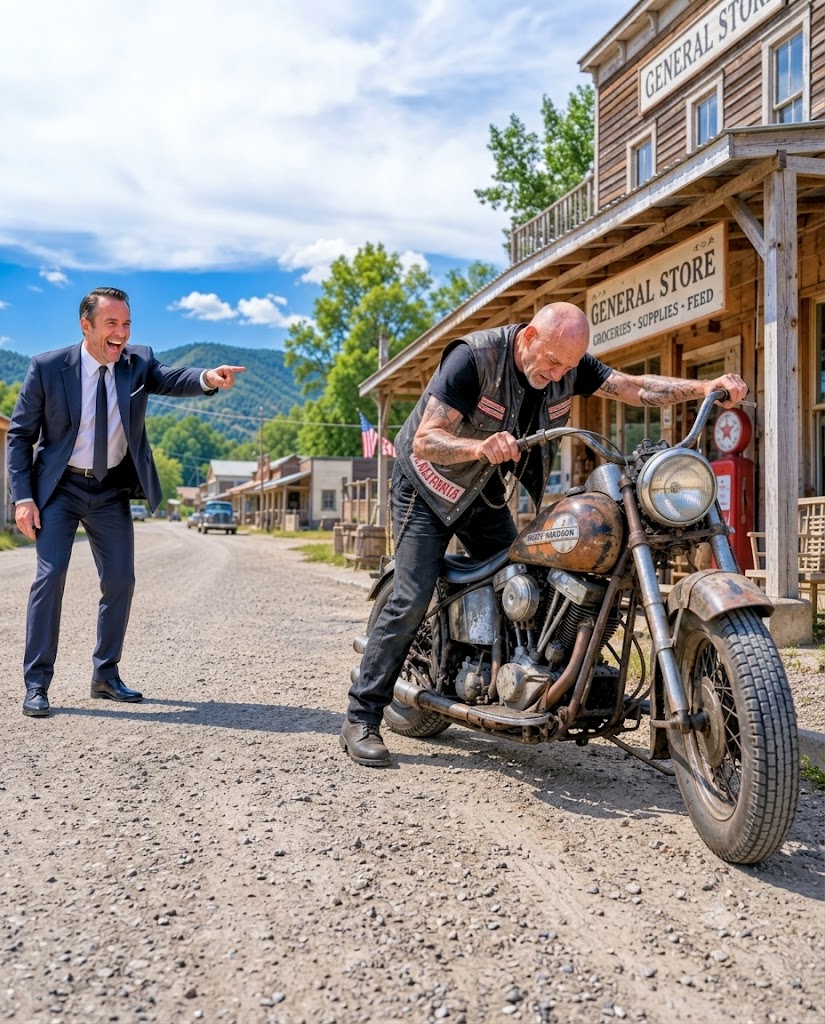
A boot slammed into an old motorcycle and knocked it over onto the gravel.
Chrome scattered.
A dog jumped up and started barking.
A man in a $2,000 suit stood over the fallen bike, laughing, filming the whole thing on his phone.
He called it rolling scrap.
He pointed at the worn leather vest on the counter and called it a Halloween costume.
Then he waited for the old man sitting there to say something back.
The old man didn’t.
He set his coffee cup down slow and steady and looked out the window at the empty road.
His name was Earl Hargrove, 70 years old, big hands scarred and thick.
And he had already heard something the rich man hadn’t.
A low rumble far off, rolling in from the east, getting louder.
What would that sound do to the man in the suit?
Stay with me on this one.
Let me take you back 20 minutes to before any of that happened.
The diner sat alone off Route 66, a little outside Barstow, California.
One of those places with a gravel lot, a hand-painted sign, and a coffee pot that never stopped.
The kind of place truckers stop at because the pie is real, and nobody rushes you out the door.
There were maybe six people inside that afternoon.
A couple of long-haul drivers, a waitress named Darling, who had worked there since Nixon was in the White House, and an old man at the far end of the counter nursing a black coffee with a bloodhound asleep by his boots.
That old man was Earl Hargrove.
Everybody who came through regular just called him Doc.
Gray beard, a face like cracked leather, a limp in his left leg that came and went with the weather.
His bike sat out front.
A 1970s Harley, paint faded, chrome dull, a few dents in the tank.
It did not look like much, but it had carried him close to a million miles, and every scratch on it had a story behind it.
His dog was named Sadie.
Thirteen years old, half blind, and the gentlest animal you ever met.
Earl wasn’t bothering anybody.
He came in most afternoons, drank his coffee, left Darling a bigger tip than the bill, and rode home before dark.
He’d feed Sadie scraps of bacon under the counter when he thought nobody was looking.
A quiet man at the end of a quiet life, taking his afternoons one cup at a time.
The regulars knew better than to mistake that quiet for weak.
Earl never raised his voice and never needed to.
Men twice his size nodded to him when they passed, and he just nodded back.
Darling had seen it for years and never asked.
Some men you don’t ask.
You just pour the coffee and let them be.
Then the silver car pulled in.
You heard it before you saw it.
A low growl of an engine that cost more than most people make in a year.
It swung into the lot too fast, kicked up gravel, and parked sideways across two spaces so nobody could pull in beside it.
Out stepped a man in his late thirties.
Sharp suit, expensive watch, sunglasses he didn’t take off even inside.
His name was Grant Delaney, and he had made a fortune selling an app that did something nobody really needed.
He had the kind of money that had never once been told no.
He walked in like he owned the building, looked around at the cracked booths, and smirked.
To him, the whole place was a joke.
The people in it were a joke.
He sat down two stools from Earl, snapped his fingers at Darling like she was hired help in his own house, and ordered a coffee he had no intention of finishing.
Now, here’s the thing.
Men like Grant get bored.
And a bored man with no respect for anything will always go looking for somebody to make small just to feel big.
His eyes drifted around the room looking for a target.
They landed on the old Harley out front, then on the old man drinking coffee beside him, and he decided he’d found his entertainment for the afternoon.
“That your bike out there?” Grant asked, already grinning.
Earl didn’t look over.
“It is,” he said.
“That thing actually runs?”
Grant laughed loud, wanting the room to hear him.
“I almost called a tow truck for you, old-timer. Thought somebody dumped their scrap metal in the lot.”
A couple of truckers glanced up from their plates.
Darling went still behind the counter.
She knew that look on a rich man’s face and she didn’t like where it was heading.
She’d seen the type before and it never ended well for whoever they picked on.
This time, though, she had a feeling the rich man had picked wrong.
Earl took another sip.
“She gets me where I need to go,” he said, calm.
No edge to it at all.
That calm should have been a warning.
Grant didn’t hear it.
Men like him never do.
He pulled out his phone and started filming, holding it up like Earl was an exhibit at a zoo.
“Look at this guy. The vest, the beard, the antique.”
He reached over and flicked the worn leather vest that Earl had folded neatly on the stool beside him.
“And the costume,” he said. “You rent that, Grandpa? Or have you been to one too many biker movies?”
Darling set the coffee pot down hard enough to make it ring.
“Sir,” she started.
Earl raised one hand just an inch off the counter, enough to stop her.
He didn’t want to fuss.
He’d learned a long time ago that a man who has to shout about who he is usually isn’t much of anything at all.
But in the corner booth, something was already in motion that nobody at that counter could see.
An old trucker named Hank had been sitting quiet the whole time, working on a plate of eggs.
Hank had driven these roads for forty years.
And Hank had seen that vest before, years back, at a funeral out in the desert, draped over a casket while two hundred riders stood in the heat with their heads bowed and the engines idled low as a hymn.
He knew what the patches meant.
He knew exactly who was sitting at that counter being called a joke.
Slowly, without a word, Hank slid out of the booth, stepped into the hallway by the restrooms, and took out his phone.
He dialed a number he’d kept for a long time.
And when a gruff voice answered on the third ring, Hank said six quiet words.
“Doc’s at the diner. He’s got company.”
Then he hung up, walked back to his eggs, and waited.
He didn’t look at Earl.
He didn’t look at the rich man.
He just ate slow and watched the clock.
Out at the counter, Grant was just getting warmed up.
The stakes had already climbed higher than a parking lot insult, though nobody had said it out loud.
The phone call had gone out, and you cannot call a thing like that back.
Grant stood up off his stool.
He walked to the window, looked at the old Harley sitting there in the sun, and shook his head like the sight of it personally offended him.
“You know what gets me,” he said, turning back to the room, playing to every face in it.
“Guys like you. You ride around on a rusted-out piece of junk, wearing a leather vest like it’s a uniform, like it means something, like anybody cares.”
He laughed.
“It’s sad, man. You spend your whole life on a bike worth less than my watch, and you think that makes you somebody?”
Earl sat down his cup.
He turned on the stool slow, and for the first time, he looked right at Grant.
His eyes were pale blue and absolutely steady.
There was no anger in them.
That was the strange part.
“Son,” he said, “why don’t you drink your coffee and leave the bike alone?”
It was not a threat.
It was almost kind.
The voice of a man giving somebody one last chance to walk away clean.
But Grant heard it as a challenge.
His grin twitched.
The room was watching now, and a man like him would rather die than back down in front of a crowd.
So he did the stupidest thing he could have done.
He pushed the door open, walked out into the lot, and stood over that old motorcycle.
“This?” he called back through the doorway, loud enough for all of them.
“You want me to respect this?”
And he kicked it.
The Harley went over sideways.
It hit the gravel with a crash of metal and glass.
A mirror snapped clean off.
Chrome scattered.
Sadie scrambled up off the floor and started barking, high and frightened, pressing herself against Earl’s boots and trembling.
That was the moment everything turned.
That was the thing that could not be taken back, because it wasn’t just a bike anymore.
It was a man’s whole life lying on its side in the dirt while a stranger filmed it and laughed.
Darling gasped.
One of the truckers started to rise, fists clenched, and his buddy put a hand on his arm and shook his head slow, like he knew something was already coming that would settle it better than any one man could.
Hank did not move a muscle.
He just looked at the clock, then out the window at the long empty road, and his jaw tightened.
Earl Hargrove stood up.
He didn’t rush.
He didn’t shout.
He reached down and put one hand on Sadie’s head, and the dog went still under his palm, trusting him the way she had trusted him for thirteen years.
Then he walked out into the sun.
He crouched down beside his fallen bike, those big scarred hands moving over the tank, checking the damage the way a man checks an old friend after a fall.
And for a long moment, he said nothing at all.
Grant stood over him, still filming.
“Oh, you gonna cry about it?” he said.
“I’ll buy you a new one. I’ll buy you ten. That’s the difference between you and me, old man. I could buy this whole diner and not notice the dent in my account.”
Earl lifted his vest, which had slid into the dirt when the bike went over, and brushed it off careful, like it was something far more delicate than leather.
On the back were patches, faded, hand-stitched, decades old.
Grant didn’t bother to read them.
He reached out, grabbed the vest by the collar, and before Earl could stop him, he spat on it.
“There,” Grant said. “That’s what your costume’s worth.”
The whole diner went dead silent.
Even the truckers froze.
Because some lines you just don’t cross, and every working man in that room knew it in his bones, even if the rich man didn’t have the first idea.
Earl looked down at the spit sliding down the patch he had earned fifty years ago with blood and loyalty and a thousand hard miles.
And something moved behind his eyes.
Not rage.
Something colder and older than rage.
Something patient, like a thing that has waited a long time and knows how to wait a little longer.
Then he folded the vest over his arm, gentle, and looked up at Grant with that same steady calm.
“You shouldn’t have done that,” he said quietly.
Grant laughed in his face.
“Or what? You gonna do something, old man?”
He spread his arms wide, daring him.
“Come on, do something.”
He dropped his arms when Earl didn’t move.
“That’s what I thought,” he said. “Nothing. You got nothing.”
And that was when it seemed to be over.
Because Earl didn’t swing.
He didn’t yell.
He simply picked up his motorcycle, stood it back on its kickstand with a low grunt of effort, and walked back inside.
He hung the vest on the hook by the door, straightening it so it hung right.
He sat back down at the counter, and he asked Darling, in a voice as even as still water, if he could get a warm-up on his coffee.
Grant Delaney stood out in the lot alone, grinning like he’d won something.
He thought he’d broken the old man.
He strolled back inside, dropped onto his stool, ordered a slice of pie to celebrate, and started scrolling through the video on his phone, chuckling at the best parts.
The truckers looked away.
Darling poured the coffee with a shaking hand.
The whole place seemed to settle like a held breath slowly let go.
Grant leaned back, satisfied.
It was over.
He was sure of it.
It wasn’t over.
It was about to begin.
The first sign was the water glasses.
They started to tremble.
A faint buzz against the countertop, ice ticking against the glass.
Then the windows began to rattle in their frames.
Darling stopped pouring mid-cup.
One of the truckers set down his fork and turned slow toward the door.
Grant felt it in his chest before he understood it.
A deep rolling thunder coming up out of the ground itself, growing louder by the second until it drowned out every other sound in the building.
He looked up from his phone.
“What is that?” he said.
Nobody answered him.
Out on the long gray highway, a shape was forming on the horizon.
A dark line stretched across both lanes, and above it the heat shimmered and broke.
The thunder became a roar.
And then you could see them.
Headlights.
Rows and rows of headlights filling the whole road, coming on fast and steady.
Motorcycles.
Dozens of them.
They poured into the gravel lot in a flood of steel and chrome and black leather, engines snarling, and they did not stop at the edges the way cars do.
They rolled in tight and deliberate, circling until they had formed a solid wall around the front of the diner, around the old Harley, around the one man Grant Delaney had chosen to humiliate for his afternoon’s amusement.
Fifty riders, maybe more, cutting their engines one after another until the silence that followed was somehow louder than all the noise had been.
The nature of this whole thing had just changed.
This was no longer one rich man mocking one old stranger over coffee.
This was something with history behind it.
Something that had answered a single phone call and ridden a hundred miles across the desert without asking one question, because of who was inside that building.
Grant’s grin was gone.
Through the window he watched them dismount, slow and unhurried.
Big men, gray in their beards, scars on their arms, patches on their backs that matched the ones on the vest by the door.
Nobody was shouting.
Nobody was reaching for anything.
That was the frightening part.
They simply arranged themselves across the lot, blocking the silver car in on all four sides, and they stood there and they waited.
If you’re still with me this far, do me one favor and hit that subscribe button, because what Earl did next is the part nobody who was there ever forgot.
The door opened.
A man walked in who had to duck his head to clear the frame.
Sixty-some years old, built like a side of beef, with a long gray braid down his back and forearms like fence posts.
The patch on his chest read PRESIDENT.
He took off his sunglasses slow and let his eyes move around the room, taking in every face.
And then his eyes stopped on Earl at the counter.
And then this enormous hard-faced man did something that made Grant’s stomach drop straight through the floor.
He crossed the room, dipped his head low, and said, “Doc, we got your call relayed. You all right?”
Earl nodded once.
“I’m fine, Tiny. No need for all this.”
“There’s every need,” the big man said quietly.
He turned and looked at Grant for the first time.
Just looked at him.
He didn’t say a word to him.
He didn’t have to.
Here’s what Grant Delaney was only now starting to understand, a slice of pie going cold in front of him.
The old man he’d been filming, the one in the rented costume on the rolling scrap, was not some lonely retiree playing dress-up on a Tuesday afternoon.
Earl “Doc” Hargrove was a founding road captain of this charter.
He had helped build it from six guys and a handshake back when most of these men standing in the lot were still children.
Half the riders out there had learned the road from him.
The president of the club called him sir, and Grant had just kicked his motorcycle into the dirt and spat on the only thing in the world that man truly treasured.
The stakes weren’t pride anymore.
They weren’t even money.
Grant’s money meant nothing to the fifty men standing between him and his car.
This was survival now, and he knew it, and the color was draining out of his face in real time.
More of them came through the door.
They didn’t crowd him.
They simply filled the diner, standing along the walls, quiet, patient, every eye on the man in the expensive suit.
The door swung shut behind the last of them with a soft click that sounded in that silence like a lock turning in a cell.
Grant stood up fast, knocking his stool back so it clattered on the floor.
“Okay,” he said, and his voice had climbed half an octave.
“Okay, look. I don’t know what this is, but I didn’t mean anything by it. All right? It was a joke. We were just having a laugh. No harm done.”
Nobody laughed.
Nobody said a word.
Tiny pulled a chair out from a table, turned it around backward, and sat down facing Grant with his arms folded over the back of it.
“Sit down, son,” he said.
It was not a request.
Grant sat.
“Now,” Tiny said, “I’m going to tell you something about the man you’ve been filming, and while I do, you’re going to put that phone on the table where we can all see it.”
Grant put the phone on the table.
His hand was shaking so bad it rattled against the Formica.
“That man,” Tiny said, nodding down the counter at Earl, “pulled me out from under a jackknifed truck on the I-15 in the summer of 1981 and kept me breathing with his own two hands until the ambulance came. Forty minutes it took them. He never let go.”
Grant swallowed.
“That man rode four hundred miles through a snowstorm to carry the ashes of my brother home to his mother, because the family couldn’t afford to ship him and nobody else would go.”
Tiny’s voice never rose.
“That man has buried more friends than you have ever had in your whole life. And he has never once in fifty years raised his hand to a soul who didn’t swing first. You follow me?”
“I follow you,” Grant whispered.
“Good.”
Tiny leaned in close and his voice dropped lower.
“Because I want you to understand that everything about to happen to you right now is the gentlest thing that has ever happened to a man who did what you just did in front of all these people.”
He paused and looked over at Earl.
“And the only reason it’s gentle — the only reason — is him. Because he asked us to keep our hands in our pockets before we even got off the road. So you’re going to thank him for that before we’re through. But not yet.”
Here is where you learn what respect really costs.
Because they did not lay a finger on Grant Delaney.
Not one.
They never had to, and that was the whole lesson.
Tiny stood and walked to the door and lifted the worn leather vest off its hook with both hands.
He carried it back and laid it on the table in front of Grant, patched side up, the spit still drying on the old stitching.
“Read it,” he said.
Grant looked down.
The stitching was faded, but you could still make it out.
A charter name, a set of wings, and underneath, in letters worn soft by fifty years of wind and rain and desert sun, the words ROAD CAPTAIN, and a date older than Grant himself.
“Out loud,” Tiny said. “So everybody hears it.”
And so the millionaire, in front of fifty silent men and a half-blind dog and a waitress who’d worked there since Nixon, read the patch out loud in a voice that cracked and broke on the very last word.
“Now,” Tiny said when he’d finished, “you spat on that. So you’re going to clean it.”
He set a glass of water and a clean cloth napkin on the table beside the vest.
And Grant Delaney, who could have bought the diner and the highway and every acre of desert for a hundred miles in any direction, bent over an old man’s vest and cleaned it by hand, while a room full of bikers watched without a sound.
When he finished, Tiny picked it up, inspected it under the light, then carried it back to the hook and hung it up with two hands, the way you’d handle something holy in a church.
“The bike next,” Tiny said.
They walked him outside into the ring of steel and leather, over to the old Harley that Grant had kicked into the dirt not twenty minutes before.
The broken mirror still lay in the gravel.
The tank had a fresh dent in it, raw metal showing through the faded paint.
And they stood Grant in front of it and made him look.
Really look.
“That dent’s going to stay,” Tiny said. “Doc’s not going to fix it. You know why? Because now it’s got a story, too. Same as every other mark on her.”
He let that sink in.
“Every scratch on that machine is something that happened in a man’s life. And from now on, that one right there is you. That’s your mark on his bike. And he’s going to carry it the rest of his days. Every time somebody asks how he came by that dent, he decides whether to tell them the truth about the rich boy who kicked over an old man’s motorcycle in a diner lot.”
Grant was crying now.
Not loud, just tears running quiet down a face that had never in its whole life been held to account for a single thing.
“What do you want from me?” he whispered. “Money. I’ll pay. Name it. Whatever it costs, I swear.”
And that was when Earl himself finally came out the door.
He walked through the crowd, and those big men parted for him like water around a stone, and he stopped in front of Grant and looked at him with those pale, steady eyes for a long moment.
Sadie limped along at his heel and sat down against his boot, pressing close.
“That’s the whole trouble with you, son,” Earl said, and his voice was not cruel at all.
It was almost sad.
“You think everything’s got a price on it. You think you can kick a man’s life over in the dirt and then just buy a new one off the shelf like it was nothing.”
He shook his head slowly.
“Some things you can’t pay for. You can only earn them, and you can only lose them.”
He nodded down at his dented tank.
“I earned every mark on that bike. You? You just bought yourself a car. There’s a difference. And you’re standing in the middle of fifty men right now who understand it down to their bones, and you’re the only one here who doesn’t.”
Grant had no answer for that.
For the first time in his adult life, the man had absolutely nothing to say and no money to say it with.
“I don’t want your money,” Earl said. “I want you to do one thing for me. I want you to get down on the ground right here and set that bike up straight and proper, the way you knocked it down. With your own two hands. And then I want you to say you’re sorry.”
He put his hand down on Sadie’s head.
“Not to me. I don’t need it. To her. You scared my dog. She’s old. She’s half blind. And she’s never hurt a thing in her life, and she doesn’t understand why a grown man would do a thing like that. Honestly, neither do I.”
And so Grant Delaney got down on his knees in the gravel of a diner lot off Route 66, in his $2,000 suit, in front of fifty bikers who never once touched him, and he set an old motorcycle upright with his own two hands, grunting with the weight of it.
Then he turned to a half-blind bloodhound sitting in the dirt, and his voice shook all the way through, and he said, “I’m sorry.”
And whether the dog understood it or not, the man who said it finally did.
Nobody cheered.
That’s not what this was.
The riders just watched, silent.
And when it was done, Tiny gave one short nod, and that was the whole of the verdict.
No punches, no blood, no broken bones.
Just a man made to stand in the full weight of what he’d done, with nowhere left to hide from it.
Here is what became of all of it.
The bikers did not drag it out.
They weren’t interested in cruelty.
Once Grant was back on his feet and brushing the gravel off his knees, Tiny stepped in close and said just one thing more, low enough that only Grant could hear it.
Nobody else ever learned what those words were.
But Grant nodded fast and did not argue, and never told a living soul for the rest of his life.
Then they let him go.
They stepped aside from his silver car, clearing a path.
He got in, and his hands were shaking so badly it took him three tries to get the key to turn, and he drove off down Route 66, slow and careful, both hands locked on the wheel at ten and two, at exactly the speed limit the whole way, which was something he had never once done before in his life.
Inside the diner, Darling poured fifty cups of coffee and wouldn’t take a dime for a single one.
The men filled the booths and the counter and spilled out onto the porch in the late sun.
And for one hour, that nowhere diner off a forgotten highway was the warmest place in all of California.
They told the old stories — the snowstorm, the truck on the I-15, the funerals, the weddings, the long rides through country so empty it felt like the last place on earth.
Earl sat quiet in the middle of it, letting the younger ones talk, and now and then he’d smile into his coffee at something only he and one other gray-haired man still remembered.
Before they left, Tiny crouched down by the old Harley one more time.
He ran a thumb slow over the fresh dent in the tank.
“You really not going to fix it, Doc?” he asked.
Earl shook his head.
“No,” he said. “You were right out there. It’s got a story now.”
He looked off down the road where the silver car had long since disappeared into the heat.
“Maybe that boy learns something from it. Maybe he doesn’t. That part was never up to me.”
He shrugged easy.
“But a man ought to carry his marks. All of them. The ones he’s proud of and the ones he’s not. That’s how you know you were really here for something.”
They rode out the way they came.
Fifty engines waking up at once.
A thunder that rolled out across the open desert and faded slow into the gold of the afternoon.
And then it was just the diner again.
The coffee pot.
Darling wiping down the counter and humming to herself.
An old man and his dog in the last booth, watching the light go gold and then red over the highway.
Think back to how this all started.
A boot, a crash of chrome in the gravel.
A rich man laughing, filming, certain he was the biggest thing in any room he walked into.
He thought power was the money he’d made and the people he could make small to feel tall.
He learned in one afternoon he was wrong about every bit of it.
Because real respect, the kind that brings fifty men a hundred miles across a desert on a single phone call, you cannot buy.
Not for any amount.
You cannot kick it over, or spit on it, or scroll past it on a screen.
You earn it one mile at a time, one friend at a time, one hard winter at a time, over a whole long life of showing up when it costs you to show up.
Earl had spent fifty years earning it quietly, and on one ordinary afternoon it rolled in off the highway and stood in a wall all around him.
Grant Delaney drove home a different man that day.
Whether it lasted, nobody can say.
But they say he traded the silver car within the year and started showing up at that diner sometimes, alone, with a plain black coffee.
And they say that if an old man and a bloodhound happened to be there too, Grant would take the stool two down, nod once, keep his mouth shut, and just listen to the old stories like a man who finally understood he had a lot left to learn.
That was the price.
Not a punch, not a dollar.
Just the long, hard lesson that the quietest man in the room is very often the one who has the least left to prove, and the most people standing silent behind him.
Earl finished his coffee that evening the same way he finished it every evening of his life.
He left Darling a bigger tip than the bill.
He whistled low for Sadie, and he rode off into the sunset on a dented old Harley that was worth more to the people who knew what it really meant than every car in California put together.
And somewhere out on that dark desert highway, fifty riders rode home easy under the first stars, knowing Doc was all right.
That’s what respect costs.
And that’s exactly what it’s worth.









