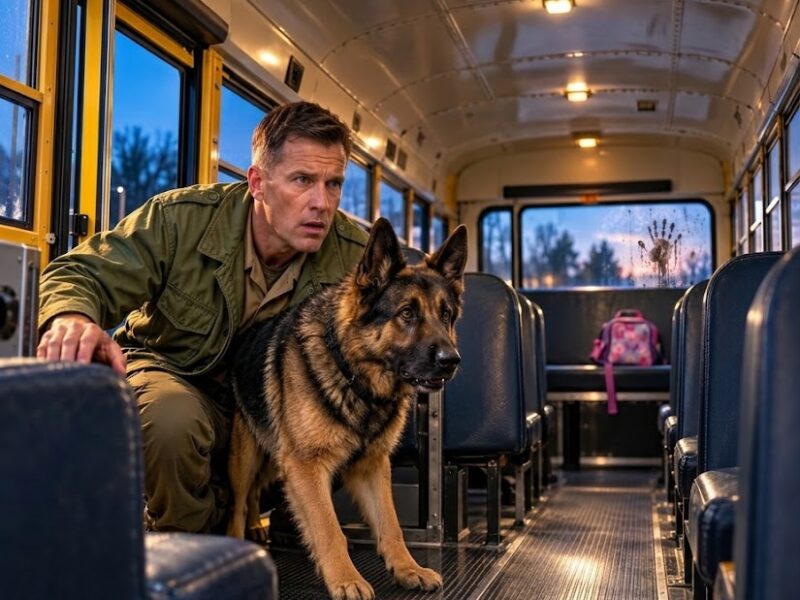
A Marine’s K-9 wouldn’t stop barking at an empty bus—then a phone rang inside.
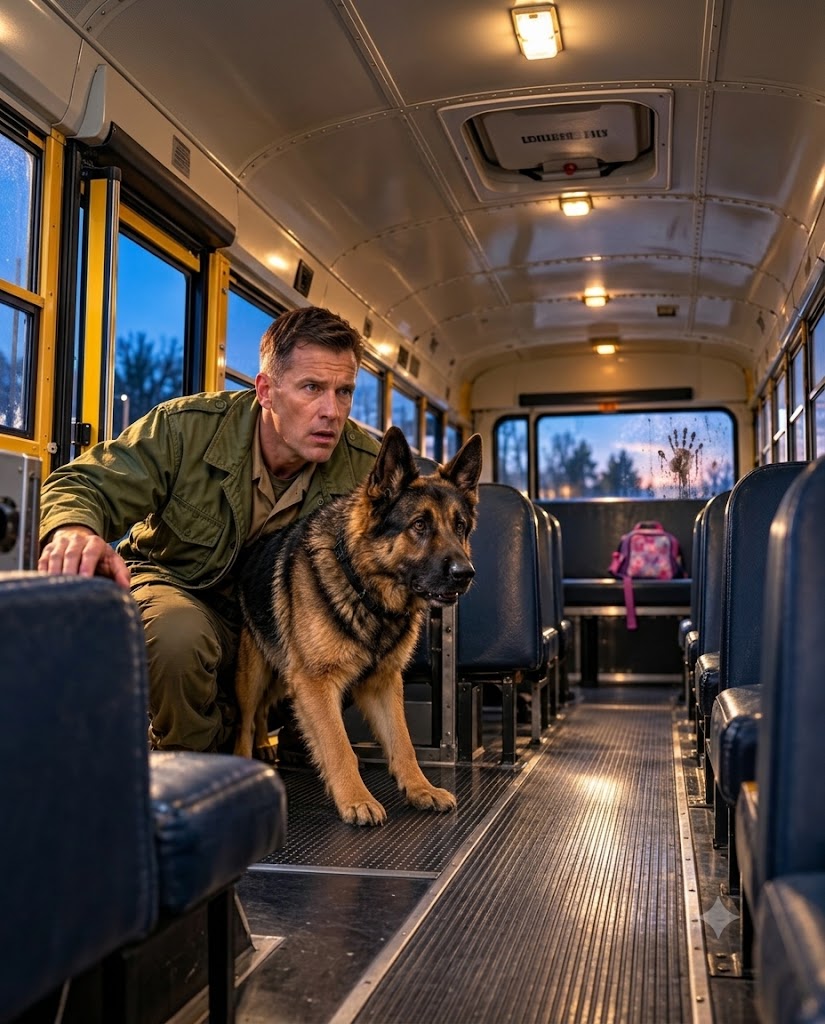
Some warnings come as sirens.
Others come as a pause.
The yellow school bus sat crooked on the shoulder of a narrow North Carolina road, its hazard lights blinking against the falling dusk like a tired heartbeat.
Staff Sergeant Cole Barrett noticed it from nearly a quarter mile away as his pickup rounded the curve between tall pines darkened by recent rain.
The road was quiet.
No houses nearby.
No children walking home.
No driver standing beside the bus with a phone pressed to his ear.
Just the bus, its folding door hanging open and a thin ribbon of exhaust drifting into the cool October air.
Cole slowed beside it.
Rex lifted his head.
The six-year-old German Shepherd had been sleeping with his muzzle across his paws, but now his amber eyes sharpened.
His ears rose.
His nose tested the air coming through the cracked passenger window.
Cole felt the change before Rex made a sound.
“Easy, boy.”
Rex did not look at him.
The truck had barely stopped when the dog stood, muscles tight beneath his black and tan coat.
Cole stepped out first.
Wet gravel pressed beneath his boots.
The air smelled of pine needles, damp earth, and diesel fuel.
He called toward the bus, “Hello.”
Nothing answered.
He waited.
Somewhere deeper in the woods, water dripped steadily from branches.
Rex moved past him, stopped ten feet from the open bus door, and barked once.
Sharp.
Deliberate.
Cole studied the windows.
Empty seats.
Pale vinyl.
A forgotten blue jacket hanging from one seat back.
No movement.
“Rex, heel.”
The German Shepherd ignored the command.
That was unusual enough to tighten something in Cole’s chest.
Rex barked again, then climbed the bus steps.
Cole followed.
Inside, the smell changed.
Warm vinyl, dust, crayons, a trace of peanut butter from an abandoned lunch wrapper near the front.
The driver’s seat was empty.
Keys still rested in the ignition.
Cole moved slowly down the aisle while Rex advanced several feet ahead, checking one row, then another.
He was not frantic.
He was searching.
Halfway down, Rex stopped.
His head turned toward the rear.
Then he walked directly to the last row and began barking at the floor beneath the seat.
“What is it?”
Cole crouched.
Nothing obvious lay there except shadows and a few scraps of paper.
Rex pawed once at the rubber flooring, backed away, and stared at Cole.
Then he went completely silent.
A vibration rattled faintly against metal.
Cole froze.
A second later, a phone began ringing somewhere beneath the last seat.
The sound seemed impossibly loud inside the empty bus.
Cole reached underneath and pulled out an old smartphone with a cracked corner, rainwater dried along its case.
The screen glowed against his hand.
For one strange second, he expected to see an incoming call.
Instead, the phone was calling someone.
Cole stared at the name displayed above the number.
His own.
The device was calling Staff Sergeant Cole Barrett.
Rex stood beside him without moving.
Outside, the hazard lights continued blinking through the windows, red against the darkening trees.
Cole had never seen this phone before.
He had no idea who had left it there.
And as his own phone began ringing inside his jacket, he realized someone who knew his number had wanted this bus to be found.
Forty-seven minutes earlier, Cole Barrett had been driving east beneath a low ceiling of gray clouds, the windshield wipers moving in a slow, steady rhythm as the last of the afternoon rain softened into mist.
Rex slept on the passenger side with his head resting near the center console, one ear twitching every time the tires crossed a seam in the road.
They were returning from a training field outside Jacksonville, where Cole had spent most of the day helping a local working dog unit practice scent detection around warehouses and parked vehicles.
It was the kind of assignment he preferred now.
Quiet work.
Useful work.
No speeches, no crowds, just clear instructions and the comfort of knowing Rex understood him before he finished most commands.
Cole was thirty-six, broad-shouldered, fair-skinned, with short brown hair and gray-blue eyes that had learned to study rooms before entering them.
The years had left him disciplined, but not untouched.
He carried certain memories the way some men carried old coins in a pocket, always there, sometimes forgotten until one shifted and reminded him of its weight.
The road wound between pine forest and scattered farm property, still wet enough to reflect the pale sky.
Rex opened his eyes when Cole reached for the glove compartment at a stop sign.
Cole was looking for a pair of work gloves.
Instead, his fingers brushed a small metal chain.
He stopped.
Two worn military identification tags rested beneath a folded road map.
One belonged to him.
The other bore the name Aaron Carter.
Cole did not pick it up.
He only stared for a second before closing the compartment again.
Rex had lifted his head.
“I’m fine,” Cole said softly.
The dog watched him with the calm, patient expression that made lying feel pointless.
Aaron Carter had been the kind of Marine who remembered birthdays, carried extra coffee for night watch, and could make a room laugh without trying to own it.
Years earlier, during one of Rex’s earliest training rotations, Aaron had spent enough time around the young German Shepherd to earn something rare from him.
Trust without command.
Aaron had been gone for several years now, and Cole had never found a useful way to explain why some friendships remained present even after the person did not.
He kept one of Aaron’s tags because returning it had once felt too final.
At first, he told himself he would deliver it to Aaron’s family when the time was right.
Then weeks became months.
Months became years.
The tag stayed in the glove compartment, traveling thousands of miles without ever reaching the place it belonged.
Rex shifted upright as they passed a weathered green sign pointing toward a small school district several miles ahead.
The dog turned his nose toward the cracked window.
“What do you smell?”
Rex did not answer with a bark.
He simply watched the road.
The rain had nearly stopped now, and thin shafts of late sunlight were beginning to break beneath the clouds, turning the wet pavement gold in places.
Cole reached for the radio, then changed his mind.
Silence suited the drive better.
A few miles later, Rex stood—not suddenly, but slowly—his paws pressed against the floorboard, body angled forward, ears fixed toward something beyond the next curve.
Cole felt it at once.
The change.
The stillness before a warning.
Rex remained focused ahead.
Cole eased his foot from the accelerator.
Around the bend, between the dark pines and the wet shoulder of the road, the first flash of amber hazard lights appeared.
The closer Cole drove, the less the scene made sense.
The bus was not blocking the road.
It had been pulled almost completely onto the gravel shoulder, angled just enough that its right wheels rested near a shallow drainage ditch.
There were no skid marks across the wet pavement, no scattered glass, no steam rising from beneath the hood.
Whoever had stopped it had done so carefully.
Cole brought his truck to a halt about thirty feet behind it and left the engine running.
Rex was already standing.
His body had gone still in that particular way Cole had learned never to dismiss.
“Stay.”
Cole opened his door and stepped into the damp evening air.
For two seconds, Rex obeyed.
Then his nose lifted toward the open folding door of the bus and a low sound formed deep in his chest.
Not aggression.
Warning.
Cole looked through the rear window.
Rows of pale seats stood empty beneath weak interior lights.
A red backpack strap hung over one seat near the middle.
Farther forward, a sheet of construction paper rested in the aisle, its edges trembling whenever the breeze moved through the open door.
It could have been nothing more than a mechanical problem.
A driver might have walked for help.
Children might already have been dropped off.
Cole knew that.
He also knew Rex.
“Come.”
The German Shepherd jumped down and immediately moved toward the bus, paws darkening against the wet gravel.
Cole expected him to circle the vehicle first.
Rex did not.
He passed the rear tire, ignored the engine compartment, and stopped directly beneath the open entrance.
His ears pointed forward, his nose worked rapidly.
Then he looked back at Cole.
“All right. Show me.”
Rex climbed the steps.
Cole followed, one hand resting lightly against the rail.
Inside, the air held the familiar smell of a school bus after a long day.
Warm rubber, old fabric, pencil shavings, a trace of fruit punch, and the heavier scent of diesel drifting in from outside.
The driver’s seat was vacant.
A travel mug remained in the cup holder.
The keys were still in the ignition.
Cole touched the dashboard near the steering column.
Warm, not hot, but warm enough to tell him the bus had not been sitting there long.
“Hello.”
His voice traveled down the narrow aisle and returned smaller.
No answer came.
Rex moved forward slowly.
He checked the first row with a brief turn of his head, then the next.
At the fourth row, he paused to smell the floor before continuing.
Cole noticed something odd about the pattern.
The dog was not searching randomly.
He was following something—a scent, perhaps, or several scents layered together.
Near the middle of the bus, Rex stopped beside the red backpack strap Cole had seen from outside.
The bag itself was gone.
Only the loose strap remained caught beneath the metal leg of a seat, as though it had been pulled away in a hurry.
Rex smelled it once and continued.
“You have something?” Cole asked.
The German Shepherd gave no response.
That concerned Cole more than barking would have.
Rex crossed the final few feet of the aisle and stopped beside the last row.
He lowered his nose toward the floor, inhaled, then looked beneath the seat.
His posture changed.
His tail became still.
Cole took another step.
Rex suddenly barked once, sharp enough to fill the entire bus.
Then again, refusing to move away from the shadows beneath that final seat.
Cole crouched beside him.
“What did you find, boy?”
Rex did not look at Cole.
He stared beneath the seat as though whatever mattered was still waiting there.
Cole lowered himself beside the last row and followed Rex’s stare into the narrow darkness beneath the seat.
At first, he saw nothing except dust, a crushed juice box, and a few strands of yellow yarn caught around a metal bolt.
Then something vibrated softly against the floor.
Rex shifted closer, nose working fast.
Cole reached under the seat and felt his fingertips brush hard plastic.
He pulled out a smartphone with a cracked corner and a faded blue case.
The screen was already awake.
A call was in progress.
For half a second, Cole assumed someone had dialed emergency services.
Then he saw the number.
His breathing slowed.
He knew those digits—not because they belonged to him, but because they had once belonged to Aaron Carter.
Years earlier, Cole had memorized the number after countless late-night calls, deployment updates, and ordinary conversations that seemed unimportant until there were no more of them.
After Aaron died, the line had remained active through a family emergency account connected to Cole for a time, a practical arrangement that no one had ever bothered to discuss much afterward.
Cole stared at the screen while his own phone began vibrating inside his jacket.
The old number was calling him now.
Rex looked up.
“That’s impossible,” Cole whispered, although he knew it was not.
Numbers could be transferred.
Accounts could remain linked.
Phones could be found, borrowed, or inherited.
There were explanations.
There were always explanations.
But none of them explained why the device was hidden beneath the last seat of an empty bus.
Cole answered his own phone.
“This is Cole Barrett.”
Silence.
Only a faint electronic hiss came through the speaker, followed by the hollow sound of the bus around him.
He looked at the cracked phone in his hand.
The call was connecting the two devices less than three feet apart.
Someone had placed the call before leaving it there.
Deliberately.
Cole ended the connection and examined the screen.
The recent call list showed the same contact several times.
Each attempt had been made within the last twenty minutes.
His number was not saved under his name.
It appeared beneath a single word.
Marine.
Cole felt the old weight in his chest return.
Rex lowered his head and smelled the phone case, then the floor beneath it.
His ears shifted toward the rear emergency door.
Cole noticed a faint smear of dried mud along the edge of the seat support.
Too high to have come from a shoe brushing the floor.
Small fingers, perhaps.
He forced himself not to guess.
Guessing created stories.
Evidence created direction.
He stood and called local law enforcement, giving the road marker, the bus number, and the condition of the scene.
Then he returned his attention to Rex.
The German Shepherd had moved back toward the middle rows.
He paused beside the loose red backpack strap, smelled it again, and turned toward the open door.
Outside, the final light of evening had begun fading behind the pines.
Cole slipped the cracked phone carefully into an empty evidence bag from his truck kit without touching the screen again.
“Show me,” he said.
Rex stepped down from the bus, crossed the wet gravel, and stopped at the edge of the roadside ditch.
His nose lowered toward the grass.
Then, very slowly, he turned toward the trees.
The first patrol vehicle arrived less than ten minutes later, its headlights washing the wet roadside in white as Sheriff Laura Bennett stepped out into the cooling evening.
She was forty-four, composed, practical, and known across the county for asking fewer questions than most people but listening harder to the answers.
Cole met her near the rear of the bus while Rex remained at the edge of the ditch, nose low, unwilling to leave the scent he had found.
Laura took in the scene without rushing.
“You touched anything?” she asked.
“Only the phone before I realized what it was.”
“I bagged it after that.”
Cole handed her the clear evidence pouch.
Laura studied the cracked device, then looked toward Rex.
“And your dog brought you to it?”
Cole nodded.
“He brought me to the last seat first. Then outside.”
Another deputy began photographing the bus while Laura contacted the school transportation office.
Within minutes, the quiet roadside filled with small pieces of information that refused to fit together.
The bus belonged to Pine Ridge Elementary.
Its regular afternoon route carried twenty-two children through three rural neighborhoods before returning to the district lot.
According to the electronic roster, every child scheduled for that route had been marked as delivered home.
The driver, Tom Willis, had not checked in after his final stop.
His personal phone went directly to voicemail.
Laura climbed into the bus and examined the onboard camera system.
The front camera had recorded most of the afternoon normally.
Children laughing, backpacks swinging, doors opening and closing.
Then, shortly before the bus reached this stretch of road, the recording stopped.
Not for the rest of the day.
Only for eleven minutes.
When the video resumed, the bus was already empty.
Laura stared at the time stamp.
Eleven minutes.
Cole looked toward the dark windows, long enough for a lot to change.
Rex gave a short whine from outside.
Cole stepped down and followed him into the shallow ditch where wet grass brushed against his boots.
Thirty feet from the pavement, Rex stopped beside a patch of low brush and pushed his nose beneath the leaves.
Something red showed through the green.
Cole crouched and pulled free a small backpack, soaked along one side but otherwise intact.
Laura joined him.
A plastic name tag hung from the zipper.
Cole wiped rainwater from the clear sleeve with his thumb.
The printed letters appeared slowly beneath the droplets.
Noah Carter.
Cole stopped breathing for a moment.
The last name seemed louder than it should have been.
Laura noticed.
“You know that family?”
Cole did not answer immediately.
His eyes moved from the tag to Rex, then toward the bus.
Aaron Carter had been gone for years, but Cole remembered hearing that Aaron had a young son—a baby at the time, too small to remember his father.
Cole had never met him.
“Maybe,” he said quietly.
Laura opened the outer pocket with gloved hands.
Inside was a school library book, a folded worksheet, and a small emergency inhaler labeled with the same name.
No phone.
No note.
No explanation.
Just ordinary things belonging to a ten-year-old child who, according to the official roster, had supposedly made it home.
Laura called dispatch again.
This time, her voice changed.
“Confirm the residence for Noah Carter and send a unit there now.”
Cole looked back toward Rex.
The German Shepherd had gone still again.
His head lifted, his ears turned toward the trees.
Somewhere beyond the roadside, hidden by wet pine and gathering darkness, a branch moved softly.
Rex stared into the woods and did not blink.
The answer from dispatch came back three minutes later, and it changed the air around everyone standing beside the road.
Noah Carter had not arrived home.
His mother had been waiting for him since shortly after four o’clock, assuming the route was running late because of the rain.
Sheriff Laura Bennett had barely finished repeating the address when another vehicle appeared around the bend, moving faster than the others but slowing hard before the bus.
A woman stepped out before the engine fully settled.
She wore a light gray sweater beneath a rain jacket, jeans darkened at the cuffs, and the expression of someone trying to remain calm because panic would make the world less useful.
Cole recognized her before she reached them.
Emily Carter.
She was twenty-nine now, though the last time Cole had seen her had been years earlier at a Marine family event, standing beside Aaron with one hand resting over a stomach just beginning to show.
Back then, Aaron had smiled like the future was something he could already see.
Emily looked at Cole, then at Rex, and stopped.
For a moment, nobody spoke.
Rex was the first to move.
He stepped closer—not pulling, not barking, only watching her.
Emily covered her mouth with one hand.
“That’s Rex,” she said.
Cole felt the name land between them.
“You remember him?”
She shook her head quickly.
“Not me. Noah.”
Laura stepped closer.
“Mrs. Carter, we found your son’s backpack near the bus. We’re still working out what happened. I need to ask you a few questions.”
Emily nodded, but her eyes stayed on Rex.
“No one knows that dog.”
Cole frowned.
“How?”
Emily swallowed.
“From photographs.”
The rain had stopped completely now.
Water slid from pine needles and slow drops ticking against the roof of the bus.
Emily explained that two weeks earlier, Noah had found an old storage box in the hall closet.
It belonged to Aaron.
Inside were photographs, letters, a folded Marine Corps sweatshirt, and a handful of things she had never been ready to sort.
One photograph showed Aaron kneeling beside a much younger Rex during a training rotation.
Another showed Cole standing several feet away, half turned from the camera.
Noah had become fascinated by the dog.
He asked what Rex had done, where he had gone, whether he was still alive.
Emily had told him the truth as best she could.
Rex had once worked around Aaron’s unit.
Rex had trusted him.
Aaron had trusted Rex.
Cole looked toward the German Shepherd.
“Did no one know my name?”
Emily nodded slowly.
“Yes. He asked about you, too.”
Laura’s gaze sharpened.
“Did he have your phone number?”
Emily hesitated.
“Not exactly.”
She reached into her purse and pulled out an old address book with a worn leather cover.
“Aaron kept this. Noah found it in the same box.”
Cole already knew what she was going to say.
Emily opened to a page marked with a faded blue ribbon.
Several names had been crossed out over the years.
One had not.
Cole Barrett.
Next to it was a number that had once been tied to Aaron’s emergency contact chain.
Emily looked at the phone sealed in the evidence pouch.
“Noah must have copied it.”
Cole felt a coldness that had nothing to do with the weather.
“Why would he do that?”
Emily’s eyes filled, but her voice stayed steady.
“Because lately, he’s been asking what his father would do if he got scared.”
Rex suddenly turned away from the group and looked back toward the bus.
Then he walked to the steps, climbed inside, and disappeared toward the rear.
A moment later, they heard one low bark.
Not toward the woods.
Toward the last seat again.
Cole reached the rear of the bus first.
Rex stood beside the last row with his nose pressed close to the metal frame beneath the seat.
He was no longer interested in the floor where the phone had been found.
This time his attention was higher, fixed on a narrow panel bolted beneath the cushion.
Sheriff Laura Bennett stepped in behind Cole while Emily remained near the front with a deputy.
“What is he doing?” Laura asked.
Cole did not answer right away.
Rex inhaled again, then scraped one paw lightly against the metal.
Cole crouched.
There was a shallow gap between the panel and the seat frame, barely wide enough for fingers.
One screw looked newer than the others.
Another sat slightly crooked.
“Someone opened this,” Cole said.
Laura pulled on a pair of gloves and leaned closer.
“Can you remove it without damaging anything?”
Cole nodded.
A small tool kit from the bus emergency compartment gave him what he needed.
He loosened the screws slowly.
The panel came away with a soft metallic click.
Behind it was a narrow hollow space meant for wiring.
At first, it appeared empty.
Then Rex pushed his nose toward the opening and gave a quiet whine.
Cole shone a flashlight inside.
Something silver reflected the beam.
Laura reached in carefully and pulled out a short chain.
Two rectangular pieces of metal swung from it, dull with age.
Military identification tags.
Cole stared at them.
One name faced outward.
Aaron Carter.
For several seconds, the only sound inside the bus was the faint ticking of cooling metal and rainwater dripping from the roof outside.
Emily saw Cole’s face from the front aisle and stepped closer.
“What is it?”
Cole turned the tag over in Laura’s gloved hand.
The edges were worn in a way he recognized immediately.
A tiny bend marked one corner.
Aaron had once joked about catching it on a locker door during training.
Cole had seen that mark hundreds of times.
This was not a reproduction from a photograph.
It was real.
Emily stopped two rows away.
Her expression changed before she spoke.
“That was his.”
Laura looked at her.
“You’re certain?”
Emily nodded.
“I kept both tags in the box.”
Cole felt the memory of his own glove compartment like a weight several miles away.
He knew one thing Emily did not.
There should not have been two tags in her box.
One had been with Cole for years, which meant Aaron’s original pair had been separated long ago, and Noah had somehow taken the one his mother still possessed.
Laura’s radio crackled.
A deputy outside reported that the working theory was now a missing child incident with possible unlawful removal from the bus.
A vehicle had been seen in the area.
There were footprints near the shoulder.
The simplest explanation was forming quickly.
Noah had been taken.
The phone and backpack were things he had dropped along the way.
Cole looked at the hidden tag and felt that explanation weaken.
“He didn’t drop this,” he said.
Laura followed his gaze.
“No. The panel had been closed again after the tag was placed inside. That required time and intention. Noah hid it.”
Rex turned away from the opening and walked three rows forward.
He stopped, looked back at Cole, then moved again toward the front—not confused, not searching, following a sequence.
Cole looked at the phone in the evidence pouch, then the backpack outside, then the tag in Laura’s hand.
Three objects.
Three different places.
“These aren’t things he lost,” Cole said quietly.
Laura’s eyes narrowed.
“Then what are they?”
Cole watched Rex reach the bus steps and pause beneath the fading amber light.
“A trail.”
Cole followed Rex down the bus steps and into the damp grass, but the German Shepherd did not immediately enter the woods.
Instead, he turned back toward the vehicle, crossed beneath the open door, and stopped near the rear wheel.
His nose moved along the gravel in short, careful passes.
Sheriff Laura Bennett watched from several feet away while a deputy held a flashlight low to the ground.
The beam revealed overlapping tire marks, shoe prints, and shallow impressions softened by rain.
Most meant nothing.
Rex seemed to know that.
He ignored the deepest tracks and followed something almost invisible toward the ditch.
Cole kept his voice low.
“Take your time.”
Rex moved fifteen feet, paused, then returned to the shoulder as though checking his own conclusion.
Cole had seen that behavior during training.
A good detection dog did not simply chase the strongest scent.
He separated layers.
He compared.
He decided that distinction mattered.
Now Laura stepped beside Cole.
“If Noah was leaving a trail, why hide the identification tag inside the seat?”
Cole looked toward the bus.
“Because a person might miss it. Rex would not.”
The answers sounded strange even as he said them, but the pieces were beginning to form a pattern.
The phone had been placed where Rex had focused first.
The backpack had been left outside along the direction of travel.
Aaron’s identification tag had been hidden inside a space carrying the scent of Noah’s hands and something deeply familiar to the dog.
None of it felt accidental anymore.
Emily stood near the patrol vehicle wrapped in a blanket a deputy had brought from the trunk.
She had gone quiet after seeing Aaron’s tag.
Cole walked toward her.
“Did Noah ever see Rex in person?”
“No.”
“Did he know where we were today?”
Emily frowned.
“What do you mean?”
Cole explained that he and Rex had been returning from a training site west of town, using the same county road they traveled several times each month.
Emily’s expression slowly changed.
“He knew.”
Laura turned toward her.
Emily pressed her fingers against her lips, searching through memory.
“Last Sunday, Noah asked where Camp Lejeune was. Then he asked whether you still worked with dogs. I told him I didn’t know. He found one of Aaron’s old maps in the box. There were notes on it. Training locations. Roads.”
Cole felt the mystery tighten rather than loosen.
Noah had not merely recognized Rex from photographs.
He had studied the fragments his father left behind.
He had known Cole’s name.
He had copied an old contact number.
He had known there was at least a chance Cole and Rex used this road.
Laura spoke carefully.
“That means Noah may have expected something before he got on the bus.”
Emily shook her head.
“He never said he was afraid.”
Then she stopped.
“But this morning he asked me something.”
Cole waited.
“He asked if dogs remember people after they’re gone.”
Nobody spoke for several seconds.
Rex suddenly lifted his head from the grass and looked directly at Emily.
She stared back at him, tears shining but not falling.
“I told him yes,” she whispered.
“I told him his father believed they remembered everything that mattered.”
Rex turned toward the treeline again.
This time he moved with certainty.
Cole looked once more at the phone, the backpack, and the metal tag now sealed separately as evidence.
Three clues left by a ten-year-old boy.
Not random.
Not panic.
A message assembled from memory.
Cole understood the frightening part now.
Noah had not begun leaving the trail after something went wrong.
He had prepared enough to know what to leave behind.
The real question was no longer whether the boy had disappeared by accident.
It was what Noah had known before the bus ever stopped.
Rex led them less than two hundred yards into the trees before he stopped beside a shallow drainage cut where rainwater moved quietly over pine needles and red clay.
Cole saw the shape first, partly hidden behind a fallen branch.
Sheriff Laura Bennett raised her flashlight and moved closer.
A man in a navy transportation jacket was sitting against the base of a pine, conscious but pale, one hand pressed to his forehead as if trying to steady the world around him.
His name patch read Tom Willis.
Rex approached carefully, then stopped several feet away.
Tom looked at the dog, then at Cole.
“The boy,” he said immediately.
His voice was weak but clear.
“You have to find the boy.”
Laura knelt beside him while another deputy called for medical assistance.
“Tom, stay with me. Where is Noah?”
Tom closed his eyes for a second.
“I don’t know.”
Cole crouched nearby.
“Tell us what happened before the bus stopped.”
Tom took a slow breath.
“Everything was normal until the last few miles. Most of the kids were already home. Noah was sitting in the back like he always does when he wants to be alone.”
He looked toward the road through the trees.
“Then he came up front and asked me to pull over.”
Laura frowned.
“Why?”
“He said someone had been following the bus.”
The words settled heavily in the damp air.
Cole glanced at Rex.
“Did you see a vehicle?”
Tom nodded.
“Dark sport utility vehicle. It had been behind us for maybe ten minutes. Sometimes close, sometimes far back. I thought it was just traffic.”
He swallowed.
“Noah did not.”
Laura asked, “What did he say?”
Tom looked directly at Cole.
“He said his father taught him that if something felt wrong, you should leave a way home.”
Cole felt the phrase strike somewhere deep.
Aaron used to say something similar during training.
Never walk into confusion without marking your way back.
Tom continued.
“I asked him what he meant. He didn’t answer. He went back to his seat.”
Rex shifted closer, listening to the man’s voice.
“A few minutes later, the vehicle came up behind us again. Noah told me not to drive toward his house. He said whoever was following might know where he lived.”
Emily, standing several feet away with a deputy, covered her mouth.
Tom saw her and lowered his voice.
“He was scared, Mrs. Carter, but he was trying very hard not to show it.”
Emily nodded once.
“That sounds like him.”
Tom looked back at Cole.
“Then Noah started leaving things.”
Cole leaned forward.
“You saw him?”
“Not all of it. I saw him take his phone out. He dialed a number from a little piece of paper. Then he slid the phone under the last seat.”
Cole’s eyes narrowed.
“Did he say whose number it was?”
Tom gave a faint, tired smile.
“He said, ‘A Marine my dad trusted.'”
For a moment, Cole could not speak.
Tom continued.
“Then he showed me the identification tag. He said the dog would know it.”
Laura glanced at Rex.
“What dog?”
Tom shook his head.
“That’s what I asked. Noah just said, ‘Rex will remember my dad.'”
The forest seemed to grow quieter around them.
Cole looked at the German Shepherd standing beneath the dripping branches.
Noah had not been scattering clues at random.
He had been building a path for one specific animal using everything he knew about a father he barely remembered.
Laura asked the final question carefully.
“Tom, what happened after that?”
The driver’s expression tightened with concentration.
“The dark vehicle pulled ahead and stopped near the curb. I pulled over because I didn’t want to risk the kid’s route. There was only Noah left.”
He paused.
“Then somebody called out from the roadside and said there had been an emergency with his mother.”
Emily shook her head immediately.
“There was no emergency.”
Tom looked at her with regret.
“Noah knew that too. He looked at me and whispered something before he stepped down.”
Cole felt Rex go perfectly still beside him.
“What did he say?”
Tom stared at Cole as though the answer had been waiting for him alone.
“He said, ‘If Rex finds the phone, he will find me.'”
The word stayed with Cole as paramedics took Tom Willis toward the road.
Rex remained beside him, alert but calm, his nose lifting into the damp air as if the forest itself were speaking in fragments.
Sheriff Laura Bennett returned from the bus, carrying the evidence pouch with Noah’s phone.
“There’s something else,” she said.
A deputy had managed to access the device without disturbing the stored data.
One audio file had been created less than thirty minutes before the bus stopped.
It was only fourteen seconds long.
Cole listened through the speaker.
At first, there was nothing but the low rumble of the bus, the soft rattle of windows, and a child breathing too quickly.
Then Noah’s voice came through, barely above a whisper.
“If you find this, check Dad’s old box. The brass key matters. Rex will know the rest.”
The recording ended.
Emily closed her eyes.
“Brass key,” Laura repeated.
Emily shook her head, then stopped.
“There was one. Small. Old-fashioned. Noah found it last week.”
Cole looked at her.
“Did Aaron ever tell you what it opened?”
“No. I thought it belonged to a foot locker.”
Emily’s voice trembled.
“Noah asked me about it three days ago. I told him I didn’t know.”
Laura’s expression tightened.
“Then whoever followed the bus may not have been interested in Noah himself.”
Cole understood where the thought was going.
“They wanted something connected to Aaron.”
Emily stared at him.
Cole hesitated before speaking.
“Aaron had worked briefly with a civilian logistics contractor during his final stateside assignment, handling inventory records for equipment moving between training facilities. Months before his death, Aaron had complained that certain shipments did not match their paperwork.”
He paused.
“He never called it a conspiracy, never claimed anyone was dangerous. He only said the numbers bothered him. Then the subject disappeared beneath deployment schedules, family life, and time.”
“Aaron thought somebody was falsifying records,” Cole said.
“He told me once that he had copied documents because he didn’t trust the originals to stay where they were.”
Laura looked toward the road.
“And a key could lead to those copies.”
Emily seemed stunned.
“Why would no one know any of this?”
Cole answered quietly.
“He probably didn’t. He found his father’s things and started asking questions. Maybe somebody realized what he had.”
Rex suddenly moved toward the backpack resting near the patrol vehicle.
He smelled the outer pocket, then pressed his nose against the bottom seam.
Cole crouched beside him.
Beneath the soaked fabric, something hard clicked softly against the ground.
Laura opened a hidden inner pocket.
A small brass key dropped into her gloved palm.
Nobody spoke.
The key had been with them the entire time.
Noah had separated the clues exactly as Aaron once taught young Marines to separate critical information so one loss would not destroy the whole trail.
Phone.
Identification tag.
Key.
Cole looked toward the trees.
“He’s not leading us to himself yet.”
Laura frowned.
“Then where?”
Cole watched Rex turn his head toward an old service road barely visible beyond the pines.
Aaron’s training maps came back to him.
There had once been a maintenance depot less than two miles north, abandoned after a county storage contract ended.
A place with old lockers, equipment cages, and records rooms.
A place Aaron had visited years ago.
Cole felt the final shape of the mystery beginning to emerge.
Noah had not only been trying to escape whoever followed him.
He had been trying to make sure that if he could not return, the truth his father protected still would.
Rex took the lead along the old service road, moving at a measured pace through wet pine needles and shallow puddles that reflected the last gray light of evening.
Cole stayed several feet behind him while Sheriff Laura Bennett and two deputies followed at a distance, careful not to crowd the dog or disturb whatever scent remained.
Emily waited near the road with another officer.
But before Cole left, she had pressed one hand against Rex’s neck and whispered, “Bring him home.”
Rex had looked at her for a long second, then turned toward the trees.
The path narrowed as they went, its cracked pavement nearly swallowed by grass.
Cole remembered this road now.
Aaron had brought him here once during a training exercise years earlier, back when the maintenance depot still handled county equipment and surplus storage.
Aaron had joked that the place looked forgotten even when it was open.
Half a mile in, Rex stopped beside a weathered fence post.
Cole saw nothing at first.
Then the flashlight caught a strip of blue cloth tied low around the wood.
It matched the color of Noah’s phone case.
Laura leaned closer.
“Another marker.”
Cole nodded and knelt low enough for Rex to notice.
The German Shepherd smelled the cloth once, then continued.
Two hundred yards farther, they found a second sign.
A small plastic whistle rested beneath a stone at the edge of the road.
Emily had told Cole earlier that Noah kept one clipped inside his backpack for field trips.
Now it had been placed where it could not have fallen by accident.
Cole picked up the pattern in his mind.
The phone had carried his number.
The identification tag had carried Aaron’s scent and history.
The backpack held the key.
The cloth marked direction.
The whistle confirmed the path.
Noah was not leaving random belongings behind.
He was building instructions from whatever he had.
Simple enough for a dog to follow.
Meaningful enough for Cole to understand.
“He planned this while he was scared,” Laura said softly.
Cole kept his eyes on Rex.
“He planned it because he believed someone would come.”
The word stayed with him.
Ahead, the trees began to thin.
Through the branches appeared the outline of a long, low building with a sagging metal roof and faded county markings on one wall.
The maintenance depot.
No lights showed inside.
No vehicles sat near the entrance.
It looked abandoned, just as Cole remembered.
Rex slowed twenty feet from the gate.
His nose lifted.
He tested the air once, then twice.
Instead of moving toward the main door, he turned right and followed the fence line.
Cole felt a familiar tension gather in his chest.
Rex was no longer tracking only Noah’s scent.
He was comparing it with something else.
At the far corner of the property, the dog stopped beside an old utility box mounted to a wooden post.
Scratched into the damp dirt below was a small shape made with the toe of a shoe.
A simple arrow.
Beside the arrow sat one final object: a brass button from an old Marine Corps coat, worn smooth at the edges.
Cole recognized it immediately.
Aaron had kept several in the same storage box with his papers.
Laura looked at him.
“Noah left that, too.”
Cole crouched and stared at the tiny marker.
“Yes.”
Then he noticed something that changed the meaning of every clue they had found.
The arrow did not point toward the building.
It pointed away from it, toward a narrow trail descending behind the depot.
Noah had known the obvious place would be searched first.
Even at ten years old, frightened and alone, he had remembered the lesson his father had left behind.
When everyone looks at the door, leave a way home somewhere else.
Rex stepped over the arrow and disappeared down the trail.
The trail dropped behind the depot and curved through a stand of young pines toward a drainage basin hidden from the road.
Rex moved faster now, but not wildly.
His nose stayed low, then lifted, then dropped again as if he were reading a sentence written across the wet ground.
Cole followed with Sheriff Laura Bennett and the deputies several yards behind.
The air had grown colder.
Mist hung between the trees, and somewhere ahead, water moved through a concrete culvert with a steady hollow sound.
Rex stopped so suddenly that Cole nearly walked into him.
The German Shepherd raised his head and stared toward a small utility building half concealed by brush.
One window was covered with plywood.
The door stood slightly open.
Cole felt every muscle in his body tighten, but Laura touched his shoulder and spoke quietly.
“We do this carefully.”
Cole nodded.
There would be no rushing in.
No heroics.
The deputies moved around the building, checking the area and calling out that law enforcement was present.
No one answered.
A minute passed, then another.
The only response came from Rex.
A soft whine.
He pulled toward the doorway, then looked back at Cole.
“You smell him?” Cole whispered.
Rex stepped forward and sat.
That was enough.
Laura gave permission to approach after the perimeter was cleared.
Cole walked beside Rex through the doorway.
Inside, the building smelled of damp wood, old paper, and machine oil.
Shelves lined the walls.
Rusted lockers stood open beneath a row of broken hooks.
At the far end, behind a stack of plastic storage bins, something moved.
Rex froze.
Cole lowered himself slowly.
“Noah?”
Silence.
Then a small voice answered from the darkness.
“Is that Rex?”
Cole closed his eyes for half a second.
“Yes. It’s Rex.”
A boy emerged from behind the bins wearing a green school jacket and one muddy sneaker.
He looked exhausted, frightened, and very young.
But he was standing.
He was breathing.
He was alive.
Rex crossed the room before Cole could say another word and stopped directly in front of him.
Noah stared at the German Shepherd as if a photograph had stepped out of the past.
Then he dropped to his knees and wrapped both arms around Rex’s neck.
The dog did not bark.
He simply leaned his weight gently against the boy and stayed there.
Noah pressed his face into the black and tan fur.
“I knew you would remember him,” he whispered.
Cole felt the words more than he heard them.
For years, he had carried Aaron Carter’s memory like something unfinished.
A promise he had failed to return.
Now Aaron’s son was holding the dog his father once trusted.
And somehow the trail between them had survived time, distance, and fear.
Laura stepped in behind Cole and asked Noah whether he was hurt.
He shook his head.
A man had brought him near the depot asking about the brass key, but Noah had slipped away through the rear path while the man searched the main building.
He had hidden here and waited because he believed Rex would follow the markers.
Cole knelt a few feet away.
“That was a brave thing to do.”
Noah looked at him, then shook his head.
“Dad said being brave is just knowing what to leave behind so somebody can find you.”
Cole lowered his eyes.
That sounded exactly like Aaron.
Outside, deputies confirmed that the property was secure and that no immediate danger remained.
Laura radioed Emily with the words everyone had been waiting to hear.
“We found him. He is safe.”
Noah still had not let go of Rex.
The German Shepherd looked toward Cole over the boy’s shoulder, amber eyes calm beneath the weak yellow light.
No miracle announced itself.
No voice came from the sky.
There was only a child, a Marine, and a loyal dog standing inside a forgotten building, while an old promise quietly found its way home.
Three months later, winter sunlight lay soft across the small backyard behind Emily Carter’s house, turning the frost along the fence into a thin line of silver.
Noah sat on the porch steps with Rex beside him, one hand resting against the German Shepherd’s shoulder, while Cole stood near the railing holding a small worn envelope.
The investigation had ended quietly.
The brass key had opened an old storage locker registered years earlier under a county maintenance account.
Inside were copies of shipping records Aaron had preserved when numbers stopped matching official reports.
The documents were turned over to the proper authorities, and the people responsible for falsifying those records were handled through the legal process.
No one ever had to understand every detail.
What mattered to Noah was simpler.
His father had noticed something wrong, protected what he could, and trusted that one day the truth would find the right hands.
Cole had spent years believing Aaron’s story ended too suddenly to leave anything behind.
Now he knew better.
Some men left letters.
Some left photographs.
Aaron had left habits, phrases, small lessons repeated often enough that a boy too young to remember his voice could still recognize the shape of his courage.
Cole opened the envelope and removed the military identification tag he had carried in his glove compartment for years.
He had cleaned it, but he had not polished away the scratches.
Those belonged to time.
Noah looked at the name, then at Cole.
“You had this the whole time?”
Cole nodded.
“I kept telling myself I would bring it back when I knew what to say.”
Noah turned the tag between his fingers.
“What changed?”
Cole looked at Rex.
The dog was watching a sparrow hop along the fence, calm and completely unaware that three people were measuring years by the quiet rise and fall of his breathing.
“I realized I didn’t need the right words.”
Noah thought about that, then slipped the chain over his palm.
Emily stood in the doorway holding two mugs of coffee and a cup of hot chocolate.
She had heard enough to understand without entering the moment.
Noah reached into his jacket pocket and pulled out the second tag, the one recovered from the bus.
For a while, he held both pieces together.
Then he removed one from the chain and carefully fastened it to a small leather keeper beside Rex’s collar.
Cole almost stopped him, almost told him the tag belonged with the family, but Noah smiled.
“Dad trusted him, too.”
Rex turned at the sound of Aaron’s name, his amber eyes moving from Noah to Cole.
It was probably tone memory associated with familiar voices.
Training scent.
There were a dozen ordinary explanations, and Cole respected every one of them.
Still, something in his chest loosened.
Noah reached for an old tennis ball resting beside the porch and tossed it across the yard.
Rex bounded after it, returned moments later, and placed it at Cole’s boots.
Cole smiled and nudged it toward Noah.
Rex picked it up again, crossed the few feet between them, and dropped it exactly in the middle.
Emily laughed softly from the doorway.
Then Noah’s old phone—repaired but still carrying the crack across one corner—chimed on the porch table.
The screen showed a reminder Noah had created weeks before everything happened.
Call Dad’s Marine friend.
Noah stared at it, then looked at Cole.
Neither of them spoke.
There was nothing left to solve.
The phone had finally reached the person it was meant to reach.
The tag had finally come home.
And Rex, standing between a Marine and a boy beneath the pale Carolina sun, simply waited for someone to throw the ball.









