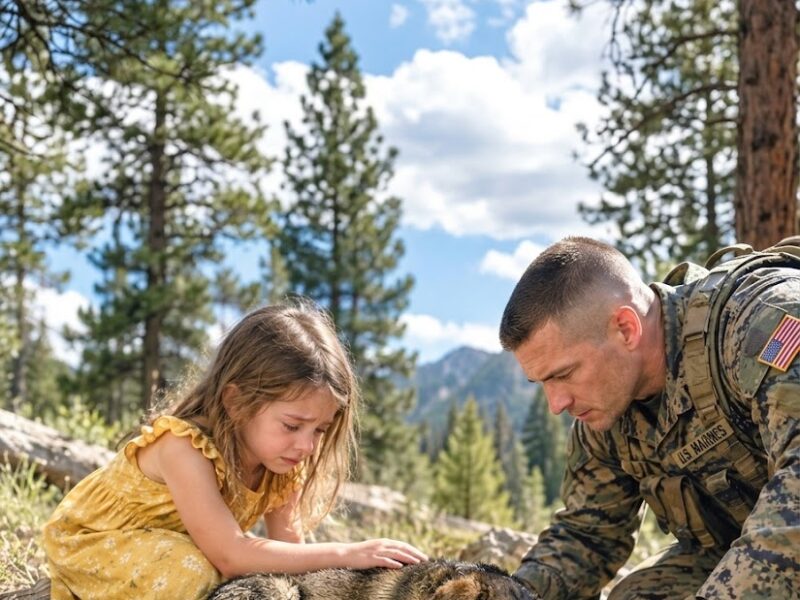
A Marine’s daughter found a puppy on a mountain—what he was running from changed everything.
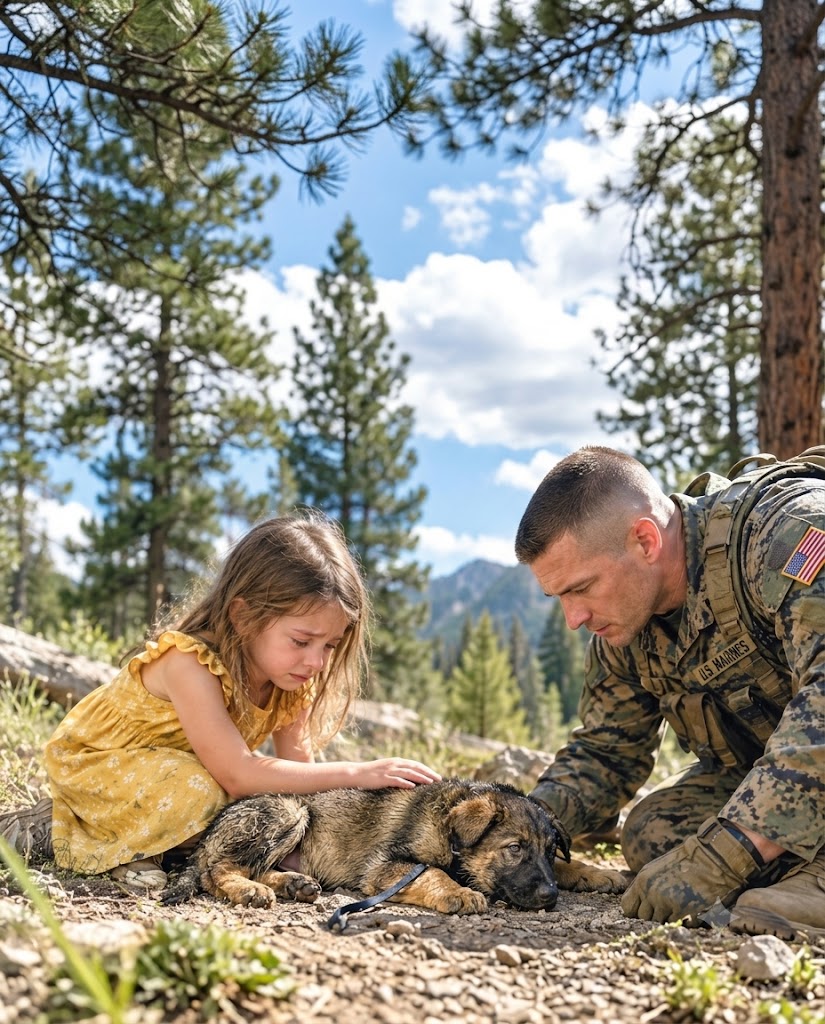
The morning sun spilled golden light across the Colorado mountains outside Estes Park, chasing long shadows beneath the lodgepole pines.
Two days of rain had left the forest floor dark and damp, thin ribbons of water still running beside the old service road.
Staff Sergeant Ryan Cole walked several steps behind his eight-year-old daughter, Emma, neither of them speaking.
Ryan was thirty-nine, six feet tall, broad through the shoulders, with the compact build of a man shaped by years in the United States Marine Corps.
His dark brown hair was clipped close along the sides, and a faint scar near his left eyebrow was the only visible reminder of an old training accident he rarely discussed.
That morning, he wore jeans, hiking boots, and a faded olive jacket because he wanted the day to feel ordinary.
Ordinary had become surprisingly difficult.
Ryan had returned home only three weeks earlier after several months away on military duty, and he had expected his daughter to meet him exactly where they had left off.
She had not.
Emma Cole was eight years old, small for her age, with light brown hair that fell past her shoulders and serious hazel eyes that noticed things adults often missed.
She wore a yellow summer dress beneath a light cardigan because she had insisted that sunshine meant summer, regardless of the cool mountain air.
Before Ryan’s latest deployment, Emma had been the kind of child who filled silence simply because silence existed.
Since he had returned, she had become quieter around him—not angry, not exactly distant, just careful.
Ryan had spent enough years reading people under pressure to recognize when someone was holding something back.
Unfortunately, understanding that about his daughter did not tell him how to fix it.
He had planned the hike because Emma used to love coming into the mountains with him.
So far, she had mostly walked ten feet ahead.
“You doing okay?” Ryan asked, adjusting the small backpack on his shoulder.
Emma nodded without turning around.
“Want some water?”
Another nod, but she kept walking.
Ryan nearly smiled.
That was apparently the level of conversation they were working with.
The trail followed an abandoned forestry road that curved gradually through tall lodgepole pines.
For the first forty minutes, nothing unusual happened.
Emma stopped once to examine a bright blue feather beside the trail, then pointed toward a squirrel disappearing around a tree trunk.
Each small moment gave Ryan hope that the wall between them was beginning to crack.
Then she became quiet again.
They reached a wide bend where the mountains opened beyond the trees, and Ryan checked his watch.
It was nearly time to turn around—he had promised Emma lunch in town.
She had already started walking toward the trailhead when she suddenly stopped.
Ryan nearly walked into her.
“What is it?”
Emma did not answer.
She was staring toward the right side of the road.
A large pine had fallen sometime during the recent weather, its roots lifting a wall of dark earth from the hillside.
Broken branches rested across the grass, and damp needles covered the ground beneath them.
At first, Ryan saw nothing unusual.
Then Emma stepped off the road.
“Dad.”
Something in her voice changed him immediately.
Ryan followed her gaze and saw a small shape near the trunk of the fallen tree, almost the same color as the wet ground.
Emma moved toward it.
“Wait.”
Ryan caught up before she reached the tree and placed one hand gently on her shoulder.
Now he could see it clearly—a German Shepherd puppy curled beside the trunk.
The little dog appeared to be only a few months old, its coat a mixture of black and tan, although mud had darkened much of its fur.
Its ears were still slightly too large for its head, in the awkward way young shepherds often seem to wear them.
One ear rested sideways; the other lifted weakly when Ryan approached.
Emma’s face changed immediately.
“Dead?”
“He’s alive.”
Ryan crouched several feet away.
Years in the Marines had trained him not to rush into unfamiliar situations simply because emotion demanded it, and that instinct followed him even here.
He studied the puppy before moving closer.
There was no obvious serious injury.
One front leg showed a minor scrape, and the animal looked exhausted, but Ryan saw its chest rising steadily.
The puppy opened its eyes.
They were dark, alert, and far more focused than Ryan expected.
“It’s okay,” Ryan said quietly.
The puppy did not try to stand.
Ryan moved closer and held out the back of his hand.
The German Shepherd watched him—no growl, no attempt to retreat, just exhaustion.
Emma lowered herself beside Ryan.
“Can I touch him?”
Slowly, she extended one hand.
The puppy’s eyes followed it until Emma’s fingers touched the fur along its shoulder.
The little dog remained still.
Emma began gently stroking its back.
Ryan watched her face.
For the first time all morning, she had forgotten to keep something between herself and him.
Her entire attention belonged to the animal.
“He must be thirsty, probably.”
Ryan removed a collapsible bowl from his backpack and poured a small amount of water into it, placing it near the puppy instead of forcing it closer.
At first, nothing happened.
Then the puppy lifted its head—the movement required more effort than Ryan liked.
It sniffed the bowl and drank slowly.
Emma looked up.
“We can’t leave him.”
“We’re not leaving him.”
That was the first answer Ryan had given all morning that made her expression soften.
While the puppy drank, Ryan examined the area around the fallen tree.
There was no food container, no backpack, no person nearby, no vehicle visible through the trees.
What caught his attention instead was something hanging beneath the puppy’s neck.
Ryan carefully moved the damp fur aside.
A narrow blue leash was still attached to the collar—except it was only part of a leash, perhaps eighteen inches remaining.
The other end was torn and frayed.
Ryan held it between two fingers.
That bothered him.
A puppy wandering away from a campground was one thing.
A puppy traveling through wet mountain terrain with a broken leash was another.
Attached to the collar was also a small metal tag.
Ryan wiped mud from the surface with his thumb.
Most of it had been scratched badly enough that he could not read it.
There seemed to be letters underneath, perhaps even numbers, but dirt filled the grooves.
He would need better light and something to clean it with.
Emma noticed him studying it.
“Does it say his name?”
“I can’t tell.”
She looked disappointed.
Ryan slipped the tag back beneath the collar.
“We’ll figure it out.”
The puppy finished drinking and lowered its head again.
Ryan touched its side carefully.
The little dog was thin beneath the wet coat, and its lack of energy concerned him more than the small scrape on its leg.
Whatever had happened, it had not happened five minutes earlier.
This puppy had been outside for some time.
Ryan looked toward the trees.
The old road continued uphill beyond the fallen pine, eventually disappearing around the mountain.
There were dozens of places the dog might have come from—cabins, campgrounds, private property, old service trails.
Perhaps someone was searching for it even now.
Ryan stood.
“We’re taking him back.”
Emma nodded immediately.
Ryan removed his jacket and folded it around the puppy before lifting it carefully.
For the first few seconds, the German Shepherd did exactly what Ryan expected—it remained limp against his chest.
Then something changed.
The puppy’s head lifted, its ears moved forward.
Ryan thought it had noticed Emma, but it wasn’t looking at her.
It was staring over Ryan’s arm toward the mountain.
The puppy shifted weakly.
“Easy.”
It pushed against Ryan’s chest, trying to turn.
Ryan adjusted his grip.
The little dog looked past him toward the old road leading higher into the forest.
Then it struggled again—not with enough strength to escape, only enough to make its intention unmistakable.
Emma stepped closer.
“Dad, he wants to go back.”
Ryan looked toward the trees.
The forest appeared completely ordinary—sunlight moving through the branches, water dropping occasionally from pine needles, nothing moving on the road.
Nothing explained why an exhausted puppy that had finally found water, warmth, and people would be trying to return toward the mountain.
Ryan began walking toward their vehicle.
The puppy kept looking backward.
Emma stayed beside him now instead of ten feet ahead.
After several steps, she reached up and touched the puppy’s head.
Ryan glanced down at her.
She had tears in her eyes, but her voice was steady.
“Dad.”
“Yeah.”
“You help people when they need you.”
Ryan waited.
Emma looked at the small German Shepherd in his arms.
“Can you help him, too?”
Ryan felt something tighten quietly in his chest.
He had spent weeks wondering whether his daughter still understood why he had been gone, whether she resented the uniform, whether she had begun seeing his absence before she saw him.
But standing on that mountain road, Emma was looking at him differently.
Not like a Marine.
Not even like a man who always knew what to do.
Like her father.
Ryan looked down at the exhausted puppy.
“We’re going to try.”
Emma moved closer until her shoulder touched his arm, and together they continued toward the truck.
Behind them, the mountain remained quiet, but the puppy never stopped looking back.
—
The veterinary clinic sat on the quieter eastern edge of Estes Park in a low stone building surrounded by cottonwoods still dripping from the recent rain.
By the time Ryan Cole pulled into the small parking lot, the bright mountain morning had begun to fade behind a bank of thin gray clouds.
The German Shepherd puppy had grown quieter during the drive.
Wrapped in Ryan’s olive jacket on the back seat, he rested with his head against Emma’s leg, but every few minutes his eyes opened and shifted toward the rear window as though he were still keeping track of the mountains behind them.
Emma had barely spoken during the drive, but she had kept one hand near the puppy the entire way.
She did not hold him tightly or crowd him—she simply rested her fingers on the edge of the jacket where he could see them.
Ryan noticed the difference.
That morning, Emma had walked several steps ahead of him, as if silence were easier than conversation.
Now, she sat close enough that her shoulder touched his seat whenever he turned.
The puppy had somehow done in less than an hour what Ryan had been trying to do for three weeks.
He had given them something neither of them needed to explain.
Dr. Hannah Brooks met them at the side entrance.
Hannah was forty-two, medium height and lean, with dark auburn hair pulled into a loose knot and the calm expression of someone who had spent years dealing with frightened animals and worried owners at the same time.
She wore navy scrubs beneath a gray clinic jacket, and a thin pair of reading glasses hung from a cord around her neck.
Hannah had worked around the mountain communities west of Loveland for nearly fifteen years.
She was patient by nature, but several seasons of treating animals brought in after storms, wildfires, and hiking accidents had given her a practical directness.
She rarely promised that everything would be fine before she knew it would be, and Ryan appreciated that immediately.
She took one look at the small bundle in his arms and opened the examination room door.
“Let’s get him warm and take this slowly.”
Ryan placed the puppy on a padded table while Emma climbed onto a chair beside it.
Hannah worked without rushing.
She checked his breathing, gums, temperature, paws, and the small scrape on his front leg.
The puppy watched every movement carefully.
He never snapped or tried to hide, but his body remained tense whenever Hannah touched an unfamiliar place.
Ryan recognized the difference between aggression and uncertainty.
This dog was not fighting anyone.
He was deciding whether they could be trusted.
Hannah finally straightened and pulled off her gloves.
“He’s exhausted and dehydrated. There are a few minor scrapes, and that front leg is sore, but I’m not finding anything that looks seriously damaged.”
Emma released a breath Ryan had not realized she was holding.
“So, he’s going to be okay.”
Hannah looked at her before answering.
“He has a very good chance. He needs fluids, food, warmth, and rest. Mostly rest.”
Emma nodded solemnly, as if she had just been assigned an official responsibility.
Hannah estimated the puppy was around thirteen weeks old.
His condition suggested he had been outside for at least a full day, perhaps longer depending on where he had come from.
Recent rain had lowered nighttime temperatures in the higher country, and a young dog could become exhausted quickly if it kept moving across steep ground without enough food or water.
Ryan glanced toward the puppy.
That explanation matched what he had seen beside the fallen pine.
What it did not explain was why the little dog had kept trying to look back.
Hannah moved him into a kennel lined with thick towels and placed a shallow dish nearby.
Emma immediately pulled her chair closer to the door.
Ryan expected her to grow restless after several minutes.
She did not.
When Hannah brought a small portion of soft food, the puppy sniffed it and turned his head away.
“That’s okay,” Hannah said. “We don’t need to force him.”
Emma looked through the kennel door.
“He drank for us on the mountain.”
“He may still be overwhelmed.”
Emma considered that for a moment, then slid from the chair and sat cross-legged on the floor.
She pushed the water bowl a little closer to the kennel entrance and moved backward until there was space between herself and the dog.
Ryan watched without saying anything.
The puppy lifted his head.
He looked at the bowl, then at Emma.
Several seconds passed.
Finally, he moved forward and began drinking.
Emma smiled, but she did not reach for him.
Hannah glanced at Ryan.
“She has good instincts.”
Ryan looked at his daughter.
“She always has.”
Emma pretended not to hear, but the corner of her mouth lifted slightly.
While the puppy settled again, Ryan removed the collar and broken blue leash.
In the clinic light, the metal tag was easier to examine than it had been beneath the trees.
Mud covered the grooves, and several scratches crossed its surface.
Hannah handed Ryan a damp cloth and a small soft brush.
He cleaned it carefully.
Letters began to appear—first a P, then several more.
Ryan turned the tag beneath the overhead light.
Pine Ridge.
Below the words was a stamped code: S17.
Emma leaned closer.
“Is that where he lives?”
“Maybe.”
Hannah had stopped beside the counter, her expression changed.
“I know that name.”
Ryan looked up.
Hannah took the tag and studied it.
“Pine Ridge Canine Recovery Center. It’s farther into the mountains, north of one of the old forestry access roads.”
Ryan remembered the closed route sign they had passed earlier that morning.
The road had been partly covered with mud, and a county barrier redirected traffic away from the upper section.
“What kind of place is it?”
“Small, mostly German shepherds and shepherd mixes. Some abandoned dogs, some working dogs that couldn’t stay in their previous homes, some younger animals that need socialization before adoption.”
Hannah set the tag down.
“The woman who runs it is Grace Miller.”
Ryan waited.
Hannah thought for a moment before continuing.
Grace Miller was sixty-three, a small, wiry woman with short silver hair and the stubborn independence of someone who had built most of her adult life around animals rather than convenience.
She had operated Pine Ridge for years and was known in the area for taking dogs that required more time than crowded shelters could provide.
Hannah described her as kind but fiercely self-reliant.
After losing her husband several years earlier, Grace had thrown even more of herself into the rescue, sometimes refusing help long after common sense suggested she should accept it.
“I’ve treated a few of her dogs,” Hannah said. “She keeps good records.”
Ryan looked toward the puppy.
“So S17 could be one of hers.”
“It could.”
Emma frowned.
“He needs a real name.”
Ryan smiled faintly.
“You have one?”
She studied the young shepherd through the kennel door.
His muddy coat had begun drying into its natural black and tan pattern, making him look younger than he had on the mountain.
“Scout?”
Ryan raised an eyebrow.
“Scout, because he found us.”
Ryan almost corrected her—technically, they had found him—but Emma looked certain.
“Scout, it is.”
At the sound of her voice, the puppy lifted his head.
Ryan reached for his phone.
Hannah found a number for Pine Ridge in the clinic records.
Ryan dialed it and held the phone to his ear.
The call rang until voicemail picked up.
He tried again.
Nothing.
Hannah gave him a second number listed for the property.
Ryan called again.
No answer.
The third attempt ended the same way.
That did not automatically mean anything was wrong.
Ryan knew that remote mountain properties lost service.
People worked outdoors.
Phones were forgotten on counters.
Still, he looked through the clinic window toward the ridge line.
Hannah seemed to read the thought.
“The rain two nights ago caused several slides above town. Nothing catastrophic, but enough to close some roads.”
Ryan turned back.
“How high does Pine Ridge sit?”
“High enough that the access could be worse than what you saw down here.”
He remembered the barrier again—the brown water crossing the pavement, the heavy branches stacked along the roadside.
Scout’s torn leash suddenly felt less like an isolated clue.
Emma remained beside the kennel.
“Can we call someone else?”
Ryan looked at her.
“We’ll figure out who needs to be called right now. He needs to rest.”
Emma accepted the answer, although reluctantly.
Hannah returned to the front computer and searched through older patient records.
Ryan stayed near Scout while Emma whispered the new name several times, apparently testing whether it fit.
A few minutes later, Hannah stopped typing.
“Ryan.”
He crossed the room.
She turned the monitor toward him.
An old intake record showed the same identification code: S17.
Beside it was a name.
Scout.
Ryan stared at the screen.
Emma leaned around him, her eyes widened.
“His name really is Scout.”
Hannah nodded.
“It looks that way.”
Emma immediately turned toward the kennel.
For the first time since entering the clinic, the puppy’s tail moved once against the towel.
Ryan could not decide whether it was coincidence, but the name had settled something.
Scout belonged somewhere.
The question was where that somewhere stood now.
Before Ryan could ask Hannah for more details, a dog barked from the rear treatment area.
Scout’s reaction was immediate.
His head snapped up.
A second bark followed.
Scout struggled to his feet.
“Easy,” Ryan said.
The puppy ignored the food bowl.
He moved toward the kennel door, favoring his sore leg but refusing to lie back down.
Another dog barked.
Scout pressed his nose toward the gap near the latch.
Then he scratched once against the door.
Emma stood.
“Scout.”
The puppy scratched again.
Ryan moved closer.
This was not the expression he had seen when Hannah examined him.
Scout was not frightened of the sound.
He was focused on it, waiting for it.
A dog farther down the hall barked again, and Scout gave a small anxious whine before looking toward the doorway.
Hannah folded her arms.
“That’s interesting.”
Ryan looked at her.
“He did the same thing on the mountain.”
“What do you mean?”
“When I picked him up, he kept trying to turn back toward the upper trail.”
Hannah’s eyes shifted toward the broken leash and metal tag resting on the counter.
Scout scratched the kennel door again.
Emma placed her hand against the outside of the bars.
“He wants to go back.”
Ryan did not answer immediately.
He looked at the Pine Ridge record on the computer, then at the silent phone on the counter, then finally at the young German Shepherd standing when his body was clearly asking him to rest.
Perhaps Scout simply recognized the sound of other dogs.
Perhaps he missed the place he had come from.
Perhaps the silence from Pine Ridge meant nothing more than poor mountain service after heavy rain.
Ryan preferred those explanations—they were simple.
But Scout had walked through wet mountain country until he could barely continue.
He had been found with a broken leash.
And now, in a warm clinic with food, water, Emma beside him, and every reason to finally sleep, the little dog was still looking toward the door.
Ryan rested one hand against the kennel.
For the first time, he wondered whether Scout had not been trying to escape the mountain at all.
Maybe he had been trying to leave it long enough to find someone.
And maybe whatever he had left behind was the reason he still refused to rest.
—
The next morning arrived cool and bright over Estes Park, but the mountains still carried the damage of the recent rain.
Low clouds clung to the higher ridges, and thin streams of runoff crossed several roads outside town.
Ryan Cole had slept badly.
Every time he closed his eyes, he saw Scout standing inside the veterinary kennel—weak on one leg but still turning toward the door whenever another dog barked.
By sunrise, Ryan had stopped treating the silence from Pine Ridge as something he could simply ignore.
Dr. Hannah Brooks had kept Scout overnight for observation.
When Ryan and Emma returned to the clinic shortly after seven, the puppy looked stronger than he had the day before.
His coat had been cleaned, revealing a handsome black and tan pattern beneath the dried mud, and his oversized ears now stood more confidently above his narrow young face.
He still favored one front leg slightly, but Hannah was satisfied that the problem was soreness rather than anything serious.
Scout was allowed short periods of careful walking as long as Ryan did not let him overexert himself.
Emma entered the kennel room first.
Scout rose immediately, his tail moving against the towel.
That reaction settled the argument before Ryan had even started having it with himself.
Scout trusted Emma—not completely, perhaps, but more than anyone else.
Ryan had already made one call that morning.
The man who answered was Mark Dalton, a fifty-five-year-old ranger assigned to the district around the northern mountain access roads.
Mark was tall and spare, with weathered skin, a graying beard trimmed close to his jaw, and the patient posture of someone who had spent most of his adult life waiting for weather, animals, and hikers to reveal what they intended to do.
He had worked the area for nearly twenty-seven years.
A rescue involving two lost teenagers early in his career had changed the way he approached mountain emergencies.
Since then, Mark was known for being cautious without becoming fearful.
He never treated urgency as an excuse to make a second problem.
Ryan met him outside the clinic.
Mark studied the Pine Ridge identification tag in Ryan’s hand.
“I know the property.”
Ryan looked toward him.
“Can we reach it?”
“Not by the normal road.”
Mark explained that a slide had blocked most of the upper forestry access route after the rain.
County crews had inspected the lower section, but they had not reopened it.
Pine Ridge sat beyond the damaged area, farther back against the mountain where smaller service roads divided through the trees.
“No emergency call?” Ryan asked.
“None.”
“Any contact with Grace Miller?”
Mark shook his head.
“Not since before the weather moved through.”
That concerned Ryan more than he wanted to show.
Mark added that no one had reported injuries or requested evacuation.
The problem was simpler and in some ways more frustrating—nobody knew the current condition of the property.
Ryan looked through the clinic window.
Scout was standing beside Emma.
“I want to check the road.”
Mark nodded once.
“So do I.”
Emma heard enough of the conversation to understand what was happening.
“I’m coming.”
Ryan turned.
“No.”
Her expression hardened immediately.
“Scout won’t go without me. He’ll go with me.”
Scout chose that moment to move closer to Emma’s leg.
Mark looked at the puppy, then at Ryan.
Ryan did not appreciate the timing.
“Dad. The upper road was damaged. You said we were checking it.”
“We are.”
“Then I can stay in the car.”
Ryan crossed his arms.
Emma copied him.
For one brief second, Ryan almost saw his own stubbornness standing eight feet away wearing a yellow cardigan.
Mark saved them both.
“We’re not driving into the damaged section,” he said. “We can take my vehicle to the lower closure. That’s still considered safe. We assess from there. If conditions aren’t right, nobody goes farther.”
Ryan looked at him.
Mark understood the question in his expression.
“I wouldn’t suggest otherwise.”
Ryan finally agreed, but he added his own rule.
“If I say we’re done, we’re done.”
Emma nodded.
Ten minutes later, they left the clinic with Scout wearing a new harness Hannah had provided.
The broken blue leash and Pine Ridge tag remained in Ryan’s backpack.
Scout walked between Ryan and Emma across the parking lot, slowly but with more confidence than the day before.
Mark’s ranger vehicle carried them north of town.
As they climbed, neighborhoods disappeared behind them.
Pine forest replaced houses, and the pavement narrowed until it became a maintained mountain road.
Evidence of the storm appeared gradually—small piles of rock along drainage ditches, mud staining the lower trunks of several trees.
In one place, a maintenance crew had cut through a fallen branch that once covered half the road.
Emma watched everything through the window.
Scout rested beside her.
Then Mark turned onto the route where Ryan had found the puppy.
Scout stood.
Ryan noticed immediately.
The puppy’s ears came forward.
His entire posture changed.
“Slow down,” Ryan said.
Mark eased off the accelerator.
When the vehicle reached the turnout near the fallen pine, Scout began moving toward the door.
Emma touched his harness.
“He knows this place.”
Ryan did not disagree.
They stepped outside.
The forest looked different in daylight.
The fallen pine was still there.
The patch of earth where Scout had been lying remained visible beside the trunk, although fresh morning wind had scattered needles across it.
Scout sniffed the ground once.
Then he turned away from the road.
He pulled gently toward a narrow opening between the trees.
Mark looked in that direction.
“Old maintenance trail.”
Ryan barely saw it.
Tall grass and low brush had covered most of the entrance.
If Scout had not pulled toward it, Ryan might have walked past without noticing anything.
They followed.
Scout moved slowly at first.
Ryan kept the lead loose enough for him to choose direction but short enough to stop him if the terrain became difficult.
Every twenty or thirty yards, the puppy paused.
Sometimes he sniffed the ground.
Sometimes he simply stood there breathing before continuing.
Emma stayed beside him.
Nobody rushed.
Several minutes into the trail, Scout left the center and moved beneath a low pine.
He stopped.
Mark crouched near the trunk.
The ground there was flattened.
Pine needles had been pushed aside, leaving a shallow patch of exposed soil protected from the rain by the branches overhead.
Ryan looked at Scout.
“You rested here.”
Scout sniffed the spot and moved on.
The next clue appeared farther uphill.
A section of old wire fencing crossed the edge of the trail where vegetation had grown around it.
A few strands of black and tan fur had caught against a bent section near the bottom.
Mark touched them lightly.
“Looks recent.”
Ryan studied the small opening beneath the fence.
Scout had probably squeezed through it.
The puppy waited several yards ahead as though impatient with their investigation.
Emma smiled faintly.
“He already knows what happened. We’re the ones trying to catch up.”
Ryan looked at her.
That sounded more like the Emma he remembered.
They continued.
The trail climbed gradually, never dangerously steep but difficult enough that Ryan began watching Scout more carefully.
The puppy’s determination made it easy to forget he was still recovering.
They reached a narrow creek running clear between stones.
Scout stopped near the bank.
Several faint paw impressions remained in a patch of soft earth above the water.
Mark measured the spacing with his eyes.
“Small dog moving downhill.”
Ryan looked back toward the direction they had come.
“How far from here to the road?”
Mark considered it.
“Over a mile if he stayed on this trail. And Pine Ridge still a long way up.”
Scout lowered his nose to the water.
Ryan gave him a small amount from the bottle instead.
The puppy drank, rested for several minutes, then stood again.
Emma watched him.
“He didn’t know anyone would find him.”
Ryan glanced at her.
“No, he just kept going.”
Ryan had no answer for that.
By late morning, they had followed enough of the route for Mark to estimate the distance.
“Depending on where he started, close to four miles.”
Emma stared at Scout.
“Four miles in mountain terrain,” Mark said. “Maybe more if he wandered at all.”
Ryan looked at the puppy, but Scout did not behave like an animal that had wandered.
Every turn had been deliberate.
Every time the trail divided, he chose without hesitation.
That realization stayed with Ryan as the path became narrower.
Ahead, storm runoff had cut across part of the trail.
Nothing dramatic, but the ground beyond it was uneven and less suitable for Emma.
Ryan stopped.
“We turn back.”
Emma looked at him.
“We’re close.”
“We don’t know that.”
Scout pulled toward the upper trail.
Ryan shortened the lead.
“That’s enough for today.”
Emma’s face closed again—the same expression Ryan had seen since returning home.
He expected an argument.
Instead, she looked down.
“You always say that.”
Ryan paused.
“Say what?”
“That you have to go.”
The forest became strangely quiet around them.
Mark glanced toward the trail ahead and deliberately moved several yards away, giving them privacy without announcing it.
Ryan lowered himself to Emma’s level.
“This isn’t about me leaving.”
Emma finally looked at him.
“It feels like it.”
Ryan said nothing.
She picked at the sleeve of her cardigan.
“When you come home, everybody gets happy. Grandma gets happy. I get happy. And then I start wondering when you’re leaving again.”
Ryan felt the words more deeply than he expected.
Emma continued before she lost the courage.
“So sometimes I don’t want to get too happy.”
Ryan understood.
She had not become quiet because she loved him less.
She had become careful because loving the moments when he returned made the next goodbye harder.
Ryan had spent weeks trying to fix the wrong problem.
He reached for her hand.
“I can’t promise I’ll never have to leave for work again.”
Emma’s eyes dropped.
Ryan continued.
“And I’m not going to promise something I can’t control.”
She looked back at him.
“But I can promise you something else.”
Emma waited.
“When I’m home, you won’t have to wonder whether you matter to me. And when I’m away, you won’t have to wonder then, either.”
Her eyes filled slightly.
Ryan squeezed her hand.
“I should have told you that before.”
Emma stepped forward and wrapped both arms around him.
Ryan held her—not for a second, not because he wanted to hurry back to the problem waiting on the mountain.
He simply stayed there.
Scout sat beside them.
When Emma finally stepped away, she wiped her face quickly and looked embarrassed.
Ryan did not mention it.
Mark returned a moment later.
He pointed toward the upper trail.
“We don’t need to go farther today to know what matters.”
Ryan looked at him.
Mark gestured toward Scout.
“That puppy came a long way down this mountain.”
Ryan looked at the flattened resting place behind them, the fur caught on the fence, the paw prints beside the creek, and the trail Scout had followed without hesitation.
Four miles, perhaps more.
Scout had been tired enough to collapse by the time Emma found him, yet he had kept moving until his body simply could not continue.
Ryan looked uphill.
Somewhere beyond the trees was Pine Ridge.
Scout stood and faced that direction again.
This time Ryan did not see a lost puppy looking toward home.
He saw an animal that had traveled with purpose.
Scout had not crossed four miles of mountain terrain by accident.
He had been going somewhere.
And whatever waited at the end of that road mattered enough that he had refused to stop.
—
By the time Ryan, Emma, Mark, and Scout reached the upper side of the mountain, the trail had narrowed into a rough strip between the pines.
The morning light had grown brighter, but the recent storm had left the forest uneven and heavy with moisture.
Broken branches lay across the ground, and runoff had carved shallow channels through the dirt.
Mark led them around the worst sections, never allowing the group to move faster than Scout could comfortably manage.
Then the trees opened.
Pine Ridge K-9 Recovery Center appeared below them in a small mountain clearing.
Ryan stopped.
From a distance, the property looked almost peaceful—several low buildings stood around a fenced central yard, their roofs dark against the green forest.
But the closer Ryan looked, the more damage became visible.
A large pine had fallen across part of the outer fence, bending one section nearly flat.
A small storage building had lost part of its roof covering.
Mud and loose rock covered the main access road so completely that no vehicle could have reached the property from below.
Then came the barking.
Scout reacted before anyone else.
The puppy pulled against the lead so suddenly that Ryan had to shorten it.
“Easy.”
Scout ignored the word.
His ears stood forward, his tail lifted.
The exhaustion that had slowed him along the trail seemed to disappear for a few seconds.
Emma looked toward the buildings.
“They know him.”
Ryan could not be sure of that, but the barking had changed.
Several dogs were answering from different parts of the property.
Mark moved toward the front gate and called out.
No one responded immediately.
Ryan noticed there were no lights inside the nearest building.
A small utility pole stood beside the drive, but one section of wire disappeared beneath fallen branches.
Mark tried again.
This time, a door opened.
A woman stepped outside.
Grace Miller was sixty-three, short and thin, with silver hair cut just below her ears and the weathered face of someone who had spent most of her life outdoors.
She wore an old brown work coat over a flannel shirt and moved with the careful stiffness of someone who had slept too little for too many nights.
Her hands were rough from years of handling leashes, feed bags, gates, and repairs around the property.
Grace was known for being stubbornly independent, but not unfriendly.
After her husband died several years earlier, she had devoted nearly all of her time to Pine Ridge.
The work had become both her purpose and the place where she avoided admitting how much help she sometimes needed.
When she saw Mark, relief appeared first.
Then she saw Scout.
Grace stopped moving.
“Scout.”
The puppy pulled harder.
Ryan loosened the lead enough for him to approach.
Scout crossed the yard as quickly as his recovering leg allowed.
Grace crouched and opened both hands.
The moment he reached her, Scout pressed his head against her chest.
Grace closed her eyes.
“I thought you were gone.”
Emma watched silently.
Ryan glanced at Mark.
That single sentence answered one question—Scout belonged here.
Grace stood slowly and looked at Ryan.
“You found him?”
Ryan nodded.
“Four miles down the mountain.”
Grace stared at Scout.
For several seconds, she said nothing.
Then she looked toward the damaged fence.
“That tree came down during the rain. I found the opening afterward.”
She had assumed Scout escaped through it when the weather frightened the younger dogs.
Ryan looked around the property.
“How long have you been without power?”
“Since yesterday morning. The radio stopped working not long after.”
Cell service had come and gone.
Grace had managed to send a few messages, but she had no way of knowing whether any of them were received.
Two part-time workers had left before the storm worsened because the lower road was already becoming unstable.
Grace stayed behind with more than a dozen dogs.
She had spent the night moving blankets, checking water, and keeping the more nervous animals inside.
Mark studied the blocked road.
“You should have had someone up here.”
Grace gave him a tired look.
“I did.”
Mark understood the answer—herself.
Ryan recognized something in that immediately.
He had seen the same instinct in Marines who believed asking for help meant becoming someone else’s burden.
He had carried some version of it home with him.
Grace turned back toward Scout.
“He wasn’t alone here.”
Emma looked up.
“What do you mean?”
Grace hesitated.
“Scout has a mother. Her name was Daisy.”
Daisy was a five-year-old German Shepherd with a black saddle, tan legs, and a calm, protective nature.
Grace described her as one of the easiest dogs at Pine Ridge to trust.
She had arrived at the center months earlier with four young puppies, including Scout.
Daisy had recovered quickly in the quieter mountain environment, but she rarely allowed her puppies far from her sight.
Scout also had three littermates still at Pine Ridge.
They had been staying in a recovery section behind the main kennels.
Emma looked immediately toward the rear buildings.
“So, his family is still here.”
Grace nodded.
“Unless something changed during the night.”
Ryan noticed the way she said it—not dramatic, not panicked, but uncertain.
That uncertainty bothered him.
Scout heard Daisy’s name.
Or perhaps he simply recognized the direction Grace had looked.
Either way, his attention shifted.
He turned away from Grace toward the rear section.
Then he began pulling.
“Scout,” Emma called.
He did not look back.
The puppy headed toward the buildings behind the main yard.
Ryan followed several steps.
Grace frowned.
“That’s where Daisy and the others were staying.”
Ryan looked at Scout.
The puppy had just crossed four miles of mountain country, reached strangers, survived long enough to be found, and then led those strangers back.
Now that he had returned to Pine Ridge, he was not seeking food.
He was not trying to stay near Grace.
He was trying to reach the back kennels.
Something began to settle into place in Ryan’s mind.
Grace seemed to reach the same thought more slowly.
“He didn’t just run away.”
Ryan looked at her.
Grace’s eyes moved toward the damaged fence.
“I thought the storm scared him.”
Scout pulled again.
Emma stood beside Ryan.
“He was going somewhere.”
Nobody answered.
They did not need to.
Later, while Mark examined the damaged access road, Grace sat for several minutes on the front step.
Scout remained restless nearby.
Ryan joined her.
Grace admitted something she had told almost no one.
She had been considering closing Pine Ridge.
Donations had fallen.
Repairs kept increasing.
She was getting older, and after years of insisting she could manage almost everything herself, even ordinary work had begun taking longer.
“I kept thinking if I worked harder, I’d catch up.”
Ryan looked toward the yard.
“I know that feeling.”
Grace gave him a tired smile.
Emma had been listening from several feet away.
She looked at Grace.
“If you needed help, why didn’t you tell people?”
Grace opened her mouth, then stopped.
It was such a simple question that every complicated answer suddenly sounded weak.
Ryan looked at his daughter.
For the second time in two days, Emma had said something that reached farther than she intended.
Grace followed Scout with her eyes.
The puppy was still facing the rear of the property, still waiting.
Ryan now understood one thing clearly.
Scout had not traveled down the mountain simply because he wanted to get away from Pine Ridge.
He had come down because something here still mattered to him.
And whatever that was, it was waiting somewhere behind the main buildings.
—
Mark Dalton made the call from the front edge of the Pine Ridge property, where the signal briefly returned whenever he stood near the higher ground above the damaged access road.
Within forty minutes, a small county rescue crew began working its way toward the center from the lower side of the mountain.
Three responders arrived on foot first, carrying blankets, portable lights, drinking water, and lightweight transport crates.
They were experienced with storm-damaged trails and animal evacuations, dressed in bright weather jackets and heavy boots.
They worked with the quiet efficiency of people who understood that rushing often created more problems than it solved.
The plan was simple.
The dogs in the safest kennels would be checked first, then moved gradually toward a temporary staging area near the main building.
From there, once the lower access route was made passable enough, they could be transported down the mountain in small groups.
Grace Miller walked beside Mark, identifying which dogs were older, which ones became anxious around strangers, and which ones needed to be moved carefully.
She looked exhausted, but now that other hands had arrived, some of the tension in her shoulders finally began to ease.
Scout, however, refused to settle.
Ryan kept him on the new harness Hannah had provided, but the thirteen-week-old German Shepherd repeatedly turned toward the rear section of the property.
He would follow Ryan for several steps, then stop and look back.
When another dog was carried toward the staging area, Scout barely noticed.
His attention remained fixed beyond the main kennel building.
Emma noticed it, too.
“He keeps looking at the same place.”
Ryan followed Scout’s stare.
Behind the rear building, fallen branches and washed-down soil covered what looked like an old walkway.
Ryan shortened the lead.
“Let’s see what he’s trying to show us.”
Scout moved immediately.
He crossed the yard more quickly than he had at any point since returning to Pine Ridge, although Ryan kept him from pulling too hard on his recovering leg.
When they reached the blocked rear passage, Scout stopped at the edge of the debris.
Then he began pawing at the loose soil.
“Scout.”
Ryan drew him back gently.
The puppy moved forward again.
He pawed at the same place.
Grace approached behind them.
“That path goes to the recovery kennels.”
Ryan looked at her.
“The section Daisy was in.”
Grace nodded.
She had checked the front approach earlier, but runoff had collapsed part of the narrow walkway between the buildings.
She believed the recovery kennels still had access from the far side of the property.
Scout scratched again.
Then everyone stopped.
A faint sound came from beyond the branches—not loud, just enough.
Scout immediately became still.
Emma looked at Ryan.
“There’s something back there.”
Grace’s face changed.
She stepped closer to the blocked path.
“Daisy.”
Mark came over.
Grace explained that Daisy and her three remaining puppies had been placed in the rear recovery section because it was normally quieter than the central kennels.
Daisy was a five-year-old German Shepherd with a broad black saddle across her back, warm tan legs, and large brown eyes that rarely missed movement around her puppies.
She was gentle with people she trusted, but motherhood had made her especially watchful.
Grace described her as patient rather than nervous—the kind of dog that positioned herself between her puppies and anything unfamiliar without making a scene.
The night before, Grace had believed the far exit remained open.
Mark walked around the building and returned several minutes later.
“It isn’t. A large pine fell across the outer route sometime during the night. The front is blocked by washed-down soil. The back is blocked by the tree.”
Grace closed her eyes briefly.
“I didn’t know.”
Ryan looked toward the debris.
Nobody blamed her.
There had been too many problems happening at once.
Mark studied the slope below the kennel building.
“We can reach the far side from lower ground.”
Ryan nodded.
“I’ll go with you.”
Emma immediately stepped forward.
Ryan looked at her before she could ask.
“You stay here.”
This time she did not argue—perhaps because she understood from his expression that this was different from the trail earlier.
Grace remained with Emma near the safe staging area while Ryan and Mark followed the lower edge of the property.
The route was longer, but it avoided the damaged walkway.
They moved carefully through wet grass and around several fallen branches until they reached the rear wall.
A narrow service door was still accessible.
Mark opened it.
Inside, the air was cool and dim.
Ryan heard movement from one of the kennels.
They found Daisy near the back.
She was lying with her body positioned along the front of the kennel while three small German Shepherd puppies remained close behind her.
The puppies were younger looking than Scout, only because exhaustion made them seem smaller.
One was mostly black across the back.
Another had lighter tan markings around the face.
The third had a crooked left ear that refused to stand completely upright.
Daisy lifted her head when Ryan approached.
She looked tired but alert.
“Hey, girl.”
Ryan stayed several feet away.
Daisy watched him.
Mark called Grace from the doorway and confirmed that all four dogs were alive.
Grace’s relief was immediate.
Ryan moved slowly, allowing Daisy time to watch every step.
She did not resist when he opened the kennel.
Her attention remained on the puppies.
“We’re taking everybody together.”
The first puppy was small enough for Ryan to carry against his chest.
Mark took the second.
They returned along the safer route.
Emma saw them first, her entire face changed.
“Scout.”
Scout pulled forward.
Ryan lowered the puppy into a blanket near Grace.
Scout sniffed his littermate immediately.
Then he turned toward the rear building again.
“He knew.”
The next trip brought out the remaining puppies.
Emma removed her yellow cardigan and wrapped it loosely around the smallest one, while Grace showed her how to keep the puppy comfortable without holding it too tightly.
“Just let her rest against you,” Grace said.
Emma nodded.
She sat completely still.
Ryan saw her from across the yard.
There was no fear in the way she handled the little dog.
No need to prove anything.
She simply did what Grace had shown her.
Ryan had spent much of his adult life around people who defined courage through action—moving forward, taking responsibility, stepping into difficult situations.
Watching Emma, he understood another version of it.
Sometimes courage looked like staying calm when something smaller depended on you.
On the final trip, Ryan and Mark returned for Daisy.
Ryan walked beside her rather than carrying her.
Daisy moved slowly but willingly, stopping once to make sure Mark still had the last puppy close behind.
When they reached the yard, Scout froze.
Daisy saw him.
Her tired posture changed immediately.
Scout hurried forward as far as Ryan allowed.
Then Ryan released the lead.
Scout crossed the short distance between them.
He stopped directly in front of his mother.
Daisy lowered her head.
Scout touched his nose to hers.
For several seconds, neither dog moved.
Grace covered her mouth with one hand.
Emma held the smallest puppy against her cardigan.
Mark looked toward the mountain trail Scout had crossed.
Ryan understood now.
Scout had escaped through the damaged fence, but he had not found shelter.
He had not stayed near the property.
He had gone down four miles through unfamiliar mountain terrain until his strength was nearly gone.
Not because he understood roads, rescue teams, or emergency plans.
He had simply kept moving until he found people.
And somehow that had been enough.
A thirteen-week-old puppy had done the only thing available to him.
He had left his family behind long enough to bring someone back.
Ryan watched Scout settle beside Daisy and the other puppies.
For the first time since Emma found him beneath the fallen pine, Scout stopped looking toward the mountain.
He had returned to what he had been searching for.
And this time, his family was no longer waiting alone.
—
By the time the last transport vehicle left Pine Ridge that evening, every dog on the property had been accounted for.
None were missing.
None had been left behind.
The clearing that had been filled with barking, movement, and hurried footsteps finally grew quiet as the remaining rescue team packed equipment near the damaged road.
Grace Miller stood beside the empty kennel building for a long time, looking through the open doors as though she was still counting dogs in her head.
Mark Dalton checked the transport list twice before folding it into his jacket pocket.
Ryan understood the habit.
After a day like that, sometimes certainty had to be written down before the mind was willing to accept it.
Daisy, Scout, and the three other puppies were taken to Dr. Hannah Brooks’s clinic for observation.
Daisy was exhausted but stable, and the puppies needed little more than warmth, food, fluids, and sleep.
Scout, however, refused to settle at first.
He paced inside his kennel, stopping every few seconds to look toward the adjoining room.
Hannah finally moved Daisy and the other puppies into kennels where Scout could see them.
The change was immediate.
Scout sat down.
Daisy lifted her head from her blanket.
Scout watched her for another minute, then curled into the corner and fell asleep so quickly that Emma smiled through tired eyes.
Ryan stood behind his daughter.
For two days, Scout had seemed incapable of fully resting.
Now Ryan understood why.
The puppy had finally reached the end of the journey he had started on the mountain.
Word about Pine Ridge spread through Estes Park over the next several days.
It did not become the kind of story Grace would have wanted anyone celebrating around her.
Instead, help simply began arriving.
Bags of dog food appeared outside the clinic.
People brought blankets, cleaning supplies, and fuel.
A local construction company volunteered labor and materials to repair the damaged roof.
Residents who had never visited Pine Ridge before offered trucks and tools.
Mark reorganized the rescue’s emergency contact system.
He installed a more reliable backup radio arrangement and created a storm check-in plan so Grace would no longer have to depend on one phone signal during bad weather.
Grace resisted at first—not because she did not appreciate the help, but because accepting it felt unfamiliar.
Ryan recognized that immediately.
He recruited several Marine veterans from the area to help clear the damaged fence line and rebuild the section where the tree had fallen.
They worked over two weekends moving posts, carrying lumber, and repairing gates while Grace followed behind them trying to find tasks that nobody had already completed.
Eventually, Ryan caught her standing beside a stack of unused tools.
“You don’t have to do all of it.”
Grace looked toward the repaired fence.
“I’ve been doing all of it for a long time.”
Ryan nodded.
“Maybe that’s the problem.”
Grace looked at him, then laughed quietly.
It was the first time he had heard her laugh.
For Ryan, helping rebuild Pine Ridge became more than volunteer work.
He understood Grace’s habit because he had lived a version of it himself.
Responsibility had always meant carrying the load, solving the problem, staying strong long enough that nobody else needed to worry.
Emma had begun teaching him something different.
Sometimes responsibility also meant letting people stand beside you.
Pine Ridge reopened gradually.
The damaged roof was repaired.
The main road was cleared.
The kennels were cleaned, the power restored, and the new emergency system tested twice.
Grace no longer talked about closing.
She still worked long days, but she stopped pretending every problem belonged only to her.
Over the following weeks, Daisy and the puppies recovered fully.
The three other puppies were adopted first.
Grace carefully chose homes that could handle young German Shepherds, turning down several applications because she believed the right home mattered more than a fast one.
Daisy took longer.
Eventually, she went to a quiet family outside Fort Collins with a fenced yard and an older shepherd who seemed perfectly content to share the porch with her.
Then only Scout remained.
Grace assumed he would stay at Pine Ridge.
Ryan never asked to take him.
Emma did not either.
That surprised him.
She visited Scout whenever they helped at the center, brushed his coat, threw toys across the yard, and sat beside him while Ryan worked on the fence.
But she never said he belonged to her.
Perhaps she had learned something from Scout, too.
Love did not always mean keeping.
One Saturday afternoon, Ryan finished securing the final hinge on a rebuilt gate.
It was done.
Emma waited beside the truck.
Ryan called goodbye to Grace and started across the yard.
Scout was playing near the kennel building.
Grace watched him.
“Scout.”
The puppy stopped.
Ryan opened the passenger door for Emma.
Scout looked at Grace.
Then he looked at Emma.
He ran.
He crossed the yard, passed Ryan completely, and sat beside Emma’s legs.
Emma froze.
Scout looked up at her.
Grace folded her arms.
“Well.”
Ryan stared at the puppy.
Emma looked at Grace.
“Is he allowed to do that?”
Grace smiled.
“I think he already did.”
The adoption paperwork was completed soon afterward.
Ryan made one decision immediately.
Scout would not become a working dog.
He had already spent enough of his young life being brave.
Ryan wanted him to learn something simpler.
How to be a puppy.
Scout became very good at it.
He carried sticks too large to fit through the back door.
He hid toys beneath the sofa and then stared accusingly at Ryan until someone retrieved them.
He slept outside Emma’s bedroom and waited at the foot of the stairs every morning for her to come down.
Emma changed, too.
She still knew Ryan’s work might take him away again someday.
Ryan never lied about that.
Instead, he made the time he was home matter.
Weekend hikes returned.
Breakfast became something they ate together instead of separately.
Sometimes Emma talked for an hour.
Ryan learned not to interrupt simply because he thought he already understood the point.
By late summer, the three of them returned to the mountain trail where Emma had first found Scout.
The road was dry now.
Wildflowers grew beside the place where rainwater had once crossed the trail.
Emma ran ahead.
Scout followed her.
Ryan walked behind them.
When they reached the fallen pine, Scout stopped.
For several seconds, he stared at the place where he had once lain exhausted beside the trunk.
Emma returned and placed a hand on his head.
Scout looked toward the upper mountain—the same direction he had once refused to stop watching.
Then he turned away from it.
Emma ran back toward Ryan.
Scout followed her.
Ryan watched them coming.
This time, Scout did not need to lead anyone anywhere.
He was simply going home.
Several days later, a letter arrived from Grace.
Inside was a photograph of Daisy lying in the grass beside her new family’s porch.
She looked healthy, relaxed, and completely at ease.
Emma turned the photograph over.
Grace had written one sentence on the back.
“Scout didn’t only save them. He brought everyone together.”
Ryan placed the photograph on the living room table beside another picture taken that summer.
Emma stood in the center.
Ryan was beside her.
Scout sat between them.
Ryan looked at both photographs for a long moment.
Scout’s journey down the mountain had saved Daisy and the other puppies, but it had also saved Pine Ridge from disappearing.
It had taught Grace that asking for help did not make her weaker.
And somewhere along the way, a small German Shepherd had helped a father and daughter find their way back to each other.
Scout had left the mountain looking for someone who would turn back with him.
In the end, he found something he had never been searching for—a home of his own.
—
You know what stays with me most about Scout’s story?
It wasn’t the broken leash or the four-mile mountain trail.
It was realizing Scout had never been running away.
He was running for help because Daisy and three tiny puppies were still waiting behind him.
Scout could have stopped beneath a tree or hidden beside the creek.
Instead, he kept moving through mud, cold, and exhaustion until Emma found him.
That kind of loyalty does not measure distance.
It only remembers who is waiting.
That kind of love is a prayer with paws.
Maybe that was what God wanted Ryan and Emma to see.
Ryan thought the mountain trip might repair the distance between them, but Scout showed them that love often begins by turning back for someone else.
Emma saved Scout.
Scout led them back to Daisy.
Grace accepted help, and Ryan learned how to be more present for his daughter.
And Scout found something, too.
He went down the mountain searching for help for his first family and ended up finding another one.
With Emma and Ryan, he finally had a home where he could rest, play, and simply be a puppy instead of always having to be brave.
Tonight, I pray God blesses you, protects the people you love, strengthens you when the road feels too long, and gives you the heart to notice those quietly waiting for someone to turn back.
I pray he brings healing into the places you do not talk about, peace into your home, and second chances where you thought there were none left.
If Scout’s story touched your heart, write amen in the comments.
And if you believe in loyalty, faith, family, and second chances, subscribe and stay with us.
But Scout’s story was not the last time a German Shepherd crossed impossible ground because someone else needed saving.
Next, I want to tell you about a retired Navy SEAL who found an aging canine standing alone beside an abandoned ranger station in the Colorado Mountains.
The dog had a faded service tag, a weather-damaged backpack, and one reason he refused to leave the trail behind him.
What that SEAL discovered beyond the treeline would lead him to a missing handler, two stranded puppies, and a promise that had been waiting years to be kept.
Subscribe now, because the next story begins with one old dog standing in the rain, staring at a trail nobody else wanted to take.









