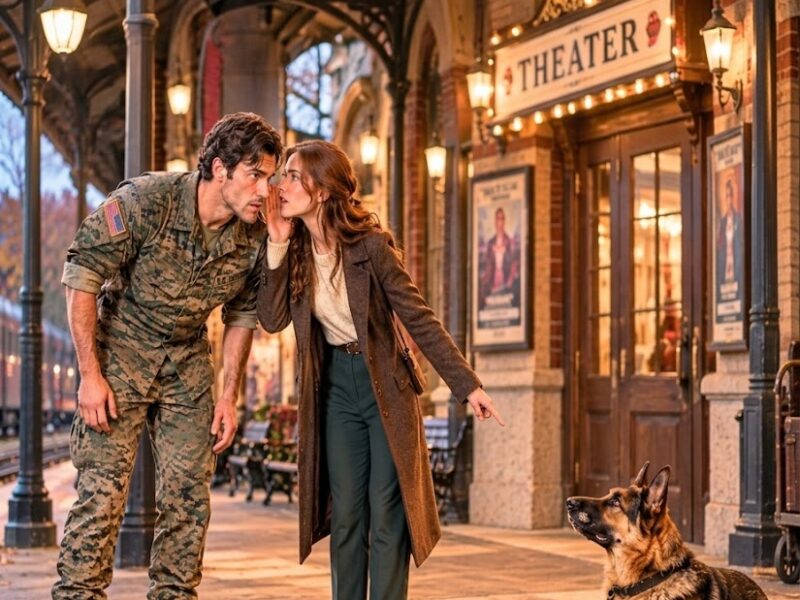
A Marine was about to leave alone. He’d learned not to expect anyone to stay. Then a woman saw his K9 — and whispered four words: “I know him.”
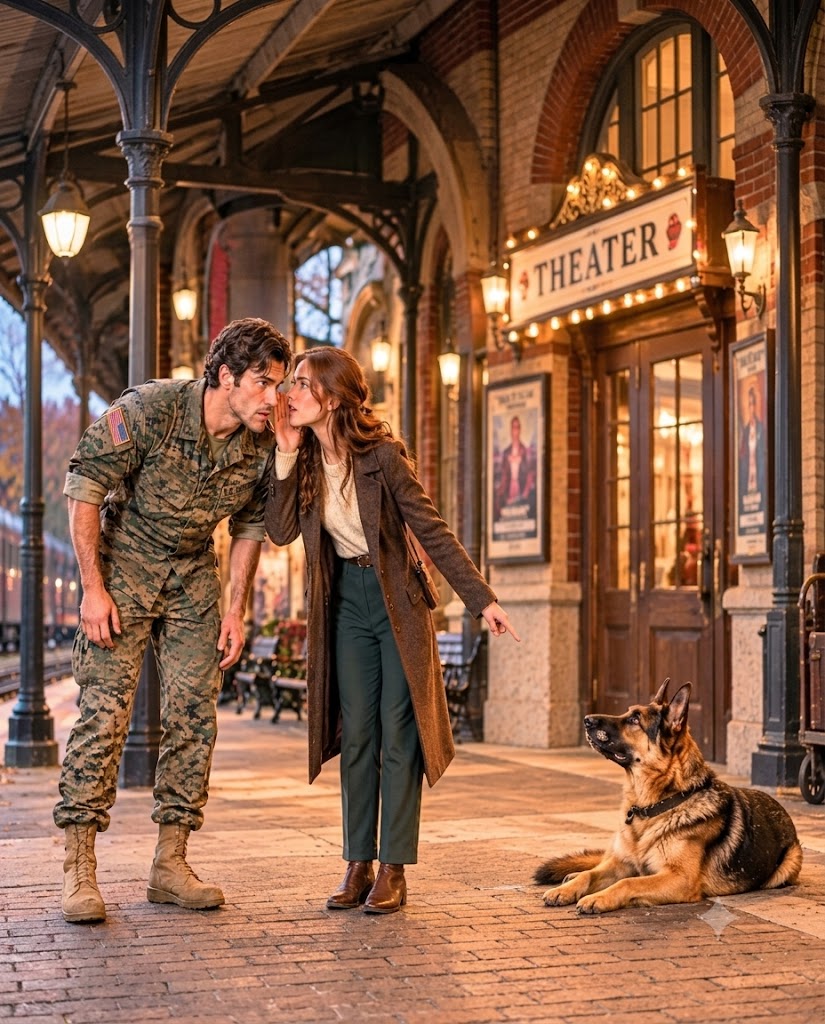
The woman he came to meet never showed up.
After nearly 40 humiliating minutes, the U.S. Marine finally stood to leave—until his German Shepherd, Orson, gave a single bark from the hallway.
A beautiful young woman heard it and suddenly froze.
She followed the Marine to his canine, stared at the faint scar behind the dog’s left ear, then whispered, “Five years ago, this dog wouldn’t let anyone near him.”
The Marine went completely still.
He had no memory of ever meeting her.
So how did this stranger know something about his canine that almost no one else knew?
Late October had turned Rowanoke cold after sunset, the old brick streets shining beneath a thin mist as wind moved through the dark Blue Ridge foothills.
At 7:35 p.m., warm light still glowed from the restored railway station downtown.
Staff Sergeant Lachlan Reeve sat behind the wheel of a faded moss-green 1997 Ford F-150 and stared through the windshield as though the building across the street required reconnaissance instead of a clean shirt and the willingness to meet a stranger.
At 32, Lachlan was tall—just over 6’2″—with the lean, hard build of a man whose strength came from years of use rather than a gym mirror.
His dark brown hair was kept short along the sides but slightly longer on top, enough to fall out of perfect order when the wind caught it.
Gray-blue eyes sat beneath straight brows, and a strong jaw, clean-shaven that evening, gave his face a sharper severity than his quiet temperament deserved.
People who served with him knew something different.
Lachlan rarely raised his voice, remembered the names of junior Marines other men overlooked, and was usually the last person to leave when somebody needed help.
He simply had no idea what to do when the person needing something was himself.
His phone buzzed on the console.
A message from the Marine who had registered him for tonight’s charity matchmaking event appeared on the screen: *You’re already there. Don’t you dare drive home.*
Lachlan almost laughed. *Traitor.*
A soft breath came from behind him.
Orson, his six-year-old German Shepherd, occupied the rear of the extended cab, watching him with amber-brown eyes.
The dog was large without being oversized—black and tan with a deep charcoal saddle across his back, wrecked ears, and the controlled stillness of an animal accustomed to reading a room before entering it.
A narrow scar disappeared into the fur behind his left ear.
Age had taken none of his alertness, though experience had replaced much of his younger restlessness with patience.
“You’re not helping.”
Orson blinked.
Lachlan finally opened the door.
The event occupied the main hall of the old station, now converted into a community arts center.
Music played quietly beneath conversations, and small tables stood beneath restored iron beams and tall arched windows.
Lachlan had arranged for Orson to rest in a secure staff area behind the main hall, where dogs belonging to volunteers and working handlers could stay away from the crowd.
Orson inspected the space once, circled his mat, and settled without complaint.
Lachlan wished adapting were that easy for him.
At table 14, two chairs faced one another.
One remained empty.
Ten minutes passed. Then twenty.
Lachlan resisted checking his phone again.
Around him, conversations gathered momentum. Somebody laughed near the old ticket counter. A couple at the next table had already discovered they both hated cilantro.
Across the room, volunteers carried trays of coffee between tables while Lachlan adjusted the cuff of his dark charcoal button-down and told himself there were considerably worse things than being stood up by someone he had never met.
At thirty-seven minutes, a young volunteer approached.
She could not have been older than twenty—slight and nervous, with blonde hair pulled into a loose ponytail and an event badge hanging crookedly from her neck.
“Mr. Reeve?”
Lachlan stood automatically, which only seemed to make her more uncomfortable.
“Yes, ma’am.”
“I’m really sorry. We finally reached your match.” She swallowed. “She had something come up and apparently sent a cancellation through the registration system, but it didn’t process correctly.”
For a fraction of a second, Lachlan felt something tighten beneath his ribs.
Then came the reflex he had perfected over years: *Make it easier for the other person.*
“No problem. She should have told us sooner. It’s all right.”
The volunteer looked relieved.
Lachlan even gave her a small smile before she left.
Only after she disappeared did he look at the chair opposite him—empty.
He had known casualty notifications that arrived with less ceremony.
He had spent nights beside Marines who were frightened but refused to say so.
In those moments, Lachlan always knew what was required: Stay steady. Handle the next problem. Do not leave until the person beside you can stand without you.
Ordinary life offered no such instructions.
Nobody needed him at table 14, and that strangely hurt more than he wanted to admit.
Across the hall, Serin Bellamy had been watching him.
At twenty-eight, Serin was striking without seeming aware of it—shoulder-length chestnut hair falling in loose natural waves around a fine-boned face, clear green eyes, and fair skin warmed by a faint scatter of freckles across her nose.
She was slender but not fragile, moving through the crowded room with the composed efficiency of someone accustomed to solving five problems while appearing troubled by none.
As the center’s event coordinator, she had spent most of the evening answering questions, finding misplaced name cards, and preventing a temperamental coffee urn from becoming the night’s main attraction.
Yet she had looked toward table 14 more than once.
Not because the man had been abandoned—because something about him bothered her memory.
The angle of his face when he looked down. The stillness, perhaps. The eyes.
Every time Serin almost reached for the memory, it slipped away.
Lachlan finally put on his jacket and headed toward the rear corridor rather than crossing the crowded hall again.
Serin watched him disappear through the service doorway.
She told herself to let him go.
Then a single bark sounded from somewhere beyond the corridor.
Serin stopped.
It was not loud or frantic—just one deep, controlled bark.
Something inside her went cold.
She left the clipboard on the counter and followed.
Lachlan had almost reached the staff area when he heard footsteps behind him.
“Excuse me.”
He turned.
Serin stood several feet away. “Were you here with a dog?”
Lachlan’s expression changed subtly. A German Shepherd now—he was watching her carefully. “Yes.”
Serin swallowed. “Can I see him?”
Lachlan did not answer immediately.
There was something in her face that had not been there across the crowded hall.
Not excitement. Certainly not fear.
Recognition was too strong a word, but it was close.
He opened the staff area door.
Orson was already standing.
The German Shepherd looked first at Lachlan, then at Serin.
His ears shifted forward.
Serin stopped just inside the doorway, leaving several feet between herself and the dog.
She did not call to him. She did not reach out.
Her gaze moved slowly over Orson, studying him with an intensity Lachlan could not understand.
Then it stopped behind his left ear.
Serin’s breathing changed.
A thin scar was almost hidden beneath the fur.
For an instant, the warm corridor seemed to disappear from her face. Her fingers curled at her sides, and something old and painful surfaced in her expression.
Lachlan noticed.
“What is it?”
Serin looked at Orson again.
When she spoke, her voice had dropped almost to a whisper.
“Five years ago, this dog wouldn’t let anyone near him.”
Lachlan went completely still.
There were very few people who knew what had happened five years ago, and the woman standing in front of him was not one of them.
At least he had always believed she wasn’t.
His gaze moved from Serin to the scar behind Orson’s ear, then slowly back to her face.
“Who are you?”
Serin did not answer Lachlan immediately.
She kept her eyes on Orson as though the scar behind his left ear had opened a door she had spent five years believing was permanently closed.
“My name is Serin Bellamy,” she finally said. “And I think I met both of you before.”
Lachlan studied her.
Nothing in her face belonged to his memory.
That bothered him more than he wanted to show.
“Where? A hospital?”
The word brought no recognition.
Serin glanced toward the empty corridor behind them.
The charity event was winding down beyond the closed doors, its music now little more than a muffled rhythm.
“It was five years ago. My brother was seventeen. His name was Theo Bellamy.”
At seventeen, Theo had been a lanky, long-limbed boy with unruly chestnut hair, pale skin, and the kind of restless energy that made sitting still feel like punishment.
He loved bicycles, hated being fussed over, and had spent most of adolescence testing the limits of both gravity and his older sister’s patience.
On that night, five years earlier, a wet curve and a badly timed turn had ended with Theo being rushed into a Virginia hospital with injuries serious enough that nobody would tell Serin whether he would be all right.
She had been twenty-three and terrified.
While doctors worked on Theo, Serin wandered toward the intake area because remaining beside the surgical doors had become unbearable.
That was where she first heard the German Shepherd—not barking, but panting. Fast, harsh breaths coming from an animal fighting pain and confusion.
Orson had been barely a year old then.
Blood darkened the fur behind his left ear, and his young body trembled with contained panic.
He had been brought in following a training accident involving the Marine assigned to him, but separation had frightened him almost as much as the injury.
Whenever someone unfamiliar moved too close, his muscles tightened and his breathing accelerated.
Serin watched trained personnel manage the situation carefully.
Nobody behaved recklessly, and nobody asked her to intervene.
She simply recognized fear—maybe because she was full of it herself.
She sat several feet away, outside the space the handlers had established, and folded her hands in her lap.
“Easy,” she whispered.
The dog’s eyes flicked toward her.
One breath at a time.
She repeated it without moving closer.
She did not offer a hand. She did not pretend she knew anything about treating an injured working dog.
She only gave him one quiet voice that asked nothing of him.
Gradually, the frantic rhythm of his breathing eased.
When the veterinary personnel approached again, Orson remained tense but manageable enough to be moved for treatment.
“I never touched him,” Serin told Lachlan in the present. “I didn’t even know his name. I just remember the wound behind his ear.”
Lachlan looked toward Orson.
A fragment shifted somewhere in his memory.
Not Serin’s face—but fluorescent light, pain medication, and the repeated question he had asked everyone who came near him.
“Where’s my dog?”
Serin continued.
Lachlan had arrived that same night after the training accident.
His shoulder had been injured badly enough to require immobilization, and blood loss had left his skin gray beneath the hospital lights.
Part of his training blouse had been cut away so medical staff could reach the injury.
He had been exhausted, medicated, and waiting to be transferred to a military medical facility, but he had remained awake largely because nobody had yet convinced him Orson was safe.
Hours later, Serin was sitting alone outside surgery.
She held a paper cup of water between both hands because they would not stop shaking.
That was when Lachlan noticed her.
He had no reason to stop. He was injured himself. A transport team was expected for him, and the pain in his shoulder was beginning to push through whatever medication they had given him.
Still, he sat one chair away.
Serin remembered staring at the floor.
“My brother’s in there.”
Lachlan had nodded. “How old?”
“Seventeen.” She tried to drink and nearly spilled the water. “What if he dies?”
Lachlan did not tell her he wouldn’t.
He did not know.
Instead, he reached with his uninjured hand and nudged the cup back toward her before it slipped from her fingers.
“You don’t have to survive tomorrow tonight.”
Serin looked at him.
“Just the next minute.”
She had stared at him as though the words were too small for what was happening.
Lachlan had apparently understood.
“One minute,” he repeated, “then another.”
So she tried.
One minute, then another.
Whenever her mind raced toward funerals, empty bedrooms, or phone calls to relatives, the wounded Marine beside her quietly brought her back to the hallway, the chair beneath her, and the next sixty seconds.
He stayed until a surgeon finally appeared.
The doctor was a compact, middle-aged man with tired eyes and silver beginning at his temples.
Serin remembered almost nothing about him except the sentence that mattered.
Theo had made it through surgery.
Serin broke down so suddenly she almost missed Lachlan standing.
Nurses surrounded her. Someone called another family member.
Relief became noise and movement.
And when Serin finally looked toward the chair beside her again, Lachlan was being prepared for transfer.
She never properly asked his name.
By morning, he was gone.
Days later, after Theo had stabilized, Serin asked hospital staff about the injured Marine who had sat with her.
Privacy rules meant they could not provide another patient’s identity or contact information.
She tried more than once afterward, working from scraps of memory, but *injured Marine with a German Shepherd* was not enough to find a stranger who had never expected to be found.
Back in the staff area, Lachlan said nothing for several seconds.
He hated that he could not give Serin the reaction she deserved.
“I’m sorry,” he finally said. “I barely remember it.”
Serin gave a small shake of her head. “You don’t have to apologize. I sat with you, and I don’t remember your face. You were hurt.”
“That doesn’t make it feel better.”
A softness entered her expression.
“Lachlan, for you, it was probably one bad night among a lot of bad nights.” She glanced at Orson. “For me, it was the night my little brother lived.”
That silenced him.
Serin slowly lowered herself into a crouch several feet from Orson.
The German Shepherd watched her, alert but composed, one ear angled forward, his nose lifted slightly as he sampled the air.
Serin kept both hands close to herself.
“Easy,” she said softly.
Orson remained still.
One breath at a time.
Something changed.
Not recognition in any way Lachlan could name.
Orson did not rush toward her or suddenly behave like a dog greeting an old friend.
He simply watched longer than before.
Then he took one step.
He stopped and smelled the air again.
Another step brought him within reach, but Serin still did not touch him.
Orson lowered his nose to her offered fingers only after she slowly opened one hand.
He smelled them.
His shoulders loosened.
Then, with quiet deliberation, the German Shepherd moved closer and rested the side of his head against her palm.
Serin’s breath caught behind her.
Lachlan felt the last of his doubt give way to something far more unsettling.
He could not know what Orson remembered—her scent, her voice, the cadence of those words, or nothing more than the calm of the moment itself.
But Serin had known about the scar.
She had known about his fear.
And she had known the exact words that had once helped a frightened young German Shepherd become still.
Five years ago, Lachlan Reeve had forgotten a girl in a hospital hallway.
Standing there now, watching Orson quietly accept her hand, he realized the night had not forgotten him.
By the time Orson lifted his head from Serin’s hand, the music beyond the staff corridor had stopped.
Chairs scraped across the old station floor as volunteers cleared the last tables.
And somewhere near the main entrance, a lock turned for the night.
Serin rose slowly.
Lachlan expected the moment to end there.
A strange story had been explained. An old debt acknowledged. Two people who had once occupied the same terrible night could return to their separate lives.
That would have been simple.
Instead, Serin looked toward the empty hall and asked, “Do you want some coffee before they throw it out?”
Lachlan glanced at Orson.
The German Shepherd had already settled near Serin’s feet.
“Apparently, I’m outvoted.”
Serin smiled, and something about that smile made leaving suddenly less attractive.
They took their coffee to one of the small tables beneath the station’s tall arched windows.
Orson lay between them, four paws crossed, occasionally raising his head when Serin spoke.
The room looked different without the crowd.
Lachlan found he preferred it that way.
For the first few minutes, they talked about Theo because that was the safest territory between them.
“He’s twenty-two now,” Serin said.
She pulled out her phone and found a photograph.
The teenager Lachlan had known only as a name outside an operating room had become a healthy young man with broadening shoulders, the same unruly chestnut hair, and an open, energetic expression.
He wore a Navy EMT training shirt and stood beside an ambulance with one thumb hooked proudly toward the vehicle.
“He’s studying to become an EMT. Almost finished with the program.”
Lachlan studied the photograph longer than necessary.
After what happened to him—maybe because of what happened to him.
Serin explained that Theo remembered very little about the first hours after his accident, but he remembered the people who appeared once he began recovering.
The nurses who learned which jokes made him laugh.
The therapist who refused to let him quit.
The paramedic who visited weeks later just to see whether the stubborn kid from the roadside had made it.
Somewhere in that recovery, Theo decided he wanted to become the person arriving on someone else’s worst day.
Lachlan handed the phone back. “Sounds like he turned out all right.”
“He did.” Serin paused. “So did I, eventually.”
Her thumb moved absently along the edge of the phone.
“When things got bad afterward, I kept using what you told me.”
Lachlan knew immediately which words she meant.
“Just the next minute.”
Serin nodded.
“College exams, Theo’s rehab, my mother getting overwhelmed, job interviews—sometimes stupid things that only felt enormous at two in the morning.”
A faint smile touched her mouth.
“You probably said it once.”
“I barely remember saying it once.”
“I’ve said it hundreds of times.”
That landed harder than Lachlan expected.
His life had trained him to measure usefulness in visible outcomes.
A task completed. A Marine brought home. A problem fixed.
He had never considered that a sentence could leave him and continue existing somewhere else.
“You make me sound wiser than I was.”
“No.” Serin smiled. “You were exhausted, injured, and a little grumpy. That sounds more accurate.”
“And kind.”
Lachlan looked down at his coffee.
*Kind* was somehow harder to accept than *brave.*
Their conversation gradually moved away from five years ago.
Serin told him how she had taken the art center job expecting it to last six months and stayed because she loved watching an old railway station become a place where people gathered again.
Lachlan told her less about deployments than she expected and more about the Marines he worked with—the young ones who pretended not to be homesick and the older ones who pretended their knees still worked perfectly.
Serin laughed.
He liked the sound.
That realization arrived quietly enough to be dangerous.
He began noticing things that had nothing to do with the hospital.
The way Serin listened without preparing her next sentence.
How she tucked her hair behind one ear when amused.
How she never filled silence simply because it existed.
She, in turn, began seeing someone beyond the wounded Marine she had preserved in memory.
Lachlan was drier, funnier, and more guarded than the man she had imagined.
He also checked on Orson almost unconsciously every few minutes—a glance so practiced he probably did not know he was doing it.
Nearly an hour passed.
A man carrying a ring of keys approached from the far side of the hall.
Miles Ardan was thirty-four, medium-tall and lean, with sandy brown hair cut neatly around the ears, warm brown eyes, and short, carefully trimmed stubble along a narrow jaw.
As the center’s program director, he possessed the unhurried temperament of someone accustomed to solving scheduling disasters without making them feel like emergencies.
Years of working beside Serin had made their friendship easy and uncomplicated.
“There you are,” Miles said to her. “I was deciding whether to lock you in.”
“Tempting.”
His attention shifted to Lachlan, then Orson.
Serin made the introduction.
Miles shook Lachlan’s hand with an easy smile. “So, you’re him.”
Lachlan raised an eyebrow.
Miles immediately laughed. “That sounded more dramatic than intended.”
Serin gave him a warning look, but Miles was already reaching for the light switch near the doorway.
“I’m glad she finally found you,” he said. “She tried for a long time.”
Then he wished them both good night and continued toward the offices.
The words should have meant nothing more than what they said.
Instead, something inside Lachlan closed.
He walked Serin to her car.
She thanked him for staying.
And before getting in, she said, “You know, you could come back when nobody has to recognize anybody.”
Lachlan understood the invitation.
“I’d like that.”
He meant it.
That was the problem.
On the drive home, Miles’s harmless sentence kept returning.
*She tried for a long time.*
Serin had spent years searching for the Marine from the hospital.
She had carried his words with her, built meaning around a night he barely remembered.
Maybe what he had felt across that table tonight was not the beginning of something new.
Maybe it was gratitude wearing the shape of intimacy.
And if he went back expecting more, he could turn something precious to her into something awkward.
The reasoning sounded considerate.
Lachlan knew somewhere beneath it that it was cowardice dressed in better clothes.
He had become very good at leaving before anyone could ask him to.
Seven days passed. Then ten.
He did not return.
On the tenth evening, Lachlan was driving home with Orson when habit took him along the edge of downtown.
Ahead, one turn led toward the old station.
Orson had been resting in the rear of the truck.
Suddenly, he stood.
His ears came forward.
The art center was visible beyond the intersection, its arched windows glowing against the dark.
Lachlan slowed at the red light.
Orson looked toward the building, then toward him.
“Don’t start.”
Orson looked back at the station.
The light changed.
Lachlan remained still long enough for the driver behind him to tap the horn.
His hand tightened around the wheel.
*Right* would take him to Serin.
He could already imagine walking inside.
He could tell her he had been busy. He could tell the truth. He could simply ask whether the coffee was still terrible.
For one second, his hand began turning the wheel.
Then Lachlan straightened it.
The old Ford continued through the intersection.
In the rearview mirror, he saw Orson still looking back.
The glowing windows grew smaller, then disappeared.
Lachlan faced the road ahead and understood with painful clarity that nobody had left him this time.
He had done the leaving himself.
Two days after Lachlan drove past the art center without turning in, the afternoon training session ended beneath a low gray sky.
Wind moved dry leaves across the pavement as Marines filtered toward their vehicles, voices fading into the cold.
Lachlan walked with Orson at his left side, a training bag slung over one shoulder.
The German Shepherd moved at an easy pace—until, without warning, he stopped.
Lachlan took another step before noticing.
“What is it?”
Orson’s ears were forward.
His attention had fixed on two people waiting beyond the low perimeter fence near the visitor parking area.
Lachlan recognized Serin first.
The recognition brought an immediate tightening to his chest.
Then he saw the young man beside her.
Theo Bellamy was twenty-two now, no longer the lanky seventeen-year-old Serin had described from the hospital.
He had grown into his long frame, standing close to six feet with lean shoulders beginning to broaden, unruly chestnut hair, and an expressive face that made it difficult to hide whatever he was thinking.
A faint pale line near his right temple was the only visible suggestion of the accident that had nearly killed him.
There was an alertness about him that suited the EMT path he had chosen, but none of the solemnity Lachlan expected from someone arriving to meet a man attached to one of the worst nights of his life.
Theo lifted a hand.
“Staff Sergeant Reeve.”
Lachlan glanced at Serin.
She looked almost apologetic. Almost.
“Lachlan is fine.”
Theo stepped forward and offered his hand. “Theo.”
“I figured that earned a quick grin.”
“Good. This would have been awkward if she brought the wrong brother.”
Serin closed her eyes briefly. “I told you he does this when he’s nervous.”
“I’m not nervous.”
“You’ve made three jokes since we parked.”
“Four.”
Lachlan surprised himself by smiling.
Orson remained beside him, watching the newcomers.
Theo glanced down at the German Shepherd but made no attempt to touch him.
“That’s Orson.”
“Yes. My sister told me about him.”
Lachlan looked toward Serin again.
Apparently, there were many things Serin had told her brother.
Theo’s humor faded.
He put both hands into the pockets of his jacket, then seemed to reconsider and pulled them back out.
“I wanted to come because there’s something I should probably say in person.”
Lachlan waited.
Theo looked briefly toward his sister.
“She told me what happened that night. Not the medical stuff—I know who did that part.”
His eyes returned to Lachlan.
“My sister told me somebody sat with her when everybody else was busy trying to save me.”
Lachlan felt the world around them become strangely quiet.
Theo continued.
“I wanted to meet the guy who made sure she wasn’t alone.”
There was no grandness in the statement.
No suggestion that Lachlan had saved Theo’s life or changed the course of medicine with a few sentences in a hallway.
That made it harder to dismiss.
“I didn’t do much,” Lachlan said.
Theo nodded as though he had expected exactly that answer.
“Yeah,” Serin said. “You’d probably say that.”
Lachlan looked at her.
Serin folded her arms. “Stop looking at me. He’s the one talking.”
Theo smiled, then became serious again.
“You didn’t have to do much. You just had to stay.”
The sentence found a place Lachlan had spent years protecting.
He thought about missions, training reports, commendations—the measurable things by which a Marine learned to judge whether he had done enough.
None of them had prepared him for a young man standing in a parking lot thanking him for occupying a chair.
Lachlan cleared his throat. “I’m glad you’re doing well.”
“I am. I heard you’re training as an EMT.”
“Almost done.” Theo nodded toward Orson. “Maybe someday I’ll get to be the person telling somebody their brother made it.”
Lachlan understood then why Serin had looked proud when she showed him the photograph.
Theo stepped backward. “All right, I did my part.”
Serin frowned. “Your part?”
“You said you needed moral support getting here.”
“You’re here.”
“I did not say moral support.”
“You heavily implied it.”
He pointed toward her car. “I’ll be over there pretending I can’t see either of you.”
“Theo—”
“Nice meeting you, Lachlan.”
Then he walked away before his sister could stop him.
For several seconds, Serin and Lachlan stood facing one another with Orson between them.
Lachlan spoke first. “You brought reinforcements.”
“I brought my brother because he wanted to meet you.” Serin held his gaze. “And you?”
Lachlan said nothing.
“I came because you didn’t.”
There it was.
No anger. No accusation.
Somehow that was worse.
Lachlan looked toward the pavement. “Serin—”
“Why?”
He could have said work. Training. Bad timing.
Twelve days offered plenty of believable excuses.
Instead—perhaps because Theo had just thanked him for staying five years ago—lying about why he had disappeared now felt particularly ugly.
“I didn’t know what you wanted from me.”
Serin’s expression tightened. “What does that mean?”
“Miles said you’d been trying to find me.”
Understanding came slowly across her face.
Lachlan continued before courage failed.
“You spent five years remembering somebody from one night. Then I show up, and suddenly I’m sitting across from you like that means we’re supposed to—to what?”
He stopped.
Serin waited.
Lachlan exhaled.
“I didn’t know if you wanted to know me or if you wanted the Marine you remembered.”
Serin stared at him.
For the first time since he had met her, genuine irritation appeared.
“You decided what I felt without ever asking me.”
“I was trying not to make something out of gratitude that wasn’t there.”
“You could have asked.”
“I know.”
“You could have come back for coffee.”
“I know.”
“You could have sent a message.”
“I know.”
Serin took a breath and softened, though she did not let him escape.
“Yes, Lachlan. Gratitude is why I walked over to you that night.”
He nodded once, almost as if the answer confirmed everything he had feared.
Then she continued.
“It isn’t why I kept hoping you’d come back.”
Lachlan looked up.
Serin held his eyes.
“The man I remembered was injured, exhausted, and sat beside me for maybe an hour. I didn’t know what coffee he drank. I didn’t know he makes terrible jokes when he’s uncomfortable. I didn’t know he checks on his dog every thirty seconds without realizing it.”
A reluctant smile almost reached him. “I do not.”
“You absolutely do.” She stepped a little closer. “I learned those things the night we talked. I wanted *that* man to come back.”
Lachlan’s body responded before his thoughts did.
Half a step backward—small enough that another person might not have noticed.
Serin did.
So did Orson.
The German Shepherd rose.
Lachlan expected him to follow.
Instead, Orson crossed the small space between them and sat calmly beside Serin.
She looked down, then back at Lachlan.
“Your dog figured this out twelve days before you did.”
The laugh escaped him before he could stop it.
It was brief, rough, and dangerously close to something else.
Lachlan looked away, blinking once against the sting behind his eyes.
For years, he had believed leaving first was caution—courtesy, sometimes—a way to spare everyone the awkwardness of discovering he had wanted more than they did.
But Serin had crossed town to find him.
Theo had come with her.
Orson was sitting at her feet.
There was nowhere left to hide the truth.
Lachlan looked at the woman in front of him, then at the space he had instinctively created between them.
Slowly, he stepped forward and closed it again.
Serin did not smile immediately.
“Are you going to disappear for another twelve days?”
“No.”
“You sure?”
Lachlan looked down at Orson.
The German Shepherd remained exactly where he was.
“Apparently, I’m outvoted again.”
This time, Serin smiled.
And when the moment came when Lachlan would normally have found a reason to leave, he did something far more difficult.
He stayed.
Winter came slowly to Rowanoke, and whatever began between Lachlan and Serin was allowed to move just as slowly.
There were no dramatic promises after the afternoon she found him.
There was coffee after work, long walks with Orson, and ordinary evenings that gradually became harder for Lachlan to imagine losing.
Serin learned that Lachlan repaired things when his mind was crowded.
Some evenings, she sat near the open garage while he worked beneath the hood of the old Ford, asking questions she already knew would receive unnecessarily technical answers.
Lachlan learned that Serin became quiet when tired rather than irritable, that she hated overly sweet coffee, and that she could spend twenty minutes choosing a movie only to fall asleep before the ending.
Theo became part of the rhythm, too.
He occasionally appeared with takeout after EMT classes, challenged Lachlan to fix things that did not need fixing, and developed an ongoing argument with him over whether the 1997 Ford was a classic or simply old.
Orson adjusted without ceremony.
At first, he lifted his head whenever Serin arrived.
Later, he began waiting near the door around the time she usually came.
Sometimes, he carried a worn rubber toy to her and dropped it nearby.
On evenings when Lachlan went into the garage, Orson no longer automatically followed.
More than once, Lachlan returned inside to find the German Shepherd asleep beside Serin’s feet.
He never mentioned how much that affected him.
Seven months after the night at the art center, Serin invited him to dinner.
“Small,” she promised.
“How small, Theo?”
“A few relatives.”
“Me.”
“That definition of small keeps expanding.”
“You’ll survive.”
Lachlan smiled.
But on the evening of the dinner, he arrived at Serin’s house exactly on time and did not get out of the truck.
The Ford idled at the curb.
Through the front window, he could see the dining room glowing beneath warm lights.
Figures moved inside.
Theo crossed the room carrying something and disappeared toward the kitchen.
Nothing was wrong.
That was precisely the problem.
Lachlan could walk into danger with a clear mind because danger told him who he needed to be.
A family dinner offered no assignment, no rank, and no useful role to hide inside.
It simply asked him to belong.
Orson sat beside him, watching the house.
“I’m tired,” Lachlan murmured.
The dog looked at him.
“Early morning tomorrow.”
Orson continued looking.
“We can reschedule—”
Lachlan put one hand on the gear shift.
His phone illuminated the console.
One message from Serin.
*No.*
*Where are you?*
*No.*
*Everyone is waiting.*
No demand for an explanation.
Four words.
*Just the next minute.*
Lachlan stared at them.
Five years earlier, he had given those words to a frightened twenty-three-year-old woman because tomorrow had been too large for her to survive all at once.
Now Serin had returned them.
He did not need to become comfortable with belonging tonight.
He only needed the next minute.
Lachlan switched off the engine.
The sudden silence inside the truck was enormous.
He looked at Orson.
“All right.”
He opened the door.
This time, Serin did not come outside to find him.
She did not have to.
Lachlan walked to the house himself.
Nearly a year after their first meeting, the restored railway station hosted the fundraiser again.
Lachlan noticed table 14 before Serin did.
“Seriously?” he asked.
She followed his gaze and laughed. “Apparently, somebody has a sense of humor.”
They sat.
Orson settled quietly between them.
Around the hall, strangers introduced themselves beneath the same iron beams.
Coffee moved between tables.
Nervous laughter rose from people hoping that perhaps tonight would become important.
Lachlan looked across at Serin.
There was no empty chair.
“A year ago,” he said, “I sat right about here, thinking that chair told me everything I needed to know.”
Serin rested her chin lightly against her hand. “What did it tell you?”
“That I’m useful when something goes wrong.” He paused. “But maybe not somebody people choose when nothing is wrong.”
Serin’s expression softened.
He could say it now without trying to disguise it as something more reasonable.
“I thought somebody not showing up proved I was right.”
“You were wrong before you even sat down.”
Lachlan raised an eyebrow. “How?”
Serin glanced toward Orson before looking back at him.
“Someone had already been hoping to find you for five years.”
For a moment, Lachlan heard everything around them—the low music, glasses touching tables, footsteps crossing old wood.
Then it seemed to recede.
A year earlier, he had spent forty minutes staring at an empty chair, measuring his worth by the absence of a stranger.
Only a few yards away had been a woman who had carried his words for five years.
The thought would once have frightened him.
Now it made him smile.
Several years later, the moss-green Ford still occupied half the garage.
Serin had suggested selling it twice.
Lachlan had refused twice.
Theo, now a working EMT, maintained that both of them were wrong and the truck belonged in a museum.
He had grown into the profession with the same restless energy he had carried as a teenager, tempered now by the patience required to kneel beside frightened strangers and make the worst moments of their lives feel survivable.
By then, Lachlan and Serin were married.
Orson had grown older with them.
Gray had begun spreading around the German Shepherd’s muzzle, and he rose more slowly after long naps.
But he retained one habit with remarkable consistency.
He preferred resting somewhere he could see both Lachlan and Serin.
And the words remained.
*Just the next minute.*
They used them when Theo faced his first brutal shift.
Serin used them when life became too crowded.
Lachlan used them on nights when old instincts told him distance was safer.
The phrase no longer belonged to the hospital.
It belonged to the family.
Years earlier, Serin had sat at a safe distance from a frightened young German Shepherd and given him enough calm to accept help.
Hours later, an injured Marine had sat one chair away from Serin and helped her endure the longest night of her life.
Five years passed before either understood that those small acts had survived them.
Serin eventually found Lachlan.
Orson helped bring the past back into the room.
But there was one part neither Serin nor Orson could do for him.
When the engine was running and every old instinct told Lachlan Reeve to leave before belonging gave him something to lose, he had to turn it off himself.
He had to open the door.
He had to walk inside.
And finally, he had to stay.
Sometimes God’s miracles do not arrive with thunder or signs we immediately understand.
Sometimes they come quietly—in a stranger who chooses to sit beside us, in a faithful dog who brings two lives together, or in a door we finally find the courage to walk through.
Lachlan spent years believing his worth came from being needed.
But perhaps God was teaching him something greater.
Being loved is not the same as being useful.
Sometimes the greatest blessing is simply finding someone who chooses to stay.
In our own lives, we may never know how deeply one small act of kindness can change another person.
So when life feels too heavy, remember you do not have to solve tomorrow tonight.
Just take the next minute and trust that God may already be working in ways you cannot yet see.
If this story touched your heart, share it with someone who needs this message.
Tell us in the comments about a kindness you have never forgotten.
And subscribe for more stories of loyalty, healing, and second chances.
May God bless you, protect your family, guide your steps, and place the right people beside you when you need them.









