A Marine visited a nursing home like any other day. Then an elderly woman grabbed his hand, pulled him close, and whispered two words that shattered everything he thought he knew.
Light snow drifted over Duluth, Minnesota, settling on the sidewalks outside North Haven Care Residence like a soft gray blanket that muted the world.
Gunnery Sergeant Silas Vardell parked beneath a bare maple tree and watched the nursing home’s warmly lit windows through his windshield, his breath fogging the glass in slow, measured intervals.
At 41, Silas was a tall, broad-shouldered Marine with close-cropped brown hair, gray-green eyes, and a clean-shaven angular face that had weathered three deployments and the quiet loneliness that followed him home each time.
His quiet manner sometimes made strangers think him unfriendly, though the men who served beside him knew otherwise.
He listened before speaking and never asked anyone to endure something he would not face himself.
Years of military service had taught him to remain composed under pressure.
They had not taught him how to comfort someone who was lonely.
During a short period of leave, Silas had volunteered for North Haven’s visiting program.
He had no particular talent for conversation, but he believed that showing up mattered.
Some people needed help carrying groceries.
Others needed someone willing to sit beside them without watching the clock.
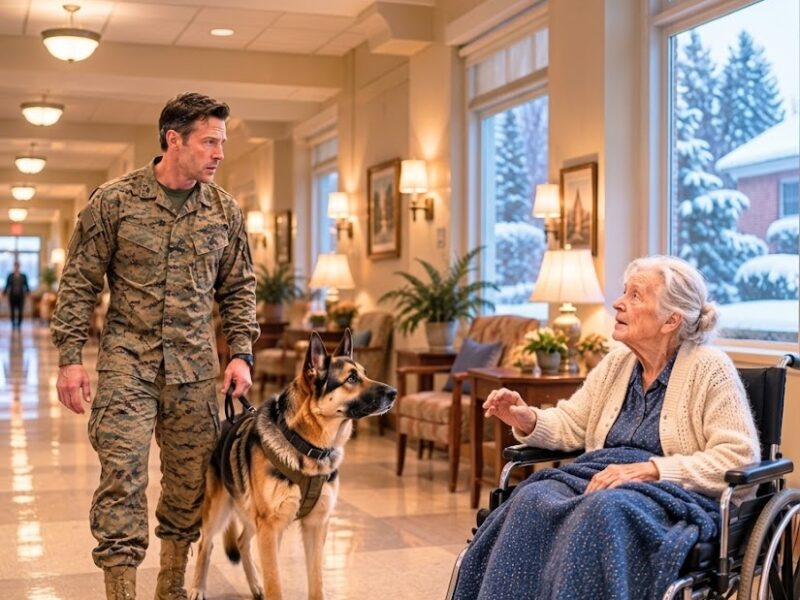
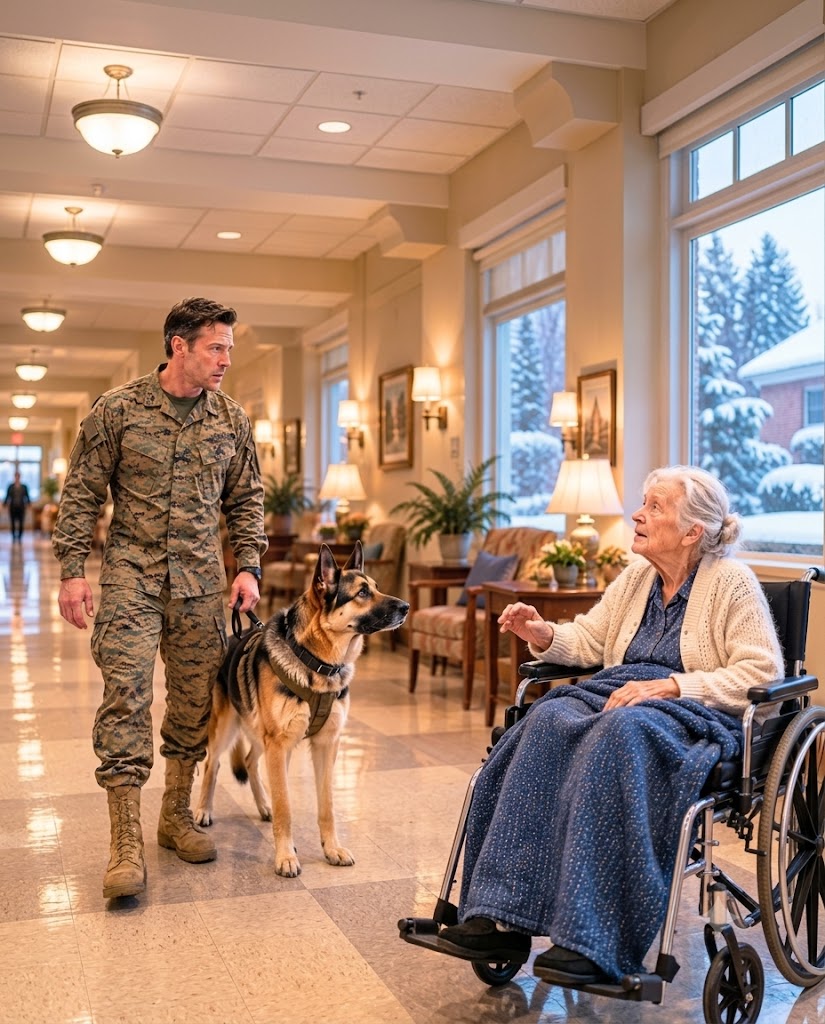
Beside him waited Bracken, his seven-year-old German Shepherd.
The retired military working dog had a black and tan coat, a dark saddle across his back, amber-brown eyes, and a small scar above his right eye that caught the light whenever he turned his head.
Though his movements had slowed slightly since retirement, he remained attentive to Silas’s smallest gestures.
After legally adopting him, Silas had discovered that Bracken enjoyed quiet company as much as he once enjoyed having a task.
North Haven had approved the dog’s visit beforehand.
“Come on, buddy.”
Bracken stepped out beside him, paws crunching softly against the thin layer of snow.
Inside, a middle-aged staff member with short auburn hair and a reassuring smile welcomed them.
She introduced herself as Clare and led them toward the common room.
“Some residents love talking,” she explained.
“Others just appreciate having someone nearby.”
“That sounds manageable,” Silas said.
Clare smiled.
“You’ll do fine.”
They passed several residents reading or chatting.
An elderly man in a wheelchair nodded at Bracken with approval.
A woman at a card table looked up and whispered something to her companion.
Silas was beginning to relax when a soft thud came from beside the common room window.
An elderly woman had dropped a blue knitted scarf from her wheelchair.
She was slender and slightly stooped with silver-white hair gathered into a loose bun.
Her pale face carried the delicate lines of age, and a cream cardigan hung loosely over her faded blue dress.
She looked like someone who had learned to keep her worries private.
Yet when she noticed Silas’s uniform, her expression changed completely.
Her blue eyes widened.
Bracken stopped, ears turning toward her as her breathing quickened.
Silas followed his gaze.
“Little C.”
The whisper struck him harder than he expected.
Nobody had called him that in 37 years.
The name belonged to a childhood he barely remembered.
A warm kitchen.
Someone laughing.
A woman lifting him toward a window.
He had always wondered whether those memories were real or merely fragments assembled from old stories.
Silas approached and knelt beside her wheelchair.
“Ma’am, what did you call me?”
She searched his face, her lips trembling.
“Daniel said he’d bring you back.”
Silas felt the air leave his lungs.
Daniel Vardell was his father’s name.
His father had died in a house fire when Silas was four.
His mother had survived briefly, according to the records, before dying from her injuries.
A loving family had adopted him afterward.
They had never hidden his past, but they possessed little information beyond a photograph and a few belongings recovered from the house.
For years, Silas had accepted that both his birth parents were gone.
Now a stranger had spoken his childhood nickname and his father’s name within moments.
Clare approached quietly.
“This is Miriam Halden,” she explained.
“She’s 73 and has lived here nearly six years.”
“Her memory isn’t always reliable.”
“Sometimes she remembers things from long ago more clearly than what happened this morning.”
Silas nodded.
Miriam.
The name stirred another distant recognition.
He looked at the elderly woman, struggling against a hope he did not trust.
She might have known another Daniel.
Perhaps the uniform reminded her of someone she had lost.
A familiar nickname could be coincidence.
But all three together.
“Do you remember Daniel?” he asked.
Miriam turned toward the falling snow.
“He promised,” she whispered.
“What did he promise?”
Her brow tightened.
For several seconds, she appeared to search for an answer.
Then the certainty disappeared from her face.
“I don’t know.”
Silas wanted to ask more.
Where had she lived?
Had she known a little boy named Silas?
What had happened after the fire?
Instead, he saw how frightened she was becoming.
“That’s all right,” he said.
“You don’t have to remember.”
He picked up her scarf and placed it across her knees.
When he began to stand, Miriam seized his wrist.
“Don’t let them take you away again.”
Her voice shook.
She glanced toward the doorway as though someone might appear and separate them.
Silas knelt again.
“No one’s taking me anywhere.”
“I’m right here.”
Her grip gradually loosened.
He noticed her looking at Bracken.
“Would you like to meet him?”
Miriam nodded.
At Silas’s invitation, Bracken stepped forward and rested his head gently on her knee.
She touched his thick fur with trembling fingers.
The dog remained still, and her breathing slowly settled.
“Good boy,” she murmured.
Silas stayed until she was calm.
He did not press her for answers.
Whatever Miriam remembered, she deserved kindness more than an interrogation.
When he finally left, she watched him with an expression he could not forget.
—
That evening, Silas returned to his rented room and opened a small wooden box.
His adoptive parents had kept it safe throughout his childhood and given it to him when he became an adult.
Inside lay Daniel’s old Marine insignia and a photograph salvaged from the family home.
Silas lifted the photograph beneath the lamp.
Daniel stood on a porch covered with snow.
Beside him, a young woman held a little boy bundled in a winter coat.
Silas had studied that picture countless times, searching for traces of himself in his parents’ faces.
Tonight, he noticed something different.
The woman’s eyes were Miriam’s.
He leaned closer, studying the shape of her face.
Thirty-seven years separated the woman in the photograph from the elderly resident at North Haven.
Yet the resemblance was unmistakable.
Then a memory surfaced.
He was small, held high in someone’s arms.
Snowflakes floated beyond a window.
A woman laughed softly and called him Little C.
Silas lowered the photograph.
His hands had begun to tremble.
For 37 years, he had believed his mother was dead.
He had built a life around that certainty, never imagining there was anything left to question.
Now he could hear Miriam’s frightened voice.
Don’t let them take you away again.
He looked at the photograph once more.
What if the woman at North Haven had not mistaken him for someone else?
What if she had recognized him?
And what if somewhere inside that quiet nursing home, his mother had been waiting for him all along?
—
The next morning, light snow still covered the streets of Duluth.
Silas returned to North Haven Care Residence, carrying the family photograph and a copy of the adoption summary he had received years earlier.
He had slept little.
Every time he closed his eyes, he saw the young woman in the photograph beside Miriam’s face.
Yet he knew resemblance was not proof.
He had spent too many years trusting a document he had never been able to verify.
This time he would be careful.
Bracken walked beside him through the entrance, his leash loose in Silas’s hand.
In the common room, Miriam sat near the window, folding a napkin into smaller and smaller squares.
She smiled when she noticed the German Shepherd.
“There’s that handsome dog.”
Silas felt a brief surge of hope.
Then Miriam looked at him politely.
“Are you visiting someone, young man?”
He answered without showing his disappointment.
“I was hoping to spend a little time with you.”
“Well, that’s kind.”
Yesterday she had called him by a name buried in his earliest memories.
Today he was a stranger.
Silas understood then that whatever answers Miriam possessed might come in fragments and that asking her to remember could be painful for them both.
He sat beside her and placed the photograph on the table.
“Would you mind looking at this?”
Miriam lifted it carefully, her expression softening when she saw the man standing on the snowy porch.
“Daniel.”
“Do you remember him?”
“He always stood outside without a coat.”
A faint smile touched her mouth.
“He said he’d only be a minute.”
Her finger moved toward the child in the woman’s arms.
“Our boy liked the snow.”
“Daniel used to lift him up to the window so he could see it falling.”
Silas looked down.
He remembered being held high, the cold glass beyond his outstretched fingers.
Until that moment, he had never known which parent had been holding him.
“What was the boy’s name?” he asked.
Miriam’s smile faded.
She turned the photograph over, searching its blank back.
“I know it,” she whispered.
“I know I do.”
“You don’t have to find it right now.”
He took the photograph back only when she offered it.
He wanted to tell her everything, but he could not risk giving her a certainty that might later prove false.
—
Later that morning, Silas met privately with North Haven’s resident services coordinator, a compact woman named Ruth Mercer.
In her late 50s, Ruth had closely cropped salt-and-pepper hair, thoughtful brown eyes, and a habit of listening without interrupting.
Years of working with vulnerable residents had made her cautious about promises, though she spoke to Silas with genuine warmth.
He showed her the photograph and the summary.
“I think Miriam may be my birth mother,” he said.
“I need to understand what happened.”
Ruth studied the documents but did not immediately offer access to Miriam’s belongings.
“These are her personal things,” she explained.
“We need to respect her wishes and the authority of the person who handles her affairs.”
Silas agreed.
He had no intention of using his uniform or his distress to push past that boundary.
Ruth contacted Miriam’s legally authorized representative, explained the situation, and arranged appropriate permission to examine the personal papers Miriam had brought to North Haven.
By early afternoon, Silas was sitting with Ruth in a small consultation room.
Between them rested a dented tin box.
Inside were letters.
Dozens of them.
The paper had yellowed, and some envelopes were worn along their folds.
Each bore the same name in careful handwriting: Silas Vardell.
Several had postal markings showing they had been returned.
Others had no stamps or addresses at all.
Silas opened the earliest letter.
My darling Silas, today you are five.
I don’t know where you are, but I hope someone has made you a cake.
He stopped reading.
He had celebrated that birthday in a home where people loved him.
He remembered the cake, though not its color.
He had never imagined another woman sitting somewhere, wondering whether he had one.
The next letters followed the years.
Miriam wrote about her recovery, a new job, and the winter mornings when she still expected to hear small footsteps in the hallway.
She described visiting the child welfare office after she was well enough to travel.
She had asked to see her son, then asked for news of him, then begged for a way to send him a letter.
The replies she described grew less encouraging.
A caseworker named Vernon Kesler had told her the adoptive family’s information was confidential.
Miriam had not known their names or address.
When she tried sending letters through the agency, several eventually came back.
Others, she wrote, received no acknowledgment at all.
Silas set the pages in chronological order.
The letters showed a woman searching through every avenue she could identify, not simply waiting beside a window.
She wrote to old addresses and followed leads that ended nowhere.
When the adoptive family moved to another state, the little information she had became even less useful.
Years later, her letters began mentioning a man named Halden.
He had become her husband and helped her write inquiries when her hands hurt.
After his death, the handwriting changed.
Some lines wandered across the page.
The last letters were shorter, but the name on every envelope remained the same.
Silas had been loved by the parents who raised him.
Nothing in the box diminished that.
They had given him a safe childhood and answered his questions as honestly as they could.
But someone had told them his mother was dead.
He unfolded his own records.
The summary stated that Miriam Vardell had died following treatment for injuries sustained in the fire.
Beneath the account appeared the name of the caseworker responsible for the report: Vernon Kesler.
Silas read the sentence again.
He had never seen an original death certificate.
When he requested information as an adult, he had received the same account with nothing that challenged it.
Across the table lay letters written by the woman who was supposed to have died.
Ruth watched him quietly.
“I don’t know who wrote the wrong information,” Silas said.
“Or why.”
“No,” Ruth replied.
“But these papers deserve a proper examination.”
He carefully returned the letters to their box, keeping the authorized copies Ruth had arranged.
He would need help establishing what the records actually showed.
Anger would not answer the questions, and Miriam had already lived too long with unanswered ones.
Before leaving, he sat beside her again.
Bracken settled at his feet.
“Would you like me to read you something?” Silas asked.
Miriam nodded.
He chose the birthday letter.
As he read, she listened with her hands folded in her lap.
When he finished, she looked toward the window.
“Do you know that little boy?”
Silas swallowed.
“I’m trying to find him.”
Miriam reached for his hand.
“Tell him his mother never stopped waiting.”
Silas held her fingers gently.
The words he wanted to say crowded his throat, but he could not yet give her an answer built on hope alone.
“I’ll keep looking,” he promised.
Outside, snow settled over the darkening street.
Silas left North Haven carrying a copy of the letter written for his fifth birthday and a report that said its author had already been dead.
For the first time, he understood that the fire might not have been the only thing that separated him from his mother.
—
The following morning, Silas sat across from an attorney in a modest office overlooking Duluth’s frozen harbor.
The letters lay between them beside the adoption summary that had shaped his understanding of his childhood.
Attorney Rebecca Hail was 52, a tall woman with dark hair threaded with silver, sharp brown eyes, and a composed manner that made hurried explanations feel unnecessary.
She had spent much of her career helping families navigate disputed records.
She listened without interrupting, then studied the documents.
“These letters raise serious questions,” she said.
“But we need to establish what the original records actually show.”
Silas nodded.
“Tell me what I can do.”
Rebecca explained that his military rank gave him no special right to confidential civilian or medical records.
Silas had expected nothing different.
With his authorization, she requested records he was entitled to receive and sought other material through appropriate channels.
Miriam’s legally authorized representative agreed to help obtain relevant medical information.
Over the following days, the surviving records arrived in stages.
Some pages were incomplete, their edges darkened by age, but together they described a winter Silas had never understood.
Thirty-seven years earlier, fire had engulfed the Vardell home.
Daniel, a former Marine, had escaped before realizing Miriam remained inside.
He went back for her and died before rescuers could reach him.
Miriam survived with a serious head injury.
Four-year-old Silas was placed in temporary care while she received treatment.
The earliest medical notes described a woman who could barely sit upright without assistance.
She experienced confusion, struggled to recall recent events, and required rehabilitation outside Duluth.
Silas read those pages slowly.
For the first time, he understood why he had not been returned to her immediately.
Then the reports changed.
Miriam began recognizing familiar people.
She remembered Daniel and spoke repeatedly about her son.
Her physical strength improved, and the rehabilitation team recommended continued assessment of her ability to resume parenting with support.
Silas looked up.
“She was getting better.”
“That’s what these reports indicate,” Rebecca said.
Yet the child welfare summaries prepared during the same period continued describing Miriam as incapable of providing a stable home.
They acknowledged her injuries but barely mentioned her progress.
The caseworker responsible was Vernon Kesler.
At 33, Vernon had been assigned to gather information and prepare recommendations concerning Silas’s placement.
He had not possessed the authority to order an adoption himself.
His reports, however, informed the people who made decisions about the child’s future.
As Rebecca compared the documents, another discrepancy emerged.
A favorable rehabilitation assessment was absent from the materials forwarded for review.
So was a recommendation that Miriam receive further support before permanent separation was considered.
“The decision-makers appear to have received an incomplete picture,” Rebecca said.
“We still need to establish who withheld what and when.”
Silas stared at the dates.
His mother had been learning to walk steadily again while strangers discussed whether she would ever be capable of raising him.
He thought of the birthday letter.
Miriam had written it while trying to recover enough strength to reach her son.
“Can I speak to Kesler?”
“You can ask him questions,” Rebecca replied.
“Don’t mistake his answers for proof.”
“Bring anything he tells you back to me.”
—
Vernon lived in a small house outside Duluth.
He was 70 now, broad through the chest but stooped at the shoulders, with thinning white hair, a square jaw, and a neatly trimmed gray mustache.
His guarded manner suggested a man accustomed to defending decisions rather than reconsidering them.
He opened the door only partway.
“Vardell,” he repeated.
“That was a long time ago.”
Silas introduced himself and explained why he had come.
Vernon reluctantly invited him inside.
“I handled hundreds of cases,” the older man said.
“You can’t expect me to remember every detail.”
Silas placed copies of Miriam’s letters on the kitchen table.
Vernon glanced at the first envelope.
His jaw tightened.
“She wrote to you?”
“She tried to.”
Vernon sat down.
For several seconds, he said nothing.
“Your mother had been badly injured,” he finally replied.
“You needed stability.”
“There was a family ready to give you that.”
“My adoptive parents did give me a good life,” Silas said.
“That isn’t what I’m asking.”
Vernon looked away.
“Why weren’t her improving medical assessments included in the reports?”
“I followed the information available at the time.”
Silas kept his voice level.
“Then who wrote that she died?”
The question settled between them.
Vernon rubbed a hand across his mouth.
He did not answer.
Silas waited, but the older man offered nothing more.
He left without raising his voice.
Anger followed him to the car, sharp and immediate.
Yet he knew a confrontation could not replace the record still missing.
—
Rebecca’s next lead was Agnes Bellamy, a retired social worker who had participated in Miriam’s early assessment.
Agnes was 78, a small, straight-backed woman with cropped white hair, warm brown skin, and clear gray eyes behind thin spectacles.
Age had slowed her steps but not her speech.
She welcomed Silas into her apartment with the directness of someone who had spent a lifetime speaking for people whose concerns were easily dismissed.
“I remember Miriam,” she said.
“She’d lost her husband, her home, nearly everything, but she never stopped asking about her little boy.”
Agnes had recommended continued rehabilitation and supervised visits while Miriam’s parenting capacity was assessed.
She had objected when the case appeared headed toward permanent separation before that work was complete.
“I put my concerns in writing,” she said.
From a folder of retained professional correspondence, she produced a copy of her objection.
Agnes had preserved it after transferring to another position, though she had not known what happened to Silas afterward.
Rebecca examined the document alongside the surviving treatment records.
Its date preceded the adoption proceedings.
Its recommendations were specific.
Neither the objection nor the favorable assessment appeared in the summary supplied for the placement review.
Agnes lowered her eyes.
“I thought someone would reconsider.”
Silas could not find an answer that would comfort either of them.
—
Back at Rebecca’s office, the second problem became unmistakable.
Records showed Miriam continuing treatment and requesting contact after the date on which the summary claimed she had died.
The false statement had also reached Silas’s adoptive family, who had believed it in good faith.
Two separate failures had shaped his life.
The decision-makers had not received important evidence of Miriam’s recovery, and the family raising him had been told she was dead.
Rebecca closed the folder.
“We have substantial contradictions.”
“Establishing responsibility will take further review.”
That evening, Silas returned to his room and opened Daniel’s wooden box.
His father’s Marine insignia lay where he had left it.
The insignia and photograph had been recovered from the damaged house and placed among the few personal belongings preserved for Silas.
His adoptive parents had guarded them until he was grown.
Daniel’s courage had helped inspire his own decision to become a Marine.
Silas held the metal emblem in his palm.
His father had gone back into a burning house for the woman he loved.
His mother had spent years trying to find the child she lost.
He could not recover those years.
He could, however, make certain the surviving evidence was no longer ignored.
He placed the insignia beside the letters and reached for Rebecca’s number.
—
The snow had begun to melt along Duluth’s sidewalks when Rebecca Hail called Silas with news.
After several days of organizing the evidence, she had submitted the conflicting records and Agnes Bellamy’s written objection to the appropriate authorities for review.
The inquiry would examine the missing assessments, the false account of Miriam’s death, and Vernon Kesler’s handling of her requests to contact her son.
“How long will it take?” Silas asked.
“I can’t promise you that,” Rebecca replied.
“But the documents are no longer sitting in a closed file.”
Silas thanked her and drove to North Haven.
For the first time, he understood how little a formal investigation could offer Miriam in the present.
Even a complete account of the past would not restore the years she had lost.
He could, however, give her something she had been denied for far too long: his time.
He continued visiting most afternoons.
Some days Miriam greeted him with the delighted recognition of someone welcoming an old friend.
On others, she asked whether he had come to see another resident.
Silas learned not to correct every mistake.
When she was tired, he talked about the weather or read aloud.
When she wanted silence, he sat beside her.
Bracken became part of their routine.
With North Haven’s permission, the German Shepherd settled beside her wheelchair, accepting an occasional gentle stroke.
Miriam sometimes remembered his name when she could not remember Silas’s.
The unevenness of her memory hurt, but Silas stopped measuring their visits by what she recalled.
Her comfort mattered more than another answer.
—
Meanwhile, the question of their relationship moved toward a conclusion.
With appropriate consent and professional assistance, DNA samples were collected and tested.
Silas had expected to feel impatient while waiting.
Instead, he found himself afraid.
If the result was negative, he would have to let go of a possibility that had already begun changing his life.
If it was positive, he would have to accept that his mother had been alive throughout the years he had mourned her.
The report arrived while he was alone in his rented room.
The laboratory’s conclusion was clear.
The results confirmed that Miriam Halden was Silas Vardell’s biological mother.
He read the words three times.
Then he sat down.
He thought of his fifth birthday, the letters written without an address, and the graduation ceremony at which his adoptive parents had cheered until their voices cracked.
He remembered receiving his first Marine insignia and wishing Daniel could have seen it.
He had never imagined that Miriam might have been alive somewhere, wondering whether her little boy had grown into a kind man.
His adoptive parents had given him a loving home.
That truth remained untouched.
But another truth stood beside it now.
His mother had wanted him, searched for him, and grown old without knowing where he was.
Silas covered his eyes.
The relief he had expected came tangled with grief.
—
As the inquiry progressed over the following days, Rebecca updated him on its findings.
Confronted with the surviving records, Vernon acknowledged that he had deliberately omitted favorable information about Miriam’s recovery and had failed to forward some of her later contact requests.
He maintained that he had believed Silas would have a more stable childhood with the adoptive family.
His acknowledgment did not resolve every question, including responsibility for the false death statement.
The review continued.
Silas met Vernon once more, this time with Rebecca present.
The retired caseworker sat stiffly across the table, his hands clasped.
“I thought I was protecting the boy,” Vernon said.
“You didn’t know what my life would become,” Silas replied.
“And you didn’t give my mother a fair chance to show what hers could become.”
Vernon stared at the tabletop.
“She wrote to me for 37 years,” Silas continued.
“Some of those letters never even had an address.”
The older man said nothing.
Silas left without demanding an apology.
He wanted the record corrected and responsibility established through the proper process.
Nothing Vernon said in that room could give Miriam back the years she had spent waiting.
—
Three days later, North Haven called.
Miriam had developed a respiratory infection and become dehydrated.
She had been admitted to a hospital for treatment and observation.
The nurse explained that she was receiving care, but Silas heard little beyond the words admitted to a hospital.
He drove there immediately, leaving Bracken at his lodging.
The dog had been approved for visits at North Haven, not for entry into a hospital ward, and Silas would not assume otherwise.
Miriam lay beneath a white blanket, looking smaller than she had in her wheelchair.
Her silver hair spread across the pillow.
An intravenous line ran to her arm, and each breath seemed to require her attention.
Silas approached the bed.
“Hello, Miriam.”
She opened her eyes.
For a moment, she studied him without recognition.
“Are you a Marine?”
“Yes, ma’am.”
“My Daniel was a Marine.”
Her voice was thin.
“Did you know him?”
Silas pulled a chair close.
“I know about him.”
He had brought the wooden box from his room.
With her permission, he opened it and placed Daniel’s old insignia in her palm.
Miriam turned it carefully.
Her thumb moved over the worn metal.
“He kept this beside the bed,” she whispered.
“Said he’d put it away properly one day.”
“Never did.”
A small, unexpected smile crossed her face.
Silas had never heard that detail.
It belonged to a marriage, not a report.
He took out the family photograph and held it where she could see.
Miriam looked at Daniel first, her fingers tightening around the insignia.
“Oh, Daniel.”
Then she studied the child in the photograph.
Tears gathered in her eyes.
“He liked the snow,” she said.
“Daniel used to lift him up so he could see it.”
Silas felt the familiar memory rise, but this time he did not struggle to hold it.
He could almost feel his father’s hands beneath his arms and hear his mother laughing beside the window.
Miriam slowly raised her gaze from the photograph to Silas’s face.
Something changed.
Her expression grew intent, as though she were looking past the years that separated the man beside her from the child she remembered.
“Little C.”
Silas took her hand.
“It’s me, Mom.”
Her free hand rose toward his cheek.
She touched his jaw, then his hair, searching his grown face with trembling fingers.
“My boy,” she whispered.
“You grew up.”
Silas bent close and embraced her carefully, mindful of the line in her arm.
Miriam held him as tightly as her strength allowed.
He had imagined this moment in a hundred different ways since receiving the test results.
None had included a hospital bed or the sound of his mother’s labored breathing.
Yet when she rested her cheek against his, he wanted nothing more.
He did not mention Vernon or the investigation.
He did not ask her to remember anything else.
For that moment, she knew him.
And after 37 years, Silas finally heard his mother call him her boy.
—
By the middle of December, Miriam was recovering from her respiratory infection.
She could sit upright and eat without assistance.
But Silas understood that leaving the hospital would not mean she could safely live alone.
Before her discharge, he met with her physician to discuss what came next.
Dr. Helena Stroud was 49, a tall woman with dark shoulder-length hair, warm brown eyes, and a calm, precise manner.
Years of caring for older patients had taught her to distinguish hope from promises.
She spoke gently to Miriam and plainly to Silas, making sure neither felt excluded from the conversation.
“Your mother’s memory difficulties need continued assessment,” she explained.
“The injury she suffered years ago is part of her medical history, but we cannot assume it explains everything happening now.”
“Will she remember more?” Silas asked.
“She may have clearer days.”
“She may also become confused.”
“I can’t promise that the past will return to her in any particular order.”
Through the glass, Silas could see Miriam smoothing the edge of her blanket.
“I’m not asking her to remember everything,” he said.
“I just want her to be safe.”
—
During the following weeks, Silas worked with Dr. Stroud, North Haven’s staff, and Miriam’s legally authorized representative to prepare a suitable care plan.
Miriam participated in decisions whenever she could.
They discussed her mobility, medication, hydration, and the support she would need throughout the day.
Silas found a small house in Duluth close to medical services.
It had a ground-floor bedroom, an accessible bathroom, and a living room window overlooking a modest garden.
He imagined Miriam sitting there when the snow returned, with Bracken resting nearby.
But finding a house was only the beginning.
Silas remained an active-duty Marine.
His leave would end, and he could not abandon his assignment or decide on a permanent transfer simply because he wanted to stay near his mother.
He arranged qualified caregivers, established regular contact with her medical team, and planned visits around his military duties.
The arrangements had to remain dependable even when he was away.
Bracken’s needs required planning, too.
The retired German Shepherd was accustomed to living beside Silas, and Miriam could not be expected to manage his care alone.
Silas made sure the caregivers were comfortable handling dogs and understood Bracken’s feeding, exercise, and veterinary routines.
Whenever Silas returned, he would resume their familiar walks and spend time with both his mother and his longtime companion.
—
Once Miriam’s health was stable and the care arrangements had been approved, she moved into the house.
Her tin box of letters came with her, carefully packed among the belongings she had kept at North Haven.
Bracken settled beside her favorite chair, close enough for her to touch his thick fur.
His presence gave the room a reassuring familiarity, especially on afternoons when Silas could not be there.
The move did not change Miriam’s memory.
Some mornings she recognized Silas immediately.
On others she greeted him as a courteous stranger.
He learned to answer without making her feel embarrassed.
“I came to see you,” he would say.
“Well, that’s very kind.”
Sometimes she spoke about Daniel as though he might arrive before supper.
Sometimes she asked when her little boy would come home.
Silas did not argue with her memories or insist that she recognize the man standing beside her.
He reassured her that she was safe, then stayed until her worry eased.
—
The inquiry into Vernon Kesler’s handling of the old case continued.
Rebecca informed Silas that the documented omissions and inaccurate statements had been referred for further review.
Questions remained about the false account of Miriam’s death and the request for contact that had gone unanswered.
Silas wanted the record corrected, but he did not need an immediate judgment against Vernon before he could begin caring for his mother.
He also spoke with his adoptive parents.
They were distressed to learn that Miriam had been alive throughout the years they believed her dead.
They had loved Silas and answered his childhood questions using the information provided to them.
He told them that discovering his birth mother did not erase the family they had built together.
He could be grateful for the childhood they gave him while grieving the childhood Miriam had been denied.
Neither feeling diminished the other.
—
One afternoon, during another period of leave, Silas sat beside his mother as light snow began falling beyond the living room window.
Miriam sat beneath a knitted blanket, watching the garden.
Bracken lay at her feet, his breathing slow and steady.
Silas brought the tin box of letters to the table.
Miriam looked at it with curiosity.
“What have you got there?”
“Some letters.”
“Would you like to hear one?”
She nodded, and he opened an envelope written during a winter many years earlier.
In the letter, Miriam described buying a small wool scarf for her son.
She had stood in the shop wondering how much he had grown.
Without knowing his address, she had carried the scarf home and placed it in a drawer, hoping that one day she might give it to him.
Silas paused.
He had never seen that scarf.
Somewhere, perhaps, it had remained folded long after he had grown too tall to wear it.
He read another letter.
Miriam had written about a quiet Christmas with her second husband, who had helped her continue searching.
She hoped her son was warm, happy, and surrounded by people who loved him.
Even while describing her loneliness, she had wished him a joyful life.
Miriam listened carefully.
Sometimes she smiled at a familiar phrase.
At other moments she looked troubled.
“Why is that woman so sad?”
“She misses someone.”
“Her child.”
“Yes.”
Silas continued reading.
He did not rush through the pages or ask Miriam to remember writing them.
Some passages were too painful to read aloud that afternoon, so he set those aside.
The letters no longer needed to prove anything.
They had reached the person Miriam had written them for.
Eventually, she studied the envelopes scattered across the table.
“Did her little boy ever get these letters?”
Silas lowered the page.
“Yes, Mom.”
“He finally got every one of them.”
Miriam looked at him for a long moment.
He could not tell whether she understood the answer or simply found comfort in his voice.
He let the silence remain.
Her gaze drifted toward the old Marine insignia Silas had placed beside the tin box.
“My Daniel was a Marine.”
“He was, Mom.”
“He had a little boy.”
Silas held her hand.
“I know.”
Her fingers moved gently against his.
“Little C.”
“I’m here.”
Miriam turned toward the window.
Snowflakes settled along the garden fence.
“You came home.”
Silas felt his eyes fill.
“Yes, Mom.”
“I came home.”
She leaned back, her hand still resting in his.
Bracken raised his head briefly, then settled again.
Silas did not know whether she would remember their conversation tomorrow.
She might wake and ask his name.
She might still search for the 4-year-old boy she had lost.
He could not recover 37 years.
But when his duties took him away, Miriam would have people who knew how to care for her and how to reach him.
When he returned, he would sit beside her, whether she recognized him or not.
Her little boy had finally received the letters, and Miriam would no longer have to wait alone.
—
Sometimes God’s greatest miracles do not arrive with thunder or dazzling light.
Sometimes they come quietly in a familiar voice, a faithful dog, or a door that opens after 37 years of waiting.
Silas could never recover the childhood he lost with his mother.
Yet through an unexpected encounter, God gave them something precious.
Another chance to hold each other, to heal, and to discover that true love had never disappeared.
In our everyday lives, we all carry unanswered prayers, painful memories, and hopes we have almost forgotten.
We may wonder whether the people we miss will ever return or whether the wounds in our hearts will ever heal.
But this story reminds us that God’s timing is not always our timing.
Even after years of darkness, a single moment of love can bring light back into our lives.
If this story touched your heart, please share it with someone who needs hope today.
Tell us in the comments: have you ever experienced something that felt like a miracle from God?
And please subscribe to The Last Patrol for more stories of loyalty, kindness, and second chances.
May God bless you and your family, protect those you love, and fill your days with peace, faith, and unexpected miracles.









