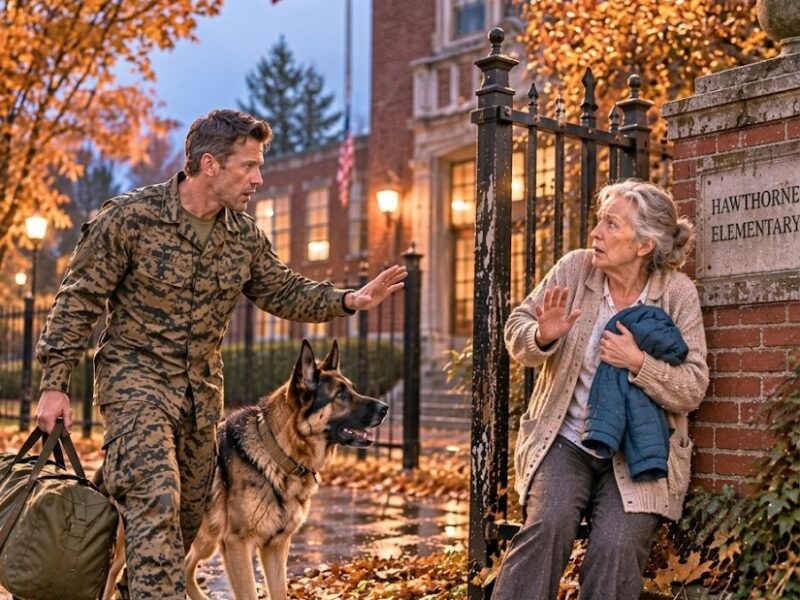
A Marine Returned Home With His K9—But His Mother Looked at Him and Asked, “When Will My Son Come Back?”
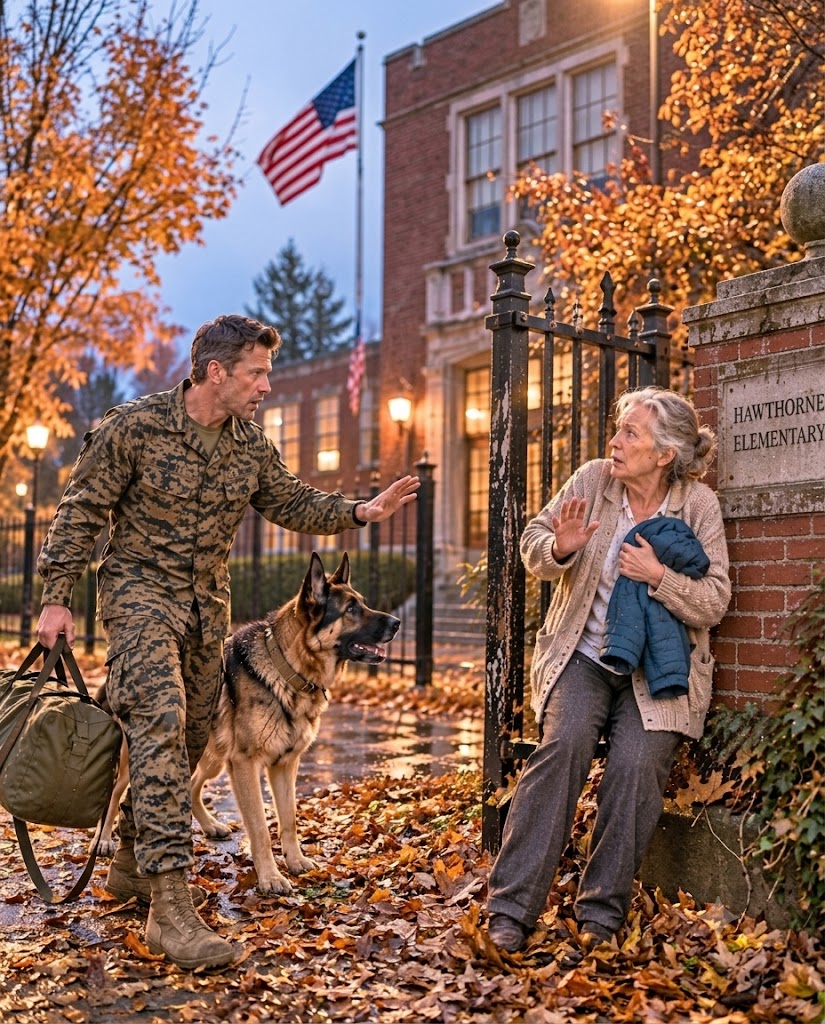
The rain had just stopped over Cordelane, Idaho, leaving the streets black and shining beneath the first evening lights.
At 6:10 p.m., cold mist still hung above the sidewalks, and darkness was settling fast.
Gunnery Sergeant Vaughn Sloan drove through the town with both hands steady on the wheel, watching familiar storefronts emerge from the wet dusk.
At 42, Vaughn was a little over six feet tall, broad through the shoulders with the compact strength of a man who had spent most of his adult life demanding more from his body than comfort ever required.
His dark brown hair was clipped short and touched with gray at the temples.
A clean-shaven, angular face and deep-set hazel eyes gave him a severe appearance until he spoke.
Then the patience beneath it usually showed.
Years in the Marine Corps had taught him to observe before reacting, and a serious injury during his later service had made him quieter still.
He was beginning terminal leave before retirement.
And for the first time in decades, there was no deployment waiting beyond the horizon.
He was coming home.
In the rear seat rode Bishop, a seven-year-old retired military working dog Vaughn had formally adopted after the German Shepherd developed mild stiffness in one hind leg.
Bishop was large without being oversized, black and tan with a dark saddle, powerful chest, erect ears, and intelligent amber-brown eyes that rarely wasted attention.
Age had slowed the first few steps after a long ride, but not the instincts beneath them.
More than a year earlier, while Vaughn recovered from his injury, Bishop had spent several months with Vaughn’s mother.
Altha had given him a biscuit after her morning coffee, spread the same blue blanket beside her chair every evening, and discovered that one slow scratch behind his left ear could turn the disciplined old working dog into something almost embarrassingly content.
Vaughn smiled faintly at the memory.
“You remember this place, don’t you?”
Bishop gave no response beyond the movement of one ear.
They were passing Hawthorne Elementary when both ears suddenly came forward.
Bishop rose.
Vaughn glanced into the mirror.
The dog’s head had turned sharply toward the passenger side window.
His body was still, his attention fixed.
“What is it?”
A low sound came from Bishop’s throat.
Not a growl, but the restrained whine Vaughn had learned never to dismiss.
Vaughn eased off the accelerator.
The elementary school stood dark behind a chain-link fence.
Classes had ended hours earlier.
Beneath the small covered entrance beside the locked gate, however, someone was standing alone.
An elderly woman.
Vaughn drove another twenty feet before his mind caught up with what his eyes had already seen.
He hit the brake.
For several seconds, he could only stare through the windshield.
Mom.
Altha Sloan was 76, barely five-foot-four now, after age had softened the straight-backed posture Vaughn remembered from childhood.
She had always been a slender woman with fine features, pale skin that freckled easily in summer, and thick chestnut hair that had long since faded to silver-gray.
Tonight, it had partly escaped a loose bun and clung damply around her face.
An oversized oatmeal-colored cardigan hung from her narrow shoulders.
One foot wore a faded sneaker, the other wore a house slipper, and pressed against her chest was a small blue jacket.
Vaughn knew that jacket.
His mother had kept it for more than thirty years.
He was out of the truck before he consciously decided to move.
“Mom.”
Altha turned.
Vaughn stopped.
He had imagined this homecoming in fragments during the drive.
His mother’s arms around him.
Her complaint that he had gotten too thin.
Coffee left warming too long while she asked questions she already knew the answers to.
Instead, Altha looked at him the way an elderly woman might look at a stranger approaching her after dark.
Her fingers tightened around the blue jacket.
“Ma’am, it’s me.”
She took a step backward.
“Please don’t come any closer.”
Something cold moved through Vaughn that had nothing to do with the October air.
He lowered his hands instinctively, keeping them visible.
“Okay. I won’t.”
Altha watched him cautiously.
Vaughn noticed the details now.
Her lips were dry.
Her hands trembled.
The hem of her cardigan was damp, and her exposed ankle above the slipper had gone pink from the cold.
“How long have you been out here?”
She glanced toward the locked school doors as if the answer should have been obvious.
“I’m waiting for someone.”
“Who?”
“My son.”
Vaughn felt his heartbeat against his ribs.
“What’s his name?”
Her expression softened immediately.
“Vaughn.”
He could barely force out the next question.
“How old is he?”
Altha looked at him with mild confusion.
“Nine.”
The traffic behind Vaughn seemed to disappear.
So did the wet street, the school, the cold.
For one impossible second, all he could see was his mother standing beneath that awning with his childhood coat clutched against her chest.
“He doesn’t like walking home after it rains,” she explained.
“He’ll pretend it doesn’t bother him because he thinks that makes him grown.”
Vaughn turned his face slightly away.
Thirty-three years collapsed inside him.
A movement sounded behind him.
Bishop had climbed from the truck.
“Stay,” Vaughn said softly.
But Altha had already seen him.
Her eyes widened.
The fear vanished from her face.
“Bishop.”
Vaughn looked back at her.
Bishop approached without hurry, his paws making quiet taps on the wet pavement.
He stopped directly in front of Altha and lowered his head.
She reached toward him.
Her fingers found the place behind his left ear.
Exactly the place.
“Oh, Bishop.”
The German Shepherd leaned gently into her hand.
Vaughn felt something inside him fracture.
She remembered the dog.
She did not remember her son.
With Bishop between them, Altha finally allowed Vaughn close enough to help.
He called 911 rather than risk driving her himself while her condition was uncertain.
As they waited, he asked permission to check her small handbag for identification.
Inside were her wallet, house keys, a folded tissue, and an old card from the North Lake Community Arts Center.
On its back, in shaky handwriting, were three words.
Tuesday 11.
“What happens Tuesday, Mom?”
Altha stared at the card.
“I have to be there.”
“Where?”
Her forehead tightened.
“I don’t know.”
At the hospital, Dr. Priya Nanduri examined her.
Priya was a composed woman around forty, medium height, and slim with warm brown skin, dark hair secured neatly at the nape of her neck, and observant brown eyes.
She spoke gently without becoming vague, a habit shaped by years of explaining frightening things to families who wanted certainty medicine could not always provide.
Altha was dehydrated, mildly malnourished, and showing signs of cognitive impairment significant enough to require further assessment.
Then Priya opened the recent medical history.
Her expression changed.
“Mr. Sloan, were you aware your mother has had previous episodes of disorientation?”
Vaughn straightened.
“No.”
Priya turned the screen slightly.
There had been three incidents in roughly six months.
Three.
Vaughn had received no call, no message, nothing.
“Who was contacted?”
Priya hesitated.
Then she read the emergency contact listed in Altha’s file.
“Marbel Crane, 57, coordinator with Silver Lantern Senior Community Support.”
Vaughn stared at the unfamiliar name.
“That isn’t me.”
“I understand.”
“No.”
His voice became quieter.
“You don’t.”
He looked through the glass toward his mother.
Altha sat on the bed with Bishop’s head resting beneath her hand, stroking behind his left ear as though she had done it yesterday.
Vaughn turned back to the screen.
“Who is Marbel Crane?”
And for the first time since coming home, Vaughn understood that his mother’s failing memory might not be the only thing he needed to be afraid of.
—
Morning came gray over Cordelane with low clouds pressed against the hills and beads of rain clinging to the hospital windows.
Vaughn had slept less than an hour in a chair beside his mother’s bed.
Altha awoke shortly after seven and looked first at Bishop, who lay on the floor with his muzzle across his front paws, then at Vaughn.
For several seconds, her face was blank.
Vaughn felt himself waiting for recognition as if it were a verdict.
“You’re the Marine from last night.”
The words landed quietly.
“Yeah, Mom.”
Her brow furrowed.
“My son is a Marine.”
Vaughn swallowed.
“I know.”
“He doesn’t call enough.”
That almost made him laugh, which somehow hurt worse.
“I know that, too.”
A knock interrupted them.
The woman who entered was Marbel Crane.
At 57, Marbel was medium height with a sturdy, practical build, warm beige skin, and dark auburn hair cut into a neat chin-length bob threaded with gray.
Fine lines around her brown eyes suggested someone accustomed to smiling patiently at frightened people.
She wore charcoal slacks, sensible shoes, and a moss-green cardigan beneath a Silver Lantern identification badge.
Nothing about her seemed hurried or defensive.
Her voice was controlled and gentle.
The practiced tone of a woman who had spent years helping elderly people preserve the appearance of independence even when their lives were becoming harder to manage.
“Altha.”
Altha looked at her and relaxed slightly.
“Marbel.”
Vaughn noticed that immediately.
Marbel introduced herself without pretending she did not know who he was.
She explained that Silver Lantern helped older residents coordinate transportation, appointments, meal services, community activities, and referrals when families lived far away.
She had known Altha for nearly a year.
Vaughn remained standing.
“Why were you listed as my mother’s emergency contact?”
Marbel did not flinch.
“Because she asked me to be.”
The answer was not what Vaughn expected.
According to Marbel, Altha’s first obvious episode had happened roughly six months earlier after grocery shopping.
She took the wrong street home, became confused several blocks away, and a police officer eventually helped her back.
Afterward, someone recommended that she list a local contact in case it happened again.
“I told her we should call you,” Marbel said.
Altha, staring at Bishop, murmured, “He was working.”
Marbel nodded.
“She was adamant that you not be disturbed unless there was a true emergency. I agreed to be the local contact temporarily.”
Vaughn looked at his mother.
“Did you ask her to do that?”
Altha rubbed Bishop’s ear.
“Maybe.”
That single word disturbed Vaughn more than a denial would have.
Marbel continued.
About eight months earlier, she had begun noticing small changes.
Altha repeated questions.
She occasionally confused appointment dates.
Once she bought groceries, came home, and later insisted she had not been to the store.
Yet on good days, she remained articulate enough that someone speaking to her for ten minutes might notice nothing unusual.
Vaughn remembered his Sunday calls.
Whenever his mother lost the thread of a conversation, she changed subjects.
When she forgot something he had told her, she joked that he was getting boring.
Lately, the calls had grown shorter.
Once Marbel had answered Altha’s phone.
“Your mother’s lying down. She’s fine.”
Another time she had a long morning.
“Vaughn, don’t worry.”
He had accepted both explanations.
The realization brought shame first, then anger.
And Vaughn distrusted both.
Shame could make a man blame himself for things he could not have seen.
Anger could make him decide who was guilty before he understood what had happened.
The Marine Corps had taught him the cost of acting on incomplete information.
So he asked for facts.
There had been two more incidents.
Three months after the grocery store episode, a neighbor found Altha walking near the end of her street shortly after dawn.
She was dressed for the day and insisted she needed to open the community center before everyone arrived.
No one was expected there that morning.
The third incident occurred only weeks ago at a pharmacy.
Altha became confused about why she was there and could not remember where she had parked.
Staff called for help, and she was evaluated at urgent care before Marbel took her home.
“And you still didn’t call me?”
For the first time, something tightened in Marbel’s expression.
“Your mother begged me not to.”
“She was getting lost.”
“She was also still making many of her own decisions.”
“She stood outside an elementary school for three hours last night.”
That hadn’t happened before.
The room went still.
Vaughn wanted to dislike her.
It would have simplified everything.
But Marbel had not presented him with a clean villain.
She had presented him with something harder.
Decisions that might once have sounded reasonable, becoming dangerous, one compromise at a time.
Later that morning, after Altha was cleared to leave under supervision while further cognitive evaluation was arranged, Vaughn drove her home.
Bishop rode beside her in the back seat.
Altha rested one hand on his shoulder most of the way.
Her small house sat on a quiet residential street beneath tall pines.
From outside, it looked exactly as Vaughn remembered.
White siding, narrow porch, brass numbers his father had installed decades ago.
Inside, the illusion lasted only seconds.
Nothing had been destroyed.
Nothing had been stolen.
That was almost worse.
Three unopened envelopes lay beneath a paid electric bill.
In the kitchen, Vaughn found two identical payments recorded for one utility, while another notice remained untouched.
The refrigerator held fresh milk beside food long past its date.
A clean blouse had been folded into a basket of dirty towels.
Then he began noticing the notes.
Lock back door.
Take morning pills with food.
Bishop likes the blue blanket.
Call Von Sunday.
Some were neat.
Others leaned downhill across the paper.
Altha stood in the doorway watching him.
“I manage fine.”
Vaughn looked at her.
There was embarrassment in her face now.
And suddenly he hated that she felt she had to defend herself in her own kitchen.
“I know you’ve been trying, Mom.”
“Not succeeding.”
“Trying. The difference matters.”
Bishop wandered toward the living room, paused beside an old wooden chest, then settled without instruction where his blue blanket used to be kept.
Altha smiled at him.
“See? He remembers.”
Vaughn looked away before she could see what that did to him.
Then something on the refrigerator caught his attention.
Unlike the handwritten reminders surrounding it, this one had been printed on plain white paper in large black letters.
Vaughn knows you are safe.
Do not call him at work.
He read it twice, then a third time.
“Mom.”
Altha came closer.
“Who printed this?”
She studied the paper.
“I don’t know.”
“Did I ever tell you not to call me?”
Her eyes moved from the note to his face, searching not memory, but permission.
“I didn’t want to bother you.”
“You never bother me.”
She looked down.
Vaughn pulled the paper carefully from beneath its magnet.
He remembered every conversation in which his mother had rushed him off the phone.
Every time someone had told him she was resting.
Every time he had accepted that reassurance because accepting it was easier than imagining something was wrong hundreds of miles away.
He looked at the sentence again.
Vaughn knows you are safe.
But Vaughn hadn’t known.
And whoever had printed that message had made sure his mother believed he did.
—
By Monday morning, the rain had moved east, leaving Cordelane beneath a pale autumn sky.
Cold sunlight reached through the kitchen windows, touching the handwritten reminders Vaughn had begun arranging by date across his mother’s table.
He had not called Marbel Crane to confront her about the printed note.
Every instinct sharpened by years in the Marine Corps told him the same thing.
Suspicion was not evidence, and anger was a poor substitute for a timeline.
So Vaughn began with what he could verify.
Receipts, appointment cards, utility statements, Altha’s calendar, the notes she had written to herself.
He photographed the printed message from the refrigerator and stored the original in an envelope without telling his mother it mattered.
He did not want to turn her home into an interrogation room.
Living beside Altha for several days taught him something no medical chart could explain.
Her memory was not simply disappearing.
It was breaking into pieces that no longer remained in chronological order.
At breakfast, she asked Vaughn whether he had finished a fourth-grade science project involving bean plants.
Then ten minutes later forgot that she had eaten.
She remembered the scar beneath his chin from falling off a bicycle at twelve but stared blankly when he mentioned the hospital visit from three nights earlier.
Some mornings she recognized him immediately.
On others, she watched him with polite uncertainty until something—a phrase, the way he held his coffee mug, the sound of his laugh—briefly connected the man in front of her to the boy she remembered.
Bishop required no such explanation.
The old German Shepherd had quietly resumed patterns established more than a year earlier.
After Altha made coffee, he waited beside the same cabinet where she had once kept his biscuits.
In the evening, he settled beside her chair.
When she became anxious because she could not remember where she had placed something, Bishop often rose and stood close enough for her fingers to find his coat.
Vaughn never pretended the dog understood her illness.
Bishop understood routines, voices, tension, scent, and the people to whom he had once belonged.
That was enough.
On Monday afternoon, Altha opened the pantry, looked inside, then turned toward Vaughn.
“Tuesday at eleven.”
Vaughn glanced up.
“What’s Tuesday?”
She frowned.
“At eleven.”
“What happens at eleven?”
The answer would not come.
That evening, she said it again while folding a dish towel.
“Tuesday at eleven.”
The next morning, by 10:15, Altha was dressed and carrying her handbag.
“I’ll be late.”
“For what?”
She looked irritated, not confused.
“Tuesday.”
Vaughn remembered the card from the night at Hawthorne Elementary.
He retrieved it from the envelope where he had placed her belongings.
North Lake Community Arts Center.
On the back, in Altha’s own unsteady handwriting, Tuesday 11.
“You want to go here?”
Altha stared at the printed name for several seconds.
“Yes.”
“You remember what happens there?”
“No.”
The honesty of the answer stopped him.
Vaughn helped her into the truck.
Bishop climbed into the rear beside her, and they drove across town.
Altha gave no directions.
Vaughn followed the address on the card, but two blocks from the community center, her posture changed.
“Turn here.”
Vaughn looked at her.
“You recognize it?”
Altha pointed toward a low brick building surrounded by maples dropping copper-colored leaves.
There, the North Lake Community Arts Center was modest and well-used, with children’s paintings taped inside the front windows and a bulletin board crowded with notices for pottery classes, veterans workshops, grief groups, and senior activities.
When Vaughn walked inside with Altha and Bishop, an older woman behind the reception desk looked up and immediately stood.
“Altha.”
Her name was June Halpern, 68, a retired elementary art teacher who now coordinated volunteer programs at the center.
June was short and softly built with light brown skin, cropped silver curls, round glasses, and paint permanently embedded beneath two fingernails.
She had the open expression of someone accustomed to making nervous people feel welcome.
But when she saw Altha, relief quickly gave way to concern.
“My goodness, we haven’t seen you in months.”
Altha smiled uncertainly.
“I’m here for Tuesday.”
June’s face softened.
“Yes, you are.”
At eleven, several older adults began arriving for a small cognitive support art group held in a room overlooking the courtyard.
Vaughn assumed his mother had once attended because of her own memory problems.
June corrected him.
“Your mother wasn’t a participant.”
Vaughn looked through the glass at Altha, who had taken a seat beside Bishop.
“She volunteered.”
For years, Altha had helped prepare materials, pour coffee, clean brushes, and sit beside participants who became embarrassed when they forgot instructions.
June said Altha possessed a particular patience with frightened people.
She never finished a task for someone merely because they were slow.
She waited.
She used to say, “Dignity takes longer,” June said.
Vaughn lowered his eyes.
That sounded exactly like his mother.
Then June’s tone changed.
Roughly seven months earlier, Altha began asking questions about people who had stopped attending.
One was an elderly widower who had managed well with occasional transportation assistance.
Another was a woman receiving meal support while recovering from surgery.
A third had only recently begun showing mild memory problems.
All three had been connected in some way with Silver Lantern.
After reassessments, each stopped coming to the center.
“Where did they go?” Vaughn asked.
“Private home care programs. More intensive ones.”
“Did they need them?”
June hesitated.
“Maybe. I wasn’t qualified to decide that.”
It was exactly the kind of answer Vaughn respected.
“What bothered my mother was the speed of it. And the cost.”
Altha had noticed that people who once needed modest community assistance were suddenly being moved toward considerably more expensive private services.
She started writing down names and dates because she feared she might otherwise forget them.
Then her own memory began worsening.
June removed her glasses.
“The last serious conversation we had, your mother told me something wasn’t right about Marbel. She mentioned Silver Lantern. She wanted to understand why the same pattern kept happening.”
“And what did you do?”
June’s discomfort answered before her words did.
“I told her we’d look into it.”
“Did you?”
“Not enough.”
Vaughn remained silent.
June looked through the glass toward Altha.
“By then, she was repeating herself, mixing dates. Sometimes she’d insist she’d already told me something when she hadn’t. Marbel said Altha had been confused lately.”
Vaughn’s jaw tightened.
June continued quietly.
“And because some of what Altha said was confused, it became easy to assume all of it was.”
Inside the activity room, Altha was helping an elderly man hold a paintbrush steady.
Her movements were slower than they must once have been, but she waited patiently while he chose his color.
Vaughn watched his mother smile at him.
For the first time since Hawthorne Elementary, he saw something other than what Altha was losing.
He saw who she had been before everyone began defining her by what she could no longer remember.
When the session ended, June touched Vaughn’s arm before he left.
“There’s something you should understand.”
He turned.
“Your mother started asking those questions before the worst of her memory problems.”
“How long before?”
“Months.”
Outside, Altha waited beside the truck with one hand resting on Bishop’s back.
She looked toward Vaughn and smiled as if she knew exactly who he was.
For that moment, perhaps she did.
Vaughn looked again at the community center behind him.
Until now, he had been asking why nobody told him his mother was getting lost.
He was beginning to realize there was another question.
What had Altha been trying to tell everyone before they stopped believing her?
And somewhere between her first warning and her fading memory, the answer had been reduced to four convenient words.
Altha is confused.
—
The next morning brought hard, clear cold to Cordelane.
Frost silvered the porch rail, and the house was quiet except for the refrigerator motor and Bishop’s nails shifting occasionally against the kitchen floor.
Vaughn sat across from Dr. Priya Nanduri later that morning with a question he hated himself for asking.
After what June had told him at North Lake Community Arts Center, suspicion had begun reaching into places where evidence had not followed.
Had someone deliberately made his mother’s condition worse?
Had medication been changed?
Had something been given to her that should not have been?
Priya listened without interrupting, then answered with the same careful directness Vaughn had come to respect.
“We don’t have evidence of that.”
She explained that Altha’s evaluations were consistent with an early but progressive cognitive disorder.
Her recent dehydration, inconsistent nutrition, poor sleep, stress, and increasing isolation could intensify confusion dramatically, making bad days appear much worse than good ones.
But nothing in the available medical information suggested poisoning, deliberate over-medication, or a manufactured illness.
“So this was happening anyway,” Vaughn said.
“Yes.”
The answer hurt because part of him had wanted an enemy he could remove and a mother he could get back afterward.
Priya seemed to understand.
“Finding wrongdoing somewhere else will not necessarily explain your mother’s disease.”
Vaughn nodded once.
It was not the answer he wanted.
It was the answer he needed.
That afternoon, with Altha’s situation documented and Vaughn’s timeline organized, a hospital social worker helped him make a formal report to County Adult Protective Services.
The investigator assigned to the initial review was Teresa Bell, 51, a compact woman with medium brown skin, straight black hair cut just above her shoulders, and calm dark eyes that seemed to slow a room down.
Teresa had spent nearly two decades working with vulnerable adults.
Experience had made her cautious about dramatic accusations.
She spoke in precise sentences, asked the same question from different angles, and never treated confusion as proof that someone had nothing truthful to say.
Vaughn appreciated her immediately.
He gave Teresa copies of Altha’s appointment records, the sequence of disorientation incidents, June’s contact information, photographs of the notes in the house, and the printed message from the refrigerator.
He did not tell Teresa what conclusion to reach.
“I want to know what happened,” he said.
“That’s different from wanting me to confirm what you already believe.”
“Yes.”
“Good.”
The review did not produce an instant arrest or a spectacular confession.
What emerged instead was slower and more complicated.
Silver Lantern itself was a legitimate community support organization.
Most of its work appeared ordinary.
But Marbel had financial relationships connected to two private home care providers, receiving repeated referrals from clients she had helped assess.
Compensation connected to referrals was not by itself enough for Vaughn to understand the legal significance, and Teresa refused to label it before records were fully reviewed.
What concerned her was whether those relationships had been properly disclosed, whether cognitively vulnerable clients had genuinely understood what they were consenting to, and whether less expensive alternatives had been presented fairly.
Then another pattern surfaced.
Complaints from several older clients contained variations of the same language in follow-up notes.
Client appears confused.
Client may not accurately recall conversation.
Family advised of cognitive concerns.
Altha’s name appeared among them.
Vaughn stared at the line until the words blurred.
The cruelty of it was not that his mother had been falsely declared confused.
She had been confused.
That was what made the situation so difficult to challenge.
Some of Altha’s memories were wrong.
Some dates were wrong.
Some conversations had been repeated or merged together.
And once that became known, every accurate thing she said could be placed in the same box.
Confused.
Unreliable.
Forgetful.
Teresa closed the folder.
“We need more records before anyone makes conclusions.”
Vaughn nodded.
But something had already changed inside him.
He no longer needed his mother to have remembered everything correctly in order to believe she might have remembered something important.
That evening, he returned home and began looking for Altha’s older appointment calendar.
She had once kept everything in the drawer beneath the telephone.
The calendar was not there, but behind a stack of takeout menus, Vaughn found an old smartphone with a cracked corner.
“Mom, is this yours?”
Altha looked from her chair.
“I think so.”
The battery was dead.
Vaughn charged it.
Most of what remained was ordinary photographs of flowers, Bishop asleep on the blue blanket, blurry pictures of grocery shelves Altha had probably taken accidentally.
Several unfinished text messages.
Then Vaughn found an unsent audio recording.
It was months old.
He pressed play.
Static whispered for a moment.
Then his mother’s voice filled the kitchen.
“Vaughn.”
He froze.
The voice sounded different.
Not younger exactly, but steadier.
“Something is happening to my memory.”
A long pause followed.
“Sometimes I know I’m right. Sometimes I don’t.”
Vaughn lowered himself slowly into a chair.
Across the room, Altha watched him without recognition of her own recorded voice.
“I keep writing things down, but then I don’t remember why I wrote them.”
Another pause.
“There’s something wrong with Silver Lantern. People are being sent places they don’t need yet. I asked questions. They keep telling me I misunderstood.”
Her breathing trembled through the speaker.
“I know I’m forgetting things, Vaughn.”
Then came the sentence that broke him.
“But I know I’m not wrong about this.”
The recording ended.
It had never been sent.
Vaughn sat motionless holding the phone.
His mother had tried to reach him.
She had known what was happening to her.
Somewhere between recognizing that her own memory was slipping and trying to warn him about what she had seen, she had failed to finish the final step.
Altha touched his sleeve.
“Why are you sad?”
Vaughn looked at her.
“Because I should have heard something.”
She studied him as though trying to place his face.
Then her attention drifted toward the hallway, where the small blue jacket from Hawthorne hung over the back of a chair.
Vaughn followed her gaze.
“Mom, why did you take that jacket to the school?”
Altha stared at it for a long time.
“Vaughn forgets his coat.”
His throat tightened.
“He always leaves it somewhere.”
Suddenly, another memory returned.
Not hers, but his.
When Vaughn was a child, Altha had given him one rule for getting lost.
Don’t keep wandering.
Go somewhere familiar.
Go somewhere you know I’ll look for you.
He looked at the blue jacket, then at his mother.
Hawthorne Elementary had not been random.
When Altha could no longer make sense of the present, her mind had reached backward to a place built from repetition.
The gate where she had waited for her son day after day.
She had taken his coat because nine-year-old Vaughn always forgot it.
She had waited because mothers waited for their children.
But perhaps somewhere deeper than the confused story her mind had constructed, another instinct had survived.
Go somewhere familiar.
Go somewhere someone who loves you will look.
Altha leaned down and rested her hand on Bishop’s head.
Vaughn finally understood.
His mother had gone to Hawthorne because, in the only language her failing memory still trusted, she had been trying to find her way home.
And somehow, after all those years, she had chosen the one place where her son found her.
—
By early November, the maples around Cordelane had lost most of their leaves.
Morning frost lingered in shaded yards, and the first snow clouds had begun gathering above the distant hills.
The investigation into Silver Lantern did not end with flashing lights or Marbel Crane being led away in handcuffs.
Vaughn was almost grateful for that.
Real accountability moved more slowly than anger wanted it to.
Teresa Bell informed him that the review had expanded beyond Altha’s case after records revealed similar concerns involving other older clients and referrals to private home care providers.
Families were being contacted.
Consent forms, disclosures, service recommendations, and financial relationships were being examined.
While that process continued, Marbel was removed from direct contact with vulnerable seniors through the program.
Vaughn asked Teresa once what would happen to her.
“When the records are complete,” Teresa said, “the people responsible for deciding that will decide it.”
A younger version of Vaughn might have hated the answer.
At 42, after enough years in the Marine Corps to understand the difference between action and impulse, he accepted it.
Marbel’s future was no longer his responsibility.
Altha’s was.
Her health improved noticeably with regular meals, hydration, sleep, and company.
Her cheeks regained some color.
Her hands shook less.
There were afternoons when she followed an entire conversation and corrected Vaughn when he misremembered a childhood story.
Those moments tempted him toward hope so fiercely that he almost resented Dr. Priya Nanduri for refusing to encourage it.
“The improvement is real,” Priya told him during a follow-up appointment.
“But improvement isn’t the same as reversal.”
Altha’s underlying cognitive disorder remained.
There would likely be good days, difficult days, and eventually changes Vaughn could not predict.
Stability could protect her.
Routine could help her function.
Familiar people and places could reduce distress.
None of those things could promise that she would keep remembering his name.
Vaughn sat beside his mother while Priya spoke.
Altha seemed more interested in Bishop, whose muzzle had begun showing faint gray around the edges.
On the drive home, Vaughn kept thinking about all the things a Marine could prepare for.
Weather, distance, failure points, extraction routes, contingencies.
There was no contingency for becoming a stranger to your own mother.
His terminal leave had already been scheduled before he returned to Idaho.
Retirement from the Marine Corps was not a sacrifice suddenly forced upon him by Altha’s illness.
That chapter of his life had already been approaching its final page.
Still, the future he had imagined changed.
Vaughn had pictured a quieter house, occasional travel, perhaps waking without checking a clock before sunrise.
Now his planning centered on door alarms, medical appointments, meal schedules, transportation, and how to preserve his mother’s independence without asking her to carry risks she could no longer recognize.
He could not promise Altha that he would never need help.
He could promise she would never face another confused morning alone.
The house he arranged for her was a small single-story place, only a short drive from medical services and close enough that Vaughn could reach her quickly.
It had no staircase.
Vaughn installed handrails where they were useful, a discrete alert on the exterior doors, and warm nightlights along the hallway.
He labeled kitchen cabinets with simple pictures as well as words.
Cups, plates, food, medicine.
He avoided turning the place into something clinical.
Altha still chose her curtains.
She still complained that Vaughn hung one picture crooked.
She still insisted that the yellow chair belonged near the window because morning light was better there.
On the kitchen wall, he placed a large orientation board.
Today is Monday.
You are home.
Below it were three photographs.
Altha.
Vaughn.
Bishop.
Some mornings she ignored it.
Some mornings she stood before it for several minutes.
Bishop adjusted faster than either of them.
The seven-year-old German Shepherd found the best patch of afternoon sun within a day and established his place beside Altha’s chair by the second evening.
Vaughn retrieved the old blue blanket and spread it there.
He also kept the small blue childhood jacket Altha had carried to Hawthorne Elementary.
He could have boxed it away again, but instead he hung it from a wooden hook beside the front door.
He never explained why.
Weeks passed.
Silver Lantern remained under review.
Teresa occasionally called with updates, but Vaughn stopped measuring his days by the investigation.
Justice, whatever shape it eventually took, could not become the center of their lives.
Altha could.
One late afternoon, Vaughn returned after handling paperwork connected to his transition from active service.
Bishop heard the truck before Altha did.
The German Shepherd rose from beside her chair and moved toward the door, tail giving one restrained sweep.
Vaughn stepped inside.
Altha was sitting by the window in a soft gray cardigan, silver hair gathered loosely at the back of her neck.
She looked healthier than the woman he had found outside Hawthorne.
But when her eyes met his, Vaughn saw uncertainty.
“Hello,” she said politely.
“Hi, Mom.”
Altha studied him.
Bishop walked back to her and rested his head against her knee.
Her fingers automatically moved behind his left ear.
She looked at the dog, then at Vaughn.
Something changed.
Not dramatically.
No sudden flood of memory transformed her face.
Recognition arrived slowly, like a light finding its way beneath a closed door.
“Are you my Marine?”
Vaughn stopped breathing for half a second.
“Yeah.”
Altha stood carefully.
Her hand rose to his cheek.
Vaughn bent slightly so she did not have to reach.
“My boy came home.”
He covered her hand with his.
“I did.”
That evening, she remembered him through dinner.
She remembered that he hated peas as a child.
She remembered the scar under his chin.
She even laughed when Vaughn reminded her that she once threatened to send him to school in pajamas because he refused to get dressed.
For several hours, Vaughn allowed himself to have his mother back without asking how long it would last.
Morning answered him.
He was making coffee when Altha entered the kitchen.
She looked at the orientation board, then at Bishop lying between the table and her chair.
Her eyes moved to Vaughn.
No recognition came.
She sat down.
“When is my son coming home?”
Vaughn’s hand tightened around the coffee mug.
For one dangerous second, he wanted to tell her.
I’m Vaughn.
You knew me yesterday.
You touched my face.
You said your boy came home.
But correcting her would only make her discover the loss again.
So Vaughn set down the mug and sat beside her.
Bishop shifted until he lay between their chairs, one paw touching Vaughn’s boot.
“He made it home, Mom.”
Altha looked relieved.
“Good. I was worried about him.”
Vaughn glanced toward the front door.
The little blue jacket still hung there, waiting for a nine-year-old boy who had grown into a 42-year-old Marine while his mother slowly traveled backward through the years.
“I know.”
Outside, the season’s first snow began drifting quietly across the yard.
Vaughn finally understood something no homecoming ceremony could have taught him.
Coming home was not one arrival.
It was not crossing a state line, finishing a career, or hearing his mother remember his name.
Sometimes love asked a person to return without being recognized.
To answer the same question without resentment.
To sit beside someone who could no longer remember all the years they had shared and love them without demanding those years back.
Altha might forget that her son had come home.
So Vaughn would come home again every single day.
Sometimes the miracle we pray for is not the miracle God chooses to give us.
Vaughn could not restore every memory his mother was losing.
He could not make her recognize him every morning or return their lives to the way they once were.
But perhaps the miracle was still there.
In a mother who could forget a name but still remember love.
In a faithful dog who became a bridge between yesterday and today.
And in a son who chose to come home again and again, even when his mother no longer knew he had arrived.
Life reminds us that the people we love will not always remain as we remember them.
Parents grow older.
Memories fade.
Time changes families in ways we cannot control.
But God can give us the strength to stay, the patience to answer the same question again, and the grace to love someone without asking them to give anything back.
If this story touched your heart, please share it with someone who needs this reminder today.
Tell us in the comments where you’re watching from and who you would always come home for.
And if you believe stories of loyalty, compassion, and second chances still matter, subscribe to the channel and join us for the next journey.
May God bless you, protect your family, and give strength to everyone caring for someone they love.
And may you never forget.
Sometimes the greatest miracle is simply that love remembers even when the mind cannot.









