A Marine Returned Home and Found an Elderly Woman Working His Family Farm—Her First Words Brought Him to His Knees
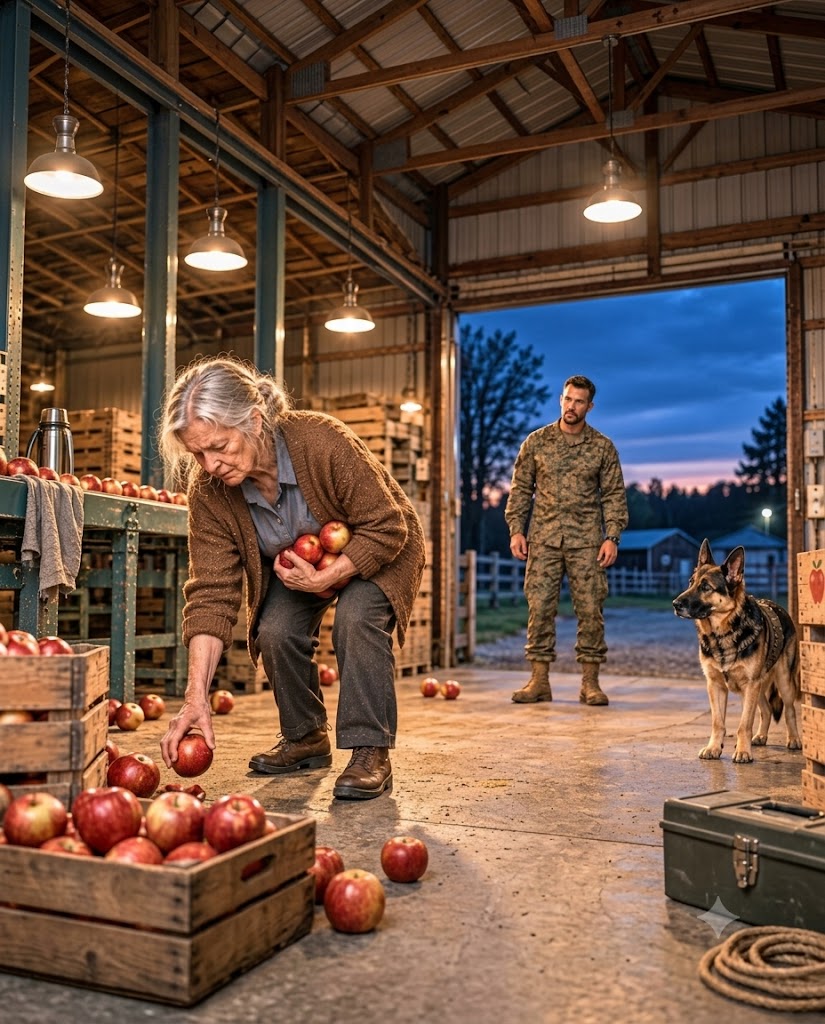
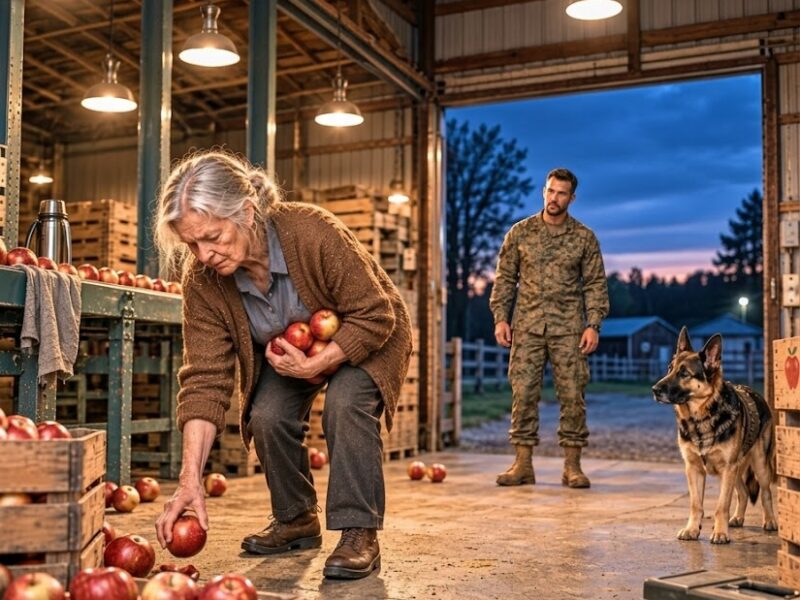
Late one night, a Marine’s German Shepherd suddenly stopped outside his family’s packing house.
Inside, Corbin found an elderly woman working alone, long after everyone had gone home.
She was sweeping the floor and stacking empty trays, her tired hands refusing to stay still.
Each time he took one task from her, she immediately searched for another.
Finally, he pulled out a chair.
“Sit.”
The woman stared at the empty room.
“Then what am I supposed to do?”
Corbin couldn’t forget that question, because soon he would discover why stopping frightened her so much — and why the answer would force him to look at himself.
Late November had stripped the Wanachi orchards nearly bare.
Cold wind moved through rows of dormant apple trees, carrying the dry scent of leaves and wood smoke beneath a sky already fading toward winter before the afternoon was gone.
Gunnery Sergeant Corbin Thayer arrived at the family orchard with 17 days of leave and no apparent idea what to do with them.
At 42, Corbin stood a little over six feet, lean through the waist and broad across the shoulders, with short dark brown hair touched by gray at the temples, a close-trimmed beard, and weathered hazel eyes that seemed to inspect a room before allowing him to settle inside it.
Years in the Marine Corps had sharpened his habit of noticing what was loose, late, damaged, or unfinished.
Beside him moved Alder, his seven-year-old black and tan German Shepherd — a large, deep-chested dog with amber-brown eyes, a dark saddle across his back, and the first faint silver beginning around his muzzle.
Alder was attentive without being restless, the kind of dog that could lie motionless for twenty minutes and then rise because of a sound no one else had noticed.
Within three hours of arriving, Corbin had inspected a sagging section of fence, walked through the equipment barn, checked two exterior lights, and started a list of repairs on the back of an old feed invoice.
“You know, leave is supposed to include leaving work alone.”
Orson Keen stood behind him with a coffee mug in one hand.
At 63, Orson was a thick-bodied man with iron-gray hair combed straight back, a square weathered face, and a gray mustache that seemed permanently attached to a patient expression.
He had managed the orchard for years and possessed the quiet confidence of someone who rarely needed to remind people he knew what he was doing.
Corbin glanced at the list.
“I’m aware.”
“Could have fooled me.”
Orson nodded toward the rows outside.
“I’ve kept this place standing while you were gone.”
“I know.”
“Then act like it.”
There was no resentment in the words, which made them harder for Corbin to dismiss.
He folded the invoice and slipped it into a shirt pocket.
As they walked toward the packing house, Orson mentioned that Graham Dell was temporarily out.
Graham, 40, had worked at the orchard for years and lived in one of the employee cottages beyond the windbreak.
He was a sturdy brown-haired man with a broad, open face, a short beard, and the easygoing temperament that made him well-liked among the seasonal crews.
Three days earlier, he had slipped on the cottage steps and badly sprained an ankle.
Nothing was broken, but the doctor had ordered roughly two weeks off before Graham could consider light duty.
His mother had driven over to help him.
“Mavis?”
“You haven’t met her. Seventy-four, lives a little over an hour away, has her own place, her own life, and apparently no intention of letting her son pour his own coffee while he’s on crutches.”
Orson smiled when he said it, and Corbin thought little more about her.
That changed at 9:47 that night.
Most of the orchard had gone dark.
Orson was finishing his last checks before locking the remaining service doors when Corbin took Alder outside.
They had almost passed the packing house when the German Shepherd stopped.
His ears rose, his head angled toward the building.
Corbin stopped, too.
“What is it?”
Alder stared at a narrow line of light beneath the side door.
Then came a faint scrape from inside.
Corbin opened the door.
A thin, elderly woman stood beside the sorting tables with a broom in her hands.
She was perhaps five-foot-four, narrow through the shoulders, dressed in a faded blue blouse beneath a brown cardigan, dark slacks, and sensible leather shoes.
Silver-gray hair had been gathered into a low bun, though loose strands had escaped around a lined pale face.
She startled at the sight of Corbin but recovered quickly.
“You must be Graham’s mother. Mavis Dell.”
She tightened both hands around the broom.
“I was just finishing.”
Corbin looked around.
Flattened cartons had been stacked neatly.
Empty plastic trays were gathered together.
One sorting table had been wiped clean.
There was no machinery running and no heavy produce in sight.
“Finishing what?”
Mavis hesitated.
Graham had been worrying that his absence left small jobs for everyone else, she explained.
She had heard him talking about it and thought there was no sense in perfectly capable hands sitting idle while other people stayed late.
“Nobody asked you to do this.”
“I know.”
Corbin reached for the broom.
“Then give me that.”
Mavis surrendered it without argument and immediately turned toward a stack of unfolded cartons.
Corbin stepped between her and them.
She looked toward the empty trays.
He moved those out of reach, too.
Only then did he notice the tremor in her fingers.
Corbin pulled a metal chair away from the wall.
“Sit.”
Mavis looked at it as though he had offered her something far stranger than a chair.
“I’m fine standing.”
“I didn’t ask if you could stand.”
Still, she remained upright.
Corbin expected stubbornness.
Instead, what appeared on her face was uncertainty.
He had removed the broom, the cartons, the trays — every small task she could reach.
For several seconds, Mavis simply looked around the quiet packing house.
Then, “What am I supposed to do?”
Something in the question stopped him.
Alder crossed the concrete floor and sat beside her.
Mavis lowered one hand to his neck.
Her fingers trembled against the dog’s fur, and for the first time, Corbin saw how exhausted she actually was.
“Tonight,” he said quietly. “Go home.”
He walked her back toward Graham’s cottage.
Near the edge of the orchard, they passed an old greenhouse, its glass dim beneath the moonlight.
It had belonged to Corbin’s mother once.
The frame was still sound, and the water lines still worked, but only a few trays had been started there in recent seasons.
Mavis slowed.
“What used to grow in there?”
“Flowers. Herbs.”
Corbin looked through the dark glass.
“Mostly things nobody really needed.”
Mavis studied the greenhouse for another moment.
“Those are sometimes the best things to grow.”
Then she continued toward the cottage.
Corbin stayed where he was.
Alder took several steps after her, stopped, and looked back at him.
Corbin had come home expecting 17 days of fences, machinery, and repairs he could understand.
Yet as he stared through the greenhouse glass, the thing he could not stop thinking about was an exhausted woman standing beside an empty chair, genuinely unable to answer one simple question.
What was she supposed to do when there was nothing left for her to do?
Morning frost silvered the orchard grass, and the bare apple branches held the first pale light over Wanachi.
By 6:30, smoke was rising from the worker cottage chimney, though Corbin knew Graham had no reason to be awake that early.
He found Mavis already moving through the small kitchen.
Coffee was brewed.
Oatmeal sat covered on the stove.
Graham’s medication had been placed beside a glass of water, and his jacket hung over the back of a chair within reach of the crutches propped against the wall.
Graham sat at the table with his injured ankle elevated on a second chair, looking mildly embarrassed by the efficiency surrounding him.
Seeing him in person for the first time, Corbin understood why Orson described him as easygoing.
Graham’s broad face carried a short brown beard and the open expression of a man more comfortable making a joke than accepting sympathy.
The swelling beneath his ankle brace had begun to ease, but standing still required both crutches.
“Mom, you don’t have to keep—”
“I know.”
Mavis straightened his coffee cup before he finished.
A few minutes later, Graham glanced toward the counter.
“My pills.”
They were already in Mavis’s hand.
Corbin leaned against the doorway and watched.
Nothing about the exchange looked cruel or even particularly unusual.
Graham thanked her.
Mavis smiled.
Yet every time her son shifted his attention toward something, she moved before he could ask.
When Graham finished breakfast, Mavis collected his bowl before he had set down the spoon.
When he mentioned being cold, she reached for his jacket.
When a crumb fell beside his chair, she bent to pick it up immediately.
By the third morning, Corbin understood that the packing house had not been an isolated decision.
Mavis did not merely like being busy.
She seemed unable to let a need exist unanswered, however small.
Corbin’s first solution was simple.
“Leave it.”
She left the dish in the sink, then wiped the counter.
“Leave that, too.”
She folded a towel.
“Mavis—”
“What?”
Corbin stared at the towel.
She stared at him.
Then Graham laughed from the table.
“Good luck, Gunny.”
Corbin did not find it funny.
Orson did.
When Corbin mentioned it later, the older manager led him toward the greenhouse.
Daylight revealed what darkness had hidden on the first night.
The glass needed washing, and one window latch had corroded, but the timber frame remained solid.
Empty propagation trays were stacked beneath two long benches, and the water line still had pressure.
“I was going to reopen this anyway,” Orson said.
“Hardy seedlings, herbs, spring starts. Nothing big.”
“When?”
“Winter.”
Orson nudged one of the trays with his boot.
“Once it’s running, maybe 15, 20 hours a week for somebody. Mostly mornings.”
That mattered to Corbin.
He had no intention of inventing meaningless work simply to keep Mavis occupied.
But if rest felt impossible to her, perhaps the path toward it began with work that had a natural stopping point.
He asked Mavis that afternoon whether she wanted to help get the greenhouse ready.
She was through the door before he finished explaining.
Over the next several days, the place slowly came alive.
Orson flushed the water line while Corbin replaced the bad latch.
Mavis washed dust from the inside glass, cleaned planting benches, and sorted usable trays from cracked ones.
Nobody hurried.
Nobody lifted anything heavy.
Alder usually stretched out across the center aisle where the weak winter sunlight warmed the concrete.
The problem was that Mavis did not recognize when a task was finished.
Corbin watched her straighten one row of trays, step back, then straighten it again.
She wiped a planting bench twice.
She tested soil moisture in containers she had checked less than an hour earlier.
When every obvious job had been completed, she began collecting individual dead leaves from corners beneath the benches.
Corbin glanced at Alder.
“She’s worse than I am.”
From the doorway, Orson said, “Didn’t know this was a competition.”
Corbin looked down at the screwdriver still in his own hand.
He had repaired the latch twenty minutes earlier and was now adjusting a hinge that had worked perfectly well before he touched it.
He put the screwdriver away.
On the sixth morning, sunlight turned the greenhouse warmer than the air outside.
Mavis had been moving since breakfast.
Corbin finally pointed toward an old wooden chair near Alder.
“Five minutes.”
“I don’t need five.”
Mavis gave him a look but sat.
Alder lifted his head from the concrete and shifted closer.
Mavis rested one hand behind his ear.
The German Shepherd leaned into the contact, then settled his muzzle across her knee.
Her fingers moved slowly through the thick fur.
Corbin returned to the window latch.
Minutes passed.
The greenhouse became unusually quiet.
When he looked over again, Mavis’s chin had lowered toward her chest.
Her hand remained against Alder’s neck, but her eyes were closed.
Alder had not moved.
Corbin checked his watch and said nothing.
Nearly an hour later, Mavis woke with a start.
“Oh.”
She looked at the sunlight, then at Corbin, and immediately tried to rise.
“I’m sorry.”
Corbin frowned.
“For what?”
“I fell asleep.”
“I noticed. For almost an hour.”
Corbin looked deliberately around the greenhouse.
The trays remained aligned.
The water line had not burst.
Nothing had collapsed.
Alder yawned.
“Nothing died because you rested.”
Mavis opened her mouth, but no answer came.
That afternoon, Graham came outside on his crutches and stopped in the greenhouse doorway.
Mavis was trimming dead leaves from a small herb start.
“Mom, could you get my—”
He stopped.
His jacket hung inside the cottage.
Mavis had already begun to rise.
“No.”
Graham adjusted his grip on the crutches.
“Never mind. I’ll get it.”
He made it two awkward steps before pain tightened his face.
Mavis quietly retrieved the jacket and helped him into it.
This time, however, Graham did not look pleased to be served.
He looked thoughtful.
Two days later, Mavis claimed a small unused corner of the greenhouse.
Corbin found her arranging several pots there.
“Flowers?”
“Is that a problem? They don’t earn us anything.”
She pressed soil gently around one small start.
“Then I suppose you’ll have to survive the loss.”
Corbin smiled.
“Could replace them with useful herbs.”
Mavis kept her attention on the pot.
“Maybe everything doesn’t have to earn its place.”
Corbin’s smile faded.
She had already moved to the next flower and apparently thought nothing of what she had said.
Corbin looked through the greenhouse glass toward the orchard.
That morning, he had checked a fence Orson had already inspected, tightened a barn hinge that had not needed tightening, and made a list of equipment repairs nobody had asked him to make.
Behind him, Mavis quietly watered something that would never repay the space it occupied.
For the first time since coming home, Corbin wondered whether he had reopened the greenhouse to teach Mavis how to stop working — or whether he had walked into it because there was something he needed to learn, too.
By the ninth morning, the frost no longer held past breakfast.
Weak sunlight stretched between the bare apple rows, and around Graham’s cottage, the clearest sign of change was the sound of only one crutch touching the floor instead of two.
Graham’s ankle was improving exactly as it should.
He could put more weight on it now, using one crutch for support inside the cottage and keeping the second nearby only when the soreness increased.
That morning, Corbin watched him make his own coffee, carry it carefully to the table, then return to the counter for his medication.
Mavis stood near the sink with a folded dish towel in her hands, watching every step.
“You forgot sugar,” she said.
“Trying it without?”
“You hate it without.”
Graham took a sip and grimaced.
“Apparently, I still do.”
Usually, Mavis would have crossed the kitchen and fixed the problem before he finished speaking.
This time, Graham reached for the sugar himself.
She remained beside the sink, but Corbin saw her fingers tighten around the towel.
There was nothing wrong with a mother helping an injured son.
The problem was becoming visible only because Graham needed less help each day.
His breakfast no longer required carrying.
His medicine no longer needed placing beside him.
He could put on his own jacket while seated and make the short walk from bedroom to kitchen.
Each small improvement returned something to Graham while quietly taking something away from Mavis.
By the following morning, she was in the greenhouse before Corbin arrived.
Every tray had already been straightened.
The planting bench had been wiped clean, soil moisture checked, and several labels rewritten because the first ones, according to Mavis, leaned slightly to the left.
Corbin said nothing.
He simply watched her finish one task and immediately search for another.
Later, he found Orson beside the barn and asked whether anything else needed doing in the greenhouse.
“Not unless you’re planning to polish the dirt.”
Corbin looked toward the glass structure.
Orson followed his gaze.
“Graham’s getting better every day.”
The older man’s expression suggested he understood more than Corbin had explained.
“Maybe that’s the problem.”
On the tenth morning, Corbin entered the greenhouse and found Alder alone in the center aisle.
The German Shepherd raised his head, ears turning toward the orchard.
Mavis’s gloves were on the bench, but Mavis was gone.
Alder rose.
A faint scraping sound carried from the direction of the packing house.
Corbin followed the dog across the cold yard and opened the side door.
Mavis stood beside a stack of flattened cartons, carefully aligning their edges.
A broom waited against the sorting table.
She looked up.
“Before you say anything, I’m not lifting anything heavy.”
“I can see that.”
“And I’m not touching equipment.”
“I can see that, too.”
“Then we’re improving.”
Corbin glanced at the cartons.
“What’s wrong with those?”
“They were untidy.”
“They’re boxes. They can still be untidy.”
She reached for another stack.
This time, Corbin did not take it from her.
Mavis paused, clearly expecting him to intervene.
“What?”
Corbin stayed where he was.
“What are you afraid will happen if you stop?”
The carton remained halfway between her hands and the table.
“I’m helping.”
“I didn’t ask what you’re doing.”
“Orson has enough to worry about.”
“Orson has enough people.”
“I can go back to the greenhouse.”
“The greenhouse doesn’t need you all day either.”
Mavis set the carton down harder than necessary.
“You seem very concerned about how I spend my time.”
Corbin could have answered sharply.
Instead, he waited.
Silence filled the packing house.
Alder settled beside the doorway, and somewhere outside a utility cart started, moved away, then faded between the orchard rows.
Mavis looked toward the broom but did not reach for it.
“Graham will be back at work soon.”
She said that’s good.
“I know.”
The answer came too quickly.
Corbin said nothing.
Mavis lowered her eyes to the cartons.
“He’s making his own coffee now. Getting his own medicine. Yesterday he told me he could manage his shower without me waiting outside the door.”
There should have been pride in her voice.
Instead, Corbin heard uncertainty.
“He’s getting better,” he said.
“Yes.”
Another silence.
Then Mavis asked, almost as if she were speaking to the floor, “If nobody needs me, what exactly am I doing here?”
Corbin finally understood.
The woman in front of him was not afraid of empty hours.
She was afraid those empty hours might reveal that she no longer had a place in anyone else’s life.
Somewhere along the way, usefulness had become the language through which Mavis measured belonging.
Someone needed coffee, medicine, a clean table, or a folded carton — and therefore she knew where to stand.
Remove the need, and she no longer knew where to put herself.
Corbin could have told her that her worth had nothing to do with what she accomplished.
The sentence formed easily in his mind.
He did not say it.
Words like that were cheap when spoken by someone who had never learned to live by them himself.
That afternoon, Corbin carried three old chairs beneath an apple tree beside Graham’s cottage.
Graham joined them with one crutch and a mug of coffee.
Corbin brought his own coffee and took an apple from a storage basket.
While Alder stretched out on the cold grass between the chairs, for the first few minutes, Mavis watched everything except the people beside her.
Her eyes moved toward the cottage, greenhouse, porch, and orchard road as though somewhere among them a forgotten task must be waiting.
After about ten minutes, she leaned forward.
“I should check—”
Alder lifted his head and nudged beneath her hand.
Mavis stopped.
Her fingers moved behind one of his ears, and she settled back.
Graham began telling Corbin about a seasonal worker who had once spent half an hour searching for pruning shears hanging from his own belt.
Corbin laughed and bit into the apple.
A utility cart passed along the orchard road, Orson raising one hand without stopping.
Twenty minutes passed, then thirty.
Nothing required Mavis.
At forty minutes, Graham finished his coffee.
“Want another?” she asked.
“No thanks.”
Mavis nodded and remained seated.
By the time nearly fifty minutes had passed, the winter light had softened across the orchard.
No work had been completed beneath that tree.
No problem had been solved.
Nobody had needed Mavis to fetch, clean, carry, prepare, or repair anything.
And yet, nobody had wanted her to leave.
She looked toward Corbin.
“What do you do when nobody needs you, Marine?”
Corbin almost answered automatically.
Then he stopped.
Since coming home, he had inspected fences Orson had already inspected, checked equipment that worked, tightened hinges that were not failing, reopened a greenhouse, watched Graham’s recovery, and turned Mavis into another problem he thought he could solve.
He had arrived with 17 days of leave and immediately filled them with reasons to remain necessary.
The realization left him with no useful answer.
“I don’t know.”
Mavis studied his face for a moment, then gave a small nod.
Graham leaned back in his chair.
Alder lowered his head between Corbin and Mavis, eyes drifting closed as the wind moved softly through the bare branches above them.
Nobody offered advice.
Nobody stood up.
For once, Corbin had nothing to fix.
Mavis had no one to serve, and neither of them walked away.
Cold morning still settled over the Wanachi orchard, but the frost was beginning to retreat earlier from the cottage steps.
Nothing had changed dramatically.
Neither had Mavis.
What changed first were the few quiet seconds between impulse and action.
Corbin began noticing them after the afternoon beneath the apple tree.
Mavis still rose when Graham reached toward an empty cup.
She still glanced at the sink when a plate was left beside it and sometimes crossed the room because someone’s jacket was hanging where she thought it should not be.
But now she occasionally caught herself halfway up.
Her hand would remain against the table for a second, her eyes fixed on whatever had drawn her attention, and sometimes she simply sat back down.
Corbin never praised her for it.
He suspected turning every small change into an achievement would only give Mavis another thing she believed she had to do correctly.
Graham was changing too.
His ankle continued to improve, allowing him to walk short distances inside the cottage without support, though he still used a cane outside and whenever soreness returned.
More importantly, he had become conscious of how often his mother’s help began with something he could have done himself.
He carried his dishes, made his own breakfast when standing felt comfortable, and stopped calling from another room for things within reach.
One morning, Mavis poured tea and sat across from him.
Graham finished his cup and glanced toward the kettle.
Mavis immediately pushed her chair back.
“Stay there. I’ve got it.”
She paused.
“Your ankle is bothering you.”
“It’s stiff.”
“Then you should rest it.”
“The kettle is six feet away. I can do it faster.”
Graham looked at her without irritation.
“I know.”
That answer stopped her.
He was not saying he did not appreciate what she had done.
He was simply telling her that being capable of helping did not mean she always had to.
Mavis slowly sat back.
Graham crossed the kitchen, poured the tea, then returned carrying two mugs.
He placed hers in front of her first.
“There.”
Mavis looked down at the cup.
“Thank you.”
Nobody turned the moment into a lesson.
Graham resumed talking about when Orson might allow him back on light duty, and Mavis drank the tea her son had brought her.
But Corbin remembered her expression.
Receiving care seemed harder for her than giving it.
The greenhouse developed a different rhythm as well.
Mavis still arrived most mornings, but she began leaving when the actual work was finished.
She watered what needed water, checked the young herbs, cleared dead leaves, and stopped.
One tray remained slightly crooked for an entire afternoon.
Corbin noticed it.
Mavis noticed it, too.
She left it alone.
The little flower corner continued growing beside the glass.
Some afternoons, Mavis carried tea to the wooden chair and sat there for ten or fifteen minutes.
She did not always look comfortable doing nothing.
Her eyes still wandered toward the benches as though an unfinished task might reveal itself, but increasingly she stayed seated anyway.
Alder no longer followed every movement.
Some mornings the German Shepherd rested beside her chair.
On others, he chose the opposite end of the greenhouse, stretched in a patch of weak winter sunlight, and slept with his muzzle between his paws.
Corbin had begun testing himself, too.
One afternoon, he passed the barn and heard a hinge squeak.
His hand nearly reached for the tool cabinet.
He kept walking.
Ten steps later, he almost turned around.
He kept walking again.
The hinge could wait.
Two nights later, a hard wind came down through the valley, bending bare branches and sending loose leaves across the yard.
Corbin was at Graham’s cottage with Mavis and Alder when the lights flickered twice and went out.
The refrigerator stopped humming.
Graham reached for a flashlight.
Then a sharp metallic bang sounded from the direction of the greenhouse.
Mavis stood immediately.
“The greenhouse.”
Corbin was already moving.
They reached the door together, but before either could open it, someone knocked from outside.
Orson stepped in, bringing cold air with him.
His jacket was damp across the shoulders, and the wind had flattened his gray hair.
“Something came loose,” Corbin said.
“West greenhouse window.”
“The latch?”
“Yep.”
Corbin reached for his coat.
Orson closed the door.
“Already handled it.”
Corbin stopped.
Beside him, Mavis had already picked up her cardigan.
“The other windows?” Corbin asked.
“Checked.”
“Water line.”
“Fine.”
There was nothing left to inspect, secure, or repair.
Graham pointed the flashlight toward the two of them and laughed.
Corbin looked at Mavis.
Mavis looked back.
A reluctant smile appeared on her face.
“We’re predictable,” she said.
“Apparently.”
They sat down again.
Graham lit the small gas stove and heated water while Orson stayed long enough to confirm that the outage appeared temporary.
Alder settled beneath the table.
Wind pushed against the cottage windows, but outside the greenhouse remained intact because someone else had already taken care of it.
Graham handed Mavis the first cup of tea.
She accepted it without trying to take over.
Corbin wrapped his hands around his own mug.
The strange part was not that Orson had handled the problem.
Orson had been handling problems at the orchard for years.
The strange part was how quickly Corbin had assumed that because something was wrong, it belonged to him.
Across the table, Mavis stared into her tea.
Perhaps she was thinking something similar.
Neither of them said it.
By the following afternoon, power had returned, and the orchard showed little damage.
Corbin looked at the calendar in Graham’s kitchen and felt the remaining days of his 17-day leave narrowing.
Soon, he and Alder would return to the unit.
He found Mavis later in the greenhouse.
The morning work was finished, and she was sitting beside the flower corner with nothing in her hands.
“You’re leaving soon,” she said.
“Yeah.”
Corbin almost told her to call if she needed anything.
He almost promised to check on her or ask Graham and Orson to make sure she kept resting.
The impulse felt responsible.
Then he recognized it for what it was.
If Mavis needed Corbin to tell her when to stop, she would only be trading one dependency for another.
And if Corbin made himself responsible for keeping her well, he would have found another mission, just as he was supposed to be learning how to put one down.
He pulled out the second chair.
For a while, they sat without speaking.
Then Corbin asked, “What do you want to do when Graham doesn’t need your help anymore?”
Mavis looked toward the planting benches.
For once, she did not answer immediately.
Her gaze passed over the herbs and settled on the small row of flowers beside the glass.
“I’d like to see what survives the winter.”
Corbin nodded.
He did not promise to arrange anything.
He did not tell her what she should do next.
And Mavis did not ask what Graham needed, what Orson needed, or what the orchard needed.
For the first time, when she spoke about what came next, she spoke about something she wanted for herself.
The last mornings of Corbin’s leave arrived clear and cold over Wanachi.
Frost covered the orchard grass, but inside the greenhouse, small green shoots held themselves upright behind glass while winter waited on the other side.
Graham’s recovery had reached the point everyone had been working toward.
He could move around the cottage without assistance and use a cane when his ankle became tired, but he was not fully healed.
After a follow-up appointment, he had been cleared to prepare for light duty with restrictions.
No heavy lifting, no unnecessary strain, and no pretending soreness meant nothing simply because he wanted his normal routine back.
Orson approved of the instructions more than Graham did.
“Light duty means light,” he told him.
“I know what light means.”
“I’ve watched you carry apple crates.”
“Those aren’t light exactly.”
Mavis listened from the kitchen table.
A week earlier, she might have begun listing everything she could do while Graham recovered.
Instead, she lifted her tea and said, “Sounds like Orson has you handled.”
Graham looked at her, surprised.
Then he smiled.
His improvement created another question, though nobody rushed to answer it.
Mavis had come to Wanachi because her son needed help.
Graham soon would not.
Her own house remained a little more than an hour away, waiting exactly where she had left it.
Nothing required her to stay at the orchard.
For several days, Corbin deliberately did not ask what she planned to do.
The answer belonged to Mavis.
It was Orson who eventually brought up the greenhouse while the four of them stood inside one afternoon.
Several herb trays were progressing well.
The hardy seedlings needed regular monitoring, and preparations for spring would increase through the winter.
“I was going to hire somebody for this before you showed up,” Orson told Mavis.
“Fifteen, maybe twenty hours a week. Temperature checks, watering, seedlings, keeping records. Nothing heroic.”
Mavis looked at Corbin.
He kept his hands in his jacket pockets for half a second, caught himself, then folded his arms loosely instead.
He had learned enough not to answer for her.
“You interested?” he asked.
Mavis looked around the greenhouse.
It would have been easy to hear the offer as another way to be needed.
Corbin could almost see her considering that old language, but this was different.
The work existed before she arrived.
Orson would hire someone whether she accepted or not.
Graham’s injury had nothing to do with it.
“What hours?” she asked.
“Flexible,” Orson said.
Mavis considered the wall calendar.
“Mornings only.”
Corbin looked toward Orson.
The older manager shrugged.
“That’s all I needed.”
Mavis smiled.
She decided to remain with Graham through the winter and try the position, then decide later what she wanted after that.
Her own home was still hers.
Nobody asked her to give it up.
Nobody spoke as though one winter decision had to become the rest of her life.
The following morning, a new line appeared on the schedule beside the greenhouse door.
Mavis Dell, Greenhouse, mornings.
Corbin stood looking at it longer than necessary.
Her name was not there because Graham had fallen.
Not because Corbin had rescued her, not because anyone felt sorry for her.
It was work that needed doing on terms she had chosen.
That evening, Corbin began packing for his return to the unit.
After dinner, he took Alder for one last walk around the property.
The German Shepherd moved easily beside him through the cold, following the familiar path past the barn, the equipment shed, and the rows of dormant apple trees.
When they approached the packing house, Alder slowed.
Then he stopped.
Corbin stopped, too.
For a moment, the scene felt strangely close to their first night home.
The same building stood beneath the same winter darkness.
Light showed faintly through one window.
Corbin looked inside.
No elderly woman stood beside the sorting tables.
No broom rested in tired hands.
No empty trays waited to be gathered by someone who believed an unfinished task gave her permission to occupy a place.
The packing house was simply a packing house again.
Alder watched the door for several seconds.
Then the German Shepherd turned his head toward the path and continued walking.
Corbin smiled and followed.
At Graham’s cottage, two chairs had been pulled onto the porch.
Graham sat in one with his injured leg stretched comfortably in front of him.
Mavis occupied the other, both hands wrapped around a cup of tea.
No laundry basket waited beside her.
No towel was being folded across her lap.
Nothing needed sorting.
Most importantly, nobody had told her to sit.
Mavis had brought the chair out herself.
Alder climbed the porch steps.
She reached down and rubbed the thick fur behind his ears.
“There you are.”
Alder accepted the attention, turned once beside her chair, and lay down on the boards.
He did not place his muzzle on her knee.
He did not need to keep her there.
Mavis continued drinking her tea.
Corbin remained near the steps for a moment, looking at the three of them.
Part of him wanted to preserve the scene by saying something meaningful.
Another part understood that he had spent most of his life believing meaningful moments required action.
Sometimes they required leaving them alone.
He wished Graham good night and walked back toward the farmhouse with Alder eventually following behind.
The next morning, Corbin loaded his bags before sunrise.
Alder waited near the vehicle while Orson gave Corbin a final report he had not requested.
Equipment fine, greenhouse fine, Graham improving, orchard still unlikely to collapse without Marine supervision.
“I’ll try to live with that,” Corbin said.
“You’ve got work to do.”
Corbin glanced toward the orchard.
“So do you.”
“Difference is mine’s here.”
Corbin understood.
Mavis approached carrying a small clay pot.
A young plant rose from the dark soil, green leaves still delicate but healthy.
“For you,” she said.
Corbin accepted it carefully.
“You know you don’t have to keep earning your room here.”
Mavis looked toward Graham, then toward the greenhouse beyond him.
Her eyes moved briefly to the porch chair.
“I know.”
That was all.
Corbin placed the plant securely inside the vehicle.
He said goodbye, called Alder, and drove down the orchard road as the morning light began reaching across the bare rows.
Near the gate, he looked once into the rearview mirror.
Mavis was still standing beside Graham.
For a second, Corbin expected her to turn toward the greenhouse.
There were seedlings inside, watering schedules, temperature readings, plenty of useful things waiting for morning.
But Mavis did not go there.
She walked back to the porch.
She pulled out the chair.
And she sat down.
Sometimes God’s miracles don’t arrive with thunder, answered prayers, or doors suddenly opening.
Sometimes the miracle is quieter.
It is a chair waiting on a porch, a faithful dog resting beside us, a cup of tea we finally allow someone else to bring, or a place where we discover we are loved even when we have nothing left to give.
So many of us live like Mavis and Corbin, measuring our worth by how useful we are, how much we provide, how many problems we solve, or how many people depend on us.
But God never asked us to earn every moment of our belonging.
There are seasons for serving, and there are seasons for simply sitting still long enough to receive the love already around us.
Maybe someone in your life needs that reminder today.
Share this story with them and tell us in the comments where you’re listening from and what this story meant to you.
If stories of faith, loyalty, kindness, and second chances have a place in your heart, subscribe and join us for the next journey.
May God bless you, protect your family, give rest to every weary heart, and remind you that even on the days when no one needs anything from you, your life still has meaning.
Amen.









