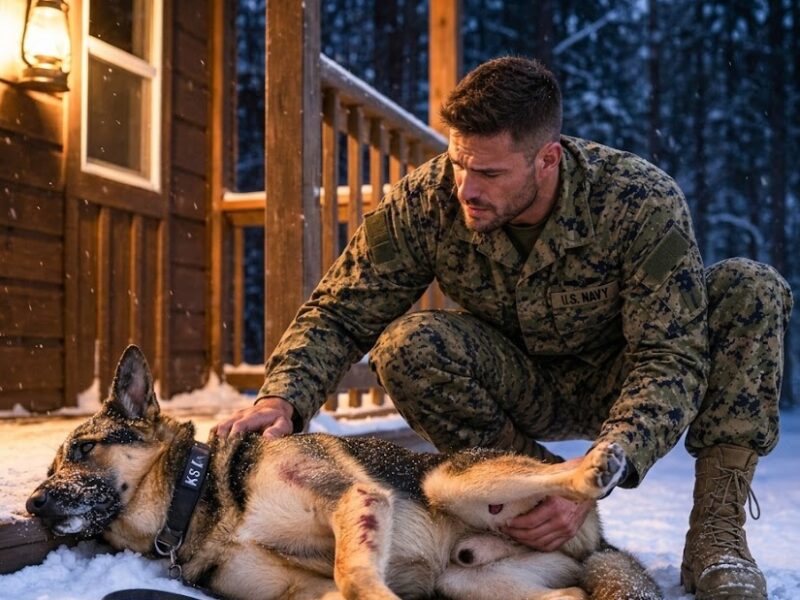
A Marine found a wounded K9 in the snow—then the dog revealed a 5-year secret about 417 Marines.
The snow came down like static on a dead channel, burying the Gallatin Mountains under three feet of white by midnight. Gunnery Sergeant Nathan Cole, thirty-eight, sat alone in his family’s old cabin an hour outside Bozeman, Montana, holding a cup of coffee that had gone cold two hours ago. He was a big man—six-two, broad shoulders, dark brown military cut, steel-gray eyes that had seen too much and said too little. Five years ago, his younger brother Ethan had died alongside 416 other Marines when Battalion 417 was lost at Raven Base overseas. The official report said communications failed. Nathan had never believed it. Then came the scratching at the door.
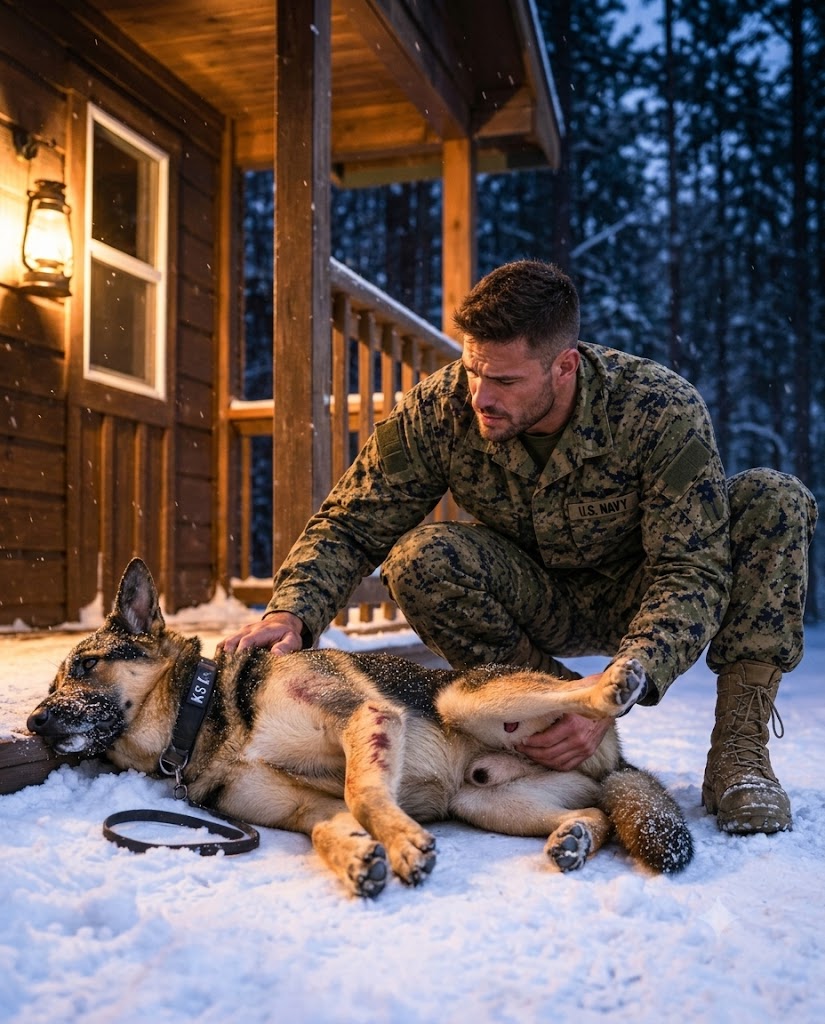
At first he thought it was a branch. The wind was doing its usual number on the pines, slapping limbs against the roof like a drunk looking for the wrong house. But the sound came again—softer, deliberate, followed by a quiet movement against the wooden porch. Nathan set down the mug, pulled on his winter coat, and crossed to the front door. Through the narrow glass panel he saw only swirling white and the dark outline of the steps. He opened it carefully. Something was curled against the porch railing, half-buried in drift. A German Shepherd. Black and tan, thick-coated, maybe eight years old, with intelligent amber eyes and a small patch of white fur beneath his chest. One front leg was injured. Around his neck sat a worn black military-style leather collar with its identification section deliberately damaged. The dog raised his head and studied Nathan without growling, without retreating. There was something unusual about those eyes. Even exhausted, the animal seemed to be evaluating him.
“Easy, buddy,” Nathan said, crouching several feet away. “You’re safe.” He extended a gloved hand slowly. The dog sniffed it, then lowered his head again. Nathan gently lifted the shepherd and carried him inside, placing him on a folded blanket near the fireplace. He brought water and a little plain chicken, then searched the cabin for his emergency medical kit. He cleaned the injured leg, applied a protective dressing, and made a mental note to call his sister Olivia—a veterinarian in Bozeman—as soon as the roads were safe. The shepherd watched every movement. He refused the food at first, but eventually drank when Nathan stepped away. “Not much for strangers, are you?” Nathan said. The dog blinked slowly. “Can’t blame you.”
While Nathan returned the medical supplies to their metal container, the lid slipped against the edge of the table with a sharp clatter. The shepherd immediately tensed, pulling his head back and looking toward the nearest doorway. Nathan stopped moving. “Hey. It’s okay. Nothing’s going to happen.” He closed the container quietly and moved it away. The dog remained watchful. Nathan understood that whatever had happened before the animal reached his cabin had left more than a physical injury. He sat on the floor several feet away and gave the shepherd time to relax. Minutes passed. Finally, Nathan spoke again. “You need a name. Can’t keep calling you buddy.” He studied the dog’s alert expression. “How about Ranger?” One ear lifted. Nathan almost smiled. “Ranger it is.”
He reached for another blanket, and an old habit made him speak without thinking. “Hold.” The shepherd instantly stopped moving. Nathan froze. The response had been immediate and precise—exactly as though the dog had spent years obeying a trained handler. Nathan slowly stood. “Release.” The shepherd relaxed. Nathan repeated the first command softly. Again, Ranger responded without hesitation. A strange feeling settled over him. Years earlier, Ethan had used those same commands while practicing with military working dogs during leave. Nathan remembered teasing him about treating every animal like a recruit. Ethan had laughed and said a good working dog listens because it trusts the person giving the command. Nathan looked down at Ranger. “Who trained you, boy?” The shepherd offered no answer.
Instead, Ranger carefully rose and began moving toward the old wooden cabinet beside the fireplace. Nathan watched, concerned about the injured leg. Ranger stopped in front of the cabinet and lifted his head toward a framed photograph resting on its upper shelf. Nathan recognized the picture immediately. Several members of Battalion 417 stood together beside a military transport vehicle, smiling during a rare quiet moment. Ethan stood near the center, wearing the familiar easy grin Nathan remembered from childhood. Beside him was Staff Sergeant Adrien Vega—a confident Marine K9 handler with short black hair and a friendly, steady expression. Adrien had also been killed at Raven Base. Ranger stared at the photograph with extraordinary attention. Then he raised one paw and gently touched the lower edge of the glass.
“What is it?” Nathan asked. The dog remained completely focused. Nathan lifted the photograph and brought it beneath the light. For the first time in years, he studied every face instead of looking only at Ethan. Then he noticed something near Adrien’s boots. A young German Shepherd was sitting proudly beside the handler, wearing a dark military collar. Nathan brought the photograph closer. The dog had the same black and tan markings, the same distinctive ears, and a tiny white patch beneath its chest. Nathan looked at Ranger, then back at the photograph. His heartbeat quickened. He remembered Ethan talking about Adrien’s exceptionally talented K9 partner—a shepherd who could recognize familiar routes and follow commands despite overwhelming distractions. Nathan had forgotten most of those conversations after the tragedy. Now the memories were returning.
“That can’t be you,” he whispered. Ranger leaned forward and touched his nose against the photograph, directly beneath Adrien’s face. Nathan felt the room grow strangely quiet. Five years earlier, the official casualty records had included the military working dogs assigned to Raven Base. Adrien’s K9 had been listed among those lost. Nathan had never questioned it. Why would he? Nobody had returned from Battalion 417 to challenge the report. But now a wounded German Shepherd had appeared at his door, wearing damaged military identification and responding to commands associated with Ethan’s unit. Nathan carefully returned the photograph to its shelf. Ranger settled beneath it, keeping his eyes fixed on the familiar faces. Nathan sat beside him, unable to dismiss what he had seen.
Outside, the snowfall had begun to weaken, revealing sections of the narrow road beyond the trees. A distant engine interrupted his thoughts. Nathan approached the window. Through the darkness, he saw the headlights of a gray pickup truck moving slowly along the forest road toward his property. The vehicle stopped briefly near the last bend. Ranger raised his head immediately—before the truck reached the cabin. It turned around and disappeared between the snow-covered pines. Nathan remained at the window, watching the fresh tire tracks stretching across the road. He looked back at Ranger, who was still listening toward the forest. Five years ago, 417 Marines and their K9 partners had been declared lost at Raven Base. Yet one of those dogs might now be sleeping beside his fireplace. Nathan glanced at Ethan’s photograph and whispered, “What did you leave behind, little brother?” Ranger lifted his head. Nathan realized the answers he had searched for all these years might have just walked through his front door.
By seven the next morning, the snowstorm had weakened, leaving the forest buried beneath an almost perfect blanket of white. Nathan had barely slept. Ranger remained near the fireplace, occasionally lifting his head toward the windows while Nathan sat at the kitchen table, studying the damaged military collar. The photograph of Battalion 417 rested beside it. He had compared the markings until sunrise, searching for something that might prove the impossible connection forming in his mind. Finally, he picked up his phone and called his younger sister. Olivia answered after the third ring. “Nathan, is everything all right?” He heard surprise beneath her concern. “I found a dog,” he said. “He’s injured. I need someone I trust to examine him.” There was a pause. “You haven’t called me in four months. Now you’re calling about a dog.” Nathan looked toward Ranger. “He’s not an ordinary dog.”
Olivia arrived two hours later, after county crews had cleared the main road, bringing her medical bag and her twelve-year-old daughter, Ruby. Olivia, thirty-five, was a slender woman with shoulder-length chestnut hair, warm brown eyes, and a practical, determined nature that had made her an excellent veterinarian and an impatient younger sister. Ruby was a quiet girl with curly brown hair, gentle green eyes, and an extraordinary sensitivity toward frightened animals. She carried a small backpack filled with books and a folded blue blanket. Nathan opened the door before they knocked. Olivia studied his tired face. “You look terrible.” “Good to see you, too.” She almost smiled before stepping inside. Ruby immediately noticed Ranger lying beside the fireplace. “Mom, he’s beautiful.” She started forward, then stopped herself. Instead of approaching, she sat on the floor several feet away and opened her favorite animal storybook. “Hi, Ranger,” she whispered. “I’m Ruby. You don’t have to come over.”
Ranger watched her carefully. Olivia noticed the interaction but said nothing. She approached slowly, allowing the shepherd time to become comfortable with her presence. During the examination, she found that his front leg needed continued rest and professional care, while several older marks around his shoulders suggested a long working history. His overall condition also raised concerns that he had spent considerable time in a restricted environment. “He’s been through a lot,” she said quietly. Nathan folded his arms. “Military?” “Almost certainly a working dog. But I can’t tell you where he’s been just by looking at him.” She passed a handheld scanner over his shoulders, then checked again. No identification number appeared. Olivia gently examined an area beneath his fur. “There’s something unusual here. It’s possible a microchip was removed or became unreadable, but we’d need further examination to know.” Nathan looked toward the collar. “And somebody damaged his identification.”
Olivia picked it up, rotating it beneath the morning light. The leather was worn, but the missing identification appeared different from ordinary aging. Then she noticed three shallow characters near the inside buckle. She moved closer to the window. “Nathan. Look at this.” He leaned over her shoulder. Beneath several faded marks, the numbers 417 remained visible. Nathan felt his stomach tighten. Olivia looked toward the photograph on the table. “That’s Ethan’s battalion number, isn’t it?” Nathan nodded. For several moments, neither spoke. Ruby continued reading softly near the fireplace, and Ranger gradually lowered his head closer to her blanket.
Nathan finally retrieved his phone. There was someone who might know what those numbers meant. Michael Turner answered with his usual dry humor. “Cole. I thought you forgot how telephones worked.” Michael, forty-three, was a former Marine record specialist with sandy hair, rectangular glasses, and a patient, meticulous personality. He had spent years managing military personnel and logistics documentation and now worked as a civilian records consultant. Nathan explained what he had found and sent photographs of Ranger, the collar, and the old battalion picture. Michael’s tone became serious. “You’re telling me this dog might have been at Raven Base?” “I’m telling you I need to know.” Michael promised to check the historical records available to him and contact Nathan when he had something reliable.
Olivia overheard the conversation. “You’re already turning this into an investigation.” Nathan looked at her. “A dog listed as dead may be sitting in my living room.” “And a living dog needs medical attention more than he needs answers about something that happened five years ago.” Nathan opened his mouth, then stopped. Olivia’s expression softened. “I know what Ethan meant to you. But you’ve spent five years chasing questions that never let you sleep. Don’t forget—there’s still a life happening right in front of you.” Nathan glanced toward Ruby. The girl was reading about a rescued horse, completely unaware of the tension between the adults. Ranger had moved his head onto the edge of her blanket. Nathan said nothing, but the sight stayed with him.
Shortly before noon, another vehicle approached the cabin. Sarah Bennett stepped onto the porch carrying a leather notebook. Sarah, thirty-seven, was a local investigative journalist with dark blonde hair, observant blue eyes, and the steady determination of someone accustomed to hearing the word no. Her husband, Captain Luke Bennett, had served with Battalion 417 and died at Raven Base. Nathan had known her briefly before the tragedy, but they had barely spoken since. Sarah had learned about Ranger through a mutual acquaintance who knew she was still researching the battalion. “Olivia confirmed you’d found a dog with military markings,” she explained. “I wouldn’t have come without asking her first.” Nathan hesitated before inviting her inside.
Sarah explained that she had spent years questioning the official account of Raven Base. Several reports had blamed Luke for failing to request assistance in time, damaging his reputation even though he could no longer explain his decisions. Her editor had recently warned her that another article about the closed investigation would jeopardize her position at the newspaper. “My son Finn is ten now,” she said. “He’s growing up reading that his father failed his men. Last month, he asked me whether it would be easier if we stopped talking about Luke altogether.” Her voice remained controlled, but Nathan understood the pain behind it. Sarah placed the notebook on the table. “Luke kept this during his final assignment. Most of it is ordinary reminders. But one phrase keeps appearing.” Nathan opened it carefully. Across several pages, written beside dates and shipment references, were the words Northstar shipment. “I never found a convincing explanation,” Sarah continued. “Luke mentioned it shortly before everything happened.”
Nathan remembered Ethan’s final warning about unusual shipments. He felt the same unanswered question returning—now connected to another man’s notes. As he placed the notebook near the fireplace, Ranger suddenly lifted his head. The shepherd approached the table, sniffed one particular page, and became unusually attentive. Nathan lowered the notebook slightly. Ranger examined the paper again, then turned toward the front door. He walked there carefully, stopped, and looked back at Nathan. “What is it, boy?” Ranger’s ears pointed forward. Beyond the door lay the northern forest, its distant ridges hidden beneath pale winter clouds. Ranger moved to the window and stared toward the mountains. Ruby closed her book. “I think he’s trying to show us something.” Sarah looked at Nathan, but neither offered an explanation.
That afternoon, Ruby stayed beside Ranger while Olivia prepared his next treatment. The girl began reading again, occasionally pausing whenever the shepherd lifted his head. At one point, Ranger moved close enough to rest beside her. Ruby smiled without reaching for him. “That’s okay, Sergeant Ranger. We can be friends slowly.” Nathan watched from the kitchen doorway, unexpectedly grateful for the gentle normality of the moment. Then his phone rang. Michael had found an archived K9 record. “Nathan, I have a match,” he said. “German Shepherd, male, assigned to Battalion 417. Name: Ranger. Handler: Staff Sergeant Adrien Vega.” Nathan gripped the phone. Michael continued. “Both were officially recorded as deceased following the Raven Base incident.” Nathan stared at the dog lying peacefully near Ruby. “Then somebody made a mistake.” “There’s more,” Michael replied. “Three months after the incident, a transfer request appeared for a German Shepherd matching Ranger’s description. Destination was a private canine training facility in Montana. The request was later deleted from the active system.” Nathan glanced at Olivia, who was carefully organizing her supplies. “Who deleted it?” Michael hesitated. “That’s why I called. I found the authorization reference and checked it against the original Raven investigation.” Nathan waited. Michael’s voice grew quieter. “The official who approved removing Ranger’s transfer record also signed the final reports concerning the deaths of all 417 Marines.”
Nathan looked toward the northern window. Ranger was watching him now. For five years, Nathan had believed the truth about his brother had disappeared with everyone at Raven Base. But somewhere in the mountains of Montana, a supposedly dead dog had survived—and the name on that forgotten list had just connected him to the people who wrote the official story.
Three days after Ranger appeared at Nathan Cole’s cabin, the snowstorm had finally passed over Montana’s Gallatin Mountains, leaving the pine forests silent beneath deep white snow. County crews had reopened the main roads near Bozeman, and pale sunlight stretched across the frozen landscape. Inside the cabin, Nathan stood beside the kitchen counter, watching Ranger move between the fireplace and the front door. The German Shepherd had repeated the same pattern since early morning. He would approach the door, turn toward Nathan, release a quiet whine, and wait. When Nathan remained still, Ranger returned to the fireplace before trying again. “You’re not asking to go outside, are you?” Nathan murmured. Ranger lifted his ears.
Nathan remembered the dog’s strange reaction to Sarah Bennett’s notebook and the way he had stared toward the northern mountains. He had also spent the previous evening reviewing Michael Turner’s discoveries. A dog officially declared dead five years earlier had somehow survived—and someone had deliberately interfered with his military records. Nathan could no longer believe Ranger’s arrival was an accident. He called Olivia before making any decision. After hearing about Ranger’s behavior, she reminded him that the shepherd’s injured leg was improving but still needed careful treatment. “Whatever he’s trying to tell you, Nathan, don’t make him pay for it by walking too far.” Nathan promised to keep the journey short, carry emergency supplies, and return if Ranger showed signs of discomfort.
He packed water, food, a blanket, a radio, and his basic winter equipment. He also sent Olivia his intended direction before opening the front door. Ranger stepped onto the porch, raised his nose toward the cold mountain air, and looked back. “All right, Sergeant Ranger,” Nathan said. “Show me what you’ve been waiting for.” The shepherd started toward the northern tree line. At first, Nathan expected him to wander uncertainly through the forest, but Ranger moved with remarkable purpose. He followed a narrow opening between the pines, avoided several snow-covered fallen branches, and paused at places that looked almost familiar to him. Nathan noticed that the dog was not following a fresh trail. He seemed to remember the landscape itself.
They crossed a gentle slope where sunlight had softened the upper layer of snow. Ranger slowed as his recovering leg grew tired, and Nathan immediately stopped beside an old pine. “Easy, partner. We have time.” He offered Ranger water and a few pieces of food before checking that the protective dressing remained comfortable. The shepherd accepted the break without complaint, then rested his head briefly against Nathan’s knee. Nathan looked down in surprise. Until that moment, Ranger had accepted care but rarely sought contact. He gently scratched behind the dog’s ear. “You’re starting to trust me, huh?” Ranger closed his eyes for a second.
The simple gesture brought back an unexpected memory. Five years earlier, during Ethan’s final leave, he had arrived at this very cabin with Adrien Vega and a younger German Shepherd. Nathan remembered the three of them standing on the porch while Ethan proudly demonstrated the dog’s obedience. Adrien had smiled as Ranger performed every command, and Ethan had laughed. “This dog is smarter than both of us put together, Nathan.” Nathan had answered that the competition wasn’t particularly difficult. They had spent the afternoon walking the nearby trails with Ranger happily leading the way. Nathan had almost forgotten that visit. Now, looking at the older shepherd beside him, he realized the animal might remember far more than he did. “You were here before,” Nathan whispered. Ranger opened his eyes and stood.
After another careful stretch through the forest, they reached an old service path almost invisible beneath the snow. The shepherd followed it toward a weathered wooden structure standing between two rocky hillsides. A faded sign identified it as Gallatin North Rescue Observation Station—a former county facility that had been closed for years. Nathan had heard of the station but never visited it. Its windows were dark, and the surrounding equipment shelters appeared unused. Ranger walked directly toward a smaller section of the building marked Communications Storage. He stopped at its door, scratched lightly against the wood, and looked up at Nathan with unmistakable expectation. “You know this place,” Nathan said.
He examined the building but did not attempt to enter. Instead, he contacted the county’s old rescue administration office using the emergency number posted on a weathered information board. After several calls, he reached Walter Pierce, a retired station supervisor in his late sixties who spoke with the calm patience of someone accustomed to mountain emergencies. Walter remembered Adrien Vega immediately. “Young Marine with a German Shepherd. Sure. He visited with a friend years ago. Asked about old rescue routes and observation markers.” Nathan explained that Ranger had led him to the abandoned station. Walter hesitated before confirming that the county still controlled the property. He arranged permission for Nathan to inspect the unused communications room and warned him to avoid any unsafe sections of the building.
Nathan thanked him and entered through the authorized access door. Inside, dust covered the shelves, and outdated radios rested beneath protective covers. Ranger moved carefully across the floor, stopping before a wooden wall panel behind an empty equipment cabinet. He sniffed along the base and sat down. Nathan examined the panel and noticed a small storage compartment that was not listed on the faded inventory sheet nearby. Inside, wrapped in protective material, lay a small notebook, a waterproof storage device, and an envelope bearing the handwritten name Adrien Vega. Nathan stared at the envelope. For five years, he had known that handwriting only from old birthday cards Ethan had brought home. He opened the letter carefully.
Adrien explained that before Battalion 417 deployed to Raven Base, he had noticed military shipments disappearing between authorized facilities. Weapons and equipment recorded as delivered never appeared at their intended destinations. He feared that some of those missing supplies were entering illegal trading networks and reaching armed groups operating in the same regions where American service members were stationed. Adrien had reported concerns but received no convincing answers. During his final leave, he had preserved copies of selected records outside military channels. Knowing Nathan’s family cabin was a trusted location, he had used familiar walks and training markers to teach Ranger a route leading toward the old rescue station. If anything prevented Adrien from returning, the dog might one day guide someone he trusted to the evidence.
Nathan lowered the letter. The room seemed impossibly quiet. Adrien had not known what would happen at Raven Base, but he had feared that the missing shipments were connected to something larger. Nathan examined the notebook, which contained dates, inventory references, and short observations. None of it directly established what happened during the attack, yet it proved that questions had existed before Battalion 417 was lost. Nathan carefully secured the materials and photographed their original arrangement. “You remembered everything important,” he told Ranger. The shepherd remained beside him, watching quietly.
Nathan sent Olivia a message confirming they were safe and began the return journey, allowing Ranger frequent rests. By late afternoon, they reached the cabin. Ruby, who had come with Olivia to check on the dog, greeted them from the porch. “Sergeant Ranger! Mission completed!” Nathan almost smiled. “He found something.” Ruby knelt without rushing toward the shepherd. Ranger approached her and gently touched her hand with his nose. Olivia noticed Nathan’s expression as he carried the recovered materials inside. “You found something about Ethan, didn’t you?” Nathan nodded. “About Adrien, too.”
While Olivia prepared Ranger’s treatment, Nathan contacted Michael and created a working copy of the recovered storage files so the originals could be preserved. Together, they examined shipping schedules, warehouse references, and military inventory lists. Several records described weapons that had disappeared during transfers connected to Raven Base’s supply network. Michael compared the available identification codes against historical summaries of equipment associated with the attack on Battalion 417. “Nathan, these belong to the same equipment classifications and supply series identified in parts of the Raven investigation,” he said. “That doesn’t prove where any individual weapon ended up, but it’s something investigators should have examined.” Nathan leaned toward the screen. One name appeared repeatedly beside approvals and transportation authorizations. Warren Caldwell.
Nathan recognized it immediately. General Warren Caldwell had overseen major military logistics operations, including supply coordination connected to Raven Base. Nathan remembered seeing his name in official statements after the tragedy. Meanwhile, Sarah Bennett called with a discovery of her own. She had located a former military communications specialist named Harold Finch, who had quietly requested access to Raven Base’s signal records after the incident. Shortly afterward, Harold had been removed from his position. “I haven’t spoken to him yet,” Sarah explained. “But someone didn’t want him asking questions.”
Olivia then shared another troubling detail. Her search through regional veterinary and kennel records had identified a private working dog training facility that closed unexpectedly only weeks before Ranger appeared. The timing made Nathan uneasy, although they had no proof Ranger had been kept there. As evening settled over the mountains, Nathan placed Adrien’s letter beside Ethan’s photograph. Ranger lay near Ruby’s blue blanket, finally resting after the long day. Nathan looked at the newly discovered documents, feeling both closer to his brother and more uncertain about the past than ever. Then his phone vibrated. Unknown number. Nathan answered. For a moment, he heard only a faint background hum. An unfamiliar man’s voice spoke quietly. “You found the dog. Don’t go looking for what he remembers.” The call ended.
Nathan remained motionless, the phone pressed against his ear. Across the room, Ranger lifted his head. Nathan looked toward the darkening forest beyond the window, suddenly aware that someone else knew the truth had begun to surface.
The morning after the mysterious phone call, Nathan Cole stood beside his cabin window, watching sunlight spread across the snow-covered Gallatin Mountains. The stranger’s warning continued to trouble him. But what disturbed him more was the possibility that someone had been protecting the secrets of Raven Base for five years. On the kitchen table lay Adrien Vega’s recovered documents, Sarah Bennett’s notebook, and the military reports Michael Turner had managed to obtain. Nathan had spent most of the night comparing dates and shipment references, searching for connections that might explain why Battalion 417 had never received the assistance it needed.
Sarah arrived shortly after breakfast, carrying several folders and a name she believed could change everything. “Harold Finch,” she said. “Former military communication specialist. He requested access to Raven Base’s signal records after the incident, then disappeared from the official investigation.” Michael joined them through a secure video call. Together, they reviewed the final battalion reports and discovered several inconsistencies in the communications timeline. Some entries described a complete communications failure, while others referenced transmissions received after that failure supposedly occurred. Michael leaned toward his camera. “Those records shouldn’t contradict each other.” Sarah opened another folder. “Harold might know why.”
By early afternoon, Nathan and Sarah were driving toward a quiet Montana town where Harold had lived since leaving military service. Ranger remained at the cabin with Olivia and Ruby, his recovering leg still requiring careful attention. Harold Finch was sixty-two—a thin man with neatly combed gray hair, tired blue eyes, and a cautious manner that suggested he had spent years avoiding difficult conversations. He opened his front door only far enough to see his visitors. When Sarah introduced herself, his expression changed. “I know who you are,” he said. “I’ve read your articles. I told the last reporter I wasn’t interested.”
Nathan stepped forward. “My brother was Ethan Cole. Battalion 417.” Harold looked away. “I’m sorry for your loss, Sergeant. But I can’t help you.” He began closing the door. Nathan did not argue. Instead, he took a photograph from his coat pocket. It showed Ranger standing beside Adrien Vega’s old battalion picture. “This dog came to my cabin last week,” Nathan said. “His name is Ranger. He belonged to Adrien Vega.” Harold stared at the photograph. His hand tightened around the door. “That’s impossible.” “That’s what the records say.” Harold studied the image again before slowly opening the door wider. “You’d better come inside.”
His small living room was filled with books, framed family photographs, and carefully arranged furniture. Harold offered coffee but barely touched his own cup for several minutes. He remained silent. Finally, he looked at Nathan. “Five years ago, I was assigned to review communication records connected to Raven Base. The official conclusion was that the battalion lost contact because its equipment failed during the attack. That wasn’t the complete truth.” Sarah opened her notebook. Harold continued. “Some communications equipment stopped working, but other channels remained active longer than investigators publicly acknowledged. Battalion 417 transmitted multiple requests for assistance.”
Nathan felt his shoulders stiffen. “Were those requests received?” Harold nodded slowly. “Several were. But the record showed them as delayed, incomplete, or already resolved. When I compared the original reception summaries with the final incident report, the entries didn’t match.” Sarah leaned forward. “My husband, Captain Luke Bennett, was blamed for not requesting support in time.” Harold lowered his eyes. “Luke sent requests. More than one. His name appears in the original records.” Sarah’s hands trembled slightly as she closed her notebook. For five years, she had watched strangers question her husband’s judgment. Now a man who had examined the communications records was telling her Luke had done exactly what he was supposed to do. “Why didn’t you tell anyone?” she asked quietly.
Harold looked toward a family photograph on the mantel. “I tried. I requested a formal review. Two weeks later, I was transferred away from the investigation. Eventually, I left the service. I had a wife, children, people who depended on me. I convinced myself someone else would correct the record.” His voice weakened. “Nobody did.” Nathan watched him without speaking. Harold eventually retrieved a small storage case from a locked cabinet. Inside were printed summaries and copies of signal logs he had preserved before his reassignment. “I kept these because I knew something wasn’t right. I was afraid to use them, but I couldn’t destroy them either.”
Nathan examined the pages. Several messages from Raven Base had been recorded as received, yet their routing histories ended without confirmation that the appropriate support units had been notified. The records raised serious questions about missed opportunities to help the battalion, although they did not establish who had intervened or why. “So these men weren’t simply forgotten by a broken radio,” Nathan said. Harold shook his head. “No. Someone needs to explain why their messages stopped moving through the system.”
On the drive back, Sarah remained unusually quiet. Finally, she looked toward Nathan. “Luke spent years teaching younger Marines that asking for help wasn’t weakness. Then the world was told he failed to ask for it himself.” Nathan kept his eyes on the road. “We’ll make sure that part of the truth is heard.” Sarah studied him. “You sound like you’re blaming yourself again.” Nathan hesitated. Then he remembered something he had never told her. During Ethan’s last leave, the brothers had argued at the cabin after Ethan mentioned strange transportation documents. Nathan had dismissed the discrepancies as ordinary administrative mistakes. Ethan had insisted that some shipment numbers simply didn’t make sense. “I told him to stop worrying about paperwork and focus on coming home,” Nathan admitted. “He was trying to warn me, Sarah. I didn’t listen.”
Sarah waited before answering. “Ethan trusted you enough to share his concerns. That doesn’t mean you were responsible for what happened afterward.” Nathan said nothing, but her words remained with him.
Back at the cabin, Michael had uncovered another significant detail. A secondary report among Adrien’s recovered files described military weapons discovered outside authorized supply channels shortly before Battalion 417’s final deployment. The equipment appeared connected to shipments that had been recorded as missing or redirected. Adrien suspected the materials were reaching unauthorized armed groups overseas. His notes also referenced concerns that someone inside the transportation system was suppressing warnings about growing threats near Raven Base. Michael compared the references with Harold’s communication logs. “Look at the dates,” he said. “Adrien was questioning missing weapons before the incident. Then the battalion encountered equipment that shouldn’t have been there. Afterward, critical communication records were altered or incorrectly classified.”
Nathan studied the documents. “Someone may have known the battalion was getting close to uncovering something.” Michael nodded cautiously. “Possibly the contracts involved were worth hundreds of millions of dollars. But we still don’t have evidence identifying who authorized the suspicious decisions.” Nathan looked toward Ethan’s photograph. The possibility was devastating. 417 Marines might have lost their lives while powerful people protected an illegal weapons operation. Yet Nathan understood that suspicion was not proof. They needed more than incomplete reports and unanswered questions.
Meanwhile, Olivia had made progress with Ranger’s history. By contacting former employees and reviewing available veterinary records, she had identified a private K9 training facility that had recently closed. One archived kennel record described a German Shepherd whose age, markings, and medical history resembled Ranger’s. The animal had been registered under a different identification number. More troubling was a note indicating that a caretaker had challenged an instruction to have the dog permanently put down, insisting he could still be cared for safely. Olivia couldn’t establish who issued that instruction or why. “Someone may have protected him,” she told Nathan. “But we need the original records before making assumptions.”
Across the room, Ruby and Sarah’s ten-year-old son, Finn, sat at the coffee table surrounded by photographs. Finn was a thoughtful boy with dark hair and serious brown eyes who had become uncomfortable whenever adults mentioned his father’s military service. Ruby had suggested making a memorial album containing stories about the Marines of Battalion 417. Finn had initially refused, saying he didn’t want to collect pictures of people everyone remembered only for dying. Ruby had quietly answered, “Then let’s remember how they lived.” Now they were arranging photographs of family celebrations, fishing trips, birthday parties, and smiling service members. Finn paused over a photograph of Luke holding him as a baby. “Mom says Dad loved terrible jokes,” he said. Ruby smiled. “Then we should write that down.”
Nathan watched the children for a moment. For years, he had thought of Battalion 417 only through its final tragedy. Ruby and Finn were reminding him that those 417 human beings had entire lives beyond that terrible day.
The following afternoon, Olivia brought Ranger to her veterinary clinic for a scheduled examination. Nathan accompanied her while Ruby and Finn waited in the small family room with their album. Sarah joined them after speaking with her editor, who had again warned her against pursuing a case considered officially closed. Ranger’s recovery was progressing steadily, and for the first time he appeared comfortable resting among the familiar voices of the family. When they returned to Nathan’s cabin before sunset, however, something felt wrong. The front door was not fully closed.
Nathan asked everyone to remain outside while he contacted local authorities. After officers from the Gallatin County Sheriff’s Office inspected the property and confirmed it was safe to enter, Nathan walked through the rooms with growing unease. Drawers had been opened, papers moved, and several old storage boxes disturbed. Yet his father’s watch, the electronics, and other valuable belongings remained untouched. Olivia examined the scene. “Nathan, where’s Ranger’s old collar?” He turned immediately. The small wooden box where he had placed the damaged military collar was empty. Nathan searched the surrounding shelves, then stopped. Nothing else of significance appeared to be missing. Whoever entered the cabin had ignored valuable possessions and taken the one object that directly connected Ranger to Battalion 417. Nathan looked toward the doorway where Ranger stood quietly beside Olivia. Five years of silence had begun to break—and someone was trying to preserve it.
Nathan understood that the missing collar was no ordinary theft. It was a sign that the past was no longer staying buried.
The morning after the break-in, Nathan Cole stood in his cabin staring at the empty wooden box where Ranger’s military collar had been kept. Local deputies had documented the disturbance, but nothing suggested an ordinary burglary. Valuable possessions remained untouched, while the one object connecting Ranger to Battalion 417 had disappeared. Nathan understood that whoever had entered his home knew exactly what they wanted. Outside, the Gallatin Mountains stood beneath a pale winter sky, their snow-covered slopes peaceful enough to make the danger feel almost unreal. Ranger rested near the fireplace, unaware that the past he had carried for five years was becoming a threat to the people protecting him.
Nathan’s first instinct was to investigate alone, but Olivia reminded him that Ruby was now involved. “You can take risks with your own life, Nathan,” she said. “You don’t get to make that decision for my daughter.” He knew she was right. Later that morning, Olivia noticed a dark sedan parked across from her veterinary clinic. She initially dismissed it, but when the same vehicle appeared again after lunch, slowly passing the entrance, her concern grew. Ruby recognized it too. “Mom, that car was there when we arrived.” Olivia calmly moved her daughter into the clinic’s private office and contacted Nathan. By the time he arrived, the vehicle had disappeared.
He didn’t pursue it. Instead, he arranged for Olivia, Ruby, and Ranger to stay temporarily with a trusted family friend outside Bozeman—somewhere away from the isolated cabin. Ruby protested immediately. “Ranger needs me. I’m not leaving him.” Nathan knelt beside her. “You’re not leaving him, sweetheart. You’re helping keep him safe.” She looked unconvinced. “But Marines don’t run away.” Nathan gently shook his head. “Being brave doesn’t mean walking toward danger every time. Sometimes courage means knowing when to let someone else handle it.” Ruby considered his words before reaching down to stroke Ranger’s neck.
Nathan then made a call he had avoided for years. Special Agent Evelyn Brooks answered after several rings. Evelyn, forty-four, was a composed federal investigator with dark brown hair, sharp hazel eyes, and a reputation for remaining patient when others rushed to conclusions. Nathan had worked alongside her during a military contracting investigation years earlier and trusted her judgment. “Nathan Cole,” she said. “I wasn’t expecting to hear from you.” “I found something connected to Raven Base.” A pause followed. “What kind of something?” Nathan looked toward Ranger. “A military working dog who officially died with Battalion 417 five years ago. And evidence suggesting somebody wanted him to stay dead.”
Evelyn arrived the following afternoon with authorization to assess the suspected theft of military property and possible record manipulation. Nathan presented Adrien Vega’s letter, the recovered storage device, Harold Finch’s communication summaries, and the photographs documenting Ranger’s identification. Evelyn examined everything carefully. “From this moment forward—no independent searches, no confronting suspicious people, and no more carrying evidence around without documentation,” she instructed. Nathan folded his arms. “I’m not used to standing aside.” “Then consider this a new assignment. Protect your family and let investigators build a case that can survive in court for once.” Nathan offered no argument.
With Michael Turner’s assistance, Evelyn began comparing the recovered shipment records against legitimate military transportation contracts. One company appeared repeatedly: Red Mesa Defense Logistics. It had received substantial transportation agreements before and after the Raven Base tragedy, including contracts associated with equipment later reported missing, damaged, or disposed of behind several layers of corporate ownership. Investigators identified a controlling interest connected to retired General Warren Caldwell—the same officer who had previously overseen important military supply operations supporting Raven Base. Caldwell, now a prominent defense industry businessman, regularly appeared at veterans charity events and spoke publicly about integrity and service. Nathan watched an archived interview in which Caldwell praised Battalion 417 as an example of sacrifice under impossible conditions. “He talks about them like he knew exactly what happened,” Nathan said. Evelyn closed the file. “Maybe he knows more than the reports show. But knowing isn’t the same as proving. We need witnesses and records that connect specific decisions to specific people.”
That evening, Olivia received an unexpected response to one of her earlier inquiries about Ranger’s missing years. A former employee of the recently closed K9 facility, Grace Ellison, agreed to speak with investigators. Grace was a fifty-eight-year-old former kennel assistant with short silver hair and a gentle, cautious manner. She recognized Ranger immediately from the photographs. “We called him K62,” she explained. “But I always knew that wasn’t his real name.” Grace described how Ranger had arrived at the private facility several months after the Raven Base tragedy, accompanied by paperwork that concealed his previous military assignment. His records classified him as unsuitable for ordinary reassignment, and employees were discouraged from asking about his earlier handler. “He was an extraordinary dog,” Grace remembered. “Quiet, disciplined, always watching the doors. Sometimes he would sit facing the northern mountains for hours.”
According to Grace, the facility manager, Thomas Bell, had grown protective of Ranger and resisted instructions to have the dog permanently put down. Thomas insisted that Ranger deserved continued care and kept him under the alternate kennel number. Grace believed the unusual restrictions surrounding Ranger were intended to prevent anyone from connecting him to Adrien Vega, although she could not prove who issued them. For nearly five years, Ranger remained at the facility. Then its owners announced an unexpected closure. Shortly afterward, unfamiliar representatives arrived requesting Ranger’s transfer. During the confusion surrounding the shutdown, the German Shepherd escaped. When workers realized he was missing, attempts to locate him produced no confirmed sightings. “I thought we’d never see him again,” Grace said softly.
Olivia looked toward the dog resting beside Ruby. Ranger had traveled an extraordinary distance through familiar mountain territory before reaching Nathan’s cabin. Whatever had happened during that journey, he had remembered the route Adrien taught him years before. Nathan lowered his eyes. “He wasn’t wandering without a destination.” Evelyn nodded. “And now we need to understand why someone kept him hidden.”
Meanwhile, Sarah Bennett was facing a difficult decision. Her editor offered her a final opportunity to publish a major article about Battalion 417 but insisted she release the story immediately. Sarah had enough material to attract national attention. Yet much of the evidence remained unverified. Publishing too soon could expose witnesses and undermine the investigation. That evening, she found Finn sitting with Ruby’s memorial album, studying a photograph of his father. “Are people finally going to know Dad wasn’t a failure?” he asked. Sarah sat beside him. “I’m working on it.” Finn looked at her. “Then don’t let them get the story wrong again.”
The following morning, Sarah told her editor she would not publish allegations she could not fully substantiate. She understood the decision might cost her position, but she refused to let another incomplete account define the lives of the men who died. At the same time, Olivia considered temporarily closing her veterinary clinic. Several appointments had been canceled because of the increased police presence, and she worried about her employees. Yet when neighbors learned that she was helping a retired military dog in difficult circumstances, support arrived unexpectedly. A local veterinarian offered temporary assistance. Longtime clients prepaid appointments. Volunteers helped organize supplies. Olivia realized she was not facing the crisis alone.
Nathan watched these small acts of kindness with growing humility. For years, he had believed carrying responsibility meant refusing help. Now he saw that loyalty could also mean allowing others to stand beside him. Evelyn’s investigation soon identified another potential witness: Aaron Price, a former warehouse employee who had handled military shipment documentation near Great Falls. Aaron claimed that several weapons shipments officially marked for disposal had instead been transferred to other facilities. He agreed to provide testimony and supporting records through a protected arrangement. But on the morning of their scheduled meeting, Aaron could not be reached. His residence was empty, and his phone remained unanswered. Evelyn received a brief message through the contact method he had previously established. “Someone inside Caldwell’s network still knows when people start talking. I can’t meet you now.”
There was no evidence that Aaron had been harmed, but his disappearance deeply concerned investigators. Nathan wanted to search for him immediately. Evelyn refused. “If you want justice for Ethan and the others, you have to let us protect the people who can help establish the truth.” Nathan looked toward the photograph of his brother on the mantle. Slowly, he nodded. He was beginning to understand that finishing Battalion 417’s unfinished mission required more than determination. It required patience, trust, and the willingness to accept help.
Near sunset, Evelyn received an update from her investigative team. Historical property records and recent observations pointed to an old warehouse complex outside Great Falls that appeared inactive on paper but still showed signs of commercial activity. An analyst sent her a surveillance photograph of the facility’s loading area. Evelyn enlarged the image and called Nathan over. On the side of a weathered transport container was a faded shipping emblem. Nathan stared at it, then opened Adrien’s recovered notebook to a page containing the same mark. The symbols matched.
Evelyn studied the photograph in silence. Nathan looked from the notebook to the distant warehouse on the screen. Five years earlier, Adrien had drawn that symbol beside shipments he believed were disappearing from the military supply system. Now it had appeared again at a supposedly inactive facility in Montana. Nathan gently rested one hand on Ranger’s shoulder. The German Shepherd looked up at him, calm and trusting. Somewhere beyond the snowy mountains, another piece of Battalion 417’s forgotten history was waiting to be examined. And for the first time, Nathan knew he would not have to face it alone.
Four days after investigators identified the mysterious warehouse near Great Falls, winter sunlight stretched across Montana’s frozen plains as Nathan Cole stood outside a federal field office, waiting for news that could finally change the history of Battalion 417. Inside, Special Agent Evelyn Brooks had spent the previous days working with federal investigators and military criminal investigators, comparing Adrien Vega’s recovered documents with historical shipping records and the evidence collected from Harold Finch. What had once appeared to be unrelated accounting irregularities was beginning to form a disturbing pattern. Thousands of military inventory entries pointed toward equipment that had officially disappeared, yet continued appearing in private transportation records.
Michael Turner had barely slept while examining the information. His careful comparisons had identified several shipment numbers that appeared in both Adrien’s notebook and Red Mesa Defense Logistics records. “I spent twenty years believing paperwork was boring,” Michael told Nathan over the phone. “Turns out paperwork remembers things people would rather forget.” Nathan almost smiled. “Ethan would have liked that.”
By mid-morning, Evelyn received confirmation that investigators had obtained a court-authorized search warrant for the warehouse complex. Nathan immediately offered to help. Evelyn shook her head. “You’re not leading an operation, Nathan. Your role is identifying the historical records and helping us understand Adrien’s evidence.” Nathan considered arguing but remembered what he had promised Olivia. “Understood.” Ranger had also been brought to a secure location nearby with Olivia supervising his comfort and recovery. His presence was limited to helping investigators compare archival K9 photographs and historical identification details when necessary. Nobody expected the aging shepherd to work another dangerous assignment. The investigation now belonged to people trained to handle it.
When the federal team reached the warehouse complex outside Great Falls, the buildings looked like ordinary abandoned industrial property. Snow rested along the loading platforms, and faded company signs hung above several entrances. But official records describing the site as inactive did not explain the recent transportation activity investigators had documented. After the property was secured, Evelyn entered with the authorized investigative team. Nathan remained at the designated coordination area, listening to updates without interfering. Nearly an hour passed before Evelyn contacted him. “Nathan, we found something inside one warehouse.”
Investigators had discovered extensive stocks of military equipment stored behind ordinary commercial inventory. Many containers still carried identification labels from authorized government supply chains. Some had been officially reported lost, damaged, or destroyed years earlier. Others were associated with shipments that never reached their intended destinations. Nathan felt his heartbeat quicken. Evelyn continued. “We’re documenting everything. Michael’s comparisons are already producing matches.” On a secure video connection, Nathan watched investigators examine recovered shipment records. Several identification numbers corresponded to entries Adrien had preserved before the Raven Base tragedy. The similarities were too specific to dismiss as coincidence.
Michael joined the conversation, his voice unusually quiet. “Adrien was tracking these shipments before anybody else understood the pattern.” Nathan looked down at the notebook beside him. Five years earlier, Adrien had been trying to follow the same trail. Now investigators were standing inside one of the places connected to it.
Later that afternoon, technicians identified an electronic archive containing financial transactions, internal correspondence, and historical transportation authorizations. The records described arrangements between Red Mesa Defense Logistics and intermediary companies that had helped redirect military supplies away from their approved destinations. Some transactions involved equipment later traced to unauthorized armed organizations overseas. Several internal communications carried approvals linked to Warren Caldwell and executives who had worked under his supervision. Evelyn cautioned that every record would require authentication, but the evidence was becoming substantial.
Then investigators opened a group of archived documents labeled with the operational designation of Raven Base. Nathan was called into the coordination room. Evelyn placed several pages on the screen. “These were prepared before Battalion 417’s final assignment.” They contained warnings about suspicious shipments and concerns that unauthorized armed groups had obtained military equipment. The documents also revealed that certain officials had received advanced information about growing threats to the battalion’s security. Instead of forwarding those warnings through the appropriate channels, several individuals had delayed or withheld them. Other records documented interference with the handling of assistance requests during the final incident. Harold’s preserved communication summaries now provided an independent comparison.
Nathan read the entries slowly. The same requests his brother’s unit had sent appeared in the recovered records, marked with administrative decisions that prevented them from reaching the proper authorities in time. For five years, Nathan had believed that Raven Base’s communication systems had failed completely. Now he was looking at evidence suggesting that some of the men responsible for protecting Battalion 417 had deliberately prevented essential information from reaching those who could help. “They knew the battalion needed assistance,” Nathan whispered. Evelyn nodded gravely. “The documents indicate several people knew more than they admitted. We’re still establishing individual responsibility, but these decisions appear connected to efforts to conceal the weapons operation.”
Nathan lowered his head. He thought of Ethan’s unanswered warning, Adrien’s determination to preserve evidence, and hundreds of families who had spent five years believing there was nothing more to learn. The truth did not bring the lost Marines back, but it challenged the story that had been used to explain their deaths.
Meanwhile, investigators finally located Aaron Price, the former warehouse employee who had disappeared before his scheduled interview. He had been staying with an acquaintance because he feared retaliation from people connected to Caldwell’s organization. Once assured that protective measures were available, Aaron agreed to cooperate. His testimony supported the recovered records, confirming that equipment described as disposed of had continued moving through commercial storage facilities.
The case expanded rapidly. Federal authorities obtained additional warrants, secured financial accounts and business records, and arrested Warren Caldwell along with several principal associates. There was no dramatic confrontation. The arrests followed an investigation built on documents, witnesses, and evidence that had survived years of concealment. When Evelyn informed Nathan, he remained silent. He had imagined this moment countless times, expecting anger or triumph. Instead, he felt an immense sadness for the people who had never been given the chance to know the truth. “What happens now?” he asked. “The investigation continues. Charges will be presented, and the evidence will be tested in court,” Evelyn replied. “But Nathan, what Adrien started five years ago has finally reached the people who can act on it.”
Across Montana, the discoveries began affecting other lives. Harold Finch formally provided his testimony and the records he had preserved. He admitted that fear had kept him silent long after he recognized the inconsistencies. Nathan spoke with him afterward. “You came forward,” he said. Harold shook his head. “Five years too late.” Nathan considered the words before answering. “Maybe. But today those records are helping someone hear what our men were trying to say.”
Sarah Bennett completed the most important investigative article of her career. Instead of opening with accusations and sensational headlines, she began with the lives of the Marines themselves—a father who coached his daughter’s baseball team, a young corporal who wrote letters to his grandmother, and Luke Bennett, a husband whose son had spent years wondering whether his father had failed his duty. She wanted readers to understand that Battalion 417 had been made up of people, not simply a number in a government report.
At Olivia’s veterinary clinic, Ranger continued recovering. His old nervousness was gradually fading, and he now slept peacefully even when ordinary sounds filled the room. Ruby and Finn spent their afternoons completing the memorial album, adding photographs and personal memories of the Marines whose families had responded to Sarah’s requests. Some entries contained only a name and a short story, but the children treated each one with care. Finn placed his father’s photograph beside a handwritten sentence. “He always came home with a joke for me.” Ruby read it and smiled. “That’s how people should remember him.”
That evening, Nathan returned to the family cabin. Olivia was preparing dinner. Ruby was arranging the completed album, and Ranger rested comfortably beside the fireplace. Nathan paused at the mantle where Ethan’s photograph stood beside Adrien’s letter. He gently rested his hand on Ranger’s head. “They found it, buddy,” he whispered. “The records. The people who hid them. Someone finally knows what happened.” Ranger leaned against his leg, and Nathan looked at the faces in the old battalion photograph. “We found the people who can bring the truth into the light. You and Adrien kept your promise.” For the first time in years, Nathan felt that Ethan’s final warning had truly been heard.
A little later, a vehicle stopped outside. A federal investigator approached the porch carrying a sealed envelope recovered during the broader examination of archived materials associated with Battalion 417. “Sergeant Cole, this was identified among your brother’s personal correspondence. It was never delivered.” Nathan accepted the envelope carefully. Across the front, written in the familiar handwriting he had not seen in five years, were two simple words: Nathan Cole. He recognized the handwriting immediately. Ethan had written him a letter before the tragedy—a letter that had somehow remained hidden from him all these years. Nathan stood beside the fireplace, holding the unopened envelope while Ranger quietly settled at his feet. After five years of unanswered questions, his little brother had one final message waiting for him.
Eighteen months later, the Gallatin Mountains of Montana were alive with the colors of spring. Snow still lingered on the highest slopes, but green grass covered the valleys surrounding Bozeman, and warm sunlight reached the wooden cabin that had once stood silent beneath a winter storm. For Nathan Cole, the world had changed in ways he never believed possible. The federal investigation into Red Mesa Defense Logistics had reached its conclusion, and Warren Caldwell, along with several senior associates, had been convicted of crimes involving illegal military weapons transactions, fraudulent government contracts worth more than $41.7 million, and the deliberate concealment of critical information. The recovered military equipment had been returned to authorized government control, and the network that had operated behind respectable business names was dismantled.
More importantly, an independent military review had finally corrected the official history of Battalion 417. Investigators confirmed that the Marines at Raven Base had fulfilled their responsibilities under extraordinary circumstances, and that critical warnings and requests for assistance had been improperly withheld. The accusations against Captain Luke Bennett and other fallen officers were formally withdrawn. For 417 families, the truth arrived five years too late to bring their loved ones home. But it restored something they had feared was lost forever: their honor.
On a clear spring morning, Nathan stood outside a Marine Corps installation where a special memorial ceremony had been arranged. He wore his formal military uniform, and beside him stood Olivia, Ruby, Sarah, and Finn. Ranger waited calmly near Nathan’s leg, wearing a temporary identification collar while his permanent retirement documents were being finalized. The German Shepherd had recovered remarkably well under Olivia’s care. His strength had returned. His movements were comfortable. And the anxious watchfulness that once kept him awake through the night had gradually disappeared. Nathan looked toward the gathering families and recognized faces he had avoided for years. Some greeted him with quiet handshakes. Others simply placed a hand on his shoulder. Nobody asked why he had missed the previous memorials. They understood that grief had kept many people away.
Inside the memorial hall, 417 names were displayed against a simple backdrop bearing the Marine Corps emblem. Photographs showed young men smiling beside their families, standing with friends, sharing ordinary moments that had once seemed too small to remember. Nathan recognized several pictures from the album Ruby and Finn had helped create. Sarah’s investigative articles had encouraged families across the country to contribute memories, transforming the memorial from a record of loss into a celebration of lives.
When the ceremony began, the commanding officers spoke about responsibility, truth, and the duty owed to those who could no longer speak for themselves. Then the names were read aloud. One by one, 417 Marines were remembered. Nathan stood motionless until he heard Captain Luke Bennett, Staff Sergeant Adrien Vega, and finally his younger brother, Ethan Cole. At Adrien’s name, Ranger lifted his head. When Ethan’s name followed, the shepherd rose to his feet, his ears turned toward the front of the room. He stood quietly beside Nathan as though listening for voices from a life he had never forgotten. Nathan rested his hand on Ranger’s shoulder. He did not know how much the dog remembered, but he knew Adrien and Ethan had trusted him long before anyone understood what was happening at Raven Base. Ranger had carried that trust across five missing years.
When the final name was spoken, the room remained silent. Nathan looked at the memorial and felt something unfamiliar beneath his sadness: peace.
After the ceremony, Sarah stood beside Finn near Luke’s photograph. Her son studied the picture before looking up at her. “Dad really did ask for help, didn’t he?” Sarah nodded. “He did everything he could for his men.” Finn looked back at the photograph. “Then I’m proud of him.” Sarah wrapped an arm around her son. For the first time in years, she could tell Luke’s story without defending him against accusations that should never have existed. Her reporting had received national recognition, but hearing those words from Finn meant more to her than any professional award.
Nearby, Harold Finch approached Nathan. Harold had testified openly during the proceedings and had since begun speaking at military ethics programs about the importance of protecting accurate records and reporting concerns. Some families had struggled to forgive his years of silence, but others had thanked him for eventually coming forward. “I wish I’d been braver sooner,” Harold said. Nathan looked toward the memorial. “You helped them be heard. What matters now is what you do with that second chance.” Harold nodded, his eyes filled with quiet gratitude.
Before leaving, a military representative approached Nathan carrying a folder. Inside were Ranger’s completed retirement and permanent placement documents. The dog was officially released from his remaining working dog obligations and approved to live permanently with Nathan. Ruby leaned forward eagerly. “Does that mean Ranger gets to stay with us forever?” Nathan looked down at the shepherd. “As long as he’ll have us.” Ranger gently pressed his head against Nathan’s hand, making Ruby laugh.
Later, when the families had departed, Nathan returned to his vehicle and took a sealed envelope from the inside pocket of his jacket. It was Ethan’s final letter, recovered eighteen months earlier among archived military correspondence. Nathan had carried it home that winter but never found the courage to open it. He had wanted to hear the official truth before facing his brother’s final words. Now, sitting beneath a clear Montana sky with Ranger resting beside him, he carefully unfolded the paper. Ethan’s familiar handwriting filled the page. His younger brother wrote about ordinary things first—the mountains near their childhood home, Olivia’s stubborn determination, and how much he missed their father’s cabin. Then the words became more personal. Ethan thanked Nathan for teaching him what it meant to serve with integrity and admitted that he had joined the Marines partly because he wanted to become someone his older brother could respect.
Near the bottom, Ethan had written: “You taught me how to be brave, Nathan. But I hope someday you learn that being brave also means knowing when to stop fighting and let yourself live. If anything ever keeps me from coming home, promise me you won’t spend your life standing beside an empty place where I used to be.” Nathan read the final lines twice. For five years, he had believed his last conversation with Ethan was proof that he had failed his brother. Now he understood that Ethan’s love had never depended on one unanswered warning or one imperfect decision. Tears rolled down Nathan’s face, and for once he made no effort to hide them. Ranger moved closer and rested his head against Nathan’s knee. Nathan placed one hand gently against the dog’s neck. “He knew me better than I knew myself, didn’t he, buddy?”
In the weeks that followed, Nathan made the decision he had avoided throughout his military career. He accepted a position training military working dog handlers close enough to Montana that he could spend meaningful time with his family. He also dedicated part of the Cole family property to a small support center for retired K9s and veterans adjusting to civilian life. Olivia volunteered her veterinary expertise while Sarah helped organize fundraising and community partnerships. Ruby proudly named their new initiative “417 Paws of Hope,” and Finn became one of its first junior volunteers. Their first visitors included an aging working dog learning to enjoy retirement and a former Marine who admitted he had forgotten what it felt like to belong somewhere. Nathan recognized something of himself in both of them.
As the center developed, his relationship with Olivia changed as well. They shared dinners, argued harmlessly about household chores, and laughed about childhood memories that had once been too painful to mention. One afternoon, Nathan visited Ethan’s grave and told him about the new training position, Ruby’s rescue project, and Ranger’s permanent home. “I kept your room the same because I was afraid changing anything meant losing you,” he said quietly. “But I think I’m finally learning how to remember you without forgetting to live.”
By late spring, the family cabin had become a place Nathan barely recognized. Extra chairs stood around the dining table. Dog toys rested beneath the couch. And photographs of the memorial hung beside pictures of new beginnings. Ranger wore a handsome dark leather collar engraved with three lines: Ranger. Battalion 417. Forever Faithful.
One peaceful afternoon, Nathan watched from the porch as Ruby threw a tennis ball across the green yard. Ranger ran after it with the happy determination of a dog who had finally discovered that not every journey needed a destination. Finn cheered from the steps while Olivia prepared dinner inside and Sarah laughed at Ruby’s terrible throwing accuracy. Nathan looked through the open doorway toward Ethan’s photograph above the fireplace. For so long, he had thought happiness would mean leaving his brother behind. Now he understood that honoring someone meant carrying their love forward, not remaining trapped in the moment they were lost.
That evening, Nathan sat on the porch as the final patches of mountain snow melted beneath the fading sunlight. Ranger settled beside him, resting his head across Nathan’s boot. Ruby sat nearby, gently brushing the shepherd’s fur. No unfamiliar vehicles waited beyond the trees. No secret remained for Ranger to protect. No unfinished investigation demanded Nathan’s attention. The old Marine looked toward the distant mountains and smiled. Five years earlier, Ethan and Adrien had trusted Ranger to remember a path home. Somehow, that faithful dog had completed a journey no human could have planned. He had helped restore the honor of 417 fallen Marines, brought a grieving family together, and given Nathan a reason to embrace life again.
Nathan leaned down and whispered, “Mission accomplished, Sergeant Ranger.” The shepherd closed his eyes, safe beside the people who loved him. For the first time in many years, neither the Marine nor his faithful dog had another unfinished mission waiting beyond the mountains. They were finally home.









