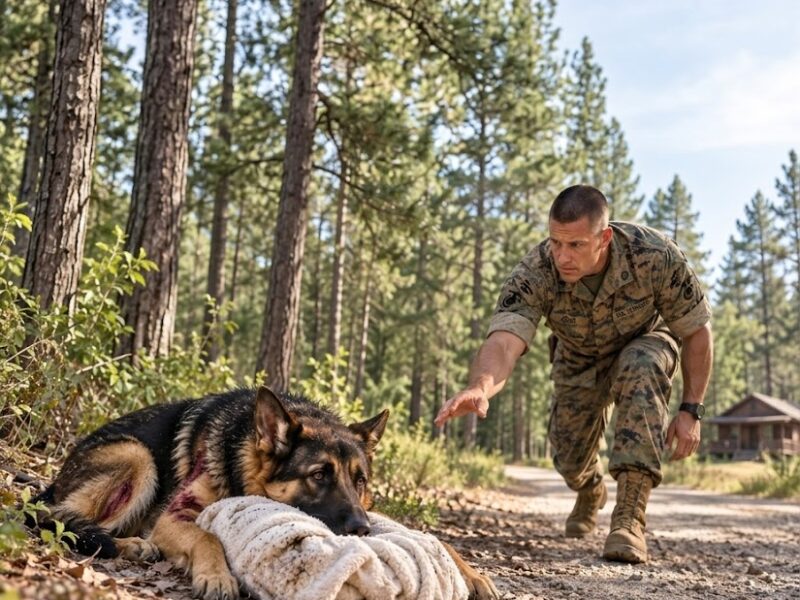
A Marine found a wounded German Shepherd guarding a white bundle in the snow. What he discovered when he unwrapped it left him completely stunned.
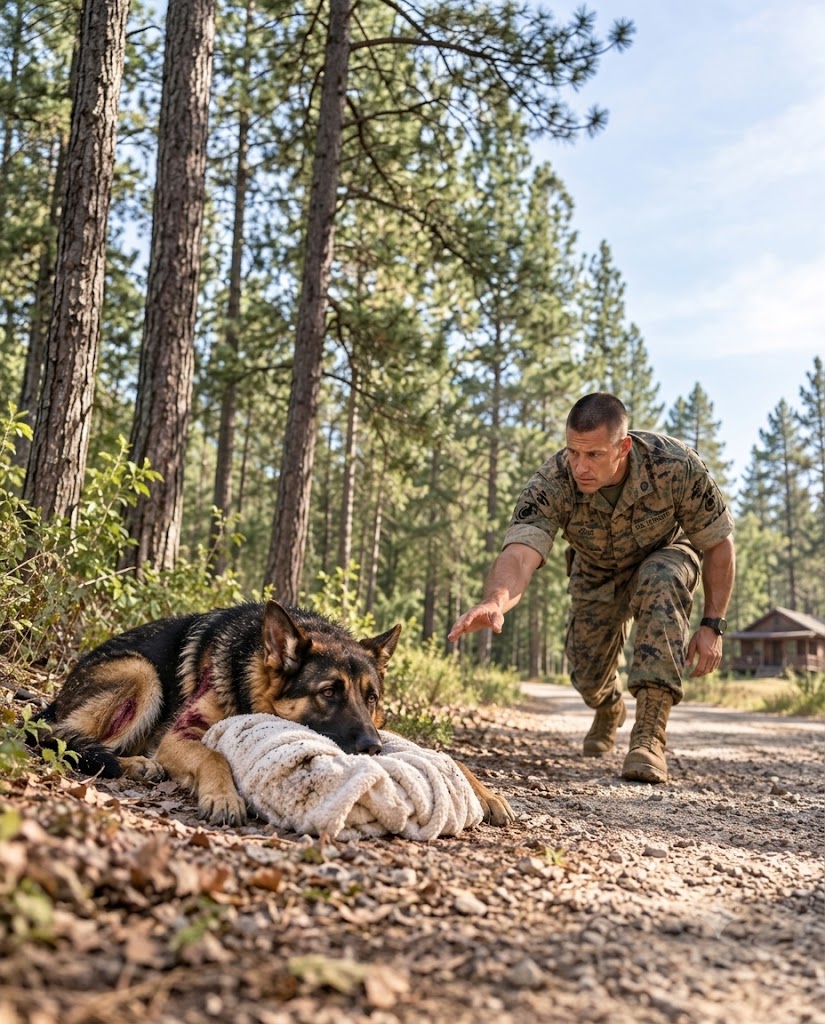
At 6:15 on a clear September morning outside Sisters, Oregon, Staff Sergeant Luke Harrison noticed a wounded German Shepherd lying beside a lonely forest road.
The dog’s legs were scraped and bleeding, yet it refused to leave a dirt-stained white blanket pinned beneath its chest.
When Luke stepped closer, the shepherd lifted its head and dragged itself in front of the bundle, guarding it with the last of its strength.
Luke slowly pulled back the blanket and stopped cold.
Inside was a 7-week-old baby girl, weak and dehydrated, but still alive.
He rushed the infant toward help, certain he had found the heart of the emergency, but the dog Ranger knew the rescue was not over.
Somewhere beyond the pines, another person was still waiting.
The late September sun had only begun climbing above the pine-covered hills outside Sisters, Oregon, when Staff Sergeant Luke Harrison turned his old pickup onto a narrow forest road.
Golden light slipped between the tall ponderosa pines, touching the dry grass and scattered needles along the shoulder.
Except for the low movement of the truck over gravel, the forest seemed almost completely still.
Luke was 38, just over six feet tall, broad through the shoulders, with close-cropped dark brown hair and faint gray beginning above both temples.
Years in the United States Marine Corps had left him with a disciplined posture and the habit of noticing small changes in his surroundings before he consciously understood why they mattered.
His face was lean and weathered from deployments and outdoor training, and his calm, hazel eyes rarely showed more emotion than he intended.
People who served with Luke described him as dependable, patient under pressure, and almost impossible to surprise.
His family might have described him differently.
Luke had become very good at being present when someone needed a Marine.
He had become much less reliable at being present when someone simply needed a father.
His phone rested face down in the passenger seat.
A message had appeared on the screen less than ten minutes earlier.
It was from his 14-year-old daughter, Emma.
Emma Harrison was tall for her age, with straight chestnut brown hair that usually fell past her shoulders and the same hazel eyes as her father.
She was thoughtful, competitive, and stubborn in a quiet way.
Volleyball had become the center of her life during the previous year, partly because she loved the game and partly because the court gave her something predictable.
Practices happened when they were scheduled.
Teammates showed up when they said they would.
Luke’s military life had rarely offered her that certainty.
Her message contained only one question.
“Dad, are you coming to my game Saturday?”
Luke had read it at the previous intersection.
He had not answered.
It was not because he did not care.
The problem was that Luke had spent years avoiding promises whenever there was even a small possibility that duty might make him break them.
Eventually, what he considered caution had begun looking like distance to the people waiting for him.
He glanced once toward the phone and then returned his attention to the road.
Behind the passenger seat sat a taped cardboard box.
Inside were several old photographs, military medals, letters, and small belongings that had once belonged to Luke’s father, Robert Harrison.
Robert had been a reserved, practical man with a strong build even into his sixties, and a habit of repairing things instead of replacing them.
He had taught Luke how to fish, split firewood, and remain calm when something went wrong.
He had also been the reason Luke still had a cabin outside Sisters.
Since Robert’s death two years earlier, Luke had visited the place only twice.
This morning, he was heading there to sort through what remained before deciding whether to sell it.
Luke had convinced himself the cabin was only a building.
The box behind him suggested otherwise.
He rounded another bend, then his foot moved toward the brake.
Something dark lay beside the road ahead.
At first, Luke thought it might be a fallen branch or perhaps an animal resting in the shade.
As the pickup rolled closer, the shape became clearer.
A German Shepherd.
Luke slowed immediately.
The dog lay partly beneath a cluster of low bushes several feet from the gravel.
Its coat was black and tan, thick, but dusty with bits of dry leaves caught around its legs and chest.
It was a large male, probably five years old, though exhaustion made him appear older.
Even from inside the truck, Luke could see that something was wrong.
The shepherd was not resting comfortably.
Its breathing looked tired, and several areas of its coat showed signs that it had pushed through rough vegetation.
One rear leg remained positioned carefully beneath its body, and its shoulder appeared sore.
There was nothing graphic about the injuries, but the dog had clearly been through something difficult.
Luke stopped twenty yards away.
For several seconds, he simply watched.
That was when he noticed the white blanket.
It was partly hidden beneath the shepherd’s front legs.
The fabric had once been clean, but dust and pine needles now covered much of its surface.
The shepherd had positioned himself across one side of it, almost as though his body were forming a barrier between the blanket and the road.
Luke’s expression changed.
He shut off the engine.
The moment the driver’s door opened, the dog’s head lifted.
His ears came forward.
Luke stepped onto the gravel.
The shepherd tried to rise.
He managed only partway before settling again, but he shifted his body enough to place himself more directly in front of the blanket.
Luke stopped.
He had spent enough time around military working dogs during his career to recognize the difference between aggression and warning.
This dog was not trying to chase him away from the area.
He was trying to keep Luke away from one specific thing.
The blanket.
“Easy,” Luke said quietly.
He lowered his hands where the shepherd could see them.
The dog watched every movement.
There was intelligence in his dark brown eyes, but there was exhaustion, too.
His body seemed to be asking him to remain still while something stronger than exhaustion kept him alert.
Luke took one slow step.
The shepherd shifted again.
Luke stopped immediately.
For nearly a minute, neither moved.
Luke crouched several yards away rather than approaching from above.
He kept his body angled slightly to the side and waited.
The dog studied him.
Up close, Luke could see more clearly that the animal was not a stray that had simply wandered through the woods.
His coat had been cared for before whatever had happened.
There was a collar beneath the thick fur around his neck, although Luke could not yet see whether anything was attached to it.
More importantly, the shepherd kept looking down at the blanket, then back at Luke.
Down, then back again.
Luke’s attention sharpened.
Something about that pattern felt deliberate.
He slowly extended one hand.
The dog did not move toward it.
Luke waited.
After several seconds, the shepherd leaned forward just enough to smell the air near his fingers.
His posture remained guarded, but some of the tension left his shoulders.
Luke moved a little closer.
This time, the dog allowed it.
He could finally see that the white fabric was not simply a loose blanket.
Several layers had been wrapped together around something small.
Luke felt the first cold pressure of concern settle in his chest.
He reached toward one corner.
The shepherd immediately raised his head.
Luke stopped again.
“I’m not taking it from you,” he said softly.
“I just need to see.”
The dog could not understand the sentence, but he seemed to understand Luke’s tone.
After several seconds, his head lowered.
Luke gently lifted the outer fold.
A pale yellow fabric appeared underneath, then a tiny hand.
Luke froze.
For one heartbeat, the forest around him seemed to disappear.
He pulled the blanket back only far enough to see clearly.
Inside was a baby girl.
She could not have been more than a few weeks old.
Later, Luke would learn that her name was Sophie Bennett and that she was seven weeks old.
At that moment, however, she was simply an unidentified infant lying beneath two carefully arranged layers of cloth beside a lonely Oregon road.
Sophie had fine brown hair beneath a soft cap and a round face flushed from warmth and dehydration.
Her eyes remained closed.
She looked tired, but Luke could see the small, steady movement of her chest.
She was breathing.
Training replaced surprise almost immediately.
Luke checked her carefully without unnecessarily disturbing the blankets.
The baby reacted faintly to his touch.
That was enough.
Luke reached for his phone.
His call to 911 was short and controlled.
He provided the road, the nearest forest marker he remembered passing, and the condition of the infant as accurately as he could.
Then he returned his attention to the blanket.
The shepherd had lowered his head until his muzzle rested near Sophie’s feet.
For the first time, Luke noticed two additional objects tucked beside her.
One was a nearly empty baby bottle.
The other was a small cotton cloth folded beneath the inner blanket.
Luke lifted one edge.
Two letters had been embroidered carefully into the corner with blue thread.
S.B.
Luke stared at them.
Nothing about what he was seeing felt careless.
The baby had been dressed appropriately for the mild morning.
She had been wrapped in multiple layers.
A bottle had been left beside her.
The cloth had been folded rather than thrown down, and a German Shepherd had remained with her despite being exhausted enough that simply standing had become difficult.
Luke looked around the empty road.
No vehicle, no adult, no nearby campsite, only pine trees stretching in every direction.
He looked back at the shepherd.
The dog’s eyes were still fixed on Sophie.
Luke had arrived believing he had found an injured animal beside the road.
Now he understood that the animal had been performing a job.
Someone had placed Sophie here carefully.
And somehow, for some reason Luke could not yet understand, that person had trusted this dog to stay with her.
Luke slid one arm beneath the bundled infant and carefully lifted her against his chest.
The shepherd’s head rose immediately.
Luke stood.
The dog tried to do the same.
His legs trembled with the effort, but this time he managed to get all four paws beneath him.
Luke took one step toward the pickup.
Behind him came the soft movement of paws over gravel.
He turned.
The German Shepherd was following slowly, painfully, but with complete determination.
Luke looked down at Sophie, then back at the exhausted dog.
Whatever had happened on this road, the shepherd clearly believed his responsibility had not ended simply because Luke had arrived, and Luke was beginning to suspect the white blanket was only the first piece of a much larger story.
By the time the ambulance reached St. Charles Medical Center in Bend, the quiet forest road outside Sisters already felt much farther away than the forty-minute drive suggested.
Luke Harrison followed several car lengths behind in his pickup, one hand steady on the wheel while Ranger lay across the passenger side floor.
The German Shepherd had resisted being separated from Sophie so strongly that the emergency crew finally agreed Luke could transport him separately, provided the dog remained calm.
Ranger had settled only after watching the ambulance pull away in front of them.
Even then, he never fully relaxed.
His head stayed raised between the seats, his eyes fixed on the flashing vehicle ahead as though he understood exactly who was inside.
The emergency department was already waiting when they arrived.
Dr. Clare Morgan, 44, met the medical team near the pediatric treatment area.
Clare was medium height and slender, with dark auburn hair gathered into a practical knot and clear gray-green eyes that seemed to become calmer whenever everyone around her became more anxious.
She had worked emergency medicine for nearly seventeen years, most of them in central Oregon, and colleagues trusted her because she rarely allowed urgency to become confusion.
Years earlier, she had spent several seasons volunteering with a rural medical response team, an experience that had taught her not to dismiss small details simply because a patient appeared stable at first glance.
Luke remained outside the treatment room while Clare and two nurses examined the infant.
For the first time since finding the white blanket, he had nothing useful to do.
That was harder than he expected.
He stood with his arms folded near the wall while Ranger remained beside his boots.
The dog seemed equally uncomfortable with waiting.
Every time footsteps approached from behind the closed doors, his ears lifted.
Every time someone passed without Sophie, they lowered again.
Nearly twenty-five minutes later, Clare stepped into the corridor.
“She was found in time,” she told Luke.
The words released a tension in his shoulders he had not realized he was carrying.
Clare explained that Sophie was dehydrated and tired after spending hours outside, but her temperature was stable, her breathing was strong, and there were no immediate signs of lasting harm.
The baby would remain under observation while the staff gradually restored fluids and monitored her.
Luke looked through the narrow glass panel in the door.
Sophie lay beneath a light hospital blanket, her pale yellow clothing still visible near her shoulders.
She looked impossibly small beneath the bright room lights.
“She’s going to be all right?” Luke asked.
Clare gave the careful answer of someone who did not make promises before medicine allowed them.
“Right now, everything is moving in the right direction.”
It was enough.
Ranger seemed to understand something had changed in Luke’s voice.
He sat down beside him, though his eyes remained on the door.
A local veterinarian arrived less than an hour later to examine the dog.
Dr. Evan Brooks was 52, broad through the chest but slightly stooped from years spent leaning over examination tables.
His sandy hair had thinned considerably at the crown, and a short beard framed a face that usually carried a patient, almost amused expression.
Evan had treated working dogs, ranch dogs, and search and rescue animals across Deschutes County for more than two decades.
He had learned that frightened animals often responded better to patience than force, so he spoke little when he first approached Ranger.
He crouched several feet away.
Ranger watched him but did not growl.
Evan waited.
Only when the shepherd lowered his head again did the veterinarian move closer.
The examination revealed nothing that suggested deliberate mistreatment.
Ranger was dehydrated, exhausted, and sore.
His coat contained dried needles, bits of brush, and several small burrs from dense vegetation.
The pads of his paws were badly worn from travel over rough ground, and the strain around one rear leg appeared consistent with prolonged movement rather than a single serious injury.
Evan cleaned the areas that needed attention, wrapped one paw, and gave Luke a reassuring assessment.
“He’s been moving for a long time,” he said.
“Probably farther than he should have.”
Luke looked toward Ranger.
“How far?”
Evan shook his head.
“No way to know from this alone. But he didn’t pick up all of that walking across a parking lot.”
That detail stayed with Luke.
Ranger had not simply wandered onto the roadside.
He had come through the forest.
The question was from where.
While Evan finished, Luke finally examined the collar more carefully.
The thick fur around Ranger’s neck had hidden most of it earlier.
Beneath the dirt was a sturdy dark leather collar, worn but well-maintained.
A small metal tag rested against the inside where it had nearly disappeared beneath the coat.
Luke turned it over.
The front carried two lines.
Ranger.
Bennett Family.
Ranger’s ear moved when Luke said the name aloud.
“So that’s you.”
For the first time since the roadside, Luke had something more useful than initials.
The back of the tag contained a phone number.
A Bend police officer who had come to document the unusual discovery attempted the number several times.
Officer Kevin Mercer was 36, lean and clean-shaven with short blonde hair and the quiet manner of someone who preferred checking facts twice before forming conclusions.
He had spent much of his career on patrol and had developed a habit of writing everything down, even details others considered unimportant.
No one answered.
The call went directly to voicemail.
Kevin tried again ten minutes later.
Same result.
Using the tag information and Ranger’s microchip registration, authorities contacted the veterinary clinic listed on his records.
The registration matched.
Ranger belonged to Rachel and Daniel Bennett.
The Bennett address was in a residential area roughly twenty minutes away.
Luke repeated Rachel’s name quietly.
Something about it sounded familiar, though he could not immediately understand why.
The answer came from a nurse.
Megan Ellis, 29, was one of the pediatric nurses helping care for Sophie.
She was petite with curly brown hair tied high behind her head and a naturally gentle manner that became especially noticeable around frightened children and worried parents.
While transferring the original blankets into an evidence bag so they could remain with the baby’s belongings, Megan noticed something hidden inside the inner fold.
A thin silver bracelet.
She brought it to Kevin.
On the inside surface, carefully engraved in small letters, was a name.
Rachel Bennett.
Luke looked from the bracelet to Ranger.
The pieces were beginning to form a shape, though they still did not explain what had happened.
Someone named Rachel Bennett had almost certainly been with Sophie.
She had wrapped the baby carefully.
She had left personal identification among the blankets.
Ranger belonged to the same family.
Nothing about the arrangement looked random.
The unanswered question had simply become more specific.
Where was Rachel Bennett?
Before Luke could spend much time considering it, his phone vibrated.
Jennifer.
He almost let it ring out of habit.
Then he looked through the glass at Ranger sitting beside Sophie’s room and answered.
Jennifer Harrison was 37, slightly shorter than Luke, with shoulder-length dark blonde hair, light brown eyes, and the composed voice of someone who had spent years learning not to begin arguments she already knew would go nowhere.
She and Luke had divorced three years earlier without a dramatic collapse.
Their marriage had worn down more quietly through absences, postponed plans, and conversations repeatedly interrupted by duty.
Jennifer had never tried to turn Emma against him, but she had also stopped protecting Luke from the consequences of his own distance.
“Did you see Emma’s message?” she asked.
Luke looked down the corridor.
“I saw it.”
“Are you coming Saturday?”
He hesitated.
“I don’t know yet.”
There was a pause.
Jennifer did not sound angry when she answered.
That made it worse.
“She doesn’t ask you much anymore, Luke.”
He said nothing.
“She stopped because she doesn’t want to be disappointed.”
The line remained quiet for several seconds.
Then Jennifer said she had to go and ended the call without pushing further.
Luke lowered the phone.
Across the corridor, Ranger had been given a bowl of food.
The dog ate only a few mouthfuls.
Then Sophie made a small sound from behind the treatment room door.
Ranger immediately left the bowl.
He crossed the short distance to the doorway and lay down directly beside it.
Luke watched him.
The dog was hungry.
Everyone could see that.
Yet hunger had become secondary the moment Sophie needed his attention.
Luke thought of Emma’s unanswered message.
He did not enjoy the comparison forming in his mind.
Later that afternoon, a nurse wheeled Sophie’s bassinet toward another room for a routine examination.
Ranger had finally fallen asleep near the wall, but the movement of the bassinet brought his head up immediately.
He stood.
His rear leg remained stiff and the bandage around his paw slowed him, but he followed.
When Sophie passed through a door where Ranger could not enter, he stopped outside.
Then he lowered himself onto the floor and waited.
When she returned, he stood again.
By four o’clock, Clare confirmed that Sophie’s condition had stabilized.
The immediate danger had passed.
Luke should have felt that his part was finished.
Instead, Ranger changed.
The shepherd left Sophie’s doorway and walked slowly toward the hospital entrance.
He stopped beside the glass doors, looked outside, then looked back at Luke.
Luke assumed he needed fresh air and took him through the doors.
Ranger walked several yards, then stopped, turned around, looked directly at Luke.
When Luke remained where he was, Ranger returned to him, paused, and walked outward again.
The same thing happened a second time, then a third.
By the third repetition, Luke was no longer watching a dog that simply wanted to go outside.
Ranger was asking for something.
Luke looked back through the hospital windows toward the hallway where Sophie was safe, then toward the shepherd, standing several yards away.
The dog had spent the entire morning refusing to leave the baby.
Now, for the first time, he seemed willing to move away from her.
Luke understood why.
Ranger’s first responsibility was finished.
Sophie had been found.
Sophie was safe.
Whatever had brought the German Shepherd through miles of rough Oregon forest had not ended at the hospital doors.
Ranger stared at Luke once more, then turned toward the parking lot.
Luke followed.
By early evening, the question surrounding Sophie had changed.
The baby was safe.
Ranger had been identified, and the silver bracelet had connected Rachel Bennett directly to the carefully wrapped bundle.
What no one could explain was why Rachel herself had disappeared.
Luke had watched Ranger repeat the same deliberate movement toward the hospital exit until he could no longer dismiss it.
The dog was not simply restless.
He appeared to be waiting for someone to understand him.
Because Sophie’s care was now in medical hands, Luke agreed to accompany local authorities to the Bennett residence.
The officer assigned to the next stage of the inquiry was Deputy Aaron Cole of the Deschutes County Sheriff’s Office.
Aaron was 41, tall and rangy with dark blonde hair cut short at the sides, a narrow face, and pale blue eyes that rarely stopped moving when he entered an unfamiliar place.
He had spent thirteen years working rural patrol and search calls across central Oregon.
Unlike officers who filled silence with questions, Aaron tended to observe first and speak later.
A failed search early in his career, when weather had erased a hiker’s trail before responders understood how quickly conditions were changing, had made him unusually careful about timelines, roads, and small inconsistencies.
Luke liked him almost immediately.
Aaron did not treat Ranger’s behavior as proof.
He also did not dismiss it.
The Bennett home sat on a quiet street north of Bend, where modest houses stood beneath tall junipers and pines.
A child’s wind spinner turned slowly beside the front steps.
The grass had begun fading toward autumn brown, and nothing outside suggested an emergency had started there.
Rachel’s blue Ford Explorer was not in the driveway.
Aaron knocked several times, announced himself, then contacted the department while confirming that officers had legal authorization to check the residence because both Rachel and her infant daughter had been unaccounted for under unusual circumstances.
Inside, the house was orderly but unfinished in the particular way homes with newborns often were.
A folded blanket rested across one end of the couch.
Several clean baby bottles stood upside down on a drying rack beside the kitchen sink.
A small basket of diapers sat near the living room wall, and a portable bassinet stood empty near the bedroom doorway.
Luke paused beside it.
Only hours earlier, Ranger had refused to leave another bassinet at the hospital.
Here, the empty one made the house feel strangely quiet.
There were no overturned drawers, broken windows, or obvious signs that anyone had entered by force.
Rachel appeared to have left voluntarily.
Aaron documented the rooms without disturbing more than necessary.
“Most important thing right now is sequence,” he said.
“When did she leave? What did she take? And where did she think she was going?”
The answer came from across the street.
A woman had been watching from behind her front window and finally walked toward them when she recognized the sheriff’s vehicle.
Her name was Martha Ellis.
Martha was 62, short and sturdy with silver-gray hair cut into a practical bob and warm brown eyes behind thin-framed glasses.
She had lived in the neighborhood for nearly nineteen years and had developed the quiet habit of noticing routines without turning them into gossip.
Her husband had died six years earlier after a long illness, and the experience had made her particularly attentive to neighbors who seemed overwhelmed but reluctant to ask for help.
She brought soup when someone was sick, collected packages when people traveled, and usually remembered which families had young children.
When Aaron asked about Rachel, Martha’s concern became immediate.
“I haven’t seen her since Tuesday morning.”
That was nearly two days earlier.
Martha explained that Rachel Bennett was 31, slender with shoulder-length chestnut hair, and an easy smile that had become noticeably more tired since Sophie’s birth.
Rachel was normally organized and friendly.
She remembered birthdays, returned borrowed dishes, and apologized even when there was nothing to apologize for.
Since becoming a mother, however, Martha had noticed that she seemed more exhausted and distracted, though nothing had appeared alarming enough to make Martha think she was in danger.
Rachel’s husband, Gunnery Sergeant Daniel Bennett, was away in California for an extended Marine training assignment.
Martha had seen Rachel loading the Ford Explorer early Tuesday.
Sophie had already been secured inside.
Ranger jumped into the vehicle shortly afterward.
Rachel had told Martha she planned to spend a few quiet days at the Bennett family’s cabin west of town.
She said she needed a change of scenery.
Martha explained it as somewhere quieter.
Aaron asked whether Rachel appeared upset.
Martha considered the question carefully.
“Not upset exactly. Tired, more tired than usual.”
Then she remembered something else.
Rachel had packed several bags, but nearly everything Martha saw appeared to belong to Sophie.
A diaper bag, a container of formula, blankets, a folding baby carrier.
Martha remembered joking that Rachel was moving the entire nursery into the mountains.
Rachel had smiled, but Martha could not remember seeing a suitcase for Rachel herself.
That detail changed the tone of the conversation.
Luke looked toward the empty driveway.
Someone planning a comfortable trip for several days normally packed for herself.
Rachel seemed to have thought almost entirely about Sophie.
Aaron asked about the cabin.
Martha knew only that it belonged to Daniel’s family and sat somewhere beyond the national forest roads west of Sisters.
She had never visited.
The location was broad enough to include miles of forest.
Back inside, Aaron began working from the available information.
Registration records confirmed the Ford Explorer.
A request went out for traffic camera footage from major roads leaving Bend toward Sisters.
The first useful result arrived within an hour.
A highway camera had recorded Rachel’s blue Explorer heading west two mornings earlier.
The time matched Martha’s memory.
Another camera farther along the route captured the vehicle again.
No available camera showed it coming back.
That meant Rachel, Sophie, and Ranger had almost certainly continued toward the forest.
A call was placed to Daniel Bennett.
Luke remained nearby when the secure return call came.
Daniel was 36, a gunnery sergeant in the United States Marine Corps with a reputation among his unit for being precise, protective, and difficult to rattle.
A family photograph on the Bennett mantle showed a tall man with close-cut black hair, a square jaw, and an athletic build, one arm around Rachel, while Ranger sat at his knee.
Even in the relaxed photograph, Daniel held himself with the straight-backed posture of someone accustomed to responsibility.
Over the phone, that control weakened the moment Aaron told him Sophie had been found.
“Is she alive?”
Aaron answered immediately.
“Yes, she is safe at the hospital.”
Daniel exhaled so sharply Luke could hear it from several feet away.
Then came the second question.
“Rachel?”
Aaron did not soften the truth.
“We haven’t located her yet.”
Silence followed.
Daniel asked for everything they knew.
Aaron explained the roadside discovery, Ranger’s condition, the blanket, the bracelet, and the fact that the Ford Explorer had been recorded heading toward the forest.
Daniel listened without interrupting.
When Aaron mentioned the family cabin, Daniel confirmed that Rachel knew how to reach it.
His father had built the small place decades earlier, and the family still used it occasionally.
But describing the route proved difficult.
There was no street address.
The cabin sat beyond a sequence of Forest Service roads, several of which changed names or split without clear signs.
Daniel gave Aaron the best directions he could from memory.
A main logging road, then a fork near an old fire break, followed by a narrower service road.
The problem was that the landscape had changed.
Road maintenance shifted from year to year.
Some tracks were seasonal, others appeared on older maps but were barely used.
Daniel immediately told Aaron he was requesting emergency leave and would begin making arrangements to return to Oregon.
Before ending the call, he asked to speak to Luke.
Luke took the phone.
Daniel knew only that another Marine had been the person who found his daughter.
“Staff Sergeant Harrison.”
“Yes.”
There was a pause.
“Thank you for stopping.”
Luke looked toward Ranger, who was resting near the doorway under Aaron’s supervision.
“Your dog made it hard not to.”
Daniel’s voice became quieter.
“That’s Ranger.”
The way he said the name carried years of familiarity.
Luke wanted to ask more.
He did not.
There would be time for that if they found Rachel.
Weather reports complicated the search further.
A thunderstorm had crossed the higher forest country the previous evening.
A ranger station confirmed that strong winds had brought down branches and several small trees across less-traveled roads.
Some service routes had become difficult to pass.
Cell reception in that region was unreliable even in good weather.
The situation now had a shape.
Rachel had left Bend with Sophie and Ranger.
She had headed toward the cabin.
She had not returned.
Somewhere between that departure and Luke finding Sophie, something had separated the family.
But there was still no exact point to begin searching.
Luke looked at Ranger.
The dog was already looking at him.
By then, the veterinarian had cleared Ranger for limited movement, provided he was not pushed beyond what he could tolerate.
Aaron agreed that using the dog as an informal directional clue was reasonable, as long as they continued treating physical evidence and official records as the foundation of the search.
They drove west.
At the first major forest intersection, Aaron slowed the vehicle.
Ranger stood behind the rear barrier.
Two roads opened ahead.
The right branch stayed broader and more traveled.
The left narrowed beneath tall pines.
Ranger immediately moved toward the left side of the vehicle.
Aaron looked at Luke.
Luke pointed.
“Try left.”
They did.
Ranger settled.
Several miles later, the road divided again.
This time, Luke wanted certainty.
“Take the right.”
Aaron glanced at him.
“You sure?”
“No.”
That was the point.
Aaron turned right.
Within seconds, Ranger stood abruptly.
He shifted toward the opposite side, paced once, then pressed his attention toward the road behind them.
His uneasiness increased the farther they continued.
Aaron stopped.
He reversed direction.
When they returned to the intersection and took the other branch, Ranger became quiet almost immediately.
Neither man spoke for several seconds.
Luke’s phone vibrated in his pocket.
He looked down.
Another message from Emma.
This time there was a photograph.
An empty seat beside a volleyball court.
Underneath it she had written, “Mom saved this one for you.”
Luke stared at the screen longer than he intended.
His thumb hovered over the keyboard.
He still did not know what Saturday would look like.
He still did not know how long this search would take.
So he did not answer yet.
But for the first time, he did not clear the notification or put the phone face down.
He saved the photograph.
Then he looked ahead.
Ranger was standing again, watching the next bend in the forest road.
Aaron eased the vehicle forward.
The dog remained calm.
Luke no longer believed they were simply guessing among roads.
Ranger knew this route.
Somewhere ahead was the place he had come from.
And for the first time since Sophie had been found beneath the white blanket, they had something more than questions.
They had a direction.
For nearly an hour, Ranger continued guiding Luke and Aaron deeper into the forest west of Sisters.
The paved road had disappeared behind them long ago.
Now the sheriff’s vehicle moved slowly along narrow Forest Service tracks where dry pine needles covered the ground and branches leaned close enough to brush both sides of the truck.
Evidence of the previous night’s storm became harder to ignore with every mile.
Small limbs lay scattered across the road.
Shallow washouts cut through the gravel, and several trees had fallen near the shoulders.
Ranger remained alert behind the rear barrier.
He no longer paced constantly.
Instead, he seemed to save his strength until something mattered.
At each fork, his attention shifted before Aaron made a decision.
When they stayed on the correct route, the German Shepherd settled again.
When the road curved sharply west, Ranger moved toward that side of the vehicle and stared ahead.
Luke had stopped thinking of those reactions as coincidence.
Then Ranger stood so quickly that Aaron immediately slowed.
Ahead, two fallen pine trunks partly blocked the road.
Beyond them sat a blue Ford Explorer.
Aaron stopped several yards away.
For several seconds, neither man spoke.
They had finally found Rachel Bennett’s vehicle.
The Explorer sat at an angle between the two fallen trees, not crushed beneath them, but trapped where the road had narrowed.
One trunk lay across the route in front of the vehicle, while another had fallen behind it at an angle, leaving very little room to maneuver.
The windshield remained intact.
The body showed only ordinary scratches from brush and branches.
There was no obvious sign of violence, no indication that another vehicle had forced it off the road.
It looked less like a crash than a journey that had simply reached a point where it could go no farther.
Aaron radioed their location before they approached.
Luke opened the rear door to let Ranger down carefully.
The shepherd immediately became more animated.
Despite the stiffness in his wrapped paw and the exhaustion from everything he had already endured, Ranger pulled toward the Explorer, nose working rapidly along the driver’s side.
“That’s definitely familiar to him,” Aaron said.
The driver’s door was unlocked.
Inside, the Explorer looked as though Rachel had left, intending to return.
Her phone rested in the center console.
Aaron pressed the power button.
Nothing happened.
The battery was completely dead.
The fuel gauge was almost empty.
In the back seat, Luke found more evidence of the same careful preparation they had already seen in the white blanket.
Diapers remained stacked inside an open travel organizer.
Several containers of formula sat beside spare baby clothes.
A folded yellow blanket rested against one door, and a small bag contained wipes, bottles, and a lightweight carrier.
Nearly everything belonged to Sophie.
Rachel’s own bag was almost empty.
Luke remembered what Martha had said.
Rachel had packed for her daughter.
Almost nothing for herself.
Aaron examined the area around the vehicle while Luke stayed near Ranger.
Most of the ground had been disturbed by the storm, but enough remained to suggest that someone had continued on foot after the Explorer became trapped.
Ranger already knew which direction.
The moment Luke clipped on the temporary leash, the German Shepherd pulled toward a narrow opening between the trees.
Aaron looked at the thick forest.
“Cabin?”
Luke watched Ranger.
“Let’s find out.”
They left the vehicle behind and continued on foot.
The path was not an official hiking trail.
At times, it was barely more than a line between the pines, but signs of occasional use appeared as they moved farther in.
A cut branch, an old wooden marker, a patch of flattened grass beneath the trees.
Aaron marked their route periodically so they would have a clear path back.
Ranger moved ahead without trying to run.
Every so often, he stopped and looked behind him.
Luke had noticed the same behavior before.
The shepherd seemed to understand that leading meant nothing if the people following him became lost.
The distance stretched beyond a mile.
Luke began to understand how difficult the journey must have been for Rachel if she had carried a seven-week-old baby and supplies through the same terrain.
Then the trees opened.
A small log cabin stood in a shallow clearing ahead.
It was built from dark weathered timber with a low porch and a simple metal roof.
Pine trees surrounded it closely enough that the building almost disappeared among their trunks.
A stack of firewood rested beneath a narrow side shelter, and one small window faced the clearing.
Ranger saw the cabin.
His entire posture changed.
He pulled forward.
Luke released enough slack to let him reach the porch.
The German Shepherd moved directly to the front steps and began pawing at them, then turned toward the door.
“Rachel,” Luke called.
No answer.
Aaron tried the front handle.
“Locked.”
Luke called again.
Still nothing.
Ranger moved along the porch, then around the side of the cabin.
Luke followed and found the rear door.
It was closed, but unlocked.
Aaron entered first, announcing who they were.
Luke followed Ranger inside.
The cabin was quiet.
But it was not abandoned.
A portable bassinet stood beside an old sofa.
Several clean baby bottles had been washed and placed upside down near the sink.
Diapers were stacked neatly in a small basket.
A pot containing water sat on the stove.
On the table lay a notebook opened to a page covered in handwriting.
Luke leaned closer.
The notes were simple.
Feeding times, bottle amounts, diaper changes, short reminders, everything centered on Sophie.
There was no chaos in the room.
No indication that Rachel had stopped caring for her daughter.
The opposite was true.
Someone had been trying very hard to maintain a routine under increasingly difficult circumstances.
Aaron walked toward the small bedroom.
Empty.
Luke checked near the kitchen.
Nothing.
Rachel was not in the cabin.
Ranger suddenly moved toward the rear door.
He stopped there and looked back at Luke again.
The same expression, the same expectation.
Luke understood.
“We’re not finished.”
Outside, Ranger continued beyond the clearing.
The forest behind the cabin sloped gradually downward.
The ground there was more uneven, with patches of exposed rock and thick clusters of brush between the trees.
Aaron stayed close behind Luke.
About three hundred yards from the cabin, Luke noticed something blue near the edge of a shallow slope.
Fabric.
He moved closer.
A jacket lay partly across the ground.
Then Ranger pulled sharply forward.
Luke followed his gaze.
A woman was lying farther down the slope.
Rachel.
Luke moved toward her while Aaron radioed their position.
Rachel Bennett was 31, slender and slightly above average height, with long chestnut brown hair that had come loose around her shoulders and a face that ordinarily carried a gentle, composed expression.
Family photographs at the Bennett home had shown her smiling easily beside Daniel and Sophie.
Here, fatigue had changed that appearance.
Her skin was pale.
Her clothing dusty.
Exhaustion showed clearly around her closed eyes, but she was breathing.
She was alive.
Luke knelt beside her.
“Rachel, my name is Luke Harrison. Can you hear me?”
Her eyelids moved.
It took several seconds before she focused on him.
Ranger came close and lowered his head beside her shoulder.
Rachel saw the dog.
Recognition immediately crossed her face.
Then her eyes widened.
Her first words were barely more than a whisper.
“My baby.”
Luke answered before she could ask anything else.
“Sophie is safe.”
Rachel stared at him.
He repeated it.
“She’s safe. She’s at the hospital in Bend.”
For the first time since opening her eyes, some of the tension left her face.
Tears appeared as she closed her eyes again.
Ranger lowered himself beside her.
Aaron quickly assessed the situation around them.
A small fallen tree lay several feet away, and the disturbed ground suggested Rachel had encountered it while moving downhill.
She explained in fragments that she had become trapped briefly, managed to free herself, but badly twisted her ankle in the process.
She had tried to continue toward what she believed was the direction of a ranger station, but the pain and exhaustion eventually forced her to stop.
She believed she had been there most of a day.
Luke gave her small amounts of water while Aaron remained in contact with dispatch.
Once Rachel was calm enough to speak, the larger story began emerging.
The Explorer had become trapped after the storm brought trees down across the forest road.
Rachel had waited at first, hoping someone else might pass, but the area remained completely quiet.
With no reliable phone signal and fuel disappearing from repeated attempts to move the vehicle, she had eventually taken Sophie, the most important supplies, and Ranger toward the cabin.
The walk had taken much longer than expected.
Still, she had made it.
Inside the cabin, Rachel had created the routine Luke had seen written in the notebook.
She cleaned bottles, prepared Sophie’s formula, kept water available, and tracked every feeding.
But the storm had changed more than one road.
When Rachel later checked the route back, she discovered that the main access path was even more obstructed than before.
Her phone finally lost power.
The remaining formula was becoming a concern.
She knew there was a ranger facility somewhere beyond the forest, though she was uncertain how long it would take to reach it on foot.
Rachel looked toward Ranger before continuing.
She had realized she could not carry Sophie for hours through uncertain terrain while also searching for help.
So she made a different decision.
Rachel wrapped Sophie carefully, took her toward the widest road where a passing forestry truck, ranger, or traveler had the best chance of seeing her, and placed her in a visible location near the shoulder.
Then she looked at Ranger.
The German Shepherd had been part of the Bennett family for years.
He had slept near Sophie’s bassinet since the baby came home.
He followed Rachel whenever she carried Sophie from one room to another and became alert whenever the infant cried.
Rachel trusted him completely.
She placed one hand against his collar.
“Stay with Sophie.”
That was all.
Rachel intended to search for help and return quickly.
She believed she would be gone perhaps thirty minutes.
Instead, she never made it to the ranger station.
The accident on the slope stopped her.
The distance, storm damage, and exhaustion did the rest.
Luke looked at Ranger.
The shepherd lay beside Rachel now, completely still.
The scratches and debris the veterinarian had found in his coat finally made sense.
Ranger had moved repeatedly through rough vegetation near the roadside, checking the surrounding area while refusing to abandon Sophie.
He had followed one instruction.
Stay.
And when Luke finally arrived, Ranger had stayed long enough to make sure Sophie was no longer alone.
Rachel reached weakly toward the dog.
Ranger shifted closer.
Luke had spent the previous day trying to understand why a baby had been lying beneath a white blanket beside an Oregon forest road.
Now he finally knew.
Sophie had never been abandoned.
She had been placed where help had the greatest chance of finding her, and Ranger had been trusted to hold that position until someone did.
Rachel Bennett returned to St. Charles Medical Center shortly after sunset.
By then, the forest search had ended.
The damaged access roads had been marked for county crews, and the questions that had surrounded Sophie for nearly two days finally had an answer.
Rachel was exhausted, dehydrated, and unable to put much weight on her injured ankle.
But doctors found no life-threatening condition.
What she needed most was rest, fluids, food, and time.
She was transferred to a quiet room near the pediatric wing so she could remain close to Sophie.
When a nurse finally brought the baby to her, Rachel held her daughter against her chest without speaking for several minutes.
Sophie was warmer now, more alert, and feeding normally.
Ranger lay on the floor beside the bed, his bandaged paws stretched carefully in front of him.
Every time Sophie moved, one of his ears lifted.
Rachel looked down at him more than once, and each time her expression carried the same mixture of gratitude and disbelief.
The dog had done exactly what she had asked, then somehow done more.
Daniel Bennett began his return from California before Rachel had even reached the hospital.
His command approved emergency leave as soon as the situation was confirmed, but getting back to Oregon still required several connections and hours of travel.
He arrived in Bend the following afternoon carrying a single dark duffel bag and wearing the same Marine uniform he had left training in.
At 36, Daniel was tall and powerfully built without appearing bulky, with close-cut black hair, a square jaw, and dark brown eyes that usually gave little away.
Years as a gunnery sergeant had made him disciplined, deliberate, and accustomed to becoming calmer when everyone else became uncertain.
Marines under him respected that steadiness.
Rachel knew another side of him.
The man who remembered exactly how much coffee she liked in the morning, who checked the doors twice before bed, and who pretended not to notice when Ranger stole his side of the couch.
On the drive from the airport, however, none of that practiced control felt useful.
Daniel had spent the previous night hearing the story through phone calls.
Sophie had been found beside a forest road.
Rachel had been missing.
Ranger had stayed.
Luke Harrison had stopped.
Aaron Cole had followed the dog back into the woods.
Daniel knew the facts, but facts did not become real until he walked through the hospital doors himself.
Luke met him near the nurses’ station.
For a moment, the two Marines simply looked at each other.
Luke recognized the exhaustion immediately.
The rigid shoulders, the eyes that had probably not closed for more than a few minutes at a time, the way Daniel kept asking questions even though he already knew the answers.
“She’s awake,” Luke said before Daniel could speak.
“Sophie’s with her. They’re both doing well.”
Daniel nodded once.
That was all he trusted himself to do.
Luke led him down the corridor and stopped outside Rachel’s room.
Through the narrow window, Daniel could see his wife sitting upright against several pillows.
Rachel’s chestnut hair had been brushed back from her face, though fatigue still showed beneath her eyes.
Sophie rested against her on a pale hospital blanket.
Ranger was beneath the bed, close enough that his shoulder touched one of the wheels.
Daniel remained outside for several seconds.
It was not hesitation exactly.
It was the strange difficulty of stepping into a room that contained everything he had spent the previous twenty-four hours fearing he might lose.
Rachel looked up first.
Daniel opened the door.
Neither of them spoke.
He crossed the room, set his bag against the wall, and wrapped both arms around his wife as carefully as he could.
Rachel leaned into him and closed her eyes.
There were no accusations about why she had gone to the cabin.
No questions about why she had continued after the road became difficult, and no attempt to turn fear into anger.
Daniel simply held her.
When he finally stepped back, he looked at her face for several seconds as though confirming that distance was no longer separating them.
Rachel tried to apologize.
Daniel stopped her gently.
“Not now,” he said.
“You’re here.”
Only then did he look down at Sophie.
He had seen his daughter through video calls during the weeks he had been away, usually asleep in Rachel’s arms or in the bassinet with Ranger nearby.
Seeing her in front of him made those images feel impossibly small.
Daniel lifted Sophie carefully.
The confident gunnery sergeant disappeared almost at once.
His shoulders softened, his voice dropped.
Sophie opened her eyes briefly, moved one tiny hand against the front of his uniform, and settled again.
Daniel stood there holding her as if every second mattered.
Ranger woke when Daniel shifted his weight.
At first, the German Shepherd only lifted his head.
He stared toward the familiar figure near the bed, uncertain for perhaps two seconds.
Then recognition arrived.
Ranger pushed himself up faster than Evan Brooks had recommended, crossed the short distance, and pressed his head against Daniel’s leg.
Daniel nearly laughed and cried at the same time.
He lowered Sophie safely back into Rachel’s arms, then dropped to one knee.
Ranger leaned into him immediately.
Daniel wrapped one arm around the dog’s neck and rested his other hand against the thick fur between his shoulders.
He already knew the sequence.
Ranger had stayed beside Sophie on the road, kept his body close to her, refused to leave her at the hospital, guided Luke and Aaron to the Explorer, then led them through the forest to the cabin, and finally to Rachel.
Daniel had spent years believing that his responsibility was to keep his family safe whenever he was home.
While he was away, Ranger had quietly taken that responsibility as his own.
Daniel held the shepherd for a long moment.
Then he said the only sentence that seemed large enough and simple enough at the same time.
“You brought my family home.”
Outside the hospital, the story was already changing the way people around the Bennetts responded.
Martha Ellis organized a small group of neighbors to retrieve Rachel’s belongings from the cabin once authorities confirmed the area was safe.
She did not turn it into an event that would have embarrassed Rachel.
Instead, Martha approached it the same way she handled most problems, quietly and practically.
One of the neighbors who joined her was Tom Keller, 58, a broad-shouldered retired utility worker with a gray mustache and the habit of carrying more tools than any job required.
Another was Denise Parker, 47, a slim elementary school librarian with short black hair and a gentle manner that made people tell her things they had not intended to discuss.
Together, they collected Sophie’s supplies, secured the cabin, removed spoiled food, and brought Rachel’s personal belongings back to Bend.
What began as a simple cleanup soon led to another discussion.
The Bennetts were not the only people using cabins in an area where cell service frequently disappeared.
Tom contacted a local volunteer group, and within days neighbors began raising money for a satellite emergency communication point near the most heavily used forest junction.
No one presented it as a monument to the Bennett family.
The purpose was simpler.
The next stranded family should have a better way to ask for help.
Dr. Evan Brooks returned that afternoon to check Ranger.
The German Shepherd’s hydration had improved, his appetite was returning, and none of the soreness appeared permanent.
Evan expected a full recovery if Ranger was given regular meals, limited activity, and enough rest.
Daniel listened seriously to every instruction, then announced that Ranger was getting the best dog bed he could find.
The following morning, a large orthopedic bed appeared beside Sophie’s bassinet.
Ranger investigated it carefully.
He sniffed the edges, stepped onto it once, turned in a slow circle, and looked almost impressed.
Then Sophie made a small sound.
Ranger stepped off the expensive bed, crossed the room, and lowered himself onto the hard floor beside her bassinet.
Daniel stared at him.
Rachel smiled for the first time that morning.
“Good purchase,” she said.
Daniel looked at the untouched bed.
“Apparently, I bought furniture for the corner.”
Ranger closed his eyes, one ear still angled toward Sophie.
Later that evening, Daniel found Luke alone near a window at the end of the corridor.
The sun was dropping behind the Cascades, turning the sky beyond Bend a deep orange.
Daniel stood beside him for a moment before speaking.
“I don’t know how to thank you.”
Luke shook his head.
“You don’t need to.”
Daniel looked toward Rachel’s room.
“You stopped.”
Luke considered that.
“Ranger made sure I did.”
Daniel asked what he meant.
Luke explained how the dog had refused to leave the blanket, refused to leave the hospital door, then refused to let anyone believe the rescue was finished.
“Every time we thought we’d reached the end of it,” Luke said, “that dog told us there was one more place to go.”
Daniel gave a tired smile.
“Sounds familiar.”
Luke almost asked whether he meant Ranger or Marines in general.
He decided it did not matter.
The words stayed with Luke after he left the hospital.
He sat inside his pickup for several minutes before starting the engine.
His phone was still holding Emma’s photograph of the empty seat beside the volleyball court.
For years, Luke had told himself that uncertainty was a reason not to promise anything.
But Ranger had spent two days doing the opposite.
The dog had not known when help would come.
He had simply stayed where someone needed him.
Luke pressed Emma’s name.
She answered after the fourth ring.
“Dad?”
Emma sounded surprised enough that Luke felt the distance between them more clearly than he had during Jennifer’s call.
“I saw your picture.”
A pause.
“Okay.”
Luke looked through the windshield toward the hospital entrance.
“I’ll be there Saturday.”
Emma did not answer immediately.
Luke corrected himself.
“Save me a seat. Saturday.”
This time he heard something change in her voice.
“Really?”
“Really.”
For once, Luke did not add maybe if nothing changes or I’ll try.
He simply let the promise stand.
Inside the hospital, Ranger remained asleep beside Sophie’s bassinet while the expensive dog bed sat untouched only a few feet away.
Rachel rested with Daniel beside her.
For the first time since a white blanket had appeared beside a lonely Oregon road, everyone Ranger had been trying to protect was finally in the same place, and Luke, driving away beneath the fading evening light, had finally decided to show up for someone waiting for him, too.
Six months later, spring had returned to central Oregon.
The snow that had covered the higher roads during winter was retreating into thin patches beneath the pines, and the hills outside Sisters had begun to soften with new grass and early wildflowers.
The forest no longer looked like the isolated place where the Bennett family had nearly disappeared from one another.
Morning sunlight reached farther between the trees now, and the roads that had once seemed empty and uncertain carried hikers, forestry crews, and families returning to their seasonal cabins.
The Bennett home had changed, too.
Sophie was now a healthy, bright-eyed baby with round cheeks, fine brown hair, and a habit of smiling at anyone who leaned close enough to attract her attention.
The doctors had expected no lasting complications from the hours she had spent outside, and over the months that followed, she had met every milestone they hoped to see.
She had begun reaching for faces, blankets, toys, and especially the pair of black and tan ears that appeared beside her wherever she went.
Those ears belonged to Ranger.
The German Shepherd had recovered completely.
Regular meals had restored the strong frame hidden beneath his exhausted body that first morning.
His coat had become thick and glossy again, the burrs and dirt long gone, and the soreness in his legs had disappeared.
He could cross the Bennett backyard at full speed whenever Daniel threw a ball, then return with the energy of a dog several years younger.
But one habit had survived unchanged.
Whenever Sophie slept, Ranger settled nearby.
If she rested in the living room bassinet, Ranger lay beside it.
If Rachel moved the bassinet toward the kitchen, Ranger followed.
If Sophie slept on the shaded porch during warm afternoons, Ranger placed himself between her and the steps.
No one told him to do it anymore.
No one needed to.
Rachel often noticed him before anyone else did.
Her own recovery had taken longer than the healing of her ankle.
Physically, she was strong again.
She walked without pain and had returned to the ordinary rhythm of caring for Sophie, cooking simple meals, and meeting friends for coffee.
Emotionally, the experience in the forest had changed the way she accepted help.
Before the incident, Rachel had often believed that asking for assistance meant admitting she had failed to prepare well enough.
Now she understood that preparation could also mean making certain there were people to call when plans stopped working.
Daniel had changed his routines as well.
He was still a gunnery sergeant, still disciplined, still responsible for Marines who depended on him, but he had become more deliberate about protecting time for home.
Whenever training schedules allowed, he returned to Oregon rather than filling every available weekend with additional responsibilities.
When he could not be there, he made calls at predictable times and asked more specific questions than he once had.
Not simply, “Everything good?”
Instead, “How did Sophie sleep? Did you get enough rest? What do you need me to handle?”
Rachel had told him once that those questions made it harder to answer automatically.
Daniel considered that a good thing.
Martha Ellis continued visiting once or twice a week.
She usually arrived carrying something ordinary, a casserole, fresh bread, groceries Rachel had forgotten to buy, and always insisted she had brought too much for herself.
Rachel stopped pretending to believe her.
Martha did not mind.
Their friendship had become less about watching from across the street and more about being close enough to notice when someone needed an extra pair of hands.
The family cabin remained theirs.
They never sold it.
After county crews cleared the storm damage, Daniel and several neighbors repaired the porch, checked the roof, and reopened the narrow access route.
The fundraising effort started by Martha and the local volunteers had also produced something practical.
Near the main forest junction now stood a clearly marked emergency communication station linked by satellite, along with updated directional signs showing the nearest ranger facilities and maintained roads.
It was not placed there as a memorial.
Daniel preferred it that way.
He wanted it to be useful.
If another family became stranded where a cell phone could not reach anyone, they would have a better chance than Rachel had.
On a mild Saturday afternoon in April, Luke Harrison drove back toward the Bennett property.
This time, there was someone sitting beside him.
Emma.
At fourteen, Emma still carried herself with the quiet independence that had grown during the years when she learned not to depend too heavily on her father’s schedule.
Her chestnut hair was pulled into a loose ponytail, and she wore jeans, sneakers, and a faded volleyball sweatshirt.
Over the previous six months, the relationship between father and daughter had not transformed through one dramatic conversation.
It had improved through smaller things.
Luke had gone to the game, then another.
He had called when he said he would.
When duty changed a plan, he explained instead of disappearing behind a vague promise.
Emma remained cautious at first.
Luke understood why.
Trust did not return simply because someone decided they deserved it.
It returned because they kept showing up.
Luke had also made another decision.
He had not sold his father’s cabin.
The cardboard box of medals and old photographs still sat inside, but it no longer felt like something waiting to be cleared away.
Luke had repaired the loose porch railing, replaced two broken window latches, and cleaned out enough space that he and Emma could spend weekends there during his leave.
At first, Emma had treated the place like an obligation.
By spring, she had chosen which room was hers.
That was enough for Luke.
When they pulled into the Bennett driveway, Ranger recognized Luke’s truck before the engine stopped.
The German Shepherd appeared near the side fence, head raised, tail beginning to move.
Emma leaned forward.
“That’s him?”
Luke smiled.
“That’s him.”
Ranger trotted toward the gate.
For several seconds, he gave Luke more enthusiastic attention than he had ever offered inside the hospital.
He pressed against Luke’s leg, circled once, then looked toward Emma.
Luke held out a hand.
“Ranger, this is Emma.”
Emma crouched carefully.
Ranger sniffed her hand, accepted a gentle touch beneath his chin, then stepped away.
Emma watched him.
“He doesn’t stay long, does he?”
Luke followed the dog’s gaze.
On the porch, Sophie was asleep in a portable bassinet beside Rachel.
Ranger crossed the yard and immediately settled beneath it.
Luke laughed quietly.
“No, he has priorities.”
Daniel came around the side of the house carrying a small toolbox.
He wore an old gray T-shirt and work jeans instead of a uniform, and the difference made him look several years younger.
He greeted Luke, then Emma, and pointed toward Ranger.
“Some Marines never know when their shift is over.”
Emma smiled.
Luke looked at the German Shepherd.
He understood the joke more deeply than Daniel probably realized.
Months earlier, Luke might have heard it as a compliment about endurance.
Now, he heard something else in it.
There was a difference between never ending a shift because you did not know how to stop and staying because someone still mattered to you.
Ranger had already completed every task Rachel had given him.
Sophie was safe.
Rachel was safe.
The family was together.
Nothing required the dog to remain beside that bassinet anymore.
He stayed anyway.
They spent most of the afternoon outside.
Rachel talked with Emma about school and volleyball while Sophie woke, played, and eventually fell asleep again.
Daniel showed Luke photographs of the repaired forest road and the new satellite station.
Martha stopped by briefly with a container of food and refused to stay because she claimed she had errands, though everyone understood she mainly wanted to make sure the family had dinner covered.
Emma surprised Luke by asking if they could stop at his cabin on the way home.
“We can,” he said.
She looked toward the trees.
“Maybe we could stay there next weekend.”
Luke answered without hesitation.
“Yeah, we can.”
Several days later, Daniel sent Luke a photograph.
Luke opened it while sitting alone at his father’s old kitchen table.
Sophie was sleeping in her bassinet beneath a light blanket.
Ranger lay beside her, his head resting between his front paws, his eyes open toward the room.
Under the image, Daniel had written one sentence.
“He stayed until help came.”
Luke printed the photograph.
He placed it on a shelf beside an older picture of his father standing outside the same cabin many years earlier.
For a while, Luke looked at both photographs.
One reminded him where he had come from.
The other reminded him what staying could mean.
That same afternoon, back at the Bennett home, Sophie woke beneath the porch shade.
Ranger’s head lifted immediately.
Sophie saw him.
Her small hand reached through the side of the bassinet toward one of his ears.
Ranger moved closer just enough for her fingers to brush his fur.
Then he lowered his head again.
The storm was long gone.
The forest road was safe.
No one was missing.
No one was waiting alone for help.
Still, Ranger stayed beside her.
Not because Sophie needed rescuing anymore.
Not because anyone had given him another command.
He stayed because somewhere between that lonely road and the day the family came home, protecting Sophie had stopped being a mission.
It had become part of who he was.
You know what stays with me most about Ranger’s story?
It wasn’t only the white blanket beside that lonely Oregon road, the empty Ford Explorer trapped beneath the fallen trees, or the sight of an exhausted German Shepherd refusing to leave a seven-week-old baby.
It was the moment Luke finally understood that Ranger had never been trying to save himself.
Every step through that forest, every time he stood beside Sophie, every time he looked back to make sure Luke was following, Ranger was carrying one simple promise Rachel had placed in his hands.
Stay with her.
Most people would have seen a tired dog beside the road and assumed the story ended there.
But Ranger knew someone else was still waiting.
Sophie needed protection.
Rachel needed to be found.
Daniel needed his family brought home.
And Luke, though he did not know it yet, needed to be reminded that love is not measured by what we intend to do someday.
It is measured by whether we stay, whether we return, and whether we show up when someone is counting on us.
Ranger could not explain any of that with words.
He simply refused to leave.
Sometimes the purest kind of loyalty is just that, a promise with four paws.
Maybe that was what God wanted Luke to see on that quiet September morning.
Not just a German Shepherd guarding a baby, but a lesson about the people waiting for him, too.
Because Luke stopped.
Sophie was saved.
Rachel was found.
Daniel came home.
Martha learned that helping does not have to be complicated.
A safer way to call for help was created in those mountains.
And Luke finally called Emma and said the words she had been waiting to hear.
“Save me a seat. Saturday.”
One dog’s loyalty did more than reunite one family.
It reminded another father that sometimes the most important mission is simply being there.
Tonight, I pray God blesses you, watches over your family, gives strength to anyone carrying more than they can say, and gives you the wisdom to notice the quiet signs that someone may need you.
If Ranger’s story touched your heart, write amen in the comments.
And if you believe that loyalty, faith, family, and second chances can still change lives, subscribe and stay with us.
Because sometimes the smallest decision to stop, to look again, to stay a little longer can become the reason someone makes it home.
But Ranger’s story was not the last time a German Shepherd refused to walk away from someone who needed him.
Wait until I tell you about the retired Marine who discovered an aging canine sitting alone outside a closed mountain rescue station, guarding a child’s red backpack that had been missing for three days.
The dog would not eat, would not leave the steps, and kept staring toward an abandoned fire road deep in the mountains.
What the Marine eventually found beyond that road connected a missing family, an old rescue tag, and one final promise the canine had never forgotten.
Subscribe now, because the next story proves that some dogs do not stop searching simply because everyone else has.









