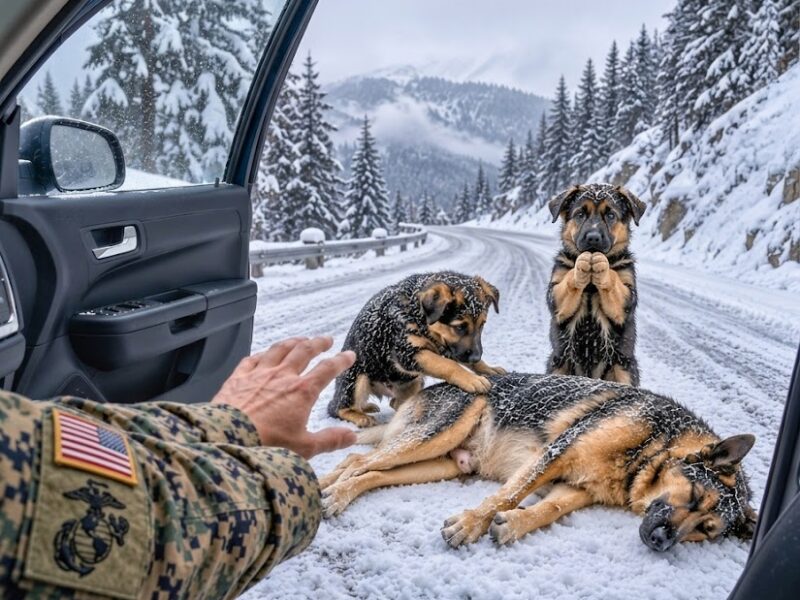
A Marine found a mother dog and her two puppies freezing in the snow. He was about to call for help—until one puppy pulled his sleeve.
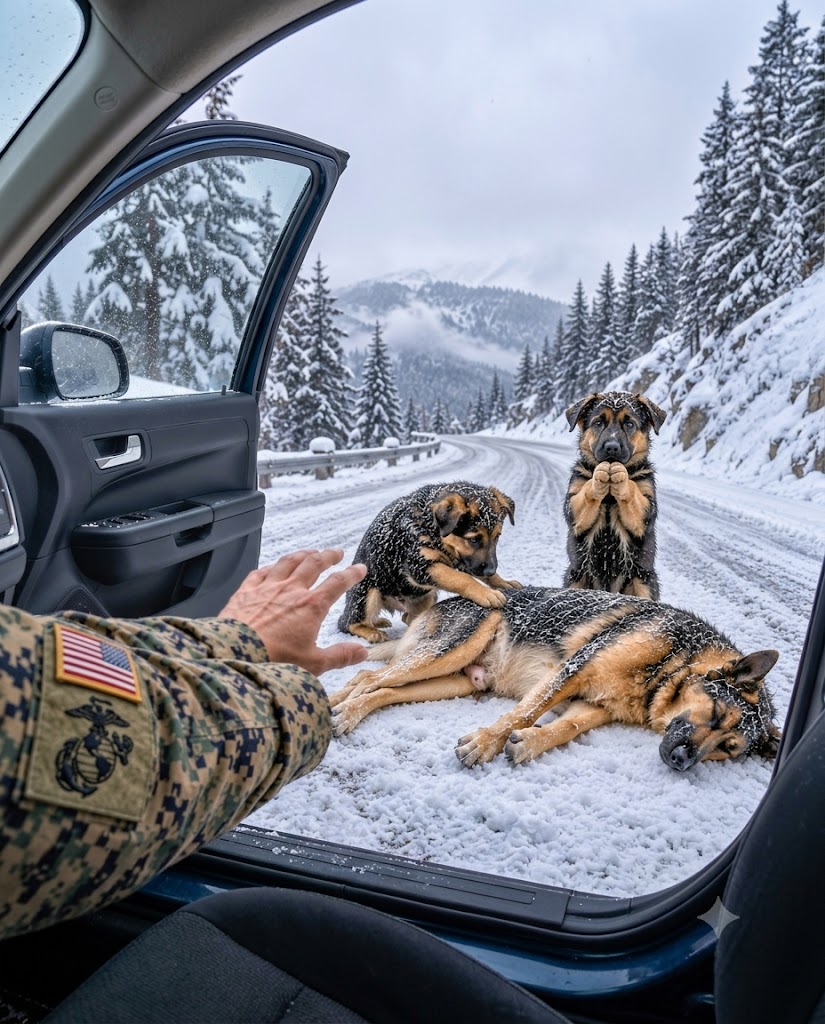
The storm had already swallowed the Sierra Nevada by the time Staff Sergeant Cole Barrett saw the dark shape beside the mountain road.
Snow swept across the asphalt in pale sheets, erasing the shoulders and turning the tall pines into gray ghosts against a closing sky.
He should have been miles away, driving home before the pass shut down completely.
But something made him stop.
—
Cole was thirty-nine years old, six-foot-one, broad-shouldered, with short dark brown hair touched by gray at the temples.
Eighteen years in the United States Marine Corps had given him the calm movements of a man who had learned to function under pressure.
His assignment near the mountain warfare training center would end soon.
For the first time since he was twenty-one, Cole did not know what came next.
—
On the passenger floor sat a small wooden box holding challenge coins, photographs, old unit patches, and other pieces of his military life.
He had planned to take it to his father that evening.
Walter Barrett was sixty-seven, a retired firefighter with a sturdy frame, close-cut silver hair, and the practical patience of a man who had spent decades helping strangers on their worst days.
Since losing his wife, Walter had grown quieter, but never cold.
—
He still checked on neighbors after storms.
He still called his son more often than Cole answered.
Three missed calls from Walter glowed on the dashboard.
Cole told himself he would call at the next safe turnout.
Then he rounded a narrow bend and saw something dark beside the road.
—
At first, he thought it was a fallen branch.
A smaller shape moved beside it.
Cole slowed and stopped several yards ahead.
He stepped into the snow and walked back toward the curve.
The dark shape was a German Shepherd.
—
She lay on her side near the road, her black and tan coat covered with snow.
She appeared about five years old, though her thin condition made her seem older.
Her frame suggested she had once been strong.
One hind leg showed signs of an older injury, and a worn collar rested beneath the thick fur around her neck.
—
Two puppies stayed beside her.
The larger one was a male about seven weeks old with oversized paws, a dark muzzle, and a small white marking above one front paw.
He was frightened but stubborn, repeatedly placing himself between the mother and Cole, even while his legs trembled.
The second was a smaller female of roughly the same age.
Her ears had not fully risen, and she had little energy left.
—
She remained pressed against her mother’s stomach, searching for warmth and refusing to move away.
Cole stopped several feet from them.
The mother opened her amber eyes.
Her breathing was weak, but she was alive.
“Easy,” Cole said.
—
The male puppy stepped forward.
Cole lowered himself onto one knee.
He had worked around military working dogs during training exercises.
He knew frightened animals did not need someone proving authority.
They needed patience and a reason to believe the next movement would not make things worse.
—
He removed one glove and placed his hand against the snow between them.
The puppy watched him from behind it.
The mother tried to lift her head.
Cole contacted local dispatch.
Road closures were spreading across the mountains, and animal control could not reach him for several hours.
Several hours was too long.
—
Cole looked at the mother again.
You’re not staying here.
He returned to the SUV and brought back an emergency blanket.
When he approached again, the male puppy moved in front of its mother.
Cole extended one arm slowly.
The puppy caught the fabric of his camouflage sleeve between its small teeth.
—
Cole froze.
There was no violent shake and no attempt to force him backward.
Instead, the puppy pulled once toward the mother, then again.
Cole stared at him.
The little dog was not telling him to leave.
He was asking Cole to come closer.
“All right,” Cole whispered. “I understand.”
—
Cole slid the blanket beside the mother and carefully lifted her, supporting her body evenly.
She was far lighter than an adult German Shepherd should have been.
Her eyes stayed on the puppies, but she did not resist.
He carried her toward the SUV.
Both puppies immediately followed.
—
The stronger male stayed near Cole’s boots.
The smaller female managed only a few steps before stopping, so Cole returned and carried her against his chest while the male hurried beside him.
Inside the vehicle, Cole placed the mother across the rear seat on the emergency blanket.
The puppies pressed against her almost at once.
—
Only then did Cole notice something beneath her collar.
A small metal plate was partly hidden under the fur.
Most of the markings had worn away.
Only two characters remained clear.
Canine.
Cole brushed snow from the collar.
—
Beneath it was a narrow section of heavy webbing, faded and weathered, built differently from an ordinary pet harness.
Cole had seen equipment like it before.
He closed the rear door and looked through the glass at the mother curled around her puppies.
He had stopped because three animals needed help.
—
Now he understood there was another question waiting beneath the snow and worn straps.
Whatever had happened before that mountain road, this German Shepherd had not always been a stray.
And somewhere in her past, someone might once have known exactly who she was.
—
Cole Barrett pulled away from the mountain shoulder with the heater running at full power and three exhausted animals behind him.
The adult German Shepherd lay across the emergency blanket in the rear seat, keeping both puppies pressed against her, even though she barely had enough strength to lift her head.
The larger male stayed alert beside her, while the smaller female remained curled tightly against the fleece lining of Cole’s jacket.
—
Cole checked them in the mirror every few seconds as the SUV crawled toward Bridgeport.
The nearest veterinary clinic was normally less than twenty minutes away.
That afternoon, twenty minutes might as well have been another state.
The radio broke through the wind with an emergency road update.
—
A small slide had come down across the highway ahead, leaving snow, branches, and debris across both lanes.
Crews were responding, but there was no estimated reopening time.
Cole slowed.
Another message followed almost immediately.
The mountain road behind him was also being restricted because visibility had fallen too quickly for ordinary traffic.
—
For several seconds, Cole simply stared through the windshield.
The road ahead was closed.
The road behind him was disappearing.
He was caught between two closures with three animals who could not wait for the weather to improve.
The mother began trembling harder in the back seat.
The smaller puppy had become unusually still.
—
Cole took his phone and called the emergency number listed for a veterinary clinic in Bridgeport.
Dr. Rebecca Lane answered after the second ring.
Rebecca was fifty-five, medium height, lean, with short auburn hair streaked with silver and the steady voice of someone accustomed to being called when people were frightened.
She had spent nearly thirty years treating ranch animals, working dogs, and family pets throughout the Eastern Sierra.
—
Years of winter emergencies had made her practical without making her detached.
She rarely raised her voice, and she had learned that frightened owners usually needed clear instructions more than comforting promises.
Cole described what he had found, avoiding guesses and giving Rebecca only what he could observe.
“Keep them warm gradually,” Rebecca told him.
—
“Especially the smaller puppy, and don’t give the mother a large meal. If she’s been without regular food for some time, too much at once can create another problem.”
Cole asked where he could take them.
Rebecca paused before answering.
The clinic was on the other side of the road closure.
She could not safely reach him yet, and he could not reach her.
—
Cole looked at the map on the dashboard.
Three miles west of his position was an old forest service ranger station used only during part of the year.
He remembered passing it during a training route earlier that winter.
Rebecca told him to get out of the wind and call again once he was sheltered.
The ranger station appeared through the snow twenty minutes later.
—
A small timber building set back among tall pines.
The parking area had nearly disappeared beneath fresh accumulation, but Cole managed to pull close to the entrance.
Inside, the building was cold, but dry.
A metal stove stood along one wall, and a stack of seasoned firewood remained beneath a covered rack near the rear door.
—
Cole carried the smaller puppy inside first, wrapped in his fleece jacket.
The male puppy followed him without being asked, stopping twice to look back toward the SUV.
Cole returned for their mother and lifted her carefully onto a folded blanket beside the stove.
She watched him closely but did not resist.
—
Once a fire was burning steadily, the room began to change.
The cold did not disappear, but it stopped feeling endless.
Cole opened the compact medical kit he carried for field exercises.
He cleaned the mother’s older leg injury carefully and covered it with a simple protective dressing.
Nothing about the injury appeared new, which troubled him in a different way.
—
She had apparently been surviving with it for some time.
The male puppy began making slow circuits around the room.
He inspected the door, crossed to the window, returned to his mother, then checked the door again.
Cole watched him, and almost smiled.
Even exhausted, the little dog behaved as though someone had assigned him guard duty.
—
The smaller female did not move far.
When Cole placed his fleece jacket beside the stove, she crawled onto it and settled into the folds.
Her brother eventually returned and lay nearby, though he kept his head raised.
Cole examined the worn equipment around the mother’s neck again.
The metal plate marked Canine was attached to faded webbing far heavier than a normal pet collar.
—
On the inside, beneath years of wear, he found what appeared to be part of a telephone number.
Most of the digits had been rubbed away, but four remained visible.
Cole photographed them with his phone.
While moving the fur gently around the strap, he noticed a small healed mark behind one of the dog’s ears.
—
It was not enough to tell him exactly what her history was, but combined with the specialized webbing and the metal Canine plate, it strengthened a thought he had been trying not to assume.
This dog had probably belonged to someone.
More than that, she may once have worked beside someone.
His phone rang.
—
Walter.
Cole looked at the screen longer than necessary before answering.
His father did not begin with a complaint.
Walter simply asked whether Cole had reached town.
Cole glanced at the mother and her puppies beside the stove.
Not exactly. The road closed. I found somewhere safe to wait it out.
—
Walter was quiet for a moment.
He knew his son too well.
Cole had always become unusually brief whenever he was leaving out the important part of a story.
You sound busy.
I’ve got a situation.
What kind?
Cole looked at the male puppy standing near the window again.
—
Nothing I can’t handle.
Another pause followed.
Walter could have pushed.
Years earlier, he probably would have.
Age and loss had taught him that forcing Cole to talk usually made his son build another wall.
All right, Walter said, but don’t try to solve everything alone.
—
Cole did not answer immediately.
The sentence stayed with him after the call ended.
Outside, snow moved past the windows in thick waves.
Inside, the mother German Shepherd slowly shifted closer to her puppies.
Cole reached down to adjust the blanket beneath her.
Earlier, she had watched every movement of his hands with fear.
—
This time, she let him touch her shoulder without pulling away.
Near midnight, Cole checked the smaller puppy again.
She had been trembling for most of the evening.
Now, she had stopped.
For one brief second, Cole felt relieved.
Then he remembered something Rebecca had told him over the phone.
—
In extreme cold, stopping the shivering did not always mean an animal was getting warmer.
Sometimes it meant the body no longer had enough energy to keep fighting the cold.
Cole immediately reached for his phone.
The night was not over yet.
—
Cole Barrett stayed awake through most of the night with the smaller puppy tucked against his chest beneath his fleece jacket.
Dr. Rebecca Lane remained on the phone for nearly an hour, guiding him through the slow process of bringing warmth back into the little body without rushing it.
Cole followed every instruction exactly.
The puppy’s breathing remained shallow at first, but after a long stretch of stillness, one front paw shifted against his shirt.
—
Cole looked down.
A few minutes later, the puppy opened her eyes.
They were dark, tired, and unfocused, but they were open.
Across the room, the mother German Shepherd lifted her head.
The larger male puppy rose beside her and took several uncertain steps toward Cole, then sat near his boots as if waiting for an explanation.
—
“She’s still here,” Cole said quietly.
The male puppy tilted his head.
Cole did not know whether the little dog understood the words, but he stayed there anyway, holding the smaller puppy until her breathing became more regular.
By morning, the storm had weakened.
Snow still covered the road, but the wind had lost much of its force.
—
Shortly after sunrise, the sound of an engine came through the trees.
Rebecca arrived in a dark four-wheel drive utility vehicle with chains on the tires and a medical bag secured behind the seat.
In person, she looked much as Cole had imagined from her voice.
Fifty-five, lean, energetic despite the early hour, with short auburn hair streaked with silver and a weathered green jacket over practical winter clothes.
—
Rebecca had spent decades working in remote mountain communities, and she carried herself with the calm efficiency of someone who understood that animals often responded to the emotional state of the humans around them.
She examined the mother first.
The dog was dehydrated and badly underweight.
The older injury on her hind leg had become irritated from exposure and poor conditions, but Rebecca believed it could heal with treatment, rest, and regular nutrition.
—
“She’s been surviving for a while,” Rebecca said. “Long enough that this didn’t happen in one bad night.”
Cole looked toward the two puppies.
Rebecca examined them next.
Both were approximately seven weeks old.
The male was stronger and more curious, though still thin.
The smaller female would require closer monitoring for several days, but her temperature had improved.
—
Rebecca looked at Cole.
You did the right thing last night.
Cole glanced away as though praise made him uncomfortable.
I followed instructions.
That still counts.
Rebecca checked the mother for a microchip.
Nothing.
—
Then she turned her attention to the worn canine equipment Cole had noticed the night before.
The faded webbing interested her immediately.
This isn’t a normal walking harness.
Cole nodded.
That’s what I thought.
Rebecca rotated the strap carefully and studied the old stitching.
—
She had treated search dogs, avalanche dogs, and volunteer rescue dogs during her career.
The materials and construction looked familiar.
This could have been part of a search and rescue setup, she said.
Maybe wilderness work. Maybe civilian canine.
Cole brought up the photograph he had taken of the faded numbers inside the strap.
—
Rebecca enlarged the image but could not make out enough digits to identify the owner.
Then Cole noticed another worn section beneath the metal plate.
He brushed away dirt with his thumb.
Three letters remained.
D. A. K.
Rebecca leaned closer.
That could be part of a name.
—
Cole looked toward the German Shepherd.
He tried several possibilities in his mind.
Then he said one softly.
Dakota.
The dog’s head came up immediately.
Her ears shifted forward.
Cole said it again.
Dakota.
—
This time she looked directly at him.
The response was too clear to ignore.
Rebecca smiled.
I think you found her name.
Cole moved a little closer.
Dakota watched him, no longer with the same fear she had shown beside the road.
For the first time, she had something from her past again.
A name.
—
Rebecca began searching regional rescue and working dog records from her phone while Cole prepared the SUV.
The roads were passable enough to leave, but there was another problem.
Every local animal rescue Rebecca contacted was full.
The storm had displaced pets across several mountain communities, and foster homes were already over capacity.
—
You may have them for a while, Rebecca said.
Cole stared at her.
How long is a while?
A few days, maybe a few weeks.
Cole looked at Dakota and the puppies.
His rented house near the base had one chair, several unopened boxes, exercise equipment, and more military gear than actual furniture.
—
It had never occurred to him that three German Shepherds might become part of the arrangement.
By noon, they were there.
Dakota entered cautiously and chose a place near the front door where she could see both puppies and the room around them.
The larger puppy began exploring almost immediately.
—
He inspected the kitchen, disappeared briefly behind a cardboard box, then returned carrying one of Cole’s socks.
Cole stared at him.
You’ve been here ninety seconds.
The puppy continued walking proudly.
Cole took the sock from him.
Scout.
—
The name came naturally.
The puppy had spent nearly every waking moment checking doors, windows, corners, and anything else that might require inspection.
Scout it is.
The smaller female remained quieter.
While Cole unpacked the medical supplies Rebecca had sent with him, an old penny slipped from his pocket and rolled across the floor.
—
The puppy lifted her head and watched it spin.
Cole picked it up.
Penny.
The little dog crawled into the opening of his combat boot and rested her chin against the leather.
Cole looked at her.
Apparently, you approve.
That evening, Walter called on video.
—
Cole answered without thinking.
Scout crossed behind him carrying the same sock.
Walter saw him immediately.
There was a pause.
Then Walter laughed.
Cole turned, caught Scout disappearing around the corner, and laughed, too.
It was brief, but neither man seemed to know the last time they had shared that sound.
—
After the call, Cole sat beside Dakota while the puppies slept.
His phone vibrated.
A message from Rebecca.
She had found an old record from Nevada.
A civilian search and rescue program had once registered a female German Shepherd named Dakota.
The dog had disappeared nearly two years earlier.
—
Cole read the message twice.
Then he looked at Dakota.
Her past had just become much larger than a faded collar.
And somewhere in that past was the reason she had ended up alone in the snow.
—
## PART 2
—
The message Rebecca sent about Dakota’s past kept Cole awake long after the house had gone quiet.
Over the next several days, he worked through old rescue records, archived volunteer pages, and contact lists Rebecca had managed to locate.
The information was incomplete, but one name appeared more than once.
Aaron Keller.
—
Aaron had been a volunteer search and rescue handler in Nevada.
A lean, dark-haired man in his early forties who appeared in several old photographs beside Dakota.
In every image, Dakota looked younger and stronger, wearing a bright working harness and standing close to his left leg.
According to the records, Aaron was patient, disciplined, and unusually devoted to his dogs.
—
He had spent weekends searching mountain trails for lost hikers and had trained Dakota from the time she was young.
Two years earlier, a transport vehicle carrying several rescue animals had been caught in a severe winter storm.
During the confusion after the vehicle was disabled, Dakota disappeared.
Aaron searched for her for months.
—
Local volunteers joined him.
Flyers were posted across several counties.
He checked shelters, ranches, and veterinary clinics long after most people would have stopped expecting an answer.
Then the records ended.
Rebecca eventually discovered that Aaron had moved out of Nevada.
Cole found an old phone number.
—
It was disconnected.
For now, the trail into Dakota’s past stopped there.
Dakota herself seemed less interested in the past with every passing day.
She gained strength steadily.
Her coat began to look healthier, and she no longer remained beside the door every hour.
Instead, she started following Cole through the house.
—
When he made coffee, Dakota appeared in the kitchen.
When he checked paperwork at the table, she settled beneath the chair.
When he carried laundry down the hallway, she followed halfway, decided the task was unimportant, and returned to the puppies.
Scout developed his own routine.
—
Every morning, when Cole prepared to leave for the base, Scout sat beside the front door and watched him tie his boots.
The puppy had grown bolder and had discovered that almost anything left within reach could be carried somewhere else.
Penny remained quieter.
Her strength was returning, but she still preferred familiar places.
—
Most evenings she curled herself onto Cole’s folded Marine Corps sweatshirt and slept with her nose buried in one sleeve.
Cole noticed all of it.
That was exactly the problem.
His assignment was ending soon.
Within weeks, he would have to decide where to live, what work to accept, and whether nearly eighteen years of military structure could simply be replaced with something else.
—
Three German Shepherds did not fit neatly into any plan he had.
Rebecca understood before Cole admitted it.
She called one afternoon with another possibility.
A family in Carson Valley had contacted a rescue network after hearing about Dakota and the puppies.
Daniel and Marcy Whitaker lived on ten acres outside a quiet rural community.
—
Daniel was fifty-three, tall and broad through the shoulders with graying hair and the slow, careful manner of someone who had spent most of his life working with horses.
Marcy was fifty, shorter, warm-faced, and practical.
She had raised two German Shepherds before and worked from home as an accountant, which meant the dogs would rarely be alone.
—
Their property had strong fencing, open ground, shade trees, and a heated room connected to the barn for cold nights.
On paper, Cole could not find a reason to reject them.
The following Saturday, he drove Dakota, Scout, and Penny south.
Daniel and Marcy were waiting near the house when the SUV entered the long driveway.
Scout stood against the rear window, looking everywhere at once.
—
Penny stayed close to Dakota.
Dakota remained completely still.
Cole opened the rear door.
Scout jumped down first.
He walked several feet, stopped, then turned immediately toward Cole.
Penny moved beneath the front passenger seat instead of following.
Dakota did not move at all.
—
Marcy kept her distance.
“That’s all right,” she said. “She doesn’t know us yet.”
Cole appreciated that she did not reach into the vehicle.
He walked toward the fenced yard.
Only then did Dakota step out.
She followed Cole.
Not Daniel.
—
Not Marcy.
Cole.
Inside the yard, Scout began exploring quickly, but every few seconds he ran back to check Cole’s position.
Penny eventually came out and remained so close to Cole that one of her paws rested on his boot whenever he stopped walking.
Daniel showed him the property.
—
The fence was secure.
The shelter was clean.
There was plenty of space.
Someone would be home almost every day.
It was everything Cole had told himself the dogs needed.
When the time came to leave, Dakota stood beside the fence.
Scout caught the loose end of Cole’s shoelace and held it.
—
Penny sat directly on his boot.
Cole bent down and freed his lace from Scout.
Then he lifted Penny gently and placed her beside Dakota.
For several seconds, he stayed there.
This is a good place, he said quietly.
Dakota watched him.
Cole walked through the gate.
—
He did not look back until he reached the SUV.
All three were watching him.
He drove away anyway.
That evening, Cole finally reached Walter’s house.
The old Barrett home stood outside Gardnerville with faded green siding and a backyard Walter had maintained almost entirely by habit since his wife died.
Walter opened the door and studied his son’s face.
—
You gave them away.
Cole nodded.
I found them somewhere better.
Walter said nothing until later, when they were standing behind the house replacing a loose section of fence.
Then he asked, “Better for them or easier for you?”
Cole stopped working.
Walter continued adjusting the board.
—
After Cole’s mother died, Walter admitted he had considered selling the house.
Every room reminded him of someone who was no longer there.
But leaving the house wouldn’t have made me miss her less.
Cole looked toward his old bedroom window.
Inside, his high school baseball jersey still hung behind the door.
—
He had never realized his father had left it there.
For the first time, Cole wondered whether Walter’s quiet life had been loneliness rather than contentment.
They finished the fence together without speaking much more.
At 2:13 the next morning, Cole’s phone rang on the nightstand.
Marcy Whitaker was calling.
—
Cole answered immediately.
Her voice was frightened.
The yard gate was still closed.
The fence looked intact, but Dakota was gone.
Scout and Penny were gone with her.
—
Cole was out of Walter’s house before Marcy Whitaker had finished explaining what she knew.
By the time he reached Carson Valley, snow was falling again, lighter than the previous storm, but steady enough to cover tracks if they waited too long.
Walter rode beside him without speaking.
The older man had changed into heavier boots and an old firefighter’s winter coat.
The dark fabric faded at the shoulders from years of use.
—
At sixty-seven, Walter moved more carefully than he once had, but the urgency in his face made him look younger.
Rebecca arrived shortly after them in her four-wheel drive vehicle.
She carried flashlights, blankets, water, and a small medical bag.
Her calm expression had not changed, but Cole could see the concern in the way she immediately began studying the ground instead of asking questions that could wait.
—
Marcy led them to the far side of the fenced property.
Near one corner, loose soil and snow had been pushed beneath the bottom rail.
The opening was not large, but it was enough.
Three sets of paw prints disappeared toward the trees.
Dakota’s were the deepest.
Scout’s wandered from side to side.
Penny’s were much smaller and stayed close to Dakota’s path.
—
Cole crouched beside them.
She took them with her.
Rebecca looked toward the tree line.
She also kept them together.
That mattered.
Dakota had not panicked and scattered from the property.
She had made a choice and led both puppies with her.
Cole stood.
Let’s go.
—
The trail entered a strip of woodland behind the Whitaker property.
Dakota’s prints remained steady, but Scout’s occasionally broke away to investigate branches or patches of exposed grass.
Penny’s tracks told a different story.
Every few hundred yards, her steps grew shorter.
Then Dakota’s prints turned back.
Rebecca noticed first.
—
She doubled back here.
Cole studied the snow.
Dakota had walked ahead, returned several yards, and then continued again with the puppies.
She had been checking on them.
The pattern appeared twice more before they reached an abandoned horse stable near the edge of an old pasture.
One of the doors stood partly open.
—
Inside was dry ground, protection from the wind, and old straw.
Cole expected the tracks to lead inside.
They did not.
Dakota walked directly past it.
Walter stopped at the doorway.
If she was just looking for shelter, she would have used this.
Cole said nothing.
—
The trail continued toward an equipment shed farther down the property line.
Its wide roof created another protected area where the dogs could have rested without being exposed to falling snow.
Again, the prints passed by.
Scout’s tracks turned toward the shelter.
Dakota’s did not.
A few yards later, Scout’s prints returned beside hers.
—
They crossed another field and reached an old livestock feeder where several handfuls of dry food had been left beneath the covered side.
Scout had clearly investigated it.
His small prints circled the feeder several times.
Penny appeared to have stopped there, too.
Dakota continued forward.
Eventually, both puppies followed.
—
Cole began to feel something changing in his understanding of the trail.
He had assumed Dakota escaped because the Whitaker property was unfamiliar.
Maybe she had been frightened.
Maybe instinct had driven her to find a quieter place for the puppies, but every shelter she passed made that explanation weaker.
She’s not searching, Cole said.
—
Rebecca looked at him.
Not for shelter.
They returned to the vehicles when the trail approached a plowed road.
From there, the dogs had moved along the protected edge, keeping away from traffic and using fences and snow banks as cover.
At a small gas station, they found the next clue.
—
Someone had placed a water bowl near the side wall for outdoor animals.
The snow around it showed Scout’s paws.
Penny’s, too.
Dakota’s prints paused only briefly, then continued.
Walter stood beside Cole and studied the direction.
For several seconds, he looked beyond the road rather than at the tracks.
—
“What’s east of here?”
Cole answered automatically.
“Gardnerville. A few back roads, then the highway toward—”
He stopped.
Walter turned toward him.
Toward your place.
Cole looked again.
The line suddenly made sense.
—
Dakota was not moving randomly away from Carson Valley.
She was following the direction they had driven from Cole’s house.
The turns were imperfect, but the overall path was unmistakable.
Cole felt the realization settle before he said it.
She isn’t running away.
Walter nodded.
—
No, she’s going back.
They returned to the SUV.
The drive felt longer than it was.
Cole kept imagining Dakota slowing so Penny could catch up.
Scout wandering toward every new smell.
The three of them moving through cold ground toward a place Cole had insisted was temporary.
—
His house appeared through the trees.
The porch light was off.
Three dark shapes rested near the front steps.
Cole stopped the SUV before it had fully reached the driveway.
Dakota lay curled around Penny, her body forming the same protective curve Cole had seen on the mountain road.
—
Penny was tired but alert, pressed tightly against her mother.
Scout sat beside the door.
Between his front paws was an old military glove.
Cole recognized it immediately.
He had left it on a shelf in the garage weeks earlier.
Walter did, too.
—
I bought those for you, he said quietly.
Cole looked at him.
Walter’s eyes remained on Scout.
Before your first deployment.
Cole stepped from the SUV.
Dakota raised her head.
For a moment, neither moved.
Then Dakota stood.
—
She walked across the snow without hesitation and pressed her head against Cole’s chest.
Cole lowered himself beside her.
Scout came forward with the glove.
Snow clung to the fur around his paws, but his tail moved when Cole touched his shoulder.
Penny tried to stand.
Cole immediately lifted her and held her close.
—
Walter remained several steps away.
Cole looked down at Dakota.
I kept telling myself I couldn’t keep you.
Walter heard the words.
Cole continued.
It wasn’t the schedule.
Walter waited.
It wasn’t the house either.
—
Cole’s hand rested against Dakota’s neck.
I was afraid if I let them become mine, I’d have something else I could lose.
Walter looked toward the porch.
That’s why you kept your distance from me, too.
Cole did not deny it.
After a moment, Walter added, “And maybe that’s why I let you.”
—
The words carried no anger, only recognition.
Cole carried Penny inside.
Dakota walked through the doorway behind him without being called.
Scout followed and went directly to the old rug near the wall where he had slept before.
Dakota settled beside Penny.
Cole stood in the middle of the room, watching them return to their familiar places.
—
For the first time, he did not think about finding them a home.
He understood that part had already happened.
They had found one.
—
## PART 3
—
The morning after Dakota returned, Cole sat at the kitchen table with his phone in one hand and a cup of coffee growing cold beside him.
Dakota rested beneath the table with her head across his boots.
Penny slept on the folded Marine Corps sweatshirt near the heater, while Scout had somehow reclaimed the old military glove and was guarding it as if it belonged to him.
Cole called Marcy Whitaker first.
—
He apologized for the night before and told her he had made a decision.
Dakota, Scout, and Penny would stay with him.
Marcy was quiet for several seconds.
Then she laughed softly.
I think Dakota made that decision before any of us did.
There was no resentment in her voice.
—
Daniel and Marcy had wanted to give the dogs a good home, not possess them.
If Dakota had crossed miles of winter ground to return to Cole, Marcy believed there was little left to debate.
By the end of that week, Cole completed the adoption paperwork for Scout and Penny and updated Dakota’s temporary records while Rebecca continued searching for anyone connected to her past.
—
The answer arrived four days later.
Rebecca called Cole shortly after dinner.
I found Aaron Keller.
Cole stopped moving.
Aaron was living outside Bend, Oregon.
Rebecca had reached him through a retired search and rescue coordinator who still had an old email address.
—
Aaron Keller was forty-four, lean and long-legged with dark hair beginning to gray at the sides and the weathered face of someone who had spent much of his adult life outdoors.
He had once worked construction during the week and volunteered for wilderness search and rescue whenever needed.
People remembered him as patient, quiet, and deeply loyal.
—
After Dakota disappeared, that loyalty had become difficult for him to carry.
He searched for months, returning repeatedly to the same mountain roads, even after official efforts had ended.
Cole spoke with him that evening.
Aaron confirmed everything Rebecca had uncovered.
Dakota had been trained for civilian wilderness search work.
—
She specialized in locating lost hikers across forest and mountain terrain.
She was disciplined when working, affectionate when off duty, and unusually protective of younger dogs.
Two winters earlier, a transport vehicle carrying Dakota and other rescue animals became stranded during severe weather.
During the evacuation and confusion that followed, Dakota disappeared into the surrounding country.
—
Aaron searched for her for months.
He checked shelters across Nevada and Northern California.
Nothing.
Eventually, work took him to Oregon, but he never deleted Dakota’s photographs from his phone.
Cole listened without interrupting.
When the call ended, he looked at Dakota lying beside the fireplace.
—
For the first time since deciding to keep her, another possibility entered his mind.
Perhaps Dakota already had a home.
Aaron drove down the following weekend.
When Cole saw him step from an older pickup, he immediately understood why Dakota might remember him.
Aaron carried himself without hurry.
—
He did not walk directly toward the porch or call her name from across the yard.
He stopped near the driveway and waited.
Dakota appeared beside Cole.
She stared at the visitor, her ears lifted.
Aaron lowered himself slowly.
Hey, girl.
Dakota froze for one second, then she ran.
—
Aaron opened his arms just before she reached him.
Dakota pressed against his chest while he buried one hand in the thick fur around her neck.
Aaron closed his eyes.
He said nothing for several moments.
Cole stood on the porch watching.
Something inside him tightened.
He had known this could happen.
—
Dakota remembered Aaron clearly.
Scout and Penny watched from beside Cole’s legs.
Eventually, Dakota stepped away from Aaron.
She looked back toward the porch.
Then she walked to Cole.
She stopped against his side.
Scout immediately pushed between Cole’s boots, and Penny settled beside Dakota.
—
Aaron watched all four of them.
A small smile appeared beneath the emotion in his face.
She remembers me.
Cole nodded.
Aaron looked down at Dakota.
But she came back to you.
Cole did not know what to say.
Aaron reached into his jacket and removed a small metal identification tag attached to a short faded strap.
—
Dakota’s old canine tag.
He had kept it for nearly two years.
Aaron placed it in Cole’s hand.
She earned that a long time ago.
Cole looked at the worn lettering.
I thought you’d want her back.
Aaron rested one hand briefly on Dakota’s head.
—
I wanted to know she was alive.
He looked at Scout and Penny.
Now I know she has a family.
Aaron left that afternoon without Dakota.
But he did not leave sad.
For the first time in almost two years, he knew how her story had continued.
—
Cole’s story changed, too, when his Marine Corps service ended several months later.
He did not move to Reno as originally planned.
Instead, he rented a small place near Walter’s property while the two men decided what came next.
Soon, what came next became a project.
Behind Walter’s house stood an old workshop that had not been used regularly in years.
—
Cole and Walter cleared it together, repaired the fencing, replaced damaged boards, and created a sheltered area where dogs could safely rest.
Cole also began volunteering with a local search and rescue organization.
Dakota was never expected to return to active work.
She had already given enough years to that life.
Instead, Cole used what he had learned from her.
—
His military experience, patience in difficult terrain, and growing knowledge of working dogs gave him a new purpose.
After leaving the uniform behind, Walter helped whenever he could.
Somewhere between replacing fence posts, sharing morning coffee, and arguing about which tools belonged in which drawer, father and son stopped behaving like two men carefully avoiding the past.
—
They became family again.
The seasons changed.
Dakota gained weight until her ribs disappeared beneath a healthy coat.
Her injured leg strengthened, and she began spending warm afternoons stretched across Walter’s porch.
Scout grew into a large, energetic German Shepherd who still stole Cole’s gloves whenever one was left within reach.
—
Penny remained smaller than her brother.
Every evening, shortly before Cole returned home, she waited beside the door.
A year after the storm, light snow fell across the yard.
Dakota rested on the porch in a patch of winter sun.
Scout and Penny chased each other through the fresh snow.
Walter stood near the fence, replacing a loose board.
—
Above the fireplace inside the house hung Dakota’s old canine tag beside a photograph of Cole in his Marine Corps uniform.
Cole stood in the doorway and watched them.
A year earlier, every life in that picture had been searching for something.
Dakota had been searching for safety.
Scout and Penny had been following their mother.
—
Walter had been waiting for his son to come closer again.
And Cole had been trying to convince himself that needing no one was the same as being strong.
None of them were searching anymore.
No one needed another home.
They were already there.
—
You know what stays with me most about Dakota’s story?
It wasn’t the snow or the mountain road.
It was realizing that Dakota never wanted the biggest yard or the perfect home.
She wanted the person who had stopped for her.
When she led Scout and Penny back through the snow, she wasn’t running away.
—
She was going home.
Cole thought he had rescued three dogs, but they rescued something in him, too.
Dakota gave him purpose.
Scout brought laughter back into the house, and Penny softened a man who had spent years hiding from loss.
Through them, Walter got his son back, and Aaron finally learned that Dakota was safe and loved.
—
Maybe that was what God wanted Cole to understand.
Sometimes love is not asking us to fix everything.
Sometimes it only asks us to open the door.
Because Cole stopped, three dogs survived.
A father and son found each other again, and a temporary house became a home.
—
Tonight, I pray God blesses you, protects the people and animals you love, heals the places in your heart that you rarely talk about, and gives you courage to let love back in when fear tells you to keep your distance.
If Dakota’s story touched your heart, write amen in the comments.
And if you believe that loyalty, kindness, family, and second chances can change a life, subscribe and stay with us for the next journey.
—
But Dakota’s story was not the last time a German Shepherd chose one person when everyone else thought the decision had already been made.
Wait until I tell you about the former Navy corpsman who found an exhausted canine sitting beside an abandoned Ranger truck high in the Colorado mountains.
The dog would not leave the vehicle, would not follow rescuers, and kept returning to one weathered backpack buried beneath the seat.
—
Inside was an old search map, a faded handler photograph, and one clue that connected the dog to a disappearance no one in that county had been able to explain for three years.
And when that corpsman finally followed the trail marked on the map, he discovered why the canine had been waiting in the same place all along.
Subscribe now, because that next story is one you will not want to miss.
—









