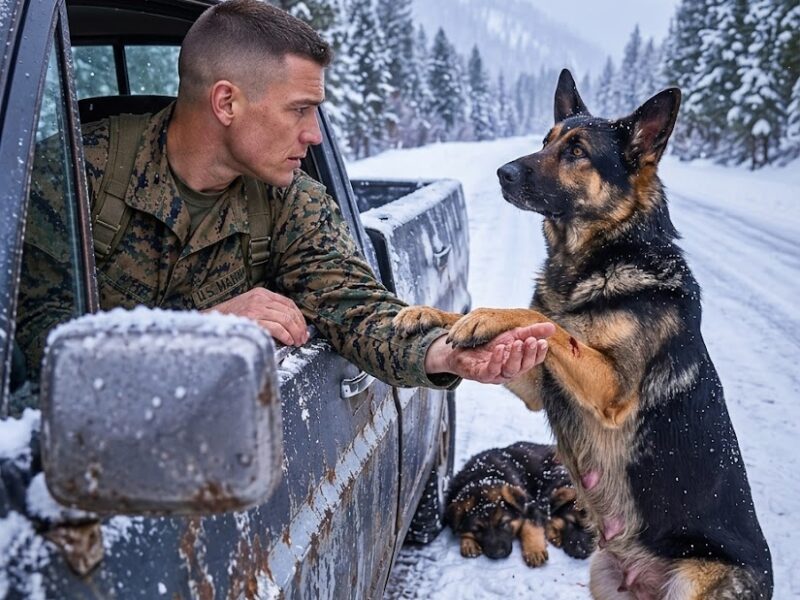
A Marine found a freezing German Shepherd mom curled up in the snow. What she led him to changed everything.
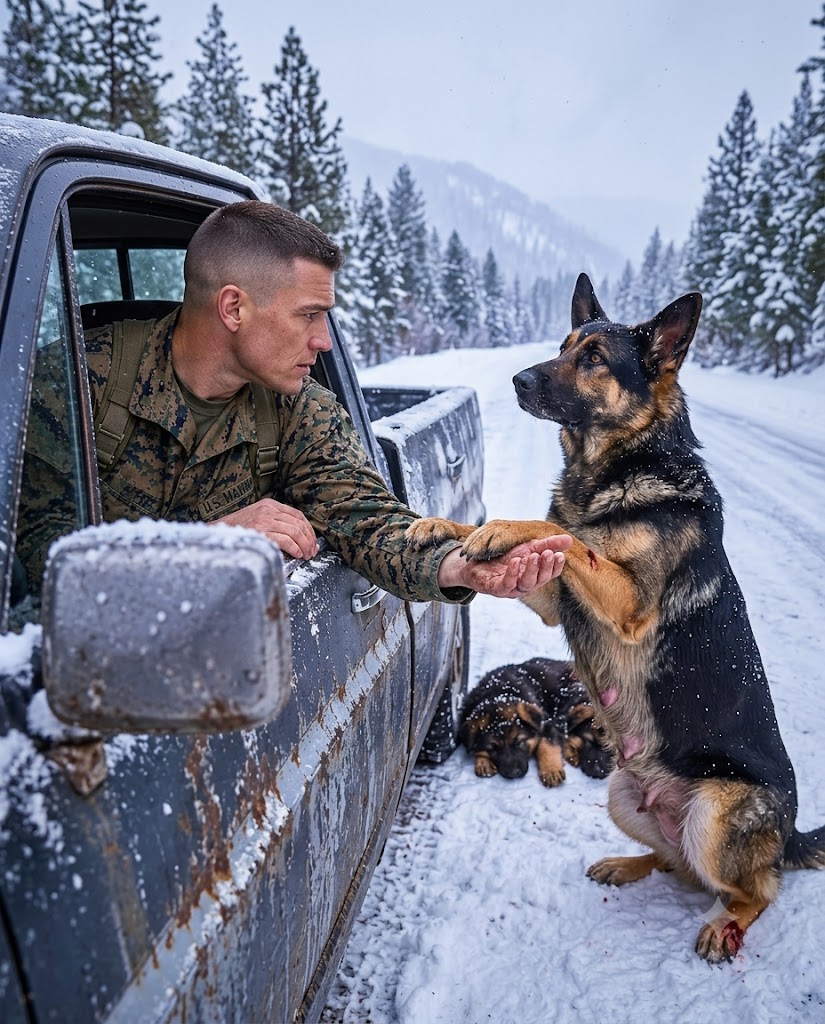
Staff Sergeant Jack Callahan was driving his old pickup through a snowstorm in Idaho’s Sawtooth Mountains when a German Shepherd suddenly appeared beside the road.
She was painfully thin, her paws bleeding, her nursing belly showing she had puppies somewhere nearby.
Jack stopped, but the dog refused to climb into the truck.
Instead, she ran toward the trees, then looked back at him as if begging him to follow.
What Jack found beneath an abandoned drainage culvert was a litter of freezing puppies, one barely breathing.
He thought he was saving a desperate mother and her babies.
He had no idea that weeks later, when he vanished after a mountain crash, that same dog would risk everything to find him.
Snow had been falling across Idaho’s Sawtooth Mountains since before sunrise, softening the pine-covered slopes and turning the narrow road outside Stanley into a pale ribbon between dark forests.
Staff Sergeant Jack Callahan was heading home when he noticed something moving beside the road.
Jack was 43, a broad-shouldered American man just over six feet tall with short dark brown hair cut close at the sides, gray beginning near his temples, and a square face roughened by years of sun, cold, and military service.
He had spent nearly two decades in the United States Marine Corps before retiring two years earlier.
People who knew Jack described him as calm, observant, and almost impossible to hurry.
The Marines had taught him to notice small changes before they became large problems.
Leaving the Marines had taught him something more difficult: he had no idea what to do when nobody needed him.
Jack now lived alone in a small cabin several miles outside Stanley.
He repaired things, cut firewood, occasionally helped neighbors during storms, and rarely spoke about the years before Idaho.
That morning, he had driven into town for fuel, canned food, batteries, and enough supplies to wait out the winter storm moving across the mountains.
Old habits remained.
Before leaving Stanley, Jack checked the fuel gauge twice, inspected the tires, looked at the weather report, and made sure the emergency kit behind his seat contained blankets, water, a flashlight, and basic medical supplies.
The battered dark gray pickup had become his closest thing to a constant companion.
Jack was about 12 miles from home when he saw the movement again.
At first, he assumed it was a deer crossing between the trees.
Then the shape entered the open road: a German Shepherd.
Jack eased off the accelerator.
The dog kept coming.
She was an adult female, perhaps 5 years old, black and tan with a dark saddle across her back and large upright ears.
Snow clung to her coat.
She was much thinner than she should have been, and exhaustion showed in the way her steps shortened whenever she slowed, but her amber-brown eyes remained intensely focused.
Jack dropped his speed.
The shepherd ran beside the pickup.
“What are you doing out here?” he murmured.
The road was empty in both directions.
No houses, no parked vehicle, no person calling after her.
Jack slowed almost to walking speed.
The German Shepherd suddenly moved toward the driver’s side.
She rose briefly against the door, placing her front paws near the window before dropping back onto the snowy road.
Jack saw enough.
Her paws were injured from traveling over frozen ground, but something else caught his attention first.
Her underside showed clearly that she was nursing.
Jack looked toward the forest.
“You’ve got puppies.”
The shepherd stared at him.
Jack stopped the truck.
He stepped outside slowly and closed the door without slamming it.
Cold air swept across the road.
The dog backed away.
Jack stopped immediately.
He had worked around frightened dogs before.
Fear could look like aggression when an animal had no other way to create distance.
“All right,” he said quietly.
“I’m staying here.”
The shepherd did not approach.
Instead, she turned toward the trees.
She ran perhaps 20 yards, stopped, and looked back.
Jack watched her.
She ran farther.
Then she stopped again.
The behavior was too deliberate to ignore.
Jack looked at the sky.
Snowfall was becoming heavier, and the ridge beyond the trees had already begun disappearing behind gray-white clouds.
Going into an unfamiliar forest road during worsening weather was not something he would normally do without a reason.
The German Shepherd looked back at him once more.
Apparently, she considered herself a reason.
Jack returned to the pickup.
“All right,” he said.
“Show me.”
The shepherd led him toward an old logging road, almost hidden beneath fresh snow.
Jack followed slowly.
Branches leaned across the track, brushing the sides of his truck.
The path narrowed between pine trees and disappeared around the base of a wooded slope.
Every short distance, the shepherd stopped.
Every time, she checked that Jack was still behind her.
Half a mile later, she suddenly left the track.
Jack stopped the pickup.
The dog stood near a shallow drainage ditch below the road.
She looked at him, then disappeared behind a cluster of snow-covered brush.
Jack grabbed his emergency bag and climbed down carefully.
The shepherd appeared again beside an old concrete drainage culvert built into the hillside.
Its opening was partly sheltered by fallen branches.
Jack crouched several feet away.
Then he saw movement.
Three small shapes were pressed together beneath the shelter.
Puppies.
Jack’s expression changed.
The first was a black-and-tan male with oversized paws and a right ear that folded slightly at the tip.
He lifted his head when Jack approached.
The second was a smaller female with tan markings above her eyes.
She remained tucked closely against her siblings.
The third puppy barely moved.
Jack lowered himself beside them.
“Hey, little guy.”
The smallest male was perhaps 7 weeks old, mostly black along his back with tan legs and a narrow tan patch across his face.
Jack later would call him Scout.
For now, Scout was simply the puppy Jack worried about most.
He was cold, weak, and too tired to react much when Jack gently checked him.
The mother stood several feet away.
Her body was tense.
Her attention never left Scout.
Jack finally understood what had happened.
She had found the best shelter she could.
Then she had left her three puppies behind and gone toward the road, not because she wanted to escape them, but because she needed someone else.
Jack removed his heavy field jacket and spread it across the snow.
He carefully gathered the puppies together inside it.
The stronger male stirred immediately.
The little female pressed closer to Scout.
Their mother stepped forward.
Jack stayed still.
As she came nearer, he noticed a pale line around her neck, the faded mark left by a collar worn for a long time.
This dog had belonged somewhere once.
Whatever had happened between then and now would have to wait.
Jack carried the puppies toward the truck.
The shepherd followed every step.
At the roadside, Jack opened the rear passenger door and placed the bundled puppies inside.
The mother stopped outside.
Jack backed away.
She stared into the cab.
Scout shifted beneath the jacket.
That was enough.
The shepherd climbed inside.
Jack retrieved the medical kit and worked carefully near the open door, wrapping her sore front paws with simple protective bandages while allowing her enough space to move away whenever she wanted.
She tolerated it only because the puppies remained beside her.
“Fair arrangement,” Jack said.
He looked at the mother.
Maggie.
The name came without much thought.
She looked tired enough to ignore it.
Jack closed the door and returned to the driver’s seat.
In the mirror, Maggie curled herself around the three puppies.
For the first time since he had seen her on the road, she stopped watching the forest.
Jack started the pickup.
The storm thickened as they returned toward the main road.
He thought the hardest part had been finding them.
Then he looked into the rearview mirror again.
Maggie was trembling, and this time it was not from running.
By the time Jack Callahan reached the turnoff to the county veterinary clinic, the road ahead had disappeared beneath drifting snow.
A temporary barrier blocked the entrance.
Beyond it, wind pushed loose powder across the pavement in pale sheets, and the small highway sign was already half buried.
Jack slowed the pickup and stared through the windshield.
The clinic was less than 15 miles away.
Tonight, it might as well have been a hundred.
He looked into the rearview mirror.
Maggie was still curled around her puppies, but the trembling had not completely stopped.
“All right,” Jack said quietly.
“Home first.”
His cabin sat beyond a stand of lodgepole pines several miles outside Stanley.
It was a simple one-story place of dark timber and stone, built for weather rather than appearance.
Inside, almost everything belonged to one person.
One heavy chair faced the fireplace.
One coffee cup sat beside the sink.
One coat hung by the door.
The small dining table had two chairs, although Jack could not remember the last time anyone had used the second.
A cardboard box remained on the highest shelf of the living room bookcase.
Inside were Marine Corps medals, unit photographs, old insignia, and letters Jack had never decided whether to keep or throw away.
For two years, his home had been organized around not needing anyone.
That arrangement changed the moment Maggie entered.
Jack carried the three puppies inside first, still wrapped in his field jacket.
Maggie followed immediately.
The German Shepherd paused just beyond the doorway, her head low and ears alert.
She studied the unfamiliar room, the fireplace, the narrow hallway, and Jack.
Then she found the warmest corner beside the stone hearth.
She lay down.
The puppies disappeared against her belly.
Jack moved slowly.
He placed a bowl of water several feet away, then prepared a small amount of plain food and set it beside the water.
Maggie watched every movement.
Jack backed away.
Instead of sitting in the chair, he lowered himself onto the floor across the room.
“You eat when you’re ready.”
For several minutes, nothing happened.
Then Maggie stood.
She approached the water first.
Jack deliberately looked away.
The quiet sound of drinking eventually filled the room.
He smiled without turning his head.
“That’ll do.”
The three puppies were beginning to show different personalities.
Finn, the strongest male, had broad little paws, a dark back, and more confidence than coordination.
He repeatedly crawled beyond the blanket, as though the entire cabin had been built for his inspection.
Daisy was smaller, with soft tan markings around her face and one ear that folded slightly to the side.
She preferred remaining close to Maggie and usually pressed herself against her mother whenever anything unfamiliar happened.
Scout was different.
The smallest male had a mostly dark coat, thin tan legs, and a narrow face that made his eyes look unusually large.
He slept more than the others.
When awake, however, he seemed increasingly interested in Jack.
Each time Jack checked the puppies from a careful distance, Scout would make a slow attempt to move toward him before tiring and settling back into the blanket.
Jack tried not to read too much into it.
He failed.
Late that evening, Finn was wrestling unsuccessfully with a corner of a towel when Jack noticed Scout had stopped nursing.
Jack moved closer.
Maggie immediately lifted her head.
“I know.”
Jack kept his movement slow.
Scout was still responsive, but he seemed colder and weaker than he had an hour earlier.
Jack had treated people in difficult conditions during his years in the Marines.
A puppy was not a Marine, and Jack knew better than to pretend otherwise.
But some principles were simple: warmth, patience, observation.
Do not panic before there is a reason.
Jack wrapped Scout in a warm towel and kept him near the fireplace while monitoring him carefully.
Maggie stayed beside them.
Her eyes followed Jack’s hands, but she did not interfere.
Minutes passed.
Then Scout shifted.
A tiny sound escaped him.
Jack let out the breath he had been holding.
“There you are.”
Maggie leaned forward and touched her nose to Scout’s head.
Jack returned him beside her.
She immediately curled around him.
That night, Jack slept in the chair instead of his bedroom.
Not because Maggie trusted him.
Not yet.
Because he wanted to be close enough to notice if something changed.
By morning, the storm had weakened.
Jack woke to knocking at the front door.
Maggie was on her feet before he was.
Jack looked through the window.
Walter Hayes stood outside holding an old wooden crate against his hip.
Walter was 69, medium height, thick through the shoulders despite his age, with white hair cut short and a weathered face that seemed permanently caught between irritation and amusement.
He had spent more than 30 years with the local fire service and retired as a battalion chief.
His wife Margaret had died four years earlier.
Since then, Walter had remained in the mountain house they had shared, insisting that independence was a condition rather than a preference.
Most neighbors considered him generous, stubborn, and nearly impossible to help without making him believe he was helping you first.
Jack opened the door.
“You’re out early.”
Walter lifted the crate.
“You’ve had smoke coming out of that chimney since before dawn. Either you finally learned to enjoy mornings, or something happened.”
Then he saw Maggie.
Walter stopped.
Behind her, Finn crawled directly out of the blanket and became stuck halfway over its folded edge.
Walter’s eyebrows rose.
“That explains the fire.”
He entered carefully.
Maggie immediately positioned herself between him and the puppies.
Walter did not move closer.
Instead, he lowered the wooden crate near the wall.
“Old apple box,” he explained.
“Thought you might need something sturdier than a laundry basket.”
Jack looked at him.
“How did you know they were puppies?”
Walter shrugged.
“I saw three sets of tiny tracks by your porch.”
Jack almost smiled.
Walter sat in the second dining chair as he lowered himself.
One knee stiffened briefly.
He hid the discomfort by adjusting his boot.
Jack noticed.
Walter noticed Jack noticing.
Neither man mentioned it.
Maggie remained standing for several minutes.
Walter spoke quietly about nothing important: weather, snow depth, a broken fence near the county road.
Then he placed a small piece of food on the floor and moved his chair farther back.
Maggie watched him.
Eventually, she stepped forward and took it.
Walter nodded once.
“Smart girl.”
Jack looked toward the shelf above the fireplace.
Walter’s attention had shifted to an old Marine Corps photograph, partly hidden behind a stack of books.
“You never talk much about that.”
Jack followed his gaze.
“There isn’t much to say.”
Walter studied him for a second.
Then, unlike most people, he did not ask again.
That may have been the first thing Maggie liked about him.
By afternoon, Finn had climbed into the wooden box twice.
Daisy had claimed the warmest corner.
Scout had somehow crawled into Jack’s old wool Marine watch cap, lying beside the chair.
Only his nose and one paw were visible.
Walter looked down at him.
“You planning to keep all four?”
Jack folded his arms.
“They’re staying until the roads clear.”
Walter smiled.
“That wasn’t what I asked.”
Jack did not answer.
Across the room, Maggie finally lowered her head to the blanket.
Walter remained seated.
Jack remained nearby.
For the first time, the German Shepherd closed her eyes while both men were still in the room.
Jack understood something then.
Maggie was not deciding whether people were kind.
She was deciding something harder: whether they stayed.
And that evening, in a cabin built around one man’s solitude, four new heartbeats made the silence feel different.
Three days after the storm, the county road finally reopened.
Snow banks still rose along both shoulders, but the plows had carved a narrow path toward Stanley, and by midmorning, Jack Callahan was driving Maggie and the three puppies toward the veterinary clinic.
Maggie rode on the rear seat with Finn, Daisy, and Scout pressed close to her.
She had improved since the first night.
She was eating more.
Her steps were steadier.
But Jack had noticed something he could not dismiss.
Maggie barely slept.
At the cabin, she would lower her head beside the puppies, close her eyes for perhaps a minute, then lift them again.
Scout moved.
She checked Scout.
Finn crawled away.
She checked Finn.
Daisy shifted beneath the blanket.
Maggie checked Daisy.
Always in the same order: Scout, Finn, Daisy.
Then the door.
Then Jack.
By the time they reached the small veterinary clinic on the edge of Stanley, Jack had started wondering whether Maggie had forgotten what rest felt like.
Dr. Hannah Brooks met them in the examination room.
Hannah was 37, tall and athletic, with dark auburn hair usually tied into a loose ponytail and gray-green eyes that gave people the impression she was listening even before they spoke.
She had worked for several years with military and law enforcement dogs at a larger animal hospital in Washington before returning to Idaho to run a rural practice.
That experience had made her careful around fearful animals.
She did not confuse obedience with trust, and she never rushed a frightened dog simply because a schedule said she should.
Hannah crouched several feet away from Maggie.
Maggie immediately positioned herself beside Scout.
“She’s watching you,” Jack said.
“She’s watching everything.”
Hannah allowed Maggie several minutes before beginning the examination.
The results were encouraging, but not completely reassuring.
Maggie was significantly underweight and dehydrated from surviving outdoors for too long.
She also showed signs of a mild infection and general exhaustion that would require medication, proper nutrition, and time.
Nothing about the treatment itself seemed to concern Hannah as much as Maggie’s behavior.
The shepherd remained alert through every pause, even while lying down.
Her ears responded to every movement in the hallway.
“She rests like someone waiting for an emergency,” Hannah said.
Jack looked down at her.
“She’s got three puppies. That explains part of it.”
Hannah watched Maggie check them again: Scout, Finn, Daisy.
“But this looks older than motherhood.”
Jack understood what she meant.
The dog had survived long enough without dependable help that vigilance had become normal.
Hannah stood.
“Her body may be inside a warm room now. That doesn’t mean the rest of her believes the danger is over.”
Jack did not answer.
The sentence felt uncomfortably familiar.
A teenage boy appeared at the doorway carrying folded towels.
His name was Eli Turner.
Eli was 16, tall for his age but still thin through the shoulders, with shaggy brown hair that constantly fell across his forehead and a quiet face that became more expressive whenever animals were involved.
He volunteered at the clinic after school.
Hannah had learned not to pressure him into conversation.
Eli’s father had left the family the previous year, and since then the boy had become withdrawn at school, speaking little and trusting slowly.
Animals, Hannah had discovered, required fewer explanations.
Eli stopped when he saw Scout.
“The little one.”
Jack nodded.
Eli crouched.
Scout immediately started crawling toward him.
Finn tried following and became distracted by a towel.
Eli smiled.
It was the first broad expression Jack had seen from him.
“He’s stubborn. That’s why he’s still here,” Jack said.
Eli reached too quickly.
Maggie lifted her head.
The boy froze.
Jack spoke quietly.
“Don’t pull away fast.”
Eli looked at him.
“Just stay still. Let her figure out what you’re doing.”
Eli slowly relaxed his shoulders.
Maggie watched him for several seconds.
Then she lowered her head again.
Hannah looked at Jack.
“You’ve worked with dogs before. You watch her like a handler.”
Jack shook his head.
“I’m not keeping them.”
Hannah glanced toward the puppies.
“You named all three.”
“That doesn’t mean anything.”
“You also named their mother.”
Jack gave her a flat look.
Hannah smiled.
“I’m a veterinarian. I notice symptoms.”
Before they left, Hannah passed a microchip scanner slowly along Maggie’s shoulders.
The machine beeped.
Jack looked up.
Hannah entered the number into the computer.
For several seconds, she said nothing.
“Found something. Registration.”
The old record listed the dog under another name: Mara.
Her owner had been Thomas Keane, 74, a retired carpenter who had lived on a small property nearly 50 miles from Stanley.
Hannah searched the county database.
Her expression changed.
“Thomas died eight months ago.”
Jack remained still.
“The property was sold several months later. There was no updated ownership information for Mara. No clear record explained how she disappeared. No shelter intake, no transfer, no new registration.”
Somewhere between an old man’s death and a winter road, Maggie had simply fallen out of the paperwork.
Jack looked at her.
He found that sadder than he expected.
Not because someone had deliberately pushed her away, but because lives could change quickly enough that one living thing could simply stop being noticed.
When Jack returned home that afternoon, Walter was already near the porch.
“You charging admission now?” Walter asked.
Jack noticed the older man was leaning slightly more heavily on one leg.
“You all right?”
“Fine,” Walter answered too quickly.
He had slipped outside his own house that morning while clearing snow from the steps.
The fall had left him sore rather than seriously hurt.
But admitting that would have sounded too much like needing help.
So he said nothing.
Maggie noticed anyway.
She walked straight toward Walter.
Instead of returning to the puppies, she sat beside his stiff leg.
Walter looked down.
“She always do that?”
“No.”
Walter reached carefully toward her neck.
Maggie allowed it.
Over the next several days, Walter began finding reasons to visit.
One evening, he brought a repaired hinge.
Another time, it was leftover stew.
Once he arrived carrying absolutely nothing and claimed he wanted to make sure Finn had not destroyed the wooden box.
Jack began to understand.
Walter was not checking on the dogs.
Not entirely.
He simply preferred Jack’s warm cabin to eating alone in his own quiet kitchen.
One night after Walter had gone home, Jack woke sometime after midnight.
Something felt different.
He looked toward the hearth.
Finn was asleep.
Daisy was asleep.
Scout was curled inside Jack’s wool cap again.
But Maggie was gone.
Jack sat up.
The German Shepherd stood at the front door.
She was perfectly still, her ears forward, staring through the window toward Walter Hayes’s house.
Maggie remained at the front door.
Jack Callahan had learned enough about her over the past week to recognize the difference between restlessness and purpose.
This was purpose.
Her ears were forward.
Her body was rigid.
She looked toward Walter Hayes’s house, then scratched once against the door.
Jack stood.
“What is it?”
Maggie looked back at him.
Then she scratched again.
Jack opened the door.
She disappeared into the snow.
Jack grabbed his coat and followed.
Walter’s house stood less than 200 yards away, beyond a line of pines.
Normally, the distance felt insignificant.
That night, with fresh snow covering the ground and Maggie running ahead without hesitation, it felt different.
She went directly to Walter’s back porch.
The door was slightly open.
Jack’s pace quickened.
“Walter?”
No answer.
Maggie slipped inside.
Jack followed her into the kitchen.
A chair had fallen near the counter.
A mug rested on its side.
Walter was on the floor.
He was conscious, frustrated, and unable to stand.
“Well,” he muttered when Jack appeared.
“This is inconvenient.”
Jack crouched beside him.
“How long?”
Walter avoided his eyes.
“Not long.”
“Walter.”
The older man sighed.
“Couple hours.”
Jack’s expression hardened.
Walter had slipped while reaching for something near the counter.
He had not suffered a serious head injury, but one wrist was swollen, and he had become increasingly cold and dehydrated while trying unsuccessfully to reach the phone several feet away.
Maggie sat beside him.
Jack called 911.
Walter immediately objected.
“I don’t need half the county showing up.”
“You’ve been on the floor for two hours.”
“I was working on a plan.”
“What plan?”
Walter looked toward the phone.
“A slow one.”
Despite himself, Jack nearly smiled.
The clinic later confirmed that Walter had a minor wrist fracture and no major complications.
The doctor told him he had been fortunate.
Remaining alone on a cold floor for several more hours could have turned a manageable accident into something much more serious.
Walter disliked the word fortunate.
It sounded too much like dependent.
He disliked what happened next even more.
Jack called Walter’s daughter.
Her name was Rachel Hayes.
Rachel was 41, a practical, energetic woman with shoulder-length blonde hair, rectangular glasses, and the direct manner of someone accustomed to solving problems before other people finished explaining them.
She worked as a school counselor in Boise and had inherited both her father’s stubbornness and her mother’s patience.
Walter loved her deeply.
That did not mean he enjoyed being supervised by her.
“You called Rachel.”
“You fell.”
“That wasn’t my question.”
“She needed to know.”
Walter folded his good arm across his chest.
Jack waited.
Finally, Walter looked away.
“That was the third time.”
Jack frowned.
Walter corrected himself reluctantly.
“Second bad one.”
He admitted he had slipped twice during the previous winter and once earlier that month.
He had told no one.
Walter stared toward the window.
“Because once people decide you’re old, every mistake becomes evidence.”
Jack understood more than he wanted to admit.
Walter had spent decades entering burning buildings while other people were running out.
Asking for help now felt to him like becoming someone he no longer recognized.
Jack sat beside him.
“Needing backup never made you less of a firefighter.”
Walter looked at him.
Jack continued.
“Why would it make you less of anything now?”
Walter did not answer immediately, but he stopped arguing.
Two days later, Jack installed an emergency alert button and additional handrails in Walter’s house.
Walter complained through the entire process.
Then he tested the button twice to make sure it worked.
Maggie supervised from the doorway.
After that night, something changed around the two houses.
Eli Turner began visiting on weekends.
At first, he came because Jack asked if he could help clear snow around Walter’s porch, but Walter quickly discovered that Eli knew almost nothing about engines.
This offended him professionally.
Behind Walter’s house sat an old workbench and a collection of small motors, radios, tools, and mechanical parts accumulated across 40 years.
One afternoon, Eli found an old portable radio covered in dust.
“Does this work?”
Walter looked at it.
“Not since Reagan.”
Eli carried it to the workbench.
For nearly two hours, Walter instructed while Eli cleaned connections, replaced a damaged wire, and learned the difference between forcing a part and understanding why it would not move.
When the radio finally produced a clear local weather report, Eli stared at it like he had performed surgery.
Walter pretended not to be impressed.
The following weekend, he handed Eli a worn metal toolbox.
It had belonged to Walter during his first years with the fire department.
The red paint was faded and one corner was dented.
Eli hesitated.
“You sure?”
Walter shrugged.
“Tools are supposed to be used.”
Eli carried it home with both hands.
Jack noticed Walter watched until the boy disappeared down the driveway.
The puppies were changing, too.
Finn had become a compact storm of bad decisions.
He investigated boots, chair legs, blankets, firewood, and anything else placed within reach.
Daisy preferred Walter.
Whenever he entered Jack’s cabin, she waddled toward him and settled near his boots as though the arrangement had been formally approved.
Scout followed Jack.
Kitchen, porch, woodshed, back to the kitchen.
His legs were still too short to keep up, but that never seemed to discourage him.
Maggie watched all of it.
She was gaining weight.
Her coat had begun to regain its deep black and tan shine.
More importantly, she was beginning to sleep.
During a follow-up visit, Hannah Brooks watched Maggie notice Eli entering the clinic before anyone else did.
“She reads people well,” Hannah said.
Jack nodded.
“I’ve thought about search and rescue training.”
Hannah looked at Maggie.
“Maybe someday.”
Jack waited.
“But don’t make her earn a place she already has.”
That stayed with him.
Maggie had spent long enough surviving.
Perhaps she did not need another job.
Perhaps for now she only needed permission to be a dog.
That evening, Walter came for dinner.
Eli stopped by afterward to return a screwdriver.
Finn chased a sock beneath the table.
Daisy slept against Walter’s boot.
Scout crawled across Maggie’s front leg.
Normally, that would have awakened her instantly.
This time, Maggie did not move.
Jack looked down.
Her eyes remained closed.
Her breathing was slow and deep.
Scout climbed over her paw and curled beside her chest.
Still, Maggie slept.
Jack finally understood what had changed.
She was no longer the only one standing watch.
Someone else was staying.
Someone else would notice.
And for the first time since Jack had found her in the snow, Maggie allowed herself to believe it.
Later, Hannah would describe the behavior in a way Jack never forgot.
Maggie seemed to notice not only when someone was in trouble.
She noticed when someone who should have been there was suddenly missing.
Six weeks later, winter still held the Sawtooth Mountains tightly.
The days had begun lasting a little longer, but after sunset, the mountain roads could become dangerous within minutes.
Snowmelt froze again across shaded pavement, leaving clear patches of ice that were almost impossible to see beneath headlights.
That afternoon, Jack Callahan received a call from a family whose SUV had become stranded on an upper forest road before another storm moved in.
Jack did not think twice.
Helping people who were stuck, cold, or simply in over their heads had become one of the few habits from his military life that retirement had never touched.
He loaded recovery straps, blankets, a shovel, extra fuel, and his emergency bag into the old dark gray pickup.
Scout followed him from the kitchen to the porch.
The young German Shepherd had grown quickly, though his paws still looked slightly too large for the rest of him.
Maggie stood behind Scout.
She watched Jack close the tailgate.
“I’ll be back before dinner.”
Maggie stared at him.
Jack smiled faintly.
“You’ve heard that before.”
Then he drove away.
The stranded family was safely moving again before dusk.
Jack turned toward home as the first snow began falling.
The road descended through a narrow mountain corridor bordered by pine forest and steep slopes.
He kept his speed low.
Still, the danger was almost invisible.
A thin section of black ice had formed across a shaded curve.
The pickup lost traction.
Jack corrected once.
For a moment, the truck seemed to recover.
Then it slid beyond the edge of the road.
The descent was brief but uncontrolled.
The pickup came to rest lower on the slope, held between two large pine trees.
Everything became still.
Jack remained in the driver’s seat for several seconds.
Training replaced panic: breathing, hands, feet, awareness.
His shoulder hurt badly and one leg had been strained during the impact, but he could move his fingers and toes.
That’s something.
He reached for the radio.
Nothing.
The unit had lost power.
Jack found his phone near the floorboard.
The screen was damaged and unresponsive.
He looked toward the road above.
From where the pickup had stopped, the vehicle was almost completely hidden by the slope and trees.
Snow was already covering the marks left behind.
Jack understood the problem immediately.
People would eventually notice he had not returned, but eventually was not a comforting word in mountain weather.
He reached behind the seat and pulled out the reflective emergency blanket.
He wrapped it around himself, reduced unnecessary movement, and checked the remaining supplies: water, flashlight, hand warmers, a small first aid kit.
Enough to help.
Not enough to make morning safe if the temperature kept falling.
Jack leaned his head against the seat.
For some reason, he remembered Maggie’s face on the first day, her paws against the pickup door, her eyes locked on his.
Then that same deliberate turn toward the forest.
She had not known who Jack was.
She had simply decided he might stop.
Back at the cabin, Maggie began pacing before Walter Hayes noticed anything unusual.
She walked from the fireplace to the door, then to the window, then back to the door.
Scout followed her twice before settling near the entrance.
Finn and Daisy remained closer to the hearth.
Walter looked at the clock.
Jack should have been home.
“He gets delayed.”
Maggie scratched the door.
Walter’s expression changed.
He had seen that behavior once before: the night she had found him.
Walter called Jack.
No answer.
He tried again.
Nothing.
Then he called Hannah Brooks.
Within 20 minutes, Hannah arrived at the cabin and Walter contacted the county sheriff’s office.
Eli came shortly afterward and sat near the radio, listening quietly to updates.
Walter reached for his coat.
Hannah stopped him.
“No. I’m going. Your wrist isn’t ready and the roads are getting worse.”
“I spent 30 years in emergency response.”
“And tonight you can help from here.”
Walter hated the logic because it was good.
Maggie scratched the door again.
Walter opened it only far enough to look outside.
Maggie pushed through.
“Maggie.”
She ran into the snow.
Walter stepped onto the porch, but she did not stop.
Scout remained at the doorway, staring after her.
Two miles down the county road, Deputy Ryan Keller was driving a four-wheel-drive rescue vehicle toward the upper mountain routes.
Ryan was 46, tall and solidly built, with short sandy brown hair, a trimmed beard touched with gray, and the patient expression of a man who rarely made decisions in a hurry.
He had spent 18 years with the county sheriff’s office and was known for remaining calm when other people became louder.
His caution came from experience.
Early in his career, he had learned that rushing toward one emergency could easily create another.
His headlights caught movement ahead.
A German Shepherd.
Ryan slowed.
Maggie ran directly toward the vehicle.
Then she turned away.
Ryan stopped.
Maggie looked back.
She ran several yards.
Stopped.
Looked back again.
Ryan frowned.
He moved forward slowly.
Maggie repeated the pattern: run, stop, look back, wait.
Ryan remembered the description dispatch had given him.
Jack Callahan.
Missing pickup.
German Shepherd at the residence.
“All right, girl.”
He followed.
Maggie led him steadily uphill near a sharp bend in the road.
She suddenly moved toward the shoulder.
Fresh snow had covered most of the evidence, but Ryan saw a disturbed section near the edge.
Then he saw faint tire marks disappearing toward the slope.
His stomach tightened.
Maggie moved down several feet and stopped.
Ryan stepped out with a flashlight.
“Jack?”
Nothing at first.
Maggie went farther down.
She barked once.
Ryan called again.
This time, a voice answered from below.
Weak but clear.
Ryan immediately contacted dispatch.
“We found him.”
County rescue crews were sent toward the location.
At Walter’s cabin, Eli heard the message over the radio.
Walter closed his eyes.
Hannah looked toward the door.
Scout was still lying there, waiting.
On the mountain, rescue personnel secured the slope and carefully reached Jack.
Maggie refused to leave the roadside.
She stood above the hidden pickup, watching every movement below.
When Jack was finally brought back toward the road, wrapped against the cold and supported by the rescue team, Maggie pushed forward.
Jack saw her.
For a moment, he simply stared.
Then he lifted one hand.
“Good girl.”
Maggie pressed close beside him.
Jack remembered the first winter road: the desperate mother, the truck door, the way she had found someone willing to follow.
That night, she had done it again.
Only this time, Jack had been the one waiting to be found.
Jack Callahan spent the first week after the accident learning how difficult ordinary things became when one shoulder could not do its share of the work.
The doctors had found a fractured collarbone and a serious strain in his knee, injuries that would heal with time, rest, and the one thing Jack had never been particularly good at accepting: help.
Walter Hayes took that as a personal invitation.
He appeared at Jack’s cabin every morning, carrying coffee, food, or some unnecessary tool he claimed Jack would definitely need.
Dr. Hannah Brooks handled Maggie’s follow-up care and checked the puppies whenever she visited.
Eli Turner stopped by after school to carry firewood, refill water bowls, and make sure Finn did not dismantle anything important.
Jack spent most of those early days watching from the chair near the fireplace.
It gave him too much time to think.
Two years earlier, if Jack had disappeared from home for several days, the cabin would simply have remained empty.
No light waiting in the window.
No one checking the road.
No dog sitting by the door.
Now Walter complained if Jack skipped lunch.
Hannah called if he missed an appointment.
Eli left notes beside the firewood, reminding him which puppy had eaten.
And every evening, Maggie lay where she could see him.
Jack had spent years believing independence meant reducing the number of people who could worry about him.
He was beginning to understand that perhaps he had defined it too narrowly.
By early spring, Jack could walk without a brace.
His shoulder still reminded him not to lift too much, but his strength was returning.
So were the puppies.
Scout had grown into a long-legged young German Shepherd with oversized paws, an alert face, and the same determination that had carried him through his weakest days.
He still followed Jack everywhere.
If Jack walked to the porch, Scout followed.
If Jack went to the woodshed, Scout waited outside.
If Jack sat down, Scout usually found a place near his boots.
The decision about him became easy.
Jack signed the adoption paperwork for Scout and Maggie.
On the same afternoon, Hannah placed the forms on the clinic counter.
“You understand this means they’re officially yours?”
Jack looked at Maggie.
She was lying beneath the window, watching Scout investigate a cardboard box.
“No,” Jack said.
“I think it means I’m officially theirs.”
Hannah smiled.
Walter’s decision was less surprising.
Daisy had chosen him weeks earlier.
She had grown into a gentle black-and-tan puppy with the same slightly folded ear she had carried since Jack first found her.
She preferred quiet rooms, warm rugs, and Walter’s company.
When Walter sat down, Daisy usually settled beside him.
When he stood, she stood.
When he left Jack’s cabin, she watched the door.
Walter eventually stopped pretending it was temporary.
“She’s coming with me.”
Jack looked at Daisy.
“That sounds more like a confession than a question.”
Walter ignored him.
Finn needed something different.
He had become the most energetic of the three, curious about everything and happiest when he had space to explore.
Hannah eventually found a family with a small farm outside Stanley.
They had a fenced yard, two older children, and enough open land to keep Finn busy without leaving him alone.
Jack worried about the separation more than he expected.
Maggie surprised him.
She watched Finn leave.
Then she returned to Scout and settled beside him.
Jack realized perhaps motherhood was not always about keeping everyone close forever.
Sometimes it was about getting them far enough to reach somewhere safe.
Eli continued volunteering at Hannah’s clinic.
He changed, too.
The boy who had once spoken only when necessary now asked questions constantly.
He wanted to know how dogs recovered from fear, how nutrition affected healing, how clinics handled emergency cases, and what education was required to work professionally with animals.
By the end of the school year, Eli had made a decision.
After high school, he wanted to become a veterinary technician.
Walter pretended this had nothing to do with him.
Then he bought Eli a new socket set.
Walter made another change of his own.
He agreed to sell the mountain house, not because Rachel forced him, not because Jack insisted, but because Walter finally admitted that the long driveway, steep steps, and distance from town had become problems he was tired of pretending were not problems.
He found a smaller house closer to Stanley.
One level, a workshop in the back, enough yard for Daisy.
Walter called it downsizing.
Rachel called it progress.
Jack called it refusing to argue with both of them.
The idea for Sawtooth Second Chance Dogs began at Hannah’s clinic.
She had seen too many rescue dogs waiting for homes and too many veterans living alone who were not looking for sympathy, only purpose and companionship.
Jack understood both sides.
They started small.
One foster dog, then two.
Local volunteers helped with food, transport, and temporary care.
The program connected suitable rescue dogs with veterans willing to foster, adopt, or simply help them adjust to life around people again.
Hannah handled the medical side.
Jack handled the practical side.
Walter claimed he was only helping with repairs and somehow became involved in nearly everything.
Eli volunteered whenever school allowed.
Someone eventually suggested Maggie should be trained formally for search and rescue.
Jack considered it.
She had already proven what she could do.
That was exactly why he said no.
Maggie did not need a vest.
She did not need a title.
She did not need to keep earning the right to stay.
She had done enough.
By April, the snow around Jack’s cabin had begun retreating beneath the pines.
One warm afternoon, Jack stood beside the old pickup, tightening a loose bracket.
Scout circled his boots.
Walter sat nearby with Daisy resting against his chair.
Eli was bent over an old lawn mower, trying to repair it with more confidence than skill.
Maggie lay on the porch.
Jack closed the hood.
“I’m heading into town.”
Scout immediately stood.
Maggie lifted her head.
Jack opened the driver’s door.
Maggie walked toward the truck.
For a moment, Jack remembered another road: snow, an exhausted German Shepherd, two paws against a truck door, a dog asking a stranger to follow.
Jack walked around and opened the passenger door.
Maggie looked at him.
Then she jumped inside.
She no longer had to chase the truck.
She had finally found one that would not leave her behind.
You know what stays with me most about Maggie’s story?
It wasn’t the snow or the old pickup.
It was realizing she had never been asking Jack to save her first.
Three puppies were waiting beyond those trees, and Maggie had risked everything because she believed someone might follow.
Jack could have kept driving, but he stopped.
Because he did, Scout survived.
Daisy found Walter.
Finn found a family.
Eli found a purpose.
And Walter learned that accepting help was not the same as losing independence.
Jack also discovered that home is where someone notices when you do not come back.
And maybe that was Maggie’s greatest gift.
She did not just lead Jack to three puppies.
She led him back to people.
Weeks later, when Jack was the one missing in the mountains, Maggie found another vehicle and led rescuers to him.
The life he stopped to save became the life that refused to leave him behind.
Tonight, I pray God blesses you and your family, protects your home, brings comfort to the places in your heart that still feel empty, and sends the right people into your life when you need them most.
If Maggie and Jack’s story touched you, write amen in the comments and tell us what city you’re watching from.
And if you believe in loyalty, kindness, faith, and second chances, subscribe and stay with us for more stories about the animals and people who find each other when they need it most.
But Maggie was not the last German Shepherd to appear on a winter road carrying a secret no one could see.
In our next story, a retired Navy SEAL driving through the mountains notices an aging K-9 sitting beside an abandoned pickup long after midnight.
The dog refuses food, refuses shelter, and refuses to leave one particular stretch of frozen road.
When the SEAL finally follows him into the trees, he discovers that the dog has been waiting there for someone who never made it home.
And what they find beneath an old ranger station changes everything the town believed about that missing man.
Subscribe now, because the next story begins with one loyal dog who has been waiting far too long for somebody to understand what he’s trying to say.









