A Marine and His K9 Found an Elderly Woman Alone in the Rain—Then She Raised a Gun and Whispered, “Stay Away From My Daughter”
Cold rain swept across the forest roads outside Medford, Oregon, at 6:40 in the evening, turning the shoulders to black mud and swallowing the last traces of daylight beneath low November clouds.
Gunnery Sergeant Beckett Rowe drove his dark gray Ford F-150 with both hands loose but steady on the wheel, his gray-green eyes moving between the wet pavement and the tree line.
At forty-two, Beckett stood a little over six feet, broad through the shoulders, without the bulk of a younger man trying to prove his strength.
His dark brown hair was clipped short, with the first gray showing at his temples, and his clean-shaven, angular face carried fine lines beside the eyes that came from years of squinting into sun, dust, rain, and situations where watching closely mattered.
He was still an active-duty U.S. Marine, and discipline had settled so deeply into him that even alone he sat straight and checked his mirrors more often than necessary.
The habit had served him well.
The silence afterward was what he understood less.
On the rear seat lay Falk, a seven-year-old black-and-tan German Shepherd with a dark saddle, intelligent amber-brown eyes, and a small notch along his right ear.
Falk had once been a military working dog, powerful and relentless when a job demanded it.
But age and years of hard work had left a faint stiffness in his hind legs.
Beckett had formally adopted him after retirement.
Sometimes Beckett looked at the dog sleeping peacefully without a mission and wondered how Falk had learned something he had not.
How to stop serving without believing he had stopped mattering.
Falk suddenly lifted his head.
Beckett noticed immediately.
The shepherd rose, braced himself against the turn, and stared through the passenger-side glass.
“What is it?”
Falk did not bark.
He rarely wasted sound.
Beckett eased off the accelerator.
Through the rain, he spotted the weak pulse of hazard lights below the shoulder.
An older Toyota Camry sat crooked in the mud, its front wheel twisted badly enough to explain why it had gone nowhere afterward.
No engine noise.
No interior lights.
Then Falk leaned toward the glass.
Thirty or forty yards beyond the car, two figures struggled along the roadside toward the faint yellow glow of a distant workshop.
Beckett pulled over.
The younger woman was supporting nearly all the older woman’s weight.
She was about thirty-five, perhaps five-foot-six, slender beneath a rain-darkened jacket with shoulder-length chestnut brown hair plastered against a pale, exhausted face.
Her name, Beckett would soon learn, was Laurel Bellweather.
Even from a distance, there was something stubborn in the way she kept one arm locked around her mother while using the other to shield the older woman’s face from the rain.
Beckett stepped out and opened Falk’s door.
“Easy.”
Falk dropped carefully to the pavement.
The younger woman saw them first.
Relief appeared on her face and vanished just as quickly when the elderly woman turned.
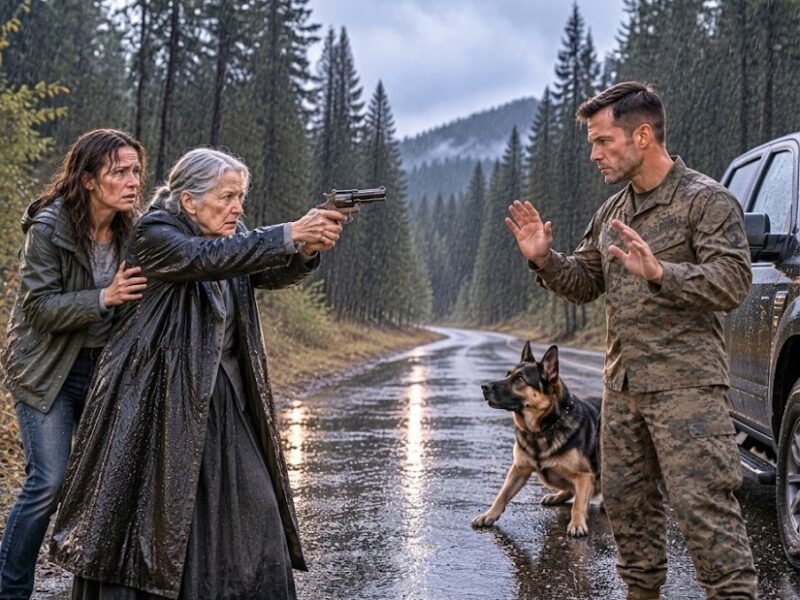
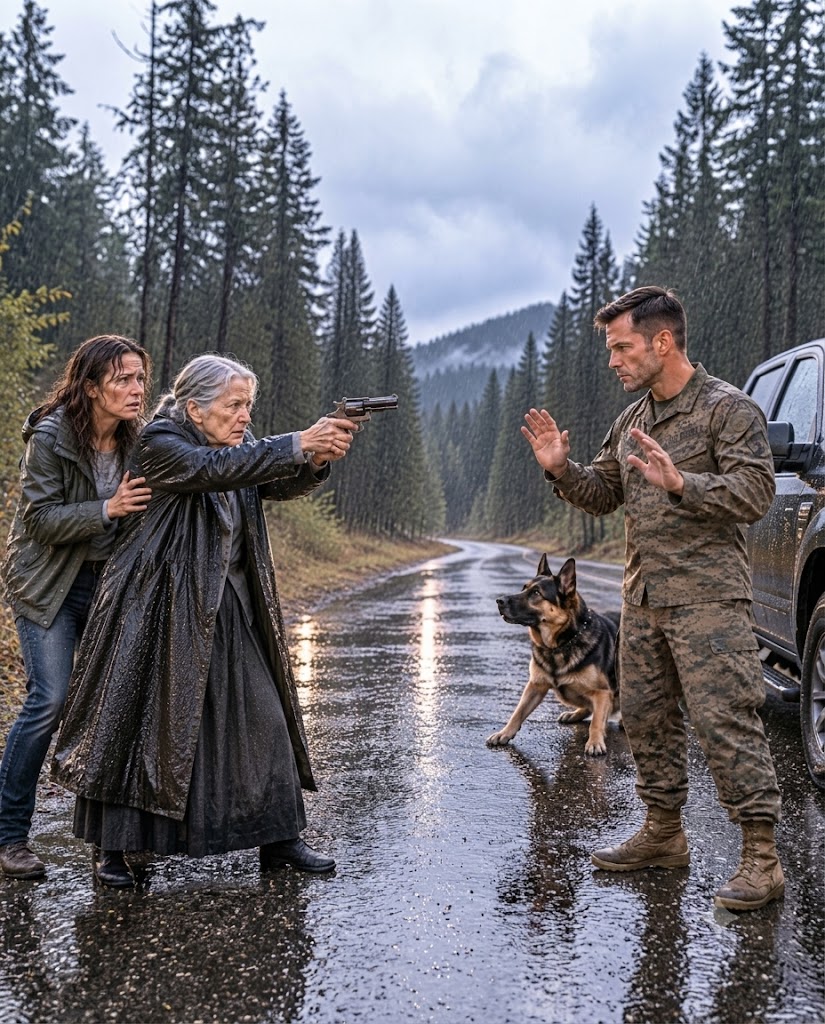
“Stay back.”
Beckett stopped.
The revolver looked enormous in Irene Bellweather’s trembling hand.
She was seventy-three, barely five-foot-three, with a narrow frame that seemed almost weightless beneath a soaked charcoal coat.
Silver hair had been gathered into a low bun, though loose strands now clung to deeply lined cheeks.
Illness had hollowed the flesh beneath her blue-gray eyes.
Yet those eyes were startlingly alert.
She moved in front of Laurel despite barely being able to stand.
The gun shook.
The woman did not.
“Mom,” Laurel whispered. “Please.”
Beckett felt Falk tense beside him.
“Down.”
The German Shepherd lowered immediately.
Beckett slowly raised both empty hands.
“I won’t come any closer.”
Irene’s breathing was shallow and fast.
“You stay right there.”
“Yes, ma’am.”
Laurel tightened her arm around her mother.
“He stopped to help us.”
“You don’t know that.”
Something in the words changed Beckett’s attention.
This wasn’t simply an elderly woman frightened by a stranger on a dark road.
She was expecting someone.
“My name is Beckett Rowe,” he said. “I’m a Marine. That’s Falk. I’m not going to touch you or that weapon, but you’re soaked through and you look like you’re having trouble breathing.”
For a moment, Irene studied his face as though searching for a lie.
Then she asked the question that made the rain seem quieter.
“How do I know they didn’t send you?”
Beckett’s eyes narrowed slightly.
“Who?”
Irene tried to answer.
Her knees folded instead.
“Irene!”
Laurel caught her halfway down, and Beckett moved only when Laurel cried, “Help me!”
The revolver slipped into the mud.
Beckett kicked it safely aside, then helped Laurel lift Irene into the heated cab.
Falk remained on the roadside until Beckett called him.
There was no triumph in the dog’s movements, only watchfulness.
Cell service returned in fragments.
Beckett got through to 911, described Irene’s condition, and followed the dispatcher’s instructions while Laurel rubbed her mother’s freezing hands beneath an emergency blanket.
The Camry’s engine had died after the slide, Laurel explained between frightened breaths.
With no heat and almost no phone signal, she had seen the workshop light and decided they had to walk.
Irene had already been shivering badly.
At the hospital, a physician explained that Irene was suffering from cold exposure, dehydration, and severe exhaustion.
Then came the part Laurel already knew.
Advanced lung cancer.
Beckett stood quietly near the doorway while Laurel sat beside the bed.
He had learned long ago that there were moments when helping meant doing something, and others when it meant refusing to fill the silence.
Later, Laurel found him near the vending machines.
She folded her arms tightly around herself.
“Yesterday morning, she told me to pack clothes and drive.”
“Where?”
“She wouldn’t say. Just away.”
Laurel looked toward her mother’s room.
“She kept checking the mirrors, told me not to use my credit card unless we absolutely had to.”
“Did she tell you who she was afraid of?”
Laurel shook her head.
Beckett remembered the revolver trembling in Irene’s hand.
How do I know they didn’t send you?
Inside the room, Irene stirred.
Laurel hurried back.
Beckett remained at the doorway.
Irene’s eyes opened only halfway.
Her thin fingers searched across the blanket until they found Laurel’s wrist and closed around it with surprising urgency.
“Laurel.”
“I’m here, Mom.”
“Don’t let anyone take the blue case.”
Laurel went still.
“What blue case?”
But Irene’s fingers had already loosened, her eyes closed.
Laurel stared at her mother, then slowly turned toward Beckett.
The confusion on her face was genuine.
“I don’t know what she’s talking about.”
Outside the hospital windows, November rain continued falling over southern Oregon, and somewhere behind them sat a blue case Laurel Bellweather had never known existed.
—
Morning came gray and wet over Medford.
The storm reduced to a steady drizzle that hung between the pines and left the road shining beneath a sky that never seemed to brighten.
By late morning, Irene Bellweather was stable enough to leave the hospital.
She looked smaller in daylight than Beckett remembered from the roadside, wrapped in a borrowed coat with her silver hair restored to its low bun and exhaustion etched beneath her blue-gray eyes.
The physician had emphasized rest, hydration, medication, and follow-up care.
Laurel listened carefully, writing everything down.
Irene listened too, but Beckett noticed that every time footsteps paused outside the room, her eyes went to the door.
The Camry remained at a repair garage.
Its front wheel and suspension had taken enough damage that no one could promise Laurel a quick return to the road.
“I can find you a motel,” Beckett offered.
“No,” Irene answered too quickly.
Laurel closed her eyes briefly.
“Mom, no motel. Not under your name.”
Beckett studied Irene without challenging her.
Twenty-four hours earlier, he might have dismissed the reaction as fear sharpened by illness.
He could no longer do that.
How do I know they didn’t send you?
It was still lodged in his mind.
“I have a guest house,” he said. “Separate from mine. You can stay until the car is sorted out. No obligation beyond that.”
Irene searched his face.
“Why?”
It was a question Beckett had heard in different forms from people who had learned to distrust kindness because kindness usually arrived carrying a price.
“Because it’s empty.”
That answer seemed to satisfy her more than a speech would have.
The guest house stood forty yards from Beckett’s modest cedar-sided home on several wooded acres outside town.
It had one bedroom, a small living room, a kitchenette, and a covered porch facing the pines.
Beckett carried their bags only as far as the doorway until Laurel invited him inside.
He showed her the thermostat and spare linens, placed bottled water on the counter, then left mother and daughter alone.
Falk followed him back toward the main house without needing to be called.
That afternoon, Laurel appeared at Beckett’s door.
“I need to go to the garage. Medicine and clothes, my charger, insurance papers.”
She hesitated.
“And apparently a blue case.”
Twenty minutes later, she sat beside Beckett in the F-150 while Falk occupied the rear seat.
Laurel spent most of the drive staring through the window.
“She wasn’t always like this,” she finally said.
“Afraid?”
“Secretive.”
Laurel rubbed her palms together.
“My mother could keep a Christmas present hidden for six months and still look guilty every time you walked past the closet. Yesterday, she made me drive for hours without telling me why.”
Beckett glanced at her.
“You still drove?”
She asked.
There was an entire relationship in those two words.
At the garage, Laurel retrieved a canvas overnight bag from the Camry’s back seat, then opened the trunk.
Beneath a folded blanket sat a hard-sided blue case no larger than a briefcase.
Her expression changed.
“You’ve never seen it?”
“Never.”
Laurel lifted it out and set it near the bumper.
Falk, waiting beside Beckett, stepped closer.
His nose moved once along the air, then toward one corner of the case.
He sniffed the seam and stopped.
Beckett crouched.
A dark brownish-red stain had dried inside the textured edge.
“Don’t touch that part.”
Laurel’s face drained.
“Is that blood?”
“Could be.”
“You sound like you don’t believe it.”
“I sound like I’m not a laboratory.”
He didn’t open the case.
Across the lot, neither of them noticed Rhett Sutter watching from beside a dark SUV.
At forty-four, Rhett was a thick-necked man of medium height with close-cropped sandy hair, a neatly trimmed beard, and a nose that had healed slightly crooked years earlier.
He dressed without anything memorable—a dark waterproof jacket, work boots, plain jeans—and that anonymity suited him.
Contract security had taught him that the easiest person to follow was the one who never remembered seeing you.
He recognized Laurel from a description and photograph provided during what had been presented to him as a property-related locate request.
When she climbed into Beckett’s truck with the blue case, Rhett photographed the license plate, waited until the F-150 disappeared onto the road, then followed at a distance.
—
Back at the guest house, Irene saw the case in Laurel’s hands and stopped pretending.
“Lock the door.”
Laurel did not move.
“First, you tell me what’s inside.”
Irene lowered herself into a chair.
“Your father’s past.”
Arthur Bellweather, Irene explained, had been a quiet, deliberate man who trusted paper more than promises and had spent much of his working life around timberland transactions.
Before his death, Arthur held an interest connected to roughly 118 acres of forest property.
He had placed that interest into the Bellweather Family Trust.
Irene served as trustee.
Laurel was its beneficiary.
And the trust imposed conditions on major transactions involving the property.
Laurel stared at her.
“Why didn’t I know?”
“Because your father wanted you to choose your life before you learned what anyone might tell you it was worth.”
Then Irene told them about Wesley Talin.
Wesley was fifty-eight, a senior title examiner with a lean build, thinning iron-gray hair, and rectangular glasses that made his already serious face appear almost severe.
He had spent decades examining deeds, liens, and chains of title, and colleagues knew him as the kind of man who would spend an hour resolving a discrepancy others dismissed in five minutes.
Weeks earlier, while reviewing records connected to a proposed development transaction, Wesley found a deed carrying Irene’s signature.
She had never signed it.
The notarization also raised questions, and older trust records suggested the property interest could not have been transferred as simply as the newer paperwork claimed.
Wesley contacted Irene privately.
“He asked me to meet him,” she said. “He said he had copies I needed to see.”
Her voice weakened.
When Irene reached the meeting place, Wesley was on the ground beside his car, blood running from a wound near his temple.
He was conscious only long enough to push the blue case toward her.
“Don’t call the number on the paperwork,” he had whispered. “They know I contacted you.”
“And you just left him?” Laurel asked, horrified.
“I called 911 from his phone and left it beside him. I heard the dispatcher answer before I went.”
Irene’s eyes filled.
“Then I came home and got you.”
Laurel’s anger faltered.
“My name was in there.”
Irene nodded.
“That was enough for me.”
No one opened the case that evening.
Beckett returned to his house after dark, troubled less by what Irene had told him than by what remained unknown.
Falk settled near the back door.
At 2:17 a.m., Beckett woke.
Falk stood beside the bed.
No barking, no whining.
His ears were forward, body rigid, eyes fixed toward the eastern side of the property.
Beckett pulled on boots and followed him outside.
The rain had stopped.
Falk led him toward the fence, nose low, but never rushing.
Beckett switched on his flashlight.
Fresh bootprints pressed into the mud.
They approached the fence from the tree line, stopped, then turned back.
Beckett followed their direction with his eyes.
From that exact spot, through a break in the trees, he could see one illuminated window of the guest house.
Irene and Laurel were sleeping behind it.
Beckett looked down at Falk.
Whoever had come here had not tried to enter, had not touched the house, had not taken anything.
They had only needed to know where the women were.
And now they knew.
—
Dawn arrived clear and brittle after the rain, leaving the pines dripping and the eastern fence surrounded by dark mud that held every footprint from the night before.
Beckett did not cross the fence.
He photographed the impressions from several angles, marked the area so no one from the guest house would accidentally walk through it, then called the Jackson County Sheriff’s Office.
Years in the Marine Corps had taught him that discipline was often less about knowing what to do than knowing what was not yours to do.
Whoever had stood outside his property had left evidence.
Chasing that person through the woods would satisfy instinct and destroy everything useful.
Deputy Celia Ward arrived shortly after 8:30.
She stood about five-foot-seven, with an athletic build, warm brown skin, dark hair pulled into a practical knot, and observant hazel eyes that seemed to settle on details before people realized she had noticed them.
She spoke quietly and rarely interrupted.
Ten years in patrol had taught her that frightened people often revealed more when silence was allowed to remain in the room.
She photographed the prints, documented their position, and listened while Beckett described Falk waking him at 2:17 a.m.
Inside the guest house, Irene immediately began packing.
“We’re leaving.”
Laurel stared at her.
“For where?”
“I’ll figure it out.”
“You didn’t figure it out the first time.”
The words landed harder than Laurel intended.
Irene turned away.
Beckett remained near the doorway.
“Mrs. Bellweather, whoever came last night already found you.”
“Which is exactly why we leave.”
“And then what?”
Irene looked at him sharply.
Beckett kept his voice even.
“You have advanced cancer. Laurel has been driving you until she’s exhausted. Your car isn’t roadworthy. If someone found this place after one afternoon, another highway isn’t going to make you safer.”
“I protected my daughter for thirty-five years.”
“I know.”
“No, Marine, you don’t.”
Beckett glanced at Laurel before answering.
“Maybe not. But running worked when they didn’t know where you were. Now they do.”
Irene’s fingers remained wrapped around the zipper of her bag.
Then slowly she let go.
“All right.”
It was not surrender.
Beckett understood that it was something harder for Irene Bellweather—accepting that protection might require trusting people she could not control.
With Celia present and both women agreeing, the blue case was opened on the kitchen table.
There were no stacks of cash, no weapons, no photographs of secret meetings.
Inside were ordinary things capable of causing extraordinary damage.
Copied deeds, title reports, old correspondence, trust documents, handwritten notes, and a USB drive sealed in a small evidence sleeve Wesley had labeled with a date and initials.
Laurel sat opposite her mother as Celia photographed the contents without rearranging them unnecessarily.
Irene unfolded a copy of the Bellweather Family Trust.
“Your father created this before he got sick.”
Laurel’s eyes moved across the pages.
“You said Dad left you his property interests.”
“He left them in trust. I managed them as trustee.”
“And me?”
“You’re the beneficiary.”
Laurel looked up.
Irene explained that Arthur’s interest was tied to approximately 118 acres of forest property, but the arrangement was neither a buried fortune nor a simple deed Laurel could cash in.
The trust contained conditions governing major transfers.
The newer paperwork discovered appeared to show Irene approving a transfer that she insisted had never happened.
“My signature is on that deed,” Irene said. “But I didn’t put it there.”
Laurel pushed her chair back slightly.
“How long have you known about the trust?”
Irene did not answer quickly enough.
Laurel understood.
“All these years.”
“Your father wanted you to make your own life.”
“My own life based on a lie?”
“No.”
“What would you call it?”
Irene’s composure finally cracked.
“A chance.”
Laurel went silent.
“Your father watched families tear themselves apart over land,” Irene continued. “Brothers who stopped speaking. Children who waited for parents to die because they had already decided what belonged to them. Arthur didn’t want you measuring every choice against acreage or money.”
“He’s been dead for years. Mom, you could have told me.”
“Yes.”
The simple admission took some of the anger out of Laurel.
“Did you think I couldn’t handle the truth?”
Irene shook her head.
“I thought you shouldn’t have to spend your life fighting for something you never asked for.”
Her voice trembled.
“And then Wesley told me your name was in those papers. After I found him bleeding beside his car, I stopped caring about the land. I stopped caring about the trust. All I could think was that someone who hurt him might decide you were the next problem.”
Laurel’s eyes filled, but she did not look away.
For the first time, Beckett understood the revolver on the rain-dark road.
Irene had not been guarding an inheritance.
She had been standing between danger and the only person she could not bear to lose.
Later that morning, Celia stepped outside to make several calls.
She returned twenty minutes later with news.
“Wesley Talin is alive.”
Irene gripped the table.
“He’s alive.”
“He was admitted after a reported assault. He was able to give an initial statement. He says he was attacked after copying documents connected to a title review.”
Irene covered her mouth.
Laurel reached across the table and took her hand.
The gesture was small, but Beckett noticed Irene’s shoulders finally drop.
By early afternoon, another vehicle entered the driveway.
Naomi Lark, forty-six, stepped out carrying a weathered leather briefcase.
She was tall and lean with straight black hair cut just above her shoulders, olive-toned skin, and dark eyes behind thin-framed glasses.
A property and trust attorney with nearly two decades of experience, Naomi had the deliberate manner of someone who distrusted dramatic conclusions.
She had built much of her career untangling family property disputes where memory, grief, and paperwork rarely agreed.
She introduced herself, listened first, then examined copies rather than making promises.
“I need everyone to understand something,” Naomi said. “These documents may be important. That does not make every conclusion about them true.”
Laurel nodded.
“So what do you do?”
“I verify everything independently. Trust records, recorded deeds, notary information, chain of title, the files on that drive. We don’t prove a document with another document from the same case.”
Beckett liked her immediately, not because she offered reassurance, but because she didn’t.
By evening, the guest house felt different.
Irene had stopped packing.
Laurel remained angry, but the anger no longer pushed her toward the door.
Celia had an official report.
Naomi had begun the slow work of verification.
Wesley was alive.
Beckett walked back toward his house with Falk beside him and stopped halfway across the yard.
His eyes moved toward the eastern fence.
The man who had stood there could have crossed it.
He could have broken a window.
He could have tried to take the blue case.
He had done none of those things.
Falk looked up at Beckett.
“Yeah,” Beckett murmured.
Whoever was behind this already knew where Irene was.
Yet they had chosen observation over force.
That did not make Beckett feel safer.
It told him something worse.
They still believed there was another way to make Irene Bellweather give them what they wanted.
—
Three days later, pale sunlight returned to the hills outside Medford, but the Bellweather case had only grown darker as Naomi Lark began comparing Wesley Talin’s copies against records that existed beyond the blue case.
By Thursday morning, Naomi had confirmed enough to be concerned and not enough to make reckless accusations.
The Bellweather Family Trust existed exactly where it should.
Older recorded documents supported Irene’s position as trustee and Laurel’s interest as beneficiary.
More troubling was the disputed deed.
Its dates and notarization raised questions that required formal examination, and the signature attributed to Irene appeared on a transfer she continued to insist she had never authorized.
Naomi refused to call it fraud.
Yet she called it what she could prove—a serious title problem.
Shortly before eleven, Falk rose from his spot beside Beckett’s porch chair and watched a black luxury SUV turn into the driveway.
Beckett stood.
The vehicle stopped well short of the guest house.
Two men emerged.
Dorian Kessich was fifty, tall and narrow-waisted with carefully combed dark hair beginning to silver above his ears, pale gray eyes, and a clean-shaven face that seemed designed never to reveal more emotion than he intended.
His charcoal overcoat was expensive without displaying a label.
His shoes were too polished for Beckett’s gravel driveway.
Dorian had spent more than two decades moving through development deals where patience, leverage, and the appearance of reasonableness often accomplished more than threats.
He carried a slim leather folder beneath one arm.
The second man was Graham Voss, fifty-three, corporate counsel for the development company.
Voss was shorter and heavier through the chest with thinning blonde-gray hair, rimless glasses, and a carefully trimmed mustache.
His expression carried the permanent restraint of an attorney accustomed to stopping clients one sentence before they created problems.
Naomi was already at the guest house reviewing documents with Irene and Laurel.
Deputy Celia Ward had arrived earlier to update them on the investigation.
That coincidence saved Beckett from deciding whether Dorian should be allowed inside.
Naomi met the men on the porch.
“This is not an informal conversation,” she said.
Dorian offered a courteous smile.
“I wouldn’t expect it to be.”
They sat around the small kitchen table.
Falk remained with Beckett near the doorway, relaxed but attentive.
Irene looked tired, her shoulders narrow beneath a blue cardigan, but she did not shrink when Dorian faced her.
Dorian opened his folder.
“What we’re dealing with appears to be a title misunderstanding that has grown unnecessarily adversarial.”
Naomi said nothing.
Dorian continued.
“The development company has assembled interests in several adjoining parcels. The Bellweather interest is one piece of a larger transaction involving investors, permits, and contractual deadlines. If ownership of that interest becomes uncertain, the consequences would spread beyond one family.”
“So your deadline is my mother’s problem,” Laurel said.
“No,” Dorian replied. “Which is why we’re offering to remove the burden from both of you.”
The proposal was substantial.
The company would contribute toward Irene’s medical expenses and pay Laurel a significant settlement in exchange for resolving the disputed interest, executing the necessary releases, and signing a confidentiality agreement.
Irene barely looked at the numbers.
“You’re offering me money to agree that I signed something I didn’t sign.”
“I’m offering a resolution that does not require anyone to spend years proving what they remember.”
Naomi’s eyes sharpened.
Dorian knew exactly how to make pressure sound like mercy.
Then his attention moved toward Beckett.
“I do have one concern.”
Beckett waited.
“Mrs. Bellweather is seriously ill. Her daughter is under extraordinary stress. Yet they’re currently staying on private property belonging to an active-duty Marine they met only days ago, while disputed documents potentially worth a great deal of money are also here.”
Laurel stared at him.
“What exactly are you suggesting?”
“Nothing. I’m asking whether this environment is as neutral as everyone assumes.”
Beckett felt the intended insult and let it pass through him.
“You should direct that question to their attorney.”
Dorian studied him.
“You don’t find your involvement unusual.”
“I found two people in cold rain. Everything after that has been their decision.”
“You’re remarkably detached for a man who inserted himself into the situation.”
“I didn’t insert myself into their legal decisions.”
The room remained quiet.
Dorian had expected anger.
Beckett could see that now.
He wasn’t going to give it to him.
Naomi closed the settlement folder.
“Any future proposal comes through me in writing.”
Dorian nodded as though the meeting had gone exactly as planned.
He turned toward Laurel.
“I understand why your mother is frightened. Seeing what happened to Mr. Talin would unsettle anyone.”
Irene’s fingers tightened around her cup.
Dorian continued almost gently.
“She must have been terrified when Talin handed her that blue case.”
Silence.
Not dramatic silence—the colder kind, when everyone in a room realizes the same thing at once.
Beckett looked at Laurel.
Laurel’s eyes moved to Celia.
Celia leaned forward.
“How did you know the case was blue?”
For the first time, Dorian’s expression changed—only for a heartbeat, but Beckett saw it.
Graham Voss saw it, too.
The attorney stood immediately and gathered the folder.
“We’re done here.”
Dorian recovered his composure.
“I may have heard it from someone involved.”
“Who?” Celia asked.
Voss answered for him.
“Any further questions can come through counsel.”
No one blocked their departure.
No one shouted after them.
And no one pretended Dorian’s mistake proved who had attacked Wesley.
But it gave Celia something she had not possessed ten minutes earlier.
A question Dorian could not comfortably answer.
—
The next developments came through methodical police work rather than revelation.
Investigators obtained footage from businesses near the garage.
One camera captured Rhett Sutter’s dark SUV leaving shortly after Beckett’s F-150.
Another camera farther along the route placed the same vehicle on the road leading toward Beckett’s property.
When Wesley’s condition improved enough for a more detailed interview, he identified Rhett as the man who had confronted him before the assault.
Wesley could not honestly say whether Dorian had ordered anything, and Celia refused to fill that gap with assumption.
Records and communications connected to Rhett’s contract work and the company’s acquisitions operation were pursued through proper legal process.
Meanwhile, Naomi’s verification continued.
The files on Wesley’s USB carried metadata consistent with the period when he said he had copied them.
Independent records confirmed the trust’s existence and historical terms.
The disputed deed and its notarization were flagged for closer examination.
Each piece was incomplete alone.
Together, they were becoming harder to dismiss.
Within days, attorneys obtained temporary relief preventing the disputed Bellweather interest from being transferred while the title dispute and related investigation moved forward.
There was no dramatic arrest, no handcuffs on Dorian, no victory speech.
Only a legal order that said, for now, no one could quietly move the property while the questions remained unanswered.
That evening, Beckett stopped at the guest house with groceries.
Irene was asleep in the bedroom.
Laurel stood in the kitchenette washing a cup.
Something looked different.
Beckett realized what it was.
The revolver was not on the counter.
“Where is it?” he asked.
Laurel understood.
“Mom asked me to lock it away.”
Beckett glanced toward the bedroom and the back door.
Laurel smiled faintly.
“She checked it once.”
Through the doorway, Beckett could see Irene sleeping beneath a quilt, one thin hand resting open on the blanket.
For days, she had slept like someone expecting footsteps.
Tonight, there was no weapon beside her, no packed bag by the door, no shoes waiting beneath the bed.
The investigation was not over.
Dorian Kessich had not been proven guilty of ordering an assault, and the Bellweather property dispute remained unresolved.
But Irene had finally understood something Beckett could not have convinced her of with words.
She did not have to outrun every danger herself.
For the first time since Wesley Talin pushed a blue case into her hands, Irene Bellweather slept without preparing to flee.
—
Winter settled quietly over the hills outside Medford, bringing pale mornings, bare branches, and long afternoons when weak sunlight rested on the guest house porch without ever quite warming it.
The following weeks produced no miraculous victory.
Naomi Lark explained that questions of civil liability, forged documents, and criminal responsibility would move at the speed of evidence, not grief.
Dorian Kessich did not vanish overnight, and Laurel Bellweather did not wake one morning transformed into a wealthy landowner.
What mattered was smaller and more real.
Transactions involving the disputed Bellweather interest remained paused while its validity was examined, and for the first time, Laurel had a voice in decisions about the family property instead of learning about them after someone else had already made them.
Irene had less time.
Her cancer progressed quickly enough that another hospital stay would offer more burden than benefit.
After conversations with Laurel and her medical team, Irene chose hospice care.
The decision devastated Laurel precisely because there was nothing dramatic to fight—no enemy to confront, no document to correct, no road left to outrun.
So the blue case disappeared into Naomi’s work, and life became small.
Laurel made coffee every morning.
Beckett sometimes arrived carrying dinner in containers he pretended were leftovers.
Irene sat beside the window beneath a knitted blanket and watched Falk stretch across a patch of winter sunlight.
Some afternoons, Beckett and Laurel occupied opposite ends of the porch for ten minutes without speaking.
Neither seemed uncomfortable with the silence.
Irene noticed.
She noticed other things, too.
Beckett always arrived with a reason—a loose hinge, groceries, a question about the heater, something from Naomi.
He almost never came simply because he wanted to.
One afternoon, Irene found him standing on the porch while Falk slept near the steps.
The German Shepherd’s muzzle had begun showing faint gray, and when he rose, his hindquarters needed an extra second to follow the rest of him.
Yet Falk seemed utterly unconcerned by what he could no longer do.
He had once lived according to commands, schedules, and work.
Now his most important decision that afternoon appeared to be whether the sunlight was better beside the railing or near Beckett’s boots.
“You’re jealous of him,” Irene said.
Beckett glanced down.
“Of Falk?”
“He retired first.”
A faint smile touched his face.
Irene studied him.
“How long have you been a Marine?”
“Most of my adult life.”
“And after?”
Beckett looked toward the trees.
He had never married.
There was no dead wife waiting inside his past, no lost child explaining why his house was quiet.
His solitude had accumulated without tragedy.
The Marine Corps had simply occupied the years—units, orders, deployments, training cycles, responsibility.
There had always been somewhere he was required to be and someone counting on him to arrive.
“I haven’t figured that part out,” he admitted.
Irene nodded toward Falk.
“He seems to have.”
The shepherd sighed and rested his head on his paws.
Irene smiled.
Then she looked back at Beckett.
“You know how to be needed, Marine. I’m not sure you know how to be wanted.”
Beckett said nothing.
For once, Irene did not rescue him from the silence.
Days later, she became too weak to sit on the porch.
Laurel moved a chair beside her hospice bed and spent hours there.
Beckett visited without inventing repairs anymore.
Sometimes he brought Falk, and Irene would lower one thin hand to the shepherd’s head.
One evening, she asked Beckett to stay after Laurel went to make tea.
Her breathing had become shallow.
“I need you to promise me something.”
Beckett’s expression tightened.
Irene saw it and almost laughed.
“Not what you think.”
He waited.
“Don’t protect her from living.”
Beckett looked toward the kitchen.
“She doesn’t need my permission.”
“Good answer.”
Irene closed her eyes briefly.
“Keep it.”
Later that night, she spoke privately with Laurel.
“When this is over, don’t choose your next life because you’re afraid of losing it.”
Laurel bent over her mother’s hand.
“I don’t know how to do this without you.”
“Yes, you do.”
“I don’t.”
Irene opened her eyes.
“You drove through the rain when I asked. You stood beside me when you were angry. You stayed when running would have been easier.”
Her thumb moved weakly against Laurel’s fingers.
“You’ve been doing it already.”
Irene Bellweather died peacefully two mornings later with Laurel beside her.
There was no final revelation, no secret name whispered at the last second, only a daughter holding her mother’s hand as the room became impossibly still.
After the funeral, Beckett returned to duty on schedule.
Laurel did not ask him to stay.
He did not offer.
The afternoon before leaving, Beckett carried his travel bag to the F-150 and opened the rear door.
“Falk.”
The German Shepherd was lying beside Laurel on the porch.
One ear moved.
“Falk.”
Nothing.
Laurel looked down at him.
“I think you’ve lost command authority.”
Beckett checked his watch.
For the first time in days, Laurel laughed.
Beckett closed the truck door.
“Five minutes.”
He walked back onto the porch.
Laurel poured another cup of coffee.
Five minutes became twelve.
Then Beckett stood, called Falk again, and this time the shepherd followed.
Beckett went back to duty because his life had not stopped simply because another part of it had begun to matter.
—
Several weeks passed.
On a quiet day off, Laurel heard tires on the gravel.
She stepped onto the porch.
The dark gray F-150 came slowly up the driveway.
There were no footprints waiting beside the fence.
No blue case on the table.
No ambulance.
No deputy’s cruiser.
No one was hiding.
No one was running.
Beckett parked and climbed out.
Laurel folded her arms against the cold.
“Something wrong?”
“No.”
“Then why are you here?”
The rear door opened.
Falk jumped down, paused long enough to look at Beckett, then trotted toward the porch as though the destination had never been in question.
Beckett watched him settle beside Laurel’s feet.
Then he looked at her.
“Coffee.”
For a second, Laurel simply stared at him.
Then she smiled and opened the door.
Beckett followed her inside.
The first time he had found Laurel Bellweather, he had stopped because somebody needed saving.
This time there was no emergency, no mission.
Nobody needed him at all.
And that was precisely why coming back finally meant something.
He had chosen it.
—
Sometimes God’s miracles do not arrive with thunder, open heavens, or answers we can immediately understand.
Sometimes the miracle is a stranger who stops on a rainy road.
A dog who senses that someone needs help.
A mother who finally learns she does not have to carry every fear alone.
Or a man who discovers that life is not only about being needed but about choosing where his heart belongs.
Irene could not choose how much time she had left, but she could choose how she spent it.
Laurel could not keep her mother forever, but she could carry her love forward without allowing fear to choose her future.
And Beckett learned that perhaps God does not close one chapter of our lives to leave us empty.
Sometimes He makes room for something we never knew we needed.
Maybe someone watching tonight is carrying a burden no one else can see.
Keep faith.
The answer may not come in the way you expect, but God can place hope in the smallest moments and the most unexpected people.
If this story touched your heart, share it with someone who may need that reminder today.
Tell us in the comments where you’re watching from and what this story meant to you.
And if you believe stories of faith, loyalty, kindness, and second chances still matter, please subscribe and join us for the next one.
May God bless you, protect your family, bring peace to your home, and give you strength for whatever road lies ahead.









