A Maine Teen’s 1980 Cold Case Was Finally Solved—The Arrest Shocked the Entire Community
**Part 1**
The evening of August 8, 1980, came down hot and slow over East Millinocket, Maine, the kind of heat that sat on the paper mill like a wet blanket and made the whole town move a little slower.
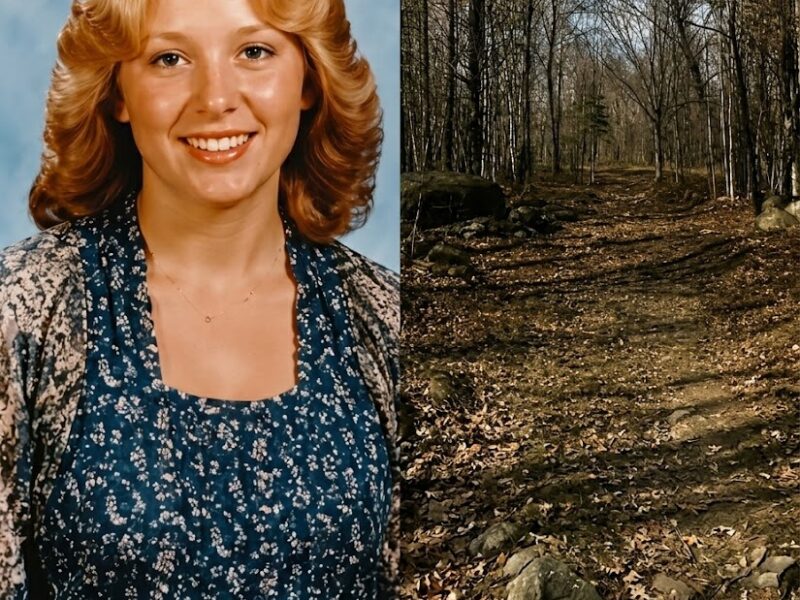
Joyce Marie McLain was sixteen years old, a junior-to-be at Schenck High School, and she had spent the day swimming at the lake with friends.
She came home, ate dinner with her mother and her younger sister, and watched the light start to go gold outside the kitchen window.
Around 7:30 p.m., she laced up her sneakers, pulled on a pink jogging outfit, and told her mother she was going for a run.
“See you later, Mom.”
Those were the last words Pam McLain ever heard her daughter say.
Joyce turned, crossed the street in front of the house, and headed toward the same route she always ran—through the neighborhood, past the athletic fields, behind Schenck High School, into the clearing beneath the power lines.
She had taken that path dozens of times before.
By 9:00 p.m., she was not home.
By 10:00, Pam was on the phone, calling every friend Joyce had, every parent she knew, every number she could think of.
Nobody had seen her.
Nobody had heard from her since she left the house.
The town turned out within hours. Family, friends, neighbors—they searched through the night, calling Joyce’s name into the dark, their flashlights cutting thin white lines through the trees behind the school.
No answer came back.
The police were notified. An official search was organized. But no one knew yet that the thunderstorm that had rolled through East Millinocket on the night of August 8th had already done its damage.
Heavy rain washed through the clearing and the woods surrounding the school. It destroyed nearly every piece of recoverable physical evidence at the scene.
No fingerprints. No usable DNA. No footprints.
Whatever had been left behind in that clearing was gone before anyone knew to look for it.
On the morning of August 10th, 1980, a volunteer named Peter Larley was moving through the tree line behind the school’s football field when he stopped.
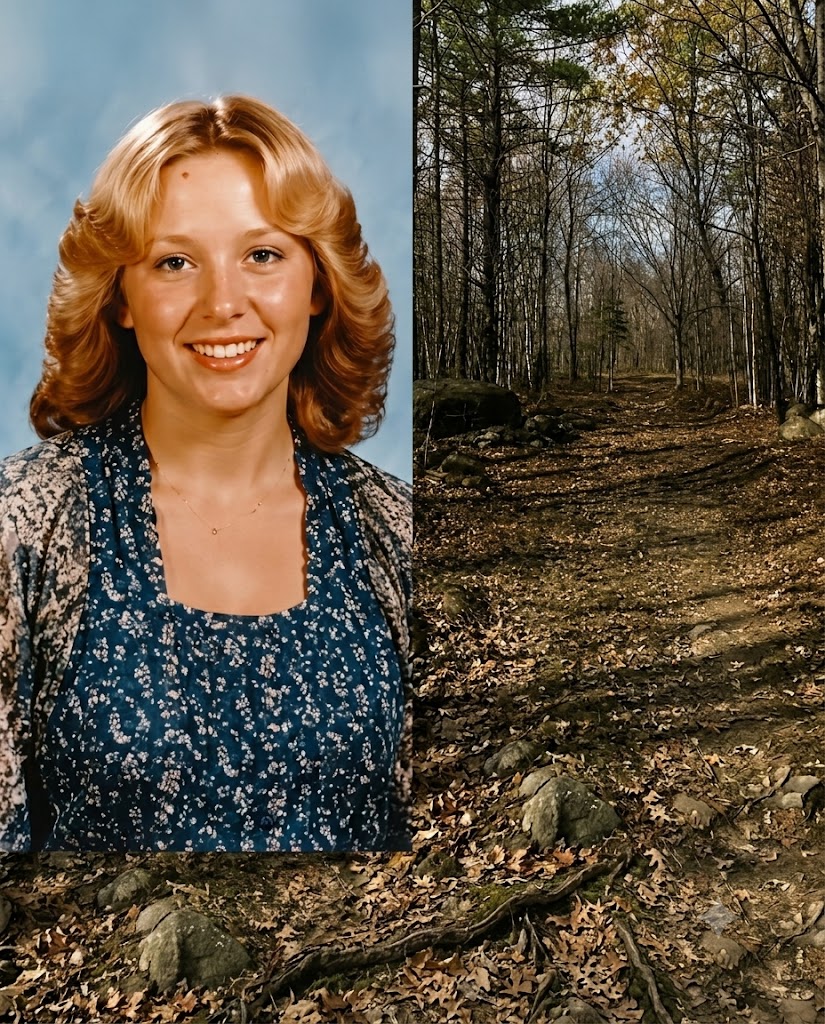
Joyce was in a clearing beneath the power lines, lying face down, roughly two hundred feet from the football field.
Her hands were tied behind her back with a strip of blue fabric.
She was wearing only socks and sneakers. Her pink jogging outfit had been removed and found in pieces, stuffed into the cracks of a nearby stone wall.
The back of her skull had been caved in by repeated blows from a heavy object.
The weapon was still at the scene—a porcelain insulator from the power lines overhead, broken at the edges, the fractures matching the wounds exactly.
He had not brought it with him. He had picked it up off the ground a few steps away and used what was already there.
The medical examiner determined the cause of death was blunt force trauma to the back of the skull. Multiple blows, not one, delivered with enough force to shatter bone.
A large porcelain insulator and a rock were recovered near the body.
No evidence of sexual assault was found.
That finding would seem minor at the time. It would not stay minor.
The scene gave investigators almost nothing to work with. The storm had erased fingerprints, washed away blood evidence outside the body, and destroyed any footprints that might have been left in the soil.
There was no DNA to recover. The weapon could not be traced to a specific person. What the killer had used, he had found on the ground.
What the rain had not destroyed, time and exposure had degraded beyond use.
The Maine State Police took over the investigation and began with a picture that would discourage any detective from the start.
No witnesses had seen the attack. No one had heard anything. And the area behind Schenck High School on the night of August 8th had not been empty.
A softball game was being played nearby. Local teenagers were gathering to drink on the school grounds. The town’s paper mill had recently brought in three hundred construction workers from outside the area—men no one in East Millinocket knew well.
The list of people who could have been in those woods that night was enormous. The physical evidence pointing to any one of them was nearly nonexistent.
Investigators started where they had to.
Peter Larley, the man who found Joyce’s body, was questioned first. The person who discovers the body is always the first suspect.
His alibi was solid. There was no connection to Joyce and no motive. He was cleared.
Then they turned to the three hundred mill workers. Dozens were interviewed, alibis checked, backgrounds run. Nothing connected any of them to Joyce or to the school grounds that night.
Without a direction to follow, the line of inquiry was gradually set aside. Not because anyone’s innocence was proven, but because there was nowhere left to go with it.
The case had started at a dead end. Every road out of it led back to the same place.
Then, during witness interviews, one name kept coming back.
Philip Scott Fournier.
He was nineteen. Multiple people had seen him hanging around the athletic fields at Schenck High School in the weeks before Joyce’s death.
His stepfather later testified that on the day Joyce disappeared, Fournier had mentioned out of the blue that he wanted to quit smoking and take up jogging.
Joyce was known to run past his house on her regular route.
On the night of August 8th, several witnesses placed Fournier near the school grounds drinking whiskey with a group of friends.
Two witnesses told investigators they had seen him running from the area where Joyce’s body would later be found.
When detectives brought him in, Fournier told them he had left the group alone that night, wandered into the woods while drunk, and tripped over a woman’s body on the ground.
He said she was already dead. He said he had not killed her.
He had not called for help. He had not reported it. He had gone home and told no one.
That same night, hours after Joyce was last seen alive, Fournier broke into a local garage, stole a fuel truck, and drove it while heavily intoxicated into another vehicle less than a mile away.
He fractured his skull. He was hospitalized and spent more than a week in a coma.
He later told investigators the crash had been intentional. He had been trying to kill himself.
Investigators noted all of it. The statement about stumbling over a body. The witnesses who placed him running from the area. The stolen truck. The attempted suicide.
None of it was enough.
There was no physical evidence connecting Fournier to Joyce or to the clearing beneath the power lines. The storm had seen to that.
The investigation continued through the rest of 1980 and into 1981. Detectives interviewed more than two dozen people connected to Fournier. They checked his alibi from every angle. They ran every name that surfaced through the file.
The work was thorough. It produced nothing that could support an arrest.
By the spring of 1981, the case had no official suspect. The file was growing. The answers were not.
Then, in May of 1981—nine months after Joyce was killed—Pastor Vanal Thomas at Calvary Temple received a visit from Fournier.
What Fournier told him in that room left the pastor shaken.
Fournier confessed. He said he had killed Joyce McLain.
Thomas told Fournier he did not believe him. He told Fournier that if what he was saying was true, he needed to say it to his parents.
Fournier agreed.
Thomas called Anita and Wayne Powers, Fournier’s mother and stepfather, and brought them to the church.
Fournier broke down in front of both of them.
Wayne Powers, who later took the stand at trial, testified he had never seen Fournier cry before that moment.
Fournier told his mother he had killed Joyce McLain. He said he had not meant to do it.
“I didn’t mean to.”
Anita hugged her son. She asked if she could go with him to the police.
The pastor told her it was a small town and word would get out fast. He was worried someone would hurt Fournier.
She stayed behind and called her sister. She did not know if her son was coming back.
The next morning, Thomas drove Fournier to the state police barracks in Bangor.
Fournier sat across from investigators and told them he had hit Joyce McLain with an insulator—the same type of object recovered from the crime scene.
He also told them he had tried to assault her before killing her.
That single claim did not match the forensic record. The medical examiner had found no evidence of sexual assault.
The inconsistency was enough.
Investigators decided not to arrest him.
Thomas drove Fournier back home. He went back to his life in East Millinocket. He was twenty years old.
The man who had confessed to murder, who had described the weapon, who had been driven to a police station by his own pastor, walked out and went home.
The file stayed open. No charges were filed. No explanation for the decision was ever made public.
Pam McLain did not know about the confession. Nobody in the community did.
She only knew that her daughter had been murdered behind her own school and that no one had been arrested.
She kept calling the state police. She kept asking for updates. The answer was always the same.
Joyce’s saxophone sat in the house. The birthday party at the beach had never happened. The college applications would never be filled out.
Wendy was growing up in a house where her older sister’s absence filled every room.
Pam carried it the way she would carry it for the next thirty-six years. Not loudly. Not publicly. Not yet.
Just by refusing to stop.
**Part 2**
1981 became 1985. The case was five years old with no arrest.
Pam founded the Justice for Joyce committee, built from donations collected door-to-door from her neighbors. She raised money. She hired private investigators. She put Joyce’s name in the local papers every chance she had.
Every August 8th, she lit candles. The community held memorial services.
Joyce McLain did not disappear from East Millinocket the way cold cases disappear from larger cities. Pam would not allow it.
In 1989, the case reached national television. NBC’s *Unsolved Mysteries* featured Joyce’s story. Robert Stack narrated it to millions of viewers.
The hotline received forty-nine tips. Investigators followed everyone. None produced a lead.
That same year, in a building one hundred and fifty miles south of East Millinocket, Fournier started a janitorial job at Husson College.
A coworker named John D. Ro asked where he was from. Fournier said the Millinocket area.
Ro asked if he knew anything about the Joyce McLain case.
Three minutes into their first conversation, Fournier told Ro he had killed Joyce McLain and that he had beaten every police interrogation.
A casual exchange between two janitors on a normal workday. No pressure. No breakdown. No pastor sitting beside him.
Fournier said it the way a person says something they have been carrying so long it no longer weighs anything.
Three confessions. A pastor. A mother. A coworker. Three different people, three different years, none of them connected.
And Philip Scott Fournier still lived in the same town where Joyce’s family bought groceries and drove past the school and lit candles every August.
The detectives who had worked the original investigation retired or transferred out. New officers inherited the file, read through the stacks of reports, and hit the same wall.
There was no physical evidence. The confessions had been rejected or had never reached the right desk.
There was nothing to build a case on and no new tool to build one with.
1990 became 2000. East Millinocket’s paper mill, the economic engine of the entire town, started to decline. The community shrank. Families moved away.
The school where Joyce had played saxophone still stood at the end of the block.
Fournier was still in the area. He had been interviewed more than twenty times by that point.
His story changed with every sitting—confessing in one interview, recanting in the next, implicating other people in a third, denying everything in a fourth.
The file recorded every version. None of them led to an arrest.
Pam aged. Wendy grew up. The candles were lit every year.
In 2008, twenty-eight years after the murder, Pam McLain did something that required more than persistence. It required nerve.
She had Joyce’s body exhumed.
The Justice for Joyce committee raised twenty thousand dollars to hire independent forensic experts for a second examination.
When the state police resisted reopening the case, Pam did not stop. She put the results in front of them and forced the conversation.
The re-examination produced new information about the cause of death—enough to make the state police pick up the file again.
For the first time in years, someone was reading it with fresh eyes and a mandate to act.
In 2009, Fournier appeared in federal court on an unrelated charge involving child exploitation material.
When Judge John Woodcock handed down the sentence, he did something no law enforcement official had done publicly in twenty-nine years.
He named Philip Scott Fournier on the record as a person of interest in the 1980 murder of Joyce McLain.
The press reported it immediately. East Millinocket heard his name connected to Joyce’s death for the first time in an official public setting.
Pam kept pushing.
She requested FBI intervention in 2010. She contacted the producers of *Cold Justice* in 2013. Neither effort produced direct involvement.
The case remained with the state police, but every door Pam knocked on made it harder for the system to sit still.
Every candle she lit, every press conference she stood at, every dollar she raised from her neighbors—all of it was pressure that accumulated year after year until the weight of it could no longer be ignored.
The file was assigned to Sergeant Darryl Piri.
Piri started at page one and read forward. Pages of interviews, forensic reports, dead ends, and conflicting statements accumulated over thirty years.
He was not looking for new evidence. The storm had taken that in 1980. He was looking for what had been overlooked.
Piri and his team went back to every living witness using modern interrogation techniques—methods developed over decades of research into how memory works over time.
They re-interviewed people who had been questioned in 1980 and found that some of them could now describe details more clearly than they had thirty years earlier.
The timeline tightened. The picture sharpened.
Every alternate suspect was re-examined and eliminated. Peter Larley cleared again. Joe Albert, who had killed another woman in Maine in 1983, was ruled out with independently verified alibis.
The mill workers—still no evidence connecting any of them.
One by one, the other names fell away.
Then Piri tracked down John D. Ro, the Husson College coworker. Ro confirmed everything under official conditions. Fournier had told him in 1989 that he had killed Joyce McLain and outsmarted the police.
Piri laid the full chain across the table.
The confession to the pastor in 1981. The confession to his parents at the church. The trip to the Bangor barracks where Fournier described the weapon. The confession to Ro in 1989.
The twenty-six interviews in which Fournier’s story shifted and contradicted itself over and over.
The witnesses who placed him near the school that night. The truck theft hours later. The attempted suicide.
And then, deep in the file, Piri found the detail that had been sitting there for decades.
In one of his many statements to police, Fournier had described an injury to the left side of Joyce’s face.
When Joyce’s body was found on August 10th, 1980, she was lying face down. Her head was turned slightly, but the left side of her face was pressed against the ground, completely hidden from view.
Peter Larley, the volunteer who discovered her, could not have seen it.
The first responders who secured the scene documented the position exactly as it was.
The injury to the left side of Joyce’s face was never made public.
It did not appear in any newspaper article, any television broadcast, any community briefing, or any conversation outside the investigation.
It was a detail known only to the people who examined her body and to the person who had been standing over her in those woods.
In one of his twenty-six interviews with police, Philip Scott Fournier described that injury.
He mentioned the left side of her face specifically.
He could not have read it anywhere. He could not have heard it from anyone.
The only way he could have known what the left side of Joyce McLain’s face looked like on the night of August 8th, 1980, was if he had been there before she was face down on the ground.
That detail had been sitting in the file for decades. Every detective who had reviewed the case had looked at it.
Piri was the first one to see it for what it was.
**Part 3**
On March 4th, 2016, Philip Scott Fournier was arrested and charged with the murder of Joyce Marie McLain.
He was fifty-five years old.
He had lived in and around East Millinocket for thirty-six years since the night Joyce disappeared. He had been interviewed twenty-six times. His story had changed with nearly every sitting.
He had confessed to a pastor, to his mother, to a coworker. He had described the weapon. He had described an injury no one outside the investigation could have known about.
And for thirty-six years, he had not been charged.
Bail was set at three hundred thousand dollars. Fournier could not post it. He was held at Penobscot County Jail.
Before the trial began, the prosecution offered a plea deal. Fournier rejected it.
The trial opened on January 22nd, 2018, in Bangor.
Fournier had waived his right to a jury. Superior Court Justice Anne Murray would hear the case alone and deliver the verdict herself.
The prosecution was led by Assistant Attorneys General Lean Zana and Leanne Robin, alongside Deputy Attorney General Lisa Marquesi and Sergeant Piri.
The defense was handled by Jeffrey Silverstein.
The prosecution’s case had no DNA, no fingerprints, no physical evidence connecting Fournier to the clearing beneath the power lines.
What it had was a chain of confessions—to a pastor, to parents, to a coworker—spanning nearly a decade, to people who had no connection to each other, in circumstances that could not have been coordinated.
And it had the detail about the left side of Joyce’s face.
Silverstein built his defense on two pillars.
First, the traumatic brain injury Fournier had sustained in the fuel truck crash on the night Joyce disappeared—the skull fracture, the coma, the weeks of hospitalization.
The defense argued that injury had made Fournier’s memory unreliable, that the confessions were the product of a damaged brain, not the truth.
Second, the alternate suspects—Larley, Albert, the mill workers, the names Fournier himself had offered in various interviews over the years.
Silverstein told the court plainly: thirty-five years of investigation, and there was nothing connecting his client to the physical scene.
The prosecution presented the confessions one by one.
Pastor Thomas took the stand. Anita Powers took the stand. Wayne Powers took the stand. John D. Ro took the stand.
Each of them repeated what Fournier had told them in their own words, consistent in the one detail that mattered: he said he had killed Joyce McLain.
Zana paused on the detail of the left side of the face.
She walked the court through the position of Joyce’s body when it was found—face down, the left side completely obscured.
She walked through every public record, every news report, every community disclosure. The information had never been released.
There was no source Fournier could have drawn it from other than his own memory of standing in that clearing.
Zana closed with an argument she held until the final minute: the thirty-six-year delay was a failure of the system. It was not proof of innocence.
The judge should not allow the system’s failure to become a shield for the man who committed the crime.
On February 22nd, 2018, Justice Murray delivered her verdict.
She rejected the brain injury defense. Fournier had remembered other events from that same period with clarity and accuracy. His memory was not so damaged that it erased only the details that could incriminate him.
She cited the detail about the left side of Joyce’s face directly. She cited the stolen truck and the attempted suicide within hours of Joyce’s death.
She found that the confessions were genuine.
Guilty. First-degree murder.
Pam McLain was sitting in the front row behind the prosecution. She had been there every day of the trial.
When the word came, she smiled. Then she broke down.
In April 2018, Justice Murray sentenced Fournier to forty-five years in prison. He was fifty-seven years old.
Forty-five years meant he would never walk free. It was a life sentence written with a number instead of the words.
Fournier stood before the court and addressed Joyce’s family.
He said he was torn up by what he had heard from them. Then he said he had proven he was not involved in Joyce’s murder.
He was standing in a courtroom where a judge had just convicted him, and he was still saying he did not do it.
Joyce’s friend Laura Sha Merrill sat in the gallery and listened to him speak. Afterward, she said she did not think he had taken responsibility.
Joyce’s uncle, Daniel Hail, said something harder to carry.
“This doesn’t bring her back. I’m not happy he’s locked up. I feel sorry for his family.”
In a small town where the killer and the victim both belong to the community, justice and grief arrived in the same breath. Nobody had the right to tell anyone else how to feel about it.
Fournier appealed.
His attorneys argued the trial court had violated religious privilege by admitting the confession to Pastor Thomas, that the judge had improperly excluded alternate suspects, and that key detective testimony had been blocked.
In February 2019, the Maine Supreme Judicial Court rejected every argument.
Fournier had waived his religious privilege the moment he repeated the confession to his parents. The conviction stood. The forty-five-year sentence stood.
Pam McLain stood in front of the same cameras.
“It took thirty-seven and a half years. And you’ll never see a happier mother than this one right here, right now.”
On the evening of August 8th, 1980, Joyce McLain crossed the street in front of her house in East Millinocket and turned back toward her mother sitting on the front steps.
“See you later, Mom.”
Those were the last words Pam McLain heard her daughter say.
Joyce turned, ran toward the school, and followed the same route she always ran—past the athletic fields, behind the football field, into the clearing beneath the power lines, two hundred feet from the field where she would have played the following season.
She was sixteen years old.
She had a saxophone sitting in her house, a birthday party planned at the beach, and a sound in her head that her mother said could not be taught.
The man who killed her had said so out loud—to a pastor, to his own mother, to a stranger at work, and to the police themselves.
It still took thirty-six years for anyone with the authority to act to finally listen.









