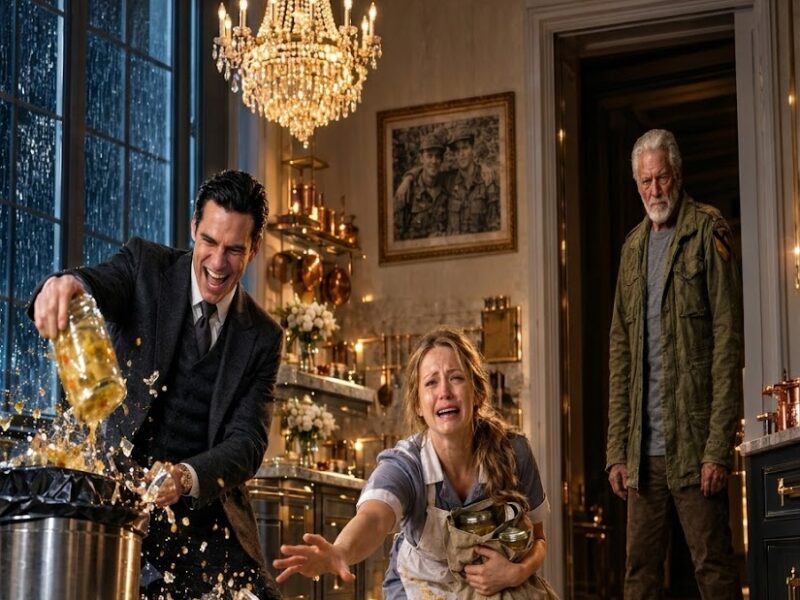
A Maid Secretly Took Leftover Soup Home Every Night—When the Billionaire Followed Her Through the Rain, He Discovered Someone He Never Expected

**Part 1**
The kitchen door swung open at 8:58 p.m., and Spencer Ashby stood in the threshold with his arms crossed, blocking the service entrance like a customs officer who had finally caught the smuggler he’d been waiting for.
“Stop right there,” he said. “Open that bag. On the table. Now.”
The woman in the gray housekeeping uniform didn’t flinch, didn’t run, didn’t even set down the canvas tote she was carrying. She just walked to the stainless steel prep table, set the bag down with a soft thud, and pulled the zipper open.
Inside were six glass jars, each filled to the brim with tonight’s chicken and rice soup, the broth still faintly steaming against the cold January air that leaked in from the delivery bay.
“It’s only soup, Mr. Ashby,” she said. “Leftovers from tonight’s dinner.”
Spencer reached into the bag and pulled out one jar, holding it up to the overhead light like a jeweler examining a questionable diamond. “Six jars. Every night. You think nobody counts the jars?”
The cook appeared in the doorway behind him, wiping her hands on a dish towel, her face a mask of practiced neutrality. “The cook throws it out at 9:00,” she said, her voice carefully flat. “Always has.”
Spencer turned on her. “I asked her first. Not you.”
The maid, whose name was Lucy Bennett, kept her eyes on the table. She was thirty-two years old, with dark hair pulled back in a practical knot and hands that had scrubbed more floors in this mansion than she could count. She had worked at the Ashby estate for two years, seven months, and eleven days, and in all that time, she had never once asked for a raise, a day off, or a single thing for herself.
“Maids in this house don’t ask,” Spencer said, turning back to her. “They obey. Watch closely.”
He reached for the trash bin, yanked it out from under the counter, and held it up like a trophy. “You see this? This is where your soup belongs. Not in your bag.”
Lucy’s jaw tightened. “Don’t,” she said, and her voice was quiet but steady. “Those jars are the only dinner six men get tonight.”
“Then they should have worked harder.” Spencer dropped the bin back to the floor with a clang. “Nobody feeds me for free.”
“Nobody has to, sir. Your uncle does.”
The words landed like a slap. Spencer’s face flushed, and for a moment the kitchen was so quiet that Lucy could hear the hum of the walk-in refrigerator and the distant ticking of the grandfather clock in the front hall.
“What is all this noise in my kitchen, Spencer?”
The voice came from the hallway, old and dry as autumn leaves, and every head in the room turned. Franklin Ashby stood in the doorway in a navy cardigan and slippers, his white hair combed back, his eyes sharp despite the late hour. He was seventy-eight years old, worth $4.3 billion according to the last Forbes list, and he had not set foot in this kitchen in at least a decade.
“Uncle Franklin.” Spencer straightened his tie. “Your maid has been robbing you for months.”
“Robbing me? Of chicken soup?”
“You’re a billionaire, Uncle. Everybody steals from billionaires.”
Franklin’s gaze moved slowly from his nephew to the canvas bag to Lucy, who had not moved an inch. “Miss Bennett,” he said. “Where does the soup go every night?”
Lucy hesitated. In two years, the old man had spoken to her exactly four times, and three of those had been to ask her to move so he could reach the newspaper. But there was something in his voice now—not accusation, but genuine curiosity, the tone of a man who had spent his whole life reading people and had just realized he’d stopped reading the ones closest to him.
“To some friends, sir,” she said finally. “Please, may I keep the last four jars?”
Franklin looked at her for a long moment. Then he reached into the bag, pulled out two of the jars, and set them on the counter. “Take them,” he said. “Go on before you miss your bus.”
Spencer’s mouth fell open. “You’re letting her walk out with it? Unbelievable.”
“Let her go, Spencer.” Franklin turned and started back toward the hallway, his slippers whispering against the tile. “Tonight, I’m going to find out.”
—
The next evening, at 8:45 p.m., Franklin Ashby stood in front of the hall mirror and buttoned an old army jacket that smelled faintly of mothballs and cedar.
“This old jacket, sir?” Martha, the housekeeper, hovered behind him with a lint roller. “I haven’t seen you wear it in years.”
“Yes, Martha. No driver, no wallet. Just coins for the bus.”
“Sir, it’s twenty-two degrees outside. At least take a coat.”
Franklin shook his head. He picked up a small canvas pouch from the entry table—the kind a kid might use for marbles—and dropped it into his pocket. “I’ll be fine.”
He walked out the service door at 8:52, down the long driveway, and onto the county road where the Route 14 bus stopped every fifteen minutes. The bus shelter was a glass box with a cracked bench and a faded ad for a dentist who had probably retired years ago. Franklin sat down and waited, his breath fogging in the air.
The bus arrived at 9:07, its doors folding open with a hydraulic sigh.
“Two-fifty,” the driver said without looking up.
Franklin held out his palm. “Coins are all I brought. Let me count them.”
The driver, a heavyset man with a gray beard and a name tag that read EARL, finally looked up. “Pennies? Look at this, folks.” He twisted in his seat and addressed the handful of passengers scattered through the bus. “He’s paying in pennies. It’s been fifty years since I rode a bus, son. And you smell like it. You’re a quarter short.”
The old man in the army jacket didn’t argue. He just stood there, his hand still out, the pennies glinting under the fluorescent lights. “Please,” he said. “It’s freezing out there. I’ll stand in the back.”
Earl sighed. “Fine. Back row. Don’t touch anybody and don’t talk.”
Franklin made his way down the aisle, gripping the seat backs for balance as the bus lurched into motion. He found a seat in the back row, next to a man in a construction vest who was asleep with his mouth open. Across the aisle, a teenager in headphones was watching a video at full volume, the tinny sound of a cooking tutorial leaking out into the air.
At the third stop, a man in a puffy coat boarded carrying a Styrofoam cup of coffee. He dropped into the seat next to Franklin without looking, and his elbow caught the old man’s arm.
“Watch it, old man,” the man said. “You nearly knocked my coffee over.”
Franklin murmured an apology. He looked around the bus—at the sleeping construction worker, the teenager, the man with the coffee, the woman in scrubs staring at her phone. “Fifty years,” he said quietly, to no one in particular, “and nobody offers a hand anymore.”
—
Lucy Bennett boarded at the sixth stop, the last one before the bridge. She was still in her gray uniform, her canvas bag clutched against her chest, and she took the front seat without looking back. Franklin watched her from the back row. Six stops and she hasn’t looked up, he thought. Six stops and she hasn’t looked at a single person on this bus.
At Maple Ridge, the last stop before the river, the driver called out, “Everybody off,” and Lucy stood, pulling her coat tighter around her shoulders. Franklin followed her down the steps and onto the sidewalk, keeping thirty feet between them.
Maple Ridge was a three-story brick building with a sagging porch and a sign that had once been painted gold but was now mostly rust. A man in a security uniform stood on the steps, his arms crossed, his breath fogging in the cold.
“Hey! You!” he shouted as Lucy approached. “Visiting hours ended at 6:00. Off my porch.”
Lucy didn’t stop. “I’m with the young lady who just went inside,” Franklin said, stepping out of the shadows.
The security guard—his name tag read DOYLE—squinted at him. “Sure you are. Another drunk looking for a free bed.”
“I served in the First Cavalry, sir. I’m no drunk.”
“Everybody out here served something.” Doyle descended the steps and put a hand on Franklin’s shoulder, shoving him backward. “Get off my steps.”
The shove was harder than it looked. Franklin stumbled, his bad knee buckling, and he would have fallen if a hand hadn’t caught his arm.
“Get your hands off him.” Lucy had reappeared in the doorway, her face white with anger. “He’s somebody’s grandfather.”
Doyle’s grip loosened. “Mr. Ashby? Sir, are you hurt? Why are you here?”
“Please,” Franklin said, straightening his jacket. “Don’t say my name. Not here. Not yet.”
Lucy stared at him, her brow furrowed. “You know this bum, Miss Bennett?”
“He’s my grandfather,” Lucy said, and her voice didn’t waver. “He’s with me tonight.”
Doyle’s eyes narrowed. “Your grandfather? I heard your grandpa had passed in March.”
“I have two, Mr. Doyle. Most people do.”
Doyle grunted, clearly unsatisfied, but he stepped aside. “Ten minutes,” he said. “And he eats nothing from my kitchen.”
“Your kitchen, sir?” Franklin said quietly, as he passed. “I thought it belonged to them.”
—
Inside, the lobby was dim and smelled of floor wax and boiled cabbage. A radio played big-band music from behind a reception desk that was empty except for a sign that said BACK IN 5 MINUTES. Lucy walked past it without stopping, through a set of double doors, and down a hallway lined with framed photographs of men in uniform.
“You followed me on the bus in that old jacket?” she said over her shoulder.
“Spencer called you a thief. I wanted to see your loot.”
She stopped at a door at the end of the hall and pushed it open. “Then come meet my loot.”
The room was a dining hall, though it looked more like a barracks. Six men sat around a long wooden table, their plates in front of them, their faces turned toward the door.
“Lucy’s here,” one of them said—a thin man with a gray beard and a USS Missouri cap. “Is it the beef stew tonight?”
“Chicken and rice, Gus. And the bread’s still warm.” She set the canvas bag on the table and began pulling out jars.
A man with a cane and a hearing aid squinted at Franklin. “Who’s the new recruit? He’s wearing a cavalry patch.”
Franklin straightened his jacket. “Franklin. First Cavalry, ’67 to ’69.”
“Korea, me.” The man pointed his cane at the man next to him. “Manny was Navy. Don’t hold it against him.”
“The Navy saved your skinny army hides twice, Gus,” Manny said, and the table erupted in laughter.
Lucy poured the soup into bowls and passed them around. “What does the kitchen here serve you for dinner?” Franklin asked, taking a seat at the end of the table.
The laughter died. Gus set down his spoon. “Gray oatmeal. One slice of bread every night since spring. They say the money ran out.” He glanced toward the door. “Funny, the director’s new car didn’t.”
“Funny, Manny?” Doyle’s voice came from the doorway. He was leaning against the frame, his arms crossed. “Keep talking, and tomorrow you lose the bread, too.”
Lucy turned on him. “Threatening hungry veterans, Mr. Doyle? That’s low, even for you.”
“Eight minutes left,” Doyle said. “Then you and Grandpa are out.”
Franklin didn’t move. “My grandpa lived here eleven years,” Lucy said, her voice tight. “He died in March. I promised him I’d feed his friends. So, I bring soup.”
“Every night?” Franklin asked. “On a bus after a full shift?”
“Every night.” She ladled the last of the soup into a bowl. “Your cook throws out enough to feed a platoon.”
“Who pays for this home? Do you know?”
“Some rich man’s foundation.” Gus wiped his mouth with the back of his hand. “Never once seen his face.”
“Quiet now.” Manny pointed toward the corner of the room, where an old man in a wheelchair was being pushed toward an upright piano. “Sergeant Tommy’s going to play. He does every night.”
The man at the piano was blind, his eyes clouded, his hands gnarled with arthritis. But when he touched the keys, the room went still. The song was slow and melancholy, a melody Franklin hadn’t heard in decades, and it hit him like a physical blow.
“That song,” he said, his voice barely a whisper. “Only one man in the world played it like that.”
“That’s Tommy Boone,” Lucy said. “He’s blind. He doesn’t talk to strangers.”
Franklin’s hands were shaking. He set down his spoon. “They told me Tommy Boone died in ’68.”
Lucy looked at him. “Sir, your hands are shaking. Who was he to you?”
Franklin didn’t answer. He stood up, walked to the piano, and stood behind the old man, listening. When the song ended, he said, “You still can’t carry a tune, Sergeant.”
Tommy’s hands froze on the keys. “Who’s there?”
“Private Franklin Ashby. Reporting.”
The room went silent. Tommy turned his head, his blind eyes wide. “Frankie? They told me you died on that helicopter.”
“They told me you died in that field.” Franklin’s voice cracked. “Fifty-eight years, Tommy.”
“Fifty-eight years,” Tommy repeated. He reached out, and Franklin took his hand. “You carried me two miles with a bullet in your leg.”
“You carried me first.” Franklin sat down on the piano bench next to him. “Now, I need to know why you’re eating oatmeal.”
—
The next morning, at 9:00 a.m. sharp, Franklin Ashby walked into the Ashby Foundation offices on the forty-second floor of a glass tower downtown. He was wearing a suit now, but the army jacket was draped over his arm, and he set it on the back of his chair like a flag.
“Uncle Franklin.” Spencer appeared in the doorway, his smile too wide. “I didn’t expect you in today.”
“The Ashby Foundation. Do we fund a veterans home?”
“Maple Ridge? $3.2 million a year. Why?”
“Three million,” Franklin said, “and the men eat oatmeal for dinner?”
Spencer laughed. “Who told you that? Old men complain, Uncle. It’s their hobby.”
“I’d like to see the meal invoices. Today.”
“You haven’t read a spreadsheet in ten years.”
“Then I’m overdue.” Franklin picked up the phone on his desk. “And Miss Bennett keeps the soup. My blessing.”
Spencer’s smile faltered. “Fine. Anything else? Should I knit the veterans scarves?”
“You could visit them. You’ve never once gone.”
—
In the hallway, Spencer pulled out his phone. “He asked about invoices?”
“Relax,” said a voice on the other end—Martin Doyle, the director of Maple Ridge, who was also Spencer’s college roommate and his partner in a real estate deal that had been three years in the making. “The sale closes Thursday. Thursday we sign, Maple Ridge becomes condos, and we’re rich.”
“And the meal money?”
“Nine dollars a man, every single day. Already spent. The maid is the problem. She feeds them. They talk.”
“Then get rid of her before your uncle starts listening.” Spencer ended the call and walked back into his uncle’s office. “Miss Bennett, my uncle is in the city tonight.”
Lucy was in the kitchen, packing the soup. “Yes, sir.”
“My uncle is seventy-eight. He forgets what he allows.”
“He told me himself this morning, sir.”
Spencer’s face hardened. “Martha was there.”
Martha, the housekeeper, appeared in the doorway. “Mr. Spencer, please. She’s done nothing but good in this house.”
Spencer turned on her. “You’re fired, Miss Bennett. Theft of household property.”
“Theft? It’s leftover soup. The cook was throwing it away.”
“Leave the key. Go near Maple Ridge and I call the police.”
Lucy picked up her bag. “I’ll go anyway. Six men are waiting for their dinner.”
“Then they’ll wait a very long time.”
Lucy walked out the service door. “Mr. Franklin will hear about this the minute he’s home.”
—
That night, the bus was late, and Lucy stood at the stop with her empty bag, her breath fogging in the cold. She got off at Maple Ridge and walked up the steps, where Gus was waiting on the porch.
“Where’s the soup, kid? And where’s your coat?”
“I’m sorry, Gus. No soup tonight. I lost my job.”
“Lost it? For feeding us? Who did this to you?”
Lucy’s eyes filled with tears. “Your nephew fired me. He said I stole from you.”
Gus’s face went pale. “Did you steal, Lucy?”
“Never. Not one spoon in two years.”
“Then my nephew owes you a lot more than an apology.” Gus reached into his pocket and pulled out a worn leather wallet. “Nobody goes hungry tonight. Diner chili for six. Still hot.”
Lucy shook her head. “There’s something else.” She reached into her bag and pulled out a stack of papers and a spiral notebook. “I found these in the trash out back.”
Gus took the papers. “Steak, salmon, fresh vegetables delivered here every week.”
“And I wrote down what they really ate.” Lucy opened the notebook. “Every night. Eight months. Oatmeal.”
“Oatmeal, bread.”
“Oatmeal.”
Gus flipped through the pages, his hands trembling. “Lucy, this notebook is worth gold.” He looked up at her. “Sergeant, that song you play—where did you learn it?”
Tommy, who had been wheeled onto the porch, turned his blind eyes toward the sound of her voice. “From a skinny private in ’68. Ohio boy. Couldn’t carry a tune. He couldn’t carry much of anything.”
“You carried him two miles,” Lucy said. “How do you know that? Nobody alive knows that.”
“Because I’m still alive, Tommy.” Franklin stepped out of the shadows at the bottom of the steps, still in the army jacket, his breath fogging in the cold. “Private Franklin Ashby. Reporting.”
“Frankie?” Tommy’s voice broke. “They told me you died on that helicopter.”
“They told me you died in that field.” Franklin climbed the steps and knelt in front of the wheelchair. “Fifty-eight years, Tommy.”
“What is this? A party?” Doyle appeared in the doorway, his face red. “MISS BENNETT, YOU’RE BANNED FROM HERE.”
“I came to say goodbye to my grandfather’s friends.”
“And you, old man.” Doyle pointed at Franklin. “I told you, off my property.”
“Is it your property, Mr. Doyle? Or theirs?”
“After Thursday, it’s nobody’s. They’re all moving to the state facility.”
“The state place?” Gus stood up, his fists clenched. “Sixty beds a room? We fought for this country.”
“Then the country can house you.” Doyle reached for the stack of papers in Gus’s hand. “And this trash goes, too.”
A hand caught Doyle’s wrist. It belonged to Tommy, who had somehow risen from his wheelchair and now stood at his full height, his blind eyes fixed on the sound of Doyle’s voice.
“Sit down, son,” Tommy said. “Every man in this room outranks you.”
Doyle yanked his arm free. “Sit down yourself, blind man. Thursday, 10:00. Pack.”
“Thursday at 10:00,” Franklin said. “I’ll be here, Mr. Doyle.”
“Bring your pennies. Maybe they’ll buy you a cot.”
—
**Part 2**
Franklin Ashby did not sleep that night. He sat in his study on the second floor of the estate, the army jacket still on, and read Lucy’s notebook from cover to cover. Eight months of oatmeal. Eight months of bread. Eight months of men who had served their country eating like prisoners while $3.2 million flowed out of his foundation and into the pockets of a food company owned by Martin Doyle’s wife.
At 6:00 a.m., he called Martha into the study. “Lucy, I need every man here at that ceremony on Thursday.”
“Mr. Franklin, I tried to stop him. Spencer fired her anyway.”
“I know. Bring me all the account books. Every single one.”
Martha hesitated. “You haven’t asked for those in ten years.”
“Ten years ago, I trusted my brother’s son with everything.”
The account books arrived in three cardboard boxes by noon. Franklin spread them across the dining room table and worked through them with a yellow legal pad and a red pen, the way he had done when he was building Ashby Holdings from a single hardware store into a $4.3 billion empire. By 3:00 p.m., he had found the meal contract for Maple Ridge—$3.2 million a year, paid in full to a company called Heartland Food Services.
He looked up the company. It was registered in Delaware, and its principal owner was a woman named Patricia Doyle.
“Martin Doyle’s wife,” Martha said, when he asked. “She incorporated it three years ago. The same month the foundation signed the contract.”
“And the men ate oatmeal.” Franklin set down his pen. “So, where did the money go?”
“A food company. It belongs to the director’s wife.”
“And the land sale on Thursday? Who’s the buyer?”
Martha opened a folder. “Riverstone Development. Spencer’s name is on the partnership papers.”
Franklin closed his eyes. “My own nephew is selling a home for old soldiers. To himself.”
“What will you do, sir?”
Franklin picked up the army jacket and held it against his chest. “What my sergeant taught me. Go back for the men left behind.”
—
Thursday morning dawned gray and cold, with a wind that cut through the bare trees along the river. By 9:30 a.m., the parking lot at Maple Ridge was full—not with moving trucks, but with news vans. Someone had tipped off the local press, and a reporter from the Riverdale Gazette was standing on the porch with a camera crew from the county’s public access station.
Inside, the dining hall had been transformed. A long table covered with a white cloth stood at the front of the room, and behind it sat Spencer Ashby, Martin Doyle, and a lawyer from Riverstone Development. Six old men sat in the front row, their belongings packed in duffel bags at their feet.
“Friends,” Spencer began, “the Ashby Foundation is proud to build a brighter future. Maple Ridge will close. Our veterans will move to modern state care.”
“Mr. Ashby is too generous,” Doyle added, sliding a pen across the table. “Shall we sign the papers, sir?”
The door at the back of the room opened. Lucy Bennett walked in, still wearing her gray uniform, her canvas bag over her shoulder.
“Mr. Ashby, did you ever eat dinner here? Even once?”
Spencer’s face went white. “Who let her in? She’s banned. Get her out of here.”
Doyle stood up. “Gladly. Come on, Ms. Bennett. And take the old bum with you.”
“The old bum stays, Mr. Doyle, and so does Ms. Bennett.”
The voice came from the doorway, and every head in the room turned. Franklin Ashby stood there in his army jacket, his white hair blown back by the wind, his eyes clear and cold.
“Uncle Franklin, what are you wearing? Why are you here?” Spencer’s voice cracked. “Uncle? That’s the old man from my porch.”
“Everyone.” Franklin walked to the front of the room. “Mr. Franklin Ashby, founder of Ashby Holdings and this foundation.”
The reporter from the Gazette lowered her camera. “The billionaire? I shoved a billionaire down my steps.”
“You shoved a soldier, Mr. Doyle.” Franklin turned to face him. “That should have been enough.”
“Uncle, let’s talk privately.” Spencer was on his feet now, his hands raised. “This isn’t the place.”
“It’s exactly the place. These men deserve to hear it.” Franklin set a stack of papers on the table. “$3.2 million for meals. They got oatmeal.”
“Budget cuts, sir. Food prices. We did our very best.”
“Your wife’s company billed us for steak every single week.” Franklin pulled out another page. “And this notebook says what they really ate. Eight months, every night.”
Spencer grabbed the notebook. “A maid’s scribbles? Uncle, she’s a thief. I fired her.”
“For taking soup I gave her, while you sold their home.”
“Sold? I’m moving them to better care.”
“Riverstone Development. Your name on the papers. You’re your own buyer.”
Spencer’s face crumpled. “Uncle, please. I’m family. My father would never forgive you.”
Franklin reached into his pocket and pulled out a photograph—a young man in an army uniform, standing in front of a helicopter. “Your father wore this same uniform. He’d never forgive you.”
The back door opened, and two men in dark suits stepped inside. “Spencer Ashby, Martin Doyle, come with me, please. Fraud charges.”
Doyle grabbed Spencer’s arm. “Spencer, you said nobody would ever check.”
“Shut up.” Spencer pulled away. “Uncle, I’ll pay it back, every cent.”
“You’ll pay it back, starting with an apology to these soldiers.”
Spencer looked at the six old men in the front row—at Gus, at Manny, at Tommy, who was staring straight ahead with his blind eyes. “I’m sorry,” he said, his voice barely audible. “I never even learned their names.”
“There will be no sale.” Franklin turned to the reporter, who was now recording everything on her phone. “Ashby Holdings buys Maple Ridge today. And it gets a new director. One who knows every man’s name.”
He looked at Lucy.
“Me? Sir, I’m a housekeeper. I clean floors.”
“Six men, eight months on bus fare. Nobody else did that.” Franklin smiled. “Steak tomorrow, Lucy? Asking for the whole army.”
The room erupted in laughter. “Steak tomorrow, Gus. And soup every single night.”
“Frankie, does this mean you’re staying for dinner?”
“Pass the gravy, army. The navy’s been waiting since noon.”
—
**Part 3**
The investigation moved faster than anyone expected. Within two weeks, the state attorney general’s office had frozen the assets of Heartland Food Services and issued subpoenas for three years of billing records. Patricia Doyle, it turned out, had been running the same scheme at four other care facilities across the state—all of them funded by the Ashby Foundation, all of them serving oatmeal to veterans while billing for filet mignon.
The total came to $9.7 million.
“Nine-point-seven million dollars,” the prosecutor said at the press conference, “stolen from the people who defended this country.”
Spencer Ashby was arraigned on eleven counts of fraud and one count of conspiracy. Martin Doyle was charged with the same, plus a count of criminal negligence for the conditions at Maple Ridge. The state facility that Doyle had threatened the men with was itself under investigation for a rat infestation and a staffing shortage that had left one wing without a night nurse for six months.
“They would have died there,” Gus said, when he heard the news. “Sixty beds a room. No night nurse. We would have died.”
—
Franklin Ashby did not attend the arraignment. He was at Maple Ridge, sitting in the dining hall with Lucy and Tommy and a contractor who was measuring the windows for new glass.
“Twelve residents now,” Lucy said, handing him a cup of coffee. “And three new nurses start Monday.”
“And our director starts nursing school in January on the foundation.” Franklin looked around the room. The wallpaper was peeling, the floor was scuffed, but the table was set with real plates and real silverware, and the smell of roasting turkey drifted in from the kitchen.
“Mr. Franklin, your car is outside. Shall I send it home?”
Franklin shook his head. “Send it home, Martha. I’ll take the bus.”
—
The Route 14 bus arrived at 9:07 p.m., its doors folding open with a hydraulic sigh.
“Two-fifty,” Earl said, without looking up.
Franklin held out his palm. “Exact change.”
Earl looked up. “Hey, I know you. You’re the penny guy.”
“I am.”
Earl waved him through. “Ride’s free tonight, penny guy. Somebody paid it forward.”
Franklin walked to the back of the bus. The construction worker was asleep again, his mouth open. The teenager with the headphones was watching a different cooking tutorial. The man with the coffee was nowhere to be seen.
At the sixth stop, Lucy got on and sat down next to him.
“Play with me, Frankie,” Tommy said, when they arrived. He was at the piano, his hands on the keys.
“You still can’t carry a tune.”
“I know. That’s why I need you.”
Franklin sat down on the bench, and the two old soldiers played the song from ’68, the one that only one man in the world had ever played like that. The room filled with the sound of it, and the six old men at the table stopped eating and listened.
“My grandpa always said,” Lucy said quietly, from the doorway, “‘Feed the man in front of you.'”
Franklin didn’t stop playing. “Your grandpa was right. Nobody gets left behind at this table.”
—
The following spring, the Ashby Foundation released its annual report. The cover photograph showed twelve old men sitting around a long wooden table, and in the center of the table was a pot of soup, still steaming. The caption read: “Maple Ridge Veterans Home. Dinner is served.”
The report included a new line item: “$4.1 million—Maple Ridge operations and resident services.” And beneath it, a note: “Effective immediately, all foundation-funded care facilities will publish monthly meal invoices. Anyone who wants to see them can ask.”
Lucy Bennett was listed as the new director of Maple Ridge. She had enrolled in the foundation’s nursing program in January, and she still took the bus to work every morning, though now she sat in the front row and talked to the driver.
“Two-fifty,” Earl said, every morning.
“Exact change,” Lucy said, every morning.
And every night, at 9:00 p.m., a blue sedan pulled up to the Maple Ridge porch and Franklin Ashby got out, carrying a canvas bag with six jars of soup. He had hired a driver, but he still liked to ride the bus on Thursdays.
“Penny guy,” Earl said, every Thursday.
“Penny guy,” Franklin said, and he dropped his coins into the fare box, one by one, counting them out loud.
The song Tommy played was different now. It was still the one from ’68, but it had picked up a melody, something Tommy had been working on for fifty-eight years. He played it every night after dinner, and every night Franklin sat on the bench next to him and hummed along.
“You still can’t carry a tune,” Tommy said.
“I know,” Franklin said. “But I’m here.”
—
The trial of Spencer Ashby and Martin Doyle began in June. The prosecutor called forty-two witnesses, including all six veterans from Maple Ridge, who testified in a row, one after the other, about oatmeal and bread and the director’s new car.
Gus went last. He was eighty-four years old, and he walked to the witness stand with his USS Missouri cap in his hands.
“Mr. Hendricks,” the prosecutor said, “can you tell the court what you ate for dinner on the night of January 14th?”
“Oatmeal,” Gus said. “One slice of bread.”
“And what did the foundation pay for that night’s dinner?”
“Nine dollars a man.”
“And what did you get?”
“Oatmeal.” Gus looked at the jury. “And a maid who brought us soup.”
The jury deliberated for six hours. Spencer Ashby was convicted on all twelve counts and sentenced to seven years in federal prison. Martin Doyle was convicted on eleven counts and sentenced to nine years. Patricia Doyle, who had fled to Florida, was arrested at a Fort Lauderdale marina and extradited to face charges.
The $9.7 million was ordered restored to the Ashby Foundation, which used it to fund a new wing at Maple Ridge and a scholarship program for the children of veterans.
—
On the first anniversary of the dinner that changed everything, Lucy Bennett stood on the porch of Maple Ridge and watched the bus pull up to the stop. Franklin Ashby got off, carrying his canvas bag, and walked up the steps.
“Steak tonight?” he asked.
“Steak tonight,” Lucy said. “And soup every single night.”
Inside, the dining hall was full. Twelve residents, three nurses, two cooks, and a reporter from the Riverdale Gazette who had come to write a follow-up story. Tommy was at the piano, playing the song from ’68.
“Play with me, Frankie,” he said.
Franklin sat down on the bench. “You still can’t carry a tune.”
“I know.” Tommy’s fingers found the keys. “But I’m here.”
The song filled the room, and the men at the table stopped eating and listened. Gus raised his glass of milk. “To the maid who took the soup,” he said.
“To the maid who took the soup,” the room echoed.
Lucy blushed. “It was just leftovers.”
“It was never just leftovers,” Franklin said, without stopping playing. “It was dinner. And nobody gets left behind at this table.”
Outside, the bus pulled away from the stop, and Earl the driver watched it go in his rearview mirror. The penny guy was inside, playing piano with a blind sergeant, and the maid who took the soup was setting the table for twelve.
“Two-fifty,” Earl said, to the empty bus. “Exact change.”
—
**Part 4**
The story spread faster than anyone could have predicted. A reporter from the Riverdale Gazette wrote a three-part series called “The Soup Jar,” and by the end of the week, it had been picked up by the Associated Press. The phrase “nobody gets left behind at this table” became a hashtag, then a slogan, then a movement.
Within a month, the Ashby Foundation had received $2.3 million in unsolicited donations from people who had read the story and wanted to help. A retired Marine in Ohio sent a check for $50 with a note that said, “I ate oatmeal for six months in a VA hospital. Thank you for feeding the men in front of you.”
A woman in California started a nonprofit called Soup Jars, which collected leftover food from restaurants and delivered it to veterans’ shelters. By the end of the year, it had chapters in fourteen states.
The state legislature, prompted by the scandal, passed a law requiring all care facilities that received public funding to publish their meal invoices online. It was called the Maple Ridge Transparency Act, and it passed unanimously.
“Nobody voted against it,” the governor said, at the signing ceremony. “Nobody wanted to explain why they voted against dinner.”
—
Lucy Bennett became a minor celebrity. She was interviewed on the local news, then on a national morning show, then on a podcast about food waste and social justice. She always told the same story: the six jars of soup, the bus ride, the billionaire in the old army jacket.
“I didn’t do anything special,” she said, every time. “I just fed the man in front of me.”
“But you did it every night,” the interviewer said. “For eight months. On a bus. After a full shift.”
Lucy shrugged. “My grandpa always said that’s the whole job. Feed the man in front of you. Everything else is details.”
—
Franklin Ashby, for his part, refused to give interviews. He attended the trial, he paid for the new wing at Maple Ridge, and he rode the bus every Thursday. But he didn’t want to be a hero.
“I’m not the story,” he told Martha, when she suggested he write a memoir. “The story is the men who ate oatmeal for eight months and never complained. The story is the maid who took the soup. I’m just the guy who finally opened his eyes.”
“You opened your eyes,” Martha said. “That’s more than most people do.”
Franklin shook his head. “I should have opened them ten years ago. I trusted the wrong person, and I stopped paying attention. That’s not a story. That’s a warning.”
—
The warning was heard in boardrooms across the country. The Ashby Foundation’s new transparency policy became a model for other philanthropic organizations, and within two years, a coalition of foundations had adopted a voluntary standard for publishing grant expenditures.
“Sunlight is the best disinfectant,” Franklin said, at the coalition’s first meeting. “And dinner invoices are the best sunlight.”
The room laughed. Nobody laughed harder than Lucy, who had been invited to speak about the importance of listening to the people on the front lines.
“You don’t need a degree to see that the men in front of you are hungry,” she said. “You just need to stop and look.”
—
The following winter, a young man named Daniel Ashby appeared at the door of Maple Ridge. He was Spencer’s son, twenty-two years old, and he had not spoken to his father since the trial.
“I’m here to volunteer,” he said.
Lucy looked at him. He had his father’s jaw, but his eyes were different—quieter, more careful, the eyes of someone who had spent a year thinking about what he didn’t want to become.
“We can always use help in the kitchen,” she said.
Daniel Ashby started that afternoon. He peeled potatoes, washed dishes, and listened to the old men tell stories about Korea and Vietnam and the first Cavalry. He learned their names, all twelve of them, and on his first Friday, he brought a pot of chili from the diner in town.
“I didn’t make it,” he admitted. “But I paid for it.”
“Nobody cares who made it,” Gus said, ladling a bowl. “Just feed the man in front of you.”
—
**Part 5**
Fifty-eight years after the helicopter crash that had separated them, Franklin Ashby and Tommy Boone sat on the porch of Maple Ridge and watched the sun go down over the river.
“You know what I remember most?” Tommy said. “Not the field. Not the bullet. The song. I remember playing that song in the mess tent, and you sitting in the corner, humming along.”
“I can’t carry a tune.”
“Never could.” Tommy smiled. “But you always knew the words.”
Franklin looked at the bus stop at the bottom of the hill, where a woman in a gray uniform was getting off the Route 14 bus, a canvas bag over her shoulder.
“Lucy’s here,” he said.
“Is it the beef stew tonight?”
“Chicken and rice. And the bread’s still warm.”
Tommy stood up, his blind eyes turning toward the sound of her footsteps on the steps. “Then let’s go to dinner.”
The dining hall was full. Twelve residents, three nurses, two cooks, Daniel Ashby, and Lucy Bennett, who had just finished her first semester of nursing school and was carrying a bag of books along with the soup.
“Mr. Franklin, your car is outside,” Martha said. “Shall I send it home?”
“Send it home,” Franklin said. “I’ll take the bus.”
He walked down the steps and stood at the bus stop, his breath fogging in the cold. The bus arrived at 9:07, and Earl the driver waved him through.
“Penny guy,” Earl said.
“Penny guy,” Franklin said.
He sat in the back row, next to a teenager who was watching a cooking tutorial, and he looked out the window at the river, black and silver under the winter moon.
At the sixth stop, Lucy got on and sat down next to him.
“Play with me, Frankie,” Tommy said, when they arrived.
“You still can’t carry a tune.”
“I know.” Tommy’s fingers found the keys. “But I’m here.”
The song filled the room, and the men at the table stopped eating and listened. And outside, in the dark, the bus pulled away from the stop, and Earl the driver watched it go in his rearview mirror, and he thought about the penny guy and the maid who took the soup and the blind sergeant who played piano every night.
“Two-fifty,” Earl said, to the empty bus. “Exact change.”
—
**Author’s Note**
This story is a work of fiction, but the problem it describes is real. Across the United States, millions of veterans live in care facilities where the food is inadequate, the oversight is minimal, and the money allocated for their care disappears into the pockets of people who never learned to feed the man in front of them.
If you want to help, the National Coalition for Homeless Veterans and the Fisher House Foundation both provide direct support to veterans in need. And if you know someone in a care facility, visit them. Ask them what they had for dinner. Listen to the answer.
Nobody gets left behind at this table.









