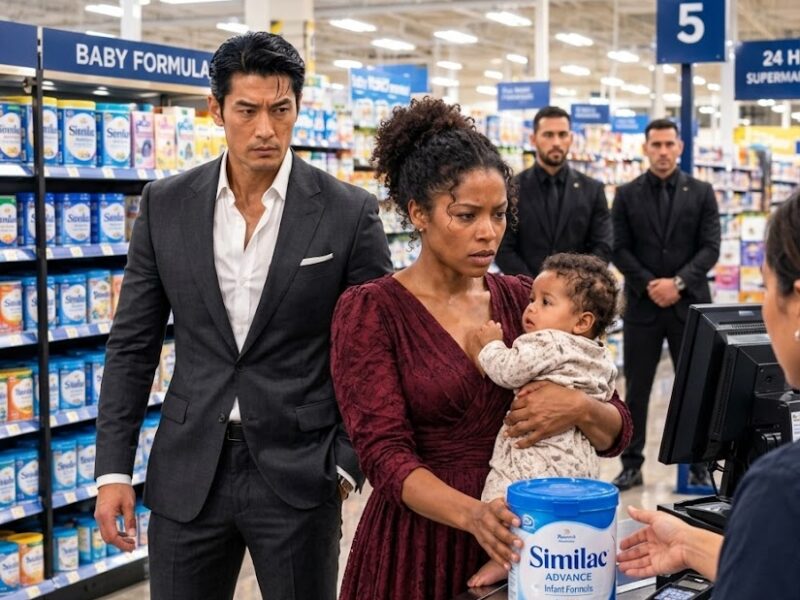
A lonely Korean crime boss sat in a convenience store at 3 A.M., watching a broke chef’s card get declined over baby formula. What he did next changed everything.
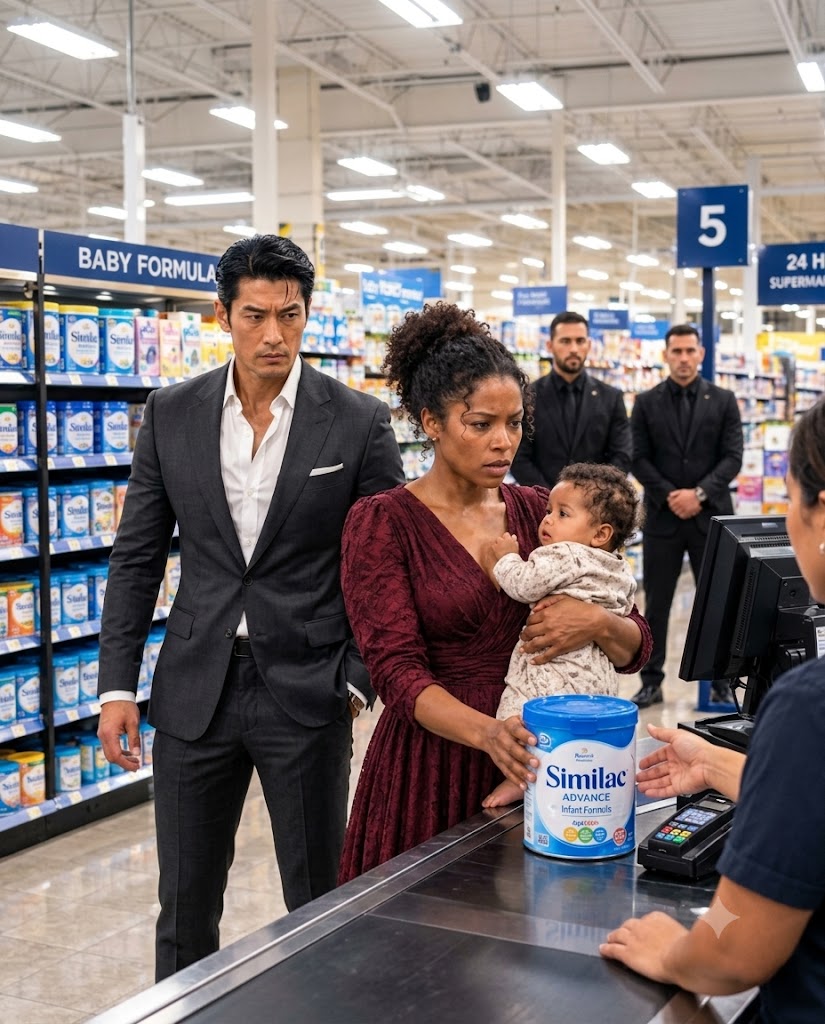
The machine beeped twice and then the cashier said it loud enough for half the store to hear.
“Declined.”
Rowan hadn’t eaten since yesterday morning.
She’d been running on black coffee and the adrenaline of dread, doing the math on the bus ride over, calculating every dollar against every bill, telling herself it would be fine, telling herself the paycheck had cleared, telling herself she had enough.
She didn’t.
She stood at the register of the 24-hour superstore on Fletcher Avenue with a can of baby formula in one hand and her nephew pressed against her chest with the other, and the whole world shrank down to the size of that blinking red screen.
“I’m sorry. Can you try it again?” she asked.
Her voice came out steady.
She was proud of that.
The cashier, a woman with long acrylic nails and the expression of someone who hadn’t been surprised by anything in twenty years, shook her head.
“Honey, it’s not a machine problem.”
Rowan closed her eyes for one half of a second.
Just one.
Then she opened them.
“Please,” she said quietly. “It’s baby formula.”
“I can see that. Can’t do anything about it, though.”
The man behind her in line made a noise.
Impatient. Conspicuous.
Rowan felt heat crawl up the back of her neck.
She bounced baby Ezra on her hip without thinking.
The same automatic motion she’d been doing for four months.
Ever since the night she’d driven three hours to a hospital in Memphis because her sister Camille had been in an accident she never woke up from.
Ezra hadn’t even been three weeks old then.
Rowan had held him in the hospital corridor under fluorescent lights that made everyone look half dead.
And she’d made a silent vow that she was keeping.
She was keeping it.
Okay.
She exhaled slowly.
“I’ll put it back.”
“Ma’am—” The man behind her cleared his throat. “There’s a line.”
“I said, ‘Okay.'”
She was already turning, already calculating whether the gas station two blocks down sold formula and how much cash she had in her jacket pocket, when a hand came down over hers on the can.
Not grabbing.
Just placing. Covering. Warm.
Rowan looked up.
The man standing beside her did not belong in this store at this hour.
He was Korean, somewhere in his late thirties, with the kind of face that looked like it had been deliberately assembled.
Sharp jaw, dark eyes that missed nothing, hair swept back from his forehead with the effortless discipline of someone who controlled everything in his vicinity.
His suit was charcoal gray and cost more than Rowan made in three months.
Behind him, two men in black stood at a respectful distance, hands folded, watching the room the way soldiers watch a perimeter.
She had not heard him walk up.
He had simply appeared.
“Set it back on the counter,” he said to her.
Low. Certain. Not a suggestion.
Then he looked at the cashier.
“Ring it through.”
The cashier blinked.
“Sir, her card—”
“I didn’t ask about her card.”
He reached into the inside pocket of his jacket and placed a black card on the conveyor belt.
It made a small, dense sound.
Like a judgment.
“Ring it through.”
Rowan stared at him.
“You don’t have to do that.”
He looked at her then, and it was the first time his eyes landed on her directly instead of on the cashier or the register.
Something moved in them.
Brief and unreadable.
Then it was gone.
“I know I don’t.”
His name was Quan Haung.
She wouldn’t learn that for another forty minutes.
She tried to give him the money back in the parking lot.
She’d counted out twenty-three dollars from the cash in her jacket, the last of what she had until Friday.
And she held it out to him in the rain with her chin up and her jaw set.
Ezra asleep against her shoulder.
And she said, “Thank you.”
But she didn’t need charity.
He looked at the crumpled bills in her outstretched hand, then at her face, then at the sleeping baby.
“It’s raining,” he said.
“I noticed.”
“My car is here. Where are you going?”
“I can take the bus.”
“The buses stopped running twenty minutes ago.”
She opened her mouth.
She closed it.
He had the faintest shift at the corner of his mouth.
Not a smile exactly.
More like an acknowledgement that he’d won this particular point on the merits rather than by force.
“I’ll take you home,” he said. “That’s all.”
The inside of the car was the quietest place Rowan had been in months.
The leather smelled like cedar and something darker underneath, something that made her think of old libraries and iron.
Ezra stirred once, fussed, and she shushed him without thinking, tucking his blanket tighter.
He sat on the far side of the back seat with his arm along the door, watching the rain on the window, giving her space she hadn’t asked for but was grateful to have.
“You live alone?” he asked after a while.
“With my nephew? His parents?”
She kept her eyes on the streetlights blurring past.
“His mom was my sister. She passed four months ago.”
A pause.
“And his father’s gone. Before Camille even told him she was pregnant.”
Rowan said it without flinching.
She’d had four months to harden the words down to something she could say out loud.
“So it’s just the two of us.”
He didn’t say he was sorry.
She appreciated that.
People who said they were sorry when they didn’t know you were just filling silence, and she’d had enough of that at the funeral.
Instead, he said nothing for a long moment.
And then he said, “Which building?”
She directed him.
He didn’t react when they pulled up to the six-story walk-up on Delmore Street with the broken intercom and the dumpsters pushed up against the south wall.
She registered his two men scanning the block when they got out, the way they positioned themselves without being told, and she filed it away in the part of her mind that was always cataloging exits.
He walked her to the door of her apartment on the fourth floor.
She hadn’t invited him past the lobby.
He simply came, and she didn’t have the energy to argue.
The apartment was cold.
She’d turned the heat down to save on the bill and forgotten to turn it back up before she left.
She went straight to the small playpen in the corner of the living room, set Ezra down, covered him with the fleece blanket that had been Camille’s, and stood there for a moment with her hand resting on his back, just feeling him breathe.
When she turned around, Haung was still in the doorway.
He hadn’t stepped inside.
He was looking at the apartment.
The way people look at things they’re memorizing.
Methodically. Without expression.
The water stain in the corner of the ceiling.
The towel she’d stuffed into the gap at the bottom of the window to keep the draft out.
The stack of job applications on the kitchen counter.
She hadn’t had time to finish them.
“Three jobs,” she said, because she could tell what he was thinking, and she needed him to understand.
It wasn’t surrender.
It was strategy.
“I cook mornings at a diner, afternoons at a catering company, and I pick up weekend shifts at a hotel kitchen. I’m looking for a fourth.”
He looked at her.
“You’re a chef.”
“I’m a cook. I have the certification for chef. I’m working on the difference.”
She crossed her arms.
“I’m not looking for pity. I was managing before tonight. Tonight was just tonight.”
“You were returning formula you’d already opened.”
She went still.
“I saw you,” he said quietly.
Not accusing.
Just factual.
“Before you came to the register, you were at the return desk. You were trying to get money back on a can you’d already opened because you needed the cash more than the formula.”
He paused.
“That is not managing.”
The words landed in her chest like a stone dropped in still water.
She felt the ripple of them.
Her throat tightened.
She was not going to cry in front of this man.
She had not cried in front of anyone since the hospital, and she was not starting now.
“What do you want?” she asked.
“People like you don’t do things for free. So what is it?”
He tilted his head slightly.
“People like me. Men in suits with bodyguards who buy strangers formula at midnight.”
“That’s not a category that exists without a ledger.”
Something crossed his face.
She thought it might be respect, but she wasn’t sure she was reading him right.
“I need a head cook,” he said.
“For my private residence. I have a large staff, and whoever managed the kitchen previously left six weeks ago. It’s a live-in position. Suite is separate from the main house. Climate controlled. Secure. The child would have his own room.”
He said it all in the same flat, declarative tone he might have used to recite facts about the weather.
“The salary is competitive.”
“How competitive?”
He named a number.
Rowan laughed.
It came out before she could stop it.
A short, startled sound.
“That’s not a cook’s salary.”
“I pay for precision, confidentiality, and the understanding that my household operates under certain terms that most employers don’t have.”
“What kind of terms?”
He met her eyes.
“The kind that keep people safe.”
She stood in her cold apartment looking at this man she did not know, with her nephew asleep in the corner and the stack of unpaid bills on the counter and the draft coming through the towel in the window.
And she thought about Camille.
She thought about the last conversation they’d had, three days before the accident, when Camille had laughed and said Rowan always thought she could outwork every problem.
That she’d probably try to cook her way out of the apocalypse.
Rowan had said, “What else am I going to do? Quit?”
She looked at Ezra.
She looked at Quan Haung.
“I need twenty-four hours’ notice before any dinner over eight guests,” she said.
“I won’t compromise on sourcing. I need quality ingredients, or the food suffers, and that reflects on your house, not just mine. And whatever your terms are, they don’t apply to my nephew. He’s not part of any arrangement. He’s just a baby.”
He was quiet for a moment.
“Agreed on all three.”
“Then we have a deal.”
She didn’t know yet what she’d said yes to.
But she had kept her word to Camille, and she had kept Ezra fed, and she would figure out the rest in the morning.
She always did.
—
The Quan Estate sat in the hills above the city, behind iron gates that opened without sound and stone walls that were taller than they appeared from the road.
Rowan arrived with two bags, a car seat, and an older woman named Mrs. Pack met her at the entrance with the practiced warmth of someone who had made many strangers feel briefly at ease.
The suite she was given had a crib already set up in the second room.
She didn’t ask how they’d known to do that.
She cooked her first breakfast for the household at 6:00 the next morning.
Short rib kanji with pickled cucumber, fried shallots, a soft egg.
She moved through the industrial kitchen like she moved through every kitchen she’d ever worked in.
Decisively. Without wasted motion. Talking to the ingredients the way her grandmother had taught her.
Rowan’s grandmother had run a soul food restaurant in Atlanta for thirty-one years.
She used to say that feeding people was the closest thing to telling the truth that most people ever got.
Rowan believed that.
By the time Haung walked through the kitchen at 6:45, there was a bowl waiting at the far end of the kitchen island.
Covered. Still steaming.
He stopped, looked at it, looked at her.
“I didn’t know your schedule,” she said without turning from the stove.
“So I made it restorable. If you eat it now, eat it now. If you don’t, it’ll hold.”
He sat down at the island.
He ate without speaking.
When he finished, he set the spoon down with the particular deliberateness of someone choosing words carefully.
And said, “You’re good.”
“I know.”
There was that almost smile again.
It became their rhythm.
She cooked.
He ate.
He started appearing at the kitchen island at unpredictable hours, and she started recognizing his footsteps on the corridor floor.
That specific, unhurried weight.
And she began setting something aside without acknowledging that she was doing it.
He started staying longer after meals.
Not saying much.
Just sitting with his tea while she cleaned down the surfaces.
Once she looked up and caught him watching Ezra, who had been stationed in his bouncy seat near the kitchen door, gumming a teething toy with tremendous concentration.
His expression was utterly unguarded.
It was the only time she ever saw him look like a man instead of an institution.
“He looks like her?” Haung asked without looking away from the baby.
“Around the eyes,” Rowan said.
“Camille had these big, serious eyes. Like she was always deciding something.”
She paused, whisking.
“He’s going to be exactly like her, I think. Quiet until he’s not.”
Haung was quiet for a moment.
“You’re raising him to know her?”
“Every day.”
She set the whisk down.
“I talk to him about her while I cook. I tell him what she liked to eat, what she was afraid of, what made her laugh. He’s too little to understand yet, but one day he’ll know. He’ll have her in him, and he’ll know where she came from.”
He looked at her then, and the thing in his eyes was different from what she’d seen before.
Deeper. Less guarded.
“That’s the right thing to do,” he said.
It was a strange thing for a dangerous man to say with such absolute certainty.
She stored it away.
—
She learned the shape of his world the way you learn a kitchen you didn’t design.
By feeling out where things were in the dark.
By understanding what certain sounds meant.
By knowing which doors didn’t fully close and which ones were never opened.
The men who moved through the estate were not household staff.
She understood that within the first week.
She understood the nature of the business he ran.
Not the specifics.
Never the specifics.
But the texture of it.
The weight of it.
The way certain phone calls made the whole house go quiet.
She was not naive.
She had grown up in a neighborhood where power looked exactly like this.
Men in expensive clothes doing things that couldn’t be spoken aloud, and the people around them pretending not to see.
She kept her part of the house.
She kept Ezra safe.
She kept cooking.
What she didn’t expect was that he would start to matter to her.
It happened slowly, in the mundane accumulation of small things.
The morning he walked into the kitchen and found her on the floor trying to coax Ezra to crawl, both of them laughing, and he stood in the doorway for a long moment before he knelt down on the kitchen tile in his suit and held out his hand a few feet ahead of the baby like a destination.
Ezra crawled to him.
Haung looked up at Rowan with an expression she couldn’t name, and she looked away first.
The afternoon she burned the caramel sauce because she was on the phone arguing with Ezra’s pediatrician about insurance coverage, and when she finally came back to the kitchen, furious and smelling of scorched sugar, there was a new pan on the counter and the burner was already preheated.
She hadn’t asked.
No one on staff would have thought to do that.
The night she heard a sound in the corridor outside her suite at two in the morning, padded to the door, and opened it to find Haung standing there in dark clothes holding a cup of chamomile, which he held out without explanation.
And she took it without asking for one.
And they stood in the doorway not speaking for a while, because sometimes silence has its own whole language.
And they had already started to learn each other’s.
She was falling for him.
She didn’t say it, even to herself.
But it was true.
She was also terrified of what that meant.
—
His underboss was a man named Shin Dawan, who looked at Rowan like a variable in an equation he was constantly recalculating.
He never spoke to her directly.
He spoke around her in Korean.
She couldn’t follow, but she understood tone, and she understood body language.
And what his body language said was clear enough.
She was a problem.
A liability.
A civilian in the wrong house at the wrong time.
She overheard him once through the half-open study door.
His voice razor-precise and low.
She didn’t catch all of it, but she caught enough.
The word for weakness.
The word for compromise.
And once, briefly, a phrase she’d heard on the streets growing up, in a different language but with the same meaning.
Used and discarded.
She went back to her kitchen and she cooked.
She didn’t tell Haung.
She filed it away the way she filed everything, in the part of herself that was always quietly preparing for the next emergency.
The emergency came on a Thursday.
—
Haung was away.
He’d been gone two days.
Business in another city.
She didn’t ask where.
And the house had a different quality without him in it.
The way any structure feels different when its most load-bearing element is temporarily removed.
She’d spent the evening making soup stock and playing music in the kitchen and letting Ezra roll around on the playmat.
Ordinary and quiet.
Until it wasn’t.
She woke at 2:00 in the morning to the sound of the outer corridor door opening.
Not Mrs. Pack’s walk.
Not any of the household staff.
She knew every set of footsteps in the house.
These were new.
And there were three of them.
And they were not moving the way people move when they belong somewhere.
She was out of bed before she was fully awake.
Pure instinct.
She grabbed Ezra from the crib in one motion, pressed him to her chest, and went to the wall beside the suite door.
The wall that was stone all the way through.
Instead of standing in the center of the room.
She had clocked that fact the first week.
Stone walls were better than drywall in almost every scenario that mattered.
The door came open hard.
Two men came through first.
Black clothes. Covered faces.
A third hung back in the corridor.
The first man’s eyes swept the room and landed on her in the corner, and he said something in a language that wasn’t Korean, wasn’t English, and there was nothing in his voice that had anything to do with hesitation.
Rowan ducked low when he moved toward her.
She’d grown up in kitchens where the fastest person at the station didn’t burn herself.
Fast was a habit.
She went sideways, and the man’s reach caught only air, and she drove her elbow hard into the shelf beside her, sending a heavy ceramic lamp crashing into the second man’s path.
And in the three seconds of confusion, she screamed.
Not for help.
Because she didn’t think about that.
She screamed because Ezra had woken up and was screaming too, and she needed the men in this house to hear it through the walls.
The estate heard it.
What came next was very loud and very fast, and Rowan stayed against the stone wall with Ezra flattened against her chest, and she did not move, and she did not look until it was over.
When she did look, two men were on the floor, and Quan Haung was standing between her and the corridor, breathing hard, his shirt torn at the shoulder, his eyes going over her face with a ferocity that had nothing to do with the men on the floor.
“You’re here,” she said, because it was the only coherent thought she had.
“I was two hours out when Shin’s men couldn’t reach the overnight guard.”
His voice was stripped of everything but urgency.
“Are you hurt?”
“No.”
“Ezra.”
“He’s okay. He’s okay. I have him.”
She looked up at Haung.
There was blood on his hand, and she didn’t know if it was his.
“Who were they?”
He looked at her for a long moment.
His jaw was tight.
The expression on his face was one she’d never seen on him before.
Not the controlled blankness.
Not the almost smile.
Not the rare, unguarded warmth.
This was something raw.
Something that looked almost like grief.
“Come with me,” he said quietly.
“There’s a room. It’s safe. I’ll explain everything.”
—
The safe room was deep in the center of the house, behind a panel she’d walked past a hundred times without knowing what it was.
Haung closed the door and turned the locks.
And then he sat down across from her at the small table.
And he told her.
He told her about the Syrian syndicate, which was what the Quan network was properly called, and about the rival faction from Vladivostok called the Orlov Group, and about how the Orlov Group had been pushing into the city for eight months through proxies and intermediaries and thin legal fictions.
He told her that the attack tonight had been a message.
Not to him.
About him.
A message from people who believed that the only real way to hurt a man like Haung was to take something from him.
She watched his face while he talked.
He was always precise.
Always contained.
But there was something happening beneath the surface that she could see now.
Something the controlled delivery was barely holding back.
“They came for Ezra,” she said.
He stopped talking.
“That’s what you’re not saying. They didn’t come for me. They came for Ezra.”
She held the baby tighter.
“Why?”
He set his hands flat on the table, looked at them, then at her.
“My intelligence team has been tracking the chain of events around your sister’s death. A mugging is what the police called it. It wasn’t.”
The room was very quiet.
“There was a man in your sister’s life briefly before she knew she was pregnant. She left him when she found out what he was. His name is Goran Orlov. He’s the heir to the Orlov Group.”
And Ezra.
Haung stopped.
His voice had gone very still.
“Ezra is his son. His only blood heir. Goran doesn’t know the child survived. But the Orlov men who attacked tonight were following a thread that led from your sister’s apartment to you. And then here. They’ll tell Goran what they found.”
Rowan sat with that.
She sat with all of it.
The weight of it.
The way it reorganized every fact of the last four months into a new and terrible shape.
“My sister,” she said slowly, “knew this.”
“Yes.”
“She died to protect him.”
Haung didn’t answer.
He didn’t have to.
Rowan looked at the baby sleeping against her chest.
Ezra, who had Camille’s eyes.
Ezra, who was going to crawl and then walk and then grow up into a person who deserved to know where he came from.
All of it.
Even the parts that were hard.
She thought about what she’d said in the kitchen.
He’ll have her in him, and he’ll know where she came from.
“You knew,” she said.
“Then you knew who he was when you found us.”
She said it quietly, but her hands had gone still on the baby’s back, and her eyes were fixed on Haung’s face with a directness that did not flinch.
He held her gaze.
“I suspected after the first week. Shin’s team confirmed it.”
“And you brought us here knowing we were a target. Knowing that having Ezra in your house gave you leverage against Orlov.”
“Yes.”
He said it without flinching.
“That was the original calculation.”
The word original sat in the air between them.
“And now?” she asked.
Haung looked at her in a way that was completely undefended.
No mask.
No precision.
Just a man sitting three feet from a woman he had miscalculated in every possible direction, being honest because there was no version of this conversation where he could afford to be anything else.
“Now I would burn the entire arrangement to the ground before I let anyone use that child as a bargaining piece.”
He said it quietly.
“Including Shin. Including my own people.”
He paused.
“I didn’t know what you were going to be when I found you at that register. I thought I was making a strategic move. I was wrong about what it was.”
She looked at him for a long time.
Long enough that Ezra stirred and resettled and went quiet again.
“Tell me what you need from me,” she said finally.
“Not what the syndicate needs. What you need.”
He blinked.
It was a small thing.
Barely visible.
But she had learned to read his small things.
He hadn’t expected that.
“Time,” he said quietly.
“To end this before Goran gets the information from tonight. Three days. Maybe four. I know where he’ll be. And if it works, then this house is safe. Then you can stay or go, whichever you choose, and neither of those choices will be made under threat.”
“And if it doesn’t work?”
He was quiet for a moment.
Then he said, “It will work.”
She almost smiled at that.
Almost.
“That’s not an answer.”
“It’s the only one I’m capable of giving you right now.”
She looked down at Ezra.
She thought about what fear felt like when it was the right kind.
The kind that sharpened you instead of paralyzing you.
She thought about Camille laughing, saying Rowan would cook her way out of the apocalypse.
And she thought, Maybe not cook. Maybe just stay in the room. Maybe just refuse to leave.
“Okay,” she said.
“Three days.”
—
The three days were the longest of her life, and she spent most of them in the kitchen because the kitchen was the only place she knew how to be.
In absolute uncertainty, she made dish after dish.
Braised oxtail and jollof rice and the sweet potato pone her grandmother had always made when things were hard.
She fed the household staff.
She fed the men stationed at the perimeter.
She left a plate covered at the island for Haung every time he came in late and went straight past without stopping.
Every time she woke at night, she checked on Ezra and then stood at the window watching the grounds below, looking at the men she didn’t know, protecting a baby they’d never met because Quan Haung had told them to.
On the third night, she was still up at one in the morning, sitting at the kitchen island with a cup of tea gone cold, when the door opened and he came in.
He looked like he had been through something.
Coat gone. Tie loose. A cut along the side of his jaw that had been hastily closed with surgical tape.
He stood in the kitchen doorway looking at her, and something about the exhaustion in his face made her get up.
She went to the cabinet where she kept the first aid kit and she brought it back to the island, and she pointed at the stool in front of her without saying anything.
He sat.
She stood in front of him and cleaned the cut with antiseptic and pressed a proper closure strip over it, and neither of them spoke.
His hands rested on his thighs the whole time.
Perfectly still.
Like he was concentrating very hard on not moving.
“It’s done,” he said finally, when she was pressing the last strip into place.
She exhaled.
“Goran?”
“He won’t be an issue.”
She nodded.
She put the antiseptic back in the kit.
She had about a hundred questions, and she chose not to ask any of them, because she knew enough about the particular kind of violence that kept people like Ezra safe.
And she had made her peace with the fact that some things existed in a place she didn’t need to see.
“Thank you,” she said.
He caught her hand as she was stepping back.
Not hard.
His fingers just closed around her wrist gently, the same way he’d covered her hand at the register that first night.
And she stopped moving.
“I need to say something,” he said.
“Okay.”
“The way this started—” He stopped. Started again. “The calculation I told you about. The leverage. I need you to know that it ended the same week. Before I even confirmed what I suspected about Ezra. It ended the first time you cooked that kanji and told me you knew exactly how good you were. It ended when I watched you on the kitchen floor teaching him to crawl, and you looked—”
He stopped again.
His jaw was tight with the effort of precise language in a situation that resisted it.
“You looked like someone who had decided what mattered and was building her whole life around it. I don’t know how to explain what that did to me except to say I have been in rooms with every category of dangerous person for fifteen years, and I have never been as thoroughly disarmed as I was by you on a kitchen floor with a baby.”
Rowan looked at him.
She thought about the night she’d heard Shin Dawan’s voice through the door.
The word weakness.
The word compromise.
She thought about how she’d filed it away and kept going.
She thought about all the ways a person could be afraid of something and move toward it anyway.
“I know who you are,” she said.
“I’m not confused about that. I know what this house is. I know what you do.”
She paused.
“And I know what I am,” she continued.
“I’m a cook from Atlanta who’s raising her dead sister’s baby on a shoestring and nobody’s idea of a strategic asset.”
“You are the most formidable person in this house,” he said simply.
She looked at him a little longer.
Then she turned his hand over, still holding hers, and pressed her palm flat against his.
“Don’t manipulate me again,” she said.
“Ever. That’s my only line.”
“Never,” he said.
She believed him.
She believed him the way you believe a person who is being honest at great cost to themselves, with all the defensive architecture stripped away.
She believed him the way you believe someone who has shown you their real face in a moment they didn’t have to.
She didn’t say anything else.
She just stayed where she was, standing in her kitchen at one in the morning with her hand pressed to his.
And she let the silence be what it was.
Which was a beginning.
—
Six months later, the cherry trees the gardener had planted along the south wall were blooming, and Rowan was in the kitchen making Ezra’s first birthday cake.
A proper lemon cake with cream cheese frosting, because she had strong opinions about birthday cake.
And she wasn’t compromising them for anyone.
Including the tiny person sitting in his high chair, throwing fistfuls of banana at the tile floor with tremendous satisfaction.
Haung came in and intercepted the banana before it hit the dog, which they had also acquired in the last six months.
A large and completely undignified golden retriever named after the street where Rowan had grown up.
“He’s been at that for twenty minutes,” Rowan said without looking up from the cake.
“I know. I was watching from the doorway.”
She smiled at the batter.
She did that a lot lately.
“There’s coffee.”
He poured two cups and came to stand at the island across from her.
He set a small envelope next to her mixing bowl without fanfare.
She looked at it, then at him.
“Shin delivered it this morning. He said it’s from the family court I filed in October.”
She put down the spatula.
She opened the envelope.
The paper inside was formal and dense, and she had to read it twice.
And then a third time.
And then she pressed her hand over her mouth because the words were very simple and very permanent.
The adoption was finalized.
Ezra’s legal surname was now Quan.
Not because of leverage or strategy or the Syrian syndicate’s interests.
Because Haung had sat across from a lawyer in October and said, “He is our son, and I need the paperwork to reflect the truth.”
Ours.
She looked up at him.
He was watching her with that unguarded expression she’d learned to recognize.
The one that lived under everything else.
The one that was only for her.
“You didn’t tell me you were filing,” she said.
“I wasn’t certain it would be approved. I didn’t want you to wait on something that might not come through.”
A pause.
“And I wanted you to be surprised. You don’t let yourself be surprised enough.”
“Haung.”
“Yes.”
“Come here.”
He came around the island, and she set the paperwork on the counter, and she put her arms around him, which was something she’d learned to do without self-consciousness.
The way you learn all the best habits.
Slowly.
And then all at once.
He put his arms around her and pressed his face into her hair and held on with the particular ferocity of someone who understood exactly what holding on had cost him once and was not going to make the same mistake twice.
From his high chair, Ezra watched them with Camille’s serious eyes.
And then threw another piece of banana onto the floor.
Satisfied with the world.
Rowan laughed.
It came from somewhere deep and entirely unguarded.
The kind of laugh she hadn’t known she still had in her.
And Haung felt it against his chest and held her tighter.
Outside, the cherry trees bloomed along the south wall, unhurried in the particular silence of things that had taken a long time to become themselves.
—
The first time Rowan saw the ledger, she wasn’t supposed to.
It was a Tuesday, three weeks after the adoption papers, and she’d come down to the study to bring Haung the lunch he’d skipped.
The door was cracked.
She heard Shin Dawan’s voice, that same razor precision, and she should have turned around.
She didn’t.
She stood in the corridor with the tray in her hands and listened, because she had learned that the things people didn’t want you to hear were the things you needed to know.
“The Orlov accounts are frozen. The proxies have gone quiet. But Goran’s mother has retained counsel in Miami. She’s filing for custody of the child. She’s claiming blood rights.”
A pause.
“She doesn’t know the adoption is finalized.”
“She’ll find out,” Haung said.
“And when she does, she’ll escalate. She’s already retained a private investigator. He’s been in the city for two weeks.”
“Doing what?”
“Making inquiries. About the sister. About the apartment in Memphis. About the hospital records.”
Rowan’s hands had gone very still on the tray.
“Does she have anything?”
“Not yet. But she’s persistent. And she has money. And she has a legal team that knows how to work the family court system in ways that don’t require her to prove anything. She just has to create enough doubt.”
“Then we remove the doubt.”
“How?”
“By making the adoption unassailable. By making Ezra’s life here so thoroughly documented, so thoroughly stable, that no judge in the country would dream of pulling him out of it.”
“That takes time.”
“Then we take the time.”
“And the investigator?”
A long silence.
Then Haung’s voice, quiet.
“He’s not to be touched. I won’t have this household involved in anything that could be used against us in a courtroom. We do this clean, or we don’t do it at all.”
“And if she escalates beyond the courtroom?”
“Then I’ll handle it. But not yet. Not while there’s a legal path.”
Rowan stood in the corridor for a long moment.
Then she turned and walked back to the kitchen, because she had heard enough, and because she had learned that sometimes the most useful thing you can do is pretend you don’t know anything at all.
—
The investigator’s name was Marcus Vale.
He was fifty-three years old, a former detective from Chicago, and he had the kind of face that looked like it had been weathered by too many years of looking at things people didn’t want him to see.
Rowan met him at a coffee shop three miles from the estate, on a Thursday afternoon, while Ezra was napping and Mrs. Pack had agreed to watch him for two hours.
She hadn’t told Haung.
She had simply left a note on the kitchen island that said “Errands” and driven herself into the city.
Vale was sitting in the corner with a laptop and a cup of black coffee, and he looked up when she walked in with the particular alertness of someone who had spent his whole career reading rooms.
“You’re Rowan,” he said.
“I’m Rowan.”
She sat down across from him.
“You’ve been asking questions about my sister.”
He didn’t deny it.
“That’s my job.”
“Who’s paying you?”
“Goran Orlov’s mother. Elena. She wants to know what happened to her grandson.”
“Her grandson.”
“Her son’s child. She believes the child is alive. She believes he’s being raised by someone who isn’t family. She wants him returned.”
Rowan leaned back in her chair.
She had spent the drive over rehearsing what she would say.
She had spent the last six months learning how to read people the way Haung read them.
The way you read a kitchen you didn’t design.
By feeling out where things were in the dark.
“I’m going to tell you the truth,” she said.
“Not because I owe you anything. But because I think you’re a decent man who’s been hired to do a job, and I think you deserve to know what you’re actually doing.”
Vale raised an eyebrow.
“That’s a lot of faith for someone you just met.”
“It’s not faith. It’s observation.”
She folded her hands on the table.
“My sister was murdered. The police called it a mugging, but it wasn’t. She was killed because she was protecting her son from a man who would have used him as a bargaining chip in a war he didn’t start. The child is mine now. Legally. And I’m not going to let anyone take him back into that world just because his grandmother has money and a legal team.”
Vale was quiet for a moment.
“You know I can’t just take your word for that.”
“I know. I’m not asking you to. I’m asking you to look at the evidence. The hospital records. The police report. The timeline. And then ask yourself whether you’re working for a grieving grandmother or a woman who wants to use a child as a weapon.”
She stood up.
“I’m not going to threaten you. I’m not going to bribe you. I’m just going to ask you to do your job honestly. And if you do, you’ll find out what I already know.”
She left the coffee shop.
She didn’t look back.
—
Vale called her three days later.
“I looked at the records,” he said.
“And?”
“And you’re right. The timeline doesn’t match the mugging story. The police report is thin. The hospital records show signs of a struggle that wasn’t consistent with a random attack.”
He paused.
“I also found something else. Something that wasn’t in the file.”
“What?”
“Your sister made a call to a domestic violence hotline two weeks before she died. She used a burner phone. She didn’t leave her name, but she left enough details that the counselor remembered her. She said she was trying to get away from someone. Someone who had threatened to take her child.”
Rowan closed her eyes.
“She was trying to protect him.”
“She was.”
Vale was quiet for a moment.
“I’m going to tell Elena that there’s no case. That the child is in a stable, loving home, and that pursuing custody would be both legally futile and morally indefensible. I’m going to tell her that if she wants to honor her son’s memory, she should let the child grow up where he’s safe.”
“Will she listen?”
“I don’t know. But I’ll tell her.”
He paused.
“And I’ll tell her what I found. About the hotline. About the threats. About the fact that her son was the reason her grandson’s mother is dead. She deserves to know that.”
Rowan exhaled.
“Thank you.”
“Don’t thank me. I’m just doing my job.”
He hung up.
Rowan stood in the kitchen for a long time, looking out the window at the cherry trees.
Then she went back to the stove and finished making dinner.
—
Two weeks later, a letter arrived at the estate.
It was addressed to Rowan, in careful handwriting, and it was from Elena Orlov.
She read it in the kitchen, standing at the island, with Ezra in his high chair and the dog asleep at her feet.
The letter was short.
It said that she had spoken to Marcus Vale.
It said that she had read the hospital records and the police report and the notes from the hotline call.
It said that she was sorry.
It said that she would not be pursuing custody.
It said that she hoped the child would grow up knowing that his mother loved him enough to die for him.
And it said that if Rowan ever needed anything—anything at all—she should call.
Rowan folded the letter.
She put it in the drawer with the adoption paperwork and the birth certificate and the photograph of Camille that she kept in the kitchen.
Then she went back to cooking.
Because that was what she knew how to do.
And because the people she loved were hungry.
—
The house had a library.
Rowan hadn’t noticed it at first.
It was on the third floor, at the end of a corridor she’d never had reason to walk, and she found it by accident one afternoon when she was looking for a quiet place to sit while Ezra napped.
The door was unlocked.
She pushed it open and stopped.
The room was two stories tall, with shelves that went all the way up to the ceiling and a ladder that slid along a brass rail.
The windows were tall and narrow, and the light came through them in long, dusty columns.
And in the corner, there was a piano.
She hadn’t known he played.
She walked over to it and touched the keys lightly, not pressing down, just feeling the cool weight of them under her fingers.
“My mother taught me.”
She turned.
Haung was standing in the doorway.
“I didn’t know you had a library,” she said.
“I don’t use it much. Not anymore.”
“Why not?”
He walked over to the piano and sat down on the bench.
“My mother used to play. Every night after dinner. She said it was the only way to quiet her mind.”
He pressed a key.
A single note, low and resonant.
“She died when I was twelve. My father sold the piano a month later. Said it was too painful to look at.”
He paused.
“I bought this one five years ago. I’ve never played it.”
“Why not?”
“Because it’s easier to buy something than to use it. To have it than to let it mean something.”
Rowan sat down on the bench beside him.
She didn’t say anything.
She just waited.
He pressed another key.
Then another.
And then, slowly, hesitantly, he began to play.
It wasn’t a song she recognized.
It was something slow and sad and beautiful, the kind of music that made you feel like you were remembering something you’d never actually experienced.
She closed her eyes and listened.
When he finished, she opened them.
“That was beautiful,” she said.
“It was my mother’s favorite.”
He looked at her.
“I haven’t played in twenty years.”
“Why now?”
He was quiet for a long moment.
“Because I’m tired of buying things I’m afraid to use. Of having things I’m afraid to let mean something.”
He looked at her.
“Of living like I’m already dead.”
She reached out and put her hand on top of his on the keys.
“Then don’t,” she said.
He turned his hand over and laced his fingers through hers.
And they sat there, in the library, with the light coming through the windows and the dust motes dancing in the air and the piano quiet under their hands.
And for the first time since she’d met him, Rowan saw Haung look like a man who wasn’t carrying the weight of the world on his shoulders.
—
Ezra took his first steps in the kitchen.
He was eleven months old, and he’d been pulling himself up on the furniture for weeks, and Rowan had been waiting for it with the particular anticipation of someone who knew that once he started walking, she would never have a moment’s peace again.
She was at the stove, stirring a pot of stew, when she heard the sound of small feet slapping against the tile.
She turned.
And there he was.
Standing on his own two feet, wobbling slightly, grinning at her with Camille’s eyes and a mouth full of baby teeth.
“Come on,” she said, crouching down and holding out her arms.
“Come here, baby. You can do it.”
He took one step.
Then another.
Then he fell forward into her arms, laughing, and she caught him and held him and laughed too.
“Did you see that?” she said to Haung, who had appeared in the doorway.
“I saw it.”
“He walked.”
“He walked.”
She stood up with Ezra on her hip and crossed the room and kissed Haung on the cheek without thinking.
It was the first time she’d done that.
The first time she’d touched him without there being a reason for it.
He looked at her with that unguarded expression, the one that was only for her, and she felt her face go warm.
“Sorry,” she said.
“Don’t be.”
He reached out and cupped her face in his hand.
“Don’t ever be sorry for that.”
She looked at him for a long moment.
Then she kissed him.
Properly this time.
On the mouth.
And he kissed her back.
And Ezra, caught between them, made a sound of protest and pushed at Haung’s chest with his small hands.
They both laughed.
And Rowan felt something settle in her chest.
Something that had been loose for a long time.
Something that felt like home.
—
The wedding was small.
Just the household staff and a few of Haung’s most trusted men and Mrs. Pack, who cried through the whole ceremony, and Marcus Vale, who had flown in from Chicago and stood in the back with his arms crossed and a look of quiet approval on his face.
Rowan wore a simple white dress.
Haung wore a suit that cost more than her first car.
And Ezra, who was two and a half by then, carried the rings on a small velvet pillow and dropped them twice before he made it to the front.
She wasn’t sure she believed in marriage.
She’d seen too many people make promises they couldn’t keep.
But she believed in Haung.
She believed in the way he looked at her.
The way he held her hand.
The way he got down on the floor and played with Ezra even when he was exhausted.
The way he’d held on to her in the kitchen at one in the morning and told her he was tired of living like he was already dead.
So she said the words.
And he said them back.
And when the officiant said, “You may kiss the bride,” Haung kissed her like it was the only thing he’d ever wanted to do.
And Ezra, standing between them, clapped his hands and said, “Again!”
Everyone laughed.
And Rowan laughed too.
And it was the best day of her life.
—
The cherry trees bloomed again the next spring.
Rowan was in the kitchen, making breakfast, while Ezra sat at the island and drew pictures on a piece of paper with crayons.
Haung came in, tie loose, hair damp from the shower, and poured himself a cup of coffee.
“You’re making that thing again,” he said, looking at the pan on the stove.
“It’s called a frittata. You like it.”
“I said it was fine.”
“You said it was fine,” she repeated, smiling.
“That’s the same thing.”
He came around the island and kissed her on the forehead.
Ezra made a face.
“Gross.”
“You’ll understand when you’re older,” Haung said.
“No, I won’t.”
“Then you’ll be very lucky.”
Rowan laughed.
She served breakfast.
They ate together, the three of them, at the kitchen island, with the sun coming through the windows and the dog sleeping on the floor and the cherry trees blooming outside.
And Rowan thought about the night she’d stood at that register with a can of baby formula and a blinking red screen and the whole world shrinking down to the size of her failure.
And she thought about how strange it was.
How you could stand in one moment, convinced that your life was over, and then wake up a year later in a different life entirely.
A life you couldn’t have imagined.
A life that had started with a stranger’s hand covering yours on a can of formula and a cashier saying “declined” loud enough for half the store to hear.
She looked at Haung.
He looked back at her.
“What?” he said.
“Nothing,” she said.
“I was just thinking.”
“About what?”
She reached across the island and took his hand.
“About how glad I am that you were there that night.”
He squeezed her hand.
“I was glad too.”
“No, you weren’t. You were calculating.”
He smiled.
“That too. But I was also glad.”
She shook her head.
“Liar.”
“I’m not lying. I was glad because I saw you. The real you. The one who was too stubborn to give up. The one who was still fighting even when she had nothing left.”
He paused.
“That’s the woman I fell in love with. Right there at that register. With your jaw set and your chin up and a baby on your hip and a cashier telling you no.”
Rowan felt her eyes go warm.
“You never told me that.”
“I’m telling you now.”
She looked at him.
Then she looked at Ezra.
Then she looked out the window at the cherry trees.
“Declined,” she said softly.
“What?”
“That’s what she said. The cashier. Declined.”
She smiled.
“Best thing I ever heard.”
Haung laughed.
And it was a real laugh, not the controlled one he used in meetings, not the quiet one he let out when he didn’t want to be noticed.
It was the kind of laugh that came from somewhere deep.
The kind that meant he was happy.
The kind she’d been hearing more and more often over the past year.
The kind that made her believe that maybe, just maybe, they were both going to be okay.
—
Outside, the cherry trees bloomed along the south wall.
Unhurried.
In the particular silence of things that had taken a long time to become themselves.
And in the kitchen, Rowan poured another cup of coffee and cut another slice of cake, because it was someone’s birthday.
She couldn’t remember whose.
But she knew it didn’t matter.
Because they were all there.
And that was enough.
That was everything.
That was the whole world.
And she had kept her promise.
She had kept Ezra fed.
She had kept her word to Camille.
She had figured out the rest.
She always did.









