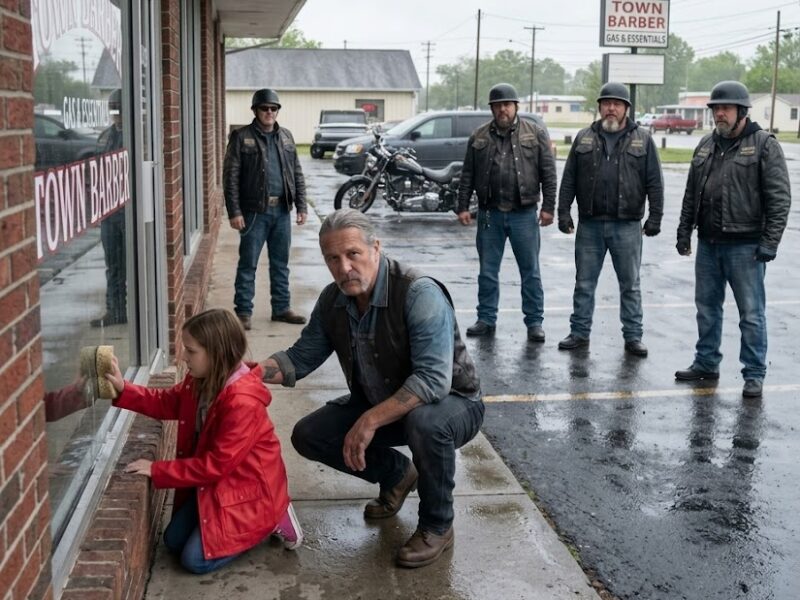
A little girl washed the same barbershop window every Saturday. Nobody asked why. Nobody offered to pay her. She just showed up, bucket in hand, and made that glass shine. Then one Saturday, 450 bikers lined up outside—and the whole street stopped.
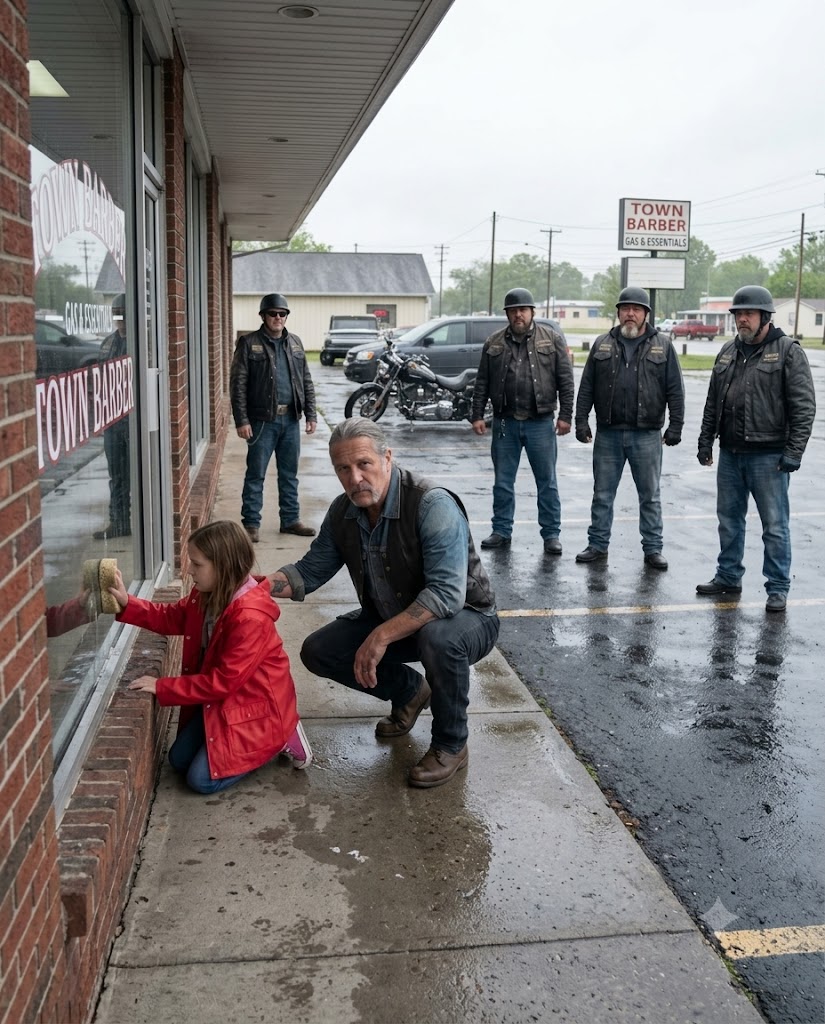
She’s out there again, said the man behind the register, and he said it the way you say a thing you have stopped expecting to understand.
Gideon Marsh heard it through the open door of the back room where he was oiling the second chair, the one with the cracked armrest held together by three wraps of electrical tape.
He was 53 years old, built like a highway overpass, with forearms that had spent 30 years absorbing vibration through handlebars, and the meat of his palms showed it, thick and ridged, and the color of old saddle leather.
His beard was iron gray, going to white at the chin, and he wore his Ash Creek Riders cut over a flannel shirt the way other men wear a second skin.
The back patch had faded to the soft particular darkness of something that has been through weather and kept going.
He set the oil rag on the counter and walked to the door.
She was outside on the sidewalk in front of the barbershop window, and she was washing it.
Eight years old, maybe nine, small for whatever age she was.
She had a blue plastic bucket that listed to one side because the handle was bent, and she had a yellow rag that might once have been a kitchen towel.
She was working the lower pane in small, careful circles, the way a person works when they know a job and do not need to think about it.
The morning light came in flat off the eastern ridge, November cold and pale as skimmed milk, and it found the window in front of her, and found her, and the glass went bright where she’d been, and dark where she hadn’t.
She worked the line between the two with total concentration.
She did not look up when the door opened, and she did not look up when a truck went by.
She worked the corner first, which is the right order, and then she moved to the center.
Gideon stood in the doorway.
His name was Gideon Marsh, and he was the president of the Ash Creek Riders, the last man standing from the six who had founded the club 22 years ago in a rented garage 12 miles outside of Kingman, Arizona.
He had been through things that left marks you could read on him like tree rings if you knew the language.
He watched the girl work the window, and he did not say anything.
The man behind the register, whose name was Carl Dryden and who had cut hair in this shop for 11 years, came to stand beside him.
Carl said, Third Saturday in a row.
Gideon said nothing.
Don’t know who she belongs to, Carl said, don’t know where she comes from.
Shows up around 8, works till the window’s clean, picks up her bucket and goes.
The girl rinsed the rag in the bucket, wrung it with both hands, and started on the upper pane, going up on her toes to reach.
Her boots were brown and too large and laced partway up, and the laces on the left one were the wrong color, white against brown, which meant they were a replacement.
Gideon looked at the boots for a moment and then looked away.
He went inside and sat down in the first chair and picked up his coffee, which had gone cold, and he drank it anyway.
Somebody ought to ask her, Carl said.
Gideon looked at the window.
The girl was finishing the top right corner, and the glass was very clean.
Yeah, he said, somebody ought to.
He did not move yet.
He sat with the cold coffee and watched her work, and the morning light moved on the glass, and there was something in the way she did it.
The economy of it, the zero-wasted motion, the way she never once checked to see if anyone was watching, made a place in his chest feel tight and very old at the same time.
He had seen that quality of attention before, and he knew where.
He was not ready to go there yet, so he sat with the cold coffee and watched her finish the window.
When she picked up her bucket and turned to go, he stood up.
He went outside.
She had already reached the corner, and he called out, not loud, and said, Hey, you want some hot chocolate?
She stopped and turned around and looked at him.
She had dark eyes and a very serious face, and she looked at him the way children look at something large that has not yet decided what it is.
She looked at him for three full seconds, and then she said, Okay.
She came back.
Outside in the November cold, she set the bucket down beside the door and followed him in.
Carl looked at Gideon, and Gideon looked at Carl, and neither of them said a word about the other thing yet, the thing that was already sitting in the room with them.
A child had been washing the same window by herself for three Saturdays at 8 in the morning, and nobody knew why, and nobody had asked until now.
The answer to that question was going to be something none of them were ready for.
The bell above the door settled back into silence, and the window gleamed in the cold light.
It would be gleaming for a long time before any of them understood what they were looking at when they looked at it.
Carl made the hot chocolate from a tin he kept for the grandkids who came in with their fathers on Saturdays.
He made it with whole milk, not water, and he set the mug on the counter with both hands like it was something formal.
The girl wrapped both her hands around it and looked into it for a moment before she drank, and Gideon noticed that her hands were red from the cold water in the bucket.
She had not complained about this, and was not going to.
She drank and set the mug down and looked at Gideon.
He had pulled the stool from behind the register and sat on it so he was closer to her height, which cost him something in his left knee, and he did not show it.
He said, What’s your name?
She said, Ren.
He said, That’s a good name.
She looked at him without expression and said, I know.
Carl made a small sound behind the counter that was almost a laugh and became something else.
Gideon said, I’m Gideon, and you come here every Saturday?
Ren said, Yes.
Gideon said, How come you wash the window?
She picked up the mug again and looked into it and said, Because it needs it.
He waited, and she drank.
He said, Who told you it needed it?
She set the mug down and looked at the window and said, My grandpa.
Gideon looked at the window, too.
The light was full on it now, and it was very clean, and it held the light the way clean glass does, the way dirty glass never can.
He said, Does your grandpa live nearby?
Ren said, He used to have this shop.
Gideon went very still, and Carl went very still.
The shop had changed hands 14 months ago.
Gideon said, What’s your grandpa’s name?
Ren looked at him and said, Hector Moya.
Then she picked up her hot chocolate and finished it, and she set the mug down neatly on the counter and said, Thank you, because she had been taught to say it.
She picked up her bucket and she left.
Gideon sat on the stool for a long moment after the bell above the door went quiet.
Carl was leaning on the counter with both hands flat and his head down, and he was the one who finally said it.
Hector Moya closed this shop 14 months ago.
Gideon said, I know.
Carl said, He had a stroke, he can’t work anymore.
Gideon said, I know.
Carl said, She’s been washing the window of a shop that doesn’t belong to her family anymore, that her grandfather can’t ever come back to, and nobody told her to stop.
Gideon said nothing.
He got up from the stool, and the knee complained, and he walked to the window and looked out at the sidewalk where Ren had been.
The pavement there was still a little wet from the bucket, and the wet would be gone in 10 minutes in this cold, and there would be no sign she had been there at all, except for the clean glass.
He put his hand flat on the glass.
It was cold and very smooth.
He thought about a man who had taught a child to clean a window properly, corner first and then center, and who could not any longer hold a rag or tell her to stop.
He thought about the child coming anyway.
He thought about the bent bucket handle and the replacement laces in the wrong color.
He took his hand off the glass and walked to the door and outside into the cold morning, and he stood on the sidewalk and looked both ways, but Ren was already gone.
There was just the pale November street and the clean window behind him throwing light into the cold air like a signal, and he stood in it for a moment before he walked to his bike.
He did not start it right away.
He sat on it with his hands on the tank and the cold coming up through his jacket, and he was doing the arithmetic of a small grief, counting up what a child could not possibly know she was carrying, and what she was carrying it for, and whether the weight of a thing like that could be lifted by people other than the ones who put it down.
He thought it probably could.
He started the bike and rode.
The Ash Creek Riders Chapter House was a converted ranch outbuilding 20 minutes north of town on a dirt road that turned to thick mud when it rained and cracked like old paint when it dried.
In November it was neither, just hard, pale ground under a sky the color of old tin.
Gideon pulled in at 9 and found seven bikes already there and three more pulling in behind him, which meant the Saturday morning ride had been gathering for the past half hour.
He cut the engine and walked inside, and the warmth hit him.
Propane heat and coffee and the particular smell of leather and machine oil that he associated with every good thing that had happened to him in the last 22 years.
Merrick Sutton was standing by the map table with a mug in his hand.
Merrick was 48 and the club’s road captain, 6-foot-2 with a shaved head and a scar across the bridge of his nose that he had stopped explaining years ago.
He looked at Gideon and said, You look like something followed you in.
Gideon said, Sit down, I need to tell you something and I need you to think before you talk.
Merrick said, That bad.
Gideon said, That specific.
He got coffee, he sat, and he told them about the window.
He told it exactly, the bent bucket, the wrong-color laces, the corner-first method, the hot chocolate, and the name Hector Moya.
He told it without editorializing because he had learned long ago that the facts of a thing like that were more effective than any arrangement of feeling he could put around them.
When he said the name Hector Moya, Denny Pharr, who was the club’s treasurer and who had grown up in this valley, put his mug down on the table and looked at it.
Denny said, I know who Hector is.
He had the barbershop on Crane Street for 31 years, made cuts, spoke Spanish, gave credit when men were short.
He had a stroke last year, and now he lives with his daughter.
Gideon said, Tell me about the daughter.
Denny said, Single, she’s a home health aide, works mornings and evenings, name’s Clara.
The girl’s name is Ren, she’s nine.
Gideon said, How do you know all this?
Denny looked up and said, Because I was one of the men Hector gave credit to when I was 23 and too proud to say I was broke, and he was too smart not to notice.
Nobody said anything for a moment.
The propane heater clicked, and outside two more bikes pulled in, and the sound was the sound the club always made arriving, not loud, just present like weather moving in.
Merrick said, So what are we doing?
Gideon said, First, we’re going to find out what they need.
You don’t help people by guessing.
Merrick said, And then.
Gideon looked at the window of the chapter house, which nobody had cleaned recently, and said, And then we do what we do.
By noon that Saturday, Denny had made three phone calls and had a number for Clara Moya’s address and the name of the agency she worked for.
Gideon asked him to pass it to exactly nobody yet, and Denny understood what that meant and said so with a nod rather than a word.
What it meant was that Gideon wanted to go himself without the club behind him, because the first contact with a woman managing an ill parent and a 9-year-old daughter alone would not be improved by 40 leather cuts coming through the door.
He had made this mistake before, and it had cost a family two weeks of fear they did not need.
So at 2 that afternoon, in his own truck rather than the bike, wearing a clean flannel and the cut because he was still who he was, Gideon drove to the address on Yucca Lane and knocked on the door.
A woman answered.
She was in her early 30s, dark hair pulled back, a home aide badge clipped to her jacket from the morning shift.
She had not been home long enough to take it off.
She looked at Gideon the way anyone would look at a man his size on their doorstep without an appointment, which was with her hand still on the door.
Gideon said, My name is Gideon Marsh, I own the bike, I do not own anything else on this street.
I was at the barbershop on Crane this morning when your daughter came to wash the window, and I gave her hot chocolate, and she told me her grandfather’s name.
I came here because I want to know what your family needs, not to give you anything you didn’t ask for.
Clara Moya looked at him for a long time.
Then she opened the door a little wider and said, She told you his name?
Gideon said, Yes.
Clara let out a breath through her nose and looked at the middle distance for a moment and said, She goes every Saturday.
I’ve told her the shop doesn’t belong to us anymore.
She says she knows.
Gideon said, Does she know why she goes?
Clara said, She says Grandpa taught her to clean the window and somebody should still do it.
She paused.
He can’t tell her to stop.
He understands things mostly, but he can’t talk.
He had the stroke 15 months ago.
Gideon nodded.
He did not fill the silence.
He had learned that the silence after a fact like that was something a person needed to occupy themselves, not something to be closed up.
Clara said, Come in if you want, I’ll make coffee.
He went in.
The front room was small and very clean, which told him something.
It was the clean of a person who has few resources and uses control of space as a form of dignity.
There was a framed photograph on the wall above the small sofa.
A man, 60 or so, dark and broad, in a barber’s apron, grinning at the camera with scissors in one hand and a comb in the other, standing in front of the window on Crane Street.
The window was very clean in the photograph.
Gideon sat down on the edge of the sofa and looked at the photograph while Clara made coffee in the kitchen, and he understood then what Ren was doing on Saturday mornings, and why she had never once explained it and never once stopped.
The man in the photograph had not died.
He had simply stopped being able to be the man in the photograph.
The girl had decided that something of his would go on being what it was supposed to be, and she had picked the window because that was the thing he had taught her.
She had been doing it for three Saturdays in a row and would have gone on doing it indefinitely, corner first and then center, because she was 9 years old and that was what love looked like when you were 9 years old and the person you loved was still present but unreachable.
Gideon put his hands on his knees and breathed through his nose and did not look away from the photograph.
Clara came back with two mugs and sat across from him in the chair and said, What is it you think you can do?
Gideon said, I don’t know yet, that’s why I’m here and not at your door with 40 people.
She almost smiled, but she did not quite.
She said, Tell me about the club.
He did.
He took 20 minutes and he told her the real version, not the short version, because she deserved it and because she was smart enough to hear the difference.
When he finished, she was quiet for a moment and then she said, My father gave credit to a lot of men when they needed it.
Gideon said, I know, I heard that today.
Clara said, He never wrote it down, he just remembered.
She paused.
He’s not going to ride in a parade, he’s not going to be moved by a gesture.
What he needs is money for the kind of occupational therapy that takes months and costs things insurance won’t cover.
And what Ren needs is to know that somebody saw her doing the thing she’s been doing and it mattered.
She stopped and looked at her coffee.
That’s all, that’s the list.
Gideon said, That’s not a small list.
She said, No, it isn’t.
He said, Give me a week.
She looked at him and said, You going to show up with 40 leather cuts and a check?
Gideon said, I’m going to show up with whatever makes sense, and I won’t show up at all if it doesn’t.
She nodded once, and that was the agreement.
He drank his coffee and thanked her and walked back to his truck in the cold afternoon light with a list in his head that he was already sorting into what the club could do alone and what it was going to need help to do.
The list was longer on the second side than the first, but not impossibly so.
He called Merrick from the truck and said, I need a number by Friday.
Merrick said, What number?
Gideon said, How many riders can we get in one place on a specific Saturday morning in November?
Merrick was quiet for a moment, then he said, What’s the ask?
Gideon said, Show up at a barbershop on Crane Street at 8 in the morning, clean, sober, and in cuts.
Be there when a 9-year-old girl comes to wash the window.
The silence on the other end was not a long one.
Merrick said, Give me four days.
Gideon said, You have four, and hung up.
He drove north out of town on the state road with the desert on both sides going gray and gold in the late afternoon, and the sky above it had turned the color of a bruise going yellow at the edges.
That was not ominous, but it was honest the way November skies in the high desert are honest, which is to say they do not promise anything they cannot deliver.
He thought about a man named Hector Moya, who had run a barbershop for 31 years and given credit to young men who were too proud to say they needed it, and who had taught his granddaughter to clean a window the right way, corner first and then the center, and who was now in a room on Yucca Lane with everything he had ever built reduced to what he could see from a chair.
What he could see from the chair was whatever his daughter and his granddaughter put in front of him.
Gideon thought about what it would mean for Hector Moya to see 450 riders lined up outside the window of the shop he used to own.
He thought it would mean something that had no single word in any language he knew.
He drove, and the desert went dark around him, and he kept driving.
Merrick Sutton had a phone like a tool and a memory like a ledger.
When he worked a phone chain, he did it with the same method he used for routing 200 miles of back roads, which was to start from what he knew and triangulate outward without backtracking.
By Tuesday evening, he had contacted seven chapter presidents across northern Arizona, two in Nevada, and one in Utah, and he had not asked for a favor, because Merrick never called what he was asking for a favor.
He called it an opportunity, which was not manipulation, but was simply accurate, because what he was offering was a chance to be somewhere that mattered on a Saturday morning, which was something that more people wanted than would ever admit it.
On Wednesday, he called Gideon and read him a number.
The number was 312 confirmed riders, with more coming in.
Gideon said, Keep going.
Merrick said, There might be a parking issue.
Gideon said, I’ll handle parking.
He called Denny, who knew the building inspector’s cousin and who could describe a problem so precisely that the person hearing it understood exactly what kind of solution was required and how it would benefit everyone involved.
Denny made two calls, and the section of Crane Street between 4th and 5th would be coned off by 7:30 Saturday morning, which was 30 minutes before Ren arrived, if she held to her schedule, which she would, because she was the kind of person who held to a schedule.
Gideon knew this from the three Saturdays of evidence and from the single conversation, and from the boots with the wrong-color laces, which were the boots of someone who solves the problem in front of them with what is available and does not make a ceremony of the compromise.
On Thursday, Gideon drove back to Yucca Lane and knocked again, and Clara opened the door and this time she did not keep her hand on it.
He told her the number.
He told her it was now over 300 and climbing and that he expected by Saturday it would be somewhere north of 400.
He watched her face.
She did not say anything for a moment, and then she said, That’s going to frighten her.
Gideon said, It might.
Clara said, She doesn’t do well with crowds.
Gideon said, We won’t crowd her.
We’ll be on the other side of the street.
We’ll be there when she arrives, and she’ll see us, but nobody will approach her except me, and only if she looks like she wants that.
Clara said, What are you going to tell her?
Gideon said, I’m going to tell her the truth, that we know what she’s been doing and we know why, and it mattered.
Clara was quiet.
She looked at the wall at the photograph of Hector with the scissors and she said, He hasn’t smiled in 15 months.
She said it to the photograph, not to Gideon, and Gideon understood that it was not something she was asking him to fix, only something she needed to say out loud in the presence of someone who would not flinch at it.
He did not flinch.
He said, Would he be able to see the window from a car?
Clara turned and looked at him and said, What?
Gideon said, If someone drove him down Crane Street at 8 Saturday morning, would he be able to see out the window of the car?
Clara’s mouth did the thing mouths do when a question lands in a place that has been shut for a long time and suddenly is not.
She said, Yes, he sees fine.
He just can’t, he can’t say what he sees.
Gideon said, He won’t need to.
He drove home and called Denny and told him they needed a vehicle with a passenger door that opened wide and a clear line of sight to the right.
Denny said he had exactly that and would drive it himself.
The plan now had a shape.
The shape was simple, which was the only kind of shape that worked when you were coordinating 450 people to honor a child washing a window.
Simple, or it falls apart.
Gideon wrote the shape on one side of an index card and put it in his cut pocket, and he did not take it out again because he did not need to.
He knew it.
He went to bed at 10 and lay in the dark with the window of the chapter house showing him a piece of sky that was very clear and very cold and full of stars, and he thought about his son.
He did not do this often, and he had rules about when he allowed it.
The rule was that he could think about Marcus only when the thinking would go somewhere useful rather than somewhere that left him unable to move.
Tonight it went somewhere useful.
Marcus had been 17 when the accident happened 11 years ago, and he had been the kind of boy who did things with total concentration and zero wasted motion, who had a quality of attention that made you feel when he turned it on you that you were the only thing in the field of view.
Gideon had watched Ren wash the window and had felt that quality and had recognized it and had not been ready for it.
Now in the dark he was ready.
He let himself think about Marcus for 11 minutes, which was the length of time it took to feel the grief cleanly and then set it down.
Then he turned on his side and went to sleep.
Saturday came in hard.
The temperature at 7 in the morning was 22 degrees, and the sky was the pale colorless white of a sheet of paper held up to the light.
The first frost of November had been two days ago, and the ground had held it.
Gideon was on Crane Street at 6:45.
Denny was already there with the wide-door vehicle idling at the far end of the cone section, exhaust rising in the cold.
The first riders came in at 7, two by two, and parked in the section between 4th and 5th in two rows along the far curb, and more came behind them, and more behind those.
By 7:30 there were 219 motorcycles lined up along the opposite sidewalk, engines off, riders standing beside their bikes in the cold without complaint, because cold was a condition and not a reason.
By 7:50 the count was 341.
By 7:55 it was 409.
By 8, when a small figure in a brown coat came around the corner of 4th with a blue bucket listing to one side, the count was 451, and the street held them in the cold morning light that had been decided a long time ago and was only now arriving at its moment.
Gideon stood on the barbershop sidewalk alone.
He had told everyone to stay across the street.
Four hundred and fifty-one people stood across the street in the cold and did not move.
The engines were off.
The street was quieter than Crane Street was at 8 in the morning on a Saturday, which meant very quiet, because 451 people standing still and not speaking is its own kind of silence.
A different kind than empty, a kind that has weight and warmth in it, even in the cold.
Ren came around the corner and stopped.
She stood at the edge of the cone section and looked across the street, and her face did not change into fear.
It changed into something else, something more careful, more considering.
She looked at 451 riders standing in two rows along the opposite curb, and she looked at the bikes, and she looked at Gideon on the near sidewalk, and she walked toward him.
She set her bucket down beside the door.
She looked up at him and said, Why are they here?
He crouched down so she could see his face and he said, Because you came every week.
She looked at him steadily and said, For the window.
He said, For the window.
She was quiet for a moment and then she said, Did somebody tell my grandpa?
Gideon said, He’s going to see it.
He looked toward the end of the street, and Ren looked where he looked, and Denny’s vehicle was pulling slowly forward with the passenger window down.
Hector Moya was visible in the passenger seat, broad and gray-haired, wearing his good jacket, and his eyes were on the street, and the street was full of motorcycles.
Ren was standing in front of the window he had taught her to clean, and the window was very clean, and Hector Moya’s face, which had not moved into a smile in 15 months, moved.
It was not a large movement.
It was the movement a face makes when it has been given back something it thought was gone.
The word for that movement is not a word that belongs in a sentence.
It belongs in the body, in the sternum and the throat, and every one of the 451 people on that street who could see it felt it land in exactly those places.
Ren saw it.
She raised her hand, just that, and waved at him.
Hector lifted one hand from his lap.
His hand moved toward the window.
Denny stopped the car.
The hand stayed up.
Four hundred and fifty-one riders who had not been told what to do in this moment did the same thing at the same time without any signal, which is what 451 people do when they know exactly what is required.
They raised their hands, every one of them.
In the cold November light on Crane Street, 451 hands went up, and the silence of it was louder than any engine any of them had ever run.
Hector Moya’s hand was up in the car window, and his granddaughter’s hand was up on the sidewalk, and the barbershop window was very clean behind her, gleaming in the pale cold light the way clean glass does when the whole world is watching.
Ren turned around.
She picked up her bucket, dipped the yellow rag, wrung it with both hands, and started at the corner, the way she had been taught, and she worked in small, careful circles.
Not one of the 451 people across the street made a sound.
They stood there in the cold and they watched her finish the window, because that was the thing she had come to do, and she was going to do it, and they were going to be there while she did.
That was all, and it was enough, and it was more than enough.
In the weeks after that Saturday, the Ash Creek Riders and the other chapters who had stood on Crane Street opened a fund for Hector Moya’s rehabilitation therapy.
The therapist was a woman named Dr. Ranatada Voss who worked out of Flagstaff and who specialized in post-stroke speech and motor recovery, and who had a 12-month waiting list and a fee that insurance covered at 40 cents to the dollar.
The fund covered the other 60 cents.
It covered 14 months of twice-weekly sessions, because the riders went back to their chapters and went back to their networks and the fund grew past what anyone had projected.
Denny kept the numbers in a ledger by hand because he said spreadsheets were for people who didn’t trust their arithmetic.
The first deposit into the rehabilitation fund was $7,400, collected in cash and checks in a coffee can on the chapter house bar.
By month four, Hector Moya could say his granddaughter’s name.
He said it one afternoon in December in the small room on Yucca Lane, and Clara was there, and Ren was there, and Dr. Voss was there, and what Hector said was Ren, just the one word, just the name, and the room held it the way clean glass holds light.
By month nine he could say short sentences.
By month 14, he was walking with a cane down Crane Street on Saturday mornings, and he stopped in front of the barbershop window and looked at it, and Ren was there beside him with the bucket.
He watched her work the corner first and then the center, and he said, Good.
Just that.
She said, I know.
The Ash Creek Riders established an annual ride on the first Saturday of November.
They called it the Crane Street Run.
The first year, 280 riders registered.
The second year it was 412.
The third year it was 607 from nine states, and the proceeds went to speech and motor rehabilitation for stroke survivors in the Four Corners area.
The entry fee included a patch that Denny’s wife sewed, a small yellow rectangle on a blue field, which was a rag and a bucket, which nobody who wasn’t there would understand, and everybody who was there would never need explained.
The barbershop on Crane Street changed hands two more times in the years that followed, and each new owner was told on the first day by whoever delivered the keys that a girl came on Saturday mornings to wash the window, and to let her.
They all did.
In the sixth year after the first Crane Street Run, Ren Moya was 15, and she walked into the chapter house of the Ash Creek Riders one afternoon in October and asked to speak to Gideon Marsh.
When he came out, she handed him something.
It was a photograph.
It was taken on a Saturday morning on Crane Street by a man she had asked to stand at the right angle.
In it, Hector Moya was standing with his cane in front of the window, and Ren was beside him with the yellow rag, and the window was clean and bright behind them, and 451 raised hands were visible in the blurred background across the street, or the suggestion of them, frozen in the cold November light.
She had written on the back of the photograph in blue ink, in handwriting that was careful and unhurried and correct, she had written, He taught me the corner first.
You taught me the rest.
Gideon looked at the photograph for a long time.
He turned it over and looked at the window and the hands and the girl and the old man, and he turned it back and read what she had written again, and he said, You want me to keep this?
She said, I made a copy.
He nodded once and slid the photograph into the breast pocket of his cut, against his chest, where it stayed.
He went outside and stood on the cracked ground in the October light and looked north at the desert and the sky.
The sky was deep and clear and the blue of something very old that is not going anywhere, and somewhere in it the pale shape of the rising moon was already visible in the afternoon, patient as a thing that has learned patience is not weakness but the highest form of arrival.
He thought about Marcus.
He let himself think about him.
This time there was no rule about duration and no need for one, because the grief and the other thing, the thing that had no name but lived in the breast pocket with the photograph, had found a way to exist in the same place at the same time.
The place was his chest, and the other thing was larger.
Some windows are not clean by accident.
Some windows are an act of love, so steady and so quiet that the world walks past it for weeks without seeing.
Then one Saturday morning, 451 people see it all at once.
What they are looking at is not the glass.
What they are looking at is a child holding the whole weight of someone else’s life in her hands and refusing, quietly, completely, without spectacle or complaint, to put it down.
The roar of 451 engines starting up on Crane Street every first Saturday of November is not a roar at all when you know what it means.
When you know what it means, it sounds exactly like a window catching the light.









