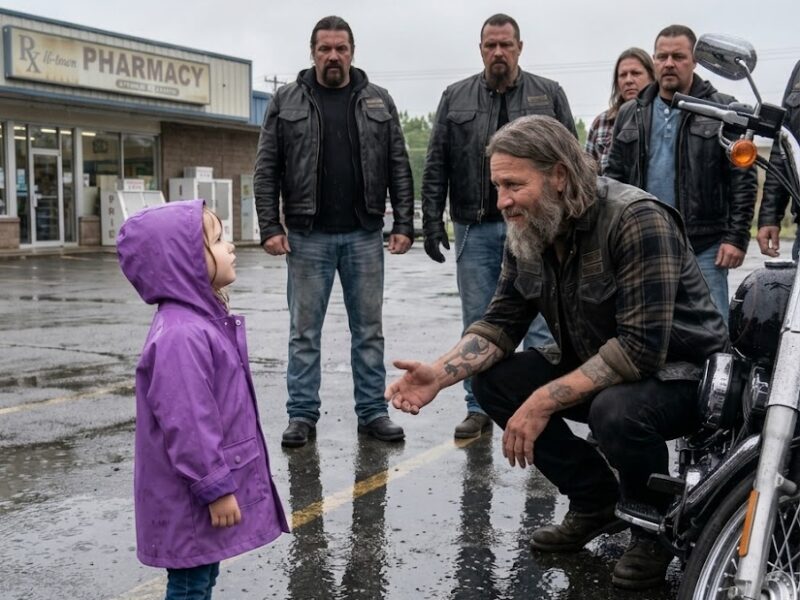
A little girl walked three miles in the freezing rain to a pharmacy for her sick mother. When she got there, 500 bikers were already waiting at the door.
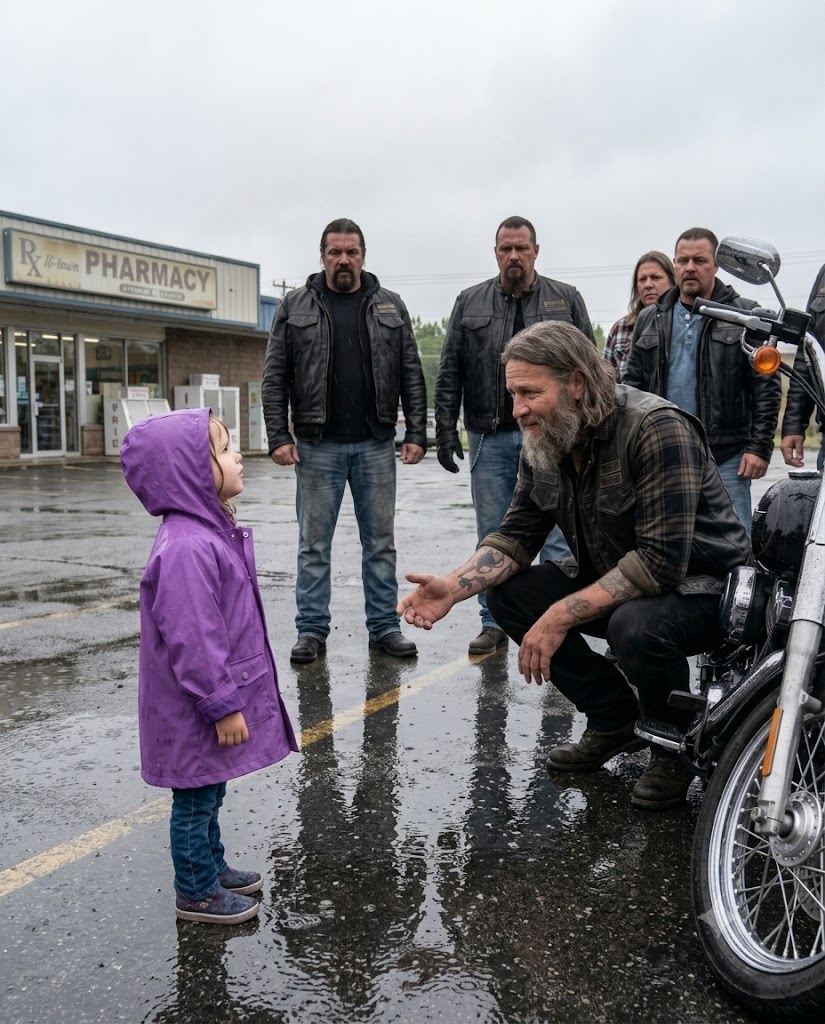
Waited. That was the word the pharmacist used when she filed her statement three days later because it was the only word that fit.
A little girl had walked into the rain at 6:40 in the morning, crossed three miles of cracked asphalt shoulder and wet gravel berm, arrived at the sliding glass doors of the Rimrock Family Pharmacy in Cobra Wells, Arizona, and waited.
She was seven years old.
She wore a single rubber boot on her left foot and a plastic bread bag knotted over her right.
She carried a handwritten note in a Ziploc freezer bag so the rain would not eat the ink.
She did not go inside.
She stood on the mat in front of the doors and did not move.
And everyone who pulled into the parking lot that morning looked at her and kept driving.
Everyone except the man on the motorcycle.
He had five hundred brothers with him.
The reason she would not go inside was the part nobody was ready for.
—
The rain had started before sunrise, the kind of northern Arizona rain that comes in from the Utah side and cannot make up its mind between drizzle and menace.
It moved in flat sheets across the high desert scrub, turned the red dirt roadsides dark and dense, and hammered the sage into silence.
By 6:00 in the morning, the temperature had dropped to 41 degrees, and the sky was the color of old pewter pressing low on the mesas.
Cobra Wells sat in the crease between two long ridges at 4,800 feet.
And in that crease, the wind had teeth.
Garland Puit was fifty-three years old, and he had been riding since he was nineteen, which meant he had been cold on a motorcycle longer than most people had been paying attention to anything at all.
He was a big man, broad through the shoulders and gone soft in the middle, the way a man goes soft when the work never stops and the cooking never starts.
His beard was iron gray and hung to his collarbone, and the skin of his hands was the texture of dried riverbeds, cracked at the knuckles from thirty years of engines and weather.
He wore a patched leather vest over a flannel shirt, over a thermal layer, and none of it was enough for a morning like this.
And he knew it, and he had ridden out anyway.
He was the president of the Ash Creek Riders, the last founding member still throwing a leg over a bike, the only man in the club who remembered what it had looked like when there were just four of them, and a storage unit, and a handshake.
He had not planned to be in Cobra Wells.
He had planned to be in Flagstaff by eight at a meeting he was already dreading.
The kind of meeting where people talked about liability and insurance riders and whether the club’s charity run permit needed to be refiled under a different category.
He had left early to avoid the interstate traffic and had taken State Route 89A through the scrub instead, which was the decision that changed everything.
He came around the long bend above town and saw the pharmacy parking lot below him, half empty in the gray morning light, and he saw the doors, and he saw the small shape standing in front of the doors, not moving, and something in the back of his skull went very still.
He pulled in.
—
A little girl walked three miles to the pharmacy in the rain, and five hundred bikers waited at the door.
He sat on the bike for three seconds after he cut the engine.
The girl had not turned around.
She was facing the doors, not the parking lot, and her shoulders were pulled up around her ears.
The way a person holds something fragile, the way you curl inward around the thing you are protecting.
He could see she was shaking.
He swung off the bike and the gravel crunched under his boots and she still did not turn.
He walked up slow, the way you approach anything that has already decided it is going to hold its ground.
“Hey,” he said, that was all, just that one word, and she turned.
Her face was seven years old, which meant it was still mostly hope even now, even soaked and pale and pinched with cold.
She had dark hair plastered flat against her forehead and eyes that were assessing him the way a child assesses a very large dog, trying to decide which category it belongs to.
She looked at his vest, at his beard, at his hands.
She held up the Ziploc bag.
“I have a note,” she said, “but I can’t go in by myself.”
He looked at the bag.
He looked at her right foot.
The bread bag nodded at the ankle, already dark with wet.
He looked at the sliding glass doors, still closed because it was six minutes before seven, and the pharmacy did not open until seven, and he understood without asking that she had been standing here longer than six minutes.
“How long have you been out here?” he said.
She thought about it with the gravity of someone doing an honest calculation.
“Since the dark,” she said.
The dark?
He felt that in his sternum like a struck bell.
“You walked,” he said.
“My mom can’t walk right now,” she said.
Not sad, not asking for anything, just a fact.
She had organized herself around the way you organize yourself around a fence post or a stone wall.
He crouched down on one knee, so his eyes were at her level, and the wet gravel soaked through his jeans, and he did not notice.
“What’s your name?” he said.
“Opal,” she said.
“Opal Drenan.”
“My name’s Garland,” he said.
“I’m going to stay right here with you until they open the door.”
“All right.”
She considered him for another moment, and then she nodded, one deliberate nod, and turned back to face the doors.
Like the matter was settled, like she had been waiting for exactly this, a large man in a leather vest to stand next to her in the rain.
And now the plan could proceed.
He stood up.
He looked at the road.
He took out his phone.
—
The first call he made was to a man named Curtis Bedlow, who went by Bedrock and was the Ash Creek Riders road captain and one of the three people on Earth Garland Puit trusted without reservation.
The phone rang twice.
“I need you to reroute,” Garland said, and gave the address.
Bedrock did not ask questions.
Bedrock never asked questions when Garland used that particular register of voice.
The one that was flat and without color, the one that meant something real was happening.
“How many do you have behind you?” Garland said.
Bedrock said he had forty-one bikes in the column with another group of twelve running parallel on the 89 and he could reach both captains in under four minutes.
“Do that,” Garland said, and hung up.
The second call was to a woman named Patrice Ambulo, who was a licensed social worker in Coconino County and who had worked alongside the Ash Creek Riders charity arm for eleven years and who picked up on the first ring at 6:52 in the morning because she always did.
Garland described the girl in six sentences.
Patrice said, “Don’t let her leave that spot.”
And he heard her already moving, keys already in hand.
“I won’t,” he said.
The third call was to a man named Vince Sells, called Splice, who handled the club’s communications network and could reach every chapter contact in the Northern Arizona corridor inside of twenty minutes if the situation called for it.
“Get on the radio,” Garland said.
“Tell them we have a child in need and we need presents.”
Splice said, “Location?”
Garland gave it.
Splice said, “By when?”
Garland said, “Now.”
Splice hung up.
He put his phone away.
The pharmacy lights had come on inside.
That particular fluorescent white that turns everything behind glass into an aquarium.
Opal was watching the lights like they were something to be grateful for.
He stood next to her and the rain came down and neither of them spoke for a moment.
“Is your mom sick?” he said.
“She has something wrong with her back,” Opal said.
“She can’t get up. She couldn’t get up for two days.”
She held the Ziploc bag a little tighter.
“The prescription ran out. The doctor called it in, but we don’t have a car and I didn’t want to wake up Mrs. Tanaka next door because Mrs. Tanaka’s husband just died.”
Garland absorbed this.
He looked at the road again.
In the distance, he could hear what was coming before he could see it, the low collective thrum of engines under rain.
A sound like the desert itself clearing its throat.
“Your mom know you came?” he said.
“I left a note,” Opal said.
“I put it on the kitchen table so she wouldn’t worry.”
She left a note.
He thought about that.
A seven-year-old girl who walked three miles in the rain on a November morning with one boot and a bread bag on her foot had stopped first to leave a note so her mother would not worry.
He did not say anything.
His jaw worked once and then he was still.
—
The first bikes came around the bend at 7:01, just as the pharmacy manager unlocked the sliding doors from the inside and stepped back to see Garland Puit and a small child standing on the mat, and then looked past them to the parking lot that was filling up the way a tide fills a harbor.
Bike after bike pulling in from both directions, headlights sweeping across the rain-slicked asphalt.
The manager, a man named Dewey Fitch, who was forty-seven and had worked retail pharmacy for twenty-two years and considered himself difficult to surprise, stood very still in the open doorway and said nothing at all.
Opal turned around and looked at the motorcycles.
Then she looked up at Garland.
“Are those your friends?” she said.
“They are,” he said.
“There’s a lot of them,” she said.
“There are,” he said.
She turned back and looked at them for another moment with that same grave, honest assessment.
Then she held out the Ziploc bag to Garland.
“Can you hold this?” she said.
“I don’t want to drop it inside.”
He took it.
She walked through the sliding doors into the fluorescent light.
He followed her.
Behind them, the parking lot continued to fill.
By the time Dewey Fitch had found the prescription in the system and begun counting the tablets, there were ninety-four motorcycles in and around the parking lot of the Rimrock Family Pharmacy, and more were coming down the ridge road in a line that went back as far as the eye could carry.
Garland stood at the counter and waited while Fitch worked.
Opal stood beside him.
She had stopped shaking mostly.
Fitch glanced up once at the crowd outside and then down again at his screen.
“Insurance,” he said.
Opal said, “I don’t know.”
Garland said, “What’s the cash price?”
Fitch checked.
“Sixty-eight dollars and forty cents,” he said.
Garland reached into the inside pocket of his vest and put four twenties on the counter.
“Keep the rest,” he said.
Fitch looked at the money and then at the man and then out at the lot full of motorcycles.
Something in his face changed in the way faces change when a person realizes they have been wrong about the category of thing they are looking at.
He rang it through.
The prescription was for cyclobenzaprine, a muscle relaxant.
Garland knew the name because his wife had been prescribed it four years ago after the accident on Route 17 that had broken three of her vertebrae and kept her flat for six weeks.
And he had driven to the pharmacy then in the car in the daylight with insurance, and he had never once thought about what it would cost a woman who had none of those things.
The thought arrived quietly and lodged itself behind his eyes, and he did not let it show.
Opal took the white paper bag from Fitch with both hands.
She held it against her chest the way she had held the Ziploc bag in the rain.
Close, like it was the most important object on the mesa.
“Thank you,” she said to Fitch.
“Thank you, Mr. Garland.”
“Garland’s fine,” he said.
“No mister needed.”
“Garland,” she said, and tried the name out like it was a new piece of equipment she was deciding whether to trust.
—
Patrice Ambulo arrived at 7:22 in a county-issued sedan with a child welfare colleague named Ross Faber, who was young and wore a lanyard that had gotten wet in the rain and now clung to his shirt collar.
Patrice was fifty-eight and had the kind of face that had seen enough hard things to have made peace with them.
She came through the doors, registered the situation in about four seconds, and crouched down to Opal’s eye level.
“Hi, honey,” she said.
“I’m Patrice. I work for Coconino County. I’m going to drive you home so your mom can take her medicine. And then I’m going to make sure somebody checks on you both. Is that all right?”
Opal looked at Garland.
He nodded.
One nod, same as she had given him in the rain.
She looked back at Patrice.
“Okay,” she said.
“How far did she walk?” Patrice said to Garland quietly while Faber helped Opal with her jacket.
“Three miles,” Garland said.
“Give or take.”
Patrice closed her eyes for exactly one second.
The way a person closes their eyes when a number arrives, and they need to hold it somewhere private before they keep moving.
Then she opened them.
“The mother’s name and address,” she said.
He gave her the information Opal had given him, the address on Canyon Street, the woman named Ida Drenan, who had been flat for two days.
Patrice wrote it on her palm with a pen from her pocket, and went to her car.
The parking lot held 212 motorcycles by the time Garland walked back out into the rain.
They were ranked in rows across the asphalt and had overflowed into the dirt lot next to the pharmacy and along the road shoulder for a quarter mile in each direction.
Riders stood between their bikes and sat on their bikes and leaned against their bikes, and most of them did not know exactly what they had come for except that Garland had needed them there, and that was a sufficient reason.
Bedrock came through the crowd, a compact man with a silver-shot beard and a limp from an old fracture that had healed at a slight angle.
He looked at Garland.
“She okay?” he said.
“She’s fine,” Garland said.
“She walked three miles in this to get her mother’s medicine.”
Bedrock was quiet for a moment.
“How old?” he said.
“Seven,” Garland said.
Bedrock looked at the road that Opal had walked, the shoulder disappearing into the wet gray distance.
Then he looked back.
“What do we need?” he said.
Garland told him.
—
By 8:00 that morning, the Ash Creek Riders had organized into four working groups.
Bedrock coordinated the first, a team of eleven riders who had tools and construction backgrounds, dispatched to the address on Canyon Street to assess what needed assessing.
A man named Tommy Grace, called Shoe Box for a reason no one could fully remember, ran the second group, six riders making a supply run to the big box store forty minutes south, working from a list that Patrice Ambulo had called in from the Drenans’ kitchen within the hour.
A third group, led by a retired paramedic named Arie Delk who rode with the club’s Flagstaff chapter, drove to the county health office in Sedona to begin the paperwork for emergency in-home medical support, a process that Arie said would take between three and seven business days under normal circumstances and that he intended to compress.
The fourth group stayed at the pharmacy because Splice had received word that two other calls had come in from club contacts in the surrounding area.
Two other situations in two other households that were not identical to Opal’s, but were near enough that it seemed like the morning was trying to say something that was worth listening to.
Garland drove to Canyon Street himself.
He did not lead a team.
He went alone because what he needed to do there was not a group task.
The house was a tan brick single-story on a narrow lot with a leaking roof gutter and a front door that had been rehung at some point and never quite squared in its frame.
There was a concrete step with a crack running diagonally across it and a dried-out potted plant that had been dead for at least one full season.
The street was quiet and residential and the sort of quiet that is not peaceful but is instead just the absence of resources.
He knocked.
He heard movement inside, slow and halting, and the door opened.
Ida Drenan was thirty-one years old, and she had the look of someone running at a steep deficit.
Not today only, but for a long time now, the way a person looks when they have been carrying more than their frame was designed for, and have simply decided to keep carrying it, because what else is there?
She was in a robe and one hand was on the doorframe and the other was clenched against her lower back.
Her eyes went to his vest and his beard and then to the white pharmacy bag in his hand and then back to his face.
“Opal,” she said.
“She’s fine,” Garland said.
“She’s with a county worker named Patrice who I would trust with my own. She’s coming home shortly.”
He held out the bag.
“She walked your prescription down in the rain. Three miles.”
Ida Drenan took the bag with the hand she had been holding against her back, and then she had to use the doorframe instead, and the doorframe held her.
Her face did something complicated that it was trying not to do.
“I didn’t know she was gone,” she said.
“I couldn’t get up. I was going to call.”
She stopped.
“I didn’t want to wake the neighbor. Her husband just died.”
Garland said, “Opal told me. She tells me things straight.”
He said, “She’s good at that.”
Ida pressed the bag against her chest with both arms.
The same gesture Opal had used.
And Garland noticed it the way you notice the thing that has been handed down without any ceremony or lesson, just passed through the skin from mother to daughter.
“Who are you?” Ida said.
“Garland Puit,” he said.
“Ash Creek Riders. We were coming through and I stopped.”
He paused.
“I’ve got people coming. They’re going to look at your roof gutter and that step. They’re going to bring some groceries. You don’t have to do anything except let them.”
Ida’s eyes were doing the thing eyes do when a person is deciding whether to keep the wall up or let it fall.
That small trembling negotiation between pride and need.
Garland had seen it before.
He had seen it in his own mirror years ago, before he had learned that need was not the same as weakness.
That the two things only looked alike from a distance.
“I can’t pay,” she said.
“Nobody asked,” he said.
She stood in the doorframe for another moment with the bag pressed to her chest.
Then she said, “Come in,” and she turned and walked back into the house slowly, one hand trailing the wall, and he followed.
The living room had two beanbag chairs and a plastic folding table and a child’s drawing taped to the wall directly across from the front door.
The kind of drawing a seven-year-old does when she is trying to render the whole world.
A house, a sun with spokes coming out of it like a wagon wheel, two figures in front of the house, one tall and one small, and under the small one the name Opal written in large earnest capitals, and under the tall one the word Mom.
Garland stood in front of that drawing for a moment.
He did not say anything.
He turned and helped Ida get to the couch.
—
By the time Patrice’s sedan pulled up in front of the house on Canyon Street at 8:40, Bedrock’s team was already on the roof assessing the gutter joint.
Shoe Box’s crew had returned from the big box store with six bags of groceries and a pair of children’s waterproof boots in size two.
And Arie Delk had called from Sedona with the information that the county health office had agreed to dispatch an in-home support worker for an initial assessment the following morning, which was not three to seven business days, which was a different outcome than the normal process produced.
Opal got out of the car.
She saw the motorcycles on the street and the men on the roof and the boots on the front step still in their box.
She looked at all of it with that same grave attention, cataloging it the way children catalog unexpected things, with precision and without judgment.
Then she picked up the boots and carried them inside.
Garland came to the door.
Patrice stood on the sidewalk.
“She needs a case worker assigned this week,” he said.
“Regularly scheduled,” Patrice said.
“I know,” he said.
“What does that take?”
Patrice said paperwork and a supervisor signature and a county budget line.
“And the budget lines are very thin right now,” he said.
“Who signs it?”
She told him.
He looked at the name on her phone screen and saved it.
“What’s his number?” he said.
She hesitated for a moment, that half second of professional caution, and then gave it to him.
He called it at 9:15 from the sidewalk outside the house, standing in the rain that had not let up.
The supervisor was a man named Harold Keat, and Harold Keat answered with the careful formality of a person who did not recognize the number and was deciding how much time to allocate.
Garland gave his name and the club’s charity registration number, which Splice had texted him, and described the situation in four sentences.
Harold Keat said there were procedures.
Garland said he understood that.
Harold Keat said the waiting period for case assignment was between six and fourteen business days.
Garland said, “Mr. Keat, I have 212 motorcycles in front of this family’s house right now and I have no plans for where to be on any of those business days.”
There was a pause.
Harold Keat said, “I’ll call Patrice Ambulo directly.”
He did.
The case assignment came through by noon.
—
212 motorcycles.
That number moved through Cobra Wells like current through wire.
The pharmacist Dewey Fitch told the story to his wife that evening and she posted it to a local community page and by midnight it had been shared nine hundred times.
A reporter from the county paper drove out the next morning and photographed the street on Canyon Street where the tire tracks were still visible in the softened dirt.
That wide unmistakable impression of 212 machines arrived in solidarity and departed in order.
But what she photographed that mattered most was the drawing on the wall.
Ida had taken it down and put it in a frame, a cheap plastic frame from the dollar store, but a frame.
The first frame in the house.
The reporter asked Opal about the drawing, and Opal said, “That one’s old. I made a new one.”
The new one was still on the table, not yet taped up.
In the new one, there were still two figures in front of the house, still a sun with spokes, but now there was a row of small rectangles behind the figures that were clearly meant to be motorcycles, rendered with the earnest imprecision of a seven-year-old working at the edge of her technical ability, and above the row of rectangles Opal had written in the same large, careful capitals, the word FRIENDS.
—
Three weeks after the morning in the rain, the Ash Creek Riders held a chapter meeting at their hall in the high desert scrub east of Flagstaff in a long low building with a corrugated roof and a parking lot that could hold forty bikes if everyone was tidy about it.
Sixty-three members were present.
Garland stood at the front of the room, which was what he did when there was something to be voted on.
He had spent the three weeks doing the kind of work he was least comfortable with and most suited to.
Calls, forms, visits, follow-ups.
The county case assignment held.
The in-home support worker had been out twice.
Ida’s prescription was on a ninety-day cycle now with automatic refill and a delivery arrangement, which the pharmacist Dewey Fitch had offered without being asked, which was the kind of thing a person does when they have been part of something that changed how they see their own capacity.
Opal was in school.
She had the waterproof boots.
But Garland had looked at what had happened on that November morning, and he had looked at what was still happening in the county and the counties around it, and he knew that Opal Drenan was not a single event.
She was a temperature reading.
He presented the proposal to the room in plain language.
A fund formally established under the club’s existing nonprofit charter, designated for emergency prescription costs and household essentials for families in the Northern Arizona corridor who could not meet an acute need on their own.
Not charity, not pity.
A standing answer to a recurring question.
He had a name for it already, and the name was the Canyon Street Fund, and sixty-three hands went up to pass it without a single hand staying down.
—
In the spring, the club ran the first annual Rimrock Ride, a 340-mile loop through the high desert that started in Cobra Wells and ended in Cobra Wells, and raised money for the fund.
268 bikes ran the first year.
Opal Drenan stood on the sidewalk in front of the pharmacy on the starting line with a sign she had made that said, “Thank you,” in letters that were big enough to read from the back of the column.
Garland came past slow and low, and she held up her hand, and he met it with his.
And that was the handshake that founded the thing.
The unspoken contract between a man on a motorcycle and a seven-year-old girl that said the world owed more than it had been paying, and they were going to collect.
Ida Drenan was standing next to the sign.
She could stand without the doorframe now.
She had a job at the Cobra Wells Library three days a week, processing returns and covering the children’s reading hour on Tuesday afternoons.
A job that had come through a connection that Patrice Ambulo had made when Patrice was also the sort of person who never wasted a connection.
She watched the column of bikes go by for a long time.
When Garland came back on foot to check the staging at the end of the lot, she said, “Thank you,” and he said, “Opal.”
And she said, “I know, but she needed you to stand next to her first.”
He thought about that for a while after.
He had been thinking about it in pieces for months already, ever since the morning in the rain, since the moment he had crouched on the wet gravel and looked at a seven-year-old who had organized her entire world around the task at hand and had walked three miles in one boot and one bread bag to accomplish it.
He thought about what it meant that she had waited for someone to stand next to her.
Not to carry the note, not to go in for her, just to stand there at the doors in the rain and be present.
That was the whole ask.
—
There was a day two years before, a day he almost never let himself go back to, when a different call had come, and he had not been present in the way that mattered.
His son, twenty-three years old, had needed something Garland had not known how to give, something that had no name on a prescription form, and Garland had been too far inside the noise of his own certainty to hear it until the noise was gone.
The silence after that was the kind you carry in your sternum, not loud, just constant, like a pilot light that never goes out.
He had ridden a lot of miles in that silence.
He was still riding in it.
But on the morning of the Rimrock Ride, standing in the Cobra Wells parking lot in the spring light that came in low and gold off the mesa and turned everything it touched the color of old brass, with 268 bikes filing past and a sign that said “Thank you” in letters big enough to read from the back, with Opal Drenan’s hand still warm against his palm, the silence was not smaller.
It was just no longer empty.
—
The Ash Creek Riders stitched a small emblem into the right shoulder of every vest that ran the Rimrock that year.
A stylized road and a figure walking it, small enough to miss at a distance, the kind of thing you had to be close to see.
By the third year of the ride, 411 bikes made the loop, and the Canyon Street Fund had paid for emergency prescriptions, fuel, groceries, and temporary housing for sixty-seven families across four counties.
And the emblem was on 411 vests, and every rider who wore it knew what it stood for, even if they hadn’t been there on the November morning when a seven-year-old crossed the rain with a note in a Ziploc bag and stood at a door she would not go through alone.
The pharmacist, Dewey Fitch, came out to watch the column pass on the third year’s ride.
He stood on the sidewalk in front of the sliding glass doors where Opal had stood, and he watched 411 motorcycles go by in the early morning light, and he held his coffee cup in both hands, and did not move until the last bike was gone, and the sound had folded back into the desert.
His colleague, a young pharmacist named Brie, who had not been working the day of the first November, asked him what the ride was for.
He told her.
She listened.
At the end, she said, “She walked three miles in the rain.”
And he said, “With one boot,” and Brie said nothing.
And the sliding glass doors opened and closed behind them as the first customers of the morning came in.
And the pharmacy went on doing what pharmacies do.
—
The drawing, the second one, the one with the motorcycles rendered in careful, imprecise lines, and the word FRIENDS in capitals above them, was framed now, too.
Ida had replaced the plastic dollar store frame with a wooden one.
It hung next to the first drawing on the wall across from the front door, and every morning when Opal came out of her room, she walked past it on her way to the kitchen, and it was possible she did not always see it anymore, the way you stop seeing the things that have become permanent, the things that have moved from event into fact.
But on some mornings she stopped and looked at it.
And on those mornings she was looking at the thing she had done before she knew what it meant.
The thing she had done because it was the only available thing and she was seven years old and her mother needed medicine and Mrs. Tanaka’s husband had just died and the rain was going to come down whether or not she walked into it.
She had not known that morning was the beginning of anything.
She had just needed someone to stand at the door with her.
—
You have believed all your life that the loudest presence in a room is the one that holds the power.
That the road and the rain belong to the large and the armored and the unmoved.
But the power on that November morning belonged to a seven-year-old girl in a bread bag and one boot standing at a door waiting.
What the five hundred answered was not a call for help.
It was a call for witness.
And if you listen to that sound, 411 engines on a desert road at first light, what you will hear underneath the thunder is not a warning, but a promise that somewhere in the scrub, someone saw you walking in the rain, and they will not let you stand at the door alone.
—
The third year’s Rimrock Ride ended at sundown in the Cobra Wells parking lot, and the sky over the mesa went through three colors before it settled on the deep blue that comes just before full dark.
The blue that is almost purple, the blue that has weight to it.
Riders shut down their engines one by one, and the sound rolled off in waves.
Each wave a little quieter than the last, until the only sound left was the wind in the scrub and the tick of cooling metal.
411 bikes still.
The lot was not big enough for all of them, and the overflow went down the road shoulder and around the corner and part of the way up the hill, and from above it must have looked like a river that had decided to rest for the evening.
Garland Puit sat on his bike after everyone else had dismounted.
The way he always did at the end of a long ride, the way he had done since the beginning, when the beginning was just four men and a handshake, and no clear sense of what they were building.
He sat and let the machine cool under him and looked at the parking lot and the people in it.
And it was Bedrock who finally came over and stood next to the bike and said, “You going to sit on that thing all night?”
And Garland said, “Thinking about it,” and Bedrock said, “Well, move over,” and leaned against the gas tank instead, which was not structurally sound.
And both of them knew it.
And neither of them said anything more for a while.
—
The Canyon Street Fund had a board now.
Three members of the club, two community volunteers, and Patrice Ambulo, who had officially retired from county service four months ago and had joined the board the week after because she said she had spent thirty-one years working inside a system, and she wanted to see what working outside of one felt like.
The board met on the second Tuesday of every month in the back room of a diner in Flagstaff that was owned by a woman named Carol Ruiz, who kept the coffee coming and never charged them for the room.
The fund’s operating total at the end of the third year stood at $44,600, built from the ride entry fees and a matching arrangement that a small building company out of Cottonwood had agreed to after one of the owners rode the first Rimrock and called Garland two days later.
The sixty-seven families had become, by the third December, ninety-three.
Ninety-three families.
The number was on a card in Garland’s inside vest pocket, written in his own handwriting, because he had started keeping it there after the second year when a journalist from a Phoenix magazine had asked him at the end of an interview why the club did it, and he had reached into his pocket and shown her the card instead of answering, and she had written in the piece that it was the most honest answer she had ever received to that question.
He did not know if he agreed with her.
He thought the honest answer was Opal Drenan walking three miles in the rain.
He thought the honest answer was the drawing on the wall.
He thought the honest answer was the sound of a seven-year-old saying, in a voice without complaint, “Since the dark.”
—
Opal was ten now.
She had grown the way children grow when someone is paying attention steadily and with increasing confidence, the way a plant grows when the water is finally regular.
She still went to school in Cobra Wells.
She had a friend named Petra who lived two streets over and who had come to the second Rimrock Ride with her parents and stood on the sidewalk next to Opal with a sign of her own, slightly smaller, that said, “Go friends,” which had kept Shoe Box smiling for the better part of a month.
Opal had taken up reading with the serious commitment of someone who had discovered a tool they intended to use, and Ida had reported to Garland at the third year’s ride, standing in the parking lot in the softening evening light, that the library had run out of books Opal had not already read in the children’s section, and she had begun working her way sideways into the adult section on the recommendation of the librarian, which was Ida herself, which struck Garland as one of the tidier outcomes he had ever witnessed.
He climbed off the bike finally when the stars were beginning to show over the eastern ridge, and he walked across the parking lot through the crowd of riders and the smell of exhaust and leather and the particular dry sage smell that the northern Arizona night carries even in spring.
He walked to the sliding glass doors of the Rimrock Family Pharmacy, which were closed now.
The lights inside reduced to the overnight safety glow that turned everything behind the glass faint and blue.
He stood on the mat.
He looked at the doors.
He had stood here before, on purpose, twice a year, in November and in spring, before the ride and after it.
He stood here and he let himself remember the shape of it, the bread bag, the Ziploc, the single boot, the shoulders pulled up around the ears.
He let himself remember crouching down on the wet gravel and looking at a face that was seven years old and still mostly hope.
He let himself remember the sound of forty-one engines coming around the bend and becoming 212 by the time the doors opened.
And he let himself remember what it had felt like to be the man standing on the mat when they arrived.
The man who had made one phone call that became a river.
He had not planned to be in Cobra Wells that morning.
He had taken the long way to avoid a meeting about liability and insurance riders and permit categories, and the long way had brought him here, and here had changed everything it touched.
He thought about his son.
He did that standing here, too.
Let himself do it fully for one minute out of the year, the November morning and the spring evening, two minutes total, in which he allowed the pilot light to say what it said without trying to turn it down.
He thought about what it meant that he had learned too late, for the person he most needed to learn it for, that the only thing a person sometimes needs is for someone to stand next to them at the door.
He had not been standing next to his son when it mattered.
He could not go back to that morning.
He could only keep showing up to this one and this one and the next one and make sure that wherever there was a door and a person waiting at it alone, there was a sound coming around the bend.
Forty-one engines becoming 212.
212 becoming 411.
411 becoming whatever came next.
He put his hand on the glass door flat.
The way you put your hand on something solid to feel that it is real.
The mat under his boots was the same mat.
The door was the same door.
The rain had stopped years ago, and the night was clear, and the stars over the mesa were the kind of stars you only get above 4,000 feet, sharp and numerous, and without mercy.
He stood there until Bedrock came up beside him and stood there, too.
Not asking, not explaining, just present the way Bedrock was always present, which was the thing Garland had trusted about him longer than almost anything else in his life.
Two large men in leather vests in front of a closed pharmacy in the dark.
The way you stand next to someone at a door.
—
It was a Tuesday in late October when the call came into the club’s dispatch line, the one Splice had set up three years ago after the Canyon Street Fund went live, the one that routed through a volunteer phone tree that could put boots on the ground inside ninety minutes anywhere in the Northern Arizona corridor.
The caller was a school nurse at a K-8 in Winslow, a woman named Dolores Kine, who had been teaching for twenty-nine years and had seen everything twice and was not easily rattled.
But she was rattled now.
She had a boy in her office, nine years old, who had walked out of class at 10:15 that morning and had not come back, and when they found him he was sitting on the curb in front of the school with his backpack on his lap and his hands folded on top of it, waiting.
Waiting for what, nobody knew.
He would not say.
He would not go back inside.
He would not call his mother, because his mother was at work and could not leave, and his father was not in the picture, and the school could not release him without a guardian present, and the nurse had been sitting with him for forty minutes trying to figure out what to do when one of the teachers said, “You know who might know what to do?”
And that was how Dolores Kine ended up on the phone with a woman named Rosa Delgado, who was the Ash Creek Riders’ volunteer coordinator for the Winslow area and who had been with the club for two years and who had never taken a call like this before but had been trained by Patrice Ambulo personally.
Rosa called Splice.
Splice called Bedrock.
Bedrock called Garland.
Garland was in the middle of a carburetor rebuild in his garage when the phone buzzed, and he wiped his hands on a rag and looked at the screen and saw Bedrock’s name and answered on the second ring.
“We got another one,” Bedrock said.
And Garland said, “Where?”
—
He was there in fifty minutes.
Winslow was a straight shot down the 40 from Cobra Wells, and he took the bike because the bike was faster and because the bike was what he knew.
He pulled into the school parking lot at 11:48 and killed the engine and sat for a moment looking at the front doors, which were propped open with a rubber wedge, and at the small figure on the curb who had not moved.
The boy was nine years old and small for his age, with dark hair cut close to the scalp and a backpack that was too big for him and shoes that had been good shoes once but were now held together at the toe with silver duct tape.
He did not look up when Garland approached.
Garland sat down on the curb next to him.
Not too close.
Just close enough.
He did not say anything for a while.
The sun was high and the day was warm and the concrete was hot under them, and the boy’s hands were folded on top of the backpack and his knuckles were white.
“Hey,” Garland said finally.
That was all.
Just that one word.
The boy turned his head.
His eyes were the eyes of a child who had learned early that adults were unpredictable and that the safest thing was to be still and wait and see.
“I’m Garland,” Garland said.
“What’s your name?”
The boy looked at him for a long moment.
“Danny,” he said.
“Danny, what are you waiting for?”
Danny looked back at the doors of the school, and then at the parking lot, and then at his own hands.
“My mom’s at work,” he said.
“She gets off at six.”
“Okay,” Garland said.
“And what happens at six?”
Danny said nothing.
Garland said, “You don’t have to tell me. But I’m going to sit here with you until somebody comes, okay?”
Danny looked at him again.
“You don’t have to,” he said.
“I know,” Garland said.
“I want to.”
And Danny nodded, one small nod, and turned back to face the parking lot, and Garland sat beside him on the curb in the October sun and waited.
—
It turned out that Danny’s mother, a woman named Elena Vasquez, worked two jobs and had been doing so since her husband left four years ago, and the reason Danny had walked out of class was that he had overheard a teacher say that morning that the school was going to start charging for after-school care, and he knew his mother could not afford it, and he had decided that the best thing to do was to wait.
Just wait.
Not go home, because the house was empty and scary.
Not stay in class, because he could not stop thinking about the money.
Just sit on the curb and wait for his mother, because his mother was the only person who could fix it, and she would be there at six, and he could wait.
He could wait.
That was the thing.
He could wait.
—
Garland sat with him for an hour and a half.
Rosa Delgado showed up at 12:30 with a sandwich and a bottle of water and a calm, kind presence that did not ask too many questions.
Patrice Ambulo, who was now seventy-one and had officially retired from everything and still answered her phone on the first ring, called the school and the district office and the county and by 1:15 had arranged for Danny to be enrolled in a free after-school program that had been funded by a grant that nobody had known about because nobody had asked.
By 2:00, Elena Vasquez had been reached at her first job and given the news, and she had cried on the phone, and Patrice had said, “It’s handled. Go back to work. We’ve got him.”
And by 3:00, Danny was in the after-school program, sitting at a table with three other kids, drawing a picture of a house and a sun with spokes coming out of it like a wagon wheel and two figures in front of the house, one tall and one small.
And under the small one, he had written his own name in large, earnest capitals.
And under the tall one, he had written the word “Mom.”
—
The Canyon Street Fund paid for the after-school program for the rest of the year.
It was $340.
Garland wrote the check himself and put it in the mail and did not tell anyone except the board, because that was how the fund worked, quietly, without ceremony, the way you put your hand on a glass door to feel that it is real.
—
The fourth year’s Rimrock Ride was the biggest yet.
503 bikes.
They came from all over the Southwest, from Phoenix and Tucson and Albuquerque and Las Vegas and even a few from California and Colorado, and they filled the parking lot and the road shoulder and the dirt lot next to the pharmacy and the field behind the church on the corner.
Opal Drenan, who was eleven now, stood on the sidewalk with her sign, which she had remade three times over the years, each version bigger and bolder than the last, and this year it said, “Thank you for standing with us,” in letters that could be read from the back of the column and probably from the ridge above town.
Garland came past on his bike, slow and low, and she held up her hand, and he met it with his, and the crowd behind them cheered, and the sound rolled up into the mesa and came back down as something that felt like a blessing.
Ida Drenan stood next to her daughter, holding a coffee cup in both hands, wearing a jacket that Patrice had helped her pick out at the thrift store in Flagstaff, and she was smiling, actually smiling, the kind of smile that starts somewhere deep and takes its time getting to the surface.
She had been promoted at the library.
She was the head of children’s programming now.
She had a routine and a schedule and a savings account with $2,100 in it, which was the most money she had ever had in her life, and she had done it herself, with help, which was not the same as doing it alone, and she had finally learned the difference.
—
After the ride, Garland stood on the mat in front of the pharmacy doors again.
The lights were on inside, the safety glow, and the mat was the same mat, and the doors were the same doors, and the rain was not falling, but he could feel it anyway, the memory of it, the weight of it, the way it had soaked through his jeans and his boots and his bones on that November morning four years ago.
He put his hand on the glass.
Flat.
Solid.
Real.
And he thought about all the doors he had stood at since then.
The door on Canyon Street.
The door of the school in Winslow.
The doors of houses in Flagstaff and Sedona and Cottonwood and Camp Verde, doors he had knocked on with groceries and prescriptions and sometimes just his presence, doors he had stood at with people who were waiting for something they could not name.
He thought about his son.
He thought about the pilot light.
He thought about the sound of 503 engines on a desert road at first light, and what it meant, and what it would keep meaning.
And then Bedrock came up beside him, like he always did, and stood there, like he always did, and neither of them said anything for a while.
—
The emblem was on 503 vests now.
A stylized road and a figure walking it.
Small enough to miss at a distance.
The kind of thing you had to be close to see.
—
It was a cold morning in February, three years later, when Garland Puit woke up and did not get out of bed.
He was sixty years old and his heart had been giving him trouble for a while, the kind of trouble he had ignored the way he ignored most things that required him to sit still and be patient, and he had ridden 340 miles the day before in the rain and the cold and had not complained once.
Bedrock found him at 8:00 in the morning when he did not answer his phone.
He was gone.
Peaceful.
The kind of gone that happens when a body finally decides it has done enough.
—
The funeral was held at the Ash Creek Riders’ hall, the long low building with the corrugated roof east of Flagstaff, and it was standing room only.
There were 700 people there.
Riders and librarians and social workers and pharmacists and county supervisors and a woman named Elena Vasquez and her son Danny, who was twelve now and tall for his age, and a woman named Ida Drenan and her daughter Opal, who was fourteen and had read every book in the Cobra Wells Library and had started ordering books from the interlibrary loan system because she had run out, and who stood at the front of the room and read a poem she had written herself, a poem about a girl who walked three miles in the rain and a man who stood next to her at a door.
She read it in a clear, steady voice, and when she was done, she folded the paper and put it in her pocket and walked back to her seat, and the room was silent for a long time.
—
Patrice Ambulo spoke next.
She was seventy-four and her hair was white and her voice was the same as it had always been, steady and warm and without any bullshit.
She said that Garland Puit had been a difficult man, and that she had known him for seventeen years, and that in all that time he had never once said the word “charity” out loud, because he believed that what they were doing was not charity, it was justice, and there was a difference, and he had spent the last years of his life trying to make other people understand it.
She said that he had not been perfect.
She said that he had carried something heavy for a long time, something she had only learned about in pieces, over coffee, in the back room of a diner in Flagstaff, and that he had never quite put it down, but that he had found a way to carry it and keep walking, and that was the most any of us could hope for.
She said that the Canyon Street Fund had paid for 214 families by then, across five counties, and that the number was on a card in his vest pocket, in his own handwriting, and that she had taken the card out and looked at it the morning after he died, and that it was still there, still in his handwriting, still the most honest answer to any question she had ever seen.
—
Opal Drenan went to college on a scholarship that the Ash Creek Riders endowed in Garland’s name.
She studied social work, the same as Patrice, and she graduated with honors, and she came back to Cobra Wells and took a job at the county health office in Sedona, the same office that Arie Delk had driven to on that November morning, the one that had taken three to seven business days to process a request that should have taken one.
She fixed that.
She was twenty-three years old when she rewrote the emergency in-home support protocol for Coconino County, and she compressed the processing time from three to seven business days to twenty-four hours, and she got the county board to sign off on it, and she did it all in the same calm, steady, grave way she had stood at the pharmacy doors when she was seven years old.
—
The Rimrock Ride was renamed the Garland Puit Memorial Ride in its tenth year.
It drew 812 bikes that spring.
Opal Drenan rode on the back of Bedrock’s bike, because she had never learned to ride herself, and because Bedrock was the closest thing to Garland that any of them had left.
She held onto his shoulders and watched the desert go by, the high scrub and the red dirt and the sage, and she thought about the morning in the rain, and she thought about the man who had crouched down on the wet gravel and looked at her at eye level and said, “I’m going to stay right here with you until they open the door.”
And she thought about how that was all it had ever taken.
Not money.
Not power.
Not a plan.
Just someone willing to stand next to her at the door.
—
The pharmacy was still there.
The sliding glass doors still opened and closed.
Dewey Fitch had retired, but the young pharmacist, Brie, was the manager now, and she had put a small framed photograph on the wall behind the counter, a photograph of the first Rimrock Ride, 268 bikes in the parking lot, and in the foreground a man in a leather vest and a little girl with a sign that said “Thank you.”
And when new employees asked her what the photograph was about, she told them the story.
She told them about the rain and the three miles and the bread bag and the single boot and the note in the Ziploc freezer bag.
She told them about the 212 motorcycles and the 411 and the 503 and the 812.
She told them about the Canyon Street Fund and the 214 families and the card in Garland Puit’s vest pocket.
And she told them that the little girl in the photograph had grown up and gone to college and come back and fixed the thing that had been broken, the thing that had made her walk three miles in the rain in the first place.
And every time she told the story, she ended it the same way.
She said, “She just needed someone to stand at the door with her.”
And then she went back to work.
—
The second drawing, the one with the motorcycles and the word FRIENDS, was still on the wall of the house on Canyon Street.
Ida Drenan had moved twice since then, to a bigger apartment and then to a small house with a fenced yard and a garden that she kept in the summer, and the drawing had moved with her both times, wrapped in newspaper and packed in a box and unpacked and hung on the wall across from the front door.
It was faded now, the paper yellowed, the colors soft, but the motorcycles were still there, the row of small rectangles behind the figures, and the word FRIENDS was still there, in large, careful capitals.
And on some mornings, when Opal came home to visit, she stood in front of it and looked at it, and she remembered the girl who had drawn it, the girl who had walked three miles in the rain with a note in a Ziploc bag and a bread bag on her foot and a single rubber boot on her left foot.
And she thought about how that girl had not known what she was doing.
She had not known that morning was the beginning of anything.
She had just needed someone to stand at the door with her.
And someone had.
And that was the whole story.
—
If you listen to the sound of 812 engines on a desert road at first light, what you will hear underneath the thunder is not a warning but a promise.
Somewhere in the scrub, someone saw you walking in the rain.
And they will not let you stand at the door alone.
—
*For Garland Puit, who stood at the door.*
*And for everyone who has ever walked three miles in the rain with a note in a Ziploc bag and a bread bag on their foot and a single rubber boot on their left foot.*
*Someone will come.*
*Someone will stand next to you.*
*Wait.*









