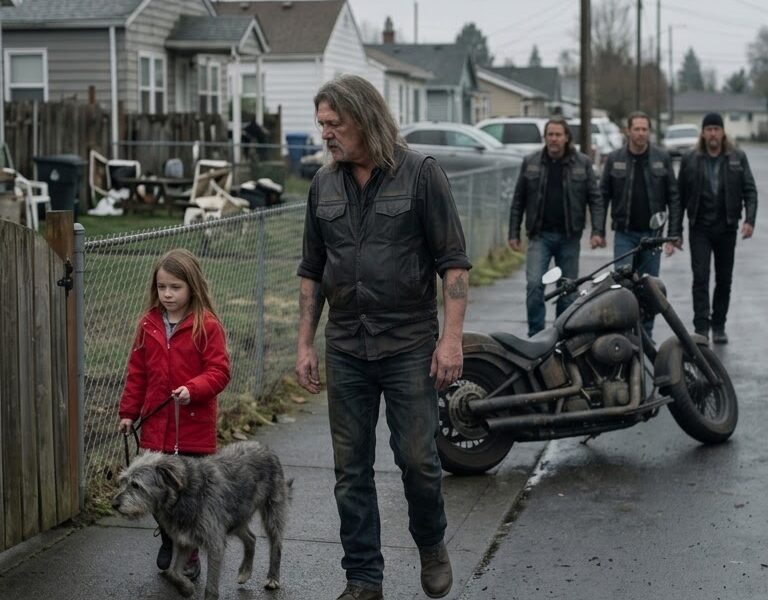
A little girl walked the same old dog to the gate every evening. Nobody knew why. Nobody asked. Then one evening, 400 bikers walked it with her.
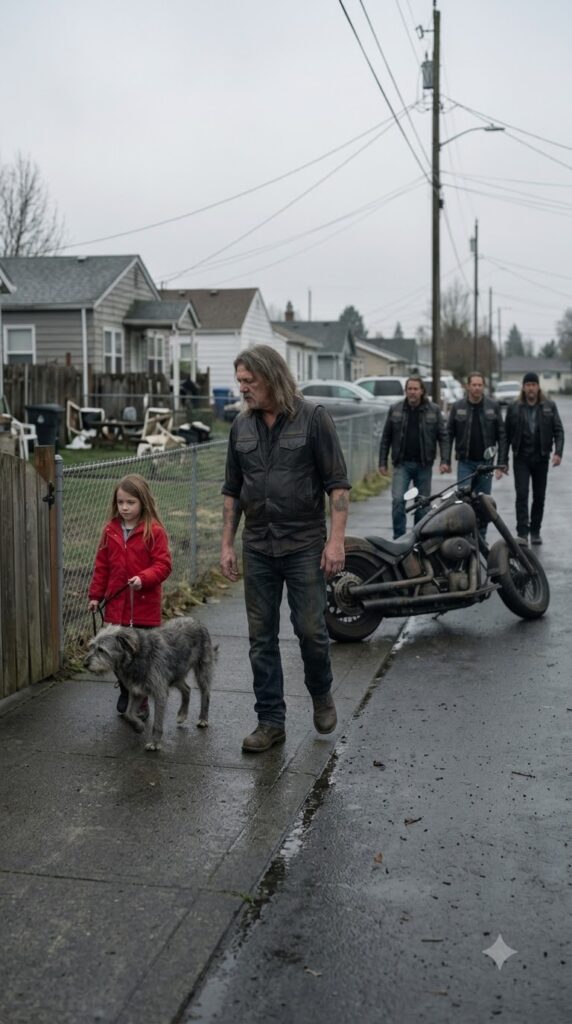
The gate was already open when Cord Delicra noticed her.
Not ajar, not swinging. Open.
The way someone leaves a thing they expect to return to. The latch folded back against the post with the patient certainty of a habit too old to question.
The girl was maybe seven. She had a leash in her left hand, and at the other end of it moved the slowest dog he had ever seen.
A hound of indeterminate color somewhere between smoke and rust, its muzzle white, its belly low, its paws making the sound of a man shuffling in socks across a kitchen floor. The leash was red.
He noticed the leash first because red was the only bright thing on the whole block at 6:00 in the November dark.
He noticed the girl second because she was not looking at the dog or at the gate or at the street. She was looking at the empty road beyond the fence with the kind of attention a person gives something that has not arrived yet, but that they have not given up on.
Every one of the 400 riders who would eventually walk that road with her had already ridden past that corner a hundred times each and seen nothing.
Cord Delicra was the only one who stopped.
What he saw, nobody around him was ready to understand. What he would do about it was the part that would take all winter.
The morning that changed nothing yet began at 5:40 in gray light on the hardpan lot behind the Ash Creek Writers Chapter House on the east side of Winslow, Arizona.
Cord was 54 years old, six-foot-two, 240 pounds, and none of it came easily anymore. His beard was black, going silver at the jaw, and had not been shaped in three years.
His hands were the hands of a man who had spent thirty years tightening things and loosening things in high desert wind. The knuckles wide, the index finger of his right hand bent at an angle that no doctor had straightened because he had never gone back to the second appointment.
The cut on his vest said PRESIDENT along the top rocker and ASH CREEK RIDERS along the bottom, and the patch in the middle was a flame over a wheel stitched by a woman in Flagstaff who had been doing the club’s leather work since before half the current membership could vote.
He had founded this chapter in a borrowed garage twenty-two years ago with six men and one working truck between them. Four of those men were still alive. He was the only one still riding.
He came out of the chapter house every morning the same way. Coffee in the left hand, keys in the right, and stood for thirty seconds looking at the bikes lined on the lot the way a man looks at a room full of sleeping people he is responsible for.
Then he rode.
He had no particular destination on a Tuesday morning in November. He had a route, the way water has a route, because gravity and repetition have made the path so deep it no longer requires a decision.
He went east on Perkinsville, turned north on a county road with no official name that the local ranchers called the Hump, dropped back into town on Seventh, and rolled slow through the neighborhood behind the grain elevator, where the houses had aluminum siding and dogs behind chain link and old trucks with primary-colored tarps over the truck beds.
He had ridden this block, this specific block, every Tuesday and most other mornings for eleven years.
That was the part that embarrassed him later when he tried to explain it. Eleven years of the same road, and he had seen that gate a thousand times, and never once registered the hinge, the latch, the precise angle at which it held open.
He registered it that morning because the red leash cut through the gray like a lit flare, and his brain, trained by a long life of reading roads for the one wrong thing, pulled his right hand back before he understood why.
He coasted to the curb.
He cut the engine.
The neighborhood filled back in around the silence. A dog two houses down, a television through a window, the thump of a dryer in someone’s utility room.
The girl did not look at him. The hound did not look at him. They stood at the open gate facing the empty road.
And waiting was so clearly what they were doing that Cord felt the intrusion of his own presence like something physical.
He sat on the bike for what he later told the membership was two minutes, but was probably closer to five. Watching the girl hold the leash with two hands and watch the road.
And then he put his kickstand down and got off.
He did not know why. He was not a man who acted without a reason. The not-knowing was stranger than the acting, so he folded it up and put it somewhere to examine later.
He walked to the fence, stopped eight feet from the girl, and looked at what she was looking at, which was the road and the intersection and the dark.
“Cold out,” he said.
She considered this.
“He used to come home this way,” she said.
He did not ask who. A person tells you that, you do not ask who. You wait, because the who will come in its own time or it will not come. And either way the asking would be a small violence.
He stood beside her at the fence for four more minutes. The three of them, the man, the girl, the hound, watching the intersection where the county road met the neighborhood street.
And then the girl said, “Beans is getting cold, too,” and she turned and walked back toward the house, the hound shuffling behind her with the patient resignation of a creature who has made this walk before and expects to make it again.
Cord watched her go. The gate was still open.
He waited until the front door of the house closed, then reached over and, after a moment’s hesitation, left the latch exactly as it was.
He rode back to the chapter house and sat in the kitchen with his coffee gone cold and tried to name what was sitting on his chest. He was not a man given to introspection. The chest thing stayed unnamed.
But the next Tuesday morning he rode the same route, and at 6:00 he slowed at the same block, and the gate was open, and the girl was there, and the hound was there, and the leash was red, and she was watching the road.
He did not stop. He rolled past slowly enough to see and fast enough not to intrude, and he counted in his head.
This was the second Tuesday. He did not know how many Tuesdays there had been before.
He found out from a woman named Rosalind Fetch, who was forty-one years old, a letter carrier on that route, and the kind of person who keeps a mental record of neighborhood rhythms without being asked.
He found her on a Thursday afternoon at the diner on Fourth where the rural carriers took their lunch. And he sat across from her and put his hands flat on the table and said, “I’m not trying to alarm anyone. I just want to know how long the little girl at the corner on Mosquite has been walking her dog to the gate at six.”
Rosalind Fetch looked at his hands and then at his face and then at his vest and then back at his face with the practiced assessment of a woman who has spent a career on foot in other people’s neighborhoods and has learned to read safety from body language.
What she read apparently satisfied her.
“Since April,” she said.
“Of what year?”
“This one.”
“Every night?”
“Every night at 6:00 until about 6:15.”
He asked what happened at 6:15 and she said she goes in, takes the dog in, comes back out and closes the gate.
He thanked her and left a tip that was larger than the coffee warranted and went back to the chapter house and stood in the cold lot looking at the bikes and did the arithmetic.
April to November, thirty-one weeks.
He had ridden past this corner for eleven years and seen nothing. And for thirty-one of those weeks, a child had been standing at a gate in the dark every single evening, watching a road, and he had seen nothing.
And the only reason he had seen it now was a red leash against a gray morning, and that felt like something he owed a debt against.
He did not tell the membership that night. He sat in the corner of the common room while Burch Navaro talked through the logistics of the Thanksgiving run, and Hector Soliss argued about the route, and a prospect named Watts got talked into making a second pot of coffee, and Cord sat in his chair with his arms crossed and thought about thirty-one weeks.
He thought about the arithmetic of thirty-one weeks of evenings, 6:00, every night. Rain and wind and the heat of July and the first cold of October.
The hound’s slow feet on the asphalt, the girl’s two-handed grip on the red leash, the gate held open.
He thought about what a child believes when she does a thing that precisely, that consistently, for that long. Not grief, not yet, not the word for it. Something prior to the word. The posture of a person who has not yet received the proof that the thing they are waiting for is not coming.
He had been that person once, in a different life, at a different gate, and the memory of it did not arrive as a thought. It arrived as a weight behind the sternum, which was the only way that particular memory ever arrived anymore.
And he pressed the heel of his right hand against his chest the way he always did when it came.
And Burch Navaro said, “You all right, boss?”
And Cord said, “I’m fine.”
And the meeting moved on.
The weight had a name, though he rarely used it. His son had been called Devon. Devon Delicra, who would have been twenty-eight now, who had instead stopped being any age at all on a Wednesday morning nine years ago on a highway outside Prescott, going too fast in the wet, the way young men sometimes do when they have been given too much freedom too early and not enough fear.
Cord had not been there. That was the part that lived behind the sternum.
He had been in Flagstaff at a regional meeting talking logistics with three other chapter presidents and his phone had been on the table face down the way he put it during meetings. And by the time he turned it over, his son had been gone for forty minutes.
He had told this story to nobody in the club except the chapter’s road captain, a man named Fitch Darrow, who had known Cord since before the club existed, and who was the only person alive Cord would allow to sit in silence with him without filling it.
It was Fitch he called the Thursday after the conversation with Rosalind Fetch. He called him at eight in the evening and said, “How many members can you get to Winslow on a Sunday afternoon?”
Fitch said, “How many do you need?”
Cord said, “All of them.”
There was a pause of about four seconds.
Fitch said, “What are we doing?”
Cord said, “Walking.”
And the pause that followed that was longer.
And then Fitch said, “I’ll start calling.”
What Fitch Darrow could do with a phone and a chain of people who trusted him had always impressed Cord in the abstract. He watched it from a distance now, and it impressed him in the specific.
By Friday evening, Fitch had reached every active member of the Ash Creek Riders across four chapters, and had put calls out through two allied clubs in Flagstaff and one in Kingman, and the count he gave Cord on Saturday morning was 406 riders confirmed, and nineteen more probable.
He had told them one thing. Show up at the Seventh Street lot at 5:15 on Sunday, park the bikes and walk. No explanation.
He had told them to wear their cuts and to leave their engines off from the moment they turned onto Mosquite. He had told them that if anyone asked questions to say they were following their president and that was the whole of it.
And nobody had asked a follow-up question because that was not how trust worked inside this club.
Cord drove past the girl’s house on Saturday morning in his truck, slowly, and confirmed three things. The gate was there. The latch was the folded-back kind. And the house was the kind of house where a family was making do.
The aluminum siding repaired in one section with wood that had been painted to match but hadn’t quite. The driveway holding a sedan with one bald front tire.
He went to the hardware store that afternoon and bought a new latch mechanism and a tube of weatherproofing compound, and he left them in a paper bag on the chapter house workbench. He did not know yet if he would use them.
He was trying not to plan too far forward. Planning too far forward had always been how he missed the thing directly in front of him.
Sunday arrived with flat white cloud cover and a wind out of the northwest that put the temperature at thirty-one degrees by midafternoon and dropping.
Cord was at the Seventh Street lot at 4:30. By 5:00 there were bikes body to body filling the lot and the side street and half of the adjacent gravel easement, idling in and then going quiet on signal.
Rider by rider killing the engines until the lot held 417 machines in utter silence, which was a silence so large and so specific it had a weight to it. The weight of 417 small decisions made all at once.
And Cord stood at the head of it and felt it on his shoulders the way he felt weather coming.
He did not make a speech. He was not a speech-making president. The membership had always understood that his authority came from the twelve words he said when words were necessary and from the thirty years of right decisions preceding them.
He said, “She doesn’t know we’re coming. She doesn’t need to know why. We just walk.”
That was it.
They walked.
Four hundred and seventeen people in leather cuts and riding boots on a November Sunday in thirty-one-degree wind, moving through the streets of Winslow in a column that stretched for a quarter mile.
Engines silent, no music, no noise except the sound of 417 pairs of boots on cold pavement, which was a sound like a slow, steady, massive thing deciding to move.
People came out of their houses. A man on a porch in a cardigan stood with a coffee mug and watched and did not go inside. A woman walking a stroller crossed to the far sidewalk and then stopped and turned back to watch. A boy of about twelve on a bicycle rode alongside the column for a block and a half before peeling off, looking over his shoulder.
Nobody in the column spoke.
Cord walked at the front with Fitch Darrow to his left and Burch Navaro to his right, and he could feel the mass of people behind him the way you feel the current of a river when you are standing at its edge even when the surface is still.
They turned onto Mosquite at 5:47. The street was quiet. Cord could see the house from the corner, the porch light on, the gate still closed.
He had done the arithmetic again that morning. If the girl came out at six, and if she was punctual the way a child is punctual when a habit has become a form of prayer, then they had thirteen minutes.
He walked at the pace he had set from the lot. Deliberate, not hurried, because hurry would make it an event, and it was not supposed to be an event.
At ten minutes to six, he stopped the column at a point thirty feet from the gate with a raised hand and nothing else, and the column folded to a stop behind him.
Four hundred and seventeen people arranged along both sides of Mosquite in the cold dark. Their breath making small separate clouds that merged above the street into one low continuous fog.
They stood. The wind moved. Nobody spoke.
From inside the house came the sound, faint, of a door at the back of the building. Then a light went on in the front room. Then the porch light brightened and the front door opened.
The girl came out first. She was wearing a coat two sizes large, a purple one, and the hood was up, and she had the red leash in her left hand, and at the other end of it came the hound, shuffling on the porch boards, navigating the two steps with the focused care of a creature for whom steps now require thought.
She did not look up immediately. She was watching the dog on the steps. When the dog reached the porch floor, she straightened and started for the gate.
And that was the moment she saw them.
She stopped. She stood on the porch with her hand on the gate latch and looked at the street full of people in the cold dark. Four hundred and seventeen of them standing on both sides of the road in leather cuts and riding boots, not moving, not speaking, their breath making one long cloud above the pavement.
The hound sat down beside her and waited, as it always waited.
The girl looked at Cord, who was standing closest to the gate, and he met her eyes and he did not say anything because there was nothing to say that the street wasn’t already saying.
She looked at him for a long moment.
Then she unlatched the gate and swung it open, the latch folding back against the post at the same angle it always folded, and she walked out onto the sidewalk and she started walking toward the intersection.
The hound beside her, the red leash in her left hand, and the column moved with her, not around her, not ahead of her, with her, at her pace, which was the hound’s pace, which was the pace of something very old and very certain of the road it was on.
Cord walked on her left, Fitch walked behind. The 414 others arranged themselves in the street and on the sidewalks and followed at the speed of the slowest dog in Winslow, Arizona, in thirty-one-degree wind, and nobody said a word.
They went to the intersection, and they stood at the intersection for the same duration the girl always stood at the intersection, which was the time it takes to watch a road for something, and to accept once more, without bitterness, that it is not coming tonight.
Then the girl turned and walked back, and the column walked back, and at the gate she stopped and looked up at Cord again and said, “He used to come home from work down that road.”
Cord said, “I know.”
She said, “His name was Marcus.”
Cord said, “That’s a good name.”
She nodded. She said, “Beans needs her dinner,” and she unclipped the leash and the hound went in.
And the girl looked at the gate and then at Cord and said, “Will you come back?”
Cord said, “Next Sunday at six.”
She said, “Okay.”
And went inside.
And the door closed, and 417 people stood on Mosquite in the dark, and nobody moved for a long time. And the man who had been holding his breath for nine years finally let it go.
It was Fitch who found the letter, not through any investigation because the Ash Creek Riders did not investigate families who had not asked to be investigated.
He found it because the second Sunday he brought coffee and thermoses for the walk, and the woman who came to the door before the girl did, a woman named Ada Brightite, who was thirty-eight years old and worked two jobs and had the eyes of a person who has not slept through a full night since April, saw four hundred and something people in leather on her street.
And instead of calling anyone, she put her hand over her mouth and leaned against the doorframe.
And Fitch, who had three daughters and understood the specific posture of a woman holding herself upright by will alone, went to the porch and introduced himself and did not offer anything, because offering something to a woman who has been managing alone requires more care than most people take.
He just stood and she talked.
Marcus Bright had been a mechanic. He had been thirty-nine. He had driven that county road home every evening for seven years, down the Hump and onto Seventh and west on Mosquite, and he had always pulled over at the gate and let the dog sniff his hand through the fence before he parked, because the dog was old even then, and rituals mattered to old dogs.
One April evening, he had not come home.
The car was found twelve miles out on the county road with a blown tire and an empty seat. The door open as though he had gotten out to look at something and then the world had simply misplaced him.
The sheriff’s investigation used the words “open” and “ongoing,” which are the words investigations use when they have no answer and no body and no witness.
Ada Brightite used the word “gone” in the flat declarative way people use a word they have said so many times it has stopped meaning anything except the fact of itself.
The girl’s name was Marin. She had been told her father was gone, and she understood this in the way a seven-year-old understands a word that does not compute. Which is to say she had built an accommodation of it that included, as its central architecture, going to the gate at 6:00 with Beans and watching the road.
Because if he had gone down that road, then that was the road he would come back on. And if she was there at the right time, the way she had always been there at the right time for the sound of his truck, then the odds were better.
That was not grief. That was engineering. The precision of a child who refuses to accept a variable she cannot test.
Fitch told Cord about the letter on the way back to the lot after the second Sunday walk. The letter was not from Marcus Bright. It was from the county, a form letter, three paragraphs, the language of jurisdiction and statutory requirements informing Ada Brightite that in the absence of a declared death, the estate could not be settled, that the insurance claim was in a review category with a timeline of eighteen to twenty-four months, and that she should contact the relevant office if her circumstances changed materially.
The letter was dated August. Ada had shown it to Fitch because he had asked if there was anything the club could help with, and she had taken him at his word and handed him the most concrete version of the problem she had.
Cord listened to this, standing beside his bike in the cold lot, and then he looked at his hands for a moment and said, “Fitch.”
Fitch said, “Yeah.”
Cord said, “Who do we know who handles estate law?”
Fitch said, “Brenda Ooa’s husband.”
Cord said, “Call him Monday morning.”
Fitch said, “Already wrote it down.”
They stood in the lot and the headlights of the last departing bike swept past them one by one and the lot went dark.
What Terrence Ooa, forty-four years old, twelve years in family and estate law, a man with the careful voice of someone who has spent a career translating institutional cruelty into plain English, found when he pulled the Bright case documentation was not technically a wall.
It was a procedure correctly applied, producing an outcome that was correctly described as unavoidable and that was nonetheless unbearable.
Marcus Bright had not been declared deceased. He had been declared missing. The distinction was not semantic. It was the mechanism by which Ada Bright’s application for the life insurance policy that Marcus Bright had maintained for six years, premiums paid by automatic withdrawal every fifteenth of the month without fail, the policy that would have paid $420,000, had been suspended pending a determination of status.
To move from missing to deceased required a petition to the superior court, a filing fee, a period of notice, a hearing date, and a judge’s ruling.
None of this was complicated in a legal sense. It was complicated in the sense that it cost money Ada Bright did not have, took time in a court calendar that stretched into next year, and required the particular steadiness of spirit it takes to ask a judge to declare your husband dead when some part of you is still going to the gate at six.
Terrence Ooa went through this with Cord at the chapter house on a Tuesday evening. The two of them at the worktable with the papers spread flat, the overhead light harsh and plain.
When Terrence finished, Cord said, “What does it cost?”
Terrence said, “Filing, notice, hearing, maybe two thousand, maybe twenty-two hundred. I’ll do my time for nothing.”
Cord looked at the papers. He said, “Give me a week.”
He got up and went to the common room where twelve members were playing cards or watching television or doing the nothing that a chapter house is for on a Tuesday night. And he said, “We’re taking a collection.”
And he put an empty coffee can on the table.
And by nine o’clock, the can had $1,800 in it. And Burch Navaro had texted nine people who weren’t present. And by Wednesday morning, the total was $4,060.
And Cord put $2,200 of it in an envelope for Terrence Ooa and the remaining $1,860 in a second envelope, which he left in Fitch Darrow’s care because the question of how to give money to a woman who had not asked for money required more delicacy than he felt equipped to manage alone.
Fitch managed it. He gave the second envelope to Ada Brightite on the third Sunday before the walk, in an exchange so plainly and unembarrassingly conducted that she took it without the performance of refusal that pride requires when an offer is made with fanfare.
Fitch just said, “From the club. For whatever’s short this month,” and she took it and said, “Tell them thank you,” and he said, “I will,” and that was the whole of it.
The walk that Sunday had 422 people. Five had come who had not been there the first week, having heard about it through the kind of informal information network that does not require social media when the people involved are already in the habit of calling each other.
Marin came out at six in a different coat, a green one this time, correctly sized, and she had the red leash, and the hound came shuffling behind her with the same patient certainty as every evening.
And she walked to the gate and opened the latch and walked out to the intersection and stood. And 422 people stood with her in the dark and the cold. And the road was empty. And it was okay for the road to be empty because she was not standing in it alone.
That was the thing Cord had not been able to name in the chapter house the first week. The thing that had sat behind his sternum unnamed and heavy. This was its name.
Not alone.
That was all it was. Not alone at the gate was the hole of what he had been trying to build for thirty-one weeks of Tuesdays when he had ridden past without stopping, without seeing, the red leash burning in his peripheral vision and his brain filing it as nothing.
Terrence Ooa filed the petition in the third week of November. The hearing was set for the nineteenth of January.
In the six weeks between the filing and the hearing, the Ash Creek Riders walked Mosquite with Marin Brightite and the hound called Beans every Sunday at six without exception, including the Sunday before Christmas when it snowed three inches by four in the afternoon, and the walk happened anyway.
Four hundred and nine people having made the judgment that snow was not an excuse a child with a red leash and a gate and a road to watch would have accepted.
And they were right, because Marin came out at six in her purple coat with the hood up and the red leash in her left hand and looked at the street full of people in the snow and said, “You came in the snow.”
And Cord said, “We came in the snow.”
And they walked.
On the morning of the Christmas walk, before the column assembled on Seventh, Cord drove to Mosquite in his truck and replaced the gate latch with the new mechanism he had bought in November, the weatherproofed folding kind that held open at the same angle as the original, because the original had begun to stick in the cold, and he had been watching Marin work it for three weeks, and it was the one practical thing he could do.
He reinstalled it so that the fold-back position was identical to what it had always been. He did not tell anyone. He left before anyone was on the street.
The hearing was on a Thursday. Cord was not in the courtroom. He had no standing to be, and it was not his place.
But Terrence Ooa was, and Fitch was in the hallway in a clean shirt with his cut left in the truck, because Fitch had the judgment to know when the cut helped and when it did not. And this was a courtroom in January, and the cut did not help.
Ada Bright sat at the petitioner’s table in a gray blazer she had pressed the night before, and answered the judge’s questions in the flat, declarative voice of a woman who has been saying these words for nine months and has made a kind of peace with the saying of them.
The judge was a woman named Honorable Clara Rice, sixty-one years old, who had been on the family bench for fourteen years, and who asked two questions and then went quiet for a long moment and then said, “The petition is granted,” in the voice of someone who understands that the words they are about to say will close a door that cannot be reopened.
The declaration was entered.
Terrence Ooa called Fitch from the courthouse steps. Fitch called Cord.
Cord was in the chapter house kitchen with his coffee and he listened to the news and then he set the mug down and stood at the window for a while looking at the lot.
The insurance company received the court order the following Tuesday. The review timeline of eighteen to twenty-four months collapsed to eleven days once the legal status was established.
Four hundred and twenty thousand dollars arrived in Ada Bright’s account on a Friday morning in February. And she sat at her kitchen table and looked at the number and then she called her mother. And then she cried for the first time since April.
The kind of crying that sounds like something structural giving way after too long holding weight it was not designed to hold.
It was March before Cord told the membership about Devon. He had not planned to tell them. It came out on a chapter night, the way things come out when the pressure behind them has exceeded the capacity of the vessel.
Not a speech, not a confession, just Cord sitting at the head of the table and Burch asking why he had stopped on that particular morning in November, and Cord saying he had seen a red leash, and Burch saying there was more than that, and there was a silence in the room.
And then Cord said his son’s name. He said it once. He described the highway and the weather and the phone face down on the table and the forty minutes. And the room held the kind of quiet that a room holds when it has been given something irreversible and is deciding how to carry it.
Fitch, at Cord’s left, put his hand on the table. Not on Cord’s arm. On the table, two inches in from Cord’s hand. That was all.
Cord said, “I drove that road every week for nine years and I never stopped at any gate.”
Nobody said anything for a long time. Then Burch said, “You stopped this time.”
And Cord said, “Yeah.”
And the meeting went on.
That was how the club carried it. Not as a wound, not as a revelation. As a fact set beside other facts in the account of how four hundred riders came to walk a road in Winslow every Sunday at six.
The walks continued into spring. By April, one year from the morning Marcus Bright had driven down the county road and not come home, there were 431 regular walkers on the Mosquite Sunday list, which was what Burch Navaro had started calling it. The list, as though it were a thing a person signed up for and received a confirmation.
The hound named Beans had slowed further through the winter, and Marin now walked slightly ahead of her, keeping the leash at a gentle tension, not pulling, just guiding, the way a person walks beside someone they love who needs the pace set without being corrected for needing it.
At the intersection on the first Sunday in April, with the air soft and the light staying later, Marin stopped at the curb and looked at the road for the usual time.
And then she turned and looked at Cord and she said, “I know he’s not coming.”
It was the first time she had said it.
Cord looked at her. He said, “Yeah.”
She said, “But I like coming here.”
He said, “So do we.”
She looked at the 431 people arranged along the road in the last of the evening light and she said, “Will you keep coming?”
Cord said, “Every Sunday at six.”
She turned back to the road one more time, the hound sitting at her feet with the white muzzle lifted slightly to the breeze, the red leash looping between them, and she looked at the intersection for a long moment.
And then she said, “Okay,” and turned and walked home.
And the column went with her, and the gate swung open, and the latch folded back against the post at the same precise angle it had always folded, the angle of something that expects to be used again.
In August, the Ash Creek Riders stitched a patch into the lining of every cut that walked that road. A small thing, hidden, red thread on black leather, shaped like a leash loop, placed over the left breast where the heart is.
Not for display. For the keeping of a thing. Not for the world to read, but for the person wearing it to remember what they had been part of on a Sunday evening in the high desert cold, when four hundred riders turned their engines off and walked at the speed of an old dog, because a child with a red leash had taught them, without meaning to teach anyone anything, what it looks like when you refuse to let the road be empty.
You think you know what power looks like. You have been taught to see it in the loud and the fast and the large and the armored.
But there are nights when the most powerful thing on any road is a seven-year-old girl with a red leash and an open gate and the absolute undefended certainty that someone is worth waiting for.
And the nights those four hundred riders walked that road were the nights they finally understood that the sound they had been making all their lives, the thunder and the roll, was always underneath just the sound of people refusing to let someone stand at a gate alone.
—
The Tuesday morning rides resumed their rhythm as if the winter had been a single held breath.
Cord came out of the chapter house at 5:40 with his coffee and his keys, stood his thirty seconds before the sleeping bikes, and rode east on Perkinsville with the air still cool and the light coming up gold over the rim.
He turned north on the county road the ranchers called the Hump, and he did not hurry. He never hurried that stretch anymore.
The road out there was two lanes of cracked asphalt with the desert pressing in on both sides, sagebrush and juniper and the occasional fence line strung between leaning posts, and the sky doing what the sky does in northern Arizona in spring, which is to say everything, all at once, weather and color and distance without any regard for the small human things moving underneath it.
He dropped back into town on Seventh and rolled slow through the neighborhood behind the grain elevator.
The gate was closed when he passed. It was 6:00 in the morning, and Marin was in school by then, and Beans was inside, and Ada was at whichever of her two jobs started earliest that day.
The latch he had installed in December was holding true. The fold-back angle was identical. He had checked it four times since Christmas, and he checked it again that morning with a glance as he rolled past, and it was fine.
That was the thing about the gate now. It was just a gate.
He had spent thirty-one weeks riding past it without seeing it, and then he had spent an entire winter seeing nothing else, and now it had settled back into being what it was. A gate. A hinge. A latch. A thing a child used to walk her dog to at six in the evening.
Except that it was also the place where four hundred and some people had learned something they had not known they needed to learn.
He thought about that sometimes, on the Tuesday rides, with the wind in his face and the road unspooling under his tires. He thought about how a thing becomes a symbol not because anyone decides it should, but because enough people show up to it with enough of themselves that the thing stops being only what it is.
The gate was a gate. But the gate was also the place where Marin Bright had stood for thirty-one weeks, and the place where 417 riders had stood with her for one night, and the place where 431 had stood with her for a season. And you could not un-know that. The gate carried it now the way a road carries the weight of everyone who has ever driven it.
He rode on.
The chapter house was quiet when he got back, the lot empty except for his own bike and Fitch Darrow’s truck parked at the far end, which meant Fitch was inside making the coffee the way he always did on Tuesdays, strong and black and too much of it, because Fitch believed in coffee the way some men believed in religion, which was to say he believed in it as a daily practice and a moral obligation.
Cord parked and went in and found Fitch at the kitchen table with two mugs and the local paper spread out in front of him.
Fitch said, “Anything on the route?”
Cord said, “Gate’s holding.”
Fitch nodded and went back to the paper and Cord sat down and drank his coffee and they did not talk for a while, which was the whole point of Tuesdays, and which was the thing Cord had never been able to explain to anyone who had not spent thirty years in a room with someone they trusted enough to be silent with.
The silence was interrupted at 7:15 by the sound of a truck pulling into the lot.
Cord looked up. Fitch looked up.
Through the kitchen window they watched a silver pickup with a dented tailgate park beside Cord’s bike, and a man get out, and stand for a moment looking at the chapter house with the uncertain posture of someone who has never been here before and is not sure he is allowed.
He was maybe forty. He was wearing work boots and a Carhartt jacket that had seen real work. He had the look of a man who had been driving for a while and had not slept well.
Fitch said, “You know him?”
Cord said, “No.”
The man walked to the door and knocked, and Fitch got up and opened it, and the man said, “I’m looking for the president.”
Fitch stepped back and let him in.
Cord stood up from the table. He said, “I’m the president.”
The man looked at him and then at the cut on his vest and then back at his face, and Cord saw the thing he had seen a thousand times in a thousand faces, which was the look of a person who has been carrying something heavy and has finally found the place where they might be able to set it down.
The man said, “My name is Daniel Ruiz. I live over on Williamson. I was on Mosquite Sunday night. The first one. In November.”
Cord said, “Sit down.”
Daniel Ruiz sat down and Fitch poured him a mug of coffee and set it in front of him and Daniel Ruiz wrapped both hands around it the way a man does when his hands are cold and his mind is colder.
He said, “I wasn’t going to come. I’ve been thinking about it since November. I talked myself out of it about forty times.”
Cord said, “What changed your mind?”
Daniel Ruiz looked into his coffee. He said, “My daughter.”
Cord waited.
Daniel Ruiz said, “She’s nine. She’s been having a hard time since her mom and I split up. Not bad, just quiet. Keeps to herself. Doesn’t talk about it. And about three weeks ago she asked me why I went on that walk in November. I told her I didn’t really know. I told her a guy I ride with called and said the president said walk, so I walked.”
He took a breath.
He said, “She asked me what it was for. And I said it was for a little girl who was waiting for her dad. And she was quiet for a while, and then she said, ‘Did it help?’ And I said, ‘I don’t know. I think it helped.’ And she said, ‘Can we do something like that?'”
Cord said, “Like what?”
Daniel Ruiz said, “There’s a kid in her class. His name is Eli. His mom died in February. Car accident on the 40. He came back to school after two weeks and he doesn’t talk to anyone. He just sits at his desk and does his work and doesn’t look up. And my daughter said to me, ‘Nobody waits with him.'”
The kitchen was quiet.
Fitch was leaning against the counter with his arms crossed, and Cord was sitting across from Daniel Ruiz, and neither of them said anything for a moment, because there are some sentences that you have to let sit in the room before you can respond to them.
Cord said, “What does she want to do?”
Daniel Ruiz said, “She wants to know if the bikers can come to his house. Just stand outside. Like they did for that girl. So he knows he’s not the only one.”
Cord looked at Fitch.
Fitch looked at Cord.
And Cord said, “Where does Eli live?”
—
The walk for Eli happened on a Thursday afternoon in late April, because Eli’s mom had been a teacher and the school had planted a tree in her memory and the ceremony was at 3:30 and the whole class was going to be there and Eli was going to have to stand in front of everyone and accept a tree.
Cord put the call out through Fitch on Tuesday and by Wednesday night he had 287 confirmed.
Not 417. 287. Because it was a school day and a weekday and not everyone could get off work, and that was fine. 287 was enough. 287 was more than enough.
They met at the Seventh Street lot at 2:45 and walked to the school, which was eleven blocks, and the column stretched for a quarter mile the same way it had on Mosquite, and people came out of their houses to watch the same way they had on Mosquite, and a boy on a bicycle rode alongside for a block and a half and peeled off looking over his shoulder the same way he had on Mosquite.
Except this time it was April and the light was soft and the trees were leafing out and the whole town smelled like someone’s lilac bush.
They stopped at the edge of the school property at 3:15 and stood along the fence line in their cuts and their boots, 287 people, not moving, not speaking, their breath not making clouds this time because it was sixty-eight degrees and the wind was from the south.
The kids came out at 3:25 for recess and saw them and stopped and stared. A teacher came out and looked at the line of bikers and looked at Cord and Cord gave her a small nod and she nodded back and did not call anyone.
The ceremony was at 3:30. The principal spoke. A teacher spoke. A woman from the district spoke. And then they planted the tree, a young oak, and Eli’s class stood in a semicircle around it, and Eli stood at the center of the semicircle with his hands in his pockets and his eyes on the ground.
He was nine years old. He had his mother’s eyes, according to what Cord had been told, and he had not cried at the funeral, and he had not cried since, and the school counselor had used the word “processing” in a report that Ada Bright had somehow seen and mentioned to Fitch, who had mentioned it to Cord, who had not known what to do with it, and had done nothing with it, until now.
The ceremony ended. The kids drifted back toward the building. Eli stayed by the tree.
And then he looked up and saw the line of bikers along the fence.
He looked at them for a long time. He did not wave. He did not smile. He just looked.
And Cord, standing at the center of the line, looked back at him and did not wave and did not smile and just stood there, the way he had stood on Mosquite, the way 287 people had stood on Mosquite, the way a person stands when they are not trying to fix anything or change anything or make anything better, but are simply refusing to let a kid stand alone.
Eli looked at them for maybe two minutes.
And then he turned and walked back to the building, and the teacher at the door put her hand on his shoulder, and he went inside.
And the bikers stood along the fence for another ten minutes, because that was what they had come to do, and then they walked back to the lot, and the lot went dark, and that was that.
Except that was not that.
Because two weeks later, Daniel Ruiz came back to the chapter house with a letter.
He said Eli had written it himself. He said Eli had given it to his daughter to give to her dad to give to the bikers. He said it was short.
Cord opened it.
It said: “Thank you for standing. It made me feel like my mom was still here. I don’t know why. But it did. Eli.”
Cord read it twice. Then he handed it to Fitch. Then he read it again.
Then he put it in the drawer of the worktable in the common room, where it stayed, and where anyone who wanted to read it could read it, and where it was still, years later, whenever anyone asked about the walk, the first thing Cord would pull out and show them.
—
The Mosquite walks continued through the spring and into summer.
By June, the list had grown to 447. By July, 463. The hound named Beans had good days and bad days, and on the bad days Marin carried her, or Cord carried her, or Fitch carried her, and nobody made a thing of it.
The gate latch held. Cord checked it every Tuesday and every Sunday, and it held every time.
In August, the club held its annual summer run, which was a three-day ride through the White Mountains, and Cord went, and Fitch went, and 200 other riders went, and they did the thing they always did, which was ride fast and loud and far, and on the second night, around a fire at a campground outside Greer, a man named Hector Soliss asked Cord why he still went on the Sunday walks.
Hector said, “I get the first one. I get the winter. But it’s been nine months, boss. The kid knows. The mom’s got the money. The town knows. What are we still doing out there?”
Cord looked at the fire for a while.
He said, “You ever have a thing you did that you can’t undo?”
Hector said, “Sure.”
Cord said, “And you ever have a thing you did that you can’t undo, but you can do one thing after it that makes it a little better, even if it doesn’t fix it?”
Hector said, “Yeah.”
Cord said, “That’s the walk.”
Hector didn’t say anything for a minute. Then he said, “That’s a good answer.”
Cord said, “It’s not an answer. It’s just the truth.”
And Hector nodded and went to get another beer and the fire crackled and the stars came out over the White Mountains the way they do, all at once, like someone had flipped a switch.
And Cord sat there and thought about Devon, and about the phone face down on the table in Flagstaff, and about the forty minutes, and about all the gates he had driven past in nine years without stopping.
And he thought about Marin Bright and her red leash and her open gate and her absolute undefended certainty that someone was worth waiting for.
And he thought about Eli and the tree and the letter in the drawer.
And he thought about the fact that he had spent fifty-four years learning how to be a man who tightened things and loosened things in high desert wind, and it had taken a seven-year-old girl with a red leash to teach him what he had actually been built for.
Which was not fixing. Not commanding. Not leading.
Just standing. Just refusing to let someone stand at a gate alone.
That was the whole thing. That was the entire lesson.
And he had needed 400 riders and a winter and a hound named Beans and a child who would not accept a variable she could not test to learn it.
—
The letter from the county came in September.
Cord was in the kitchen when Fitch brought it in, and Fitch was holding it like it was something that might bite him, and Cord took it and opened it and read it.
It was from the sheriff’s office. It was two paragraphs. It said that a body had been found in a remote area of Coconino County, and that the body had been identified through dental records, and that the identification had been confirmed as Marcus Bright, and that the remains had been released to the family, and that the investigation was now closed.
Cord read it twice. Then he set it down on the table and looked out the window at the lot.
Fitch said, “You want me to call Ada?”
Cord said, “No. I’ll do it.”
He drove to Mosquite in his truck. He parked at the curb and walked to the door and knocked, and Ada Bright answered, and she looked at his face and she knew.
She said, “They found him.”
Cord said, “Yes.”
She said, “Where?”
Cord said, “Coconino County. Remote area. They identified him through dental records.”
She said, “Was it—” and she stopped, because there was no version of the question that had an answer that would help.
Cord said, “The letter says the investigation is closed. That’s all it says.”
She nodded. She stood in the doorway and nodded and did not cry, because she had already cried, and because the crying was done, and because what was left was not grief but the strange flat relief of a question that had finally been answered, even if the answer was the one she had known in her bones since April.
She said, “Does Marin know?”
Cord said, “Not yet. I wanted to tell you first.”
She said, “Thank you.”
She said, “Will you tell her?”
Cord said, “If you want me to.”
She said, “I think she should hear it from you. You’re the one who’s been walking with her.”
Cord said, “Okay.”
Ada went inside and came back a few minutes later with Marin, who was wearing a sweatshirt with a cartoon dog on it and who looked at Cord with the same direct attention she had looked at him with on the first night, on the porch, with her hand on the gate.
Marin said, “Hi.”
Cord said, “Hi.”
He said, “Can I talk to you for a minute?”
She said, “Okay.”
They sat on the porch steps, the two of them, and Beans came out and lay down at Marin’s feet, and Cord looked at the road and the intersection and the gate, and then he looked at Marin.
He said, “They found your dad.”
Marin looked at him. She did not say anything.
Cord said, “He was in the county. They identified him. He’s not coming home.”
Marin looked at the road for a long time.
And then she said, “I know.”
Cord said, “You know?”
She said, “I’ve known since Christmas. I didn’t want to say it because everybody was being so nice.”
Cord did not say anything.
Marin said, “Beans knew too. She’s old. She knows things.”
Cord said, “Yeah.”
Marin said, “Are you still going to come on Sundays?”
Cord said, “Every Sunday at six.”
Marin said, “Okay.”
She leaned against him, just a little, just enough that he could feel the weight of her against his arm, and they sat on the porch steps and looked at the road, and the road was empty, and it was okay for the road to be empty.
—
The funeral was on a Saturday in October.
It was small. It was at a church on the north side of town, the kind with a white steeple and a parking lot that fit thirty cars, and there were about sixty people there, family and coworkers and neighbors and a few of the guys from the shop where Marcus had worked.
And there were 312 bikers.
They did not go inside. They did not need to. They stood along the street outside the church in their cuts and their boots, 312 of them, not moving, not speaking, and when the hearse came, they stood at attention, and when the family came out, they stood at attention, and when the procession started, they did not follow.
They just stood there, along the street, in the October light, and let the family go by.
Marin was in the first car. She looked out the window and saw them, all 312 of them, along the street, and she put her hand up against the glass, and Cord, standing at the corner, put his hand up, just once, just a small wave, and she nodded, and the car went on.
And then the bikers went back to the lot and went home.
—
The Sunday after the funeral, the walk was at 6:00 as always.
Marin came out in her purple coat. She had the red leash in her left hand and Beans at the other end, and she walked to the gate and opened the latch and walked out to the intersection and stood.
And 447 people stood with her.
And the road was empty. And it was okay.
And when she turned around to go back, she looked at Cord and said, “He’s not coming.”
Cord said, “No.”
She said, “But you are.”
Cord said, “Yeah.”
She said, “Okay.”
And she went inside.
—
The walks continued.
Through the winter, through the snow, through the cold. Through the spring and the summer and the fall.
In the second year, there were 478 regular walkers on the Mosquite Sunday list. In the third year, there were 502. People moved in from other towns and joined the club just to be part of it. A chapter in Tucson started its own version for a family in their neighborhood. A club in New Mexico called Fitch to ask how it worked. Fitch told them it didn’t work. It just was.
Beans died in the spring of the third year, at home, on her bed, with Marin’s hand on her head. She was fourteen, which the vet said was ancient for a hound, and Marin said she knew, and Ada said she knew, and Cord said he knew, and they buried her in the backyard under the oak tree that Ada had planted the year they found out.
Marin was ten by then. She had grown six inches and lost two teeth and gained a stepbrother, because Ada had remarried, a man named Paul who worked at the hospital and who had come to the walks three times before he had asked Ada out, which Cord had always thought was the right order of operations.
The gate still had the latch Cord had installed. It still folded back at the same angle. It still held.
And Marin still walked to it sometimes, without Beans, just to stand at the intersection and look at the road.
Not because she was waiting. Because she liked coming there. Because it was the place where she had learned that you can wait for something that is not coming and still be okay. Because it was the place where she had learned that you can be not alone even when the thing you want most is gone.
Cord was fifty-seven by then. He had gone gray at the jaw and his knee had started to bother him on cold mornings and he had finally gone back to the doctor about his finger and the doctor had said it was too late to fix and Cord had said that was fine, he had gotten used to it.
He still rode every Tuesday. He still came out of the chapter house at 5:40 with his coffee and his keys and stood his thirty seconds before the bikes.
He still rode east on Perkinsville and north on the Hump and back into town on Seventh, and he still rolled slow past the gate on Mosquite, and he still checked the latch every time.
And every Sunday at six, he was at the corner with the rest of them.
And every Sunday at six, Marin came out, and walked to the gate, and opened the latch, and stood at the intersection, and watched the road.
And every Sunday at six, the column stood with her.
—
There is a picture that Fitch took, on the fourth anniversary of the first walk.
It was April, and the light was soft, and the whole street was full of people in leather cuts and boots, and Marin was at the intersection with her hand on the leash loop of a new dog, a rescue hound named Rufus who was also slow and also patient and also knew things, and Cord was standing to her left, and Fitch was standing behind, and the 500 and some others were arranged along the street in the last of the evening light.
And if you look at that picture, you do not see anything dramatic. You see a girl and a dog and a man and a crowd, standing on a street in a small town in Arizona, doing nothing.
But if you look at it for a while, you start to see the thing that is not in the frame.
Which is the road. The empty road. The road that goes out to the county and the Hump and the highway and the world, the road that Marcus Bright drove home on every evening for seven years, the road that did not bring him back.
And you start to understand that the picture is not about waiting. It is about refusing.
Refusing to let the road be empty. Refusing to let the gate be closed. Refusing to let a child stand alone at the edge of a world that has already taken too much from her.
And you start to understand that the thing that power actually looks like is not in the frame either. It is in the fact that 500 people showed up on a Sunday evening in April to stand in the street with a girl and a dog because she had once stood there alone for thirty-one weeks and nobody had seen her.
Except one man. One man on a motorcycle, riding the same route he had ridden for eleven years, who had seen a red leash against the gray and stopped.
And that was all it took. That was the whole thing. One man who stopped.
And then another. And then another. And then 400 more.
And then a town. And then a movement.
And then a girl who knew, finally, that she was not alone.
—
Cord died in his sleep nine years after the first walk.
He was sixty-three. It was a heart thing, the kind that takes men who have spent their lives working in the wind. He had not been sick. He had gone to bed on a Tuesday night after a chapter meeting and had not woken up on Wednesday morning.
Fitch found him. Fitch had come to the chapter house at 6:00 and Cord’s truck was there and the coffee was made and the bike was parked and Cord was not in the kitchen, and Fitch went to the back room where Cord sometimes napped and he was there, on the cot, with his boots off and his hands folded on his chest.
Fitch sat with him for a while. Then he called the police and then he called the members and then he called Ada Bright.
The funeral was the largest the town had ever seen. There were 1,200 bikers. There were people from four states. There was a flag line and a missing man formation and a 21-bike escort, and the whole town came out and stood along the street, the same street, the same corner, the same gate.
Marin was nineteen by then. She was in college, studying engineering, because of course she was. She spoke at the funeral. She stood at the front of the church and looked at the crowd and said:
“He stopped. That’s all he did. He saw a girl with a red leash and he stopped. And then he walked. And then he kept walking. And he never stopped walking. And because he didn’t stop, I didn’t have to stand alone. And because he didn’t stop, a lot of people didn’t have to stand alone. So if you want to know what to do with your life, that’s it. Stop. And then walk. And then keep walking.”
She sat down.
And the church was quiet.
And then 1,200 bikers stood up and walked out and started their engines and rode, and the sound was like a slow, steady, massive thing deciding to move, and it moved through the streets of Winslow and out onto the county road and up the Hump and into the desert, where the sky was everything and the road was empty and the wind was high and the man who had stopped was finally, after all those years, riding with them.
—
The walks continue.
They are led now by Fitch Darrow, who is seventy-one and still rides, and by Burch Navaro, who is fifty-eight and has taken over the day-to-day of the chapter, and by Marin Bright, who comes back every April and every October and every Sunday she can, and who has never once missed the anniversary.
The gate latch that Cord installed is still there. It is rusty now. It still folds back at the same angle. It still holds.
And on Sunday evenings at six, in the high desert cold, in the wind and the snow and the heat and the light, the column still forms, and the people still come, and the girl—the woman now—still walks to the intersection and looks at the road.
And the road is empty.
And it is okay.
Because she is not alone.
Because 500 people are standing with her.
Because one man stopped, a long time ago, on a Tuesday morning in November, and saw a red leash against the gray, and understood that the only thing that matters in this world is whether you stop when you see someone waiting.
And he stopped.
And he walked.
And he kept walking.
And so do they.
—
There is a patch now that the Ash Creek Riders wear on the inside of their cuts, over the left breast, where the heart is. It is a small thing, red thread on black leather, shaped like a leash loop.
And if you ask any rider who wears it what it means, they will tell you about a girl named Marin and a hound named Beans and a man named Cord Delicra, who founded a chapter in a borrowed garage twenty-two years ago with six men and one working truck and who spent the last nine years of his life walking a road in Winslow, Arizona, every Sunday at six.
And they will tell you that the patch is not for display. It is for the keeping of a thing.
And the thing it keeps is this: that the most powerful thing on any road is not the engine and not the speed and not the sound.
It is the refusal to let someone stand at a gate alone.
And that refusal, once it starts, does not stop.
It just walks.









