
A little girl walked past the same hardware store window every day after school. She never went in. She never said a word. Then one day, she looked up—and 450 bikers were standing inside.
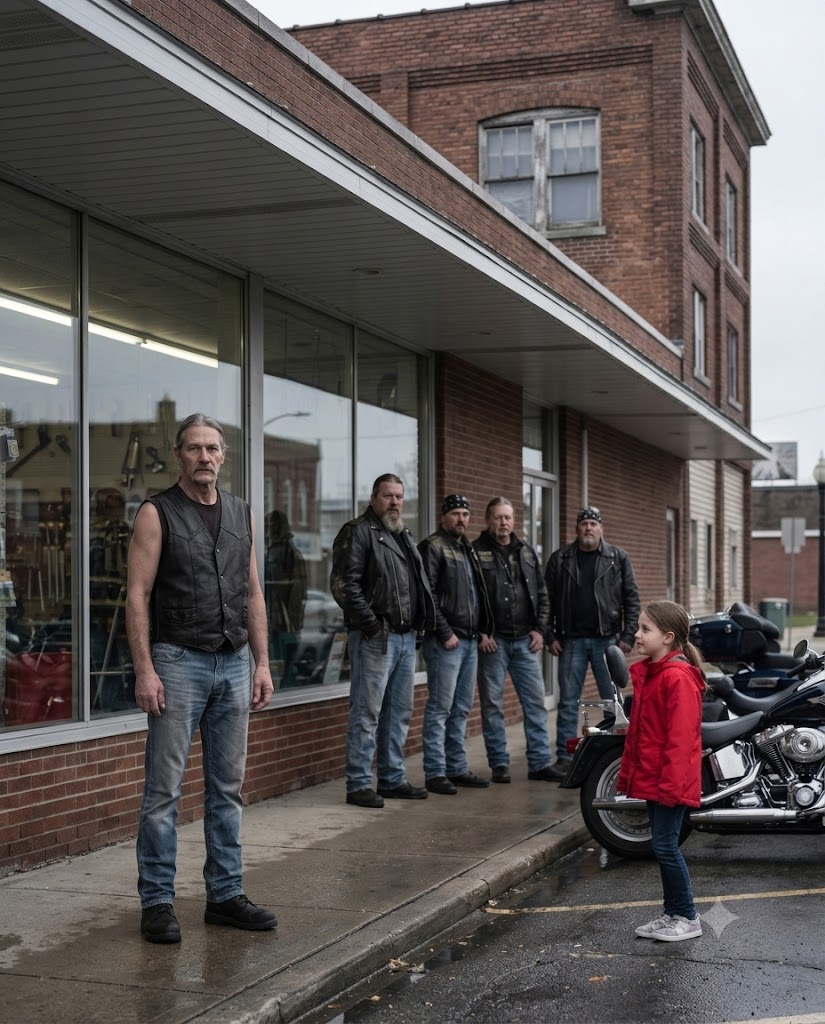
G. Llewellyn counted 14 windows in the hardware storefront, and the girl was framed in the seventh one.
Same as yesterday, same as the day before.
He was sitting on an overturned milk crate behind the counter eating a cold tamale when he saw her stop.
And something about the precise way she stopped—not drifting, not distracted, but arriving, the way a person arrives at a place they have decided on—made him set the tamale down on the glass case and keep his eyes on her.
She was maybe 8 years old.
She wore a green canvas backpack that was too large for her frame and a pair of brown corduroy pants with a tear at the left knee that someone had ironed flat as though pressing it could close it.
She stood at the seventh window, put both palms flat against the glass, and looked in at the rack of kerosene heaters on display inside the store.
She stood that way for a count of 12.
Then she picked up her backpack straps, turned, and walked back up the sidewalk toward the elementary school with the same deliberate step she had arrived with.
G watched her go.
Outside, the oaks along Mineral Street had gone the color of old rust, and the wind off the Kaibab Plateau came down Maine hard enough to move the yellow caution tape somebody had strung around the sinkhole three storefronts north.
Ash Creek, Arizona, sat at 4,600 feet in October.
There was not a gentle thing.
He had lived in this town 41 years, and he still had not made peace with the cold that came pouring down off that plateau the moment the calendar said October.
He watched the green backpack until it disappeared around the corner by the feed store, and he finished his tamale, and he told himself it was nothing.
He told himself that for four more days.
On the fifth day, he got up from the milk crate before she reached the window, walked out through the front door, and waited on the sidewalk.
Three hundred forty-four miles of high desert road had creased his face into something people crossed streets to avoid.
Sixty-one years of living, 28 of them as president of the Ash Creek Riders, had left marks on G. Llewellyn that no amount of goodwill could disguise.
He was thick through the shoulders, gray in the beard and the braid, with hands that looked like they belonged to a man who had spent his life carrying weight he had not been asked to put down.
He stood on the sidewalk in front of the seventh window, and he waited.
She came around the corner of the feed store at 3:20, same as every day.
She saw him standing there, and she slowed down one step—assessing.
Then she came on.
The morning of that first Friday in October had started the way mornings in Ash Creek always started in autumn—with cold that got into the building before the heat did.
G had been at the club’s table in the back room of the hardware store since 6:45, going over the lease renewal on the property, which he also owned, which was a thing that still struck people as improbable when they learned it.
A man who looked like G. Llewellyn, holding the deed to a piece of Mineral Street.
The back room served as the Ash Creek Riders meeting hall on the first and third Thursday of every month, and on the other days it served as overflow storage, and as the place G came to think when the apartment above felt too small and his own company too familiar.
The club had 19 active members and 11 on associate status, which was not a large number but was the right number for the stretch of high desert they rode.
And every one of those members had been chosen the way G’s father had taught him to choose tools—for what they could actually do under actual pressure, and for nothing else.
The lease paperwork was spread across the long table, and G was working through the property tax line with a yellow highlighter when he heard the school bus stop on Maine and the sound of children dispersing onto the sidewalk, the way they always did at quarter past three.
And he looked up through the narrow interior window that gave onto the store floor, and through the store floor to the front glass, and he saw the girl stop at the seventh window for the first time.
He thought she was looking at the display.
Children looked at displays.
He went back to the lease.
But something filed itself away in him without his permission.
The precise way she had placed her palms on the glass, the angle of her head, the fact that she was not looking at the children’s items—the hand warmers or the pocket flashlights—but at the kerosene heaters, which were the largest and most expensive items in the display, which started at $239 and went up from there.
He highlighted the property tax line.
He did not think about her again until the next afternoon when she came back.
The second day she stayed for a count of 15.
He knew because he counted without meaning to.
She had the same green backpack, the same corduroy pants with the ironed-flat tear.
She had pulled her hair back with a rubber band that was too tight for it, so a ridge of dark hair stood up along the top of her head like a small determined crest.
She looked at the heaters with an expression that G could only describe, even to himself, as professional.
Not wanting, not sad—measuring.
She was measuring something, and whatever the measurement was, it was important, and the answer was not yet right.
The third day, she brought a notebook.
It was a school composition notebook, the kind with the black-and-white marbled cover, and she opened it against the glass while she looked at the heaters, and she wrote something in it with a stubby pencil she kept tucked behind her ear.
She wrote for a while, then she closed the notebook, put it in the backpack, and left.
G stood behind the counter for a long time after she turned the corner.
The wind hit the front windows, and the kerosene heaters in the display shifted slightly in their cardboard staging like things uncertain of their position.
He was not certain of his either.
He had learned over 61 years that the things he did not understand had a way of costing him later.
He had also learned that the things he did not act on cost him more.
By the fourth day, he knew her schedule down to the minute.
3:20, seventh window, a count that had grown to 22 seconds of standing with palms flat, writing something in the notebook, then leaving.
She never looked in through the door.
She never came inside.
She looked only at the heaters, wrote in the notebook, and went.
On the fifth day, he went outside to wait for her.
He had not planned what he would say.
That was not unusual for him.
He was better at listening than at planning, and he had known that about himself for long enough to work with it instead of against it.
She came around the corner of the feed store at 3:20 and saw him on the sidewalk and slowed by one step—assessing.
She had brown eyes set wide apart, and they were calm eyes.
Not a child’s frightened eyes, not a child’s delighted eyes—just eyes that gathered information carefully and stored it somewhere behind a face that did not give much back.
She came on.
She stopped two feet from him, which was a considered distance—close enough to speak, but far enough to reconsider.
She looked up at him, and G. Llewellyn, who could make county sheriffs uncomfortable simply by holding eye contact, felt the peculiar experience of being evaluated by someone who weighed considerably less than his left arm.
“That’s a lot of heaters,” she said.
He looked at the window.
“Yep,” he said.
“The middle one,” she pointed at the display without putting her hand on the glass this time—just a finger aimed at the largest unit in the center.
A Dura Heat DH2304 that ran on 2.3 gallons of kerosene and would heat 12,200 square feet for 14 hours on a single fill.
He knew the specs because he had ordered them himself in August.
“What about it?” he said.
“It costs $289,” she said.
“Plus tax,” she said.
“Plus tax.”
The way someone says a fact they have verified three times to be sure of.
“That’s right,” G said.
She looked at the heater for another moment.
Then she looked at him.
“My mom’s hours got cut,” she said.
“At the plant. She folds.”
She shifted the backpack straps on her shoulders—a small adjustment, a settling.
“Our heat doesn’t work,” she said.
“It broke in September.”
“Have you told the landlord?”
She looked at him the way a person looks at someone who has said something they already knew the answer to.
“He said he’d get to it.”
She said it the way it was.
No anger in it, just the weight of it.
“Okay,” G said.
He did not say anything else.
She waited to see if he was finished, determined that he was, and then walked to the window, put her palms on the glass the way she always did, looked at the Dura Heat for her count, opened her notebook, and wrote something he could not see.
He watched her write.
“What’s in the notebook?” he said.
She turned enough to answer without fully turning.
“How much I have,” she said.
She closed the notebook, tucked the pencil behind her ear, and looked at the heater one more time.
“I have $19.40,” she said.
“I walk Mrs. Bellen’s dog on Saturdays.”
Then she put the backpack straps back on her shoulders and walked away up Mineral Street.
G stood in front of the seventh window, and the wind off the plateau came down Maine and found every gap in his coat and in his collar, and he let it.
$19.40 toward $289 plus tax.
He did not do the math on how many Saturdays that was because he did not need to.
He already knew it was the wrong number by so much that the number itself was the problem.
He went back inside.
He sat down on the milk crate.
He looked at the Dura Heat DH2304 in the display, and he looked at the floor, and he looked at the backs of his hands, which were large and scarred and had not been enough once when being enough had mattered.
He had had a daughter.
She had been nine.
That was 17 years ago.
And he had learned to keep that fact in a place where it did not get in the way of functioning, which was not the same thing as being over it, and he had never claimed it was.
He picked up his phone.
He called Denny Marsh first because Denny was the road captain and the most organized person in the club by a margin significant enough to matter.
And because if G called Denny before he called anyone else, it sent a signal to the rest of the membership that this was not an impulse but a direction.
Denny answered on the second ring and said, “What?”—which was his standard greeting, and the reason G kept him as road captain.
A man who did not waste syllables on pleasantries was a man who would not waste anything else either.
G told him what he had seen for five days and what the girl had told him in two minutes on the sidewalk.
And Denny was quiet for a moment.
And then Denny said, “How old?”
“Nine,” G said.
“Maybe eight.”
“What’s the landlord’s situation?” Denny said.
G told him what the girl had told him.
Denny was quiet again, and in that quiet, G could hear the very precise sound of Denny shifting from the part of himself that assessed situations to the part of himself that organized responses to them.
“I’ll call Reyes and Tall Cotton,” Denny said.
“You call the others.”
“Yep,” G said.
He called nine more members in the next 11 minutes.
He did not explain at length to any of them because he did not need to.
He told them what there was to tell, which was a child, a cold apartment, a broken heating system, a landlord who had said he would get to it, and a girl with $19.40 in a composition notebook who came every day to look at a thing she could not yet reach.
Every one of the nine said yes before he finished the sentence.
That was what the club was.
That was what it had always been.
Under every patch on every back.
Under every mile of road between Ash Creek and the edge of the plateau.
Under every misread expression on every stranger’s face when the bikes came through their town.
People who said yes before the sentence was finished to the people who needed it.
And nothing else needed to be said about that.
By 6 that evening, 11 club members were at the back room table with coffee and Denny’s yellow legal pad.
And G told them the rest of what he knew, which was not yet much.
He knew the girl came from the direction of the elementary school.
He knew her mother worked at the laundromat on Cottonwood and Fourth, folding clothes for whatever the laundromat paid folders, which was not a number that included emergency heating equipment.
He knew the apartment was cold enough that an eight-year-old had decided on her own—without telling anyone except a stranger in front of a hardware store window—to fix it herself.
He set that fact on the table between them and let them sit with it.
Reyes, who had two daughters of his own and coached Little League in the spring, put both hands flat on the table and stared at them for a moment.
Tall Cotton, who was 6’4″ and spent his off-seasons working search and rescue in the canyon country north of town, had a muscle working in his jaw that meant he was keeping something in.
Marlene Goff, the club secretary and the only member with a paralegal certification, was already writing on a second legal pad.
“I need the landlord’s name,” Marlene said.
“And the address.”
“I don’t have either yet,” G said.
“I’ll have them tomorrow. I’ll start with the property at Cottonwood and Fourth.”
She said there was only one laundromat there, and she could pull the county assessor’s records for the residential properties on that block.
She said it the way she said everything—flatly and as if it were already done, which was the reason G had asked her to be secretary 11 years ago.
“What’s the number on the heater?” Denny said.
“$289 plus tax,” G said.
“$312 something.”
Denny wrote it down.
He wrote it down even though everyone in the room already had it.
He was that kind of man.
They went through the rest of it.
Who would talk to the girl again, which needed to be G because she had already decided something about him that would take a different person longer to establish.
Who would pursue the landlord question through Marlene’s research.
Who would check whether Cottonwood County had a housing ordinance with timelines for heating system repair, because Tall Cotton had a feeling they might, and Tall Cotton’s feelings about regulations had a way of being accurate.
They talked for an hour and 20 minutes.
When they were done, Denny tore the top sheet off the legal pad and folded it and put it in his chest pocket, and they went home in the October cold.
And the wind was picking up off the plateau, and the oaks on Mineral Street were losing leaves by the handful.
Bright rust-colored things skidding across the sidewalk in front of the hardware store where a girl had stood every afternoon with her palms on the glass and her $19.40 and her composition notebook, measuring the distance between where she was and where she needed to get to.
Marlene had the landlord’s name by 8 the next morning.
She had also pulled Cottonwood County Municipal Code Section 14, Article 7, which stated that a landlord was required to restore heating to any residential unit within 15 days of receiving written notice of failure.
And if the tenant had not given written notice, the clock had not started.
The girl’s mother had called.
She had not written.
The clock had not started.
The landlord’s name was Boyd Cutter, and he owned seven properties in Ash Creek and two more in the county outside city limits.
And his practice, according to Marlene’s brief survey of the county magistrate’s public filings, was to respond to verbal complaints with the phrase “he would get to it,” and to respond to nothing else until someone gave him a reason to.
He was not breaking the law.
That was the unbearable part.
He was correctly reading a law that had a hole in it the size of a family’s winter, and he was standing in that hole and calling it a foundation.
G took this information and sat with it for the morning.
He was not a man who moved fast when fast was the wrong speed.
He had learned the cost of fast and the cost of slow, and he had learned more precisely the cost of confusing them.
He drank his coffee at the kitchen table upstairs from the hardware store and looked at the wall and thought about what he actually had, which was not nothing.
He had the code.
He had the clock, which had not started but could start.
He had Marlene, who could write a letter that would start the clock today.
He had 15 days from the moment that letter was delivered, and 15 days in October in Ash Creek at 4,600 feet with a non-functioning heater and a child who wore corduroy pants with an ironed-flat tear in the knee was not an acceptable 15 days.
He did not intend to use them.
He went downstairs at quarter past ten and unlocked the hardware store and turned the lights on and started the day.
And at 11:15, Denny came in through the back and said he had called a friend in the fire marshal’s office who had told him that a residential heating system that failed entirely could, under the right circumstances, constitute a safety hazard.
And a safety hazard could change the timeline from 15 days to 72 hours.
And Denny’s friend in the fire marshal’s office had agreed that it was worth an inspection.
G looked at Denny.
“How fast?” he said.
“Could be today,” Denny said.
“If I follow up.”
“Follow up,” G said.
Denny took out his phone.
He was a meticulous person, and he liked having a task that was precisely sized to his abilities.
And making a phone call that started a formal government inspection was exactly that.
And he walked to the corner of the store by the paint samples and made the call in a low, deliberate voice that carried just enough across the store floor for G to hear the shape of it without the words.
At 3:20, the girl came to the seventh window.
G went outside again.
She stopped at the same two-foot distance, looked up at him, and waited.
“I need to know your name,” G said.
She considered this for a moment.
“Why?” she said—not hostile, procedural.
“Because I’m going to talk to your mom,” he said.
“And I need to know your name before I do that.”
She thought about this the way she thought about everything, which was seriously and without apparent hurry.
“Petra,” she said.
“Petra Voss.”
“G. Llewellyn,” he said.
She looked at the name like she was filing it.
“Does your mom know you come here?” he said.
Petra looked at the window and then back at him.
“She knows I walk home this way,” she said.
“I haven’t told her about the heater.”
“Why not?” G said.
Petra shifted the backpack straps.
“Because she’d feel bad,” Petra said.
“And she already feels bad.”
She said it simply, the way she said everything.
And it landed the way it landed, which was somewhere in G’s sternum, where things landed when they were true and unasked for and cost someone something to say out loud.
“Okay,” he said.
“I’m going to need your mom’s permission to help with the heating situation.”
“She works until 6,” Petra said.
“The laundromat on Cottonwood.”
“I know,” G said.
Petra looked at him just briefly with an expression that was not quite surprise but was adjacent to it.
And then she went to the window and put her palms on the glass and looked at the Dura Heat for her count and wrote in her notebook and left.
G went inside and waited for 6:00.
He walked to the laundromat on Cottonwood and Fourth at 5:50, which gave him 10 minutes before the girl’s mother finished her shift.
And he went in through the front door and stood near the folding tables at the back.
And the woman who looked up from a pile of fitted sheets and saw him standing there did what most people did when they saw G. Llewellyn appear in a doorway without warning, which was go very still while their face decided what to do.
She was in her mid-30s, slight, with Petra’s wide-set eyes and the kind of exhaustion that sits in a person’s posture rather than on their face because the face has learned to keep going regardless.
Her name badge said Nora.
“Mrs. Voss,” G said.
“My name is G. Llewellyn. I own the hardware store on Mineral Street.”
She set the fitted sheet down.
“Petra’s been stopping by after school,” he said.
“She told me about your heat.”
Nora Voss looked at him for a long moment.
Outside, the laundromat’s dryers ran, and the windows fogged with the warmth of them.
“She’s been stopping by,” Nora said.
“Every day this week,” G said.
“At 3:20. She stands at the window and she looks at the heaters.”
Nora put her hand flat on the fitted sheet.
Her hand was red from the heat and the handling.
“I didn’t know that,” she said.
“No,” G said.
“I know. She didn’t want you to feel bad.”
Nora Voss looked at the far wall of the laundromat for a moment in the way people look at a wall when they are actually looking inward.
Then she looked back at G.
“What is it you’re wanting to do?” she said, and her voice was careful.
The voice of a person who had been offered help in ways that cost more than the problem did, and who had learned to ask first.
G appreciated that about her.
He told her what he knew about Section 14, Article 7, and what Marlene could do with a written letter today, and what the fire marshal’s inspection could do for the timeline, and what the club could do about the gap between those processes and tonight’s temperature, which was forecast to drop to 38 degrees by midnight.
He did not tell her it was free.
He had found in 61 years that telling people something was free made them feel the price differently than hearing it come to nothing of its own.
He just told her what there was to do and what he had that could do it.
She listened to all of it without interrupting.
When he finished, she was quiet for a moment.
“I have a landlord who said he’d get to it,” she said.
“I have that, too,” G said.
“In writing now, if you’ll let us send the letter.”
Nora looked at her red hands.
She turned them over and looked at the palms.
“She’s been saving up,” she said.
It was not a question.
“$19.40,” G said.
“Walking Mrs. Bellen’s dog.”
Nora closed her eyes for one second.
Then she opened them.
“You can send the letter,” she said.
Marlene sent it at 7:14 that evening by certified mail and by email to the address listed on Boyd Cutter’s county assessor registration.
And she copied the Cottonwood County Housing Authority and the Fire Marshal’s Office.
And she used language in the subject line that contained the phrase “Section 14 Article 7 formal notice” and the phrase “fire safety inspection pending.”
And she knew as she sent it that Boyd Cutter was going to see that email before 10:00, and that the 15-day clock had just become something else entirely.
What Marlene knew about landlords who owned seven properties was that they were not unresponsive because they did not understand, but because understanding was optional until it was not.
She had made it not optional.
She filed the certificate.
She went home that night because the temperature was forecast to drop to 38, and because Petra Voss was eight years old and her mother worked a folding shift and the apartment had no heat.
Denny Marsh drove to the hardware store and loaded a Dura Heat DH2304 and two gallons of kerosene into his truck and drove to the address Marlene had pulled from the assessor’s records on Peach Tree Lane.
And he knocked on the door, and Nora Voss opened it, and Denny held up the heater in both hands and he said, “Loaner until the real one’s fixed.”
He did not say who authorized it or how much it cost or what they expected back.
He set it up in the front room, showed Nora how to fill and light it, and left.
Petra watched from the doorway of what Denny assumed was her bedroom, the green backpack hanging on the hook behind her.
She watched Denny work with the same careful measuring expression she had used on the hardware store window.
When he was done and the heater was running and the front room was already beginning to hold its warmth like a body coming back from cold, Petra said, “Thank you.”
She said it once, directly, and she meant it the way a person means something they have considered from all sides.
Denny said, “Yep,” which was as close as he got to “you’re welcome.”
And he went back out into the October night, where the wind off the plateau was already finding everything it could find.
Boyd Cutter called G at 9:17 the next morning.
He was a man who began conversations from a position of offense, the way some men began conversations from a position of inquiry, because offense had worked for him often enough that he had mistaken it for a technique.
He said several things in the first minute that were defensible on their own terms—which was that he was a property owner who received a great many maintenance requests and who triaged them by severity, and that verbal complaints did not constitute formal notice under the county code, and that he had not been given an opportunity to respond through the correct channels before a letter that was frankly aggressive in its language had been sent to multiple government offices.
G let him finish.
“Mr. Cutter,” he said, “there’s a fire marshal’s inspection scheduled for your Peach Tree Lane property.”
There was a pause.
“When?” Cutter said.
“Day after tomorrow,” G said.
“Unless the heating system is repaired before then.”
There was another pause, longer.
“That’s not much time,” Cutter said.
“No,” G said.
“It’s not.”
Cutter said he would need to find an HVAC contractor.
G said he had three numbers, all local, all available, and he read them out slowly enough for Cutter to write them down.
And Cutter wrote them down.
And then Cutter said, “I’m doing this because it’s the right thing to do.”
And G said, “I know.”
And that was the end of the conversation.
He had not raised his voice.
He had not needed to.
Cutter called an HVAC contractor that afternoon—a company called Toller and Sons that G happened to know because Toller Senior had been riding with the club for six years before a knee replacement had moved him to associate status.
Toller Senior called G 15 minutes after Cutter’s call and said, “You know this property?”
And G said yes and gave him the situation in under a minute.
And Toller Senior said he would have his boy out there first thing Thursday, which was two days away, which was within the window that made the fire marshal’s inspection unnecessary, and kept Boyd Cutter in the legal framework he had been depending on.
Except now the framework was working for the people it was supposed to work for instead of against them.
That was how Marlene had written the letter.
She had not tried to punish Cutter.
She had tried to make the mechanism do what it was designed to do, and that was different, and it mattered, and G had said as much to her when she had shown him the draft, and she had nodded and said “I know” and sent it exactly as written.
Thursday morning, G was at the hardware store before 7.
And at 7:45, Denny called and said Toller’s truck was already on Peach Tree Lane.
And at 11:30, Toller Senior himself drove by the hardware store and came in and stood at the counter and said, “Forced air unit was 12 years old and the heat exchanger cracked. Boyd Cutter wrote the check this morning.”
He said it with the particular satisfaction of a man who has spent his career restoring things to working order.
“Heat’s on,” he said.
G thanked him.
That afternoon at 3:20, Petra Voss came around the corner of the feed store and walked toward the hardware store, and G was outside again.
Same position, same sidewalk, seventh window behind him.
She stopped at the two-foot distance.
She looked at him.
“The heat works,” she said.
“I know,” he said.
“Mr. Toller fixed it.”
She looked at the window.
The Dura Heat DH2304 was gone from the display, which she noticed immediately because she noticed everything.
“We gave it back this morning,” G said.
“The loaner.”
She looked at the space where it had been and then at him.
“Thank you,” she said—exactly as she had said it to Denny, once, directly, complete.
Then she opened her composition notebook.
She looked at what was written inside.
She tore out a page cleanly along the spiral and she held it out to him.
He took it.
It was a column of numbers in pencil, dated entries, each one with an amount.
The Saturday dog-walking amounts.
$5 here, $6 there, accumulated toward the number she had been measuring against the display every afternoon.
At the bottom of the column, she had written: Total $19.40.
Below that, in the same careful print: $289 to go.
She watched him read it.
“You can keep that,” she said.
“So you have it.”
He did not know exactly what she meant by that, what she thought he needed it for, but he understood that she was giving him something she had carried, and he folded it carefully and put it in his chest pocket.
“Okay,” he said.
She looked at the window one more time, at the empty space in the display, and then she put her backpack straps back on her shoulders and went home.
He called the Thursday meeting two days early because Thursday was the regular table night and he did not want to wait, and he did not entirely understand why he did not want to wait except that the not-waiting felt like the right speed for this particular thing.
Nineteen members showed up and three associates, which was effectively everyone with any reason to be in Ash Creek on a Tuesday, and the back room was fuller than it usually was for the first-and-third meeting, people standing along the walls where the folding chairs ran out.
G told the whole story from the beginning, including the five days of watching the window and the $19.40 and the composition notebook.
And he told it without embellishment because the story did not need embellishment.
It only needed to be said plainly and let stand.
He told them about Nora Voss folding sheets at the laundromat and about Petra standing at the two-foot distance to assess him before deciding to answer, and about the column of numbers in careful pencil.
He told them about Boyd Cutter and about Section 14 and about Toller’s truck and the cracked heat exchanger and the check Cutter wrote Thursday morning.
Then he put the torn composition notebook page on the table, and everyone in the room could see the pencil column and the number at the bottom.
Nobody said anything for a moment.
Then Marlene said, “I want to propose something.”
She was already writing on her legal pad.
“There are seven residential properties on Boyd Cutter’s county assessor registration,” she said.
“I want to know if any of the tenants have outstanding maintenance requests that haven’t been formally noticed.”
Reyes said he had a friend at the county clerk’s office.
Tall Cotton said he knew a woman at the housing authority, a person he described as someone who took her job seriously, in a tone that suggested this was rarer than it should be.
What they were building, G understood as they built it, was not just a response to one child in one apartment.
They were building a procedure—a way of taking the mechanism that Marlene had already shown could work and making it work systematically for the other people who had called and been told someone would get to it.
They worked through the logistics for an hour and 40 minutes.
By the end of it, Denny had a new page on the yellow legal pad, and Marlene had three pages on hers, and Tall Cotton had texted the woman at the housing authority and received a text back that said she would call in the morning.
They decided, without a formal vote but by the clear consensus of every person in the room, to hold a meeting the following Saturday, open to the broader Ash Creek riding community, and to anyone who wanted to bring people from the Canyon Country chapters and the High Desert clubs between Ash Creek and the Utah line.
Not to recruit, not to expand, not for anything except this.
To put enough people in the hardware store parking lot on a Saturday morning that Boyd Cutter and every landlord in Cottonwood County with outstanding complaints could see them.
Not a threat—a witness.
A number.
When the meeting was done and people were pulling on their cuts in the cold of the back room, G took the composition notebook page out of his chest pocket and looked at it one more time.
$19.40 in a column.
$289 to go.
He thought about a girl who had decided alone and without asking that the distance between where she was and where she needed to be was a problem that could be solved by walking a dog on Saturdays and standing at a window every afternoon and measuring.
He thought about the nine-year-old that had never gotten any older.
He put the page back in his pocket.
He turned the lights off in the back room.
He went upstairs.
Saturday came in cold and flat.
The sky the color of old pewter.
The oaks stripped down to their last dozen leaves each.
The wind off the Kaibab Plateau arriving in long, steady pushes that moved the club’s banner above the hardware store parking lot and made the hardware store’s front sign creak on its bracket.
By 7:30 in the morning, there were already 40 bikes in the lot.
By 8, there were 112.
They came from the Canyon Country chapters and from the high desert between Ash Creek and the state line.
Came down Highway 89 and up from the valley road and across the plateau from the east, came in groups of six and 12 and 20, their exhaust hanging silver in the cold air, parking in the organized rows that Denny and Tall Cotton had marked out with orange cones the evening before.
Denny stood at the entrance to the lot with a clipboard and counted each group as it arrived and wrote the number down.
He was the kind of man who wrote numbers down.
By 9:15, the count on Denny’s clipboard was 450.
By 9:45, it was 454, and that was where it stopped, because Highway 89 was empty in both directions by then and the lot was full and the overflow had spilled down Mineral Street in both directions.
Four hundred fifty-four bikes.
Four hundred fifty-four people in cuts and leathers and canvas, standing in the October cold of Ash Creek, Arizona, and none of them making noise about it.
None of them requiring management or direction—just standing in the lot with coffee and paper cups from the diner two doors down, which had opened an hour early because the owner, a woman named Helen Varga, had been told what was happening and had decided on her own that she would be open.
G stood at the door of the hardware store and looked at them.
He had been doing this for a long time—calling the club and watching it answer.
And it had never been this many.
And the weight of that, the clean, specific weight of 454 people standing in the cold because someone had asked them to, sat in him the way heavy things sit when they are also precious.
He had not spoken to Petra Voss in three days.
He had not needed to.
What happened next had not required her.
At 10:00, G walked to the middle of the lot and the crowd oriented toward him without being asked, the way crowds do when they have come to hear something and the person who is going to say it moves.
He did not have a microphone.
He did not need one.
“This is the Ash Creek Riders annual property safety check,” he said.
“Starting today and every October from here on.”
He said it loud enough for the back row.
There was no more formally designed annual thing than that.
It had just been invented.
But Denny was writing it down on the clipboard, and that made it real, and everyone in the lot understood that.
“We’re going to break into 11 groups,” G said.
“Denny has the assignments. Each group takes one block of residential properties in the county with outstanding housing complaints. You’re not going inside. You’re not confronting anyone. You are present. And present is enough.”
He said those four words and stopped.
It was the longest speech he had given in three years.
Denny read the group assignments off the clipboard, and 11 groups sorted themselves and mounted and rode out in 11 directions across Ash Creek and the surrounding county.
Four hundred fifty-four bikes in 11 streams.
And the sound of them going was the loudest sound Mineral Street had heard since the rodeo parade in June, and people came to their windows to see it and stood there watching until the sound faded into the plateau wind and the sky.
Boyd Cutter received calls from four of his seven properties that day.
Tenants who had been told someone would get to it received written notices by the following Wednesday, informing them that contractors had been scheduled.
The housing authority woman that Tall Cotton knew issued a statement the following Thursday commending what she called a “community property safety initiative” and announcing that the county was establishing a new intake form for housing complaints that did not require tenants to understand the distinction between verbal and written notice before the clock started.
Marlene read the statement twice and then set it down and looked at the wall for a moment the way she did when something had come out the right way.
Petra Voss did not know any of this happened on the day it happened.
She was at school.
When she came home that afternoon, her mother told her the apartment was warm and would stay warm and that some people had helped make sure of it.
Petra said, “I know.”
Nora looked at her.
“You know,” she said.
Petra put her backpack on its hook.
“Mr. Llewellyn,” she said.
She went to do her homework.
Nora stood in the warm front room with the sound of the heater running, a steady, low sound, like something breathing evenly, and she did not immediately go after her daughter because she needed a moment with that—with the fact of her eight-year-old daughter knowing which grown-up to stand in front of and wait.
Six weeks later, on the first Thursday of December, the Ash Creek Riders held their regular table meeting.
And at the end of it, before anyone pushed their chair back, Denny read out from the yellow legal pad the final accounting of the annual property safety check, which was 11 groups, 454 riders, 17 housing complaints formally noticed, 12 repair orders issued, nine completed as of that morning, and one Dura Heat DH2304 removed from the display and replaced with a new unit, because the one that had gone on loan to Peach Tree Lane had come back smelling pleasantly of kerosene and belonging and was not something G was willing to put back in a display window and sell to a stranger.
He had put it in the storage room in the back.
He had not told anyone why.
He did not need to.
Marlene had designed a small card the size of a business card that said “Ash Creek Riders Annual Property Safety Check—First Saturday in October.”
And on the back it had the housing authority’s new intake line and Marlene’s own contact information.
And she had printed 200 of them and left a stack at the diner and a stack at the fire marshal’s office and a stack at the county clerk’s and a stack at the elementary school, which the school secretary had accepted with an expression of confused gratitude and placed on the counter near the sign-out sheets.
Reyes had made a patch—a small embroidered thing, a roof with a flame below it, and the year.
And every member of the Ash Creek Riders had one on their cut by the first week of December, and four of the Canyon Country chapters had asked for the design file so they could make their own.
The following Saturday in December, which was the second one, which was cold enough that the puddles on Mineral Street were iced at the edges by 8 in the morning, G was unlocking the hardware store when he heard footsteps on the sidewalk and turned around, and Petra Voss was standing there in her green canvas backpack and her corduroy pants, the tear at the knee stitched now—properly stitched, with a doubled thread in a color that almost matched.
She was not at the seventh window.
She was at the door.
“My mom said to give you this,” she said, and she held out an envelope.
He took it.
“She wrote it,” Petra said.
“It took her a while.”
He looked at the envelope.
“Can I open it later?” he said.
“Yes,” Petra said.
She looked at the store and then at him.
“You moved the heaters,” she said.
He had moved them inside off the display because the display in early December was given over to a selection of insulated water pipes and frost cloth and the other equipment of preparing for a high desert winter.
“They’re still here,” he said.
“I just moved them back.”
She thought about this.
“Inside is better,” she said.
“The window fogs.”
She shifted her backpack straps—the small familiar settling.
“Okay,” she said.
Then she put her hands in her jacket pockets and walked back up Mineral Street in the December cold, her breath coming in small, visible clouds, her boots leaving prints on the iced edge of the sidewalk where the frost had not melted yet.
Her steps—the same deliberate steps she had used every afternoon when she arrived at the seventh window, and every afternoon when she turned and went home.
The steps of a person who knows where she is going and why it matters and how far it is from here.
G stood in the doorway until she turned the corner.
He opened the envelope.
Inside was a piece of paper folded twice.
And on it Nora Voss had written nine lines in a hand that was careful and a little unsteady—the hand of someone who had started over more than once.
He read it through once.
He folded it and put it in his chest pocket alongside the composition notebook page, the column of numbers, the $19.40, and the $289 to go.
He went inside and turned the lights on and started the hardware store’s day.
Forty-five years of road had given him a category for the things that mattered and a category for everything else, and very little confusion about which was which.
And this was the first category.
Outside, the oaks had lost every leaf by now, just bare branches against a sky that was very blue and very cold.
And the wind off the plateau came down Mineral Street, steady and clean.
And a year from now, on the first Saturday in October, 454 bikes would come back to that parking lot—or more.
And they would sort themselves into 11 groups again—or more.
And they would ride out into every corner of this county and do the same thing.
Not as a rescue, not as an intervention, but as a ritual—annual and expected.
The kind of thing that becomes so regular it begins to seem like the town itself is doing it.
Which is exactly what happens when enough people show up for long enough.
That is what 454 looks like when it moves.
It does not look like a crowd.
It looks like a reason.
You see a man shaped like G. Llewellyn standing in a doorway and you see one thing, but what is standing in that doorway is something else entirely.
It is the sum of every yes said before the sentence finished.
Every mile ridden toward cold instead of away from it.
Every hand that lifted something heavy so that an eight-year-old girl would not have to measure the same window every afternoon in November alone.
The window fogs.
Go inside.
The warmth is where the work is.









