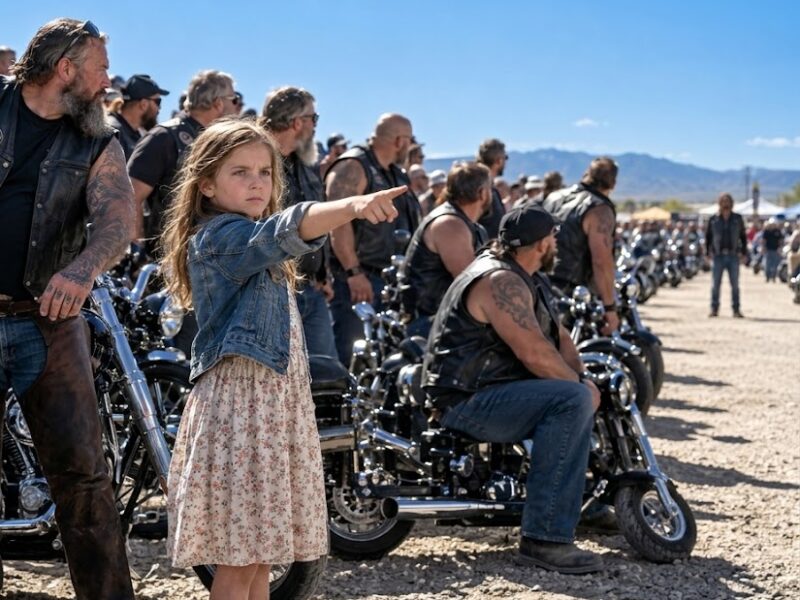
A little girl walked down a line of 300 bikers. She stopped at one man, pointed, and said two words: “Not Him.” That night, the club found out why.
**PART 1**
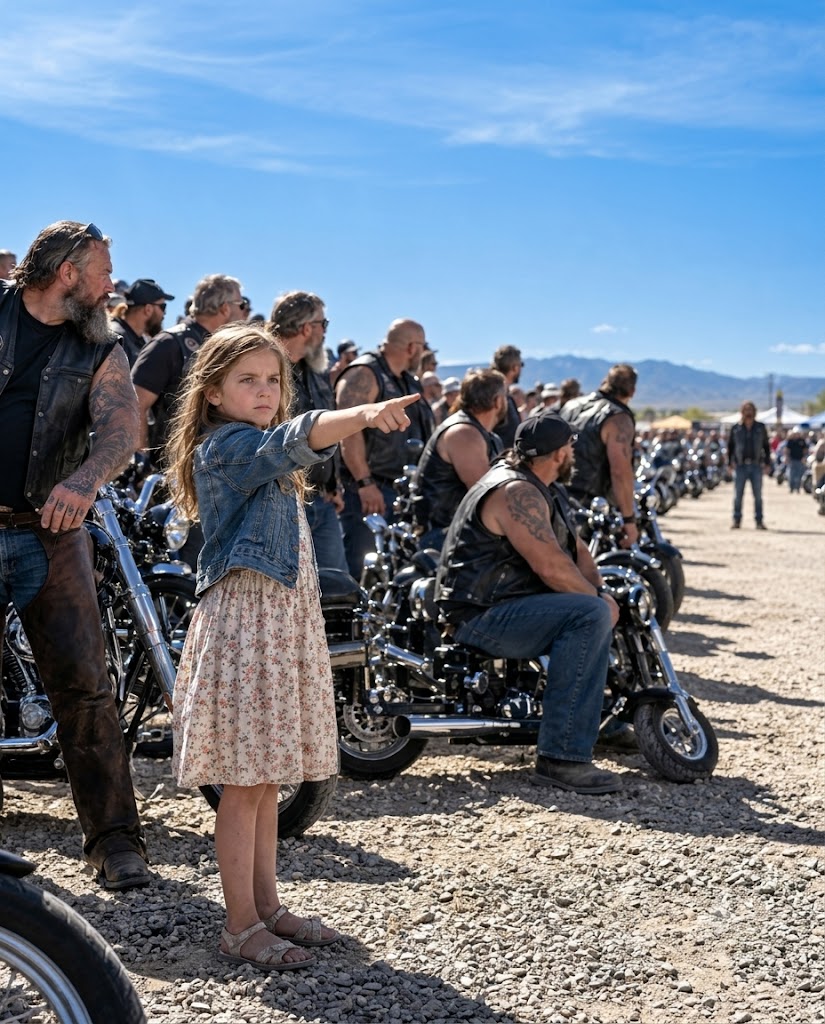
She was eight years old, and three hundred men in black leather stood shoulder-to-shoulder in the gravel waiting for her to choose.
Three hundred vests, three hundred sets of scarred knuckles, three hundred tattooed forearms folded across chests as wide as doors.
The crowd behind the chain-link fence had already reached its verdict.
One of those men had put her mother in a hospital bed, and the oldest, most battered one was the man.
It took her nineteen minutes to walk the line, her hand shaking inside a stranger’s.
Then she stopped.
She lifted one small finger toward the gray-braided old rider alone at the far end.
Seventy-six years of hard road written across his face.
She said two words.
What came to light that night is why not one of them ever forgot her.
The scream came from the back of the exhibit hall at 1:52 on a Saturday afternoon, and it lasted less time than it takes to tie a shoe.
But by the time it ended, eight-year-old Hattie Lockheart had learned something no child should have to learn at a charity rally.
A man can speak in the gentlest voice in the world while doing the cruelest thing.
An hour earlier, the worst thing anyone in Kingman, Arizona expected was a traffic jam.
It was Saturday, the eighteenth of May, 2019, and the Mojave County Fairgrounds had disappeared under 304 motorcycles.
They stood in rows on the gravel lot behind the grandstand, chrome flashing in the eighty-eight-degree sun.
The Hualapai Mountains rose blue and dusty to the south.
The air smelled of brisket smoke, hot engine oil, and sunscreen.
This was the third annual Sundown Ridge Run, and every dollar it raised went to the Mojave Children’s Burn Fund, which paid for skin grafts for kids whose parents could not.
The town still did not entirely trust it.
At the lemonade stand beside the grandstand, Pearl Dowling kept a cash box in her lap and one hand on the shutter cord whenever a rider walked her way.
The county’s fairgrounds coordinator, a tidy, smiling man named Lyle Tinsley, had told the crowd Friday evening that he’d promised the commissioners his guests would behave.
The riders laughed along.
It was the laugh of men who had heard that joke in every town they had ever visited.
She was small for eight, with long honey-brown hair that never stayed brushed, and serious gray-green eyes that always seemed to be checking your math.
She wore her denim jacket in the heat because it had pockets, and a cotton dress sprigged with tiny pink and white flowers that her mother had ironed that morning.
Her mother, Colleen, thirty-four, a teller at the credit union on Stockton Hill Road, was volunteering all weekend in the cash room, a windowless back office with a steel strongbox bolted to the floor.
By noon that Saturday, the box held $38,400.
At 1:20, Hattie got bored and wandered out into the heat.
Under a shade canopy at the edge of the lot sat the man everyone else walked around.
He was seventy-six, six-foot-two, with a gray braid down his back and a scar that split his left eyebrow like a crack in a windshield.
His leather vest was so crowded with patches you could barely see the leather.
His forearms were sleeved in faded blue ink.
The patch over his heart said Roscoe.
He was drawing on a paper napkin with a stubby carpenter’s pencil.
Hattie stood six feet away until she found her nerve.
Then she said, “Are you any good at that?”
“Depends who’s asking,” said Roscoe Daggot.
“I have a dog. His name is Biscuit. Can you draw him?”
He turned the napkin to its clean side.
He did not say, “Is he big? Is he brown?”
He said, “Tell me about Biscuit.”
So she did.
One ear stood up and one flopped down.
He had a white sock on his back left foot.
He tilted his head when he was confused, which was most of the time.
Roscoe’s pencil moved while she talked, and it never lifted, as if it were tracing something already written on the paper in invisible ink.
When he turned the napkin around, Biscuit looked back at her, one ear up, one ear down, head tilted, so exactly himself that Hattie’s mouth fell open.
“How do you know about the sock?”
“You told me.”
He tore the napkin along its edge and handed it over.
“People will tell you almost anything if you quit asking them for it.”
Children were not allowed in the cash room during a count, so she sat down in the narrow back corridor between a stack of folding chairs and the wall, where the air smelled of floor wax, and waited for her mother to finish.
She could hear coins and her mother humming.
She was smoothing the napkin on her knee when the corridor door at the far end opened.
A man came in fast and quiet.
He wore a black leather vest, a bandana over his face, and a small black half-helmet.
Hattie saw him the way a child behind a stack of chairs sees a room from the floor up.
Brown leather loafers with little tassels, a gold watch on a stretchy band, hands that were clean and pale.
The vest was strange.
It had no patches at all, and it was creased across the chest in stiff squares, as if it had just been unfolded.
He did not see her.
He went into the cash room, and the humming stopped.
“Excuse me, you can’t be in here,” her mother said.
“Then—no, please. That’s for the children.”
There was the click of a key, a scuffle, her mother’s voice rising, a sound like a body hitting a step, and the scream.
He came out carrying a canvas bag.
Then he stopped, because he had seen her.
He crouched so close she could smell peppermint gum and new leather.
His eyes were hidden under the brim of the helmet.
His voice, when it came, was soft and warm, almost kind.
“Don’t look at me, sweetheart,” he said. “Take your time. Count to one hundred.”
Then he was gone, and the loading door banged.
Hattie did not count.
She ran.
Her mother lay at the bottom of two concrete steps with one arm bent wrong and blood in her hair.
And the napkin fluttered out of Hattie’s hand and landed across her mother’s shoulder.
Someone big was already there, kneeling, one hand flat on Colleen’s chest, the other holding her head perfectly still.
A gray braid swung forward.
“Don’t move her,” said Roscoe Daggot, to no one and to everyone. “Somebody called 911.”
Now Pearl Dowling called.
At 2:04, an ambulance came down Fairgrounds Boulevard, and at 2:11, a Mojave County Sheriff’s deputy arrived.
A broad-shouldered man in sunglasses with his thumb resting on the snap of his holster.
He looked at the blood.
He looked at the little girl, who had not said a word, and then he looked straight past both of them out the loading door at 304 motorcycles shining in the gravel, and Hattie saw his jaw settle.
He had already decided who had done it.
He just hadn’t picked the face yet.
By 2:40 that afternoon, the fairgrounds had been sealed, and Deputy Brent Sheridan had already built his case in his head.
He stood in the shade of the exhibit hall with a notepad in one hand and a radio crackling on his shoulder.
A vendor had seen a man in a black vest run from the building.
The victim, drifting in and out on the stretcher, had whispered the word “vest” twice before the paramedics closed the doors.
Three hundred and four men in the lot wore vests.
As far as Sheridan was concerned, the math was done.
“Nobody leaves this property,” he told the man who walked up to him.
The man was Marlon Vickers, fifty-eight, president of the Sundown Ridge Riders, with a steel-gray crew cut and reading glasses hanging from a cord.
He looked like a retired high school principal until you noticed the size of his hands.
“Deputy, nobody’s going anywhere,” he said. “That woman was counting money for burned children. Every man out there wants whoever did this found. Whatever you need, you’ll have.”
Sheridan looked at the offered hand and did not take it.
“I’ll start with whoever was near the building.”
Pearl Dowling was still gripping her shutter cord when he reached her.
She had seen two things, she said.
A bald giant in a vest standing near the exhibit hall’s east door that morning, big as a refrigerator, and a long-haired older man in a vest sprinting toward the building at the exact second of the scream.
The giant was Dewey Concincaid, forty-one, six-foot-six, 290 pounds, with a shaved head, a beard down to his breastbone, and arms sleeved in tattoos from wrist to collar.
He was eating a brisket sandwich when Sheridan found him.
In his vest pocket was a sealed envelope holding $1,100 in cash.
“That’s from a vendor out of Bullhead City,” Dewey said evenly. “I sold him a set of cylinder heads. The receipt’s in my saddlebag.”
“Turn around,” said Sheridan.
At 2:58 p.m., the handcuffs closed.
A young prospect named Teddy Mayfield, twenty-three, lunged forward with his fists up.
Marlon Vickers caught him with one flat palm against the chest so calmly it looked like he was stopping a door.
“Not today, Teddy,” he said quietly. “Not like this. Look around you.”
Teddy looked along the chain-link fence.
Dozens of faces were waiting to see what the bikers would do.
“It’s fine, Teddy,” Dewey said, and lowered his enormous frame into the gravel, cuffed hands behind him in the full sun. “Let the man work.”
For the next hour and seven minutes, he sat there.
Hollis Rudd, the road captain, sixty-one, wet a bandana from a cooler and tied it around Dewey’s bald head, then held a water bottle to his mouth because his hands were locked.
Dewey drank and said, “Thank you.”
He did not say another word.
Pearl Dowling pulled her shutter down halfway and kept watching through the gap.
Hollis Rudd kept a spiral notebook in his vest where he logged every vehicle that passed the gate, a habit from forty years of running group rides.
At 3:08, he wrote, “White county pickup out, the deputies were waving county vehicles through.”
Meanwhile, in the back of a patrol car with its door open, Hattie Lockheart sat with a crumpled napkin in her lap and said nothing.
A victim advocate named Janelle Barrett, a gentle woman in her forties with a county lanyard and a tote bag full of crayons, sat beside her and said nothing too, which was exactly the right thing to say.
Sheridan crouched at the open door.
“Hattie, honey, I need you to help me. Was it a big man? A man in a vest like those men out there? A man who looked mean? Was it that big, bald one?”
Hattie looked at her knees.
Forty feet away, under the shade canopy, an old man’s jaw tightened.
Marlon stood at his elbow.
“Roscoe drew for the state a long time ago,” Marlon said to no one in particular. “He’d tell you that’s no way to ask a child.”
“Leave it, Marlon,” said Roscoe Daggot. “He said it gently.”
He did not look away from the girl.
Sheridan came across the gravel a minute later, sunglasses on, thumb on his holster.
Snap.
“You’re the long hair. The vendor says you ran at that building the second the scream went up.”
“I did.”
“Why?”
“Because somebody screamed,” said Roscoe.
It was a perfectly good answer, and Sheridan resented it.
“Then you can stand at the end of the line.”
“What line?” said Marlon.
Marlon had been thinking, and he did not like where the afternoon was headed.
Saddlebags dumped on the gravel, motel rooms emptied, the whole club run out of town by Monday with a story in the Kingman Daily Miner to match.
So he offered the only thing that would end it.
“You want the girl to look at us? Then let her look at all of us. Every man, every bike. Nobody hides. Nobody can say we hid.”
Sheridan considered it.
At his shoulder, a tidy man in pressed khakis spoke up.
“It’s a fair offer, Brent. Cleanest way to clear this up. I’ll help coordinate.”
That was Lyle Tinsley, the fairgrounds coordinator, who had a clipboard, a warm voice, and a bottle of water for everyone.
Sheridan nodded.
Four o’clock.
At 4:08 p.m., three hundred riders took their places in two long rows, facing each other along a gravel aisle behind the grandstand, each man standing beside his motorcycle, hands at his sides.
Dewey Concincaid, uncuffed at last, stood at the head of the right-hand row with his wrists rubbed red.
The temperature had climbed to ninety-three.
Along the fence, townspeople had gathered, forty then sixty, whispering.
At the far end of the aisle, where the gravel opened onto empty lot, Roscoe Daggot stood alone in a dark canvas jacket and faded jeans, because Sheridan had told him to stand apart.
At the head of the aisle stood the girl, denim jacket, flowered dress, long hair stirring in the hot wind off the mountains.
Janelle held her left hand.
Sheridan stood at her right.
Behind them, a little closer than anyone noticed, were the man with the clipboard and two more deputies.
“Whenever you’re ready, Hattie,” Sheridan said.
She took one step, and from just behind her left shoulder, a man’s voice, warm and low and almost kind, said, “Take your time, sweetheart.”
Hattie stopped as if she had walked into a pane of glass.
Her fingers clamped around Janelle’s until the woman winced, and every drop of color left her face.
It took Hattie Lockheart nineteen minutes to walk the aisle, and every one of them felt like a mile.
She walked it the way she might have crossed a frozen pond, in small steps, with her eyes on the gravel.
Three hundred men watched her go, and the strange thing, the thing the people at the fence would talk about for years, was how they watched.
Sunglasses came off, one pair at a time.
Men with beards like horsehair and forearms like fence posts dropped their eyes to their boots so as not to frighten her.
A rider with a gray ponytail, 250 pounds of him, lowered himself onto one knee in the gravel as she approached, just to be shorter.
Teddy Mayfield, who had nearly swung at a deputy an hour before, stood so still and stared so hard at nothing that his chin trembled.
Nobody spoke.
Nobody moved.
Hattie counted bikes to keep from counting men.
She reached ninety-one and lost her place.
Along the fence, the whispering did not stop.
“Look at the size of them.”
“It’s one of them. It’s always one of them.”
“My husband says you can’t tell which. They’re all the same.”
A woman pulled her son’s face into her skirt.
Pearl Dowling, behind her half-lowered shutter, did not whisper.
She only watched the old rider at the far end, and her mouth moved as if she were arguing with herself.
Hattie heard none of it.
She was hearing one sentence ringing under her ribs.
*Take your time, sweetheart.*
She kept her eyes down.
Behind her, she knew, the voice was still following her down the aisle.
At the far end, the row ended.
Wind pushed grit across the open gravel.
One man stood in front of her alone in a dark canvas jacket with a gray braid over one shoulder and a scar through his eyebrow.
“Hattie,” Sheridan said, and she heard the change in his voice, the eagerness. “Look carefully. Is it him? The one at the end? The one with the scar?”
Hattie lifted her head.
She looked at Roscoe Daggot.
Roscoe looked back and did not smile, and did not nod.
He only waited the way you wait for a bird to decide whether to land.
She raised one small hand and pointed straight at his chest.
Sixty people at the fence drew in one breath.
Sheridan’s hand was already moving toward his cuffs.
“Not him,” said Hattie.
Sheridan stopped.
“What?”
“Not him,” she said again, louder.
Then her whole body folded.
She turned and pressed her face into Janelle’s side and would not lift it.
“Hattie, honey, you look terrified of him. You can tell me. Nobody’s going to hurt you.”
She shook her head against Janelle’s ribs.
Behind them, the tidy man in khakis murmured, “Poor kid. She’s frozen, Brent. Maybe she’s too scared of him to say it.”
Sheridan turned on Roscoe.
“I’m going to ask you to stay where I can see you, Mr. Daggot.”
“I’m not going anywhere,” Roscoe’s voice was quiet. “But you asked that child eleven questions today, Deputy, and nine of them had the answer built in. She’s eight. You can’t find out what a frightened kid saw by pointing a flashlight at the man you want.”
“I’ve been doing this eleven years.”
“I did it for thirty-four,” said Roscoe. “That’s why I’m telling you.”
“Did what?” said Sheridan.
But a sergeant’s truck was already rolling into the lot with two more deputies, and the moment was gone.
The line was dismissed at 4:29.
Nobody would be leaving.
Every saddlebag in the lot would be searched, beginning at seven.
By 5:30, the long shadow of the grandstand had stretched across the gravel, and the Sundown Ridge Riders sat in silent knots around their bikes.
Dewey Concincaid had walked to the water cooler and was refilling bottles for the whole club.
Behind the hospitality tent, on an overturned plastic bucket, sat Roscoe Daggot with his hands between his knees.
Marlon found him there.
“You’re shaking, Marlon.”
“I swore I’d never do it again.”
“Do what?”
Roscoe studied his own big scarred hands.
They had not shaken in years.
“Sit down with a scared child and a pencil.”
He drew a slow breath.
“Flagstaff, 2003. A nine-year-old boy saw a man take a woman from a parking lot. I’d done four hundred of those interviews. That day, a detective sat in the room with a photo spread in his lap and nodded every time I got close to a face he liked. The boy watched him nod. He was nine. He knew what the grown-up wanted. I drew it, and it looked just like the man the detective had in mind. And that man did six years in Florence before DNA got him out. I turned in my papers two months later. Thirty-four years with the Department of Public Safety, and I walked out with one drawing I couldn’t forgive.”
Marlon was silent a long moment.
Then he said, “She pointed at you in front of three hundred of us and half the county and said, ‘Not him.’ Everybody out there wants her to say yes. The deputy wants it. The fence wants it. Why would a scared eight-year-old stand in the middle of all that and say no?”
“I don’t know.”
“Yes, you do.”
Roscoe looked up.
“Because she’s the only one out there who isn’t guessing. And if I’m wrong, Marlon, if I put a face on her fear and it’s the wrong face, then you’ll be wrong beside a kid who trusts you instead of right with nobody.”
Marlon rested a heavy hand on the old man’s shoulder.
“She picked you, Roscoe. Out of three hundred. Go sit with her when she’s ready.”
At 6:20, Janelle Barrett’s voice carried across the lot, thin with panic.
She had turned away for twenty seconds to sign a form, and Hattie was gone.
Deputies jogged.
Riders fanned out without being asked.
It was Roscoe, walking back to his own picnic table beneath the shade canopy, who stopped and looked down.
She was sitting under it, knees drawn up inside her flowered dress, the crumpled napkin with Biscuit’s drawing smoothed flat on one knee.
“Janelle,” he called, not loudly. “She’s right here.”
Janelle ran up.
Roscoe lifted a hand.
“Wait.”
Then he lowered himself joint by joint into the gravel on his side of the table and said nothing at all.
After a long time, Hattie said, “You didn’t ask me anything today.”
“No.”
“Everybody asked me everything.”
“I know.”
She picked at the napkin.
“You can’t say it out loud. Not where he can hear.”
She looked up, her gray-green eyes enormous.
“But maybe I could show you.”
Roscoe’s hand went still over his shirt pocket, where a carpenter’s pencil had been waiting for sixteen years.
**PART 2**
Brent Sheridan almost said no.
It was 8:15 p.m.
The sky had gone the color of a bruised peach.
The deputies had searched 304 motorcycles and found two pocket knives and a flask.
And the sergeant wanted results.
Now an old rider wanted to sit in the hospitality tent with the only witness and a pad of paper.
“Here are my rules,” Roscoe said in a level, unhurried voice Sheridan had not heard from him before. “Janelle sits at her shoulder the whole time. You record every word on your phone. You can listen, Deputy. You can’t speak. And if she wants to stop, we stop.”
“Why would I agree to that?”
Roscoe took a worn leather wallet from his back pocket and slid a laminated card across the folding table.
Arizona Department of Public Safety, Forensic Composite Artist, R. Daggot, Retired.
Sheridan read the name twice.
Something shifted behind his face.
“Daggot,” he said slowly. “My father was a trooper in Flagstaff. He kept a sketch taped inside his locker for twenty-two years. A six-year-old girl in Camp Verde, 1989, saw a man take a baby from a porch. The composite hung in every patrol car in the state. They caught him in four days.”
He took off his sunglasses, then his hat, and set both on the table.
For the first time that day, his thumb was nowhere near his holster.
“That was you.”
“I drew a lot of faces, son.”
Sheridan pulled out a folding chair, sat down so his eyes were level with Hattie’s, and kept his mouth shut.
Roscoe placed a sketch pad on the table and laid the carpenter’s pencil beside it.
He did not pick it up.
“Hattie, I’m not going to ask what he looked like,” he said. “I’m going to ask about the room. Start anywhere you want. The beginning, the end, the middle. It doesn’t have to go in order.”
She was quiet a while.
Then: “The floor was cold.”
“Tell me about the floor.”
“Gray. Waxy.” She swallowed. “And peppermint. The man smelled like peppermint gum and like new shoes. Like at the store.”
“What did your ears hear?”
“Coins. Mom humming. Then a key. Then Mom said, ‘No, please. It’s for the children.’ And he said, ‘Let go.'”
Her voice cracked.
“Mean. Whispery. But when he saw me, he was nice.”
“What did nice sound like?”
Hattie shut her eyes.
“He said, ‘Don’t look at me, sweetheart. Take your time. Count to one hundred.'”
Her eyes opened.
“He said it again today. At the line. Right behind me. The same way.”
Nobody in the tent breathed.
Sheridan’s face had gone gray.
Behind Hattie, at the head of that aisle, he remembered with a drop in his stomach, had stood Ms. Barrett, two deputies, and exactly one civilian.
“No,” he said, forgetting the rule.
And then, “Sorry.”
“No, I haven’t said a name, Deputy,” Roscoe said. “Neither has she. She doesn’t know one. What she knows is what she heard. Hattie, why did you tell them ‘not him’?”
The little girl looked at her hands.
“Because everybody wanted it to be him so much. The deputy, the fence, and the nice man, too. The one who said ‘take your time.’ I thought that’s why he said it. So I’d say yes, and then everybody would stop looking.”
Marlon Vickers and Hollis Rudd stood unnoticed in the tent flap.
“Show me what was near the floor,” Roscoe said softly, and finally lifted the pencil.
She talked, and he drew, and the pencil never left the page.
Brown leather loafers with tassels.
Longer tassels.
A scuff of white on the left toe, like paint.
A gold watch on a stretchy band that pinched the pale skin of the wrist.
A black vest.
“It had squares. Squares like when you take a new shirt out of the package. Lines across it where it was folded. And no patches. Not one.”
Roscoe set down the pencil.
“Deputy, a rider’s vest takes years to earn its creases. They come from wind and rain and miles. The creases on this one came out of a cardboard box.”
Hollis Rudd stepped forward, notebook open.
“Deputy, I logged the gate. At 3:08 this afternoon, a white county pickup went out Fairgrounds Boulevard. Your boys waved it through. At 3:41, it came back. Thirty-three minutes.”
He tapped the page.
“Didn’t think anything of it until now.”
Sheridan grabbed his phone and called Orin Pike, who owned Boot and Saddle Western Wear on Andy Devine Avenue, and who, at 8:40 on a Saturday night, answered through a mouthful of supper.
“Orin, it’s Brent Sheridan. Did you sell a new black leather vest this week? Size forty-two, maybe a half-helmet?”
“Hold on,” said Pike. “I’ve got the camera over the register. Let me pull it.”
At 9:30, the speakers on the stage coughed.
Out in the dark, a voice thanked everyone for their patience.
“Folks, I want to thank the Sundown Ridge Riders for being such good sports today. No matter what, we’re one community.”
In the tent, the crayon in Hattie’s hand snapped in two.
“That’s him,” she whispered. “That’s his voice.”
Out on the stage, Lyle Tinsley kept talking.
At 9:41 p.m. on Saturday, the eighteenth of May, Sheridan’s phone buzzed on the table.
A picture arrived.
Thursday, May 16, 4:52 p.m., to the camera over the register at Boot and Saddle.
A man in a tan Mojave County Parks polo held up a black leather vest by its shoulders, a new half-helmet on the counter at his elbow.
He was smiling.
In the corner of the frame, below the edge of the counter, stood a pair of brown tasseled loafers with a white scuff on the left toe.
Roscoe laid the sketch beside the phone.
Nobody needed to say a word.
Sheridan stood and put on his hat.
“Ms. Barrett, please stay with her,” he said, and walked out toward the light.
On the stage, Lyle Tinsley was saying, “And finally, to every rider who stood in that line today—”
When Deputy Sheridan climbed the three steps, took the microphone out of his hand, and spoke quietly into his ear for eleven seconds.
The smile did not leave Tinsley’s face.
It simply stopped belonging to it.
“Brent, you can’t be serious. You’re taking the word of a traumatized child and an old biker.”
“I’m taking the word of a camera, Lyle,” said Sheridan. “Step down.”
Tinsley came down the steps and, instead of following the deputy, turned toward the white county pickup waiting under a light pole.
He took four fast steps, and a man’s bulk stepped quietly into his path.
Dewey Concincaid did not touch him.
He did not need to.
“Evening, Mr. Tinsley,” he said.
Then a sound moved across the lot, the sound of three hundred pairs of boots finding the gravel at the same time.
The riders had simply risen from their bikes and stepped, row on row, back into the same two lines as that afternoon, facing each other, hands at their sides, a long gravel aisle between them.
Tinsley looked down that aisle, and for the first time that day, he had nowhere to put his eyes.
Sheridan took his arm gently and walked him through.
No one spoke.
No one raised a hand.
Three hundred men who had been looked at all day simply looked back, and the weight of it slowed Tinsley to a shuffle by the thirtieth bike.
At the head of the aisle, in the glow of the tent, a little girl in a denim jacket stood holding an advocate’s hand, watching him pass with her serious eyes.
She did not say a word.
“That’s all you ever had to do, Hattie,” Roscoe said quietly beside her. “You looked.”
Under the patrol car’s dome light, Sheridan pressed Tinsley’s head down and shut the door.
On the gravel, one brown loafer showed a white scuff on the left toe.
At 11:20 that night, Brent Sheridan walked back into the lot with his hat in his hand.
Nobody had told him to.
Under the work lights, three hundred riders sat on their bikes and tailgates and cooler lids, and the talk dropped away as he came, row by row, like a tide going out.
He walked past all of it to where Dewey Concincaid sat alone on an upturned bucket, rubbing one red wrist.
“Mr. Concincaid.”
Sheridan held out a sealed envelope with an evidence tag still on it.
“Eleven hundred dollars. I took it from you at 2:58 this afternoon. I owe you an hour and seven minutes in the sun and an apology I can’t make big enough.”
Dewey looked at the envelope and then at the hand holding it.
He took the envelope.
For a long moment, he did not take the hand.
“I’m not the one you owe,” Dewey said at last. “She’s in a hospital bed. Her little girl got walked past three hundred strangers because we made it easy to believe.”
Then he stood, all six-foot-six of him, wiped his palm on his jeans, and shook the deputy’s hand once.
Sheridan’s eyes were wet, and he did not hide it.
They found the money at 12:48 in the morning in a rented storage unit off Airway Avenue, inside a cardboard box marked Christmas Ornaments.
The telephone warrant had come through at 10:25.
Every dollar of the $38,400 was in the canvas bag, along with a black vest folded back into its squares and a pair of brown loafers wrapped in a county parks T-shirt.
By two in the morning, in an interview room at the sheriff’s office on Beale Street, Lyle Tinsley had stopped pretending.
He owed $61,000 to a lender in Laughlin, Nevada, a man who did not send letters.
He had known where the cash would be and when, and he had known something else, he told Sheridan with a tired little shrug that Sheridan would remember for the rest of his career.
“I figured nobody in this county would ask hard questions about men like that,” Tinsley said.
“Not one.”
Sheridan wrote it down.
He did not trust himself to say anything back.
Afterward, he would tell Marlon Vickers that the worst part was not the lie.
It was how reasonable it had sounded inside his own head at 2:40 that afternoon.
But before that, a little after midnight, he had gone looking for one more person.
Roscoe sat at the picnic table at the edge of the lot with Hattie asleep beside him, her cheek on his folded canvas jacket, one small fist still closed around a napkin.
“My father kept your sketch twenty-two years,” Sheridan said quietly. “And I almost put you in handcuffs. I should have asked who you were.”
“You should have asked better questions,” said Roscoe. “But you sat down in the chair, and that’s the part that counts.”
“How do you stand it? Everybody out there looked at you today and saw one thing.”
Roscoe was quiet a moment.
“Son, a vest is leather. Anybody can buy one on a Thursday afternoon for a hundred and sixty dollars. What tells you who a man is, is what he does when the whole county is pointing at him. Dewey sat in the dirt in handcuffs for an hour and never raised his voice. Three hundred men stood in a line they didn’t have to stand in and made themselves small for a little girl. And the man who picked that vest picked it because he knew exactly what you’d see when you looked at it. That’s the oldest trick there is. It only works on people who’ve stopped looking at the person.”
“Where did you learn to do it? The drawing.”
“Santo Domingo, 1965. I was twenty-two. An army specialist with a sketchbook, and a captain put me at a checkpoint and told me to draw whatever faces people described. An old woman corrected me eleven times in one afternoon. She taught me the only rule that matters. Draw what they tell you, never what you hope they tell you.”
Hattie stirred.
She opened her gray-green eyes and said thickly, “Did I do it right?”
Roscoe took the carpenter’s pencil from his pocket and put it in her hand.
“You told the truth when everybody wanted something else. That’s the hardest thing there is, and you did it at eight years old.”
Marlon Vickers sat with the old man until the stars came out, and neither said much.
“Sixteen years,” Marlon said finally. “You carried it sixteen years.”
“I put it down tonight,” said Roscoe.
On Sunday morning, Pearl Dowling raised her shutter all the way up.
She carried two pitchers of lemonade across the gravel on a tray, walking from bike to bike, and when she reached Dewey Concincaid, she stopped and set the tray on his saddle.
“On the house,” she said. “All weekend.”
Her voice cracked on the last word.
By noon, the riders had emptied their pockets again, and the Sundown Ridge Run closed with $71,310 for the Mojave Children’s Burn Fund.
When the bikes rolled out that afternoon down Andy Devine Avenue toward Interstate 40, the woman who had pulled her son’s face into her skirt stood on the curb and let him wave at every single rider.
Teddy Mayfield spent that Sunday morning picking up every cup and napkin on the fairgrounds.
And when a county worker told him he didn’t have to, he said it was the least he could do.
That evening, Roscoe stood in the doorway of a room at Kingman Regional Medical Center with his hat in his hands until Colleen Lockheart, propped on three pillows with her wrist in a cast, told him to come in.
She had heard everything from Janelle by then.
She cried without a sound and did not try to stop it.
“She told them the truth,” Colleen said. “With the whole town staring.”
“She told it to you, Mom,” said Roscoe. “That’s who she was talking to when she said it. The deputy just happened to be standing there.”
On the bed table, Hattie had already laid out a fresh sheet of paper and the carpenter’s pencil.
She was drawing Biscuit again, one ear up, one ear down, and this time she did not ask anybody whether it was right.
On Monday, Colleen Lockheart went home with a cast on her wrist and eleven stitches in her scalp.
On Tuesday afternoon, the twenty-first of May, a pickup pulled up in front of the little house on Louise Avenue, and Dewey Concincaid got out with a gallon of milk and a loaf of bread.
Marlon had asked Janelle Barrett whether the family needed anything.
The answer had been the lawn.
He mowed it in neat stripes, edged the walk, and carried the clippings to the curb in two trips.
When he finished, he wiped his boots on the mat, set the milk and bread on the kitchen counter, and rinsed the empty gas can at the hose before he put it in his truck.
At the curb, he stopped, bent, and picked up a candy wrapper the wind had pushed against the Lockhearts’ mailbox, and tucked it in his vest pocket.
Then he drove home.









