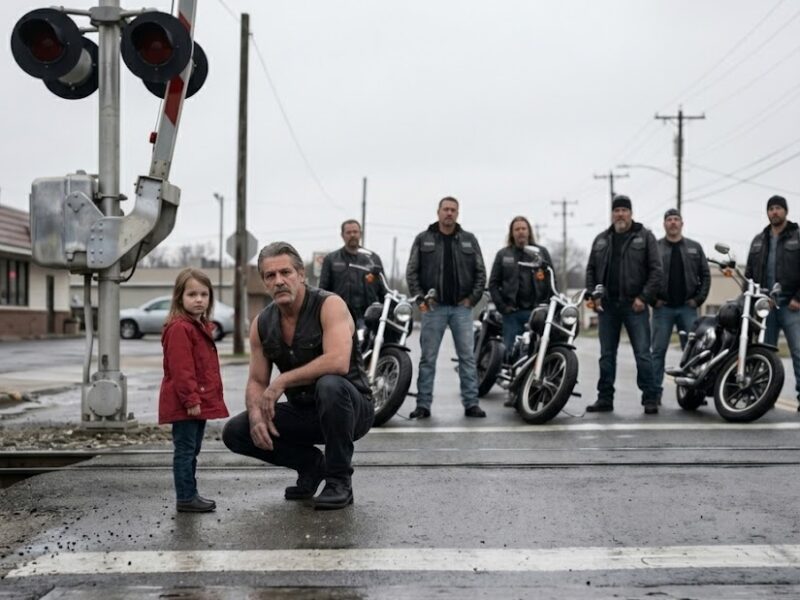
A little girl waited at the crossing gate every Wednesday at four. Nobody knew why. Nobody asked. Then 400 bikers shut their engines off—and the whole town went silent.
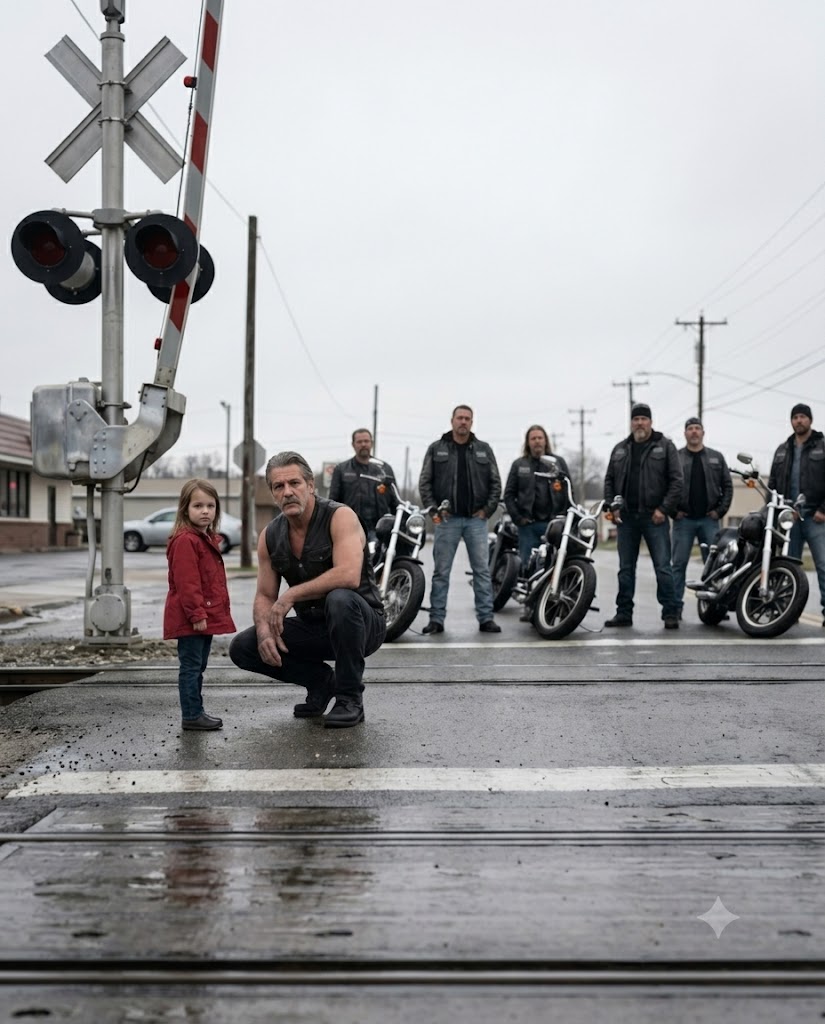
The gate arm was down when Harland Briggs first noticed her, a Wednesday in October, the 4:00 light coming in flat and orange across the scrub flats west of Malo Crossing.
She was standing just inside the painted safety line with a tin coffee can held out in front of her in both hands, the way a person holds something they are afraid to spill.
Seven years old, maybe eight, in a corduroy jacket two sizes too large and boots that had been resoled at least once with rubber from a different boot entirely.
The can had something in it.
She did not look at the lowered arm or at the road behind it or at the sky.
She looked at the crossing and she waited.
Forty-six bikers rolled past her that afternoon on Route 9 heading back toward Ash Creek.
Forty-six engines loud enough to shake the creosote bushes and not one of them knew what the can held or who the girl was waiting for.
Harland Briggs was the last rider in that column, the way a club president rides when he wants a complete picture of what is behind him.
He saw her.
He did not stop that day.
That is the part he would carry for the next sixteen months, the part that would come back to him in the hour before dawn when the desert went so quiet he could hear his own blood moving.
He did not stop, but he looked in his mirror until the crossing was gone.
The morning before that October Wednesday had started the way most of Harland’s mornings started, with someone else’s voice arriving before his eyes were open.
It was Cutter McGee, the Ash Creek Riders road captain, sixty-one years old and built like a railroad tie left in the weather, standing outside Harland’s screen door at 6:45 and speaking at the door because he had enough respect not to knock before 7:00.
“There’s a fuel leak on the sweep bike,” Cutter said.
“Found it in the lot this morning. Carb joint, looks like.”
Harland lay still for two more seconds, listening to the desert.
A cactus wren somewhere, wind in the cholla.
Then he got up.
He was fifty-three years old, broad through the shoulders and gone thick at the middle in the way of men who have not stopped working, but have stopped being young.
His beard was iron gray and came down to the second button of whatever shirt he happened to be wearing.
His hands, when he pressed them flat on the kitchen counter and looked out the window at the empty lot, showed forty years of mechanical work in the creases.
He had been president of the Ash Creek Riders for eleven years, the last of the four founding members who still rode every Wednesday, the club’s designated run day, without exception.
Wednesday was the rule.
It had been since the beginning, back when there were only nine of them and they rode because the alternative was sitting still, and sitting still had consequences.
None of them were equipped to survive.
Harland had his coffee and pulled on his boots and went out to look at the carb joint himself, because that was also the rule.
The president looks at what the road captain shows him and makes the call.
The morning smelled of sage and dried clay and the faint diesel memory of the highway two miles east.
The sun had just cleared the ridge and was laying long gold lines across the parking lot behind the chapter house, a converted cattle barn that the club had owned for twenty-two years and repaired incrementally, one season at a time, until it was solid in a way that looked accidental, but wasn’t.
Cutter stood back and let Harland crouch beside the sweep bike.
The leak was real, small but real.
“It’ll hold a flagstaff,” Harland said.
“It won’t hold back.”
“No,” Cutter agreed.
Harland stood up and looked at the ridge.
“Take the parts truck as sweep. Mendez rides up front.”
Cutter wrote nothing down.
He did not need to.
He had been riding Wednesdays with Harland Briggs for nine years and had learned that the president’s logistics were simple and precise and did not require elaboration.
That was how thirty-one men organized into a two-hour run without friction.
Not by talking more than necessary, but by knowing their positions before the engines started.
The column rolled out at 10:00 past 9:00.
The desert opened ahead of them.
The road unspooling through the dry flats with the ease of something that had been practiced so many times it no longer required thought.
Harland rode point.
The ridge threw a long blue shadow across the road and then the shadow broke and the sun was full on everything.
It was a Wednesday like the Wednesdays before it, which meant it was not ordinary at all, only familiar.
And familiar was what these men had spent decades building because the alternative was chaos and chaos had already cost most of them something they could not replace.
Harland would not have been able to say, if asked, what he was expecting when the column crossed back through Malo Crossing at 4:00 that afternoon.
He had ridden that route one hundred and twelve times.
The crossing gate was a fixed feature of it.
A white and red arm that came down when the freight train passed, roughly every two hours, predictable as weather in a dry year.
He was not expecting the girl with the tin coffee can.
He did not stop.
He rode back to Ash Creek.
He did not sleep well that night, which was also not new.
Only the reason was.
The second Wednesday he watched for her from a quarter mile out.
She was there.
Same spot inside the painted line.
Same corduroy jacket.
Same can.
The gate arm was down again because the 4:00 freight was early that week.
A minute and forty seconds ahead of its usual time, a thing Harland noted because he noted everything about crossings on principle.
The habit of a man who had learned the hard way what can happen in the moment before a gate arm rises.
He pulled out of the column without a word to Cutter, eased the bike onto the gravel shoulder, and cut the engine.
He sat for a moment looking at her.
She did not look at him.
She looked at the crossing.
The can was held in front of her, both hands, same grip as before.
He swung off the bike, unclipped his helmet, and hung it from the handlebar, and walked toward her.
He was aware of how he looked.
He had been aware of it for thirty years.
Six-foot-one, two hundred and thirty pounds, iron beard, the Ash Creek Riders patch on his back, cut and road-worn, and not the sort of figure that children were trained to welcome.
He stopped about eight feet from her.
Eight feet felt right.
“What’s in the can?” he said.
It was not exactly a question.
She looked at him then, the first time she had looked at anything except the crossing since he’d arrived.
Her eyes were dark brown, very steady.
“Seeds,” she said, “for the crossing.”
He waited.
She looked back at the gate arm.
“My grandpa planted sweet peas here every spring,” she said.
“He died in February. I’ve been coming to plant them for him.”
She did not say it like a grief.
She said it like a fact, the way you say the store is closed on Sundays, or the well water runs cold.
Harland looked at the crossing.
The gravel along the track bed was bone pale in the 4:00 light.
He could see, now that he was close, a thin green thread of something growing just inside the rail, a survivor from last season, or the season before or longer.
“He came here every spring, every April since I was born,” she said.
“He said sweet peas like the vibration from the trains, said it helped them climb.”
The gate arm went up.
The freight was passed.
She walked forward staying inside the safety line by habit or instruction and crouched at the edge of the gravel.
She pressed three seeds into the dirt with her thumb.
Careful.
One, two, three.
Then she stood and stepped back and looked at the place where she’d pressed them.
“You’ve been doing this every Wednesday,” Harland said, not a question.
“Since March,” she said, “every Wednesday at 4:00 like Grandpa did. He said Wednesday was the best day.”
She picked up the can and held it in front of her again.
“There are forty-one left,” she said.
“I counted.”
Harland looked at the gravel.
He looked at the thin green thread he could see surviving by the rail.
He looked at the girl.
He said, “What’s your name?”
“Ondine,” she said.
“Ondine Marsh.”
He told her his name was Harland.
She nodded as though she had expected this or had expected someone eventually and he happened to be it.
He rode back to Ash Creek slower than he had ridden in years.
Cutter had waited at the edge of the lot, his engine off, his arms folded, the expression on his face that meant he had already decided not to ask, but Harland told him anyway.
He told it plain, the way he told everything, the can, the seeds, the grandfather, the Wednesday rule the old man had set that she was now keeping alone.
Cutter listened with his arms still folded and then was quiet for a moment.
“How many seeds she got left?” he said.
“Forty-one,” Harland said.
“Forty-one left in the can. She’s been pressing them in three at a time.”
Cutter unfolded his arms.
“She’s been doing this since March.”
“March?” Harland confirmed.
“Every Wednesday at 4:00.”
Cutter looked off toward the ridge.
The sun was below it now, and the sky above was the color of a coal ember, red fading to orange, fading to something between purple and gray.
“What do sweet peas need?” Cutter said.
“Besides seeds?”
“Support,” Harland said.
“Wire or a fence. Something to climb.”
Neither man said anything for a moment after that.
Then Cutter said, “I’ll make some calls.”
Harland went inside.
He stood at the kitchen counter with both hands flat on the Formica and looked out the window at the dark lot and thought about what the girl had said.
He said sweet peas, like the vibration from the trains, said it helped them climb.
He had been sitting still since January, since the day the letter came from his sister telling him their mother had died in Tucson, alone and in a room he had not been to in three years because he had been here, keeping the club running, keeping the Wednesdays intact, telling himself the road was how he expressed what he could not say out loud.
He had sent money.
He had called on Sundays when he remembered.
He had not gone.
Now there was a girl pressing seeds into crossing gravel every Wednesday at 4:00 because a man who was no longer living had told her Wednesday was the best day, and she had believed him, and she was keeping faith with that belief alone, with a can that was down to forty-one.
The feeling landed in Harland’s chest and stayed there.
He did not name it.
He went to bed.
He did not sleep well, but the reason this time was different from all the times before.
This time it was not regret.
It was something that had not visited him in a long while, and he would not have known what to call it if someone had asked, and no one did.
By the following Tuesday, Cutter McGee had made seven calls.
Three were to other Ash Creek riders who had not been on the Wednesday run and needed to be told.
Two were to members of a chapter in Sedona, the Painted Rim Riders Harland had ridden with twice at regional events.
Good men who kept their word and asked few questions.
One was to a man named Frank DeLloyd in Winslow, a retired iron worker who had spent thirty years building fencing for desert properties, and who owed Cutter a favor from 2009 that had never been collected.
The seventh call was to Ondine’s mother, a woman named Cecilia Marsh who worked the morning shift at the diner in Malo Crossing, and whose number Cutter had obtained from the diner owner, a woman named Vera Polacheck who had known the Marsh family since Ondine’s grandfather had moved to the county.
Cecilia Marsh answered on the third ring and was silent for long enough after Cutter explained who he was and what he was proposing that Cutter said, “You still there?”
“I’m here,” she said.
“I just—I didn’t know anyone had noticed her.”
“One of ours did,” Cutter said, “and now all of us have.”
Cecilia Marsh said she needed to call him back.
She called back in twenty minutes and said yes.
She said it quickly before she could change her mind, and Cutter recognized the sound of a person who had been carrying something alone and had just been offered the chance to put part of it down.
Frank DeLloyd drove up from Winslow the following Monday with a flatbed carrying sixty feet of cedar rail fencing, the kind designed for garden borders, low enough to not obstruct sight lines at the crossing, but sturdy enough to give sweet peas something serious to hold on to.
He asked Harland where exactly and Harland showed him, pacing out the distance from the rail to the edge of the safety line.
“Right side or both sides?” DeLloyd said.
“Both,” Harland said.
“She plants from both sides.”
DeLloyd set the posts himself and Harland worked beside him.
And by late afternoon on Monday, the fence was in.
Sixteen feet of cedar rail on each side of the gate arm.
Sunk two feet deep and set with the quiet assurance of something built to last a season or several or as long as anyone needed it.
Cutter painted the posts white that evening, standing in the last of the light with a brush and a half-empty can of exterior latex, working careful strokes from top to bottom.
He did not ask whether to paint them.
He just did.
The next morning, Harland drove out to look at the fence in the full daylight.
He stood at the edge of the road and looked at the crossing and the new white posts and the thin surviving thread of green by the rail that had come up through the winter from someone else’s seeds, from a man who had stood in that same spot every April and pressed them in himself.
Harland stood there for a while.
He was aware of something moving in him that was not sadness exactly, but was adjacent to it.
A feeling like ground water rising to the surface after a long dry summer, slow and steady and not to be stopped.
Then he drove back to Ash Creek.
Wednesday came.
Harland told the column at the morning briefing, all thirty-one riders in the lot behind the chapter house, standing in the cold October air with the sun still behind the ridge.
He told it the way he told Cutter, plain, no embellishment, just the facts in order.
The girl, the can, the grandfather, the forty-one seeds still to go.
The fence.
He told them that Ondine Marsh would be at the crossing at 4:00 that afternoon, same as every Wednesday since March, and that he wanted the column to be there.
He did not tell them what to do when they got there.
He trusted them to know.
Cutter, standing to Harland’s right, said, “Sedona is sending riders.”
“How many?” someone asked.
“Enough,” Cutter said.
The column headed out at 9:00.
The run took them north through the flats and then up into the ponderosa belt, the trees closing over the road in a long dark corridor that always made Harland think of moving through something that was holding its breath.
They stopped for lunch at a gravel pull-off where Mendez unloaded sandwiches from the parts truck and they ate standing up, looking at the canyon below and not talking much, the way these men had always eaten together, with the ease of people who have shared enough meals in difficult places that food no longer required ceremony.
The afternoon came on cool and thin.
The column turned back south at 2:30.
By 3:15, they were descending through the scrub flats, the road straightening toward Malo Crossing.
Harland counted the bikes in his mirrors.
Thirty-one Ash Creek riders.
Behind them, having joined at the junction with Route 9, a line of riders from the Sedona chapter that stretched back further than he could see clearly in the afternoon light.
He did not have a number yet.
He rode point.
At five minutes to 4:00, he could see the crossing gate ahead and the small figure standing inside the painted safety line, the corduroy jacket, the tin coffee can.
The column slowed.
Harland raised his left fist and the column stopped, easing to the shoulder in a long practiced exhale of brakes and gravel, two hundred yards short of the crossing.
He cut his engine.
The silence moved forward from bike to bike down the column, each engine going quiet in turn, not by command, but by the kind of attention a group develops when it has been riding together long enough that instruction becomes redundant.
One engine, then the next, then the next, and then it was quiet, all of it, and the desert sound came back in.
Wind, a crow somewhere, the distant approaching vibration in the rails that meant the 4:00 freight was on its way.
Ondine Marsh looked up.
She looked back at the column.
She was eight years old.
She would turn nine in November, and she had been standing at this crossing every Wednesday since the ground thawed in March because her grandfather had told her Wednesday was the best day, and she had believed him.
She saw the white fence posts.
She stood very still for a moment, and then she turned and looked at the gravel at her feet, and she crouched down and began to press seeds in.
The gate arm descended.
The freight came through.
Ondine pressed seeds in, one two three and three more, and three more, methodical and unhurried, moving along the base of the new fence the way a person moves when they are doing something they have done many times and intend to do many more.
Then the freight was past.
The gate arm went up.
She stood.
She held the can in front of her and looked into it.
She turned and looked at Harlan, who had walked up to the edge of the safety line while the gate was down.
“I think I’m almost out,” she said.
He reached into the inside pocket of his cut and brought out a small paper envelope.
It had come from Vera Polacheck at the diner, who had ordered it from a seed catalog in November and paid three dollars and twenty cents for it, and it contained exactly thirty sweet pea seeds of the climbing variety, the old fragrant kind, the kind that like vibration.
He held it out.
Ondine took it.
She looked at it, turning it over in her hands.
On the back, in Vera Polacheck’s handwriting, were four words, “For Ondine, from everyone.”
She put it in the can with the one she had left, and held the can in front of her again, both hands.
Then she looked back at the column.
Four hundred engines, silent.
The noise of the desert coming through.
“There’s a lot of you,” she said.
“Four hundred and seven,” Harland told her.
She thought about this.
“Did you see the fence?” she said.
“We put it in Monday,” he said.
She looked at the white posts.
She looked at the thin surviving green already threading up from last year’s planting, finding the cedar rail without being shown, climbing because it was what it was built to do.
“Grandpa would have liked it,” she said.
Harlan said, “I think he’d have been glad it was here.”
She nodded.
Then she turned back toward the crossing and pressed three more seeds in because she still had time before the next freight, and the ground was good, and there was more to plant.
The story of the crossing at Malo and the tin coffee can did not stay local.
Vera Polacheck told three customers at the diner on Thursday morning, before she had even decided to tell anyone.
One of those customers called her daughter in Flagstaff.
By Friday, the weekly paper in Holbrook had a six-paragraph piece with a photograph of the white fence posts and the thin green climbing up from last year’s seeds.
By the following Wednesday, there were two reporters at the crossing, and Cecilia Marsh had to explain to Ondine what a journalist was, and why they wanted to take her picture.
Ondine asked if she still had to plant the seeds on the same schedule.
Cecilia said yes.
The reporters stood back and let her plant.
The Ash Creek Riders came back the next Wednesday and the Wednesday after that.
Not four hundred and seven each time.
The logistics of that required notice and planning.
But there were never fewer than sixty riders in the column when it stopped at Malo Crossing at 4:00.
The engines went quiet every time.
Every time without a vote or a signal beyond what they had established the first Wednesday.
You hear the engine ahead of you cut, you cut yours.
That was the whole mechanism.
It was enough.
In November the club voted eleven in favor and none opposed to make the Wednesday stop at Malo Crossing an official part of the route.
Cutter wrote it into the run sheet as the Marsh Crossing stop and that was what it became.
Harland ordered a small enamel pin made, a sweet pea on a white ground that was sewn onto the run board above the route map in the chapter house.
The original tin coffee can, the one Ondine had carried from March through October, sat on the shelf below the board by January.
Cecilia Marsh had brought it in herself the week after Thanksgiving.
Walking into the chapter house in a moment that required more courage than it looked like from the outside because she was a woman walking into a room full of men who frightened most people and she was carrying a small tin can and nothing else.
Harland had been at the workbench when she came in.
He had stood up and she had walked across the floor and put the can on the shelf and said he’d have wanted it somewhere it would be seen.
Harland had said, “It will be.”
She had looked at the shelf for a moment and then at the run board and the enamel pin.
She said, “Ondine asked me if bikers are nice.”
Harland said, “What did you tell her?”
“I told her some of them are,” Cecilia said.
She picked up her bag and went out, and Harland looked at the tin coffee can sitting under the enamel pin and the route map and stayed there looking at it for a while.
In April, when the ground warmed and the sweet peas came up along the cedar rail fence, white and pink and deep purple, running the full sixteen feet on each side, Ondine was there to see them.
She came on a Wednesday at 4:00 because that was the day and the time and she had not once changed it.
She stood inside the painted safety line and looked at the flowers climbing the fence in the afternoon light, the fragrance of them reaching her before she was close enough to see the individual blooms clearly.
She was nine now.
She had a new jacket that fit.
The tin coffee can was not with her because it was on the shelf in the chapter house where it belonged.
She stood at the crossing and looked at the flowers her grandfather had been planting for twenty years and that she had been planting for one, and she put her hand out and touched one of the blooms very lightly with two fingers, the way you touch something you want to make sure is real.
The 4:00 freight went through.
The gate arm went down and came back up.
Harland Briggs was parked on the shoulder where he had been since 3:45, engine off.
He did not interrupt her.
He sat on his bike and watched the flowers in the wind from the train’s passage, the way they moved all at once and then settled, and he thought about his mother and the calls he had not made and the road between Ash Creek and Tucson that was not actually very long, and he thought, There is still time for some things.
He was fifty-three years old and he was still riding Wednesdays, and the Ash Creek Riders had planted four hundred and seven seeds in a single afternoon, all without a word of instruction from anyone, and the flowers had come up.
Four hundred and seven seeds.
Ondine touched the bloom and stepped back and looked at the crossing the way her grandfather had looked at it, with the particular satisfaction of someone who has finished a thing that required patience and was worth every Wednesday it took.
Then she turned and walked back to where her mother was waiting, and the afternoon light came in golden flat across the scrub flats, and the engines, all of them, stayed quiet because some sounds are not improved by being louder than the thing they are meant to honor.
You have been trained to cross the street when you see them coming, to tighten your grip on whatever you are carrying, to assume the worst about the roar, but on a Wednesday in April in the high desert scrub of northern Arizona, four hundred and seven engines went silent for a girl with a tin can and a grandfather’s Wednesday, and what grew in the quiet was not what anyone expected.
It was sweet peas climbing.
The first Sunday in May, Harland drove to Tucson.
He did not tell anyone he was going.
He put the truck on the highway at 6:00 in the morning, the desert still dark and cool, the headlights cutting a pale channel through the creosote.
He drove the one hundred and twelve miles without the radio on.
He had the address from his sister, who had kept the house after their mother died, rather than sell it, because selling it required decisions, and decisions required a kind of steadiness his sister was still working toward.
The house was a small adobe on a street of small adobes, the yard in the state of contained neglect that happens when someone loved the garden for decades and then was no longer able to tend it.
Harland parked at the curb and sat in the truck for a moment.
The morning light was low and sideways, the kind that shows you everything without mercy.
The yard had an old rose hedge along the front that had not been cut back in at least two seasons, long canes arching out over the sidewalk, and beneath it the ghost of a garden bed his mother had kept with an attention that he recognized now, looking at the dry shape of it, as the same attention Ondine Marsh brought to the crossing gravel, precise, repeated, rooted in a loyalty that did not require an audience to remain real.
He got out of the truck.
He had brought pruning shears from the chapter house, a good pair that Mendez kept oiled and sharp.
He worked on the rose hedge for two hours, cutting back the dead canes, shaping the live ones, clearing the bed beneath with his hands where the shears could not reach.
His sister came out at 8:30 in a robe with a cup of coffee and stood on the porch and did not say anything for a long moment.
“You could have called,” she said.
He kept working.
“I’m here now,” he said.
She sat on the porch step and drank her coffee and watched him work, and neither of them spoke about their mother or about the three years between the last visit and the letter, because some reckonings are not conducted in words, or not at first.
They are conducted in the slow clearing of dead wood from something that still has the capacity to bloom.
By the time he was done, the hedge was even and the bed beneath it was visible, the soil dark and ready.
His sister brought him coffee.
He drank it on the porch step.
The morning had warmed, sparrows moved in the hedge.
“She used to cut that back every March,” his sister said.
“I know,” he said.
He finished the coffee.
He drove back to Ash Creek in the full heat of the morning, the highway shimmering ahead of him, the saguaros throwing short shadows.
He was back at the chapter house before noon and Cutter saw him come in and saw the soil on his hands and the shears laid in the bed of the truck and said nothing because Cutter had known Harland Briggs for nine years and understood the grammar of the man’s silence well enough to read it.
Some things were being set right.
It took the time it took.
That was enough to know.
The Wednesday runs through May and June drew riders from further than Sedona.
A chapter out of Williams heard about the Marsh Crossing stop from a rider who had been in the Sedona column in October and passed the information along at a fuel stop in the way information travels among those who ride long routes without ceremony, one sentence, the essential facts.
The Williams chapter sent six riders the first Wednesday they came and the six became fourteen by July.
A man named Roscoe Fain, thirty-seven years old, a former wildland firefighter from Prescott who had been riding since he was nineteen and had joined a Flagstaff chapter three years prior, took it on himself to coordinate the numbers because someone had to and he had the instinct for logistics the way some men have an instinct for finding water.
He called Cutter McGee in June and said, “You want an accurate count or an estimate?”
Cutter said, “Accurate.”
Roscoe said he would see to it.
From July forward, every Wednesday at Malo Crossing, Roscoe Fain stood at the edge of the shoulder with a hand clicker and counted the bikes as they stopped.
He sent the number to Cutter by text after each run.
Cutter wrote the numbers on a piece of lined paper that he taped to the inside of his locker at the chapter house.
The numbers ran sixty-one, eighty-four, ninety-seven, one hundred twelve, one hundred forty.
By the last Wednesday of July, it was one hundred and sixty-three riders, engines quiet at the crossing while the freight passed through and the sweet peas moved in the wake of it.
Harland watched the numbers the way he watched most things, steadily and without apparent reaction.
But on the evening that Cutter showed him the paper, the column of figures in Cutter’s careful block handwriting, Harland read it twice.
He said, “Frank DeLloyd built that fence for one girl.”
Cutter said, “He did.”
Harland set the paper down.
He said, “Make sure Roscoe knows we’re grateful for the count.”
Cutter said he would.
What Harland did not say, what he kept in the place behind his sternum where the private accountings live, was that the number mattered to him in a way that had nothing to do with pride in the club’s reach.
It mattered because it was the counterargument to the story he had been telling himself since January of the year before, the story in which a man who stays on the road and keeps the organization running is doing enough, is present enough, is faithful enough to what he loves.
The number said otherwise.
The number said that showing up in force, all of it, every engine, every Wednesday, was what faithfulness actually looked like when it was not abbreviated.
He had not known that until a girl with a tin coffee can showed him.
Ondine Marsh turned nine in November, a fact the chapter house acknowledged with a card that Cutter organized and twenty-six riders signed their names in a variety of handwriting from Cutter’s precise block print to Mendez’s sprawling cursive.
Vera Polacheck delivered it to Cecilia Marsh at the diner on a Tuesday morning, and Cecilia put it in the pocket of her apron and did not open it until her break.
When she read each name in order and then folded it carefully and sat with it in her lap for a moment before putting it in her bag to bring home.
Ondine read it that evening at the kitchen table, reading each name aloud with the focused concentration of a child who takes the task of knowing names seriously.
There were two she could not pronounce and she asked her mother.
Cecilia sounded them out.
Ondine repeated them until they were right.
Then she got up and went to the shelf where she kept the things that mattered to her.
A smooth piece of agate her grandfather had given her, a photograph of the two of them at the crossing in better weather, a small notebook where she had been writing down the Wednesdays since March, the date and how many seeds she had pressed in and what the weather was.
She put the card beside the notebook.
She had twenty-three Wednesdays recorded in the notebook.
Each entry was two or three lines in a child’s large handwriting, the date, the weather, the seed count, and sometimes a single observation.
October 5th said, “Cold and a man was there. He told me his name. His beard is very gray.”
October 12th said, “There are bikers now, a lot. They are quiet.”
Harlan would not see that notebook until the following spring when Cecilia Marsh brought it to the chapter house and left it on the shelf next to the tin coffee can.
He would read the October 5th entry standing at the shelf with the morning light coming through the high window of the chapter house, and he would set it back down with the care of a man handling something that has already been decided is worth preserving.
The second spring came early to the high desert.
The sweet peas were up along the cedar rail fence by the third week of March, earlier than anyone had predicted, the ground having held enough warmth from the previous autumn to give the seeds a running start.
Harland drove out to look at them on a Thursday, not a Wednesday, because he wanted to see the crossing on a day that was not the ritual day, when no column was coming and no engines would gather and the place was just itself, a road crossing in the scrub flats with a white fence and flowers on it.
He parked on the shoulder and walked up to the fence and crouched down and looked at the seedlings.
The new growth pale green and already reaching, finding the cedar rail the same way last year’s plants had found it, without instruction, following whatever internal geometry guides the climbing things toward what will hold them.
The fragrance was not strong yet.
It would be strong in April, in the full heat of the day.
He stayed crouched for a moment, his big hands resting on his knees, looking at the pale green threads against the white cedar, and he thought about Ondine’s grandfather, a man named Douglas Marsh who had worked for thirty-one years as a track inspector for the railroad and who had planted sweet peas at this crossing every April for twenty years because he believed the trains helped them grow.
He had died in February knowing the seeds were in the can and the can was in the right hands.
He had not needed to tell Ondine what to do.
He had only needed to tell her that Wednesday was the best day and she had worked out the rest herself.
That was the kind of faithfulness, Harlan thought, rising slowly from his crouch, that did not require explanation or audience or acknowledgement to remain entirely intact.
You either showed up or you did not.
The crossing did not change its schedule for you.
The 4:00 freight ran on its own time, and the gate arm came down and came up regardless, and the ground was either ready or it wasn’t, and the seeds were either in the earth or still in the can.
He walked back to his truck.
He drove back toward Ash Creek, the road running straight through the scrub flats, the morning wide and pale around him.
He had a call to make to his sister before he started the day.
He made it from the shoulder a mile outside town, parked with the engine running and the window down and the desert air coming in, smelling of sage and warmed clay.
His sister answered on the second ring.
They talked for twenty-two minutes, which was longer than they had talked on the phone in the previous three years combined.
She told him the rose hedge had put out new growth.
She told him the bed he had cleared in May had things coming up in it.
She did not know what.
She had not planted anything, but something was coming up and she thought maybe their mother had put bulbs in the fall before she got sick.
He said he would come down in April and see what they were.
She said she would not hold him to it.
He said she could.
He meant it.
The call ended and he sat for another moment with the window down, listening to the desert.
A cactus wren somewhere.
Wind in the cholla.
The same sounds as any morning, rearranged.
The last Wednesday of April brought four hundred and eleven riders to Malo Crossing.
Roscoe Fain counted them twice to be sure and sent the number to Cutter and then sent it again because he thought the first message had not gone through.
It had.
Cutter showed Harland the number at the morning briefing, and Harland looked at it and said, “Write it on the board.”
The column was the longest the Ash Creek Riders had run in the chapter’s twenty-two-year history, stretching back along Route 9 further than Harland could see when he looked in his mirrors.
They stopped at Malo Crossing at 4:00.
The gate arm was down, the freight on its way through, and Ondine Marsh was inside the painted safety line in a jacket that fit her now.
The tin coffee can on the shelf at the chapter house where it belonged, her hands empty at her sides, watching the crossing.
The engines went quiet one by one, front to back, the silence spreading down the column like something spilling slowly across a flat surface until there was nothing left to quiet, and the desert sound came in over all of it.
The freight passed through.
The sweet peas moved in the wake, all thirty-two feet of them in full April bloom, white and pink and deep purple against the white cedar rail.
The fragrance came in the window of wind that followed the train.
Ondine reached out and touched one of the blooms with two fingers, the same gesture as the year before, making sure it was real.
She was nine years old, and she had not missed a single Wednesday since the ground thawed in March of the year before.
Fifty-six Wednesdays in a row.
Each one recorded in the notebook in two or three lines of large handwriting.
She had planted every seed in the can and every seed in Vera Polacheck’s envelope, and she had watched what came from them with the patient attention of someone who understood, in the way that children sometimes understand things before they have words for them, that showing up on the appointed day and doing the appointed thing was not a small matter.
It was the whole thing.
It was everything.
Four hundred and eleven engines quiet.
The afternoon light gold and level across the scrub flats, coming in from the west and laying itself across the flowers and the white fence posts and the waiting riders, and the small girl standing at the crossing her grandfather had tended for twenty years.
Harland Briggs sat on his bike at the front of the column, engine off, both feet on the ground, and watched Ondine Marsh touch the flower and step back and look at the crossing with the satisfaction of someone who has kept a promise that did not require keeping, who has shown up not because anyone was watching but because the appointed hour arrives regardless and the question is always only whether you will be there when it does.
He was fifty-three years old.
He was still riding Wednesdays.
He had not missed a single one in eleven years and he understood now, watching the flowers move in the last of the afternoon wind, that this was not a small thing either.
You can spend years believing the roar of it is the point, the engines and the miles and the column stretching back further than you can see in the mirrors.
But sometimes a girl presses three seeds into crossing gravel and holds the can in front of her with both hands and waits for the gate arm to rise and the roar goes quiet, all four hundred and eleven of it, because the quietest things are often the ones that have been there the longest, patient as sweet peas, climbing toward whatever holds.









