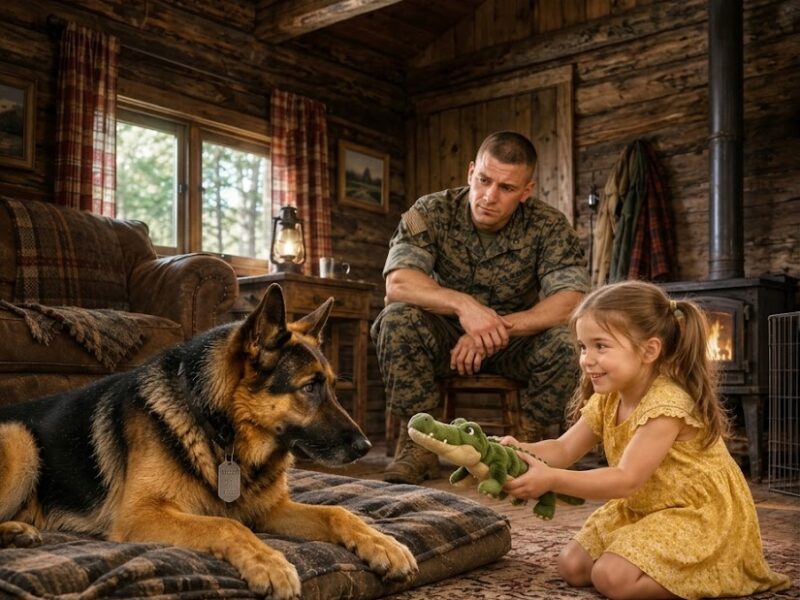
A little girl tugged her father’s sleeve and asked, “Daddy, can we keep him?” The Marine knelt down to check the old dog’s tag—and froze.
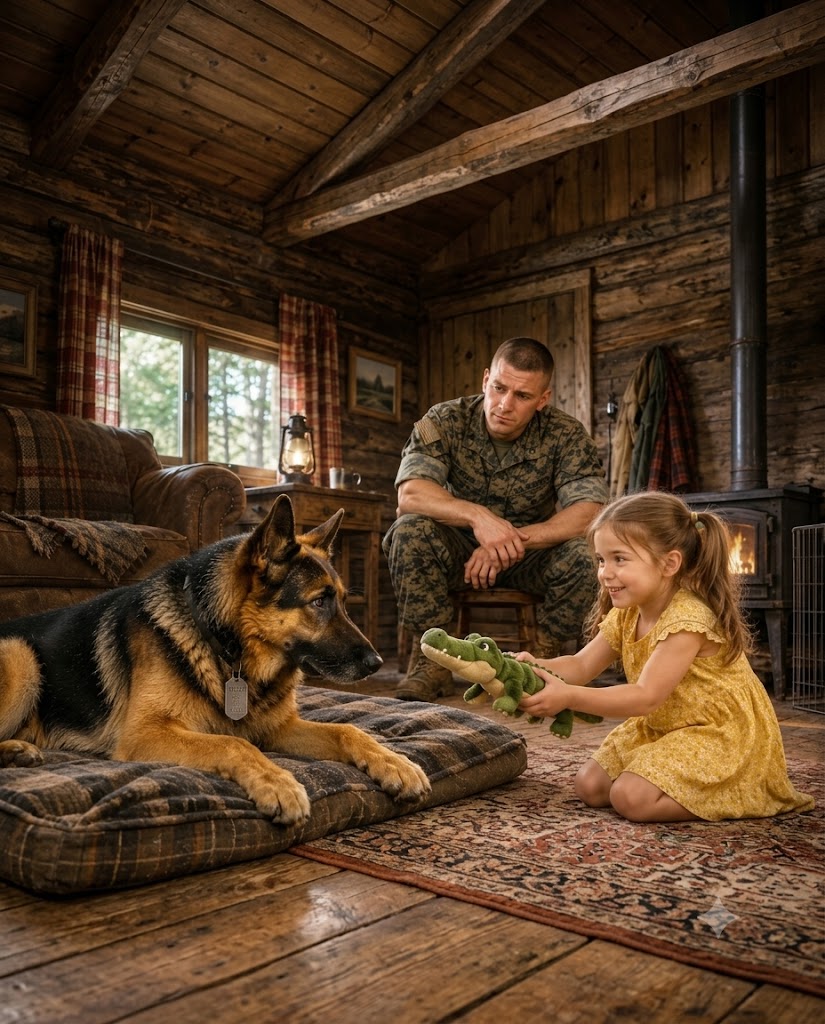
Staff Sergeant Cole Bennett pushed open the door of his late uncle’s cedar cabin outside Sisters, Oregon, and the smell of old wood and dust hit him like a memory he hadn’t earned. Late afternoon sunlight slipped through the pines, turning the windows gold. His eight-year-old daughter Avery stood behind him in a yellow summer dress, clutching a green stuffed alligator named Gator. “Stay behind me until I check the floor,” Cole said. “I know,” Avery replied, her hazel eyes already scanning every forgotten thing in the room. Then something moved beside the cold cast-iron stove. A German Shepherd lay on a faded blanket, large even while resting, his black and tan coat dusted with gray around the muzzle. His left ear leaned slightly outward; the right stood upright. He watched them without barking, without rushing—just assessing. Cole had seen enough working dogs around military installations to know the difference between fear and evaluation. This dog was evaluating him.
“Daddy,” Avery whispered. “Stay where you are.” “He doesn’t look mad.” “That doesn’t mean we walk up to him.” Avery nodded, then lowered herself carefully to her knees several feet away and placed Gator on the wooden floor. “Maybe he needs a friend.” The shepherd’s upright ear shifted forward. Slowly, he crossed the room, sniffed the toy once, and gently picked it up. Avery smiled. But the dog did not lie down with it. He turned, walked toward the fireplace, and placed Gator beside one particular floorboard. Cole frowned. “He put it there,” Avery said. “I can see that.” Cole picked up Gator and handed it back to her. Avery set the toy down again. The shepherd took it almost immediately, carried it to the same board, and placed it in the exact same spot. Cole’s expression changed. “That’s twice.” “Maybe he’s showing us something.” “Maybe.”
Cole checked the dog’s water first, filling an old metal bowl near the back door. He found an unopened bag of dried dog food in a cabinet. The shepherd approached but did not eat. He looked at Cole, then Avery. Cole motioned for her to step back. Only then did the dog lower his head and begin eating—controlled, patient, waiting for space before taking food. While Cole checked the bedrooms and storage room, the shepherd followed, always on his left. At each doorway, the dog paused, looked inside, then moved on. By the time they returned to the living room, Cole was no longer wondering whether someone had trained him. He was wondering who.
His phone vibrated. An email from Marine Corps personnel filled the screen. Instructor assignment. Response deadline. Cole read only the first lines before locking the phone. Avery noticed. “Work.” “Something like that.” “Are you going away again?” Cole put the phone in his pocket. “I haven’t decided anything.” Avery looked toward the windows. “You always say that before deciding something.” Cole had no answer he liked enough to give her. The instructor position had followed him for weeks. It would keep him in uniform. It would allow him to train younger Marines. More importantly, it offered something his current assignments rarely did: a schedule Avery could actually understand. But accepting it felt complicated. Cole had spent most of his adult life believing service meant going wherever he was needed, whenever he was needed. A quieter assignment felt almost like stepping away from a version of himself he had spent years building. Avery did not know all of that. She only knew her father sometimes packed a bag, and when he did, she never knew exactly how long it would be before the house felt normal again.
That night, they stayed in the cabin. Cole left the shepherd on a folded blanket near the stove while Avery slept across the hall. Sometime after midnight, Cole woke to check on her. The blanket was empty. He found the dog lying directly outside Avery’s door, head between his paws, eyes open. He simply watched Cole until Cole stepped away. Cole remained in the hallway for several seconds. The shepherd had known Avery less than a day, yet he had chosen that doorway. “Okay,” Cole murmured. “I’m starting to get the message.” The dog’s upright ear shifted toward him. Nothing more.
The next morning, pale sunlight entered through the plaid curtains as Avery came into the living room holding Gator. The German Shepherd immediately stood. Avery looked at her father. “One more time.” Cole knew exactly what she meant. He nodded. Avery placed the green alligator on the floor. The shepherd picked it up without hesitation. He crossed the room and, for the third time, placed it beside the same floorboard. Now Cole stopped joking. He crouched beside the fireplace. Dust had settled deeply between the old boards. At first, nothing looked unusual. Then Cole noticed that one edge was slightly darker than the others. He brushed it clean with his hand. Avery crouched beside him. “What do you see?” “I’m not sure yet.” He ran his fingers along the seam. Something cold touched his fingertip. Cole brushed away another layer of dust. A small iron ring appeared, almost completely hidden. Avery’s eyes widened. “He really was showing us.” Cole stared at the ring. Someone had deliberately built a way to lift that section of floor, and judging by the dust around it, nobody had opened it in a long time. He reached toward the ring, then stopped. Something on the German Shepherd’s collar had caught the morning light. Cole had noticed the old leather collar the day before but had assumed the scratched piece of metal beneath it was an ordinary identification tag. Now he leaned closer. The shepherd remained perfectly still. Cole gently turned the tag between his fingers. The metal was worn around the edges as though it had been carried through years of weather and work. Most of its surface was scratched, but the engraving remained readable. Ranger. SAR 214. Avery leaned over his shoulder. “Ranger.” The German Shepherd looked directly at her, his upright ear shifting forward. Avery’s face brightened. “That’s your name, isn’t it?” Ranger remained beside her. Cole barely heard the question. His attention had fixed on the second line. SAR 214. He had worked around military personnel, emergency crews, and civilian search teams often enough to recognize those letters. SAR: Search and Rescue. Cole slowly stood. Yesterday, Ranger had waited before taking food. He had followed Cole through the cabin on his left. He had checked doorways. He had spent the night outside Avery’s room, and three separate times he had carried her toy to the same hidden section of floor. Those things no longer felt unrelated. Avery gently touched Ranger’s shoulder. “So, he had a job.” Cole looked down at the old German Shepherd. “I think he had more than a job.” He turned toward the hidden iron ring, then toward the quiet room Robert Bennett had left behind. Cole had believed his uncle used this place to escape the noise of ordinary life—a fishing cabin, a mountain retreat, a place filled with old tools, faded photographs, and memories the family would eventually sort into boxes. Now he was beginning to suspect Robert had kept an entirely different part of his life hidden here. And Ranger knew something about it. Cole looked once more at the tag. Ranger. SAR 214. The old dog inside Robert Bennett’s cabin was not a stray, and he had not been waiting beside that fireplace by accident. He had been waiting for someone to notice where he wanted them to look.
Morning came cool and clear over the Cascade foothills, sunlight moving slowly through the pines and spilling across the old cabin floor. Cole Bennett had been awake for nearly an hour before Avery came downstairs. Ranger was already standing near the front door, alert but calm, as though he had been waiting for the day to begin. Cole had decided not to open the hidden floor compartment yet. The iron ring beneath the dust had been enough to change the entire meaning of the cabin, but he wanted to understand Ranger first. An old search and rescue tag was not something he intended to treat casually, especially when the dog carrying it appeared to remember more about this place than anyone else did.
By 8:30, Cole, Avery, and Ranger were driving toward Sisters Veterinary Center, a modest clinic at the edge of town, surrounded by juniper trees and low volcanic hills. Ranger sat upright in the back seat beside Avery instead of lying down. His gray muzzle pointed toward the window, and every time they passed a maintenance truck, hiking group, or person in uniform, his attention sharpened for several seconds before relaxing again. Avery had brought Gator with her. “He probably wants it,” she said. “He’s shown absolutely no evidence he wants to play with it. He carried it three times to the floor. That still counts.” Cole glanced at her in the mirror. “You have a flexible definition of play.”
Dr. Lauren Mitchell met them in the examination room ten minutes later. Lauren was 39, medium height and slender, with chestnut hair pulled into a loose ponytail and warm brown eyes behind thin-framed glasses. She wore dark green scrubs beneath a white coat and had the calm, unhurried manner of someone who believed frightened animals usually needed patience more than persuasion. She had grown up on a ranch outside Bend and originally planned to work with horses, but after volunteering at a rural shelter during college, she changed direction and built her career around family pets and older working dogs. She was known locally for explaining things clearly and never making owners feel foolish for asking basic questions. “Well,” Lauren said as Ranger watched her from beside Cole’s leg, “you certainly brought me an interesting gentleman.” Avery smiled. “His name is Ranger.” “We think,” Cole added. Ranger’s right ear shifted toward Lauren, but he did not move. Lauren avoided approaching him directly. She turned slightly sideways, let Ranger watch her, then opened the examination room door wider. Ranger stepped forward, stopped at the threshold, looked briefly into the hallway, and only then crossed. Lauren noticed. “So, he does that often.” “Every doorway since yesterday.” “And where does he position himself around you?” Cole stepped away from the wall. Ranger immediately moved with him and settled beside his left leg. Lauren raised an eyebrow. Avery folded her arms proudly. “He knows things.” “I’m beginning to agree.”
The examination itself revealed nothing alarming. Ranger was underweight compared with what Lauren expected for his frame, and his age showed in some stiffness when he changed position, but his heart sounded steady. His coat was in reasonable condition beneath the dust, and he remained attentive throughout the visit. Lauren estimated him at approximately nine years old, perhaps slightly older. “He’s had some instability recently,” she said. “But I don’t see anything today that makes me think he can’t have a comfortable life with routine care, better nutrition, and time.” Avery immediately looked at Cole. Cole knew the question before she asked it. “So, we can keep him.” Lauren smiled but wisely looked away. Cole sighed. “That is not what she said.” “But she said ‘comfortable life.'” “She did. And our house is comfortable, Avery. I’m just organizing the evidence.” Lauren covered a laugh with one hand. Cole gave her a look. “You’re helping.” “I haven’t said anything.” Ranger sat beside Avery, clearly neutral on the housing negotiations.
Lauren then noticed the worn tag on his collar. “SAR 214.” “Search and rescue,” Cole said. “At least that’s what I assume.” Lauren’s expression became more serious. “Did Robert ever mention knowing a search dog?” “Never.” “Then let’s see whether Ranger has a registered chip.” She retrieved a handheld scanner and passed it slowly across his shoulders. A beep came almost immediately. Avery straightened. “He has one.” Lauren entered the number into the clinic computer. At first, her face remained routine. Then she leaned closer. “What?” Cole asked. “One second.” She entered the number again. Same result. The record appeared under an organization rather than an individual owner. Name: Ranger. Organization: Oregon Northwest Search Coalition. SAR identification: 214. Cole leaned closer. Then Lauren stopped scrolling. A line at the bottom of the archived record read: Status: deceased three years ago. For several seconds, no one spoke. Avery looked at the monitor, then slowly down at Ranger. “But he’s right here.” Cole stared at the screen. “Yeah,” he said quietly. “He definitely is.” Lauren checked the chip number a third time, then compared it with the identification code on the collar. Everything matched. “This isn’t a similar dog with a reused name,” she said. “The chip belongs to Ranger.” Cole looked at the old shepherd sitting calmly beside his daughter. Somewhere three years earlier, an official record had closed Ranger’s life. Yet Ranger was sitting in a veterinary clinic outside Sisters, watching Avery hold a green alligator.
Lauren searched through archived contact fields and found a handler name attached to the original registration: Daniel Morgan. There was also an old telephone number. “You want to try it?” she asked. Cole nodded. The call rang six times before a man answered. “Hello.” The voice was deep, guarded, and slightly rough. “Is this Daniel Morgan?” A pause. “Who’s asking?” “My name is Cole Bennett, Staff Sergeant, United States Marine Corps. I’m calling about a German Shepherd.” Another pause. Cole looked at Ranger. “SAR 214.” Nothing came through the phone for several seconds. Then the man spoke. “Where did you get that number?” “It’s on his collar.” The silence changed. Not suspicion anymore. Something closer to disbelief. “I have the dog.” The man on the other end gave a short breath that did not quite become a laugh. “No, you don’t.” “His name is Ranger.” The breathing stopped.
Daniel Morgan was 52, though Cole would not learn the details of his appearance until later. He was a former volunteer search and rescue handler, tall and broad through the chest with graying dark hair, a weathered face, and the quiet personality of a man more comfortable on a trail than in conversation. Years of wilderness searches had made him patient. Losing Ranger had made him private. After being told his partner was dead, Danny had stepped away from organized search work almost completely. On the phone, all Cole heard was a man trying not to believe something he desperately wanted to believe. “Ranger died three years ago,” Danny finally said. Cole looked at Lauren. “That’s what the record says.” “It’s not just the record.” Danny explained that Ranger had been one of the strongest dogs in the Oregon Northwest Search Coalition, particularly skilled at wilderness tracking and locating missing hikers in difficult terrain. By the time Ranger reached his later working years, age and accumulated strain had begun slowing him down. After one final mountain search, the organization decided retirement was the right choice. A private placement program had offered to handle the transition into permanent retirement. “They told me he’d be somewhere quiet,” Danny said. “Good property, people familiar with working dogs.” “What happened?” “For a few weeks, I got updates. Then nothing. I called. Eventually, they sent a letter.” Cole already knew where this was going. “They said he died.” Danny’s voice remained controlled, but barely. “Complications related to age. I asked about his collar, his tag, his harness. Never got any of it back.” “You never saw him afterward?” “No.”
Avery had gone unusually quiet. Cole sent Danny a photograph from the clinic. Ranger was sitting beside Avery, one ear upright, the other leaning slightly outward. The reply came almost immediately. Danny inhaled sharply. “That’s him.” “You’re sure?” “Look at the left ear.” Cole already had. Danny’s voice softened. “He got that bend when he was young. Never bothered him. And the way he sits when he’s watching someone.” A pause. “Yeah, that’s Ranger.” Cole glanced down at the dog. “There’s something else at the cabin. Avery gave him a toy. Ranger carried it to one specific floorboard three times.” Danny went silent again. Then: “That’s what he used to do.” Cole straightened. “What?” “If he wanted me to check something, he’d use whatever object was available. Glove, rope, sometimes a water bottle. He’d pick it up, take it to the location, and wait.” Cole thought of Gator beside the hidden iron ring. For the first time, the loose floorboard felt less like an odd coincidence and more like a deliberate message. Before ending the call, Cole asked whether Danny wanted to come see Ranger. The answer did not come quickly. “I need a little time,” Danny said. Cole understood. Three years was a long time to mourn something. Hope could be harder than grief when you were afraid it might disappear again.
Back at the cabin that afternoon, Avery found a small spiral notebook in one of Robert’s desk drawers. She sat at the kitchen table and wrote across the first page in careful block letters: “Things Ranger remembers.” Under it, she added: “One. Doorways. Two. Dad’s left side. Three. Gator and the floor.” Cole watched from the counter. “You’re making a case file?” “Yes.” “You’re eight.” “I’m organized.” Ranger lay beside her chair. Later, Cole misplaced a pair of work gloves while moving boxes from the storage room. He searched the porch, the truck, and the kitchen before Avery held one old spare glove beneath Ranger’s nose. “Find Dad’s.” Cole turned. “Avery, don’t.” Ranger sniffed once, walked through the cabin, and stopped beside a stack of folded blankets near Robert’s old bedroom. Cole lifted the top blanket. His gloves were underneath. Avery added another line to the notebook: “Four. Finding things.”
That evening, Cole opened Robert’s old financial folder while sorting paperwork. Between utility bills and property tax receipts, he found several small donation acknowledgements from an organization called the Northwest Working Dog Retirement Fund. Robert had donated more than once. Cole stared at the receipts. His uncle had never mentioned the organization, never mentioned Ranger, never mentioned search and rescue dogs at all. Outside, Ranger rested on the porch beside Avery. Cole’s phone buzzed with a message from the real estate agent confirming Monday’s appointment to begin the sale paperwork. Cole looked around the cabin, then toward the hidden iron ring still waiting beneath the floorboard. He typed a short reply: “Need to postpone. Family matter. I’ll contact you.” He did not cancel the sale. Not yet. But for the first time since Robert died, Cole was no longer certain selling the cabin was the right decision. Avery appeared in the doorway. “Does that mean Ranger stays?” Cole looked past her at the old German Shepherd. “I didn’t say that.” “You postponed the house.” “I postponed paperwork.” “That sounds promising.” Cole almost smiled. Ranger stood and moved automatically to his left side. Cole looked down at him. Three years ago, someone had declared this dog dead. Robert Bennett had apparently known something about retired working dogs that Cole had never been told, and Ranger had spent his first two days with them quietly demonstrating that his memory had survived whatever his records had not. Cole turned toward the loose floorboard near the stove. Danny’s words remained in his mind. If he wanted me to check something, he’d take an object there and wait. Ranger had done exactly that three times. Whatever Robert had hidden beneath that floor, Cole was beginning to believe Ranger had been waiting for someone to finally understand the message.
By 9 the next morning, the cabin no longer felt like a place Cole Bennett was preparing to sell. It felt like evidence. The iron ring beside the fireplace remained exactly where Cole had uncovered it, half hidden beneath the old pine floorboards. Ranger sat several feet away, watching the room with the calm patience that had become increasingly familiar. Avery sat at the kitchen table with Gator beside her notebook, adding another line beneath the title “Things Ranger remembers.” Cole had resisted opening the compartment alone. After what they had learned from Ranger’s microchip and Danny Morgan, whatever Robert had hidden beneath that floor might belong to a story larger than the Bennett family. So Cole had made one phone call.
Sheriff Ethan Hayes arrived shortly after 9. Ethan was 42, a little under six feet tall, solidly built with short black hair beginning to gray at the temples and a square face that rarely revealed more emotion than he intended. He wore the brown uniform of the Deschutes County Sheriff’s Office and carried himself with the quiet confidence of someone who had spent years entering situations where patience mattered more than volume. Before becoming a deputy, Ethan had served six years in the Army. That shared military background was how he and Cole had first met during a joint emergency preparedness exercise years earlier. Where Cole tended to trust instinct once he had enough evidence, Ethan trusted sequence. What happened first, who knew what, what could be documented. He had learned early in law enforcement that a strange story became useful only when facts could survive being separated from emotion. Ethan crouched beside the exposed ring. “So, this is what the dog was showing you?” “Three times,” Cole said. Avery looked up. “Four if you count this morning.” Cole turned. “You did it again.” “I was checking.” Ethan almost smiled. “Good quality control department you have here.” Avery pointed toward Ranger. “He’s in charge.” Ranger remained unimpressed.
Cole handed Avery Gator. “One last demonstration.” She placed the green alligator in the center of the room. Ranger stood immediately. He crossed the floor, picked up the toy, carried it toward the fireplace, and placed it directly beside the iron ring. Then he sat. Ethan’s expression changed. “That’s deliberate.” “That’s what Danny said. Ranger used objects to mark places his handler needed to inspect.” Avery looked from Ranger to Gator. “So, Robert didn’t hide Gator there.” “No,” Cole said. “Gator wasn’t here until you brought him.” She considered that carefully. “So, Ranger used my toy because I gave it to him.” “Looks that way.” Avery smiled slowly. “He trusted me.” Cole did not correct her.
Ethan photographed the compartment before Cole touched it. Then Cole wrapped his fingers around the iron ring and pulled. The board resisted at first. Years of dust and dry wood held it tightly in place. Then it lifted. Beneath it was not a basement or hidden tunnel, just a rectangular storage compartment between the floor supports, perhaps three feet long and two feet deep. Someone had lined the interior with cedar boards and placed several sealed plastic containers inside to protect their contents from moisture. Cole stared down. “Robert built this.” “Looks like it,” Ethan said.
The first container held photographs—dozens of them. Some showed mountains, volunteer crews, emergency vehicles, and dogs wearing brightly colored search harnesses. Others were ordinary family photographs Cole had not seen in years. He picked one up. Robert stood on this same porch nearly 25 years earlier, younger and broad-shouldered, his dark hair not yet silver. Beside him was a 12-year-old Cole holding a fishing rod far too large for him. Avery leaned over his arm. “That’s you.” “Unfortunately.” “You had terrible hair.” “It was the ’90s. Everyone had terrible hair.” Another photograph showed Cole asleep in a camping chair while Robert held a marshmallow over his head. Cole smiled despite himself. He had spent months thinking of Robert primarily as an estate to settle—paperwork, property, belongings, decisions. The photographs reminded him that before Robert became an old man living alone in the mountains, he had been the uncle who taught Cole how to tie fishing knots, change a tire, split firewood, and leave a campsite cleaner than he found it.
Then Ethan pulled out another photograph. “Cole, this one was newer.” Robert stood outside a search and rescue facility wearing a faded work jacket. Beside him was Ranger—younger, stronger, his muzzle almost entirely black. And standing on Ranger’s other side was a man Cole recognized from the photograph Danny had sent after their phone call. Daniel Morgan. Avery whispered. “Uncle Robert knew him.” Cole turned the photograph over. Robert’s handwriting covered the back: “Danny, Ranger, Robert. Santiam training weekend.” Cole sat back on his heels. His uncle had not simply known about working dogs. He had known Ranger personally.
The second container held an old orange search harness, several retired collar tags, transportation receipts, and folders marked with handwritten dates. Ethan examined each item without rushing. Then they found Robert’s notebook. It was a black hardbound book, the corners worn smooth from years of use. Robert’s handwriting filled nearly every page. The first entries were ordinary: mileage, dog names, pickup locations, veterinary appointments. Gradually, a clearer picture emerged. After retiring from utility work, Robert had begun volunteering as a driver for organizations that helped relocate retired search and rescue dogs, service animals, and other working dogs into permanent homes. He used his pickup and sometimes the cabin as a temporary overnight stop when travel distances were too long to complete in one day. “He never told me,” Cole said. Ethan continued turning pages. “Maybe he didn’t think it was important enough to talk about.” “That sounds like Robert.” Then the entries changed. Robert began noting dogs whose final destinations did not match the paperwork he had originally received. One name appeared repeatedly: North Valley K9 Placement. Beside several dogs, Robert had written short questions. Receiving family not listed. Transfer date changed. Call returned by different coordinator. Final placement unclear. Ethan’s voice became careful. “This doesn’t prove wrongdoing.” “I know. But it gives us something that needs to be checked properly.”
Then Avery pointed toward one page. “Ranger.” Cole looked. Ranger. SAR 214. Below it, Robert had written only four words: “Alive. Record is wrong.” Nobody spoke. The sentence was dated almost three years earlier. Cole read it again. Robert had known. Not recently, not accidentally. Three years ago.
A knock sounded at the cabin door. Ranger stood before anyone else moved. Cole opened it. Grace Holloway stood on the porch holding a covered casserole dish. Grace was 61, short and slightly rounded, with silver-blonde hair cut neatly to her chin and pale blue eyes behind large glasses. She lived on a small property about half a mile down the forest road and had known Robert for nearly 15 years. A retired elementary school librarian, Grace had a gentle voice but a direct way of speaking developed from decades of dealing with children who believed “I forgot” qualified as a complete explanation. After losing her husband five years earlier, she had become even more involved in the scattered mountain community, checking on older neighbors during winter storms and keeping spare keys for people who traveled often. Her eyes moved immediately toward Ranger. Then she stopped. “Oh,” she said softly. Cole noticed. “You know him?” Grace looked at him. For a moment, she seemed to consider denying it. Instead, she stepped inside and set the casserole on the table. “I wondered how long it would take.” Cole stared at her. “You knew Ranger was here?” “Yes.” Avery immediately moved closer to the dog. Grace sighed. “Robert asked me to help feed him whenever he couldn’t come up.” Cole’s confusion sharpened. “For how long?” “On and off for months before Robert passed. After that, I kept checking on him. Ranger spent some nights at my place, but he always wanted to come back here.” “Why didn’t you tell me?” “Because Robert asked me not to move anything until someone in the family came to sort through the cabin.” Ethan stepped closer but kept his tone gentle. “Did Robert tell you what he was doing?” “Some of it.” Grace explained that Robert had become increasingly concerned about retired working dogs whose placement records seemed incomplete. He had no intention of accusing anyone without evidence. He wanted to gather documents first, compare transfer records, and then take everything to the appropriate authorities. But Robert’s health declined faster than he expected. “He hated making people worry,” Grace said. “He’d tell everyone he was fine until he was too tired to drive himself into town.” Cole looked down at the notebook. That sounded exactly like him. Grace glanced toward Ranger. “A few weeks before Robert went into the hospital, he told me something strange. He said if he couldn’t finish what he started, I should keep Ranger close to the cabin.” “Why?” Grace looked toward the open floor compartment. “He said, ‘The dog knows where the papers are.'” Avery’s hand went to her mouth. Cole turned toward Ranger. The old shepherd was sitting beside her, calm as ever. Robert had not left a coded message. He had left something simpler: a dog that remembered.
Grace then told them about another plan Robert had rarely discussed outside their small circle. He had wanted to repair the unused workshop behind the cabin and turn the property into a temporary resting place for retired working dogs waiting for permanent homes. “Nothing huge,” Grace said. “Three or four dogs at a time, somewhere quiet.” Avery looked at Cole immediately. “We can do that.” Cole almost laughed. “We currently have one dog, a cabin that needs repairs, and no plan.” “We have the workshop.” “We also have bills.” “That sounds like a grown-up problem.” “It is very much a grown-up problem.” But the idea stayed with him. Ethan closed Robert’s notebook. “For now, nobody contacts North Valley. Nobody drives out there asking questions. These records need to be copied and reviewed properly.” He looked directly at Cole. “That includes Marines who think rules become optional when they’re curious.” Cole raised both hands. “I heard you.” “I know you heard me. I’m checking whether you understood me.” Avery smiled.
That afternoon, Cole called the real estate agent again. This time, he postponed the appointment indefinitely. He still did not know whether he could afford to keep the cabin. He did not know what Robert’s unfinished dream would cost or whether it was realistic. But selling it before understanding what his uncle had built here suddenly felt impossible. Near sunset, Avery sat on the porch beside Ranger. “You waited for us,” she told him. Ranger rested his gray muzzle across his paws. Cole stood behind them, holding Robert’s photograph of Ranger and Danny. His phone vibrated. A message from Daniel Morgan. Cole opened it. “I’ve been thinking about what you said. I can’t keep wondering whether it’s really him. I’m driving to Oregon.” Cole looked at Ranger. The dog raised his head toward the fading light beyond the trees. For three years, Ranger had remained connected to two men who believed very different things. Danny believed he was gone. Robert knew he was alive. Now, one man was coming to see the truth for himself, while the other had left behind enough clues to finally begin telling it. And beneath the old cabin floor, Robert Bennett had given them the first real piece of the story.
—
Three days after the hidden compartment beneath Robert Bennett’s cabin was opened, Sheriff Ethan Hayes carried copies of the notebooks, transfer sheets, photographs, and collar records to the county office. What had begun as one impossible question about Ranger was slowly becoming a much larger puzzle. Robert had marked seven other working dogs besides Ranger. Every one of them had passed through the same organization: North Valley K9 Placement. The final records did not match cleanly. Three dogs were listed as adopted, two as transferred to other programs, and two as deceased. But several receiving addresses were incomplete. Dates changed between copies. Some microchip numbers appeared in one document and vanished from the next. Ethan was careful not to make conclusions the paperwork could not prove. “Bad records aren’t automatically a crime,” he told Cole over the phone. “But eight working dogs with unclear final destinations is enough for the right agencies to start asking questions.”
Cole stood outside the cabin while listening, replacing a loose board in the old fence Robert had built years earlier. Two weeks ago, he would have ignored the fence because the property was supposed to be sold. Now, he had replaced six boards, repaired the gate latch, and started clearing brush from the unused workshop behind the cabin. Avery noticed everything. “You’re fixing a lot of things for a place we’re not keeping.” Cole drove another screw into the wood. “I’m fixing things that need fixing.” “That wasn’t my question.” “I know.” Ranger lay beneath a pine tree nearby, watching them with his gray muzzle across his paws. A new orthopedic dog bed waited inside the cabin. Avery had purchased it with money she had saved from birthdays and small household chores. Cole had offered to pay. She refused. “He already had people make decisions for him,” she had said. “I want this one to be mine.”
By the end of the week, the first calls began coming back. Animal shelters, rescue organizations, veterinary clinics, and working dog groups were asked to compare Robert’s list against their microchip databases. No one was looking for dramatic explanations. They were simply trying to answer the same question repeatedly: Where had these dogs actually gone? The first answer came from Salem. A 12-year-old yellow Labrador named Murphy had been listed in North Valley records as transferred to an unspecified senior dog program. Investigators eventually traced his microchip to George and Patricia Collins, a retired couple who had adopted him almost three years earlier through a small community rescue. Murphy was safe. The rescue had simply never received the earlier transfer history, leaving the paperwork disconnected. A photograph showed an elderly Labrador with a pale cream coat, cloudy brown eyes, and a broad face resting happily on a porch beside two grandchildren. Avery studied the picture at Lauren’s clinic. “He looks comfortable.” “He looks extremely comfortable.” Lauren said Murphy was apparently famous for stealing warm spots on the couch.
The second dog was a Belgian Malinois named Juno, nearly 10 years old, lean and dark-faced with the intense amber eyes typical of her breed. She had once worked with a volunteer wilderness team before retirement. Her paperwork said “adopted” but gave no family information. Juno was found living on a small farm outside Madras with a former paramedic who had received her through another rescue network. She spent most days following him between a barn and vegetable garden. Another dog, a black and tan German Shepherd originally registered as Echo, had been located at a shelter in Eugene under the name Ruby. Ruby was about 11, with a graying face and one white patch beneath her chin. She had arrived at the shelter months earlier with almost no history. Staff described her as reserved with strangers but deeply affectionate once she trusted someone. Three dogs found, four still unclear. For Cole, the discoveries changed the shape of the mystery. The story was no longer simply about dogs disappearing. It was about dogs becoming separated from their own identities. Some might have reached safe homes while the records behind them collapsed. Others might still be somewhere under different names. And somewhere in the middle of all that confusion, Ranger had ended up in Robert’s cabin.
While the adults dealt with paperwork, Avery decided she wanted to do something she could understand. At Sisters Veterinary Center, she placed a large wooden box beside the reception desk. Lauren had helped sand the rough edges. Grace Holloway painted the letters across the front: “Ranger’s Toy Box.” Grace had arrived that morning wearing a lavender cardigan over jeans, her silver-blonde hair held back with a blue clip. Although she had spent most of her life quietly helping neighbors, she approached projects with the energy of someone who believed any problem looked smaller once a list was made. “What exactly are we collecting?” Grace asked. Avery opened her notebook. “Blankets, dog toys, leashes, food, old dog stuff?” Lauren smiled. “Old dog stuff may need a more technical name.” Avery thought about it. “Senior supplies?” “Much better.” On the front of the box, Avery drew a green alligator. Gator sat beside her on the floor as the model. Within two days, the box held three folded blankets, two unopened bags of treats, several toys, a leash, and an envelope containing $20. Lauren stood beside Cole, watching Avery sort everything. “You know,” she said, “there’s a real need for something like this. Toy boxes, a program specifically for older working dogs. They don’t always fit ordinary adoption systems. Some need quieter homes, experienced owners, more medical support.” Cole looked at Ranger resting near Avery. “You’re thinking bigger than a box.” “I usually do.”
That evening, another vehicle came slowly up the forest road. A dark green pickup stopped beside the cabin. The driver remained inside. Cole recognized Daniel Morgan before the man finally opened the door. Danny was 52, tall and broad through the chest, though age and years of outdoor work had rounded his shoulders slightly. His dark hair had turned gray along the sides, and weather had drawn deep lines around his eyes. He wore faded jeans, brown work boots, and an old canvas jacket. Nothing about him was polished. He looked like a man who had spent more comfortable hours in forests than in offices. He stepped from the truck, then stopped. Ranger was visible through the porch railing. Danny did not move for nearly 10 minutes. Cole stayed back. Avery started to ask something, but Cole gently touched her shoulder. “Give him time.” Danny had spent three years believing Ranger was dead. He had built an entire life around accepting that fact. Walking 20 feet across a yard should have been easy. It wasn’t.
Finally, Danny approached. Ranger stood. Danny stopped again. He did not whistle. He did not call Ranger’s name. He simply lowered himself to one knee. Ranger watched him for several seconds. Then the old German Shepherd walked slowly down the porch steps. One step, then another. When he reached Danny, Ranger pressed his head gently against the man’s chest. Danny closed both arms around him, his eyes shut. “I thought I lost you, buddy.” Nothing else needed saying. Avery stood beside Cole holding Gator against her chest. After several minutes, Danny sat on the porch with Ranger beside him and told stories Avery had never heard. Ranger finding a lost backpack in deep timber. Ranger refusing to leave a search area until Danny checked one final drainage path. Ranger sleeping across Danny’s boots after long training days. But eventually, Ranger stood. He walked across the porch and sat beside Avery. Danny watched him. Cole saw the change in the older man’s expression. Not hurt exactly, but understanding. “He remembers you,” Cole said. “I know.” Danny looked at Ranger, leaning lightly against Avery’s knee. “He also knows where he is now.”
That night, Ethan called with another discovery. Among Robert’s papers was evidence that he had attempted to send a formal report shortly before his health declined. A draft letter and certified mail receipt showed he had started documenting the discrepancies surrounding North Valley. “He was trying to do this the right way,” Ethan said. Cole looked toward Robert’s notebook on the table. “That sounds like him.”
The next morning brought the call that changed everything again. A regional shelter had scanned an elderly German Shepherd whose history could not be confirmed. The dog was approximately 11 years old, sable-coated with a heavy gray muzzle and a small notch along the edge of his right ear. He had arrived under a temporary name and behaved calmly around staff, but he responded unusually strongly to simple search dog hand signals. Lauren arranged for Ranger to visit the shelter under controlled conditions. Danny came with them. When Ranger entered the quiet meeting yard, the other German Shepherd lifted his head. Neither dog rushed forward. Ranger walked halfway across the grass, stopped several feet away, and slowly lay down. The sable shepherd stared at him. Then his tail moved once, twice. Danny went completely still. “Scout,” he whispered. Cole turned. “You know him?” Danny was already pulling out his phone, searching through old photographs. He found one. A younger Ranger stood beside another German Shepherd wearing an orange search harness. The sable coat. The same right ear. The identification beneath the photograph read: Scout. SAR 207. Danny looked back toward the dog in the yard. “Scout trained with Ranger for years.” Ethan checked the copied records. Then he found the line. Scout’s final status had been entered almost two years earlier: Deceased. Avery looked through the fence at the two old shepherds resting quietly in the grass. Ranger was no longer the only dog whose official story said one thing while the living dog said another. Cole looked at Danny. The question that had begun beneath Robert Bennett’s cabin had just become something much larger. Ranger had been proof that one record was wrong. Scout was proof that it had happened again.
—
The morning after Scout was identified, Sisters woke beneath a pale blue sky and a thin band of mist stretched across the lower Cascade foothills. At the cabin, Ranger slept longer than usual. The reunion with Danny, the trip to the shelter, and the excitement surrounding Scout had clearly taken something out of him. Cole noticed the stiffness when the old German Shepherd finally stood, and that alone was enough to remind him of something everyone seemed in danger of forgetting: Ranger was nine years old. Whatever he had once been capable of, he did not owe anyone another demonstration.
By mid-morning, Ethan called with an update. The remaining North Valley records had been turned over to the appropriate agencies for formal review. No one was making public accusations, and Ethan was careful to keep Cole away from speculation. “The paperwork is moving where it needs to move,” he said. “Our job now is to let the people responsible for reviewing it do theirs.” Cole leaned against the cabin porch rail. “Any word on the other dogs?” “One. Scout’s former handler has been located. Her name is Karen Whitmore, 58, a retired wilderness medic from Eugene.” Karen was tall and lean with short silver hair and the steady posture of someone who had spent decades hiking difficult terrain with rescue teams. She had always been known for being calm under pressure, but losing Scout had ended her fieldwork earlier than she expected. She had been told years before that Scout had died after retirement placement. And like Danny, she had never been given the chance to see him again. When Karen arrived at the shelter, she did not call Scout from across the room. She sat on the floor. Scout stared at her. Then he walked forward and rested his head in her lap. Danny later sent Cole one photograph. Karen had both hands around Scout’s face, eyes closed, while the old shepherd leaned against her knees. Avery stared at the picture for almost a minute. “Are they staying together?” “That’s the plan,” Cole said. Avery smiled. “That’s one.” “One what?” “One dog who found his person again.” Cole looked toward Ranger. “Yeah,” he said. “One.”
Another dog from Robert’s list found a home that same day. Echo, the German Shepherd who had been living under the name Ruby, was recognized by a retired firefighter named Marcus Hale. Marcus was 47, broad-shouldered and bald with a trimmed brown beard and a personality so quiet that people sometimes mistook him for unfriendly. Years earlier, he had worked alongside search teams during wildfire evacuations and remembered Echo from several training exercises. After hearing that she needed a permanent home, Marcus drove to Eugene, intending only to meet her. He left with adoption paperwork. Avery added both names to her notebook. Scout found Karen. Echo found Marcus. Below them, she wrote: “Ranger found us.” She did not show Cole that line.
Across town, Lauren was also expanding the idea that had begun with Ranger’s Toy Box. She created a simple list of people willing to foster senior working dogs while permanent homes were located. Some were retired first responders. Others were experienced dog owners with quiet houses and fenced yards. Grace offered to coordinate donated blankets and supplies. Danny surprised everyone by volunteering, too. “I’m not taking another dog home,” he told Lauren. Lauren looked over her glasses. “I didn’t ask you to.” “I’m just saying you’re saying it suspiciously often.” Danny ignored that. Instead, he offered to help shelters understand old working dog behaviors that could otherwise be misunderstood. Some retired dogs checked doors. Some preferred specific positions beside people. Some responded to gestures no one realized were commands. Danny knew how to recognize the difference between anxiety, habit, and training. For the first time in three years, he had found a reason to use that knowledge again.
The unexpected call came shortly after noon. Megan Turner was on the line. Megan was 31, average height, athletic, with curly dark blonde hair usually tied beneath a baseball cap and freckles across a face that made her look younger than she was. She worked as an elementary school art teacher during the week and volunteered with a regional shelter on weekends. Megan had become involved in rescue work after adopting an older mixed breed dog during college, and she had a particular weakness for animals that needed patience more than excitement. That morning, Megan had been helping move a recently recovered young shepherd to a temporary foster facility near the foothills. The dog was approximately 18 months old, mostly tan with a dark saddle across her back, long legs, and ears that still seemed slightly too large for her narrow face. Shelter staff had temporarily named her Piper. She was healthy enough to travel but remained uncertain around unfamiliar places. During the transition between facilities, Piper became frightened by the sudden change in surroundings and slipped away before the volunteers could settle her. She disappeared toward the wooded foothills. No one blamed her. Everything around her was unfamiliar. By the time Megan called Lauren, volunteers had searched the surrounding roads and trails without finding her. Lauren called Cole.
Cole listened, then immediately said, “No.” Lauren paused. “I didn’t ask yet.” “You were going to ask about Ranger.” “I was going to tell you they have a blanket Piper was sleeping on.” “No.” Ranger was lying beneath the porch table. Cole looked at the gray muzzle and old shoulders. “He’s done enough.” Danny arrived 30 minutes later. He agreed with Cole at first. Then Megan brought Piper’s blanket to the cabin so volunteers could coordinate a broader search. Ranger had been sleeping. The moment the blanket entered the yard, his head lifted. He stood. Danny stopped talking. Ranger approached the blanket, sniffed it, then looked toward the forest road. Cole shook his head. “No.” Ranger looked at him. Danny folded his arms. “That’s his choice.” “He’s nine.” “I know.” “He hasn’t worked a real search in years.” “I know that, too.” Cole crouched in front of Ranger. “You don’t have to prove anything.” Ranger remained standing, focused. Danny looked toward the storage box inside the cabin. The old orange search harness Robert had hidden beneath the floor was still there. Cole stared at it for several seconds. Then he made a decision with conditions. They would go slowly. Ranger would stop whenever Cole decided he needed rest. No one would push him. And the moment Ranger showed that he wanted to stop, the search ended. Avery stayed behind with Grace and Lauren. She did not argue. That surprised Cole. A few weeks earlier, she would have begged to follow. Now she simply hugged Ranger around the shoulders, then stepped back. “Bring her home if you can.”
Cole fitted the old harness gently around Ranger. Something changed in the dog’s posture. Not his age. Not his strength. His focus. Ranger lowered his nose to Piper’s blanket, then started walking. There was no dramatic sprint. The old shepherd moved steadily through the trees, following a narrow route beyond the service road. Cole stayed beside him. Danny followed several yards back, carrying water and letting Ranger work without crowding him. Twenty minutes passed, then thirty. Cole stopped Ranger beside a shaded clearing and offered water. Ranger drank briefly. They continued. The terrain rose gradually before falling toward a shallow stream. After more than an hour, Ranger reached the water and stopped. He moved several yards downstream, then back. Cole watched him carefully. “Lost it.” Danny did not answer. Ranger lifted his head. For nearly 10 seconds, he remained completely still. Then he turned away from the stream. The new direction led uphill through open pine forest toward a long-abandoned summer camp that had once served hikers traveling through the area. Several small buildings remained. Most were weathered but standing. Ranger slowed near one of them. Beneath the covered porch, something moved. Cole stopped. Piper was tucked behind an old wooden bench. Her tan face appeared briefly between the supports before disappearing again. Megan had warned them that she might be frightened. Cole did not approach. Neither did Ranger. The old German Shepherd simply walked to a place several yards from the porch and lowered himself onto the ground. Piper watched him. Ranger rested his head between his paws. Nothing happened. Five minutes passed. Then Piper’s nose appeared. One paw came forward, then another. She stepped from beneath the porch. Ranger did not move. Piper approached him slowly. When she reached Ranger, she sniffed his face. Only then did Cole crouch several feet away. Piper looked at him, then back at Ranger. Eventually, she moved close enough for Cole to calmly secure her for the walk back. Danny looked at Ranger. A small smile appeared beneath his weathered face. “He still knows.” Cole rubbed Ranger gently behind one ear. “He always knew.”
That afternoon, Piper returned safely to the shelter. Megan sat beside her enclosure while Lauren arranged a quieter foster placement. No celebration was necessary. No one needed Ranger to become a hero again. He had simply remembered how to help another frightened dog find the way back. When Cole returned to the cabin, Avery was waiting on the porch. Ranger climbed the steps slowly. Cole removed the orange harness. He folded it once, then placed it inside Robert’s old storage box. “That’s it, Ranger,” he said quietly. “No more missions.” Avery held out Gator. Ranger took the green alligator gently. Everyone watched. For weeks, the toy had meant something—a place to check, a message to understand, a mystery beneath the floor. This time, Ranger did not carry it anywhere. He walked to Avery’s new dog bed, lowered himself beside her, and placed Gator between his front paws. Avery sat beside him.
Cole’s phone rang. Marine Corps personnel. The voice on the other end reminded him that the instructor assignment needed a final answer soon. Cole looked toward Avery. He ended the call without answering yet. Avery did not ask him to leave the Marines. She did not ask him to stay forever. She leaned against Ranger and said only, “I like knowing when you’re coming home.” Cole looked at his daughter, then at the old search dog resting peacefully beside her. For the first time, he understood that choosing what came next might have less to do with what he was leaving behind than with what he wanted to be present for. Ranger closed his eyes. Gator remained between his paws. This time, there was nowhere else he needed them to look. The search was over.
—
By early October, the first yellow leaves had begun collecting along the forest road outside Sisters, Oregon. Morning fog settled between the pines, and the old Bennett cabin no longer looked like a property waiting for a real estate sign. Fresh boards replaced the broken sections of fence. The porch had been repaired. The unused workshop behind the cabin had new windows, insulated walls, and three quiet indoor runs connected to a fenced yard. Cole Bennett stood at the end of the driveway holding a cordless drill, while Avery balanced a wooden sign against two cedar posts. “Left side higher,” she said. Cole adjusted it. “Too high.” He lowered it. “Now the right side.” Cole looked at her. “You know there are adults who charge money to be this difficult.” “I’m supervising.” “You’re eight.” “Exactly. Less expensive.” Ranger lay beneath a maple tree several yards away, his gray muzzle resting over his front paws. He had gained healthy weight since the day Cole found him beside the cabin fireplace. His movements were still slower than they had once been, and nobody pretended otherwise. He was an old working dog now, officially retired for the last time. Between his paws was Gator—the real one. Avery’s faded green stuffed alligator had become so permanently associated with Ranger that she had quietly stopped calling it hers. Cole tightened the final screw and stepped back. Across the wooden sign were the words Robert Bennett had never lived long enough to see: “Ranger’s Rest — A Haven for Retired Working Dogs.” Avery smiled. “Uncle Robert would like it.” Cole studied the cabin. “I think he would.”
A few months earlier, Cole had been preparing to sell the place. He had thought of it as another responsibility waiting to be completed: empty the rooms, sign the paperwork, hand over the keys, move forward. Robert had changed that without being there. His notebooks had shown Cole what the cabin had quietly meant to him. The place had not only been a retreat. Robert had imagined it as a temporary landing place for dogs whose working years were ending before their next homes had been found. Cole could not complete every part of Robert’s original plan. He could complete enough. Ranger’s Rest was not a large shelter. Cole was determined it never would be. There were only a few spaces. The idea was simple: retired search and rescue dogs, police dogs, service dogs, and other working animals could stay somewhere quiet while experienced foster families or permanent homes were located. No endless rows of kennels. No constant noise. Just the cabin, the workshop, fenced grass, pine trees, and people who understood that an older working dog sometimes needed time to learn that nobody was asking for another mission.
Dr. Lauren Mitchell handled the veterinary side. She visited twice each week, keeping records, evaluating new arrivals, and explaining to volunteers that retirement could look different for every dog. “You’re not building a collection,” she reminded Cole one morning. “You’re building a bridge.” “That sounds like something you put on a brochure.” “I might.” Grace Holloway immediately claimed responsibility for the small garden beside the workshop. At 61, she remained incapable of arriving anywhere without carrying either food for people or treats for dogs. Her jacket pockets usually contained both. Cole had once watched her pull a biscuit from one pocket and a peppermint from the other. He never asked questions after that. Danny Morgan became the volunteer adviser nobody had formally hired but everyone relied on. Three years away from search and rescue had made him believe that part of his life was finished. Ranger changed that. Danny did not return to field searches. He did something quieter. He taught foster families what working dogs remembered. A dog checking a doorway was not necessarily nervous. A dog sitting beside someone’s left leg was not necessarily clingy. A retired search dog might suddenly become intensely interested in a backpack, a dropped glove, or a particular scent and need a calm redirect rather than punishment. Danny understood those habits because he had spent years reading Ranger before Ranger became a mystery. Now that knowledge had somewhere useful to go.
The biggest change, however, happened inside Cole’s own life. He accepted the Marine instructor assignment. When the confirmation arrived, he read it twice before telling Avery. She stared at him across the kitchen table. “You’re still a Marine?” “Yes.” “You still wear the uniform?” “That is generally how it works.” “But you’ll know when you come home.” Cole understood the real question. “Most days, yes.” Avery nodded as though approving a contract. “Okay. That was all.” The assignment allowed Cole to remain in service while working a much more predictable training schedule. He and Avery relocated their everyday life closer to Sisters, keeping the cabin at the center of their weekends and increasingly at the center of Ranger’s Rest. Cole had spent years believing commitment could be measured by how much a person was willing to leave behind. The instructor role slowly taught him something different. Experience passed forward still mattered. So did being home for dinner. So did knowing when Avery had a school project before 10:00 the night before it was due. So did fixing a kennel gate on Saturday morning while his daughter painted green alligators on donation boxes.
Ranger’s Toy Box had grown, too. Lauren’s original wooden donation box was now one of several placed around town. Avery organized everything with Grace. Blankets on one shelf. Leashes on another. Toys in labeled baskets. Senior dog supplies near the veterinary cabinet. On the first shelf sat a small green stuffed alligator. It looked almost exactly like Gator. Almost. Avery had bought the replacement herself after deciding Ranger’s Toy Box needed a symbol. The original Gator remained with Ranger. Nobody argued with that. One part of the plan changed from what Cole initially expected. Scout did not need another adopter. After his reunion with Karen Whitmore, the old shepherd remained with the handler who had spent years believing him gone. Ethan, who had claimed repeatedly that he had no intention of adopting any dog, eventually became a foster for another senior shepherd brought through the new network. “I’m temporary,” Ethan insisted. Grace looked at the new dog sleeping across Ethan’s boots. “Of course you are.” Lauren smiled. Danny said nothing. Avery wrote “not temporary” in her notebook. Ethan pretended not to see it.
By November, Ranger’s Rest welcomed its first official temporary resident. His name was Harbor, a 10-year-old yellow Labrador with a broad chest, pale gold coat, whitening face, and the deeply relaxed personality of a dog who had spent most of his life working around people. Harbor had once supported community search and rescue teams near the coast. Age had slowed him, but his tail still moved whenever someone said his name, and he had a habit of carrying the nearest soft object whenever he became excited. Danny walked him up the driveway one warm afternoon. Avery ran from the workshop wearing her yellow dress beneath a denim jacket, a new blue rope toy in her hand. “Is that him?” “That’s Harbor,” Danny said. Harbor looked toward her. His tail moved. Ranger lifted his head beneath the maple tree. For several seconds, the two old working dogs simply looked at each other. Then Ranger lowered his head again. Harbor followed Danny toward the fenced yard as though the matter had been settled. There was room.
That afternoon, Danny sat on the porch steps beside Avery. Ranger rested between Avery and Cole, his body stretched across the warm boards. Gator remained beside his front paws. Danny watched the old shepherd for a while. Then he asked, “Do you know why I didn’t take him back?” Avery looked at him. “Because he lives with us.” “That’s part of it.” She waited. Danny smiled. “Because finding someone is one job. Knowing you’ve found home is another.” Avery looked down. Ranger lifted his head and rested it across her leg. Cole watched them from the porch rail. Danny had believed his best partner was dead. Avery had believed her father’s service might always mean waiting for him to leave again. Cole had believed the cabin belonged to a part of the family’s past that needed to be sold. And Ranger had spent three years holding on to a place, a memory, and one unfinished instruction. They had all misunderstood something. Fortunately, life had given them enough time to learn differently.
Inside the cabin, beside the cast iron stove where Avery first discovered Ranger, Cole had mounted a simple wooden frame. Inside it was Ranger’s old metal identification tag: SAR 214. Beside it was a photograph of a younger Ranger standing proudly beside Danny during his search and rescue years. The third photograph was new. Ranger lay beneath the maple tree with Avery beside him, Gator between his paws. Under the photographs, Avery had written the inscription herself: “Some heroes find people. Some heroes help people find home.”
Late sunlight spread across the yard. Cole returned to repairing the latch on one of the kennel gates. Danny slowly introduced Harbor to the fenced area. Grace stood beside her garden with treats hidden somewhere in her pockets. Lauren’s truck was expected before dinner. Avery ran across the grass carrying another donated toy. Ranger remained beneath the tree—gray muzzle, bent ear, old SAR tag now safely framed inside. The green alligator rested between his front paws. Nobody needed him to search. Nobody needed him to prove what he had once been. Nobody needed a database to explain who he was. For the first time in many years, Ranger had no unfinished assignment waiting for him. He had only the cabin, Cole, Avery, and home.
You know what stays with me most about Ranger’s story? It wasn’t the hidden floorboard or the SAR 214 tag. It was realizing Ranger had not been waiting to be rescued. He had been waiting for someone to understand what he was still trying to protect. Ranger remembered his training, Danny, and the secret Robert left behind. And even in old age, he still had enough purpose to help one frightened young dog find its way home. Loyalty like that does not disappear with time. Maybe that was what God wanted Cole to see, because he stopped and listened. Ranger found home. Danny found purpose again. Avery turned kindness into a mission. Robert’s dream became Ranger’s Rest. And Cole learned that coming home could be part of serving, too.
Tonight, I pray God blesses you, protects your family, heals the quiet places in your heart, and reminds you that your value is never decided by your age, your past, or whether someone else still sees your purpose. If Ranger’s story touched your heart, write amen in the comments. And if you believe in loyalty, faith, family, and second chances, subscribe and stay with us. But Ranger was not the last old working dog whose past refused to stay buried. Wait until I tell you about a retired Marine who found an aging German Shepherd sitting alone beside a snow-covered mountain cabin with a faded military tag around his neck. The handler named on that tag had vanished years earlier, and beneath the cabin floor was one clue an entire town had stopped looking for. When the dog finally led that Marine into the mountains, the truth waiting at the end of those paw prints changed everything. Subscribe now, because that next story begins with one forgotten dog in the snow and ends with a homecoming no one believed was still possible.









